
if you spend any time in author groups on Facebook, the number one topic of conversation this week is that the KENP page read payout has gone down again. It’s at an all time low of $0.003989. That means KDP will pay you $0.0039 whenever someone reads a KENP page of your book if it’s in Kindle Unlimited. For as long as I’ve been publishing and having my books in KU, it has never dropped below $0.04X and it is a little bit disheartening to see, mostly because it’s been decreasing over the summer, and it’s always easier to fall than to climb up, no matter what you’re doing.
Just as a quick reference, we can do the dreaded math. Take, for example, Rescue Me. It has an KENP of 391. You can find that information on your Bookshelf. Hover over the three dots to the right of your title, click on Promote and Advertise, and the information is at the bottom of the page.
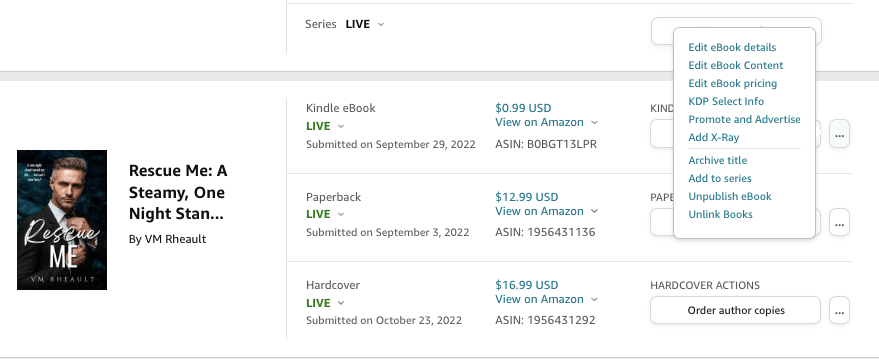

To do the math, you multiply the KENP of your book with whatever the payout is. For Rescue Me, if I multiply 391 by 0.003989 I get $1.55. So in KU, every time someone reads Rescue Me from cover to cover I get $1.55. Which is less than 70% of $4.99 if someone were to buy my book. For June, it was $ 0.004042 and that math equals out to $1.58. Three cents it’s that big of deal especially to smaller indies who don’t sell many books. (But considering it was $ 0.004293 at this time last year, it’s worth keeping in the back of your mind.)
Of course, this has brought on a tidal wave of authors declaring they’re going to pull their books out of KU and go wide, but it’s not a good idea to make decisions in anger and hate for Amazon. This is your business, businesses go through ups and downs and it’s better if you run your business with informed choices.
Here are my thoughts:
You have to build a brand/readership no matter where you are. This is true no matter if you’re in KU or you’re wide. You need to find readers, you need to show them you are in it for the long haul. You need a solid brand so a new reader can look at your author page/book covers and know exactly what they are going to get if they read one of your books and stick with you. Building a brand/readership is even more important wide because unless you regularly run sales on your books, you’re asking a reader who has never heard of you before to spend $3.99+ to try you, and you better be giving them their money’s worth. Not only so they don’t waste money on your unedited book, but that is their one and only taste of your writing and you need them to crave your books enough to spend money on each and every book you ever publish.
You have to be consistent no matter where you are. When I went to the Sell More Books Summit in Chicago before the pandemic hit, they had a panel of indie vendor reps, among them, Ricardo Fayet from Reedsy, Brad and Brad from Vellum, and a rep from Kobo who is no longer in that position. The one thing that stuck out for me during that talk was when she said, don’t put your books in and out of wide. We remember you, readers remember you. Google Play, Apple Books, Nook, and Kobo and others have representatives that work with authors and book promos. They won’t okay you for a promo if they know your fickle. Why would they help you build a brand and an audience when they think all you’re going to do is pull your books out and put them in KU the next month? Going wide is hard, but so is being in KU. It doesn’t matter where you are, you still have to build that readership. Authors think being on more than one platform is a sure way to find readers, but that’s not true. Your book will sink anywhere if readers don’t know your book exists. Stick with one place, publish consistently, advertise, work with the platform reps with promotions and sales. Being wide takes work, but it’s only a different kind of work than being in KU. They say work smarter, not harder, and if smarter for you is being wide, then you should do that.
Go direct where you can. It’s tempting to put your book on Draft2Digital and let them take care of it, but no one considers that if you do that, you’re paying D2D to distribute, you’re paying Nook, Kobo, Apple, etc, to sell your book, and you’re left with what’s leftover. After everyone takes a cut, you might as well have stayed in KU and absorbed the cost of the lower payout. If you want to go wide, do the work and publish directly to the platforms you can. Upload at Nook, Kobo, Google Play (if they’re accepting new authors–for a long time they weren’t and I have no idea if they are now). Upload direct wherever you are able to save yourself the cost of the distribution fee D2D charges you. Their fee and other FAQs are here: https://www.draft2digital.com/faq/
Your KU readers won’t follow you. Some authors think that their readers will follow them if all of a sudden their books are not in KU on Amazon anymore, and with all the years I’ve been part of author groups, the one thing anyone can agree on is, no, they won’t. KU has over four million books in it now, and depending on the genre you write, your books are a dime a dozen. I’m not so self-important to understand that if readers who have read all 7 of my billionaire books in KU (and even LOVED THEM) suddenly had to pay wide prices for any other books I publish, they won’t buy them. They would write me off and move on to the next romance author. Wide readers and KU readers are very different audiences. I have a KU subscription myself. I don’t buy books on top of that and I won’t try wide authors who put their first in series for free because I know I would have to buy the rest of the series if I liked the first. (That’s a normal marketing strategy even for books in KU because read-through is what earns you royalties.) Readers are smart–they know if you’re in KU or not just by browsing the newsletter promo lists like Freebooksy and Fussy Librarian.

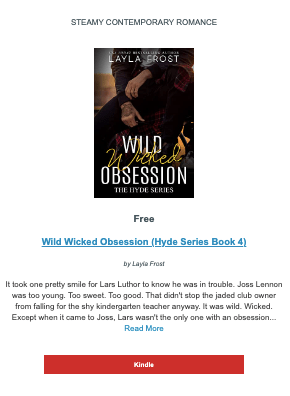
Here are the first two books in the Freebooksy contemporary romance promo newsletter I sign up for sent to me on Wednesday, August 16th. Any reader who has been reading books for any number of years knows that the Kindle-only book will be in Kindle Unlimited. It might not be reader knowledge that Amazon forces us into exclusivity, but they don’t need to know that. They see Kindle only, KU. When I go through these looking for books, I don’t even read the blurbs for books available everywhere. I don’t want to like a book that’s wide. I can’t afford to buy the others. Wide readers have a book budget, and KU readers have a book budget that’s wrapped up in their KU subscription fee. It’s too bad, but with rent prices out of this world, medical costs, parents doing the back-to-school thing, groceries, gas prices, and whatever else, the entertainment budget is the first to go. I’m not saying that so you stay in KU if you’re there, but you know, you have to build a readership with really great books and that takes time.
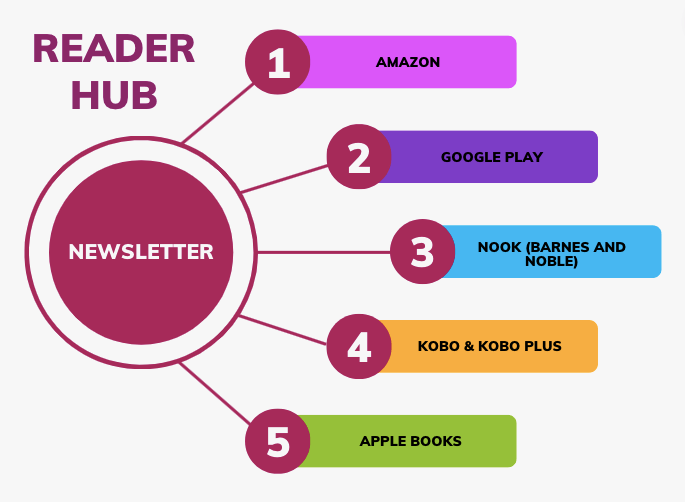
Change your mindset. Instead of moaning about the drop, do something about it. The piece of advice I see the most when this kind of thing happens is, “Write another book.” More books will earn you more money, no matter where you are, so get your butt into your chair and write. You can also write longer books to fill in that page-read payout shortage. If you write 70k books, write 75k books. Add a sex scene, or a couple of dialogue scenes between characters. Add an epilogue. You don’t have to add filler or fluff to lengthen a book. Also, if you haven’t already, start a newsletter. If you’re everywhere, a newsletter will be your reader hub. If you’re Amazon exclusive, readers can follow your Amazon author page and Amazon will email your readers when you publish a new book. If you’re wide, you want a place you can share with your readers about sales and promos and new releases. When you move your books over from KU, edit your interior and put your newsletter sign up link in the back matter of all your books.
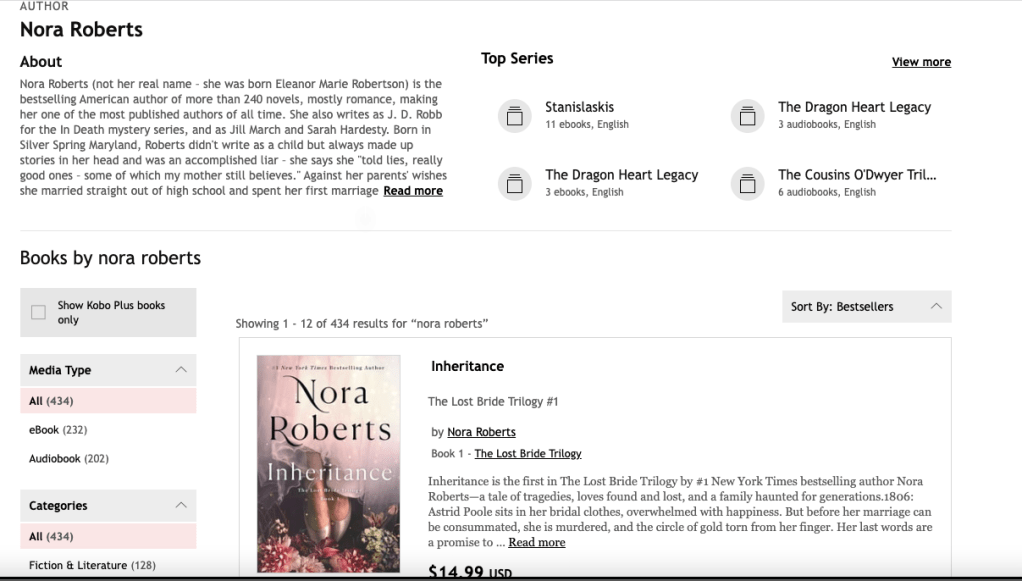
If you don’t have one, you might think that’s just more work, but I don’t know if other platforms offer author pages like Amazon does. Kobo doesn’t. You can click on an author’s name and get their list of books, but it doesn’t look like you can follow an author, and I have no idea if Kobo will email you new releases once you’ve bought an author’s book. This is what I get when I searched Nora Roberts:
It’s just better to control that for yourself, and you can even put your newsletter sign up link in the author bio. Here’s mine on my Amazon author page.
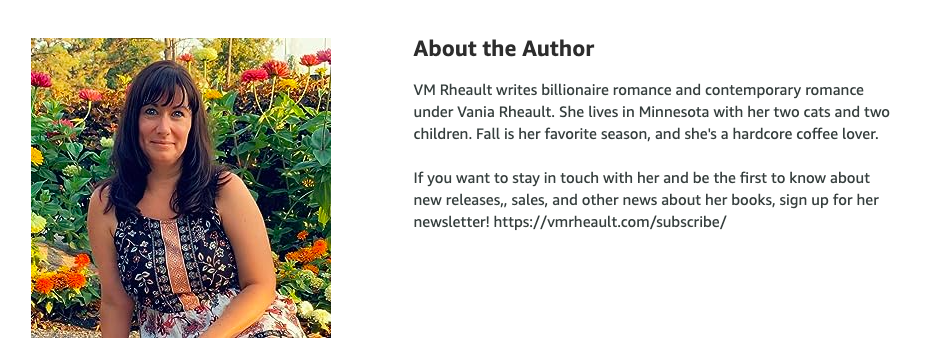
What am I going to do? I’m going to hang in there a while yet. I have four more books coming out this year, and six next year, so we’ll see what happens. I could move my 3rd person books over, but then I would be courting two different audiences, and one for a name I’m not writing in anymore. I don’t think moving my older backlist titles is the answer. They aren’t selling, and I don’t use any of the tools given to me so they do. I can’t remember the last time I put All of Nothing or The Years Between Us for free, and since those are are standalones. I only get page reads for royalties if a reader happens to borrow instead of download when I do that, no read-through to other books.
It’s important to have some kind of plan in place when you make a decision like this, a goal, so you can measure if what you did worked.
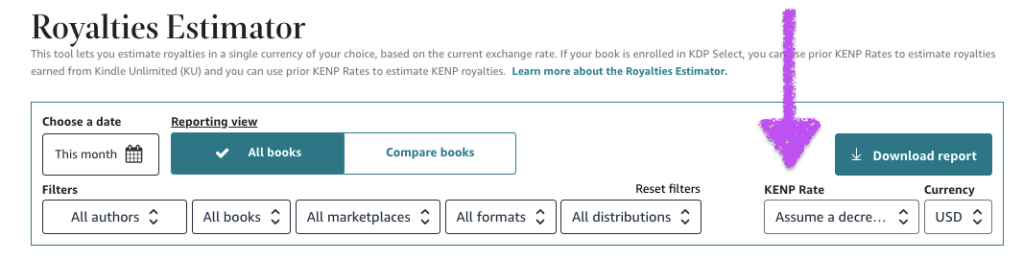
Anyway, this will come up again and again, but I hope this is the last time it drops. You can assume a decrease when looking at your KENP royalties, and that’s what I do:
The biggest concern right now, for me, is if this downward trend keeps going. More than 50% of my royalties of any given month are from Kindle Unlimited, and like other authors say on various forums, if you’ve published for a bit and have built a brand around being in KU, you can feel trapped. You don’t want to stay because you’re scared to leave or don’t want to put in the work to move wide. It’s how I feel in my day job right now. I’ve worked there for 22 years, and finding something else is scary. I signed a contract saying I can’t say derogatory things about them online, so let’s jus say they aren’t the same company I worked for 20 years ago, and it’s discouraging not to be valued. Things change, and that includes Amazon. How much you want to put up with will be your own personal decision. If you don’t feel Amazon values you and your business, if you think you’ll be treated better elsewhere, then you should go. We all need to know our worth and act accordingly.
I blogged about wide resources and you and find some at the end of this blog post: https://vaniamargene.com/2021/09/06/ku-vs-wide-can-you-have-your-cake-and-eat-it-too/
I also tweeted all of the resources I knew about in a tweet thread here:
Whatever you choose, good luck!
Discover more from Vania Margene Rheault
Subscribe to get the latest posts sent to your email.

 Vania Margene Rheault