
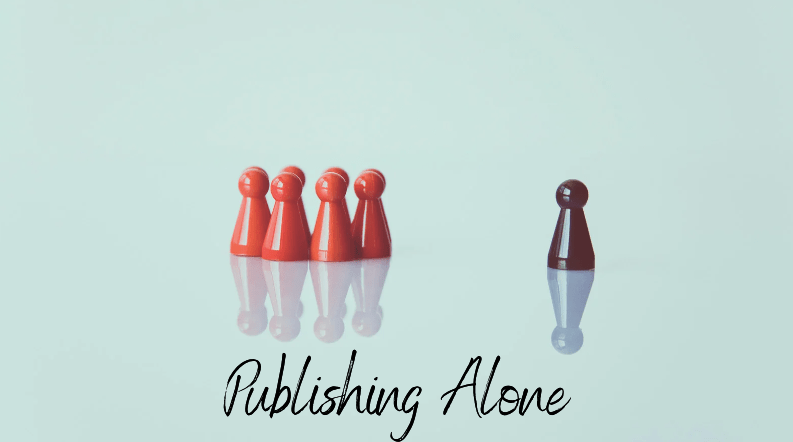
This has been on my mind a little since there’s not a day that goes by when i see something online putting down authors who publish their own work. We aren’t included in some award competitions, people say readers don’t read self-published books (though I still don’t understand how readers know), and just a common misconception everywhere that self-published books are “less than” books that are gate-kept.
The problem is, not many, if any, books are truly self-published. What do I mean by that? Let’s take a look at book creation, design, and publishing.
Content: If you’re a writer, chances are 100% that you’ve brainstormed with someone. You’ve hit a plot hole and need help, or you can’t parse out your characters’ backstories to align with their present story. You bounce ideas off someone, more than likely another writer, who lights that creative spark that helps you figure out A to Z. Maybe you plot and use a plotting software like Plottr, or you use a plot generator or trope generator. Writing is a solitary endeavor, to be sure, but we rarely do it alone.
Content Part 2: After you’ve written your book, there are very few people who publish that book without a second set of eyes, be it a beta reader, editor, or proofer. Even though my editing routine is pretty hardcore (I mean, I listen to each and every book I publish, and that takes several days) I still miss things that a proofer picks up. I haven’t always used a beta reader or proofer, and with this pen name, I’m trying to get better with that. A second opinion (other than your own) can go a long way. While betas and editors can be expensive, there are ways around it–trading for services or asking a friend who isn’t in the indie community to help you in exchange for lunch. It could very well be by the time an author’s book is ready to publish, that book has been read by an editor, a proofer, and several beta readers.
Interior: Vellum makes it easy to format your own books. I’m lucky and my ex-fiancé bought me a Mac and the software. I format all my books with it, and to pay his kindness forward, I format for others for free. If you don’t have the resources to format your own book or don’t want to take the time to learn how using free software from places like Reedsy and Draft2Digital, an author is going to pay for their books to be formatted. Word does an okay job, but the PDF for the paperback can get a little complicated. I offered a lot of resources for formatting in a different blog post and you can look at them here.
Blurbs: Blurbs are probably one of the most difficult parts of publishing your book. You need one that’s hooky, that will draw a reader in, and if there is one thing out of any part of self-publishing that I make sure I do, it’s get help with my blurb. A bad blurb will turn away a potential reader just as quickly as a bad cover. A great-sounding blurb is your biggest marketing asset next to your cover. You have no idea how convoluted or confusing your blurb sounds until you workshop it. Especially with people who haven’t read your book before. Don’t put your blurb up on your book’s buy-page without feedback. No matter how good you think your blurb sounds, it can be better. Your book will thank you for it.
Covers: Considering my blog post on how to create your own cover in Canva has been viewed over five thousand times, more authors than ever are doing their own covers. It isn’t any wonder since cover designers can be a sketchy bunch, and costly, too, even the designers who are just starting their businesses because they have to recoup stock photo and font fees. You may do your own cover, but if you do, get feedback. I’ll post my covers on the Indie Cover Project on Facebook (find it here https://www.facebook.com/groups/582724778598761) and grab some tips. Often, people will see things you don’t. It’s tough though, because sometimes they’ll suggest improvements you don’t know how to do if you have limited skills, or they’ll suggest things that don’t go along with your genre. I’ve gotten some good feedback, but if you post your cover there, thicken your skin up first.
Marketing/Advertising: There are a lot of resources for indies on learning advertising platforms and marketing tips. Bryan Cohen, who offers a free Amazon Ad Profit Challenge every three months, runs a Facebook group, and that group has over twenty-seven thousand members in it. That is a lot of people to help you if you do the challenge with Bryan. Author Unleashed, another Facebook group hosted by Robert J. Ryan, has almost six thousand members in it. Authors Optimizing Amazon and Facebook Ads – Support Group, also on Facebook, has almost seven thousand members in it. That is a lot of support if you’re running ads and have questions. There are a ton of books, Facebook groups, webinars, and classes that will teach you what you need to do to market your books effectively.
Publishing: There are a lot of Facebook groups, podcasts, blogs, and books that talk about publishing. You can also join Facebook groups for authors in your genre. I’m in several for romance authors. Members are more than happy to answer ISBN, wide vs. KU, and other questions that constantly pop up. Right now there’s a big conversation about the Adult/Explicit Content and 18+ readership that KDP has started. If you have a publishing question, the 20booksto50k group is great for it. You can even tweet your question, but I’ve read some convoluted and not entirely true information over there, so it would be worth it to get a second opinion if you ask there.
Considering all the steps indies take while they’re writing, packaging their books, and publishing indies rarely do this alone, and if you truly do, I encourage you to find a group or create your own. I spent the better part of the past 7 years I’ve been publishing networking and getting to know the wrong people. Find authors who have the same goals as you do. I’ve run into some issues online lately and with writing acquaintances because we don’t have the same goals. I want my books to sell and will do what it takes to make that happen. Not everyone thinks like that–unable to separate the art from the business. I take my writing seriously. It’s not a hobby. I consider it a second job. If you feel like that too, hang out with authors who feel the same. It will save you a lot of hurt down the road.
I’m sorry this blog post was late! I was so busy formatting over the weekend, this post completely slipped my mind. I don’t want to start slacking as that is the easiest way for me to fall out of the habit of writing at all. After I post, I’m going to work on my covers. I’ll have a trilogy update for you next Monday.
Enjoy the 4th if you’re in the States, and have a great week!
Discover more from Vania Margene Rheault
Subscribe to get the latest posts sent to your email.

 Vania Margene Rheault
Thank you for this postm
LikeLiked by 1 person
I guess it’s called “self” publishing because you choose who edits your work, who designs your cover, whose opinions you take, etc. Essentially, you’re still in control of your books. With a publishing company, you don’t have that opportunity: if you don’t vibe with someone or you get assigned to a guy who’s a mediocre designer, then you don’t have a choice to switch.
LikeLiked by 1 person
I’ve self-published a few things in the last year or two and it’s definitely a lot of work. I kind of just bumbled around and tried to figure out how to do it solely by myself (besides my wonderful proofreader, my mom). You gave a lot of great resources that I wasn’t aware existed! I’m definitely going to be utilizing them from now on, so thank you!
LikeLiked by 1 person
I do everything alone (even though I shouldn’t!). If there is ever anything I can help you with, let me know. My personal email is the best way to reach me. It’s listed in the Contact Me portion of my website. Good luck and I’m glad you found the blog post useful!
LikeLiked by 1 person
Thank you so much!
LikeLike