
1,467 words
8 minutes read time
Lately I have come to realize that there is a certain subset of readers who are no longer reading for pleasure.
Before Al became a household name (I like to call him Al because in some fonts AI looks like Al… You know what, never mind), readers picked up a book to either be entertained or to find out information. There wasn’t really a reason to read a book otherwise. Maybe in the indie community someone slogged through a book they didn’t like in the name of “support,” and if you do your own detective work, sometimes you can still spot it every now and then, but these days there’s another reason readers read.
They’re searching to see if you used AI to write your book.
I don’t have concrete evidence for this of course, except that every post I see on Threads now leaves no room for writerly error.
Didn’t vibe with the style? AI
Too many inconsistencies? AI
Too many clichés? AI
Too many em-dashes, semicolons, any other punctuation that particular reader decided to dislike that day? AI
Too much echoing/too many filler words? AI
It’s never-ending, and I have a theory that those certain readers don’t sit down to just enjoy a story anymore. They’re reading to find AI tells, and when they think they’ve spotted something, they shout it to the whole world.
And I don’t mean they’re telling people to warn other readers not to read an AI-written book. They want to feel validated, vindicated, and smug they “caught” you.
When, in reality, unless an author leaves a prompt or a prompt answer in their book, no one is going to truly be able to tell. Because, and this is the sad part, a newer writer, or an author who couldn’t afford an editor, might have poured years of their life into a book that has all those things wrong with it. I’ve edited for people for many, many years, and we forget how raw a new author’s writing can be.
I think the existence of AI has changed how a lot of us, or even most of us, have started consuming content. A very vocal section of the internet does not want to consume any content that’s even partially AI, and for the most part, I agree. There isn’t much, if anything, that I would prefer to hear from Al instead of a human being, and I do get kind of disgusted with people when they can’t put in the work to write their own blog posts, Substack articles, and Threads posts (like the ones that need 5-20 posts to tell a story or recount an event). If you can’t put in that work, then don’t try to offer that content to people. There is so much noise online there’s nothing in it for you anyway.
I’ve noticed this particularly recently when the newest accusation popped up that if you don’t credit your cover designer or your editor on your copyright page, you used AI to create your cover and to write your book. A long time ago I started crediting the stock photo contributors on my copyright page, and I say that I make my own covers in Canva. It never occurred to me to add that I edit my own books, mostly because that sounds like an invitation to read my poorly edited books. It’s not anyone’s business, I don’t think, if I edit my own books or not, as long as they sound good and make sense. I’ve edited my own books for many years now simply because I can’t afford to hire out, especially at the speed I produce and with how little I make after publishing. And in an ironic twist, now days I don’t want to be scammed by an editor who will only drop my book into ChatGPT and ask him to find typos. I can do that myself . . . for free.
All of this has made readers wary, and I get it, but that doesn’t explain the vindictiveness I see toward books that aren’t to a reader’s liking. I feel bad for newer authors who are putting their first book out right now. Maybe they haven’t gotten their voice and style down yet, or they haven’t controlled their echoing, or they fall into clichés because they’re easy to write. Maybe they have terrible memories and hired basement-bargain editors. Then you get someone talking about you online and giving it the biggest insult there is: this was written by AI.
There are only three ways, that I know of, that you can potentially avoid having a bookstagrammer accuse you of writing your book with AI. You’d think the simple answer would be just not use AI, but unfortunately, it’s not that easy.
Don’t use an AI cover
Almost everyone who is on writer/reader social media will assume your book was written by AI. Is it fair, no. But you’ll undoubtedly get people making the leap, like people in this thread on Threads:
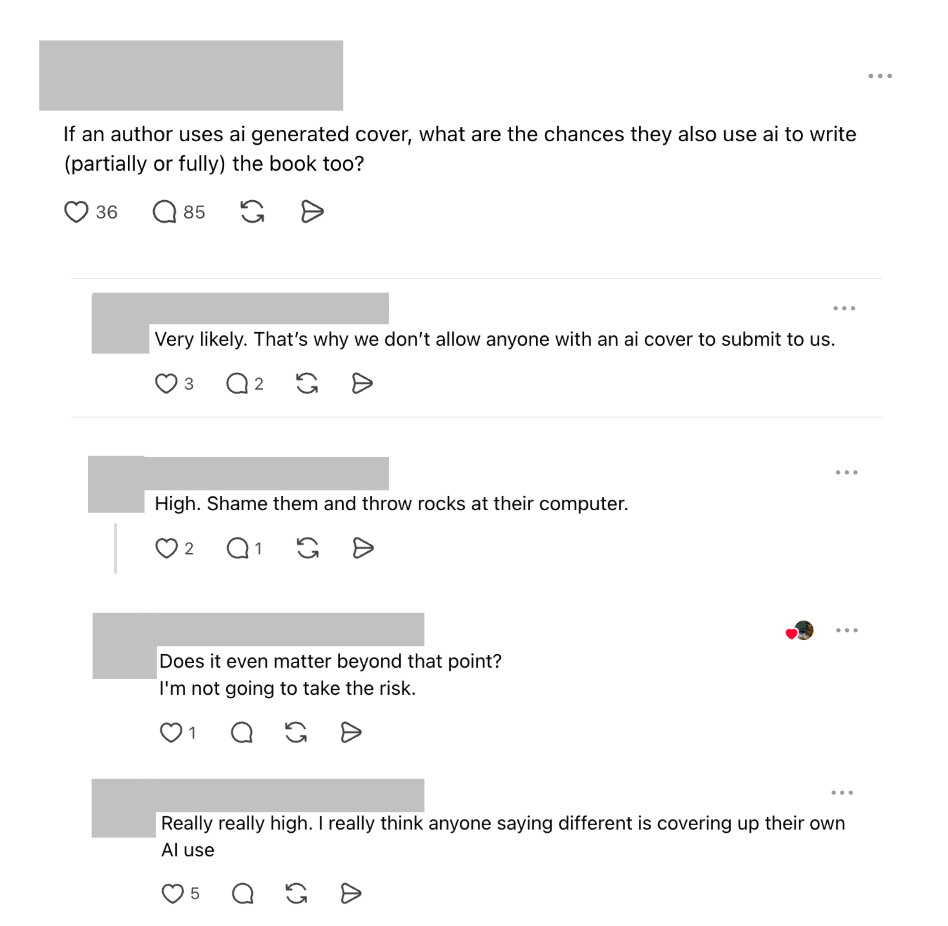
I’m not saying you shouldn’t use Midjourney to make your cover, but you do have to realize that you are not giving your book its best start if you do. You’re going to be posting your cover on social media–I don’t think there’s any way around that even if you’re not actively marketing–and loud and proud anti-AI people are going to see it. If they make the assumption that your book was written by AI because Al made your cover, then unfortunately, you’re going to lose a lot of people right off.
DepositPhotos has a lot of stock, even if you filter out the AI offerings, and you can make a decent cover with a legit stock photo and good font. I would very much rather do that because I work really hard on my insides, and I’m sure you do too.
Do the best you can editing
This sounds stupid, because I’m going to assume everyone does do the best they can while they’re editing. You can try to clean up your book as much as possible during editing by avoiding:
*Echoing the same words repeatedly (over time you can make a list of crutch words and search for them using the search feature of your writing program)
*Reusing sentence structures (altering sentence length and structure just makes for a good reading experience anyway)
*Characters saying similar things (each character should sound like their own person and have their own distinct personality)
*Illogical situations (if you have a two year old in your book, don’t let her sound like an adult when she speaks or if you’re leaving her home alone, make sure she has a babysitter)
*Plot holes (give your book a break for a couple of months to read with fresh eyes)
*Inconsistencies (keep a character sheet for each character and write down eye color, hair color, careers, etc for easy reference)
I’m not going to tell you senseless fixes like avoiding em dashes or leaving typos in your book to prove that AI didn’t write it, or avoiding the rule of three. Some people are just not going to vibe with your voice, and that’s okay. Your writing was never meant to be for everyone and if the first conclusion they jump to is that AI wrote it, that’s on them, not you.
Credit your cover designer and editor
You don’t have to do this on your copyright page, though that is probably the best place to do it. You can also add a link to your website on your copyright page and give your designer and editor attribution there if you have an About Me page or something. But also be prepared for people not to believe you. Once these particular people get a bee in their bonnet about your book, there isn’t going to be much that changes their minds, especially since people can lie. Anyone can say anything, and people will.
I think it’s pretty sad that we’ve come to this. That we can’t post our daily word counts because people will accuse you of using AI if you’re a fast writer. I just saw someone on Threads accuse Freida McFadden of using AI, when you know she can write full time and probably actually uses her time to write, like other heavy hitters such as Nora Roberts and Marie Force.
The readers who have turned Nancy Drew have stopped reading for pleasure and now read to investigate. That’s a real tragedy that doesn’t seem to have a happy ending.
Books are supposed to be an escape, not a crime scene.
And if you read thrillers, then you know that some mysteries are never solved.
Thanks for reading, and I’ll see you next time! Have a great week ahead!

 Vania Margene Rheault