
Words: 2725
Time to read: 14 minutes (FML, I’m sorry!)
When I go through and read threads and posts about marketing, I’m surprised sometimes by the misunderstanding. I shouldn’t be because I had the same misunderstandings long ago. I don’t think authors really grasp the concept of what a long game writing and publishing is. We’re still hopeful that we’ll be an overnight success and that marketing will be taken care of for us by a viral TikTok or a random influencer who happens to love our book. The problem with that though, is that even if something like that were to happen, a lot of us don’t have our ducks in a row to keep that tail going.
During my first five or six years of publishing, I didn’t get what marketing was because I was thinking of each book singly as I published it. I also didn’t understand the magnitude of putting my work out there for strangers to enjoy (or not)…the responsibility I had as an author who is asking for readers to pay for a product. I was caught in an indie Twitter bubble, and honestly, it took me many many years to get out of it, or to realize I was in it, to be honest. Looking back at the first three books I published that I had no right to publish at all, and then the first trilogy I published that is still not good but better than what I had published before, I’m a little embarrassed I was so clueless. Sometimes you can’t learn unless you do it and fuck it up while you’re at it, but when you’re selling something, you’re also playing with people’s money.
When we talk about advertising vs. marketing, we’re going to assume your book is as good as it can be inside. If you’re getting any type of poor review that indicates the editing isn’t there, your character arcs aren’t fully formed, or there’s just an overall discontent with your book, you may need to revisit and revise. No amount of advertising or marketing is going to sell your subpar book and you can’t build an author brand on a shaky foundation. That’s what took me six years to learn, and maybe you need six years too, but six years is a long time to waste if you just believe what I say instead.
So this is what I’ve parsed out in my years publishing, especially the past three when I started writing for my pen name:
Advertising: Deciding what book you want to write next! Yay!
Marketing: Choosing a standalone or a series and which genre, knowing if you’re going to meet reader expectations, if you’re going to write to market, how long the book(s) are going to be, and if you’re going to write a series, if you’re going to write them all at once and rapid release them or if you’re going to publish as you go and how long that’s going to take.
Publishing, as we say, is a very long game, and you have to be honest with yourself. If you’re planning a five book series but you work full-time and have children, how long is that five books going to take you to write? Five years? If you do that and want to publish as you go, how are you going to keep your audience interested so they don’t forget about you while you’re writing the next one? I’ve spoken a lot about series on this blog, and I’m not going to rehash my pros and cons here, but advertising one book because it’s done and published is a lot different than creating a marketing and publishing plan for an entire series–especially if it’s long and won’t be completed for several years.
Advertising: You’re creating a cover for your book that you’ll use in ads like Amazon Ads and Bookbub CPC ads and social media graphics.
Marketing: You’re creating a cover for your book that will fit in with the image you want to project as an author, build your brand, and be recognizable to readers the instant they see a cover that belongs to one of your books. Not to mention convey the genre your book is written in (because you chose a genre, right?).
I think this is one of the hardest lessons I learned. I was pretty adamant that I was going to make my own covers when I first started writing and publishing, teaching myself with the help from a book that is now 100% obsolete how to make a PDF in Word. Because of that, you can thank me for the Canva how-to blog posts I have here on the website, which gets hits every day. I never would have been able to do that for others if I hadn’t learned it for myself first. That’s not to say it was the smartest thing I ever did, considering I made a lot of mistakes I still see indies make today–using a free photo from Pixabay, et al, not having any idea of a consistency stretching across other books in their catalogue, and having zero idea that the cover should actually match the spice-level my book was written in (people will tell you to browse the top 100 in your genre for a reason). I guess because my book had no specific genre, that made it kind of difficult to do any research had I even known to do it. (Romantic Speculative fiction, anyone? Blah.) One of my favorite examples of what I mean is Melanie Harlow. She has the cutest font for her name, her covers all have the same vibe, and with the sweeping font she uses for a lot of her titles, I know right away if it’s a Melanie Harlow book. I love everything she does and she knows her brand like nobody’s business. If you want to see what I mean, look at her website: https://www.melanieharlow.com/
If you work with the same designer (or do them for yourself) you’ll eventually end up with a cohesive vibe. We all have our own styles, and that will show. Choose a nice font for your name that you won’t get tired of. Decide if you’re going to do single men, couples, lighthouses, streets, what have you, depending on your genre. You want your Amazon author page to look TOGETHER. I’ve seen some author pages that look like I’m digging through a giveaway book box at a rummage sale, and that’s not a way to grab a reader . . . or their loyalty.
Advertising: You’re buying a promo spot like Freebooksy, Bargainbooksy, E-Reader News Today, Fussy Librarian, or something similar for one of your books to see if you can generate some buzz.
Marketing: You’re mapping out your promos for the next 12 months based on what you have coming down your publishing pipeline.
I heard a big-time author say you should be doing something every quarter–that’s four times a year. (It comes in handy if you’re in Kindle Select because they give you 5 free days per title, you guessed it, four times a year.) If you don’t have the backlist (or the front list) to continually run sales, you have to sit down and decide how fast you can write and what the next three to five years are going to hold for you. You don’t have much to market or advertise if you’re not writing and publishing, and what you’re writing and publishing will be important. You can do a sale or do a free promo, but unless you’re in KU where you might get some page reads during your promo, it doesn’t make a whole lot of sense to give away a standalone novel, especially if it’s your only book. If all you have are standalone novels, make sure your back matter is pointing your reader to the next standalone (if you like this book, check out this book) and/or to your newsletter.
You may be thinking you can’t afford to do something like that four times a year, and I understand that completely. In time you’ll start to earn out your fee or get ahead, and if you never do, then the conversation turns back to quality (book covers and blurbs) and craft (how well are the insides written).
So, grab a wall calendar and map out the next 12 months. I can mark up my new releases from now until the beginning of 2025. Can you?
Advertising: You decide to write XX genre for your next release, but you’ve written and published XX genre under the same name so your backlist is going to look a bit wonky. That’s okay though because you’re going to focus all your social media efforts and advertising promo dollars on your new release.
Marketing: You’ve decided on Small Town Romance, that is where you will stay, and that is what you want to be known for.
Everyone tells you not to genre-hop, and a lot of indies don’t listen, saying that it boxes them in or stifles their creativity. I get it. I went from Billionaires to Rockstars because I wanted to write my Rockstar trilogy and that’s what I did. I had an amazing idea for a trilogy and I wasn’t going to not write it–that would be dumb, right? I mean, rockstars are rich too, and as I’ve pointed out in the past, my books are still more contemporary romance than true Billionaire romances. Just because I make them rich doesn’t exactly mean they’re going to meet reader expectations, but so far I haven’t gotten any feedback to indicate readers are unhappy. Romance is neat in that you can choose a genre like small town romance, but the sky’s the limit when it comes to tropes. Most romances are written with a trope for a foundation, and it doesn’t matter which genre or subgenre you choose. So far, I haven’t found that writing Billionaire is stifling–there are many many tropes and you can twist them your own way to keep them fresh. Here’s a blog post I did on consistency: https://vaniamargene.com/2021/12/20/buzzword-consistency/
Advertising: I’m going to post on Social Media every chance I get. All my followers are other writers, but that’s okay–authors are readers too.
Marketing: Starting a reader group or author page on FB and joining reader groups for the genre you write in. Using author groups for publishing information and networking to find beta readers, editors, and making friends for newsletter swaps.
Bursting out of the writing community bubble was hard, but I think I’m finally doing it. It helps that Twitter imploded and I don’t waste time there anymore and besides all the authors whom I follow and who follow me back on IG where I rarely post, all my social media (besides this blog) now is for readers. I’m slowly building up a readership on my FB author page, VM Rheault, and my V’s Vixens Read Romance FB page, mostly because I run ads from it and I post so it doesn’t look empty. When I started my TikTok account, the smartest thing I did was not label myself as an author. I didn’t think it was necessary as I’m not posting non-fiction (like writing updates) there, and I’m keeping my author following to a minimum, too. I understand that social media is free and falling into the writing community is easy, especially on Twitter and Instagram, but there really is no cheap way to find readers that’s effective. Surprisingly, I’ve had better cost per click using Facebook ads, and when I paused my Amazon ads during Zoe York’s Stuff Your eReader day, I didn’t turn them back on. My sales haven’t suffered, so I’ll wait and see. I have two ads running on FB right now, one for Twisted Alibis and one for Rescue Me. I don’t want to say free social media is useless–established authors still have great success and engagement with reader groups, but filling your social media following with other writers or family and friends won’t get you the sales you’ll want long-term.
Advertising: You start a newsletter but don’t offer anything as an incentive to sign up and don’t push the link anywhere but on social media where the same people hang out.
Marketing: You start a newsletter and have a reader magnet that is a great sample of the kinds of things you’ll be writing or reflect what’s in your backlist. You add the sign up link to the back matter of all your books, you add the link wherever you can–Amazon Author Page bio, your BookBub Author Page bio, FB reader groups (if it’s allowed) and anywhere else you can get signups like BookFunnel or StoryOrigin promotions. You also push the link and your reader magnet with FB ads and promos like Fussy Librarian and Bookdoggy.
Probably the number one reason I hear for not starting a newsletter is that authors don’t like them so therefore don’t want to offer them, and the second is that they don’t know what to write. Like publishing, building a newsletter list a long game, but the longer you wait, the harder it is and the more urgent it will feel. I should have started one a long time ago, but I can genuinely say the first six years I’ve been doing this was all just one big learning curve. Maybe you aren’t ready for the information in this blogpost–and that’s okay. We do have to write the books of our hearts and in our own time, learn for ourselves that shilling books on Twitter will only go so far, and realize that if you try, you can actually make some money at this publishing thing.
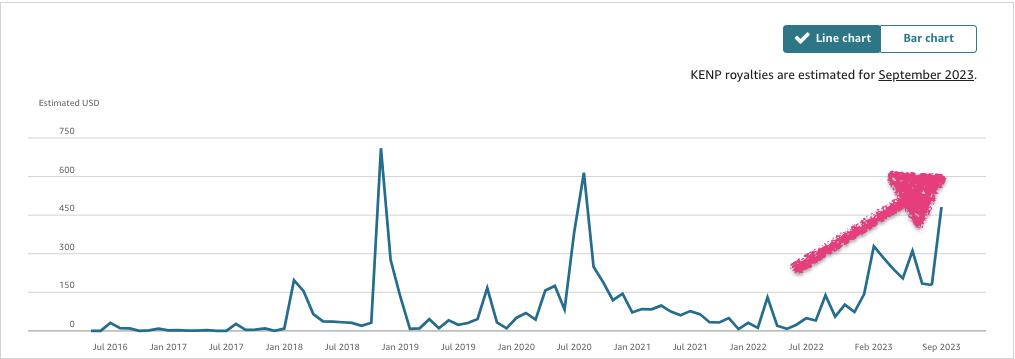
If you don’t think I know what I’m talking about, I pulled up the graph from my lifetime of publishing. As you can see, I had some spikes, anomalies, but the slight upward trajectory since June of 2022 when I first released Captivated by Her and Addicted to Her means more to me than the unexplained sale spikes. Consistency will win the race, and one day my sales will make me a small, if not steady, profit.
I could be sad that it took me so long to figure things out, but I met some great people along the way and learned a lot. I wasn’t prepared for success to come any earlier, but if I wrote something and a TikTok influence loved it now, I would know what to do with the attention and that’s really important. I’m still small potatoes, and I know that, especially since I’ve joined some TikTok for Author groups on FB, and holy hell, can those billionaire/mafia/dark romance authors rake it in. But after all the books I’ve written, I think I found where my heart truly lies–with rich guys written in angsty first person. Finding my niche may have been the biggest accomplishment from the past six years. Now I can write happily in a genre while building my audience.
You can look at advertising as something you do in the present, something that builds buzz short term, but marketing is something you do over months and years, pushing yourself as an author, what your brand is, as well as your books and what they’re about. But, you do need content, and that’s what trips people up, I think. You need be writing, need to have something for people to read, be it books or newsletter content. Time can be a huge factor and that’s why I suggested buying a wall calendar and mapping out what you think you can do for the next year or two.
It’s tiring, believe me, I know. If I didn’t love writing so much, I would have quit long ago, but I do love it, already thinking of what I’m going to write next, even if that won’t be published until the spring of 2025. God knows if I’ll even be alive then with the way I feel some days, but I never want people to think I’m floating on this cloud tapping away at my keyboard, when you probably would never believe the number of down days I have. My sexy men keep me going, and I hope your characters, when you’re down, keep you going too.
Have a good week!
Discover more from Vania Margene Rheault
Subscribe to get the latest posts sent to your email.

 Vania Margene Rheault
Thank you for this! It comes at the perfect timing. I want to release Book 2 by the holidays and we accidentally began our prequel series (Prequel #1 is my reader magnet for the newsletter) and will have Prequel #2 out by Q1 of 2024… I have set aside a full planner for nothing but launches and marketing thanks to your advice. I want to finally take this business to the next level.
LikeLiked by 3 people
I’m so glad my experiences are helping you! Good luck!
LikeLike
I’ve been in web(shop)design since 2016 and before that on-and-off in the (fair) trading business. It’s not only authors who need to read this. 90 percent of people, especially if they are starting out, get it wrong! (Yours truly included.)
LikeLiked by 2 people