
1,810 words
10 minutes read time
I saw something sad yesterday, and no it wasn’t my sales dashboard. Just kidding. I stopped looking at that.
No, even though I talk like I’m not a part of the writing community anymore, I’m still a member of a lot of writing and publishing groups on Facebook. It’s pretty much all that’s in my feed right now which works because I’m not really interested in much else besides the occasional spoiler for House of the Dragon. Anyway, so a woman that I have actually met in person when I tried to join a local writing group posted that her debut had just been published by a “small-press–” I use the term loosely–and her cover was . . . not great. It kind of looked like the romance covers that were coming out in 2016 when authors were doing it themselves and didn’t know how to blend or add a filter so the couple fit into the background. It made me curious about the publisher, and I went on their website. Unfortunately, nothing I saw boosted my confidence that this author would have a good experience with this small press.
I understand the appeal of wanting to publish with a small press, and I’ve known other people who have made the same choices. You can’t afford an editor, you don’t know cover design, and you wouldn’t begin to know where you’d get your book formatted. So a small press sounds like an answer to a desperate prayer. They take on your book and promise you editing, formatting, and a genre-appropriate cover. If they’re being honest, maybe they say that marketing efforts will be weak and that you’ll have to do the bulk of it, and you think that’s a fair trade in exchange for the services they’re going to provide.
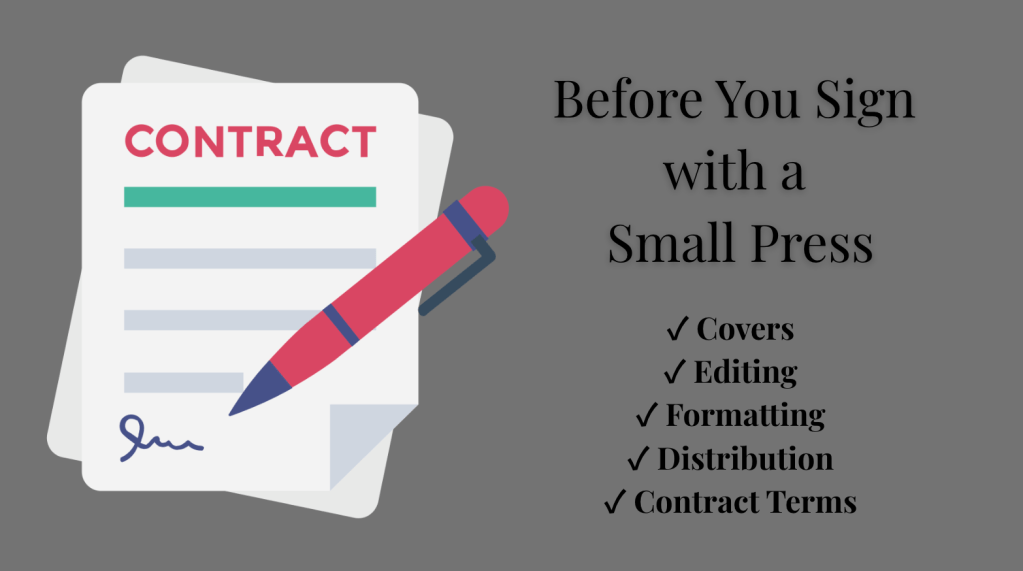
Deciding to go with a small press presents the same challenges that an indie author faces having to hire out every step. When you’re looking at a small press and you’re thinking about submitting your work, there are a few things you should do first:
Look at what they’ve already published.
This is huge because if you don’t like the covers on some, or most, of the books in their library, chances are really good that you aren’t going to like the one they do for you. Small presses tend to have one designer on their staff, and that one designer is going to have a certain way of doing things. If you don’t like their style, you may take that as a warning that what they come up with for your book won’t match what you had in mind. And what you want may not even be that crazy. Just a nice, normal cover that meets genre expectations and that looks professional. When I looked up the designer on the copyright page of my acquaintance’s book, the designer’s website looked sketchy as hell. So please click around the internet and look at what they’ve published, peek at the designer they use, and decide if you think they’re going to give you a cover that will actually sell your book.
Look at who the founders are.
I don’t think judging someone by their looks is that great in most cases–we all have our bad hair days–but on the other hand, if you’re running a business, you should look professional in your picture. A founder of a small press who is wearing pajamas doesn’t inspire much confidence even if they work from home and wear pajamas for most of their day. Also, what are his or her credentials? What makes them a good fit for your book? Do they have previous publishing knowledge? What can they offer that you don’t have access to yourself? I can edit, format with Vellum, and make you a decent cover in Canva. But that doesn’t mean I know how to run a small press. I have no distribution channels besides knowing how to upload a book to KDP and IngramSpark. I can’t get your book into bookstores. I don’t have the connections or warehouse space for storage to do that. I have absolutely no money to hire someone to help me. Think about what your goals for your book are going to be once it’s published. Can the small press you’re considering do those things? Also look to see if they’ve published their own books. If their finished products don’t look professional, chances are good they won’t be able to do any better for yours.
What kind of editing do they do?
It’s really important that you skim, if not read, a few of the books that the small press you are considering has published. If you find typos on the very first page, or if there are grammar or punctuation errors throughout, their editor may not be very good. When you’re going with a small press and giving them your rights, the least they can do is edit your book properly. Do they have an editing certification? Do they have testimonials saying that they’re good at what they do? If they’ve published their own books, do they sound good? How long will it take them to edit your book? Do they use AI tools, or will they do it themselves?
What kind of formatting do they do?
Granted, formatting is probably the least of your worries if you’re finding red flags elsewhere. And from what I can tell, small indie presses just use Vellum. But you should still check out whether their books look nice on the insides. Do they add chapter headers? Ornamental scene breaks? I don’t pretty my books up too much, because I think story is king, and I have actually seen readers complain that gooped-up pages take away from the reading experience, but still. A nice chapter header can make a paperback look professional. Like, you know, someone actually cared. And if you can, make sure that they’ve taken a little time with an author’s front and back matter. You might not get all that with Amazon’s 10% sample pages, but look at what you can. Formatting, from my experience, is the simplest step. If they aren’t doing that, your editing and cover chances don’t look great.
What are they doing for distribution and visibility?
To be fair, this was probably one of the only things that the small press that I referenced earlier was doing. Or looked like they were doing. Their website listed the book fairs they attended or were planning to attend. Whether they actually did, I guess no one knows, and what they did there would be a mystery unless you were present to see it. Since both the founder and the editor of that small press had published books, they could have been there to only represent themselves. Hard to know. If they aren’t going to show up on your behalf, will they pay for author copies or other swag so you can attend your own book fairs and signings? How are they investing in your books besides basic services? Zero investment may be more common than you hope, and maybe you think that’s asking too much anyway since author copies are expensive, but if they aren’t going to do anything, it’s better to know before you sign your life away.
And then after you’ve taken a look at all that and think it isn’t so bad, take a look at what they’re asking for.
How long do they hold your rights? When can you get them back if you decide to? What happens if the press closes? Do you automatically get your rights back? Are your rights folded into a new small press? You might say this should be the first bullet point, and you might be right. If you don’t like the contract terms, none of the rest matters. But I also know some authors will accept contract terms that aren’t exactly awesome if it means they’ll have their editing, formatting, and cover taken care of. Is it a good trade? It really depends on what you’re comfortable with. You’re essentially giving your book away and may never get it back. Some small presses can be really nasty to their authors, never giving rights back or asking exorbitant amounts of money to break a contract. A mediocre cover is annoying. Being locked into a mediocre cover for seven years is a disaster.
I’m not sure what’s going to happen with my acquaintance and her book. Her cover broke my heart, but she could be happy with it and that would be okay too. It’s her debut, and maybe she’s not really aware that her cover doesn’t fit in with what contemporary romance covers look like now. If she’s happy, then I’m happy for her. But competition is so fierce–not in an author-eat-author way, but we’re at an all-time high for how many books are available to choose from–that a poor cover can kill a book before it’s even had a chance. If she would have posted in the group that she wanted to self-publish and needed help, I would have helped her and she could have kept her rights. Not everyone knows that I would do that, and maybe that’s for the best, haha, or if she didn’t trust me, I could have at least pointed her in the right direction so she could have hired out dependable people.
Wanting to go with a small press is an understandable choice, but if you have to ask, “If the publisher’s version isn’t better than what I could have reasonably done alone what exactly am I getting in exchange for my rights?” then maybe that small press isn’t for you.
Not all small presses are bad. Some do excellent work and provide opportunities that would be difficult for an author to access alone. The point isn’t to avoid small presses. The point is to investigate them with the same care you’d use when hiring an editor, cover designer, or formatter. Because the old adage, “If you want something done right, you have to do it yourself” may be truer than you want to admit and you could save yourself a lot of pain and heartache along the way.
If you want to read more about small presses, Writer Beware is a great source of information, and you can find it here: https://writerbeware.blog/2011/11/11/introducing-writer-bewares-small-presses-page/
Thanks for stopping in this week! Next week I’ll have another editor Q & A to post, and after that possibly an author update. By then summer will be half over. Do you have any goals you’re keeping an eye on that you’d like to finish up before the kids go back to school? Let me know so I can cheer you on!
I hope you all had a lovely 4th of July holiday!
Until next time!

 Vania Margene Rheault