Why I have an author website and the advantages of having one.

When I decided to publish my first person POV under a pen name, I was torn between starting a whole new website, or simply adding a page and listing my books on this one. I already knew my way around WordPress (this theme, anyway) and starting another and letting WordPress host my domain would be easy, if I chose to go that route. I don’t pay for an outside host, WordPress takes care of that for me, and I bought both of my domain names through them too. I’ve blogged for seven and a half years, I think, and I have never had a problem logging in, hackers taking over, or spam comments dirtying up my posts. I’ve always been very happy with WordPress and I like being part of the WordPress Reader. I think over the past seven and a half years I’ve found a lot of readers showing up in WordPress community, and that traffic is invaluable.

The main issue for me was keeping my nonfiction and writing community separate from my readers and my books. For a long time I put a graphic of my books and author page at the end of posts, and I realized that my audience isn’t here. You guys come to me for publishing news, indie information, and how-to posts like my how to do a full wrap in Canva instructions. You come here to read about my experiences, and I love sharing them. If I ever sold any books from having them at the end of my blogposts, it was few, and I decided instead of trying to cram two readerships together, I took my graphic down and stopped. It didn’t do anything to my sales, such as they were, and well, I think I made the right choice.

But, readers like somewhere to go, a place to look at your stuff, even if you don’t think they do. So, I decided to put up a website just for my first person books.

One of the first things I realized is that I needed a brand. My books are about Billionaires (kind of. I have a rockstar trilogy coming out at the end of the summer, and they’re rich, but in a different way LOL). Sexy men with gobs of money, wanting, needing, things money can’t buy. I needed graphics, fonts, that would carry across the website, my newsletter, and any other social media posts. Starting my website was a way to put everything I learned from five years of doing it wrong into practice, and I still made a lot of mistakes along the way.

The first thing I did was think about the font for my author name on my books. I got some flack in some feedback groups on FB for using Cinzel Decorative for my name.

This is the cover for the first in my rockstar trilogy I’m playing with. My name will look like this on all my first person POV books. Always. I wanted it to look similar to my name on the third person books, but with a little twist. I may go back to writing in third person. I don’t know. I still sell a few here and there, and I don’t want to completely write that name off.

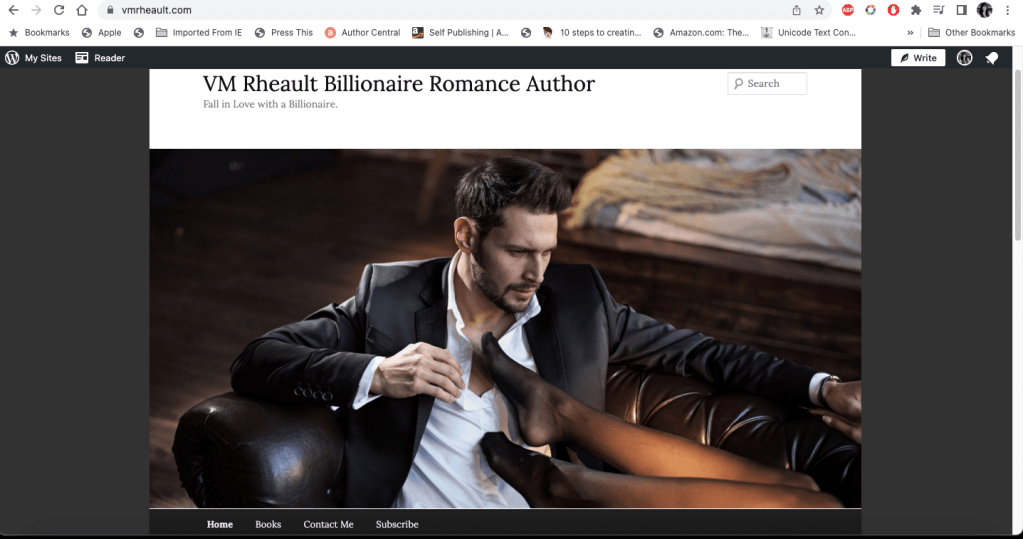
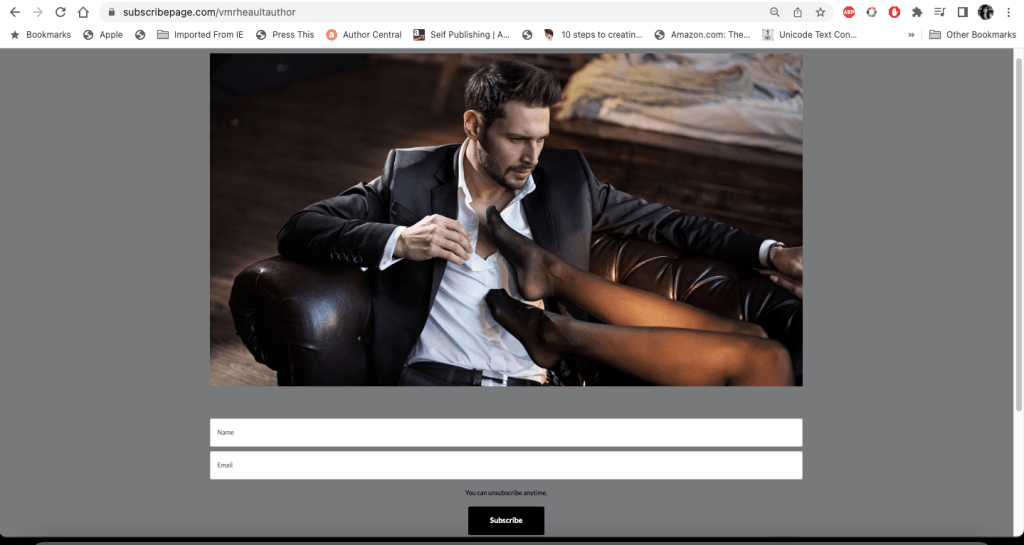
That was the first thing I had to decide. Next I had to figure out what would denote sophistication, elegance, and money, but also sex as I have open-door sex scenes and I thought I should hint at that. The brand of a billionaire. I chose this photo as a header for my FB reader group page, my FB author page I rebranded instead of starting a new one, and it’s the header for my newsletter sign up landing page. It’s important to be consistent all over the web.

My home page header and tagline.
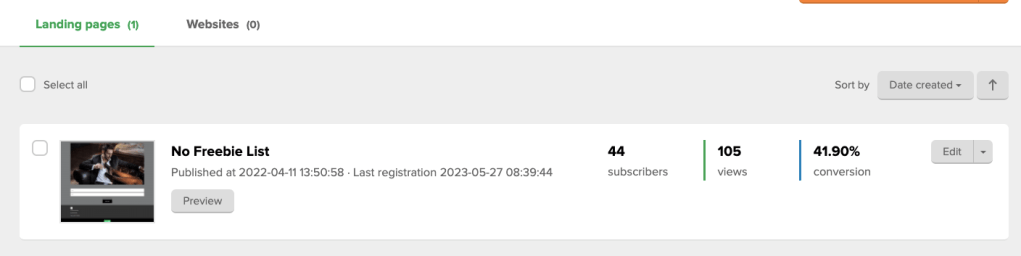
My landing page for my newsletter signup through MailerLite

I went through a lot of graphics and I changed a lot of things before settling on him.

The reason why I’m telling you all this is because when you decide to create and pay for a website, it’s more than just putting up a list of your books. It’s part of your marketing strategy. You’re giving your readers a look at what they’re going to be be getting buying and reading your books and signing up for your newsletter.

So, after I got all that up and running, I decided I didn’t want to blog. I wanted to do things differently than what I was doing for my non-fiction part of writing. Instead of blogging, I started a newsletter to reach readers, and it’s a lot easier writing a newsletter once or twice a month than it is thinking about relevant topics for this blog once a week. This is like a journal about my publishing journey, and readers don’t care about that. It’s fun to think of little things to tell my readers about my books, and now that I’ve gotten used to the MailerLite platform, it doesn’t take any time at all to knock out a newsletter and send it off.

My author website doesn’t have much to it. An about me page, how to contact me, my books, and a subscribe link to my newsletter. The only thing I keep up to date is the list of my books, and that doesn’t take much time at all. There are other things I could add, like a list of trigger warnings, or when I have more books published, I could list them by trope. There is always something to add, but for now my website is very simple.

I got the idea to write this blog post is because I wanted to give you some numbers. I don’t promote my website anywhere. I have the link on my Twitter bio (along with this one, too) and my subscribe link is at the back of all my books (www.vmrheault.com/subscribe). You would think I wouldn’t get any views, but I do. You may not believe readers will find you, that a website isn’t relevant, but it readers will find you. They really will.

I started my author website in September of 2021 and I published my first 1st person POV book in June of 2022. I already had a reader magnet written, and I started up my newsletter a few months after I published my website.

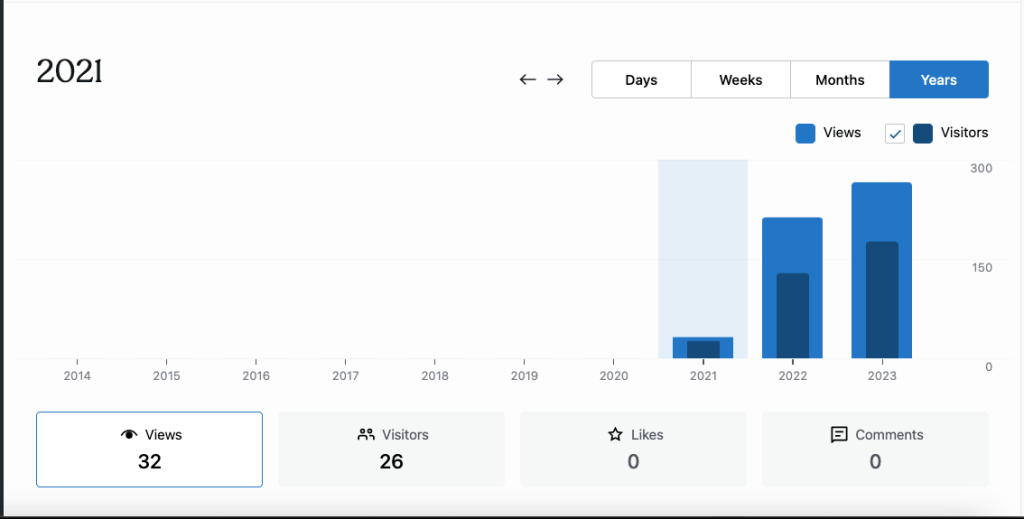
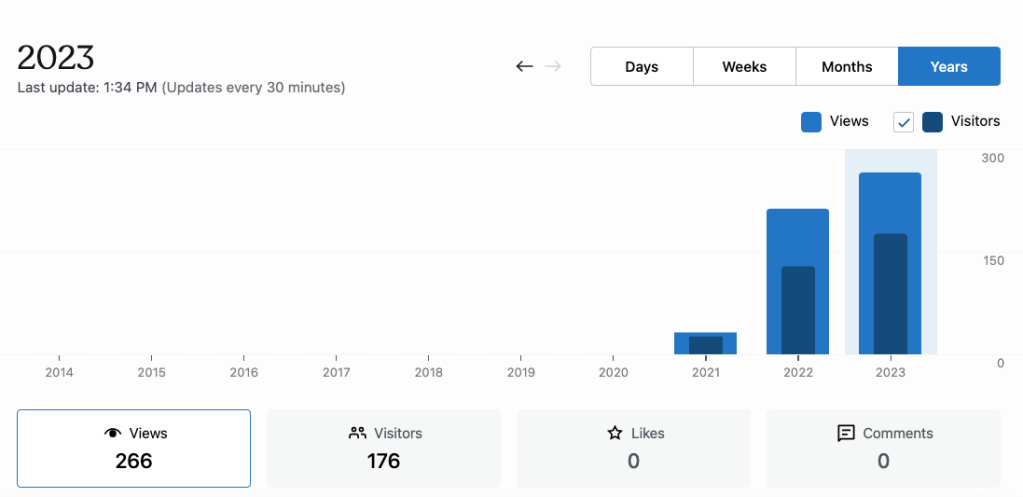
In 2021 I only had 33 views:

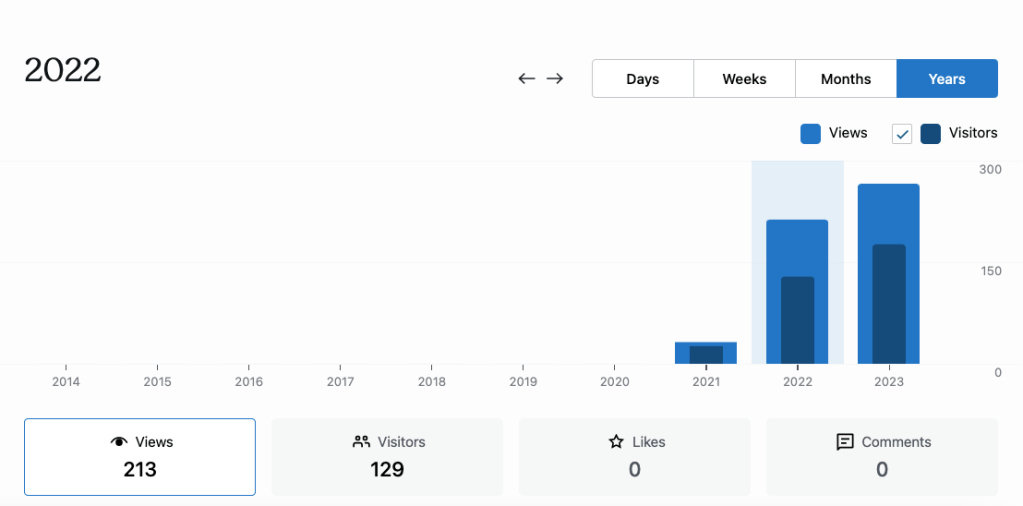
In 2022 I had 213 views.

So far, this year, I’ve had 266 views.

I don’t use attribution links, so I can’t tell you how many people have bought books using my Books page, but all those views could be readers, and I never would have had them if I hadn’t had a website.

I’ve had 44 newsletter signups that came from my landing page I have connected to my website. That may not seem like much, but that’s 44 people who may not have signed up. Every little bit helps when it comes to building your mailing list.

I call it my No Freebie List because I have a different way to collect email addresses through Bookfunnel when I have a little money to play with to run FB ads to my Bookfunnel link. They are still able to download a copy of my reader magnet–that was just how I differentiated them in my mind.

For as little time as keeping up website updated costs me, I think it is worth it to have one. When you’re building a readership, each reader counts and they want a consistent way to be able to find you. I don’t do much with any of my Facebook pages. Sometimes I’ll take a couple hours and schedule posts for a few weeks in advance, but I’m terrible at keeping those up to date. I like my newsletter for that, because I don’t send it out often, and I don’t have that much to share. I write a lot. That’s where my time goes.

If you’re on the fence about an author website, ask yourself why you wouldn’t want one. Would the lack of views get you down? You do have to write and put the links in the back and not be afraid to share it on social media. I admit, having a reader magnet goes a long way. I’ve given my reader magnet away 1,004 times, and that probably has brought traffic to my website, too. It all works together, and that’s part of your marketing strategy. All the wheels need to turn, and a vehicle stops moving if you have a flat tire. I’m happy with the stats of my website, and I’m glad I put one up.

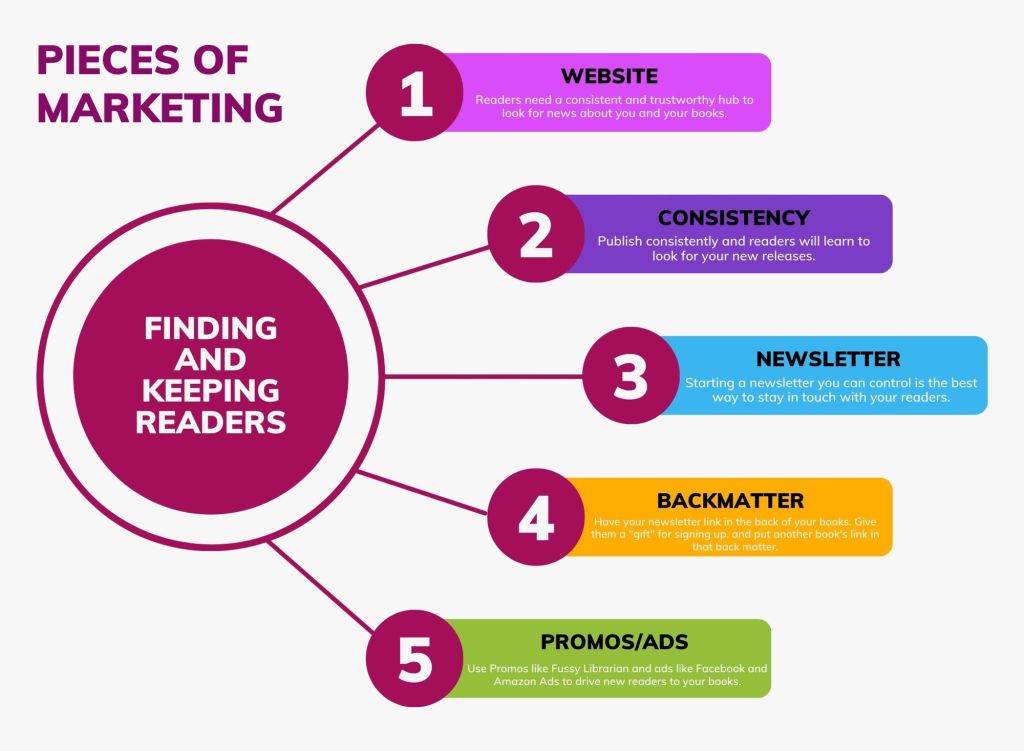
pieces of marketing: website, consistency, newsletter, backmatter, and promos/ads.

Do you have any other reasons why you would have an author website? Let me know!

Have a great week!

Monday Musings and Quick Author Update

Words: 1100
Time to read: 6 minutes

Happy Monday, if you like that kind of thing. Today, incidentally, is the first day of May, as well, which means everyone should probably check to see how their ads are doing and compare ad spend with royalties earned. Because my Amazon ads were running away with clicks but my royalties didn’t seem to be keeping up, I paused some of them. Sometimes that’s not the best idea, but until royalties catch up, I can only spend so much. I’ve made $219.62 this month in sales, spent $108.00 on Amazon Ads (my fault I wasn’t keeping track of them) and $39.96 on my Facebook ad for Rescue Me. Of course, that’s not great (an ROI of $71.66), and I take all the blame for my Amazon ads. I had one going for Rescue Me that didn’t make any sense, because those clicks were .34 which is what I earn on a .99 book. My FB ad is .13/click so I make a tiny something. Mostly I’m using it as a gateway to my other books, and just from Rescue Me this month I made $72.22 so at least the FB ad is paying for itself.

Over the weekend I put Faking Forever on Bookfunnel to offer a few ARCs to my newsletter subscribers and later this month I’ll need to put it on Booksprout for reviews. That is going to go live around the 17th sometime, and I need to book another promo for Give & Take. I wanted to for Captivated but that duet isn’t selling and as I have lamented before, there’s no point in trying to throw money at that duet anymore. If people find it with my low click bid ads, that’s cool, but as my backlist grows, it may just get lost in the shuffle.


Today I wanted to talk a little bit about why I give away a full novel as my reader magnet for my newsletter subscribers. You hear a lot of opinions on it. No one wants to put in that amount of work into something for nothing, or they want to make money off selling it instead. Maybe they can write something shorter that still gets the job done (but how you would measure that is debatable–maybe if no one signs up would be a hint). I can understand the reluctance, and I tried writing short for my reader magnet too. But when I realized it would be easier to just give away something longer, the idea wasn’t so painful. Mostly, I heard advice a long time ago that made sense: you want to give your readers a taste of what you write. I will never write a novella, nor do I write short stories. My Biggest Mistake is the perfect example of what I’m writing under my pen name. It’s 78k words long, is about a billionaire who finds love (and family), and it’s steamy. There really is nothing better I could give away, and if the readers who picked it up don’t like that, they sure as hell aren’t going to like what’s in my backlist I’m selling.

Someone in one of my writing groups said she read that people think their email is worth ten to twenty dollars. I tried to find the source, but after snooping around online for a bit, I gave up. What’s important here is that people don’t give their email addresses to just anyone and for just anything. Authors who don’t like newsletters and haven’t started one because of their own personal biases will probably believe this more than anyone. They protect their email and will only give it away if they know it’s worth it. A $4.99 ebook more than likely isn’t worth it unless the cover and blurb really pull them in, but perhaps the books you’ve already written add to the value, the books you’ll write, and the special offers you’ll only give newsletter subscribers might be enough to tip them over the edge. Since I started my newsletter last year around this time, I’ve given my reader magnet away 952 times. I collect email addresses through Bookfunnel and Bookfunnel sends them directly to my MailerLite account. I don’t force people to give me their address, so I’m 300 email addresses short in my MailerLite account. I was hoping to add people who really wanted to be there by giving them the choice.

I suppose what I’m trying to say is, you need to make sure you’re giving value to your subscribers, and not think you’re entitled to emails just because you have a newsletter. A little short story may not do it, though there are plenty of ways to entice readers, one way being writing bonus content for newsletter subscribers only. I’m too lazy to do this– and once a story’s done in my mind, it’s done. I had one reviewer for Rescue Me say she appreciated I didn’t dangle bonus content in front of her in the form of a newsletter sign up, and I don’t do that because I’m already giving away a book and don’t feel the need to give away anything more than that. It frees up a lot of headspace.

My novel took 3 months to write and I can use it for years to build my list. I think that’s a great return on investment. I can understand if it takes you longer to write a book, but you will have to decide what you want to offer instead. It may not be good enough to entice subscribers and it will take you a lot longer to build your list.


This is all I have for his week. I’m just trying like mad to get the last book of this trilogy written, and it’s been one of those books that are more fun to read than to write. I’m going to have to make a serious effort to finish up in the next couple of weeks. I’ve already went back and read this book from the beginning twice, so I don’t need to do it again. I know exactly what I need to get it done, I just need to stop letting things get in the way. I’ve enjoyed writing this trilogy very much, and like all the other books I’ve written, I’ll be sad when their stories are done and it’s time to move on. After these are good to go, I may be able to squeeze in a Christmas novel. I really want to write one and have some kind of holiday auction plot simmering in the back of my mind, but we’ll see. I need to finish the book I AM writing first and take it from there.

Have a great first week of May everyone! Make every day count!

The surprising ways signing up for a newsletter isn’t as helpful as you think.

Words: 1028
Time to read: 5 minutes

I see it a lot on social media in the writing community–people sign up for each other’s newsletters to be supportive, thinking they are doing a good thing. I would never want to discourage anyone from trying to help out another author. Support and encouragement are so important, and sometimes just a simple, “I’m here for you if you need me” can be the difference between an author opening their laptop and writing that next chapter or walking away from everything for good.

So when someone mentioned they sign up for newsletters to show support and I said unless you’re engaging with that content it’s not really that helpful, I felt bad. I felt bad for making her feel bad because she genuinely thought what she was doing was a good thing. She, and a few others, were surprised signing up for a newsletter wasn’t as supportive as they thought it was, but here’s why signing up for a newsletter and not opening that email and enjoying and engaging in that content can be a real downer for the author sending out that newsletter.

Most email aggregators are pay to play. Unless you send out your own newsletter, you probably don’t realize that authors usually pay for their newsletter aggregators. Some of them have a free threshold, such as MailChimp at 500 email subscribers, or MailerLite who will let you have 1,000 under their free plan. Some you pay for the second you sign up, so every email they collect counts. Successful indie authors can afford their lists, and having some dead weight probably doesn’t hurt them as much as smaller authors who stretch their marketing pennies. So keep in mind that the author you’re supporting might very well be paying for you to be on their list.

We know if you’re not opening our newsletters. With the built-in stats our aggregator provides, we know if you’re opening our newsletters or not. Maybe not YOU specifically, but MailerLite tells me my open rate for each newsletter I send out. You can sign up for a newsletter from every author friend you have, but how supportive are you if you’re not opening the emails sent to you? If you just automatically toss them into the trash? Like people who promote their books for no sales, authors get discouraged when they send out newsletters and no one bothers to look at them. Here are the stats from my newsletter I sent out in March:

A picture of my stats. The subject like of that newsletter was Blizzards, Sales, and Rockstars. The stats are 570 recipients, 33.69% open rate, and 1.23% of those clicked on the link inside the newsletter.

I have 570 email subscribers and only 33.69% of them opened my email. I included a link to something, I can’t remember what to now, but only 1.23% of that 33.69% bothered to click. Authors can cull their lists when they get too expensive and there’s not enough engagement for the cost, but it’s better all around if you’re signing up for newsletters from content creators that you’ll enjoy hearing from.

A low open-rate can affect our ability to join promotions. Authors who use newsletter builder sites and promotional sites such as StoryOrigin and Bookfunnel want to know what your open rate is before they’ll join in promos with you or ask you to join in theirs. That’s another reason why signing up for a newsletter but not opening and engaging with that content is hurtful. Tammi Labrecque who wrote Newsletter Ninja and runs the Newsletter Ninja: Author Think Tank Facebook group says a good open rate is about 40%. If you’re not opening the newsletters you sign up for, you’re hurting our chances of getting into these promotions. That’s the opposite of being supportive.

We start and offer newsletters to sell our product. The main reason we start a newsletter is to reach our customers. If you’re an author, you start a newsletter to hopefully sell your books to your subscribers. We want to build a community of readers who want to read our books and are willing to buy them. If you’re just signing up for a newsletter and not engaging with the content, you’re not going to want to buy our books. If you won’t give us your time, you definitely aren’t going to give us your money. Newsletters are an author’s strongest marketing tool–but only if their subscribers want to be on it and are happy to hear from us.


If you really want to support your author friends, the best thing you can do is read their books and talk about them. If they write in genres you don’t read, that’s not your fault and being truthful can go a long way. It’s an author’s job to promote their books, not yours, and sometimes there’s nothing you can do. I’ve turned down three people in the past couple of weeks who have asked me to read and review their books. I don’t read in those genres and I said no. With running this blog, sending out my newsletter, writing my books, and working full-time, I’m stretched thin, and that’s okay.

This wasn’t a blog post to tell you never to sign up for a newsletter, but be selective and sign up for newsletters from people you want to hear from because you enjoy their work. Of course we love it when we see new subscribers, but we want those subscribers to open our emails, enjoy the content, click on the links, and look forward to new releases. It’s difficult starting a newsletter and feeling like you’re not writing to anyone. It’s difficult to write a blog to no one, and it’s difficult to write a book when you have no readers. We all start somewhere, and little by little we grow our community. The writing community isn’t necessarily going to be your reading community, and that’s fine. We all write different genres and it’s one of the reasons I don’t share my newsletter link on Twitter–or on the blog for that matter. If anyone wants to sign up–they know how. The link is at the end of my books, and that’s the best way to gain subscribers.

How do you support your fellow authors and friends who write? Let me know, and have a great week!