Splitting Your Author Life in Two: Readers vs. Writers

 white background. black piece of torn paper.  text says in black and white, splitting your author platform.

One of the biggest mistakes authors can make is trying to talk to everyone from the same place. Back when I first started publishing and writing my blog, I did this, and it actually took me years to figure out that not all readers are created equal. If you don’t know what I mean, let me explain.

It may not feel like it, but once you publish, your author life is suddenly split in two. You have your author pals who support you, maybe read your books (and that’s a big maybe), promote you on their socials that may or may not have readers in the audience, and after a while can even turn into accountability partners, alpha and beta readers, and friends. Then you have your readers, your actual readers who, if they are on social media at all, aren’t part of the . They use socials for other things like connecting with family and reading articles about gardening, cooking, movies, and politics. Maybe they like their favorite authors’ Facebook author pages because that’s where they hear about new releases, giveaways, book boxes, and in-person events.

I came this realization a while back, and when I started my pen name, decided I needed to have a hub just for readers. To be honest, I didn’t want readers reading my nonfiction stuff anyway. I use this blog as a way to help others in their publishing journeys, let other indies know what worked for me in terms of marketing (promos and ads), and just talk about what crazy BS is going on in the publishing industry. That information isn’t for readers, and it shouldn’t be. They don’t need to know how many books I’ve sold, what Amazon pays in terms of KENP, or that I make my covers in Canva and format my own books.

But, I understand this decision isn’t for everyone. I pay for two websites, and some authors don’t even like paying for one. I enjoy blogging for other indies and connecting to the industry makes me feel “professional” so I eat the cost of the WordPress plan and domain name. But, if that’s not for you, don’t feel bad. Not every indie author wants to share their journey, stay up-to-date on what’s going on in the publishing world (both trad and indie) to have something of substance to write about, or pass on what they’ve learned because writing tutorials can take a lot of time. There are weeks when I’m at a loss as to what to say too, and I either just default to an author update or scroll Threads looking for dirt a topic. I feel fortunate when I can share a podcast I enjoyed and/or learned from or I’m able to find a subject like this one that might resonate with someone and help them move in a better direction. You don’t have to lock yourself into writing every week like I have, but if the views and visits are what get you out of bed, consistency will always make that happen faster. I owe a lot of my SEO to my tutorials, particularly my Canva post on how to make a paperback cover. I’ve tried to keep this blog relevant and helpful, but if you already have limited time to write, nurturing a blog that won’t sell books won’t sound appealing.

That said, if you really want to make a go of this publishing stuff, you should have an author website, a place to point readers in the backs of your books. This is where you’ll have your backlist of books and where readers can find them, a newsletter signup, your reader magnet, trigger warnings, direct sales, and any in-person events. If you check out other author websites, you’ll find that they don’t blog about process or complain about Amazon payouts or how they package author copies for shipping. Author websites cater to readers and what they want, not other authors who like to hear about behind the scenes news.

The problem with only writing to only readers is that if you don’t have a lot going on, there’s not a lot to say and that can make you feel disconnected. I write my newsletter on my author blog once a month, and I usually have something to share. A sale, a new release. Maybe highlighting an older book in my backlist that hasn’t gotten a lot of love. Creating content can be challenging if you’re a one-book-a-year author, and it might be tempting to write about what you’re working on, but unfortunately, readers don’t care until you can give them something to buy and read. When that happens, when you aren’t constantly updating, it may feel like people are forgetting about you, but you know, as I’ve said in the past, they will. You can be afraid of something that will happen, but there’s no point to that. There is so much content out there it’s inevitable, but it’s better to jog their memory after a few months of silence than waste their time blogging about something that doesn’t concern them.

If that describes you, if you feel like if you’re not reaching out then you’re invisible, then yeah, you might want to blog for indies who are interested in your process, would like to know how well your promos did, and/or how you make your covers. It gives you a reason to communicate and not feel so alone, and you’re writing to the people who actually care what you’re working on. Sales won’t come of it, which is why in the end I moved my books off this website and put them on my author website, but the more you segment your efforts, the more effective each one becomes and you won’t feel like you’re shouting at people who aren’t listening. Reaching out doesn’t even require a blog. You can create an indie Facebook group or Discord channel. A place where other writers and authors can get together but where you also know the score: your peers won’t buy your books. You can let go of that expectation and just be happy you’re in a group of people who are going through what you are and know how it feels to have zero sales on your dashboard.

So you might ask how is my author platform split in two?

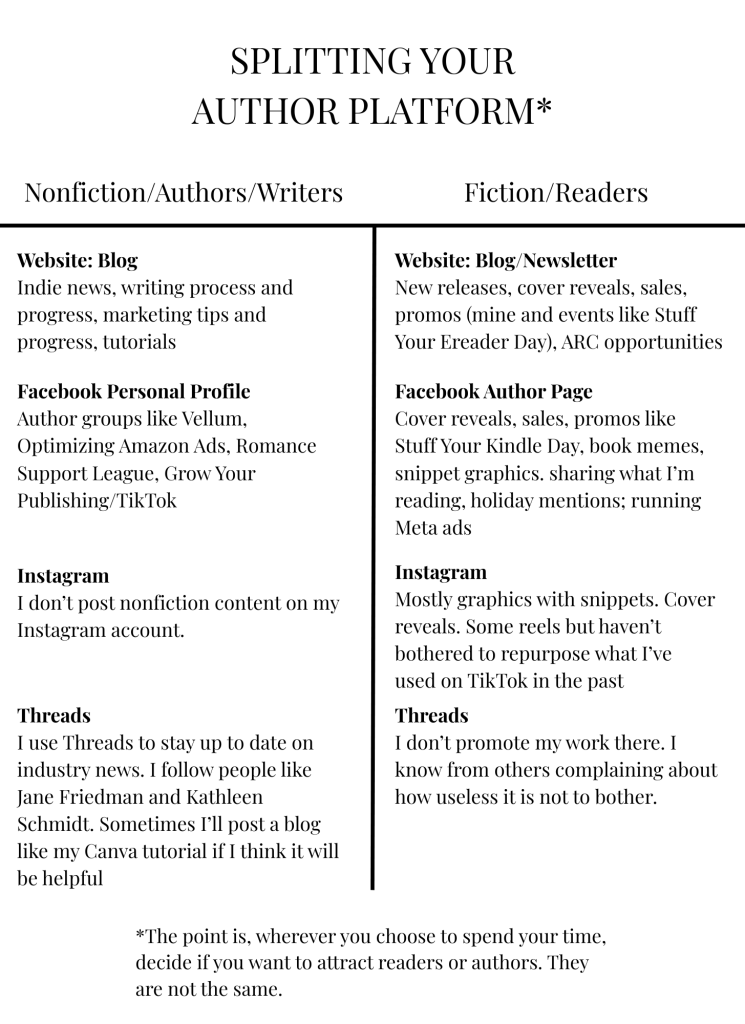
Here’s what I do, and I made a graphic in Canva so you can save it or print it out if you want a quick reference.
png image:
SPLITTING YOUR AUTHOR PLATFORM*
Nonfiction/Authors/Writers
Fiction/Readers
Website: Blog
Indie news, writing process and progress, marketing tips and progress, tutorials
Website: Blog/Newsletter
New releases, cover reveals, sales, promos (mine and events like Stuff Your Ereader Day), ARC opportunities
Facebook Personal Profile
Author groups like Vellum, Optimizing Amazon Ads, Romance Support League, Grow Your Publishing/TikTok
Instagram
I don't post nonfiction content on my
Instagram account.
Threads
I use Threads to stay up to date on industry news. I follow people like
Jane Friedman and Kathleen Schmidt. Sometimes I'll post a blog like my Canva tutorial if I think it will be helpful
Facebook Author Page
Cover reveals, sales, promos like Stuff Your Kindle Day, book memes, snippet graphics. sharing what I'm reading, holiday mentions; running
Meta ads
Instagram
Mostly graphics with snippets. Cover reveals. Some reels but haven't bothered to repurpose what I've used on TikTok in the past Threads
I don't promote my work there. I
know from others complaining about how useless it is not to bother.
*The point is, wherever you choose to spend your time, decide if you want to attract readers or authors. They are not the same.

There are a lot of places to hang out that I haven’t listed. I just can’t be everywhere and don’t want to be. Lemon8 is popular, so is Pinterest, and let’s not mention TikTok because I really don’t want to use my time making videos, but the fact is, if you’re a slow writer and you want to talk to only readers, you’re not going to have a lot to say. You can share book memes and pet photos, where you went to dinner on your anniversary, but you’re going to lose readers to other authors who publish faster. The industry in some ways is very slow, such as trends are very very slow to change, but when they do, it feels like it happened over night. Trad authors can seem like they get away with a book a year, but behind the scenes, they’re worried about getting a new book deal, if their publisher will pay for marketing, how their launch is going to go since they haven’t had a new book out in however long. Indies face the same trouble, trying to find traction while others are zooming ahead because they have more time/motivation/whatever than they do.

Figuring out where and what to post is a mental health issue, it really is. I’ve gone through my own struggles, beating myself up for not wanting to post on my Facebook author page, not making videos for TikTok when everyone says that’s where you belong if you’re an author. I boosted a post on my Instagram account and got a few new followers, but they aren’t going to do me any good if I don’t post. And you know, I’m pretty prolific, so it’s not that I don’t have content, it’s just that I don’t care. I let Amazon ads, promo newsletters like BargainBooksy, FreeBooksy, and Fussy Librarian, and author-driven book blasts like Zoe York’s ZoeBub pickup most of my sales weight, which I can do because my series and trilogies have solid read-through. Maybe I have to pay for it, but I’m reaching readers, not shouting at other authors then getting mad when my books aren’t selling.

Splitting up your author platform can take a lot of the stress off your shoulders. You know who you’re talking to and what they want to hear. Shouting to everyone will never work and you’ll only get frustrated. It’s difficult to break out of the bubble, but the longer you do it the more natural it will feel and the feedback will become more positive because you’re staying in your chosen lane and once you draw the lines, you’ll actually have more time to write because that urgency to post and reach anyone you can will be gone.

Again, I know this advice isn’t for everyone, but if even reading this makes you step back and look at how you’re posting on social media, you may make some small changes that could turn into big results. Let me know what you think!

I better get off here and finish proofing my proof of Loss and Damages. I’m almost done then I can put the changes in and order another proof. I’m really excited to jump into more hockey research. I’ve put that aside to get Loss and Damages ready for ARCs next month, but I’m eager to start again. Take care everyone, and have a great week ahead!

Six Things I Learned after Starting My Pen Name

2,277 words
12 minutes read time


I thought starting my pen name (not really a pen, VM Rheault vs. Vania Rheault but for now, that’s what I’ll call it) would be the ticket to not fame or fortune, but I wanted to start my career on the right path after a couple of years of not doing things the proper way.

When I first started publishing, I did what a lot of indies did, and still do. I published what I wanted, didn’t really have a plan. I genre-hopped, looking for that genre I wanted to settle into long-term. No one told me I didn’t have to actually publish those experiments, but I wouldn’t have listened even if they had. Publishing without gatekeeping was a free-for-all, and it still is, indies publishing whatever they want without regard to a publishing schedule, marketing, or anything else that would start them on the right foot. Probably the only habit I had and still hold on to now, is writing all my books in a series first before publishing them. I started that when I wrote my Tower City Trilogy and I’ll never stop, even if that means I have a year or two between launches. But, let’s break it down. Here are the six things I learned when I started my pen name back in 2020, well, 2022 when I first published my Cedar Hill Duet and I tried to do things the “right” way.

You can’t click Publish and walk away.
If you don’t have a launch plan, this is what a lot of authors do. They don’t know how to launch and it can hurt you. When I published my Cedar Hill Duet, I didn’t put them on Booksprout for reviews. Before 2022, it was a free service, and I used it for my Rocky Point series under my full name. Then it went to paid, and I listened to the annoyed authors who said they were going to stop using that service. I should never have listened and put my own books up. Reviews matter. No one wants to think it, and I know correlation doesn’t equal causation, but Captivated by Her and Addicted to Her are my worst selling books and I attribute that to their low number of reviews. So, if you don’t have a plan or don’t want to have a plan, like cover/title/blurb reveal or newsletter, at the very least, try to get as many reviews as you can the week of your launch. They will affect how your book does from that day forward.

Nail your cover the first time.
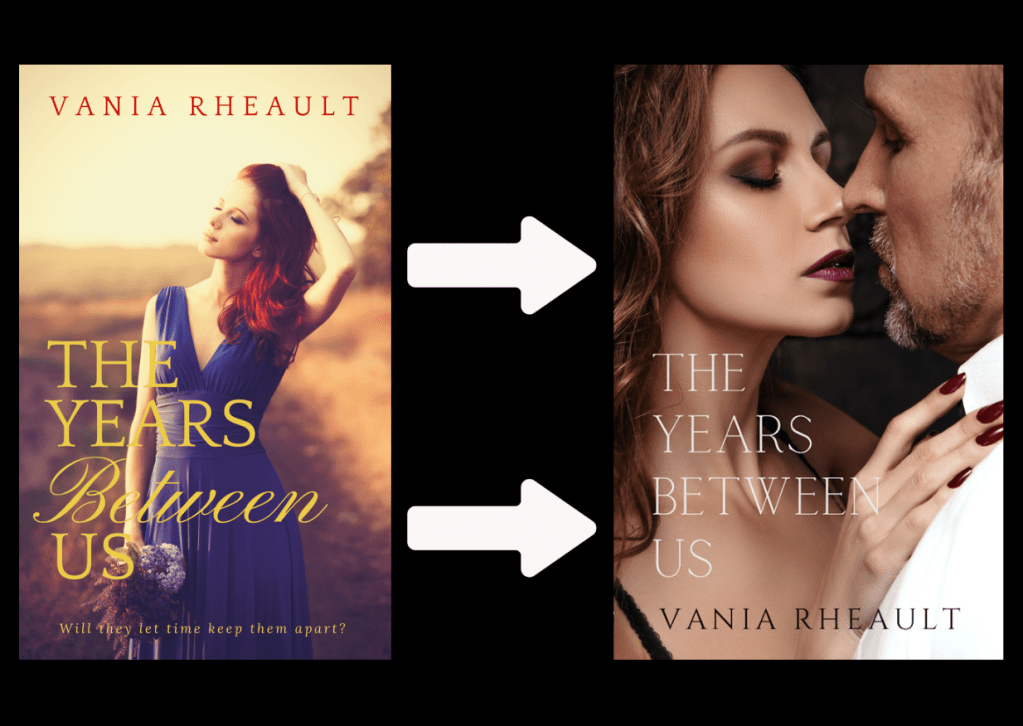
When I decided to do my pen name, I really wanted to make sure I published correctly the first time. And by that, I mean I wanted to make sure my covers met genre and reader expectations. I’ve written a lot about how my cover for The Years Between Us screamed Women’s Fiction, and after I changed it to a couple, my sales went up. It was a beautiful cover but didn’t match the blurb or what the book was about.


I changed the cover to Wherever He Goes, too, and that helped. Unfortunately, I’ve had to change covers for some of my first person books even though I tried my best to avoid it. Your skills get better or better models come along, your taste changes, whatever, but no matter why you have to change your cover, if you change it to something better, just know that you’re blowing your launch period. I totally fucked up my launch for my Lost & Found trilogy because I didn’t wait to find better models. I published with what I had, and didn’t change the covers for a year or so after my launch. I gave them another edit, too, so I “re-launched” them, but man, you really waste Amazon’s bump if you screw up the first month of your release. Title, blurb, and your cover’s tone need to be spot on. Just because you like something or it looks professional doesn’t mean it’s a good fit. You have to do market research, and nobody wants to do that because it sounds like you’re selling out. You’re not. You’re helping the right readers find your book, and that’s all that should matter. I wrote more about choosing the appropriate cover, and you can read it here: https://vaniamargene.com/2024/04/08/my-marketing-secret-shh/

Don’t listen to everything you hear.
One of the riskiest things you can do online is listen to other people. I’m on Threads a lot (you know this) and the number of opinions out there, well . . . you know the saying: Opinions are like assholes . . . everyone has one and they all stink. There is no place this is more true than when you get a bunch of romance authors together, be it on Threads or in a Facebook group, and they’re telling you what they like and what they think should be the standard. No 3rd act breakups, no cliffhangers. Don’t use the word “folds” when you’re talking about p*ssy. Don’t make him an asshole, don’t write about rape. Don’t romanticize stalking. Don’t write in 3rd person. Don’t write your blurb in 1st person. Don’t do this, don’t do that, but what’s funny is that when you take a look at popular books, THEY ALL DO THAT! Yes, there is some advice out there that’s good, like don’t genre-hop if you hope to build an audience. I’m a firm believer in writing your blurb in the POV your book is written in. But at the end of the day, when it’s just you and your book, you need to write what you enjoy. Even if that’s a super dark romance that would get you locked up (and not in a good way). If you’re bombarded with opinions about how nasty the enemies-to-lovers trope is, and that’s what you’re working on, it can be discouraging. But honestly, you’re not writing for other authors anyway, and if an author tells you she hates cliffhangers and you love them, tell her to fuck off. There are readers for everything, and it’s okay if people self-select out of your books. You don’t want people who don’t like what you’re writing to read your stuff because all you’re doing is courting bad reviews. It can be difficult staying true to yourself, but you’ll be happier for it.

Just because you do everything right doesn’t mean you’ll find success.
This is probably the hardest lesson of all. You can spend a ton of money on editing, you can publish with the perfect cover and a ton of reviews, but in the end, that doesn’t mean you’re going to find success. And by success, I mean, readers, sales, royalties, whatever success means to you. I’ve said in the past that success to me would be making a part-time income with my books. Part-time for me would be about 15k a year. It would help me out tremendously, that little extra money, but this year I gave up that dream and realized that maybe what I’m writing just isn’t going to hit the market the right way, or my reluctance to be on TikTok will always hold me back. My books are too quiet, or I chose the wrong sub-genre when I rebranded myself. I don’t know, but the fact is, there are thousands of authors out there who publish regularly, publish good books regularly, and they get absolutely nowhere. They spend more than they make, they get burnt out, and/or they publish to no one over and over again. After you come to that realization, you’re hit with the trite sayings like “A quitter never wins and a winner never quits” or “Believe in yourself and you’re halfway there” and you just wanna cry (or puke). When 2025 rolled around, I decided to change how I looked at my writing. I can’t call it a business because I don’t have one. That implies money in and money out, and right now, I pay more than I earn. So, in that vein, I decided to stop doing what I think I should be doing and just do what I want. That means writing what I feel like writing without regard to a publishing schedule. I stopped all my ads. Don’t care about social media and post only when I have something to say. I stopped chasing the dream and I feel better. Writing is fun again and that has turned into my new definition of success. Here’s an interesting article by Jane Friedman about having what it takes to make it: https://careerauthors.com/do-you-have-what-it-takes-to-make-it-in-publishing/

Numbers don’t mean anything.
Social media sucks. It really does. I believe that you should have a hub where readers can find you if they want. (That should ultimately be your website, but I understand the value of a Facebook author page or an Instagram account.) Authors should have some kind of social media presence, if only to prove you’re a real person instead of a made up author some guy sitting in his mother’s basement created using AI. You can’t appear fake in this day and age when there are so many bots out there that can act and interact like a real person. As AI usage gets worse and worse, readers knowing you are real will be part of your marketing toolbox. But in the past seven or eight years I’ve been online, I’ve learned no matter how many followers you have, that doesn’t mean you’re going to sell books. They might like you because you have pets or because you live in the same state. They like how you do your hair or think you’re pretty, whatever it is, but that doesn’t necessarily mean you’re going to be able to sell them your books [see Billie Eilish: https://medium.com/better-marketing/billie-eilishs-book-flopped-because-her-marketing-team-assumed-it-would-sell-itself-71c32dc19af3]. I just looked up someone who has over 5k followers on her Facebook author page, and she sells very few books every month–and she has a lot of books. So, if you don’t have many followers or you’re just on social media to kill time or to amuse yourself, don’t feel bad. Finding readers is hard work and it’s a long game. Besides, depending on how you run your social media, you could just have other authors following you, and when it comes down to it, that’s not helpful. I wrote about busting out of the bubble, and you can read it here: https://vaniamargene.com/2021/12/06/how-to-break-out-of-the-writing-community-bubble-and-sell-books-to-readers/

Mix friendship with business at your own risk.
I help a lot of people do their covers, format, even just give them publishing advice through my experiences and what has worked for me. I’ve paid my friends to edit and beta read, I’ve done a lot of free work that I was pleased to do because you’ll learn fast that the can be full of people only in it for themselves. I’ve also accepted some payment for the work I’ve done for others, but no matter if it was free or paid, in the past eight years I’ve been at this, nothing has pleased me more than helping someone publish their book. But not every relationship is infallible, and mixing business with pleasure isn’t always something that works out. I’ve lost friends because the business part of our relationship soured, and unfortunately, that’s a risk you take. Sometimes you can see that person for what they are and you realize that in time your friendship would have tanked anyway. But, it’s important to understand what you’re getting into, even simply saying you’ll format for someone or if you offer to whip up a quick cover. Writers and authors are some of the touchiest people on earth, and I’m included in that because I know I’ve gotten upset over things other people would have shrugged off. But when I help someone, I’m a professional at heart and always do my best to give them a product I would be proud of if it were for my own book and I don’t think I’m out of line to expect the same–especially when cash exchanges hands. I’d never beta read while watching TV or use photos on a cover that weren’t safe to use. Even though I have ethics and integrity, not everyone does, and I stopped talking to someone who admitted she was editing my book while she was at a hair salon, and I cut ties with someone who backed out of reading for me when she gave me her absolute promise she would finish. I know that sounds callous, but we had underlying issues and those instances just happened to be what did me in. So if you think you’d be heartbroken to lose that friendship, don’t let the line between personal and business smudge. It’s difficult to get past that.


I’m sure there are more things I’ve learned, but this blog post is long enough for now and I touched on the topics that I have found the most important in publishing and the most important to me when it comes to my experiences. It’s tough to cut out the noise, but like I said, at the end of the day, it’s only you, your book, and your readers and if you go to bed happy, that’s all that matters. People will come and go, opinions and advice change. Do your best with what you have, keep true friends close, and go outside and touch grass every once in a while.

That’s all I have for this week. Next week I’ll let you know about a shiny new thing I couldn’t step away from and what my publishing schedule will entail because of it.

Chat soon!