1,686 words
9 minutes read time
Back in 2015, Michael Anderle had an epiphany. He did the math and came up with the idea that if an author had a backlist of twenty books, they could make a living wage–$50,000 dollars a year. If memory serves, he was sitting on a beach somewhere.
It seems simple enough. Write twenty books that each make $208.00 dollars a month.
That revelation turned into a phenomenon, and plenty of authors rose to the challenge. And not only rose to the challenge, but smashed that ball right out of the park.
In 2015, I wasn’t published yet. I was active on Twitter while I was writing a high fantasy series that I’d end up not publishing, but if you were in the #writingcommunity, you knew about the Facebook group and were likely a member. It turned into a hub of hope. You learned how to make covers-to-market, write-to-market, to write a series and give the first book away to earn royalties through read-through. But it was more than just advice. Authors were actually doing those things and showing snapshots of their sales dashboard proving that those tactics made money.
We drank the Kool-Aid because it made us feel good. I guess it was more like spiked punch at that point, which makes sense because when I get tipsy, I want to do ALL THE THINGS. And more than that. I think ALL THE THINGS are possible. Anyway, yeah, that group gave us a buzz that was hard to push back. So we wrote our novels and packaged them with good covers and wrote long series that had open plot arcs so a reader had to read all the books to know how the story ends. We were in it together.
A rising tide lifts all boats.
Unless your boat has a hole in it.
Over the past year or so, I’ve talked a lot about letting the dream go. Wicked Games will be out May 15th, and it will be the 19th book I’ve published since starting my pen name and changing to first person present POV romance. I wrote and stockpiled books during the pandemic and published my first books in 2022 (the duet I recently re-covered and re-edited).
I don’t make $44,928 a year off the books I have out now (that total is adjusted to the 18 books I have published, not 20). There are days I’m lucky if I make pennies from all my books combined.
Last week I had to turn off my Amazon ads. All of them. And it made me sick inside because ads are the only exposure my books have. I don’t like posting on social media and don’t do it nearly as often as I should, and my newsletter/blog brings in not very much interest. But my ads were getting a lot of clicks and no sales to show for it. I even checked my rank for the books I was advertising and their ranks were actually falling, not going up. So people were clicking but not borrowing in KU. With that proof, I had to turn them off.
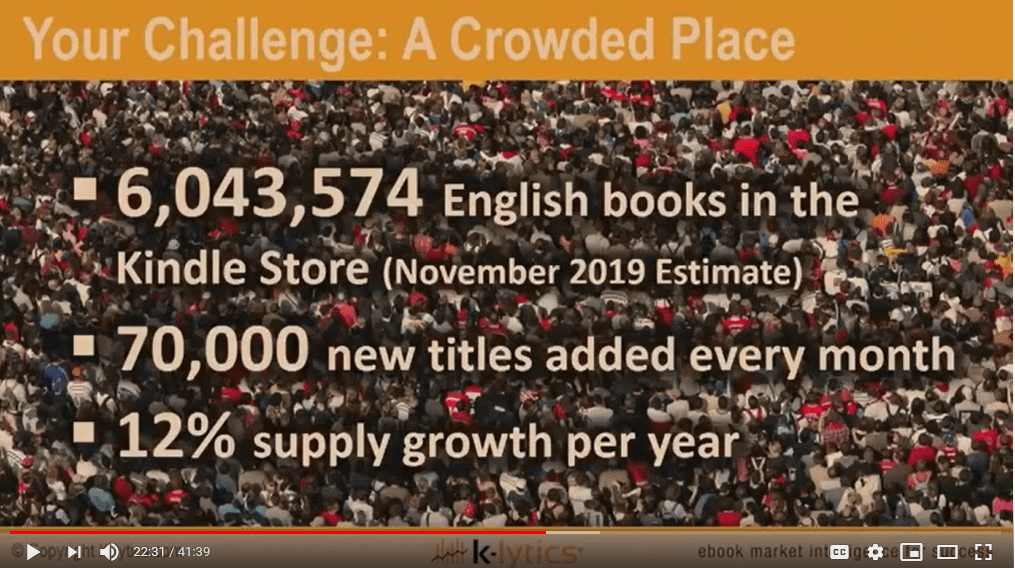
There are a lot of reasons why books don’t sell, and I don’t mean mine specifically. Probably the biggest culprit is saturation. Back in March, an article in Publisher’s Weekly said that in 2025, four million books were published between people self-publishing and authors who had trad deals. Four million books in one year alone. And those four million books don’t make the books published in 2024, 2023, 2022, etc, disappear. All those books just stack on top of each other into a seemingly endless abyss of novels that give readers so much to choose from they may not be choosing anything at all (doomscrolling, anyone?).
One thing the 20booksto50k group did was turn the indie mindset from writing books as a hobby into writing books as a business. We started thinking about covers and blurbs and marketing strategies and what readers wanted, and today, it’s easier than ever to produce a book written-to-market that looks professional. Unfortunately, publishing a professional book is only the start, when before it’s what got you halfway there.
The other day, a friend of mine said something that stuck with me. Publishing is no longer a distribution channel or a discovery tool. All publishing is now is uploading a file. That really resonated with me because ten years ago, there was organic discovery. Simply being part of the KU ecosystem ensured visibility, borrows, and royalties. I think that’s why when Draft2Digital put their $12.00 a year maintenance fee in place there was such an uproar and why I’m seeing such a disdain toward Kobo lately. Authors want help selling their books and believe the distribution service of their choice should be the ones helping them. Nobody likes paying for nothing, and when you’re not selling books, that’s what you get. Dead weight, indeed.
Do any of the philosophies of the 20booksto50k group still hold true? I mean, a book with a good cover and a good blurb will always sell better than a book with a DIY cover and a blurb so vague a reader can’t tell what the book is even about. But some of their biggest fundamentals like rapid releasing and having a large backlist don’t seem to move the needle much, if at all, anymore.
Because of some personal reasons, I left that group a couple of years ago and haven’t looked back. When I was a member, yes, making money was a goal, but so was building a readership of fans and giving them a good product on which to spend their time and money. From what people have been saying now, the group is focused more on quantity than quality and adopting AI as a way to make that happen. The group also has a new vibe now that it’s called Author Nation, run by Joe Solaris instead of Michael Anderle and Craig Martelle, and I’m a little disappointed I never made it Las Vegas for their yearly convention when the group was still under their leadership. I missed their golden era, when everyone was helping each other and you could ride the high of a good conference with good speakers for months.
These days I don’t know what any group could really offer an author to help them get ahead, besides just “emotional support.” All the information is out there and you can follow it to a T and still end up with zeros on your dashboard.
Why am I talking about this now? I guess because I’m closing in on the twenty books part of the idea, and I’m not even close to making the 50k part. It’s an idea that was perpetuated a long time ago, and it was perpetuated because some authors managed to do it. And that too, is like driving wood splinters under your fingernails. You can have perfectly fine books. Cover, title, blurb, tropes, and have it professionally edited, and no one will buy it or borrow it in KU. You start to wonder if there is something wrong with you, especially when other authors around you are able to do it, and with fewer books than you.
While I was scrolling Threads the other day, there was an author who was saying a first book in her series wasn’t doing well, and she was wondering if she should even bother publishing book two. I looked up her profile, and in one post she said when her book was on preorder she had over 100. To me that sounded pretty good, so on Publisher Rocket, I looked up how well she was doing. Her books were earning her thousands a month. She was literally living the 50k part of that dream, and I was so angry I almost started crying. To have what so many of us wanted, and she was complaining about it. I’m happy for her, but it’s really difficult to be happy for someone who doesn’t seem to be grateful for their own success.
I don’t know when I’m going to publish next. I told myself that I would start Frozen Assets at the beginning of May, and it’s the beginning of May. I’ve been enjoying the time off, getting things done around my apartment, going for walks, and watching TV in the evenings guilt-free. I like not feeling pressured to get words down. I like not having a publishing plan.
I learned some valuable lessons while I was part of the 20booksto50k group, but they instilled a dream that many of us will never reach and a mindset that’s hard to turn off. The publishing landscape is too different from what it was ten years ago and we need to make adjustments in our own businesses and hobbies to protect our mental health.
I’ll keep writing because I love it, but publishing is something else and I’ll see how that feels next year. Wicked Games comes out on the 15th of this month and it will be my only book this year. The few readers I have already know this, and they also know I’ll be working on my hockey duet for the foreseeable future. With the changes at my work, I don’t know how fast I can write a book now, and that really isn’t the point anymore anyway. I’ve been looking forward to my hockey duet for the past year, and I’m excited to write them. But publishing might mean something else. I’m not sure yet.
20booksto50k wasn’t a crazy idea. It was achievable to some. But now it feels like an outdated map that leads to riches that have already been found. Like Craig Martelle and Michael Anderle, it’s time to go out on my own. Who knows what’s out there.
Next week I’ll write up an author update, and then on May 18th, I have another installment of my editor series, so bookmark this site or subscribe! I’d love to see you again!
As always, thanks for your time, and I hope you have a great week!