Don’t Rush to Publish!

Probably the best advice I can give you about publishing is not to rush.

I’ve always promoted doing as much as you can yourself—especially since your first book is pretty much a loss until you write more and have more books available for purchase. When it’s when it’s your only book available, you’ll never get back what you put into it. (Unless you have a tangible way to measure pride and satisfaction.)

Combining the fact that this is your first book with doing it all on your own is dangerous. You’ll never be sure if your book bombed because you’re an unknown author and this is your first book, or if it’s because your book sucks. Publishing a superior product rather than a POS will take some of the guesswork out of the question.

You want to put your best work out there, so when you have more books available you don’t have to waste time fixing it. Being it is so easy to update files in Kindle Direct Publishing, you may get into the habit of updating your files and covers all the time. It’s a waste and you’ll never move forward. Fixing your files in CreateSpace is easy too, but your book isn’t available until your files are approved, and CreateSpace’s approval time is longer than KDP’s. People still can buy your Kindle book while the new file is being approved, but it will be your old file.

Here are some tips to not rush:

Cover

Never publish your first attempt at making a cover. Make many covers. Many, many, many. Try different pictures, fonts, and color themes. Take your best two or three and turn them into a contest on Facebook or Twitter. Enter all the names of the people who chose the one you decided to use into a drawing and give a signed copy of your book to the winner. Ask for lots of feedback. There are plenty of people online who are willing to give you an honest opinion.

Research your genre, watch picture manipulation videos to learn how to do what you want. If your idea is too much for you to do on your own, or you just can’t get your vision from your head onto the computer, ask for help.  Don’t publish your first attempt. Keep it clean, keep it professional. One day you may change your cover to bump up sales, or because your skills have improved, or because you found a better picture. All I’m saying is, don’t make it a habit. You’re supposed to be writing more books.

Formatting/Book Interior

The inside of your book needn’t change much. As you grow your library you may want to add those books to a list in the front or back matter letting your reader know they are available. Maybe you’ll want to fix typos, but don’t get caught up with this. You’ll never stop editing, and I feel it’s disrespectful to the people who previously bought your book before your fixes.

CreateSpace takes 12-24 hours to approve files, and your book is not available during the approval process. You can lose sales going into it to fix to too many times.

KDP takes five hours, but don’t use this as an excuse to fix every little thing. Plus you want your paperback and Kindle files to match. Publishing your book as close to perfect as possible will save you lots of time in the long run.

Blurb

Changing your book’s description is simple enough, but if you offer a paperback you’ll want your product information to match the blurb on the back of your book. Again, CS has to approve any changes and this takes time. Blurb writing is difficult, every writer loathes it. I find it easier to write blurbs for others than for my own books. Research how to write one and get plenty of feedback from people who both have and have not read your book. The people who have read it can tell you if it’s accurate. The people who have not read your book can tell you if the blurb makes them want to read it.

Editing

I’ve written a lot about editing in my publishing series, and in two prior blog posts. Editing is the worst because of all the waiting, waiting, waiting. For other people. To read your work. You’re waiting on someone (or hopefully many someones) to read your work and you can’t say anything or you’ll seem rude. If you pay someone, hopefully, you come to some kind of a time agreement. If your friends are doing you a favor, you need to be patient. I’ve edited for people who have published before I was done. Please don’t do that—especially if they keep you updated and they are finding things. It’s rude, and frankly, it hurt my feelings. What I advise you to do is forget about publishing it. Work on something new. Work on your cover—can you make it better? Work on your website, or write a few blog posts and schedule them out so you’re ahead. Try to get into a blog tour, or ask some of your friends who run blogs to interview you. Beta-read or edit for someone else. There are plenty of ways to fill your time and still feel like you are moving forward career-wise.

Be patient.

Don’t rush into publishing. It will save you a lot of time down the road, and a lot of regrets, because you’ll never now how many sales you lost because of a poor cover, or your first 20% in the Look Inside feature has typos in it and a potential reader didn’t want to take a chance on the rest of your book.

It took a year or more to write your book. Waiting a bit longer won’t hurt.

What’s your biggest publishing regret?

Bad Writing Mistakes

I’ve written a lot in the past two years; I’ve read a lot too. I’m trying to get better, and every time I delete the words “s/he thought” out of my manuscript and just write it like the plain old monologue it’s supposed to be it’s a big deal. I used to make my characters “think” everything. Their minds were probably smoking.

When Joshua Edward Smith (you can find his amazing books here) took a chance on me and read my NaNoWriMo project from 2015, he did me an enormous favor. He told me to get rid of the “prettys” and the “justs” and the “reallys” and all the “thats.” (I did and deleted half my manuscript, haha.) He told me I was head-hopping. He told me the reason for my “major conflict” was unbelievable (I write contemporary romance, so there’s always a “big fight”). He pointed out things I should have known as a life-long reader and holder of a Bachelor’s in English degree. But writing is a different thing, and writing a full-length novel in a month did not help. I didn’t know how to write then, so maybe the time frame didn’t matter. Anyway, his feedback was priceless and though I’ve beta-read for him twice now, I still may never pay him back. He reminded me how to write, and I will be forever grateful.

Jewel E. Leonard (you can find her wonderful books here) edited On the Corner of 1700 Hamilton. It’s funny because with all the writing I had done up to that point, I still hadn’t found my voice. I can reread that book now, and I can tell you the minute I fell into the rhythm of my own writing. Paired with actually finding my own voice and her fabulous editing, 1700 turned out okay. I say okay because, well, I’ve come a long way since then, and I wrote it the best I could with what skill I had at the time.

Fast-forward 200,000 words and several self-editing books later, and I think I’m a pretty good writer. I wish I had more time to write because at times I feel like I’m floundering, but I’ve come a long way in the past two years.

But I still make mistakes, and I’ll probably never be able to get avoid hiring an editor. I’m being responsible, though, and doing my best to become the best writer I can be, so their job is a lot easier.

Mistakes I still make, and mistakes I’ve seen others make, as I’ve paid forward Joshua’s kindness and beta read for other writers, are:

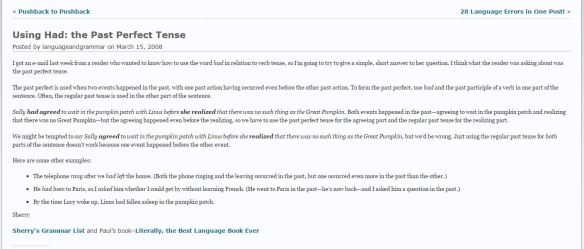
Using the Word “Had”

Had. Had had. It’s a third person past writer’s nightmare. When do you use the damn thing, and when do you don’t? I’ve tried to look up the rules, and the rules are about as clear as a mud puddle.

when to use had

This is probably the clearest explanation I’ve ever found on the subject. When I write, and when I edit for others, I use my woman’s intuition and hope for the best.

Being Lazy

Get, Got, Had, Has, Put. These are the laziest verbs I’ve ever seen and can be easily substituted for a real action. I’m guilty of using these. Especially if I’m on a roll and cranking out words.

She got off her horse. Really. She didn’t jump, slide, or fall?

He put the paper away. He slid the paper into the file folder.

She put her coat on. She threw her coat over her shoulders and rushed out the door.

If I edit for you and I see these, I’ll tell you these are lazy and to do better. You always can.

Being Too Wordy

New writers keep an eye on their word count like a falcon on a mouse in a field. It hurts to take out words, but it will hurt your read more to read the useless ones you’ve kept in your novel.

When I edited Summer Secrets, (six novellas totaling 150,000+ words) I mean, really edited them, I took out, on average 1,000 words a novella. That’s 6,000 words in total. My editor very well may find more. My favorite editing book I’ve read so far on the topic is Rayne Hall’s The Word-Loss Diet. (You can find it here.)

Head-hopping

People defend head-hopping because authors still do it. I guess I shouldn’t say still. Ernest Hemingway was famous for letting you know every single thought of every single character, including animals. So, yeah. But he’s not being newly published today; you’re hoping you will be, and the general consensus is you don’t head-hop. It’s tough advice to dish out because I’m reading a book right now where the author head-hops between the two main characters, and it doesn’t matter who’s POV the scene starts with. It’s a contemporary romance, and I’ve been told that it’s more common in that genre, and maybe even more acceptable. But I would caution you doing it because it can quickly become out of control, and take it from a head-hopper–it’s hell to fix.

Person/student/mom/dad/author/parents = who, not that

This is probably my biggest pet peeve of all. People are who. Students are who. Parents are who. Humans are who. Authors who use “that” to refer to people drive me nuts. When you use “that” to refer to a person, you are turning them into an object. Please don’t do that. Companies . . . that. Maybe.  I do not use companies that hire people who are rude to their customers.

Naughty words

I have a list of naughty words that I find and delete after I complete my mauscript. Words I use on a regular basis that I don’t need like just, pretty, really, that. Those are just for starters.

When I’ve edited for people I’ll get snagged by a word, and out of curiosity I’ll search for it to see how many times it pops up. When Joshua told me to look up some of these words, I was appalled to realize I used “just” over 500 times. Pretty and really about the same as well.

You can go crazy with actions too. How many times does your character nod or lean? Shake their head? Furrow their eyebrows. Frown. Sigh. Shrug. Does your herione’s heart skip a beat so many times she needs heart medication? If you can get a good editor or beta reader or critique partner who (do you see what I did there?) can read your work for you, you can make up your own list, but for now, here’s mine:

Starts, started, start

Turns, turned, turning

Looked, peered, glanced, stared, studied, gazed

Frowned

Could

Sighing, sigh, sighed

Breathed, breathing, breaths

Smiled, smiling (use other ways to describe their happiness)

Wondered, thought, understood, realized

Nodding, nodded, nods

Shook (the ‘no’ gesture)

Felt

Relaxed

Just

Really

Only

Pretty

Very


Obviously, I could go on and on, because many books have been written on this subject, and I encourage you to read them. I love Ashley Forge’s Self Editing for a Penny. She taught me a lot, and I recommend her book over and over again.

There’s no way you’ll ever avoid not ever needing an editor, but you can teach yourself to write a cleaner manuscript. Being self-aware of common mistakes, and understanding why these are mistakes, can take time, but one day you’ll be able to crank out a fairly decent rough draft. Read, read, read, and write, write, write.

It all starts there.

Thanks for reading!

Do You Really Need an Editor? Er . . . Yes?

Orna Ross, from the Alliance of Independent Authors, said in a podcast I listened to the other day, and I paraphrase: “Stephen King has an editor. Why would an indie think s/he didn’t need an editor? It’s the biggest mistake an indie author can make.” Or something along those lines. She, with others associated with Alli, have a lot of informational podcasts. You can watch their videos on YouTube, or find them in your podcast app on your smartphone.

I’m an indie author, and I had a few issues with this. First of all, Stephen King doesn’t pay for his own editor. Not out of his own pocket, and certainly not at a loss like most of us just starting out. Secondly, when he puts out a book, a million people read it, and it more than likely will get turned into a movie. Thirdly, because we are one the outside, we don’t know how much of the editor’s advice Mr. King actually takes. Does he take plot advice? When he’s told one of his characters is reading flat, does he fix that character, or does he tell his editor to shove it?

Comparing us to Stephen King didn’t help her make her point.

Or did it?

Indie authors are in need of an editor more than probably anyone. Especially if that book is their first. Or even their second, or their third.

There are different editors out there; they range in duties from helping you plot before you even write your book (that would be more like a writing coach, but developmental editors have their say in your plot) to simply proofreading it before publication.  These types of editors cost hundreds of dollars, and if you’re told you need even more than one of these kinds of editors, it can be intimidating.

I’ve always advocated that an indie author do as much as they can on their own. This isn’t just about being cheap–it’s good business. You are not only an independent author when you write a book, you need to be a self-publisher if you want people to read it. You need to know what you’re doing so you can make good choices for your business. Especially if you’re planning on doing this for the long haul.

(And you can forget about special treatment from a publishing house if you want to get traditionally published. They ask your book be as close to publishable as possible to cut editing costs. It’s not unheard of to hire an editor to edit your manuscript before you query.)

The bottom line is you need someone else to look at your stuff before you publish it. We all learn something new about writing on a daily basis, so your writing will never come out perfectly, and I don’t believe a writer can spot all their own issues. (We all learn, we never stop, so maybe Stephen King does listen to his editor.) That’s where an editor comes in.

That’s not to say you can’t substitute. If you are in a writing group, your critique partner could stand in for a developmental editor.

Maybe your friend who has an English degree and can diagram a sentence with her eyes closed can read your manuscript and look for such things such as subject/verb agreement, faulty sentence structure, and correct word usage.

Maybe your best friend is a prolific reader and can read for typos.

If you can take the criticism as how it’s supposed to be meant,  not an attack on your writing, but rather an honest attempt to help you improve your work, you can learn a lot from the editors and “editors” in your life.

When you compare writing a book to having a baby–nothing could be truer. You don’t birth a baby on your own. You have an OB doctor, nurses, a doula perhaps, your partner, your mother to give you support. You don’t have a baby alone, and you don’t write and publish a book alone, either.

As for actually paying an editor, a real one who knows what they are doing, that is a decision left entirely between you and your pocketbook.

I use a paid editor, but she doesn’t do it as her day job. She’s a fabulous writer, and she’s a fabulous editor. I’ve learned a lot from her feedback, and my writing has improved a lot over the past year. But she’s busy with her own projects and a full-time job, so I’m doubting she’s going to stick with me and my writing career as she is trying to get her own off the ground. I’ll need to find someone else to edit the contemporary romance series I’m going to be publishing in the coming months.

I’ve learned a lot from beta readers and my editor. I’ve also started to read self-editing books to help me recognize my mistakes and cut unnecessary words. I’ve started outlining so my plots are tighter and there’s less chance of plot-holes. I’ve started doing character workups so I can get to know my characters before I write about them. This saves me from writing flat characters.

You are writing a book–a lot of what an editor can and will do for you, you can take into your own hands as you actively learn your craft.

An editor can help you put your best work into the world.

And that’s what we all want.

You can read a great article about editing here.