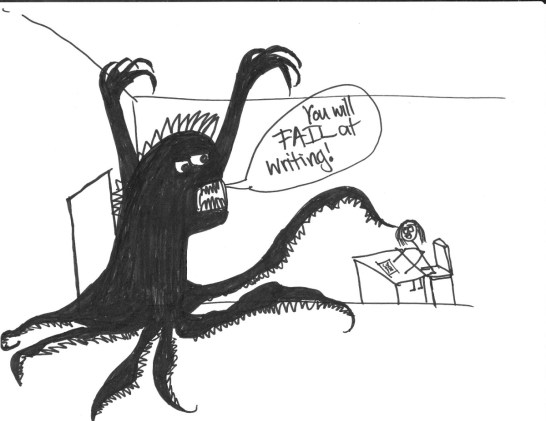
Competitiveness. Let’s Not Talk About It

The other day, I got into a little spat with a couple people in a Facebook writer’s group. Someone announced that they had just published their book. There were a lot of congratulations, but there was one woman who felt the need to edit this person’s post. Yes, there was a typo in it. But it was clear this person hit the comma on their phone instead of the spacebar. No harm done, right?

The fact that she called him out on it wasn’t really what bugged me–it was the fact that her own post had a typo in it. All this poor guy did was post he’d published a book. That’s all. So why the need to attack him? I usually let this stuff go, but the fact she did it with a typo herself made me jump in.

typos_LI (2)

But like all good catfights, it didn’t end there:

i'm going to hell_LI

Did you notice that the person corrected her typo? I wanted to tell her that correcting her typo didn’t make her comment any less bitchy.  The person correcting my comment was someone different, but I like to think I got the upper hand there, too. Know your grammar before you begin correcting people, or you’ll just look like a fool, and yes, it is damaging to your online presence.

I’m trying to figure out why people need to be so callous. It came to me in the shower (where all good ideas do).

We jump on each other because we’re insecure and jealous. These people probably haven’t published anything, and they felt threatened by this person’s announcement.

Does that make it okay? No of course not, but I think it does point out something no one likes to talk about: competition.

Writers support each other, that’s a given. When we’re writing.

But what about when we’re trying to sell our books, novellas, shorts? What about when we try to market our blog posts?

There are only so many publishers/agents/bookshelf space to go around. Whether we like it or not, we are competing for prime real estate.

So when we feel like people are “ahead of us” in some way, be it a new marketing trick, or what????!!!!!! . . . they just put out another book? It can feel disheartening, and it can make some people, not very nice frustrated.

But you know what? It’s okay to have those feelings. We all feel them. Yes, I support all my writer friends; yes, I want their books to sell.

But.

I want my books to sell, too.

Maybe, maybe you can even admit, you want your books to sell more than you want their books to sell.

You can admit that–in a dark little corner of your soul. It’s okay. It’s natural that if someone is choosing between your book and someone else’s you want that person to choose yours.

But it’s what you do with those feelings that matter.

Don’t: attack people online; in the end, it only makes you look bad
Don’t: not write because you feel it’s hopeless
Don’t: stop supporting your friends because they make you feel inferior with their progress or sales

Do: turn those feelings into productivity and work harder
Do: trudge through those feelings and support your friends anyway (Jennifer Probst has a wonderful section on this in her book Write Naked which you can find here.)
Do: keep those feelings to yourself, or confide in someone you trust who won’t turn on you or blab behind your back.

The guy who was put down in that thread PM’d me to thank me for sticking up for him. I have been known to stick my nose in a few places where it doesn’t belong because I’ve been on social media long enough I don’t give a f*ck what people think of me. If I see nastiness, for the most part, I’ll call you out. There’s no need for it. We all have one goal: for people to read our work. Being nasty online is counterproductive to that. You can bet I’ll remember those two women, and if they ever publish anything I’ll look the other way.

Speaking of memory, I remember Rebecca Thorne posted a little something about this during her experience at the Dallas Writer’s Conference in 2016. Must have stuck with me to remember a blog post from over a year ago, and you can read it here.

After I defended my use of and at the beginning of a sentence, I left that group. I don’t need that kind of negativity in my life–and I certainly don’t need to waste my valuable time defending idiots who just won’t get it anyway.

You can be supportive and still want to do well for yourself.

And for those other two, karma’s a bitch, baby.

karma


Let me know what you think!

Vania Blog Signature

It’s Beginning to Look a lot like . . . Something the Cat Dragged in

I’ve been blogging close to nothing these past few weeks. I’ve been sick, but not like, a flu/head cold/stomach bug thing that wouldn’t go away. I’ve had an infection in the cartilage of my nose, and while the pain has been annoying and uncomfortable, it’s been the antibiotics that have made me feel off for the past few weeks. I went through two courses in the past 24 days. I just finished my second course a couple days ago, and I think my body is finally getting back to normal. Though now I have some weird sinus/fuzzy ear/ face pressure thing that won’t go away. It can’t be anything bacterial-related since all the antibiotics I’ve been on would have killed it. I’m just biding my time, waiting to see if my body will right itself after all the drugs I’ve pumped into my body lately. (With the second round of antibiotics I was also put on Prednisone; that didn’t do me any favors.)

cat-2749889_1920

Tired of this BS. I want to get better!

Anyway, so I’ve been fuzzy, sleeping, and my nose hurt until the antibiotics kicked in, and the tip of my nose still tingles and aches in the cold (I live in MN). I admire anyone who can function on a day to day basis with any kind of chronic illness. Not only does the pain do things to your body, it preys on your mental health. I couldn’t concentrate while waiting to see if the drugs were going to kick in or not. And yes, I have to force myself to stop poking at my nose to see if it hurts. The short answer, yes. Anything you poke at long enough will start to hurt. LOL

Through it all, any mental wherewithal I had went into my books. I released book one of my Tower City Romance on November 18th to little to no fanfare. My fault. But that’s okay. My second book is loaded into CreateSpace and KDP and is ready to go on December 18th. I’m editing and scrambling to get book 3 ready for release on January 18th. I might be behind on that one, and I may need to settle for the end of January, or even the beginning of February. I don’t want to sacrifice any part of editing just to publish, and I know Christmas is going to take a little time whether I want it to or not.

retro-gifts-1847088_1920

On the bright side I already know the next book I’m going to write–it’s a stand-alone and once I get going on it, I should be able to write and publish it rather quickly. I’ve already got it plotted out, and I’ve been playing with the cover. I’m so used to dealing with a million words at a time (Summer Secrets was about 160,000 words all together and this trilogy is 210,000 combined) that working with only a 70,000-word book will feel like a dream come true.

Anyway, so that’s what I’ve been doing these past few weeks.

I’ve also been fiddling with what I can do to break into the reader/social media barrier that eludes a lot of writers.

binoculars-1209011_1920

I read a lot of books so, for now, I’m going to focus on reviewing them. But not just any books. I’m going to read romances (what I write, naturally) pick at them, and compare how they are written to what I’ve learned in the world of self-publishing. That way I’ll be reading my genre, get a blog post out of it, but also I can compare what’s being published to what indies are “learning” in the Twitter Writing community. A win-win for everyone.

I’ll start with The Mountain Between Us by Charles Martin. I watched the movie with my sister and bought the book to compare. But that is another blog post.

I realize 2017 is coming to a close, and I’ll be writing another blog post or two about what happened in 2017 both in the publishing community and in my own career. I have a lot to share–if my nose and my ears stop doing weird things.

Fingers crossed!


Vania Blog Signature

Let’s Talk about WAS

“Was” is a nasty, dirty, filthy word, am I right? “Was” means, oh my God, you are writing in the passive voice, and all passive voice must be eradicated from your Work in Progress, or you are going to fall into the fiery depths of writing hell when you die.

fire-298105_1920

Indies are told it’s bad, that you need to take it out of your writing. Even when I edit for others, I will find it, give the authors the bad news that yep, they used it 4,000 times in a 70,000 word WIP.

But just how bad is it?

I’m reading The Snowman by Jo Nesbø right now. I love it. I saw the trailer for the movie, and I wanted to read the book before I watched the movie. (Chances are after I finish the book I won’t want to watch the movie anymore, but that’s a different blog post.) But you know what I saw when I opened up the book? Well, yeah, I saw the front matter, the title page. But what was the first sentence of the first paragraph?

It was the day the snow came.

A book by an acclaimed author whose book was turned into a movie started his book with passive voice. He could have written, Snow came that day or It happened the day it snowed. Something. But he didn’t. Why didn’t he? Why didn’t his editor catch it? Ask him to fix it? I wonder how many “was” words he uses in his book.

When should you write out “was?” Here’s what I think.

wite out

When it’s an indicator of tell, not show.
This is another no-no in the indie world. Always, always show, not tell. And for the most part, I agree. Description is always a lot better than telling your reader something.
When I was editing Don’t Run Away one of my little triumphs was:
Dane was livid.
I turned it into:
Dane trembled with rage.
You can see right away that’s a better way to go. I didn’t do it so much as to get rid of the “was” word, but I wanted my readers to picture what Dane’s anger looked like.

When the sentence simply sounds better without it.
This is tricky because how do you know? You can try to rewrite your sentence, but if you can’t get it to make sense without “was,” leave it alone.  Writers use “was” because it’s easy. It’s a lot easier to say, The sky was blue, rather than, The blue sky shone; not one cloud masked its brilliance. But not every sentence needs to be written that way–it’s up to you as the author to pick and choose, to decide where you want to put your energy.

When you freaking use it too many times. 
It always sucks when you do a search to see how many times you’ve used a crutch word. Just, 500, that, 1,000. Nodded, smiled, rolled eyes, shrugged.  “Was” is no different. If you have a ton of them, it could mean you are doing more telling than showing, that you’ve gotten a bit lazy, and you need to examine your WIP to see what you can fix. A paragraph describing a room like this:

The bedroom was small. A bed was pushed against the wall to make room for a desk that was filled with papers. A dog was sleeping at the foot of the bed, and a picture was hung crookedly on the wall. The rug was dirty, and the closet door was open, revealing clothes hanging haphazardly on their hangers.

Can be turned into this:

A dog lay on an unmade bed that had been pushed against the wall to make room in the small space. A desk filled with paper sat under an open window.  A rug that had seen better days lay in front of a closet that hadn’t been closed properly, and Janet wrinkled her nose in distaste at the mess inside. She straightened the crooked picture on the wall before leaving. Jack wasn’t there. She’d have to look for him somewhere else. 

Not only are you getting rid of “was” words, you are getting rid of repetition. I’ve edited for a few people whose paragraphs sound the same. Subject + verb + the rest of the sentence. If you want to get words down and move on, that’s fine. Some writers like to worry about the editing later. But please do go back and mix up your sentence structure. Sometimes this includes getting rid of “was”, sometimes it means starting a sentence with a prepositional phrase.

When you can fix the verb.
Don’t say, He was standing say He stood. She was watching turns into She watched. This is an easy fix and will save you some words too, if your WIP is bloated and you need to cut it down.

Rewriting some sentences that have “was” in them can make a sentence or paragraph stronger, can show your reader something instead of telling them what is going on.

But I also think that “was” is a lot like “said” in that it is invisible to a reader. The room was dark, and Stacy stumbled. We know what that means. We can picture that just as clearly as Stacy couldn’t see two inches in front of her face. She didn’t know what lurked in the shadows of the bedroom, and she tripped over God knew what when she gingerly took a step inside. Did the second example sound better? Maybe it did, but it’s also exhausting to read that all the time. It’s also exhausting to write that way. If every author tried to eradicate “was” from their writing, every book would be as thick as a Stephen King novel.

There is room for “was,” and I’m not as hardcore to get rid of it as I used to be. As long as you’re conscious of how many you have, if some of them can be replaced with something stronger and you do, then you’ll be okay.

Sometimes we can get too caught up in following every single rule out there. And it’s disheartening to be trying your best when you read trad-pubbed books doing things you’re trying not to do. Give yourself a little break. Keep on eye on the numbers, take your beta-readers’ opinions to heart. Listen to your editor.

Avoiding “was” hell won’t matter too much if you’ve trapped yourself in editing hell. Find a happy medium. Your sanity, and your readers, will thank you.

#SmutChat Self-publishing Topic Recap!

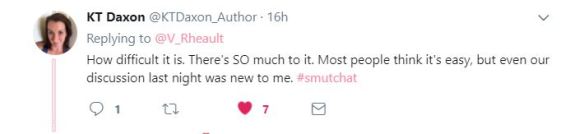
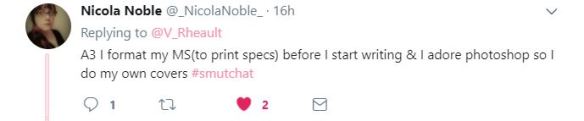
I run a Twitter chat called #smutchat. It’s geared toward more than just smut, (though I am a romance author and I like to chat about that too, from time to time) and last night we talked about self-publishing.

I said I would recap the chat for a few people who couldn’t make it, so here you go. 🙂


#SmutChat-Selfpublishing (2)#SmutChat-Selfpublishing

Question one, when I was making it up, was intended to be a question about the process of self-publishing. Was it formatting your paperback book? Dealing with uploading to KDP? Maybe figuring out your book cover? Some hit the nail on the head; others went far beyond.

smutchat recapsmutchat recap 4smutchat recap 2smutchat recap 1smut chat recap 3

smutchat recap 5


#SmutChat-Selfpublishing (3)

To be honest, I didn’t know what I was going to get out of this one, and the answers were all over the place.

smutchat recap 7smutchat recap 8smutchat recap 9smutchat recap 6

#SmutChat-Selfpublishing (4)

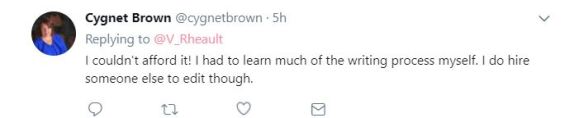
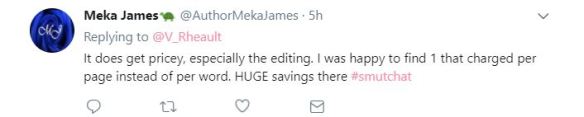
This question brought about the answers you would expect. It’s expensive to publish a book if you hire out, and no we can’t afford it, and no again, we probably won’t see a return on that investment any time soon. Yet the people who don’t know what they’re doing and publish bad-looking books muddy the pool for the rest of us who do it right.

smutchat recap 10smutchat recap 11smutchat recap 12smutchat recap 13smutchat recap 14

smutchat recap 15

nadia covers

gareth editing


#SmutChat-Selfpublishing (5)

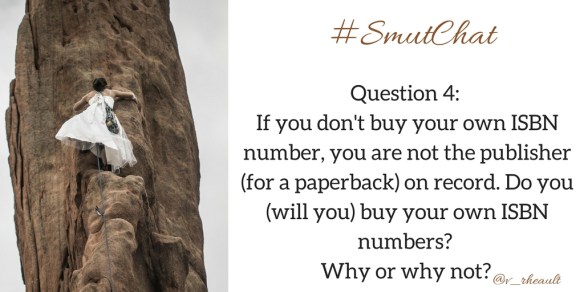
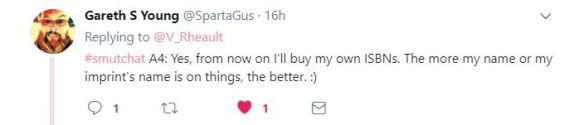
ISBNs are expensive–at least, they are in the US. CreateSpace gives you one for free and if you use theirs, they are listed as your book’s publisher, not you. Kindle Direct Publishing will give you an ASIN number, but I read somewhere that selling an ebook isn’t considered publishing per se, it’s just selling a file. I use my own ISBN numbers for both my Kindle file and my paperback for CS. Here’s what others said:

smutchat recap 16smutchat recap 17smutchat recap 18smutchat recap 19

emae isbn numbers

#SmutChat-Selfpublishing (6)

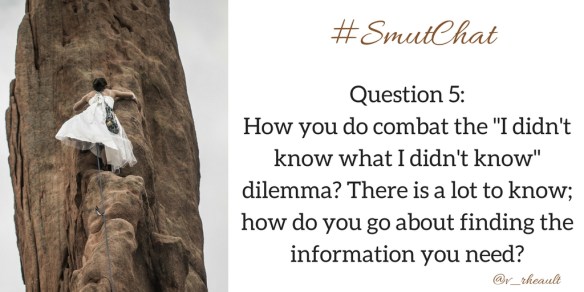
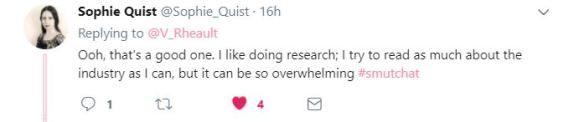
This is tough because if you don’t know you don’t know it, how will you figure it out? I researched the hell out of self-publishing, CreateSpace, and Kindle before I published On the Corner of 1700 Hamilton and I still got a lot of things wrong. When you self-publish on your own without help from someone who has done it before, you’re bound to make mistakes. I still make mistakes. I had to resubmit my cover for Don’t Run Away. CS said they “fixed” my cover, but I wanted to fix it myself. The more I know, the better off I’ll be. Here’s what other people thought:

smutchat recap 20smutchat recap 21smutchat recap 22

smutchat recap 23smutchat recap 24

That wrapped up the chat about self-publishing. Though I didn’t showcase them here, there were several tweets about book marketing. I haven’t delved into marketing yet, so I don’t have anything to offer in the way of that or what works. I do know that I have been reading up on Amazon Ads, and a good book by Brian D. Meeks seems to make a lot of sense. Whether it will work for you (or me) remains to be seen, but you can find it here. I have also been reading about Facebook Ads and this is the book I’m reading.

Rachel Thompson @BadRedheadMedia  runs a book marketing chat. You should check out her chat and maybe get some tips and ideas on how to market your own book. She has also written a book about it, and you can find it here.

In some sub-tweets, I told someone to look at Author Marketing Club, run by Jim Kukral. He’s co-host of the Sell More Books Show podcast I listen to every week. He also runs Happy Book Reviews if you’re interested in finding more book reviews. I haven’t used his services so do so at your own risk. Like everything online, be careful where you throw your money. I do listen to his podcast though, and he seems to be on the up and up or I wouldn’t point them out to you.

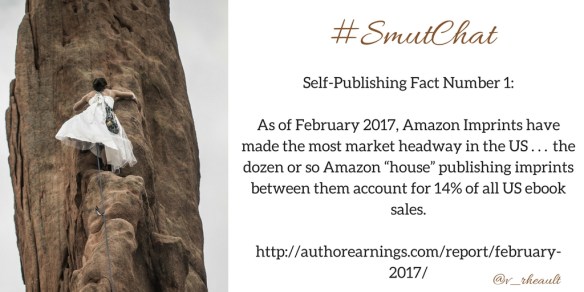
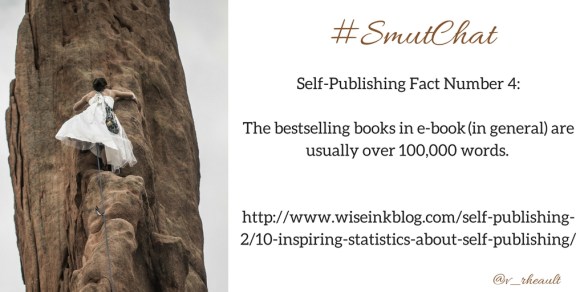
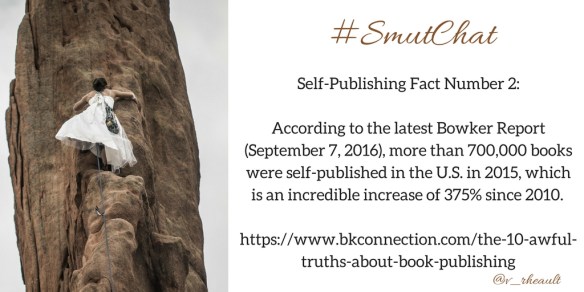
I also tweeted some interesting facts about self-publishing:

#SmutChat-Selfpublishing (14)#SmutChat-Selfpublishing (13)#SmutChat-Selfpublishing (12)#SmutChat-Selfpublishing (11)#SmutChat-Selfpublishing (10)

Anyway, thanks for reading over the recap. I apologize if I didn’t feature one of your tweets to a question. It was difficult wading through the answers, though I do appreciate everyone who participated last night! If you’re interested in all of the answers, or you want to look at the sub-tweets, please take a look at the hashtag! It was a great chat!

Vania Blog Signature

Read to Me, Baby!

Many have you may have realized I’ve disappeared off social media for a bit. If you haven’t, uh. Anyway, so I’ve been editing the first book in my Tower City Romance Trilogy. I’ve been working on this for a while now, and I’m so close to publishing, I can taste it.

coffee-2436940_1920

But editing is a bitch, and it seems like no matter how much I do, it will never be enough. It doesn’t help that I’m taking an online editing class, and every time I complete lesson, I find a million more things wrong with my manuscript.

One class was extremely helpful though and we were told to either make Word read our work to us aloud or to read it ourselves. I can’t stand the sound of my own voice, and it’s a fact that you know what it says so your brain may fill in the blanks and you won’t catch what’s wrong, anyway. I didn’t know Word could read to you so I looked up the directions. You can find them here.

Quite simply, I fell in love with it. I can’t stop listening to my own work. I delight in hearing a perfect sentence or laugh when a piece dialogue sounds as good spoken as it did in my head. Of course, it’s not perfect. He doesn’t say some of my characters’ names right, and he skips over ellipses and em dashes. What does he get right? Well, he reads everything just as it’s written: the double words, the typos, the skipped words. I’m not sure a human could even do this level of proofreading. It’s not fail-proof, he doesn’t know I typed except when I meant accept, but that’s the beauty of him speaking it aloud, you can read along and correct as he goes.

The voice sounds more like this than that, but that’s okay.

This makes it tedious–it takes a long time to listen, correct, listen, correct, listen. Sometimes to the same paragraph over and over again. But I see more advantages of this than not. Audio is getting bigger and bigger, and there are a couple avenues indies can take to make audiobooks of their books.

ACX
ACX stands for Amazon Creative Exchange. Through ACX, for a fee, an indie can turn their book into audio and sell it alongside their books on Amazon.

Findaway Voices
Draft2Digital has partnered with Findaway Voices to give indies another choice than to go with Amazon to turn their books into audio. You can read about it here.

How cool is it that you already have an idea of how your book is going to sound if you decide to turn it into audio?  You won’t have to worry how that two-page paragraph, where, oops, you have six comma splices and five semicolons, will sound. You won’t have to worry if it sounds odd every time your characters speak to each other and they say each other’s names a million times.

Not to mention, that since you have already heard everything in your book spoken aloud, you really won’t have to do anything with your proof but make sure the inside and cover turned out.

So, this is what I’ve been doing for the past few days. I have a publishing date set for November, and I’ve been trying to get through this book. It’s slow going because as I said, he’s finding things I want to fix, so I do, then I listen and have to fix it if it doesn’t sound right, or if I made a mistake while I was fixing my mistake. Yeah, that happens. A lot. But I know that after all this is done, my book will sound the best I can make it.

Have you tried this? Tell me what you think!

Vania Blog Signature


Point of View vs. Head Hopping

When I hosted my editing #smutchat on Twitter a few weeks ago, I was surprised to learn people were confused between POV and head hopping. I thought I would write a quick refresher on the topic. This will just be an overview because complete books have been written on the subject, and I’ll list my favorite resources at the end of the post.

point of view

When you look up the definition of POV, this is what you’ll find. Essentially, when you talk about characters and writing, point of view is the character’s view and thoughts of the story. When you write in 1st person, you only have one point of view—that of the person who is “I.” Many writers like to write in this way because it’s easier to keep track of characters and plot. You don’t have to worry about who is doing what when because there are the thoughts and actions of only one character. The worry about head hopping is nonexistent because you only have the thoughts of the “I” character.

bubble-19329_1920

Writing in 3rd person is different. That is when you can write in the POV of several characters if you want. A popular example of this is Game of Thrones. Each chapter is written in the POV of a different character, and Game of Thrones has a lot of characters. Some writers do this with their 1st person characters—each “I” has their own chapter, and in this way, the author is allowed to move among characters. I think this is lazy, and be mad at me if you want, but ultimately, if you want the POV of more than one character, you might as well just write in 3rd person. It’s cleaner and reads better.

Anyway, I write romances. Most romances are written in 3rd person, and the point of view alternates between the hero and the heroine. (Some longer romance sub-genres like Chick Lit and Romantic Mysteries will add other POVs, say that of the best friend, or the villain.) Switching between the hero and heroine is fun because we like to know if the characters have different thoughts and feelings about a situation they are both involved in. Like a kiss: He’s swept away by the moment, but she’s grossed out because of his breath.

But switching points of view in this way also means changing scenes or chapters and making sure each character and their thoughts are confined to their specific scene or chapter.

Head hopping occurs when an author starts a scene or chapter with the POV of one character, but then the author slips in thoughts of different characters who are not the owner of the point of view.

woman-1172718_1920

Let’s take a look at a clean POV scene:

Amy pushed her food around her plate. She didn’t understand why her boyfriend’s mother hated her so much. She could feel the woman glaring at her across the table. Her boyfriend, Zach, rubbed her back. She appreciated his support, but sometimes she wished he would just tell his mother to chill out. If the woman didn’t stop being so mean to her, Amy would stop eating Sunday dinner at their house. It wouldn’t make Zach very happy, but he would deserve it if he didn’t start sticking up for her.

This is a quick paragraph in Amy’s point of view. We only know her thoughts. She’s uncomfortable with the situation, she’s resentful Zach doesn’t defend her against his mother. There isn’t any head hopping because we don’t know what the other characters are thinking. If this is a romance between Zach and Amy, and we want to know Zach’s thoughts about dinner, we would need to make a scene or chapter break and begin the new scene or chapter in Zach’s point of view.

Zach wished Amy would be nicer to his mother. He was going to have to break up with her if things continued this way. He’d always thought Amy was a sweet girl, and he’d been happy when he asked her out and she said yes. But things went downhill the day he introduced her to his mother. They hadn’t clicked from day one, and it was Amy’s fault. She caused so many problems acting so pretentious. Disgusted with how dinner was going, he guzzled his beer hoping to take the edge off. Breaking up with her was the last thing he wanted to do, but he couldn’t marry a woman who didn’t get along with his mother.

This is why I like 3rd person POV so much. You can surprise your readers with character reveals. Were you surprised Zach was taking his mother’s side? Maybe you were because in Amy’s POV Zach patted Amy’s back and she took that for support when in actuality, Zach was thinking thoughts that were anything but.

This is a classic staple of romances—misunderstandings and conclusions being assumed up the tension and create conflict.

Let’s take a look at head hopping. Head hopping is when the author tries to cram thoughts of more than one character into a scene. You can still start the scene or chapter in the POV of one character, but then you start slipping in thoughts of your other characters. You aren’t necessarily changing POV, but you are revealing thoughts from characters who aren’t having their “turn.”

Amy pushed her food around her plate. She didn’t understand why her boyfriend’s mother hated her so much. She could feel the woman glaring at her across the table. Why is she so mousey? Lydia thought, stabbing at the pork roast she’d made for dinnerHer boyfriend, Zach, rubbed her back. You need to be nicer to my mother, Zach fumed to himself. If the woman didn’t stop being so mean to her, Amy would stop eating Sunday dinner at their house. It wouldn’t make Zach very happy, but he would deserve it if he didn’t start sticking up for her.

This is a short example of having three people’s thoughts in one paragraph. We still have Amy’s point of view—she can think to herself without the italics because the scene is hers, and we’re in her head. But then I added in the thoughts of Zach and his mother. I put those in italics because the scene does not belong to them but we are given a glimpse at what they are thinking.

The question during #smutchat was: how important is avoiding head hopping when you can still find it in today’s books?

There is still head hopping in today’s traditionally published books, even though us indies are told over and over again not to do it. Nora Roberts head hops, and I just abandoned a book that head hopped between the male and female main characters.

So is it important not to head hop?

Agents and editors will tell you not to do it. Readers will tell you they don’t like to read it because it’s jarring and takes them out of the moment.

In my opinion, head hopping is lazy and an author can learn to write well and avoid it.

As a reader what do you like?

As a writer?

Tell me what you think!

Other links:

A great post by Bryn Donovan can be found here.

Fight head hopping by learning how to write in deep POV. Take a look at Marcy Kennedy’s book here.

Also another book by Rayne Hall: here.

Vania Blog Signature

Anchoring Your Characters in Their Scene

I’ve shared some of my work lately, and I’ve received a lot of feedback in return (don’t worry, it was all good). But the best compliment I received was that I knew how to effectively set a scene.

girl-358771_1920

After I thought about it, I realized that is probably the number one thing I comment on when I edit or beta read for someone (besides making notes on grammar and punctuation). I like knowing where the scene is taking place. I think describing the scene, letting the reader know where your characters are, is important. If your characters are in a restaurant, but you don’t write that they are, your characters could be eating their dinner anywhere: on a bridge, at the park, on the moon. This might not seem like a big deal until all of a sudden where they are is part of the plot. Maybe your male main character moves in for a kiss, and your female main character balks. Why would she do that? Because they are in the middle of a grocery store and she doesn’t want a foot of tongue down her throat in the meat department. This makes him angry (why is she such a prude) so they fight. You’ve written that they are grocery shopping. Everyone can picture a grocery store, so problem solved.

supermarket-949913_1920

What happens though is, if you don’t write where the scene is taking place close to the beginning of the scene, your readers have already guessed where your characters are, and if they can’t, your reader is going to feel disorientated because she can’t picture the scene in her head. You haven’t given her anything to work with.

This is why when you read editing how-to books, they recommend describing a character right off the bat—this way your reader doesn’t have a chance to make up her own mind as to what a character looks like. If you allow your reader to do that but then go on to describe how your characters actually look and it differs from what your reader thinks, your reader feels cheated. You don’t want to give a reader an excuse to put your book down. Ever.

But you don’t have to anchor every single scene. If your scenes take place one after the next, say you’re just flipping POV to another character, or you’re starting a new chapter and your character hasn’t moved, repeating where your character is–standing by the fireplace or sitting at the kitchen table or peering out the window, is redundant. Your readers will remember where your characters are fighting, eating, making love, whatever they’re doing. But if in one scene they’re having sex, then in the next you fast forward and they’re having date night at the movies, ah, yeah, you want to tell your readers they’re at the movies now because your readers don’t want to read about your characters having sex during “The Hitman’s Bodyguard.” (Well, maybe they do, who am I to judge?)

I’m going to also assume that unless your characters are traveling across the country, or across the world, or into space, that you won’t have many settings in your novel/novella/story. And that’s fine. You don’t need to set your story in all of America to make it interesting. The story I’m writing now, for example, has three or four settings at best, and I’m half way through it.

fantasy-picture-2550222_1920

Here’s a quick list of when you should set a scene:

  1. When your characters are moving. If they are in the car, describe the car (the owner is a slob and has tons of fast food garbage in the back seat and the car stinks like grease). Describe what she sees out the window. How does the engine sound? Maybe the radio is on. The window is rolled down, and the character’s hair is flying in her face. If they’re taking a walk, describe the trees, are they changing colors because it’s fall? Describe the sidewalk. Cracks? Garbage along the path? You can work these details into the dialogue and narrative.
  2. When your characters are in a place they’ve never been before. This seems like a crazy thing to mention, but it’s true. If your characters are visiting a place they haven’t been to three-quarters of the way through your book, you may forget to mention where they are. Especially if the dialogue is more important than where the scene is taking place.
  3. When your characters are in a place they have been before, but things have changed. A teenage girl is mad because her mom cleaned her room. A room feels different because someone has been there when they shouldn’t have been and things are slightly out of place.
  4. When your characters are flashing back. It is really important that you describe where they are so your readers know that this is a flashback. I did this in book one of my trilogy. My characters were on a plane flying home, but I used a flashback while they thought about their vacation. I had to set the scene for each of them as they were daydreaming about different memories. I wanted to let my readers know they were thinking about their vacation while they were on the plane.
  5. When it’s important to the plot. It might not be so easy to forget to describe where your characters are if you depend on it for part of the plot. (The sun is shining in your character’s eyes while she’s driving so she hits a kid jaywalking.) But it’s best to pace your descriptions so they are already in place when you need them. (Having the sun conveniently show up to blind your character is a cop out. Have your character admire the sunny day before she climbs into her car.)

castle-2516837_1920

I can explain more on how to set a scene next time. For now, my 1,000-word limit is almost up. Did I miss a time when you should set a scene? Let me know!

Vania Blog Signature


Making Time to Beta Read and/or Edit

I beta read and I edit for my friends. When I beta read, sometimes that turns into light editing—I’ll point out typos, etc., if/when I find them, and I think the authors appreciate that. Sometimes I get asked to do a full edit, and sometimes the author isn’t clear, and I end up doing a full edit, anyway. Doing an edit is almost easier than only beta reading because my eyes immediately start searching for mistakes.

canstockphoto89558

This is true when I read anything. Reading for pleasure is almost non-existent because I automatically start editing and revising. “I would have written it this way. . .” While this can be good practice, trying to turn it off to enjoy a book is almost impossible. It doesn’t help when I feel justified when I do find something wrong.

But I like to beta read and edit because it sharpens my own skills as a writer. If I see repetition, telling instead of showing, words being used in the incorrect context, head hopping, it makes me more sensitive to it and I spot it more easily in my own work.

Stephen King says you don’t have time to be a writer if you don’t have time to be a reader, and this is true. You learn by reading other people, and you also expand your vocabulary. You improve your grammar and punctuation when you see it used correctly and if you think it isn’t being used correctly, you can look it up. Fact-checking helps you and the person you’re editing/beta reading for.

stephen king reading

It isn’t easy to make time to beta read—we have so little time as it is, writers like to use that time to write.

I’ve often likened writing to other occupations: you don’t have a business without product to sell, you wouldn’t want your child to go to school with a teacher who wasn’t always updating her skills, you wouldn’t go to a doctor who wasn’t constantly going to workshops, seminars, and publishing in medical journals.

glasses-272399_1920

You can’t write books without reading other people’s work or fine-tune your voice without reading editing books and how-to books about the craft of writing. No organization is making you do those things; a company isn’t going to give you tuition reimbursement. You are your own boss and it’s up to you to keep learning for yourself.

Beta reading is fun, and it’s helpful, and someday you’ll need a beta reader. What goes around comes around, so try to make time when you can.

Tips on how to beta read:

  1. Sometimes you’ll start beta reading a book that doesn’t suit you. Figure out why it doesn’t before you say anything. If it’s not your preferred genre, speak up before you agree.
  2. If it is your genre, make notes as you read. What feels off? Is the beginning slow, are the characters flat? This is why you’re beta reading—to give useful feedback. Don’t be vague—the beginning lacked pizzazz. How was it boring? Maybe the action picked up in chapter two.  Did the author start the book in the wrong place?
  3. As you read to the middle look at the characters. Are they still interesting? Are they battling an inner conflict? Are they struggling? A saggy middle is something many authors, including myself, have an issue with.
  4. Look for inconsistencies. Are the characters’ physical attributes the same throughout the book? If they have a pet, do they disappear half way through the book because the author forgot to include it?
  5. How is the dialogue? Does it flow? Do what the characters talk about further the story?
  6. Do any scenes seem to bog the story down?
  7. When you reach the end, think of the story as a whole. Are there any plot holes? Any minor characters that could have been developed or any of their storylines that don’t make sense? (Ask if there is a sequel in the works if this is the case, sometimes the foreshadowing won’t make sense. But foreshadowing should only make the reader curious to read the next book, not make the reader wonder if the author dropped the ball.) Does the ending give you a satisfied feeling? Does it feel rushed? Do the characters complete their internal journey, face their fears,  finally get what they want?

Ideally, the author you’re beta reading for will give you ample time to read the book before publishing and tell you a reasonable deadline. Sometimes, if they’ve finished editing it and the piece is ready to be published, the author won’t wait.

This can put you in a bad position if you’re finding typos—you won’t get a chance to give your feedback to your author. If you’re given a deadline try to stick to it. But the urges to hit “publish” are strong, and if your author goes ahead and publishes without waiting for you, try not to feel hurt or resentful. You can still finish beta reading and forward on the mistakes you found. Perhaps s/he fixed them without telling you.

Sometimes you might be expected to leave a review. Ask first to be sure—especially if you didn’t care for the book. You may want to skip leaving a review rather than leave a poor one because this book is will be new and no review will be better than a bad one.
Anyway, beta reading or editing for people is win-win. It helps you become a better writer, and it helps the person you’re reading for.

blond-1866951_1920

We need to help each other be better writers, one chapter at a time.

Vania Blog Signature

Things to Think About When You Choose Your Setting

Last night was the second night of Settings for my Twitter chat, #smutchat. We don’t just talk about smut, we talk about lots of things about the craft, and where you set your story was one of the topics.

How do you know where your story is going to take place?

ipad-632394_1920

Generally, this is a no-brainer. If you’re writing fantasy, more than likely your characters are going to move around a world that resembles medieval times.  A story with a Prince cursed with magical powers who needed to fend off an evil sorceress wouldn’t have the same feel if it were set in present-day New York City. Along those lines, if you are writing a time-traveling saga, the historical periods you choose for them to travel to will play a huge role in where your story will take place. A contemporary romance wouldn’t be contemporary if you set your story in 1700 England.  You get the idea.

But when we talk about settings, we need to dig deeper than just the time and the place. The smaller details can have a huge impact on your story.

When I chose to write Summer Secrets, the first thing that popped into my head were couples on a vacation at a fishing resort.  I didn’t think beyond that setting other than each couple stayed in their own cabin, and each couple would have their own story. But as I began writing, I noticed how this setting both positively and negatively affected my characters.

cabin-2149726_1920


For every positive, there was a negative. They were on vacation, which meant they were relaxed, in a good mood. But as the story went on, the characters also got bored, and they rubbed on each other’s nerves. This created conflict that I didn’t foresee, but it was great planning on my part all the same.

In this vein I also didn’t realize exactly what cutting them off from other people would do. They were forced to talk to each other, whether they were tired of each other or not. As the title suggests, each couple kept secrets from each other and forcing my characters to talk because they didn’t have anyone else to talk to created some very tense dialogue, and of course, the unveiling of those secrets.

The setting caused some issues for people vacationing from the city: my characters got lost while hiking, bit by bugs, almost drowned, were hurt from falling in terrain they weren’t accustomed to.  Putting my characters into another environment would have worked too, so long as they were strangers to that environment so it would have caused outside conflict that they had to handle along with the internal conflict of being pushed together.

Choosing a lake resort gave my characters plenty of room for themselves where they thought things through, assumed things, came to erroneous conclusions. The seclusion also made my characters feel even more alone with their problems and secrets.  On the flip side, they also found peace being away from city life.

lake-696098_1920

When you think of your setting, look at it as a character in its own right. And when you create your setting be it world building for a fantasy, or choosing a city for your romance novel, think of some of these things:

  1. How will it positively affect your characters? Your character moves to the city of her dreams. Your male MC moves next door to the girl he’s always wanted to marry. Your character wins a trip on a cruise, or your knight on a quest finds a prosperous kingdom.
  2. How will your setting negatively affect your characters?  Your MC’s mother moves next door and makes your MC’s life a living hell.  Your MC’s boss hits on her at work, so now she views her workplace as a nightmare she must go to every day until she finds another job. The mansion your MC inherits from her uncle is haunted.
  3. How will the setting make your character feel?  An empty lake could exaggerate a character’s feeling of loneliness. A hospital setting could remind your character of an accident from his childhood and he feels fear when visiting his sick sister. A crowded room could make your character feel anxious and claustrophobic–maybe she was abused as a child and locked in a closet.
  4. Incorporate all the senses when writing about your setting.  Sight is the most common because we’re writers and we describe what our characters see. But what do they smell when they enter a diner? Greasy fish that turns her stomach? Visiting her mother’s home, does the smell of apple pie bring her back to her high school days after school?  Does your MC love her cat, but hates when her cat licks her because the cat’s tongue is too rough for her sunburnt skin? Does the music playing from a car passing by remind her of a date gone wrong?
  5. Setting can help you weave backstory into your character’s lives and novel. A man must go back to his hometown and gradually we learn why he left in the first place.

For me, the setting will pop into my head along with the characters and some of the plot. When I went to California, it was my first time in LAX and I was curious if I was going to see any celebrities (I didn’t), but being in an airport I had never been in before made a story pop into my head, characters, plot and all.  I’m champing at the bit to write it.

aircraft-742833_1920

In this day of technology with Google and Google maps, it’s easier than ever to set a story where you’ve never been. You can go anywhere the world; the setting for your next story is at your fingertips.

How do you decide on your setting?

More tips on choosing your setting:

4 Ways to Choose the Right Story Setting

Tips for Establishing Setting in Your Novel

http://blog.janicehardy.com/2013/07/10-questions-to-ask-when-choosing.html

#SmutChat Settings Giveaway

Thanks for participating in #smutchat tonight! I hope you all had a great time!

The giveaway for today is Angela Ackerman’s and Becca Puglisi’s book The Urban Settings Thesaurus.

Good luck!

giveway

Enter here:

a Rafflecopter giveaway