My Next Few Weeks

Vania's AprilMay Plans

Last week I finished Wherever He Goes. At 77,863 words, it’s one of the longest books I’ve written, and I’m very proud of how the story came out.

What does this mean for the next couple months in terms of my writing schedule?

Take a look:

Plot out my next book.
I left a few threads open while I wrote Wherever He Goes, and I need to decide if I want to close them up or write a companion to the book. The companion would be about Aiden’s brother Dylan. I foreshadowed a few things about him, but his story isn’t fully developed in my head yet, so I need to think, do I want to leave the threads loose in case his story comes to me, or tie them off and move on? I’m hoping a solution will come to me while I edit. For now, I have another book I need to plot out that has nothing to do with Wherever He Goes. I want to get most of the bones of that book written down before I forget any of it.

I start edits on Wherever He Goes on April 2nd. My editing process is long and contains many steps, mostly because I edit myself, but mostly because even if I did pass my book on to an editor, I would give them as clean a version as I could. My editing process includes:
Initial read-through. This is where I fix blatant typos and plot holes I noted while writing that I didn’t go back and fix. I’ll fix character discrepancies and repetition. I’ll fix my characters’ overall arcs. As I get to know them, my writing loosens up, so I’ll even out the flow of the story. All this is easier on the screen.
Print it out. I need this step because this is where I put my chapters in (I write without breaking up my book) and make sure the plot makes sense. I have an easier time with this when I can “see” the book laid out in front of me. Often this is when I beef up scenes or take out parts that don’t need to be there.
I listen to my manuscript. I have Word read my book to me. This is where I do line edits, and I pay special attention to dialogue and syntax. One day I’ll do audio for my books, so I pay special attention to this step. This step gets rid of wordiness, and it takes about four to five days to listen to it all.
I proof the proof. You can see a lot of typos and long paragraph blocks that need to be broken up when you read the proof you order from CreateSpace or wherever you publish through. You can find repetition, errors, and there have been times I’ve caught huge consistency issues. Always read your proof as a reader would. Take your time, sip on some coffee, tea, or other beverage (keep it non-alcoholic so you have a clear head). This step takes me about three days. I take my time because this is the last step, and the last time my eyes will be on it.

After I edit, I’ll put in the changes and order another proof to make sure my formatting stays perfect.

I don’t have a pre-order set up for Wherever He Goes, no blog tour set up or anything. I did a successful Freebooksy for my first book in my trilogy, so I know I have readers out there. I’ll do a soft release for this book because I hope I’ll already be a few thousand words into my new book.

I’ll still continue to blog. Lately, I’ve been doing more book reviews on the non-fiction I’ve been reading. I have a lot of time at work and I’ve accumulated a pile of books that could be useful to other indie authors. Plus, it’s content, and I’m horrible at blogging consistently.

I’m going to basically stop doing Twitter giveaways. They are useless. There is too much free stuff out there and they are a waste of money. No offense to the people still doing them–I wish you well. This includes doing a Goodreads giveaway. Until I can know for sure you get the bang for the buck, a promo site like Bargainbooksy may make more sense. And cents.

Summer is a time when things slow down, and people take vacations, do things with their families. I still would like to try to write 1,000 words a day and publish another book by the end of the summer. Trying to stick to a three-book a year schedule may be tough because I have to have a whole book in my head before I start writing. I have bits and pieces of plots bouncing around in my brain, but nothing fully realized yet. So I have this next book to plot out, then I hope something comes to me.

Vania's AprilMay Plans (1)

That’s what I’ll be doing for the next little while. I’m excited to release Wherever He Goes. I have the cover tentatively worked out, and you can see it on my Facebook Author Page.

I don’t have any writing conferences to attend this year–a few things take precedence like my son’s high school graduation. I also have a few things going on I don’t have the liberty to discuss, but I’m going to guess will be very time-consuming.

I also need a couple days to make box sets of Summer Secrets and my Tower City Romance Trilogy. It will be a pain in the butt, but worth it!

I’ll be busy between now and Fall, but I’m looking forward to the challenges!

What are your plans for the next little while?

Happy writing Vania Margene


images created with http://www.canva.com

Swearing, Sex, and Drinking . . . What Do Your Characters Do?

I’ve always appreciated a well-timed, or a well-placed, “Fuck.” Especially when it’s supposed to be funny.

When I was in my lower teens, I read a lot, and I read one book where the character–and for the life of me I can’t remember who it was (I want to say it was Detective J. P. Beaumont, in the detective series by J. A. Jance, but it could have been in any of the books I read back then) who said, “Jesus Christ on a bicycle.” It cracked me up, and to this day, if I hear it, or if I read it, I laugh.

The phrase may be offensive to some, hell, I went to Baptist school as a kid and just for a split second, I was offended too, until my sense of humor won out.

My characters swear, and sometimes they swear a lot. This is a bit unusual, as I don’t swear much, in real life, and a lot of times our characters are us, or pieces of us. My amount of swearing depends on who I’m with. I don’t swear around my kids unless I’m telling them to stop being pissy, a futile plea, that, as they are teenagers. But my sister swears like a truck driver (is this really true?) and when she starts saying the F word, it starts coming out of my mouth, too.

I like to try to make my characters swear for a reason. They’re grumpy, or angry, or I, too, like to use a well-placed swear word for comedic effect. Take this excerpt, for instance, from the book I’m writing now, Wherever He Goes:

When Aiden came out of the bathroom, Kat was studying the cappuccino selections across the store. The gas station sold a huge selection of Monster energy drinks, and just as he opened the door to grab his usual, a low-carb flavor, the bell over the door rang.
“Nobody move!”
In the round fish-lens mirror attached to the wall above the restrooms, Aiden watched a tall figure dressed in black aim a handgun at the older lady staring out the window behind the counter.
Aiden rested his forehead against the chilled glass of the cooler.
“Shit.”

Not everyone wants to read characters swearing though, and sometimes the readers who come across it can take it out on you in a bad review:

swearing review

This is a review for Don’t Run Away, book one in my Tower City Romance Trilogy. Never once did I say I write sweet/inspirational romance. I write contemporary, and that is the category my books are labeled under. I don’t try to fool anyone. A lot, if not most, contemporary romances have some kind of swearing and/or intimacy. In fact, had this reader used the Look Inside feature on Amazon, they would have known right away this book contained sex and swearing, maybe even both at the same time (gasp!). The book is long enough I’m going to assume the first two chapters are available.

I didn’t redo my blurb, per that reviewer’s request, simply for the fact that the category I put it under shouldn’t give a prospective reader any false illusions.

But it did make me wonder why readers are so sensitive, and if writers respond to it, or if they still do their own thing.

I read a Harlequin Blaze not long ago, and the author used the word pussy. It’s not such a big deal in the scheme of things–the series’ name says it all, to my way of thinking. But the person who read the book before me inked out all the words she didn’t agree with. I wish I had taken a picture.

When I think of swear words in content, I think about a lot of programs on the CW. I watched Gossip Girl from beginning to end (the show; I haven’t read the books to compare), and I watched a lot of The Vampire Diaries (also the same, watched the show, didn’t read the books).

The writers of Gossip Girl had a fun time throwing in curse words that weren’t curse words. Blair was forever calling Chuck Bass a Basshole. We know what she meant, but in all the episodes I ever watched, she never, ever, came out and actually called anyone an asshole.

basshole

Another favorite was when people would call Chuck a Motherchucker. This one, too, is pretty self-explanatory.

blair waldorf

Why the creators wanted to keep the show “clean” is beyond me, as all the characters drank like fish–whether they were old enough or not. The same is true for The Vampire Diaries–even though I guess you could say that Stefan and Damon were “old enough” to drink, even while portraying high school students. When you Google “Damon and Stefan drinking” there are a lot of images that come up. I could post pictures all day of them knocking back scotch!

damon drinking

And while Elena starts the show at 17-18, I would assume she turns 21 at some point. But her age doesn’t stop her from having a little fun.

elena drinking

These characters were also having sex, some of it open door, some of it not, but it surprises me that the creators would show, or even imply, underaged sex.

So, underaged sex is . . . not worse than swearing?

What is a reader’s tolerance when it comes to books? I think swearing is natural–you can’t get away from it in real life, and writing a few curse words into your books could crank up the reality factor a notch or two.

Depending on your genre, sex, too, is also natural. A detective in a high-stakes thriller could have sex to take the edge off. Most romances and chick-lit have sex in them, sometimes even funny sex. Erotica has the most sex, of course, and it’s up to the author to submit their books to the proper category when publishing.

My characters drink–probably not as much as they do in The Vampire Diaries, but they like to have a drink now and then. So do I.

Everything in moderation.

It’s a concept the Salvatore brothers didn’t understand, but I guess, there’s nothing else to do in a small town like Mystic Falls.

Taste is subjective, and it’s easy to get freaked out by a poor review, but what an average amount of swearing is to one could be an overuse to another. Contemporary romance is light on sex, but I have yet to read a contemporary romance where the couple didn’t do it at least once.  How graphic the scene turns out to be is up to the author.

I expect swearing, sex, and drinking in the books I read.

How about you?

Happy writing Vania Margene


If you’re interested, the New York Times printed an article about sex, or lack thereof, in current YA. You can read it here.

The fuckety index: how much bad language is allowed in your novel?

For Fuck’s Sake! – The Art Of Swearing And Cursing In Fiction Writing

How to Use Profanity And Other Raw Talk In Your Fiction

Your First Novel–Book Review

Writing a novel is daunting. Not only because of how long (many words) a novel can typically be, but because of all the components a novel contains. And if your novel is missing any of those pieces, a reader may not enjoy it which could translate into a poor review. Worse, if you plan to query, if your novel doesn’t have all the parts an agent or acquiring editor is looking for, your book will never be picked up.your first novel

One of the biggest problems a writer can face is writing a book and not knowing their novel is missing pieces.

I have never queried any of my books, and may not ever query anything I write, but I still found Your First Novel to be a very informative read. Written by an agent and a published author, (Ann Rittenberg, Laura Whitcomb, Camille Goldin, Dennis Lehane (Foreword), Your First Novel walks you through the writing and querying process.

The first half of the book explains what a good book needs to contain in order to catch the eye of an agent or editor. If you don’t plan on querying, that’s okay. Your first book still needs to have all those elements or you may find your book has flat characters, not enough of a plot, or both. Remember–your agent wants what a reader wants–a good story told well.

Part two contains information about what to do with your book once it’s written. There are chapters such as What a Literary Agent Does–and Why, and Before You Submit your Manuscript.The authors of this book offer information a writer could find useful if querying for the first time–or helpful hints on what to fix if querying didn’t go how an author envisioned (rejection letters).

There are pieces of advice a writer may take offense to, such as on page 163 of the paperback. The first couple sentences of Chapter 12 read, “As any seasoned novelist will tell you, most first novels are not actually first novels. The real first novel is locked away in a drawer, never to see the light of day.” Or on page 166, “Agents and editors should not be your first readers.”

This book isn’t for a writer with delicate sensibilities or are too precious about their work. The authors of this book want to help you find an agent and get your book published, or self-publish the best book you can. Sometimes that’s more than holding your hand and giving you advice. Sometimes that’s giving you a kick in the ass and telling you to do the work.

Writing a book and signing an agent takes a lot of time and hard work. One of my favorite parts of this book are all the resources it contains. From websites and online articles to more books, there is always something to learn about writing/craft and the publishing industry, and the authors of this book give you a long list to start work through. Keep your ear to the ground–you never know what you’ll hear about that could help your career.

Will this book help you write the best book you can and land an agent? I don’t know, but I do know it’s a good place to start.

Buy Your First Novel on Amazon here.

Other articles on querying:

How Do You Know When You’re Ready to Submit?
By: Chuck Sambuchino

How Do You Know When Your Book is Ready?
BY KRISTINA ADAMS

Are You Ready to Contact an Agent? Take This Short Quiz and Find Out

Results of my ad with Freebooksy

I figured with a few books out now, I should do a little marketing. I’ve been against it, claiming I needed a backlist before I started putting money into my career, but I thought since my trilogy was done, I could do a little promotion.

I’ve heard about various book marketing websites where you pay for exposure, and that’s what Freebooksy is. Essentially, you’re paying to advertise your book in their newsletter for one day. There are other promotions run by the people of Freebooksy if you don’t want to to go free with your book, but I did because 1) it didn’t bother me to give my book away and 2) I was hoping for a little read-through since the other two books were available.

My trilogy is enrolled in KDP Select, and I had never used any of my free days for any of my books before, so I went ahead and chose five days for my book to be free, then I went on Freebooksy and chose a day that I wanted my book in their newsletter. In the future, if I do this again, I’ll plan ahead to give myself time to promote the promotion.

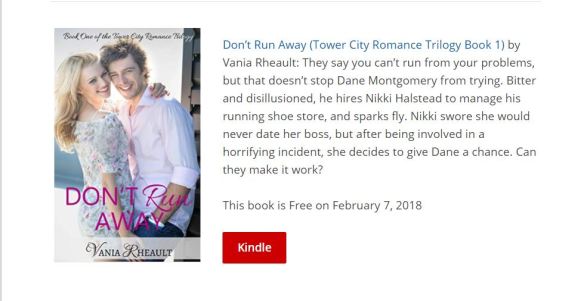
A rep reached out to me, and she was very nice, but she wanted to put my book in the sweet category romance newsletter. I replied that it didn’t belong there as the book had four open door sex scenes. I’m not sure why she wanted to do that, unless she mistook my cover. Nikki and Dane do look cute together, but I didn’t choose to put a steamy couple on the cover because there is a fine line between contemporary romance with sex, and erotica. I didn’t want anyone mistaking my trilogy for erotica. I’ve written erotica, had my “taste” so to speak, and I’m more comfortable writing contemporary romance.

Anyway, this is what the ad looked like that went into their newsletter:

freebooksyad

You’re the one who writes the blurb, and I was afraid I didn’t spend enough time on it. You only get so many characters, and it’s difficult to try to convey what the book is about and still make it interesting in that short space.

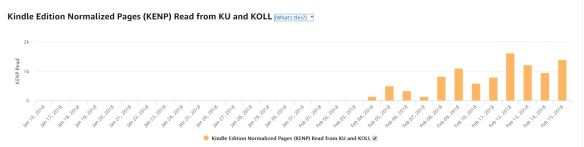
My book was free from February 6th to the 10th. I started getting downloads even before my book went out in the newsletter. In total, while my book was free, I gave away 4,458. Between February 6th and today, February 15th, I have sold fifteen of Book 2 and six of Book 3, so you can see there was a small amount of buy-through (not necessarily read-through), and I lowered the prices of those books to .99 to go with the free promotion. Also, my page reads for Kindle Unlimited for all my titles went up from 0 to this:

page reads for KU

It’s not the best, of course, since even all those lines only represent $25.00 in sales. If you do the math, that’s a horrible ROI, at least, on paper.

Return on investment comes in many different forms, monetary being only one of them. I’m hoping now that I’ve given away so many books, people will remember my name, I’ll begin to foster some lifelong readers for future books.

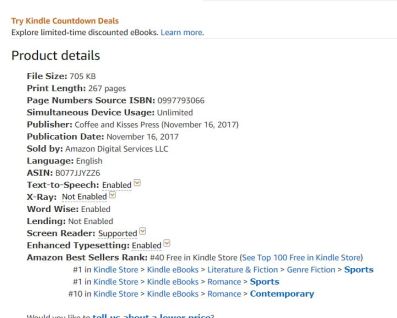
My sales ranking did go up for a little bit, and I can give you a snapshot of those, though I didn’t take a picture every time my book moved up in ranks. And as everyone congratulated me, going up in rank in *free* books looks nice, but it’s not the same as going up in the paid lists.

awesome stats!3

These are the best stats the book got. I don’t know if it did much more than earn me a few bragging rights, but there it is.

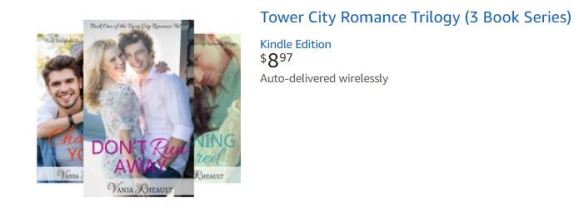
Amazon did a nice thing, too and put my books together in an ad on my Author page.

tower city box set

You can’t buy them that way–I haven’t created the box set yet, and that is on my to-do list after I figure out my stupid cover for book three. (Yeah, still wrestling with it to get it exactly how I want it in paperback.)

If you were to ask me the best part about this whole promotion thing, I would have to say that it’s that people are starting to read my work. We all want people to read our stuff, but when they actually do, it’s nerve-wracking. So far I’ve been getting decent reviews. They’ve been saying my editing is solid, and there hasn’t been a complaint about formatting, which is a relief since I do all my own formatting myself.

criticism-3083100_1920

Overall, I would say the experience was a positive one.

If I were to give any advice to someone doing this I would say:

  1. Have more than one book out. I did prove that if you spend money advertising one book, you’re really advertising your whole backlist. Not many people bought books 2 and 3 who downloaded book 1, but it was enough I was happy they were available.
  2. Having a good cover is no joke. It doesn’t seem like a big deal when no one is looking at your books, but the minute you realize people are going to be choosing your book among a selection, suddenly you’re hoping it’s good enough. Be sure it is.
  3. Have a decent blurb. I shortened mine from what I wrote for Amazon, and I worried I didn’t spend enough time on it. Had I spent more time on it, maybe I could have gotten even more downloads.
  4. Have people willing to spread the word. I don’t know how many downloads came from my Twitter followers, or my followers willing to tweet about it. I don’t know how many downloads came from the people who liked my FB Author Page. I was also naughty and told everyone on my personal FB page that my book was free, and I know it’s against TOS to do that. I only did it once, on the day the newsletter went out. And I was lucky a few people shared that post.

I won’t be doing this again anytime soon, but it was fun to try something new and to get my feet wet. A little snowflake can cause an avalanche, and I’m hoping this is true in my case. But now that my trilogy is over and done, I need to relegate it to my backlist and move forward. I’m 31,000 words into a new WIP, and I can’t wait to share with you!

Happy writing Vania Margene

Using Writing Resources

When people talk about writing and editing, they like to spout rules. Don’t use adverbs, don’t use speech tags, don’t start a scene with someone waking up, don’t end a scene with someone falling asleep. Don’t begin a book describing the weather.

Don’t, don’t, don’t.

All the rules are enough to drive a newbie writer to drink–if they weren’t already.

girl-1064664_1920

But what people really mean when they make lists of rules that you must follow or else is–find a balance. Everything in moderation.

The problem is with this advice? It’s easier said than done.

Finding your balance, finding your happy place, finding your voice, takes many, many, many, words. Many words. Both reading them and writing them.

You can read editing books all day long, but they won’t help you if you’re not writing, and vice versa. The best way to better your writing is to read editing books, write, ask for feedback on your writing, and then do it all over again.

I’ve given several people my favorite editing and writing resources, but the thing with all these books and all that advice they contain is that you can’t follow all of it.

And you shouldn’t.

If you take everyone’s advice every time you try to write, you’ll never sound like you.

I once read a blog post and the writer was giving some writing advice–rules–and one of them was, never use was more than twice a page. Imagine trying to find your style, writing to find your voice, all the while attempting to eradicate was from your writing. Sometimes you effing need it. (The book I’m reading now averages four a page, by the way. And this is a traditionally published book by a well-known author. Sure, the sample is small; I only highlighted was throughout six pages, but still. The fact that she’s using the word is clear.)

Writing resources are good to have on hand. They can spark ideas, smooth over a sentence you’re having problems with. Help you write that scene you just couldn’t make gel no matter how many times you’ve attempted to rewrite it.

What I recommend is reading these books, marking the advice you know you need because your feedback has indicated it, or because as you’ve been writing you’ve developed a list of naughty words you need to replace or delete in your writing. Words newbie writers lean like, just, that, pretty, really, smiled, sighed, nodded, frowned, shrugged. And any other word or phrase you’ve latched onto without realizing it.

Unfortunately, sometimes you need help, and that is where the feedback from beta readers and your editor’s notes come in. Then you have to develop the skill to make the writing resource suggestions yours.

Stephen King said, if you have to use a word out of a thesaurus, it’s the wrong word.

stephen king, thesauras

I used to disagree with this one a lot because when I write, I use a thesaurus on a daily, maybe hourly basis. But what he meant is, and I’m just guessing here, don’t choose a word because it means what you need it to mean. Use the word that sounds like your character.

As you write, you’ll learn your style, find your voice, and you’ll develop the confidence you need to wave off the advice you don’t want to take.

But don’t be arrogant, about how great a writer you think you are because you could turn your nose up at some really great advice that could take your writing to the next level.

Some of my favorite writing resources include:

  1. The Writer’s Lexicon by Kathy Steinemann
    This book is wonderful! Lists upon lists of everything from things your character can do instead of nodding to suggestions on what to use instead of got. This book will also help you identify and delete filler words from your writing and help you show rather than tell by using descriptive words and strong verbs.
  2. Self-Editing for Fiction Writers, Second Edition: How to Edit Yourself Into Print by Renni Brown and Dave King
    This book has a little bit of everything–from to perfecting your dialogue to knowing when to break up your paragraphs, this is a must-have for writers if the natural ebb and flow of your writing (your voice) is still eluding you.
  3. Master Lists for Writers by Bryn Donovan
    Need a first name? Need a last name? Don’t know what your MMC does for a living? This book contains a million ideas. It’s great to have on hand.
  4. Naughty Words for Nice Writers by Cara Bristol
    Tired of using the word cock? Need something classier than pussy? This book has it! Whether you’re writing an erotica book and all your scenes are starting to sound the same, or you want to add a small sex scene at the end of your contemporary romance book when they finally get together, this book will help you find just the right word!
  5. Thinking like a Romance Writer: The Sensual Writer’s Sourcebook of Words and Phrases  by Dahlia Evans
    Another lovely writing source full of descriptions and adjectives, this book will keep your characters’ romantic scenes from turning boring with the same old, same old phrasing.
  6. Self-editing on a Penny: A Comprehensive Guide  by Ashlyn Forge
    This is one of the first books I used to help myself start editing after an eye-opening round of beta-reading. She’ll help you cut filler words and stop your head hopping. This book is a must for a beginning writer who is making mistakes that tag him as a floundering new author–something you don’t want to read like if you’re querying.

There are many many books out there, some are good, some are not so good. Some are written by indies who don’t know what they’re doing, and some are written by bestselling authors themselves. But no matter who you read, or how many, writing resources do have a place in your writing learning curve. There isn’t anything I’ve read that hasn’t helped me.

What’s your favorite writing resource? Let me know!


Reusing Plot Devices: Good Idea, or the Devil of Plotting?

Plotting is hard. Thinking up things for your characters to do, the trouble they get into to make a story interesting, fast-paced, is a pain in the butt. Readers want things to happen; they want your characters moving. Characters who sit around are boring, and if they’re not talking about anything interesting, forget it.

hiking-1312226_1920Where are your characters going? How do you get them there?

Sometimes that’s where saggy middles come from. The beginning is exciting, lots of action, your characters are finding whatever trouble they’re going to get into for most of the book, be it fall in love with the wrong person, witness a murder, find a missing person, start a journey, whatever the case may be. The beginning of the book is always thrilling, full of promise, or at least, it should be.

And the end, oh the end! You know how it ends, the happy reunion of those two people in love, the satisfying conclusion to a journey, the missing child found. Endings can make a reader cry, close your book with a sigh and a smile, or throw the book (or Kindle, or tablet) across the room in frustration.

But the middle, the middle is difficult to write. You need scenes to move the story along, when you come up empty, it’s easy to reach for an old standby.

Plotting from A to Z is an art, a skill, a talent. Which is why so many books have been written on the subject.

And because plotting is so difficult at times, it’s easy to get caught up in what has worked for us in the past.

If you have a few books under your belt or saved on your memory stick, you probably have reused something, at some point. But is that a good idea?

Sometimes you have to. Take romances for instance. There are only so many plots to go around: boy meets girl, they break up, they reunite. Be it a case of mistaken identity, ending up in the wrong bed, best friends falling for each other, tropes are reused for a reason. That’s why they’re tropes. Same for mysteries. There’s always going to be the question of why, and how that question is answered.

And while all plots, to some extent, are recycled, that’s not exactly what I’m talking about. I’m talking about the small things that we do in our books that we do over and over again. Take for example the Stephanie Plum novels by Janet Evanovich. I hate calling out authors, but to explain what I mean, it’s the easiest way. For those of you who have never read a Stephanie Plum novel, it’s about an untrained, unprofessional bounty hunter named Stephanie. She works with her police detective boyfriend and another (male) bounty hunter.

You can probably already see where I’m going with this. Love triangle.

And that is fine. It’s perfect. It’s another plot/trope/plot device that lots of writers use. Hell, I have.

But Stephanie, being untrained, can’t do her job correctly. And it’s funny. The first couple times she does something. But the 5th time her car blew up, it wasn’t so funny anymore.

And the love triangle thing works GREAT for the first few books, but when you’re reading book nineteen, you’re practically screaming, “Choose one of them already!”

It’s frustrating.

Not to mention that when Janet tries to be funny using these plot devices over and over again, we’re cheated out of a character’s emotional arc. You would think, in twenty-four books, that if Stephanie really wants to be a good bounty hunter, she’d go to school. Cop school, self-defense classes, at the very least. Gun safety, anyone? There isn’t any character growth, and that’s too bad. But Janet purposely did that so she can write about all these dumb things Stephanie does to make us laugh. And it works, for a long time. But Janet released book twenty-four, and it’s not working anymore. In fact, when did it stop working? I would say around book nineteen when I stopped reading the series.

So when should *you* reuse plot devices?

I ran one of my cool Twitter polls . . .

twitter poll

. . . and it does seem as if writers like using the same plot devices. I don’t know how many books these writers have out, if any, but in one of the comments Chuck said . . .

chuck plot devices

. . . and I agree. It may be easier to use a plot device because it fits, it doesn’t take a lot of work to incorporate it, but will your readers like reading the same thing over and over, or will they drop off because eventually, all your books will start to sound the same?

In the end, this is your call. Do all your characters eat chocolate cake? Do they all drive clunker cars? Do all your heroines at some point get lost, physically? Do all your heroes have the same tragic backstory?

In my own writing, I’ve been dealing with this. I think, oh, my characters reuniting on the beach would be beautiful . . . oh, wait. They did that in book two of my trilogy. Probably best not to end my new stand-alone that way.

I wanted my characters to find a cat or something, but my characters, yes in book two of my trilogy, found an abandoned dog at a state park. So, no homeless kittens in this new book.

It can be challenging to think of new material, but you can do it. Try a couple of these tips:

  1. Read in your genre, but outside your genre, too. You never know if a character’s situation will spark a whole new idea for you.
  2. Use writing prompts. Maybe a picture or a line of dialogue will land your characters their best/worst situation yet!
  3. Brainstorm. I love to brainstorm plots with people. Just because someone came up with an amazing idea, that doesn’t mean you can’t use it. I’ve used ideas people have thrown out in these sessions, but of course, as you write and as you adapt the idea to your characters, things change. Never be afraid of using something someone has throw out there. In the writing process, you’ll make it yours.

    workplace-1245776_1920

    Brainstorming can be a great way to come up with plot bunnies! 
  4. Listen to music. Maybe a lyric or the way that piece of music is played will spark an idea.
  5. Go for a walk and let your mind wander. Letting your mind think about whatever it wants is an incredible way for new ideas to pop into your head.

    dress-2542263_1920

Empty your mind; let it wander. Let your characters speak to you.

Anyway, be careful when reusing plot devices. You’re a creative–you’re a writer. You can think of something original. Keep delighting your reader with new ideas, new situations, and they’ll keep coming back to you and your books over and over again.

And maybe at book nineteen, they won’t drop off.

Tell me what you think!

Vania Blog Signature

Who Are You Writing For? Yourself or Your Readers? Be Honest.

There’s a lot of fear in a writer’s heart. Lots of it. Am I good/smart/brave/pretty/handsome/wistful/*insert adjective here* enough to be a writer? Am I writing books people want to read?

I see this all the time. The fear. The agony of publishing. The waiting on pins and needles for reviews to start coming in. If they do. Then we have to wonder, is a bad review better than no review? Bad reviews mean that someone read my book, right? Or *gulp* tried to.

I have to admit, I see this stuff and I go wwwwwhhhhhhyyyyyyy?

Why_

There shouldn’t have to be this crippling anxiety when you write and publish a book. Not if you do it right. What do I mean by right? Well, I have some ideas.

The first and foremost is be honest who you’re writing for. Are you writing for yourself? Because if you are, then you have no justification to piss and moan when someone doesn’t read your book or want to read your book. Because after all, you wrote it for yourself so what do you care if no one else is reading it? So, be honest. I find that with a lot of indie myths floating around out there that this isn’t so easy. Some of my favorite indie myths? Indie myths

  1. Build it and they will come.
    This is the stupidest thing I ever heard. Your book is not a sports stadium. (And even sports stadiums are built with specifications. Could you image a stadium built with no bathrooms because the owner didn’t want to pay to put them in?) No one is going to find you unless you push your book out there. Even publishing houses make you do most if not all of the marketing for your book yourself. If you’re an indie, this means contacting book bloggers, paying for ads, hosting events on your FB author page. Setting up your own signings at bookstores. How does this fit in with writing for yourself? You can write what you want all day long, but if you’re writing what no one wants to read, why bother?
  2. Writing to market is a cop-out.
    I love this one the most. Do you know what writing to market even means? My friend Holly put it like this: Writing to market isn’t being a sell-out. Writing to market is writing what people like to read. That’s it. It’s not any harder than that. So what does that entail significantly? Knowing your genre. What tropes are used? What kind of characters are in that genre? It can even come down to how many pages does a book in that genre typically have? Know the genre. It’s why your reader picked up your book in the first place.
  3. Experimenting is okay/write what you love/it’s your book.
    I agree up to a point. You have to experiment to find your voice. You have to love what you’re writing because this is your hobby, this is your passion, and if you hate it, you might as well go to work instead and hate it there and get paid for it, too. And it is your book. Absolutely. The choice of genre and POV is in your hands. But you have to stay within the confines of the genre you choose. I don’t know how many more times I can say it. And if, for God’s sake, you have to experiment with a medieval Zombie sex plot, no one is saying you have to publish the *insert derogatory adjective here* thing.
  4. And the worst indie myth of all:
    I DO WHAT I WANT
  5. I’m an indie and I can do/write/publish what I want.
    This is hurtful for so many reasons. One, because what you do affects all of us. You know that saying “one rotten apple poisons the barrel?” It’s true. Indie publishing already has a bad enough reputation, do we need to add to it by publishing whatever crap you decide to write? You hurt me, and I hurt you. And if you think I’m full of crap, think again. Another reason this hurts is because you are hurting yourself on a personal level. One crap book and your reputation is on the line. Readers remember you. Don’t think they don’t. I have a list of readers I don’t like, both indie and trad-pubbed, and you know what? I don’t buy their books. Easy-peasy.

So what does all this have to do with the fear I was talking about earlier? Well, I’m willing to guess and say, if you follow the rules (yep, I went there) and produce a good book, you may find that the idea of people reading your book won’t scare you as much as it did.

What are these blasphemous rules I speak of?

  1. Know the genre you’re writing in. When a publishing professional asks, If you were to put your book on a shelf in a bookstore, where would you put it? That’s a serious question. We all dream of being in a bookstore, and I don’t think that means being in the back room because the manager hasn’t got a fucking clue where to put your book. Follow the tropes and expectations of that genre.
  2. Get the thing edited. I don’t care by who. Just do it. You have a typo on the first page, and it can be something as simple as using a period in dialogue when it should have been a comma, you lost me. And probably about 100 other readers who were interested. They aren’t anymore.
    And if this is your first book and you have no idea what you’re doing? Get a developmental editor, too. Your plot needs to move, your characters need to grow. If you have trouble crafting a good plot (ie no plot holes) and your characters are flat out boring, don’t publish.
  3. Have a cover that matches your genre. Seems like a no-brainer, but it’s amazing how many authors do what they want with no sense of what is going on in their genre. This could be because they don’t have a genre, and well, that sucks. No genre, no cover, no bookshelf space, no book. It takes two seconds to Google the hot 100 on Amazon in your genre. If your cover looks like a sweet romance, but you wrote erotica, you’ll piss off a lot of people. And you know that means? Bad reviews.
  4. Write a decent blurb.

If you do all these, and yeah, it takes work, time, and money, and you publish the best book you can, there is no reason why you should be scared people will read your book.

Let me tell you a little story.
A someone told me they were petrified people were going to find and read their book. This puzzled me, as they published the darn thing–they should want someone to read it. Naturally, I looked them up on Amazon. The cover was okay; it prepped me for a chick-lit plot with some naughty bits. Can’t beat comedy and sex. The blurb sucked, but well, writing them is hard, so I gave them a pass. Their author bio was written first person, a no-no, but well, I guess some people don’t know that. I used the look inside feature that Amazon has so graciously set up for us so we don’t waste money, and I found the book was a mess. Their cover didn’t match the serious tone of the book, the formatting was horrible, and it was evident from the first paragraph they didn’t have an editor. They’re scared people are going to find their book? They should be.

There are things you can do to control the quality of your book. Find an editor/critique partner/beta reader who will teach you things, not just blow smoke up your bum. Read craft books. Go to writing conferences and have your first pages critiqued. Read in your genre. For the love of God, choose a genre. It makes writing a lot easier, trust me. And after you hit publish, you did it. Own it.

And seriously. If you are writing for yourself, when you’re done, print it out and shove it under the bed. Maybe the monster under there can edit it for you.

Am I too harsh?

Tell me what you think!

Vania Blog Signature

What Draws a Person to Buy Your Book: A VERY Scientific Poll and Results

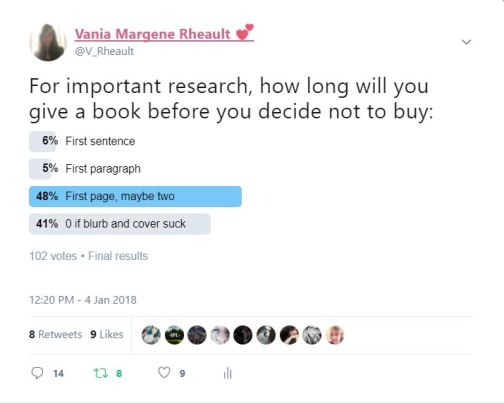
Your first pages do a lot of work for your book, and this blog post was going to talk all about it. This very scientific poll I ran on Twitter was going to lead the way. But it bought up way more than just first pages, and this post turned into an overall-type thing. I’ve always enjoyed knowing how others make decisions, and here’s a small idea of what attracts readers to your book.

twitter poll

What I found was that some people are really brutal with a book. You get the first sentence with some, others, maybe the first paragraph. That’s it–if your potential reader even gets that far.

If you have a typo anywhere, forget it. I have little patience for typos. I’m starting to feel quite agent-y about the whole book-buying thing. All it takes is one little nope, and I’m done.

this-is-the-cutest-nope-ever-5457814

I would imagine though, that if an author knew how many readers s/he was losing due to a small error, it wouldn’t seem so cute.

The picture above was just a poll, but there were a lot of comments, too:

first lines twitter poll 7

This is a great thing to keep in mind. Your writing style won’t hit home with everyone. I dislike first person present. There is only one author I will read who writes that way. I’ve turned down beta requests and review requests because of this. I might as well be reading something like, right?

first lines twitter poll 5

Reviews were one aspect of the whole thing that I didn’t consider. Mainly because I don’t look at reviews unless it’s a non-fiction book. Taste is subjective, and unless the reviews say it’s poorly edited, I don’t think someone’s opinion would have much weight with me. And I would know if it’s poorly edited by reading the first couple paragraphs.

first lines twitter poll 3

Liking the blurb makes sense–if that is poorly written, there’s a good chance the book will be too. But blur-writing is a skill in itself, and you need to either pay someone who has the skill to do it or learn it yourself.

first lines twitter poll 8JPG

Being swept away by a book is the best sign. If you’re reading on Amazon and you run out of the free sample and you want more . . . that’s the goal of every author right? Because it’s not such a long stretch from being sad the sample has run out to clicking the buy button.

first lines twitter poll 6

Some people give their books way too much of a chance–and I think this happens when someone has already bought the book and doesn’t want their money to go to waste. That’s one thing you have to watch out for when buying indie books from Writer Twitter. We’re all friends, but just because that person is a friend, that doesn’t mean what they’ve written is any good. It’s an unfortunate fact that some of your friends will publish crap. Be it because they can’t afford hire an editor, or didn’t want to take the time, didn’t take the time to have beta readers weigh in on their book, or because they don’t do anything in their non-writing time to get better, (reading craft books, reading other fiction) sometimes you just can’t trust the people you know are good writers (or know how to format correctly, either).

first lines twitter poll 4

While I was thinking of mainly indie books, Jamie brings up a good point. Trad-pubbed authors don’t control the book cover or the blurb. If you’re turned off by those two things, you won’t make it to the inside. Although, if you are trad-pubbed and have a little marketing power behind you, maybe a high number of good reviews or positive word of mouth would counteract a cover you don’t like and a blurb that sounds boring.

first lines twitter poll 2

Leanne brings up the book’s title, something else I didn’t think of, at least for this poll. I’ve lamented in the past about my title for On the Corner of 1700 Hamilton. I loved it then, not so much now. I don’t think the title has helped sales. *Laughs* But I bought the ISBN number for it so to retitle it I would have to trash the number, and that’s a waste of money. But anyway, to get back to Leanne, she likes the title and the cover.
If you want to laugh at some, look here.

first lines twitter poll 1

And last, but not least, Laurie likes the blurb as do most of us.

This poll surprised me, but it shouldn’t have because it’s a no-brainer to have a decent cover and a good blurb. But taste is subjective, and what you like for your own book may not be the best for your genre or your book’s content, so it’s always a good idea to research what is selling in your genre and try to fit in and stand out at the same time. Got it? Good. 😛

If you have a poor cover, some won’t bother with you at all. If you have poorly written-blurb, that’s probably a good indication the inside isn’t written well either, and potential readers will pass you by.

Publishing is a cutthroat industry; readers don’t have time for your poorly written book.

So, what makes a reader buy your book?

  1. A good cover. Something that fits within your genre.
  2. A good title.
  3. A good blurb. Hire someone. Learn how to do it and get honest feedback from people you trust.
  4.  Have awesome first pages.
  5. Format it correctly. Your book could have won the Pulitzer, but if you leave the automatic 8 pt. space between paragraphs, I’m not reading you. Simple as that.
  6. Decent reviews won’t hurt. At least one five star review so when you tweet the link to your book the five stars will pop in the tweet. I’m kidding. Kind of.

I rarely tweet my own books, but this is what it looks like:

never tweet my own books

Might not help if someone found your book on Amazon, but if you tweet it now and then, it can’t hurt.

This blog post was going to be about first pages, but I wanted to feature my Twitter poll, so I’ll write about first pages another day.

Thanks for reading, and tell me what you think!

Vania Blog Signature


I’m Going to be a Bad, Bad, Girl . . .

Since I’ve already gotten all my presents from Santa, I’m going to be a little naughty in 2018. I’m going to be decadent, give in to my desires.

book-2899636_1920

I’m going to go against everything I’ve ever preached on this blog.

I’m going to genre-hop.

I know. I’m sorry. There are so many reasons not to do this, and I’m going to disregard every single one. If you don’t know what they are, let me give you a short run down . . .

  1. You can’t build an audience that way.
    When you’re an indie, you need to focus all your energy on writing and finding your readers. You can’t do that when you’re skipping around genres. Write one genre, focus your time on getting books out there. Eventually, you will be known for writing that genre and your readers will find you through advertising, consistent content. You’ll become known on social media as a writer for that genre. I’m not saying you can’t ever write something else, but if you’re a new writer and looking for readers, genre-hopping is the fastest way to waste time.
  2. You don’t have anywhere to concentrate your energy on social media.
    Maybe, if you’re like me, and you write romance, you follow other romance writers, you follow book bloggers who blog romance, agents who rep romance. You’re networking with that genre. So, how easy do you think it would to turn around and decide you’re going to write horror? It’s not easy. There are writers who set up different twitter accounts, do this that and the other thing, and pretty soon, they aren’t writing. They’re doing social media maintenance all the time. It’s not productive.
  3. This goes with number two. If you genre-hop, you may decide to write under a pen name. Pen names need new twitter handles, maybe a new website, blog posts. And that’s just what you want to do. What you have to maintain is your new Amazon author page for that pen name, and a GoodReads profile, too. Now we’re back to social media maintenance, and who wants to be online all the time? Blah.
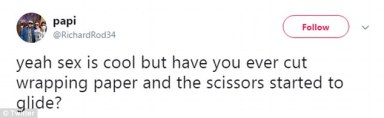
  4. It wastes time. If you decide you don’t like writing in that genre, you’ve wasted all that time you could have had writing something you like. I did that when I wrote Summer Secrets. Summer Secrets is six erotica novellas published split between two books. I think I was in the middle of writing novella 4 when I realized I didn’t want to write erotica anymore. All. That. Sex.sex is great but . . .
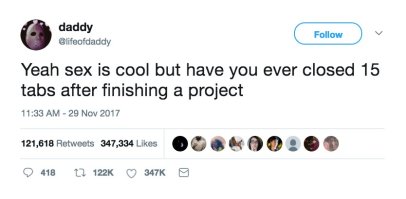
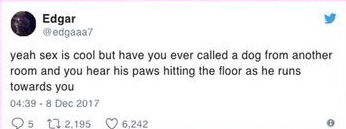
    sex is great but 1. . .
    sex-is-cool-but-jokes-1513681415

    Anyway, so you get the idea. By the time I was done with those six novellas, I knew I never wanted to write erotica on a regular basis. Summer Secrets, from start to finish, took me a year. Do I regret that? No. The stories are solid; I learned a lot from writing them. Not only writing but cover design, editing, etc. Every time you writing something, publish something, you learn something new, and that is experience you can’t learn in a book, no matter how much you research.

Do you want to know what I’m going to write? Sure you do! Before I wrote Don’t Run Away, I jumped into writing a high fantasy novel. It’s got everything: dragons, unicorns, wolves. Princesses, Princes, Kings, Queens. It is almost a fully completed series. Book One is 71,278 words, Book Two is 58,019,  Book Three is 114,815, Book Four is 88,005, and Book Five is 108,567, so far. Book Five not completed, as I took a break to write Don’t Run Away for my NaNo project, back in November 2015. I opened the file for Book One on January 4th, 2015.

Even though they are full of mistakes I have long since hammered out of my writing, I would feel sick if all those words went to waste. I’m confident that with what I know now, I can make those books into something I can be proud of. But it will take some work. A lot of work. And my contemporary romance schedule will be put on hold for at least a year but probably a lot longer.

Things I see I need to fix just by skimming the files as I retrieved my word count:

  1. Double spaces after my periods. Yep. I’m old, and that’s how I was taught to type. I didn’t know any better then.
  2. Head-hopping. I had a lot of head-hopping in Don’t Run Away, as well, and Joshua Edward Smith was nice enough to give me some much-needed feedback. Everything he pointed out in Don’t Run Away is there in that series, X 5. Will it be fun to correct all that head-hopping? Nope. Will the story sound better when I do? Yep. Fixing head-hopping is probably the hardest thing a writer can do during editing. Sometimes it requires so much rewriting and POV fixing, it can take months.
  3. These are very raw, and just the amount of typos I’m going to have to fix leaves me shaking. I can type 90 words a minute, but sometimes my brain is faster than that, and it leaves me with typos and missing words.
  4. Actually complete the 5th book. I need to finish book five, and I think I estimated I still need about 20,000 more words to end it. I know how I want it to end, and providing that doesn’t change, it should be easy enough. A piece of cake, really, compared to the massive amount of editing I’ll need to do before I write it.
  5. If I remember correctly, the main plot is a little shaky. I’m hoping with editing and POV-fixing that will naturally sort itself out. Fingers crossed!

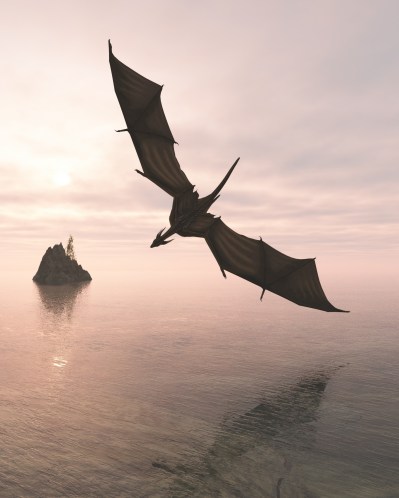
I’ve gone back and forth about fixing this series for a long time, mainly for the reasons I listed above. But, this is the part where I’m being bad, being naughty, and I’m just going to say it. I’m going to follow my heart, write what I want. I’ll genre-hop from contemporary romance to flat out high fantasy, but you know what? I’ll be indie here too, I don’t care. I’ll publish under a pen name, I’ll do what I’ll need to do to get it out there. I’ll hire an editor, hire a cover designer (I could never do fantasy by myself). Pay for some advertising and then leave it alone. I’ll have it out there, I’ll be proud of it, and if it flies, it flies. Like this guy.

canstockphoto45233200

It will set my writing schedule back by a year, maybe even two, because I know the score: editing these is going to be a labor of love. Lots of labor, but also, lots of love. I want to get my characters out into the world so you can love them, too!

That is all for now. I’m tired and being it’s Christmas Day, it’s been a long day. But I will use my blog as a way to keep you all updated on how editing is going and look for a new chat series with my friend, KT. She’s going through the publishing process for the first time, so we’ll be chatting about that up to twice a week. Tune in for newbie questions, road bumps, and hurdles that can slow you down. Use our chats and finally know what you don’t know!

Let me know what you think!

Vania Blog Signature

Indie Book Reviews: My Unpopular Opinion

There’s been a lot of talk lately about writing indie book reviews. You know, it’s a kind thing to do, you’re giving the book a bump in the Amazon algorithms. You see it everywhere on Twitter: support an author, leave a review.

And I’ll be honest, when I jumped into the indie world, I read a lot of indie books. I was supporting my Twitter friends. But when you are just starting out, when you’re new to Writer Twitter, the thing that no one tells you is that there are bad books out there. Maybe I was naive, maybe I was just inexperienced. I was in awe of anyone who had published books. I hadn’t been exposed to the indie world, and I had no idea that a published book could be bad.

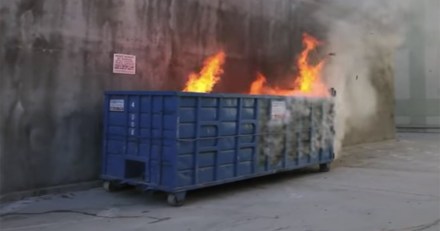
So I bought books, tweeted I was reading them, showed my support. The only problem was, some of them were good, some were okay, some were dumpster fires.

20-dumpster-fire.w1200.h630

Then I would have to write a review. I admit, I wrote a handful of 5-star reviews for books that were mediocre. (I realize that is a moral dilemma for some, and I have stopped doing it since it’s not fair to anyone). There was a lot of telling, or the characters were flat. Maybe a plot hole here and there.

After I bought two books in a row that I did not finish (DNF), I stopped buying indie completely. Because let’s face it, indie books are expensive. I buy paperback, and to get any kind of royalty, CreateSpace makes you price your book at a ridiculous price. So spending $17.99 on a book I won’t finish is a blow to my wallet.

But lately, the review talk is getting out of hand. While writing a positive review for a book that is well-written and well-edited is one thing, writing a negative review for a book that isn’t good is something else.

What makes a book bad?

Poor or complete lack of editing
The formatting is wonky, so wonky that it takes away from the reading experience
Flat characters
Plot holes
An all-around boring story

I’ve read my share, and if you read indie, you have too. I once read a book that had so many typos in it, I used it as a proofreading exercise (a quick run through Grammarly could have fixed 80% of those mistakes). I’ve read two books that I did not finish because the formatting was so terrible I couldn’t focus on the story. I read one book where nothing happened for three chapters. I was still waiting by chapter four and eventually toss the book aside.

Did I write bad reviews for any of those books? No, I didn’t. Did I reach out to those authors, my friends? No, I didn’t.

See, here’s the thing that you probably won’t agree with, but something that I live by:

When I pick up a book at Target, Walmart, Barnes and Noble, I’m picking up a traditionally published book. I’m reading a book that has been read several times by an agent, by several (and different kinds at that) editors. If the book is bad, say unlikeable characters, maybe a slight plot hole, or just a boring story, several people are to blame for the all the book lacks. I’m also reading that book as a readerI don’t know the author, probably. I’ll never interact with them. I can leave an honest review, and for a traditionally published book on GoodReads I have left, you know, two or three stars (which technically isn’t a bad review anyway).

When I read indie, I’m doing it because they are my friends, or I know them peripherally, or I thought it looked good and picked it up in a show of support. What do you get when you purchase an indie book?

Maybe something that hasn’t been edited all that great due to cost, resources, what have you. Most times editing is a favor, and it’s not always done by someone who knows how to edit.
A book that has a cover that was maybe done by the author to save a few bucks. I do my own covers, and I like to think they look decent. I know decent isn’t what we’re aiming for here, and I realize that if I wrote in any genre other than Romance, I would have to pay to have my covers done. Romance is the only genre you can get away with slapping a kissing couple on the front and adding the title and your name and be able to call it good.
A book that hasn’t been properly formatted. This has always bothered me because CreateSpace has free templates for you to download. And there are lovely templates you can purchase at a low cost you can use over and over again. Copy and paste your book into it, and you’re done. You’ve got your headers, footers, the pages where there should be numbers, and where they shouldn’t be. Gutters, margins. The templates aren’t perfect, and I’ve had to tweak mine, but even just using a template as a starting point will put you ahead of hundreds of authors who don’t know they exist or are too stubborn to use them. Pick up a trad-published book for God’s sake. Copy it. Page numbers, title, author name in the headers and footers. Full-justify the damn thing. Take out the auto spacing between paragraphs. A 200-page book shouldn’t be 600 pages. It costs money, for you and your customers, to print all that space. Stop it.

But you know what, a review is not the place to say all this. By the time the book is published, it’s too late. It’s not your job. You might say, well I have to warn other readers, or I’m giving my feedback.

When you read an indie, you are doing so as a writer, and that is not the same as reading a book as a reader. It’s not the same. When you read indie, you are peer-reviewing their books, and giving a poor review is a low blow. Reach out to them in a DM if you absolutely must, but be prepared for the backlash.

Look, there are a lot of readers out there, and eventually the book you want to “leave feedback on” will receive an honest review from someone the author doesn’t know. That’s an honest review, and maybe if your friend receives enough of them, they’ll pull the book and have it edited, or whatever.

reviews

This blog post is really long, and I haven’t even touched on the thing that makes me the maddest. I’ll write another blog post about it. But anyway, I don’t leave bad reviews for the simple fact that I am a nobody in the world of indie publishing. I don’t have thousands of sales, I don’t make six-figures. And when I do become an authority, I still won’t leave reviews. I’ll write blog posts like this.

Let’s try to save these books before they are published. Instead of reviewing, maybe offer to beta read, be a CP. Tweet informational articles about formatting. If you find services you like, tweet about it! Share when you find a paperback interior template that you LOVE. Share tips, tricks. A good editor that doesn’t cost an arm and a leg. Maybe you can get the information out there; even if you can help one person, it’s worth it.

It’s hell for an author to pull a book to fix it, and by then, their reputation may already be ruined. All it takes is one book for a reader to be turned off by an author, forever.

Let’s stop it before it starts. It can only help all of us.

no one heals themsevles by wouding another

Tell me if you leave bad reviews. Feel bad about it? Proud of yourself for being honest? Let me know!

Vania Blog Signature