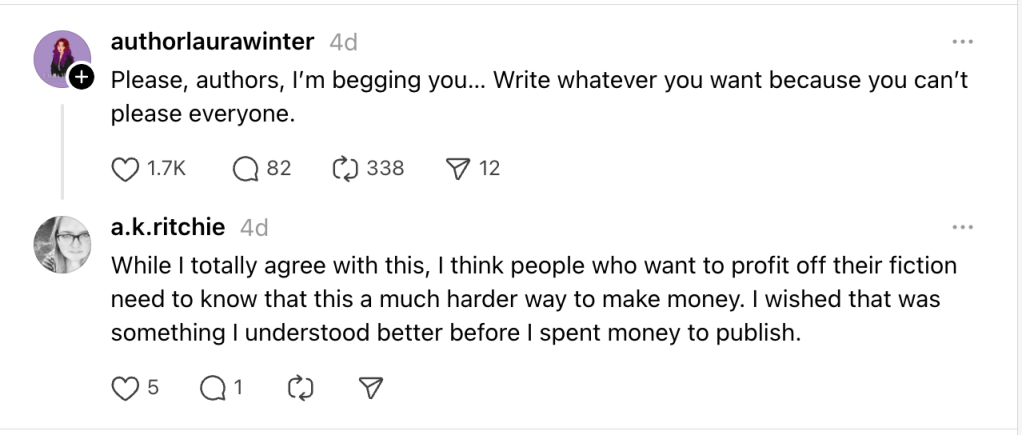
As with most of my online friends, I met A. K. on Twitter many years ago. After I left, I wasn’t sure how many people I’d lose touch with, and when I found her on Threads, I was thrilled! Recently, I saw her reply to this post:
Right away I asked her if she’d be willing to do a guest post to talk about her response a little more, and she agreed!
I’ll let her have the floor now. Thanks, A. K.!
It wasn’t long after I published my first novel, AFTER THE PARTY, that I realized a hard truth. I’d been so focused on getting my novel edited and learning how to manage the technical side of self-publishing that I forgot I would have to market my own book. Specifically, I would have to find my own readers.
I didn’t understand the impact platforms like TikTok and Instagram were going to have on fiction and sales. It never occurred to me that I would have to concisely explain to people my novels’ genre on a regular basis. I never realized how hard it would be to find my readers and promote my book.
I often joke that my novels are marketing nightmares. While some of my novels have romance, I don’t fit into the genre as the love story is often a subplot (or not included at all like my novel WILDE LIKE US). While my themes may be well suited for Upmarket fiction, my writing style does not fit the current trends. I landed on Women’s Fiction, but some argue that it’s more Coming-of-Age. It never occurred to me to lock down a genre and the ideal reader before I started creating.
It makes it hard to find readers when you don’t know who they might be.
I went into self-publishing over traditional publishing because I wanted to write what I wanted without the pressure of conforming to trends and labels. I grew up in a culture of hand-made, home-printed zines. I found bands recording in their garage, burning their songs to CDs with handwritten track listings. I wanted to DIY it. This is something that I lived in my everyday life, so I wanted it to apply to my fiction as well.
While I may have broken even on my first two novels, it occurred to me that writing only what you love, without considering the market, can make self-publishing an expensive endeavour. As much as I love the stories I’ve told and what I’ve created, it doesn’t mean that passion will translate to sales.
Without sales, it becomes difficult to continue producing more fiction. The cost of editors, artists, subscription for websites, etc, all costs money and unless you have funds coming in from other sources, continuing to produce fiction this way may not be sustainable for the vast majority of people.
If I were to start this journey from the beginning, I would take more time to understand what readers are looking for and how that can be implemented into the stories I want to tell. I’d try to find a space where my voice already fit into a thriving community.
In no way do I regret writing my stories the way I did. I was being true to my creative side, honouring the stories I wanted to tell. I was also learning so much. And I still am. My storytelling has become stronger with each novel I create. I wrote without external pressures of deadlines and expectations.
But I’ve also come to realize that if I would like to keep publishing, and would like to do so with more frequency, there needs to be a balance between what I write and what the market wants. Even those bands I listened to and zines I grew up consuming took that into consideration. They had a market and they were filling that need in their community.
There is nothing wrong with writing for yourself or writing based on the current trends or a mix of both. My advice would be to set realistic expectations based on your personal goals and move forward with intent. A good balance would be finding that sweet spot between stories you’re passionate about and ones that make a profit.
For now, I will keep writing my novels as a form of expression and as a hobby. However, I am already making plans for future romance novels that may still explore a mix of emotional topics with a focus on romance first and foremost. My plan is to bring my stories forward in a way that might meet the readers where they are.
Thanks again to A. K. for her post about writing what you love! If you’d like to follow A. K., you can find her on these platforms:
You may have glanced at the title of this post and shrugged. “I write novels and series. I’m not interested in short fiction.” Maybe you even rolled your eyes. “It’s just not worth my time.”
But wait! Don’t go away yet. I promise there are great reasons to consider writing short fiction alongside your novels and series—both to hone your craft and to market your longer fiction and reach new readers. So let’s dive in and discuss six of these reasons, shall we?
Actually, it might be helpful to first define short fiction. I dwell in the world of science fiction and fantasy, and in that world, we break down short fiction into four main lengths. Flash fiction is typically 250 to 1000 or 1500 words; a short story is between1500 and 7500 words (with 3000 to 5000 words considered a sweet spot); a novelette is 7500 to 17500 words; and a novella is 17500 to 40000 words. Anything longer than 40000 words is a novel. Other genres may use different definitions, so it’s good to familiarize yourself with some short fiction in your genre.
I also want to mention from the start: if you want to write short fiction, you need to read short fiction first. Not a huge amount, but some. It will help a great deal. If you find a story that absolutely blows you away, you can study it for craft and apply what you learn in your own writing. And by searching for short fiction to read, you will also discover markets where you could submit and publish your own short fiction later on.
How do you find short fiction to read? There is a rich plethora of short fiction magazines and anthologies out there, some in print, some digital, and many available in both formats. My favorite tool to search for magazines and anthologies (to submit to but also to read), and to track my submissions, is the Submission Grinder. You can search by genre and length, pay rate, response time, etc. And it’s absolutely free to use (although you could support the creator to help the good thing going). The Best of… anthologies are also a great choice, as long as they are pretty recent.
Okay. Let’s first talk about the benefits of writing short fiction in terms of craft, and then about all the different ways to use short fiction to market your longer works and widen your readership.
Craft reason #1: Practice and improve your openings.
The openings of novels are crucial. When a reader comes across your book on Kobo or Amazon, they’re very likely to open the ebook sample and read the first chapter or so. If the opening grabs them and pulls them in, they will get the book. The same happens in physical bookstores. The reader picks up a paperback and reads the first few pages.
The opening is crucial! But how often do we get to practice writing the opening? If you write long novels, not very often. Just once per novel. Short fiction lets you practice writing different kinds of openings and get better and better at them. A super helpful skill that you can directly apply when writing your next novel.
Craft reason #2: Practice and improve your endings.
If the opening sells your current book, the ending sells your next book (or so the saying goes, and I think it’s true). But as novelists, how many endings do we get to write? Not many. Again, just one per book. Short fiction lets us write lots of endings and different kinds of endings, and as with openings, practice makes perfect, and the improvement is directly applicable to novel writing. Stronger, more effective endings could also make a huge difference for the success of your series, where the read-through rate is critical and you want to do your best to compel the reader to jump directly to the next book in the series.
Craft reason #3: Experiment with new genres and genre mash-ups.
Maybe you write crime mystery and want to try adding a speculative element, like a futuristic technology or a paranormal ability. Or vice verse: you write speculative fiction but want to venture into the psychological thriller territory.
However, it can be daunting to jump straight into writing a novel in a new genre. Short fiction is a perfect playground to try it out and see what happens, without investing too much writing time and effort. In fact, even reading short fiction in a new genre is a great way to get the lay of the land, including popular tropes that you could play with and subvert as you wish—as long as that short fiction is current, published in the last decade or so.
So far so good? Great. Onward to using short fiction for marketing!
Marketing reason #1: Put your writing in front of readers who love the genre.
Let me ask you this: What’s the biggest challenge for writers today? It’s discoverability, isn’t it?
Whether you are self-published, with a small indie press, or with a traditional publisher, it is incredibly tough to get readers to find your book. I don’t know how many millions of books there are on Amazon, but it’s an astronomical number, and advertising is expensive.
If only there was a way to reach the readers in your genre—the readers who are most likely to enjoy your writing—and introduce yourself to them… Well, there is!Short fiction magazines in that genre. If you can get your story published in a magazine like that, guess what will happen? Hundreds or thousands of readers who already love the genre will read your story and discover you, the author, and all your other books! I discovered some of my favorite authors that way—by reading their short story in a magazine first.
If your flash fiction or short story or novelette gets published in a top tier market, you will also get paid a nice amount; and even better, if the contract is good, you will get paid for only for the first-publication rights and anthology rights, but you can republish your short fiction in your own collection later on.
Imagine that! A terrific promotion—and you get paid for it, instead of the other way around.
To be fair, the best magazines and anthologies are competitive. Don’t expect to send them your first story and get an acceptance email (although if you do, congrats!). Rather, think of short fiction as part of your writing journey. It will take time to write good short fiction; it will take time to get it published. But I truly believe it’s worth it. In fact, personally, I consider writing and submitting short fiction as important to my writing career as my novels or series, at least for now.
One last idea: When you are done with a series, consider writing a short story in that world. In most magazines, if your story gets published, it would be accompanied by your short bio, and the bio could mention your series and encourage the readers to pick up book one. Be careful not to include spoilers in the short story. And just to be safe, you could center it on a minor character or event, rather than the major character or the main story arc. But if your story is compelling and intrigues the readers enough to want to know more, you could gain new fans for your entire series!
Marketing reason #2: Reader magnets to build your newsletter list.
Short fiction also works great as a reader magnet (for new readers to sign up for your author newsletter). By definition, short fiction is short, and therefore takes less time and effort to write than a novel. This makes it easier to give it away for free than an entire novel, especially when you are just starting out and only have a few novels published (like I do). And a fun short story or novelette can still entertain the readers and, if they like it, bring them one step closer to becoming your fans.
The last bit of advice on reader magnets: Use a strong, compelling short story. It should be as good as you can make it in terms of your writing craft, even if it’s short. Don’t forget that the goal is to woo and impress a new reader enough to read more of your work and become a loyal fan over time. A careless, poorly edited short story will not cut it, and you could actually lose a reader that way.
Marketing reason #3: Gifts to reward your loyal fans and keep them engaged in between books in a series.
Another terrific way to use short fiction is as a giftfor your loyal fans, already on your mailing list. And one time when such a gift might come in handy? When you are in between books in a series, and your fans are anxiously awaiting the next installment. Unlike with a short story that you would submit to a magazine, for new readers who are not familiar with the series, here you are writing primarily for fans who know the characters and the plot inside out. You may still want to be careful with major spoilers, just in case a few readers are behind in their reading. But you have more leeway in terms of what you could refer to in the short fiction, and it might be fine to assume quite a bit of knowledge of the series already.
A quick mention, since this post is already getting long: Many authors use short fiction as Patreon rewards for their supporters. It’s a similar idea to gifting a short story to your fans through your newsletter. And the best part? Whenever you gift short stories to your fans, once you have enough stories, you could publish a collection of your short fiction! How cool is that? I adore individual-author collections. And it’s another book to your name, so helps with discoverability too.
One last thing I wanted to mention: Nowadays, both reader magnets and gift copies are distributed electronically, and that’s especially true for short fiction, which may be too short to publish as a paperback. So basically, you would use an ebook version of your short story or novella to give away. You want to make sure that the ebook is correctly formatted, including epub and mobi files, but the distribution can get complicated pretty quickly because of all the reading devices out there. So my recommendation would be to use a service like BookFunnel where you can open an account (for about $20 a year currently), upload the files with your short story (you will need a cover!), set up a landing page for the readers to download the ebook, and then share the link.
That’s all for now. I think I ran over the word limit a little bit. (Oops. Sorry, Vania. I hope that’s okay.)
Before I let you go, here are a few of my favorite resources on the craft and the marketing uses of short fiction. Best of luck with your writing!
Resources:
Writing Excuses podcast – a long-running podcast about writing and publishing fiction, with the focus on helping the listeners improve their craft and become better writers.
Mary Robinette Kowal’s guest lecture on writing short stories – part of a series of lectures on the craft of writing science fiction and fantasy directed by Brandon Sanderson.
Vera Brook is a science fiction, fantasy, and romance writer, and the author of the SAND RUNNER SERIES. Her latest book, THE KISS, a paranormal love story, came out in November 2021. She’s working on two entirely new series, a standalone novel, and a whole lot of short fiction. You can learn more about her writing on her website at verabrook.com. She also tweets about her writing journey, books she loves, and things that interest her at @VeraBrook1.
The Pitfalls and Perks of Being a Multi-Genre Author
I’m going to speak from my heart in this blog post about the pitfalls and perks of being a Multi-genre Author. Who am I, if not honest and true to myself? In turn, I’m going to convey those feelings to you. Keep in mind that these are my personal thoughts on the subject. This article is not about trying to sway your opinion. It’s about my personal experience.
The pitfalls – There are none.
The perks – There are many.
I’ll start by elaborating on the fact that I don’t feel like there are any pitfalls (or roadblocks) to being an author who writes in various genres. I consider myself more of a “storyteller”. I’m like the grandmother who beckons the children to sit at her feet and asks them what kind of story they would like to hear.
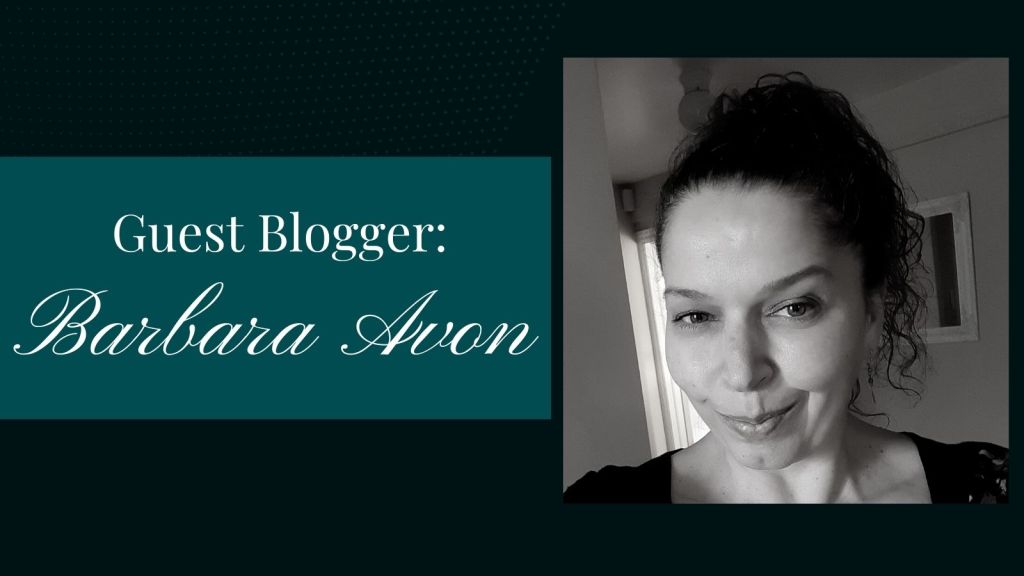
I never considered “boxing myself in” when it came to writing stories. There are infinite stories to tell, and so far, I have explored writing romance, horror (including paranormal and psychological), fantasy (time travel), literary fiction, thriller, and even children’s books. Compare writing in multiple genres to dreaming. Do you dream in only one colour? Do your dreams encapsulate only one type of scenario? Probably not. I let my mind take me where it wants to take me. I let my imagination flow freely. Being an Independent (or Indie) author, I am allowed that freedom of expression. I don’t report back to anyone (i.e., an agent, or publisher) to ensure that my story fits a trend. My name is not synonymous with any one genre; in fact, my name, and brand, are synonymous with being multi-genre. (Or that is my goal at least.) I don’t wish to be know as “Barbara Avon – Romance Author”. I wish to be known as “Barbara Avon – Author.”
I’m often asked this question: “Do you use your real name across genres?”
Yes, I do.
The inevitable follow up question to that is: “Does it hinder or help?”
So far, I have not had any reader tell me that they are put off by my choice to write in different genres. In fact, I had a very good friend honour me by saying that I inspired them to try their hand at writing different genres, which brings me to “the perks”.
I can revel in different worlds. I allow myself to explore not just a romantic situation, but a horrific one, or one that will let me travel in time, or one where I thwart the evil villain. Is this a “perk”? Yes, because I’m going to put it simply: Life is too short for me to prohibit myself or allow myself to stifle my creativity.
I started this journey later in life. I was 42 when I self-published my first book. Growing up, I used my imagination to escape the doldrums of daily life. I was a shy kid, and especially so when I switched schools and became the “new kid”. I was often alone, reading, listening to music, dreaming. I started writing angsty poetry in my teenage years. When I was awarded an A + for my short story in high school English Class, that was it. I caught the writing bug and knew that one day I would write a novel. What is my biggest regret? It’s that I didn’t start sooner. That’s what I mean about “life being too short”. I had a lot of time to make up for. My first three books are romantic suspense, but (inspired by the great Jack Finney), I thought to myself, “Why can’t I write time travel too? Why can’t I at least try?” They are merely words. Place them strategically one after and another, and eventually, you’ve created something out of nothing. I soon realized that I could write time travel, and then horror, and I even became a serial killer in a book or two.
I have a box of all my books. It’s a time capsule, of sorts. I want it passed down to family throughout generations, and between the pages, they will catch glimpses of who I was. Because there are many facets to a person’s personality, there is so much to learn about me through my words. Yes, it’s fiction, but authors leave a piece of themselves on the page.
I want to state a very obvious perk: I have the chance to reach more readers. I have the chance to romance someone, or scare someone, or help someone skip through decades. When I started this journey, I had a group of loyal readers (who resided locally) who read each of my books, regardless of the genre. It was clear to me that I wasn’t chained by genre, and the creative freedom remains exhilarating to this day. As an Indie I also have control over cover design, marketing; everything that has to do with publishing a book, from start to finish. I am my own publisher, but let’s face it, readers don’t care if I’m Indie. They want a good story, period. As a reader myself, I want a good story, period. Fiction is our greatest escape, and it thrills me to know that I can help someone escape their life, if even for a few hours.
Here’s my advice if it’s advice that you seek. Do it. If you are a horror writer who has always wanted to delve into fantasy, do it. If you prefer to write under a pen name, do that too. When it comes to pursuing a desire, I’ve always said that I’d rather regret something I did, than regret never doing it at all.
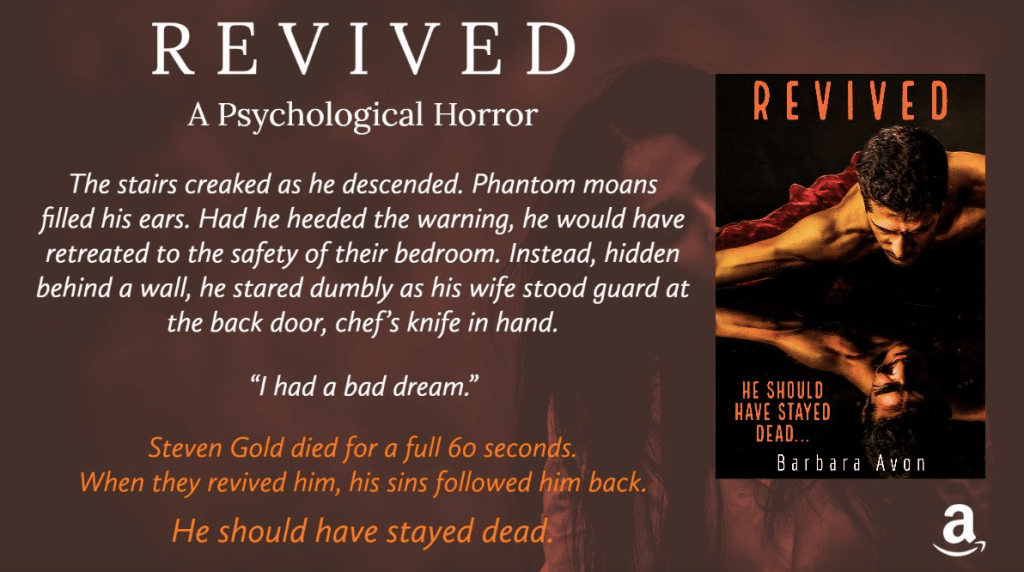
What’s next for me? After publishing a romance last November, I am currently working on a psychological horror. Later this year, I’ll be publishing another romance. After that, a Christmas story (as is my tradition every year). I’m also asked, “Is there any genre you won’t tackle?” Yes, I will never be able to write Science Fiction. (Side note – I leave science out of time travel stories.) I also would never be able to write Historical Fiction (1900s and earlier), or Regency Romances. (I’m in awe of my fellow authors who are able to expertly write in those genres.) However, I do want to try my hand at romantic comedy soon. I also love marrying genres! No one says that you can’t write a horror story with a romantic subplot. In fact, it’s my brand: “Love is the most remarkable magic – Even in horror.”
When will I stop writing? Never. Not as long as I have my senses and use of my hands. My books will last forever, but I will not. That is the greatest perk of being multi-genre. I’m immortal through my books. I was able to traverse multiple different worlds – and what a ride it was.
I’d like to welcome Savannah Cordova from Reedsy to my blog today! I was so excited when she reached out to me and asked if I would be interested in hosting a guest blog post. Of course I said yes! I love Reedsy and all they have to offer indie authors. If you like this post and are interested in others like it, Reedsy hosts its own blog, and you can find it here. Thanks for stopping by today!
How to Ensure Your Romance Sequel Exceeds Expectations by Savannah Cordova
Having enough acclaim to write a sequel to your book is every writer’s dream — but that doesn’t mean the process comes as easily as the butterflies when you get a crush. There are plenty of critically panned sequels out there, and the pressure can be nerve-wracking: you’re stressed about both living up to the first novel and coming up with something fresh and original.
The best romance novel sequels build on the success of their debuts, while also introducing new concepts, characters, and plot lines — which means that some beloved elements of the first novel might end up on the cutting room floor. A lot to juggle, right? Read on if you’re a romance author in need of some help; here are five tips to help your sequel shine.
1. Identify what your fans loved and focus on it A great love story is a surefire way for a book to attract a following and take on a life beyond itself. With investment into a fictive world, and the growth of a fandom, come expectations. Expectations that need to be met or, dare I say, exceeded.
To do this successfully, it’s important to analyze what really made your first love story sing. Were people inspired by your fresh twist on that popular romance trope? Was the main love interest setting readers’ hearts aflutter? Did people enjoy the relatability of a certain character’s struggle to accept love? A stellar first romance novel normally has something special to distinguish it from other releases (if you’re feeling brave, reviews of your book might help you on this front). Zero in on this aspect and do your best to tease it out in the sequel.
That said, you shouldn’t be completely cowed by what you think your fans want — it’s your story, after all! Don’t be afraid to challenge their expectations and take the plot in unanticipated directions. It’s even advisable to drop some characters and subplots if they no longer serve a purpose. “Out with the old, in with the new,” as the old adage goes.
2. Introduce new plot threads Writing a sequel doesn’t always mean picking up where you left off — this can fall into the trap of predictability and boring linearity. You may need to resolve cliffhangers left in your first book, but you should also take the opportunity to explore uncharted waters!
Many romance authors change the who of the story in their sequels (focusing on a new set of protagonists, often secondary characters of the previous book), but keep in mind that you might be better off simply changing the where and when. Great material can be found in illustrating your amorous protagonists adapting to unfamiliar settings and different life challenges, and can allow you to “test” the strength of their romantic relationship.
Another idea is to throw up some roadblocks that will put your characters through their paces, revitalize your narrative, and make space for character development. For example, in Bridget Jones: The Edge of Reason, Bridget diverges from the original setting of London and, after a mishap on a vacation in Thailand, ends up in jail — definitely not what she (or readers!) were expecting. However, we learn about Bridget’s resilience, and this scene change also sets the stage for her two suitors to fight over her, in that iconic fountain fight scene.
3. Don’t hesitate to change the stakes Beware of giving your readers another helping of the exact same dish. It’s fairly easy to change the more episodic events of a story, but what will really give your story fresh dynamism is changing your protagonist’s priorities or stakes. Better yet, doing this without betraying any key qualities of your characters, their principles, or the overall tone will mean the key change won’t seem gratuitous or excessive to the point of unbelievability.
Let’s take Jojo Moyes’ Me Before You trilogy as an example. In the second book, following the death of her lover Will, Louisa is dealing with her heartbreak and trying to move on as best she can. After an accident, she ends up in a church basement with the members of the Moving On support group.
So what’s changed? For one, in grief, she’s a more world-wise, introspective character. She’s also adapting to a new social setting, where she is introduced to handsome and charming fireman, Sam — you can probably see where this is going. The stakes have been altered because of the events that have occurred. She’s recovering from an accident and therefore vulnerable, which no doubt factors into the risks she will take if she is to fall in love again.
4. Develop your characters in interesting ways You may think you know a character, and then they respond to a situation in a way you never would have anticipated. Surprise is the essence of any great drama, right? Though introductory beats are usually where a good chunk of character information is found, any good novel will treat character development as a continuous process. To do so will give you room to interrogate and deconstruct your characters — and subvert expectations.
Though character development has been touched upon in point #2, consider also how you might want to accentuate a feature (or flaw) of a character that was not touched upon in your first story. This might come naturally if the character has aged, as well as with the general forward-thrust of your plot. Perhaps a softer, more sensitive side to a character is revealed when they become a parent — or a more daring, combative facet of another character comes to the fore when their relationship is threatened by a third party. The list is endless!
5. Expand on the backstory Even as you’re in the process of driving your plot forward, why not throw in a bit of time traveling via flashbacks? There is more incentive to do this if you’re penning a sequel to the first part of a book that did well — your fans will be invested in your characters and hankering for juicy details on their backstories.
Moreover, elaborating on a character’s origins will give color to their actions, reactions, and decision-making in the present day. For example, in the Bridgerton books and Netflix series, we learn that the Duke of Hastings lost his mother at a young age and had a terrible relationship with his father. From this, we are better equipped to understand his reluctance to marry Daphne Bridgerton — the Duke has trust issues and feels unworthy of her love.
Throwing in some snapshots of life before the present day is often an effective way to understand characters’ psyches and how this factors into a romantic dynamic. In this instance, Daphne and the Duke’s love story is made even more powerful after we learn of the psychological hurdles the Duke has had to overcome to commit himself to their relationship.
And there you have it. Hopefully these ideas will aid your writing process and enhance the next act of your story, as it were. You might even have an entire series under your belt one day!
I want to thank Vania for allowing me to guest post on her blog today. Our friendship began a little over four years ago, I believe, and with it has come some pretty stellar conversations about the life of an indie author. Today I want to talk about a few tools necessary if you want to succeed in this business, based on personal experience.
When I began writing my debut novel, four years before I published it the first time, I had no idea what I was doing. Through research, my love of reading, and a handful of supportive people on Twitter, I figured out the barebones of how to write and publish a novel. It still wasn’t enough.
I was stupid and naive. I thought that because I had a cover made, I had someone edit the book, and someone else to format it too, that it was all I needed to publish my story. Sure, my book cover was really well done. But I was impatient. I didn’t have a clear vision for my story so I wasn’t able to work with the designer to get it how I wanted because I didn’t fully know what I wanted. My editor gave it a first glance edit and made constructive notes. I made changes that I thought needed to be made, then I was done. I thought one round of edits would be enough and I didn’t need to have anyone else look at the book. I had set a publishing date, made the announcement on social media, and was two steps ahead of anyone who’d graciously offered to help me.
I imagine now, when I look back on that time, a clear picture of those who helped me, standing on a sidewalk. Shock and disappointment on their faces, watching the cloud of dust behind me as I flew straight for the finish line with my unfinished project that I was so sure was this great thing. Back then, I had a lot of support on social media. I felt important, accepted, and successful.
Then, I published. And I fell flat on my face.
It seemed like overnight I lost 95% of support from social media. I sold approximately 25 books that first day, which isn’t bad but most of those were family members. Then sales dropped off a few days until I had months with no sales. The friends that were still in my corner were concerned for me and I was lost in a darkness of shame and disappointment in myself. I had no backbone for the blows I endured during that time and I felt defeated.
My first review was from a FB friend who hadn’t even bought or read the book. That 5-star review was posted on the day the book went on sale. Before there were any sales. Then, family members finished reading the book a few weeks later and I got more 5-star reviews. A few friends who read the book gave 5-star reviews or 4 stars. I was so excited!
After about six months, I finally sat down and read my book again as a reader. I couldn’t believe it. The book wasn’t a 5-star book. At. All. At best, if I’m being nice, I’d give it a three. Once we got settled into our new home, I began a new edit and commissioned a new cover. December 1st, 2019, I released the newly edited version of my debut novel, Broken Tomorrows.
It’s still not a 5-star book.
Over the last three years since I first published the novel, I have grown and learned as an author. I have attempted to mend some of the friendships that I lost, and I took a good look at how I reacted and how sensitive I came across to those who knew me. If they left a 5-star review because they didn’t want to hurt my feelings, that’s on me. I never want anyone to feel like they can’t be truthful with me because it’ll hurt my feelings.
In 2020, I took six months and focused on myself. I reviewed my life since I joined this business of writing and I asked myself some really tough questions, like, is writing really what I want to do with my life? I also stripped Broken Tomorrows off Amazon and redid about 75% of the story with the intent of republishing a third time. How do I know I’ve grown? I took a step back and realized that I need to write something new and fresh. I need to walk away from my characters and meet new ones. I do have a plan for what I rewrote of Broken Tomorrows, but that will come in a couple of years after I’ve shared some other characters with my readers.
Authors should never pick up the task of writing a book unless they are prepared for everything that goes into it. Here are five tools you MUST understand before you begin writing that book, tools that I learned the hard way are essential to the craft.
Read Reviews with Caution: As authors, we aren’t supposed to read reviews as they aren’t really for us. They are for other readers to share if the book is worth buying. I can do a whole other blog post about my thoughts on reviews, but I’ll save that for another time. IF you find yourself peeking (believe me, it’s hard not to do), take them for what they are: Someone else’s opinion. Read it, process it, check it, and then move on.
Get a Backbone: This was one of my biggest lessons I had to learn, and it’s not something that happens overnight. Sometimes we need to read bad reviews and get negative feedback to strengthen us. But we also need to be stronger than the sensitive versions of ourselves. How to do this? Don’t take everything so personal. If someone gives you a negative reaction, take the good you can learn from it and grow.
Have a solid Writing Community: I went into this business thinking that everyone in the writing community were supportive and loving people. That’s not true. There’s a saying out there that says something like, “other writers aren’t our competition” but in reality, not everyone believes that. While I did eventually find a handful of really great writers who support each other, it’s rarer than you might think. Reach out to other authors in the genre you write and support them. Some of those people may give you support back, or some may use you because your support goes a long way. Know what to look for and at the end of the day, understand that when people say writing is a lonely business, it’s not a false statement.
Own Save the Cat Writes a Novel:I wish I had this book back in 2014 when I first started drafting Broken Tomorrows during NaNoWriMo. It gives a clear breakdown on each scene that needs to be written and why. It’s the perfect guide for those who enjoy outlining their novels. I get nothing for recommending this book to you, I just really believe in it. You can find the book on Amazon by Author Jessica Brody.
Invest in Yourself: I used to scoff when people would tell me to do this. I mean, when you don’t have the money for an editor or cover designer, you don’t have it. But, while you may not be able to afford that $1800 Developmental Edit, you can buy books that will teach you how to edit yourself. You can find a way to enroll in inexpensive courses online to teach you the craft. Groupon got me into a Write Academy course and a 6-month subscription to The Writer Magazine. There are deals out there you just need to look for them. Sell items that you don’t use anymore and start a Writing Fund. Network with other authors and reach out to University students.
Vania knows a lot about making writing a business. If this is your first time on her blog, I recommend following her because she has a lot of useful advice based on personal experience. I’ve learned that you have to treat this like a business if you want to make it as a successfully published author. Don’t let these tips above discourage you from doing what you love, if writing is what you feel destined to do. Writing has a lot of tough moments, but when you are holding your bestseller in your hands, you’ll remember those tough moments as paying your dues for success.








 Vania Margene Rheault