Unknown's avatar

About Vania Margene Rheault

Vania enjoys reading and writing. She's lived in Minnesota all her life, and with a cup of coffee in hand, enjoys the seasons with her two children.

What in the Heck Have I Been Doing?

I haven’t done much writing lately, and I haven’t blogged much either. I gave myself a pass last week because I flew from MN to FL on Friday to go to my sister’s wedding, and I just got back last night (Monday) pretty late. I had a great weekend, though, and I spent a lot of time at the ocean, which was fantastic! I love going to the beach and looking for shells. There’s something calming about seeing the ocean and realizing how small we are in comparison.

But I’m back now, and this summer is going to be all about writing. This is what I’m going to be doing in the next little while:

Editing

An editing project came my way, and she was lovely enough to run it through CreateSpace for me so I can work on it at work. I don’t have computer access there, so having the paperback will be a big help. I’m looking forward to helping this author and reading her book. I hope she can get it out this summer.

Summer Secrets

My own editor is coming back with my edits for Summer Secrets. I’ll be putting them in and doing all the rest so I, too, can publish these novellas this summer.  The things I need to before release:

  • Put in all the edits
  • Write the front and back matter
  • Ask @DRWillisBooks (David Willis) to redo improve my map for the book
  • Create the cover
  • Format it for both CS and Kindle. (I will also be going wide with these, and I’ve chosen Draft2Digital to help me with that. I’ll blog about my experience with them at a later date.)
  • After editing the proofs and fixing anything that needs to be fixed, I’ll be seeing if any of the bloggers who had approached me earlier are still interested. These took a lot more time than I had anticipated simply because I added a 6th novella to the series and editing always takes me a lot longer than I anticipate.

I am hoping for an August release. I’m hoping. My plans have been shot to hell before, but I’ll do my best.

A Writer’s Conference in June!

I’ll be going to Santa Barabara in June for a writer’s conference. It’s my first big one and my first time in California! I’m so excited I could die! I have everything paid for . . . I’m just waiting to go! I’ll have to see how much Summer Secrets I can get done before then.

Don’t Run Away

This is my new working title for my Nano project from two years ago (formerly known as Running to Love). I’m letting this one breathe as I have ripped it apart a couple of times now, but I’m thinking as soon as I take the bandages off, it’s going to be all healed to perfection! Maybe not, but I do plan to release it in the fall after editing it a few more times. This is the first book in my Tower City Romance series. I’ll have the second one finished soon, and I plan two more books after that.

tower city logo

#SmutChat

And of course, I’ll be doing #smutchat, the Twitter chat I started last month. Or was it two months ago now?  Anyway, I think that people are enjoying it, and it’s going in a direction that I didn’t think it would. I always give away a non-fiction writing resource book in conjunction with the topic of the chat, but other authors have approached me and asked if I could give away their books too. So I will be pairing these books with the non-fiction writing resource I’ll be giving away and even interviewing the author for my blog if they are willing and able. My first foray into this is during one of my weeks when we talk about settings. I have the book picked out already and Jewel E. Leonard is going to be giving away Rays of Sunshine. The writing resource book of the week for that one is @AngelaAckerman‘s book on settings.  It’s something interesting, but I won’t be doing this for every chat simply because planning the blog interview takes time, and quite honestly, I haven’t seen a lot of interest in the giveaways. I was hoping making the giveaway a writing resource would help spark interest, I mean, who doesn’t want to add to their collection to help them write better, but still, no. The last chat I hosted I had only 5 people enter the giveaway. It’s too bad.

Anyway, so that’s what I’ll be doing this summer. I do have a solid publication schedule down though, so you can watch for these:

Summer Secrets, August 2017

Don’t Run Away, (A Tower City Romance) November 2017

Chasing You, (A Tower City Romance) March 2018

After that, I hope to have books three and four of the series completed and ready to go.

I have a busy summer ahead of me, and I hope you do too! What are your summer writing plans?

The Shocking Revelation of Editing

When I write, I can tear through a manuscript pretty quickly. I have more free time as a mother of two who works full time should, and being I can write at my job if I know what I’m writing, I can put words down at a fairly acceptable pace. You would think I could crank out books, and believe me, that is one of my main goals as a writer.

But what holds me up is all the %#!*&$# editing I end up doing. I have to edit a lot because yeah, I’m still learning my craft, (I’ve complained before I feel like I’m skidding my wheels and this is a big reason why) and there’s not a lot I can do to speed that up besides doing what I’m doing. I’m learning not to head-hop, I’m learning how many points of view work in a book. I’m learning to write without all my naughty words. All of these things will help me put out a book that will reduce the amount of editing that I need before I can publish.

notebook-1064660_1920

When I have to edit my book, I take a lot of selfies too.

One of the things that took me by surprise was that amount of time it took adding the “set it aside” time everyone recommends before reading it again. I completely understand this, and I do it myself. I’m doing it now, putting aside one manuscript while I write the next, and when I’m done writing it I’ll go back to the first. But doing this takes so much time. Who wants to take so much time? Here you have a completed manuscript, then you read it, and read it again, and even again, fixing things as you go, if you’re lucky to find them, because let’s face it, by the time you read it that many times you know what it says by heart and it could turn to Greek and you wouldn’t even notice. And now you’re supposed to set it aside for a week, a month, whatever. What are you supposed to do? All you want is to publish the darn thing.

After you think you can’t do any more with it, then come the beta readers,  and if they find stuff you missed, you’re at it again. Then maybe you send it to an editor or a proofreader, and then you have to fix those things, too.

It’s nutso and when someone would tell me they’ve been working on their book for two or three or four years, I would just be, forget that I’m not doing that. But guess what? I’m doing it because I have to.

I won’t always have to.

I’m getting better. I’m learning which POVs work best, I’m learning to not head-hop, I’m learning not to write using my naughty word list.

One day I’ll get there, and a 77,000 word novel won’t take me two years to publish because I’ll have all the lessons I’ve learned already in my head as I write a new book, and I won’t have to go back and fix all those mistakes I didn’t know I was making in the first place. My career is just beginning; one day I’ll know what I’m doing.

And that day can’t come soon enough.

More articles on letting your WIP sit so you can read it with fresh eyes:

http://www.hillarydepiano.com/2011/12/i-just-finished-a-novel-what-do-i-do-next-let-it-sit/

http://annerallen.com/finished-your-first-novel-what-to-do-now/


#SmutChat Tropes Giveaway

Thank you for participating in #smutchat. Here is the link for the giveaway of Jennifer Probst’s book, Write Naked: A Bestseller’s Secrets to Writing Romance & Navigating the Path to Success

Good luck and stay tuned for the winner announcement!

(This contest is open internationally!)

a Rafflecopter giveaway

Interview with darling Brickley Jules!

These past few blog posts have been about editing, and today I interviewed Brickley Jules who has had some trouble experience with editors. I asked her some questions about her editing process, and what she went through to get some of her WIPS whipped into shape. Listen in!

Tell our readers what you’ve been working on.

I’ve been working on the next book in the Chrome Thunder series.

I’m curious about your editing process. How much editing do you do before you pass your work on to an editor?

I let it sit for a month or more before I even start editing. Then I read through it taking notes for character cards, setting cards, businesses cards, and a misc. catch everything else set of cards. I use those to add details and check consistency. After that’s done I read through it to catch typos and any plot holes that I may have missed. I fix all that and usually have a panicked epiphany of something I need to change or adjust through the whole novel. An example would be after doing a search I realize I used a word 300 times, and it’s not an invisible word. Finally, I read it out loud or use my laptop to read it to me.

How did you find your editor for Her Unexpected Life? What were your expectations? Had you worked with an editor before that point?

I posted on Facebook that I was looking for editor recommendations. I had no idea what to expect; this was my first experience with an editor.  And actually, I hired them to help me with Out of the Blue, which is still not published. 

How would you rate your experience with that editor?

As a person new to being edited I would give it a five out of ten. Sometimes things took longer than expected, with no deadline for return given. But as a more seasoned person, I would rate it even lower. I was really bothered by never knowing when I’d get my stuff back. Communication was lacking. I received little to no progress reports unless I asked directly, then the answer was vague. 

In your opinion, did she make your novel better? Was there anything she brought to your attention that surprised you? Did she make your writing better overall?

My first novel was crap and needed lots of editing. So, I believe it was made better. I learned I love a sentence fragment. 

Was there any feedback you didn’t agree with?

I questioned some things because it had been a few years since I wrote. (Where did double spaces go?) But for the most part, it was way better than what I started with. I questioned things in general because I was trying to study up as I went.  

Through Facebook you found a different editor for Vested in Her. What made you change editors?

I used my original editor but also used a new one. The major deciding factor was my wait. I waited and waited for drafts to return just to question what was sent back. 

Can you compare their styles? Was this editor better, worse, or the same?

The second editor flat out told me I was being lazy. My other editor never would have said that. I prefer the second one’s approach. I need the honest harsh truth. Deadpool style. 

Cost is always a big factor when hiring out jobs. Was cost a factor for you when you hired these editors?

Yes. I’m on a shoestring budget and have to get the biggest bang for my buck. (The second editor was free but a close fit for my style of writing.)

Going forward, what will you look for in an editor?

Someone not afraid to throw punches.

Can you give our readers a few tips on how to find a good one?

Don’t be like me and just pick the first recommended to you. Ask them to sample edit for you. Ask a lot of them. You’re hiring them. You’re the boss. What would a boss ask and expect of you?

Thank you, Brickley! Finding an editor is a difficult process. I hope you can find someone to mesh with and maintain a strong relationship with that person going forward. I believe we all need editors to put our best work out there.

Please follow Brickley on Facebook and Twitter @BrickleyJules.

You can find Brickley on Amazon and Goodreads. Browse Her Unexpected Life and Vested in Her, now available!


Don’t Rush to Publish!

Probably the best advice I can give you about publishing is not to rush.

I’ve always promoted doing as much as you can yourself—especially since your first book is pretty much a loss until you write more and have more books available for purchase. When it’s when it’s your only book available, you’ll never get back what you put into it. (Unless you have a tangible way to measure pride and satisfaction.)

Combining the fact that this is your first book with doing it all on your own is dangerous. You’ll never be sure if your book bombed because you’re an unknown author and this is your first book, or if it’s because your book sucks. Publishing a superior product rather than a POS will take some of the guesswork out of the question.

You want to put your best work out there, so when you have more books available you don’t have to waste time fixing it. Being it is so easy to update files in Kindle Direct Publishing, you may get into the habit of updating your files and covers all the time. It’s a waste and you’ll never move forward. Fixing your files in CreateSpace is easy too, but your book isn’t available until your files are approved, and CreateSpace’s approval time is longer than KDP’s. People still can buy your Kindle book while the new file is being approved, but it will be your old file.

Here are some tips to not rush:

Cover

Never publish your first attempt at making a cover. Make many covers. Many, many, many. Try different pictures, fonts, and color themes. Take your best two or three and turn them into a contest on Facebook or Twitter. Enter all the names of the people who chose the one you decided to use into a drawing and give a signed copy of your book to the winner. Ask for lots of feedback. There are plenty of people online who are willing to give you an honest opinion.

Research your genre, watch picture manipulation videos to learn how to do what you want. If your idea is too much for you to do on your own, or you just can’t get your vision from your head onto the computer, ask for help.  Don’t publish your first attempt. Keep it clean, keep it professional. One day you may change your cover to bump up sales, or because your skills have improved, or because you found a better picture. All I’m saying is, don’t make it a habit. You’re supposed to be writing more books.

Formatting/Book Interior

The inside of your book needn’t change much. As you grow your library you may want to add those books to a list in the front or back matter letting your reader know they are available. Maybe you’ll want to fix typos, but don’t get caught up with this. You’ll never stop editing, and I feel it’s disrespectful to the people who previously bought your book before your fixes.

CreateSpace takes 12-24 hours to approve files, and your book is not available during the approval process. You can lose sales going into it to fix to too many times.

KDP takes five hours, but don’t use this as an excuse to fix every little thing. Plus you want your paperback and Kindle files to match. Publishing your book as close to perfect as possible will save you lots of time in the long run.

Blurb

Changing your book’s description is simple enough, but if you offer a paperback you’ll want your product information to match the blurb on the back of your book. Again, CS has to approve any changes and this takes time. Blurb writing is difficult, every writer loathes it. I find it easier to write blurbs for others than for my own books. Research how to write one and get plenty of feedback from people who both have and have not read your book. The people who have read it can tell you if it’s accurate. The people who have not read your book can tell you if the blurb makes them want to read it.

Editing

I’ve written a lot about editing in my publishing series, and in two prior blog posts. Editing is the worst because of all the waiting, waiting, waiting. For other people. To read your work. You’re waiting on someone (or hopefully many someones) to read your work and you can’t say anything or you’ll seem rude. If you pay someone, hopefully, you come to some kind of a time agreement. If your friends are doing you a favor, you need to be patient. I’ve edited for people who have published before I was done. Please don’t do that—especially if they keep you updated and they are finding things. It’s rude, and frankly, it hurt my feelings. What I advise you to do is forget about publishing it. Work on something new. Work on your cover—can you make it better? Work on your website, or write a few blog posts and schedule them out so you’re ahead. Try to get into a blog tour, or ask some of your friends who run blogs to interview you. Beta-read or edit for someone else. There are plenty of ways to fill your time and still feel like you are moving forward career-wise.

Be patient.

Don’t rush into publishing. It will save you a lot of time down the road, and a lot of regrets, because you’ll never now how many sales you lost because of a poor cover, or your first 20% in the Look Inside feature has typos in it and a potential reader didn’t want to take a chance on the rest of your book.

It took a year or more to write your book. Waiting a bit longer won’t hurt.

What’s your biggest publishing regret?

#SmutChat Aftermath

I held my first Twitter chat the other night. My emotions were all over the place.

The chat itself started off very slowly. It was only me, @DRWillisBooks, and @JewelELeonard at the beginning. @SpartaGus and @Alex_Micati joined in and helped out (thanks, guys!). Then @ceeleeolson and @KaelanRhy popped in as well as @erikafrose (thank you too! It was nice to see you!). After that, there were enough participants it didn’t sound like crickets, and as the chat went on more people joined in.

Yes, the first ten minute were very nerve-wracking, and I saw my whole Twitter chat future go down the drain. I imagined the worst-case scenario rather quickly, but it wasn’t necessary.

Though the chat was on the smaller side in terms of participants, it was my first, so that’s to be expected. I think everyone had a good time, nonetheless.

I understand if people were a bit leery—who really knows what a #smutchat could turn into— but my main goal is to keep it informative and classy. I want participants to have fun, and there were a few naughty jokes mixed in, which is fine as we are romance/erotica writers after all. I don’t see the harm in it as long as for the most part the chat maintains a rep as being informative and fun.

I was pleased to see people answering the questions long after chat closed for the evening, and my phone was blown up the next morning with notifications of people participating in the middle of (my) night and into the morning.

I will try my best to touch base with everyone individually, but I do hope that this chat takes off, and participants are happy to chat amongst themselves about the topics as well.

I was a bit disappointed not many jumped at the book giveaway, but that would have been caused by many things—people missing the tweet, or lack of interest in the book. Maybe people didn’t realize the giveaway is open to all countries. (My giveaways always will be.)

I had to work the next day, so I wasn’t able to answer all my notifications right away, but I will always try.

I think I will always announce the winner of the book and announce the date of the next chat at the same time—provided there is still a want for the chat.

I appreciate everyone who participated in my first chat, and I welcome feedback. Please DM me on Twitter or email me at vaniarheaultauthor@gmail.com.

Some things I learned and mistakes I made during my first Twitter chat, plus tips if you’re thinking of starting your own chat:

  1. Don’t panic if you get off to a slow start, but definitely have good friends to help get the traffic moving. Plus I did tweet about the chat almost once every day for two weeks before the chat. This will help keep the chat in people’s minds and give them a chance to schedule the time to participate.
  2. Figure out how you’re going to give your prize away beforehand. I set up a Rafflecopter account and tried the demo before I did my chat. I still made mistakes. When I tweeted about the giveaway and provided the link, I linked to my WordPress.com admin page for my website, not the actual website page. I think this may have caused people who use the WordPress software but are not actually part of WordPress blogging network to log in, which they wouldn’t be able to do. @drwillisbooks had this issue. I realized it in the middle of chat what I did and did eventually linked to the right page, but I may have missed a few people who wanted to enter and thought they couldn’t.
  3. When I announced the winner, I tweeted a screenshot of the Rafflecopter winner so everyone would know I just didn’t pick someone (this rules out favoritism). Rafflecopter adds personal information to the winner pick that shouldn’t be made available to the public. A kind person on Twitter called me out on it, and I took the tweet down. Luckily it had only been up for maybe 45 minutes so hopefully, no harm was done. I wasn’t impressed with Rafflecopter as a whole anyway, so I am going to look for another way to give my books away during chat.
  4. Keep a tab open for Notifications and the #smutchat hashtag. Hosting a chat was new to me, so sometimes even I forgot to add the hashtag to my tweets. Keeping both windows open allowed me to keep an eye on both sets of traffic.
  5. Be actively involved on Twitter and in the community you are a part of. Having friends who supported me definitely helped. I couldn’t have done it without them.
  6. Try to choose a night that does not host a lot of other chats. I researched a good night for chats, and chose Thursdays. I know nights may not always work for everyone, but you won’t please everyone so you need to choose a night that works best for you, as you are the host and moderator and need to focus on the chat.
  7. Be prepared to be online for longer than the chat. Late-comers started answering questions almost at the very end of the chat, which is perfectly fine, but if you want to give them a personal “hello, thanks for playing,” be prepared to be online for a lot longer. I may eventually call this the “chat after party” since I was online for 2 ½ hours for a one hour chat.
  8. Space out your questions. Sometimes I let too many minutes go by between questions. If you stick to a schedule this will keep the chat moving more easily as your participants will have a new question to answer. I don’t think it was too obvious, but sometimes I forgot to put up question because I was busy chatting.

And that is all the tips I have for now. I don’t know how the second chat will go, as I’ll be trying out a new giveaway mechanism, so there will be another learning curve. Overall, hosting the chat was fun, and I have questions already made up for many more. I hope you all join me!


April’s #smutchat Giveaway

Using Rafflecopter is a pain in the butt, but thank you for clicking and entering the drawing! Good luck and I hope you had fun participating in #smutchat!

See you soon!

(And if you want to follow my blog that would be super cool!)

Click here to enter:

a Rafflecopter giveaway


Congratulations to Jewel E. Leonard (http://www.jeweleleonard.com/) for winning the book giveaway! Thanks for playing!

#smutchat: What is it?

THIS BLOG POST IS ARCHIVED. I HAVEN’T RUN #SMUTCHAT FOR A WHILE NOW AND HAVE NO PLANS TO START AGAIN IN THE FORESEEABLE FUTURE. IF YOU PARTICIPATED AND ENJOYED IT, THANK YOU! IF YOU WERE NOT ABLE TO PARTICIPATE I BLOG ABOUT THE TOPICS WE FREQUENTLY COVERED. CHECK BACK TO MY WEBSITE! 

smutchat

I’ve been a part of the Twitter writing community for a couple of years now. I’ve met some wonderful people, and they have been instrumental in helping me publish On the Corner of 1700 Hamilton. Without my friends, my journey would have been harder, and certainly not as much fun.

I follow and am followed by writers who write in all genres, but I am an erotica and romance writer. There are a lot of writing chats on Twitter that I sometimes participate in, but I’ve never participated in one that primarily chatted about romance, or “smut.” When I searched #smutchat, I saw the hashtag hadn’t been used for a Twitter chat, and I took it as a sign. Finding a hashtag not in use, and one that is short, is half the battle in hosting a Twitter chat or writing game.

But before I announced my intentions, I did a bit of research. I participated in a couple of chats before, but hosting a chat is different. I had to decide how often I would host them, and on what day. There are a lot of popular chats, and I didn’t want anyone to have to choose between mine and another. I had to think of questions, and I wanted to find sexy pictures to grab people’s attention and draw them into the chat. I want to convey that #smutchat is sexy and fun, but informational. I read a lot and used the writing books to make up thought-provoking questions about the world of writing and romance.

I also wanted to set my chat apart from the other chats, so I decided to give one of those reference books away at the end of every chat. Each chat will have a theme, and each book will hopefully support that days’ theme in some way. Some of my writer friends caught wind of that and offered their books up, too. If I do give away a friend’s book, it will be paired with the reference book I’ve chosen as well.

If fingers crossedthis chat takes off, fingers crossed, I have enough questions for a whole year if I host one every 2-3 weeks.
I would love to host one every week, like some chats, but I first and foremost am a writer, and I have a few books that are very close to publication. While #smutchat will be a fun way to connect with the Twitter writing community, I can’t lose sight of the fact of why I am part of it in the first place.

#smutchat highlights will be posted on my blog, time permitting.

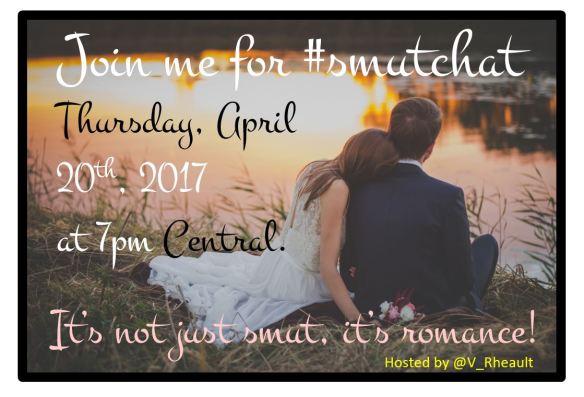
Join me, tomorrow, Thursday, April 20th at 7 pm Central, USA.  (I do plan to mix-up the times so my Twitter friends who are not in the USA and Canada have an easier time participating).

Come have a good time, make some new friends, and maybe win book!

See you there!


Bad Writing Mistakes

I’ve written a lot in the past two years; I’ve read a lot too. I’m trying to get better, and every time I delete the words “s/he thought” out of my manuscript and just write it like the plain old monologue it’s supposed to be it’s a big deal. I used to make my characters “think” everything. Their minds were probably smoking.

When Joshua Edward Smith (you can find his amazing books here) took a chance on me and read my NaNoWriMo project from 2015, he did me an enormous favor. He told me to get rid of the “prettys” and the “justs” and the “reallys” and all the “thats.” (I did and deleted half my manuscript, haha.) He told me I was head-hopping. He told me the reason for my “major conflict” was unbelievable (I write contemporary romance, so there’s always a “big fight”). He pointed out things I should have known as a life-long reader and holder of a Bachelor’s in English degree. But writing is a different thing, and writing a full-length novel in a month did not help. I didn’t know how to write then, so maybe the time frame didn’t matter. Anyway, his feedback was priceless and though I’ve beta-read for him twice now, I still may never pay him back. He reminded me how to write, and I will be forever grateful.

Jewel E. Leonard (you can find her wonderful books here) edited On the Corner of 1700 Hamilton. It’s funny because with all the writing I had done up to that point, I still hadn’t found my voice. I can reread that book now, and I can tell you the minute I fell into the rhythm of my own writing. Paired with actually finding my own voice and her fabulous editing, 1700 turned out okay. I say okay because, well, I’ve come a long way since then, and I wrote it the best I could with what skill I had at the time.

Fast-forward 200,000 words and several self-editing books later, and I think I’m a pretty good writer. I wish I had more time to write because at times I feel like I’m floundering, but I’ve come a long way in the past two years.

But I still make mistakes, and I’ll probably never be able to get avoid hiring an editor. I’m being responsible, though, and doing my best to become the best writer I can be, so their job is a lot easier.

Mistakes I still make, and mistakes I’ve seen others make, as I’ve paid forward Joshua’s kindness and beta read for other writers, are:

Using the Word “Had”

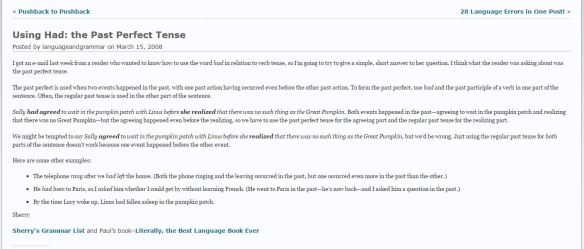
Had. Had had. It’s a third person past writer’s nightmare. When do you use the damn thing, and when do you don’t? I’ve tried to look up the rules, and the rules are about as clear as a mud puddle.

when to use had

This is probably the clearest explanation I’ve ever found on the subject. When I write, and when I edit for others, I use my woman’s intuition and hope for the best.

Being Lazy

Get, Got, Had, Has, Put. These are the laziest verbs I’ve ever seen and can be easily substituted for a real action. I’m guilty of using these. Especially if I’m on a roll and cranking out words.

She got off her horse. Really. She didn’t jump, slide, or fall?

He put the paper away. He slid the paper into the file folder.

She put her coat on. She threw her coat over her shoulders and rushed out the door.

If I edit for you and I see these, I’ll tell you these are lazy and to do better. You always can.

Being Too Wordy

New writers keep an eye on their word count like a falcon on a mouse in a field. It hurts to take out words, but it will hurt your read more to read the useless ones you’ve kept in your novel.

When I edited Summer Secrets, (six novellas totaling 150,000+ words) I mean, really edited them, I took out, on average 1,000 words a novella. That’s 6,000 words in total. My editor very well may find more. My favorite editing book I’ve read so far on the topic is Rayne Hall’s The Word-Loss Diet. (You can find it here.)

Head-hopping

People defend head-hopping because authors still do it. I guess I shouldn’t say still. Ernest Hemingway was famous for letting you know every single thought of every single character, including animals. So, yeah. But he’s not being newly published today; you’re hoping you will be, and the general consensus is you don’t head-hop. It’s tough advice to dish out because I’m reading a book right now where the author head-hops between the two main characters, and it doesn’t matter who’s POV the scene starts with. It’s a contemporary romance, and I’ve been told that it’s more common in that genre, and maybe even more acceptable. But I would caution you doing it because it can quickly become out of control, and take it from a head-hopper–it’s hell to fix.

Person/student/mom/dad/author/parents = who, not that

This is probably my biggest pet peeve of all. People are who. Students are who. Parents are who. Humans are who. Authors who use “that” to refer to people drive me nuts. When you use “that” to refer to a person, you are turning them into an object. Please don’t do that. Companies . . . that. Maybe.  I do not use companies that hire people who are rude to their customers.

Naughty words

I have a list of naughty words that I find and delete after I complete my mauscript. Words I use on a regular basis that I don’t need like just, pretty, really, that. Those are just for starters.

When I’ve edited for people I’ll get snagged by a word, and out of curiosity I’ll search for it to see how many times it pops up. When Joshua told me to look up some of these words, I was appalled to realize I used “just” over 500 times. Pretty and really about the same as well.

You can go crazy with actions too. How many times does your character nod or lean? Shake their head? Furrow their eyebrows. Frown. Sigh. Shrug. Does your herione’s heart skip a beat so many times she needs heart medication? If you can get a good editor or beta reader or critique partner who (do you see what I did there?) can read your work for you, you can make up your own list, but for now, here’s mine:

Starts, started, start

Turns, turned, turning

Looked, peered, glanced, stared, studied, gazed

Frowned

Could

Sighing, sigh, sighed

Breathed, breathing, breaths

Smiled, smiling (use other ways to describe their happiness)

Wondered, thought, understood, realized

Nodding, nodded, nods

Shook (the ‘no’ gesture)

Felt

Relaxed

Just

Really

Only

Pretty

Very


Obviously, I could go on and on, because many books have been written on this subject, and I encourage you to read them. I love Ashley Forge’s Self Editing for a Penny. She taught me a lot, and I recommend her book over and over again.

There’s no way you’ll ever avoid not ever needing an editor, but you can teach yourself to write a cleaner manuscript. Being self-aware of common mistakes, and understanding why these are mistakes, can take time, but one day you’ll be able to crank out a fairly decent rough draft. Read, read, read, and write, write, write.

It all starts there.

Thanks for reading!

Do You Really Need an Editor? Er . . . Yes?

Orna Ross, from the Alliance of Independent Authors, said in a podcast I listened to the other day, and I paraphrase: “Stephen King has an editor. Why would an indie think s/he didn’t need an editor? It’s the biggest mistake an indie author can make.” Or something along those lines. She, with others associated with Alli, have a lot of informational podcasts. You can watch their videos on YouTube, or find them in your podcast app on your smartphone.

I’m an indie author, and I had a few issues with this. First of all, Stephen King doesn’t pay for his own editor. Not out of his own pocket, and certainly not at a loss like most of us just starting out. Secondly, when he puts out a book, a million people read it, and it more than likely will get turned into a movie. Thirdly, because we are one the outside, we don’t know how much of the editor’s advice Mr. King actually takes. Does he take plot advice? When he’s told one of his characters is reading flat, does he fix that character, or does he tell his editor to shove it?

Comparing us to Stephen King didn’t help her make her point.

Or did it?

Indie authors are in need of an editor more than probably anyone. Especially if that book is their first. Or even their second, or their third.

There are different editors out there; they range in duties from helping you plot before you even write your book (that would be more like a writing coach, but developmental editors have their say in your plot) to simply proofreading it before publication.  These types of editors cost hundreds of dollars, and if you’re told you need even more than one of these kinds of editors, it can be intimidating.

I’ve always advocated that an indie author do as much as they can on their own. This isn’t just about being cheap–it’s good business. You are not only an independent author when you write a book, you need to be a self-publisher if you want people to read it. You need to know what you’re doing so you can make good choices for your business. Especially if you’re planning on doing this for the long haul.

(And you can forget about special treatment from a publishing house if you want to get traditionally published. They ask your book be as close to publishable as possible to cut editing costs. It’s not unheard of to hire an editor to edit your manuscript before you query.)

The bottom line is you need someone else to look at your stuff before you publish it. We all learn something new about writing on a daily basis, so your writing will never come out perfectly, and I don’t believe a writer can spot all their own issues. (We all learn, we never stop, so maybe Stephen King does listen to his editor.) That’s where an editor comes in.

That’s not to say you can’t substitute. If you are in a writing group, your critique partner could stand in for a developmental editor.

Maybe your friend who has an English degree and can diagram a sentence with her eyes closed can read your manuscript and look for such things such as subject/verb agreement, faulty sentence structure, and correct word usage.

Maybe your best friend is a prolific reader and can read for typos.

If you can take the criticism as how it’s supposed to be meant,  not an attack on your writing, but rather an honest attempt to help you improve your work, you can learn a lot from the editors and “editors” in your life.

When you compare writing a book to having a baby–nothing could be truer. You don’t birth a baby on your own. You have an OB doctor, nurses, a doula perhaps, your partner, your mother to give you support. You don’t have a baby alone, and you don’t write and publish a book alone, either.

As for actually paying an editor, a real one who knows what they are doing, that is a decision left entirely between you and your pocketbook.

I use a paid editor, but she doesn’t do it as her day job. She’s a fabulous writer, and she’s a fabulous editor. I’ve learned a lot from her feedback, and my writing has improved a lot over the past year. But she’s busy with her own projects and a full-time job, so I’m doubting she’s going to stick with me and my writing career as she is trying to get her own off the ground. I’ll need to find someone else to edit the contemporary romance series I’m going to be publishing in the coming months.

I’ve learned a lot from beta readers and my editor. I’ve also started to read self-editing books to help me recognize my mistakes and cut unnecessary words. I’ve started outlining so my plots are tighter and there’s less chance of plot-holes. I’ve started doing character workups so I can get to know my characters before I write about them. This saves me from writing flat characters.

You are writing a book–a lot of what an editor can and will do for you, you can take into your own hands as you actively learn your craft.

An editor can help you put your best work into the world.

And that’s what we all want.

You can read a great article about editing here.