Your Best Marketing Strategy–TL;DR (Write more books!)

TEAL GREEN BACKGROUND STACK OF OLD BOOKS. TEXT SAYS. TL;DR: WRITE MORE BOOKS

We talk about marketing a lot, such as buying promos, setting up a newsletter, networking with authors in your genre to do newsletter swaps, learning an ad platform. Depending on the status of your mental health and how thin your wallet is, you should probably be doing all those things. As Meta buys everything and then enforces guidelines, (no more steamy snippets on Instagram, y’all) it’s getting more and more difficult to use free resources.

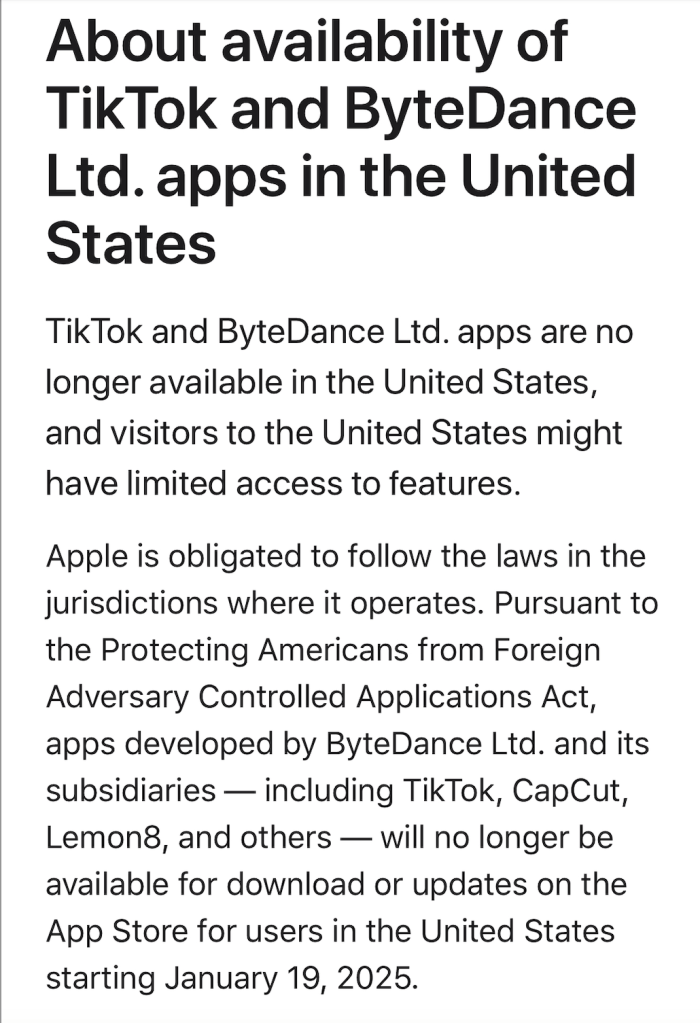
Social media could be useful, or has been, but as these company shy away from content they consider porn, or pörn, you run the risk of getting your account suspended, shadow-banned, or simply the algorithms just won’t show your stuff to anyone. TikTok is the worst in its guidelines they arbitrarily enforce, and I can’t remember the last time I even bothered to post a video. With the announcement of the new Instagram guidelines pertaining to sexual content, lots of romance authors are scrambling. Social media isn’t dependable, and hopping from platform to platform won’t do anything, and here’s why. Author problems are not reader problems. Instagram’s policies really don’t affect readers. We get caught up in the author world and forget that readers aren’t always where we are. Yeah, you might be posting hoping to catch the eye of a bookstagrammer, and if that’s part of your marketing strategy, then you’ll be dealing with the change, but for the most part, you can find readers other places.

The one best marketing thing you can do though–we hear it a lot and also ignore it–is to write the next book. There are caveats to that, and I think that’s why it gets pushed aside. If no one is reading what you’ve got, then why keep going, right? I agree to a point, and that’s when you have to make a decision. Learn how to market in other ways or accept that no one is going to read you. BUT, here’s the thing we don’t talk about. If a reader finds you an likes you, having a backlist is the best way to keep them with you.

Here are the reasons why I think it’s always important to be working on your next book despite what’s happening on social media… and your sales dashboard.

Publishing regularly keeps you relevant. There’s not a lot we can agree on when it comes to Amazon besides how frustrating it is to work with them, and this: Amazon gives you a 30-, 60-, and 90-day new release cliff. This is where they push your book, giving you a little bump that you’re supposed to run with. Once the first 90 days pass, you’re on your own, and authors frequently find out that being on your own is not a good thing. Ask any author who is pleasantly surprised by their positive ranking only to watch their rank sink. It’s why indies try to publish four times a year–they don’t want to fall off the cliff. You may not be able to publish four times a year, not unless you save up and slowly release, but the more you publish the more relevant you are to Amazon and to readers who will know you’re in it for the long haul.

You get better with every book. Writers need to write to get better. Each new book gives you the opportunity to try new things and level up your craft. Like I mentioned before in previous blogs, I plotted out A Heartache for Christmas years ago, but I couldn’t write it because I wasn’t good enough to execute the plot twist. After I wrote ten other books, I tackled the plot and the mystery with ease. Maybe the mystery isn’t a shocker, but it was more than what I was able to do when I was plotting the book in the first place.

Another great reason along these lines is you get faster with every book. All these social media posts that say books that are written in two months (or whatever) are trash are written by people who are jealous an author doesn’t need long to write something good. The more you write the faster you get and the less you need to spend on editing. You can’t get good at anything unless you practice.

More promotional opportunities. Events like Stuff Your Ereader Day and newsletter swaps are becoming more prevalent as social media becomes more unstable and more undependable. It really helps when you have more product to be able to rotate in these promos. Even when I buy a Freebooksy, I don’t always promote the same book, and you can find different readers by advertising different books because they’ll be written around different tropes/plots/characters. On the same token, you’ll have more books to put on sale. Even if you’re in KU, being able to put your books on sale is a great way to find new readers. Right now I have three of my King’s Crossing series on sale: Book one is .99, the second is 1.99, and the third is 2.99 to encourage readers to buy and try. I’ve sold 24 of book one since its release, and I don’t think I would have sold them unless they were on sale. Book one could potentially lead a reader to buy the other five, so never discount the power of putting a book on sale. Elana Johnson is a master of putting her books on sale. She talks about rapid releasing and book prices in her talk at the 20booksto50k conference a couple years ago. It can be intimidating to listen to her, but she’s motivating too. You can listen to her here:

You’ll have more to offer your readers. Readers want more from you, and while that can be scary, it can be motivating, too. You’ll have more to talk about in your newsletter (and on social media) more excerpts to share, more covers to reveal. If readers know you’re going to stick around, it makes it more likely they’ll stick around to see what you’ll be up to next.

You may motivate someone else. I’ve heard from a few people they have admired how many books I’ve been able to write in such a short amount of time. I was writing to hide how I felt, sure, but I also could have used my health as an excuse to wallow (no judgment to those who have health issues and can’t write as much as they’d like. I was fortunate. I was able to write, so I did). The fact is, I enjoy writing and it’s never a hardship to give up a few hours every day to get some words in. I hope that as a whole, my career has motivated a few people. I’ve gotten compliments on this blog, too, how I manage to stay consistent and try to help people with the topics I write about. I’ve said I really only can do that by being active in the writing community, trying new things (like my Goodreads giveaway), and be willing to spend a little money (like on ads) so I can write about my experiences. Writing and publishing your own books is difficult, and to keep doing it year after year is admirable. Willing to write about your failures is also admirable and can be a learning experience so others don’t have to go through it.

Keep a book on reserve. One thing you could do with an “extra” book is keep one on your computer and publish it at a time when things are rough and you can’t get the words down. Most authors I know wouldn’t do this because they write slowly and every book they finish they want to publish and put out into the world. But I do know one or two people who hang on to books for this very reason. They don’t know if they’re going to get sick, they don’t know if having a baby will slow them down. Life is full of uncertainties, and if you’re making any kind of money you can’t lose, having a book on reserve could be the difference between keeping your royalties up, or losing what momentum you’ve managed to create for yourself.

Use a book as a reader magnet. I’ve given away My Biggest Mistake over a thousand times since I put it up for free as a newsletter freebie in January of 2022. The downloads have slowed down a bit because I used to run an ad to my Bookfunnel link, but I don’t do that anymore. It got to be too expensive, and now I just give it away for free, casual like, and hope people will sign up for my blog instead. MailerLite did me dirty, and that’s okay. I like blogging and I’m still reaching readers, and I don’t mind giving away a taste of what readers will get if they buy one of my books.

If you’re going to be in this for a while, there’s no downside to writing the next book. It’s kind of like that running saying that I used to hear all the time back when I was running: You regret 100% of the runs you never take. Maybe it would help if you had a plan for the book before you start or while you’re writing it. Like, this will be my reader magnet, because I want to spend the second half the new year nurturing my list, or, this will be on standby because last year I was sick a lot and having something already written would easy some of the pressure. (Kinda like making saving your sick time for when you really are sick.) Maybe just working toward finishing a series is enough motivation to keep you going. At any rate, marketing can be time-consuming, creating graphics and looking for snippets, but none of that really means anything at the end of the day. A healthy backlist will look more impressive, and the more product you have the more product you can sell.

What are you goals for 2025? How many books do you want to write? How many do you know your capable of doing? I wish you the best of luck when writing!

Results of My Goodreads Giveaway

1,610 words
9 minutes read time

borrowed from goodreads.com/blog

I don’t mind trying new things, mostly because (for now) I can afford to experiment. I give all my receipts to my tax guy and he works his magic. I don’t know how much I get back, but it helps to know that I’m not taking a complete loss on all the extras I need to buy to keep my business going. (I’m looking at you, WordPress, Canva, Booksprout, and Bookfunnel.)

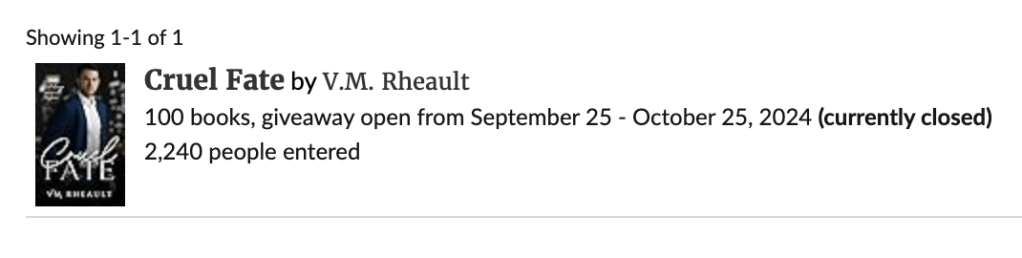
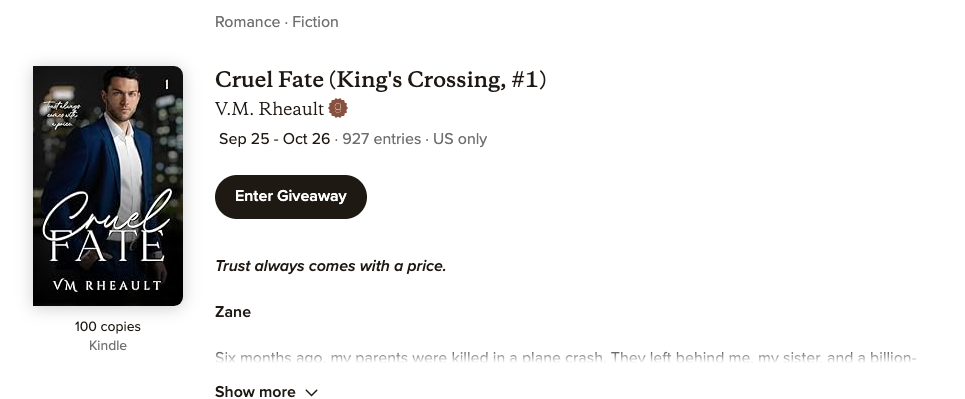
Anyway, because I saw someone on Threads saying Goodreads giveaways should be free, I bought one out of spite (the entitlement on that site is outrageous). It was good timing, since from what I’ve gathered, they’re used to build buzz for new releases. Cruel Fate had only been out for a week when I bought the giveaway, and I did make sure it was okay to run a giveaway on a book that’s enrolled in Kindle Unlimited. It is, and a Goodreads giveaway is probably the only thing you can do while your book is enrolled.

I hit a snag right away because I didn’t realize I couldn’t host the giveaway under my pen name. The giveaway is connected to the name that you have your Amazon/KDP bank account information under (which makes sense because that’s how they bill you). Then I had to verify my email which was a hassle and I wrote about it in a different blog post. You can read it here: https://vaniamargene.com/2024/09/23/housekeeping-update-and-verifying-your-email-address-on-goodreads/

Besides those two things, set up was pretty easy. I researched a little about it, and Al said to put it on for a month, so that’s what I did (don’t always listen to him, sometimes he lies). Looking through other giveaways, thirty days seemed to be about standard, though there were some that were shorter, probably in an attempt to create urgency which can work depending on who your publisher is and how big of an author you are. I’m still just a baby author as far as I’m concerned and didn’t have many expectations. Thirty days worked for me and I gave away the maximum number of ebooks, which is one hundred. I thought back in the olden days you could mix and match and I was going to give away five signed copies of the paperback as well, but if that was true then, it’s not the case now. I was going to give them away on my Facebook author page or something, but honestly, having one book out of six, that ends on a cliffhanger at that, seems pretty useless, and I’ll buy the other five and bundle them up next spring for a giveaway when the last book is released.

So, all in all, the giveaway went okay. In total, there were 2,240 people who entered.

I can’t say that’s more or fewer than what I was expecting since I’d never done one before. Of course, comparison is the thief of joy, but I did notice some books received fewer entries that had the same timeframe as mine and some books by bigger authors that had five-figure entries. I posted the giveaway where I could, and as often as I thought I could get away with, without irritating people. I posted it on IG a few times (and changed the blog subscribe link in my bio to the giveaway link), I told my newsletter/blog, and put it on my Facebook author page. The only place I didn’t put it was on Threads because I don’t have readers there and I’m not trying to find any. I don’t know if posting on social media helped–I think Goodreads pushes your giveaway somehow because my posts have never solicited that kind of response before, and if they do promote on your behalf, I’m grateful. I just don’t have the social media platform to promote something like this which is why I didn’t have high expectations going in.

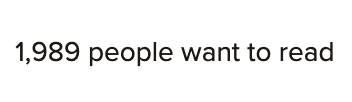
You can’t measure this kind of return on investment. Sure, when they entered the giveaway, my book was added to their Want To Read list, but I’m not sure how far that really goes.

Everyone knows that in reality, a reader’s TBR list could wrap around the earth twice, so that’s another reason why I considered the giveaway an experiment. Since the last book doesn’t even release until April, I may not see any ROI for months. I could get a few reviews out of it if people read the copy they won right away, but there’s no telling if the reviews or read-through to the next book that’s available can be attributed to this giveaway.

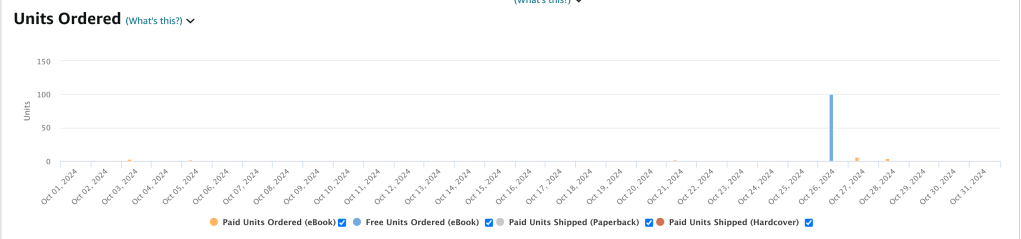
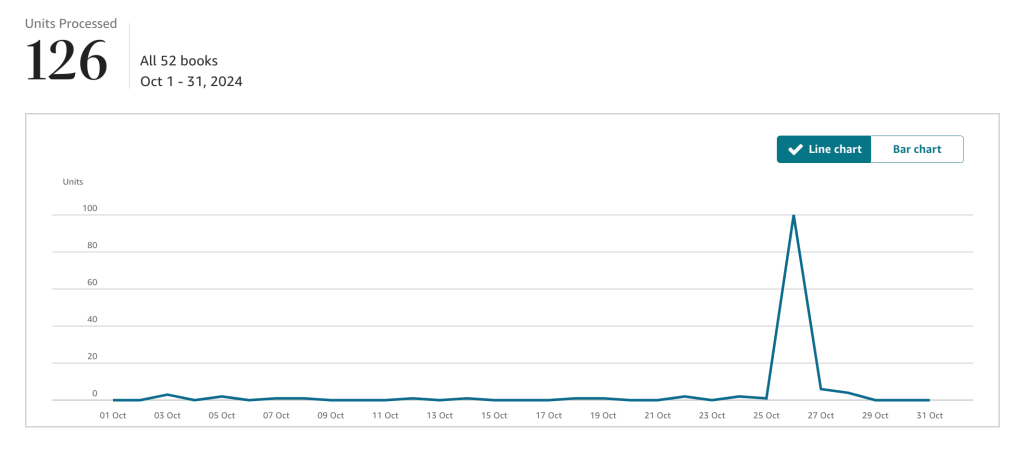
One thing that took my by surprise was that the one hundred copies that were given away showed up on my KDP dashboard. They showed up as processed orders, and I was very confused. First because had I sold them, I would have gotten the royalties. They didn’t show up as free copies on the new reports dashboard, but they did on the old reporting dashboard (that’s going away November 11th, incidentally).

Don’t mind the blank space–my KENP graph looks a lot better.

I even went so far as to contact KDP chat who said the sales looked fine on her end, but she didn’t tell me the books were connected to the giveaway. It was only one night while I was trying to fall asleep and planning this post and what to say that it hit me. So that was a strange lesson learned, but I’m glad I figured it out because a phantom one hundred copies of my book floating around, or KDP glitching, would have driven me crazy.

So why did I do it? I don’t know. Something to try, I guess. I’m not stupid and I know that had I been more active on Goodreads the giveaway probably could have gone even better. But since becoming an author, I just don’t think being active in a space like that is a good idea. There’s an expectation if someone finds out you’re reading their book and honestly, it’s no one’s business what I’m reading (or not reading) or what I think of it. Part of being an author is the literary citizenship, recommending books you’ve read, discussing a book if you know someone who has read the same one. I get it. But in the land of poor reviews and authors who will retaliate if you don’t like their book, I keep what I do pretty private.

Both of my Goodreads profiles are dumpster fires. It’s on my list to clean them up and have a Goodreads librarian update the covers to almost every single book I ever published because they’ve all changed. Maybe answer some questions so they’ll have recent answers. Update my bios because I think a lot of them still say I have my cats, and Blaze passed away almost a year ago already. (She was our last cat and due to financial reasons we will remain pet-free). Look like I’m at least still alive even if I’m not active. That’s the problem with all these book sites popping up. It’s like you’re tasked to keep a profile up to date when you don’t even want to participate. Fable, StoryGraph, LibraryThing. BookBub. I don’t want to be involved like that. Goodreads I almost have to because I need to move all my books over to my “real” profile whenever I publish because of an issue with the initials on my pen name. I get that, and it is what it is. But beyond that, I don’t want to do their reading challenge, I don’t want to update my status. I don’t think everything I read needs to be shouted from the rooftops because it’s no one’s business what I’m doing.

I got a little off track there just because when we talk about places like Goodreads, it’s natural to start talking about reviews, and I don’t like talking about reviews. I don’t write them anymore because I don’t think I should be criticizing my peers’ work, and I’ll leave it at that.

Will I run another giveaway? I don’t know. If I’m going to pay $99.00, I feel like I could put that money toward a promotion where I can measure the ROI better. On the other hand, I reached readers I haven’t before, and depending on who won a copy, maybe a bookstagrammer or someone on TikTok or an influencer of some kind, someone will read it and fall in love with the series. A lot of this publishing game is luck, and you just never know what can happen which is why I don’t mind trying new things in the first place.

Would I recommend it? Not if you don’t have the money to burn. If you need reliable ROI, I would pay for a promo through Freekbooksy or BargainBooksy or Bookspry or Fussy Librarian, Robin Reads, or Ereader News Today. Those work well, especially if you don’t use them often and their newsletter subscribers are new-to-you readers. But as I said, I think this could have gone better had I been active there, and if you treat Goodreads as its own social media platform and have friends and followers there that you interact with, you could see some positive ROl. We’re all different and we write different books, and what can work for someone won’t do anything for you and vice versa. If you do try it, keep an open mind and remember you may not see any positive movement for months. Hope for the best and at worst, chalk it up as an experience. That’s all you can do.

Until next time!

Are Stuff Your E-reader Days Beneficial?

Words: 2252
Time to read: 12 minutes

black bomb on black background. text says are book blasts worth it

With the number of book blasts on the rise, once again we’re talking about if giving away books is worth it. Not even giving away books because if you’ve read my blog for any amount of time you know I’m a big fan of giving books away. But there are so many book blasts coming into existence now, when before there were just one or two prominent ones and that was all. These book blasts can have anywhere from 100 to 2,000 free books and they always bring up questions such as, “Are readers actually going to read my book or will it sit on their Kindle?” “Do these book blasts hurt authors who don’t give books away?” “Do readers take a chance on new authors?” “If I give away a first in series will a reader read the rest of the series?”

No one can know the answers to these questions, but I don’t think authors really care about the answers anyway. What they’re concerned about is getting lost in the shuffle, and you can get lost during a free book blast just as easily as publishing a book and watching it sink to the bottom of your category because you don’t know how to market.

I’ve given a couple of my books away, during book blasts and using promos like Written Word Media’s Freebooksy. I don’t think there’s a lot of difference between them besides cost. Most, if not all, of the book blasts are free (the only cost is spreading the word around online and with your newsletter) and a Freebooksy is about 120 dollars depending on the genre you write in. The only time I’ve never not gotten my money back is when I’m giving away a first in series that no one likes. (I’m looking at you, poorly edited His Frozen Heart, book one in my Rocky Point series I happen to be re-editing now.) I’ve also discovered that my standalones do better than first in series, and I’m not sure why. Maybe some readers don’t want to get locked into a series by an unknown author and they just want an uncomplicated taste of your writing style. Maybe the tropes hit a little better. I mean, there could be a thousand reasons why one reader picks up one book but not another.

At any rate, the number of downloads your book gets doesn’t mean that readers are going to read it, or if they do, turn into a fan. Free book blasts are a way to get your name out there, but you have a responsibility to the readers who do try your book. If a book blast has 2,000 books available, and you get downloads, that’s half your battle. Here’s how to tackle the other half.

Write the best book you can.
I know this sounds like a no-brainer, but for a lot of readers, grabbing your book out of a book blast will be their first taste of your work. You want the cover to look great and you want your book to have as few typos as possible. I realized that no one is going to waste their time on a poorly written book, and if it’s a first in series, you can forget about read-through to other books. I know firsthand. I think these numbers reflect a couple different free promos I’ve done over the years, but I’ve given away 10,604 copies of His Frozen Heart. The series was rapid-released back in 2018 and I tried to promote the hell out of it. You all know I do my own editing, and you’d think I’d learn my lesson, especially after crunching these numbers.

His Frozen Heart:
Free: 10,604
Paid: 83
KU pages converted into books sold: 362

His Frozen Dreams:
Free: 0
Paid: 34
KU pages converted into books sold: 105

Her Frozen Memories:
Free: 0
Paid: 32
KU pages converted into books sold: 96

Her Frozen Promises:
Free: 0
Paid 31
KU pages converted into books sold: 77

You could tell me that out of 10,000 books given away that people did go on to read, and yeah, it looks like a few did, but the numbers aren’t great because the first book was a dumpster fire, and to be fair, so are (were) the rest. After these have new covers and they’re re-edited, it will be a very interesting experiment to see if any of these numbers increase. Of course, the first one will be exposed to the same readers, who may or may not remember they downloaded the first before, but Amazon will remind them when they click on the product page. So, putting my book in another blast may not do what I want it to do anyway.

The moral of this story of course, is to put out the best book you can. You’ll increase your chances of growing your readership if you’re publishing good books.

Be consistent.
I talk about this a lot, but this is especially true if you’re hoping to expand your readership through a book blast. You’re giving out a free sample of your work, and hopefully that sample reflects other books that your reader can choose from. I doubt any of the readers who managed to choke down my series went on to read other books, even if they did forgive all the flaws. My Rocky Point series is a small town holiday and other books under that name are enemies to lovers, close proximity, and age gap. And let’s not forget the first trilogy I ever published that probably sounds even worse than my Rock Point series that I should just unpublish and sweep under the rug (which happens to be a sports/running romance). That was probably one of the biggest publishing lessons of my life: if you hope to build a readership, don’t genre-hop. I thought I was writing “contemporary romance” and that anything under that umbrella was okay. It is okay. For Nora Roberts. The thing is, traditional publishing and indie publishing are different, and you can maybe attribute my sales going up to just being a better writer, but I did start selling more books when I created my pen name and niched down to Billionaire. I also changed my POV from 3rd past to 1st present, so that could have had an impact too, but when we try to drill down like that, we’ll never know for sure.

Make use of your back matter.
You should be doing this anyway, but capture those readers who chose to read your book out of 2,000 books. Put your newsletter link in the back and give them a way to stay connected to you. Then, actually send out your newsletter. Authors get so weird about saying they have nothing to say or that they don’t want to bother anyone. People don’t sign up for things they don’t want. It’s actually a confusing take, but the point is to stay connected so readers know you have more to offer or that you’re going to be publishing soon.

Be real.
In an era of AI, readers are going to seek real people to connect with. They want to know about you, what your struggles are, what you like to do when you’re not writing. I know this sounds like a load of crap, but look at the engagement of any huge author and the activity on their Facebook Author pages. Authors like Brenda Novak and Lori Foster have thousands of members and they talk about everything from what kind of wine they like to drink to sharing pictures of family vacations. They treat their members like family, and when they have a new book out, all it takes is a post to make them a best seller. Start by personalizing your bio on Amazon. A reader may look at it when going through book blast entries. Whether you want to use a real author photo or an avatar or a logo, that’s up to you, but I’ve never regretted putting my real photo on my author pages and in the backs of my books.


Do I think that book blasts are harmful or there aren’t good reasons to participate? I don’t think they’re harmful at all, no matter what other authors say. Yes, there are lot of free books on that day, but honestly, there are a lot of free books out there every day. I don’t have any reasons why you wouldn’t want to participate unless you have few books out. If you only have one or two, there’s not much for a reader to move on to if they like you, so you would have to fit the blast into your marketing strategy so you know what you’re getting and that you’re okay with the outcome. I don’t participate in every romance book blast that’s available. There are books I haven’t given away, like my first rockstar book in that trilogy or my Christmas novel. The last book I gave away was the first in my Lost & Found trilogy, but I don’t think it did too much. I got a few downloads (3,000) but not a lot of read through after the fact because it wasn’t the first time I’d given it away. It’s really difficult to let a book blast pass me by because I have terrible FOMO and I worry I’m giving up a golden opportunity to be seen. Because of the money I save doing the blasts with other authors, I feel okay paying for a promo every now and then, or something different like the Goodreads giveaway I paid for last month. I pay for ads, too, so the blasts are just a part of my overall marketing strategy.

You can use them as a learning opportunity, like my Rocky Point series. If you’re getting downloads but no read through, or if your book is also in KU and you get very few pages read, you know something is wrong with your book. It’s not well-written or the first ten percent is too slow and doesn’t keep their attention. It’s a costly lesson, as those readers may not try anything else you’ve written, even if you leveled up your craft and you’re doing better now.

I don’t know if I’ll do any more blasts this year. I did two, and that seems like enough. My King’s Crossing series is slowly releasing, the next book will be out on the 28th, and I’ve been trying to do better posting on social media to keep sales up. The second book has 7 preorders, which is amazing to me since I’ve never had that many preorders for a book before, and Cruel Fate, the first book in the series, has sold 7 ebook copies and has had the equivalent of 7 books read in KU. Not the greatest launch by any means, but the book ends on a cliffhanger, and I’ve been very clear about it, so I hope that just means readers are waiting to dig in.

If I can give you any advice as to joining a book blast, it’s to figure out what you want out of it. Do you want downloads? KU reads? Are you doing it to simply get your name out there? If you’re giving away a first in series but your series isn’t done yet, what are you hoping to accomplish? That’s not a derogatory question, it’s something you should ask yourself as your read-through won’t reach its full potential and you’ll have to work at dragging those people back to your series when the next book releases, which, if they didn’t connect with you in some way, is easier said than done.

I’m not going to whine about book blasts or support others who do. I don’t think they take away from my audience on days I don’t participate, in fact, I still tell my newsletter and social media followers about them because it’s content they appreciate. It would just be sour grapes to keep that information from my list.

If you choose not to do them, that’s a business choice, as well as doing them over and over again. It really does help to know what you want out them, though, and to keep your expectations realistic depending on the books you’re giving away. They can be a great marketing tool if used correctly, and free exposure never hurts.

Here’s a list of book blasts I’ve put together. Someone is always asking how to join but either don’t know where to start to search or are too lazy to do the legwork. Either way, the list is mostly romance, though it wouldn’t surprise me if more genres start forming. It’s a lot of work to put together, so if you do join, please be kind to the facilitator. They are doing a lot of work on your behalf, so the least you can do is follow their rules to make things easier for them. I don’t run any of these, and I’m not interested in doing so, so please use the contact information for the blast you want to participate in if you have questions.

Fantasy: https://stuffwithfantasy.com/authorhelp

Romance all genres: https://www.romancebooklovers.com/authors

Romance all genres: https://www.romancebookworms.com/for-authors

Witchy books: https://www.facebook.com/groups/witchybookwormsauthors

Alpha Cinnamon Roll Book Boyfriends: https://alphacinnamonroll.com/for-authors/

Dark Fantasy, Romance, Horror: https://www.darkmodesyk.com/sign-ups

Closed Door Non-Explicit Romance:

https://www.facebook.com/groups/cleanromancecollab/


That’s all I have for this week. I hope you’re doing well and if you celebrate Halloween, be safe!

Amazon Ads: A Case Study

I stumbled upon something interesting on Threads the other day. Someone was asking for tips and tricks on how to make Amazon ads work for her. Of course, I looked at the book she was trying to sell, noted a few things, and told her what I thought. That never works well in the land of the public, and there were a couple of people who commented on my comment. It’s interesting to me how people can tell you their opinions without looking at what you’re trying to sell or just spew stuff based on their own poor experiences. I’m not going to call this author out, but you can apply what I’m going to say to almost any debut author.

One of the things you should do when wanting to run ads is look at your product. We think we’re pretty wonderful we’ve managed to write a book and publish it, but that doesn’t mean everyone is going to want to read it. In fact, there are so many books out there it’s actually a miracle if you can find anyone who wants to pay for what you’ve written. Thinking that you’re going to set the world on fire will only set you up for disappointment. You have to be realistic when it comes to your book and by that I mean you have to look at your book and your author career as a whole.

What did I see when I saw her book?

It was only the first in a duology and the second book wasn’t on preorder. This is a Catch-22, and we know it is. People won’t buy the first book in a series without the others available because they don’t want to wait or won’t take a chance the author will finish. Authors who don’t sell enough of their first book think there’s no interest, lose motivation, and may not want to finish. I get it, but we also need to look at it from a reader’s point of view. Not being able to start and finish a series on their timetable is unsatisfying. Bingeing is a way of life now and when we are kept from it, we hear about it. No one wants to wait for the next season of Bridgerton or The House of the Dragon. No one knows where they’re going to be in 2026. This author doesn’t have the second book even on preorder, so God only knows when it will be out. She may not have even started writing it yet. It’s a sad fact that if she’s selling a duology, the first would sell better if readers had access to the second, even if only in preorder form.

She’s wide.
Amazon ads can be used if you’re wide, but to me, it makes more sense to use Facebook ads so that you can capture readers on all devices (by targeting them in your audience list). I told her that, and someone said she uses Amazon ads to great effect even though she’s wide. I just scoffed. Okay, Karen. The person who said that has been publishing for years, has over 30 books in her backlist, and, I would imagine, a very large newsletter list. She started way back in the Kindle gold rush where it was possible to make a lot of money simply publishing books and buying ads to fuel the flames. Publishing isn’t like that today, and only running ads won’t get you very far, especially as a debut author. I wasn’t impressed with her answer since it was clear she didn’t look at this author’s book or lack of backlist to provide any real, personalized direction. There’s no reason why you can’t run Amazon ads if you’re wide, but Amazon ads are known to be spendy, can’t get any traction for less than 30 cents a click, and you’re only reaching one audience. Facebook ads can reach more than only Kindle readers, can be cheaper (there are ads where I’ve gotten my clicks down to 9 cents a piece), and just seems all around a better investment. For her.

She’s not in KU, and her book is priced at $5.99.
This goes along with the “wide” part of the case study. I’m not saying Amazon readers are cheap, I’m sure there are people on Amazon who buy books at full price. But, we’re also talking about a debut author who has one book and the other book doesn’t look to be forthcoming. I’m not sure how many readers will really take a chance on a book that’s $5.99. I’m not arguing for or against being in Kindle Unlimited, that’s a business choice and being wide can be beneficial, but you are choosing your audience and that audience has disposable cash to buy entertainment. I don’t think it’s easier or harder to reach those people, you just have to know how. She may have her book in the Kobo Plus program (Kobo’s KU) but running Amazon ads won’t help her find those readers. So, she’s using Amazon ads to find readers who are willing to pay $5.99 for a debut author who is more than likely still writing the next book. If she’s getting a lot of clicks and no sales, her price could be part of the reason.

She has few reviews.
We like to think that reviews don’t matter, but they do. My duet won’t move no matter what I do and I attribute that to not putting them on Booksprout for reviews. The first book is only at twelve, and the second book is only at ten. I didn’t look to see if those are text reviews or only star ratings, but it doesn’t really matter. I don’t know the statistics on the number of readers who read reviews or just glance at the stars, but it does stand to reason the more star ratings you have, the better your book looks. Even if you have a good cover and solid blurb, a reader could nope right out of there if you don’t have enough social proof.

The book is old.
She published a while back, about eight months ago, well past the ninety-day grace period Amazon gives you. Running ads to a book that is old and already not selling well is like pushing a boulder up a mountain. Amazon is all about relevancy, and if your book isn’t relevant, meaning, people aren’t buying it, Amazon doesn’t care about it. They may still show your ad, and you get evidence of that when you see your impressions, but who knows if Amazon is pushing down your ad when it could be doing better. She’d do better to put her second book on preorder and then create an ad that targets both of them. That may be her plan once her book is closer to completion, I don’t know, but trying to drum up buzz for an old book takes a lot of time and money. Being that I have no idea how many ads or what kind she’s running, it’s hard to say if creating more and different kinds of ads (category vs. auto placement vs. keywords for example) with a higher budget would work.

So that’s what I saw when I looked at her Amazon page. Marketing is more than just figuring out an ad platform or posting social media graphics. It’s the genre you’re writing in, what your publishing schedule is like, if you offer a newsletter. She’s just getting started, so it’s no surprise her marketing tactics will be slow to take off.

I mentioned a little bit about the ad platforms, but let’s just take a shallow dive into them (I don’t have the expertise to go deep). Amazon’s ad platform isn’t complicated, though you do have to invest in clicks if you want any traction. I can’t get anywhere if I’m not bidding 40 cents or more, and that’s for contemporary romance/billionaires/rockstars. The ad itself only consists of your book cover, a tagline if you live in a country where that’s offered, and the number of reviews your book has. You need a strong cover, and if you get clicks, your cover is doing its job. It’s after you get the click and it doesn’t convert into a sale that you need to look at your product page. If your price doesn’t attract readers or if they’re looking for KU books and your book is wide, or your blurb is confusing, or they decide you don’t have enough reviews. Those can affect other ad platforms too, but if we’re just talking clicks, having your book in solid categories so they show up in the right spots on Amazon and having a fabulous cover will go a long way.

There’s a lot that goes into Facebook ads, and the potential to get one part wrong is huge. It’s probably the reason why the guy who said my Facebook ads recommendation was garbage. He had a bad experience, didn’t know how to put the ad together and maybe lost some money, but not everyone is going to have that experience. You need a good description, a good hook (headline), a good stock photo (creative) that will draw readers in enough to click. They can take a lot of trial and error and it can be costly, but I know it can be worth it once you figure out the secret sauce. Again, though, clicks can be a waste of money if readers don’t like what they see after they click on your ad. Facebook ads allow you to target more than just one kind of reader (versus Amazon ads whose readers only read on Kindles). You can target Google Play readers, Apple readers, Nook readers, Kobo, hoping to draw in those Kobo Plus subscription holders. Facebook will spend your money faster than Amazon does, but I found overall the clicks can be cheaper which allows for a little wiggle room. The dashboard is hella complicated, and I hate clicking around in it, but like any platform, once you get used it it, it’s not so bad. She could start small and boost a post off her author page and see how it goes. She would still need to create an audience, but you’d want to do that anyway. Every author needs comps.

I saw someone who was having bad luck with BookBub ads (not the featured deal you have to approved for) saying she was getting impressions but no clicks. It’s really important to understand what kind of platform you’re using. Amazon ads can cater to regular-priced books as does Facebook, but BookBub’s audience are freebie seekers and if she was trying to sell a book at full price, she wasn’t going to get any clicks. I asked her if she was trying to sell a full-priced book and if she had the price on her creative like they encourage you to do, but she didn’t answer me. Whether she didn’t see my response or she resented me telling her a full-priced book wouldn’t sell there, I have no idea, but I’ve heard of other authors trying to sell full-priced books on BookBub and it just won’t work. They have built their entire readership on readers who want free and cheap books. Trying to go against years of that will be futile. You can use them if you put your book on sale, though I have noticed that not a lot of authors want to do that. The author who is trying to sell the first in a duology might do that when her second book comes out, but without knowing her, I would guess the chances are slim.

When you decide to run ads, you have to take a look at your product and your company, which is you. Backlist, number of reviews, how long you’ve been publishing (there’s a reason why companies love to say they were established in XXXX–it creates trust in the person who’s looking at the advertisement), and how often you publish can all influence a reader’s potential to buy. Being a debut author isn’t a bad thing–we all have to start somewhere–but you have to keep your expectations in check. When she does release the second book in her duology, how long will it take her to write another book? Will she be marketing two books for the next two years? Will she release another first in series and expect readers to wait while she writes the next? Building a backlist can take years and she may not get ads to work for her for just as long.

There’s a reason why they say writing the next book is your best marketing tool. I understand the want to push your book out into the world, and I applaud her for trying, but she seemed to think the ads were what was going wrong, and well, I think in this case, it’s the operator and not the machine.

I’m certainly not an expert and I’ve killed ads that were costing me money, not making it. Like I said, I stopped trying to run ads to my duet, and now when I get someone reading them, I just figure they found out about them some other way. I’m running Amazon ads to my King’s Crossing series, and I had to kill a very productive ad. No one was preordering and the clicks were adding up. I may turn it back on once more books are available to purchase or read in KU. I knew from the start I would be paying for exposure, and I left three of the slower-moving ads on. I created two for my rockstars but they are very slow moving right now but maybe rockstars aren’t in and the books are a year old already (relevancy).

Once I write a blurb for the whole series I’ll set up a Facebook ad for it. I need a blurb that explains what the series is about, but I’ve been busy doing other things (which isn’t great since marketing this series should be on the top of my list) and well, I hate writing blurbs.

Anyway, ads are a great marketing too, just be sure you’re in a place in your career where you can benefit from them and always make more than you spend.

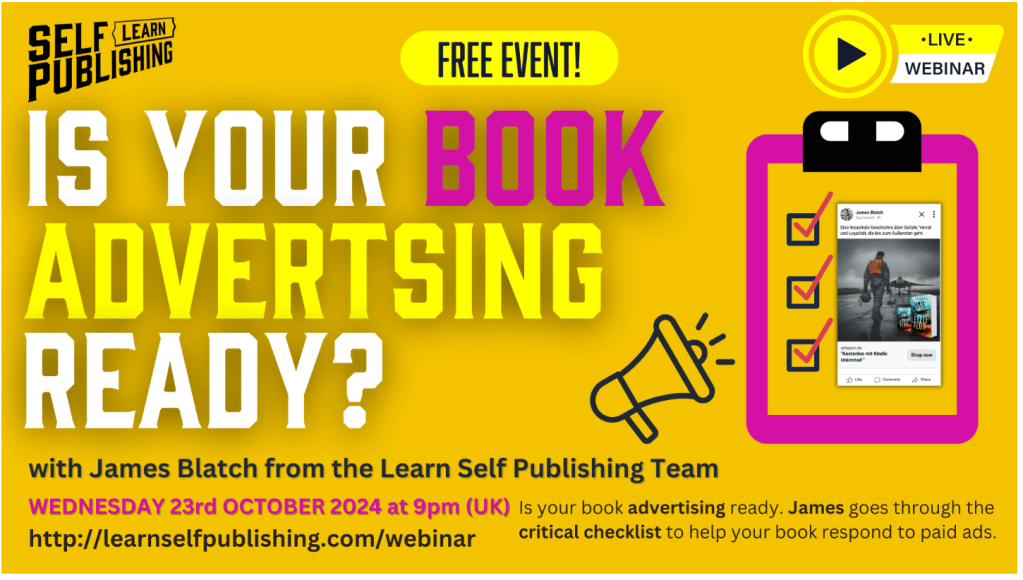
I found this in my email from James Blatch–Is your book advertising ready? Could be a fun webinar to listen in on. It’s free, and you can click here to sign up:

https://us02web.zoom.us/webinar/register/WN_RqcLtAxuSd-ioWbFGZiIKQ?inf_contact_key=d2952934bcb214bf7377961b3d3304084dfbc39d7283b2cb89d5189540b69330#/registration


Quick Links:

Bryan Cohen’s free five day Amazon Ads course: https://www.bestpageforward.net/getting-ready-for-the-5-day-amazon-ad-challenge/
The link at the bottom directs you to his Facebook page. Join his group to stay up to date on all the webinars he offers. https://www.facebook.com/groups/2230194167089012

Dave Chesson’s Free Amazon Ad course: https://kindlepreneur.com/free-amazon-ads-course/

Matthew J. Holmes offers a newsletter and classes on Amazon and Facebook ads: https://www.matthewjholmes.com/

David Gaughran has free tools on his YouTube channel that includes using Canva to make Facebook ads graphics: https://www.youtube.com/@DavidGaughran

There are a lot more resources out there when it comes to learning ads. Robert Ryan’s books are great, and if you want to learn BookBub ads, David Gaughran has one that will read outdated because the platform has surely changed, but the tactics described to find your audience are probably still on target. Ricardo Fayet of Reedsy also wrote one that is really informative.

Author Update and Mixed Bag

Words: 1592
Time to read: 8 minutes

tea, candle, cotton branch laying on comforter

text reads author update and mixed bag

I didn’t make any progress on my small town series last week, at least, not on my days off. I was silly and reread a standalone I published a few years ago because someone bought it and I was like, “Wait! What is she reading? What did she pay for?” And I really have to stop doing that every time someone reads something in my backlist (the reason, you’ll recall, I’m editing my small-town series in the first place), especially my 3rd person stuff, because there will always be mistakes to fix. I think that’s just the law of being an indie author. But it was worth it in other ways, as I thanked people in my Acknowledgements who no longer deserve it, and it was a relief to just delete the page entirely. One wrote under a pen name that doesn’t even exist anymore (so I doubt she’d want anyone to look her up anyway) and the other was my ex-fiancé who doesn’t need to be attached to anything I’ve done or do. I don’t need to keep reminders of people who have hurt me, even if back then they were important to me. A long time ago I wrote a blog post about this, and I think my opinions have changed. Then I advocated to leave the pages, since those people were a meaningful part of your life in some way, but now I say, change it if you want. Do whatever you need to do to protect your mental health and move on. You can read it here: https://vaniamargene.com/2018/05/31/acknowledgements-and-dedications/

I was also able to update my Also By page in the back and add all my first person stuff. I’m the same person so I thought, why not. The long list looks nice, anyway, haha. I didn’t do anything else with my back matter, though I could have put in a call to action (CTA) because it didn’t have one. I should have, but I was in a hurry, that side project not intentional, and I was mad at myself for wasting time. Oh well, it doesn’t matter since on the way home from dropping my daughter off at work the other morning I decided to stop with the hard sell.

A few years ago, during COVID, I guess, I listened to an author marketing podcast and one of the pieces of advice was to give them the CTA the second the book was done. I followed that advice and the back matter for Faking Forever‘s ePub looks like this:

screenshot of the last page of faking forever. ornamental break between last sentence of book and subscribe call to action for vmrheault.com/subscribe

The end of the story bleeds right into the call to action, and I don’t like it (anymore). I want a reader to be able to sit back and savor the ending of the story, not have my newsletter subscribe link shoved down their throats. It probably still is good advice, to hit them when they’re feeling good about your story, feeling good about you as an author because you delivered on your promise and didn’t waste their time and money. But I don’t think it hurts to give them room to breathe, either. If they liked your book that much, they’ll find a way to follow you, even if that means simply “flipping” the page to see what’s in your back matter.

Anyway, so editing All of Nothing was a side project I hadn’t counted on, but I’ll try to keep my eyes on my series now and get that done as soon as possible. I have a potential beta reading and formatting project I might be helping with that I really want to do, so that’s an incentive to stay on track.

Sometimes I think when I get sidetracked it has to do with how I’m feeling. I was a little lost last week. Just normal social media experiences that can rub you the wrong way or leave you feeling out of sorts. My friends and I talk about this a little, about the need to find connection, but when you’re online trying to reach out, you get your hand bitten off or snubbed. It’s common, and my experiences weren’t great. So, of course, when you get to feeling down like that, it’s easy to start wondering why you work so hard on your books for no reason, blah, blah, cue the violins, right? My mental health has gotten a lot better since my diagnosis, but there are a few things that can still bring me down. I’m not perfect, but things out of my control shouldn’t have that kind of effect on me and it’s something I’m working on. I can log out of Threads or even Facebook, and my books will always be there. Except Canva. I can never log out of Canva, haha.

Otherwise I don’t have much else. I posted on social media today, for the first time in a while. I think I need to keep this tab open, because the graphics BookBub highlights in their blog post can be a good source of inspiration. I was reading this today: https://insights.bookbub.com/bookstagrams-ebooks/. If you need a free place to make a book mock up, even if you just want your book’s cover on a Kindle, you can look here: https://diybookcovers.com/3Dmockups/#

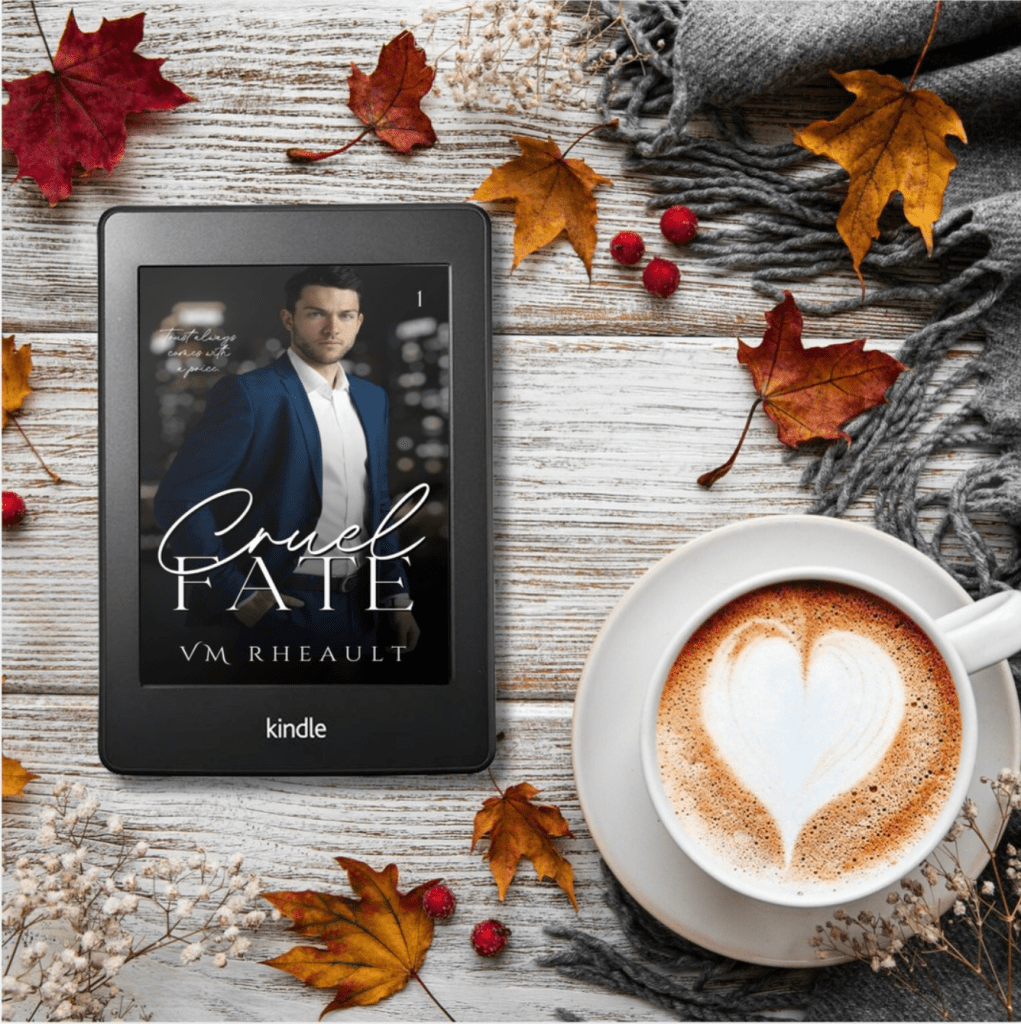
I posted this pic on Instagram. It’s pretty simple, but I forget it doens’t take long to make something like this and who knows who could see it.

flat lay of wood wht autumn leaves and a blue scarf. cup of cappuccino that has a foam heart
also Cruel Fate's book cover on a kindle device

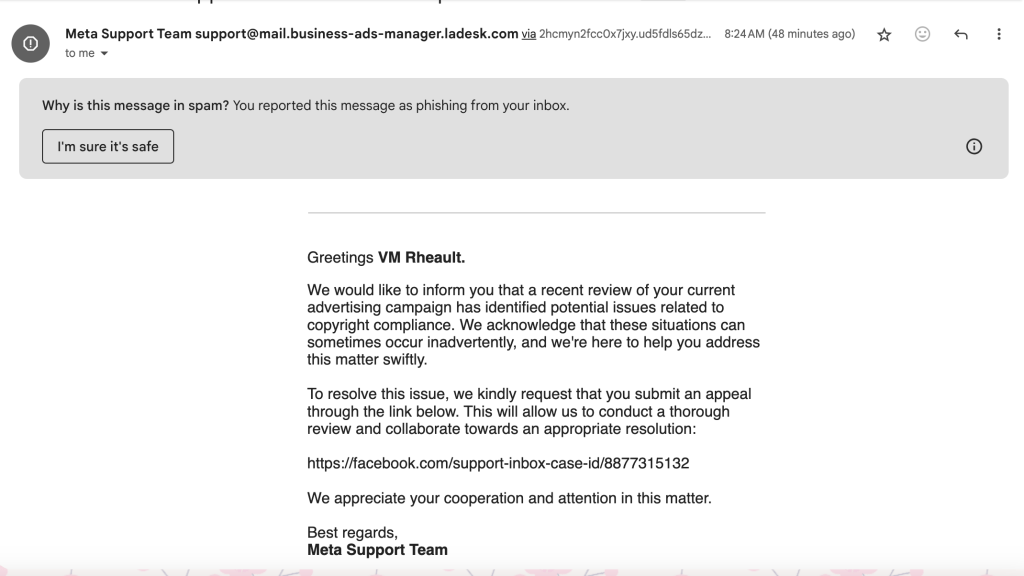
I was sent a scam email today that said I need to appeal a Facebook ad because I broke copyright. Anything like that makes you want to take action right away, but there are a lot of scammers on Facebook; I get messages on my Facebook author page and my reader page all the time. Here’s what the email looked like:

screenshot of bogus email.

It wasn’t sent to my Spam Folder, it went to my Inbox, which gave me pause. But I didn’t click on the link, thank goodness. I checked all my ads first because I know enough if Facebook thinks you’re violating copyright, they’ll take your ads down and maybe even suspend your ad account. I checked my ads, and they were all running fine, so I reported the ad as phishing and sent it to Spam. The things you have to be aware of as an indie is getting out of control, but I was proud of myself that I didn’t overreact and click the link, which gives them access to your ads dashboard (and my ads dashboard is connected to a bank account I assigned for my marketing budget. Needless to say, that’s money I don’t want to lose). So if anything seems suspicious or fraudulent, take a deep breath before freaking out and check things out first.


I don’t think I’ve mentioned it in a while, but if you’re looking for a good book marketing resource, Nicholas Erik has a wonderful book on it. I bought his second edition and was sad when he unpublished it because I recommended it to everyone. But, he revised it and released the new version. I bought it on his website but it’s also available on Amazon. This isn’t an affiliate link, I just like to recommend his book because it really helped me see book marketing clearly. If you’re interested, look here: https://nicholaserik.com/books/marketing/ Also sign up for his newsletter. He gives a lot of good advice in there, too.

photo of book cover. the title is the ultimate guide to book marketing by nicholas erik
Image borrowed from his website.

I had to pause a couple of my Amazon ads because even though I knew I was paying for exposure, it was getting to be too much. I’d already spent $29.00 by the 13th of this month, and my sales and preorders definitely weren’t reflecting that. I knew the clicks would start adding up, but I didn’t pause all of them because I know exposure is only the first step in selling books. I boosted a post on Instagram that I made about my Goodreads giveaway, and that was a little over 1200 entries the last time I checked. It will be interesting to see if anyone who wins the first one will buy/borrow the others, but like any promo, it could be months or even years until I find out, if I ever do.


That’s about all I have this week. I won’t be getting distracted by anymore side projects, though I have plenty of books I could read through on a whim. I need to get this series done because I have plans for it around the holiday season.

If there’s one thing I can say about the last four years or so, it’s that I’m glad life didn’t get me down to the point I stopped writing. When I bought those dryer sheets and my life turned upside down, I could have easily given up. I’ve accomplished a lot in the four years I’ve been writing (launched a whole new pen name and will have seventeen titles released by the time all the books in my King’s Crossing series launch), and if you’ve written despite the odds and against life’s challenges, I’m proud of you. I can look back on a long list of books, whether they need a bit of a polish or not, and be proud of myself.

Take care this week. I’m taking Friday off and we’re going to the state park to look at the leaves, then we’re trying a new bar and grill that opened in the town next door. It will be a fun day, and hopefully I’ll be celebrating being that much closer to done on my series.

Until next time!

Author Update and SMH

Words: 1299
Time to read: 7 minutes

So, there have been a couple things going on that just make me shake my head because I have too much going on to care, and while I do take interest in most things, if my energy allows it, I’ll be patient and see what happens.

I guess there’s been some issues with the founder of WordPress and WP Engine who uses the… I want to call it software, but I guess it’s technology? I’m not really sure, but I did a little snooping and my website isn’t run by WP Engine, it’s through WordPress directly. I don’t know how any of that is going to affect anyone’s websites now, and it seems a lot of people are panicking and pulling their websites that use WordPress technology down and going with something else. From what I understand, a lot of websites are built using WordPress, but are hosted by someone else like GoDaddy. I never went with a different host, even knowing I wouldn’t have all the flexibility, but I never minded. My website and blog does what I want it to do. Not to mention, I’m not very tech savvy, and fighting to create a website didn’t interest me. (Not back then. I was too busy trying to figure out how to format my freaking books!) Anyway, since the issue is really with the founder of WordPress and the people who run WP Engine, I think I’m safe. Listening to my gut has paid off before, so I’ll wait it out and see what happens. Moving my websites somewhere else, or breaking off from WordPress hosting and going with a different host sounds like a headache and nothing I want to tackle. I did export my blog posts from January of 2018 (the first two years I blogged are a disaster and that information is probably useless anyway) up until now. That would be a lot of words to suddenly lose, and maybe it’s a good idea to do that once in a while anyway. TechCrunch summarized what’s been going on and you can read it here: https://techcrunch.com/2024/09/27/wordpress-vs-wp-engine-drama-explained/

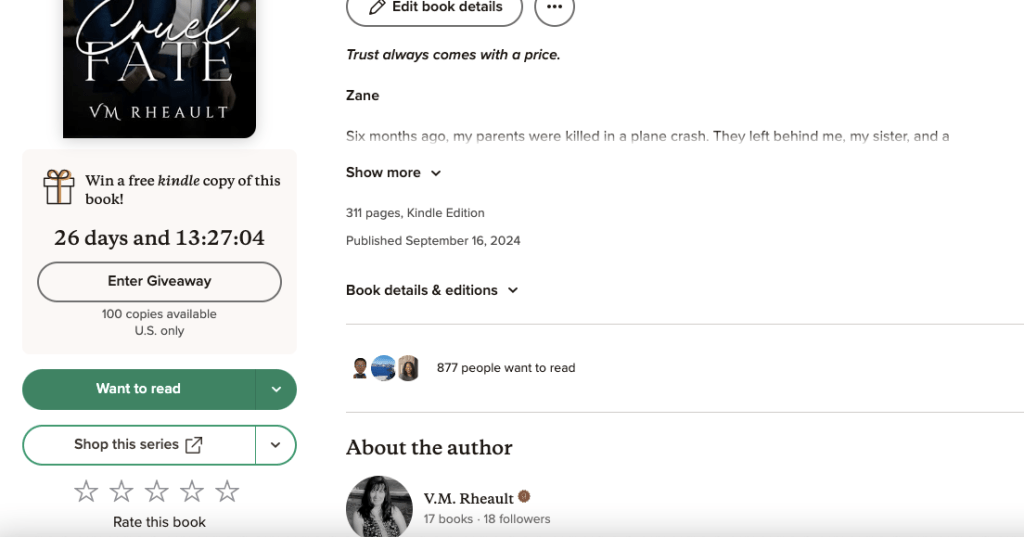
In other news, my Goodreads giveaway is doing fine, and just under a week I already have over 900 entries. If you want to enter, click here: https://www.goodreads.com/giveaway/enter_kindle_giveaway/397874-cruel-fate

I’m not actually sure what I expected, but I’m grateful there seems to be interest.

screenshot of goodreads 877 people want to read

I knew this giveaway would plump up my “want to read” numbers, and that’s cool, too. I don’t do much with Goodreads, haven’t even bothered to change the old covers on some of my books. I don’t know really, if Goodreads is safe for an author who reads, and at this point, with all my health issues and other things going on, I don’t think I want to add another platform anyway. Alessandra Torre is a huge Goodreads cheerleader, and you can read (and watch) how she uses it here: https://www.alessandratorreink.com/home/2017/5/12/grpromo

She has quite a bit of information out there on how to use Goodreads, just search “Alessandra Torre how to use Goodreads,” and a lot of information comes up. I don’t read as much as I should, so maybe Goodreads isn’t that great of a place to hang out if you don’t, but I don’t think once a reader becomes an author that it’s an author’s place to review another author’s work. I see authors all the time who defend their right to say what they want, but then when they get an “honest” review of their work, they can’t handle it. Don’t be in the kitchen if you can’t stand the heat is all I have to say to that. You all know my stance. Stay out of reader spaces (even if you are one!). Leave people alone. Go write your next book. There are actually some things you don’t have to tell anyone about. Imagine.

Now that I got my sarcasm out of the way for today, no, I don’t think I plan to be on Goodreads all that much, even during/after my giveaway. This was mostly an experiment in paying for exposure, and I have no idea really if it’s even worth it. I have Amazon ads going to my series, and I’m getting quite a few clicks and lots of impressions, but all my books will be released into KU and that’s what my readers will wait for. I’m not running ads hoping for preorders, even though I dropped the preorder price on books two and three. Book one is still .99 and probably will be until the last book comes out in April. I’m trying to be pragmatic about this release, realistic, and even though they call it “rapid release” I know I won’t see any real movement until they’re all out.

I have a lot of thoughts on paying for exposure, and maybe I’ll do a blog post about it sometime. For now, let’s move on.

Actually, there’s not a lot to move on to. I’m still editing my series, and I did get done with book two on Friday after our trip to the zoo and the junk market and started book three while I was at work on Saturday. Book two needed some work, some plumping up, and I know why. That was the first book I wrote and I remember thinking it was too “quiet” to carry a series and I decided to make book two book one. Now that I’m reading them with fresh eyes, I think book two would have been an okay book one, but I hadn’t gotten into the flow of the characters and I added 1500 words to book two. That took a little time, and I added a lot to the ending because it didn’t quite make sense. I think I learned a lot writing my King’s Crossing series, handling all that plot and all those details. I have a better memory than I did when I wrote my Rocky Point series, or maybe I was just in a rush to publish and didn’t work on them as hard as I should/could have. Hard to say since I published them in 2018, and that feels like a lifetime ago now. Still, never too late to fix a mistake, and these will sound good when I’m done. I’d like to celebrate their rerelease since some authors do that, maybe do a couple of lives if I can get up the courage and I’ll order some author copies to give away. I know I need to start being more active online, engage with people more. I’m not sure why I have problems with it. Hiding behind a screen is the easiest way to communicate with people.

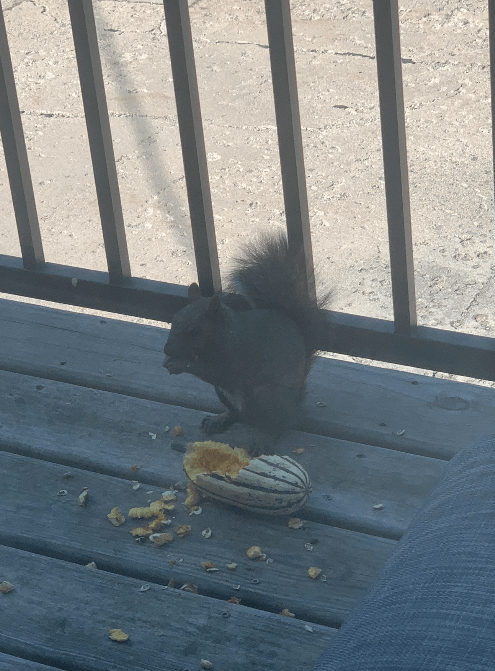
That’s really all I have left. My ex-husband has a key to my apartment (it was ours before we divorced and he kept his in case of an emergency) and he does weird things like come over while I’m working and drops off bags of garden veg he gets from somewhere. He did that a couple weeks ago and I put the squash on my balcony, jokingly referring to it as my fall aesthetic because I’m terrible at decorating. So, you all know I feed the squirrels and one of them decided to turn my fall aesthetic into a snack. She completely ripped the guts out of one and scattered them all over the balcony. But, she’s enjoying it, and I’ll let her have at it until there’s nothing left.

Squirrel eating squash
I took the picture through my screen so I wouldn’t disturb her.

That’s all I have for this week. I’m praying for everyone who was affected by Hurricane Helene. I’ve seen some pictures and read on Threads what’s been going on and I feel for everyone who has suffered. My thoughts are with you.

Until next time.

How to turn your book’s cover full wrap PDF into an ebook cover

I’ve gotten a few questions about this, and I guess maybe I was remiss in not typing out the instructions before now.

In all honesty, I’ve been doing it the hard way, importing the PDF into GIMP, cropping out the back cover and spine, adjusting the DPI and size, then downloading the JPG file. When someone asked me in the comments of my updated full wrap post for instructions, I didn’t want to direct them to a software they might not have. My full wraps are made in Canva, so should the ebook covers.

So, I messed around a bit, figured it out, and to my surprise, found it was easier than using GIMP anyway.

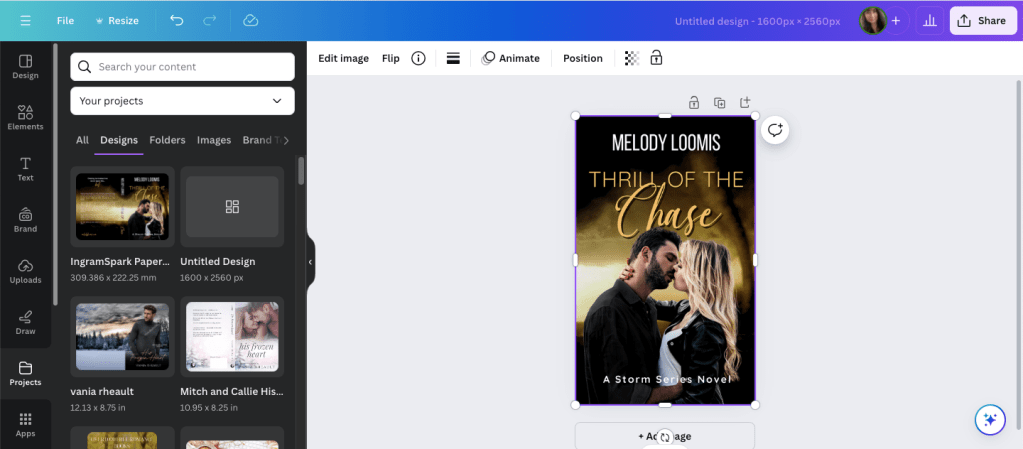
For the screenshots, I used Melody Loomis’s cover for her book, Thrill of the Chase. I designed the cover, so I already had access to the PDF and she gave me her permission to use it.

Here you go:

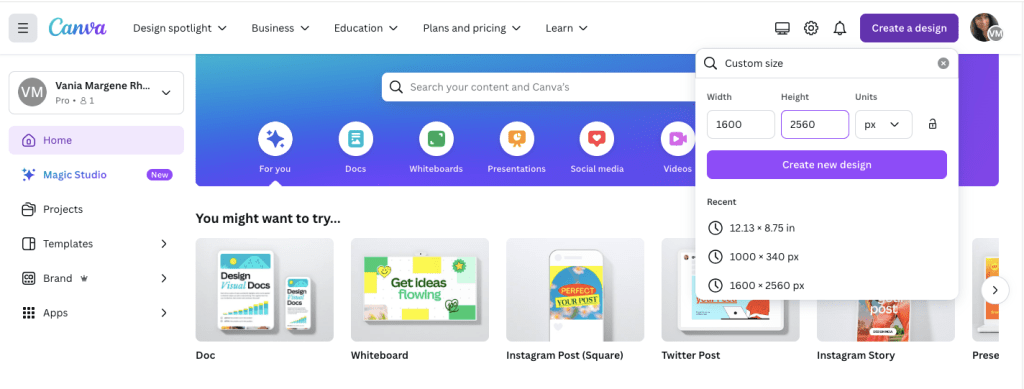
Click on Create a Design.
KDP’s guidelines for an ebook cover are 1600 x 2560 pixels. Click on Create a Design and click on Custom Size. Enter in the pixels, like this.

Click Create New Design.

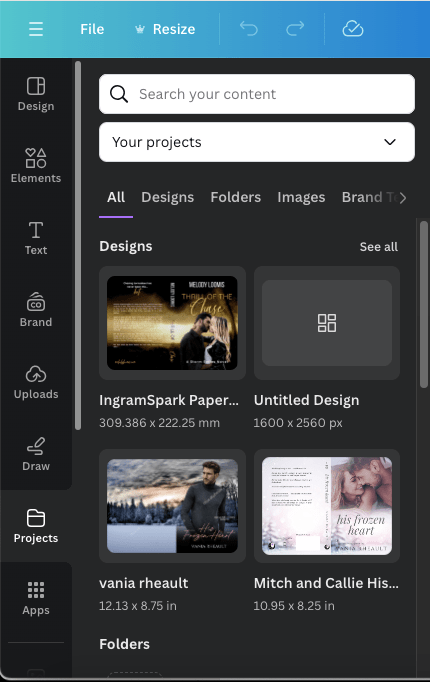
Next, you can either upload your book’s PDF or check your Projects folder. It will already be there unless you’re doing an ebook cover for someone else. The first time I uploaded a PDF I was really confused and kept thinking I was doing something wrong. So either way, your Projects folder is where you’ll find the PDF. I’m using Melody’s Draft2Digital cover, and it’s at the top because I uploaded it for this post.

Click on it so it’s laying on your empty canvas.

Click the cover to select it, if it isn’t already, and crop off the back cover and the spine.

Now grab a corner and enlarge it. At this point, just play with it until it fits the canvas how you want it. It won’t fit 100% and you’ll lose just a tiny bit on the sides, but it’s so little you won’t notice.

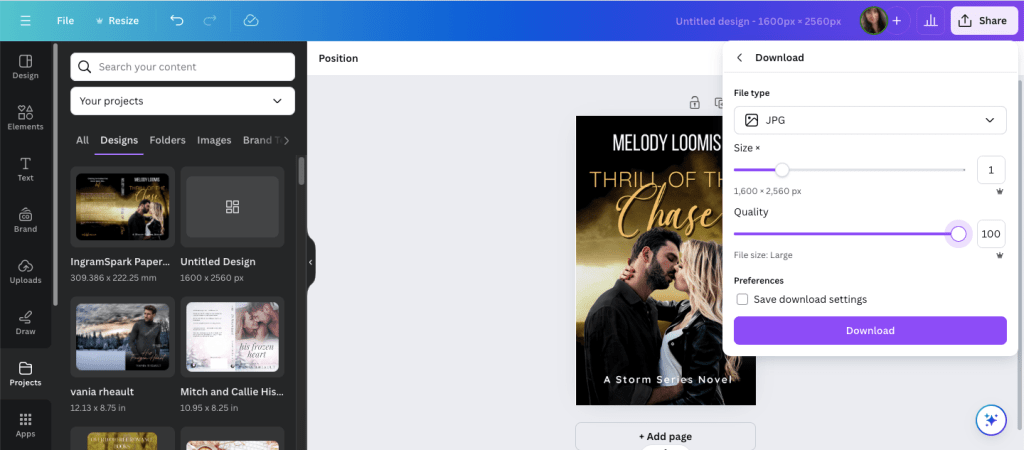
Click Share and Download.

Choose JPG because KDP won’t accept a PNG. If you have Pro, scoot the quality up 100.

Save it in a place and under name you’ll remember.

It will save in the correct size and DPI and you won’t have to do anything else to it.

That’s it. I should have written this out a long time ago, but I never thought to. Anyway, it’s simple enough to do and I should have been doing it this way from the beginning. After that reader posted his or her question, it did get me to thinking about it, and now I’ll never use GIMP to make ebook covers again.

If you have any questions, drop them in the comments below, and I’ll answer them to the best of my ability.

Thank you to Melody Loomis who let me use her cover, and if you’re interested in her Storm Series, you can follow her author page and check out her books here: https://www.amazon.com/stores/Melody-Loomis/author/B093KGD3ZC

Until next time!

Author Websites: Do You Need One?

Words: 1918
Time to read: 10 minutes


Today’s topic on websites is thanks to Melody Loomis, and you can check out her website here: https://www.melodyloomis.com/


I’ve been a writer in some way, shape, or form, all my life, like most writers are, but when I found writing after a failed attempt at going into Human Resources as a career, I didn’t think to create a website. In fact, the idea of it sounded foreign, confusing, and costly. I dusted off my Twitter account–I had made one while I was in school to connect with HR people–and joined the writing community instead (thinking I’d make the connections I would eventually need to sell my books. Ha!). One of the first things they said was to start a website, so, despite my inhibitions, like everything else I’ve done in publishing, in December of 2015, according to my WordPress site, I jumped right in.

I didn’t create my website to tell people about my books though. I started an indie blog, the one you’re reading right now. Almost nine years later, I have never taken my website down or skipped a week publishing, for that matter. I was pretty hardcore back then, writing six times a month about stuff I knew nothing about. Arrogant, I suppose, like a lot of newbie authors are. I don’t recommend having a website where you blog for indie authors and try to sell your books to readers at the same time. Mixing the writing community and the reading community can leave a bad taste in someone’s mouth, be it the writing community who doesn’t like the kinds of books you’re writing or the reading community who doesn’t like what you have to say on your blog that’s intended for other writers and authors. In fact, after typing that sentence, I’m tempted to take my Books page down. I don’t promote them anyway, and really, they don’t belong on a website that I use to write about my publishing experiences. I could always add them to my true author website (vmrheault.com), nesting a page under that Books page and making it clear they’re written under another name, but that’s a thought for another day.

The title of this blogpost is “Author Websites: Do you need one?” and the answer to that question is yes. Yes, you do, and along with the reasons why, I’ll explain how I use my websites and how they differ from each other.

Don’t build your house on other people’s land.
This is really important and I can’t stress this enough. Just a couple of days ago, someone on Threads was saying how her Facebook Author page got taken down and she lost over four thousand followers. Imagine if she had created a newsletter/blog instead. I know this post is about websites, but websites and newsletters/blogs are almost one and the same. A website is yours, and so is your newsletter. Social media platforms come and go (not because they fall apart like Google + but because you’re at the mercy of a bot who decides if you’re breaking their guidelines), but your website and a newsletter will always be around (unless, for some reason, you take them down).

It’s where you should send newsletter subscribers.
It’s a very bad idea to use your newsletter aggregator’s landing page link to send readers to sign up for your newsletter. If you change your landing page or you have an issue with your newsletter, that link might not always work. When you put that link around online and for some reason it gets broken, readers will think you don’t have a newsletter anymore and you could lose a fan. Also, broken links just look plain unprofessional. If you send subscribers to your website instead, you can make changes to your newsletter sign-up link as needed. No one learned this lesson better or faster than I did when my MailerLite newsletter went up in a puff of smoke. I had an invitation to sign up to my newsletter in the back matter of over ten books. That’s a lot of links to change when you think of ebooks, paperbacks on KDP, and paperbacks on IngramSpark. Luckily, I was sending them to my website, and now instead of a landing page link, I edited what the page says and it invites them to subscribe to my blog. My reader magnet is on that page now, instead of in my welcome email, but it is what it is. I’ll never try another newsletter aggregator. I like being in control of my website and blog. The longer I’m in this industry, the more I learn it’s difficult to trust anyone with any part of your business. If you want to see what that page looks like, you can look here: https://vmrheault.com/subscribe/

It doesn’t cost that much.
I can only speak for WordPress. I use WordPress and let them host. I bought my domain name and the email I needed, vania@vaniamargene.com, when I set up my newsletter, through WordPress too. I’ve shared that email enough that I probably won’t get rid of it even if I don’t need it for MailerLite anymore. Way back people said you shouldn’t do that because you can’t enjoy plugins and other things on a WordPress-hosted site. I didn’t care about having popups or selling books on my site, and still really don’t. Selling my books here sounds like a big time-suck and I already have enough of those. So, I went with a Premium plan for both and pay $96.00 dollars a year, each, $19.00 for my domain names, each, and my G Suite email for $72.00. You don’t need all that. Personal plans are $4.00 a month or $48 a year plus the domain for $19. You can have a professional WordPress website for $67.00 a year. Some website providers are even free, and there’s no reason you can’t go that way, but you’ll still end up paying for a domain name. One of the things authors forget is that when you get your taxes done, you can write off your expenses. I keep track of all my yearly spend and give that and my yearly royalties to my accountant. With how much I spend in ads, I break even or I’m in the red, but I can still get some money back for all the money I put into my business. No matter which way you go, free or paid, or if you find a site that’s in between, set something up.

Your website will turn into your hub.
Your website will be around for years and years and years and as you publish books, you’ll add those to build a nice backlist. You don’t need to worry about SEO or how people will find you. You can add your website link to the backs of your books and on all your social media profiles. People who are searching for you or your books already know your name and what to Google. The only time you need to worry about building SEO is if you’re blogging on a topic and you want to be found when someone searches for information about that topic. That really doesn’t apply to authors, unless you write nonfiction, and then you’re probably blogging about your subject.

This website gets anywhere from 30-100 hits a day. Mostly because people are looking for instructions on how to make a paperback cover in Canva. The updated instructions have gotten over 6,000 views since I published it in June of 2022. I get my regular readers who will read every Monday, and they count too, but if you search for “making paperback covers in Canva” my blog post is on the first page of results. That doesn’t matter much since it doesn’t sell books, I’m just happy I can help people publish. I don’t sell books off this website, so that would be another reason to take my Books page down. If you’re worried about SEO for your website, the only thing you can do is blog consistently on it. Being that a normal newsletter is only sent out once a month, if you blog that infrequently, you’ll never get the SEO you want. Building SEO takes hard work and consistency. Anyone who blogs whenever they feel like it and hops around from topic to topic can tell you how difficult it is to grow your following. Still, if you choose a WordPress-hosted site, you can be part of the WordPress Reader. When I moved my newsletter to my blog, not only did my number of opens stay around the same, but my posts were seen in the WordPress Reader, a perk I hadn’t considered but appreciate now. If you truly want your website to come up if someone searches your genre, sell a lot of books. That’s all you can do.


People say they don’t want a website because they don’t have anything to put on it. To me, that sounds like a good reason to have one. There’s no maintenance. I guess then you can argue you’re paying for nothing, but you’re paying for an internet presence you own and you have no idea how helpful it is to have one until you don’t and you need it. I loving having both my websites, and I have to admit, I love blogging on both too. I never understood people who say they don’t have anything to write, and oh, my God, do I hear it a lot. You’re a writer. How hard is it to come up with 500-1000 words once a month? Talk about yourself. Talk about your books. People can’t get to know you or think they’ll try out your books if you don’t put yourself out there. Though, that’s neither here nor there since we’re just talking about websites and not blogging, but if you’re worried your website will become stale, at least copy over your newsletter content to a blog once or twice a month, and maybe you’ll get some new readers who haven’t subscribed to your newsletter.

Content is the name of the game, and you’d need something to post if you make up a Facebook Author Page. You definitely need to create content on FB if you want people to see it, otherwise the algorithms will sink your page faster than Amazon will sink your book. If you write lengthy posts on Facebook, repurpose those posts on your website.

When I started posting about my books on my author site, I really enjoyed myself, and I was surprised at the number of views and visitors I was getting. I put my ARC links up and though they haven’t gone as fast as I would have liked, more signed up than if I wouldn’t have made them available on my website at all.

Your website will be what you make it. It will reflect who you are as author and the kinds of books you write. We’re all grappling for discoverability, for our books to be seen. A website is a good way to do that.

Now, I need to set up a blog for my author site. I’m blogging more over there to create buzz for my series, and it’s working well. In the past week I’ve had 145 views and 95 visitors, plus the opens I get from the list I exported from MailerLite when I deactivated my account. I couldn’t be happier.

I hope you had a good weekend and that you’re enjoying the Labor Day holiday. Check www.vmrheault.com if you want to see what I’m writing to my readers.

Until next time!

It’s a Matter of Perspective (Ad Platforms)

Words: 1906
Time to read: 10 minutes


Things may seem bleak now, Brother. But if I’m learning anything from my art studies, it’s that it is almost always a matter of… perspective. I look at my art, and if I do not like what I see, I may always alter the color palette, but I certainly do not toss the entire design aside. Perhaps you, too, could do the same in your own life.

Benedict Bridgerton to his brother, Anthony

Season 2 Episode 7: ‘Harmony’ (2×07) | Produced by Netflix (Taken from: https://scatteredquotes.com/always-a-matter-of-perspective/)


There is a lot of advice online about indie publishing, and we all know to take advice with a grain of salt. People rarely post the whole story to any situation, but a lot of times that’s not their fault. When you’re given a character limit, there’s not a lot you can do. That’s why when someone is asking about ads or editing or marketing, there’s going to be a lot of missing, or misleading, information. Whole books are written on topics like that and there’s no way the person asking how to run Amazon ads will successfully learn everything they need to know in a Threads post or on Twitter. Even Facebook with their unlimited character limit, people won’t/can’t post everything you should probably know. Besides, it’s not their job to teach you, and their way may not be your way.

Part of the problem is the people asking don’t want to take the time research for themselves. We’re all busy and sitting down to read a 200 page book on Amazon ads may sound bland and time-consuming. They want to know the nitty-gritty, but the problem is, we all have different books, knowledge bases, different budgets, and yeah, different perspectives.

I never considered it until someone I’ve interacted with every once in a while relayed this story on Threads:

Authors: please realize that phrases like “this doesn’t work” or “this works great” in regards to sales of promo are completely subjective. No one owes you their numbers but without them it can be hard to get a sense of what their advice means. For instance, I was talking to another Author in my genre and was saying that I had a hard time getting Facebook ads to work, and she replied that she has no problem at all.


I replied “wow that’s great. I could never make a profit. The best I could do was break even” she says “oh I don’t make money on them , but I don’t lose either and I consider that a win because it keeps me visible”
We were both having an identical ROI but I thought of it as going not well while she considered it a success because our goals were different. Now take this example and multiple by a million for every aspect of this industry

I related to the post because I too, break even on Facebook ads, but I never considered myself “failing.” I reason that I’m finding readers–people are reading my books who wouldn’t have before–so I never considered the ads or my books, a failure. So, yeah, in a sense they are “working” but anyone who is in my shoes would want them to work “better.”

That’s why it’s important to know what you want out of your books, what you want out of your business, and what you want out of your ad platform. If you want to sell 100 books a month, your goals are a lot different from someone who’s happy to sell one. If they’re happy with that one book a month, then your marketing strategy is going to be vastly different from theirs.

I haven’t done a very good job of figuring out what I want, mostly because I’ve been happy simply writing the next book and breaking even. I’m rather vague, saying I just would like to make a part-time income to fill in some of the blanks my day job leaves behind. I need to change that mission to earning a part-time income without having to spend on ads, or making 200% ROI so I’m earning more than just being able to cover ad costs. I’m grateful I’m selling books at all, even if I have to pay for ads to do it, because the market is crazy right now–there are so many authors and books out there–and selling books isn’t a guarantee no matter how wonderful your books are or how big of a backlist you have.

So when you seek advice online, be prepared for advice given by people who have different goals and perspectives than you. Rarely do we all want the same things or have the resources to obtain them. Taking advice from someone who has very little to spend on ads will be a lot different than listening to advice from someone who can afford to throw $500.00 a month at them. They can because either they have the day job to afford it, or they’re making money off their books and they’re putting their royalty money right back into their business. You may be a ways off before being able to do that.

If you aren’t making money off your ads or you’re not selling books, changing how you look a your product can help too. Get honest feedback on your cover. Get help rewriting your blurb. We become very close to our books and we’re biased because we don’t want to think anything negative or bad about something we worked so hard on. But it’s essential to look at your book as a reader of that genre and not its creator. Change your perspective and you might be faced with a whole lot of truths that can only help you move forward.

When you think about ads or booking a promo through Written Word Media or something else like Fussy Librarian, it helps to know what you want. Do you just want to make your fee back? Maybe you want some reviews too (keeping in mind on average, only one reader out of 100 will leave a review). Maybe you’re just testing the waters and don’t mind losing a little money. Maybe you’re just paying to get your name out there, wanting the exposure, or maybe you’re pushing out your backlist and laying the groundwork for a new release. If you know what your goals are, you can study what others are doing and twist them to suit you and your business.

If someone does say they are having success with ads and you want to break down the hows and the whys, here are some basic things you can look at:

  1. How are their covers? Covers play an important part when you pay for ads, especially Amazon ads where the book cover is the only thing that’s featured (if you don’t choose to write ad copy). Are yours up to snuff? Because if they’re not and theirs is, you can throw their advice away. It won’t work for you.
  2. Blurbs. You need a strong blurb (and cover) or you could pay for clicks and once they reach your product page, they’ll back out and you won’t get any sales.
  3. How many reviews do they have? Opinions on this vary, but from my own experience, books that have more reviews do better than books that have fewer. If you have five and the person you’re talking to has 500, you’ll have to keep that in mind and maybe realize it will be harder for your ads to encourage sales.
  4. How often do they publish/how big is their backlist. If they publish four times a year and never fall off Amazon’s 90-day cliff, but you can only publish once a year, take that into consideration. You’re going to be pushing a boulder up a mountain, and that author is already at the top.
  5. Are they promoting other ways (like a newsletter)? Any way an author is pushing readers toward Amazon tells Amazon to push your books and ads will work that much better. It’s kind of a crappy cycle: the more you push readers to Amazon, the more they push your books, and the more your books will sell, and the more your ads work, and the more your books will sell, and the more Amazon will push your books. I believe that’s called being “sticky” an achievement I haven’t reached yet.

Changing your perspective can help in other ways, too. Experiment with your bid, experiment with your ad copy/tagline, even changing your keywords or categories. If something isn’t working, you need to look at it from a different point of view. This is what my ad would look like if I ran an Amazon ad with ad copy to Twisted Alibis.

For as good as it sells, I’m disappointed I don’t have more reviews, but it’s better than Captivated by Her that only has like, 11 star-reviews and maybe one text-review, so I’ll take what I can get.

You can study that ad and think of what you could do if it was your book. Is the cover good? If you’re in a country that allows you to add text, is your tagline hooky? How many reviews do you have? Is your Kindle price where it should be, or is it too much… or too little?

You have a lot more freedom with Facebook ads, though they’re making changes now and I bought a class from The Writing Wives because Mal is going to go over them. I’ll be logged into work and I won’t be able to watch it live, but I need to know what to do the next time I want to set up a Facebook ad. I have two running right now that have great social proof and I’m never going to turn them off. As of right now, even though I’m slightly losing money on them because sales are dismal, they are the only thing driving any kind of traffic to my books.

There are a lot of resources out there about how to set up Amazon and Facebook ads. A lot of it is technical information, and you have to take that information and tailor it to your books. Like with Facebook ads, not everyone is going to use the same featured stock photo, or use the same headline, or use the same description. All they can tell you is how to set up the ad and possibly give you tips on hooks. You’ll have to figure out what works and what doesn’t. Look at your ad in the POV of a reader and ask yourself if it would draw you in.

Anyway, Dave Chesson has a free Amazon ads course he just updated, and you can find it here:
https://courses.kindlepreneur.com/courses/AMS

There are others out there like Robert Ryan who have written books on Amazon ads, and Matthew J Holmes has a book on Facebook ads.

David Gaughran has a ton of information on Facebook ads, and he recently just did a tutorial on how to turn your book’s cover into a graphic using Canva.

This blog post has gotten way out of hand, and honestly, I’m not even sure what I’m trying to say. Listen to what people have to say, but be aware their goals may not be yours. That might not be a bad thing–getting others’ opinions can be helpful. Know what you want out of ads, and be honest with yourself if they’re not working. Or if they are working and you want them to work better, figure out what you can do, even if that’s just adding a dollar to your daily spend (if you can afford it and/or if you know you’ll earn it back). Right now, I’m stalled out, spending about 8 dollars a day and earning 6 if I’m lucky, but I think it’s because I haven’t published anything for a long time, and we always have to keep in mind that writing the next book is the best thing you can do.

It’s been kind of a long week, and it’s hot outside–86F. I’m going to go outside and give some water to my animal friends and walk around the block to clear my head. I swear to God I’ll be a different person once this series is done. Maybe I can finally get some rest.

Have a great week!

Author Update and Monday Musings

Words: 1625
Time to read: 9 minutes

desk flat.  pink flowers, blue candle. text says, author update and monday musings

I don’t have much to update you on this week. I’m slowly making my way through my King’s Crossing proofs and I’m in the middle of book two right now. I’m not finding much, a word that should have been deleted here, a word that should have been added there. Like many authors, some of what I mark I’ll decide to leave alone, and that’s usually the hint I need to realize that after proofing these, there isn’t going to be anything left to change or to make better. I recommend everyone reads their proofs because it’s amazing what you’ll find when your book is printed out, and actually, ordering a proof is a cheaper than printing it out at your local Office Max.

Anyway, so that’s all I have for my author update.


As far as my Monday Musings are concerned, I want to defend all my Canva book cover blog posts. There are opinions circulating on Threads that pretty much say it’s not safe to use a cover made in Canva because Amazon won’t accept them if they ask for proof of copyright. This isn’t correct and I do not want any baby authors to get scared or bummed out they can’t use Canva to create their covers. The truth is, KDP/Amazon doesn’t care how you made your cover. You can use Canva, BookBrush, Photoshop, Affinity Photo, InDesign, GIMP, or even Word. What they care about is where you got the stock photos that you used to create your cover. Canva Pro gives you access to hundreds of thousands of stock photos, and you can use them, for anything but book covers because if KDP asks you if you have the licensing rights to use the photos, they won’t accept Canva’s. That’s it. That’s all it is.

When you buy a stock photo, you’re not buying the copyright of that photo. you’re buying the licensing, or the permission, to use it. The photographer and the model, through a model release, say it’s okay for you to use the photo on your book, and that’s the documentation that KDP wants. Canva doesn’t give you the proper permission to use their stock photos, not in a way that Amazon wants, anyway. So, whenever I talk about Canva, I always say you should buy your photos from places like DepositPhotos, Shutterstock, Dreamstime, or 123rf. You can browse Canvas stock and find the source and purchase it directly. Sometimes the source is Getty, and we all know most of us can’t afford that. For that reason, I never practice book covers using their stock because I might fall in love with something I can’t use.

The same goes for places like Unsplash, Pexels, and Pixabay. Those places are fine if you’re using stock for blog posts and aesthetics, but for an actual cover where you’re going to be making money from your book, you should buy your stock photos.

The standard licensing is fine–the extended license of a photo is primarily if you’re going to use the photo on something you’re going to sell, like a coffee mug. The standard license is fine for a mug if you’re going to make one for a giveaway, or something else like bookmarks, but if you’re going to sell those coffee mugs and bookmarks at a book table at a convention, then you need the extended license, which is a lot more expensive. That’s why I don’t make swag. It’s expensive and I don’t have a readership that would pay. If you want to make bookmarks or business cards, or even post cards, the standard license is fine–knock yourself out. VistaPrint is a good option.

Another reason someone said it’s not safe to use Canva book covers is because someone could copy it and you can’t do anything about it because you can’t copyright what you make in Canva. The thing is, anyone can copy a book cover, and it doesn’t matter where you make your cover. The reason most authors don’t have their book covers copied, even if they’re gorgeous, is because you’re just asking for trouble if you do. There’s no faster way to get blackballed in the author/writer community than copying someone else’s work. Now, can the author you copied sue you for that? Sure. They might start off sending you a cease and desist email first, ask you to change your cover, counting on that to scare you enough, and if you’re baby author who got swept up in loving a cover, or you bought one from a designer and you didn’t know she “borrowed” the design, then a cease and desist letter would probably be enough. But the threat to sue, I don’t want to say is empty, but a lot of authors don’t have the money to take you to court. So, it doesn’t matter where your made your cover, anyone at any time can copy it.

When you’re a romance author, we do get into some shaky and shady territory. We use the same models, a lot, even the same backgrounds, a lot, and when that happens, sometimes vibes are the same. I think most of us authors understand that and we just shrug and say, “It happens.” I even blogged about it, and you can read it here: https://vaniamargene.com/2023/08/14/romance-covers-finding-the-right-stock-photo/

I’m not a copyright lawyer, and when I talk about stock photos and book covers, that’s all my knowledge pertains to. Canva is used by people who are not authors, and when someone uses their elements to make logos and social media graphics geared toward selling products, I have read those logos and social media graphics don’t belong to that company. Maybe that’s true. I have no idea. I don’t work for a company that asks me to make social media graphics, so I don’t have to know the legalities of it.

When I make a cover in Canva, sometimes I do use a Canva element, like a gradient or a glow star, but I use DepositPhotos for everything else. When Amazon asked me for licensing information for the 3rd book in my rockstar trilogy, I took screenshots of the download information of the background photo, the model’s photo, and my profile information. I had other things on my cover (a small piano vector indicating what instrument the guy in the third book played) but I didn’t give them that, or the font information. If you’re ever asked, give them as little information as possible because right off the bat you’re dealing with a bot that randomly picked you and you don’t want to muddy the water with information they don’t care about. Keep it polite, give them the stock photo information, and if you don’t have it, they’ll tell you to change your cover. If that’s something you have to do, be smarter and buy your licensing agreements the way you should (or never use that cover designer again). (Here’s a blog post I wrote about scammy cover designers–https://vaniamargene.com/2024/04/22/author-update-and-vetting-your-book-cover-designer/)

I hate when “important” information is passed around on a platform like Threads. There’s no way you can include all the information you need in a post so you don’t confuse people. And if you do see blanket statements like, “Don’t use Canva to make your book covers because it’s not safe,” I always suggest you look up who’s saying it. A lot of times it’s going to be someone who benefits from your fear, like, you guessed it, a book cover designer who is going to be out money because you’re making your own covers.

I saw that once last year. A book cover designer in a book cover Facebook group was trying to go after GetCovers because they were “copying” book covers. After a lot of back and forth and nasty comments, even between her and the GetCovers owner, or whoever he happened to be, what it boiled down to was she was a book cover designer who was angry they could charge so little and she felt it was eating at her potential client base. It’s the same for editors, too. Anyone who says you can’t publish without paying an expensive editor is probably an expensive editor who wants to guilt you into paying their prices.

I’ve turned so jaded lately I just always assume people are looking out for themselves first, most, and always, so always, before you get scared, do your research.

Thousands of authors use Canva to do their covers. Some use it properly, purchasing stock photos from reputable sources like DepositPhotos, some take chance and use Pixabay or Unsplash, thinking that their “free for commercial use” agreement is enough, some use Canva stock and hope for the best. If you’re going to use Canva because it’s easy and user-friendly, then you’re not doing anything others aren’t doing. I know that shouldn’t be much of a consolation, but you’re hardly breaking the law. Even if I make a cover for someone else and they’ve downloaded their photos, I download them too so I have the licensing agreement under my profile in my downloads. And what I would send KDP, or what I have sent, looks like this:

This is the purchase proof for the model who will be on the third book of my King’s Crossing series.

That way the author I’m helping can say I made their cover, and I can turn around and give her the screenshots she needs to prove I paid for the licensing agreement.

I have said in the past that your books are your business, and it really doesn’t feel true until KDP smacks you with a proof of licensing for a stock photo.

Anyway, that’s all I really wanted to say. Like almost everything, if you mess up, it’s the operator, not the machine.

Have a good week, everyone! I’m going back to proofing.