Let’s Talk about WAS

“Was” is a nasty, dirty, filthy word, am I right? “Was” means, oh my God, you are writing in the passive voice, and all passive voice must be eradicated from your Work in Progress, or you are going to fall into the fiery depths of writing hell when you die.

fire-298105_1920

Indies are told it’s bad, that you need to take it out of your writing. Even when I edit for others, I will find it, give the authors the bad news that yep, they used it 4,000 times in a 70,000 word WIP.

But just how bad is it?

I’m reading The Snowman by Jo Nesbø right now. I love it. I saw the trailer for the movie, and I wanted to read the book before I watched the movie. (Chances are after I finish the book I won’t want to watch the movie anymore, but that’s a different blog post.) But you know what I saw when I opened up the book? Well, yeah, I saw the front matter, the title page. But what was the first sentence of the first paragraph?

It was the day the snow came.

A book by an acclaimed author whose book was turned into a movie started his book with passive voice. He could have written, Snow came that day or It happened the day it snowed. Something. But he didn’t. Why didn’t he? Why didn’t his editor catch it? Ask him to fix it? I wonder how many “was” words he uses in his book.

When should you write out “was?” Here’s what I think.

wite out

When it’s an indicator of tell, not show.
This is another no-no in the indie world. Always, always show, not tell. And for the most part, I agree. Description is always a lot better than telling your reader something.
When I was editing Don’t Run Away one of my little triumphs was:
Dane was livid.
I turned it into:
Dane trembled with rage.
You can see right away that’s a better way to go. I didn’t do it so much as to get rid of the “was” word, but I wanted my readers to picture what Dane’s anger looked like.

When the sentence simply sounds better without it.
This is tricky because how do you know? You can try to rewrite your sentence, but if you can’t get it to make sense without “was,” leave it alone.  Writers use “was” because it’s easy. It’s a lot easier to say, The sky was blue, rather than, The blue sky shone; not one cloud masked its brilliance. But not every sentence needs to be written that way–it’s up to you as the author to pick and choose, to decide where you want to put your energy.

When you freaking use it too many times. 
It always sucks when you do a search to see how many times you’ve used a crutch word. Just, 500, that, 1,000. Nodded, smiled, rolled eyes, shrugged.  “Was” is no different. If you have a ton of them, it could mean you are doing more telling than showing, that you’ve gotten a bit lazy, and you need to examine your WIP to see what you can fix. A paragraph describing a room like this:

The bedroom was small. A bed was pushed against the wall to make room for a desk that was filled with papers. A dog was sleeping at the foot of the bed, and a picture was hung crookedly on the wall. The rug was dirty, and the closet door was open, revealing clothes hanging haphazardly on their hangers.

Can be turned into this:

A dog lay on an unmade bed that had been pushed against the wall to make room in the small space. A desk filled with paper sat under an open window.  A rug that had seen better days lay in front of a closet that hadn’t been closed properly, and Janet wrinkled her nose in distaste at the mess inside. She straightened the crooked picture on the wall before leaving. Jack wasn’t there. She’d have to look for him somewhere else. 

Not only are you getting rid of “was” words, you are getting rid of repetition. I’ve edited for a few people whose paragraphs sound the same. Subject + verb + the rest of the sentence. If you want to get words down and move on, that’s fine. Some writers like to worry about the editing later. But please do go back and mix up your sentence structure. Sometimes this includes getting rid of “was”, sometimes it means starting a sentence with a prepositional phrase.

When you can fix the verb.
Don’t say, He was standing say He stood. She was watching turns into She watched. This is an easy fix and will save you some words too, if your WIP is bloated and you need to cut it down.

Rewriting some sentences that have “was” in them can make a sentence or paragraph stronger, can show your reader something instead of telling them what is going on.

But I also think that “was” is a lot like “said” in that it is invisible to a reader. The room was dark, and Stacy stumbled. We know what that means. We can picture that just as clearly as Stacy couldn’t see two inches in front of her face. She didn’t know what lurked in the shadows of the bedroom, and she tripped over God knew what when she gingerly took a step inside. Did the second example sound better? Maybe it did, but it’s also exhausting to read that all the time. It’s also exhausting to write that way. If every author tried to eradicate “was” from their writing, every book would be as thick as a Stephen King novel.

There is room for “was,” and I’m not as hardcore to get rid of it as I used to be. As long as you’re conscious of how many you have, if some of them can be replaced with something stronger and you do, then you’ll be okay.

Sometimes we can get too caught up in following every single rule out there. And it’s disheartening to be trying your best when you read trad-pubbed books doing things you’re trying not to do. Give yourself a little break. Keep on eye on the numbers, take your beta-readers’ opinions to heart. Listen to your editor.

Avoiding “was” hell won’t matter too much if you’ve trapped yourself in editing hell. Find a happy medium. Your sanity, and your readers, will thank you.

To Query or Not to Query

When I talk to people about my publishing plans for my next couple of books, people ask me if I’ll ever query and try for a traditionally published deal. I always say, “No, I’m not writing anything queryable right now.”

People can take that a lot of different ways, and mostly that sounds like I don’t have faith in what I’m writing, or that my work is crap and only suited for self-publishing.

That couldn’t be further from that truth.

What I mean by that is, I know what I’m writing. I know what it’s suited for. That doesn’t mean what I’m writing isn’t being traditionally published; it just means I don’t have to find an agent to get it there. I write fluff. Maybe that’s demeaning to my genre when I say that, but I also am not pinning my work with any more importance than it deserves. Harlequin, the publisher that brings you the lines Temptation, Desire, Blaze, and the like (they’ve done some remodeling, so I don’t know what their lines are now) prints hundreds of books like that every year. In my Barnes and Noble, they take up a shelf in the corner of the building near the floor. All the shiny red spines with titles like One Night with the Billionaire or The Cowboy’s Baby. Women read these by the handfuls; a quick read you can get through in a couple hours before tossing it onto a pile and reaching for another one, like candies in a heart-shaped box. You know what you’re getting, you savor it as it melts in your mouth, but you have no problem reaching for another one when the chocolate is gone.

My books are like that. What I write in three to four months will be devoured in three to four hours, and I’m okay with that. I’m more than okay with that. Romance is a huge genre, and where there are millions of writers cranking out millions of books, there are also millions of readers. They don’t call the Romance genre the bestselling genre for nothing.

But along with pages of guidelines for how they like their books to be written and their preferred word count, Harlequin has its own dropbox on its website. I don’t need to query an agent and let my manuscript sit in a slush pile to wait for an agent’s assistant to skim my query letter. I can upload my manuscript onto Harlequin’s website myself, or to Carina Press, the digital-first arm of Harlequin, and let it rot in their slush pile without any help, thank you.

If I were to query, going back to the original question, I would query something more serious. Something I worked harder for. We all have visions of our books sitting on the display table at Barnes and Noble in the center of their main walkway. Trust me when I say Don’t Run Away would never make it there—agent or not. No, looking at the New York Times Book Review right now, I would want to write something more akin to Women’s Fiction, not Contemporary Romance. I would want my manuscript to mean something, to say something, to point out an injustice, to try to right a wrong, to help someone. I would want my manuscript to come from my brain as well as my heart.

bookstore_page

I’m not trying to degrade romance, not at all. But any romance writer or reader knows the difference between In the Arms of Her Boss and Sing Unburied Sing by Jesmyn Ward, a finalist for the National Book Award for Fiction. And let’s be clear, a reader who picks up either one of these knows what she’s getting. You have to be in the mood to read it, and a writer has to be in the mood (not to mention have the talent and skills) to write it.

I’m not in the mood to try to write something of Sing Unburied Sing’s caliber. I’m perfectly happy editing Chasing You. (You can weigh the two books by title alone, can’t you?)

If, or when, I plan to query, it will be with a book that will make it worth my time, and it will be with a book that will be worth the pain and heartache of rejection. Because I know the score. Querying is a whole lot of rejection, and I won’t put myself through that for a computer file full of fluff.

You might think that I’m too hard on myself, but I prefer to think of it as a realistic POV of my work. And, quite possibly, more indie writers should have it. Querying a story that won’t make it onto a table at the Barnes and Noble will sour you on the whole process. Traditional publishers only publish so many books per year. Why query a book that would never make it? That’s not to say your fluff isn’t good enough for Harlequin or a small press. (The back of bookstore on a shelf near the floor is better than nowhere at all, right?) It very well may be, and you should definitely go that route if you feel your book is worth it. Query to find an agent knowing/admitting where your book is going to end up, or use Harlequin’s dropbox and let your book sit in cyber purgatory for a few months while interns wade through the submissions.

But I won’t bother to try to find an agent for something that will sell just fine when I self-publish it.

After I’ve grown a bit more as a writer, or maybe when I have a nice backlist I can be proud of and want to challenge myself, or when the perfect plot plops into my head, I’ll write my book and I will query it to find an agent who loves it as much as I do, and maybe one day it will end up at the Barnes and Noble on a table in their main walkway.
I’ll pass it and brush my fingers over the cover as I walk to the café for a coffee. But for now, I’ll finish writing Running Scared while chocolate melts in my mouth.

#SmutChat Self-publishing Topic Recap!

I run a Twitter chat called #smutchat. It’s geared toward more than just smut, (though I am a romance author and I like to chat about that too, from time to time) and last night we talked about self-publishing.

I said I would recap the chat for a few people who couldn’t make it, so here you go. 🙂


#SmutChat-Selfpublishing (2)#SmutChat-Selfpublishing

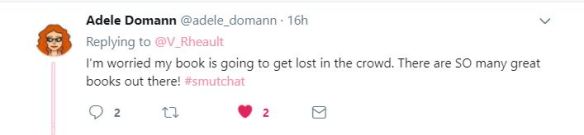
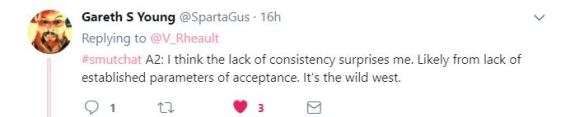
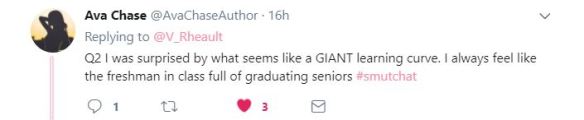
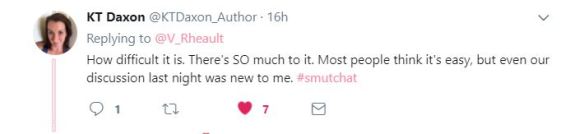
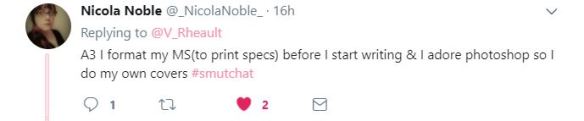
Question one, when I was making it up, was intended to be a question about the process of self-publishing. Was it formatting your paperback book? Dealing with uploading to KDP? Maybe figuring out your book cover? Some hit the nail on the head; others went far beyond.

smutchat recapsmutchat recap 4smutchat recap 2smutchat recap 1smut chat recap 3

smutchat recap 5


#SmutChat-Selfpublishing (3)

To be honest, I didn’t know what I was going to get out of this one, and the answers were all over the place.

smutchat recap 7smutchat recap 8smutchat recap 9smutchat recap 6

#SmutChat-Selfpublishing (4)

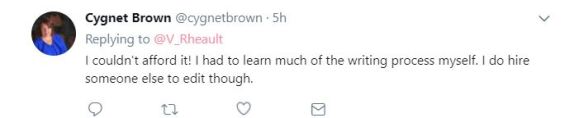
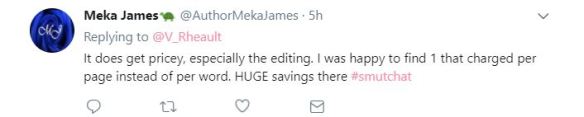
This question brought about the answers you would expect. It’s expensive to publish a book if you hire out, and no we can’t afford it, and no again, we probably won’t see a return on that investment any time soon. Yet the people who don’t know what they’re doing and publish bad-looking books muddy the pool for the rest of us who do it right.

smutchat recap 10smutchat recap 11smutchat recap 12smutchat recap 13smutchat recap 14

smutchat recap 15

nadia covers

gareth editing


#SmutChat-Selfpublishing (5)

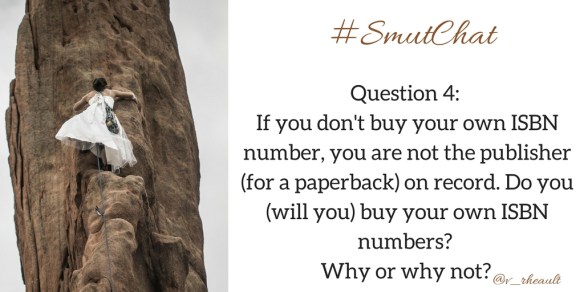
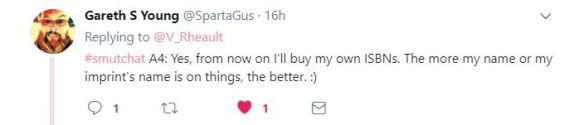
ISBNs are expensive–at least, they are in the US. CreateSpace gives you one for free and if you use theirs, they are listed as your book’s publisher, not you. Kindle Direct Publishing will give you an ASIN number, but I read somewhere that selling an ebook isn’t considered publishing per se, it’s just selling a file. I use my own ISBN numbers for both my Kindle file and my paperback for CS. Here’s what others said:

smutchat recap 16smutchat recap 17smutchat recap 18smutchat recap 19

emae isbn numbers

#SmutChat-Selfpublishing (6)

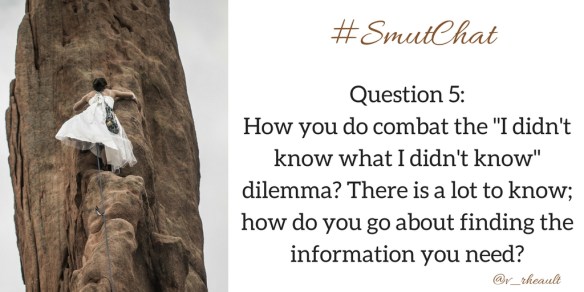
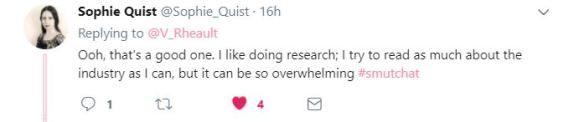
This is tough because if you don’t know you don’t know it, how will you figure it out? I researched the hell out of self-publishing, CreateSpace, and Kindle before I published On the Corner of 1700 Hamilton and I still got a lot of things wrong. When you self-publish on your own without help from someone who has done it before, you’re bound to make mistakes. I still make mistakes. I had to resubmit my cover for Don’t Run Away. CS said they “fixed” my cover, but I wanted to fix it myself. The more I know, the better off I’ll be. Here’s what other people thought:

smutchat recap 20smutchat recap 21smutchat recap 22

smutchat recap 23smutchat recap 24

That wrapped up the chat about self-publishing. Though I didn’t showcase them here, there were several tweets about book marketing. I haven’t delved into marketing yet, so I don’t have anything to offer in the way of that or what works. I do know that I have been reading up on Amazon Ads, and a good book by Brian D. Meeks seems to make a lot of sense. Whether it will work for you (or me) remains to be seen, but you can find it here. I have also been reading about Facebook Ads and this is the book I’m reading.

Rachel Thompson @BadRedheadMedia  runs a book marketing chat. You should check out her chat and maybe get some tips and ideas on how to market your own book. She has also written a book about it, and you can find it here.

In some sub-tweets, I told someone to look at Author Marketing Club, run by Jim Kukral. He’s co-host of the Sell More Books Show podcast I listen to every week. He also runs Happy Book Reviews if you’re interested in finding more book reviews. I haven’t used his services so do so at your own risk. Like everything online, be careful where you throw your money. I do listen to his podcast though, and he seems to be on the up and up or I wouldn’t point them out to you.

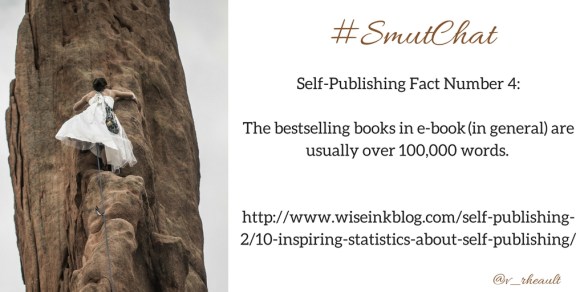
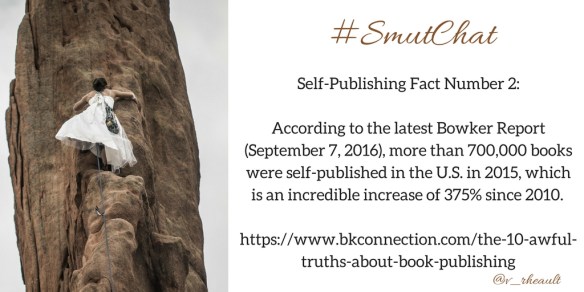
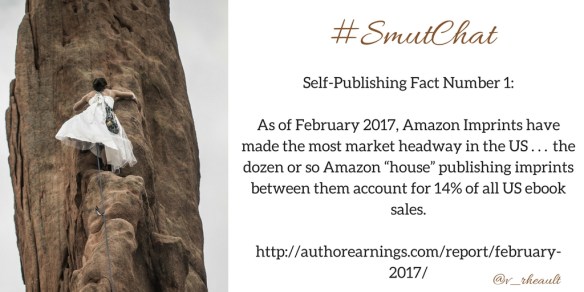
I also tweeted some interesting facts about self-publishing:

#SmutChat-Selfpublishing (14)#SmutChat-Selfpublishing (13)#SmutChat-Selfpublishing (12)#SmutChat-Selfpublishing (11)#SmutChat-Selfpublishing (10)

Anyway, thanks for reading over the recap. I apologize if I didn’t feature one of your tweets to a question. It was difficult wading through the answers, though I do appreciate everyone who participated last night! If you’re interested in all of the answers, or you want to look at the sub-tweets, please take a look at the hashtag! It was a great chat!

Vania Blog Signature

Read to Me, Baby!

Many have you may have realized I’ve disappeared off social media for a bit. If you haven’t, uh. Anyway, so I’ve been editing the first book in my Tower City Romance Trilogy. I’ve been working on this for a while now, and I’m so close to publishing, I can taste it.

coffee-2436940_1920

But editing is a bitch, and it seems like no matter how much I do, it will never be enough. It doesn’t help that I’m taking an online editing class, and every time I complete lesson, I find a million more things wrong with my manuscript.

One class was extremely helpful though and we were told to either make Word read our work to us aloud or to read it ourselves. I can’t stand the sound of my own voice, and it’s a fact that you know what it says so your brain may fill in the blanks and you won’t catch what’s wrong, anyway. I didn’t know Word could read to you so I looked up the directions. You can find them here.

Quite simply, I fell in love with it. I can’t stop listening to my own work. I delight in hearing a perfect sentence or laugh when a piece dialogue sounds as good spoken as it did in my head. Of course, it’s not perfect. He doesn’t say some of my characters’ names right, and he skips over ellipses and em dashes. What does he get right? Well, he reads everything just as it’s written: the double words, the typos, the skipped words. I’m not sure a human could even do this level of proofreading. It’s not fail-proof, he doesn’t know I typed except when I meant accept, but that’s the beauty of him speaking it aloud, you can read along and correct as he goes.

The voice sounds more like this than that, but that’s okay.

This makes it tedious–it takes a long time to listen, correct, listen, correct, listen. Sometimes to the same paragraph over and over again. But I see more advantages of this than not. Audio is getting bigger and bigger, and there are a couple avenues indies can take to make audiobooks of their books.

ACX
ACX stands for Amazon Creative Exchange. Through ACX, for a fee, an indie can turn their book into audio and sell it alongside their books on Amazon.

Findaway Voices
Draft2Digital has partnered with Findaway Voices to give indies another choice than to go with Amazon to turn their books into audio. You can read about it here.

How cool is it that you already have an idea of how your book is going to sound if you decide to turn it into audio?  You won’t have to worry how that two-page paragraph, where, oops, you have six comma splices and five semicolons, will sound. You won’t have to worry if it sounds odd every time your characters speak to each other and they say each other’s names a million times.

Not to mention, that since you have already heard everything in your book spoken aloud, you really won’t have to do anything with your proof but make sure the inside and cover turned out.

So, this is what I’ve been doing for the past few days. I have a publishing date set for November, and I’ve been trying to get through this book. It’s slow going because as I said, he’s finding things I want to fix, so I do, then I listen and have to fix it if it doesn’t sound right, or if I made a mistake while I was fixing my mistake. Yeah, that happens. A lot. But I know that after all this is done, my book will sound the best I can make it.

Have you tried this? Tell me what you think!

Vania Blog Signature