The Scary World of Amazon Marketing Services

Writers need to get their books out there. Twitter doesn’t sell books. Neither does Facebook–at least not on your personal profile. There are only so many copies Aunt Edna wants. And she’s not going to pay your bills. (If she is, that’s no one’s business but yours.)

So what is an author to do? Well, you can write more books. You should be anyway. What else? Instagram the shit out of your life hoping to draw some attention to your fabulous #writerslife.

What else?

Pay for promos, maybe. I’m assuming I’m still getting some KU page reads from a Freebooksy promo I did a few months ago. (To read about that, click here.)

I’ve come to the conclusion after a few years on Twitter, the only way to find readers is to write books and tell people (who aren’t on Twitter) about them (you know, actual readers). I’ve decided to dip my toes into the world of Amazon ads.

amazon adsNow, lots of people have told me that they don’t work. I bought Brian Meeks’ book, and he tells me they do. But you gotta be smart, and you gotta be patient, and you gotta test. Test and Test. And Test.

Oh, by the way, you have to have a decent book, good cover, good blurb. Because if you don’t have a quality book, no amount of advertising will sell your POS. (Sometimes people forget about that part.)

So, I’ve been running ads for a couple of weeks. Brian says this isn’t hardly any time at all, and I agree. Buying and running ads on Amazon isn’t the magic trick to selling books and getting famous. You need to have patience, and you need to know what you’re doing.

At first, I bid low (like Brian advised–he walks you through the entire process), and piecing together information from other sources, I realized this was way too low. I write contemporary romance, and it’s a highly competitive market.

The thing with Amazon ads is you need to bid high enough that Amazon will show your ads, but not so high that if someone clicks on your ad but doesn’t buy, you don’t go broke paying for clicks that don’t turn into sales.

It’s called a sweet spot, and from what I can tell, few people have the patience to get there. Or they are too scared they are going to waste a lot of money trying.

I’ve been running ads for 13 days, and this is what I have so far:

ams ads so far june 18

Remember, 13 days isn’t hardly any time at all. But for anyone scared to run ads, take a look: I have 12 ads running right now, and I’ve spent 35 cents. Not dollars, cents. None of the ads are doing particularly well, and I assume it’s because I’ve bid too low. The ad for Don’t Run Away that has over 3,000 impressions, hasn’t cost me anything. But those impressions could have given me a few page reads in KU if someone saw the ad, but didn’t click and just decided to try the book in KU anyway. Where and when someone decides to read your book if it’s enrolled in KU will always be a mystery.

Here are my KU page reads for DRA. I took this screenshot on June 18th. The same day I took the screenshot of my ad dashboard.

sales and ku reads for dra

Nope, I don’t have any sales yet. But I haven’t gone broke trying, either.

So anyone who is wanting to try this but is afraid of losing money can err on the side of caution, figure a few things out, and go from there.

I’m surprised that DRA is getting impressions, as the second set of ads I did for Wherever He Goes is a higher cost per click (which you would think would buy me more exposure), and I think the cover for WHG is better than DRA. But maybe the blurb is better written, or the characters resonate better with readers.

So where do I go from here? I plan to bid a bit more for WHG, and see if I can’t get some impressions, at least. Maybe I could even do another set of ads for DRA at a higher bid, and see if that doesn’t ramp up my impressions even more and hope those turn into clicks. Or I could do nothing, and wait to see what happens, because 13 days of ads is hardly any time at all.

But I’ll keep an eye on it. I just wanted to let you know a high daily limit doesn’t have to scare you.

And if you take anything away from this it’s this: if your ads are successful, and you are getting a ton of clicks but they aren’t turning into sales–you need to look at your book. You need to look at your cover. Your Look Inside pages. Your blurb. Don’t pay for ads for a crappy book. Make it better.

I’ll keep you posted!

How Do You Create Well-Rounded Characters?

From time to time I’ll read a book written by an indie author. I like to see what’s going on in the world of self-publishing and what my competition friends are writing. But I’ve happened upon a common theme–new authors don’t understand the concept of three-dimensional characters. Or if they do, they can’t correctly express it on the page.

What do we mean when we say readers want a well-rounded character?

When you read editing books, (and shame on you if you aren’t!) you’ll read a section on show, not tell. Show me your Female Main Character is tough, don’t just tell me she is.

angry-2878934_1920

This is so much harder than it sounds because you need to begin your character-building from page one and continue the building through the entire book.

Say your FMC is moving, and she drops a box on her foot. Or she’s hanging a picture and she slams her thumb with a hammer. She doesn’t cry. She’s tough. You’ve shown us she can hurt and not give in to tears.

So what?

That means nothing to the reader. We want to know why. Why is she tough?

Did her father beat her mother whenever she cried, so your FMC has trained herself not to cry? Maybe her father beat your FMC for being weak. (Gotta love some horrific backstory, right?)

This makes your character tough. Now we have a reason. How does that tie in with the story? Because it always has to tie in. Your characters’ traits need to blend into the internal conflict and external conflict.

Your characters’ traits are involved in your characters’ emotional growth. And your characters’ emotional growth is propelled forward by the plot.

Readers need the emotional arc to care and invest in your characters, their lives, and their problems.

Let’s have a quick example:

Felicity is starting a new life. She’s tough–life has made her that way. She grew up watching her father beat her mother. Her new apartment in a new city is a fresh start.

She clicks with a mover who delivers her new furniture. He has a temper, and after dating she realizes he has anger management issues. He reminds Felicity of her father. She gets scared of him, though he would never hurt her, or anyone, for that matter.

We have some fabulous internal conflict now:

  1. Felicity is tough on the outside, but as you write her backstory and weave it into the plot, we’ll see she’s actually vulnerable on the inside.
  2. The man she falls in love with brings her back to fearful and unhappy times.
  3. He loves her, but can’t control his rage enough to make her feel safe around him.
  4. She needs to learn that not every man she meets is like her father.
  5. He needs to learn he has to calm down and get help or they have no future.

This isn’t enough for a full plot, of course. Maybe someone is after her (she’s running from something/someone) and she has to trust him despite being scared of him.

Maybe he already knows who she is, and he was assigned to protect her–but he knows if he can’t control his temper, she won’t trust him and he won’t be able to do his job.

At any rate, we have reasons and backstory. (I focused on Felicity, but we see that our MMC has issues as well, and you could make up a fabulous backstory for him, too.) We have an explanation as to why they behave the way they do.

Your characters are people who have traits that have been cultivated by events in their lives.

For your reader, it’s not enough to make your FMC a bitch, or moody, or pissy. Readers need reasons tied to backstory and internal conflict, or all they have is an unlikeable main character.

Even your villains need reasons for being evil. Some of the best villains are characters readers feel sorry for, even relate to.

Jaime Lannister is a good example. Everyone despised him for pushing Bran out the window in A Song of Fire and Ice. But when his hand was cut off in A Storm of Swords, we almost feel sorry for him. And, possibly, everyone wanted a romantic relationship to develop between him and Brienne. Even though there wasn’t a character less deserving. (Oh, that was only me? Sorry. Must be my romantic coming out in me, again.)

Make your character a bitch, and all she is is a bitch. Make your character a bitch with reasons, feelings, and a desire to change, or she’ll lose what matters most, and you have internal conflict and a character growth arc.

The best books are both plot-driven and character-driven.

Readers want change–to go on a journey with your characters. They need internal/emotional growth while going with your characters from point A to point B.

Some of the writers I’ve read have the plot down, but haven’t yet perfected revealing backstory, explaining why the characters behave the way they do.

Sometimes this can be easily solved by getting to know your characters better. Spend time with them. What are their hopes, fears, ambitions, and flaws?

An author will have a difficult time introducing their characters if they don’t know who their own characters are. And if the writer doesn’t know, the reader sure as hell won’t.

Traits, negative or otherwise, does not a well-rounded character make.

For more tips on writing a well-rounded character check out WRITERS HELPING WRITERS®. The assortment of books for traits and emotions can go a long way to helping you figure out who your characters are and how to write them in a way readers can understand and empathize with.


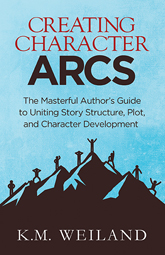
Creating Character Arcs is another good book written by KM Weiland. Check out her blog here. She dishes out fantastic tips on writing, and I own all of her nonfiction books.  Happy writing!
Creating-Character-Arcs-165