What to Think About When Writing and Publishing a Series

There is a lot to consider when writing and publishing a series. I wrote a novella series called Summer Secrets. The collection consists of six novellas—the shortest being 25,000 words, the longest 32,000. I wrote them one right after the next without a break. The novellas each feature a couple and they are chronological—the next book picks up right where the last leaves off. I made a lot of decisions while I was writing them and one decision I had to make right away was how I was going to publish these. Did I want to paperback each novella? How much money did I want to spend on them? (I pay for photos for my covers and my own ISBN numbers.) Maybe I just wanted to publish them through Kindle Direct Publishing. When should I publish? Creating a cover on Canva.com and uploading it and hitting publish on KDP would take less than 24 hours.

I had to think if this was the way to go. Plenty of authors do it. Release, write the next, release, etc. but this strategy requires some thought. How long will it take to write the next book? How long do you want your readers to have to wait if they are eager for the next book? How will you use the time between books to market and build anticipation? What’s your publishing plan?

It takes about a month for me to write a novella, so I was faced with these questions not too long after I decided to write my series.

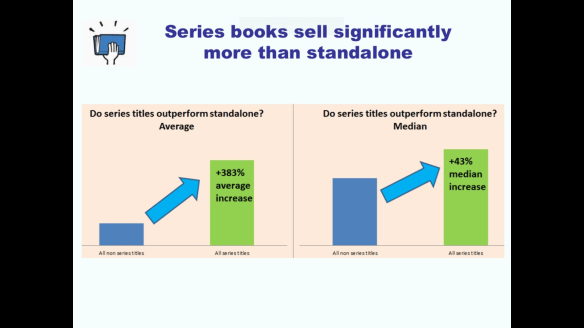
There’s no doubt that when you’re writing and publishing (in romance in particular), a series is the way to go. Smashwords released their 2017 survey that said books in a romance series sold way better than standalone books. That’s reason enough to think about writing a series. But Smashwords doesn’t tell you the best way to publish them. (Though they did favor setting up a pre-order for the first one, and pricing it for free. I’ll link to the study at the end of the blog.)
2017-07-17 (2)

Let’s list some pros and cons between waiting between books and releasing your series at once.

Pro: You can build anticipation for the next book through promos online.
If you have fans and can reach them through social media and email list, this may work very well for you.

Con: If you wait too long to release the next, your fans will forget about you.
This may not happen if you can reach your fans. But if you’re just starting out like I am, you may not want to run the risk of readers forgetting about you or waiting until the series is complete.

Pro: If you have one or two books published, you can take a break.

Con: That “rest” can turn into months—or years—because you realize you’re tired of writing them and don’t want to finish, or you get involved in a different story and you never go back to your series.

Pro: You can fix consistency issues before you publish your books. Or if you’ve written yourself into a corner, you can fix it because your books aren’t “out there” yet.

Con: You have to have a ton of patience, because how great is it to finish a book and hit publish?

Pro: Your books will have the same “feel.” Your voice will be consistent if you write and publish them at once. (We’re constantly developing and fine-tuning our voice and craft. If you wait months or years between books, they may sound different as you cultivate your skill.)

Con: Editing takes a long time, and you’re going to bog yourself, or your editor, down, if you give them your whole series at one time.  My editor took a while to get through all six novellas. It added a lot of time to my publishing schedule. There’s no doubt she could have gotten through them a lot faster had I given them to her one by one.

Pro: If you give them to your editor all at once, you’ve given them to her/him in their best possible shape. I know waiting and editing them more before I turned them over gave me time to make changes with my consistency, etc. It’s better I fix mistakes myself than pay an editor. It’s just respectful anyway to give your editor your best possible work.

Con: If your book doesn’t sell, you won’t know why. It may be because the rest isn’t released yet, or maybe because you didn’t do any promotions. Maybe it’s just because you’re a new author and you don’t have an audience yet. You can’t let this get you down and discourage you from writing and/or releasing the next book. That would be a downer to you and to the people who did buy your first book.

In the end, I did decide to publish them all at once. I split them in half to paperback them—novellas 1-3 in book one, and novellas 4-6 in book two. I felt like this was a good option because I definitely wanted to offer a paperback—I always will for all my books. But holy cow, there was no way I wanted to format and create covers for six novellas, and CreateSpace would have made me set their prices too high (for novellas) for anyone to buy, anyway. I’m going to release them the same way on the e-reader as well. It was important to me that my readers read them in order. In some series it’s okay if you read them out of order because they only deal with the same people; the plot of one book doesn’t necessarily depend on the next. A reader needs to my novellas in order or they won’t make sense. Publishing them bound together was a way to make sure this happened.

While the trilogy I’m writing right now won’t depend on each other for the plot, I’m still thinking of releasing them all at the same time. Number one is done, two is being edited by me, and three I’ve just started writing. Because Summer Secrets isn’t out yet, I feel I have some wiggle room. I’ll release my novellas, enjoy that release for a while and then publish my trilogy. Before I publish my trilogy though, I would like to have another book almost done—I have a standalone I would like to write and be ready to publish a few months after my trilogy is released. (Oh my God am I drooling to write new material!) It would be great for me if I could continue to release something every three to four months. By this time next year, I would love to have a decent backlist built up.

Everyone’s publishing plans are different and I encourage you to think ahead to what you want to do with your books and your writing career.

Here is the Smashwords Survey.
Another article on how to publish a series is here.

Let me know what you think.

Until next time!

#Smutchat Conflict Giveaway

Thank you for participating in #smutchat! I hope you’re having fun and maybe picking up some writing tips and tricks as we go along.

Today’s giveaway is Master Lists for Writers by Bryn Donovan (@BrynDonovan ). She has a lovely website too–check it out here.

master lists for writers

As always, this giveaway is open internationally. Good luck! You’ll love this book!

a Rafflecopter giveaway

An Interview with Writer Thomas Jast

Today I interviewed the deliciously eccentric Thomas Jast. His new book, Exit Strategies, featuring his character, Alex Aberdeen, is now available on Amazon. This is his fourth published book. Come have a slightly scary peek at the world in which Thomas Jast lives. Have you poured a glass of wine? Good. Let’s begin.

IMG_3133

How long have you been writing? What are you working on now?

I did writing journals in Grade 1 to learn English. I assumed that every child was a literary superstar so I overcompensated and hammered out page after page. Little did I realize that writing was going to be my favourite artistic expression and that it would continue forever. I started writing “novels” at age 13 with my older sister’s PC. They were terrible and I truly believe someone would pay money to stop reading them. (And yes, I still have every word I have ever written backed up to a half-dozen locations.)
I’m currently working on a comedy project called Derek Must Die with my BFF Vito Andrews, and this fall I’ll be starting on my next project, Under Gemini Skies, a twisted story of two small-town girls whose friendship disintegrates when one of them gets a taste of wealth and freedom… mixed in with a murder plot, a revenge scheme and an unhealthy dose of psychology, of course.

Exit Strategies is the third book featuring Alex Aberdeen. What appeals to you about her? Why do you keep coming back to her?

I felt that Alex didn’t get a proper ending in Mixed Messages since the original third Alex book never came out. Exit Strategies is entirely new and is set years later, but does the things I didn’t have the skill (or guts) to do back during the original writing period (2009-2010). I have bravely (foolishly?) labelled this novel as a romance and categorized it as such. It’s a love story featuring Alex using everything I’ve learned in life. Mostly bad things. A lot of horrifying things. And it’s kind of dirty and graphic in parts, which isn’t something I’m used to doing.

Do you have more books planned for her?

Always. I have the titles “Trust Issues,” “Systematic Habits” and “Burning Bridges” rolling around in my head. Each one is going to get darker and darker until the text is basically black on black pages. But no earlier than 2020, since I’m moving onto other things for a while. Alex will evolve along with the rest of my work, I hope. Comparing Calculated Regrets to Exit Strategies is unusual because I didn’t even attempt to make them feel similar. I never want to write the same thing twice, which is what a lot of serialized books feel like.

The art on your covers is unique. Can you explain the process of designing your covers?

I generally try to find a “moment” in the book that has a strong visual element to it, something that can be summed up as a single still frame. From Empathetic onward, I found myself moving more toward graphic design, iconography or pictograms. Since indie works are generally found and judged by small Amazon thumbnails, I seem to think that bold, simple images with high contrast stand out more. I’m hoping to catch someone by surprise, have them check it out, and then browse the reviews or a sample.

You publish with IngramSpark. How did you choose between IngramSpark and CreateSpace?

I’ve used CreateSpace years ago on a different project and it was fine. However, as a computer and graphics design nerd, the flexibility and high technical standards of IngramSpark appeal to me. I love the inherent complexity. I love the difference between “black” and “60-40-40-100 CYMK.” That’s my jam.

You publish on Kindle only. What made you decide to go Select rather than publish wide?

I really like Kindle’s KDP Select plan where you get paid when people read the books as part of Kindle Unlimited. As an indie author, many people will give your work a chance if there’s no risk. For a fellow author friend of mine, maybe 80% of his revenue comes from “free” reads and he couldn’t get that with any other plan.

You’re querying a different project. Can you share how that journey is going for you?

I haven’t done as much as I would like but will resume later on this year. I query that book because it’s not my usual indie style and I feel it could be a mainstream success if it lands in the right place. I have no delusions of what is appropriate where: I am aware that a majority of my work is niche and enjoyable for a select audience. But to answer the real question: Querying is soul-crushing and frustrating and probably one step removed from walking around in hell in bare feet.

Do you have any tips or tricks for authors who may be thinking about querying?

Don’t query your first-ever completed novel. It’s probably much rougher than you think, no matter how great the ideas are. You will do much better as your writing skills evolve. The trick is to still *want* to query after all of that time…

You have a limited social media presence. Can you share your opinion on the idea that writers must have a strong social media platform to sell books? Why or why not do you think this is true? If you agree with this opinion, can you give a reluctant author tips on how to work around this?

Leaving Twitter was the very best thing for me and my work ethic. It was a platform of sorts and it did get my name out, but it also paralyzed me from writing new material. What used to take a month now took six, and the competitive and (dare I say…) negative atmosphere eventually sunk me. It depends on what kind of person you are. I’m an obsessive, clingy, dedicated type and what engages me tends to have a way of backfiring. My social circles on there were improved with my peer editing, chat groups, and existing friends. Pushing your indie works on uninterested strangers isn’t very effective so that shouldn’t be the primary reason to use social media. Make yourself and your personality known, and eventually people will want to check out your work.

Exit Strategies will be the first time I release something without the cushion of Twitter, so we’ll see what happens.

What’s next for you writing- and publishing-wise?

Writing one novel a year and releasing a polished novel from the previous year. I want to top Cassandra’s End and am having trouble doing that so far, in both scope and refinement. I want to write a mix of indie and mainstream works because I don’t think one single style or group of content can truly improve your general writing craft. I always want to be out of my comfort zone, even if I fail in the end. I have many completed books I’ve scrapped and don’t regret a thing.

Thanks, Tom, for talking with me! I love chatting with writers about how their journeys are going.


You can find all of Tom’s books on Amazon. Calculated Regrets and Mixed Messages are both on sale now on Kindle for .99 until July 18th. Take advantage of this awesome sale and get to know Alex Aberdeen.

Tom’s newest book, Exit Strategies is available now in paperback and Kindle! Follow Tom on Goodreads and Amazon and read about his imprint, eVw Press here.

Thanks for reading! Come back soon.

(Photo credits: Thomas Jast’s personal photo, covers taken from Amazon.com)

Adventures with CreateSpace

Publishing your own books isn’t easy. After you write it and pay to have it edited, or self-edit the best you can, you still have to format the insides, write front and back matter, write the blurb, and design the cover. And after you’ve managed to do that, you still have to submit it, and if you’ve got it wrong–well.

rawr

It’s enough to make you pull your hair out. I’ve been working on Summer Secrets since last August. I’m not kidding. It’s when I opened the file and started with that first sentence. It feels like forever, though some writer friends kindly remind me that they’ve been writing their current WIPs for years. I feel for them, I really do, because there’s nothing I want more than to push these books into the world and never look back.

But alas, I cannot because CreateSpace, to borrow the words of my friend Brickley, is a temperamental hag, and what I’m doing isn’t good enough for her.

Don’t get me wrong, that’s a good thing. It’s a great thing because of course I want to publish my best work, and I want it to look its best, too. But I’m beginning to lose hope that I’ll ever be able to publish a book without some issues. Well, this is only my second try, and some things have changed since I published 1700 last year, so I should cut myself some slack. Publishing will always be a learning curve, and yep, I’m learning.

First off is my font. CreateSpace didn’t like the font I laboriously searched for. It’s not embeddable. That doesn’t mean I can’t use it (always look for a site that says their fonts are free for commercial use or pay because my first choice was $35.00, and let’s face it, publishing a book costs enough as it is), but CreateSpace gave me warnings up the wahoo. Interestingly enough, in the email I received saying my cover had been rejected, they mentioned my interior file was fine. The email and the interior viewer said two different things, so the only thing I can do is wait for the proof.

My cover was rejected?!

confused cat

You caught that, huh? Yeah, let me tell you it was a surprise. I knew I had the measurements for the page set up just right. I triple-checked the numbers. The only thing I could think of when they said I didn’t leave room for bleed, (though I know I did because my measurements were spot-on with what they said they needed) was that my font on the cover was too close to the edges. I can’t show you because I’m not revealing my cover yet, but I fixed it, lowering my font size and bringing in the margins on the blurb. I did the same thing to my title and my name. I’m hoping this fixes it. If it doesn’t, I’m going to have to call.

No one said publishing was boring!

excited cat

I’ll let you know how it turns out.

Until next time!

Things to Think About When You Choose Your Setting

Last night was the second night of Settings for my Twitter chat, #smutchat. We don’t just talk about smut, we talk about lots of things about the craft, and where you set your story was one of the topics.

How do you know where your story is going to take place?

ipad-632394_1920

Generally, this is a no-brainer. If you’re writing fantasy, more than likely your characters are going to move around a world that resembles medieval times.  A story with a Prince cursed with magical powers who needed to fend off an evil sorceress wouldn’t have the same feel if it were set in present-day New York City. Along those lines, if you are writing a time-traveling saga, the historical periods you choose for them to travel to will play a huge role in where your story will take place. A contemporary romance wouldn’t be contemporary if you set your story in 1700 England.  You get the idea.

But when we talk about settings, we need to dig deeper than just the time and the place. The smaller details can have a huge impact on your story.

When I chose to write Summer Secrets, the first thing that popped into my head were couples on a vacation at a fishing resort.  I didn’t think beyond that setting other than each couple stayed in their own cabin, and each couple would have their own story. But as I began writing, I noticed how this setting both positively and negatively affected my characters.

cabin-2149726_1920


For every positive, there was a negative. They were on vacation, which meant they were relaxed, in a good mood. But as the story went on, the characters also got bored, and they rubbed on each other’s nerves. This created conflict that I didn’t foresee, but it was great planning on my part all the same.

In this vein I also didn’t realize exactly what cutting them off from other people would do. They were forced to talk to each other, whether they were tired of each other or not. As the title suggests, each couple kept secrets from each other and forcing my characters to talk because they didn’t have anyone else to talk to created some very tense dialogue, and of course, the unveiling of those secrets.

The setting caused some issues for people vacationing from the city: my characters got lost while hiking, bit by bugs, almost drowned, were hurt from falling in terrain they weren’t accustomed to.  Putting my characters into another environment would have worked too, so long as they were strangers to that environment so it would have caused outside conflict that they had to handle along with the internal conflict of being pushed together.

Choosing a lake resort gave my characters plenty of room for themselves where they thought things through, assumed things, came to erroneous conclusions. The seclusion also made my characters feel even more alone with their problems and secrets.  On the flip side, they also found peace being away from city life.

lake-696098_1920

When you think of your setting, look at it as a character in its own right. And when you create your setting be it world building for a fantasy, or choosing a city for your romance novel, think of some of these things:

  1. How will it positively affect your characters? Your character moves to the city of her dreams. Your male MC moves next door to the girl he’s always wanted to marry. Your character wins a trip on a cruise, or your knight on a quest finds a prosperous kingdom.
  2. How will your setting negatively affect your characters?  Your MC’s mother moves next door and makes your MC’s life a living hell.  Your MC’s boss hits on her at work, so now she views her workplace as a nightmare she must go to every day until she finds another job. The mansion your MC inherits from her uncle is haunted.
  3. How will the setting make your character feel?  An empty lake could exaggerate a character’s feeling of loneliness. A hospital setting could remind your character of an accident from his childhood and he feels fear when visiting his sick sister. A crowded room could make your character feel anxious and claustrophobic–maybe she was abused as a child and locked in a closet.
  4. Incorporate all the senses when writing about your setting.  Sight is the most common because we’re writers and we describe what our characters see. But what do they smell when they enter a diner? Greasy fish that turns her stomach? Visiting her mother’s home, does the smell of apple pie bring her back to her high school days after school?  Does your MC love her cat, but hates when her cat licks her because the cat’s tongue is too rough for her sunburnt skin? Does the music playing from a car passing by remind her of a date gone wrong?
  5. Setting can help you weave backstory into your character’s lives and novel. A man must go back to his hometown and gradually we learn why he left in the first place.

For me, the setting will pop into my head along with the characters and some of the plot. When I went to California, it was my first time in LAX and I was curious if I was going to see any celebrities (I didn’t), but being in an airport I had never been in before made a story pop into my head, characters, plot and all.  I’m champing at the bit to write it.

aircraft-742833_1920

In this day of technology with Google and Google maps, it’s easier than ever to set a story where you’ve never been. You can go anywhere the world; the setting for your next story is at your fingertips.

How do you decide on your setting?

More tips on choosing your setting:

4 Ways to Choose the Right Story Setting

Tips for Establishing Setting in Your Novel

http://blog.janicehardy.com/2013/07/10-questions-to-ask-when-choosing.html

#Smutchat’s Settings Part 2 Giveaway

Here’s the lovely link for the giveaway tonight! I’m doing something a little different, and I partnered with Jewel who was sweet enough to volunteer to give her book away.  Please see her interview about her book!

Good luck, and thanks for playing!

a Rafflecopter giveaway

smutchatsettingsgiveaway


A Fun Interview with Jewel E. Leonard about her book, Rays of Sunshine!

Jewel's FB Author Pic

Today I interviewed Jewel E. Leonard about her book, Rays of Sunshine. We’re talking about Settings for #smutchat this week, and I was interested in how she came to choose her setting for Tales by Rails, her first novella in the book. Listen in to how she wrote her steamy story!


What have you been working on lately?

I am up to my neck in edits for the second book of The Witches’ Rede series. Mostly now I’m writing scenes I failed to get to when I originally wrote this book several years ago during NaNoWriMo. I consider it punishment for a job not-well-done. (Just kidding. Sorta.)
This book was a dumpster fire the way I left it, and I’m pleased to say it’s turning out superbly well with my edits.

#SmutChat’s theme this week is settings. Thanks for taking the time to share your thoughts on Tales by Rails. Your novella is set on a train. How did you choose that location?

To be honest, I gave it little thought; it seemed the natural choice.
When I started writing Tales by Rails, I really didn’t have anything planned for it as it started with what became the opening lines of narration that popped into my head just as I was falling asleep one night. Then as more of the story started coming to me, placing the–ahem–action on a train was a little bit fantasy fulfillment for yours truly.

Have you traveled by train before? (If you have, how was your experience?)

Oh absolutely, many times–California to Pennsylvania and back (twice), California to New Hampshire and back, California to Nebraska and back, Arizona to Texas and back. Like Surfer Boy, I don’t fly.
My experiences with Amtrak have been wildly variable … I wouldn’t recommend taking the train unless you can afford a private “roomette,” as they call the downstairs cabins (Superliners, like the one in Tales by Rails, have two stories–some coach seats downstairs with the roomettes, and coach seats all on the second level).
I had a few trips where nothing went horribly wrong, and some trips where Murphy’s Law was the rule of the rails.
Lost luggage, the dining car splitting from the train and leaving passengers with nothing but the snack car for sustenance, no air conditioning in the heat, heater turned full-blast at night and nothing to be done about it, smokers sneaking cigarettes on board (Amtrak is strictly non-smoking now and was at that time), smoking section sharing a car with a non-smoking section because clearly the smoke will be so kind as to stop at some invisible barrier (this was back in the days before Amtrak went non-smoking), old seats eager to snap at a finger if you tried to recline them, and don’t get me started on the state of the bathrooms at the end of several thousand miles … and there was one trip where we were pretty sure the train was breaking speed limits to get through nasty weather through the Midwest, which spurred a conversation about what happens should a tornado meet a train that scared passengers around us (oopsie) …
Having said all that–a good trip on Amtrak is well worth the fare and yes, I miss going, and double-yes, I sometimes wish I could just drop everything and run away the way Rhea does at the beginning of Tales by Rails.

Did you find yourself restricted in any way by the setting while you were writing?

With the train layover in Albuquerque enabling Surfer Boy to run to a nearby convenience store for some necessities not sold aboard the train, no, I really didn’t feel especially restricted.
Picking compact quarters was also a tip I picked up from a theater class I took as an elective at a community college a few years ago. The plays we studied all took place in one room, generally with more characters than can comfortably fit in them.
Combining tight spaces and two strangers with undeniable chemistry is a quick and dirty way to create tension. In my case, sexual tension.
And yeah, you’d better believe all that entendre was deliberate. 😉

What did you like most about the setting?

I found the setting especially conducive to speeding along the “natural course of events” between Surfer Boy and Rhea, when it almost certainly would have progressed far more slowly under other circumstances. When you’ve got a first-time rail-rider who didn’t especially prepare for her trip, there’s really very little to do if you’re not interested in talking to random people in an Amtrak observation car.
Basically, to be blunt, “trapped” in a tiny Amtrak roomette, if Rhea and Surfer Boy weren’t entertaining each other, they were bored out of their minds.

The sequel to Tales by Rails, Smiles by Trials, is not set on a train. How different was your experience writing the two books?

Smiles by Trials was more difficult … but not only did I expand Rhea’s world into a slightly fictionalized version of Illinois, I introduced several new characters with an assortment of complications, each, and the short novel spanned many months. It was more complicated all around, but more rewarding and–to my shock–seems to be more well-received than the novella that came before it.

Do you think you will write about trains in the future?

Seeing as I’m writing in the old west for The Witches’ Rede, including (steam) trains seems necessary. The railyards of Tucson are featured in book one (with a scene on a west-bound train omitted from the beginning), and there’s quite a bit of train that pops up in book two, with a rather —–never mind that. That’s spoilery. 😉
But yes, trains seem to be a staple in my writing these days, though I imagine that will change once The Witches’ Rede is complete.

Thank you, Jewel, for taking the time to answer some questions and for giving away a paperback copy of Rays of Sunshine during #smutchat this week! Follow her on Twitter, Facebook, Goodreads, and bookmark her website.  Take a moment to subscribe to her newsletter to stay up to date on everything she has going on this year!

Her books are available on Amazon! Don’t forget to check them out!


Naming Your Baby, I Mean, Ah, Book

I read books. I read lots and lots of books. Which, even though Stephen King says you can’t be a good writer if you don’t have time to read, is actually unusual for a writer. Most writers, especially those who don’t have much time to write, spend their time writing. That makes sense, right?  Right. But I read a lot of books, and sometimes I’ll have an epiphany.

Right now I’m reading Making More Money: Habits, Tactics, and Strategies for Making a Living as a Writer by Honoree Corder and Brian D. Meeks, and I had an epiphany.

How does a writer title their books, short stories, blog posts?

I suck at it.

And that was my epiphany.

No, not that I suck at creating titles for my books and stories. I knew that already.

No, I realized that On the Corner of 1700 Hamilton is the worst book title in the world. It was what I had named it while I was writing it, and I never changed it.

I should have.

Because I will never know how much money that sucky title cost me. In sales, in readers, in exposure. In anything that has to do with selling books.

Which is too bad because the story inside is really good.

Anyway, where was I going with this?  I should have chosen a better title for my book. It’s about a guy in a bar called The Maze. I practically named the book myself while I was writing it, but did I use it? Nope. Even the new cover has a picture of a maze on it.

I blew it. Big time.

Anyway, back to the book I’m in the middle of reading. The authors talk about where to advertise. They talk about your cover, your description. Keywords. They haven’t, so far, mentioned the story itself, because I’m assuming they expect you to publish quality work. And they don’t talk about your book’s title. It would have been nice if they had.

How important is a book’s title? As important as the description? The cover? The reviews? Maybe it doesn’t matter.

It must matter somewhat because when I do research on deciding a book title, I read over and over again how to choose something that is not being used a million times. (This is easy enough to find, just search for that title in Books on Amazon and see what comes up.) But you also don’t want to name your book something so crazy in an attempt to stand out that it sounds out of place in your genre.

Choosing a title, writing your blurb, choosing your keywords, and creating your cover all need to go together to complement what your book is about in an attempt to achieve maximum sales and a high number of reviews.

I wish I would have known how important titles are when I named 1700. I do now, and I won’t be making any more mistakes. My title will make sense, my cover will tell readers what genre they are reading, and my tight description will hook them into the plot.

title blog picture

The problem is, we can’t know what turns a potential customer off. They might see past a sucky cover if the description is well-written and grabs their attention. Some might not do anything more than look at a horrible cover and move along. Some go directly to the reviews and if they are all glowing reports of a wonderful read, they don’t pay attention to anything else. Without knowing how a potential reader chooses their next read, it’s imperative that we get all the pieces of the book spot-on the first time around.

I’ve learned my lesson with Summer Secrets. I researched the title; I researched the genre. The title will match the cover and the description will be a hook so well-written that no one reading it could possibly turn away. I’ll try by best with the keywords. Unfortunately, reviews are out of my hands, but I can get the title right.

This time.

How do you think of names for your books/stories/blogs?

Articles about choosing a title:

http://www.writersdigest.com/writing-articles/by-writing-goal/write-first-chapter-get-started/7-tips-to-nail-the-perfect-title

http://www.writersdigest.com/editor-blogs/guide-to-literary-agents/how-to-choose-your-novels-title-let-me-count-5-ways

#SmutChat Plotting Part 2 Giveaway!

Thank you for participating in tonight’s #smutchat! I appreciate you taking the time to make #smutchat a success, and I hope you had a wonderful time! The giveaway tonight is Libbie Hawker’s (@LibHawkerTake Off Your Pants! I hope you find the book useful in your writing endeavors. Thanks for playing, and I’ll see you next time!

a Rafflecopter giveaway

#SmutChat Plotting Giveaway

Thank you for participating in #smutchat tonight! Click to enter the giveaway of @KMWeiland‘s book Outlining Your Novel and the workbook that goes with it. 

I hope to see you again soon!

a Rafflecopter giveaway