
1,491 words
8 minutes read time
I was going to post something else today, something about writing “rules” and publishing “rules” mostly because I saw an author on Facebook who was complaining about sales who definitely wasn’t making choices I would be making, but alas, no one wants to read about rules. And, well, no one wants to hear what they’re doing wrong, either, which is fine. Some people need to learn from their mistakes, and some don’t realize they’re making mistakes, blaming their lack of sales on other things. *Cough* Like the Amazon boycott. *Cough Cough*
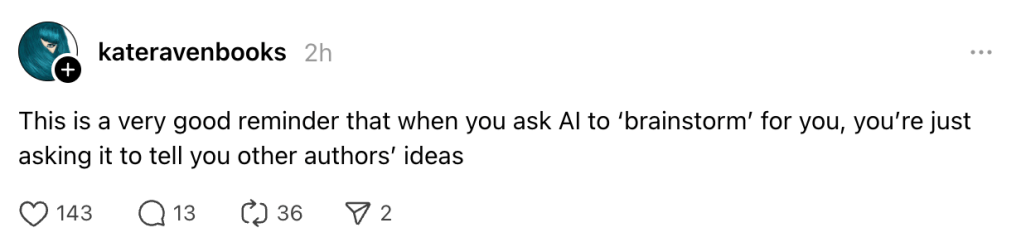
So, that doesn’t leave me with much except my own updates, of which there are not many. I’ve been listening to Loss and Damages, and Word has updated their read aloud feature since I used it last. The process is a lot smoother and it’s really easy to listen now. It can be tedious because it takes a lot of time, but I catch syntax errors, missed words, repeated words, and typos. I catch enough that I would never skip this part of the editing process. I’d much rather listen to my manuscript than feed it chapter by chapter to ProWritingAid, even if I have been pro-Al in the past. I will still Google a grammar question here and there, but even if I miss things, I like to be in control of my own editing. It’s slow going, I can only listen to about thirty pages at a time, but it’s worth it. That’s what I’ve been doing for the past few days since I took a break after I finished writing and doing a couple read-throughs of Wicked Games. I’ll be able to write Loss and Damages‘s blurb, format it, and order the proof sometime in the next couple of weeks, and that book will pretty much be a wrap.
Next I’ll maybe give Wicked Games another read-through, though I might let it sit for a while longer yet. I was going to jump into a series I have that’s 1/3 completed, but thinking about tackling another big project like that really wears me down. I never used to be one to shy away from work, but I’m still not feeling well, I’m always tired, and it doesn’t sound appealing. I’ve been reading Dea Poirier’s Last Girl to Die, and in that book, a detective goes back to her home town to solve a murder. It got me thinking about my own books and tropes, and besides a book in my Rocky Point series where Logan goes home to Rocky Point for a wedding and reconnects with his high school girlfriend, Ivy, I’ve never written a “back to my hometown” book.
I started putting the pieces together about a guy who left his small town after high school graduation to strike it rich, and he does. He gets called home because his grandpa is dying and there he bumps into his high school sweetheart. She knew it was better for him to leave after graduation and pretended to hook up with another guy to force him to go. I was thinking about all the shit he could step in going home, and the characters started grabbing me. It would be another standalone, but I realize now that I’m inching away from true Billionaire romances. Giving characters money isn’t the only thing that defines the genre, and shoving my characters into small towns doesn’t fit, no matter how rich they are. I turned to the billionaire genre and the alternating first person POV hoping it would springboard a career, but lately I’ve just been writing “Contemporary Romance” that would have better fit under my full name written in 3rd person. I don’t know what to do about that since I don’t want to write in 3rd person anymore. I could keep writing in first, but that would also possibly mean a shift in what my covers should look like. I’m seeing more covers with couples on them in general, but I’ve been watching my brand so carefully that suddenly throwing a couple on a cover would look very out of place. I’m between a rock and a hard place. I whole-heartedly believe in writing what you want, but I also believe you need to package those stories correctly or they won’t meet reader expectations resulting in readers not finding the books they want and/or poor reviews.
Along those lines, I have to stop looking at that series as a drudgery or I’m never going to want to write the rest. I could start looking at the books one by one instead of the series as a whole and maybe that would help my mindset. Maybe I’m still burnt out getting my King’s Crossing books done then jumping right into editing those Rocky Point books, but whatever the cause is, I’m not wasting the two books already written so I better just put some lipstick on and get my shit together, as Elizabeth Taylor is rumored to have said. Whether I’ll do that before or after this new standalone remains to be seen. It just depends on how loudly this new set of characters speaks to me. On the other hand, already having a standalone planned after my series is done would be like a little treat to myself for working so hard. It was very nice writing Wicked Games, no pressure at all to set up other books or having to think about more than one cover.
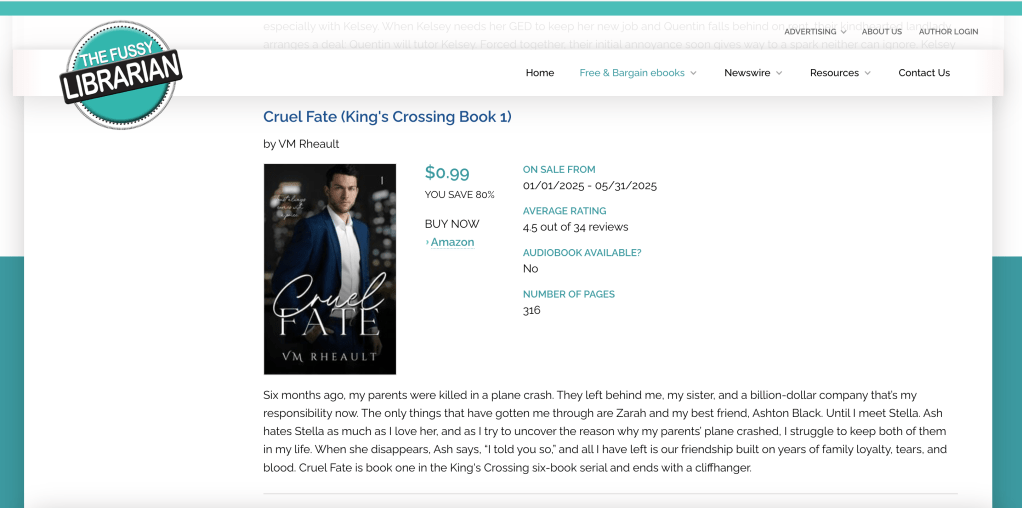
Speaking of series, my King’s Crossing serial isn’t lighting the world on fire, but I am happy to say that readers are making it to the sixth book. That’s always a gamble, writing such a long series, especially all at once instead of publishing as you go. I will always finish a series that I start just for the personal satisfaction and closure, but it’s nice when it pays off. I tried running an FB ad to it, and while it was getting clicks, sales and borrows didn’t keep up with ad spend and I paused it. I have a couple of Amazon ads running, some are auto placement and some are category placement, and that’s the only thing pushing my series right now. Well, any of my books. If I’m selling other books that aren’t my King’s Crossing serial, it’s because readers found my FB author page or my IG account or they’ve read me before and they’re reading other books. That’s about it. I was thinking of buying a BargainBooksy, since Cruel Fate is still .99, and seeing what that does. My Fussy Librarian didn’t do that much, more than if I had done nothing, but still. A BargainBooksy Romantic Suspense feature is $72.00, and it would be nice to think that I would earn that fee back but it doesn’t always happen.
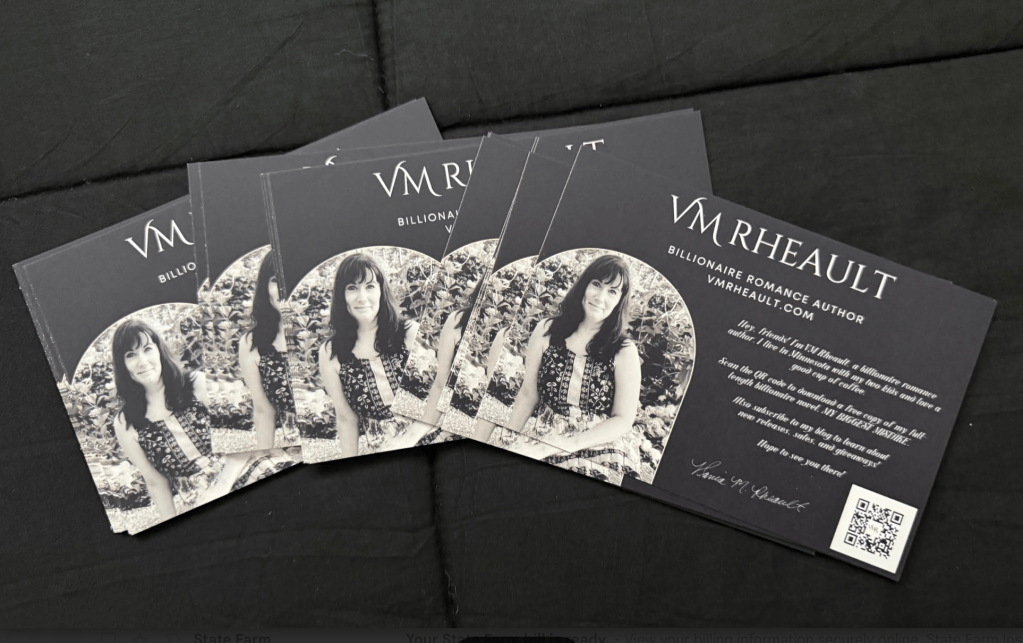
I’m also going to run a giveaway of my paperbacks and the mug I made. If I run my giveaway in conjunction with that, maybe it would help a little. I have no idea. Here’s a picture I took for the giveaway.
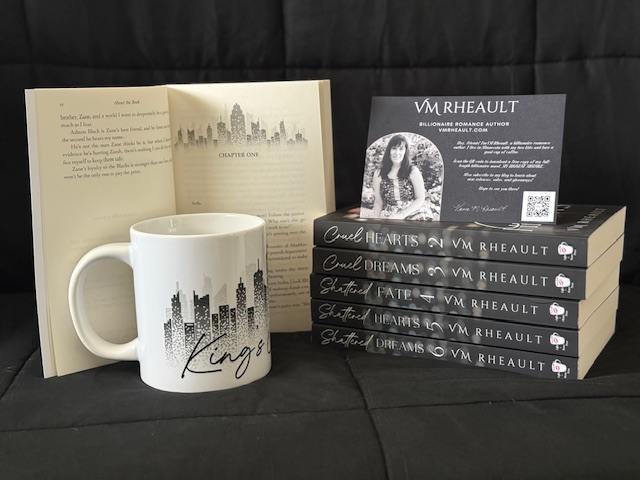
I’m still teasing the giveaway on my FB page. I’m going out of town this week, Monday through Thursday (if you read this on Monday I’m probably on the road), and I didn’t want to run the giveaway while I’m gone in case something happened and I can’t fix it. I’ll do all of that when I get back and I’m available to post about it.
That’s about all I have. Life would be super if I felt better, but a lot of people can say that. If I had access to better doctors, I might even go back to see if there was anything else that can be done, but I don’t trust the idiots where I live and driving five hours to see someone who knows what they’re doing isn’t feasible. I was driving back and forth last year and it wore out my mental health and my wallet. It’s been nine months since my last appointment and in some ways I’m feeling a lot better and in some ways I’m not. I don’t know if, in the ways I’m not, that’s even treatable, but like I said, figuring that out seems like it would be a lot of work. I might just end up with a, “You’re old and this is your life now,” diagnosis that would just be depressing to hear or something that could possibly be, if not fixed, made better, through surgery, but I’m not letting myself get cut open again. I think that’s what caused a lot of this mess in the first place.
Next week I think I have an author interview scheduled, and if something happens with that, I’ll just let you know how my trip went and hopefully I can tell you I’m done listening to Loss and Damages.
I hope you all have a wonderful week ahead!


![screenshot of paperback book. text reads: Hezra's jaw tightened, her voice dropping to a serious note. "Div-
ination witch... maybe blood magic."
Irene's impatience flared. Her gaze turned to Zahra. "The ashes?" [Highlights start]This is already quite strong, but it can be tightened for a sharper and more striking delivery while maintaining the intensity and sardonic edge you're aiming for. Here's a refined version: [End Highlight]
Zahra stood, holding up the necklace of ashes she was using to decipher the maps. Irene's eyes locked onto it. "Keep them in your sight at all times," she ordered. "We'll take turns guarding you—and the ashes—while you work."
Zahra nodded, but Irene's sharp tone didn't waver. "So? Where
are we?"
Excitement flickered in Zahra's eyes. "The history of the sapphire runs deep... Wars, legends, empires-all tied to the goddess Nehelan-nia. These words I decipher... they almost sing in my heart. This isn't just a treasure hunt. Hundreds have died for this sapphire. It all began—"
end of screenshot text](https://vaniamargene.com/wp-content/uploads/2025/04/screenshot-2025-04-18-at-11.01.39e280afam.png?w=1024)













 Vania Margene Rheault