Last Author Update of 2025

2,117 words
11 minutes read time

desk flatlay.  black pen. cream book that says last author update of 2025 coffee with cream and plant that looks like baby's breath

I can’t believe the year is almost over. This year has been terrible in a lot of ways (we all know what I’m talking about) but for me personally, this year has been full of small wins that added up to big things. I won’t get into all of that now–I’ll do a proper author recap of 2025 next week–but I did want to talk about what I’ve been doing the past little while and offer my opinions on a couple things that KDP has been rolling out.

First, I finished Bitter Love. At 86,448 words, it’s a little longer than I thought it would be, but I took my time writing the ending, giving Jesse the last chapter/epilogue and then a side character her own epilogue. This is the first book I’ve written where a child has been a prominent secondary character, and though I haven’t had a seven year old for a while now (my youngest is twenty), I hope I was able to portray her accurately. She has the “official” epilogue that’s set ten years later, as I wanted readers to see her family through her eyes and tell everyone how happy she is in her own words. I’m not sure what readers will make of it, since I think doing that kind of thing is getting more into Women’s Fiction/Family Drama territory, but it felt right to write it even if it might not fit the romance genre as a whole. Because I don’t have a proper newsletter, I can’t offer it as bonus material. I mean, I could add a Bookfunnel link to the back of the book, but since I don’t collect email addresses, I think it’s just smarter to add it to the book itself and if readers want to read it they can, and if they aren’t interested, they already have Jordan and Jesse’s story in its entirety.

I think it’s fun to play with epilogues like that, and I did it with my rockstars. The books were about Sheppard, Eddie, and Brock, but the epilogue at the end of the last book was told in Dalton’s, the band’s manager, point of view. I haven’t gotten much feedback so I have no idea if readers enjoyed it, but I think it adds a little extra and helps wrap up the story in a way readers might not expect.

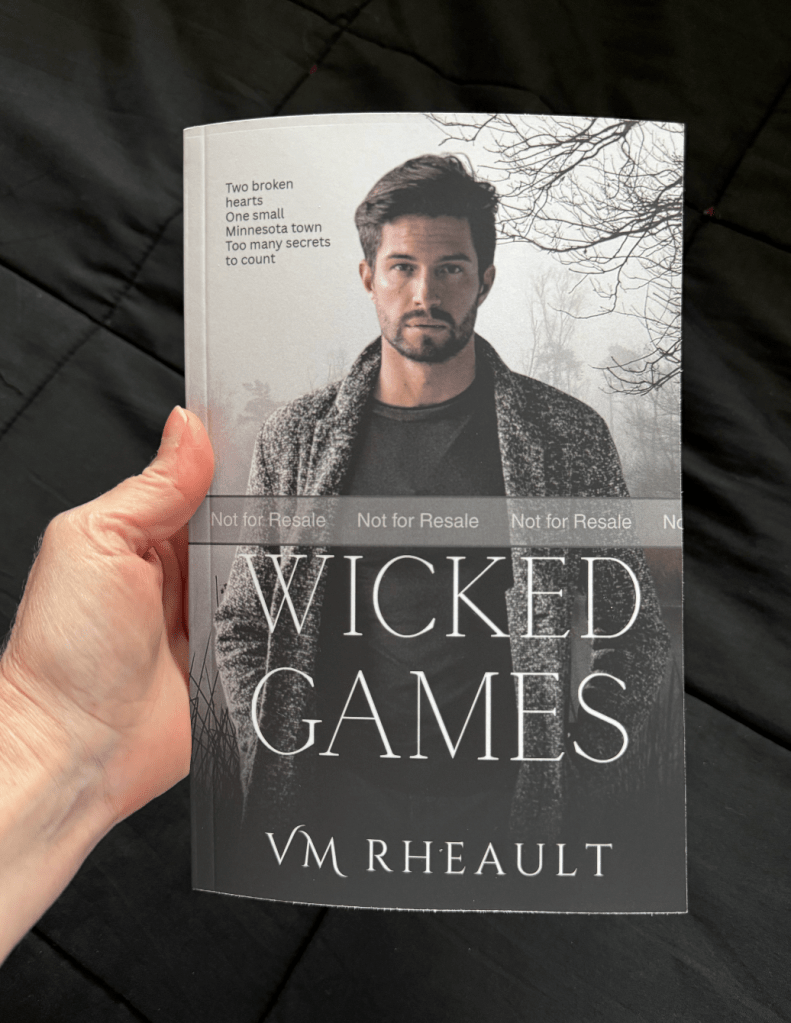
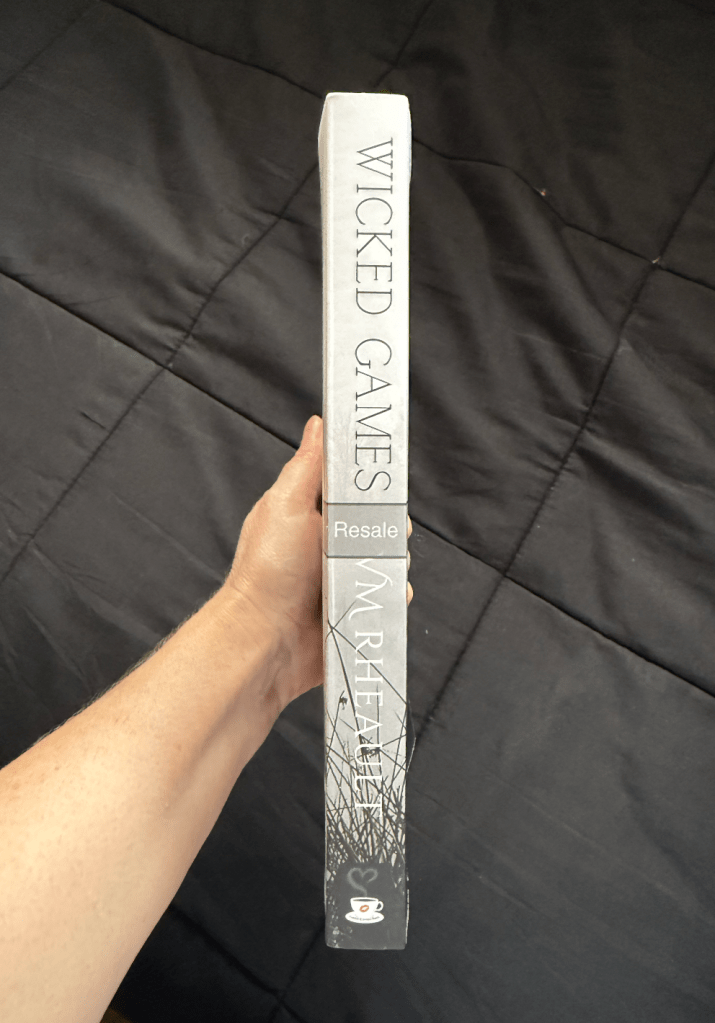
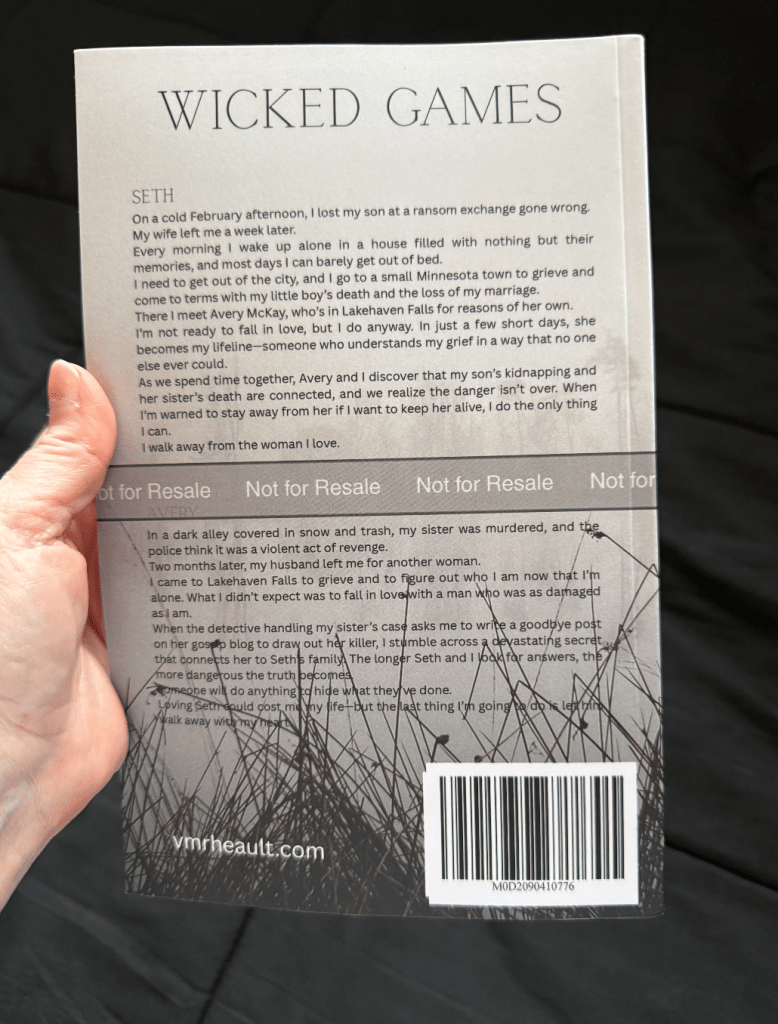
I was going to re-edit my Cedar Hill duet, but since I’ve announced to my small newsletter (who’s left, anyway) and on other social media, that Wicked Games will be out in May, I suppose I better get Seth and Avery ready first. Time can go by so quickly and editing can take a couple months at least–editing the Word document, listening to the manuscript, and then proofing the proof–so I think I should start on that to give myself extra time for ARCs if needed.

As I said in a previous blog post, I’m not using Booksprout anymore. I’m not even sure what I’m going to do for reviews. Putting the Bookfunnel link in a Facebook ad was a total failure. I mean, not in terms of people being interested and downloading the book (I gave all my available copies away), but in terms of getting reviews as a result. I think it’s necessary to publish with a few reviews at least, but I have to admit, not using Booksprout anymore makes me a little scared of the number of reviews I’ll have during launch month. Still, there’s no point in paying for something that’s not delivering, but it’s too bad that punishing the many also punishes the few who did enjoy my books and left honest, legitimate, reviews. I can only hope that my true fans on that platform are following me other places so they know where to get future ARCs if they want them.

So that’s my plan for the next little while–get Wicked Games‘s cover finalized and blurb written so I can do the “reveal stuff” while I’m editing, get it formatted and make ARCs available, and then after the ARC period closes, put it up on preorder. I hope that doesn’t take me until April, but who knows. With the changes at my job, everything I do takes me twice as long, so I wouldn’t be surprised if it does.

I’m going to start 2026 with a clean slate, and I decided to redo the logo for my Coffee & Kisses Press imprint. I’ve been publishing under that imprint for ten years, and when I first created it when I bought my first batch of ISBN numbers, my son and then-fiancé made it for me. Back then we were told to draw our own so it’s “ours.” I understand that a graphic made in Canva doesn’t belong to me, but I bought the stock images from DepositPhoto and the font is a free-for-commercial-use font. I changed the colors and added an element that I also purchased from DepositPhoto. I bought the standard license for each photo because I don’t plan on selling merchandise with that logo on it. I think that will be good enough, though my son would probably draw me something else if I asked.

Mostly, I just wanted to get my ex-fiancé’s name off the copyright pages of my books. We haven’t been together for a long time now and it’s funny and a little aggravating that I’m still scrubbing him out of my life. At least I can get his grubby paws off my books and Wicked Games will be the first book to use my new logo. I like what I came up with and I’m glad I decided to do it.

white coffee cup on black background. heart made out of the steam.  coffee & kisses press written on saucer

Now that I got my updates out of the way, I wanted to talk about two of the things that KDP has rolled out recently. One is allowing readers to download ePubs and PDFs of our book after they purchase a copy. This requires DRM (digital rights management) to be turned off and you have to go into your bookshelf, click “edit book content” of each ebook, and select the box that tells them you understand that you’re allowing readers to do that.

I saw a lot of opinions about it online, everything from authors being happy their readers can keep copies of their books to authors automatically assuming that readers are going to pirate their books or give their books away. In my ten years of publishing, I have never enabled DRM on my books. I’ve always known that DRM won’t stop my book from being pirated and it’s just an inconvenience to readers who want to read across their devices, say from the Kindle app on their phone to their Kindle, to their iPad that has the app on it. DRM traps them to one device, and maybe there really is only a handful of readers who read across multiple devices, but I didn’t want to inconvenience them. What bothers me about the whole thing is how little I see authors trust readers. There’s a hostile suspicion that I can’t understand, and maybe I never will. Because when it comes right down to it, how terrible is it really, if someone loves your book and innocently emails their friend a copy? It’s not any different than passing around a paperback. So, I don’t know. The second I read that email from KDP, I went into my bookshelf and checked the boxes to all of my first-person books and made them available to download.

The only thing that gave me pause was wondering if they were going to do a full review of each book since they’re making you resubmit to publish. I know that some of my older books have keywords they don’t allow now, like KU and Kindle Unlimited, and I didn’t want an unpleasant surprise of having a book stalled because of that. But each book only took about forty-five minutes to be approved, so I can only assume they acknowledged I checked the box and moved on. There are going to be a lot of authors either enabling DRM for the first time or checking the box, so hopefully they did what they could to streamline the process.

If you have naughty keywords, I wouldn’t worry about it, but I also wouldn’t change anything else while you’re in your book’s contents. Simply check the box and publish again. Save changes like a blurb refresh for another time. I hate messing with my books after they’ve been published. KDP is so finicky you never know what could cause them to flag your book. I mess with them as little as possible.

Going forward I’ll always check the box and let my readers download and keep what they paid for. Trying to restrict reader movement is fruitless and in the end, I believe you’ll come across looking stingy and hostile. Especially when you blast your choice all over social media pointing fingers at innocent readers. In these days of AI, appearing sincere, friendly, and trustworthy will go a long way in earning reader trust.

The other thing Amazon did was add an “Ask About this Book” feature to Kindle ebooks. If you’re not familiar with it, you can read about it here: https://writerbeware.blog/2025/12/12/kindles-new-gen-ai-powered-ask-this-book-feature-raises-rights-concerns/

I don’t have a lot of opinions about it other than no matter how you feel about AI, it’s here to stay. While I have been straddling the fence on this blog, neither fully condemning it nor fully embracing it, I do have personal moral and ethical lines I won’t cross. I don’t use it to write. I don’t use it to generate pictures. I see the usefulness in using it to write ad copy and hooks. I see the usefulness in it for organizing thoughts and creating checklists. No matter how you use it or don’t use it, the best thing you can do for yourself and your book business is to not make any sudden decisions because you’re angry. I see a lot of authors jerking their books off Amazon because they don’t want AI anywhere near them and they might regret that later.

The thing is, AI is everywhere and even if a book platform isn’t using AI now, they will eventually. Kobo put out a disclaimer in May saying that they will never use an author’s books to train AI, but even they say they use AI to “identify and quarantine books containing hate speech, child sexual abuse, or other harmful content that violates our guidelines.” So AI, even of their own creation, is processing books put on their platform. When every distribution platform uses it, authors will have nowhere to go and they’ll be right back to their biggest earner anyway.

Amazon is all about customer satisfaction, and they must have some information that put “Ask About This Book” into motion. We’ll never know what that information is, but Amazon never does anything without a reason. I don’t fully trust them, but we’ll see what happens. I’m not going to pull my books down. I don’t have the mental energy go to wide again and I don’t see the point when other platforms are going to be doing the same if they aren’t already.


This will be my last “Favorite Things” segment since my 2025 recap is usually pretty long and I don’t need to make it any longer. There are so many tools and services in the indie space and I’ve tried to highlight a few of the books and things I like best. So, for this last one, even though you probably know about him already, I’m going to mention Dave Chesson’s Kindlepreneur. He has three FREE services I’d like to share and they are not affiliate links:

QR code maker. I’ve used this before, and I love it. I think it’s especially cute you can add a logo or picture in the middle of the code. https://kindlepreneur.com/qr-code-generator-for-authors/

Barcode creator. There’s not a day that goes by when I’m not seeing someone asking about barcodes to go with their ISBNs. There’s no need to buy them from Bowker. They don’t have anything that Dave’s barcode creator won’t do. https://kindlepreneur.com/isbn-bar-code-generator/

Amazon Ads Class. If you need a free class that will teach you the basics, then this is for you. Not all people use ads the same way, and through trial and error you’ll find a combination of bid, daily budget, category or auto ads that will work for you. https://kindlepreneur.com/courses/free-amazon-ads-course/

That’s all I have for this week! Make sure you check back next Monday when I go over my 2025 recap. Thanks for reading this far. Have a great Monday!

Putting a Price on Writing and Publishing a Book

1,998 words
11 minutes read time

person wearing sneakers standing next to stack of books (only feet and books are visible). text on cream square overlay says putting a price on writing and publishing a book

This is an age-old question: How much does it cost an author to write and publish a book? This comes up a lot because after the book is finished, edited, formatted, the cover made and blurb written, paying for book set up on a distribution site then paying them for said distribution, authors would like their money back.

But, unfortunately, that isn’t so simple.

Before I started writing, I used to run. I’m not sure how I even started, but it got to the point where I was running six or so miles a day, five or six days a week. Running, though while considered free (much like writing), is anything but. I developed tendonitis in my left ankle, and this required buying new shoes every three to four months. I had to buy Brooks Adrenaline, and they were at least $120.00 a pair at the local running store–I shopped a local, small business store. Then all the running clothes, Garmin watches, race fees, gym membership fees to run in the winter if the temperatures and snow were bad, and protein bars, shakes, and other health food, I was spending just as much or even more to run as I do right now running my book business (pun not intended).

Then we have to factor in time. At my peak, I could run six miles in an hour. I never really got better than that, and that was fine. Having a new personal record (PR) was fun, but nothing I worked toward. After that hour or so of running, I had to cool down, stretch, then shower. And sometimes I would go longer than six miles, especially in the last year or two when I trained for a half-marathon. When you’re not very fast, running ten or eleven miles takes a long time. While my kids were in school and I did the longer runs on my days off, running could easily eat up most of my morning.

I mentioned all that because I wanted to give you a real life example of why I understand, and not only understand, but I’m okay with, spending money on my book business. I spend a lot that could be considered a “waste.” Two websites, paying for things like a Red Feather promotion on a standalone book (no read-through, you see), paying the Goodreads fee for their giveaways, a business email even though I don’t run a newsletter anymore, author copies and postage for reviewers who prefer paper, Bookfunnel for distribution of my reader magnet and ARCs. When I started writing instead of running, all my running money kind of shifted into this new hobby, and I didn’t think much of it at all. It was just something I had to do. New shoes to stay healthy, check. Websites to look legit, check.

But, writing costs more than just what it does to your wallet, and that’s mostly what I wanted to talk about. There’s an old adage that says, “If you don’t spend money, you’ll spend time,” and that’s especially true in indie publishing. On top of everything I listed above, indies pay for a lot of things, and if they don’t pay, they have to learn how to do those things themselves. There are free tools to format your book, like Reedsy and Draft to Digital, but there’s a learning curve to get familiar with even the simplest software. Then you have to learn a different kind of software like Canva or Bookbrush to make graphics for marketing.

Posting those graphics isn’t easy, either. Learning the algorithms of a platform takes a lot of trial and error. Not all social media platforms are the same, and their audiences respond to different content. Some authors cross-post which can work, but not often. I’ve never been a big fan of cross-posting, mostly for that reason. So we have to learn all the quirks of each platform so our posts are seen by at least some people. Then we have to learn ad platforms and those are changing all the time. Just when you think you have things figured out, they change the way you have to put an ad together and it can eat up hours of your time relearning where everything is.

When we spend time writing, learning craft, being a good literary citizen by helping others, reading in your genre, and marketing, we are not doing other things like spending time with family and friends, chores, errands, taking the dog for a walk or playing with your cat. There’s an emotional trade-off happening, and it can make you feel guilty when you want to work on your book but you’re pulled in the opposite direction. Lately I’ve been a victim of this. Our cat Pim, who has been with us since June, knows I’m a sucker. When I’m trying to write, she’ll come into the bedroom, sit near the bed, and stare at me. She’ll stare at me until I get up, go in the living room, and play with her. Her favorite thing is chasing after a crumpled up piece of notebook paper. Sometimes she’ll bring it back in a cute little game of fetch. Her previous owner didn’t tell us she liked to play this game–he might not even have known–I figured it out because I took the time to get to know her. So, she definitely knows that if she stares long enough, she’ll get me off my butt. But, that’s a half an hour or forty-five minutes I could have been writing.

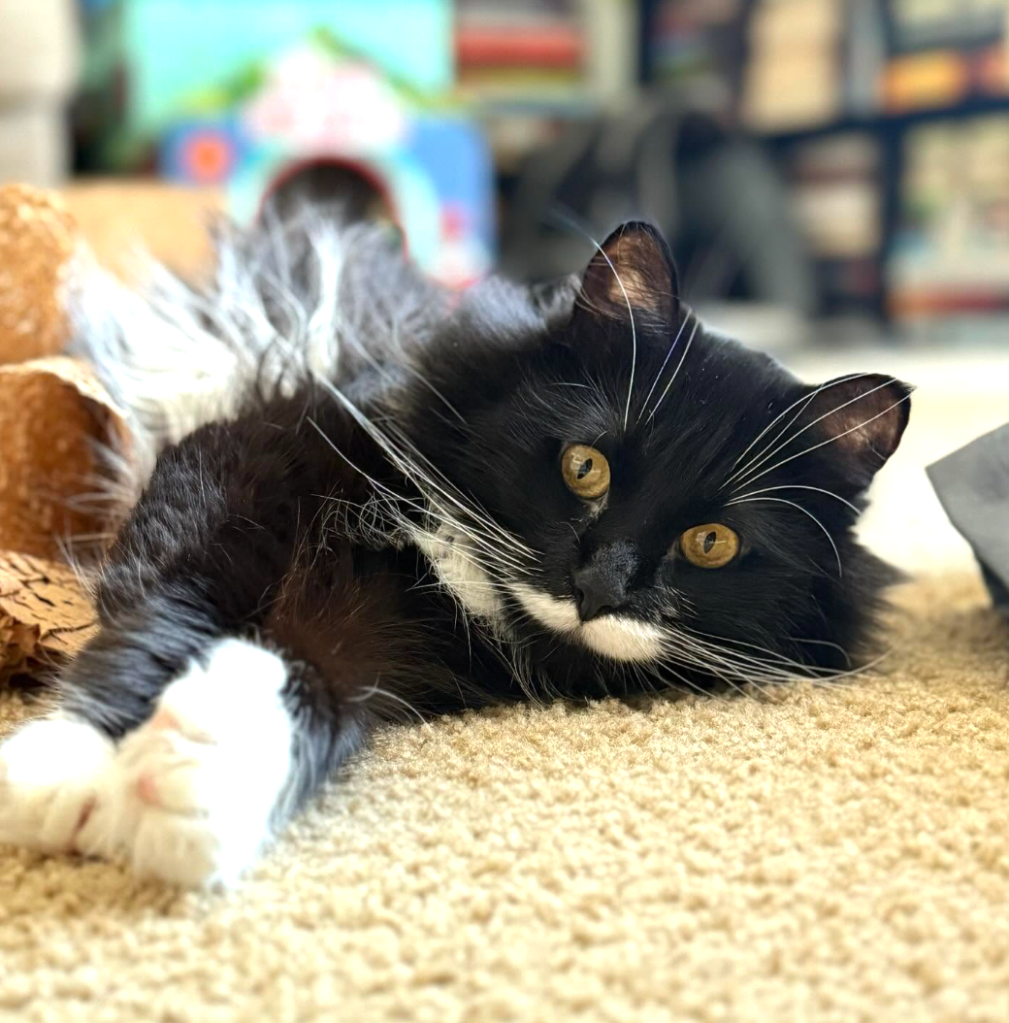
Here she is for the cat tax:

black and white tuxedo cat lying on the floor staring into the camera. amber eyes, brown carpet

This past year I’ve been trying to let go of the urgency I feel when I’ve spent too much time away from writing, and it’s been happening more and with changes at my work. My writing time has been cut in half, but my personal obligations have stayed the same and so there’s a push/pull that happens when I want to write but want to do other things too, like play with Pim, go to a movie, or go for lunch with my daughter. Over time this can create an emotional toll that we don’t even realize is there.

So, when we talk about how much it costs to write and publish a book, there are hidden expenses we pay that can’t always be calculated.

But the same holds true for “getting our money back.”

At the beginning of 2025, I made peace with the idea that my books would never turn into a full-time income. But when your sales dashboard is all zeroes, it’s good to remind yourself that positive return on investment (ROI) can be just as hidden as the emotional costs of writing and publishing.

Here are some of the things I’ve gained since I started writing ten years ago:

The skills you learn along the way
There’s no denying that even with my BA in English, my writing and editing skills have significantly improved. I’ve read quite a few self-editing books since I started my indie journey, edited for friends, and of course, written millions of words. There’s no way I could have gotten ROI like that without actually doing the work. I’ve developed an eye and can make passable, if not decent, book covers. I’m getting better at writing ad copy (thanks for nothing, TikTok!). All those things add up to valuable ROI, and I know this because without my time in the indie trenches, my resume would look pretty bleak.

Being part of a community
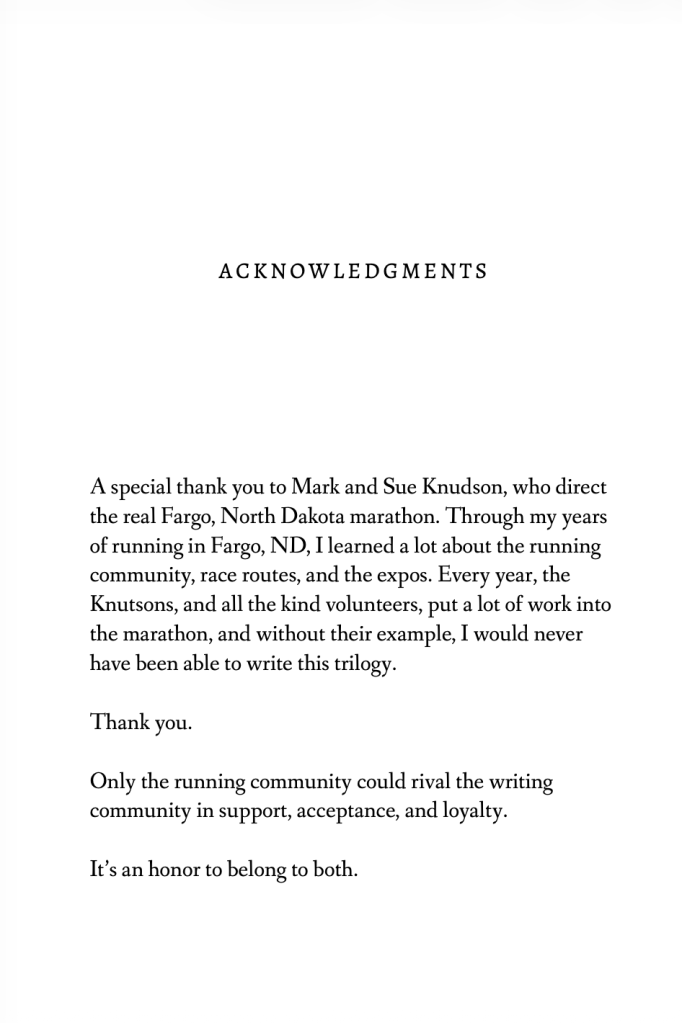
I know I’ve bemoaned the state of the indie community–it seems like deteriorated along with Twitter after Musk bought it. But I know that my opinion is valued because I get thousands of hits on my blog every year. I’ve made friends and connections these past ten years, even if more people have fallen out of my orbit than have come into it. Runners, as well, have a strong community, and when I was still running but had started writing, I was in both and that was the best feeling in the world. In fact, I thanked both communities in my acknowledgments in the last book of my running trilogy, Running Scared. In that book, my MMC isn’t part of the running community but he falls in love with a hardcore runner who is hired to be the city’s university running coach.

ACKNOWLEDGMENTS
A special thank you to Mark and Sue Knudson, who direct the real Fargo, North Dakota marathon. Through my years of running in Fargo, ND, Hearned a lot about the running community, race routes, and the expos. Every year, the Knutsons, and all the kind volunteers, put a lot of work into the marathon, and without their example, 1 would never have been able to write this trilogy.
Thank you.
Only the running community could rival the writing community in support, acceptance, and loyalty.
It's an honor to belong to both.

I miss being a part of the running community, but being an indie is very rewarding too.

Emotional Satisfaction
In running circles there’s a saying, “You only regret the runs you didn’t take.” I don’t think that can be so easily applied to writing, but I know that if I have time to write and don’t, it’s the same guilt factor. There’s an emotional satisfaction to lacing up, just like there is when you sit down, stay off socials, and use an hour to put 1,000 words down. I know for me and most other authors there’s nothing better than opening up that envelope and holding a proof of your book baby in your hands. You worked hard in more ways than one to get to that point in time, and you should always be proud of yourself.

Long-term Impact
Two years ago, the director of the Fargo, ND marathon, Mark Knudson, whom I mentioned in my acknowledgements above, died when he lost control of his bicycle and was hit by a truck. The running community was devastated. He had put so much time into getting the Fargo Marathon off the ground, and for his life and contribution to be so suddenly ended was traumatic for everyone who knew him.

The longer you’re in the writing community, the more impactful that time is, even if it doesn’t feel like it. The time you spend blogging, helping other indies, and of course, the books you write, all contribute to a lasting legacy.

Writing and publishing a book has concrete, evident costs, money and time, and also hidden ones like hits to your mental health, lost time with family and friends, and choosing to write rather than do something else you also enjoy like watching TV. But there are more rewards than just sales and KU page reads.

So, when we’re asked, “What’s the cost of writing a book?” The cost is higher than most of us imagine, but the rewards, like skills, connections, creative satisfaction, and legacy, are far richer than anything you could ever report to your accountant.


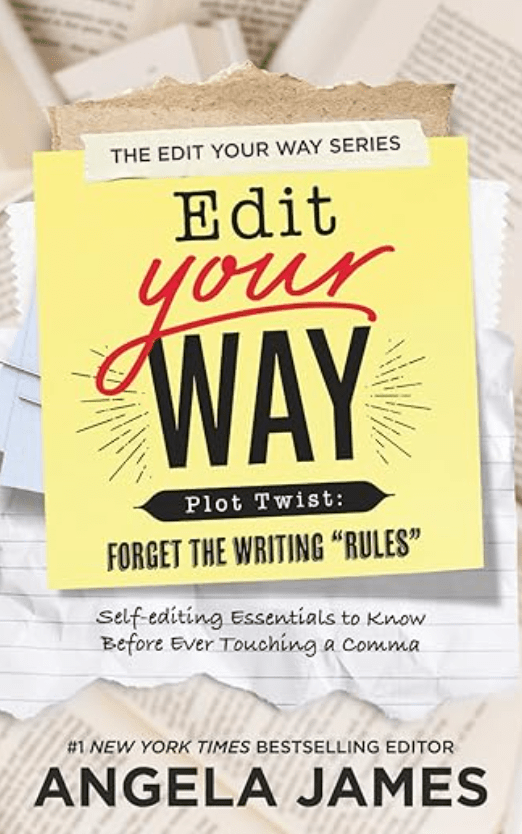
I only have a couple weeks of my “Favorite Things” segment left, and this week I’m highlighting a new self-editing book by Angela James. I love a good editing book, and I cannot wait to dig in. This is her bio on her website:

Helping fiction authors build strong stories—and stronger careers

Hi, I’m Angela James. I’m a #1 New York Times bestselling indie editor and author career coach with over two decades in publishing. I help authors write better books and build sustainable, satisfying careers—on their own terms. Whether you’re indie, trad, or hybrid, I meet you where you are and help you get where you want to go, using clear editorial feedback, coaching, and frameworks that support both your storytelling and your career growth.

Together, we create stories that connect with readers, and an author business that works for you.

Edit Your Way: (Plot Twist: Forget the Writing “Rules”) is available from your favorite retailers (AKA, wide). Here’s the Amazon link and book cover: https://www.amazon.com/dp/B0G63FR1Q8 (This is not an affiliate link.)

book cover.  text says. edit your way plot twist; forget the writing "rules" angela james new york times best selling editor

That’s all I have for this week. Next week I’ll do an author update and the week after that, my year-end recap. It’s hard to believe this year is almost over, but the timing for the other two blog posts works out perfectly.

I hope the holiday season (and all the cold temperatures!) haven’t been too hard on you. Have a good week and I will see you next Monday!

Monday Author Update and a Quick Glimpse into 2026

1,368 words
7 minutes read time

You all know i have a terrible fear of missing out, and it was triggered this week by the announcement that Flodesk, the newsletter aggregator, is going to stop their unlimited pricing structure at the end of the month and you need to lock in that plan before it goes away. This shouldn’t concern me because for one, I don’t have a newsletter anymore, I blog on my author site, and two, I probably will never have the number of signups that would require the need for an unlimited pricing plan.

screeshot of a flodesk ad. the text is black and says flodesk...now is the itme unlimited emails, unlimited subscribers, subscribe before november 28th

sign up bar in purple
This ad popped up in my Instagram feed

But that didn’t stop the “what ifs” from running through my mind. What if I ever wanted to start up a newsletter again? What if I pushed my business to the next level and I needed that unlimited plan? WHAT IF I’M MISSING OUT ON THE BEST DEAL OF MY LIFE?

Cue the panic, right?

But this made me stop and think about where my business is and where it’s going. As of right now, I don’t have a book business. While I have money going out and money coming in, I have more money going out and I consider operating in the red more of a hobby than anything else. That reminded me I probably shouldn’t take on any more services that would dig my financial hole even deeper than it already is. Because if I paid for Flodesk, I would have to pay Bookfunnel for integration because I wouldn’t stop giving my reader magnet away. I already did that once with MailerLite, and while I did build up my newsletter to close to 1,000 subscribers back when I was trying, that is just more money than I want to spend for where I’m at and where I’m going.

So far, I’ve been able to eke time out in the week to keep this blog afloat, and surprisingly, it’s been easier than I thought. I do have a little free time on the days I work, but it’s not conducive to fiction writing, so I’ve been able to blog and make carousels for my secret TikTok account. That’s been a huge relief because when my work did all that changing up, I was really worried about having to cut back on this blog. I enjoy writing it and it gives me a place to put my thoughts about what’s going on in the industry and where I am in my indie life. So, unless work decides to mix things up again, or cut me loose all together, I think I can confidently say that I can keep writing my blog posts every Monday.

I have lost a lot of writing time though, and adding a “real” newsletter when my publishing schedule is taking a hit doesn’t make much sense–especially since I already pay for my WordPress website–so I might as well use it, even if it doesn’t have the same functionality as a newsletter aggregator. That doesn’t mean that from now until November 28th every time I see that ad I won’t think I’m making a huge mistake not signing up. That’s just the way I am. And I’m sure with Black Friday right around the corner there’s going to be more deals and steals I’ll have to say no to because I already have what I need to write and publish books. (I’m looking at you, AppSumo DepositPhoto sale when I already have 358 downloads available.)

I signed up for ProWritingAid’s Novel November, but I’m behind, or at least, I think I am. I’m not keeping track of the words I’ve written so far, but I’m 46k into Bitter Love, and if I can keep up the pace, I should be able to finish by the end of the year like I want. I’m at the point now where I go back and read from the beginning so I’ll be taking a couple days to do that, fix any plot points that got lost as the story developed and make sure the ending’s on track. I’ll have to add slow-burn to the list of tropes because this story needed so much setup, but a lot of secrets had to come out so hopefully even if the characters take their time hopping into bed it’s not boring or slow.

Besides that, I really don’t have much else. November is always kind of busy with my daughter’s birthday, Thanksgiving, and my birthday rounding out the month, but I’m not doing anything this year (I turned 50 on Thanksgiving Day last year and I think all that excitement will hold me over for a couple of years). I lucked out with my work schedule and I have Thanksgiving Day off, so that’s a nice break, and my daughter is still deciding where she wants to eat her birthday dinner.

Overall, things are okay, nothing bad happening, which I’m thankful for. Pim is doing great, but I’m trying to turn her into an internet star and that’s not working out. The last photo I posted of her on Threads only got 82 likes, but I’m probably lucky she got that since I think I post there maybe four times a month and the algorithms have no idea who I am.

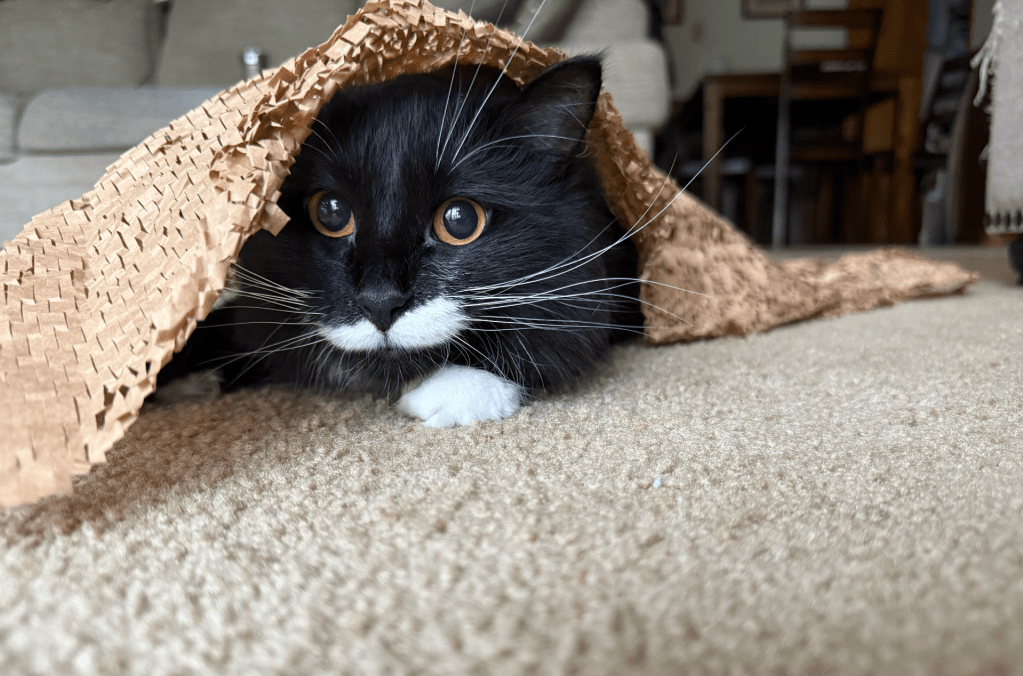
tuxedo cat hiding under piece of brown perforated paper. face is visible along with her two front white paws.

But, I started a reader/book profile on TikTok, as opposed to my personal one and that seems to be doing better in terms of views. I didn’t tell anyone about it so I can’t “taint” the algorithms, but I didn’t use a VPN or anything. Just my personal iPhone using a gmail address I don’t use for much else. At least I broke out of the 200 views dungeon for a lot of my carousels, one getting over 3k views, but I haven’t gone viral . . . yet. I’m getting better finding hooks and writing ad copy, and I’m staying away from sex which always got me in trouble on my other profile. So far going for angsty instead of spicy has been serving me well, and now that I’ve slowed down with the writing, I’m making more time to post there. We’ll see how it goes.

I’m starting to think about promos for the holiday season, and I forgot that I have a nice four-book series set in the winter around Christmas I could promote if I wanted to. There’s a big author-driven book blast taking place next month but I don’t think I’ll officially put a book in it. It’s not that I don’t think free books are worth it, because I still think they can be if used strategically, but I’ve kind of given up hoping promos like will build into anything that lasts. So rather than take space from authors who are trying to use the blast to their advantage, I could just put a book or two free and piggy-back off the momentum of the day and see what that does. Or I could pay for something, but I doubt I would make my money back, so I would have go into it know that and being happy that people were just interested enough to download a copy. I’m not sure yet. Books are a dime a dozen, in every way that means, so what I do or don’t do won’t have any effect on me or my book business. It’s just something to do if I feel like it.


My Favorite Things
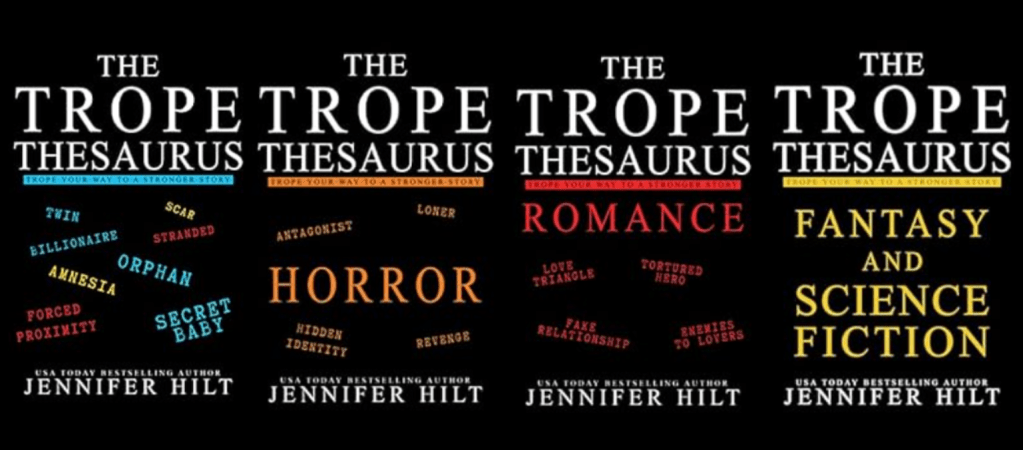
I’m going to end every Monday blog post from here until Christmas with something that I’m liking in the author space, be it a writing resource, tool, or service that I find especially helpful. Today’s feature is the Trope Thesaurus series by Jennifer Hilt. I have the romance trope book, and I have to admit, when I’m feeling down, I get out my copy and flip through it. There are so many tropes out there I haven’t tried and it gets me really excited for all the books I haven’t written yet. There’s one for horror and fantasy/sci-fi and it looks like just a general one as well. Check them out here (this isn’t an affiliate link): https://www.amazon.com/dp/B0BFYR9L4Z

book covers on black background:

the trope thesaurus (general) (all colors lettering) 
the trope thesaurus horror (orange lettering) 
the trope thesaurus romance (red lettering)
 the trop thesaurus fantasy and science fiction (yellow lettering)

That’s all I have for today. Thanks for reading, and I will see you next week!
Monday Musings: Where Have All the Reviewers Gone?

1,415 words
7 minutes read time

silhouette of a cowboy on horseback among wild horses.  sepia tones

text says: where have all the reviewers gone

If, after reading that, you have Paula Cole’s Where Have All the Cowboys Gone? stuck in your head, you’re welcome. If not and want a flash of nineties nostalgia, you can listen to it here: https://youtu.be/bUmKUWzbDxg?si=u6OsnxNGOCIqQiil

Recently I came to the disappointing conclusion that I’m going to cancel my BookSprout membership. I’ve published quite a few books over the years and I can definitely tell that the quality of the reviews has gone down. It really sucks because for a long time it was a great place to find reviewers, and I was building a following of dedicated readers. But with my latest release of Loss and Damages, I’m finding that’s no longer the case. While I don’t want to insult the reviewers who have read my books because there are still a couple who read and leave honest feedback, there really is no incentive for me to stay there anymore, at least, not for the price I have to pay every month.

I put up Loss and Damages two months before launch because I know how important it is to give readers time to read, think about the book, and write a heartfelt, honest review. Twenty copies out of twenty five were taken, and now, nine days after my launch day, only eleven of those twenty have left a review and of those eleven only two wrote a review that was more than just a couple of sentences, wasn’t a blurb recap, or wasn’t written by AI. I understand that only a sentence can be a meaningful review and that any indie would/should be happy with any review at all. But when an author is paying for a service, and when those readers have voluntarily signed up to review books, I would think expectations can be a little higher.

There are a few reasons for this, I think, mostly due to so much content being out there these days. I see ARC readers online say they have several books on their lists, and it could be true they are over-extending themselves. There are so many books to choose from and if an ARC reader has several favorite authors, it would be easy to suddenly have ten books that need reviews at the same time. This is on top of day jobs, kids, and other responsibilities. This leads to shorter reviews or ARC readers resorting to using AI to spit out a review.

Another reason I think ARC reviews don’t have the quality they used to to is that authors are demanding they leave reviews all over the place–and there are many places. TikTok, Instagram, Facebook, Goodreads and Amazon, other platforms like Kobo and Apple Books if those authors are wide, their own social media, and places that may not be at the top of everyone’s heads but are there nonetheless like Pinterest and Lemon8. If authors aren’t making the graphics those ARC readers need, it can be time-consuming for those readers to come up with videos and graphics for those reviews and platforms. Whenever I added a book to BookSprout, all I asked was that the review be posted to Amazon. There were a couple that went above and beyond posting to TikTok and Instagram, but it wasn’t anything I asked for. Sometimes they’ll post to Goodreads too, but again, that wasn’t something I required.

I admit I’ve been doing things wrong. When I put out my Bookfunnel ARC link, I don’t ask for email addresses, I don’t ask potential reviewers to fill out a Google form. I don’t vet reviewers who ask for a copy of my book. I just give my link away and hope for the best. Obviously, I’m not getting the best, or even anything close to it, and I doubt my tactic ever will considering if you don’t hold people accountable, they’ll more than likely take what they can and run. I gave out over 100 copies of Loss and Damages this way and have nothing to show for it. Although, I never could be as unrelenting as some authors I see, which is why I go with my “hope for the best” process to begin with. I’ve seen some truly nasty authors treat reviewers with such disrespect and I can’t even imagine why they think that’s okay. I never want to come across as a harpy because you can do irreparable damage to your reputation with readers and reviewers. I just think that if you say you’re going to do something, then you should do it and apparently not everyone thinks that way.

I also gave away 100 copies of Loss and Damages in a Goodreads giveaway. Unfortunately, though that giveaway ended ten days ago, that didn’t result in many reviews yet either (I skimmed my reviews on GR and it looks like one person reviewed from that giveaway so far.) In a perfect world, I’d have over 200 reviews for that book: reviews from the people who took a copy on BookSprout, the people who downloaded it from my Bookfunnel link when I advertised it in an FB ad, and the people who won my Goodreads giveaway. I mean, it’s not for lack of trying that my books launch to few reviews, and I know I’m in the same position as a lot of other authors.

There are other review sites out there like BookSirens and Hidden Gems, and I follow an account called PenPinery on Threads that looks hopeful. I have a little bit of time to figure out what I want to do as I just announced to my newsletter and my (small) FB author page that my next book, Wicked Games, will come out in May of 2026. Trying a different review service might yield more favorable results, but being that I really do think ARC readers are already dealing with an onslaught of content and suffer from lack of time, it may not be the solution.

As for what other options you, me, or anyone else can try, I’m not sure. We obviously need reviews–social proof is really important. I firmly believe that reviews help your ads do better, they help a reader trust you’ll give them a good story, and book promos who vet your books before accepting you are more apt to feature your book. I don’t think there’s a magic number, like I don’t believe Amazon gives your book better treatment if you have say, 50 reviews. What authors see is that a book that has a good number reviews sells, and Amazon will boost that book because it’s already selling, and then it just gets more reviews. It’s a circular motion that feeds into itself, but it takes a lot of traction, sales, and a solid launch, to reach that point.

What I’ll try for my next launch?

Use a different review service.
Cancelling BookSprout will give me that money to experiment with.

Build (better) buzz.
I’ll try to post on social media more before ARCs are available. Readers can’t be excited about reading your book if they’ve never heard of it before. This is an especially difficult thing for me because I really don’t like posting on social media that much and I’m probably doing it wrong by not creating reels and videos for TikTok anyway.

Try a Google form.
Maybe that will help weed out the people who only want a copy from the people who will actually do something with it once they have it. I have never created a form for all the books that I have ever given out ARCs for, so it will be interesting. Going in this train of thought, I may even just make only a set number of copies available. Scarcity creates excitement and a “Pick Me” vibe could also generate buzz.

Going about my ARCs in a different way next year may help me get more reviews. I have to do something. Well, I mean, I don’t, but I don’t mind trying new things. I gave BookSprout a lot of time and a lot of books and if there’s anything this business taught me it’s that doing things the same way and expecting different results never works. I don’t want to turn into one of “those” authors, but going the “set it and forget it” way isn’t helping. All I can do is try.

Have you tried a way to get reviews? Did it work? Let me know your thoughts in the comments.

Have a lovely day!

Is writing a (long) series worth it?

1,715 words
9 minutes read time

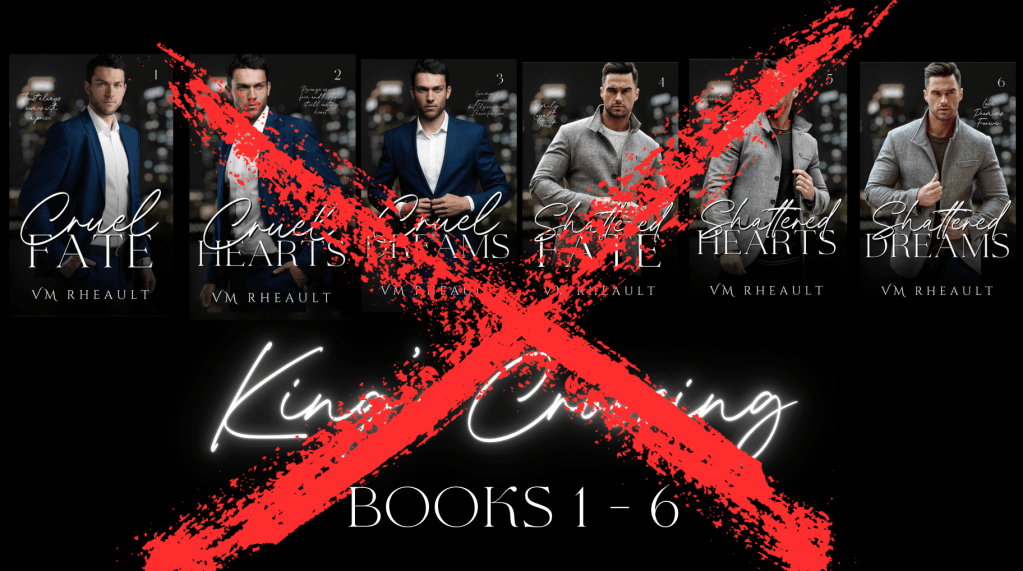
graphic of my king's crossing serial. all book covers with a red x in front of them.

In a blog post a couple of months ago, I shared my series’ sales and read-through numbers with you, and it really got me thinking about whether or not it’s worth it in this reading and publishing climate to write another series. Of course, if I really wanted to write another one (and I will some day because I have 2/6 done in a series I started years ago and I won’t let those two books go to waste) I would no matter where the evidence pointed. But because I’m curious by nature, like knowing the landscape of the publishing industry, and well, I just like plain old BSing, I wonder, how worth it these days is it to write a series in the first place?

Any author with a huge series and a strong audience for those books will say it’s worth it: JD Robb (In Death 60 books), Marie Force (McCarthys Of Gansett Island Books 28 books) Robyn Carr (Virgin River 20 books), and Susan Mallery (Fool’s Gold 22 books), to name a few. There are indie authors who write long series too, like Shannon Mayer (Rylee Adamson 10 books), A.J. Rivers (Emma Griffin® FBI Mystery 37 books) and more I don’t have the energy to look up. But if there’s one thing they all have in common is that they didn’t start writing those series recently. They’ve been building their audiences for years, when things were different. So where does this leave a new indie author who’s planning to write a ten-book series?

The blog post I referenced was written back in July, and my numbers haven’t gotten much better: (FYI the person who bought my series in print was my aunt.)

Book	Paid eBooks	Print	KENP Read	Est. Paid Books (KENP ÷ KENPC)	Total Paid + Print + KU
Cruel Fate	76	1	32,050	74	151
Cruel Hearts	26	1	29,027	62	89
Cruel Dreams	13	1	26,438	57	71
Shattered Fate	8	1	19,871	45	54
Shattered Hearts	9	1	16,028	36	46
Shattered Dreams	11	1	14,268	32	44

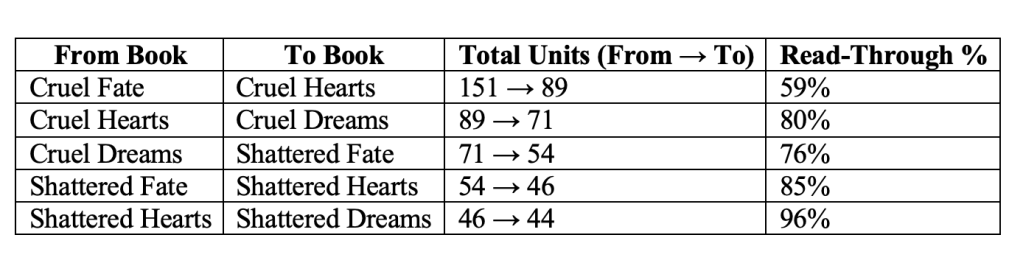
When doing series read-through, you can see how many readers are going from book one to book two and on. I don’t have big numbers to play with here, and for some reason my KDP dashboard decided not to show me all the free ebooks of book one I gave away during promos like Fussy Librarian and Freebooksy. That just makes my stats look even worse anyway, so let’s stick with paid books for now.

From Book	To Book	Total Units (From → To)	Read-Through %
Cruel Fate	Cruel Hearts	151 → 89	59%
Cruel Hearts	Cruel Dreams	89 → 71	80%
Cruel Dreams	Shattered Fate	71 → 54	76%
Shattered Fate	Shattered Hearts	54 → 46	85%
Shattered Hearts	Shattered Dreams	46 → 44	96%

You can see my biggest drop is from book one to book two, but once readers get invested they keep going. Though, these numbers look deceiving because when you do the math, read-through from book one to book six is only 29%. (Dividing 44 (sales of Shattered Dreams)/151 (sales of Cruel Fate)x100=29%.) It’s rather disheartening to know that only 29% of readers who read book one went on to finish the series.

Of course my experience isn’t indicative of what’s going on in the entire indie industry when it comes to what people are doing and what their success or lack of it is. But it does make me wonder if there is an overall shift in what authors are doing or will be doing because of the changing landscape.

What do I mean by changing landscape?

People’s attention spans are shorter than ever. According to a Microsoft study, the average human has the attention span of 8.25 seconds. That means it’s difficult to grab someone’s attention and keep it where you want it. There’s competing content everywhere–ads, reels, books, podcasts, movies, TV shows, and even if a reader enjoyed book one, that doesn’t mean they’re going to want to read the rest of your series. People get bored and may not want to follow the same set of characters for hundreds of thousands of words. In fact, Lauren Brown in an article on The Bookseller writes:

Publishers are noting a shift in industry mindset around short stories as readers embrace shorter works, with a number feeling like “something is slowly shifting” and that “there’s a real excitement around stories again.”

Getting readers excited about diving into a series that has five, six, seven or more books might be more work than an author wants to admit, or put in.

Authors may also not want to invest time to write a series. “Build it and they will come” isn’t true anymore, and there’s nothing more heartbreaking than putting years of your life into something no one wants. Writing a series is a serious time commitment and when there’s no guarantee a reader will make it all the way to the end of a series, the investment might not be worth it. When you think about it, an eight-book series could be a four-book series, a duet, and two standalones–books that are much more easier to digest and easier entry points for readers.

This also brings up the argument you can’t get away from when we talk about series. Readers may not want to start until all the books are released, but authors don’t want to write more books unless there’s proven interest in what’s already published. This creates a strange Catch-22, and the bottom line is an author would have to write, and finish, a series for their own personal fulfillment first rather than continuing based on positive reader response.

That’s not to say there isn’t advantages to writing a series, which is why the advice used to be so popular ten years ago. A series can build loyal readers. A well-written series can practically sell itself, but your first book has to be so strong that your series has actual read-through or you could end up with my 29%. Unfortunately, you don’t know how your book is going to hit the market, and what you think is a strong start could be boring to readers. But, if you have an engaging book one that leads readers to the rest, as long as your books keep reader attention, that’s money in your pocket and time well-spent writing them.

We’ve changed so much from where we were ten years ago that maybe readers and authors are moving in a different direction. Readers’ attention spans have shortened, there is a lot of content out there to compete with–from real authors and from people using AI to write their books, and authors are burning out trying to compete with all that content and getting frustrated when readers don’t want to wait for the next book.

What’s the solution? (If you think there needs to be one.)

Writer short “series.” Series that have four books in them instead of a massive list, or write trilogies or duets.

Write interconnected standalones. These types of series you can stop writing at any time if you get burned out, bored, or if readers stop reading.

Write a long series in novella length rather than full-length novels. You can still write a ten-book series, but if you cut the length of the book in half, you don’t have to put so much energy into writing them and readers don’t have to put so much time and energy into reading them. You can write them faster, save them up and do a rapid-release style launch and still get almost the same rewards. Your page reads may drop because longer books have higher KENP, but you may get more readers to settle in and binge.

Or go even shorter and write 10k-20k shorts. Sadie King has an excellent book on that if you write romance, and you can find it here: https://www.amazon.com/Writing-Short-Romance-Pleasure-Profit-ebook/dp/B0CFKTRC13

I wrote this blog post as a way to feel out what’s been happening in the industry. From my own experience and the complaints I’ve been seeing online with regard to reader retention and author burnout, I think we’re going to see a shift in the coming years. Offering a selection for readers to choose from has always been solid advice anyway. Even if a series is fabulous, not ever reader wants to sign up for the time or financial commitment of reading one. Not to mention the mental and emotional requirement to get invested. Standalones, duets, and trilogies are great entry points for readers who haven’t read you yet or just want something they can read in a day or over the weekend. Offering a diverse backlist can only help you find and keep readers.

As for what I’ve got next, that series I started years ago will take more years to finish. I have Wicked Games done (standalone), working on Bitter Love (standalone), and have my hockey duet waiting in the penalty box. After those are finished, I have a Mafia duet simmering (but I could turn that into a trilogy as the premise is new for me and I’m excited to write it. I won’t be surprised if I want to stay in that world for longer than two books.), and only after that will I have the time and maybe the want to do work on something else. So it might be quite a while before I want to tackle the last four books in the series I started. But fortunately, I don’t publish until I have my series all written, so the books are trapped on my computer. Readers aren’t wondering where the rest are, and that takes a lot of pressure off me to keep going.

What do you think of the publishing landscape? Do you think it’s changing or do you see readers still getting excited for longer series? Let me know in the comments!


With the changes at my work, I think the time has come that I’ll have to cut my blog posts down to twice a month. Not only did they do a reduction in workforce, they shuffled my days off around which impacts my writing time during the week. I’ll still do my best to post weekly, but I’m not sure how easy that will be for me while still writing as many words as I want on my books during the week. When they let a lot of my coworkers go, I thought this might be coming, but then they changed my work schedule from something I had been working for years, so I need to get used to a new routine. Hopefully I can bounce back because I love writing on this blog, so we’ll see how it goes in the coming months.

I have no idea what I’m writing about next week, but I’ll try to show up and see you then.

Have a lovely day!

Friendships, Coworkers, and Cliques: Navigating the Author Communities

1,973 words
10 minutes read time

“In prosperity our friends know us; in adversity we know our friends.” 

– John Churton Collins

There has been a lot of talk about author cliques on Threads lately, and while I didn’t feel the need to contribute to those conversations, I do have a lot of thoughts about friendships that I’ve collected over the ten years I’ve been doing this. Not friendships. Thoughts. Though, I guess, maybe friendships too. Friendships are complicated, made even more so by expectations and reciprocation. Here’s a breakdown of what I think friendships, coworkers, and cliques are, and if you’ve been at this for a while, in the comments you can tell me if you agree or what you’d add to the conversation.

Indie Friends
When I first got into the writing community, I made lots of friends. That was back when I was writing my high fantasy series that will never see the light of day. Anyway, I thought, “I should join Twitter so once it’s ready, I’ll have readers.” It was a naïve way of thinking at best, but even back then I was aware that I would need some kind of marketing strategy once my books were released. I already had a Twitter account made from when I was in school for human resources and I changed the focus of my profile from HR connections to the writing community. There I made lots of friends, joined chats like #1linewed and #2bittues and even made my own chat called #smutchat. The tweets are still there if you search the hashtag. Anyway, so I got in with a group of people, some of whom I still talk to today, and life was good. We beta read for each other, retweeted each other’s tweets, and everyone supported my blog when I first started writing it.

Of course there were the usual troubles when it came to those friendships. Some of them became one-sided, some people dropped off because they stopped writing. (One of my friends even had to deactivate his Twitter account because a person he had grown close to started stalking him. Yikes!) Some people you just learn you don’t really mesh with and you stop talking to them or they stop talking to you. I definitely had my share of rocky relationships, some of which I’ve documented on this blog over the years, notably when you mix business with friendship: https://vaniamargene.com/2019/03/11/when-friends-turn-into-business-partners-sometimes-it-doesnt-work-out/

Some of the talk I’ve been seeing alluded to the idea that if you don’t have the “right” kinds of friends, they can’t/won’t help you propel your book business to the next level. I’ve reached out to a couple people here and there who I’ve met on Threads and they weren’t too interested even after posting they were looking for friends. It wasn’t until this morning in the shower that I realized it was because they probably took a look at my socials and sales and realized being friends with me wouldn’t get them anywhere. It was an “oh, shit” moment, but it didn’t hurt my feelings. If all they want to do is use me, I don’t need them as friends anyway.

When I was at my Twitter “peak,” I had a different kind of friendship experience. What I found out was that making friends on Twitter wasn’t the same as finding your readers, and some people I know still get caught in the trap of making author friends with the idea that those authors will buy their books. They confuse making friends and networking with marketing and that only ends in frustration.

The indie author friends I was making wrote all different kinds of genres, were happy to boost my work and support my blog and I reciprocated. Those times are gone and I haven’t replaced the real friends I lost. While I have made connections, I’ve come to realize those people are coworkers, and if you have a day job, you know, and hopefully not through trial and error, your coworkers aren’t your friends.

Coworkers
Coworkers are what people mean when they say you should be networking in your genre. Coworkers are going to be the connections that offer things like newsletter swaps, promo opportunities, anthology opportunities and more. They help you with ads, they might beta read for you or put you in touch with who they use. They help you find ARC readers and open the door to things like book conventions. They’re like Deb in they cubby next to you. She’s not your friend but she’s happy to tell you about what went on in the meeting you missed because you were sick.

What a lot of authors get confused is that these coworkers are not your friends. They don’t touch base on a daily basis. You don’t talk to them about your kids. They don’t text you privately or want to meet you in person if they happen to be in your area. We all know what friends are, and these people are not it. But, to have these kinds of coworkers, you also have to be pulling your own weight, meaning, your books are selling and you have your own opportunities and experiences to share. You do your share of the work in anthology compilations and book blasts, and you can do your share because you’ve put in the work to have a large newsletter, Facebook group, and reader base. You bring something to the table and you share the sides with the other authors who also have something to bring to the table.

When I see authors complain about not being invited into networking circles, I can take a look at what they’re doing and know right away why no one wants to work with them. They don’t have an author platform, they don’t have a newsletter. They don’t have a solid backlist that’s selling. They haven’t worked on an individual basis to get the results they need to get invited into the group. No one wants to do your work for you. I know that puts some authors in a quandary because they say they can’t get to that level without help, but you can make headway on your own with social media, ads, and publishing consistently and in one genre. Start smaller and network with authors who are at your level. Grow together and you’ll naturally expand your professional network.

On a smaller, more personal scale, maybe you know how to format and you format for others, either out of kindness or you charge a small fee that’s less than what a professional formatter would charge. Then you don’t hear from that person again until she needs another book formatted. I have quite a few acquaintances I’ve made because I offer help, they take it, and I don’t hear from them again until/unless they need something else. It was actually a surprise to realize they aren’t friends, they’re coworkers, but it’s helpful to know where the line is. Not everyone needs to be your friend. Maybe someday they’ll remember I helped them and pass along an opportunity, but I didn’t offer to help with the idea they would reciprocate. I wanted to help because editing, formatting, and designing covers keeps my skills sharp for when I need to work on my own books.

Unfortunately, I’m still living in a time when I was on Twitter and we all did happily for each other. I don’t think we can ever go back to the way things were and over the past couple of years I’ve been getting used to being an island. You can’t get jaded. If Deb brings peanut butter cookies to put in the breakroom and you have a peanut allergy, just remember your workplace isn’t where you should be making friends anyway.

Cliques
This brings us to cliques. I must not get out enough, because honestly, I haven’t had much exposure to cliques. What I have bumped into online is romance authors who have been writing and publishing for years, who are friends and have been for that same amount of time. They can appear as cliques because they have that history of friendship, but not only that, their careers grew successfully at the same time keeping them on the same playing field professionally. You can say that’s because they had each other’s help, but that’s not necessarily true. What you’re writing has to hit the market, your writing style has to resonate with readers. No number of friendships can help you do that.

When I think of cliques, I think of their members as unkind, and I haven’t met any romance authors that have been truly unkind to me. I used to listen to a romance marketing chat on Clubhouse (that they stopped because it was too much work to keep going) and the hosts were friends and seemed like they had been for years. All the speakers and anyone else who contributed were very nice and eager to share their knowledge and experiences. The same goes for the book blasts I’ve been a part of, and when I do those, I always make graphics to share on social media so others can use if they don’t have time to make their own and post the blast everywhere I can to pull my own weight.

Of course, I haven’t elevated myself to be coworkers or acquaintances of huge romance authors like LJ Shen or Melanie Harlow, but I haven’t wanted or needed to approach them, either. I’ve traded a comment here and there with authors like Lindsay Buroker, Zoe York, and Elana Johnson, and EL James actually responded to a comment I made on her post on Threads, and everyone is very nice. I don’t approach people wanting something because that’s never been who I am and I think the bigger the author is the stronger their BS radar is and they know if you’re just looking to use them.

So, I don’t think author cliques truly exist, not in the negative way some authors say they do because they’re resentful they can’t crack the code to be invited in.

And cracking the code to be invited in will only get harder as time goes on. I mean, let’s be honest here. No one wants to talk to you if you support the orange clown. No one will want to talk to you if you use AI to write or use AI for your covers. No one will want to talk to you if you don’t respect your peers and insist on leaving bad reviews for the books you’ve read. Authors are guarding their space more than ever before and because of that you’re in for a harder time proving yourself. That’s something I can totally understand. Our president is tearing this country apart and I don’t want to talk to anyone who supports him either.

The best thing you can do, in my opinion, is join Facebook groups in your genre and get to know people there. Making friends, good friends, will take time. Share resources, share experiences. Learn from the people you’re networking with and let those relationships grow. Oftentimes I’ve complained about feeling lonely, though that has gotten better as my health improved, and I know that I don’t do enough to expand my circle. I should be participating in romance groups, offering to do newsletter swaps with my small blog, beta read, and format if needed. But right now I’m juggling a few things and don’t have the energy for that. That is also something else you’ll have to take into consideration. How much time and energy do you have to nurture new relationships? Don’t take if you can’t give.

Next week I’ll talk about where I ended up when I started on that path of friending writers and authors who weren’t writing romance.

Hint: It’s not a bad place.

Talk to you next week!
Monday Musings: Editing, Book Launches, and the Rest of 2025

1,902 words
10 minutes read time

Editing Update
For the past few months I’ve been trapped in editing hell. A hell of my own making, but hell nonetheless. Anyway, I’m happy with the choices I’ve made, especially since I’ve sold a couple copies of Rescue Me since I updated the files. At the time of this writing, I’m waiting for another proof of Faking Forever to come because I forgot to add the “About the Book” section to the front. I also made a couple additional edits, but because you can edit a book forever and ever, after this second proof comes, I’ll just page through it and mark it done. Even if I happen to miss something, it will still sound 1000% times better than what it did, so I’ll consider that a win.

I’m still going through my Christmas novel and I’m hoping to be done with it by the end of the month. It’s a little slow going because I’m trying to avoid having to read through it again, but I guess I’ll skim the paperback proof when I order one. Of course there’s always a risk of editing in mistakes, but I’m not the only one that happens to, so I’ll just make peace with the fact that all the books I’ve edited in the past several weeks sound better than they did. I did a blog post on some of my changes for A Heartache for Christmas and you can read it here: https://vaniamargene.com/2025/08/18/when-dumbing-down-your-writing-isnt-dumb/

Loss and Damages Launch Activity
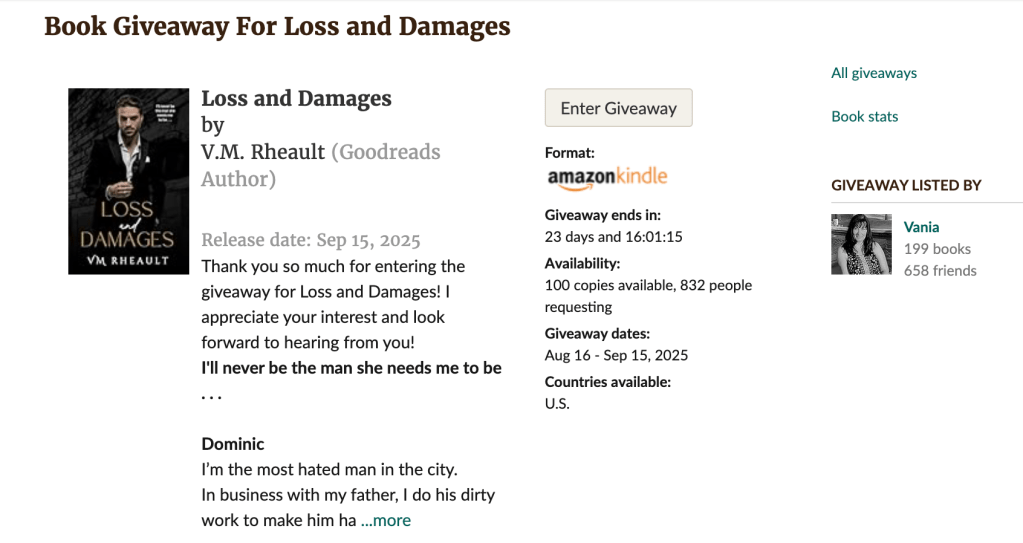
I haven’t been doing much for it except buy a Goodreads giveaway and run an Amazon ad to the preorder. At first I felt bad I spent the $99 dollars on the giveaway because other than exposure, like when I bought one for Cruel Fate, I won’t get much out of it. Comparing the two books might be worthless since Cruel Fate is the first in a six book serial and Loss and Damages is a standalone which (in my mind) makes it much more likely to be read, so chances are outcomes will be completely different anyway. But, I get paid three times in September, so after realizing that, I shrugged and moved the Goodreads receipt into my 2025 Book Spend folder to give to my accountant next April. All that being said, I’m at 832 entries and the giveaway ends the day the book is live, on September 15th. Since those free books are added to my sales dashboard, maybe they’ll count as “sales” and they’ll give me a little push that day. Who knows. If you want to enter, you can here: https://www.goodreads.com/giveaway/show/419642-loss-and-damages

Book Giveaway For Loss and Damages
Loss and Damages by V.M. RheaultLoss and Damages
by V.M. Rheault (Goodreads Author)

Release date: Sep 15, 2025
Thank you so much for entering the giveaway for Loss and Damages! I appreciate your interest and look forward to hearing from you!
I'll never be the man she needs me to be . . .

Dominic
I’m the most hated man in the city.
In business with my father, I do his dirty work to make him ha ...more
Enter Giveaway
Format:
Kindle book

Giveaway ends in:
23 days and 16:01:03

Availability:
100 copies available, 832 people requesting

Giveaway dates:
Aug 16 - Sep 15, 2025

Countries available:
U.S.

The Amazon ad isn’t doing too much but it’s just another way to push my book out there, and for now, it’s low-cost. My ads going to other books are doing well, but my sales aren’t keeping up with ad spend so I may have to reassess them at the end of the month. For now, the ad has resulted in one pre-order. I usually get none, so that’s a small win all around.

snapshot of Amazon ads stats for Loss and Damages. 6422 impressions, three clicks, cost per click is .35 cents.

I have four paperback copies I ordered since my paperback is scheduled and I can order them without the proof stripe on the cover. I was thinking about maybe offering them on IG to a few bookstagrammers or something, but time is slipping away if I want to do that because half the appeal is getting the book and reading it before it releases. I have less than a month to do that now, and with shipping, even to the United States, I’m cutting it close. Still, it never hurts to put up a post, so I might be doing that sooner than later.

Overall, I don’t have other plans for it. Most times I forget I even wrote it and that I should be pushing it. I have a terrible habit of moving on before I really should be moving on, but I’m always thinking about the next thing, and being stuck in editing makes me antsy to write something new.

What subgenre in romance is hot right now:
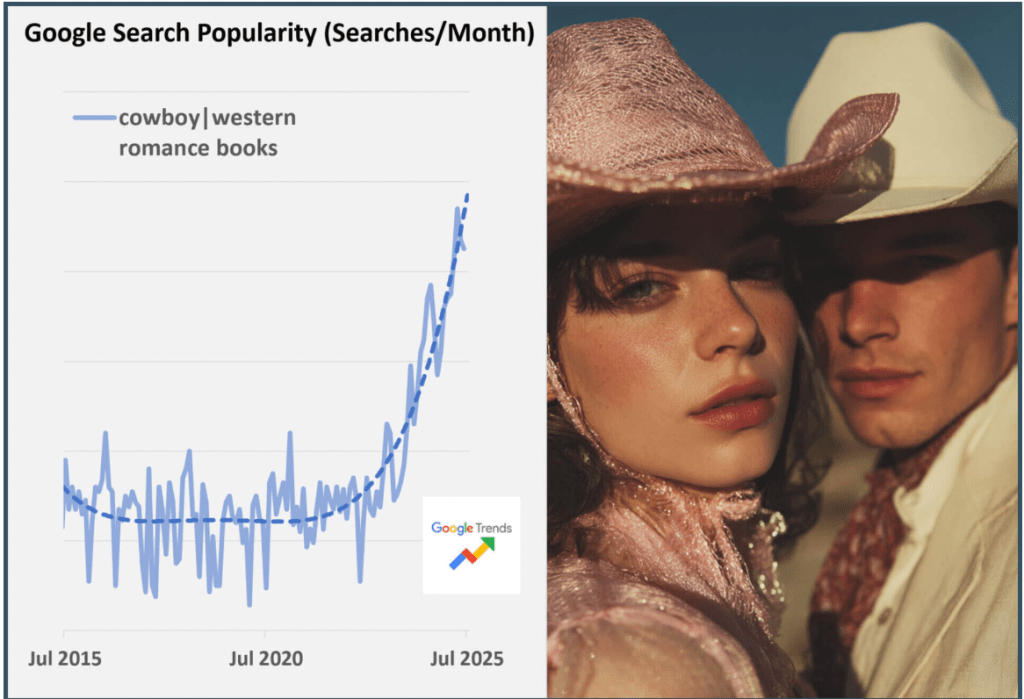
If you get the K-Lytic’s marketing trends research newsletter, you’ll know that Cowboy and Western Romance is on the upswing. I never was one to care about cowboys, even if Glen Powell portrayed a pretty sexy one in Twisters (that I have seen approximately 100 times). Ranch and farm life is a bear to get right if you’ve never lived on a ranch or a farm. Tacking a horse incorrectly will get you skewered by readers who actually know how to ride, and that is a level of research that I just don’t care to do. Especially since the last, and only, time I rode a horse was back when I was ten and went to summer camp. The last time even I saw a horse in person was two winters ago when we went on a sleigh ride (“sleigh” being used loosely as there wasn’t much snow that year and we were actually on wheels) and I got to pet one before we set off. That, unfortunately, does not qualify me to write a cowboy romance, and neither does living in the middle of farm country. But, it’s interesting to note that Cowboy and Western Romance is having a moment. This is the snapshot that Alex Newton shared in his K-Lytics email.

graph on left showing uptick between 2020 and 2025 of cowboy romance. on the right, a sexy cowgirl and sexy cowboy both wearing cowboy hats

If you want to buy Alex’s newest report, you can find it here. In the past they were $37 and now they’re $57, I believe, but he offers a lot of information. This is not an affiliate link: https://k-lytics.lpages.co/western-romance/. I like watching them but I have a Mafia report from two years ago that I haven’t watched, so it’s pretty obvious I don’t make the time and shouldn’t waste the money.

Authors Guild Webinar
There’s a free Authors Guild webinar that looks interesting that also popped up in my email. It’s called How and Where to Find Your Readers and it’s on Wednesday, August 27th, at 2pm EST. Someone on Threads asked me if there would be a replay, and though the information doesn’t say that there will be (that I could see), they usually put a lot of their content on their YouTube channel. Here is the registration link if you’re interested in attending the webinar: https://us02web.zoom.us/webinar/register/WN_z9jduvBMTL-wsm77dcFMjg#/registration You don’t have to be an Authors Guild member to attend.

You can also subscribe to their YouTube channel as they have a lot of content there as well: https://www.youtube.com/@AuthorsGuild

The Anthropic AI Lawsuit
You all might have heard that Anthropic was found to have legally obtained thousands of books and other work from pirate sites such as LibGen and Library Mirror. There was information going around that if your books were included that you could join the class action lawsuit. If. If you had filed a copyright for your work with the Copyright Office. That little piece of information was hidden in the Threads posts and other bits and pieces I read about it, but Craig Martelle was very upfront about it in his Facebook group, Successful Indie Author. I realized it’s because it’s just one of those things people assume an indie author will do. [Cue the Chrissy Teigen meme where she’s grimacing in the audience.]

Applying for copyright was something I planned on doing when I started my pen name and then, I guess you can call them excuses, I lost focus because of COVID, my health, and other things going on at the time. Not to mention price. After paying for what we have to pay for, adding another expense, and one that didn’t seem imperative, was a lot, and I just . . . didn’t. Now I’ll be paying for that along with many, many, many other authors who don’t bother because if whoever is behind this class action lawsuit wins and damages are paid out, they won’t be paid out to us. It’s really a “coulda woulda shoulda” moment, and you can’t go back to retroactively submit your copyright because you have to do it within three months of your book being published. And I don’t even mean that in a skeezy way of trying to become a part of the lawsuit, just simply going back to fix your mistakes. Along with having a membership to the Alliance of Independent Authors, paying for your copyright is probably a good idea. There are so many scammers and thieves out there now. Authors need all the protection they can get. If you want to read more about that, you can find it on the Authors Guild website here: https://authorsguild.org/news/anthropic-ai-class-action-important-information-for-authors/

What’s next for the rest of 2025?
It’s a little early to be thinking about the end of the year, but September is just around the corner, and once the holidays hit, it’s game over. So, in recognizing that, I’d like to try to write another book. I have Bitter Love pretty much plotted out in my head. I’ll have to fill in some blanks as being a “planster” that’s expected, but I know the major plot points. How it ends right now could go either way, not the HEA part, but where they end up, you know. When I write my small town romances, sometimes they stay and sometimes they don’t.

If I can start on Bitter Love September first, I’d have to write 5300 words a week to write a 90k word book. That actually sounds pretty doable, considering in the past I’ve been able to write 5000 words a day, but now with changes at my work, I’m not sure what kind of word count I’ll be able to produce. I have a really difficult time writing on the days I work–my ten hour shifts don’t leave me a lot of time and by the end I’m exhausted anyway–and the days I don’t are filled with chores, errands, and other pesky things that make up life. So, while that 5300 word count cheers me because it doesn’t sound that bad, I’ll have to see what reality lets me do. But that is the goal so we’ll see what happens. Especially since this book might not be that long. There’s no mystery in it, just a bunch of garbage my characters have to deal with, so maybe it would be a nice change if my book came in at 75k words or so. I won’t know until I write it, but I’m not put off by the idea.

I guess that’s all I have for this week. Overall things are good. Health is hanging in there, nothing bad is happening with my car. Pim is a little jerk (I mean that very affectionately) and she hates being alone, but I think we’re all still getting used to each other and there’s a chance yet she could quiet down. I hope she does because having to feed her breakfast around 4am isn’t awesome, and sometimes, like on the days I know I have to get up for work, I can’t always fall back asleep. My son has been good with getting up with her, too, and sometimes when I finally get up, he’s asleep on the couch. Not great, but I love having a cat again, so you just have to deal.

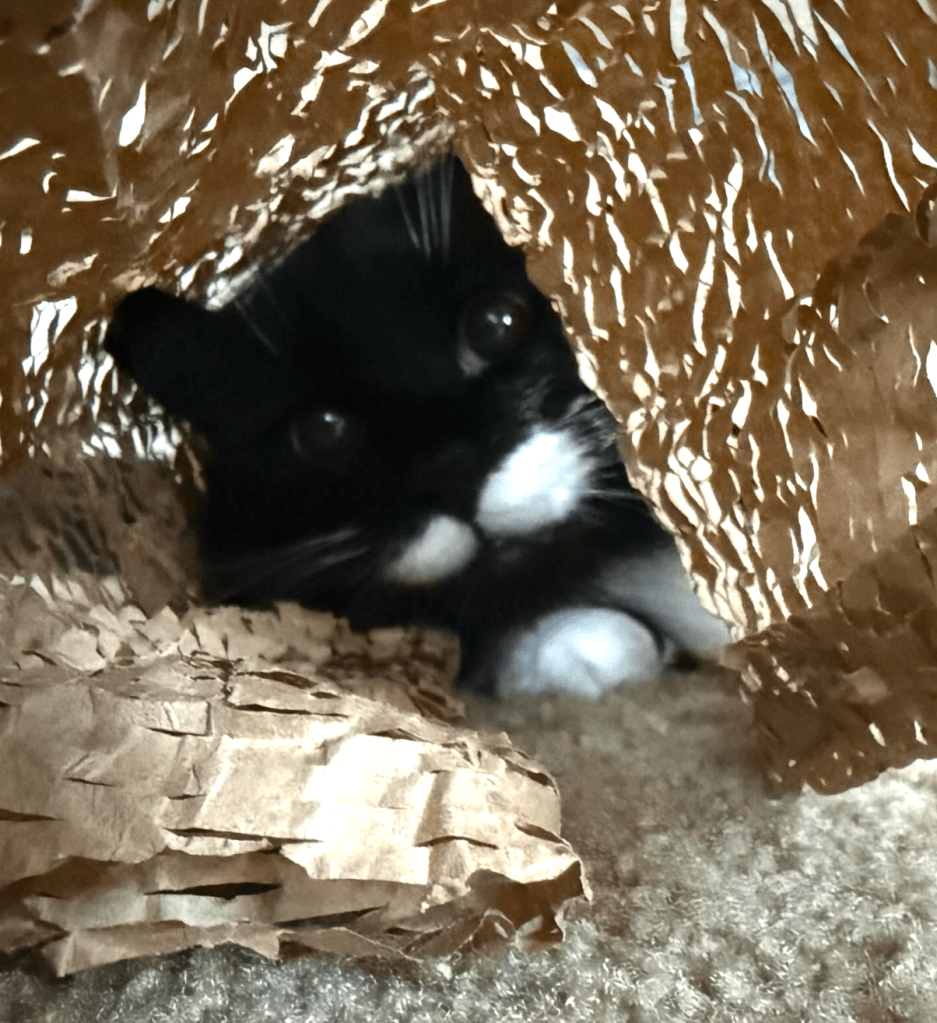
Here’s Pim for the pet tax. She loves that piece of packing paper.

Enjoy the last little bit of August, and I will talk to you next week!

Pity Isn’t a Good Marketing Plan

1,483 words
8 minutes read time

box of tissues, with one coming out of the top. pink background. text says pity isn't a good marketing plan

It’s valid to talk about our struggles as authors. It’s something I do almost every Monday. We like to know that we’re not alone, that we can relate to people and what they’re going through with writing, marketing, and publishing.

But sometimes it gets out of hand. In the past week or so, there’s been a big TikTok account that has taken the concept of sharing our struggles just a little too far, and what started out as “I really need some support” has turned into a huge marketing strategy constructed pretty much on just . . . pity. I don’t want to go into all that, the article I linked to actually does a really good job, and honestly, I’m not interested enough in that person to do a deep dive to write my own post about it.

Actually, I see a rendition of it on social media all time. Little posts like, “I haven’t sold a book this week/month/year,” or “My husband just got laid off, any sales will help!” or, “I just had a death in the family. I’ll donate proceeds to their funeral if you buy my book,” or “I can’t afford my cat’s vet bills, please, any reads in KU will help a lot.” I sympathize with each and every one of those people. I really, really do. I’ve had financial trouble. I lost three cats in five years, and let me tell you, the vet costs were astronomical. I’m not a stranger to needing money, but what I didn’t do was ask my readers to help me by buying my books. Why? Because:

One: Book royalties don’t work like that. Amazon doesn’t pay us for today’s sales for three months, so even if I managed to guilt-trip a few people into buying my books, it wouldn’t help. Three months is a long time to wait when you need the money now.

Two: My financial situation isn’t my readers’ business nor is it their responsibility. Asking them to buy my book so I can have some cash to pay bills or whatever else grossly oversteps the author/reader relationship.

Three: It erodes reader trust. After a while, they won’t want to see your social media posts because they’ll be afraid you’re going to ask them to do something they can’t do. Not all readers have a ton of disposable income, and if you have a short backlist, maybe they already supported you and will feel bad now if they’ve already bought your book and don’t want to buy it again.

Four: It takes attention away from your books. As an author trying to create a professional reputation and a credible and enjoyable backlist, that diverted attention could cost you. Not only for just that day, or that week, or that month you’re begging for help, but . . . forever. Followers can mute you without unfollowing, so you may never know the true damage you cause. Out of sight is out of mind, and in this time of content saturation and short attention spans, it doesn’t take much for a reader to forget she ever read anything you wrote.

The only time you should be asking readers if they’d like to read your books is when you know that what you’re offering them is something you think they would enjoy, either because you know they’ve read similar books to yours or they asked for a recommendation and you have something they’re looking for. That’s it.

But, I can hear a lot of you saying, I share my bleak numbers and empty sales dashboards to have support and so others don’t feel alone. That’s understandable and you’re not alone thinking that, but unfortunately, the reader/author line blurs more every day. I know this and take the risk keeping this blog up. Maybe a reader would find my indie talk not to their liking and skip out, either from this blog or my books too, and that’s okay. It’s unrealistic to think that we can keep our roles completely separate, so let’s just say begging for sales in most ways is unappealing wherever you happen to be hanging out online.

Besides, and I wrote a whole blog post about this before: transparency means diddle squat if you’re not prepared to have a conversation about why your sales are in the toilet and how to fix it. Saying you had zero sales so far for the month of June means little. That’s pity marketing if I ever heard it. You can frame it any way you want: “Just letting people know how tough it is out there. No sales this month.” “Being transparent today. No sales for this month. Keep on keeping on.” “No KU page reads this month and we only have a couple days left. Fingers crossed next month is better.” Those all sound familiar because we hear them all the time, but what I really want to ask is, What are you doing marketing-wise to combat this? Are you only posting on Facebook? Only Threads? Pinterest? How’s your cover, how’s your blurb? Is your book first in a series that won’t be done until 2030?

If you’re not ready for the hard conversations, then you have no business sharing. Some people will ask, out of a want to help you, and mostly I hear, I don’t have money for ads, or ads didn’t work for me. There are a lot of reasons why ads don’t work, the top one being your book isn’t advertising-ready. The cover is off, the blurb is confusing. You didn’t choose the right keywords or categories and the ad platform is confused and doesn’t know who your readers are. Those things are fixable. The money thing, not so much, but indie publishing is the only business venture I know of where people think they can start a business with no start-up cash. It’s completely unrealistic to think you can publish a book and have it be successful completely for free. People get really mad at me when I say stuff like that and call me privileged, but it’s true. Even a simple artist who wants to sell paintings on Etsy needs money to buy canvas and paint. It’s really crazy and probably why Kickstarter has had another surge in popularity recently. Authors need money to produce books. It’s always been that way.

So, the biggest takeaway from this post today is, should you be sharing that online? Do you really want your readers to see it? Do you really want your peers to be feeling sorry for you? I have a lot of sympathy for my “co-workers” such as they are, but whenever I take a look at their books, I can usually find a hundred ways to fix what they’re complaining about. New cover, new blurb. Get that series done. Fix your formatting, your title is confusing. Your ads won’t waste money if you’re selling a book people want to read. You may need to experiment a bit with your audience–Facebook wants to shove your ad in front of everyone which we all know rarely works–but even though I’ve complained about my own ads, I’ve never lost money. Simply broken even which I don’t consider a failure, I was just having mental health issues and decided to step back from the grind.

Anyway, so 2025 is half over. We’ve got six more months to get stuff done. Can you go through your backlist and make a list of things to fix?
*Cover–just because you like it doesn’t mean it’s working
*Blurb–too confusing or too vague because you don’t want to give away spoilers may turn readers off
*Look Inside: the first 10% is important. If nothing is happening or you start off your book with an info dump, you won’t hook readers.
*Make sure your categories and keywords are solid
*Price competitively

Then you can:
*Do a couple of free days and join an author-driven promo
*Learn Amazon ads
*Buy a promo from Written Word Media or places like Fussy Librarian and Robin Reads

Let’s stop the pity marketing and take matters into our own hands. We have the power to fix things and acting like you don’t just makes you look bad.


One more thing before I head off to get my errands done for the day: Angela James is offering a deep POV workshop on July 8th for $30.00. Improving craft is another way to increase sales. No one wants to read a book that sounds like crap and is full of telling. Angela’s a fabulous editor who used to work for Harlequin’s Carina Press. Take a look at her workshop, and if you haven’t invested in your author business so far this year, this money will be well spent. This is not an affiliate link: https://angelajames.co/deep-pov-workshop/

Have a good week everyone, and if you live in an area that’s been hit by storms, stay safe!
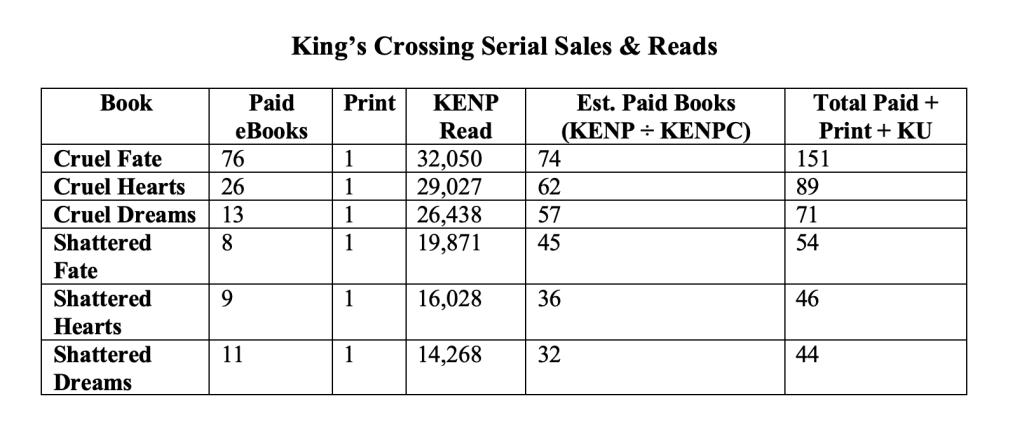
Didn’t Know What to Write About This Week

I tried four different times and started four different blog posts and nothing sounded right.

I came up with something Saturday night that was actually pretty unhinged and not like me at all. My gut told me not to publish it, and at the last minute, listened to my intuition (writing this on Sunday night at 9pm). Don’t need you all to think I’m losing my mind.

For now, if you’re publishing this summer and need some help, I have a few tutorials that will point you in the right direction:

I recently updated (like a couple days ago) how you can make a full paperback book wrap in Canva:
https://vaniamargene.com/2022/06/13/updated-creating-a-full-wrap-paperback-book-cover-using-canva-plus-more-screenshots/

Once you have that, you can make an ebook cover, and you can read how I do it here:
https://vaniamargene.com/2024/09/09/how-to-turn-your-books-cover-full-wrap-pdf-into-an-ebook-cover/

If you’re planning on publishing on IngramSpark, I talk you through it here:
https://vaniamargene.com/2024/03/18/an-ingramspark-tutorial/

That’s all I got, but it feels safer than what I was going to publish. I’ve felt good, just maybe trying to find some balance with living life now that I’m feeling better and where writing fits into all that with how the publishing industry is. I certainly don’t want to say anything I’ll regret.

Anyway, have a good week, and hopefully I can come up with something better next time.

Six Things I Learned after Starting My Pen Name

2,277 words
12 minutes read time


I thought starting my pen name (not really a pen, VM Rheault vs. Vania Rheault but for now, that’s what I’ll call it) would be the ticket to not fame or fortune, but I wanted to start my career on the right path after a couple of years of not doing things the proper way.

When I first started publishing, I did what a lot of indies did, and still do. I published what I wanted, didn’t really have a plan. I genre-hopped, looking for that genre I wanted to settle into long-term. No one told me I didn’t have to actually publish those experiments, but I wouldn’t have listened even if they had. Publishing without gatekeeping was a free-for-all, and it still is, indies publishing whatever they want without regard to a publishing schedule, marketing, or anything else that would start them on the right foot. Probably the only habit I had and still hold on to now, is writing all my books in a series first before publishing them. I started that when I wrote my Tower City Trilogy and I’ll never stop, even if that means I have a year or two between launches. But, let’s break it down. Here are the six things I learned when I started my pen name back in 2020, well, 2022 when I first published my Cedar Hill Duet and I tried to do things the “right” way.

You can’t click Publish and walk away.
If you don’t have a launch plan, this is what a lot of authors do. They don’t know how to launch and it can hurt you. When I published my Cedar Hill Duet, I didn’t put them on Booksprout for reviews. Before 2022, it was a free service, and I used it for my Rocky Point series under my full name. Then it went to paid, and I listened to the annoyed authors who said they were going to stop using that service. I should never have listened and put my own books up. Reviews matter. No one wants to think it, and I know correlation doesn’t equal causation, but Captivated by Her and Addicted to Her are my worst selling books and I attribute that to their low number of reviews. So, if you don’t have a plan or don’t want to have a plan, like cover/title/blurb reveal or newsletter, at the very least, try to get as many reviews as you can the week of your launch. They will affect how your book does from that day forward.

Nail your cover the first time.
When I decided to do my pen name, I really wanted to make sure I published correctly the first time. And by that, I mean I wanted to make sure my covers met genre and reader expectations. I’ve written a lot about how my cover for The Years Between Us screamed Women’s Fiction, and after I changed it to a couple, my sales went up. It was a beautiful cover but didn’t match the blurb or what the book was about.


I changed the cover to Wherever He Goes, too, and that helped. Unfortunately, I’ve had to change covers for some of my first person books even though I tried my best to avoid it. Your skills get better or better models come along, your taste changes, whatever, but no matter why you have to change your cover, if you change it to something better, just know that you’re blowing your launch period. I totally fucked up my launch for my Lost & Found trilogy because I didn’t wait to find better models. I published with what I had, and didn’t change the covers for a year or so after my launch. I gave them another edit, too, so I “re-launched” them, but man, you really waste Amazon’s bump if you screw up the first month of your release. Title, blurb, and your cover’s tone need to be spot on. Just because you like something or it looks professional doesn’t mean it’s a good fit. You have to do market research, and nobody wants to do that because it sounds like you’re selling out. You’re not. You’re helping the right readers find your book, and that’s all that should matter. I wrote more about choosing the appropriate cover, and you can read it here: https://vaniamargene.com/2024/04/08/my-marketing-secret-shh/

Don’t listen to everything you hear.
One of the riskiest things you can do online is listen to other people. I’m on Threads a lot (you know this) and the number of opinions out there, well . . . you know the saying: Opinions are like assholes . . . everyone has one and they all stink. There is no place this is more true than when you get a bunch of romance authors together, be it on Threads or in a Facebook group, and they’re telling you what they like and what they think should be the standard. No 3rd act breakups, no cliffhangers. Don’t use the word “folds” when you’re talking about p*ssy. Don’t make him an asshole, don’t write about rape. Don’t romanticize stalking. Don’t write in 3rd person. Don’t write your blurb in 1st person. Don’t do this, don’t do that, but what’s funny is that when you take a look at popular books, THEY ALL DO THAT! Yes, there is some advice out there that’s good, like don’t genre-hop if you hope to build an audience. I’m a firm believer in writing your blurb in the POV your book is written in. But at the end of the day, when it’s just you and your book, you need to write what you enjoy. Even if that’s a super dark romance that would get you locked up (and not in a good way). If you’re bombarded with opinions about how nasty the enemies-to-lovers trope is, and that’s what you’re working on, it can be discouraging. But honestly, you’re not writing for other authors anyway, and if an author tells you she hates cliffhangers and you love them, tell her to fuck off. There are readers for everything, and it’s okay if people self-select out of your books. You don’t want people who don’t like what you’re writing to read your stuff because all you’re doing is courting bad reviews. It can be difficult staying true to yourself, but you’ll be happier for it.

Just because you do everything right doesn’t mean you’ll find success.
This is probably the hardest lesson of all. You can spend a ton of money on editing, you can publish with the perfect cover and a ton of reviews, but in the end, that doesn’t mean you’re going to find success. And by success, I mean, readers, sales, royalties, whatever success means to you. I’ve said in the past that success to me would be making a part-time income with my books. Part-time for me would be about 15k a year. It would help me out tremendously, that little extra money, but this year I gave up that dream and realized that maybe what I’m writing just isn’t going to hit the market the right way, or my reluctance to be on TikTok will always hold me back. My books are too quiet, or I chose the wrong sub-genre when I rebranded myself. I don’t know, but the fact is, there are thousands of authors out there who publish regularly, publish good books regularly, and they get absolutely nowhere. They spend more than they make, they get burnt out, and/or they publish to no one over and over again. After you come to that realization, you’re hit with the trite sayings like “A quitter never wins and a winner never quits” or “Believe in yourself and you’re halfway there” and you just wanna cry (or puke). When 2025 rolled around, I decided to change how I looked at my writing. I can’t call it a business because I don’t have one. That implies money in and money out, and right now, I pay more than I earn. So, in that vein, I decided to stop doing what I think I should be doing and just do what I want. That means writing what I feel like writing without regard to a publishing schedule. I stopped all my ads. Don’t care about social media and post only when I have something to say. I stopped chasing the dream and I feel better. Writing is fun again and that has turned into my new definition of success. Here’s an interesting article by Jane Friedman about having what it takes to make it: https://careerauthors.com/do-you-have-what-it-takes-to-make-it-in-publishing/

Numbers don’t mean anything.
Social media sucks. It really does. I believe that you should have a hub where readers can find you if they want. (That should ultimately be your website, but I understand the value of a Facebook author page or an Instagram account.) Authors should have some kind of social media presence, if only to prove you’re a real person instead of a made up author some guy sitting in his mother’s basement created using AI. You can’t appear fake in this day and age when there are so many bots out there that can act and interact like a real person. As AI usage gets worse and worse, readers knowing you are real will be part of your marketing toolbox. But in the past seven or eight years I’ve been online, I’ve learned no matter how many followers you have, that doesn’t mean you’re going to sell books. They might like you because you have pets or because you live in the same state. They like how you do your hair or think you’re pretty, whatever it is, but that doesn’t necessarily mean you’re going to be able to sell them your books [see Billie Eilish: https://medium.com/better-marketing/billie-eilishs-book-flopped-because-her-marketing-team-assumed-it-would-sell-itself-71c32dc19af3]. I just looked up someone who has over 5k followers on her Facebook author page, and she sells very few books every month–and she has a lot of books. So, if you don’t have many followers or you’re just on social media to kill time or to amuse yourself, don’t feel bad. Finding readers is hard work and it’s a long game. Besides, depending on how you run your social media, you could just have other authors following you, and when it comes down to it, that’s not helpful. I wrote about busting out of the bubble, and you can read it here: https://vaniamargene.com/2021/12/06/how-to-break-out-of-the-writing-community-bubble-and-sell-books-to-readers/

Mix friendship with business at your own risk.
I help a lot of people do their covers, format, even just give them publishing advice through my experiences and what has worked for me. I’ve paid my friends to edit and beta read, I’ve done a lot of free work that I was pleased to do because you’ll learn fast that the can be full of people only in it for themselves. I’ve also accepted some payment for the work I’ve done for others, but no matter if it was free or paid, in the past eight years I’ve been at this, nothing has pleased me more than helping someone publish their book. But not every relationship is infallible, and mixing business with pleasure isn’t always something that works out. I’ve lost friends because the business part of our relationship soured, and unfortunately, that’s a risk you take. Sometimes you can see that person for what they are and you realize that in time your friendship would have tanked anyway. But, it’s important to understand what you’re getting into, even simply saying you’ll format for someone or if you offer to whip up a quick cover. Writers and authors are some of the touchiest people on earth, and I’m included in that because I know I’ve gotten upset over things other people would have shrugged off. But when I help someone, I’m a professional at heart and always do my best to give them a product I would be proud of if it were for my own book and I don’t think I’m out of line to expect the same–especially when cash exchanges hands. I’d never beta read while watching TV or use photos on a cover that weren’t safe to use. Even though I have ethics and integrity, not everyone does, and I stopped talking to someone who admitted she was editing my book while she was at a hair salon, and I cut ties with someone who backed out of reading for me when she gave me her absolute promise she would finish. I know that sounds callous, but we had underlying issues and those instances just happened to be what did me in. So if you think you’d be heartbroken to lose that friendship, don’t let the line between personal and business smudge. It’s difficult to get past that.


I’m sure there are more things I’ve learned, but this blog post is long enough for now and I touched on the topics that I have found the most important in publishing and the most important to me when it comes to my experiences. It’s tough to cut out the noise, but like I said, at the end of the day, it’s only you, your book, and your readers and if you go to bed happy, that’s all that matters. People will come and go, opinions and advice change. Do your best with what you have, keep true friends close, and go outside and touch grass every once in a while.

That’s all I have for this week. Next week I’ll let you know about a shiny new thing I couldn’t step away from and what my publishing schedule will entail because of it.

Chat soon!