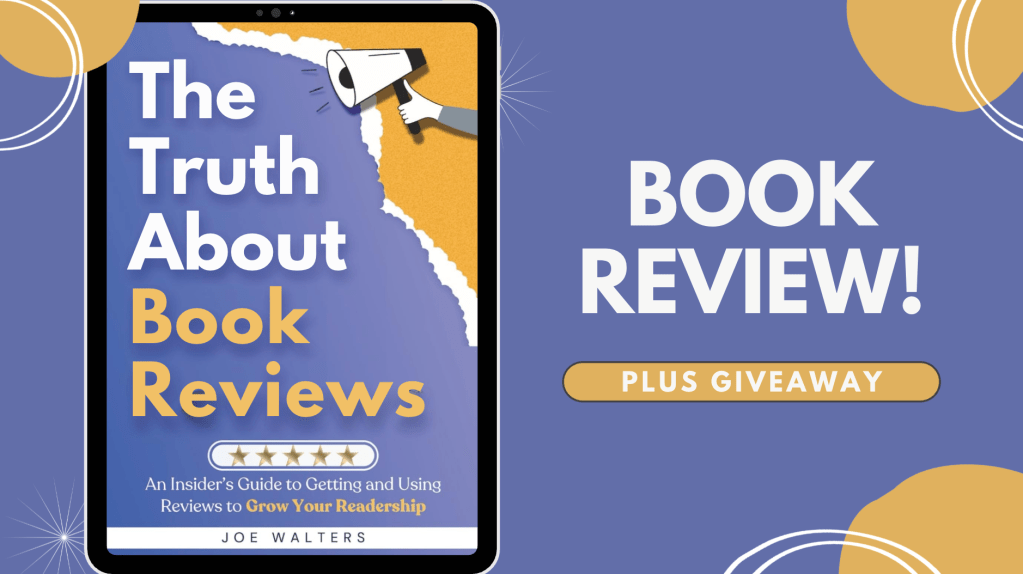
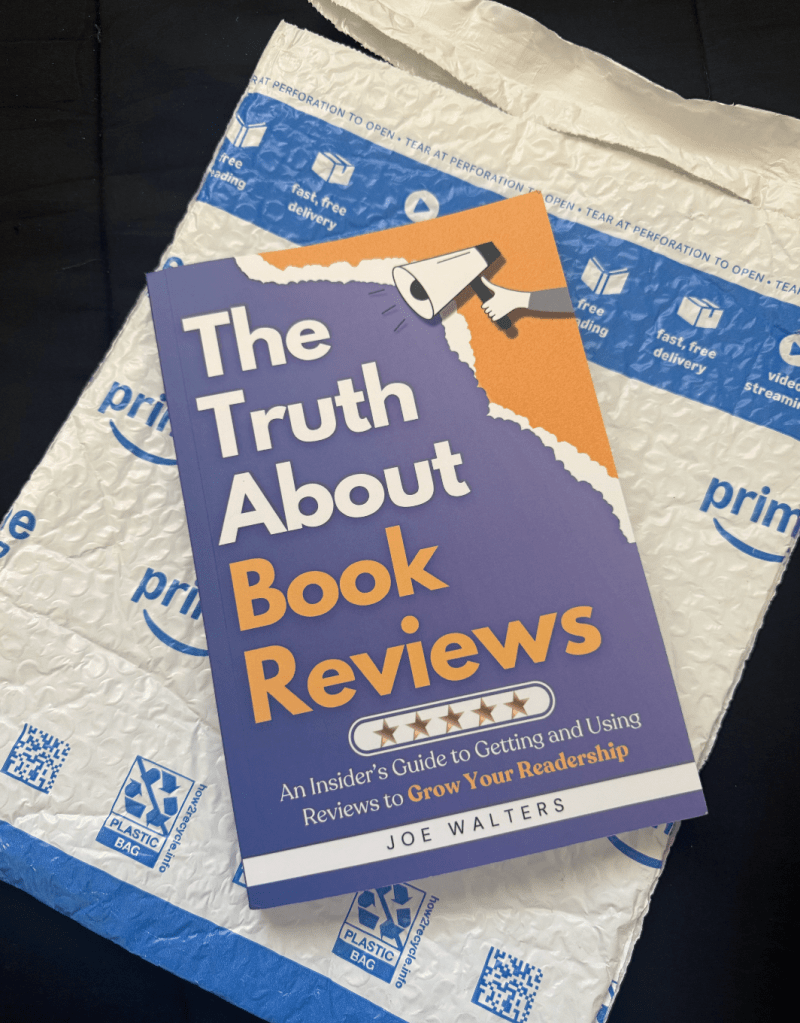
When Joe Walters, editor-in-chief of Independent Book Review, told me he bumped into one of my blog posts scrolling the WordPress reader and asked if I would be willing to review his book, I said sure. Why not? If you know me, you probably know if you ask me to do something, I’ll do it. Whether that’s a flaw or an attribute, who knows, but I downloaded his book that was free when he contacted me, and during slow times at my work (not many which is why it took me so long–he emailed me back in September!) I read it. Even though it took me a while, I wanted to finish since I said I would, and besides, I wrote about reviews not long ago and thought maybe there would be some advice I could follow in my own book business.
Did Joe’s book deliver? Yes.
Is getting reviews a lot of work? Yes.
Did he offer to do that work for you? Unfortunately, that answer is no, though writing the book in the first place is a big help all on its own.
There are lots of different kinds of reviews, and I think the kind indies think about the most are from readers who put their reviews on platforms like Amazon and Goodreads. You can’t do much about those–all you can do is sell a lot of books and hope readers review when they’re done reading, or pay for a review service like Booksprout and hope the readers who pick up your book follow through. Joe focused a lot on editorial and trade and media reviews and gave you several examples of what to say when you reach out to them.
That was probably one of the best parts of the book. Unless you’re having Al write your requests for you–and I would advise against that being all the AI spam that authors have been getting lately–it’s difficult to figure out what to say that doesn’t sound smarmy, like you’re begging for a favor, or flat because you’re scared to reach out. He gives you plenty of examples of what to say, taking the guesswork out of it.
Not only does he tell you what to say, he tells you how to find people who review in the first place, which is a godsend if you have no idea where to start looking.
But, I’m not going to lie, and he doesn’t either. Finding people to read and review your book is a lot of work. You have to make a list of the reviewers who read your genre, write the email (follow their submission guidelines!), and wait. Do that over and over again, and be prepared to follow up if they don’t answer you. He even says in his book that the majority of his reviews come from the followup email, and that’s how it was with me too. I forgot I said I was going to read his book and he nudged me a couple months later. I emailed back and apologized, showed him a picture of his book on my Kindle Fire as proof of life and intention, and even left his email in my inbox to remind myself that I said I would review. (Even that has been a while, so he’ll probably be shocked I followed through.)
Another thing I liked about reading his book is that he speaks indie, and that helps a lot. He knows what Bookfunnel is, knows about sites like Booksprout, and understands Kindle Unlimited limitations if your book is enrolled. He has a sense of humor that keeps the material from becoming too dry, and I appreciated that very much. He also has a thing for ghosts, and though he says dead people can’t review your book, the next time you go to Barnes and Noble, grab a ouija board out of their games section. Every little bit helps!
One last thing that I really liked was not only does he tell you where and how to get reviews, he includes a short section on what to do with them once you have them. He explains how to access your book’s editorial reviews section on Author Central, how to use Canva to create A+ content for your book’s Amazon product page, and how to make graphics to feature reviews on social media and in your newsletter.
Overall, if you’re at a loss as to where to look for reviews and how to go about getting them, this book is very useful, but also keep in mind that there is a lot of content out there and chances are good you won’t be the only one asking. Tenacity and patience are key, like a lot of areas of indie publishing.
With my release of Wicked Games coming up soon, I’m going to try a different review service and also, I take back what I said about Booksprout. I wasn’t going to use them anymore, but I felt bad not giving the readers I have there a warning that I was leaving. I do have a few people who enjoy my books and leave real reviews, not just plot summaries or generic AI commentary, and I would hate to disappear without telling them how to find me in the future. So, in the “Notes to the Reader” section, I’m going to tell them this will be the last book I put up and if they want access to other ARCs, to follow my social media or blog. With Loss and Damages, I just got so disheartened, and it doesn’t seem like something I need to keep paying for.
Anyway, I’ll keep Joe’s book as reference if one day I decide I want to chase reviews written by other people than just readers, like Joe and his review team over at the Independent Book Review. If you want to read Joe’s book, The Truth About Book Reviews: An Insider’s Guide to Getting and Using Reviews to Grow Your Readership, you can find it on Amazon. It’s available on Kindle, in Kindle Unlimited, and Paperback. https://www.amazon.com/dp/B0F7C3WFM5
I also purchased a paperback copy as a giveaway to go along with this blog post–and in true Amazon fashion, it came a little banged up. I know giveaways aren’t popular anymore, but if you’re in the United States, comment below and I will draw a name next week.
I don’t hate social media. In fact, I enjoy it a lot. I like to scroll Threads for current events and book, or writing community, news. Although, I limit how many platforms I’m willing to spend my time on, and I don’t always jump on the new thing. For example, I claimed my username on BlueSky but I don’t scroll or post there. I don’t have it on my phone. I haven’t done anything with UpScrolled. Or Mastodon. Or Tumblr (honestly, I don’t even know what Tumblr is), and most everything else that’s out there. Reddit. I have an account there (I give my reader magnet away on a free book subreddit) but I don’t have the app on my phone and don’t regularly spend time reading and/or posting there.
I update my personal Facebook profile maybe twice a month, if that, and that could be just me sharing a post or joke I liked. Half my “friends” aren’t really friends anyway, and I should just clear them out. They don’t care what I’m doing. My Facebook author page fares a bit better, but not by much. I try to keep it updated so that if a reader lands there, they can see that I do post and I do have books coming out. A dead Facebook author page could say more than “This author hates social media” so if I’m going to keep it up, I know I should keep it up to date.
I also post sporadically on Instagram, and I’m trying to do more there because it seems like the most friendly in regard to posting book content. I boost posts every now and then and for the first time in many years I have over 500 followers. That was a big accomplishment for me, especially since after leaving Twitter, a huge following seems like a thing of the past. When I left Twitter, I walked away from 13.5k followers (and 2k accounts that had mine blocked LOL). Just because of how little time I put into social media these days, that was probably my “peak,” and because having that many followers didn’t sell books, I didn’t mind leaving that account behind.
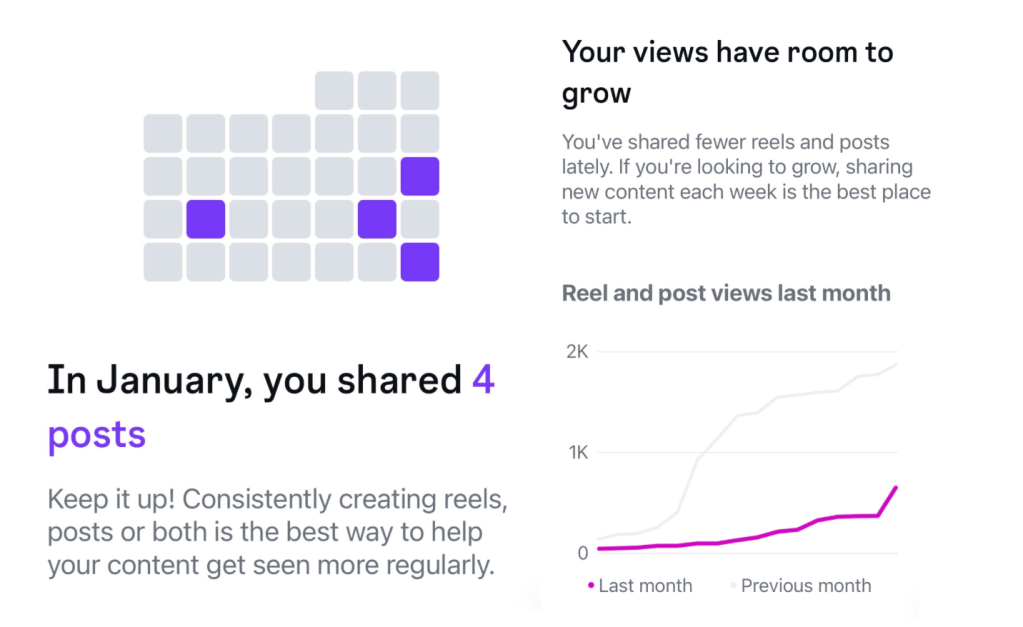
I thought I was doing pretty good on Instagram, but then they sent me my January insights, and I regret to say that I posted only four times in the whole month. I can probably do better.
Thanks for the pep talk, IG!
So, I can say that I do like social media. I scroll Threads a lot and I added Substack to my phone, even though I don’t plan to blog or post there. It’s a place where I can get book news without the state of the United States thrown in and I like reading longer-form posts because lately that’s where the real news is.
What I have a problem with is engagement. Not getting it, because for as little as I post, I do get some. Responding to it. If someone tags me on Threads or Instagram or maybe replies to a post on my Facebook author page, I’ll see it, because my phone is attached to my body like almost everyone else’s, but I don’t respond right away. I catalog the tag or response, remember it, and don’t acknowledge for days or even weeks after. That . . . isn’t good. Not that everyone expects to have an instant answer–some of us watch TV without our phones or have jobs where we can’t be online–but it doesn’t look charming or mysterious (even though I’d like to think so). It looks rude. It looks rude not to return someone else’s energy. It’s rude not to acknowledge that they were thinking about me and gave me their time.
That’s the struggle I have, and I’ve been this way for as long as I’ve been active on social media in the book community. On Twitter, I’d answer all my notifications once a week, and when people saw that I was online, they answered my responses and I was stuck for hours. And I don’t want to say “stuck” like it’s a bad thing. I had lots of friends that I truly enjoyed talking to, but writing, even as far back as 2015 when I was writing my fantasy books that I would never publish, always came first. That doesn’t happen anymore. Nowadays I trade actual emails or DMs with a friend or two, sometimes what will be all-day chat if I have the time between errands and chores. I don’t get as many notifications on Threads as I used to on Twitter, mostly because I don’t post on Threads very often and the writing community there isn’t the same as what Twitter used to be.
There’s something strange, I think, to be told that someone is reading one of my books, stranger still for someone to tag me in a post and say they enjoyed it. Not odd in the fact that happens, but odd in the way I perceive it, and I wonder if this comes from not having confidence in my books. I’m proud of them, and I know I wrote them as well as I could for that time of my life. Someone on Instagram just tagged me in a post that said she was re-reading an old third person book of mine. A re-read implies she liked it enough to read it again, and of course I don’t want to say anything bad about that book because that would insult her taste. I’ve re-edited it a couple of times since I published it, but I feel like the plot is flimsy and a reader has to suspend their belief quite a bit–especially since what’s been happening recently with police activity and social media. It was just one of those books that I didn’t think through because I was so damned happy writing it. I replied back thanking her, because there wasn’t anything else I could do, and I am thankful and humbled she read anything I wrote, took time to make a graphic and add my name and book title to it, and tag me when she posted it.
I don’t mind putting myself out there–I do it here every Monday on this blog. Sometimes I get comments, and I take just as long to reply. Sometimes I see my blog posts out in the wild, like once I saw someone post my Canva tutorial in a Facebook group I’m in. That was surreal because I responded as well, just a watered-down version of the instructions she was asking for (most groups think it’s bad manners to self-rec). I can see in my referrers where some of my traffic comes from, and I tracked down a couple of people who shared my posts on Threads. I didn’t respond to those because I feel like that’s intruding on reader territory and I never want people to be afraid to talk about me or disagree with me. I’m a big girl and like discussion. I’m always open to learning and hearing other people’s opinions. I also have kind of a snarky sense of humor and not everyone can tell when I’m trying to be funny, so they don’t always take my blog posts in the spirit in which they’re meant. I could defend myself when that happens, but there’s really no point to that.
You would think then, that if I have such a terrible time responding to people, that I would just not post anymore, but I have to get over the uncomfortable feelings I get when people reach out. I don’t know why I wait to respond, especially since it wouldn’t take more than a minute when I see the notification on my phone. I don’t want people to be hurt or think they did the wrong thing. Also, sharing their content gives me content and my four times a month posting schedule on Instagram proves I could use more of it.
I think, overall, at the risk of sounding like Al, that I work quietly, and besides writing about my updates here, I don’t talk a lot about my process or how much I get done. I don’t post word counts or any kind of progress like that–not where fiction readers can see it. The posts that are about my books require a different kind of creative brain and when I open up Canva, I usually have no idea what to make. I have several books to choose from, but I just never know what kind of post to create. A snippet post? A one-liner? Then what background to choose? A character sketch? A video? A carousel? I mean, all of them at some point, obviously, but I get sucked into the technicalities and just go back to what I really want to do: write.
So, yeah, I have a complicated relationship with social media. I’ve made a lot of resolutions in the past, but I can never stick with anything. I don’t depend on social media for sales, which is a good thing, I think, since it cuts out the desperate urgency of having to post, but I admit that it could help me too, if I could commit.
I need to try harder to have better response times on social media and reach out to people who reach out to me first. I like social media, but that doesn’t mean I want to participate.
And lurking is okay, but I can’t be so content in the shadows that I can’t step into the light.
Because, after all, that’s what social media is for.
I used to watch Sullivan’s Crossing. I say “used to” because I kind of bailed on the show like I do most shows I watch. I get bored or I’d rather work on my books. I might go back to Sullivan’s Crossing at some point, if there’s nothing else to watch, but I mostly stopped because I hated the way Maggie and Sydney treated the men who liked them, or, in romance-novel speak, their love interests. I know the show writers just wanted to devise drama for the plot, but even knowing that didn’t stop me curling my lip whenever one of their scenes came on.
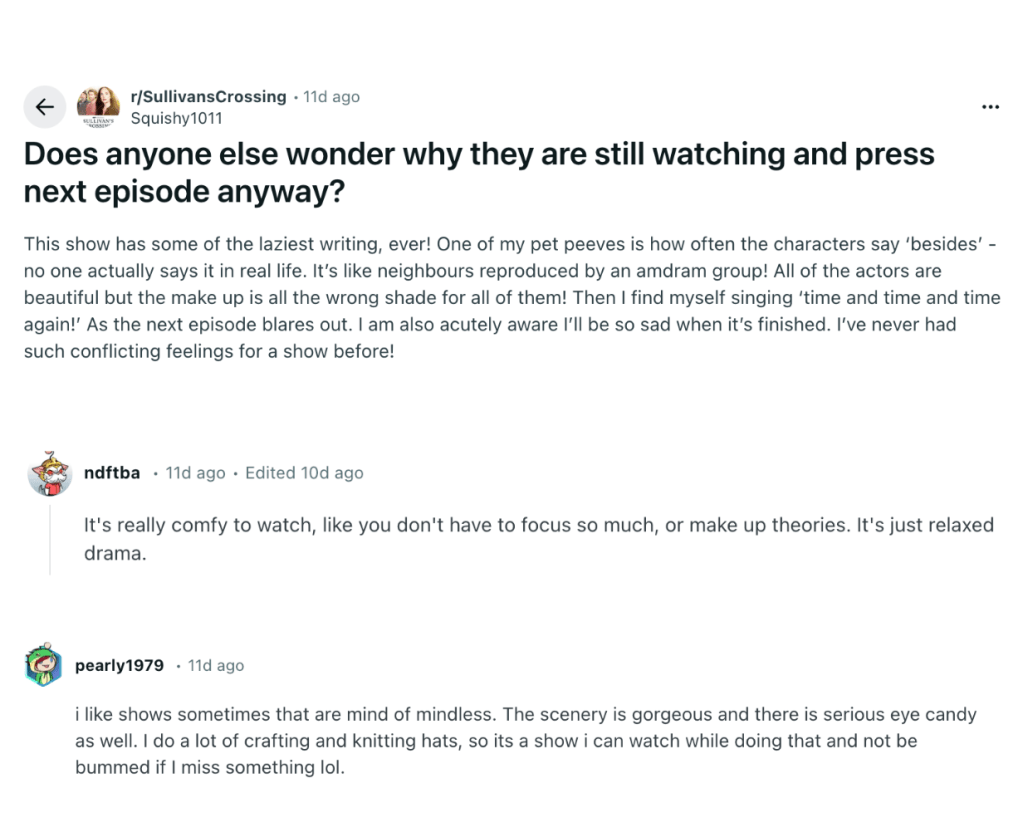
I went into that because everything in the universe is connected, and I started getting emails from Reddit about people talking about that show. I engaged a little bit, enough to know that I’m not alone in my dislike and my reasons why. But there was also one exchange that I’d like to show you here:
My mind went in a couple of different ways when I read that. The first was, why are you watching something you really don’t want to watch, and second, as a romance author, I felt bad for Robyn Carr (who wrote the books Sullivan’s Crossing is based on) and the producers of this show. No one wants to be told that their content is “kind of mindless” or is made up of lazy writing.
We’re living in an age where our attention is constantly split between two or even more things. TV shows turn into background noise while we do chores or cook, we scroll on our phones when we shouldn’t like at a movie theater and behind the wheel, or we have a conversation with someone on speakerphone or FaceTime while we shop. It’s almost like if you do one thing at a time you’re failing at life.
I think what bothers me the most when it comes to talking about distraction and split attention is the lack of respect that goes along with it. What do I mean by that? I’ll tell you a little story.
Two years ago I hired my last beta reader. I didn’t pay her very much, but I was supposed to be helping her set up a beta reading service, so it was a win-win situation for both of us. I paid her and emailed her my manuscripts. She was an avid reader and I had known her for a long time, so while I felt a bit apprehensive because we’d had some conflicts in the past, I pushed them aside. She did read, but occasionally I’d get messages like, “At the auto shop waiting with my husband and reading your book,” or “On a road trip with the family, reading your book,” and I started to wonder just how much attention was she giving my story. It turns out she missed an important callback that resulted in some skewed feedback. Meaning, she forgot what a character said, or possibly missed it completely, which made what another character said later in the book not make sense to her. I didn’t need a math degree to put two and two together. She was reading while she was distracted.
Needless to say, I was pretty disappointed. Since then I haven’t bothered to find other beta readers or give my manuscripts to anyone else. I realized that no feedback is better than bad feedback and we can’t always guarantee that our money is going to pay for quality.
When you’re a new writer, accurate feedback is really important. You’re still learning and leveling up your craft depends on useful, thoughtful, and relevant critique. What is a new writer going to do if they can’t find someone who’s willing to actually sit down in a quiet space and give their words the attention they deserve? And why offer to beta read or help someone if you’re not going to do the work that’s required and expected? I’ve seen other beta readers say they’re settling down to beta read a client’s work and that they’re reading with the TV on for background noise. I can understand if that’s part your process, but not everything needs to put online. If you’re charging the going rate to beta read or edit for someone, it might be better to keep that kind of detail to yourself.
When people don’t pay attention while reading they can come back with questions, accusations, or even complaints, and an author can lose confidence that their writing is good and that plots and character arcs make sense. Books require a person to be present while they consume those words or the meaning, nuance, and themes can get missed entirely. Is that going to be the author’s fault? Was the plot too complicated? Were the characters too complex? Was the prose too purple? How is an author going to know? Maybe the real reason that reader couldn’t follow what was going on was because she was playing Bingo with her grandma at the VFW. I mean, things happen.
Distraction is also bad news on the author side. I used to be able to listen to music while I wrote, but I can’t do that anymore. I start listening to the song instead of writing, and now when I have a writing or editing session, I do it in silence. Sometimes I’ll pick up my phone and scroll, and I’ll ask myself if I’m going to write/edit or scroll because I can’t do both. That’s enough to get me to put my phone in another room and focus on the task at hand. Editing while distracted is just an invitation to edit more typos into your manuscript rather than fix what’s already there. Readers deserve respect because they invest in an author’s work twofold: they pay to read and give hours of their time as well. The last thing an author needs is a reader saying, “What was that?” at the end of their book because a main character had five careers, her hair changed colors six times, and there’s a plot hole big enough for the Grand Canyon to fall through. The setting of Sullivan’s Crossing is beautiful, but it’s not that important.
That’s not to say that a comfort watch is invalid. In these times finding comfort and a little peace where you can is more important than ever. Being able to sit and watch something relaxing is critical to mental health. Our brains aren’t meant to work twenty-four hours a day, seven days week, and authors and writers are often encouraged to take a break and fill their creative wells. Maybe that means doomscrolling while sitting through bland dialogue and watching a shirtless and sweaty Chad Michael Murray chop wood. But that doesn’t mean every show on TV needs to be that way and dumbing down scripts and books isn’t the answer to a culture that’s becoming used to doing two or three things at once.
What is the answer then? I’m not sure. I’m at a place in my career where going without feedback isn’t ideal, but having beta readers who will read with only one eye on the paper isn’t any better. We can’t police how people live, and putting a clause in a contract asking people to please don’t beta read or edit while watching TV or playing Bingo probably won’t work. People will do what they’re gonna do. But I don’t think it’s wrong to expect the service providers you pay to give you quality. Important callbacks, breadcrumbs, twisty plots, and complicated character arcs demand attention, not someone singing the theme song to Sullivan’s Crossing under their breath while they read.
What made me think of this topic was the Substack article I read a couple of weeks ago, https://thecreativegood.substack.com/p/what-is-second-screening-and-why, about screenwriters at a certain streaming service being asked to dumb down their writing. People scroll on their phones while they watch TV causing them to miss important details during a show. This article reinforced what has already been circling in my brain for a while now, especially when it comes to long serials and series where it’s imperative that readers pay attention from the very first page so the very last page makes sense.
In the article Jamie Feldman argues that dumbing down isn’t the answer, and of course it’s not. We can’t dumb down everything to appeal to the people who can’t put down their phones because that means people who do want to invest time and attention in a murder investigation or kidnapping case will get left behind. There will always be people who want to turn their phones off and get lost in a world to forget their own for a little bit, and those are the people who we should create for. If that’s who you want to create for. Maybe Robyn Carr doesn’t care the show based on her books is considered “mindless comfort.” She’s getting paid either way regardless.
I’ll keep writing my twisty books and it will be a reader’s loss if they’re distracted and can’t connect the dots. I’m not going to take responsibility for someone’s lack of focus and I won’t take feedback personally. Maybe one of the most important rules in writing craft is to trust your reader, and I will. I will trust them to remember what a character said on page 100 so the callback on page 300 makes sense. And if a reader decides my books are too complicated, they can self-select out and find lighter fare. That’s completely reasonable and won’t hurt my feelings at all. There are an unlimited number of readers out there and an author for everyone to enjoy.
There’s a time and a place for split attention, and only you can decide when and where that is. I’ll keep my attention on things that matter: my books and projects and the books and projects I help other people with. No matter how tempting Sullivan’s Crossing‘s eye candy is.
If you read Jamie’s Substack article, tell me what you think of it. The idea of dumbing down content to appeal to distracted consumers is interesting and I’d love to start a conversation in the comments.
This year, 2026, marks the tenth anniversary of the first book I ever published. The Corner of 1700 Hamilton is a speculative contemporary romance told from his and hers POVs–the first novella in his, the second novella in hers. I wrote it specifically to publish, and beyond that, I’m not quite sure what I was thinking. Well, I know what I wasn’t thinking. Genre, building an audience. What my brand was going to be moving forward. I had discovered indie publishing where everything is made up and the points don’t matter. (H/t to Whose Line is it Anyway where their slogan fits what indie publishing used to be pretty accurately.) I made the cover myself in Word and formatted the manuscript using a KDP Word template to get the margins, gutters, and page numbers right. Since then I’ve edited it a couple of times and redid the cover probably about five times now. I always cringe when I see someone reading it and I should probably just take it down since it’s not worth selling–it still has some telling and a strange plot–but I guess it’s not hurting anything. A reader will know real quick if they want to keep going after the first paragraph.
Anyway, I don’t need therapy to figure out why I wrote it or why I keep it up for sale. I wrote it to feel part of the writing community and I keep it on Amazon for nostalgia.
You’d think after ten years I’d have something meaningful to say about it all. Some deep philosophy about writing and passion and how much it means to me that my books carried me through some of the toughest times of my life, namely, a divorce, a health issue that fucked me up for a good five years, and breaking up with a man who said he loved me and wanted to marry me but then treated me like garbage. Writing was the one thing that was with me through all of it, and honestly, I’m a little surprised that I don’t have any triggering feelings toward my pen name. I started publishing under my initials in 2021, a year after I started having health problems, and those problems pressed down on me while I wrote and published every single one of my first person books. Luckily, that isn’t the case, and I can reread my backlist without feeling anxious, only regret that my health issues took away from the experience of writing them.
I’ve seen a lot in the past decade, but no, I don’t have anything deep or profound to say. I’ve made plenty of mistakes, and of course, anyone who does make mistakes wonders what their career trajectory could have been like if those mistakes hadn’t been made. Doing my own covers, not working with an editor when an honest one was a lot easier to find. I’m sure publishing subpar books hurt me in ways that can’t be measured. Even now, though I’ve gotten better at doing covers and self-editing, taking every step of the publishing process upon myself is probably slowing me down. Changing how I do things would take a lot more money and a lot more work now than say, six years ago. COVID changed the publishing landscape in many ways and with AI, finding an honest editor who won’t just run your manuscript through ChatGPT or ProWritingAid is its own nightmare. Then after you find one, or hope that you have, you need the money to pay, and with no money coming in, it’s harder to find the money to go out.
I thought I’d write about all the things I’ve learned in my ten years of publishing, but I’ve written about that in some way, shape, or form, for years and I don’t know if it’s worth repeating those lessons. Mainly, because, well, writing a good book doesn’t ensure success. Writing an amazing book, putting a fabulous cover on it, and writing the most enticing blurb is only the first entry on a very long list to find readers. Luck plays such a huge part in an author’s success, and for a long time I pushed back against that, saying stupid stuff like, “The harder you work, the luckier you are,” and “Be prepared to take advantage of opportunities that may come your way.” Those two things are true, up to a point, but they don’t take into account pure luck, like an influencer getting a hold of your book or word of mouth by the millions. Luck like that happens, we see proof of it every once in a while, but no matter if the stars align or what your horoscope says, you can never predict or manufacture it for yourself.
So, what have I learned during my ten years writing and publishing? I’d say….
Trends last longer than we think. (If you wanna chase vampires or write something like Heated Rivalry to get in on the action, go for it!) One of the most common pieces of advice I hear for authors just starting out is not to chase trends. Write the book of your heart then figure out the rest later. The problem is, writing a trendy book could be the book of your heart. Every book I decide to write is the book of my heart or I wouldn’t write it. If you want to write something that’s trending right at this very moment, do it! Trends take years and years and years to fade, if they do. E. L. James put billionaires on the map and that was fifteen years ago. Take a look at any top 100 romance list and you’ll see that billionaires still sell. Hockey isn’t going anywhere. It’s not merely sports romance anymore, it’s its own romance subgenre. Write what you want because the more people who pile on a trend, the longer it will stay. Just make sure you include what readers are reading the trend for. Keep up with reader expectations but add your own twist to stand out.
Why I started thinking about marketing before writing. This one might get some flack too, but it’s true. After you write your book, It’s too late to try to figure out tropes, categories, genre, and who your readers are. You’re not going to rewrite it if you realize mashing four genres together wasn’t a good idea or you have no idea what your tropes are. Or if you think your audience is older but your characters are barely out of their teens. Deciding genre, what tropes you’re going to include, what the ages of your characters are and who they’ll appeal to before you write will help you position marketing efforts once your book is done. Knowing your genre and category will also help you create your cover so it fits in with other books. I understand why this gets pushback–thinking of your book as a product instead of art first puts a bad taste in people’s mouths–but I’d rather think of reader expectations than be disappointed after I publish because no one wants to read it.
What ads taught me. It takes a lot of honesty and market knowledge to admit when a book isn’t working. The cover’s off, the title’s weird, and the blurb is bland because you were too afraid of revealing spoilers when you wrote it. You don’t have enough social proof–reviews, a series not finished–to make your book look desirable, and you lose money on clicks or even worse, you don’t get any clicks at all, just a low number of impressions that make it look like the ad platform was trying to show your book to someone.
Probably the biggest complaint I have ever seen in my ten years in the industry is people saying, “Ads don’t work for me.” They don’t for a reason but it’s not for reasons anyone wants to hear. I’ve lost money on ads, and I don’t blame it on anyone but myself. The blurb could have been better or the cover wasn’t right. Over the past ten years, I’ve learned that my covers didn’t always hit the genre mark and blurbs need a hook, motivation, stakes, and consequences. Your keywords need to be on target as well as your categories so the ad platform knows who to show your ads to. If your ads don’t work, it’s fixable. You just have to be honest with yourself about what needs fixing and do the work to make the changes.
What people really want when they complain. If you know me, you know I’m a fixer. I’ll happily redo your cover if my skills allow or help you brainstorm a new blurb or look at your product page and tell you what’s keeping readers from clicking that buy button. Unfortunately, it took a lot of people telling me to mind my own business to realize that when they complain about sales they don’t want a solution, they want validation that their choices are solid so they can blame something else. I see it a lot on social media– “Why aren’t my books selling?” “Why aren’t I being invited into author book promos on Bookfunnel?” “I made this cover, tell me what you think!”–and I have learned to scroll by. I only hurt myself when I try to give an honest opinion to someone who doesn’t want it. I’ve learned to mute perpetual complainers and to keep scrolling past people wondering why their $8.99 ebook isn’t moving. I’m not going to lie to someone to make them feel better. They don’t want to hear the truth so I’ve stopped trying to say it.
You never get time back. Probably the saddest lesson I’ve learned is that you don’t get time back. You don’t get a book launch back. You don’t get the time back you used helping someone who didn’t appreciate it. Making mistakes is how you learn and the lessons you learn making those mistakes need to compensate for the time you lost. Anyone who hears that I’ve been writing and publishing for ten years and not making a living wage would have a right to be confused and baffled. That’s why there are days I take my success, or what there is of it, so hard. I’ve been consistently writing books and publishing them for ten years. But they weren’t always written to market, they weren’t always well-written or well edited, and they didn’t always have good covers on them.
During the past ten years I’ve moved forward in other ways. I know how to make a nice cover-to-market in Canva now (depending on the genre and what I can find for stock photos). I know how to format with Vellum. I know how to edit–just ask the last couple of people I’ve edited for. I know what goes into a nice-looking graphic. The knowledge I’ve picked up since I started self-publishing is priceless, and the number of people I’ve been able to help writing this blog for the past ten years means a lot in a different kind of way. There are many authors who don’t touch the nonfiction side of indie publishing. They don’t blog about the process, they don’t speak at indie cons like NINC and Author Nation. It wasn’t a path I consciously chose for myself either, but I wouldn’t do it over. If I felt like that I would take my blog down and stop giving my time to it. What I can do is measure my time and use it differently. Use what I’ve learned to put out books that don’t need work after they’ve been published. Choose more carefully who I help. Guard my time and don’t waste it doing things I don’t want to do like post on social media. Don’t watch that webinar if I don’t think I’ll get something out of it.
I like to look ahead and plan, but ten years is a bit out of my depth. I’d like to say in five years I wrote my breakout book that turned things around. Maybe I will. If I do, I’ll have long, nicely edited backlist holding me up.
I’ve had a lot of fun these past ten years and my writing saw me through a lot of turmoil and trauma. Now I’m easing back into a life that’s not so bumpy and I’ll keep writing.
If you just found me, hi, and welcome. Let’s keep learning together. And if you’ve stuck with me, thank you. Let’s hold each other up for the next ten years.
I’d like to thank a lot of people who have helped me in some way, especially at the very beginning. They aren’t all around anymore, some taking their books down and pursuing other things. I’ve lost track of quite a few people who wrote under a pen name then faded away. You can’t keep tabs on someone who never quite existed. But here they are in no particular order and their Amazon links if their books are still available:
Then the few that wrote or had social media under pen names I can’t remember or who have disappeared: Al, Holly, Tori, and Mr. Blackthorne whose naughty writing prompt actually inspired what turned into A Heartache for Christmas. SMH.
I first started this blog talking about all the hideous things that are happening in the world, but no one wants to read that. We’re all hoping that 2026 will be better. Despite who’s in charge, my year was okay. I’ve been reading some of my old blog posts, like my 2024 year in review, my Word of 2025, and my 2025 Mid-Year Recap to compare how things have been. Last year I sounded kind of sad, and I was. I was letting go of a dream to turn my writing into a career. It’s really hard when the question is, “Other people have done it, why can’t I?” and the answer is, “There’s no reason, it just wasn’t meant to be.” That’s fine. I believe in Karma and Fate and all that good stuff, so this year I made an active effort to let a few things go, not work so hard, and stop spending so much money. Let’s see how things turned out:
Books/Novels/WIPs
Number of Books Written: 2 I wrote Wicked Games at the beginning of the year, and I finished Bitter Love on December 18th. In my other blog posts, I had planned to go in a number of different directions. I still want to finish the series I started a couple years ago. I have two books out of a planned six done, but in the end I was too burnt out to take on a huge series like that. I was also planning to write a hockey duet, and that too, just seemed to be too much. I will still write them, since both books are mainly plotted out, but this year I stuck with standalones, and I’m happy to say that I reached my amended goal of two. Number of Books Edited and/or Re-edited: 4 + 1 From January 1st to the end of August, I edited Loss and Damages for a September release and re-edited Faking Forever, Rescue Me, and A Heartache for Christmas. They all needed it, since my writing style has changed. I’m learning how to relax and write in a more conversational tone, and I am so happy that I took the time to do it. They sound so much better. Then in September, before I really dove into Bitter Love, I edited a book for a friend. Because of the changes at my work and how long the book was, I needed all of September to get that done. Even though the words aren’t mine, I’ll count it. Time and effort is time and effort.
Number of Books Published: 4 The second half of my King’s Crossing serial released–Shattered Fate,Shattered Hearts, and Shattered Dreams–and in September I released my standalone, Loss and Damages. Going forward, I’ll never have that many in one year again. Even though they were all saved up, I’m just not working that fast anymore.
Royalties for the Year: I didn’t say how much I made last year, and I’m on the fence with whether or not I should say this year. It’s kind of tacky, but, in the name of transparency, what the hell. There are still two days left before this blog posts, but I normally write ahead and schedule my posts and the unaccounted days won’t amount to much.
Assuming a decrease in the Kindle Select payout, among that, Kindle sales and paperbacks, I made $1,677.89. I continued to run Amazon ads, but even though I kept track of them better this year, I still spent a whopping $713.50. I said somewhere that I wasn’t going to run any Facebook ads this year, and I didn’t. I boosted some Instagram posts which cost $211.22, and that was a lot easier on my nerves. Together, I spent $924.72, but I also spent money to run my business such renewing my WordPress websites, my Microsoft 365, Booksprout (that I have since canceled), and Canva. I also paid for two Goodreads giveaways, one for Cruel Fate and one for Loss and Damages ($198 together), and two Written Word Media features ($225 together) for Cruel Fate and A Heartache for Christmas. I haven’t totaled up the exact numbers–I only do that for my accountant–but it’s fair to say that after all that, I’m in the hole.
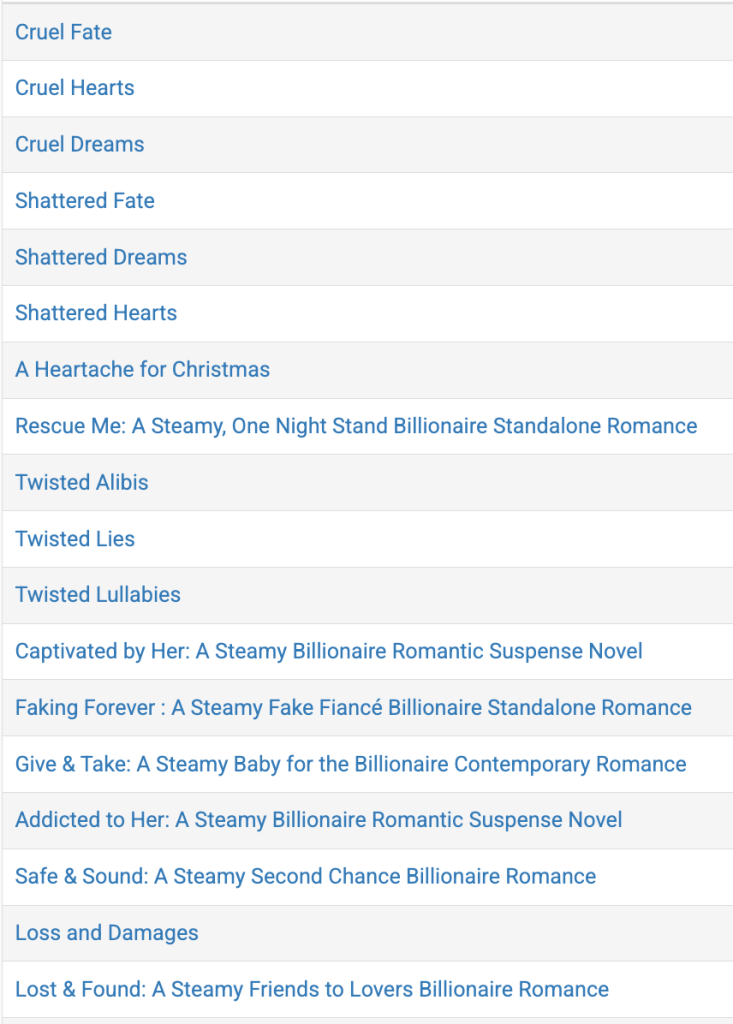
I keep saying it’s fine, and it is–or it must be because I keep doing it. I sold 184 books, gave away 4,419 (though that number will rise because I’m in the middle of a Stuff Your Kindle Day), and had 304,169 pages read in Kindle Unlimited. I’ll keep doing what I do because I love seeing people read my books. Last year I gave you a list of my books in order of how well they sold. I’m really grateful that my King’s Crossing serial is at the top of the list this year. I put so much time and effort into those books, it’s really nice to see that people are reading from beginning to end. This is a screenshot from Book Report which is a Chrome extension:
Website/Blog Stats
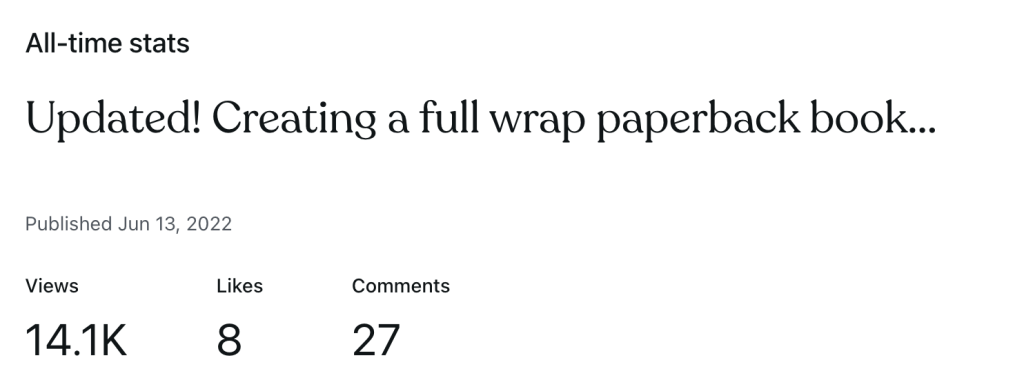
My Canva tutorial on how to make a full paperback book cover is still the most popular blog post on my website by far. Earlier this year I updated it to reflect Canva’s glow-up and I chose a different book because I didn’t end up using the cover I demonstrated with.
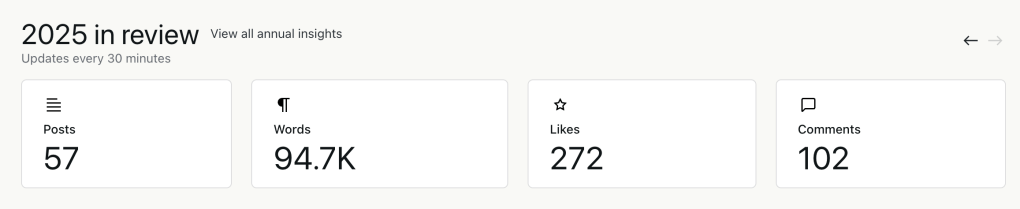
I posted 57 times for a total of 94.7k words.
It’s crazy to think that I blogged enough to fill a whole book. I really don’t have much to say about my blog accept that I still enjoy doing it and it’s easier now that I’m feeling better. For a while I was treating my blog as more of a diary, but after I finally figured out everything that was wrong and made changes. I started writing more about what was going on in the indie community rather than how my mental health was making me feel about writing. I’m back on track and saving personal updates for maybe once a month or so and focusing on indie news and scandals and my thoughts about all of it instead.
I gained 27 subscribers this year, which I’m thankful for. I still get anywhere from 50-100 visits/views a day, mostly on my Canva tutorial, but my IngramSpark tutorial is a close second and also people still like to read about my thoughts on K. C. Crowne. From what I can gather from my stats. indies are searching for instructions on how to do things and also for information that’s based on fact. I see so much misinformation online, and I’m happy to share my experiences and what worked for me.
I paid my renewal fees up until 2027 for both sites so I don’t plan on going anywhere. I like writing about the industry and where I think publishing is going. Sharing keeps me in the loop and it’s always good business to know what’s going on even if you don’t think it concerns you.
I’ll try to find more authors to give interviews and write guest posts in 2026 since people seem to enjoy them. A. K. Ritchie was a particular favorite, and I’m glad I reached out to her when I saw her response to a particular post on Threads. I’m excited to keep blogging, so if you haven’t subscribed, you should. I blog every Monday and some Thursdays if I have extra thoughts to share. I am a writer, after all.
Health Update
I’m okay, better than I have been since all that dryer sheet nonsense started five years ago. This year I stopped drinking our tap water, and that made a big difference. I used to be able to drink it without a problem but I guess my body started being sensitive to the chemicals in it. I’m not on any medication now except the skin cream for the lichen sclerosis that I’ll have for the rest of my life and my vitamins and magnesium. I have nerve damage and scar tissue from my hysterectomy, but on good days I barely feel it. I would still like to lose a bit of weight, but with my job the way it is, I have to be really choosy with what I do with my free time and that will probably always be writing or napping because every once in a while I need to catch up on my sleep. This will probably be my last health update. Nothing health-wise is impacting my writing anymore. Now that my physical stuff is under control, my anxiety has gone away. I can think about my book business with a clear mind and accept that a lot of my success, or lack of, isn’t in my control. So, while I’m not perfect, I’m better than I was at this time last year, and every day is a step toward feeling even better.
What’s next for 2026?
What’s next for next year? More of the same, only with a more relaxed attitude. I’m going to have fun and dedicate all of 2026 to my hockey duet. They might take a little while to get done since they’re going to be long and emotionally heavy. Not to mention all the world-building I’ll have to do from scratch such as player and team names and cities. I’ll publish Wicked Games in May and Bitter Love sometime after that but I don’t know when. Either at the end of 2026 or just wait until the beginning of 2027. I need to pace myself so there aren’t gaps between books. Even if that means I publish just one book a year I’d rather do that and be consistent than publish right when a book is finished and then not know when I’ll publish next. I also want to re-edit my Cedar Hill duet, so I’ll be doing that as soon as Wicked Games is ready to go. I already made them new covers, and they look amazing! I’m really excited to blow the dust off them.
As far as my personal life, things are good. With my kids’ help I have money for bills, and my sister, daughter, and I are planning a vacation to Florida sometime in the summer. I haven’t been there for many, many years and we’d like to visit our mother’s grave. I miss the ocean, too. I’m grateful I’m feeling good enough to want to go and my daughter is looking forward to it since she’s only flown twice and the first time she was too young to remember.
We can always want more, and I did, for a long time. More sales, better health. I’m finding that sweet spot where I don’t need more anymore. After the five years I’ve had health-wise I’m so grateful and thankful for where I am now, and it’s the same with my sales. I’m so grateful for everyone who reads my books, and even if that’s only one person a day, that’s one person who saw my cover, read my blurb, and gave my book a chance. That’s all any author can really hope for, and I hope my damaged heroes and courageous heroines keep them coming back.
I don’t have a word for next year nor am I going to share any motivational quotes. Do what you can to be happy. Keep a flicker of hope alive. Don’t let things that are out of your control get you down. Keep the people close who want to be there and walk away from those who don’t. They aren’t worth your time. People will come and people will go, but always remember your worth. It’s always going to be more than you think it is.
This is an age-old question: How much does it cost an author to write and publish a book? This comes up a lot because after the book is finished, edited, formatted, the cover made and blurb written, paying for book set up on a distribution site then paying them for said distribution, authors would like their money back.
But, unfortunately, that isn’t so simple.
Before I started writing, I used to run. I’m not sure how I even started, but it got to the point where I was running six or so miles a day, five or six days a week. Running, though while considered free (much like writing), is anything but. I developed tendonitis in my left ankle, and this required buying new shoes every three to four months. I had to buy Brooks Adrenaline, and they were at least $120.00 a pair at the local running store–I shopped a local, small business store. Then all the running clothes, Garmin watches, race fees, gym membership fees to run in the winter if the temperatures and snow were bad, and protein bars, shakes, and other health food, I was spending just as much or even more to run as I do right now running my book business (pun not intended).
Then we have to factor in time. At my peak, I could run six miles in an hour. I never really got better than that, and that was fine. Having a new personal record (PR) was fun, but nothing I worked toward. After that hour or so of running, I had to cool down, stretch, then shower. And sometimes I would go longer than six miles, especially in the last year or two when I trained for a half-marathon. When you’re not very fast, running ten or eleven miles takes a long time. While my kids were in school and I did the longer runs on my days off, running could easily eat up most of my morning.
I mentioned all that because I wanted to give you a real life example of why I understand, and not only understand, but I’m okay with, spending money on my book business. I spend a lot that could be considered a “waste.” Two websites, paying for things like a Red Feather promotion on a standalone book (no read-through, you see), paying the Goodreads fee for their giveaways, a business email even though I don’t run a newsletter anymore, author copies and postage for reviewers who prefer paper, Bookfunnel for distribution of my reader magnet and ARCs. When I started writing instead of running, all my running money kind of shifted into this new hobby, and I didn’t think much of it at all. It was just something I had to do. New shoes to stay healthy, check. Websites to look legit, check.
But, writing costs more than just what it does to your wallet, and that’s mostly what I wanted to talk about. There’s an old adage that says, “If you don’t spend money, you’ll spend time,” and that’s especially true in indie publishing. On top of everything I listed above, indies pay for a lot of things, and if they don’t pay, they have to learn how to do those things themselves. There are free tools to format your book, like Reedsy and Draft to Digital, but there’s a learning curve to get familiar with even the simplest software. Then you have to learn a different kind of software like Canva or Bookbrush to make graphics for marketing.
Posting those graphics isn’t easy, either. Learning the algorithms of a platform takes a lot of trial and error. Not all social media platforms are the same, and their audiences respond to different content. Some authors cross-post which can work, but not often. I’ve never been a big fan of cross-posting, mostly for that reason. So we have to learn all the quirks of each platform so our posts are seen by at least some people. Then we have to learn ad platforms and those are changing all the time. Just when you think you have things figured out, they change the way you have to put an ad together and it can eat up hours of your time relearning where everything is.
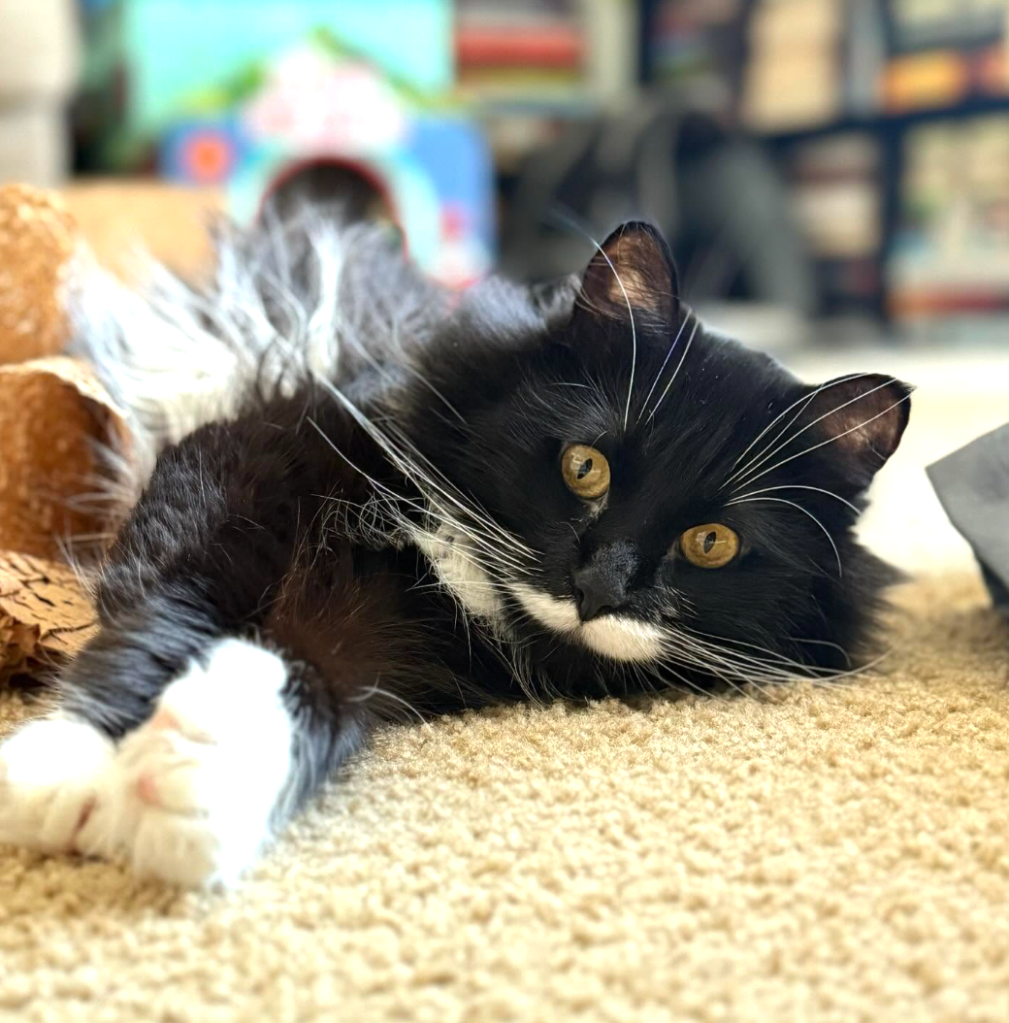
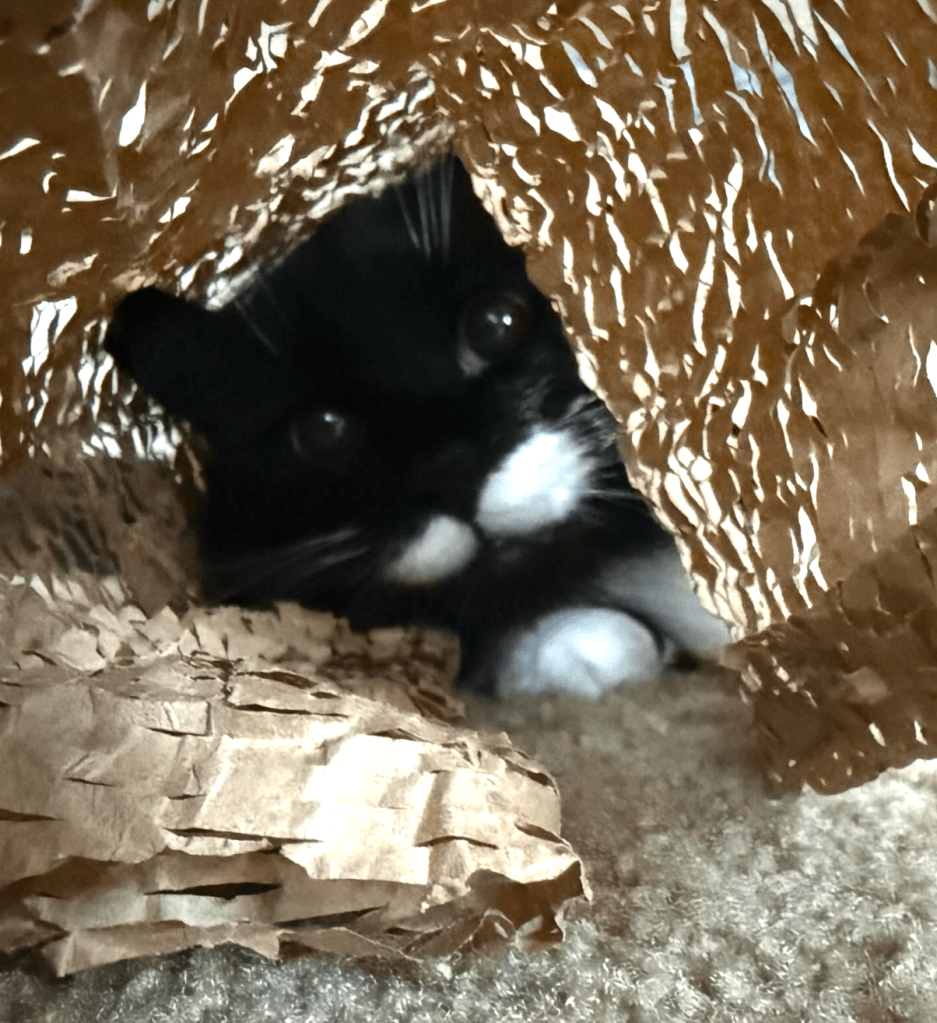
When we spend time writing, learning craft, being a good literary citizen by helping others, reading in your genre, and marketing, we are not doing other things like spending time with family and friends, chores, errands, taking the dog for a walk or playing with your cat. There’s an emotional trade-off happening, and it can make you feel guilty when you want to work on your book but you’re pulled in the opposite direction. Lately I’ve been a victim of this. Our cat Pim, who has been with us since June, knows I’m a sucker. When I’m trying to write, she’ll come into the bedroom, sit near the bed, and stare at me. She’ll stare at me until I get up, go in the living room, and play with her. Her favorite thing is chasing after a crumpled up piece of notebook paper. Sometimes she’ll bring it back in a cute little game of fetch. Her previous owner didn’t tell us she liked to play this game–he might not even have known–I figured it out because I took the time to get to know her. So, she definitely knows that if she stares long enough, she’ll get me off my butt. But, that’s a half an hour or forty-five minutes I could have been writing.
Here she is for the cat tax:
This past year I’ve been trying to let go of the urgency I feel when I’ve spent too much time away from writing, and it’s been happening more and with changes at my work. My writing time has been cut in half, but my personal obligations have stayed the same and so there’s a push/pull that happens when I want to write but want to do other things too, like play with Pim, go to a movie, or go for lunch with my daughter. Over time this can create an emotional toll that we don’t even realize is there.
So, when we talk about how much it costs to write and publish a book, there are hidden expenses we pay that can’t always be calculated.
But the same holds true for “getting our money back.”
Here are some of the things I’ve gained since I started writing ten years ago:
The skills you learn along the way There’s no denying that even with my BA in English, my writing and editing skills have significantly improved. I’ve read quite a few self-editing books since I started my indie journey, edited for friends, and of course, written millions of words. There’s no way I could have gotten ROI like that without actually doing the work. I’ve developed an eye and can make passable, if not decent, book covers. I’m getting better at writing ad copy (thanks for nothing, TikTok!). All those things add up to valuable ROI, and I know this because without my time in the indie trenches, my resume would look pretty bleak.
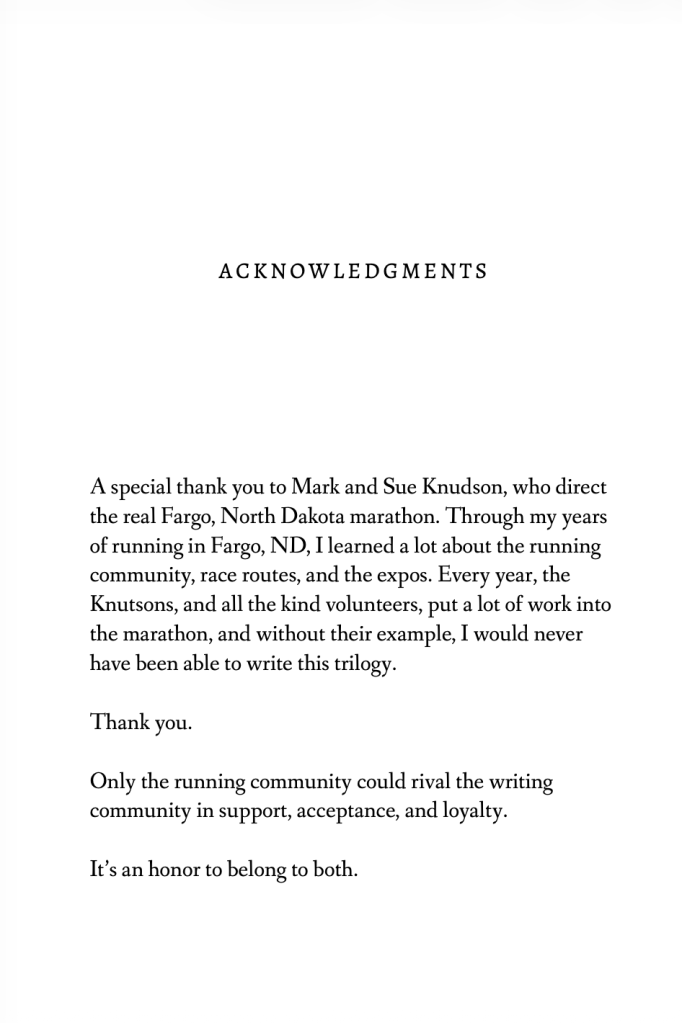
Being part of a community I know I’ve bemoaned the state of the indie community–it seems like deteriorated along with Twitter after Musk bought it. But I know that my opinion is valued because I get thousands of hits on my blog every year. I’ve made friends and connections these past ten years, even if more people have fallen out of my orbit than have come into it. Runners, as well, have a strong community, and when I was still running but had started writing, I was in both and that was the best feeling in the world. In fact, I thanked both communities in my acknowledgments in the last book of my running trilogy, Running Scared. In that book, my MMC isn’t part of the running community but he falls in love with a hardcore runner who is hired to be the city’s university running coach.
I miss being a part of the running community, but being an indie is very rewarding too.
Emotional Satisfaction In running circles there’s a saying, “You only regret the runs you didn’t take.” I don’t think that can be so easily applied to writing, but I know that if I have time to write and don’t, it’s the same guilt factor. There’s an emotional satisfaction to lacing up, just like there is when you sit down, stay off socials, and use an hour to put 1,000 words down. I know for me and most other authors there’s nothing better than opening up that envelope and holding a proof of your book baby in your hands. You worked hard in more ways than one to get to that point in time, and you should always be proud of yourself.
Long-term Impact Two years ago, the director of the Fargo, ND marathon, Mark Knudson, whom I mentioned in my acknowledgements above, died when he lost control of his bicycle and was hit by a truck. The running community was devastated. He had put so much time into getting the Fargo Marathon off the ground, and for his life and contribution to be so suddenly ended was traumatic for everyone who knew him.
The longer you’re in the writing community, the more impactful that time is, even if it doesn’t feel like it. The time you spend blogging, helping other indies, and of course, the books you write, all contribute to a lasting legacy.
Writing and publishing a book has concrete, evident costs, money and time, and also hidden ones like hits to your mental health, lost time with family and friends, and choosing to write rather than do something else you also enjoy like watching TV. But there are more rewards than just sales and KU page reads.
So, when we’re asked, “What’s the cost of writing a book?” The cost is higher than most of us imagine, but the rewards, like skills, connections, creative satisfaction, and legacy, are far richer than anything you could ever report to your accountant.
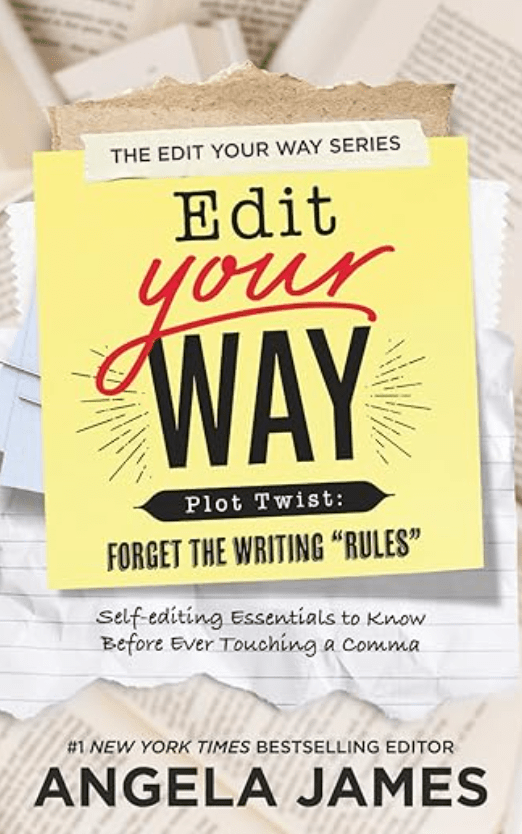
I only have a couple weeks of my “Favorite Things” segment left, and this week I’m highlighting a new self-editing book by Angela James. I love a good editing book, and I cannot wait to dig in. This is her bio on her website:
Hi, I’m Angela James. I’m a #1New York Times bestselling indie editor and author career coach with over two decades in publishing. I help authors write better books and build sustainable, satisfying careers—on their own terms. Whether you’re indie, trad, or hybrid, I meet you where you are and help you get where you want to go, using clear editorial feedback, coaching, and frameworks that support both your storytelling and your career growth.
Together, we create stories that connect with readers, and an author business that works for you.
Edit Your Way: (Plot Twist: Forget the Writing “Rules”) is available from your favorite retailers (AKA, wide). Here’s the Amazon link and book cover: https://www.amazon.com/dp/B0G63FR1Q8 (This is not an affiliate link.)
That’s all I have for this week. Next week I’ll do an author update and the week after that, my year-end recap. It’s hard to believe this year is almost over, but the timing for the other two blog posts works out perfectly.
I hope the holiday season (and all the cold temperatures!) haven’t been too hard on you. Have a good week and I will see you next Monday!
Hello, hello! We are nearing the end of November, and US Thanksgiving is this week! I have everything I need except potatoes, and I’ll grab them during my usual grocery run on Wednesday. When my schedule at work changed, I had no idea how much I depended on my routine and I probably will always have to grapple with when I can get stuff done while still trying to write as much as I can. Anyway, some weeks are better than others, but that’s life in general, and despite those changes, things are okay.
WIP Update Even though my writing time being severely cut, I’m still making great progress on Bitter Love. I’m 59,000 words into it and I am so happy with the progress I’ve made this month. I joined ProWritingAid’s Novel November, but I haven’t been keeping track of how many words I’ve written so far. My only goal was to get this book done by the end of the year, and I think I can do that. I have the last third of the book plotted out, which is the hard part, in my opinion, so writing the rest should be easy enough. I was going to jump into my hockey duet, but I’m going to put that on the back burner again, and in January re-edit and re-cover my Cedar Hill duet. That will take me a month or so, and then when I’m done with that, I’ll get Wicked Games ready to go for a May release. (I already announced it so I don’t want to lie to the few people who were listening.) I’m struggling with whether or not to do ARCs considering that my attempts in the past have had lackluster results. People take but don’t review, so there’s really no point in handing them out. I canceled my BookSprout subscription because the quality just wasn’t there for the price I was paying. I listed some other alternatives in a previous blog post, so I might try something new, if just as an experiment so I can blog about it later.
Then once Wicked Games is off my plate, I have a cute story idea about a woman who inherits a bakery she doesn’t want and a billionaire who wants to buy it. She can’t sell because of some stipulations in her grandma’s will, and he can’t work around them because of his own obligations. With some of the dialogue that’s already going through my head, it might be more romcom, if I can find my funny bone, and the characters already have names which means I will definitely be writing them in 2026.
So my plan is: *Finish Bitter Love *Revamp my Cedar Hill duet *Get Wicked Games ready to release in May 2026 *Write One Tough Cookie *Jump back to Bitter Love to get that ready for release maybe at the beginning of 2027 or the end of 2026, whichever works out
It’s nice to have so many plans and an idea of what I’ll be doing for the next little while, but it also makes me kind of sad too. I’m not doing this for anyone but me, which, I know, that should be the only reason a writer does anything–for themselves first–but it can be disheartening after a while and it doesn’t seem like there’s much I can do to fix it.
Deleting TikTok I mentioned in a previous blog post that I was having fun with a reader account on TikTok, and I was even getting a few views above the 200 view dungeon a lot of people seem to get stuck in. Then they started suppressing my carousels and labeling them as AI. This ticked me off for two reasons: one, they weren’t AI. I used stock photos from DepositPhotos (that were not AI) and two, there actually is a lot of AI on TikTok they aren’t flagging and the hypocrisy drives me insane. So, I deleted my accounts. Both my reader one and my personal one I started a long time ago.
The hit to my mental health was just too much and I don’t have the bandwidth to put up with it. It’s too bad because I was getting into a groove posting, and doing slides is a great way to learn how to pull hooks out of your books and write ad copy. But maybe I’ll just try to post more on Instagram. I barely post there and even though Facebook keeps telling me that my author page is getting views, I haven’t posted there in three weeks. I saved all my carousels in my Canva account, and turning them into Reels would be easy enough, but I’m not sure if I really care that much to do the work. Posting on social media is something I struggle with anyway, though I do like talking about my books to the handful of people who see my posts.
Black Friday Promo I wasn’t sure if I was going to buy a promo for any of my books this holiday season, but I went ahead and bought a promo in the Red Feather Romance Books newsletter and set my Christmas novel to free for three days around Black Friday. I’m not sure what else I’m going to do, if anything, because while I think giving away books can be beneficial if you have a plan, I have no plan, and don’t really care either way about giving books away. Mostly, all I think it does is create high hopes that it will finally do something and then it never happens. Chances are 100% I won’t make back the $135.00 I spent on their fee, but I’m really proud of the changes I made to the book when I re-edited it a couple months ago, so I wanted to give it another push. But A Heartache for Christmas is getting old, so maybe one day I’ll write another Christmas novel, if I can think of a plot.
The Future of this Blog(It’s good!) I had to renew my plan for this website, and they gave me a discount if I paid for two years instead of one, so I’m locked into this website and blog until the end of 2027. I suppose that was kind of optimistic, though I have no plans to go anywhere. I enjoy blogging very much, and having all my things in one place has been nice. I get why people write on Substack, but having a WordPress plan isn’t very expensive and having a main hub where readers can find you is less confusing for everyone. Granted, blogging on my author site isn’t the same as having a true newsletter, and even though I regret not having one, I still don’t think I’ll ever try that again. My author website is also locked in until March of 2026 and that auto renews every two years as well. I pay $156.00 for those two years and I think that is a decent price for a site that only has about 100 visitors a month.
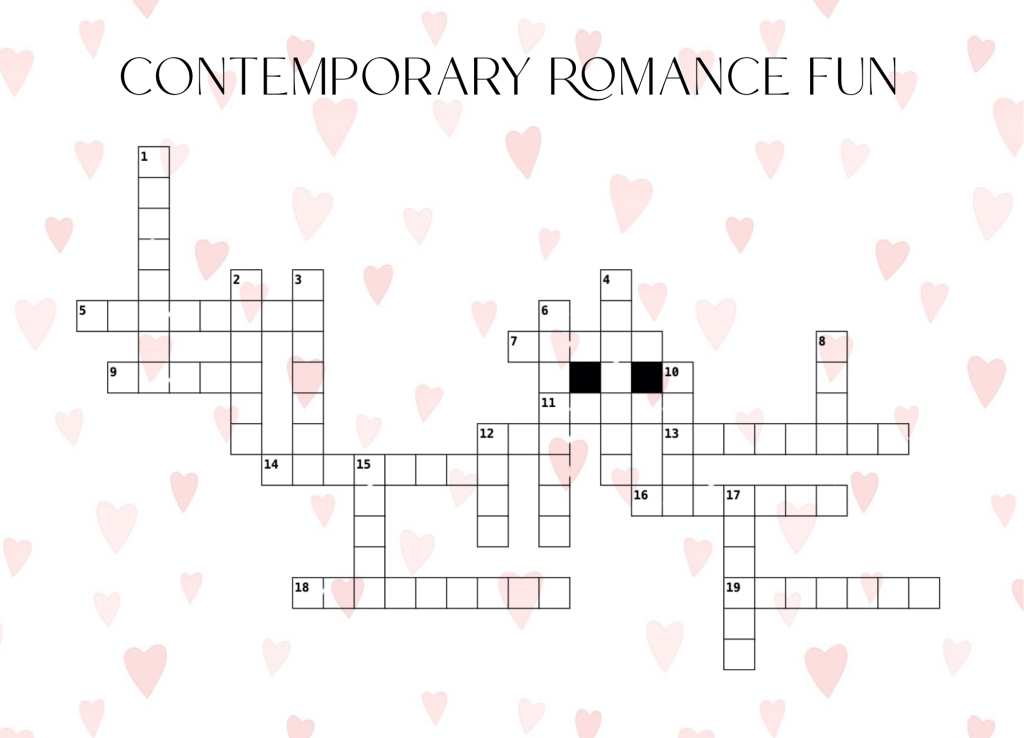
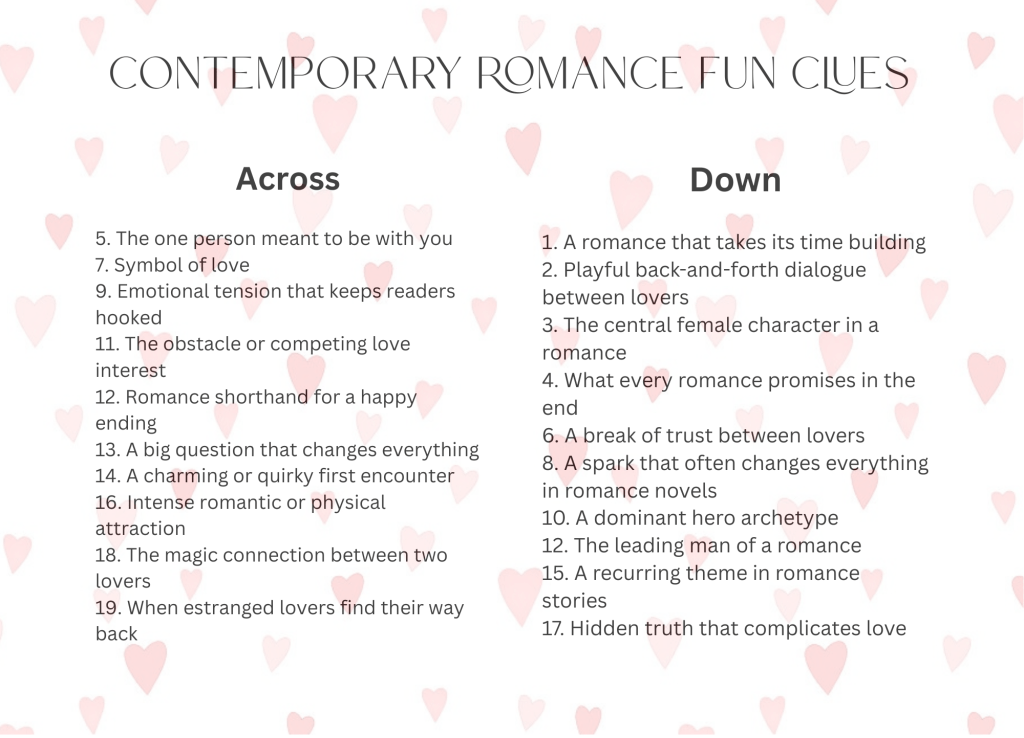
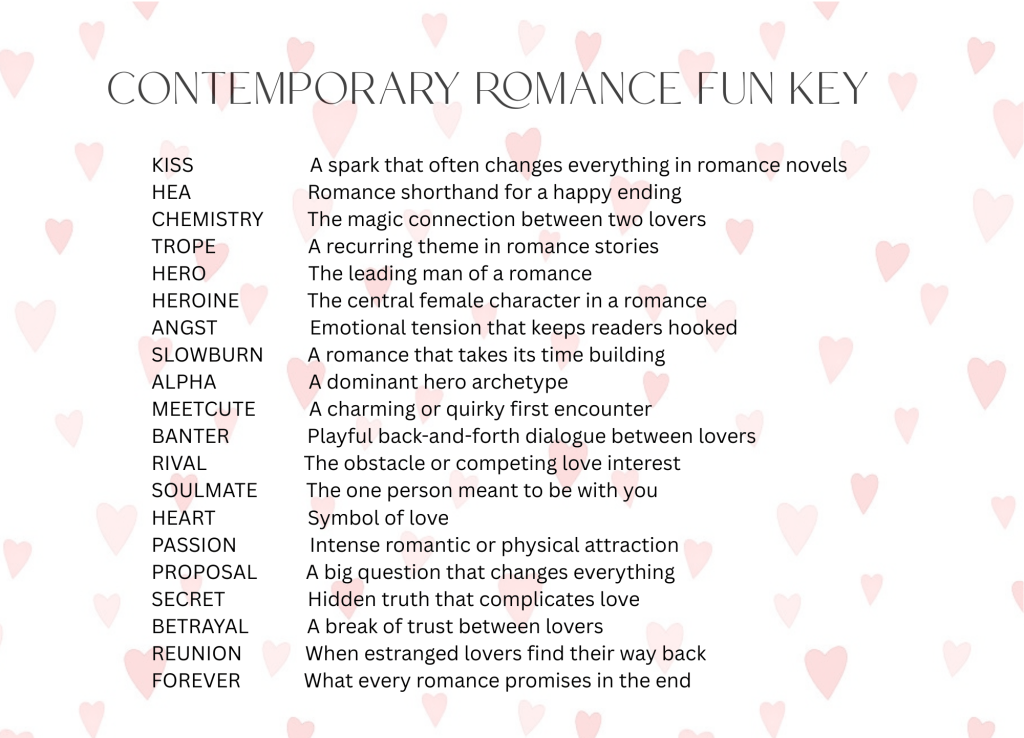
That’s about all I have for this week. As part of my “Favorite Things” section of my blog I have going until Christmas, I want to tell you about this free crossword puzzle maker that I used to make a romance crossword for my Facebook author page. You make up the questions and answers, and the website spits out the puzzle. It’s fun, and you can find it here: https://crosswordlabs.com/
Here’s the one I made with the answers. You can steal it if you want. I don’t mind.
I saw a post on Threads a few days ago accusing authors of gatekeeping information, namely how to sell books, and lots of them. Needless to say, she got reprimanded in the comments because most authors are nothing but transparent when it comes to what worked and didn’t work for them.
I’m not sure what they were looking for, most of that information is common knowledge. Write a good book and publish it with a good cover, title, and blurb that meet genre and reader expectations, and do that over and over again, forever. I think the problem comes from authors who have done that and haven’t gotten anywhere. They think there’s special information out there and successful authors are keeping it to themselves. I understand the frustration, being in the predicament situation I’m in, but the longer you’re in this business, the more you realize that there is no magic bullet that will ensure your success.
That got me thinking about the “real” gatekeepers out there, and I mean in indie publishing, not so much traditional because we all know those are agents and editors who acquire the books. We like to think there are no gatekeepers in indie publishing, but, unfortunately, there are. You can tell me if you agree with me or not.
What kind of gatekeeping am I talking about? Let’s explore.
Money–the obvious but unspoken gatekeeper We don’t think much about the money part of indie publishing because in all actuality, you can publish without it. Edit yourself or trade if you can find someone willing, do your own cover in Canva, format using a free tool like Draft2Digital’s software, take the free ISBN from Amazon, and you’re all set. It sounds easy, and plenty of authors publish this way. But the hard reality is, a lot of people aren’t willing to trade services anymore, preferring to get paid for giving their time, and a lot of authors can’t edit on their own or have the skills to create a good cover. You can format yourself, but you can say goodbye to fancy chapter headers and forced edges.
Money also enables you to buy ads and promos, what you need to start a newsletter and have an author website, and other resources like nonfiction resource books and classes.
There are a lot of free things out there, but free will only get you so far until eventually you’ll run into a dead end. After a while your books and author platform won’t be able to compete with authors who can invest in their business.
Time–money’s invisible twin Anyone who says we all have the same twenty-four hours in a day can fuck right off. If you have a full-time job, take care of littles, have a spouse, run errands, do chores, wrangle a pet, and try to write on top of it, you know how difficult it is to get the words down and the books published. I’ve said on this blog many times that if you can’t pay with money, you’ll pay with time, and that’s something you can’t get around.
If you can’t pay for an editor, you have to teach yourself. If you can’t buy a premade book cover or hire a designer, you have to teach yourself how to make one–at least enough to get a handle on the basics (a good font and stock photo can go a long way). If you can’t hire a formatter, you have to learn how to do it yourself, and Draft2Digital’s free software is the easiest I’ve found to use.
Then there’s the marketing: constantly creating graphics and writing ad copy to go with them, networking, engaging with readers. Writing newsletters or blog posts. Writing a reader magnet and bonus material. A lot of that will fall to the wayside if your time is limited because it’s more important to get that book written. Lucky are the few who have the time to write and market while doing the thousand other things that make up a life.
Time is a powerful gatekeeper, and to the people who write during naptimes and after your kids have gone to bed, I see you.
Access–who you know and where you exist online Networking used to mean meeting connections in your MFA program. Now it means joining Facebook groups where authors in your genre hang out, joining author chats and Discord groups. It means knowing authors who write in your genre not only to be invited into promotional opportunities like newsletters swaps and anthologies, but because authors really are willing to share what works for them, and you never know if just one tiny tweak to an ad or a change to your back matter will be what lifts your business to the next level.
It’s not about trying to bust your way into established cliques–it’s about having access to information that could boost you up. Here’s a funny story, or actually, not so funny (it’s rather pathetic, if you want to be honest). I’m a romance author and have been publishing romance for around ten years. When I first started out, I networked with indie authors, not necessarily romance indie authors, and I missed out on some big connections. I kind of knew who Zoe York was, but didn’t really get to know her or other romance authors of her caliber until I joined a romance marketing chat on Clubhouse, that, incidentally, I only learned about by being in the connected Facebook group. Zoe runs a huge book blast promo group, and I didn’t know about it for eight years. I’ve tried to make myself feel better by telling myself I just wasn’t ready to know, and maybe that’s true, but it’s a sad testament that I wasn’t networking and meeting the right people. Even if I wasn’t ready to participate, I should have at least known about it.
Not everyone has time to hang out in Facebook groups or participate in chats, and some people don’t feel comfortable joining groups or talking to people they don’t know. I used to be a lot more involved, but I don’t have the time anymore to answer questions or give feedback. It’s tough, and like any other professional industry, a lot of success can boil down to who you know and the opportunities they bring with them.
Overall, authors with the right connections learn faster what’s working, which platforms are paying off, and how to pivot. Without those connections, you’ll always feel behind, and chances are, you probably will be.
Luck and Timing–the chaos gatekeepers Unfortunately, luck and timing are two things that you can try your best to control, but you never will. You can go crazy with it, trying to go viral on TikTok or publishing your book on a certain day of the week. Bad timing can pop up when you least expect it, like inadvertently releasing the same day as a bigger author in your genre, or as a lot of authors who released in 2020 found out, during the start of a world-wide pandemic. Or, as I found when I launched one of my books in my King’s Crossing series, on the inauguration day of a president nobody wanted.
It’s uncomfortable to admit, but luck and timing can have just as much weight as skill, strategy, networking, or money. They aren’t predictable. They aren’t earned, which is why so many authors get bitter when someone they don’t consider “worthy” gets all the attention. And, unfortunately, someone else’s luck or good timing can’t be replicated, not even by the person experiencing it.
You can position yourself to take advantage of luck if it eventually comes your way, but you can’t force it to show up. This is one of the hardest parts of the industry because it means success isn’t guaranteed to those who work harder than others. Hard work raises the odds of success, but it doesn’t promise a payoff. As far as timing goes, sometimes you completely miss your window (like when a reporter for the New York Times wanted to talk to me about one of my blog posts and she emailed an email address I don’t check but stupidly had in my contact information). Sometimes you never get a window that opens–it’s always glued shut. And sometimes the window flings open wide when you least expect it and you happily jump through, much to the envy of those around you.
Emotional endurance–the gatekeeper everyone talks about but there are only so many spoons to go around The ability to keep going after you’ve done everything right and have still fallen short of your expectations might be the biggest gatekeeper of all. I’ve been around for ten years, which can seem like a long time to those who are just publishing their first novel, yet, I know people who have been around for double that time. They were around when the Kindle Goldrush was a thing, and are still writing and publishing books. But I would guess for every one person who was around then and are still going strong, a hundred authors have quit and disappeared.
I used to be a hardcore cheerleader of Team Endurance, spouting nonsense like “A quitter never wins and a winner never quits” and “The harder I work, the luckier I am.” Actually, I think Christian Grey said that one first, but you know what I mean. These days I’m still in the game, and not just dipping my toes in indie waters. I constantly dive in, writing books, keeping up a publishing schedule, and trying to remain at least somewhat visible online. I’m proud of that, though sometimes it does wear me out. Not because of the work itself, but because it produces so few results. “Write what you love and you’ll find readers who love it too” isn’t true. “Write for yourself” is the only saying that I can fully get behind these days because with the industry how it is, you might be the only one reading it.
“Publishing is a marathon not a sprint” is another pithy saying, but I stopped running for the same reasons I’m facing this wall in indie publishing. I ran a half marathon in 2015. It’s one of my biggest achievements. But no one was there to congratulate me at the finish line. I drove home, took a shower, and went to work.
And I never raced again.
I still write, and with all the plots in my head and characters banging around begging me to let them out, I have no plans to stop. But I no longer “Live to write,” another line I used to say that makes my stomach churn now. Maybe one day I won’t have any more stories to share, but unless that happens I’ll keep going. Not because of endurance, but for the simple fact writing is a part of me and has been all my life. At this point, it would be harder to let it go than to keep going, and maybe that’s true for you too.
Privilege–the gatekeeper no one wants to admit is there The publishing industry is a white man’s world, and it would be remiss of me if I didn’t include privilege in this list of hidden gatekeepers, though if you’re a marginalized author, this particular gatekeeper isn’t so hidden. It’s something you have to fight against every day. Marginalized authors aren’t the only ones who deal with the lack of privilege in the industry. Disability, economic background, sexuality, geography, language, and education all play a role in how accessible publishing is. And not just indie publishing, but the entire writing and publishing industry.
A white, cis-het author like me doesn’t have to worry about certain biases, like how my name and author photo will be judged, whether my characters will be considered “marketable” or not, if a cover featuring people who look like me will get beaten down by social media (algorithms, bots, and keyboard warriors alike), or whether agents/editors/ARC reviewers will dismiss my work before they even read the first page. Authors who belong to marginalized groups face barriers I can’t even imagine, and pretending that everyone is on the same playing field only encourages the problem.
Privilege shows up in smaller ways that, as a white author, you might not have thought about: * Who feels welcome in author groups * Who gets boosted by influencers without asking * Who agents assume is “commercial” * Who feels safe being visible online
What can you do to fight against this? Read widely, boost up your fellow authors any way you can, be friendly and welcoming to everyone you meet, online and at author events, and acknowledge that some authors have more stacked against them than you realize.
Authors aren’t gatekeeping other authors. It’s just a sad fact that no two authors are alike and we’re all trying to do the best we can with what we have. If there is ever anything I can help you with, be it resources, a question about publishing or marketing, or if you have an issue and you can’t find a clear solution, email me. I’ll always do what I can. There’s enough holding us back.
I’m sorry this post is so long! My biggest thank yous to those who made it to the end! Or maybe by now you’re used to me being long-winded, haha.
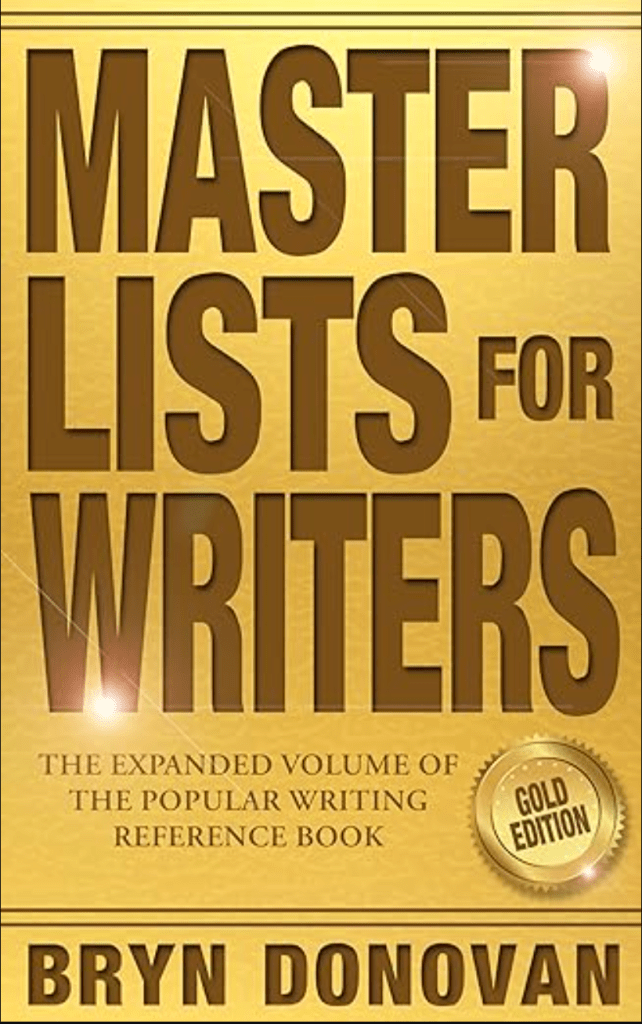
My last little bit is my “Favorite Things” section that I’m adding to the end of every blog post until Christmas, and this week’s favorite thing is Master Lists for Writers, Gold Edition, by Bryn Donovan. This book of lists is amazing and covers everything from facial expressions to settings. I have the first edition she published back in 2015, and I was so excited when I saw on Instagram she wrote an updated version. (Kind of validates that social media can sell books….noooooo! LOL)
You all know i have a terrible fear of missing out, and it was triggered this week by the announcement that Flodesk, the newsletter aggregator, is going to stop their unlimited pricing structure at the end of the month and you need to lock in that plan before it goes away. This shouldn’t concern me because for one, I don’t have a newsletter anymore, I blog on my author site, and two, I probably will never have the number of signups that would require the need for an unlimited pricing plan.
This ad popped up in my Instagram feed
But that didn’t stop the “what ifs” from running through my mind. What if I ever wanted to start up a newsletter again? What if I pushed my business to the next level and I needed that unlimited plan? WHAT IF I’M MISSING OUT ON THE BEST DEAL OF MY LIFE?
Cue the panic, right?
But this made me stop and think about where my business is and where it’s going. As of right now, I don’t have a book business. While I have money going out and money coming in, I have more money going out and I consider operating in the red more of a hobby than anything else. That reminded me I probably shouldn’t take on any more services that would dig my financial hole even deeper than it already is. Because if I paid for Flodesk, I would have to pay Bookfunnel for integration because I wouldn’t stop giving my reader magnet away. I already did that once with MailerLite, and while I did build up my newsletter to close to 1,000 subscribers back when I was trying, that is just more money than I want to spend for where I’m at and where I’m going.
So far, I’ve been able to eke time out in the week to keep this blog afloat, and surprisingly, it’s been easier than I thought. I do have a little free time on the days I work, but it’s not conducive to fiction writing, so I’ve been able to blog and make carousels for my secret TikTok account. That’s been a huge relief because when my work did all that changing up, I was really worried about having to cut back on this blog. I enjoy writing it and it gives me a place to put my thoughts about what’s going on in the industry and where I am in my indie life. So, unless work decides to mix things up again, or cut me loose all together, I think I can confidently say that I can keep writing my blog posts every Monday.
I have lost a lot of writing time though, and adding a “real” newsletter when my publishing schedule is taking a hit doesn’t make much sense–especially since I already pay for my WordPress website–so I might as well use it, even if it doesn’t have the same functionality as a newsletter aggregator. That doesn’t mean that from now until November 28th every time I see that ad I won’t think I’m making a huge mistake not signing up. That’s just the way I am. And I’m sure with Black Friday right around the corner there’s going to be more deals and steals I’ll have to say no to because I already have what I need to write and publish books. (I’m looking at you, AppSumo DepositPhoto sale when I already have 358 downloads available.)
I signed up for ProWritingAid’s Novel November, but I’m behind, or at least, I think I am. I’m not keeping track of the words I’ve written so far, but I’m 46k into Bitter Love, and if I can keep up the pace, I should be able to finish by the end of the year like I want. I’m at the point now where I go back and read from the beginning so I’ll be taking a couple days to do that, fix any plot points that got lost as the story developed and make sure the ending’s on track. I’ll have to add slow-burn to the list of tropes because this story needed so much setup, but a lot of secrets had to come out so hopefully even if the characters take their time hopping into bed it’s not boring or slow.
Besides that, I really don’t have much else. November is always kind of busy with my daughter’s birthday, Thanksgiving, and my birthday rounding out the month, but I’m not doing anything this year (I turned 50 on Thanksgiving Day last year and I think all that excitement will hold me over for a couple of years). I lucked out with my work schedule and I have Thanksgiving Day off, so that’s a nice break, and my daughter is still deciding where she wants to eat her birthday dinner.
Overall, things are okay, nothing bad happening, which I’m thankful for. Pim is doing great, but I’m trying to turn her into an internet star and that’s not working out. The last photo I posted of her on Threads only got 82 likes, but I’m probably lucky she got that since I think I post there maybe four times a month and the algorithms have no idea who I am.
But, I started a reader/book profile on TikTok, as opposed to my personal one and that seems to be doing better in terms of views. I didn’t tell anyone about it so I can’t “taint” the algorithms, but I didn’t use a VPN or anything. Just my personal iPhone using a gmail address I don’t use for much else. At least I broke out of the 200 views dungeon for a lot of my carousels, one getting over 3k views, but I haven’t gone viral . . . yet. I’m getting better finding hooks and writing ad copy, and I’m staying away from sex which always got me in trouble on my other profile. So far going for angsty instead of spicy has been serving me well, and now that I’ve slowed down with the writing, I’m making more time to post there. We’ll see how it goes.
I’m starting to think about promos for the holiday season, and I forgot that I have a nice four-book series set in the winter around Christmas I could promote if I wanted to. There’s a big author-driven book blast taking place next month but I don’t think I’ll officially put a book in it. It’s not that I don’t think free books are worth it, because I still think they can be if used strategically, but I’ve kind of given up hoping promos like will build into anything that lasts. So rather than take space from authors who are trying to use the blast to their advantage, I could just put a book or two free and piggy-back off the momentum of the day and see what that does. Or I could pay for something, but I doubt I would make my money back, so I would have go into it know that and being happy that people were just interested enough to download a copy. I’m not sure yet. Books are a dime a dozen, in every way that means, so what I do or don’t do won’t have any effect on me or my book business. It’s just something to do if I feel like it.
My Favorite Things I’m going to end every Monday blog post from here until Christmas with something that I’m liking in the author space, be it a writing resource, tool, or service that I find especially helpful. Today’s feature is the Trope Thesaurus series by Jennifer Hilt. I have the romance trope book, and I have to admit, when I’m feeling down, I get out my copy and flip through it. There are so many tropes out there I haven’t tried and it gets me really excited for all the books I haven’t written yet. There’s one for horror and fantasy/sci-fi and it looks like just a general one as well. Check them out here (this isn’t an affiliate link): https://www.amazon.com/dp/B0BFYR9L4Z
That’s all I have for today. Thanks for reading, and I will see you next week!
Years ago when I saw someone say being an indie author felt like always having homework, I laughed, but I didn’t quite believe it. When I was in school, I hated homework. Back in high school, anyway. College was a little different, and when I went to tech school to get my HR degree, I actually enjoyed homework and group assignments. I suppose age could have played a part in that, because I think as we get older we just naturally appreciate things more and I was grateful to have the resources to go back to school.
Anyway, so when it came to my writing and all the stuff that went along with it, I didn’t compare homework, a seemingly endless, joyless, task, to what I had to do to write, publish, and market my books.
But, when I wrote my blog post for last week, I realized that no matter how much an indie author gets done, there is always going to be more to do, and instead of being excited for the next cover design, formatting job, or editing sweep, it turns into a version of Groundhog Day that we can’t escape. That infinity loop also sucks the joy out of the past accomplishments, and something to be proud of, like a book release or the cover of a book that comes together perfectly, is just an item on the list that needs to be checked off.
When I really thought about why we never feel like we’ve done enough, a few things came to mind.
Because we’re indie: We control everything — writing, editing, marketing, covers, social media — there’s no external validation from a boss or coworker nor is there a stopping point we can work toward. There’s always going to be another social media post to create to keep your profiles from stagnating. There’s always going to be a newsletter to send out. Another ad to create. There’s always a WIP to work on because we all know that writing the next book is the best marketing and front list sells backlist.
Moving the goalpost: We hit one milestone (a release or a finished draft) and immediately reset the net. I think this one is what I was particularly feeling writing my blog post last week. No matter how much I accomplish there will always be more to do. Another goal to score, another game to win.
Comparison culture: We see other authors posting “I just hit 10k sales” or “my preorder is live,” and that fuels the sense we’re behind. This one is particularly triggering for me because I have a terrible fear of missing out. I don’t want other authors to be doing something I could be or should be doing too.
The creative push to keep moving forward: Creatives are wired for “what’s next?” The next book, the next painting, the next drawing. That desire to create makes us prolific, but it can also burn us out. This one I understand 100% because once I start thinking about characters for a new book, they don’t leave me alone until I set them free on the page. I mean, that’s a great place to be in–I never have to worry about writer’s block or what I’m going to write next–but it’s also draining because I don’t let myself properly rest between projects . . . or celebrate something I just achieved.
Lack of (what you consider) success: This one probably hit me the hardest because with all the books I have out, with all the hard work I’ve put into my author career in the past ten years, I don’t have the sales I hoped I would have. So I’m always reaching for that next book, that next social media graphic, that will get me there.
The indie hustle culture: This kind of goes along with comparing yourself to other authors. We see on social media what other authors are doing, but at the same time, there’s an underlying feeling of not doing enough and getting judged for it. You see it on Threads when people start their posts with, “It might not mean much to some . . .” or “It might not be a big deal to a lot of people here but . . .” We are constantly afraid that we’re being judged for our successes and achievements, and while a lot of people will tell you to stop worrying about what others will think because no one is watching you, for as many people who don’t care what you’re doing, there are just as many who do and are judging you. “You’ve only written one book this year?” “You’ve only made fifty dollars this week?” “You don’t post on TikTok? How do you expect to sell books?” “When is the rest of your series coming out?” The hustle culture online is real, you can see evidence of it every day, and it’s just another reason why you can never be happy with what you have because it will never feel like it’s enough. And it will never feel like that so long as someone you see online is doing more than you.
So, what can we do to combat this? It’s a question that I’ve been dealing with since the beginning of 2025 when I came to the conclusion my books would never be a business and that I would never make any meaningful earnings from it.
It was a disappointing and disheartening realization to come to, but it was freeing in some ways. I stopped my Facebook ads. I took time to go into my backlist and re-edit a few titles. I don’t stress about the fact that I have written only one book this year. I don’t let myself feel bad if I don’t feel like writing and would rather watch a show instead. Do the low sales numbers bother me? Sure. I think any author who publishes to a site where readers have to pay wants sales. But I just remind myself there is a lot of content out there and I can’t be, and don’t want to be, everywhere online. Creating content when you don’t feel like it is just as stressful as forcing yourself to write when you’re not in the right headspace.
But, no matter how many times I remind myself to loosen up or brush away those pesky feelings of inadequacy, they always manage to pop up, which is why I wrote my blog post last week to begin with. I needed the reminder that yes, I have accomplished a lot this year, and more than acknowledging it, I should celebrate it. Even if I closed my laptop today, after I schedule this post, and don’t open it again until January first, my 2025 year in review would still rock and it really has nothing to do with how much I’ve made this year and if I managed to break even with all that I’ve had to pay for to keep my hobby afloat.
I wrote a book I’m proud of. Maybe it won’t make me any money, but I wrote it with my whole heart, and I love Seth and Avery. I wrapped up five years’ worth of work when the last of my King’s Crossing serial released, and I doubt I’ll ever write anything like that again. I applied what I learned and re-edited three of my standalone books. I’ve helped hundreds of authors make their own book covers using my Canva instructions. I edited for someone who couldn’t afford to hire out and helped her get that much closer to publishing her next book.
It’s easy to forget even your biggest accomplishments when the to-do list never ends. Give yourself credit for everything you’ve managed to do–this week, this month, this year. Being an indie author really does feel like having homework sometimes, but maybe it’s time we start grading ourselves on how happy we are with what we’re doing, not on our output or the outcome of it.
And stop moving those goalposts. Run past them and don’t look back.