
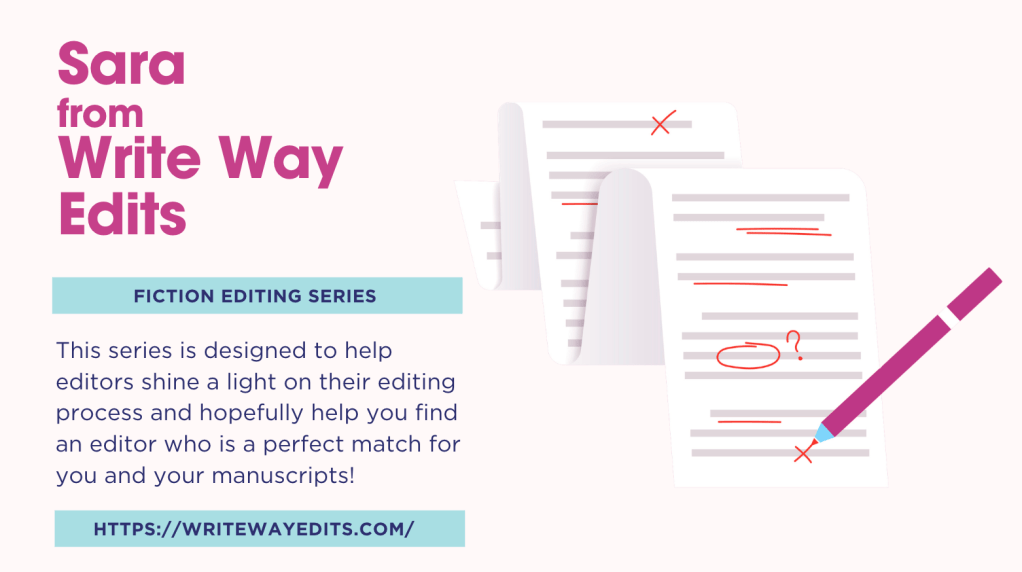
Introduce yourself! How did you get into editing and what are your qualifications? What genres do you enjoy editing most?
Hi! I’m Sara, fiction editor and owner of Write Way Edits. I work with authors at different stages of the editing process—from big-picture developmental feedback through to copyediting and proofreading. I love working with fantasy, romance, soft sci-fi, historical fiction, and women’s fiction—and all the subgenres and spice levels. I’ve also worked with authors writing thrillers and memoirs.
I’ve always loved stories and language and dreamed of working for one of the Big Five publishers. In college, I interned with a professor and helped research and edit a political process textbook. After graduation though, life took me in a different direction and I ended up managing a classic car restoration shop.
Editing still found its way into my life. I volunteered with nonprofits and edited business materials, but eventually felt the pull to officially work with words. In 2019, I applied for UC Berkeley’s Professional Sequence in Editing instead of pursuing a master’s program, and I officially launched Write Way Edits in 2024.
I’m committed to continuing my professional development because editing—like writing—is a craft you keep refining over time. I’ve completed multiple courses through organizations like the Editorial Freelancers Association (EFA) and Club Ed, and I aim to complete one to two professional courses every year.
What is the biggest mistake you see indie writers making right now? (For example, info dumps at the beginning of their book, not enough conflict, too much tell vs. show, etc.)
Honestly, editing and writing are pretty subjective. What one reader loves another reader hates. What one writer excels at another writer struggles with. What one editor prefers another editor avoids.
That said, a common developmental issue I encounter often is a weak opening.
Whether you’re querying or self-publishing, the opening pages are your chance to hook the reader and give them a reason to keep reading. If those early chapters are overloaded with background information or focus more on setting the world than introducing the main character, you risk losing your reader before the story really begins.
Another common issue is when the story problem isn’t introduced early enough. The reader doesn’t need to understand everything right away, but they do need a sense that something is happening and that it matters to the main character.
A strong opening usually gives the reader three things fairly quickly: a character to connect with, a sense of the situation they’re in, and the hint of a problem or tension that will drive the story forward.
How do you keep the author’s voice intact while also guiding them with suggestions on how to make their book the best it can be?
One of the most important rules an editor should be following is to never change an author’s voice.
Author A, Author B, and Author C could all write the same story—a gallant knight on a quest to save the beautiful princess from her evil stepmother—and each version would feel completely different. Our life experiences, education, and writing styles shape how we tell stories: the words we choose, the punctuation we favor, how emotions appear on the page, and where we lean more toward showing or telling.
An editor’s job isn’t to rewrite a story but to strengthen it. Before I make any suggestions, I take a step back to understand my motivation for that particular change. Is it simply my personal preference? Is it rooted in my experience and training, industry standards, or reader clarity? Oftentimes what a reader labels as an error is actually a stylistic choice. A good editor recognizes that and makes sure those choices are intentional and consistent throughout the manuscript.
I also try to explain the reasoning behind my suggestions. When authors understand why and how something might be improved, they can better decide whether that change fits with their vision for the story.
At the end of the day, it’s always the author’s book and the author’s decision.
Is there ever a time when a book requires too much work? What do you tell a writer whose manuscript isn’t ready for a professional edit? What resources do you refer them to?
One of the first things I ask authors is what stage their manuscript is in and whether anyone else has had eyes on it yet—alpha readers, beta readers, critique partners, or another editor.
If a first-time author comes to me requesting a developmental edit on a first draft, I’ll usually recommend they go through a few rounds of self-editing first then get feedback from a few beta readers. That outside perspective can help identify bigger story issues before a professional editor comes in. Sometimes I’ll also read a sample and suggest a few areas the author can focus on in their self-edits.
I’m a big believer in focusing each revision pass on a specific element of the story. For example, one pass might focus on structure and plot. Another might focus on the characters, ensuring their choices make sense and their motivations are clear. A later pass might look at pacing or tension. Breaking revision into smaller goals can make the process much more manageable.
I also try to point authors toward helpful resources whenever I can. Over time I’ve built a collection of articles, craft books, and guides from other editors, writers, and organizations that I’m happy to share.
What advice can you offer an author who can’t afford a professional edit? Are there things they can do to sharpen their own self-editing skills?
Self-editing is super important, even when you’re planning to hire a professional editor.
I’m sure everyone is sick of hearing this, but practice really does make perfect. The more you write, the more you learn—not only about writing but about your own habits, strengths, and patterns as a writer.
Another helpful strategy is stepping away from your manuscript for a period of time before revising. Distance helps you come back to the story with fresher eyes and notice things you might have missed before.
Reading your work aloud is also effective. Whether you read it yourself or use tools like Word’s Read Aloud feature, hearing the text makes it much easier to catch awkward phrasing, pacing issues, and repetitive language.
These are some great craft books that focus specifically on revision: Self-Editing for Fiction Writers by Renni Browne and David King; Intuitive Editing by Tiffany Yates Martin; 5 Editors Tackle the 12 Fatal Flaws of Fiction Writing by C. S. Lakin, Linda S. Clare, Christy Distler, Robin Patchen, and Rachel Starr Thomson.
Have you noticed AI writing tools affecting the manuscripts you edit? What are your thoughts on authors using them in the writing process?
I don’t think generative AI has any place in creative spaces, so the authors I interact and work with are also anti-generative AI. I include a section in my contract that states I reserve the right to refuse to work on a manuscript written with the help of a generative AI tool, and I will never use generative AI in my editing process.
But just because I want nothing to do with generative AI doesn’t mean that there aren’t authors using these tools to aid them in their writing. Some use them for brainstorming ideas or organizing their thoughts. I have mixed feelings about this, honestly. On the one hand, I understand these authors’ arguments for needing something to help them organize the creative jumble in their brains. On the other, scientific studies are proving that a reliance on generative AI tools like ChatGPT is leading to intellectual laziness and a decline in reading comprehension, literacy, and logic skills.
I’ve also seen some authors use ChatGPT in place of beta readers or editors. The issue with this is that generative AI has no capacity to actually understand human emotions. It bases “revisions” on other authors’ works—aka, theft—and doesn’t have the ability to make editorial decisions based on stylistic choice vs grammar “rule.” As much as people tout that ChatGPT can “learn your voice / style,” it always reverts back to generic styles and specific patterns of language. It also hallucinates “facts” and sources. (And it’s killing our environment and targeting marginalized communities, but that’s a rant for another time.)
Now assistive AI, on the other hand, is a great asset. (Think spellcheck, basic Grammarly, and Speechify and other accessibility tools.) And if a generative AI tool enters the landscape that sources its information ethically and doesn’t contribute to the doom of our planet, I’ll give it a try and see if it’s up to the task of actually helping writers. Until then, I’ll stick to human writers, artists, and editors.
As an editor, it’s important you’re honest and give critical and actionable feedback. How do you offer this feedback so a writer doesn’t take it personally?
When I was in college, I briefly considered becoming a teacher—until I realized my tendency to say the word “fuck” in every other sentence would probably slow down my career advancement.
Even though I didn’t go into teaching, that instinct to explain and guide people stuck with me. I’m also a mother, which involves a lot of teaching (and learning) every single day.
Those experiences shape the way I approach editing. Whenever possible, I ask authors how much explanation they’d like during the edit, whether they prefer deeper comments and guidance or a lighter touch. Editing isn’t about tearing a manuscript apart or telling an author how to write their story better; it’s about working with an author toward the same goal: making the story stronger.
My feedback is always specific and actionable. I don’t just say “fix this” or “this is wrong.” That’s not helpful for anyone. Instead, I explain what the issue is (or might be) and suggest ways it could be improved or strengthened. When it’s helpful, I’ll even include an example revision to demonstrate what I mean—though the author is always free to ignore it or take the idea in a completely different direction.
I also make a point to highlight what’s already working well. Every story has strengths, and it’s important for authors to know what readers are likely to connect with just as much as where the manuscript could improve.
Are there any other tips or thoughts you would like to add about editing or publishing?
Editing is part of the creative process, not a sign that you’re doing something wrong.
Even NYT bestsellers go through multiple rounds of editing before publication.
The most important thing is to stay curious about the writing and editing process and remember that every draft teaches you something new about the story you’re telling and the craft of writing itself.
And lastly, where can readers find you online?
You can find me at:
Website: www.writewayedits.com
Instagram / Threads / Pinterest: @writewayedits
I’m also revamping my blog, Coffee-Stained Pages (https://writewayedits.com/blog/) and sharing thoughts and resources via my newsletter, The Editor’s Brew (https://writewayedits.kit.com/posts)


















 Vania Margene Rheault