Point of View vs. Head Hopping

When I hosted my editing #smutchat on Twitter a few weeks ago, I was surprised to learn people were confused between POV and head hopping. I thought I would write a quick refresher on the topic. This will just be an overview because complete books have been written on the subject, and I’ll list my favorite resources at the end of the post.

point of view

When you look up the definition of POV, this is what you’ll find. Essentially, when you talk about characters and writing, point of view is the character’s view and thoughts of the story. When you write in 1st person, you only have one point of view—that of the person who is “I.” Many writers like to write in this way because it’s easier to keep track of characters and plot. You don’t have to worry about who is doing what when because there are the thoughts and actions of only one character. The worry about head hopping is nonexistent because you only have the thoughts of the “I” character.

bubble-19329_1920

Writing in 3rd person is different. That is when you can write in the POV of several characters if you want. A popular example of this is Game of Thrones. Each chapter is written in the POV of a different character, and Game of Thrones has a lot of characters. Some writers do this with their 1st person characters—each “I” has their own chapter, and in this way, the author is allowed to move among characters. I think this is lazy, and be mad at me if you want, but ultimately, if you want the POV of more than one character, you might as well just write in 3rd person. It’s cleaner and reads better.

Anyway, I write romances. Most romances are written in 3rd person, and the point of view alternates between the hero and the heroine. (Some longer romance sub-genres like Chick Lit and Romantic Mysteries will add other POVs, say that of the best friend, or the villain.) Switching between the hero and heroine is fun because we like to know if the characters have different thoughts and feelings about a situation they are both involved in. Like a kiss: He’s swept away by the moment, but she’s grossed out because of his breath.

But switching points of view in this way also means changing scenes or chapters and making sure each character and their thoughts are confined to their specific scene or chapter.

Head hopping occurs when an author starts a scene or chapter with the POV of one character, but then the author slips in thoughts of different characters who are not the owner of the point of view.

woman-1172718_1920

Let’s take a look at a clean POV scene:

Amy pushed her food around her plate. She didn’t understand why her boyfriend’s mother hated her so much. She could feel the woman glaring at her across the table. Her boyfriend, Zach, rubbed her back. She appreciated his support, but sometimes she wished he would just tell his mother to chill out. If the woman didn’t stop being so mean to her, Amy would stop eating Sunday dinner at their house. It wouldn’t make Zach very happy, but he would deserve it if he didn’t start sticking up for her.

This is a quick paragraph in Amy’s point of view. We only know her thoughts. She’s uncomfortable with the situation, she’s resentful Zach doesn’t defend her against his mother. There isn’t any head hopping because we don’t know what the other characters are thinking. If this is a romance between Zach and Amy, and we want to know Zach’s thoughts about dinner, we would need to make a scene or chapter break and begin the new scene or chapter in Zach’s point of view.

Zach wished Amy would be nicer to his mother. He was going to have to break up with her if things continued this way. He’d always thought Amy was a sweet girl, and he’d been happy when he asked her out and she said yes. But things went downhill the day he introduced her to his mother. They hadn’t clicked from day one, and it was Amy’s fault. She caused so many problems acting so pretentious. Disgusted with how dinner was going, he guzzled his beer hoping to take the edge off. Breaking up with her was the last thing he wanted to do, but he couldn’t marry a woman who didn’t get along with his mother.

This is why I like 3rd person POV so much. You can surprise your readers with character reveals. Were you surprised Zach was taking his mother’s side? Maybe you were because in Amy’s POV Zach patted Amy’s back and she took that for support when in actuality, Zach was thinking thoughts that were anything but.

This is a classic staple of romances—misunderstandings and conclusions being assumed up the tension and create conflict.

Let’s take a look at head hopping. Head hopping is when the author tries to cram thoughts of more than one character into a scene. You can still start the scene or chapter in the POV of one character, but then you start slipping in thoughts of your other characters. You aren’t necessarily changing POV, but you are revealing thoughts from characters who aren’t having their “turn.”

Amy pushed her food around her plate. She didn’t understand why her boyfriend’s mother hated her so much. She could feel the woman glaring at her across the table. Why is she so mousey? Lydia thought, stabbing at the pork roast she’d made for dinnerHer boyfriend, Zach, rubbed her back. You need to be nicer to my mother, Zach fumed to himself. If the woman didn’t stop being so mean to her, Amy would stop eating Sunday dinner at their house. It wouldn’t make Zach very happy, but he would deserve it if he didn’t start sticking up for her.

This is a short example of having three people’s thoughts in one paragraph. We still have Amy’s point of view—she can think to herself without the italics because the scene is hers, and we’re in her head. But then I added in the thoughts of Zach and his mother. I put those in italics because the scene does not belong to them but we are given a glimpse at what they are thinking.

The question during #smutchat was: how important is avoiding head hopping when you can still find it in today’s books?

There is still head hopping in today’s traditionally published books, even though us indies are told over and over again not to do it. Nora Roberts head hops, and I just abandoned a book that head hopped between the male and female main characters.

So is it important not to head hop?

Agents and editors will tell you not to do it. Readers will tell you they don’t like to read it because it’s jarring and takes them out of the moment.

In my opinion, head hopping is lazy and an author can learn to write well and avoid it.

As a reader what do you like?

As a writer?

Tell me what you think!

Other links:

A great post by Bryn Donovan can be found here.

Fight head hopping by learning how to write in deep POV. Take a look at Marcy Kennedy’s book here.

Also another book by Rayne Hall: here.

Vania Blog Signature

Anchoring Your Characters in Their Scene

I’ve shared some of my work lately, and I’ve received a lot of feedback in return (don’t worry, it was all good). But the best compliment I received was that I knew how to effectively set a scene.

girl-358771_1920

After I thought about it, I realized that is probably the number one thing I comment on when I edit or beta read for someone (besides making notes on grammar and punctuation). I like knowing where the scene is taking place. I think describing the scene, letting the reader know where your characters are, is important. If your characters are in a restaurant, but you don’t write that they are, your characters could be eating their dinner anywhere: on a bridge, at the park, on the moon. This might not seem like a big deal until all of a sudden where they are is part of the plot. Maybe your male main character moves in for a kiss, and your female main character balks. Why would she do that? Because they are in the middle of a grocery store and she doesn’t want a foot of tongue down her throat in the meat department. This makes him angry (why is she such a prude) so they fight. You’ve written that they are grocery shopping. Everyone can picture a grocery store, so problem solved.

supermarket-949913_1920

What happens though is, if you don’t write where the scene is taking place close to the beginning of the scene, your readers have already guessed where your characters are, and if they can’t, your reader is going to feel disorientated because she can’t picture the scene in her head. You haven’t given her anything to work with.

This is why when you read editing how-to books, they recommend describing a character right off the bat—this way your reader doesn’t have a chance to make up her own mind as to what a character looks like. If you allow your reader to do that but then go on to describe how your characters actually look and it differs from what your reader thinks, your reader feels cheated. You don’t want to give a reader an excuse to put your book down. Ever.

But you don’t have to anchor every single scene. If your scenes take place one after the next, say you’re just flipping POV to another character, or you’re starting a new chapter and your character hasn’t moved, repeating where your character is–standing by the fireplace or sitting at the kitchen table or peering out the window, is redundant. Your readers will remember where your characters are fighting, eating, making love, whatever they’re doing. But if in one scene they’re having sex, then in the next you fast forward and they’re having date night at the movies, ah, yeah, you want to tell your readers they’re at the movies now because your readers don’t want to read about your characters having sex during “The Hitman’s Bodyguard.” (Well, maybe they do, who am I to judge?)

I’m going to also assume that unless your characters are traveling across the country, or across the world, or into space, that you won’t have many settings in your novel/novella/story. And that’s fine. You don’t need to set your story in all of America to make it interesting. The story I’m writing now, for example, has three or four settings at best, and I’m half way through it.

fantasy-picture-2550222_1920

Here’s a quick list of when you should set a scene:

  1. When your characters are moving. If they are in the car, describe the car (the owner is a slob and has tons of fast food garbage in the back seat and the car stinks like grease). Describe what she sees out the window. How does the engine sound? Maybe the radio is on. The window is rolled down, and the character’s hair is flying in her face. If they’re taking a walk, describe the trees, are they changing colors because it’s fall? Describe the sidewalk. Cracks? Garbage along the path? You can work these details into the dialogue and narrative.
  2. When your characters are in a place they’ve never been before. This seems like a crazy thing to mention, but it’s true. If your characters are visiting a place they haven’t been to three-quarters of the way through your book, you may forget to mention where they are. Especially if the dialogue is more important than where the scene is taking place.
  3. When your characters are in a place they have been before, but things have changed. A teenage girl is mad because her mom cleaned her room. A room feels different because someone has been there when they shouldn’t have been and things are slightly out of place.
  4. When your characters are flashing back. It is really important that you describe where they are so your readers know that this is a flashback. I did this in book one of my trilogy. My characters were on a plane flying home, but I used a flashback while they thought about their vacation. I had to set the scene for each of them as they were daydreaming about different memories. I wanted to let my readers know they were thinking about their vacation while they were on the plane.
  5. When it’s important to the plot. It might not be so easy to forget to describe where your characters are if you depend on it for part of the plot. (The sun is shining in your character’s eyes while she’s driving so she hits a kid jaywalking.) But it’s best to pace your descriptions so they are already in place when you need them. (Having the sun conveniently show up to blind your character is a cop out. Have your character admire the sunny day before she climbs into her car.)

castle-2516837_1920

I can explain more on how to set a scene next time. For now, my 1,000-word limit is almost up. Did I miss a time when you should set a scene? Let me know!

Vania Blog Signature


Making Time to Beta Read and/or Edit

I beta read and I edit for my friends. When I beta read, sometimes that turns into light editing—I’ll point out typos, etc., if/when I find them, and I think the authors appreciate that. Sometimes I get asked to do a full edit, and sometimes the author isn’t clear, and I end up doing a full edit, anyway. Doing an edit is almost easier than only beta reading because my eyes immediately start searching for mistakes.

canstockphoto89558

This is true when I read anything. Reading for pleasure is almost non-existent because I automatically start editing and revising. “I would have written it this way. . .” While this can be good practice, trying to turn it off to enjoy a book is almost impossible. It doesn’t help when I feel justified when I do find something wrong.

But I like to beta read and edit because it sharpens my own skills as a writer. If I see repetition, telling instead of showing, words being used in the incorrect context, head hopping, it makes me more sensitive to it and I spot it more easily in my own work.

Stephen King says you don’t have time to be a writer if you don’t have time to be a reader, and this is true. You learn by reading other people, and you also expand your vocabulary. You improve your grammar and punctuation when you see it used correctly and if you think it isn’t being used correctly, you can look it up. Fact-checking helps you and the person you’re editing/beta reading for.

stephen king reading

It isn’t easy to make time to beta read—we have so little time as it is, writers like to use that time to write.

I’ve often likened writing to other occupations: you don’t have a business without product to sell, you wouldn’t want your child to go to school with a teacher who wasn’t always updating her skills, you wouldn’t go to a doctor who wasn’t constantly going to workshops, seminars, and publishing in medical journals.

glasses-272399_1920

You can’t write books without reading other people’s work or fine-tune your voice without reading editing books and how-to books about the craft of writing. No organization is making you do those things; a company isn’t going to give you tuition reimbursement. You are your own boss and it’s up to you to keep learning for yourself.

Beta reading is fun, and it’s helpful, and someday you’ll need a beta reader. What goes around comes around, so try to make time when you can.

Tips on how to beta read:

  1. Sometimes you’ll start beta reading a book that doesn’t suit you. Figure out why it doesn’t before you say anything. If it’s not your preferred genre, speak up before you agree.
  2. If it is your genre, make notes as you read. What feels off? Is the beginning slow, are the characters flat? This is why you’re beta reading—to give useful feedback. Don’t be vague—the beginning lacked pizzazz. How was it boring? Maybe the action picked up in chapter two.  Did the author start the book in the wrong place?
  3. As you read to the middle look at the characters. Are they still interesting? Are they battling an inner conflict? Are they struggling? A saggy middle is something many authors, including myself, have an issue with.
  4. Look for inconsistencies. Are the characters’ physical attributes the same throughout the book? If they have a pet, do they disappear half way through the book because the author forgot to include it?
  5. How is the dialogue? Does it flow? Do what the characters talk about further the story?
  6. Do any scenes seem to bog the story down?
  7. When you reach the end, think of the story as a whole. Are there any plot holes? Any minor characters that could have been developed or any of their storylines that don’t make sense? (Ask if there is a sequel in the works if this is the case, sometimes the foreshadowing won’t make sense. But foreshadowing should only make the reader curious to read the next book, not make the reader wonder if the author dropped the ball.) Does the ending give you a satisfied feeling? Does it feel rushed? Do the characters complete their internal journey, face their fears,  finally get what they want?

Ideally, the author you’re beta reading for will give you ample time to read the book before publishing and tell you a reasonable deadline. Sometimes, if they’ve finished editing it and the piece is ready to be published, the author won’t wait.

This can put you in a bad position if you’re finding typos—you won’t get a chance to give your feedback to your author. If you’re given a deadline try to stick to it. But the urges to hit “publish” are strong, and if your author goes ahead and publishes without waiting for you, try not to feel hurt or resentful. You can still finish beta reading and forward on the mistakes you found. Perhaps s/he fixed them without telling you.

Sometimes you might be expected to leave a review. Ask first to be sure—especially if you didn’t care for the book. You may want to skip leaving a review rather than leave a poor one because this book is will be new and no review will be better than a bad one.

Anyway, beta reading or editing for people is win-win. It helps you become a better writer, and it helps the person you’re reading for.

blond-1866951_1920

We need to help each other be better writers, one chapter at a time.

Vania Blog Signature

Things to Think About When You Choose Your Setting

Last night was the second night of Settings for my Twitter chat, #smutchat. We don’t just talk about smut, we talk about lots of things about the craft, and where you set your story was one of the topics.

How do you know where your story is going to take place?

ipad-632394_1920

Generally, this is a no-brainer. If you’re writing fantasy, more than likely your characters are going to move around a world that resembles medieval times.  A story with a Prince cursed with magical powers who needed to fend off an evil sorceress wouldn’t have the same feel if it were set in present-day New York City. Along those lines, if you are writing a time-traveling saga, the historical periods you choose for them to travel to will play a huge role in where your story will take place. A contemporary romance wouldn’t be contemporary if you set your story in 1700 England.  You get the idea.

But when we talk about settings, we need to dig deeper than just the time and the place. The smaller details can have a huge impact on your story.

When I chose to write Summer Secrets, the first thing that popped into my head were couples on a vacation at a fishing resort.  I didn’t think beyond that setting other than each couple stayed in their own cabin, and each couple would have their own story. But as I began writing, I noticed how this setting both positively and negatively affected my characters.

cabin-2149726_1920


For every positive, there was a negative. They were on vacation, which meant they were relaxed, in a good mood. But as the story went on, the characters also got bored, and they rubbed on each other’s nerves. This created conflict that I didn’t foresee, but it was great planning on my part all the same.

In this vein I also didn’t realize exactly what cutting them off from other people would do. They were forced to talk to each other, whether they were tired of each other or not. As the title suggests, each couple kept secrets from each other and forcing my characters to talk because they didn’t have anyone else to talk to created some very tense dialogue, and of course, the unveiling of those secrets.

The setting caused some issues for people vacationing from the city: my characters got lost while hiking, bit by bugs, almost drowned, were hurt from falling in terrain they weren’t accustomed to.  Putting my characters into another environment would have worked too, so long as they were strangers to that environment so it would have caused outside conflict that they had to handle along with the internal conflict of being pushed together.

Choosing a lake resort gave my characters plenty of room for themselves where they thought things through, assumed things, came to erroneous conclusions. The seclusion also made my characters feel even more alone with their problems and secrets.  On the flip side, they also found peace being away from city life.

lake-696098_1920

When you think of your setting, look at it as a character in its own right. And when you create your setting be it world building for a fantasy, or choosing a city for your romance novel, think of some of these things:

  1. How will it positively affect your characters? Your character moves to the city of her dreams. Your male MC moves next door to the girl he’s always wanted to marry. Your character wins a trip on a cruise, or your knight on a quest finds a prosperous kingdom.
  2. How will your setting negatively affect your characters?  Your MC’s mother moves next door and makes your MC’s life a living hell.  Your MC’s boss hits on her at work, so now she views her workplace as a nightmare she must go to every day until she finds another job. The mansion your MC inherits from her uncle is haunted.
  3. How will the setting make your character feel?  An empty lake could exaggerate a character’s feeling of loneliness. A hospital setting could remind your character of an accident from his childhood and he feels fear when visiting his sick sister. A crowded room could make your character feel anxious and claustrophobic–maybe she was abused as a child and locked in a closet.
  4. Incorporate all the senses when writing about your setting.  Sight is the most common because we’re writers and we describe what our characters see. But what do they smell when they enter a diner? Greasy fish that turns her stomach? Visiting her mother’s home, does the smell of apple pie bring her back to her high school days after school?  Does your MC love her cat, but hates when her cat licks her because the cat’s tongue is too rough for her sunburnt skin? Does the music playing from a car passing by remind her of a date gone wrong?
  5. Setting can help you weave backstory into your character’s lives and novel. A man must go back to his hometown and gradually we learn why he left in the first place.

For me, the setting will pop into my head along with the characters and some of the plot. When I went to California, it was my first time in LAX and I was curious if I was going to see any celebrities (I didn’t), but being in an airport I had never been in before made a story pop into my head, characters, plot and all.  I’m champing at the bit to write it.

aircraft-742833_1920

In this day of technology with Google and Google maps, it’s easier than ever to set a story where you’ve never been. You can go anywhere the world; the setting for your next story is at your fingertips.

How do you decide on your setting?

More tips on choosing your setting:

4 Ways to Choose the Right Story Setting

Tips for Establishing Setting in Your Novel

http://blog.janicehardy.com/2013/07/10-questions-to-ask-when-choosing.html

#SmutChat Settings Giveaway

Thanks for participating in #smutchat tonight! I hope you all had a great time!

The giveaway for today is Angela Ackerman’s and Becca Puglisi’s book The Urban Settings Thesaurus.

Good luck!

giveway

Enter here:

a Rafflecopter giveaway

#SmutChat Plotting Part 2 Giveaway!

Thank you for participating in tonight’s #smutchat! I appreciate you taking the time to make #smutchat a success, and I hope you had a wonderful time! The giveaway tonight is Libbie Hawker’s (@LibHawkerTake Off Your Pants! I hope you find the book useful in your writing endeavors. Thanks for playing, and I’ll see you next time!

a Rafflecopter giveaway

How Do You Feel When You Get Your Work Back From Your Editor?

As a writer, putting your work out there is difficult. It’s probably the number one reason writers don’t publish: they are afraid of people seeing their work. And not only seeing their work, but judging it. I’m editing Summer Secrets right now. My editor (I feel like such a professional writer when I say that!) sent me back my novellas, and over the past week, I’ve slowly been putting in the revisions she suggested and fixing the mistakes she found.

You would think that I would be ecstatic that my novellas are so much closer to publication, and don’t get me wrong, I am. But you know how I really feel when I go through all her comments and suggestions?  Shame. Embarrassment. Sadness. Fear.

Shame

The definition of shame from Merriam-Webster is:

shame definition

When I go through my editor’s comments (and let me be clear, these are all my feelings, not caused by my editor. My editor is a professional, in that she is kind, supportive, and in no way hurtful or disrespectful in regards to me and my work) I’m ashamed. I’m ashamed I made the mistakes I made. I’m a writer, aren’t I? I can’t see for myself I used the same word five times in two sentences? I can’t see for myself my two main characters have names that are similar and therefore yes, a reader may mix them up, and why couldn’t I choose different names, for crying out loud?  In the definition above, 1a mentions shortcomings.  Uh. Yeah. Nothing makes you feel like you are less than a writer than when all your mistakes are highlighted and accentuated with a comment. Definition 3a mentions regret. Yep. I have a ton of regret in that, why didn’t I find all these mistakes before I passed on my work to someone?

Embarrassment

Embarrassment goes hand in hand with shame. I’m embarrassed I sent her my work with so much wrong with it. I’m embarrassed I didn’t try harder.  Never mind how many times I read through them, never mind that I used Grammarly, then read them again. Never mind I spent money on printing them out to edit a paper copy. I didn’t try hard enough to make them mistake-free. That’s my inner critic talking, my irrational, unrealistic inner critic. Because any writer knows how impossible it is to catch all your own mistakes.

embarrassed

But it’s how I feel when my eyes slide away from a highlighted paragraph and the comments telling me what’s wrong with it and possible ways to fix it.  My cheeks heat up, I have to swallow hard, and I have to force myself to just get on with it.

Sadness

Sadness is probably the weakest feeling I have when I edit, but it’s still there. I get sad that my editor had to work so hard, I get sad when I feel like I could have tried harder. I get sad when I think there are better writers out there than me. Sadness waltzes with self-doubt in my heart when I see how many comments she made in my document. But you know what else I get sad about? Thinking about not writing anymore. That makes me sad, too.

Fear

fear of writing

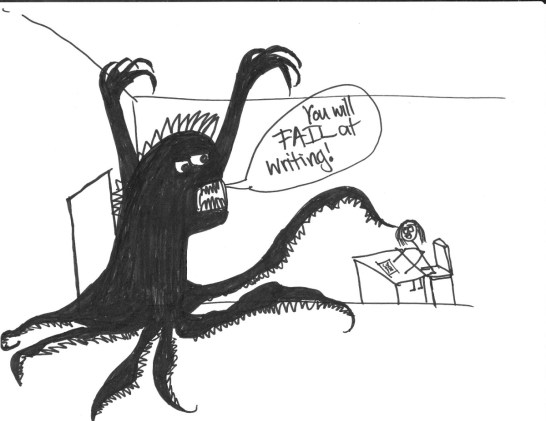
When I searched “fear in writing” I found this lovely drawing on Lynette Noni’s blog post. I have a lot of fears about my writing, and yes, they come out when I’m editing. I fear I’m not a good writer. I fear I’ll never sell any books. I fear I’ll never be able to make a career out of my writing. After all, I can’t be a good writer if my editor finds all these things wrong with my book, right? And I want to be a good writer so I can sell books, so people can say, “Wow, that was probably one of the most emotional, heart-wrenching books I have ever read.”  We all want to be writers who touch someone in some way with our work.

But What Else . . .

But you know what else I feel when I edit? I feel joy. I feel happy when my editor says she enjoyed a setting description or how I nailed how a character feels with show and not tell.  I get excited when she tells me she loved an intimate moment between two characters, and a “More please!” in the comment section. I get excited when she congratulates me on proper grammar.

I’ll feel pride when I hold my published books in my hands, when my friends, family, and co-workers congratulate me on being tenacious, of having a dream and working toward it.

The act of writing and publishing is no doubt an emotional roller coaster ride. There are ups and downs, you’re thrown sideways and completely head over heels. But the trick, and oh my, is it a trick, is to keep fighting. To not let those negative feelings overwhelm you, to let them win. Surround yourself with friends who know what you’re going through, who will support you, and not let you give up.

If I have any advice from going through the editing process, it’s to keep your mind open and learn. Learn from what your editor is telling you. S/he’s on your side. Your editor wants to you to put out your best work, and that undoubtedly is your goal too, which is why you hired one. Don’t take their advice and suggestions as hurtful criticism, (unless it is, then you need a new editor) take their feedback and turn it into a positive learning moment. I’ve learned a lot going through my editor’s feedback.

I took a break from editing to quickly write up this post. I’d come to a paragraph where her advice was hard to swallow. I see it, I understand it, I agree with it, but there again, those feelings come up. Why didn’t I see this? Why did I send my work to her this way? What is so wrong with me I couldn’t fix this on my own?

Nothing is wrong with me. Nothing is wrong with you, either. We’re all human, and doing the best we can.

For more articles about fear in writing, look here:

http://www.writersdigest.com/whats-new/10-ways-to-harness-fear-and-fuel-your-writing

Being Held Back by Your Fear of Writing? Here’s What to Do

What in the Heck Have I Been Doing?

I haven’t done much writing lately, and I haven’t blogged much either. I gave myself a pass last week because I flew from MN to FL on Friday to go to my sister’s wedding, and I just got back last night (Monday) pretty late. I had a great weekend, though, and I spent a lot of time at the ocean, which was fantastic! I love going to the beach and looking for shells. There’s something calming about seeing the ocean and realizing how small we are in comparison.

But I’m back now, and this summer is going to be all about writing. This is what I’m going to be doing in the next little while:

Editing

An editing project came my way, and she was lovely enough to run it through CreateSpace for me so I can work on it at work. I don’t have computer access there, so having the paperback will be a big help. I’m looking forward to helping this author and reading her book. I hope she can get it out this summer.

Summer Secrets

My own editor is coming back with my edits for Summer Secrets. I’ll be putting them in and doing all the rest so I, too, can publish these novellas this summer.  The things I need to before release:

  • Put in all the edits
  • Write the front and back matter
  • Ask @DRWillisBooks (David Willis) to redo improve my map for the book
  • Create the cover
  • Format it for both CS and Kindle. (I will also be going wide with these, and I’ve chosen Draft2Digital to help me with that. I’ll blog about my experience with them at a later date.)
  • After editing the proofs and fixing anything that needs to be fixed, I’ll be seeing if any of the bloggers who had approached me earlier are still interested. These took a lot more time than I had anticipated simply because I added a 6th novella to the series and editing always takes me a lot longer than I anticipate.

I am hoping for an August release. I’m hoping. My plans have been shot to hell before, but I’ll do my best.

A Writer’s Conference in June!

I’ll be going to Santa Barabara in June for a writer’s conference. It’s my first big one and my first time in California! I’m so excited I could die! I have everything paid for . . . I’m just waiting to go! I’ll have to see how much Summer Secrets I can get done before then.

Don’t Run Away

This is my new working title for my Nano project from two years ago (formerly known as Running to Love). I’m letting this one breathe as I have ripped it apart a couple of times now, but I’m thinking as soon as I take the bandages off, it’s going to be all healed to perfection! Maybe not, but I do plan to release it in the fall after editing it a few more times. This is the first book in my Tower City Romance series. I’ll have the second one finished soon, and I plan two more books after that.

tower city logo

#SmutChat

And of course, I’ll be doing #smutchat, the Twitter chat I started last month. Or was it two months ago now?  Anyway, I think that people are enjoying it, and it’s going in a direction that I didn’t think it would. I always give away a non-fiction writing resource book in conjunction with the topic of the chat, but other authors have approached me and asked if I could give away their books too. So I will be pairing these books with the non-fiction writing resource I’ll be giving away and even interviewing the author for my blog if they are willing and able. My first foray into this is during one of my weeks when we talk about settings. I have the book picked out already and Jewel E. Leonard is going to be giving away Rays of Sunshine. The writing resource book of the week for that one is @AngelaAckerman‘s book on settings.  It’s something interesting, but I won’t be doing this for every chat simply because planning the blog interview takes time, and quite honestly, I haven’t seen a lot of interest in the giveaways. I was hoping making the giveaway a writing resource would help spark interest, I mean, who doesn’t want to add to their collection to help them write better, but still, no. The last chat I hosted I had only 5 people enter the giveaway. It’s too bad.

Anyway, so that’s what I’ll be doing this summer. I do have a solid publication schedule down though, so you can watch for these:

Summer Secrets, August 2017

Don’t Run Away, (A Tower City Romance) November 2017

Chasing You, (A Tower City Romance) March 2018

After that, I hope to have books three and four of the series completed and ready to go.

I have a busy summer ahead of me, and I hope you do too! What are your summer writing plans?

The Shocking Revelation of Editing

When I write, I can tear through a manuscript pretty quickly. I have more free time as a mother of two who works full time should, and being I can write at my job if I know what I’m writing, I can put words down at a fairly acceptable pace. You would think I could crank out books, and believe me, that is one of my main goals as a writer.

But what holds me up is all the %#!*&$# editing I end up doing. I have to edit a lot because yeah, I’m still learning my craft, (I’ve complained before I feel like I’m skidding my wheels and this is a big reason why) and there’s not a lot I can do to speed that up besides doing what I’m doing. I’m learning not to head-hop, I’m learning how many points of view work in a book. I’m learning to write without all my naughty words. All of these things will help me put out a book that will reduce the amount of editing that I need before I can publish.

notebook-1064660_1920

When I have to edit my book, I take a lot of selfies too.

One of the things that took me by surprise was that amount of time it took adding the “set it aside” time everyone recommends before reading it again. I completely understand this, and I do it myself. I’m doing it now, putting aside one manuscript while I write the next, and when I’m done writing it I’ll go back to the first. But doing this takes so much time. Who wants to take so much time? Here you have a completed manuscript, then you read it, and read it again, and even again, fixing things as you go, if you’re lucky to find them, because let’s face it, by the time you read it that many times you know what it says by heart and it could turn to Greek and you wouldn’t even notice. And now you’re supposed to set it aside for a week, a month, whatever. What are you supposed to do? All you want is to publish the darn thing.

After you think you can’t do any more with it, then come the beta readers,  and if they find stuff you missed, you’re at it again. Then maybe you send it to an editor or a proofreader, and then you have to fix those things, too.

It’s nutso and when someone would tell me they’ve been working on their book for two or three or four years, I would just be, forget that I’m not doing that. But guess what? I’m doing it because I have to.

I won’t always have to.

I’m getting better. I’m learning which POVs work best, I’m learning to not head-hop, I’m learning not to write using my naughty word list.

One day I’ll get there, and a 77,000 word novel won’t take me two years to publish because I’ll have all the lessons I’ve learned already in my head as I write a new book, and I won’t have to go back and fix all those mistakes I didn’t know I was making in the first place. My career is just beginning; one day I’ll know what I’m doing.

And that day can’t come soon enough.

More articles on letting your WIP sit so you can read it with fresh eyes:

http://www.hillarydepiano.com/2011/12/i-just-finished-a-novel-what-do-i-do-next-let-it-sit/

http://annerallen.com/finished-your-first-novel-what-to-do-now/


Interview with darling Brickley Jules!

These past few blog posts have been about editing, and today I interviewed Brickley Jules who has had some trouble experience with editors. I asked her some questions about her editing process, and what she went through to get some of her WIPS whipped into shape. Listen in!

Tell our readers what you’ve been working on.

I’ve been working on the next book in the Chrome Thunder series.

I’m curious about your editing process. How much editing do you do before you pass your work on to an editor?

I let it sit for a month or more before I even start editing. Then I read through it taking notes for character cards, setting cards, businesses cards, and a misc. catch everything else set of cards. I use those to add details and check consistency. After that’s done I read through it to catch typos and any plot holes that I may have missed. I fix all that and usually have a panicked epiphany of something I need to change or adjust through the whole novel. An example would be after doing a search I realize I used a word 300 times, and it’s not an invisible word. Finally, I read it out loud or use my laptop to read it to me.

How did you find your editor for Her Unexpected Life? What were your expectations? Had you worked with an editor before that point?

I posted on Facebook that I was looking for editor recommendations. I had no idea what to expect; this was my first experience with an editor.  And actually, I hired them to help me with Out of the Blue, which is still not published. 

How would you rate your experience with that editor?

As a person new to being edited I would give it a five out of ten. Sometimes things took longer than expected, with no deadline for return given. But as a more seasoned person, I would rate it even lower. I was really bothered by never knowing when I’d get my stuff back. Communication was lacking. I received little to no progress reports unless I asked directly, then the answer was vague. 

In your opinion, did she make your novel better? Was there anything she brought to your attention that surprised you? Did she make your writing better overall?

My first novel was crap and needed lots of editing. So, I believe it was made better. I learned I love a sentence fragment. 

Was there any feedback you didn’t agree with?

I questioned some things because it had been a few years since I wrote. (Where did double spaces go?) But for the most part, it was way better than what I started with. I questioned things in general because I was trying to study up as I went.  

Through Facebook you found a different editor for Vested in Her. What made you change editors?

I used my original editor but also used a new one. The major deciding factor was my wait. I waited and waited for drafts to return just to question what was sent back. 

Can you compare their styles? Was this editor better, worse, or the same?

The second editor flat out told me I was being lazy. My other editor never would have said that. I prefer the second one’s approach. I need the honest harsh truth. Deadpool style. 

Cost is always a big factor when hiring out jobs. Was cost a factor for you when you hired these editors?

Yes. I’m on a shoestring budget and have to get the biggest bang for my buck. (The second editor was free but a close fit for my style of writing.)

Going forward, what will you look for in an editor?

Someone not afraid to throw punches.

Can you give our readers a few tips on how to find a good one?

Don’t be like me and just pick the first recommended to you. Ask them to sample edit for you. Ask a lot of them. You’re hiring them. You’re the boss. What would a boss ask and expect of you?

Thank you, Brickley! Finding an editor is a difficult process. I hope you can find someone to mesh with and maintain a strong relationship with that person going forward. I believe we all need editors to put our best work out there.

Please follow Brickley on Facebook and Twitter @BrickleyJules.

You can find Brickley on Amazon and Goodreads. Browse Her Unexpected Life and Vested in Her, now available!