Indie Author News Roundup

I’d love to write a cowboy romance, but I don’t know a thing about horses!
(Except how beautiful they are!)

1,781 words
9 minutes read time

There have been a couple of interesting things happening in the world of indie publishing, and I thought it would be worthwhile to chat about a couple of them. I don’t have much going on besides editing Bitter Love and keeping in mind the self-inflicted pub date I set for myself, and if you want a more updated version than that, I posted a real update last week. You can read it here: https://vaniamargene.com/2026/10/05/monday-author-update-7/

What’s been in the news? Maybe you’ve heard about them already, but you haven’t been treated to my sparkling opinion of it all, so let’s dive in.

Meta launched Meta One, a paid membership service, and some Facebook Pages are now being limited to two posts containing external links per month unless they pay for a subscription.
What does this mean? Well, Meta is rolling out this restriction, so not every Page is affected yet. But if your author Page is included, you’ll only get two opportunities a month to direct your readers somewhere else, such as Amazon, Goodreads, a Books2Read link, or anywhere else that takes your readers off Facebook. You can pay for more, and according to Reader Radius, the tiers are priced like this per month: Advanced ($49.99) gets 8, Expert ($149.99) gets 20, and Max ($499.99) is unlimited. I doubt many will pay since there were so many people who opposed Draft2Digital’s 12-dollar-a-year fee, and I won’t give Zuckerberg any of my money. He has enough of his own, and I’m not paying for the privilege to post links. Especially since I don’t use affiliate or tracking links and I have no idea how many people really click on them anyway.

News of this change made a lot of authors angry, but I took it in stride like I do most things. Why? Because… Okay, well, let me be honest for a second. I didn’t have many followers until I started posting Reels at the end of August. I was stuck at 229 for years and years. I would get followers, sure, but I almost ruined my page when I was boosting posts and Meta was showing them to males in India who would follow my page. Because of that, I had a lot of followers that would never buy my books and I started blocking them, which kept my follower count very low. I stopped boosting posts, and after I started posting Reels consistently, my followers shot up with people who, I hope, are actually interested in my books.

So, let’s get back to why I don’t care that much. For one, I didn’t really direct people to go anywhere else, and I didn’t want to start. I write about bits and pieces of my books, what I’m working on, mention a quote I like, etc, and those posts have no links. Readers want more than BUY MY BOOK all the time anyway, and I don’t like yelling BUY MY BOOK all the time either. I’d rather post about WHY someone would love reading my book and you don’t need a link for that. For another–and this is the biggest one–people who really want to read your book will find it on their own. I’ve accumulated quite a bit of proof when it comes to that because my Reels don’t have a link and never have. At the bottom of all my captions, I list myself as the author, the title, and where they can find it, like this:


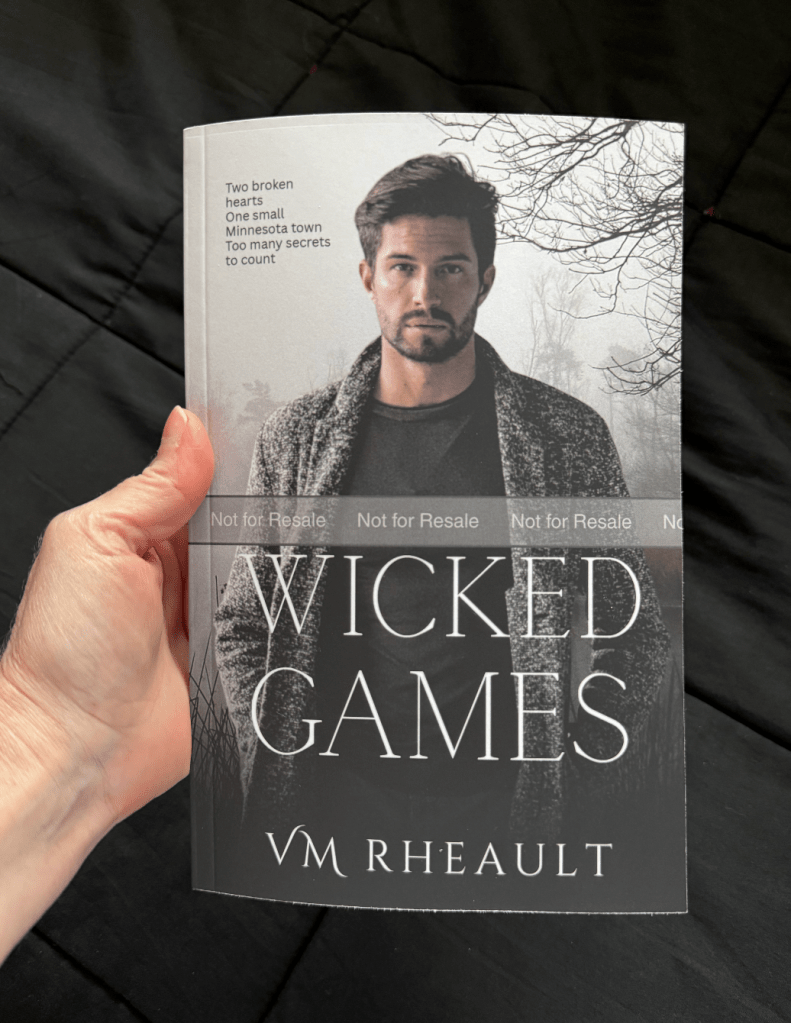
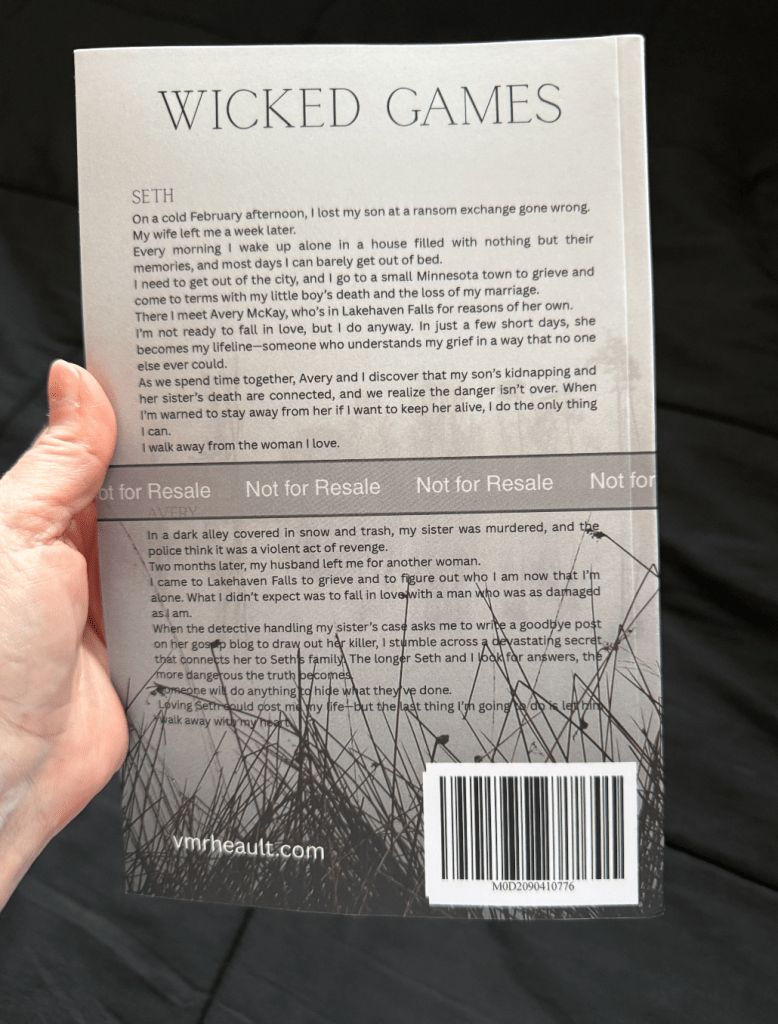
Wicked Games is a standalone romantic suspense novel by VM Rheault, available on Kindle, in Kindle Unlimited, and paperback.

Then I add the categories so they know the type of book it is. That’s all a reader is going to need if they’re interested in finding and reading your book. I promise.

I haven’t found anything to the contrary, but you can still put a link in your post (it won’t be “live”), and if a reader really wants to know where it goes or act on your CTA (call to action) they can copy the link and paste it in a different tab. That would be another version of “If a reader really wants to find your book, they will” and I would do that too, if I ever surpassed the free monthly limit.

I’ve seen a lot of angry authors posting on Threads over this, and yes, it’s okay to feel your feelings, but Meta is gonna do what Meta is gonna do. Like with anything similar, getting mad won’t help. You can try to find loopholes, like posting the link in the comments, having a third party publish your posts for you, or putting all your links in a pinned post, and see how that works, but if you have to work that hard to get around something Meta is going to enforce, it might be better to find an alternative. All your energy could go into writing your book.

And, I mean, I’m not saying this to say “I told you so,” but we all need the reminder. I really think free author services are eventually going to go away, and this is just another example of it happening. We cannot expect things for free. If you use a service to run part of your business, you’re going to have to expect to pay. I’ve cut way back on the things I’m willing to pay for, in all aspects of my life, not just my author business. Learn to go without, but if it’s valuable to you and your books and you want to keep it, fork over that green stuff.

If you want to read more about this you can here:
https://www.socialmediatoday.com/news/facebook-pages-get-charged-for-link-posts/830743/
https://kanorio.com/en/blog/meta-link-limit-brand-response

Goodreads added fraction stars to their rating and reviewing system.
I hate Goodreads and don’t go on there (unless I have a new release and I have to make sure that it transfers from KDP to my author profile), so I didn’t care about this particular piece of news, either, but authors on Threads lost their minds.

I’m not really sure why, except for the idea that readers and reviewers will now go back and adjust their reviews, bringing them lower or closer to the “true” number of stars they wanted that book to have in the first place. Personally, if you’re an author, I think it’s a terrible practice to review another author’s book, since you’re peers and coworkers in an increasingly hostile industry, and I’ve seen enough authors make fun of reviewers for simply stating their honest opinion (which is what a review is for!) that I honestly don’t feel safe posting a review, even if it would be mostly positive. The author of the book I’m reading now wouldn’t like to read the review I’d write. There’s too much echoing and the characters are too young for the situations she has written them into. Her book would read much better if they were aged up by ten or fifteen years, but I would never say that in a public forum with our names attached, nor will I DM her because it’s not my place and the criticism wouldn’t be taken well anyway.

If you’re a professional reviewer, you might appreciate the accuracy fractional stars provide, but I don’t see what all the fuss is about. Although, I watched a clip of someone playing around, moving their pointer back and forth over the stars, and it looks like it’s possible to rate a book less than one star–.50 or .25 of a star. I actually think that’s kind of crappy and wasn’t necessary. Does anyone really need to rate a book less than one star? I’m not sure what that gets the reviewer or the author. With review bombs a real thing and vindictive reviewing a common occurrence among spiteful authors and readers both, I see this blowing up and not in a good way. It just makes me even more glad that I don’t review books or read the reviews attached to my books. That is part of the publishing industry I’m comfortable avoiding.

If you’d like to read more about that, you can here:
https://goodereader.com/blog/amazon-news/goodreads-finally-supports-both-half-star-ratings

Those were the two biggest news stories to cross my path last week, but I think this is something of interest to those who are still in KU. The KENP payout for the month of August is the highest it’s been so far this year, at 0.004895. Everyone says how little KU pays and that the KENP keeps getting lower and lower, so this should be good news for the pessimists who think KU isn’t worth it. Though, it’s probably not enough proof to get them to change their minds.

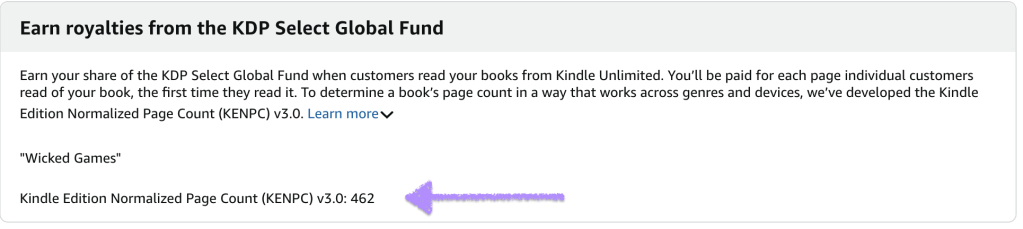
If you want a visual of what that means, Wicked Games has a KENPC (Kindle Edition Normalized Page Count) of 462. That’s different than the number of pages in the paperback, and you can find your KENPC under the “Promote and Advertise” tab on your dashboard. Click that and scroll all the way to the bottom of the page.
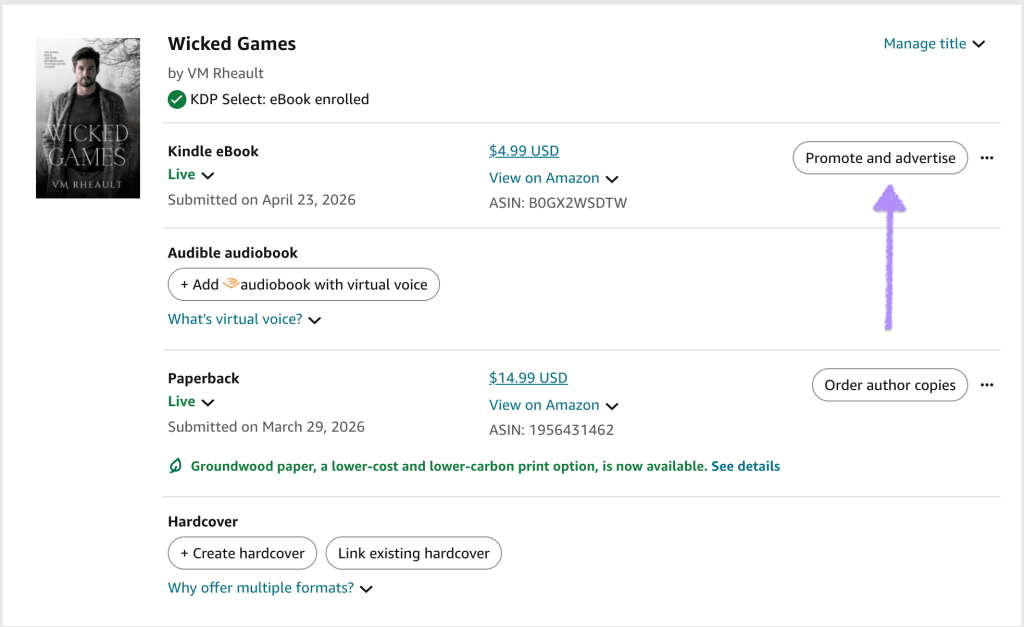
Screenshot of the Amazon KDP Bookshelf showing Wicked Games by VM Rheault. The Kindle eBook is live at $4.99 and enrolled in KDP Select, while the paperback is live at $14.99. A purple arrow points to the “Promote and advertise” button beside the Kindle eBook listing.
Screenshot of Amazon KDP’s “Earn royalties from the KDP Select Global Fund” section, explaining how authors earn royalties from Kindle Unlimited page reads. The listing for Wicked Games shows a Kindle Edition Normalized Page Count (KENPC) of 462 pages, highlighted by a purple arrow.

Anyway, if someone reads your book from cover to cover, you can multiply the KENP payout by the number of pages and you’ll come up with how much you get paid for that read. At 462 x .004895, a full read of Wicked Games earns me $2.26. That doesn’t quite compare to what I earn if someone buys the paperback or the ebook, but I’d rather make $2.26 than nothing at all because my books aren’t in KU. This isn’t a KU vs. Wide debate, it’s just how I feel, and I was happy to hear the payout had risen that much. Of course, that doesn’t mean it will stay there, but it’s good news for authors in KU who are toughing it out despite Amazon’s shaky content policies and the AI slop taking over the bestseller lists that Amazon doesn’t seem too keen on doing anything about.

I don’t have sources to cite for the KU payout, but Craig Martelle said in his Successful Indie Author Facebook group that 2026 was turning into a stellar year for KU authors and he keeps track of the monthly payout. I stole the August figure from him. September’s hasn’t been released yet, but hopefully the trend keeps going. Especially since in September I had the best sales month I’ve had in years, and I didn’t have to pay a dime for it either.

That’s all I have for this week. I hope you have a lovely Monday!

Until next time!

Monday Musings: Mixed Bag

1,562 words
8 minutes read time

picture of a cream burlap shopping bag. cream/yellow flowers in the corner of the graphic. text says, monday musings mixed bag

There was a lot of stuff on my mind last week and over the weekend. Things that I saw online that bothered me, things that pertain to the publishing industry that bothered other people, and content for this blog. None of it’s bad… just stuff I simmer about while I’m taking a shower because I’m not writing a new book right now so something has to go through my head while I’m shaving. Yes, if you’re curious, I do shave all year around. I cannot stand being prickly. Anyway, we don’t need to get into that. The point is, if I’m not writing scenes in my head, there’s a lot of space in there for other things. And really, it doesn’t help that I scroll Threads while I’m drinking my morning coffee and trying to wake up. It just sets the rage-y tone for the rest of the day. That might not be a bad thing. I mean, how many of us just keep going out of spite? But, it can get a little tiring too. If you’re wondering if there’s a point to this, yes, there is, thank you for asking.

Spring is here, and for once it actually looks like Spring in my part of Minnesota. It’s dirty and wet, and big, grimy piles of snow are all that’s left. But, it’s proof that we made it through the blizzards and the wind chills. There’s something about the warmer temperatures and the sun shining that lets you breathe a little bit, and the longer days–of sunlight, I mean–aren’t so depressing. Not that I mind the dark so much. But you know, Spring is just a different vibe and it’s nice to get some fresh air in here after the windows have been frozen shut for four months.

Author Update
Not much has changed for me since last week–the second (and hopefully last) proof for Wicked Games came so when I have longer than a minute I can look over the formatting changes I did (I had blog posts and interviews in there that look better set off from the regular text) and make sure the cover is how I want it.

I’ve been making slow progress on my Cedar Hill Duet, but they are going to ✨ shine ✨ when I’m done. It’s always an aggravated pride when I re-edit a book. I’m annoyed I had to do it in the first place but I’m proud that I took the time. It’s strange, but I’ll be happy when those are done and republished with new covers. Proofing the proofs is slow going though, and new files probably won’t be ready until the end of April. It just takes a long time because I fight with myself between my natural voice and style and the conversational tone I’m now aiming for, but, fortunately, I’m not finding many actual typos. Just still smoothing out prose and finding the occasional discrepancy. Chunking out a timeline is a lot easier on paper. So, progress doesn’t feel like it’s being made, but it is, even if I’m grumbling about the whole thing.

It’s okay to have help
One of the things I saw on Threads the other day made me mad. She was saying how getting feedback and brainstorming was essentially “outsourcing” a skill writers need to learn for themselves. She brought AI into the mix because apparently she had read something where a writer used AI as a brainstorming partner. I disagree with her on so many levels. Not the AI part–I have chosen to be Switzerland when it comes to that–but the part where if writers ask for help, they’re keeping themselves from learning craft. I’m not quite sure where she came up with that idea, but seeing it on Threads made me mad and a little sad, too. New writers don’t need to be told that if they can’t do it alone they’re not building their skills. Writing is already so lonely.

So, yes, I think it is okay to have help. Get developmental feedback from an editor or beta reader. Brainstorm plots and twists with a fellow author. Read that craft book. Look up lists of tropes and mini-tropes for inspiration. My reader magnet exists because a long time ago back when she was on Twitter, Zoe York tweeted a list of tropes that included “ugly duckling.” It intrigued me–how could I write a MMC that didn’t sound like an arrogant, shallow bastard–and I wrote a whole book around it. Brainstorming with peers, reading craft books, and reading in your genre is how we learn. On top of writing and writing and more writing. It doesn’t matter where you get help, be it a friend or a writing class, you still have to sit down and write. But having support and someone to turn to if you’re stuck makes it a lot easier. There are a lot of gross takes out there, and yeah, I guess AI hasn’t helped, but pre-AI, there were always plot generators, trope lists, and writing prompts. I have no idea where all of a sudden having outside resources helping you write your novel is bad, but writing isn’t done in a vacuum and never has been. You can find a simple and fun plot generator here. I would mess around with it, but I have enough on my plate as it is. Likely, I have enough projects to keep me going until 2030. https://artisthu.com/plot-idea-generator/

Goodreads’ New DNF Shelf
This is another subject that came up last week on socials. Apparently Goodreads created a Did Not Finish (DNF) shelf for their users. Authors were a little perturbed by it, but I don’t see the harm. What does it really matter if readers don’t finish a book? I know authors wouldn’t like to see one of their books on that shelf, but more and more people read by mood, and I could see a DNF shelf turn into a Come Back Later shelf instead. I also think that authors just forget, or don’t want to admit, the sheer number of books out there right now, and readers don’t have to push through a book that doesn’t grab them.

I feel guilty if I don’t finish a book, so I usually try, even if that means skimming until I reach the end. I have to at least read the last chapter to know how the couple gets their HEA. Why I start skimming varies, but my top reason for skipping to the end is that there’s not enough male POV. I remember a while back that I really wanted to read a book two in a series. The premise sounded good, but being who I am, I needed to read book one first. Even though it was “dual” POV, there were too many FMC chapters in a row, and I didn’t keep reading. Unfortunately, I just figured that the author preferred writing the FMC POV and I didn’t make it to book two. You’re never going to please every reader, that’s just a fact, and whale readers will always keep track of their books. That’s just a fact too. Goodreads doesn’t tell you what readers are doing with your books, so it’s better just not to hunt for information you don’t want to know in the first place. If you want to read a little more about the DNF shelf on Goodreads, you can do it here: https://www.goodhousekeeping.com/entertainment/books/a70504162/goodreads-dnf-shelf/

Editor Series
A couple of weeks ago, I asked on Threads if there were any editors who would be willing to answer some questions about what it’s like editing for indies, common mistakes they see, their take on AI, etc. I got quite a few responses, unlike when I tried on Twitter a few years ago. So, I’m happy to say that I will be able to start posting those interviews starting next week! I like the idea of it because it seems like editing is a necessary evil. It’s expensive, you don’t know who to trust, and you need to find someone who’s a good fit. I’m hoping that these interviews will shed a little light on the process and maybe you’ll find your next editor.

I’m not going to post them all in a row, though. I think you would get tired of them, and you know me. I have too many opinions to be quiet for that long. So, I’m going to post one a month starting next week. I hope you enjoy reading their responses as much as I did!

That is all I have for today. Lots of talk about the Shy Girl debacle, but I really don’t have a lot to say on it. AI is everywhere, it’s not going away, and we just have to try to find our way around it. People are going to use it to write, authors are going to use it to edit, brainstorm, and research, and I’m not saying we have to live with it, but until there’s an infallible way to identify AI writing, it’s going to exist in the industry. If you want to read the Times’ article, you can here, and hat tip and big thank you to Cat Johnson and to various others on Threads for the gift link.

Have a great week!

Monday Musings: ARCs, Goodreads, and Writing While You’re Sick

1,906 words
10 minutes read time

I’ll tell you a little story. In our city, our Walmart is located in a poor neighborhood. I would imagine when they built it, they didn’t intend for that to happen, but as the city grew, it became a poor part of town. Since then, theft has increased. You can tell it’s increased because of the way they treat their customers. They have security walking around their store (I know who he is because I worked with him many many years ago when I was checker at K-Mart), they lock up everything that has value, from laundry detergent to pregnancy tests, and in the cosmetics department, you have to pay for anything you want before you leave. They don’t let you pay at the main checkout counters anymore.

They treat you like you’re going to rob the place the second you step foot in their store. And you know what? It sucks. It sucks being treated that way. I mean, I get it, they probably do lose thousands of dollars in product every year, and that will continue to happen as things get more expensive and companies don’t want to pay their employees.

The sad part is, I’ve seen authors treat their ARC readers this way. Changing one word in each copy to “catch” someone pirating, watermarking their copies, making them sign NDAs. Sometimes we forget that we need them–ARC readers don’t need us. Treating them like they’re guilty before they do anything is kind of, I don’t know. I left another Facebook group the other day because I got into a discussion with someone who was trying to prevent theft. At first she said her post was about ARC readers then she changed her story and said she was doing a giveaway on Instagram, mostly, I think, because I told her treating ARC readers like they’re guilty before they even do anything is nasty and unnecessary. No matter how you’re giving out copies of your book, treating readers like they’re going to steal from you will only make you look petty and mean. Your book will get pirated. The potential is there for it to get stolen, but the stories I hear of that happening? Other authors are doing the stealing, not plain old, every day readers who want to help you.

I’m glad I left that group, but I’m sure I’ll see it again. I don’t like being treated like I’m going to do something before I’ve done it. I don’t like being accused when I’m innocent. And neither does anyone else. If you feel that strongly about protecting your work, don’t give out ARCs. Don’t do giveaways and don’t publish because the second your book is on Amazon, it will get pirated.

And as Forrest Gump says, “That’s all I have to say about that.”


Once again I had to go through the wonderful process of contacting Goodreads to move Loss and Damages from my “fake” profile to my “official” one. I don’t understand how my “fake” profile isn’t allowed to exist, but it does, and every time I publish, I have to contact Goodreads and have them move my book. This time I contacted support rather than a Librarian and they actually took my “fake” profile down, so maybe the next time I publish a book it will move over correctly without me having to do anything. They were great about it and did it in a couple of hours. I should contact a Librarian and change some of my old covers too, but dealing with Goodreads is a necessary evil, and I try to do it as little as possible.


I’ve been re-editing some older titles, and I think I mentioned that in my last blog post. Since then I finished Faking Forever a couple days ago. Now I’m reading it over just because I made so many changes that I’m looking for mistakes in my edits.

I’m trying to think back to when I was writing that book, or Rescue Me for that matter. Most of my books I wrote between 2020 and 2024 were written while I wasn’t feeling well. I wasn’t myself, dealing with my lichen sclerosis when I didn’t know what it was, getting a hysterectomy that I’d find out later wouldn’t help and only cause me post-surgery issues, and breaking up with my fiancé who did nothing less than catfish me into thinking he was a decent human being. I look back at that time in my life, and I just wonder if those things didn’t effect how I wrote, because I have to say, Rescue Me didn’t sound too terrible, but Faking Forever sounded like shit. My word choices, my writing style, it all sucked, and I can really tell that I wasn’t in a good frame of mind. I just wasn’t.

When I was re-editing Faking Forever, I practically rewrote the whole thing. Not on a plot or character arc basis, but on a sentence and paragraph level. I took out over 1,000 words when I re-edited Rescue Me, and I took out almost the same in Faking Forever. It makes me sad because looking back, maybe I shouldn’t have been writing. Though, I don’t know what I would have done with myself if I hadn’t. Those four years I was undiagnosed, my doctors lying to me, prescribing treatments that wouldn’t help, I was in a really bad place mentally. I had anxiety. We were going through COVID and lockdown and I was trying to support my daughter who started tenth grade virtually.

I’m feeling better now. In 2024 I got a diagnosis. I stopped taking the medication that had side effects. I stop drinking the tap water that was making me nauseated and messing up my digestion. Most days now I don’t think about how I feel physically. I can push what’s left into a corner of my brain and ignore it. But in doing so, that leaves my mind open to a lot of other things, and I can see in my writing how stressed out I was.

This makes me feel horrible, because in 2020 I started my pen name in an effort to do everything “right.” I wanted to turn my books into a career, but I sabotaged myself and starting a pen name or trying to do any kind of “real” work not feeling well only backfired. I have a lot of books out. My Lost & Found Trilogy. My Cedar Hill Duet. Those are the first books I published. Since I published them, I’ve edited them, but I edited them when I still wasn’t feeling well, and well, unless I read them again, I have no idea how they would sound to me now.

I can safely say that my other books are okay. I just reread my rockstars and I like how they sound (except for a couple of typos here and there that are normal). I’m lucky I did the final sweeps of my King’s Crossing serial when I was feeling good. That would have been a monster of a project to re-edit and I’m confident I don’t have to do that. Rescue Me and Faking Forever are fixed, or close to it. I’ll edit A Heartache for Christmas after I upload new files to KDP for Faking Forever, just in time for the holiday push this year. Then, maybe I can feel in a good enough place to write new work. I felt good writing Wicked Games earlier this year. I edited Loss and Damages (coming out next month) when I was feeling good.

Where does this leave me? I’m cleaning up my house, literally and figuratively, but there’s a lot of time gone by. I don’t want to say wasted. I can’t. Writing was there for me when my world was pretty much falling part, for lack of a better way to describe it, but I don’t want to sound melodramatic either. I can write new books knowing I’m giving my best to the story and the characters and nothing is holding me back or distracting me.

A friend told me to give myself grace. That if my writing is better today it’s not only because I’m feeling better but because I’ve put a lot of words on the page. That might be true. I know I learned over the past year to spot some writing tics that I’ve been able to avoid in newer work. I’ve learned to relax, not only just to enjoy the writing, but my writing style and my voice. Who cares if I use “get” or “put” or “takes” or a little telling slips in there sometimes? My writing sounds stilted because I was trying to avoid garbage words, and honestly, with the books out there that are selling like ice cream cones in 90 degree weather, you’re better off just saying “fuck it” and write in a freer manner than trying to conform to rules that will only make you sound like cardboard.

But this also circles around to my not having an editor. I’ve broken probably one of the most important rules in publishing. Not even just indie, but publishing in general. There are a lot reasons why I haven’t. I mean, I used to, back when I first started, but my productivity was so much that I would never have been able to afford one for every single book anyway. And I’ve had this argument with myself and others before: an editor can’t teach you how to write. They can only make better what you’ve given them, and if you give them garbage, you only get better garbage when they’re done.

Likely, an editor wouldn’t have been able to do much with Faking Forever. It was my voice, my style as a whole, that had problems. Fox’s and Posey’s character arcs are solid. The plot is fine. It just read like crap and I’m not sure what an editor could have done. Marked every sentence and suggested I rewrite it? And even if that had happened, I’m not sure I could have. Not how I was feeling.

So, I guess the best thing I can do is move on. Write more, enjoy the process now that I can. Celebrate my improved health. Go back if I feel like it, and I probably will at some point. Re-edit my Lost & Found trilogy and my Cedar Hill duet. Those would be the last books I’d need and then I could say all my books are okay. But I don’t want to be re-editing forever either. I’d like to write something new, but I’m going with my instincts and right now after getting Faking Forever out of the way, giving A Heartache for Christmas one final read will make me feel better. I like Evie and Sawyer anyway, so going back won’t be a hardship. I’ve read bits and pieces since I published them and I already know that book doesn’t sound like Faking Forever did. Maybe I was in a particularly nasty frame of mind when I wrote Faking Forever, I don’t know. All I can do is take the good from that time in my life and leave the bad.


I’m still getting used to the restructuring my work did last week. Only time will tell if it will effect how often I can blog, but I love sharing bits of my life and news with you so I’ll do my best not to let it impact me too much.

Have a good week, everyone, and I’ll chat with you later for sure.

Monday Musings and What I’m Liking Right Now

This is the last Monday of August, and I hope the month has treated you well. I got a lot done this month, including finishing the last book of my trilogy. It came in at a little over 80k and I’m pleased with how all the books turned out. They still need editing, but I’m on track to release them in January. I still don’t have a firm publishing schedule for them, maybe a week apart, but I do know that I’m not waiting between books like I did for my duet.

Sales of my duet have been slow, and no reviews on Amazon for either book as of yet. I’m running Amazon ads and actually just created a couple of fresh ones with a higher bid hoping to get more impressions and a few more clicks. I contacted the Librarian’s group on Goodreads and had my second book added to my pen name profile. The one thing I dislike about adding a subtitle to an ebook is that it looks like a different book from the paperback, and I have no idea why the paperback of Captivated was added but the ebook of Addicted was after that. It’s annoying, and though I don’t have any kind of OCD, I grind my teeth anyway.

Not that I should care, I guess, but it just looks funny to me. There have been discussions wondering if adding a keyword-stuffed subtitle is necessary or even helpful (though we all know that it’s against Amazon’s TOS) but there is still no arguing tropes in romance sell. It is getting to the point though where I have seen so many qualifiers attached to a blurb, I wonder if it does anything at all: A steamy small-town second chance standalone happily ever after with no cliffhangers full-length novel. Are readers that picky or are we just so marketing-focused we’re compelled to spell out every dirty detail before a reader buys? I don’t have the answer to that, but it’s interesting to think about nonetheless.

I finished proofing the proof of Rescue Me, and it’s all ready to go in KDP. I’m still on the fence if I should use Booksprout to find reviews–if I am, I should publish the paperback now so I have a link and ISBN as they ask that information when you set up your book for reviews. (At least they used to. I’m not sure if they still do–the platform went through an overhaul over the spring and I’m not familiar with it anymore.) There is no free plan for that service like there used to be, and the kinds of reviews I was getting almost doesn’t make it worth paying the $9.00 fee. I feel as though most readers use it as a vehicle of accessing free books and if they do leave a review it’s a synopsis of the book (if they’ve read it) or a copy and paste of the blurb (if they haven’t). Still not unsure, but a standalone would be a good book to try it out with, at least, so I’m still considering it. Here’s a little thing I made on Canva. I think my copywriting skills are getting better.

I have the large print version stuck in my KDP dashboard, but after going around and around with the large print version of Captivated, I’m not going to bother to try. It can just be stuck in there. I never did get an answer from anyone who answers Jeff Bezos’ email, so I’ve given up offering large print. I asked in the 20booksto50K group if anyone had a workaround, and the only thing that made sense to me was when someone said KDP doesn’t want you to have two paperback books available and if I was stubborn and wanted to offer large print, I would have to create a hardcover edition. Printing is already expensive enough as it is–a large print paperback costing about 16.99 to earn any royalties, and adding a hardcover on top of that isn’t worth it. I don’t give up on many things, but fighting with Amazon is one of them.


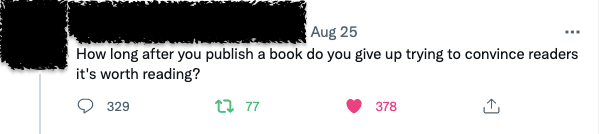
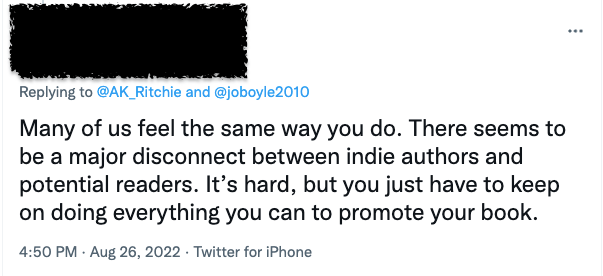
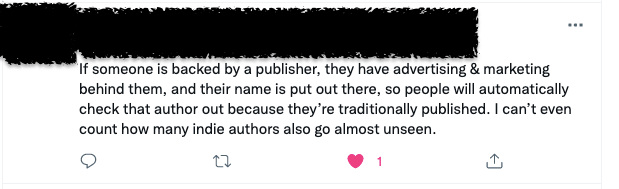
A tweet caught my eye this morning. Well, not this tweet as I answered her a couple of days ago when I saw it first, but I think the response I saw this morning was interesting.

I’m not 100% sure what he means–I asked for clarification but haven’t received a response as of writing this blog. To me, it can be taken two ways. 1) indies don’t know how to reach readers, which would be the natural assumption considering the original tweet, or 2) readers don’t like reading indie. When I first read the tweet, I thought that’s what he meant–that readers avoid indie for whatever reason. But then I read the tweet again after a couple cups of coffee, and he probably does mean indies don’t know how to reach readers. It’s interesting to me that he recognized it and lumped us all together and admitted it. I don’t know, I’m probably reading too much into it, it was just strange to see it in black and white. It’s also interesting to me because there is so much more to marketing your book and yourself as an author than just tweeting all the time. I’ve learned this creating my pen name and getting that going. Marketing begins with the products you want to sell so what is your product and what does it consist of?

*Genre/tropes
*Voice/writing style
*Cover
*Title
*Blurb
*How often you publish/how many books you have out and how many you plan to publish in the next year
*If you stick with one genre or if you genre-hop and/or sub-genre hop
*Metadata for your book such as categories and keywords

These are pretty important when you’re trying to market, and most authors don’t think about any of that until the book is published and they can’t find anyone interested in reading what they’ve written. If you don’t consider any of that, what you do after will be hit or miss. And what comes after that? Building a newsletter (though everyone says you should before you publish, and that’s a feat in and of itself) running ads, buying promotions in newsletters like Fussy Librarian and Ereader News Today. And after that, once you start to find some readers, you better be writing the next book or have one almost ready to go. That’s why indies don’t understand marketing. Marketing isn’t the same as advertising. https://www.outbrain.com/blog/marketing-vs-advertising-7-key-differences-you-need-to-know/

As far as the idea that readers don’t want to read indie–that’s a valid reason why there are some authors with no sales. They look indie. Their covers are only so-so and their books need editing. They only have one book out and it makes them look like a newbie (I am fully aware what my Amazon Author page looked like when I only had Captivated out and that’s why I’m going to publish my trilogy with little time between books). I don’t mean to insult indies. I am one, so why would I do that? But the less indie you look and your book sounds, the better your sales will be.

He answered me (real-time blogging is cool!) and I was actually kind of right on both counts:

I’m not going to argue with someone’s beliefs. I think in some way, shape, or form we all have to do a little marketing/advertising of our books. Tweeting isn’t going to get you very far.

Anyway, so that’s kind of what I’ve been thinking about today. I started my pen thinking years into the future. What my sub-genre would be, my voice/style of my books, the age of my characters and what that means for the ages of my readers. I research covers before I create mine, I try better to think of more relevant titles for my books–something I’m terrible at–but I know a title can make or break a book. Of course, I had to publish for five years before I figured out any of that, and I’ll have to publish for at least year before I know if that kind of preparation will pan out.

If you want to fall down the rabbit hole, I linked the picture of the original tweet to Twitter. I’m always interested to hear what others are saying about marketing and publishing.

September will be full of editing and playing with covers. I won’t start a new project until my trilogy is ready to go, but I do have loose plans what I want to write next. After tackling a trilogy, a standalone will be welcome. I had the idea when I was still writing in third person, but I think I can make it work in first just as well. There’s nothing stopping me from writing it in third and publishing it under my name and not my initials, but I rather like first person present and I might as well keep going with my pen name. We’ll see.


Oh, I forgot what I’m liking right now. Haha. Can’t be that great. Just kidding. When I have a bit of time, I’m going to listen to the roundtable talk moderated by Jane Friedman about the DOJ vs. PRH trial and what it means for authors and the book business. I didn’t follow the trial as it was happening, and if you didn’t either, but you’re curious, give it a listen.

Have a good week, everyone!

Until next time!