Monday Musings: Editing, Book Launches, and the Rest of 2025

1,902 words
10 minutes read time
Editing Update
For the past few months I’ve been trapped in editing hell. A hell of my own making, but hell nonetheless. Anyway, I’m happy with the choices I’ve made, especially since I’ve sold a couple copies of Rescue Me since I updated the files. At the time of this writing, I’m waiting for another proof of Faking Forever to come because I forgot to add the “About the Book” section to the front. I also made a couple additional edits, but because you can edit a book forever and ever, after this second proof comes, I’ll just page through it and mark it done. Even if I happen to miss something, it will still sound 1000% times better than what it did, so I’ll consider that a win.

I’m still going through my Christmas novel and I’m hoping to be done with it by the end of the month. It’s a little slow going because I’m trying to avoid having to read through it again, but I guess I’ll skim the paperback proof when I order one. Of course there’s always a risk of editing in mistakes, but I’m not the only one that happens to, so I’ll just make peace with the fact that all the books I’ve edited in the past several weeks sound better than they did. I did a blog post on some of my changes for A Heartache for Christmas and you can read it here: https://vaniamargene.com/2025/08/18/when-dumbing-down-your-writing-isnt-dumb/

Loss and Damages Launch Activity
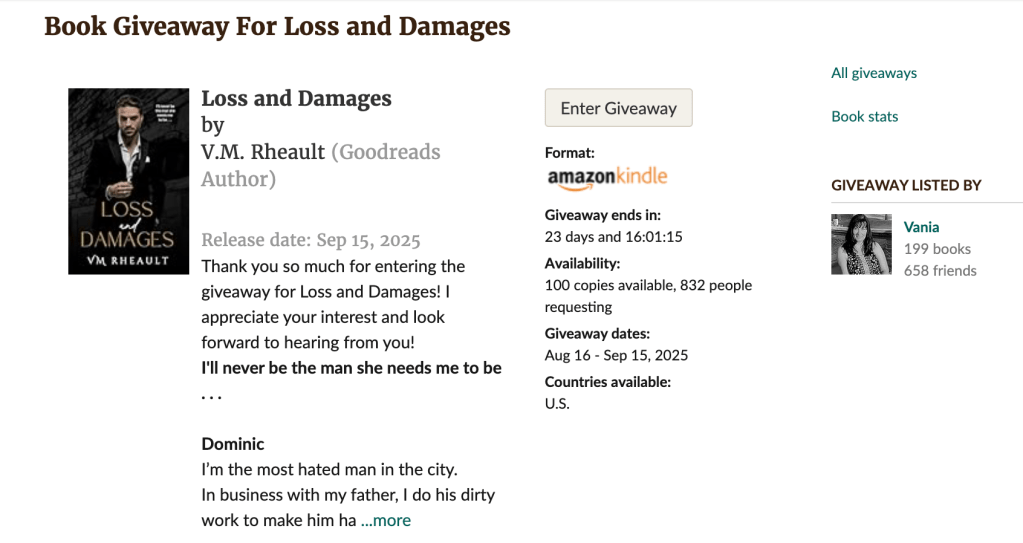
I haven’t been doing much for it except buy a Goodreads giveaway and run an Amazon ad to the preorder. At first I felt bad I spent the $99 dollars on the giveaway because other than exposure, like when I bought one for Cruel Fate, I won’t get much out of it. Comparing the two books might be worthless since Cruel Fate is the first in a six book serial and Loss and Damages is a standalone which (in my mind) makes it much more likely to be read, so chances are outcomes will be completely different anyway. But, I get paid three times in September, so after realizing that, I shrugged and moved the Goodreads receipt into my 2025 Book Spend folder to give to my accountant next April. All that being said, I’m at 832 entries and the giveaway ends the day the book is live, on September 15th. Since those free books are added to my sales dashboard, maybe they’ll count as “sales” and they’ll give me a little push that day. Who knows. If you want to enter, you can here: https://www.goodreads.com/giveaway/show/419642-loss-and-damages
Book Giveaway For Loss and Damages
Loss and Damages by V.M. RheaultLoss and Damages
by V.M. Rheault (Goodreads Author)

Release date: Sep 15, 2025
Thank you so much for entering the giveaway for Loss and Damages! I appreciate your interest and look forward to hearing from you!
I'll never be the man she needs me to be . . .

Dominic
I’m the most hated man in the city.
In business with my father, I do his dirty work to make him ha ...more
Enter Giveaway
Format:
Kindle book

Giveaway ends in:
23 days and 16:01:03

Availability:
100 copies available, 832 people requesting

Giveaway dates:
Aug 16 - Sep 15, 2025

Countries available:
U.S.

The Amazon ad isn’t doing too much but it’s just another way to push my book out there, and for now, it’s low-cost. My ads going to other books are doing well, but my sales aren’t keeping up with ad spend so I may have to reassess them at the end of the month. For now, the ad has resulted in one pre-order. I usually get none, so that’s a small win all around.

snapshot of Amazon ads stats for Loss and Damages. 6422 impressions, three clicks, cost per click is .35 cents.

I have four paperback copies I ordered since my paperback is scheduled and I can order them without the proof stripe on the cover. I was thinking about maybe offering them on IG to a few bookstagrammers or something, but time is slipping away if I want to do that because half the appeal is getting the book and reading it before it releases. I have less than a month to do that now, and with shipping, even to the United States, I’m cutting it close. Still, it never hurts to put up a post, so I might be doing that sooner than later.

Overall, I don’t have other plans for it. Most times I forget I even wrote it and that I should be pushing it. I have a terrible habit of moving on before I really should be moving on, but I’m always thinking about the next thing, and being stuck in editing makes me antsy to write something new.

What subgenre in romance is hot right now:
If you get the K-Lytic’s marketing trends research newsletter, you’ll know that Cowboy and Western Romance is on the upswing. I never was one to care about cowboys, even if Glen Powell portrayed a pretty sexy one in Twisters (that I have seen approximately 100 times). Ranch and farm life is a bear to get right if you’ve never lived on a ranch or a farm. Tacking a horse incorrectly will get you skewered by readers who actually know how to ride, and that is a level of research that I just don’t care to do. Especially since the last, and only, time I rode a horse was back when I was ten and went to summer camp. The last time even I saw a horse in person was two winters ago when we went on a sleigh ride (“sleigh” being used loosely as there wasn’t much snow that year and we were actually on wheels) and I got to pet one before we set off. That, unfortunately, does not qualify me to write a cowboy romance, and neither does living in the middle of farm country. But, it’s interesting to note that Cowboy and Western Romance is having a moment. This is the snapshot that Alex Newton shared in his K-Lytics email.
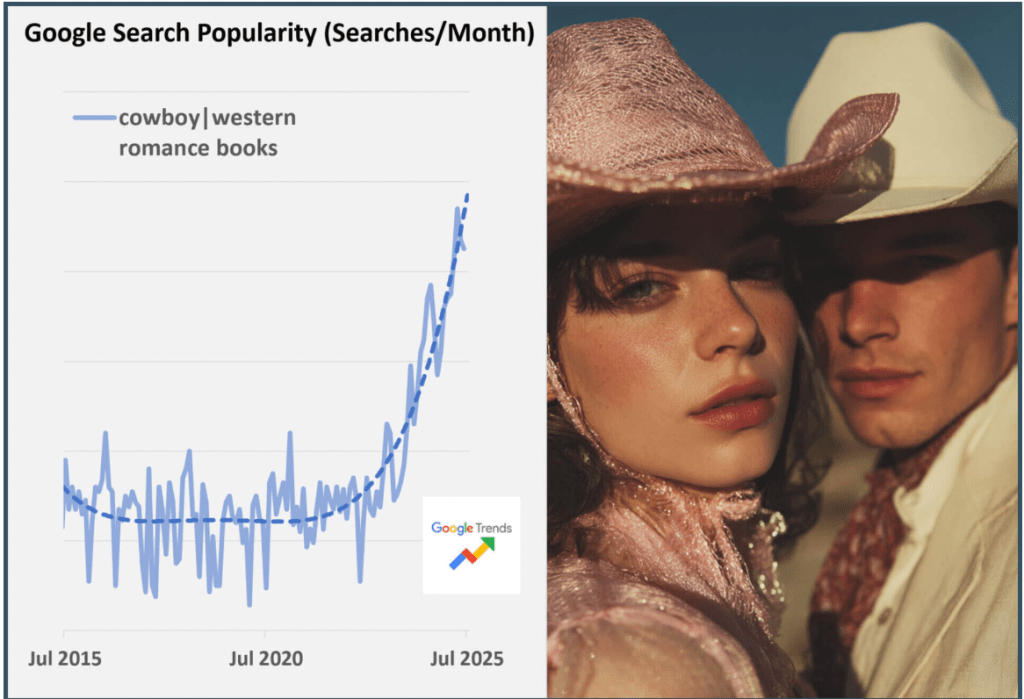
graph on left showing uptick between 2020 and 2025 of cowboy romance. on the right, a sexy cowgirl and sexy cowboy both wearing cowboy hats

If you want to buy Alex’s newest report, you can find it here. In the past they were $37 and now they’re $57, I believe, but he offers a lot of information. This is not an affiliate link: https://k-lytics.lpages.co/western-romance/. I like watching them but I have a Mafia report from two years ago that I haven’t watched, so it’s pretty obvious I don’t make the time and shouldn’t waste the money.

Authors Guild Webinar
There’s a free Authors Guild webinar that looks interesting that also popped up in my email. It’s called How and Where to Find Your Readers and it’s on Wednesday, August 27th, at 2pm EST. Someone on Threads asked me if there would be a replay, and though the information doesn’t say that there will be (that I could see), they usually put a lot of their content on their YouTube channel. Here is the registration link if you’re interested in attending the webinar: https://us02web.zoom.us/webinar/register/WN_z9jduvBMTL-wsm77dcFMjg#/registration You don’t have to be an Authors Guild member to attend.

You can also subscribe to their YouTube channel as they have a lot of content there as well: https://www.youtube.com/@AuthorsGuild

The Anthropic AI Lawsuit
You all might have heard that Anthropic was found to have legally obtained thousands of books and other work from pirate sites such as LibGen and Library Mirror. There was information going around that if your books were included that you could join the class action lawsuit. If. If you had filed a copyright for your work with the Copyright Office. That little piece of information was hidden in the Threads posts and other bits and pieces I read about it, but Craig Martelle was very upfront about it in his Facebook group, Successful Indie Author. I realized it’s because it’s just one of those things people assume an indie author will do. [Cue the Chrissy Teigen meme where she’s grimacing in the audience.]

Applying for copyright was something I planned on doing when I started my pen name and then, I guess you can call them excuses, I lost focus because of COVID, my health, and other things going on at the time. Not to mention price. After paying for what we have to pay for, adding another expense, and one that didn’t seem imperative, was a lot, and I just . . . didn’t. Now I’ll be paying for that along with many, many, many other authors who don’t bother because if whoever is behind this class action lawsuit wins and damages are paid out, they won’t be paid out to us. It’s really a “coulda woulda shoulda” moment, and you can’t go back to retroactively submit your copyright because you have to do it within three months of your book being published. And I don’t even mean that in a skeezy way of trying to become a part of the lawsuit, just simply going back to fix your mistakes. Along with having a membership to the Alliance of Independent Authors, paying for your copyright is probably a good idea. There are so many scammers and thieves out there now. Authors need all the protection they can get. If you want to read more about that, you can find it on the Authors Guild website here: https://authorsguild.org/news/anthropic-ai-class-action-important-information-for-authors/

What’s next for the rest of 2025?
It’s a little early to be thinking about the end of the year, but September is just around the corner, and once the holidays hit, it’s game over. So, in recognizing that, I’d like to try to write another book. I have Bitter Love pretty much plotted out in my head. I’ll have to fill in some blanks as being a “planster” that’s expected, but I know the major plot points. How it ends right now could go either way, not the HEA part, but where they end up, you know. When I write my small town romances, sometimes they stay and sometimes they don’t.

If I can start on Bitter Love September first, I’d have to write 5300 words a week to write a 90k word book. That actually sounds pretty doable, considering in the past I’ve been able to write 5000 words a day, but now with changes at my work, I’m not sure what kind of word count I’ll be able to produce. I have a really difficult time writing on the days I work–my ten hour shifts don’t leave me a lot of time and by the end I’m exhausted anyway–and the days I don’t are filled with chores, errands, and other pesky things that make up life. So, while that 5300 word count cheers me because it doesn’t sound that bad, I’ll have to see what reality lets me do. But that is the goal so we’ll see what happens. Especially since this book might not be that long. There’s no mystery in it, just a bunch of garbage my characters have to deal with, so maybe it would be a nice change if my book came in at 75k words or so. I won’t know until I write it, but I’m not put off by the idea.

I guess that’s all I have for this week. Overall things are good. Health is hanging in there, nothing bad is happening with my car. Pim is a little jerk (I mean that very affectionately) and she hates being alone, but I think we’re all still getting used to each other and there’s a chance yet she could quiet down. I hope she does because having to feed her breakfast around 4am isn’t awesome, and sometimes, like on the days I know I have to get up for work, I can’t always fall back asleep. My son has been good with getting up with her, too, and sometimes when I finally get up, he’s asleep on the couch. Not great, but I love having a cat again, so you just have to deal.

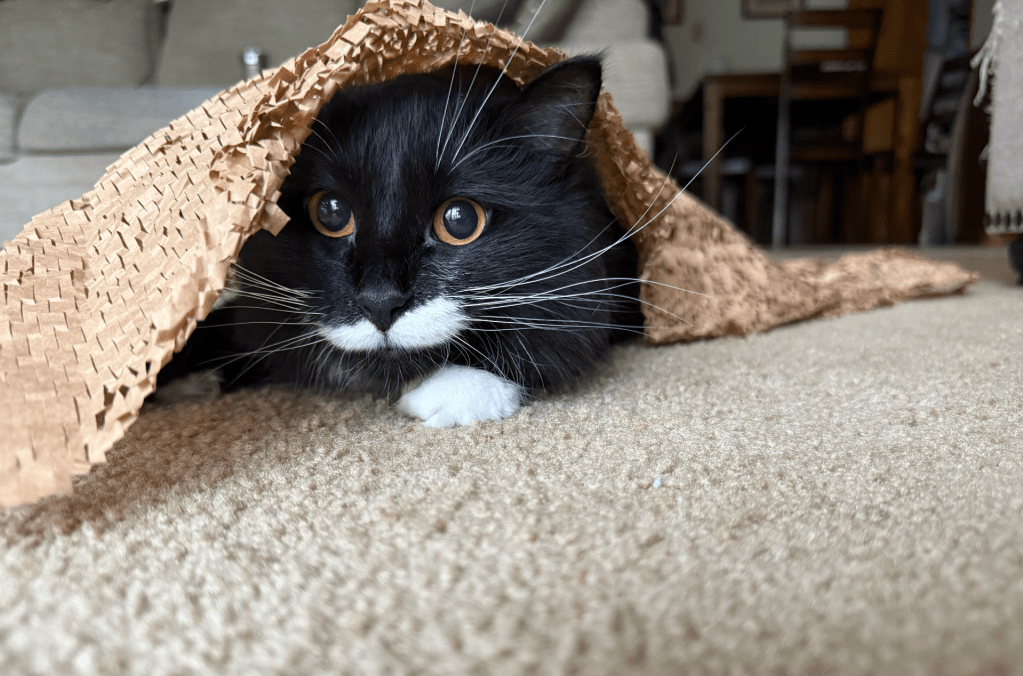
Here’s Pim for the pet tax. She loves that piece of packing paper.
Enjoy the last little bit of August, and I will talk to you next week!


Thursday Thoughts: Social Media

1,396 words
7 minutes read time

sell phone with chalk drawings depicting social media icons like cloud, envelope, speaking bubble and envelope. different colors: yellow, teal, and purple. text says, thursday thoughts: social media

So, a couple things caught my eye this morning while I was having coffee trying to wake up. Thursdays are my Mondays and I don’t always handle the mornings as gracefully as I should. Becca Syme says maybe not opening social media (or checking your sales dashboard) the minute you open your eyes could help, but for now this is my way of easing into my day.

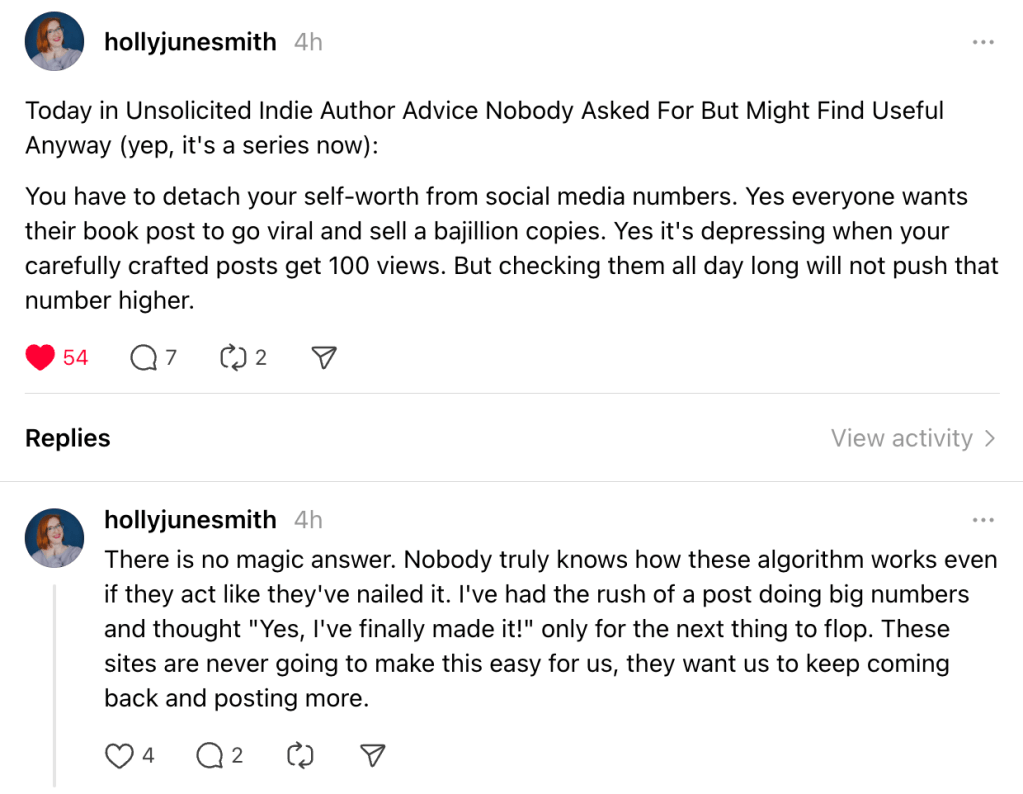
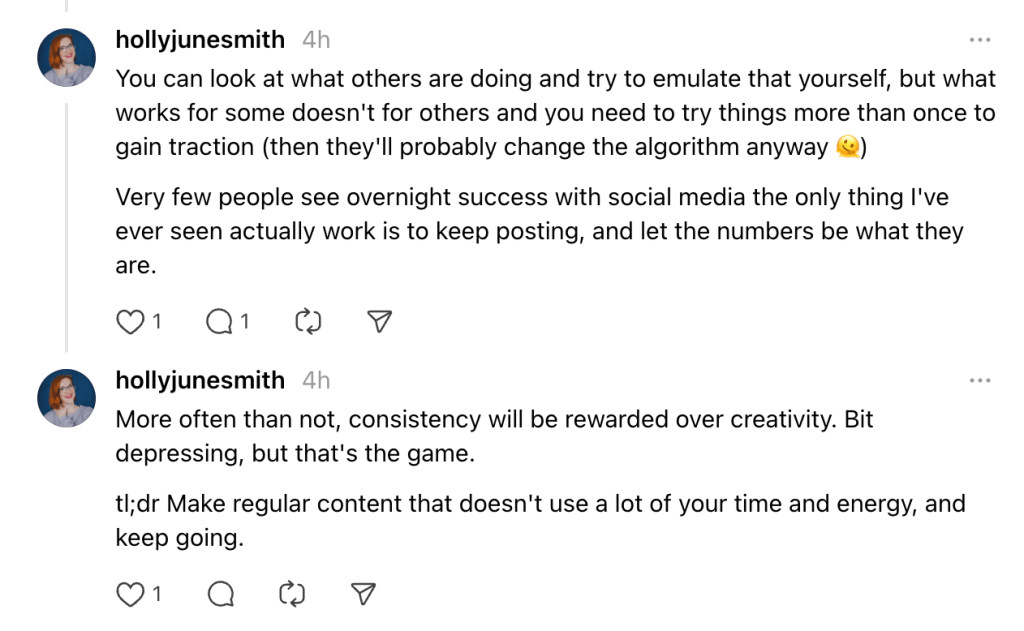
The first thing I saw this morning was this lovely Thread by Holly June Smith (typed out in Alt text):

Snapshot of a thread:

Hollyjunesmith
Today in Unsolicited Indie Author Advice Nobody Asked For But Might Find Useful Anyway (yep, it's a series now):
You have to detach your self-worth from social media numbers. Yes everyone wants their book post to go viral and sell a bajillion copies. Yes it's depressing when your carefully crafted posts get 100 views. But checking them all day long will not push that number higher.
There is no magic answer. Nobody truly knows how these algorithm works even if they act like they've nailed it. I've had the rush of a post doing big numbers and thought "Yes, I've finally made it!" only for the next thing to flop. These sites are never going to make this easy for us, they want us to keep coming back and posting more.
Snapshot of a Thread:

Hollyjunesmith
You can look at what others are doing and try to emulate that yourself, but what works for some doesn't for others and you need to try things more than once to gain traction (then they'll probably change the algorithm anyway 🫠)
Very few people see overnight success with social media the only thing I've ever seen actually work is to keep posting, and let the numbers be what they are.
More often than not, consistency will be rewarded over creativity. Bit depressing, but that's the game.

tl;dr Make regular content that doesn't use a lot of your time and energy, and keep going.

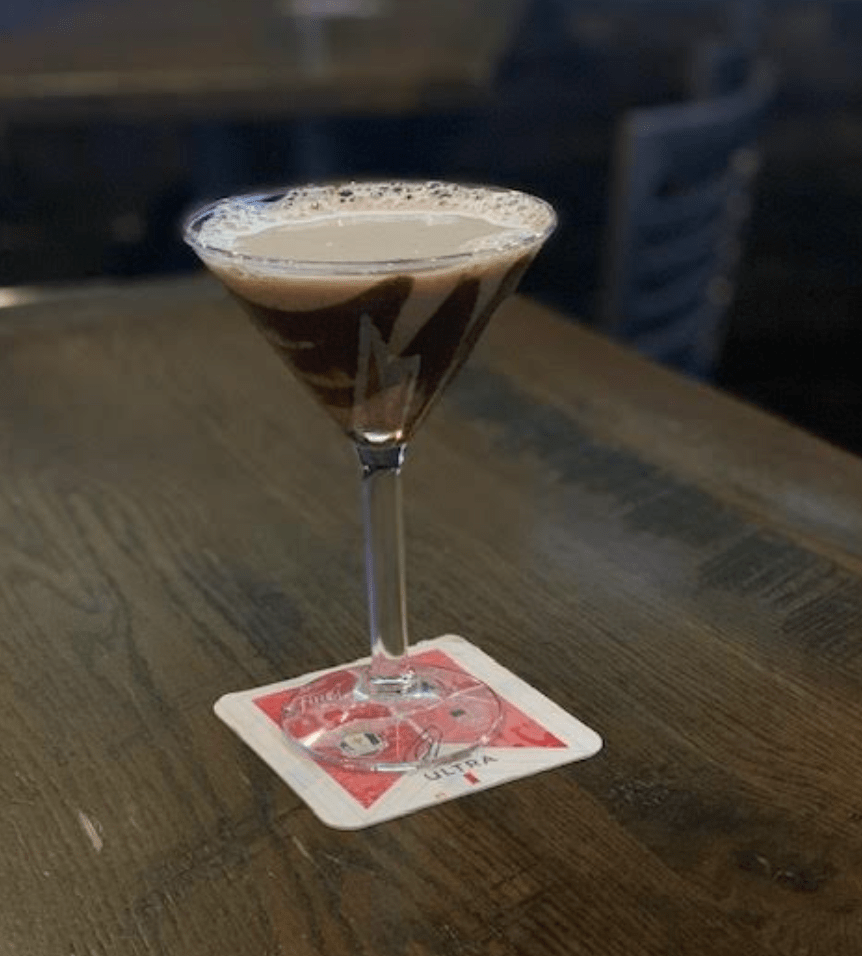
I really love this and what I needed to hear because underneath all the blog posts I write about doing better, complaining about low views when I do actually post, and just overall wondering if social media really moves the needle at all, is the fact I have a really difficult time posting. Even on my personal Facebook profile, I rarely post anything. I don’t care much about “checking in” when I go somewhere or telling people about my day. I don’t take pictures of my breakfast, and if I take a picture of a boozy drink like the one I ordered last night when I went out with my sister…

Southtown Pourhouse, Fargo, ND

…I usually forget to post it and delete it off my phone later. I learned years ago on Twitter that followers don’t add up to a whole lot.

Then right after I saw Holly June’s perfect thread I read someone’s bragging about her social media growth. It made me feel crappy for about two minutes because while she can brag about how quickly her account grew, I have a lot of things I’m proud of that (in my opinion) are more important than that.

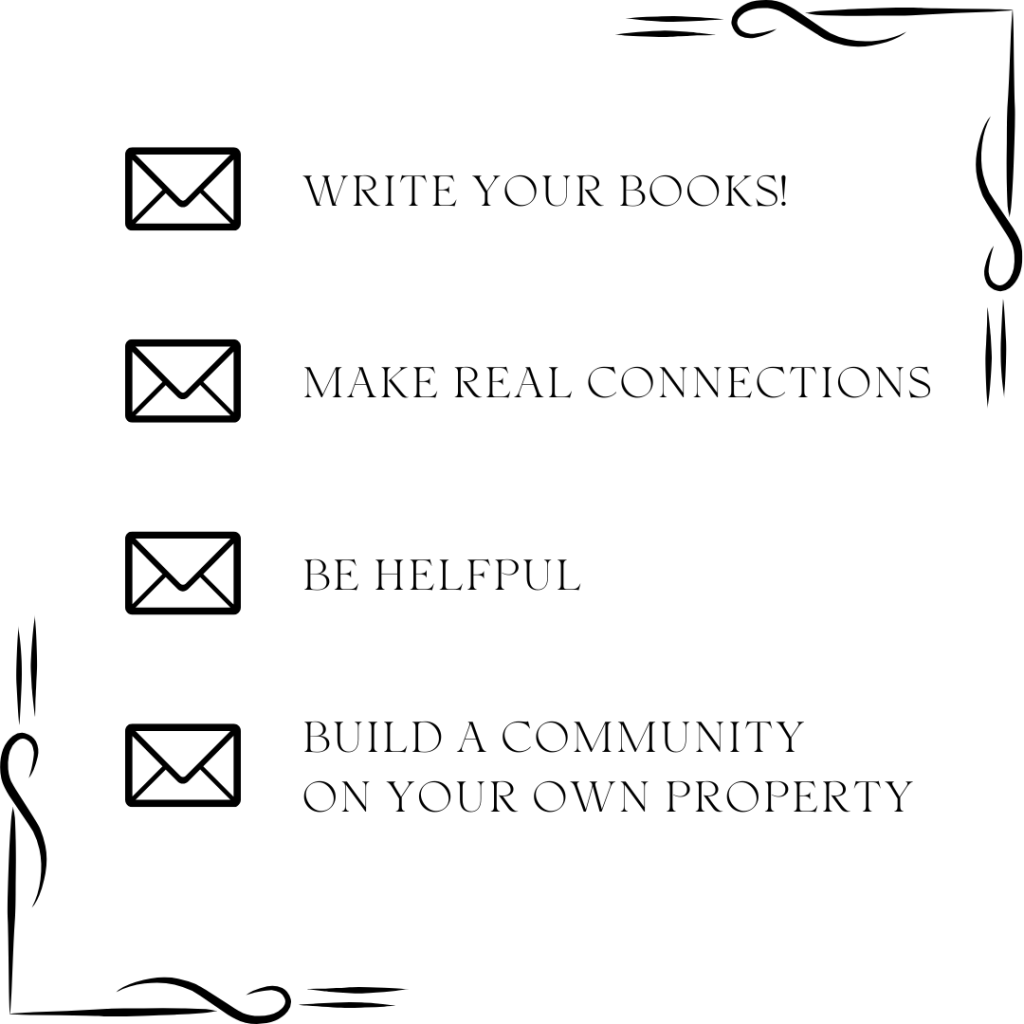
If you ever feel down because your social media growth isn’t what you want it to be, remember what’s important. Here’s a list and you are welcome to print it out and tape it somewhere to remind yourself that there are more important things than follower count.

write your books
make real connections
be helpful
build a community on your own property

each with an envelop  black filigree in corners of graphic

Write your books!
Remember why you got into this game to begin with. Everyone is talking about what will happen when TikTok gets banned, and when you have 40k followers and use that platform to sell books, yeah, it’s going to be a devastating development. I’m still pretty optimistic that TikTok won’t go away anytime soon (I’ll believe it when I see it), but social media platforms and the billionaires who own them are fickle beasts and one way to control that is to keep your eyes on your own paper and write your books. Your books will always be there no matter what kind of social media disappears and what takes its place. I’d rather say I wrote three books this year than say I gained 50 followers or whatever. Remember what’s important. Besides, even if you do have a ton of followers, they can’t buy what’s not there.

Make real connections.
Personally, the only reason I know of to have social media is to make personal, genuine connections. Obviously, 100% of my online friends I’ve met through social media. Though, some have reached out to me through this blog and we stay in touch through email or the messages part of a platform like Instagram. Network with others in your genre, build bridges with those you can help and who can help you. That’s what social media is really for. (I’ve said for years if you’re not connecting with other authors and using it to find out important book news, you’re using Facebook wrong.) I’ve been friends with a handful of people for several years that I met on Twitter and I wouldn’t have met them if I hadn’t be a part of that platform.

Be helpful.
It’s going to sound dumb, but helping my friends and other authors is probably the most important part of this whole thing. I learned how to do book covers, I have Vellum and learned how to use it. Now I help other authors who can’t afford to hire out those services. I edit for people when I can. I beta read. I like helping people and between that and writing my books, publishing them and hearing feedback from readers that they loved the story, those are the two most important reasons why I keep writing and publishing. It’s why I keep coming back to this blog every Monday. Just the other day I got a message on Instagram from someone who thanked me for writing the Canva tutorial on how to make a full paperback wrap. I’d rather have someone reach out and thank me for giving her the tools she needed to publish her book than a million followers.

Build a community on property you own.
I can’t stress this enough. Like the future of TikTok and what Musk did with Twitter, you never know the outcome of some of these platforms. Some seem to be around to stay, but for every platform that hangs on, there are more that don’t like MySpace and Google +. As an author, even if you don’t want to hear it, build your reading community on land you own and that way it doesn’t matter what social media does or doesn’t do. Create a website, blog on it if you want so you can build SEO. Start a newsletter. Collect those email addresses and back them up often so no matter what happens to your aggregator, your readers are yours to keep. Sometimes we put our energy into the wrong place. I’m not saying building a following anywhere, like TT or your Facebook author page, is a bad move, but also have a plan B, because just like we say about Bezos, they don’t care about you. The last thing Mark Zuckerberg cares about is your book business. You have to take it upon yourself to find a way to stay in touch with your readers that doesn’t depend on anyone else. If you have an FB page, frequently remind them to sign up for your blog or newsletter or as an alternative, tell them to follow your author page on Amazon. Amazon may not be around forever either, but if they don’t want to give you their email address, I think a follow over there is the next best thing. Now that Zuck owns Instagram, Threads, and Facebook, when their servers go down, ALL that goes down. Having a way to reach your readers that doesn’t depend on someone else is a must. It really is.

You can get down looking at other authors’ follower counts, but behind the scenes, those followers might not be doing anything for them anyway. I know my followers on Twitter didn’t, but I also made friends and that’s what really counts. Post if you want, find joy in sharing your work with others. I’m not saying having a social media account and trying to gain followers isn’t valid, it can be in this world of being online, but it’s definitely not the end all be all of your publishing journey. I have to remind myself of that when I see others’ social media accounts exploding and mine is a stagnant mess. But I’ve accomplished a lot in the past year. I’ve finished a 6-book series and started publishing those books. I’m editing a standalone that sounds so good, and the cover I’m tweaking is a perfect match. I’ve picked up a reading and formatting project I’m going to start working on soon.

I’m on social media. I like talking to other authors, talking shop, supporting them in bite-sized Threads pieces. I’m trying to like posting on my FB author page, even if my reach is bad and my engagement isn’t any better. But with anything, what you put into it is what you’ll get out of it, so I’ll keep posting my favorite lines out of my books, talking about my books, and my life as an author. If those posts find fans, they do, and if not, that’s okay. I’ll keep editing Loss and Damages, and it will be a solid addition to the backlist I’ve written over the years.

And unless I’m starving, my breakfast won’t have anything to do with it.

Come back on Monday. I’ll have my usual post and I’ll be talking about the 2025 Written Word Media publishing predictions. Have a good weekend!

Fake It ’til You Make It (Or something like that.)

cinderella's glass slipper with text tha says fake it 'til you make it
It worked for Cinderella

Words: 2974
Time to read: 16 minutes

A lot of people wonder, when they start the publishing game, just how long and just how much money it’s going to take until you “make it.” And without muddying the waters with things like “success is what you think of it” or “every sale counts” let’s assume that “making it” is earning a full-time wage. That will be different for different people too (I could do a lot with an extra 30k a year) but let’s go with 50k since the group 20booksto50k put the number out there.

When you’re getting your book, or books, ready to publish, you can put as little or as much money into your product as you want, and chances are unless you publish a real stinker of a novel, the quality of your book will be just fine. Maybe you’ll be shocked to hear it, but when you look at books that have taken off, they aren’t literary masterpieces by any means. So, if you’re looking at editing, do I think you need to spend $1,000 on a developmental edit, $600 on a copy edit after you’ve made changes, then $200 on a proofread? No, and the people who say that you should are probably other authors who are snobs and editors who want you to hire them. I don’t believe you should publish without some kind of feedback, even if you just ask your spouse to read it to look for plot holes, unless you’ve been at this for a long time and have found your voice and you know what your tics and weaknesses are and can edit them out on your own. If you’re patient enough, shoving your book in a drawer for a month can go a long way to reading your manuscript with fresh eyes. Make use of critique partners and beta readers, catch typos on your own by listening to your manuscript and proofing the proof (mistakes really do jump out at you when your book looks like a book). So, the bottom line is, pay for the editing you can afford or think you need and use free where you can get it.

This also applies to covers–some authors make their covers for as little as $7.00 to buy the stock photo from DepositPhotos and use the free Canva plan, some spend hundreds, even thousands on a cover from places like 99Designs and Damonza, or hire artists for one-of-a-kind art. Of course I believe people judge books by their covers, but your cover is only going to be as good as what’s inside. I knew someone who used Damonza, and his cover was beautiful. I tried to read his book in KU to support him, but it was all telling. He had an entire trilogy in 300 pages because of all the telling. If your book isn’t good, the most beautiful, expensive cover in the world won’t help it take off. Your readers will review, your star rating will tank, and even if you can sell a book, that reader won’t enjoy it, she’ll think she wasted money and never buy you again. I think you can find a happy medium when it comes to covers. GetCovers is inexpensive, they do a decent job, and you’re supporting Ukraine. Or buy a premade for $100 dollars. It’s more important to know what the trends are and what other top authors are doing in your genre than how much money you put into your cover. Do your research because being original isn’t the flex you think it is.

Formatting doesn’t have to be complicated, and while you might want the fancy chapter headers, be honest and admit it’s for yourself and not your readers. I don’t sell many paperbacks, and ebook formats can’t support the fancy stuff authors are always talking about. Ebooks don’t have “pages” and frilly extras don’t apply. So you can pay the $300 for the formatting that will have black pages or full-spread graphics, if you think you’re going to put a lot of energy into selling paperbacks to get your fee back, or you can pay $50 for a simple formatting job. Or you can do it yourself for free using Draft2Digital’s free formatting tool, or Reedsy’s, or upload a Word document. It’s all up to you. I wrote about formatting and gave a lot of resources in this blog post, and you can read it here: https://vaniamargene.com/2022/08/22/formatting-your-paperback-books-interior-tips-and-tools-that-can-help/

That’s packaging your book, and there are always more things you can spend money on like an author logo, the ISBN, or registering your book with the copyright office. When I started my pen name, I swore I would start registering my copyright, but then the fee went up from $35 to $65, and I lost my resolve. If you’re not putting out many books, maybe the $65 dollar fee isn’t that bad, but it can add up if you’re publishing six books a year. Here’s the fee list if you want to bookmark it. https://www.copyright.gov/about/fees.html

I didn’t do a very good job explaining how much it costs to get a book ready to go because depending on their choices, costs can vary from author to author. Some want to bootstrap it because they don’t know if they’ll earn their money back and some don’t care. Some have disposable income and paying for services isn’t a big deal, some can barely afford the seven dollars to buy a stock photo. Some have a huge network and don’t pay for anything because they have a lot of free help or they’ve joined something of an author’s co-op where they all trade services. If you’re like me, pretty much doing this alone, do the best you can. You might be surprised your best is better than you think it is.

Once you have your book ready, reviews are kind of important. I don’t believe in the magical number of 50, but I think if you’re writing commercial fiction, putting your book on a place like Booksprout (there’s a small fee) would give you a few to start out. I didn’t with my duet and published without any, and now Captivated by Her and Addicted to Her are my poorest sellers. I’ve tried doing free promos for Captivated, but I think I ruined any momentum I could have had not launching with a few reviews. Maybe it’s circumstantial, but my other books always had a better launch maybe because I put them on Booksprout first. You never know.

So what do you do after you publish your book? How many times do you have to do that to “make it?” How much money do you throw at marketing to make your book sticky enough to quit your job? The sad part is, I don’t know or I would be doing it. I’m at a point where baby authors would probably envy me my sales dashboard, but authors who knew what they were doing from the very beginning and have been making six figures for the past few years would be unpleasantly surprised if they woke up to my numbers.

Even going viral, in some cases, won’t help. Chelsea Banning (and I’m not picking on her or throwing her shade in any way. She’s an interesting case study because I watched in real time how that all played out and what happened afterward.) went viral on Twitter after Stephen King quote-tweeted her. Suddenly, she was everywhere, from USA Today to doing a video call on the Kelly Clarkson Show. But when something like this happens, not a lot of people are prepared to keep it going. Having a backlist helps because your sudden popularity will lift up all your books. If the timing is right and you have a new book ready to go, that will boost the algorithms too, as will throwing your unexpected royalty money at some ads (you’d have to borrow from yourself because of how Amazon pays out, but I think in this instance you’d be okay with that). But if you only have one book out, don’t have another ready to go, even if you run ads, you may not be able to keep the momentum going. You can save up a little money, maybe have a few hundred to a couple thousand depending on how viral you really went, to throw at your next book, but you need to be in the right place and be in the right mindset to make the most out of going viral. We all want it, but I don’t think we understand what the rewards and consequences of going viral can entail. At this point in my career, I would love to go viral (in a positive way). I have a few books out, trilogies that have good read through and standalones that have a number of decent reviews. I have a six-book series about to drop, and I have a newsletter (blog) in place to capture new readers. But even I would question if I have what it takes to keep that going–after a while, you get burnt out. Posting on social media to stay relevant is time consuming, and if you’re scrambling to get another book ready or to set up a newsletter because you didn’t have one, creating graphics for Instagram or your FB author page may not be on your list of priorities, especially since more than likely you have a full-time job and maybe some kids and a spouse you’d like to see every once in a while. I brought up Chelsea only because going viral didn’t seem to help her in the long run. She might have been able to put away a small nest egg, but on Threads she was asking people to buy her book because her husband had gotten laid off or some such, and she does only have one book out right now so while going viral must have been exciting, it was only a blip in her career. I wrote a little bit about her here: What I learned from an author’s literal, overnight success

And it’s really hard to say how many of those readers stay with you, or if they bought your books and interacted with you to taste your fifteen minutes of fame. Going viral is a flash in the pan, and no doubt helpful, but how can it compare to writing and publishing consistently for many years and organically attracting readers who love your work? Though I doubt anyone would turn down going viral–that’s like saying you wouldn’t take a $100,00 dollar jackpot because you were disappointed you didn’t win a million dollars.

So let’s go back to the question, how long do you have to fake it before you make it? And the honest answer is, I have no idea. Some unlucky authors fake it forever and don’t truly make it. And why they don’t make it is going to boil down to what they’re doing wrong on an individual basis. (I talked a little about this in my transparency post, and you can read it here: https://vaniamargene.com/2024/02/29/the-magic-of-transparency/)

I mean, obviously, there are things you can do to up your chances of consistently selling books:

Write in a popular genre and package it properly. Romance, Thrillers, Sci-Fi/Fantasy, maybe? I haven’t watched a K-Lytics report in a while, so I don’t know what the numbers are, but there are some genres that are harder to make a go at it, like horror (that’s not YA–I think Goth Cottagecore is having a moment right now) or speculative fiction, literary fiction. Like that. You’re already making it hard on yourself by choosing a genre that’s not already a bestseller.

Put up a website and start a newsletter/blog then put that link in the back matter of your books. I always have to qualify that now since I moved my newsletter to my blog, but start something where readers can find you and subscribe for updates. But do more than just start one. Keep it updated. If you’re putting out a book a year, you may think you have nothing to talk about, but doing character sheets, character interviews, talk about where and why you chose the setting you did, etc, can fill up a post a month. You can also do author interviews to keep your name out there.

Learn an ad platform. If you only have one book, it might seem repetitive after awhile, but ads are the best way to shove your book out into the world, especially if you don’t want to put it on sale or use any free days (and why would you? You want to make money.). There are millions of readers and you can run ads indefinitely so long as your spend doesn’t outrun your royalties. You can spend (waste) a lot of money if you don’t know what you’re doing. I would start with a solid list of comp authors–this will help whether you run FB ads or Amazon ads. Make sure your keywords and categories are solid and that your book’s cover, title, and blurb complements them. Figure out how much you want to set for a budget. Go slow and see what happens.

Network with authors in your genre, not just authors in the writing community. Romance is big for opportunities such as newsletter swaps, promos, anthologies, auctions, collaborations, and just genre news in general. I missed a lot of chances for exposure because I got sucked into the writing community on Twitter instead of meeting and getting to know authors who write romance. I’m getting better at it now, spending time in romance groups on Facebook, but I should have been introducing myself many many years ago.

One of the pieces of advice I hear from big indie authors is to have multiple streams of income. If you can’t do it now, that’s fine, I’m not in a position to right now either, but if you have an ebook, a paperback, and audio, that’s three ways, setting up a Patreon could be another, going wide rather than enrolling in KU could be one, starting a podcast that businesses could eventually sponsor could be another. Even adding a Ko-fi link to your social media profiles could be one, or maybe editing/beta reading on the side. If you already don’t have time to be working on what you need to be working on, absolutely none of this will sound appealing, and that’s okay. But if you look at what the big indies are doing, I’m thinking of authors like Joanna Penn and Lindsay Buroker, they have money coming in from a lot of places like translations. One day I would just like to add audio, and that’s a long ways off.

So, you can ask me the question again…. how long do I have to fake it before I make it? And does spending more increase my odds of making it? I’m just shaking my head and shrugging. No one knows. I know what to do to increase your chances and I implemented some of those things myself, but the only thing you can really do is publish your best book and publish your best book as often as you can. Build a backlist because the more product you have to sell the more you sell. Always be working on the next book. That might not get you to 50k in a year, or five, maybe not even ten. I’m on year eight, but I don’t know if not making the mistakes I made would have helped. It’s difficult to watch authors zoom ahead of you, and I have. Two that come to mind are Cara Devlin and Elizabeth Bromke. I met them on Twitter, both when maybe we are around the same level. All of sudden they took off making full-time earnings from their books. Then I see some of the authors who have been around for as long as I have, or even longer, who are still in the same place, maybe because they let their lack of sales get them down and they don’t write much anymore, or their covers and/or genres are just off the mark, or they don’t have money for ads and depend on free social media to get anywhere, or maybe life just got in the way and before they knew it, two years went by and they haven’t opened their Word document.

The problem is, we all write such different books, have different resources, have different lives, that someone like Elizabeth (who writes romance/women’s fiction) could tell me exactly what she did, and maybe I would pick up something here and there, but in the end, I’m not sure it would get me anywhere. She hires an editor and cover designer, but if she lives a life where she could afford that before she started making money from her books, that’s two strikes against me, so we could stop writing out the list already. I mean, it’s nothing to get bitter about–I’m sure there are some people who read my blog get a little annoyed when I recommend running ads. Spending ten dollars without a guarantee of ROI is a stretch and a luxury they can’t afford. I get it. So some of us, through no fault of our own, may be blocking our own paths to success.

I’ve given up the idea that I will ever make a full-time author’s wage. A lot of authors don’t–trad and indie–and not because their books aren’t good or they didn’t go viral. They weren’t at the right place at the right time, or they never wrote a book that hit the market just right. But as I always say to myself with every new release, maybe this will be the one.

It never is, but all you can do is keep faking it.

author photo

Being a Career Author. Do you have what it takes? Wrap Up!

In this blog series we’ve been going through a survey by Written Word Media, and what it takes to be a career author. They surveyed authors who are emerging authors, authors who make 60k and authors who make 100k from their writing.

I went through their points as an emerging author who has six books in her library and I make less than $2,000 a year from my books. They went through how much authors spend in editing and covers. It’s no surprise that they found authors who put out quality books make more money.

They went through how they marketed, with easy and affordable promo sites heading the list.

They surveyed authors about being wide or exclusive and found it didn’t matter – authors still need to take time to build a readership no matter where they publish.

They also went into the time authors write, which not surprisingly, revealed at 60kers and 100kers spent the most time writing. In that blog post I tried to hammer in to the emerging authors that to make the leap from emerging author to 60ker, you still need to put in the writing work, no matter how many hours you put into your day job or how tired you are. Career money requires career time.


There are some variables as to why some authors make more than others, and the bonus material revealed some of these differences.

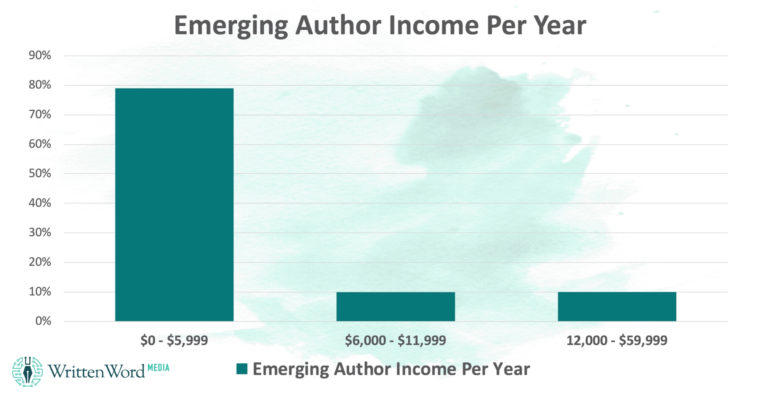
But first if you were curious about the amount of money an Emerging Author makes, take a look:

The difference between the emerging author and the 60ker. It’s quite a leap to be sure. If you’re single, you don’t need to make 60k to support yourself. At least in my area, you can get by okay on $30,000 a year. You’re not living in the lap of luxury, but a nice two-bedroom apartment with its own washer and dryer runs about $700/month. As an emerging author, even if I made an extra $300 a month, that’s a car payment on a newer car I desperately need. You can take a look at the graphic to check how much an emerging author makes.

EA-Income-768x400


Now for some of the reasons why one author would make more than another:

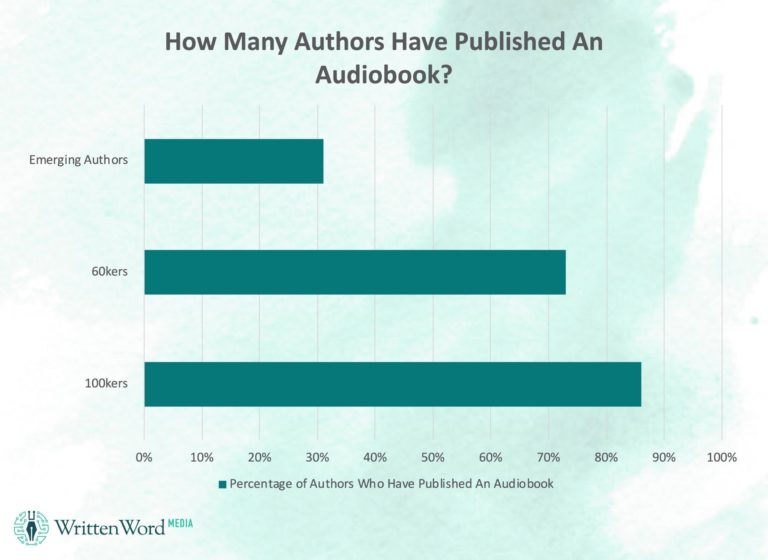
  1. Audiobooks. While audio is on the rise and it’s easier than ever to hire a narrator and get your audiobook out into the world, there’s no point in spending the money if the e-book isn’t selling. It makes sense to invest in audio if your book takes off, but if it doesn’t, there’s no point in spending the money to make an audio version. So while audio is a great supplement for 60kers and 100kers, they were already selling books and the audio is a complement to their library. Also, when audio finally fits into your publishing plan, indies now have their shit together and release the paperback, ebook, and audio all at the same time.

    Audiobook-s-768x560

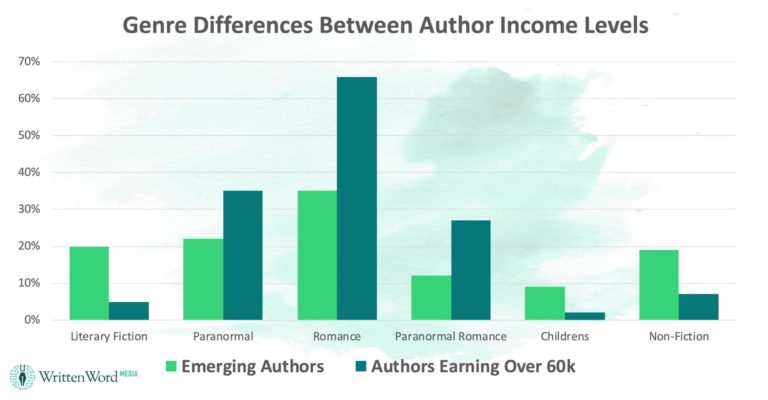
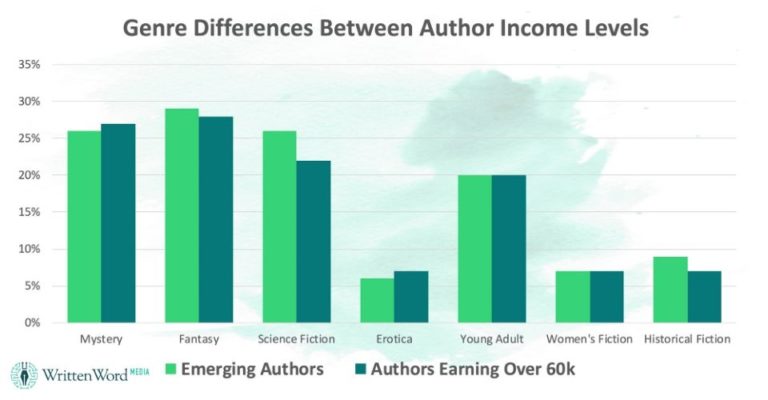
  2. Genre differences. I’m surprised they didn’t add this to the original survey because the genre you choose to write in is really important. As you can see by the graphics, authors made the most writing commercial fiction. Romance took the lead, and mystery, science fiction, and fantasy follow closely behind.

    Genre-Differences-768x400Genre-non-Differences-768x400
    Children’s books are a hard sell as they depend heavily on print, bookstore and library sales.

    Young adult is broken into lots of sub genres like fantasy and romance, and broken down further into sub sub genres like coming of age, new adult, or college. I don’t see many indies right now writing plain YA like Five Feet Apart or The Fault in Our Stars. They tend to lean more toward dystopian or fantasy like the Hunger Games or Harry Potter. At least, that’s what I get from seeing what others on Twitter are writing about. (Agents turned authors are the ones writing vanilla YA like Eric Smith’s Don’t Read the Comments. Maybe because they have their fingers on the pulse of the market and they’ll write what sells. Who knows.) If you look at indie romance YA, they tend to lean toward paranormal or urban fantasy. Paranormal Academy is hot right now and that usually includes a younger MC. It’s difficult to completely separate the genres, especially since indies like to mash as many genres together as possible.

    And with Amazon allowing you to choose 10 categories for your books, there’s a lot of space to move around.

    We can all agree that while you can make money writing nonfiction, it’s a lot different than writing fiction and it takes a different set of skills to market it. Authors like Bryan Cohen who wrote How to Write a Sizzling Synopsis, Mark Leslie Lefebvre who wrote Killing it on Kobo, and Brian Meeks who wrote Mastering Amazon Descriptions, all have solid foothold in the indie community and pretty much have a built-in audience. They’ve been a part of the indie community for many many years, and they have the platform required to succeed.

    In my experience many indies who venture into non-fiction write creative nonfiction also called memoir. Let’s face it. Everyone’s life is hard. I could write a book about how I survived my divorce, but that wasn’t anything special. I just joined the 50% of other American couples who also have divorced. Hardly book worthy. Unless you have something super special to say, it will be difficult to be the next Michelle Obama.

    Most emerging authors have no platform, and that’s what you need to get a nonfiction book off the ground.

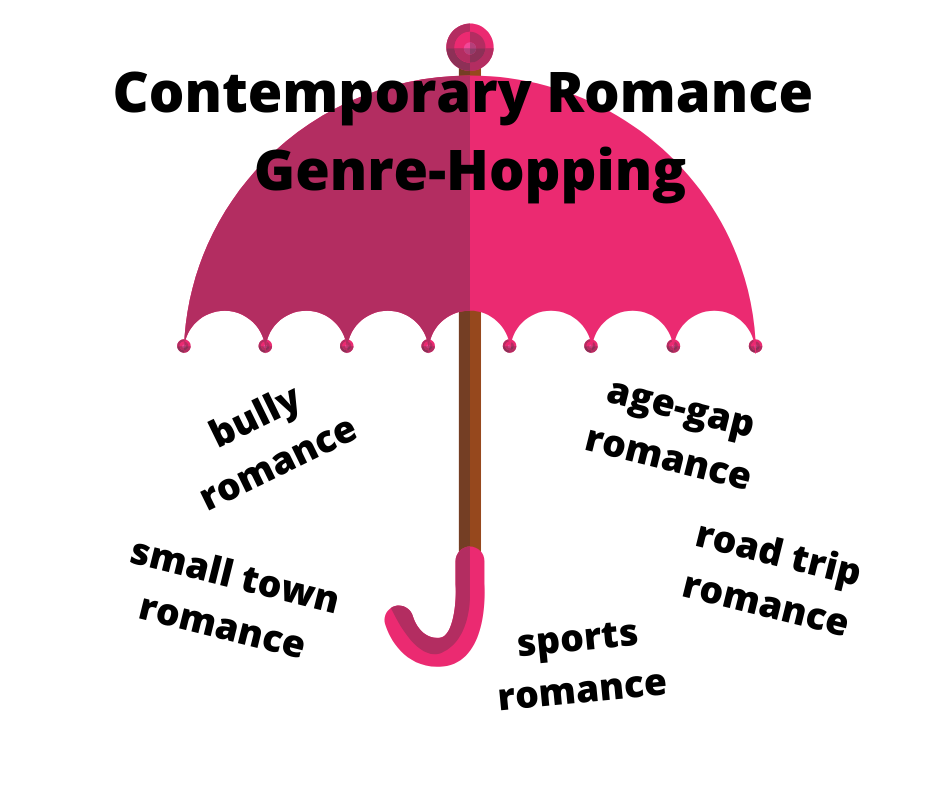
    When you’re an indie, it makes a difference what you choose to write, and, not only that, what you keep writing. Genre-hopping has never done an emerging author any favors, either, something I am finding out subgenre-hopping under my Coming soon!-2contemporary romance umbrella. From what I can see, the most successful indies stay within the same sub-genre like Aidy Award and her curvy girls or Alex Lidell’s academy books. Even Jami Albright writes romcoms and makes a killing with her Runaway Bride trope.
    Mystery, too, is seeing more segregation with subgenres, and authors who choose to write run-of-the-mill detectives might always want to stay with that, only moving the setting to other states, different police departments, and other tragic backstories.

    Indies do like to go their own way, though, and I like to write the stories I like to write as well. Hopefully we can all find a happy medium between writing what we want in writing what sells.

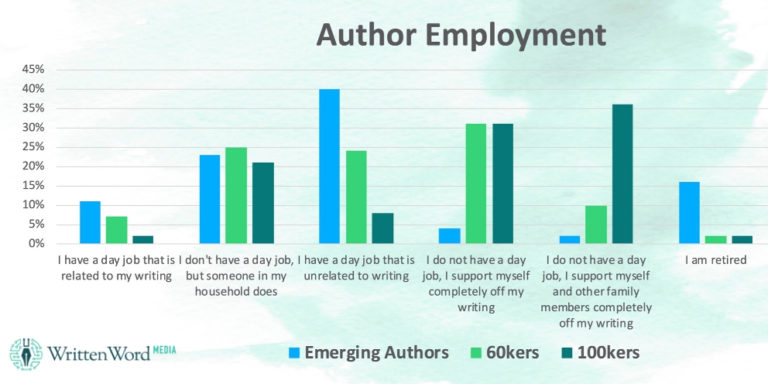
  3. The last point they went into was if the authors had a job outside of their writing. It’s not surprising emerging authors worked. Bills need to be paid somehow. The problem with needing to work is that sometimes your day job is so emotionally draining you don’t have any emotional energy left to write. I’m lucky that I can write and read at my job and that it isn’t emotionally draining. But I do trade that luxury with a lower wage and only because I have help paying bills can I continue to do so. I’m working hard to write as fast as I can to build my backlist so I can eventually hop from emerging author to 60ker. Eventually the sacrifices I’m making to put so much time into my writing will pay off. I’ll make sure it does.

employment-1-1-768x384


Even though they did add some additional data, they did leave out some other variables that I find are important in making an author successful.

  • Newsletter. The survey mentions newletter swaps saying that swaps aren’t an effective marketing tool. But that’s only swaps. Swapping implies an author has one to begin with, and I’m willing to bet there is a large gap between emerging authors who don’t have a newsletter and the 100kers that do.
  • The cost of ads. While the survey did go into how authors promoted their books, it’s not often authors reveal how much they’re spending on ads. If you make $50,000 a year but you’re spending $10,000 in ads you’re still doing well obviously, but the amount that author is claiming to have made is a bit deceiving. Bryan Cohen, when he does his mini ads courses, says any profit is good profit. At the core that is true. But if you have to babysit your ads so you make $2.00 for every $1.75 you spend, at some point you have to decide if you’d be better off writing. Ad creation takes time, especially when you need to take the time to write (or learn how to write) catchy ad copy. If you start a newsletter and add the link and call to action in the back of your books and pay for a promotion now and then, you may find that a bit easier, and a little less terrifying, than learning an ad platform and watching your ads like a hawk so overnight you suddenly aren’t $50 in the hole because people hated your blurb.
  • Writing in a series. I hate to keep harping on this, but this is also another component that the survey didn’t go into. Readers like series. They get invested in the outcome. They fall in love with the characters they follow through all the books. 60kers and 100kers know that and they capitalize on it. Emerging authors write what they want, and that isn’t always a series. But I would’ve liked the survey to ask its authors how many emerging authors versus how many 100kers write series. I doubt I would be surprised by the answer.
  • Frequent publishing. The survey didn’t go into how often authors publish. It stands to reason that the faster you put out books, the faster you can make money. But emerging authors have a hard time with timely output. They have their jobs. They are probably still learning craft and the critique partner/beta-reading stages they go through slow them down. Besides Jami Albright, I haven’t heard of an author who is not prolific making $60-$100,000 a year. And she admits she has to rely heavily on ads and other marketing techniques between releases. She knows her limits and embraces them. But you have to wonder if she could write more than one book a year, what that would do for her bottom line. I write as fast as I can, but I am not 100% confident in my ability. So the beta-reading stage slows me down as well, as does making sure of consistency and wanting no potholes in my stories. Maybe one day I won’t need so much reassurance. But I’d rather do it right the first time than pay for my haste with bad reviews.

In conclusion, the money is out there. There are different paths to the pot of gold at the end of the rainbow. But whether anyone wants to admit it or not, some paths are easier than others. Write commercial genres. Publish quality work. Publish often. Start a newsletter. Use promos like Freebooksy and Bargainbooksy to promote your work.

If you’re not doing these things, success may take longer to come. We all make mistakes and maybe telling your story the way you want to tell it is more important to you than money. That’s cool too, but be honest. Writing the story you want, with no editing, using a cover that’s not professional, and tweeting it out day after day won’t earn you any sales. So no whining when it doesn’t.


Thank you for joining me in this blog series where we broke down the Written Word Media Survey and the bonus material they later released. I hope the information given can steer you in the right direction to a productive and lucrative writing career.

Thanks for reading!


end of blog post graphic

Writing to write, or Writing to Publish? Is there a difference?

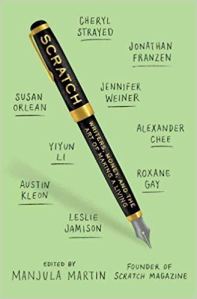
I had another post planned for today, but while I was working an extra shift at my job on Saturday night, I finished Scratch: Writers on Money and the Art of Making a Living. This book is a collection of essays by writers about, yeah, money and writing.

scratch book coverAs an author, I love looking through paperbacks. How is the copyright page constructed? Who did the author dedicate the book to? I skim over the table of contents. Do they use a quote? And by whom? I also look at the Acknowledgements. I like to read who people thank. In the indie world, sometimes I know a person who is mentioned. I like seeing who has helped the writer turn author.

I read Manjula Martin‘s acknowledgments, and something popped out at me. She said:

Thanks to the members of the Blood Moon writing group, who always reminded me that writing is more important than publishing.

She goes on to list names of people whom I don’t know, but I can appreciate their message.

writing is more important than publishing

In this modern time of CONTENT CONTENT CONTENT, that sentence is extremely powerful.

In this age of free books, blog posts, tweets, and author updates, how often we publish has turned more important than what we publish.

This has never been more true than the today with the market being saturated with bookstuffers to take advantage of KU page reads, or authors who team up to publish a book every two weeks, or authors who hire ghostwriters only to blame them when they are caught plagiarizing. There are even those who sell their previously published books to new authors who will strip the book of its title, repackage it, add a new author name, and put it up on Amazon for sale.

What happened to the quality of what we publish?

What has happened to the way we think about our content?

It’s a hard question for me, and I’ve been thinking about this while I’ve been writing my series. I have a different blog post about something similar already, in that I would like to try my hand at women’s fiction. I won’t get into that post now, but that quote does make me think about my publishing journey.

Sometimes publishing isn’t always what we should be doing with our work.

Sometimes we should be writing to practice. Sometimes we should be writing to learn. Sometimes we should write to give ourselves therapy, like writing in a journal or diary, or writing a poem.

Sometimes we should write for fun.

Sometimes we shouldn’t be writing at all. Too busy, burnout, nothing to say. There’s no harm in not writing–even if it feels like there is.

Though indie publishing is becoming more widely accepted (even some of the big-name authors use POD–especially for their non-fiction titles) it may always carry the stigma of people publishing crap.

There are legitimate reasons to write to publish: you’re on a deadline, or you freelance to pay the bills and if you don’t hustle, you can’t eat. But that doesn’t feel like the majority of my writing peers. We write to be published as any of our debut novels can attest.

This not only impacts our own writing careers–who wants to start a lifetime writing career on a cracked foundation?–but if affects all of us a whole.

Write to write, and then publish.

writing is more important than publishing (1)

Lots of people ask writers, “If you were never read, would you still write?” Of course most writers say yes. Writing is a passion, and they would write even if they never had another reader as long as they put words on the page. To be honest, if someone told me from here on out I wouldn’t have a single reader ever again, I would stop writing. There are other ways for me to communicate my passion. I would start running again, or I would volunteer. I would do what I set aside because writing takes up so much of my time. Because I love it. But an audience fuels my love of it, if that makes sense.

Now, if I were told I would still have readers, but I wouldn’t/couldn’t make any money, I would still write. If I was locked into only blogging, or publishing my work on Wattpad, I would still publish my stories. Being read means more to me than making money.

Seeing your book on Amazon is a crazy wonderful thing, and I don’t fault anyone who is damned proud of it.

But sometimes we need to take a step back and ask ourselves why we write. What fuels us? What do we get out of publishing our work? Would we be just as happy, just as proud, if we posted that novel for free, or even more mind-numbing, shoving that novel under your bed?

If we began every project without thinking of the cover art, or who is going to format for us, or when our publishing date is (Hello, Amazon and your one year pre-order deadline now) how would that change our perception of the project? Would we take our time? Put more of our hearts into the piece? Would we dive deeper into the truths of what we want to put down on paper?

Maybe if we wrote to write, writer’s block would be obliterated. After all, if we only wrote for ourselves, we wouldn’t fear criticism or disappointment and the blank page wouldn’t scare us so much.

When indie-publishing is so easy now, we have to stay aware of why we’re writing and what we’re trying to say to our reader.

Open a new document and put words on the page just to write. No agenda. No deadline.

You may find you’ll write something worth publishing.


I loved reading Scratch. There were great essays by some of the top authors. I particularly enjoyed Manjula’s interview with Cheryl Strayed (she talks about her book deal for Wild), and Jennifer Weiner’s essay on earning respect for your work vs. earning money and if you can have both.


Jeff Goins also has a blog post about this topic. You can find it here.


Until next time, lovelies! Have a wonderful writing week!

end of blog post graphic