Author Life Lately: The ol’ bait and switch

1,919 words
10 minutes read time

Author Life . . . is the only life for me. (Just kidding, and no, I wasn’t tipsy writing this blog post.)
Happy Monday, if it is for you. I don’t mind Mondays, they’re a break after working four ten-hour shifts at my job. They usually entail some chores and couple of errands since I don’t have time for much while I’m working. Today I’ll be doing some of that and hopefully listening to more Loss and Damages. I’m halfway done . . . my trip to the Mall of America and the Minnesota State Zoo took up a large portion of last week and I didn’t get anything book-related done, though it was a nice break. I’m not really in any rush to finish it, but after having a heart to heart with a friend, I decided to work on my next series which will be called The Husband List just to get that off my plate. I have no idea how long it will take me to write four books and package them all. I’ve decided to write the four instead of rewriting book one to have only two left because I think it will just be easier to write four more plus it will be a nice addition to my backlist. But the minute I’m done with Loss and Damages and Wicked Games, I’ll be looking through stock photos for men for the covers. Six covers, six men, figuring out the series concept . . . that will take me just as long as writing the remaining four books. I like the idea of it though, so I’m going to jump in and see if I can turn that series into something special.

Besides that, it’s the same old, same old. Summer is coming and the days are getting warmer and longer. I don’t have anything planned for the next three months besides relaxing, writing, and going on a couple of day trips with my sister and daughter. We usually go to the zoo that’s in a town 45 minutes away and to Bismarck, ND, for my sister’s birthday in June. Last year it was raining and we couldn’t go to the zoo there, but we’ll try again this year. I’m kind of a zoo junkie, though I know how sad and inhumane it is for those animals be locked up.

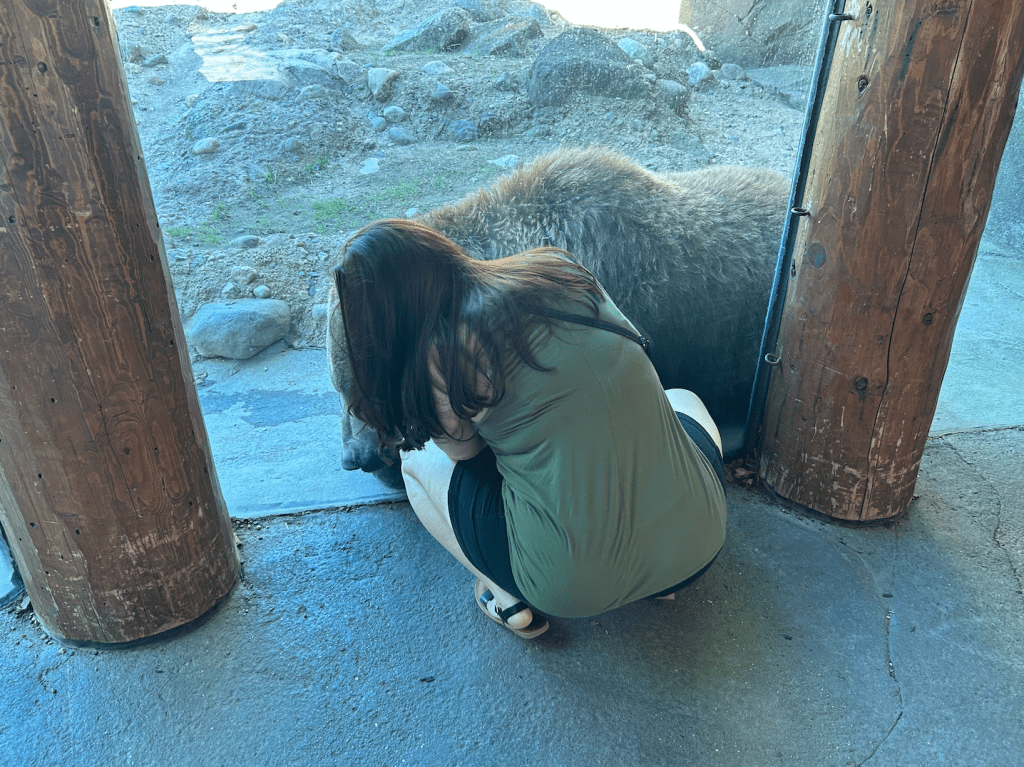
This is me bonding with a tired old bear. I know how he feels.

Russian Bear exhibit. Minnesota State Zoo

It was free, now it’s not, and isn’t that the way life goes?
As far as anything in the indie publishing industry is concerned, Bryan Cohen is doing his famous Amazon Ads Challenge again, but it’s disappointing because he decided to charge this time around. It’s not like anything that hasn’t been done before. There are quite a few indie publishing services that have started off as free and then as soon as they had customers who relied on their services, they changed to paid tiers only. The two that come to mind right off the top of my head are StoryOrigin and Booksprout. So, what Bryan is doing isn’t new, but it makes me wonder if he’s going to be subjected to any backlash or if the new authors who were planning to take his challenge will just pay the $9.00. For the information he gives you, that’s still a bargain, but I won’t be able to recommend his challenge as freely as I used to because if you’re an indie strapped for cash, even $9.00 can feel out of reach. I’m fluent in “poor” and $9.00 to me is three gallons of milk. Nothing to take lightly if you’re struggling paycheck to paycheck.

I also wonder what Amazon will think of Bryan suddenly charging for his challenge. For the past couple of years they’ve backed him and recommended his challenge to authors, and it makes me wonder if they’ll still encourage authors to participate or if they’ll be salty Bryan’s making money off them (or trying to. Who will actually pay remains to be seen). He wouldn’t be the first one to do that, either, so maybe it’s not a big deal. There are plenty of Amazon ads resources out there, including books from Janet Margo who is a former Amazon employee. Bryan’s been under fire in other ads groups on Facebook, some members saying that his approach is just flinging spaghetti noodles at the wall, but his challenge does more than just tell you how much to bid. Probably the most valuable part of his challenge is that he goes through what will actually make your book marketable. I’ve seen some pretty gnarly covers and read some very confusing blurbs during his challenges, and if anything, it makes authors open their eyes and choose covers that will sell, not only covers that they like. He also explains ad copy, page reads, and read-through. But if you’re looking for a book that does the same, Nicholas Erik has updated his book on book marketing, and I found it extremely useful. Also, you can keep his book, whereas Bryan’s course has a time limit even though you paid.

I won’t be paying to participate in his challenge. I’ve already taken it a couple of times and I feel I’ve been in this business long enough to understand what makes your book sell:
1. Good cover. It’s the first thing a reader sees, especially using Amazon ads where you don’t choose your own graphic.
2. Good blurb
3. A title that’s not confusing
3. Strong look inside (first 10% of your book)
4. Strong keywords (the seven fields you fill in when you set up your book to publish)
5. Categories that actually match your book’s genre
6. A list of comp authors and comp book titles if you choose to do keyword ads
7. A short hook if you want to add text to your ad
8. Competitive price

Those are pretty non-negotiable before you even set up your ads account. Once you do that, Amazon will know whom to show your ad to, and that can make or break your ads. Then bid .50 cents or so per click (it’s gone up over time due to market saturation, but NEVER go with their recommended), and you’re pretty much all set. I don’t think I revealed any super-secret information. Most of that stuff is no-brainer material anyway but can be difficult to come up with once you need it. Like the keywords you should choose while you’re setting up your book in the KDP dashboard. The number of reviews can affect sales, so can your book being first in a series but your series isn’t done. You need to take a lot of things into account for ads to work. And well, Bryan tells you that stuff whether you want to hear it or not. I’ll be interested to see how his challenge does now that it’s paid. Nothing in life is free, baby. Except this blog. You’re welcome.

Never kill the dog (unless you want John Wick to come after you).
There was some emotional discussion last week on Threads over an author who defended killing a dog in her book.

screen shot of thread post. text says
erinleeauthor
indieauthors
3d
I killed a dog in my book & said there's no afterlife. Then I watched a writing video that said pets can have big roles in books so be careful. & a beta reader asked me if a dog dies & said she checks a site with a list of books to avoid. Then a dating app guy said my afterlife rule was a "hard pass" & dipped. Damn, people. Dog culture is dire. They're a great pet, but stop acting like they have little moons orbiting them. Your behavior is raising our vet bills. They're not a child. Chill.

2.7k hearts 10k comments 745 rethreads or quotes 931 shares
https://www.threads.com/@erinleeauthor/post/DJZS7YSRIw- A million views? OMG.

This is a bad take. A bad take. A bad bad bad take. Especially after all the crap we had to read and hear about Kristi Noem killing her own pup last year. It’s kind of amazing how something can go viral (chances are good I could write the exact same thing and get the obligatory 10 views Threads seems to think I deserve), and I hope she got what she was looking for putting her nasty thoughts out in public. It does bring into question what should be listed on content warnings or if animal death is considered “normal” in the genre you’re writing in. Horror, I would imagine, can get away with a few things Romance can’t, for example. I killed a cow once, and it was very much needed for character trait evidence, but I don’t have it listed on any content warnings anywhere. Fortunately, the feedback I’ve gotten for that book has been nothing but positive. I told ARC readers on Booksprout there was an animal death, but no one mentioned it in their reviews. I don’t go out of my way to kill things, even people. When they die, it’s surprising to me and never planned. It just happens, much like real life. Though, when I was putting together the content warnings for my King’s Crossing page on my website, I included this:

screenshot of trigger warning on my website. text says
One last thing–people do die in this series, but if you read through to book 4, I assure you, Gage’s dog is okay through to the end. I would never hurt a dog!

picture of dog vector. german shepherd

Baby, actually, plays a pivotal role in the books where Gage is the MMC, and I considered her a main character in her own right. Anyway, nothing quite shakes up the internet like talking about dogs dying, so be careful what you say. Erin ended up taking her book down and now she has quite a few one-star reviews on her product page. What she thought was “any press is good press” didn’t turn out to be true. Wanna peek at the book she will now have to rebrand and publish under a pen name to hide? Look here: https://www.amazon.com/Dead-Aware-Erin-Lee/dp/B0CRZJDZJZ

Everyone complains, but no one says thanks.
Everyone complained when it wasn’t possible to buy books off the Kindle app on an iPhone or iPad because of Apple’s fees and restrictions on external purchases, but no one mentioned when a recent court ruling prevented Apple from doing so. Apple is appealing, but for right now, if you use the Kindle app on your iPhone or iPad you no longer have to go to the browser to buy a book. I read on my Kindle Fire anyway, and I’ve always purchased books on my laptop because for me, it’s easier to look around the product page. But this is a big win for authors right now and we can only hope it lasts. If you want to read more about that, you can here: https://www.theverge.com/news/661719/amazon-app-ios-apple-iphone-ipad-kindle-buy-books


That’s about all I have for this week. My schedule is back to normal and I’ll work on Loss and Damages on my days off work. It’s going to be hot, the highs in the 90s until Thursday, so I will also be lying on my balcony enjoying the heat and sun.

If you’re looking for something to listen to while you, too, are flirting with heat stroke, I’m going to be digging into this podcast episode with Jane Friedman. She’s got a new updated version of her book, The Business of Being a Writer, and she’s been promoting that. I love listening to her talk about the industry. If you’re interested, you can find it here: https://podcasts.apple.com/us/podcast/how-to-make-a-living-as-a-writer/id472152554?i=1000705377607

A new Craftwork conversation about the business of being a writer with Jane Friedman. Her book, The Business of Being a Writer, is now available in an updated second edition from the University of Chicago Press.

Friedman has spent 25+ years working in the publishing industry, with a focus on business reporting and author education. Established in 2015, her newsletter The Bottom Line provides nuanced market intelligence to thousands of authors and industry professionals; in 2023, she was named Publishing Commentator of the Year by Digital Book World. Jane’s expertise regularly features in major media outlets such as The New York Times, The Atlantic, NPR, The Today Show, Wired, The Guardian, Fox News, and BBC.

***

Otherppl with Brad Listi is a weekly literary podcast featuring in-depth interviews with today’s leading writers.

Have a great week, everyone!

Monday’s Author Mashup

1,782 words
9 minutes read time

easter desk flat of cappuccino, white chocolate bunnies, ribber and chocolate covered, i'm not sure. coffee beans, peanuts. gold ribbon and a white keyboard.  text says Monday's Author Mashup

Slow news week this week or maybe I’m just doing my own thing and not really paying attention to what everyone else is doing. I’m editing Wicked Games still, even though I said I would let it breathe. I wanted to read it one more time before I put it aside, and I’m halfway through. Though, I’m taking my time and not working as hard on my books as I used to. I don’t really feel the need anymore, and my King’s Crossing “splash” has pretty much died since the launch of the last book last week.

It seems authors can’t get enough of using AI, and another one was “caught” with an AI suggestion in the text of her book.

Apparently, she’s blaming a beta reader for inserting that without her knowledge, but the fact is, authors are responsible for what they put out into the world. I’ve had betas and editors look at my stuff, and maybe comments can get in the way during formatting, especially if you’re not resolving the comments as you go through them, but there is no excuse for things to be in your manuscript you don’t want there. I’m not going to judge her for using AI, don’t care either way what she’s doing, and I think this is going to be more common as time goes on. There are so many authors in favor of AI, Facebook group after Facebook group that want to encourage and help you write with AI that this is never going to go away. Even ProWritingAid has an AI beta-reading helper who will give feedback on your entire manuscript. And I get it, I really really do. Not just because I want to defend my own past use of Al, even if it was only with brainstorming and nonfiction stuff, but because I’ve been in this industry for a really long time and know how difficult it is to find people who are willing to help you. Not even for free or trade, but people you can trust who won’t steal your ideas or your manuscript. Someone who won’t ghost you after saying they’ll help you, or change their minds and pull out of your project halfway through when you were counting on them. If you can’t find someone you can afford and/or who won’t sell you out, Al can start looking pretty good. He’s not going to publish your book under his own name or pirate it or flake on you when he decides his time is worth more than your project. Whether you use that as validation to turn to Al and his help, that’s on you, but it’s also on you to give your readers a good book because once they know you use AI, the readers who don’t like that will never read you again. I’ve written a blog post on why you should proof your proof. You can read it here: https://vaniamargene.com/2025/01/30/five-reasons-why-you-should-proof-your-proofs/


I actually got my butt out of my apartment the other day and went for a walk.

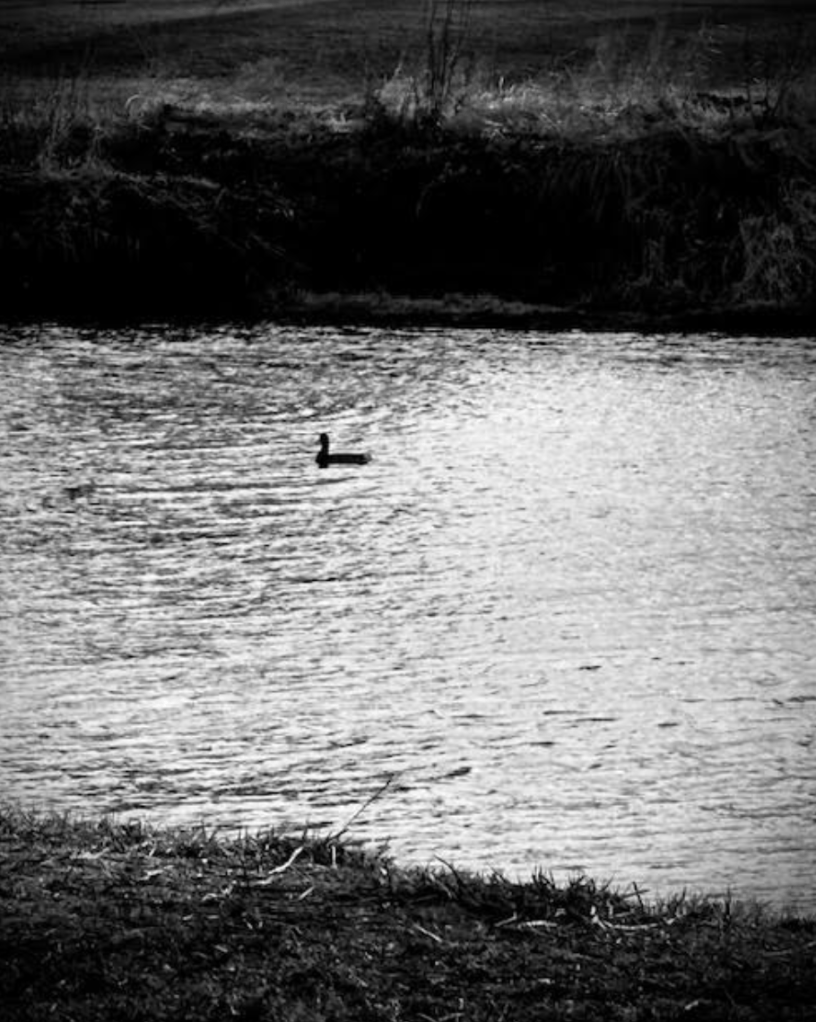
black and white photo of a single duck floating on a choppy river.
The Red River, Gooseberry Park. Moorhead, MN

It was nice out and I wanted to get some fresh air and also feed the stray cat that I think is still living at the city park close to where I live. I’m still putting food out, but at this point, I don’t know for sure it’s the cat that’s eating it as I know there is a raccoon that lives in the park too. My daughter and I went out a couple weeks ago, and I saw something that could have been an orange Maine Coon, or it could have been a fox, but I think it moved too slowly to be a fox unless it was injured. At any rate, I still have plans to go out there with some tuna and see if I can catch it. It’s been out there since October or so, but I need to wait until it dries out a bit. It’s way too muddy and there’s nowhere to sit to wait it out.

Anyway, so I was listening to some podcasts that I had marked and I tried the Indie Writers Club with James Blatch, a podcast he started with Cara Clare after the one he was doing with Mark Dawson ended. I was hoping for a good indie author podcast I could sink my teeth into, but unfortunately, that podcast will not be it. Maybe it could be for you, but not for me. The episode I listened to was about writing a series versus a standalone, a topic I really like to talk about as I love writing a good standalone when everyone tells you to write a series, but the first half of the episode was them talking about insider stuff like a writing retreat in Aruba and getting help with your writing from Al. I’m not for or against Al and what he can do, so that part of it wasn’t terrible, but if an episode is only forty-four minutes long, maybe it’s best not to crap up the first half with junk. It didn’t seem very professional, at one point James leaving the taping to let his dog out letting Cara ramble alone, and well, I’d rather listen to nothing than that. So I flipped over to Print Run, as they released a new episode a couple of weeks ago. I like the hosts, Erik Hane and Laura Zats, an editor and agent, respectively, based in Minneapolis who own their own literary agency. Even though they’re geared more toward writers who want to query, I find that their industry talk is useful and I enjoy their banter. The episode I listened to was particularly interesting as they were talking about Trump and his tariffs, and whether or not his administration was going to inspire “the big book.” (If you’re interested in listening to the episode, you can listen to it here or find it on your podcast app of choice. https://soundcloud.com/printrunpodcast/episode-177the-jimmies-the-rock-the-tariffs.)

I like what Erik had to say when he began hypothesizing what “the big book” was going to be about. He hasn’t read the Hunger Games books, and they talked a bit about that, I guess because Sunrise on the Reaping came out last month. Anyway, so he started talking about scarcity and how he thinks that’s going to play into what “the big book” is going to be about. But not like, actual food, like it is in the districts, though that could play into our everyday struggles as food costs rise in the world’s retaliation against us, but in other ways. In technological ways. This made me start thinking about what’s scarce right now, and you know, you think privacy for one. There are cameras everywhere and even if it’s not a public camera like a street cam, CCTV, or a security camera, someone is always on their phone filming, right? So we definitely don’t have privacy. We don’t have security, as anything we put online can be stolen at any given second. We see that with people who steal viral content hoping to go viral themselves (and they often do), pirates who steal our books, companies like Meta and Amazon who go on to steal that content. Books get stolen and sold by others, book cover concepts get stolen. Human connection is also disappearing. Not the kind online but in person. If you don’t have a significant other, people can go days, weeks, or even years without a hug. In fact, online connection is replacing in-person connection, so you could say that affection is turning into a scarcity, and for some it already is.

I don’t want to write and query “the next big book,” but it did get me thinking about how scarcity affects my writing, or rather, what I’m writing about. In my book Wicked Games, Seth’s son is abducted and killed, and Avery’s sister is involved. The lack of privacy influenced just how the kidnappers were able to get away with the murder, how my characters deal with lack of privacy in the media, whether they choose it or not (he’s a billionaire and she’s an essayist who blogs), and lack of affection and love both my characters deal with because their exes cheated and left them for other people.

I don’t want to write a book that specifically tackles scarcity in its many forms, but it’s interesting to think it’s there anyway, even in the background of my writing.


My quest to find other podcasts will be long and painful, I’m afraid, as I’m pretty picky about where I give my time, especially when it comes to noise, since I have voices constantly in my ears during my day job. I know it’s why I don’t like videos, listening to people rattle on about stuff that I don’t care about. I used to listen to The Sell More Books Show with Bryan Cohen, but I dropped that after his co-host, Jim Kukral, left. Maybe it’s a brain thing, but I don’t like change, and after he left, I had a difficult time staying engaged. I might have to go back and see what his weekly podcast is like now. I’ve been exploring Bookfunnel’s podcast, but, I don’t know. Maybe it’s just better not to listen to anything. We’ll see.

That’s about all I have for this week. I can’t stay focused in the evenings, jumping around from my book to a movie then back to my book. I want to take a break sometimes, but I put a movie on and then I’m not happy watching it, so I’ll go back to my book and edit a few paragraphs, then jump over to Threads and scroll. I know I’m bored with my book because I’ve already read it a few times, and I should have let it breathe when I said I was going to. There’s also no urgency to finish it because I’m no longer on the hurry-up-and-write-and-publish treadmill that so many other authors seem to be on. I have my books scheduled out giving me a cushion, but it also takes away the excitement of publishing. I really don’t know how trad authors stay excited. Wicked Games won’t be out until January of 2026 and that seems impossibly far away.

I hope you have a good week this week. Today my sister is coming over for a late Easter thing, so I’ll be offline most of the day. I hope you are having a good day whatever you are doing, and that you have a pleasant week ahead.

Until next time!

Author Update|Mid-April Check-In

2,061 words
11 minutes read time

You may not be used to this level of positivity from me, but I am excited to say that I’m doing pretty good. It probably helps that I’m feeling not too bad today, physically, and that always helps. Even on my “good” days I don’t feel great, but on my “bad” days I feel even worse, so you have to celebrate the little things.

Last week I finished Wicked Games. It came in at 97,606 words, and I’m really happy that I was able to finish it. I had given myself until the end of April, thinking that my funk would last longer than it did, but I got past a slow part, came up with the last little plot point I needed to push to the end, and that was it. It helped that for the past couple of weekends I had really great word counts, and it just snowballed. I hadn’t expected it since the days I felt down I felt really down, but I should realize by now that hormones play a huge part in how I’m feeling and that how I feel at that time won’t stay. I’ve already read through it once, but I’ll set it aside now and let it breathe while I work on Loss and Damages. I have a lot to do to get the ARCs ready for July, but looking at the cover gives me motivation to get the last edits done, format it, and write the blurb.

That’s not to say that the blog post I wrote a couple weeks ago was a waste, because I actually did have a pretty big epiphany that I think I realized but didn’t understand the full meaning of until I was emailing with a friend. Back when I pivoted to first person present POV in 2020, I was actively looking for ways to build a readership and to turn my writing from what was then a hobby into a career. I did a few things they say you should do, like write a reader magnet and start a newsletter. I’ve always had a website for this blog, but I created a new one that was for my author business only. I started taking my titles and my covers more seriously and instead of putting what I liked on my books, compromised and started doing research on what belonged on commercial genre covers. I started thinking about my brand and my books as a product to sell.

Maybe I never thought that I would become a millionaire author like some of my fellow romance authors such as Elana Johnson, Lucy Score, Melanie Harlow, Sadie Kincaid, or LJ Shen, but there are plenty of mid-list romance authors who write full time and are able to live off their royalties. I wanted to at least be a mid- mid-list author, making part time wages to supplement my day job. That came to a halt this year after I did my 2024 taxes. So it wasn’t that long ago actually when I decided that I was done trying to build a career. I have all that in place–the reader magnet, the blog/newsletter, the website. My brand is pretty well established if you scroll through my books on Amazon, at least for my pen name. I’m not going to be taking any of that down, and I’ve gone into why before and don’t want to repeat myself. But, I am going to change how I come at my writing. I’ve set myself up so that I’m ahead. I’m spacing my books out to give myself time to write, but I’m back to where I was in 2017 when I was writing because it was fun and publishing was exciting. (Though I don’t think after pressing Publish the night before I’m going to wake up rich and famous anymore.)

The longer you’re in the writing community, the longer you’re exposed to possibilities, and I think that’s what trips a lot of us up. We have no idea that money can be made until we start talking to authors who are making it. We have no idea we can build a newsletter subscriber list to the tens of thousands until we start hearing about authors who are doing it. And we think, Well, if they can do it, so can I, but the problem is, just because they’ve done it doesn’t actually mean you can. Some things are possible, just not for you, and it’s a blow to realize that, you know?

It puts you in a place that you’re not sure about. I’ve given 20-40 hours a week to my writing since at least 2020, possibly earlier than that. I bought into the belief that you can’t make it as an author if you don’t treat your writing like a job, something I really hounded you guys on over the years on this blog. I scheduled time to write and cranked out books like you wouldn’t believe. Of course I had fun, you can’t do something like that if you don’t like it, but looking back now, there was an underlying sense of, I don’t know, unhinged and deranged work ethic that demanded I spend every waking second I could writing because I wouldn’t get anywhere if I didn’t. Guess what? I didn’t get anywhere anyway. I’m proud of my backlist, of course I am. But no one is reading (and the zeros on my sales dashboard over the last few days are proof of that), so there wasn’t a point in working that hard and missing all the things I missed. A habit like that isn’t something I’ll be able to shake off so easily, and I wrote Wicked Games in two months. I started on February 5th and finished April 8th. I didn’t need to write that fast except that I had the plot in my head so it was easy to get it down on paper, and I enjoyed it. I love Seth and Avery, like the twisty plot. But it is kinda crazy to be writing with this resignation that I’m writing for myself and will only be writing for myself.

I’m still doing “fun” things that indie authors do, like I just made mugs that use my King’s Crossing chapter headers and I used the font in one of the title words on the covers:

I used a promo code on Snapfish and ordered two. They’re big (20 ounces) and sturdy, and came about to be about $15.00 a piece because of shipping. I can’t sell them because I didn’t buy the extended license for the vector, but I might do another giveaway at some point or I was playing around with doing a couple book boxes and seeing if I can build a little buzz, though with the last book out today, that might be too late.

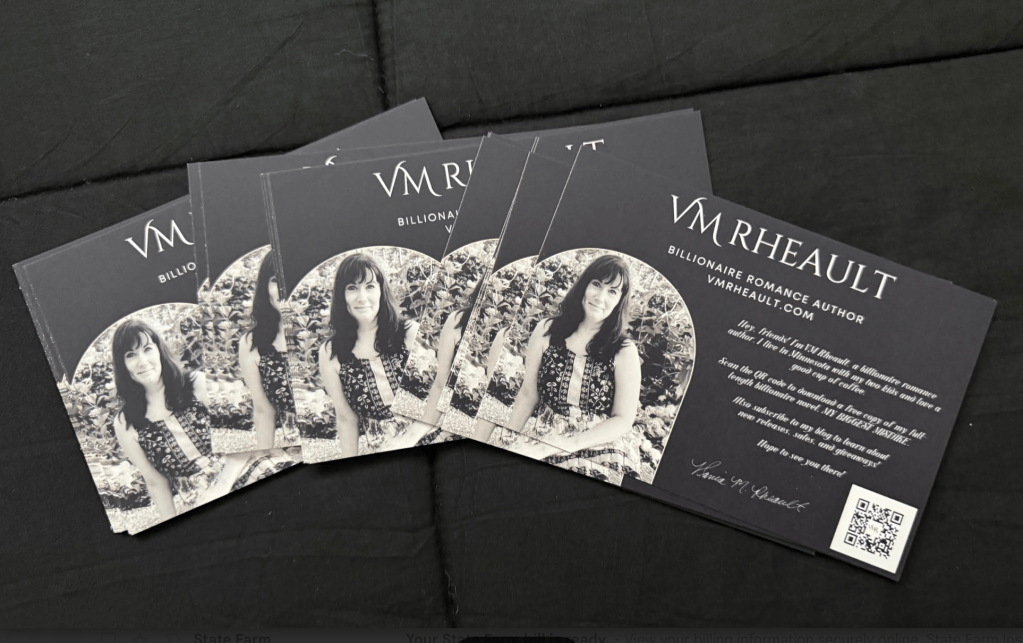
I also made some cards (the size is 6 x 4 inches) that have the QR code to my website’s subscribe page where people can download my reader magnet.

I ordered them from VistaPrint, and I paid $25.00 dollars for 25. I don’t know what I’m going to do with them, keep them in my purse and pin them to community bulletin boards and whatever. Maybe buy some author copies of a standalone and tuck them into Little Free Libraries this summer while I’m out walking. I can do these things knowing that they won’t really do anything. I’m back to where I was, many years ago.


I started reading the first book in the next series I’m going to finish, and I must have gone through it a few times already because it’s pretty clean. That’s kind of depressing because it sets up five more books and I wasn’t really in the mood to write another long series. So my thought was it would have been easier to tear up a book that needed work. It’s a cool concept though, a woman’s father creates a list of men he thinks would be acceptable for her to marry, and each book is for a man on the list. Maybe I will just write them all. The second one is already written and the third is set up in it. I have the MMCs for the fourth, fifth, and sixth, but not any plots for any of them. No backstories or love interests, so I’ll be doing a lot of brainstorming if I’m going to go through with it. I don’t know. I’m glad I started reading the first one though, because I used the same last name in Wicked Games for one of my secondary characters as I did for the main female character in the first book, and it will be a lot easier to change it in one book instead of two. I’m starting to look at cover concepts though, because I’m running out of ideas on how to brand a series, so I’m hoping that will get me excited, too.

I know this blog post sounds a lot like what I’ve been writing about before, but it really was an “Ah-ha!” moment for me when I decided to stop chasing that career dream. It was like when I went to school for human resources and decided I didn’t want a job in HR after all. All that schooling, all that tuition. Just kidding! Right? Education is never a waste, just like the books I’ve written in the past few years aren’t a waste either, but it is a shock, a let down, a broken dream. (Though, to be fair, no one dreams about a career in HR, and if you thought writers drink, you’ve never seen a group of HR reps during happy hour.)

Where am I going from here? I’ll be doing the same I’ve always done. Work on my books, publish them. But I’ll take more time for myself during the day, during the week, only write when I feel like it. Which is still a lot because it’s something I like to do, but I have different expectations, different hopes, for the outcomes of that writing. It’s not a job anymore and any royalties I earn I won’t consider as wages. Maybe I’ll break even at the end of every year after paying what I have to pay to keep my hobby going, maybe I won’t. So far I can afford to keep investing, like I worked new running shoes into my budget every six months when I was running and racing a lot. I need to focus on my health too, so maybe I’ll get back into that. I know I’d feel better if I dropped a little weight as I’ve been a slug for the past five years, but it will be a painful process and I’m not looking forward to it at all.

Now that I’ve had my lightbulb moment, I can stop thinking about it and if I do need to muse about it any more, I’ll put it on my mental health blog. I don’t use that blog anymore since my anxiety faded. That too, has been a journey full of ups and downs and the final destination was a letdown, but it’s better to know how things stand than live under the guise things will get better.

I have a couple blog ideas for the coming weeks, and an author interview in the works. I’m going out of town for a few days with my sister and daughter at the beginning of May to hit up Mall of America and the Minnesota Zoo, and after that, I’ll hopefully be setting into the lazy days of summer. I’m getting a new mattress for my bed delivered tomorrow and Wednesday I’m finally getting my hair cut. I wish that once I marked something off my list that something else would’t take its place, but I suppose that’s what being an adult is. Still, my car’s been holding steady for a while now and I’m grateful for that, and my kids are working and seem to be doing fine if not spending too much time in front of their screens, but I’m not one to judge.

Things are okay here, and I hope they are for you too.

Have a great week!

Four Things I Learned Editing My King’s Crossing and Rocky Point Wedding Series

1,933 words
10 minutes read time

For the past several months, from October of 2023 right after I published A Heartache for Christmas until January of this year, I was editing. I was editing my King’s Crossing Series, doing the final editing passes since I had sat on those books for over three years after I wrote them, and my Rocky Point Wedding series since I hadn’t looked at them since I published at the beginning of 2020. After so much time had gone by, I knew they could be better, and since a few people here and there were finding them, I thought while I was between projects, it would be a good time to edit them again.

But, editing ten books in a row dragged me down, so much so I didn’t even realize how icky I was feeling until those projects were finished and I started having fun writing again. Huge projects are a lot of work, especially when you don’t have help. My Rocky Point Wedding series might not have needed more editing if I’d had help in the first place, on the other hand, a lot of time had gone by and a lot of words too, so I was bound to get better regardless.

Since I doubt I’ll ever edit ten books back to back again, I thought I’d write out the four things I learned while editing these books.

Time between edits is really helpful.
When I wasn’t feeling well, I wrote nonstop. I would finish a book and move on to the next with barely a break. Before I knew it, I had several books on my computer and a different kind of anxiety started weighing on me. What was I going to do with all those books? So, while I was writing, in a way, I was taking a break from the others I had written before. I think my King’s Crossing books benefited the most from that because each time I did an editing sweep, I added more details I hadn’t thought of before and fixed inconsistencies I missed. As more time went by and I could edit with fresh eyes, I was able to fix the smaller and more intricate details and inconsistencies. I once said that something small in book two could have damning consequences in book four, but for me to remember that incident, I needed space between editing sweeps. Not everyone is going to take four years to edit a series, and I didn’t really, either, writing new books between editing sessions, but knowing how beneficial breaks can be, I’m going to try to stagger projects in the future so every editing sweep will feel “new.”

I had to develop a better memory.
Maybe it’s easier to write standalones, but while I was writing my King’s Crossing series it was difficult to remember things, and it might sound dumb, but you don’t remember what you forgot. When I was re-editing my Rocky Point Wedding series, I found a lot of places where I had forgotten things, like where a character parked her car, or when a character was supposed to be somewhere and I had him somewhere else. Also, characters had a habit of just “fading away” when I didn’t need them anymore. I was actually kind of surprised I messed that up so badly, and I could tell I learned a lot from editing my King’s Crossing series as those discrepancies were easy to spot. If you don’t have a good memory, you’re going to have to hire someone who does. I told a friend that by the time I was done editing my King’s Crossing series, I pretty much had all the books memorized. After editing them back to back three times in a row, I don’t think I had much of a choice. Now I think I have a better memory than before, though right now I’m only working on standalones and I don’t think I ever had a problem with those. I’ve gone through the standalones I have out and those were more of a garbage word sweep than anything else, maybe plumping up some scenes. But yeah, I definitely found out my memory wasn’t as great as I thought it was, but I can take steps to help with that now that I know.

Putting inside information into the books was a lot of fun, some I didn’t even consider until the fourth or fifth edit.
Probably what I loved best as I was getting to know the plot and the characters more was putting connected information from books 1-3 into books 4-6 . For instance, there’s a place in book six where Gage thinks, I bet Zane’s never gone through the public entrance of the airport, but we know in book three he did with Stella. What I loved was writing Max’s journal entries that Gage reads in books 4-6 that Max, as a character in books 1-3, wrote down. I really enjoyed writing the events of those books through Max’s eyes only for them to be interpreted into information Gage needed in books 4-6. I’m not sure if I would have even thought to do some of that stuff if it hadn’t been for the multiple rounds of editing those books went through. One of my biggest pleasures was when in book six, they need to go across the state in a hurry, and in the past Zane would drive. We didn’t really understand his fear of flying because of his parents’ plane crash until he says he’d get on a plane to save his sister.

I could tell I pantsed my King’s Crossing series a lot more than I did other books I’ve written.
I think one of the things I did the most was smooth out consistency issues, and maybe not even issues, just adding details to make books 1-3 and books 4-6 more cohesive. Because I didn’t realize that Zarah was going to get her own story until almost the very last second, that meant a lot of smoothing out books 1-3, adding details and motivations of characters to better explain what was going on. That was especially true of Max, when they didn’t really know why he was investigating Zane and Zarah’s parents’ plane crash, and the reasons he was come up in the later books.

I remember plotting out all the books in my Rocky Point series before I started writing, so the plot stuff there wasn’t too big of an issue while I was editing those, and I was happy about that. I did have one instance where I messed up and I had a character say he was doing something when he definitely was not. That was part of my memory issue too, but besides having to fix that, the plots were solid. I don’t like pantsing books because for me it takes a lot of work to edit them, but even if I had to put a lot of time into my King’s Crossing series, it was worth it in the end.


A friend and I were talking about series and how I keep details straight. Short of memorizing every single line of every single book, I really didn’t have an answer because that’s what I felt like I did, at least to the point I knew exactly the sentence to search for to get to the scene I needed to check something. I used a notebook at times, writing stuff down, but then I would never look at it again, so I don’t think writing anything down really helped me all that much. When I first decide to start a book, I write down character names and traits, that kind of thing, but once you’re five books deep into a series, that stuff doesn’t come up too often. I mean, once you establish a character’s eyes are blue, you don’t need to keep repeating it.

I think over such a long series, I had trouble more with keeping characters’ goals and motivations in check. For instance, Zarah’s therapist turns out to be a bad person, but I was vague as to how she came to be Zarah’s therapist to begin with. Once her therapist’s role became even more apparent, I could think of how she inserted herself into Zarah’s life. I’m hesitant to say that some of this stuff could have been avoided if I had written slower because I did write six books in a little over a year, and maybe that’s true, but these books were also the first 1st person dual POV books I ever wrote, so not only did I jump into a huge series, I hadn’t taken the time to learn how to write in first person after writing in 3rd all my life.

I haven’t gotten feedback on the series as a whole yet–books five and six have yet to release, and even though they were all available on Booksprout, the reviewers haven’t posted reviews of book six because it’s not time for them to. Only when feedback starts to come in of book six will I know if the series as a whole works. Probably everyone I ever tell I did these alone will think I’m crazy, but as prices go up and up, editing will be farther and farther out of a reach for a lot of authors. Which is unfortunate because if you don’t have the skill to edit your books yourself, there’s not a lot out there that can compare to a human’s feedback. ProWritingAid can only do so much, and no matter how “smart” Al is, this is just a level of editing he can’t handle.

I don’t know what the solution is. I had these beta read, both series, but you’re not going to get the kind of feedback you need to avoid inconsistencies like that unless you hire the right kind of editor and that costs. If I have to give any advice on doing something like this alone, it would be to plot, take your time writing, and give yourself plenty of space to edit, and then, when all is said and done, be okay with knowing you might not have caught everything. There probably are a couple things I missed editing my King’s Crossing series. Layers I could have added, details that would have made the story richer, but like with any book, you can’t chase perfect or you’ll never publish. That’s the simple truth.

If you’re thinking of writing a series or if you have trouble plotting in general and want to give it a try, I have a couple of resources for you (none of them are affiliate links). Next week I’ll do a proper author update, and the week after that I have a lovely interview planned with Brandi Easterling Collins.

Have a good week! Until next time!


Romance Your Brand: Building a Marketable Genre Fiction Series (Publishing How To Book 1) by Zoe York: https://www.amazon.com/gp/product/B07XMDKV1Y

Take Off Your Pants!: Outline Your Books for Faster, Better Writing: Revised Edition by Libby Hawker: https://www.amazon.com/Take-Off-Your-Pants-Outline-ebook/dp/B00UKC0GHA

Melody Loomis: How to outline a novel when you don’t know what’s going to happen:

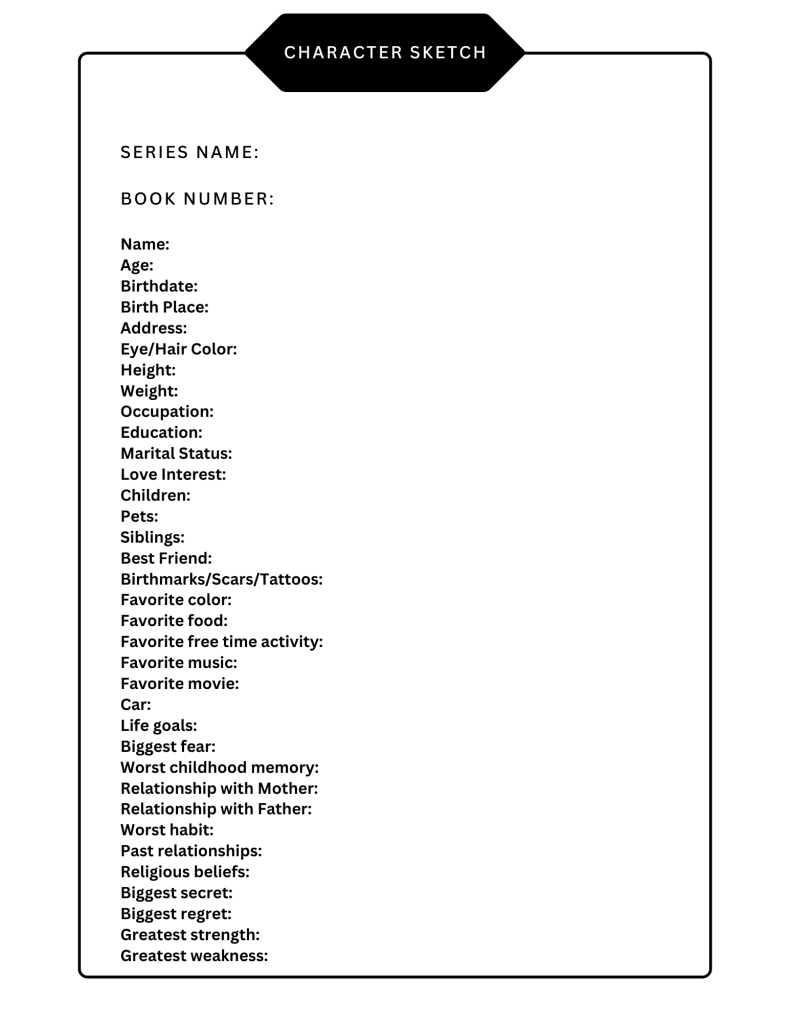
Melody also said I could share this graphic with you. She found the original via Priscilla Oliveras’s “Romance Writing” course and you can find it here: https://www.ed2go.com/courses/writing/writing-and-editing/ilc/romance-writing. She added a couple of things and so did I. Have fun filling it in–I’ve only used a notebook to write all these things down, but maybe I will try this instead. Have fun plotting:

save and print me!

Thursday Thoughts: The world is a large place

917 words
5 minutes read time

When I get up in the morning, I have a routine. I go to the bathroom, start a pot of coffee, and go out and feed the squirrels, bunnies, and the crows if they come. I have a bowl I use and fill it with cat treats (for the crows) bird seed, and peanuts in the shell, and toss it outside in my apartment complex’s parking lot. There is an empty parking spot and the animals, because we live in a quiet building, don’t mind picking around there for food. Anyway, so I toss the food out while the coffee drips, go inside and pour a cup, and scroll social media for a few minutes before I shower.

I always see some goofy stuff, some Amazon hate, politics (of course), the Cat Distribution System at work, that kind of thing. Today I saw a post that said (paraphrased), that if you’re bummed about sales there’s a Stuff Your Kindle Event going on and that could be why your sales are low.

I mean, I get it. I’ve gone through my own pity parties before (it seemed like mine went on for all of 2024) and I can get behind whatever you have to tell yourself to feel better. But, lying to yourself also does your books a disservice. The world is not that small that a Stuff Your Kindle Day would hurt your sales, especially if you don’t write romance.

That’s one thing that being stuck in the writing community will do: it will box you in to the point where you think nothing else is going on outside that bubble, and let me just remind you that’s not the case at all. I’ve joined Stuff Your Kindle Days, and out of respect for the person putting it together I’m not going to spew the numbers she shares with us, and I have no idea what Stuff Your Kindle event this is anyway. There are so many now it’s hard to keep track of them all. I hadn’t heard there was one going on today, but let’s just say there are 500 books available. That seems to be an average number where these things are concerned, so that means 500 authors are taking part. Some authors’ newsletters subscribers and social media followings can get pretty high, but if those 500 authors had 1,000 newsletter subscribers, that’s half a million readers this event is going out to. Not everyone opens their emails, so we can subtract a few thousand from that number but we can also add them in again to make up for authors posting on their social media. I would think a half million readers is pretty generous as authors just starting out can have as few as a hundred newsletter subscribers, and some none at all, using the event to jumpstart their writing careers.

A half million readers might seem like a lot, but according to Visual Capitalist, in 2020, there were five billion eighteen million adults in the world between the ages of 20 and 79. That’s a lot of readers that we might be forgetting about when we hear there’s a Stuff Your Kindle Day.

I think instead of being bummed there’s an event going on, or trying to blame your low sales on holidays (that not everyone celebrates) or a time of year that doesn’t affect all parts of the world at the same time, like summer (we have summer in the US while Australia has winter for a quick and harmless reminder), we could just use that energy to figure out how to reach readers all over all year round.

That’s easier said than done, of course, as my own sales being what they are don’t put me in a position to preach to anyone. But, I’m also realistic in that I don’t blame my lack of sales on things like Christmas. I take full responsibility for it.

It’s a better use of your time and energy to think of ways to reach those 5 billion plus readers such as write a reader magnet and build your newsletter list. Join a Facebook group of authors who write in your genre and introduce yourself. Networking is a great way to build relationships for newsletter swaps down the road. Experiment with some ads, they don’t have to be expensive. Double check that your categories and keywords are correct. The correct meta data will help Amazon position your book and help your ads work better too. Write another book, preferably a series. As much as I say how difficult they can be and how much energy they take, if you write a strong first book, read-through can lift your sales by more than you’d think.

When we place the blame of low sales on something like a Stuff Your Kindle Day, you’re taking power away from yourself. I know marketing can feel painful and not everything you do is going to work, but you can explore options to get the word out about your books.

Anyway, this was just a quick thought I had today. I hope you’re all staying warm where you are. It was a chilly -20F this morning when I went out to feed my animals. While I’m waiting for it to warm up I’m busy writing WICKED GAMES, but next week I’ll update you on what I’ve been doing.

See you on Monday!

QUICK LINKS:

I wrote about Stuff Your Kindle Days in a different post, and if you write romance or a romance subgenre and want to participate, you can find the list here.

If you’re interested in buying a promotion David Gaughran has a huge list, and some aren’t that much money. You can find the list here.

Written Word Media’s 2025 Trends: Part Two

2,028 words
11 minutes read time

If you’re just finding the blog and/or missed the first five trends I wrote about that are in Written Word Media’s blog post, you can find that post here: Written Word Media’s 2025 Publishing Trends: Part One. And if you want to read Written Word Media’s blog post yourself, you can find it here: https://www.writtenwordmedia.com/the-top-10-publishing-trends-for-2025/

Let’s jump right in to the trends.

Trend number six: Trad and Indie Converge in Due Course
We already see this happening in different ways, so I would imagine this will keep going. Publishers snapping up indies who are doing well to exploit the audiences they’ve already built, trad authors publishing titles on the side themselves, the Big Five using print on demand technology. Publishing is getting mixed up more than it ever has been, and that won’t stop as authors and publishers alike look for the best ways to find an audience, save money on printing and distribution, and keep as many royalties as they can.

I think what this means for indies is that as long as you put out a good book that has a good cover and has been edited, it’s not going to matter if you published the book yourself. The stigma that used to come from self-publishing is gone. Trad authors who publish on the side to either add extra books to their publishing schedule or publish books that their agent didn’t sell, or whatever the reason is, they have a loyal audience who buys all their books and it doesn’t matter if it was trad-pubbed or not. Indies don’t have that convenience of an already-made audience, so that’s one thing we have to take upon ourselves, but everything else is pretty much the same, especially when we read every day about a traditionally published book that needs more editing. If you want to read about traditional publishers using print-on-demand equipment, Jane Friedman wrote a blog post about it and you can read it here: https://janefriedman.com/dont-demonize-print-on-demand/

Trend number seven: AI Tools Become More Mainstream
I think anyone who really believes this isn’t tapped into the way a lot of authors feel. I get that being on Threads and seeing the hate AI evokes isn’t an accurate sampling of authors everywhere, but just knowing that there is a portion of authors out there who won’t use AI no matter what makes this prediction shaky at best.

As I discussed in my blog post about KC Crowne, I do understand that Al can be used for different things. WWM’s article also talked about non-fiction uses, such as “social media posting, to advertising, email, sales fulfillment, or tax management” and I think if authors start embracing Al in bigger numbers, that will be all they’ll use it for, because, here’s the thing. Writers actually like to write. We want to plot our stories, we want to come up with backstories, we want to delve into our characters’ feelings and emotions so we can evoke those feelings and emotions in our readers. If we turn to Al for any part of that creative process, why are we writing then? Like with KC wanting to relate to her readers, how can she do that when she won’t take the time to get to know her own characters and write her own work?

People who predict the controversy of using AI will go away don’t have their fingers on the pulse of what a lot of authors feel. We also want people to get paid for their work, which is why I would never ask Al to create a picture for me. Almost every single thing you want can be found on a stock photo site, and if you can’t find it there, hire an artist, and maybe she’ll be able to pay her internet bill with the fee you’re paying her.

Readers may not care if you use AI to write, or to make your books’ covers, or to make Facebook ads as long as their enjoyment of a book they read isn’t impacted. Which means that whether you use AI or not, your main goal when writing and packaging your book should be to deliver a good product that will keep readers coming back for more.

Trend number eight: AI Unlocks Licensing and IP Innovation
I think this trend will only work for the authors who can pay to do it correctly. A long time ago on Twitter I saw someone who said she was using AI to translate her English language books to German and then she was publishing them. She wasn’t using a German-speaking real live human to double-check Al’s work, and I think that is a big mistake. Al doesn’t understand nuance and context, and there’s a reason why the phrase “lost in translation” exists. But, paying a proofreader, any kind, costs money, and using AI is supposed to help us get around that, right? So yeah, she might have had more IP in her hands, but God only knows what she was selling her German readers. Maybe it isn’t that bad, but who’s going to know unless she starts getting bad reviews? By then, it’s too late.

AI narration is getting better and better every day, but I haven’t heard anything recently about the quality of KDP’s audiobook program. It made waves when it first came out, many authors cursing it to the depths of hell, others embracing it as an affordable way to finally have their books in audio format. When I found out that duo narration, preferred when writing dual POVs, wasn’t available, I lost interest in it anyway. I’ve always figured audiobooks will be out of my reach as I can’t afford production, and I kind of left it there. Considering a determined reader can figure out how to have a book read to them on their device, it may not matter much. If AI narration is getting better, so is text-to-voice and the experience for a reader that’s not too picky will be just fine.

I think the bottom line on AI and IP is that yeah, Al can help you put together translations and audio books and art for special editions, but it’s up to you to make sure the quality is there (no one wants to see a model who has six fingers on each hand and has three legs). Al can make mistakes, (just look at Grammarly and how often they recommend commas you don’t need) and going without a human to check and make sure what he’s doing is okay is a risk I wouldn’t want to take with my audience. Listen, I’ve edited for authors who have trusted Grammarly, and it’s harder to edit a manuscript like that than if they would have just handed me a rough draft. Grammarly and other editing software is not perfect so always use with caution.

You might end up with a lot of IP if you use AI to get ahead, but if it’s trash, it’s not worth much.

Trend number nine: Audiobook Accessibility Expands in 2025
We already talked about this a bit, but it will be up to authors who want to use AI narration and readers who want to listen to it. When it comes to AI, it isn’t just about availability and quality, it’s also about what you feel is best for you, your book business, and audience. Not everyone wants to support AI. Maybe we want to support true voice actors who depend on their jobs to make a living. Maybe readers would also like to support humans. Once you put out enough audio books, you’ll find an audience who will support either (or maybe even both). Maybe you’ll find a system where you hire narrators for full-length books but use AI for novellas, or maybe you write only shorts and AI is good enough for your needs. As access expands, it doesn’t mean authors will use it. And if authors us it, it doesn’t mean readers want to listen to it. So while this trend is true, it will expand, because why wouldn’t it, authors can choose not to create with it and readers can choose not to consume it.

Trend number ten: POD Goes Mainstream
We talked a little bit about this already, and it didn’t even occur to me that I’ve purchased a book from a trad author and her paperback book came printed by KDP (there was the time, date, and location stamp in the back). I was wondering what the heck and if she’d been dropped by her publisher and had gotten her rights back. It makes sense for publishers to use POD as it takes up less space than keeping stock and they don’t have to worry about titles going out of print. But as Drew Broussard in Jane’s blog post I linked to above says, there’s just a little lesser quality with a POD print than a book that came from a print run. You’re not going to get the embossed letters or fancy textures, you even run the risk of getting the wrong book between the covers, so I’m guessing that publishers will decide which title will get the POD treatment based on how big the audience still is and how old the book is.

This also could be why it takes so dang long to get author copies. Obviously the more authors who depend on POD the busier the equipment is, and that means planning ahead months if you need to order author copies. Especially since the more authors who use the equipment the more taxed they are and you don’t know if your books will come in good condition and you need to put in a replacement order.


Everyone says don’t write to trends, write the book you want to write because trends change too quickly to keep up. That’s not true, and Billionaire romance is proof of that. Everyone said that was a trend, that “mommy porn” was a passing phase, but it’s going on fifteen years since EL James published her Fifty Shades of Grey trilogy and Billionaire romance is still one of the top selling romance subgenres, though lately Mafia is giving it a run for its money. Trends take a long time to actually lose favor with readers, even if it feels like it happens overnight. These trends WWM talked about won’t fade because that’s just the direction publishing is going right now. AI won’t go away because too many people find value in using it, even if practices like using it to write or narrate books some find too abhorrent to do.

2025 will be like all the others, authors writing good books and trying to get them seen to build an audience of their 1000 true fans. Sometimes I think the publishing industry is glutted with too many books, but then I remember that readers can read a book a day and demand probably matches supply, even if we look at the thousands of books published every month and it doesn’t feel like it. Personally, I don’t think ramping your publishing schedule will help any. If someone doesn’t know you’ve written a book, they wont know you’ve written two. Being that the top marketing advice right now is to write the next book, advice I have passed along and believe in, I think we should still be writing with intent, trying to level up our craft each time we write, always trying to write a book better than our last.

The fact is, it’s difficult finding an audience, but the trick now is to not give up. Do what you have to do to stay interested and engaged and not lose heart. I’ve started to enjoy working on LOSS AND DAMAGES again, and I get excited talking about the next book I’m going to write. I like thinking about the future and the books I want to write, having material planned for well into 2027. I don’t know what life has in store for me, but I’m pretty sure writing is more than a passing trend.

Take care of yourselves this year, and in the meantime, I’ll you next week!

Five Reasons Why You Should Proof your Proofs!

1,080 words
6 minutes read time

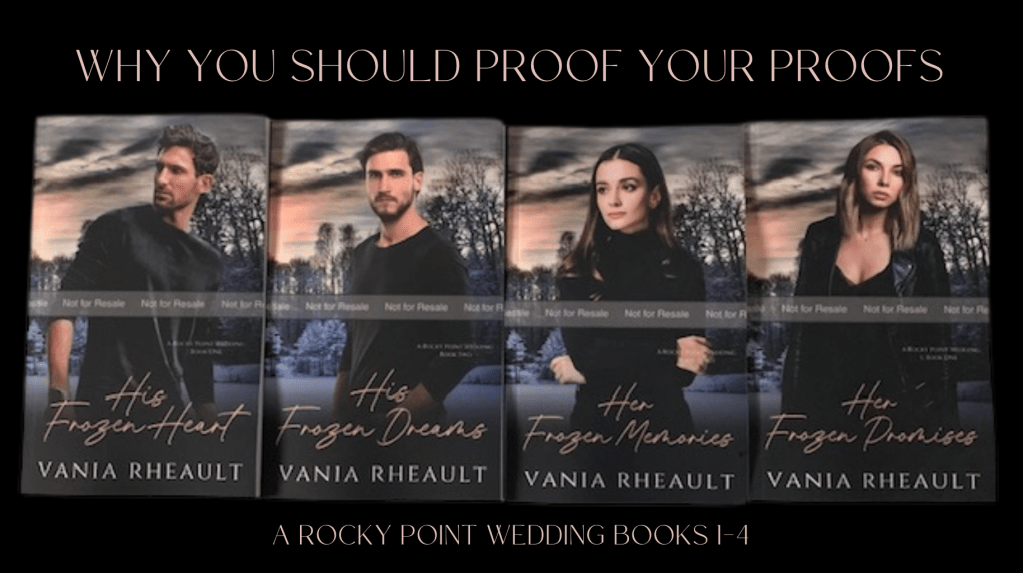
picture of four book covers. they have the not for resale stripe in the middle. a rocky point wedding series
I still love the way those covers turned out!

Back in the day, I used to be excited to order my proof from KDP. It was fun to see my book look like a book, and I’d take pictures of it, proud I was a published author. That was when we published through CreateSpace and they didn’t have that ugly stripe in the middle. When Amazon merged CreateSpace and the ebook part of KDP, I didn’t mind. I liked having my book versions together on one dashboard, and when they added the NOT FOR RESALE stripe, I was okay with it. A lot of physical ARCs have some kind of warning that it’s not the finished product, and these are no different.

But, there is also other value in ordering a proof (if you can) and as the years went on, I started going over my proofs. Now I’m always shocked to learn not everyone proofs their proofs, and they are missing out on a great opportunity.

A last editing sweep, of course.
Editors and other authors say to change your font in your Word document to make typos stand out or use the read aloud feature (listening to the voice read a word that’s not spelled correctly is funny), and those are both great ways to find typos that would normally slip by. But, also reading your proof is a good way to see run-on sentences, punctuation errors like broken ellipses, spelling mistakes, and more. One of the things I have noticed is that reading your proof can actually help you see where scenes could be plumped up or if it drags. Reading your book, flipping the pages, and seeing the words on a printed page allows you to feel how your book moves, and when I was proofing my King’s Crossing series, I made a lot of scene changes right at the last minute. There’s something real about holding your book in your hands and reading it, and if you don’t proof your proof, you’re missing out on that experience.

Check your formatting.
Sometimes things look okay on your screen but not in print. When I was proofing books 4-6 of my King’s Crossing novels, there are a lot of journal entries. Max left Gage his journal that described a lot of what happened in books 1-3 and played a huge part in Gage figuring out Zarah’s past. But I wanted to format those journal entries in a way that didn’t distract the reader from the story. I finally ended up just using italics, though I tried other things like setting them in in a block quotation or an alignment block. Then, once I decided on how I wanted them formatted, I had to go through all the books and make sure I changed them all and didn’t miss any for consistency. Sometimes you’ll end up with just a word or two on a separate page that you need to fix, sometimes the pictures in your back matter need to be adjusted. You won’t know those things if you don’t proof your proof.

Check the cover.
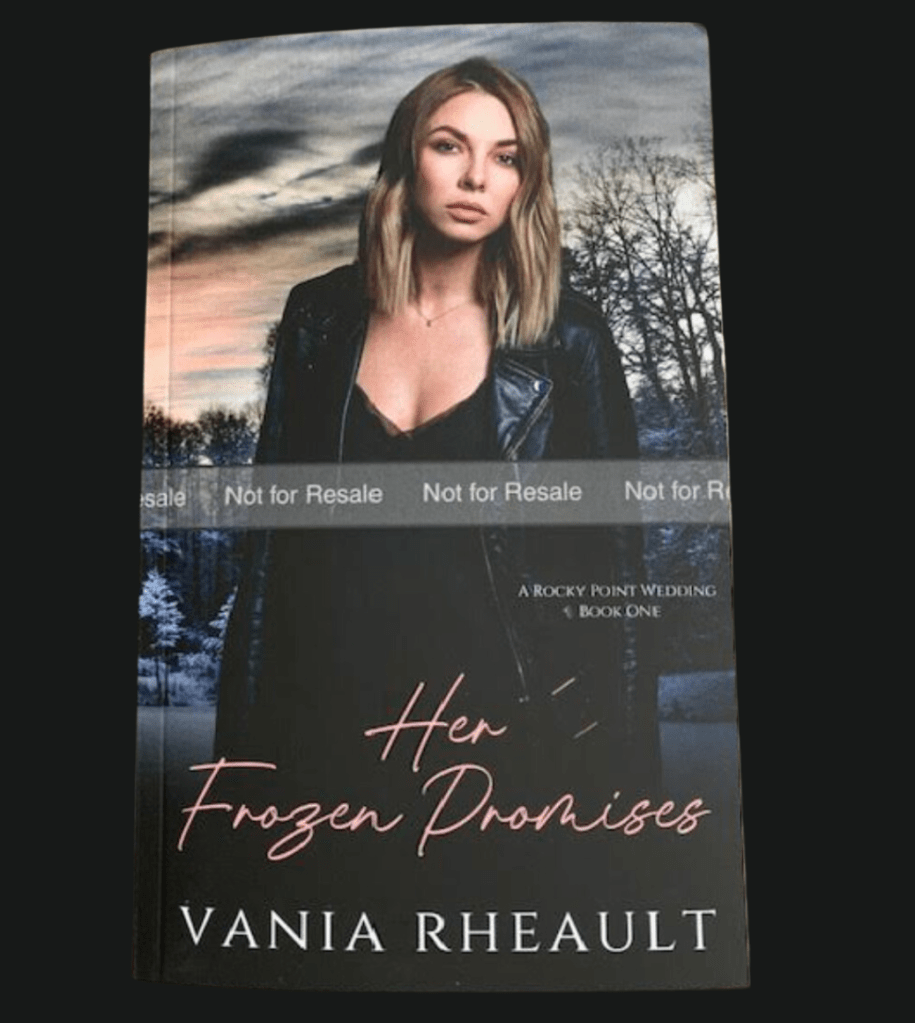
Print on demand isn’t always accurate, and KDP is notorious for printing dark. Sometimes you might decide to go with a matte cover instead of glossy. You are never going to get the colors you see on the screen, so it’s best to order a poof copy and make sure the colors are how you want them, that your spine looks good, and the back over looks professional. A lot of times I don’t get the gradients lined up to the spine just right and I have to move it over. You won’t be able to tell that looking at a PDF of your cover. One of the last-second catches I saw when I was proofing my Rocky Point Wedding series was that I still had A Rocky Point Wedding Book One on book four. KDP might have caught it when I published, but it was better that I saw it and fixed it myself.

This is book four. Ooops.

Look for lines and scenes that you can use in graphics and reels.
This will probably be one of the last times you read your book, and you can use this read-through to highlight hooky lines, dialogue, and scenes you can use in social media graphics and TikTok videos. One of the most time-consuming things is to page through your book, looking for lines you can use, and if you do this during your last edit, you’re saving yourself time in the long run. I wish I would have thought of this a long time ago, but social media isn’t my strong suit. You can be sure that I’ll be doing it from now on.

Peace of mind.
I see so many people who want their books in bookstores and libraries, yet they never order a proof to see exactly what their readers are getting when they pay 10-20 dollars to buy a paperback. I want to see exactly what my readers are going to get. I want the cover to look good, I want my formatting to look like a traditionally published book. I want to be able to catch all the typos I can (humanly) catch. I know that cost can be a barrier for some, the cost of the book and shipping might be too much after spending on editing and cover design, but as long as you are able, I would always recommend proofing your proof.

You probably don’t want to know how many proofs I ordered of my King’s Crossing series. That series is over four years in the making, and I changed the covers, too. I spent a lot on books I ended up throwing away, not needing them after fixing what I needed to fix. I throw away a lot of proofs, actually, because I don’t need them anymore. I only have room for so many, and prefer to keep a few author copies on hand instead. If you have the space, you might keep them for nostalgic purposes, but I don’t have much room, and I don’t see the sense in keeping them. The finished product is enough for me.

Ordering a proof is exciting, but it’s also a chance for one last read, no matter how sick you are of the story by now. Enjoy the last time you’ll read it, and quietly say goodbye to characters that you worked so hard on.

Written Word Media’s 2025 Publishing Trends: Part One

2,449 words
13 minutes read time

illustrated picture of brunette woman holding cell phone with a stack of books behind her

The first month of the year is almost over, but I’ve been promising this blog post for a while now, and I think Written Word Media’s 2025 predictions are still worth exploring. I need to break this post into two parts, five trends in each, or this blog post will get so long no one will want to read it, and honestly, I don’t have time to do all ten at once (still gotta get some editing in today). I linked to the article if you want to read the original first or as you go along. Some of them you might have seen before, here on this blog, or theirs. Sometimes it feel like publishing, especially indie publishing, can move quite fast, but in reality, publishing, both trad and indie, moves at a snail’s pace, and turning in any other direction than the one in which you are going is slower than the Titanic trying to avoid that iceberg.

Let’s begin:

Trend number one: Authors Focus on Building Loyal Audiences
I feel like this might be a given, and no offense to WWM or the author of the article, but I don’t see the point of adding it. Authors have always been focused on building a loyal audience, finding their true 1,000 fans. I’m not sure why it was included, except maybe to accentuate the fact that building a loyal audience is hard work. First you have to actually find your readers, then offer them enough books to either look forward to everything you write, or self-select out of your books because they don’t like your style or voice or whatever reason they have. How you go about doing this will be different for everyone, not to mention if you can only write and publish one book a year, it will take a long time. The authors who are making a living wage and who do have their 1,000+ fans have managed to accomplish this, so we know it can be done. But given the number of books out there, finding, and keeping, your readers is just a given of being an author. Write your books because without them, you won’t need an audience.

Tread number two: Authors Invest in Email Marketing
It’s always been known that if you’re an author, you should be building a newsletter, and if you’re not, that’s a personal choice that may come back and bite you in the butt. After the TikTok fiasco, I saw a lot of authors on Threads saying they might start one or start a blog so they have something that’s not social media. It’s probably the smart thing to do, since we saw a lot of desperation when TikTok almost went away, and even some now, because if you deleted TikTok off your phone or other device, you can’t get it back. The app store doesn’t allow you to download it anymore (and if you do still have it, there won’t be any new updates).

About availability of TikTok and ByteDance Ltd. apps in the United States
TikTok and ByteDance Ltd. apps are no longer available in the United States, and visitors to the United States might have limited access to features.
Apple is obligated to follow the laws in the jurisdictions where it operates. Pursuant to the Protecting Americans from Foreign Adversary Controlled Applications Act, apps developed by ByteDance Ltd. and its subsidiaries — including TikTok, CapCut, Lemon8, and others — will no longer be available for download or updates on the App Store for users in the United States starting January 19, 2025.

That’s not say you can’t use TikTok in your browser, but who knows what kind of reach it has. We’ll talk more about Meta in the next trend, but if you don’t like good old Zuck (for political reasons or other), you might not want to be dependent on Facebook, Threads, and Instagram, either. They say you can’t be everywhere at once, but maybe be on a place that you control first and foremost, and then use social media as a backup or Plan B. Evergreen content can be used over and over again, and all content can be repurposed. A blog post on your author site can be chopped into chunks to use on your FB author page or IG. I think the main thing here though, is to train your readers to look for you on your website. If you have an active FB page, make sure they know you have a website too. Turn your website and your newsletter into your primary source of news for your reader. Billionaires don’t care about you–we see this over and over again. Stop thinking they do and take care of yourself. Jane Friedman has a get-started-guide to newsletters, and you can read it here: https://janefriedman.com/email-newsletters-for-authors/

Trend number three: Meta Continues to Dominate
Unfortunately, because he owns Facebook, Instagram, and Threads, there’s not a lot of places for authors to go if you want to avoid Mark Zuckerberg. Personally, I think he’s an idiot for licking Trump’s feet. Be that as it may, he owns a lot of social media now, and if you have a large following on your Facebook author page or your Instagram page, you probably don’t want to leave. I think if anyone was still hanging around Twitter, they left after Musk’s Nazi salute. Finding anywhere else to go is difficult, Bluesky’s founder Jack Dorsey (that is such a good name though) not without his share of problematic activity. I don’t use social media a lot, though I’ve been posting more this month because I joined a challenge. Once the challenge is over at the end of the month, I’ll probably just go back to not posting at all. Being accountable to someone helps, but I should be feeling accountable to my readers and so far, that has only extended to my blog and my books. If I say I’m going to have a book out at a certain time, I do and that’s about as far as my accountability goes.

As far as ads, Facebook ads probably are the best ad platform an author is going to get, Instagram, Bookbub, and Amazon coming in close second, third, and fourth, though hard to tell which order. They all have their attributes and setbacks, and though I’ve struggled in the past, I would lean toward Facebook ads if I ever wanted to run more ads in the future.

I think the thing to remember about any social media, not just what Zuckerberg owns, is that if you’re trying to reach readers, that’s different than being part of the writing community. Approach each platform with the goal you have in mind. If you want to post graphics and reels all day that feature your books, Instagram seems to be the place for that. If you want to connect with other authors, Threads and Bluesky seem like the better choice. Facebook acts as a one-stop-shop, and you can join author groups for publishing and marketing information and networking with other authors to join newsletter swaps and author-driven promos, start an Author page for your readers, and run ads. Each platform does have different purposes, and while above I suggested you reuse content, not all content will be fit for all platforms. For an example, I’ve been posting a lot on my FB author page, but that’s kind of an anything goes platform, whereas, if you’re trying to create an aesthetically pleasing grid on Instagram, everything has to be in line with your theme which means you’ll be planning your posts. Choose your goal and have your plan. I post on FB and Instagram to promote my books to my readers, joined FB groups for publishing industry news and networking, and I joined Threads (though I said I wasn’t going to) to get book news and just post random crap that’s not fit for anywhere else. (How many people care I had to buy a new coffeemaker?)

It seems like Meta will be around for a bit, but always have a backup plan. When Meta servers go down, Facebook, Instagram, and Threads go down at the same time. That’s a lot of social media blackout. Know why you’re posting and what you want to get out of your social media use. If something isn’t working, move on. Algorithms are heartless animals, don’t let them beat you down.

Trend number four: Direct Sales Continue to Grow
I think this is really true. Authors are seeing the benefit of cutting out the middleman and earning more for themselves. But, on the flip side, if you don’t have the technical savvy (or patience) to pull it off, don’t have the space to store physical books, don’t have the spoons to think about any of it much less the ability to get to the post office two or three times a week, I wouldn’t worry about it. For as many authors who do sell direct, there are just as many or more who do not. Because my ebooks are in KU, I couldn’t sell those directly, but I could sell my paperbacks if I wanted. I don’t have the space to store stock, and though I know a couple people who could probably help me get some kind of system set up on my website, it just sounds like too much work.

Honestly, anything more than what I’m doing sounds like too much work. Direct sales doesn’t necessarily mean setting up Stripe on your website and shipping physical books out of your home. It could mean setting up a Patreon and asking readers to pay for exclusive content. It could mean setting up a paid newsletter. Anything where you are engaging with readers directly, where they pay you (minus the fees of whatever platform or system you’re using) directly for content they want. If I ever had a book take off, maybe I would create a special edition to sell directly to readers somehow, but all that seems so up in the air and you have to consider ROI. Are you getting enough from the time and stress it takes to put all that together? I sound like I’m against direct sales, but I’m not. If you have the energy, resources, and your books are available to be sold elsewhere other than Amazon, then you should do it. What I’m trying to do is tell authors who don’t want to or can’t do this right now, or ever, that it’s okay. Not everyone does it or wants to do it. With my luck, I would put paperbacks on my website and sales would explode. I don’t have a team to handle that. Amazon is okay for what I want it to do. They take care of taxes, distribution, and shipping, and royalties land in my account.

I don’t know what’s in store when it comes to a trend like this. More authors doing it? Maybe, as Amazon’s reputation gets worse and worse and Draft2Digital and IngramSpark get increasingly harder to work with. Indies go indie to be in control, after all, and there’s no greater control than selling your own books.

Trend number five: Authors Experiment with Pricing
I think all authors experiment to some extent, though from the small sampling I’ve seen on Threads, authors could be a bit more flexible. Amazon doesn’t make this easy, only giving us 35% if our prices are 1.99 and below, and we’re reluctant to price at .99 only to receive 34 cents per sale. This is where having a series can come in handy, putting your first book for .99 (or free if you’re wide) as a loss leader and recouping that loss when a reader reads all the books in the series. There are a lot of arguments as to what book blasts like SYKD do for anyone, though no one can truly know since evidence for or against is so elusive.

When I price my books, I think of two things: I’m in KU so price doesn’t mean that much, but I also want to be price-friendly for readers who do not have KU and have to pay out of pocket. Right now my six-book series is priced like this: Book One, .99; Book Two, 1.99; Book Three, 2.99; Books 4-6, 4.99 (USD). That’s still over twenty dollars if someone wants to read all six. That sounds crazy to me considering they could pay for a month of Kindle Unlimited for 11.99 USD plus tax. They could read mine and as many other books as they could for the month. I understand not every country has access to Kindle Unlimited but my audience is 75% US, so I always keep that in mind when I make decisions for my book business.

I gave away almost 15,000 books in 2024, and I see the benefit in giving away a first in series or even just a standalone to let readers get a free taste of what you offer, but as the article states, we have to price in a way that we still make money. That’s been something I haven’t quite figured out, and we all have to find that delicate balance among ad spend, giving away our books, and pricing low to keep readers happy but also to reach whatever monetary goals we have. I’ve decided making money isn’t going to be my focus in 2025, stopping all my ads and just letting the chips fall where they may. I’m focusing on enjoying the writing process and not thinking so much of how many books I’ll publish every year.

The more books you have, the more choices you have. You don’t have to think so much of price if you have only one book out or if your series isn’t complete. Look at the bigger picture when pricing your books, not just what you’ll get when one person buys one book. (I also touched on this in a different blog post and you can read it here: https://vaniamargene.com/2024/07/29/every-time-someone-reads-your-book/) Pricing your books is a sales and marketing strategy, so try to know what kind of outcome you want when figuring out what to price your books. You can’t measure return on investment if you don’t know what kind of return you want. Sometimes it’s not all about sales, it’s about exposure or read-through.

Experiment and see what works for you. The first three books in my series won’t be low forever, but I can’t guarantee when I’ll get around to changing them to 4.99 like the rest. It is smart though, to mix it up every now and then, even if it’s just so you have something to write about in your newsletter.


That’s about all I have for the first five of Written Word Media’s 2025 trends. I’ll do the other five next week. Here are some quick links if you’re looking for resources about what we talked about. I hope 2025 is treating you well. I can’t believe how fast time is flying by.

Until next time!


Links:

Bookbub also did a predictions list that focus more on AI: https://insights.bookbub.com/publishing-leaders-share-predictions-2025/

Jane Friedman and newsletters for authors: https://janefriedman.com/email-newsletters-for-authors/

How to do a Kindle Countdown Sale: https://www.writtenwordmedia.com/kindle-countdown-deals-explained/

TikTok Uncertainty Prompts the Book Business to Envision an Even Better Future: https://www.publishersweekly.com/pw/by-topic/industry-news/publisher-news/article/96889-tiktok-uncertainty-prompts-the-book-business-to-envision-an-even-better-future.html (You might hit a paywall if you’ve read all your allotted free articles)

My First Author Update of 2025

Words: 1450
Time to read: 8 minutes

Last year went out with a bang, and this year has come in with a whimper. I mean, the whimper isn’t because I’m in pain, it’s just how I’m going to live my year. I finished reading a book I started last fall, right before I decided to edit my Rocky Point Wedding Series, and started another, reading for pleasure. This weekend I’ll begin edits on Loss and Damages, but I took New Year’s Eve and New Year’s Day “off” and did some housekeeping instead.

KDP approved my new files for the ebooks and paperbacks of my series without giving me any hassle about keywords or licensing rights (or something else I wasn’t prepared to tackle). I was pleasantly surprised and relieved. Not so pleasantly surprised and relieved when I did the same for IngramSpark and ended up paying $200. Fifty dollars a book ($25 dollars per file) wasn’t something I could afford, but the changes were too drastic not to do it. It was something I had taken upon myself and paid the price. The books are better for it, and I’ll find the invoice somewhere and give it to my accountant, uh, next year as I did that on the first of January. This year’s taxes (2025) will look a lot different as I doubt there will be many royalties to declare and a lot less ad spend to claim.

I turned off all my ads after earning $1.76 in royalties on Saturday. I had two Facebook ads that had two dollars a day ad spend, and some Amazon ads that were going at .50/click. I can’t keep my ads on if my royalties aren’t at least breaking even, so I just put up my white flag completely and shut them all down, even my rockstars on Facebook I said I would never stop. I suspect it won’t take long for my books to sink, but like I keep saying, that’s okay. I used to think that breaking even was okay, or even a good thing, but all that takes energy and I don’t want to have to think about click spend or conversion anymore. I might still boost a post now and then. Facebook ad gurus say not to do that, but with the way the algorithms are, boosting a post once in a while is practically the only way to get views. Since I have my ad information all set up in Facebook anyway, boosting a post won’t be difficult. I am trying to get more followers on my author page, though I’m not sure to what end. It’s a nice thought that followers turn into readers who will buy, but I lost that dream when I was on Twitter and my 14k followers did nothing for me. But, like I told a friend in an email, without ads running, I need to do something or no one will know I’m still breathing.

Last year my books were in two promos in December. I paid for a Fussy Librarian and gave away 3,491 copies of A Heartache for Christmas, and in a Stuff Your Ereader promo, I gave away 3,130 copies of Twisted Alibis. I was disappointed because in previous SYKD events I’ve given away a lot more than that, and Twisted Alibis and my Ghost Town Trilogy as whole have done well. Not sure if my hook wasn’t hooky enough or what, but I don’t know if I’m going to participate next year. I was surprised my Fussy Librarian did so well (Al says they have 352,127 free promo contemporary romance subscribers which was more than I thought) but I gave away a Christmas novel in December, so that was probably just timing. I said in a previous blog post that I was going to do four of those kinds of promos this year, but I don’t know. I’m tired of pushing my books, tired of hoping for a result that probably isn’t going to happen. Giving away books has an ROI that can’t truly be measured, and I think I’ve given away enough books for the foreseeable future. I did an author unwrapped on Threads and looked up the free books I gave away last year. I gave away almost 15,000 books in 2024. I don’t mind giving away books, I really, really don’t, but at some point you have to decide how beneficial it is and I’m going to wait and see what kind of page reads and read-through those promos will produce, if any, in the next few months.

I did some website cleanup and moved my books off this website to my author site. I don’t blog to sell books anyway, and all my 3rd person stuff is old and not worth mentioning. I updated some bits and pieces on my author website and I’ll be fine leaving the sites separated. Blogging over there is going okay–I got a couple more downloads of My Biggest Mistake when I sent out a Happy New Year post. Checked my subscriber stats and I’m still losing people, but that’s okay. I don’t know how to cull my list on WordPress so them opting out is the only way to get people who don’t want to be there off my list.

I’m going into this year gentler, trying not to care as much, enjoying the writing and books in general. Tired of trying to make money and there are a lot of posts on Facebook and Threads right now from authors who have been at this for just as long or longer than I have making pennies a day. I’m not alone but knowing that doesn’t make me feel better. I’ve just come to terms with it, and honestly, it’s fine. I’ll accept the yearly loss on my subscriptions like Canva, Office 365, and WordPress because at this point not paying for that stuff is stepping away farther than I want to and I wouldn’t be able to help the authors I’m currently helping. My Alliance of Independent Authors membership is a must because you never know when I’ll need their support if Amazon does something to my account. Once all the books in my King’s Crossing series are done releasing, I can downgrade my Booksprout plan to only one book a campaign instead of unlimited, and I’m only paying $20 a year to Bookfunnel so they can distribute my reader magnet and my Addicted to Her easter egg. The money I have in my savings account needs to stay there, and I don’t have the energy to make sure my royalties are matching my ad spend, so it’s best just to turn them off and let my sales do what they will. The $200 I paid to IngramSpark hit me hard and will be my last big spend. I shot my shot and missed. Now I don’t have any money to play with. I knew it was going to happen, and I’m prepared. It is what it is and all that.

I’m still going to write and publish, like I said, so this blog will always be here. Besides, for some reason, I have 400 downloads in my DepositPhotos account I thought I needed, and I still have about 70 ISBN numbers to use out of that pack of 100 I bought a few years ago. I’ve learned to bootstrap book production–editing, covers, formatting–so maybe I’ll learn to bootstrap some marketing, though the only bootstrapping I know of is social media, and I’ve never been great at that. I did ask Al for some social media prompts geared specifically toward billionaire romance indie authors, and he did a good job. He gave me 31 prompts for the month of January that could actually work without much tweaking. Though, he’s not too helpful when it comes to videos (I’d never ask him to make them for me), if that’s what’s really moving the needle. At this point, my social media accounts are the only place I can talk about my books now, besides my newsletter, and I should talk about them somewhere. Especially since I still have three more books of my King’s Crossing series yet to release. Still working on keeping my books in my mind even after they’ve been published.

That’s about all I have this week. Thanks to my friend Melody for giving me a heads up about the Bookfunnel YouTube channel/podcast. Lately, while I’m cooking dinner, I’ve been listening to their episode on having a publishing plan. Because, you know, what else am I going to listen to when I’ve been saying for the past few weeks I’m going to go easy on my writing and publishing? [Insert rolling eyes here.] Whatever. It’s a great talk, and maybe it will fire you up for the next 51 weeks. If you want to listen to it, or check out their channel, look here:

That’s about all I got. I hope the new year treats you well!

Until next time!

Vania (VM) Rheault is a contemporary romance author who has written over twenty titles.
 
When she’s not writing, you can find her working her day job, sleeping, or enjoying Minnesota’s four seasons with a cup of coffee in hand.

Happy New Year! (Making every minute count)

Words: 1835
Time to read: 10 minutes

I could have saved this for Monday, but I figured the thoughts running through my mind while I made pancakes for the kids this morning were an apt New Year topic.

You know lately I’ve been going through some old 3rd person books. I revamped a four-book series and it took me four months. Two rounds of editing, waiting for proofs, and redoing their covers. The proofs will come today and the last step is just pushing Publish on Amazon and swapping out files on IngramSpark. Then I can put that series away, and maybe even start promoting them a little bit because I won’t be wincing, wondering what people are reading.

Yesterday, I looked for the Vellum files of my erotica novellas and couldn’t find them. I remembered that they were lost in a Mac update and if I wanted to have them, I’d have to open the PDF in Word, re-import that .docx file into Vellum and reformat them. It’s not so bad, I grouped them into threes and so that’s what I did. I started that process, anyway. Got the front and back matter fixed again, though all that could be updated, and edited the first novella which is 25,000 words. I finished last night and moved on to the next, but then I got to thinking, “Why am I doing this?” I had a legitimate reason for doing my Rocky Point series. People were finding them without me promoting them, and since I hadn’t looked at them in four years (Amazon says publication dates were in January of 2020) I knew they could use a polish.

The only trouble with this way of thinking is, all my old books could use a polish. Scratch that. Every singe book I have ever published could use a polish, because that’s the way an author’s life works. We grow, we change, maybe our styles mature, and I doubt there’s one author out there who could go back to a book they’ve previously published and not find one thing they would want change.

So, this really just begs the question, How should we spend our time? Do I need be using my time going back to books so old that of course there’s going to be tons wrong with them, despite the fact these were edited by someone other than me, and I can tell they were. I haven’t found any typos so far except a sentence didn’t have a period and at one point a character had a tank top on and it changed to a t-shirt. What would I gain re-editing six erotica novellas? What would I gain re-editing the first trilogy I ever wrote and published. Would it help me get ahead? And should I always think about getting ahead?

A new year always calls for dissecting how you’re going to spend the next twelve months. They feel shiny and new, the world is your oyster, and everyone wants to start off with a bang. Hit the ground running. I’ve never treated a new year as anything special because I had goals and a plan and didn’t need the extra oomph a new year provides. January first is the same as July first and October first. I always had the drive to get things done, no matter what was going on in my life at the time.

So I stopped editing the second novella in my erotica series and closed out the Vellum file. The files that are published are okay, and I don’t know if Amazon has hidden them in their erotica dungeon or not. I don’t even know if I labeled them erotica when I published them, and since then, even if I had, Amazon didn’t get weird about explicit material until recently and they could still show up if someone looked. Not that anyone is going to. The couples on the covers are in bed, and Amazon won’t let me run ads to them. I could on Facebook, but the only way I would do that is if I re-edited them, and so we’re running around in circles, but after everything I just typed, I think we can discern it’s not worth it.

Books are going to have typos, even heavily edited books have typos and inconsistency issues because humans human, and there’s nothing you can do about it. I guess when I start thinking of my imperfect backlist, that’s when imposter syndrome takes over, but when that happens, I know I haven’t been reading enough. I’ve read many imperfect books since I started my indie career, books that have sold thousands of copies (you can tell just by the number of reviews they have), and I’ve said readers just don’t care as long as you give them a good story. I truly believe this, I just have to start applying that to my own books.

What does this mean for 2025? I need to stop going back. Editing my Rocky Point series was fun and I liked revisiting those characters . . . but I lost four months. In those four months I could have finished editing Loss and Damages, the next book I’m going to publish in September, and either made a good start writing my next standalone (I might have even finished. I can write 80k words in three months), or began editing the first two books I have written in the next series I want to publish. Only I can answer if those four months were worth it, but since I’ve seen the end result and I’m proud of what that series is, I guess it’s safe to say it was. But going back any further won’t do me much good, and if I ever do finish reformatting and re-editing those erotica books, and even my Tower City Trilogy, that kind of thing will have to be a side project because this is the honest to goodness truth: it won’t matter to my career hobby if I do those things or not. It would be for my own personal satisfaction only. Those books were published to the best of my ability at the time, just like Captivated by Her and Addicted to Her, the first books I published when I switched to first person present. Getting better is indicative of growth, and we all do that. Or should, anyway. Your first book should sound different than your tenth. We all grow and change, we work with different editors who use different skills and give us different perspectives, we work with different betas who give us different opinions. We read different books and learn different techniques. We listen to craft podcasts and marketing podcasts and learn to keep plot points opened-ended until the last book to promote read-through and learn to write bonus content that only newsletter subscribers have access to. There are lots we do to level up our craft, and that will show in every new book we write. Going back will always be futile because older books will always be lacking. It’s just the way it is.

But, you know, I’ve struggled to find purpose in this writing and publishing endeavor, struggled to find a reason to keep going. I spent more on ads in 2024 than I have, ever, and knowing that has kind of left me feeling deflated. I love finding new readers, and I know you have to spend money to make money, but it’s draining to run ads, spending a dollar only to make a dollar. Creating them, keeping an eye on them, watching them appear to spend more money than they earn–I say appear because most times they don’t (if they are wasting money you have to look at what you’re doing and the product you’re trying to sell, but that’s a lesson for another day). Facebook and Amazon bill you at different times than your royalties are paid out, so you have to be patient when comparing ad spend vs. royalties earned. The marketing part is a letdown, but I need it or my sales dashboard would be empty which I know would hurt me more than breaking even. I’m treading water, but like I said in my 2024 recap, I’m not unhappy. I just have to keep reminding myself of that.

Recently I looked at my follower count for my pen name (VM Rheault) and I was surprised to find I have 325 followers. That’s 325 reasons to keep going. I have 734 newsletter subscribers and have a 34% open rate most days I send one out. That’s 250 reasons to keep going. I have readers who care, and I value every one.

Today I’m setting aside my third person stuff and opening my Loss and Damages file. I love these characters, love the cover I already made. I’ll be happy to get this book on preorder. What I’ll do after that, I’m not sure. After so much editing, I’m a little intimidated to open a new Word file and start a book from nothing. I’ll need to sit with those characters a bit, work out the plot and get comfortable with who they are and what they’re going to go through. I’ve been thinking about them a lot in the past few months and scary or not, I’ll be happy (and relieved) to write their story. I already have the cover for that book done as well, so maybe working on something completely new is what I need perk myself up after a year of editing. But, unlike the title of this blog post, I don’t think every second needs to be accounted for. You don’t have to spend every single second trying to get ahead. That’s only a recipe for burnout and takes the joy away from whatever activity you’re doing. In my last post, I said my publishing is more of a hobby than career, and at this point, it is. I only make what I put into it, and it’s dejecting to think if I didn’t spend any money, I would make the same amount . . . zero. But, it’s freeing too, and I have tweaked my ads already in preparation for the coming year, but I’ll explain more about that in my post on Monday.

Tiffany Yates Martin came out with a new book not long ago called The Intuitive Author: How to Grow & Sustain a Happier Writing Career, and I plan to pick it up as a New Year’s gift to myself. I think it might help me gain perspective when it comes to how long I’ve been doing this and how to work through my accomplishments or lack thereof thus far. I love her other book on editing, so I know I’ll like this book too. If you want to check it out, look here: https://www.amazon.com/Intuitive-Author-Sustain-Happier-Writing/dp/1950830098

Thats all I have today. May the New Year bring you productivity and prosperity in whatever way that means to you. Subscribe to the blog if you haven’t already, and let’s trudge through 2025 together.

Until next time!