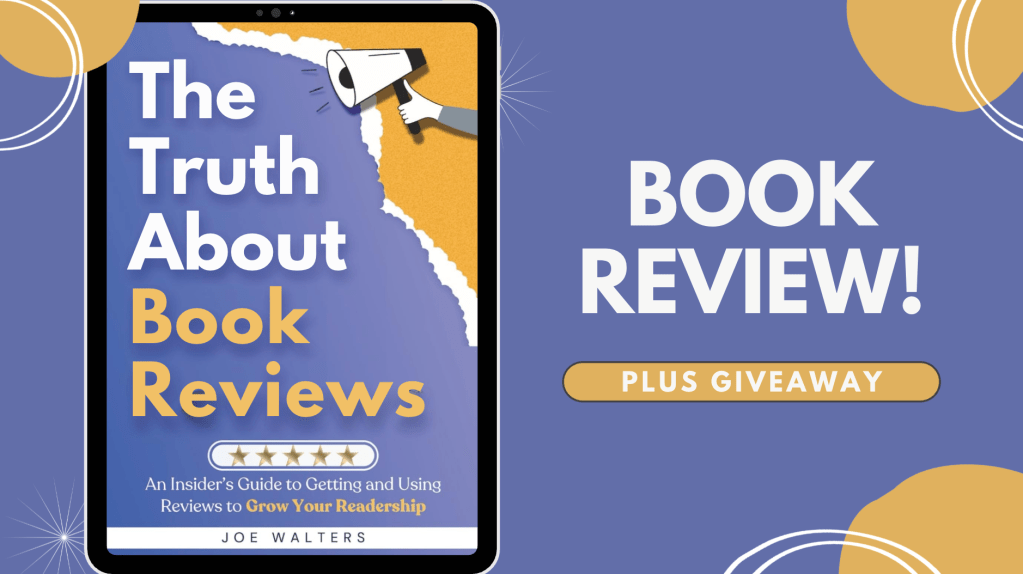
When Joe Walters, editor-in-chief of Independent Book Review, told me he bumped into one of my blog posts scrolling the WordPress reader and asked if I would be willing to review his book, I said sure. Why not? If you know me, you probably know if you ask me to do something, I’ll do it. Whether that’s a flaw or an attribute, who knows, but I downloaded his book that was free when he contacted me, and during slow times at my work (not many which is why it took me so long–he emailed me back in September!) I read it. Even though it took me a while, I wanted to finish since I said I would, and besides, I wrote about reviews not long ago and thought maybe there would be some advice I could follow in my own book business.
Did Joe’s book deliver? Yes.
Is getting reviews a lot of work? Yes.
Did he offer to do that work for you? Unfortunately, that answer is no, though writing the book in the first place is a big help all on its own.
There are lots of different kinds of reviews, and I think the kind indies think about the most are from readers who put their reviews on platforms like Amazon and Goodreads. You can’t do much about those–all you can do is sell a lot of books and hope readers review when they’re done reading, or pay for a review service like Booksprout and hope the readers who pick up your book follow through. Joe focused a lot on editorial and trade and media reviews and gave you several examples of what to say when you reach out to them.
That was probably one of the best parts of the book. Unless you’re having Al write your requests for you–and I would advise against that being all the AI spam that authors have been getting lately–it’s difficult to figure out what to say that doesn’t sound smarmy, like you’re begging for a favor, or flat because you’re scared to reach out. He gives you plenty of examples of what to say, taking the guesswork out of it.
Not only does he tell you what to say, he tells you how to find people who review in the first place, which is a godsend if you have no idea where to start looking.
But, I’m not going to lie, and he doesn’t either. Finding people to read and review your book is a lot of work. You have to make a list of the reviewers who read your genre, write the email (follow their submission guidelines!), and wait. Do that over and over again, and be prepared to follow up if they don’t answer you. He even says in his book that the majority of his reviews come from the followup email, and that’s how it was with me too. I forgot I said I was going to read his book and he nudged me a couple months later. I emailed back and apologized, showed him a picture of his book on my Kindle Fire as proof of life and intention, and even left his email in my inbox to remind myself that I said I would review. (Even that has been a while, so he’ll probably be shocked I followed through.)
Another thing I liked about reading his book is that he speaks indie, and that helps a lot. He knows what Bookfunnel is, knows about sites like Booksprout, and understands Kindle Unlimited limitations if your book is enrolled. He has a sense of humor that keeps the material from becoming too dry, and I appreciated that very much. He also has a thing for ghosts, and though he says dead people can’t review your book, the next time you go to Barnes and Noble, grab a ouija board out of their games section. Every little bit helps!
One last thing that I really liked was not only does he tell you where and how to get reviews, he includes a short section on what to do with them once you have them. He explains how to access your book’s editorial reviews section on Author Central, how to use Canva to create A+ content for your book’s Amazon product page, and how to make graphics to feature reviews on social media and in your newsletter.
Overall, if you’re at a loss as to where to look for reviews and how to go about getting them, this book is very useful, but also keep in mind that there is a lot of content out there and chances are good you won’t be the only one asking. Tenacity and patience are key, like a lot of areas of indie publishing.
With my release of Wicked Games coming up soon, I’m going to try a different review service and also, I take back what I said about Booksprout. I wasn’t going to use them anymore, but I felt bad not giving the readers I have there a warning that I was leaving. I do have a few people who enjoy my books and leave real reviews, not just plot summaries or generic AI commentary, and I would hate to disappear without telling them how to find me in the future. So, in the “Notes to the Reader” section, I’m going to tell them this will be the last book I put up and if they want access to other ARCs, to follow my social media or blog. With Loss and Damages, I just got so disheartened, and it doesn’t seem like something I need to keep paying for.
Anyway, I’ll keep Joe’s book as reference if one day I decide I want to chase reviews written by other people than just readers, like Joe and his review team over at the Independent Book Review. If you want to read Joe’s book, The Truth About Book Reviews: An Insider’s Guide to Getting and Using Reviews to Grow Your Readership, you can find it on Amazon. It’s available on Kindle, in Kindle Unlimited, and Paperback. https://www.amazon.com/dp/B0F7C3WFM5
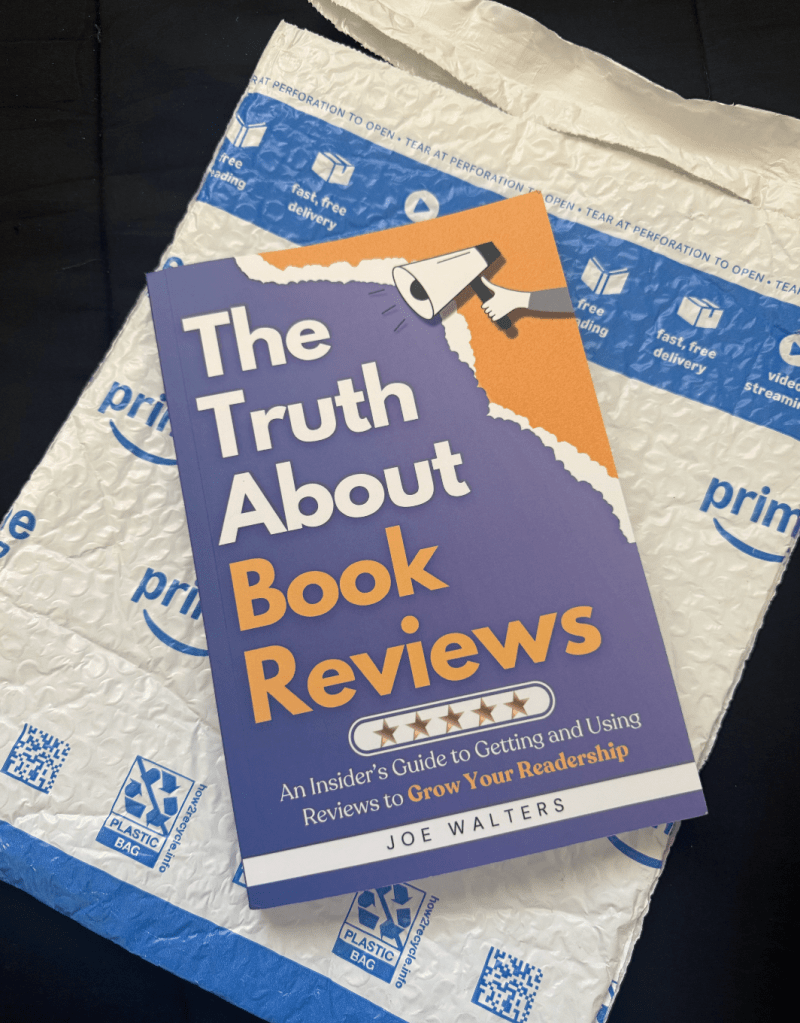
I also purchased a paperback copy as a giveaway to go along with this blog post–and in true Amazon fashion, it came a little banged up. I know giveaways aren’t popular anymore, but if you’re in the United States, comment below and I will draw a name next week.
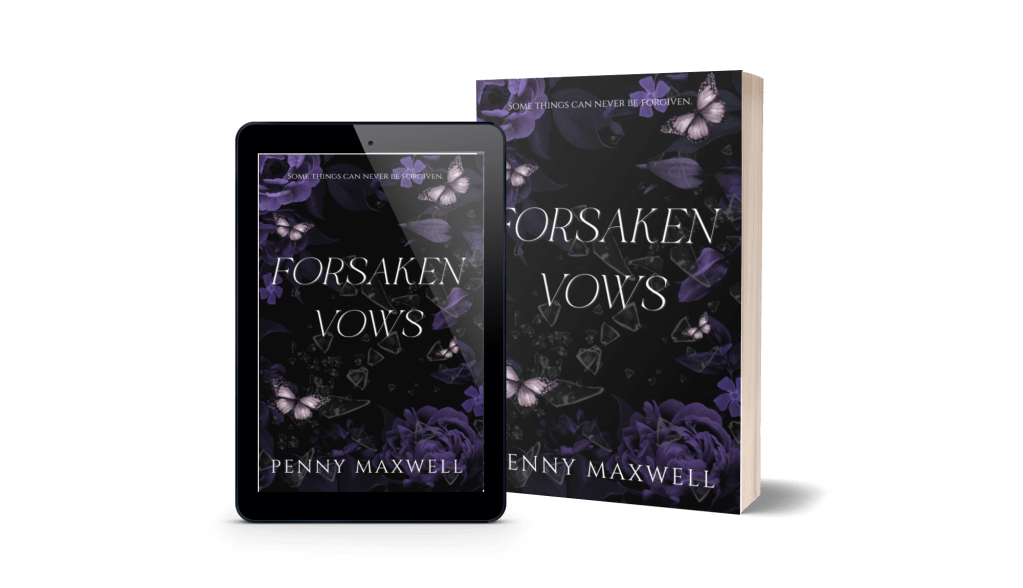
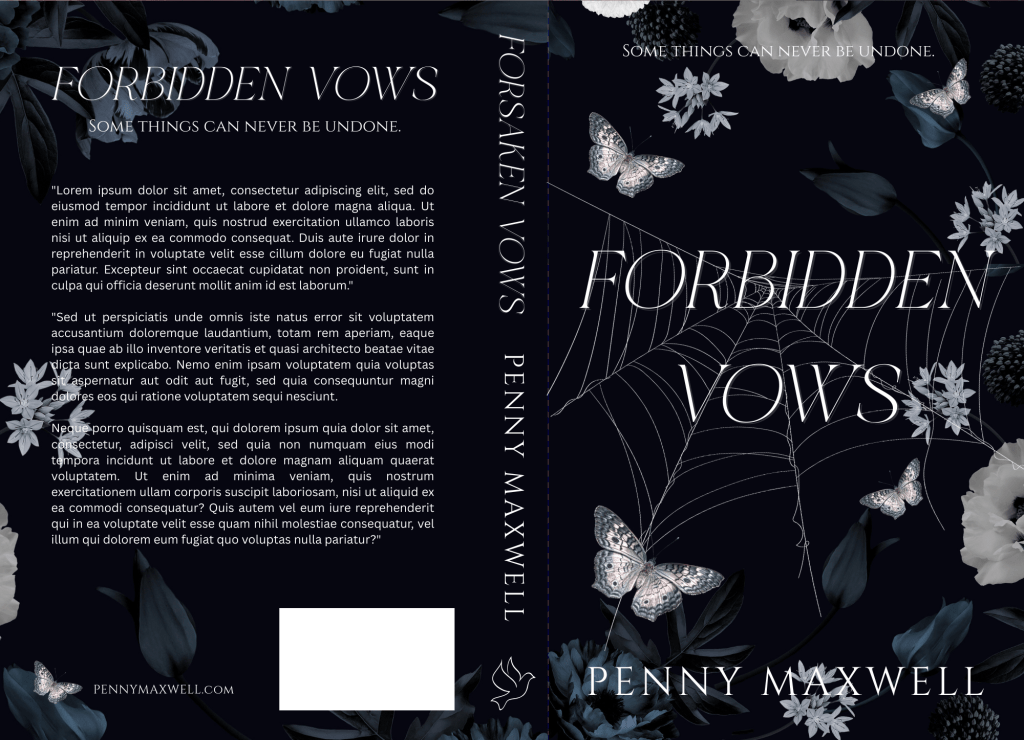
**This is a short tutorial on how to make a simple floral cover, full paperback wrap in Canva.
I have Canva Pro and use elements from that plan. I’m not sure what’s available in the free plan, but I’m hoping you can find comparable elements so you can also make your own covers if you ever want or need to. I also source my stock photos from DepositPhotos. You can use photos from wherever you want, but because they’ll be going on a book cover, I wouldn’t use free stock photos from places like Unsplash or Pexels. If KDP happen to ask you for copyright proof, they do not accept Canva’s copyright agreement if you use their stock photos, so always be safe and buy the stock photos you’re going to use on your books. Elements are fine to use as long as you’re not attempting to use one element for the entire cover. Here’s Canva’s licensing agreement FAQs if you want to look them over: https://www.canva.com/licensing-explained/ There’s a lot of incorrect information out there. Don’t be afraid to use Canva. Just be smart when you do.
I’m a broke and impatient author. And when it comes to publishing, I know many authors are just as broke and impatient as I am. Meaning they can’t afford to hire out but don’t want to wait to publish while they save. Maybe they don’t even have money to save, if they live paycheck to paycheck like I do.
I’ve done my own covers, for good or for ill, for many, many years. Every year I get a little better, or maybe stock photo choices get better, or maybe I stumble upon a male model that hasn’t been used to death. I’m especially proud of the covers for Wicked Games and A Heartache for Christmas. Loss and Damages is fine too, but I didn’t need nearly the luck that helped me put Wicked Games and A Heartache for Christmas together.
But I know that not every romance author wants to use men on their covers. What’s popular will come and go, and if I do come across a male model on a published book these days, a lot of the time he’s AI generated. I don’t want to use AI to make my covers. I want to pay photographers and models. Maybe they’re living paycheck to paycheck too. Anyway, right now I see a lot of illustrated covers, but I don’t plan on using one for my books anytime soon. Florals or object covers seem pretty versatile, and not even just for dark romance. I think some authors still use them for discreet paperbacks while using a shirtless male model for the ebook, but I’m actually seeing less and less of that. I’m not sure if it’s cost or if it’s just a trend that’s fading, but I’m glad. I never liked it and never did it myself. (Be proud of your men! LOL)
If you don’t have a lot of skill, you have to keep two things in mind when doing your own covers: choosing the right stock photo and what font you use. Those two things will make or break your cover because you won’t be able to use the skill you don’t have to make the stock photo better than it is or twist it to suit your needs, and font is the finishing touch, like a pretty bow on a present. So it’s really important that you know what you want and that what you want matches your skill level or you’ll just end up frustrated. It’s not much different from crafting the perfect scene in your head and then sitting down to write and forgetting the alphabet.
The first thing I would do is clock your genre. What your genre is and what kinds of covers are selling right now. It doesn’t hurt to take a look at the top 100 on Amazon in your genre not only for inspiration but to remember their readers will be your readers and you want to blend in. Then look at the author. If it’s a big name author like Colleen Hoover, looking at her covers probably won’t do you too much good. She sells with her name, not her covers. Same with some of the bigger indies, or indies who have picked up book deals. They already have a fan base and can get thousands of pre-orders without even having a cover yet. The midlist author who’s making a good living but not well-known enough to have name recognition will be your best bet.
That said, let’s figure out what the book is about. Maybe an enemies to lovers. Something that would fit a simple floral cover. We aren’t going to get too crazy because the purpose of a “simple” cover is to a) still be good enough to keep because you’re stubborn like I am and want to do it yourself or b) stay as a placeholder until you can afford something better if that’s what you want. You may always do your own covers and swap this one out as your skills get better. So, maybe a romance that would fit a dark floral cover. A standalone, possibly, but if you’re writing a series, finding similar stock photos for other books wouldn’t be too hard. Once you get into the right search, you can find a lot of similar pictures on DepositPhotos.
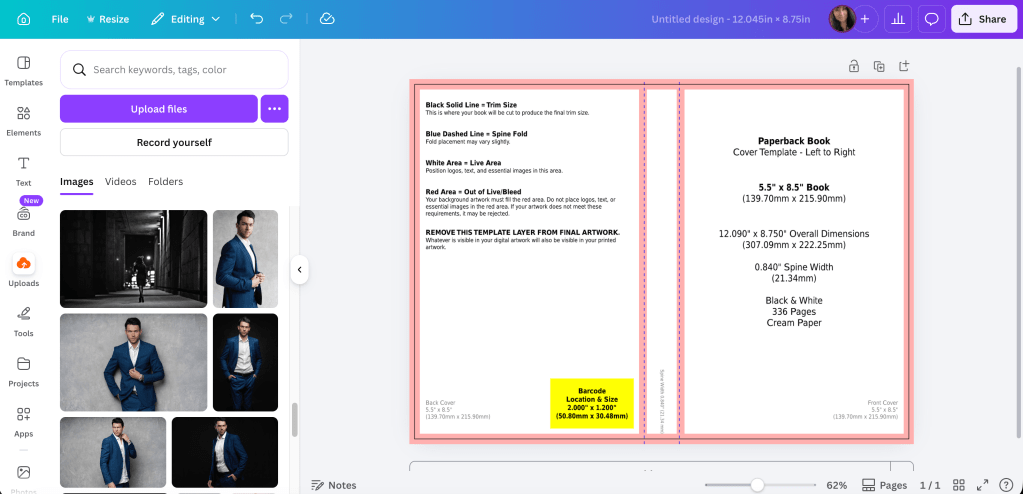
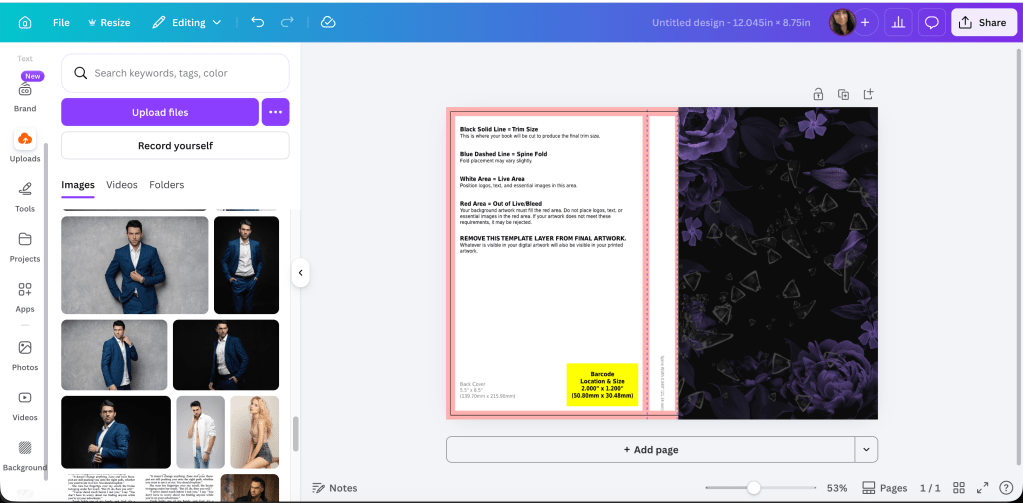
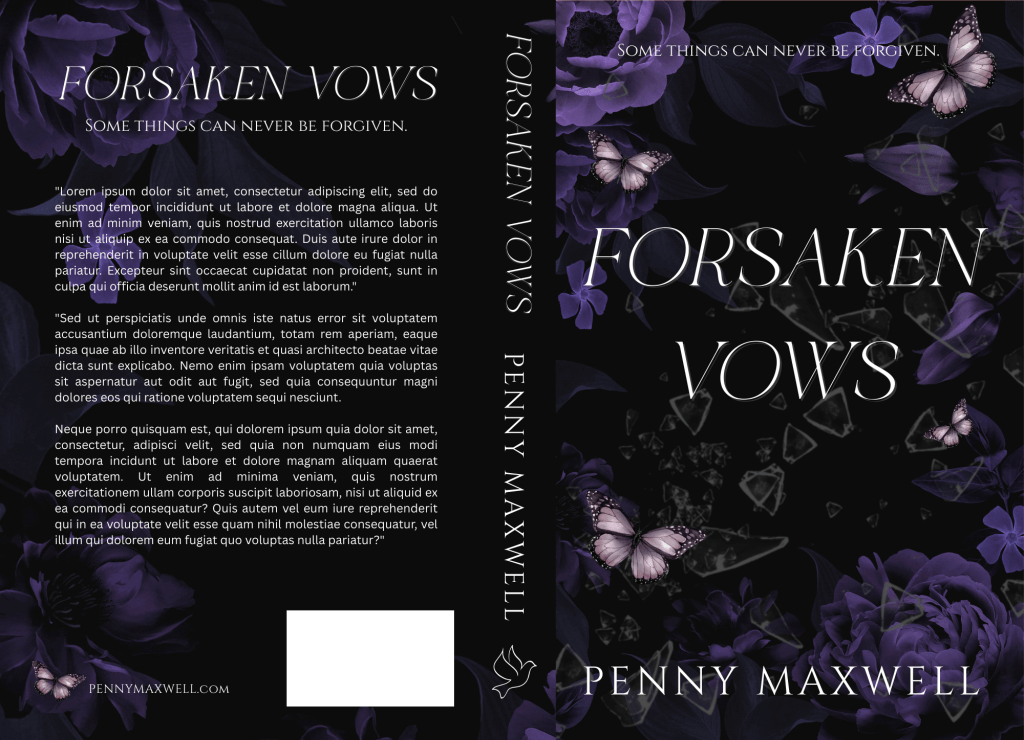
Let’s start with a blank template. We’ll do the full wrap since it’s easier to design the whole thing at once. I’m using Canva Pro, but because you’ll be using stock from a site like DepositPhotos and a font from somewhere like Creative Fabrica or a free source like 1001 Fonts, you can probably do your cover just fine with the free plan. If you don’t know how to get here, I have the instructions in a different post.
Next, go through photos on your stock photo site. I buy packages from App Sumo for DepositPhotos so that’s where I’ll always source my stock photos. What you’re looking for is something that will give you room for a title, maybe a series logo if you want. Also your author name. If you take a look at other floral covers, you can pick them apart and see what they have that’s similar. Before spending the money or credits on the photos, you can download the sample or use a screenshot of the picture first to try it. Then if you know for sure that you’re going to use it, you can buy it.
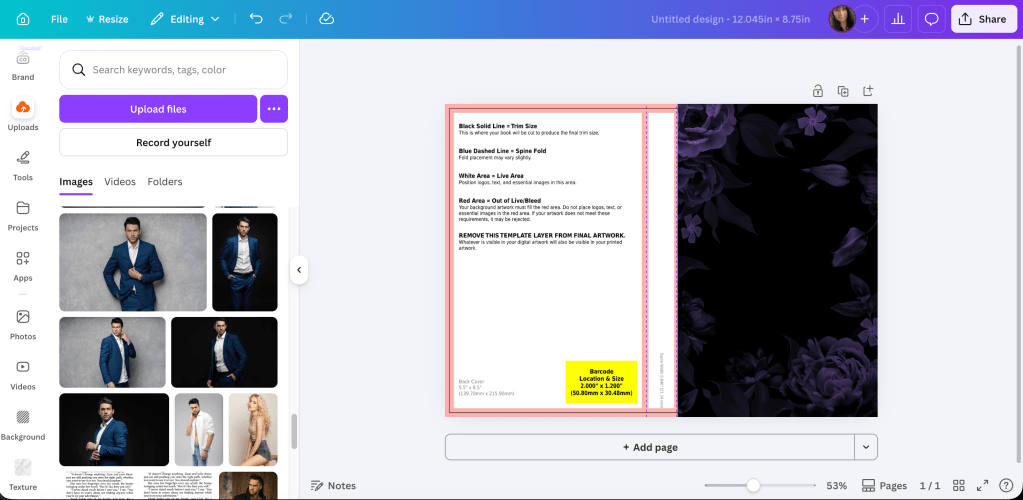
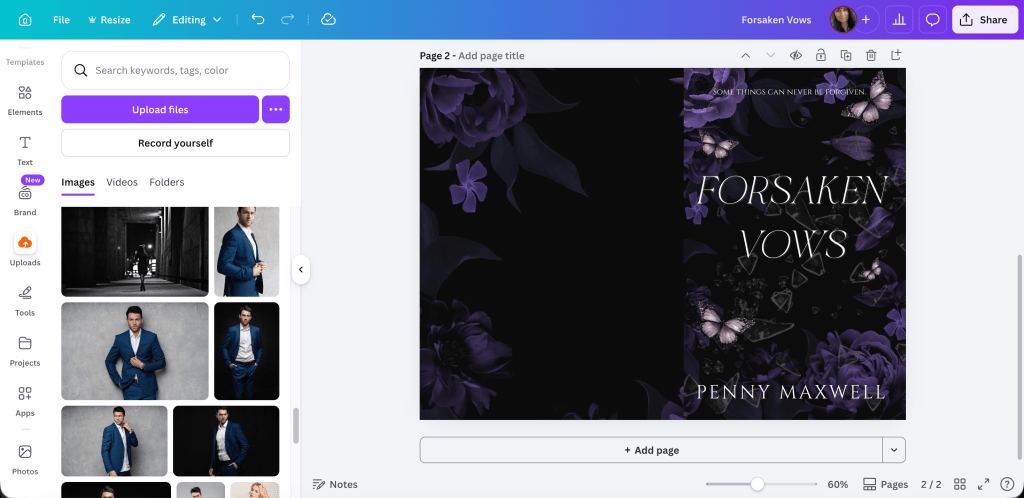
I chose some dark purple flowers. (I’ll link the photos below so you can find them easily if you want.) I like how they’re positioned. I don’t have to worry about making room in the middle for the title. They are a little dark though, so play with the brightness of your photos. You should bring out the color a little bit because when you print through KDP, their paperbacks are always darker than what you see on your screen.
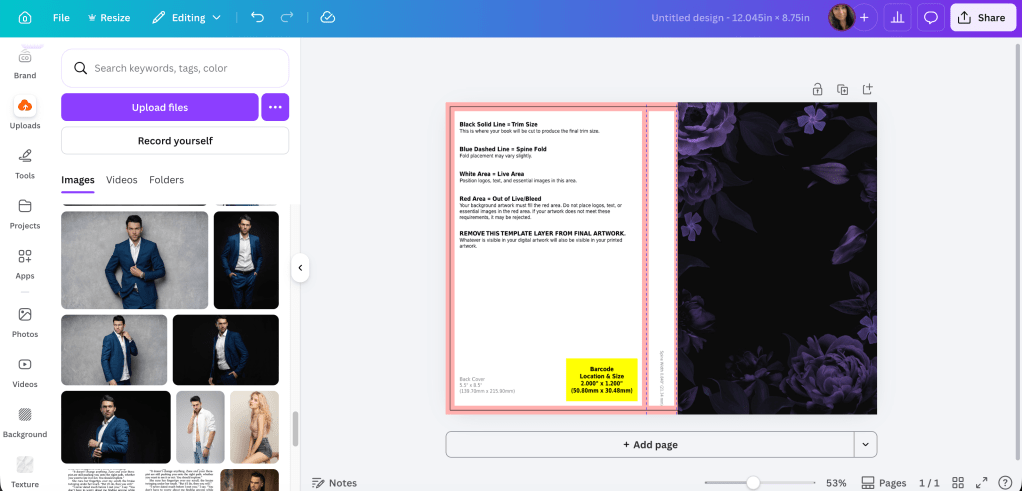
Okay, I brightened it up. You might not be able to tell I did much, but always do enough so you like it, and always order a proof. You’ll probably need to adjust the colors again once you see it in person.
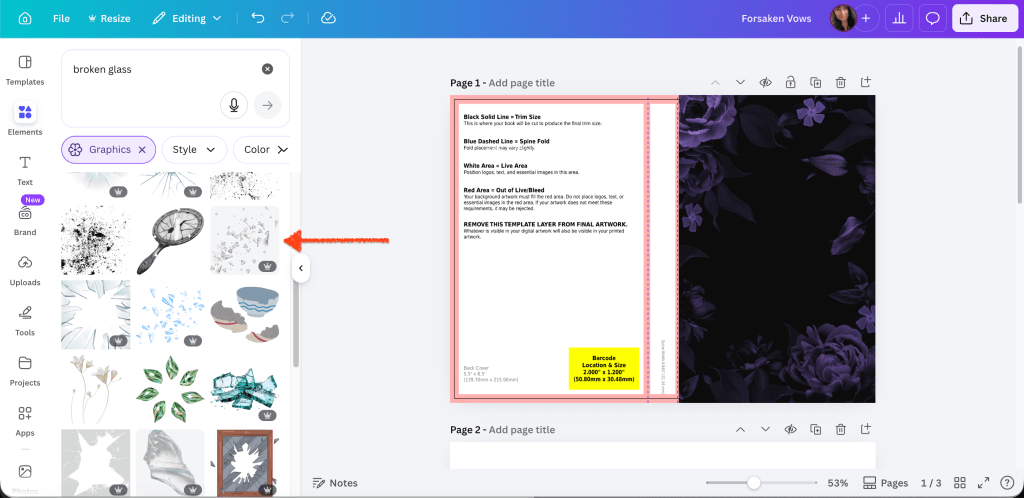
If you wanted to add texture like broken glass to the middle now would be the time. I’m not quite sure if it really needs it, but let me play and see what I can come up with. I wouldn’t bother using more stock for this. Canva will have something that will work and using their elements on your book cover is okay. It will barely be detectable, but it’s the little things like that that separate something that looks DIY from something that borders on professional.
I was able to find some broken glass in Elements that fit nicely since they were already on a transparent background:
Position the glass where you want it. Remember you can play with photo by making it bigger or moving it around so you can put the glass shards where you want them to go.
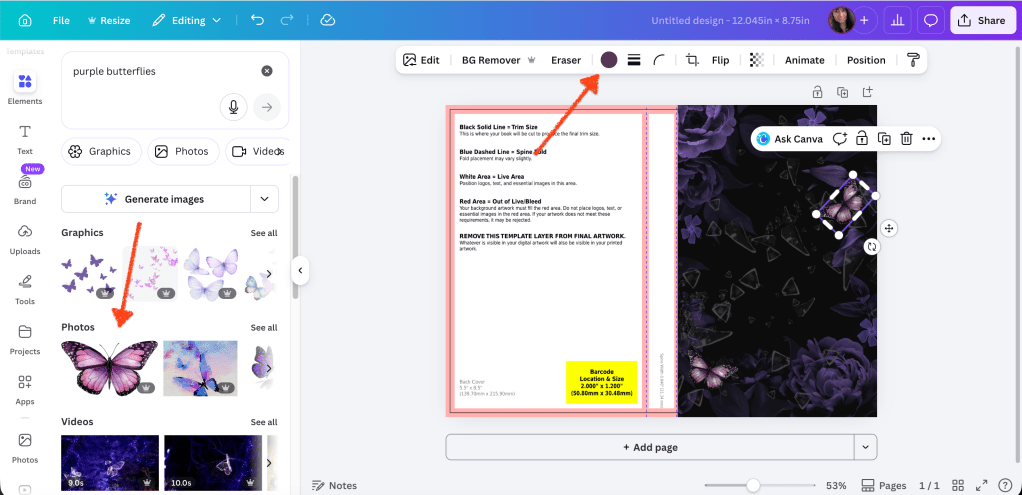
Now that we have a “base,” if you wanted to add things that pertain to your book, you can discreetly put those in. Rings or strings of pearls. Ribbons. Whatever. I’ve seen a lot of covers with butterflies, though I have no idea what they represent. Innocence, maybe. I found one style I liked in Elements and messed with their color a bit to make them blend in.
I don’t want to add too much, so the glass and the butterflies will do for me. Part of learning how to design covers is experimenting, so just keep at it until you find what you like. When you don’t know what you’re doing or haven’t developed your eye yet, simpler is always best. It’s really easy to add too much then it looks like Canva threw up all over your cover.
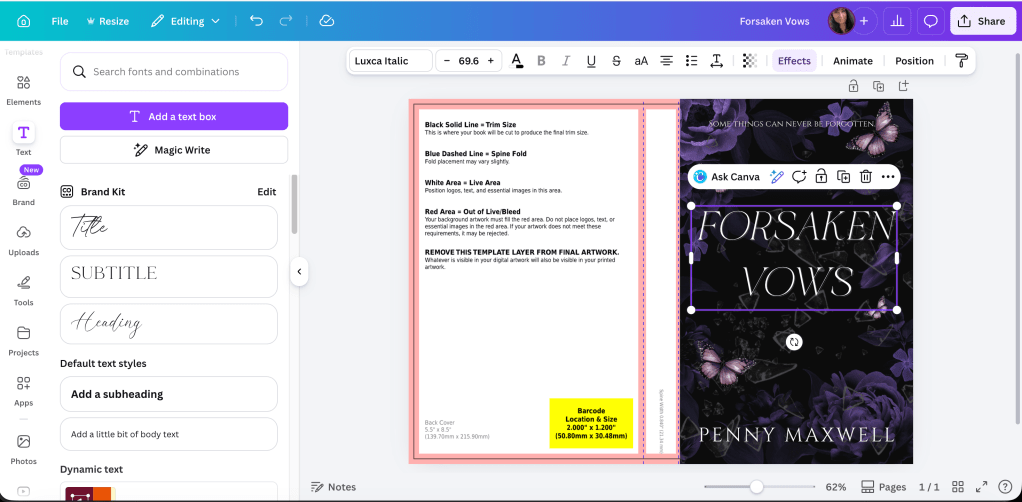
Now we can have fun with font. A bad font can ruin your cover. I’ve seen beautiful art, and a cover just isn’t the same if you can’t find something that will complement the illustration or stock photo and the book as a whole. I think for this one, rather than edgy, we’ll go with elegant. There aren’t any skulls or anything here, so let’s stick with something pretty. I get my fonts from a combination of places. Sometimes I use Canva’s, sometimes I buy from Creative Fabrica. Sometimes I use 1001 Fonts depending on if what I like is available for commercial use (sometimes they’re tagged as personal only). There are lots of places to get fonts. It doesn’t matter where you get them as long as they’re available for commercial use.
For this one, I went through a few before I found one I liked. It’s called Luxca Italica and it came with a bundle I downloaded from Creative Fabrica. The font for the tagline and Penny’s name is Cinzel. I think you can get that anywhere. I’ve read that you shouldn’t use more than three different fonts on your cover. I like to stick with two if at all possible. But I can understand if you need a clear font for the tagline, then your pretty font for the title, and then whatever you use your author name. I use the same font on all my books for brand awareness.
What this means, though, is that since we’re doing simple, that if you found the fonts you like, then you’re done with the front cover. Now we can do the spine and the back.
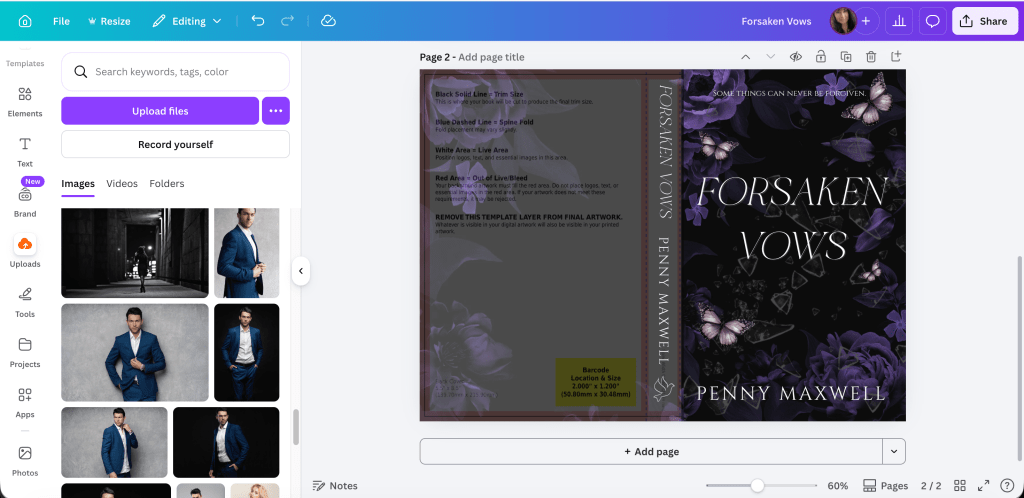
The back cover graphic will mirror your front, but you probably don’t need to copy it exactly. Especially since you want people to be able to read the blurb you’re going to put back there. What I did was duplicate the flower picture but then cropped it and made it fit the rest of the template. That way there will be plenty of black space for the words.
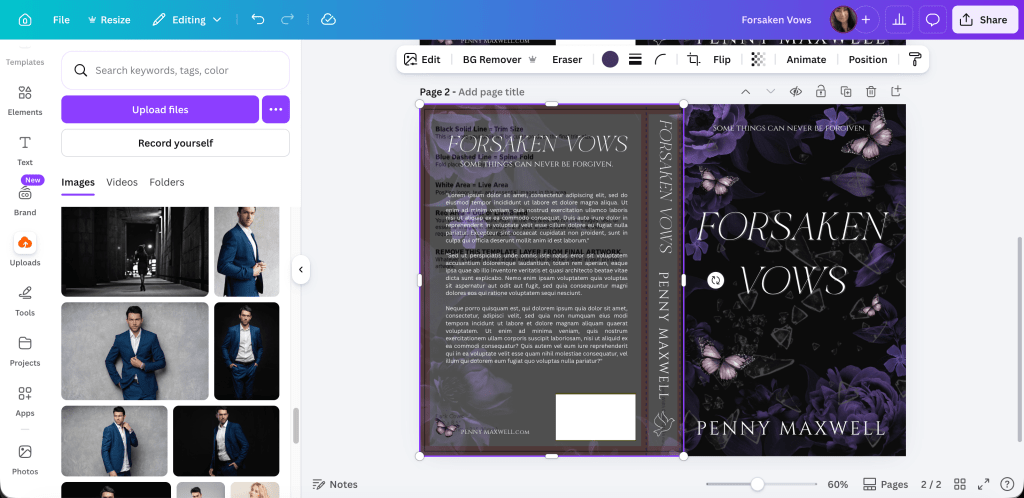
Lower the transparency so you can fit the title and author name on the spine. The orange lines are the bleed lines. Don’t get too close to those. I also chose a dove just as a filler in case you have an imprint logo that you use.
Keep the transparency low so you can center your blurb. You don’t have to put the white rectangle over the yellow one if you don’t want to. KDP and Ingram Spark will fill that space in with the barcode. If you’re using your Ingram cover for Draft2Digital, they don’t like the white rectangle and will kick your cover back to you anyway.
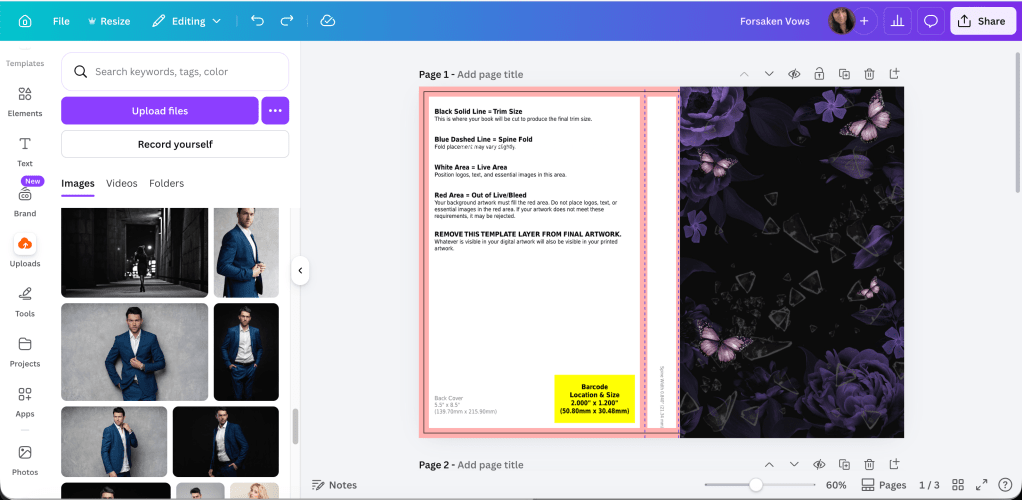
I never know what to put in the lower left, so most of the time now I just add my author website. It seems to work okay. For this one, I added a butterfly that matched the front cover.
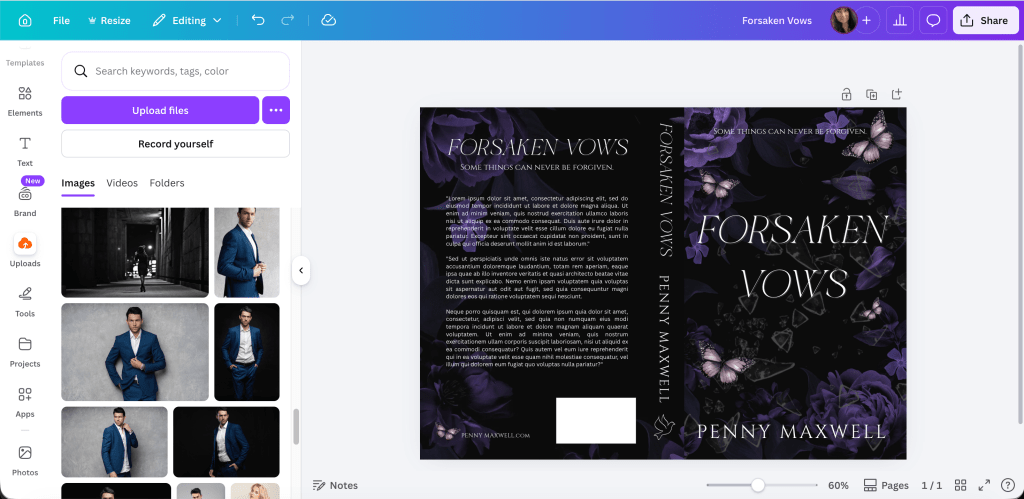
Now you can remove the transparency and look at the cover as whole.
If you’re not sure how it will look as an ebook cover or in promos, take a screenshot of the front cover and use a site like this one: https://diybookcovers.com/3Dmockups/#
I think it looks really good, actually. Not bad for something I put together in a few minutes for not much money. The title font is clean and what we added to the flowers (glass and butterflies) doesn’t clutter.
Now that you have a template of sorts, you can make covers for a series if that’s what you’re planning. I write all my books in a series first and design their covers at the same time.
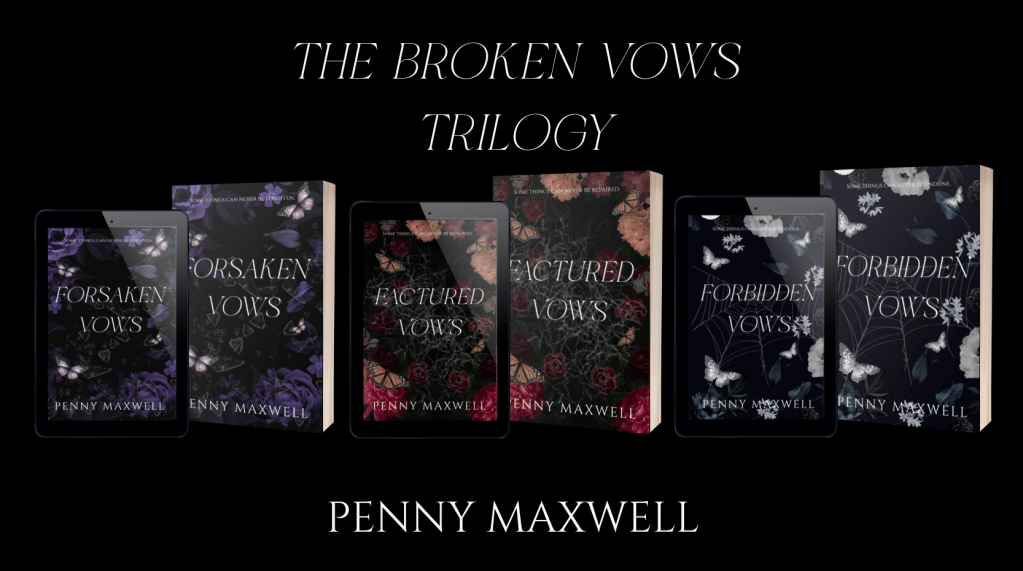
This could be a trilogy:
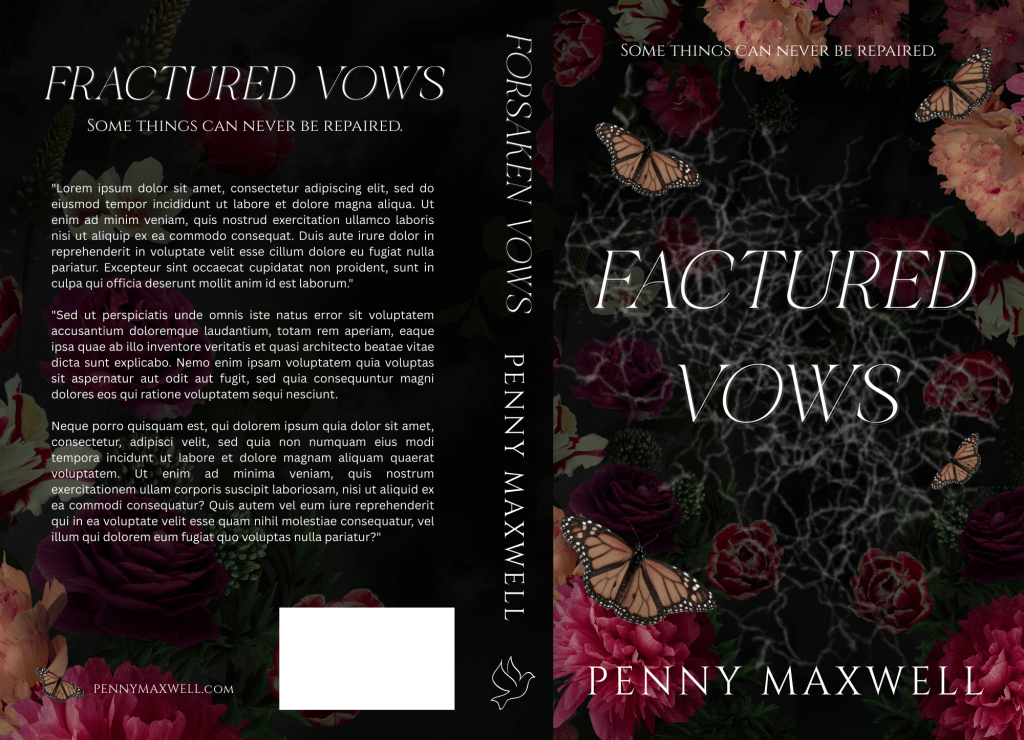
And here they are up close if you want to study them:
2. If you’re doing a series, plan your theme. The middle elements for these books are: broken glass, shattered ice, and spider web. Keep extra elements the same as well. I chose butterflies but picked colors that blended in with the flowers. If you want to go creepier, you can do moths, insects, or birds.
3. Don’t be afraid to experiment and adjust your stock photos. Move the flower pictures around to position them in the way you want. You can even crop and just add only sections of the pictures. With the black backgrounds, as long as you’re not cutting off flowers mid-petal, you won’t be able to tell. Also colors. I changed the colors of all three butterflies. To make the black spider web pop against the already black background, I inverted the colors (an option in the edit menu when the photo is selected) and turned the black web white. Voilà.
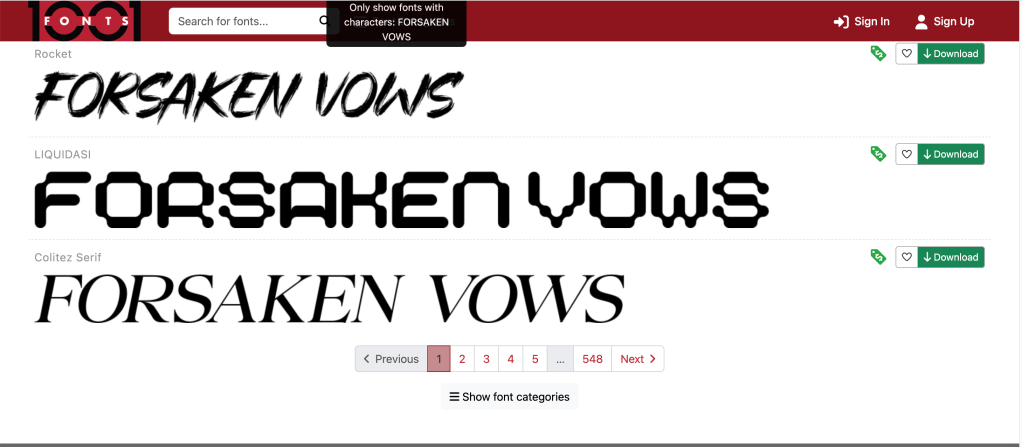
4. Take your time choosing the font. I went through about twenty fonts before I chose. Just click down your list to see which one looks best. If you don’t have very many, 1001 Fonts that I linked to above lets you try out your title before you download it. Colitez Serif looks like it would be a nice fit too, and it’s free for commercial use.
5. Remember to look at what’s selling in your genre now. Covers with men on them are really easy to create too, easier than floral covers. So even though cover trends change, it helps to know what’s selling at the moment.
6. Test and get feedback. Adjust if you have to. Maybe the photo isn’t right. Maybe you need to pick a different element for the middle.
7. Keep it simple. One or two elements and three fonts maximum. If you haven’t developed your eye, it’s easy to bog down your cover.
I hope this blog post helped you a little, or at least inspires you to try your own floral covers.
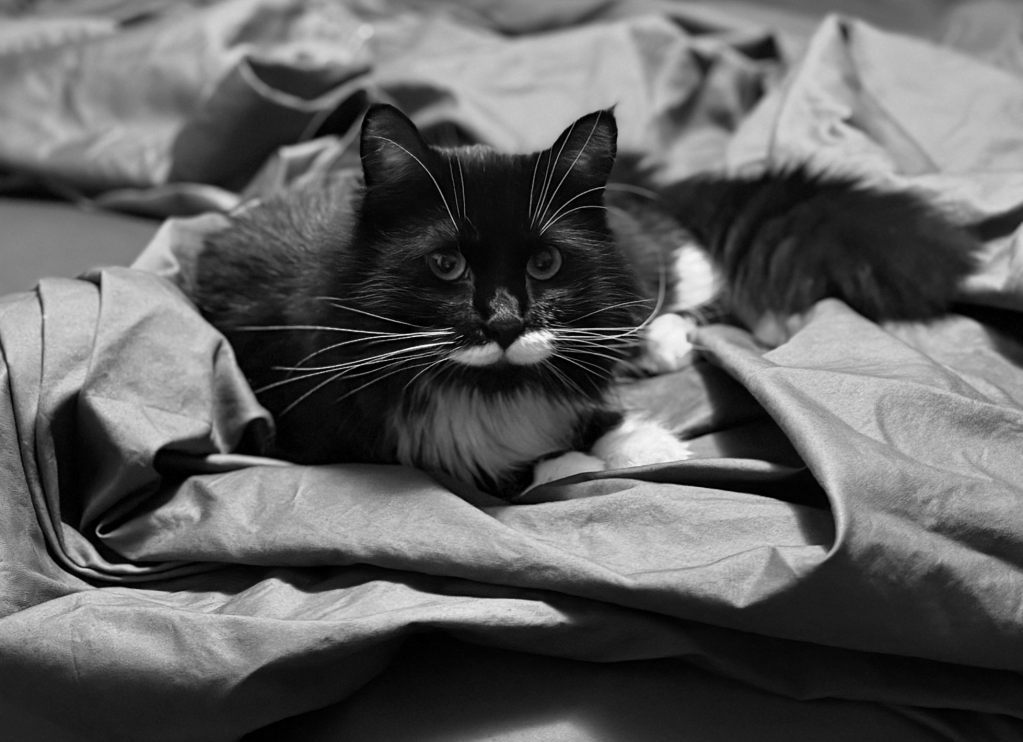
It’s hard to believe that by the time this blog post is published that the first month of 2026 will already be over. There’s nothing scarier than looking back at time that’s gone and realizing you didn’t do anything. Time is a finite resource, in some ways more valuable than money, and no matter how hard you work going forward, you just can’t make up what could have been. That’s why I really dislike the phrase “Give yourself grace.” That’s fine, when you really really need it, but if I gave myself grace for all the times I’ve wanted it, I’d have half a book and two blog posts done. Not really, blogging and writing is what I love best in the world besides our new cat, Pim, but sometimes you have to get your words down first then indulge in what you consider grace (the new season of Bridgerton, anyone?).
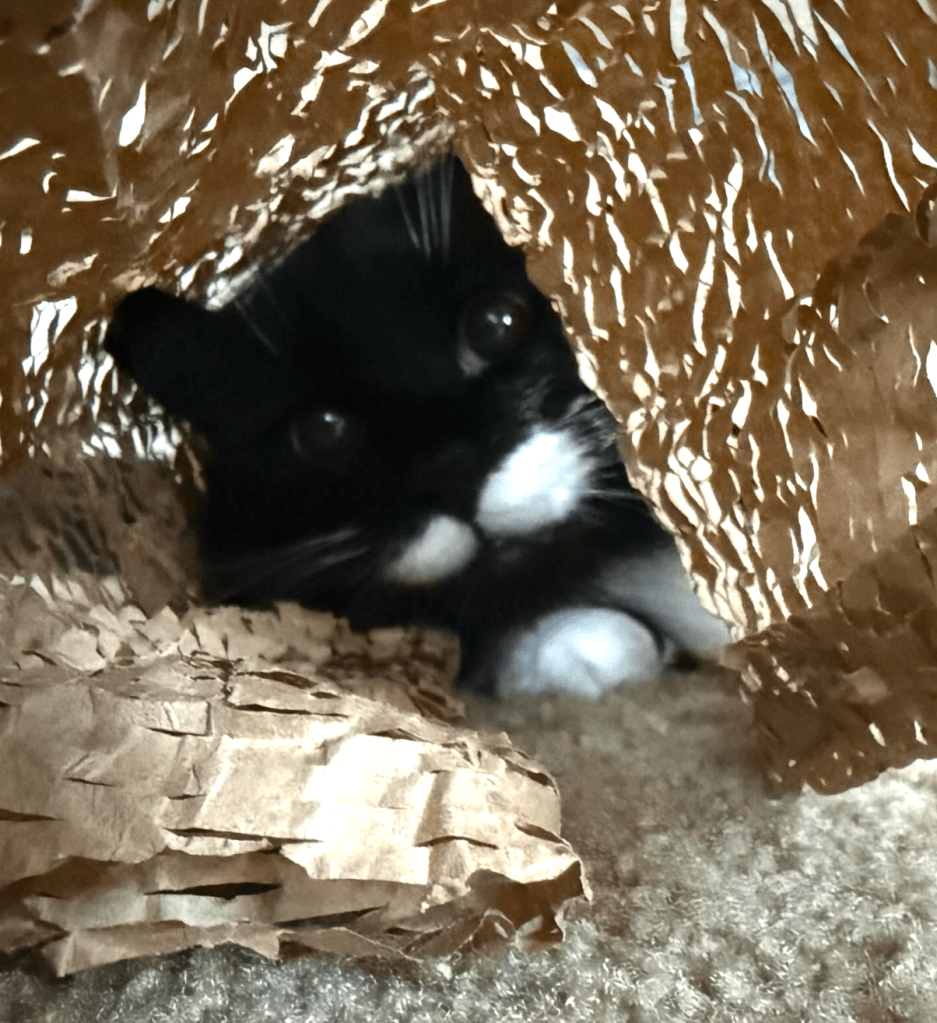
Pim for the cat tax
Anyway, so 2026 is already 1/12 over, and while that doesn’t seem like much, summer will be here before you know it.
January was full of little crappy things that sucked my time away from me. I had to get a hair cut, then I took a few minutes afterward to color it because I’m not getting old without a fight. My car needed an oil and battery change and that took half the day. My son needed to go to a doctor’s appointment, and I had a dental cleaning. Then I finally put my big-girl panties on and scheduled maintenance to fix our toilet and replace our sink faucet. I hate having workmen in the apartment and with my previous health issues, not having an accessible bathroom triggered my anxiety. They were here for two hours and I managed, though I was working and had the double-whammy stress of not having a bathroom and being trapped at my desk. I was able to get through it, and now I don’t have to worry about it anymore. They gave us a new toilet, which I didn’t expect, and they chose a pretty faucet for the sink that I like looking at.
So, I’m trying to check things off my list, and last month it just seemed like everything happened at once. This month I’ll still be nickel-and-dimed out of my free time as I have to get my taxes done–unless I push that back to March–my daughter has a new-patient appointment at my dental office which I am very thankful for because they’ve told me in the past that they had reached their capacity for the insurance we have, and I have to make us appointments at the post office to get our passport applications submitted. I want to go to Florida this summer and having a passport is the only way my daughter can fly because she doesn’t have her driver’s license yet. I figured since she’s going through the paperwork and hassle that we all should, but that means figuring out a time when all three of us can go–which has to be on one of my days off work.
So, yeah, I’m giving myself some grace because those are things that I just can’t get out of, but the frustration is there because I want to get Wicked Games ready so ARCs are available in March, and mostly, because I just like working on my books and when I’m doing other, necessary garbage, that time is gone.
I did manage to finish re-editing Captivated by Her, but getting the second book in that duet, Addicted to Her, re-edited will take me a while, and I won’t have that duet re-released until probably spring at the earliest. I’m changing out the covers as well and I always order proofs when I do that. I’m hoping that once I get the things that I only need to do once every six months out of the way that my free time will open back up.
I also want to find time to do some marketing things like trying Bookbub ads again. The last time I tried was back when I was wide and I didn’t have my first person backlist. With all the AI garbage that Facebook is trying to shove on us in the ads dashboard and them taking away the ability to target bigger authors, it just feels like Bookbub ads might be easier and have just a tiny bit better ROI. I mean, I’m hoping that’s the case, not that I heard it from somewhere. But I won’t run ads without researching–I have to reacquaint myself with the platform to make sure I know what I’m doing and how much to bid, or I’ll sound like every other clueless person who says ads didn’t work for them. I get BookBub’s newsletter, and right now I’m going through their Ultimate Guide to BookBub ads, and you can read it here or bookmark it if you’re interested: https://insights.bookbub.com/ultimate-guide-bookbub-ads/. What’s also a plus is that their ad graphics are a lot easier to put together because they literally tell you what works. Facebook lets you guess, and the creative you make could break your ad and you won’t even know it. I just feel like with how little time I have that choosing a platform that doesn’t have so much guesswork is the way to go.
But there is a time and place for Facebook ads and if you want an up-to-date tutorial on which kind of ad to choose (such as traffic vs. engagement) and how to turn off all the AI stuff and choose the interests for your audience that are available, you can watch David Gaughran’s most recent tutorial here:
He doesn’t go into much of what actually makes the ad, like the description, headline, and primary text, and I think those are really important. It’s like the cover, title, and blurb that work together for your book. If you don’t have the right description, primary text, headline, and graphic, any one of those broken cogs can take the whole thing down (or drive cost-per-click up). So, definitely look into that part of it as well because the backend and the front end work together.
Sales are slow, which is why I’m looking for other ways to get the word out. I keep seeing that Trial Reels on Instagram is the way to go, but I still feel pretty deflated after TikTok started labeling my carousels as AI and putting that level of commitment into a different social media platform doesn’t sound appealing. It never did, but now it feels even worse. I’ve been trying to post to Pinterest, and I’ve been able to make a few pins and a few boards, though nothing that would move the needle in any significant way. On the plus side, making a pin is very easy and for the amount of time it took me to make a TikTok carousel, I can make three or four pins. Mostly it’s just another platform a reader might stumble upon and realize I’m an active author who is consistently publishing books.
But yeah, that’s been the first four weeks of 2026 in a nutshell, and I’m just going to be keeping on, keeping on. My main goal is getting Wicked Games ready, and then I can loosen up a little bit. I announce books and create deadlines so I have something to work toward. With a slow sales dashboard in a climate where a new release barely does anything because of all the content out there, it would be easy for me to just let the things that use up my free time take over. Announcing books and keeping to a timeline for anyone who just happens to be waiting keeps the spark from dying out.
This is a short blog post today, but nothing has caught my eye online to complain about, which actually is probably a good thing. Keeps my blood pressure low.
I hope 2026 has been going well for you all too! See you next week.
This isn’t exactly what I meant, but he’s yummy to look at.
There are a lot of things that I just don’t care about anymore, and maybe with what I’ve seen and what I’ve been through, how I’ve been treated and where I am now compared to where I wish I was, that you would consider that statement as apathy. But I don’t think I’ve fallen that far. It’s more like, I’ve lost the will to put out all the dumpster fires I see every day and would rather just step back and roast marshmallows with the flames.
As we get older, it’s common that what used to be important no longer is, and I can tell every day when I see fights online that I’ve softened. There are a lot of indies out there who speak with their whole chest about things that matter to them, and their version of facts can either be right or wrong or somewhere in between.
I’ve written this blog for ten years now, and when I dare scroll backward that far, I can feel the heat on my face from my own flames. I was very “This is how you do it if you want to do it correctly” and I didn’t leave a lot of grey area. It was my way or the highway, and man, I don’t even have a highway anymore. I have a path, through the woods, that goes to a lake, where I sit and watch the ducks.
Going back and reading my older blog posts is almost cringe in a way. That you had conviction is supposed to make you proud, that you had the nerve to stand up for yourself, or in my case, the industry/readers, but usually all I sounded like was a pompous idiot who hadn’t been in the trenches long enough to realize that I’m not going to be right all the time. Not even some of the time. I only thought that I was.
Here are some of the things I’ve stopped fighting about.
Craft is a personal choice: I’m not going to argue with you (anymore). Probably one of the biggest things I don’t care about anymore is how people write. Especially romance. In 2019, I was pretty against writing romance in first person. Not because I didn’t like reading it–I enjoyed Hunger Games and Twilight like everybody else–but from a craft point of view, I didn’t like the dual first person idea of a romance. The “I” belonged to one person, not two. Which, fine. I can see where I was coming from, but then what the fuck was I thinking when I started Zane and Stella and what would become my King’s Crossing serial in December of that year? I couldn’t have been that appalled by it.
Now days, I don’t care who writes what. Write a chapter in first, then the next in third, then the next in first if you want. Some authors actually do that. I don’t care anymore when the idea before would have made me throw up in my mouth a little. The thing is, I don’t have to pay for it. I don’t have to read it, and I don’t have to write like that. So live and let live. If you want read that stunning piece of craft critique, you can do so here: https://vaniamargene.com/2019/07/22/changing-your-point-of-view-how-you-write-and-thoughts-on-1st-3rd-past-and-present-tense/
Trigger Warnings: To add them or not to add them. Another thing I don’t care about anymore is trigger warnings. You may be surprised to know that I was against them, or at least, I wasn’t for them, and I’m not sure when I changed my mind. This year? Last? I used to say stupid shit like, “Life is triggering.” I was callous and agreed with people who said to “Just get over it.” I didn’t consider them spoilers–I have never thought spoilers ruined books–only that books about life can be hard. But that’s the whole point. Life is hard, and if a warning can help a reader avoid more hard, why not add it?
The only thing with adding triggers anywhere to your book now is that Amazon takes that to mean it’s full of naughty, filthy things, and they’ll bury it. Or so some authors say. Publishing a book on KDP is like playing Russian roulette, so I never wanted to take my chances adding something to the blurb or author’s note in the front matter that could get my book locked in the dungeon or taken down completely. I should make up a list and put it on my website, but the only list I have there so far is for my King’s Crossing serial because yeah, those books are full of some shit.
Do I think you should add trigger warnings to your books? I think they should be somewhere accessible for your reader to find so people can choose if they want to read your books or not. It’s okay for people to self-select out. It’s the best way to keep readers happy and avoid bad reviews.
When should you redo a book?Whenever you want. Back when I first started writing, I would get frustrated when I saw authors redoing their books after they were already published. I had this kind of purity rule that I followed and believed that once you published a book you shouldn’t go back and re-edit it or change the cover because people had already spent money on that edition. It was kind of a strange stance, especially since I’ve re-edited and re-covered many books since I’ve been publishing. In fact, re-editing and updating the cover and blurb is encouraged these days to give older titles a little breath of fresh air. It’s smart marketing when you have time to circle back to older work. I’m re-editing my Cedar Hill duet now, and I have new covers made that look fabulous. And of course I’m going to do the whole cover reveals and ads and treat them like new releases because these are good stories and mediocre covers and so-so writing was holding them back.
My blog post, When Should You Redo a Book, https://vaniamargene.com/2017/08/08/when-should-you-redo-a-book/, goes a little deeper and discusses old books completely redone with new titles, covers, and ISBN numbers. I’ve known indie authors who have done this too, trying to give their debuts a better second chance. I always figured that was too much work–to pull a book, waste an ISBN, get a new cover and title. I figure, let that one go and just write a better book next time. The blog I linked to was written back in 2017, a year after I jumped into the indie trenches with both feet. I should probably just unpublish it because I talk about trad authors like Robyn Carr, and when their backlist gets revamped and re-released, they probably don’t even get a say, or if they do, they agree because who wouldn’t want to breathe new life into a thirty-year-old book? New cover and title could mean thousands of new readers who weren’t familiar with that particular story.
So, yeah. My viewpoint has definitely changed. Do I think you should go back and redo a book from top to bottom? You do you, boo, because one day ten years from now, I might wanna do it too.
Should you write a series? If you can handle the commitment. Because I started publishing back in 2016, I repeated, and believed, a lot of the advice that was thrown around back then. There was no reason not to when you could listen to any six-figure author tell you how they built a readership and made all their moola. But, as Exposé sings, seasons change, and 2026 isn’t the same as it was back in 2016. When I wrote this blog post– https://vaniamargene.com/2019/09/02/why-i-wrote-a-series-and-why-you-should-write-one-too/— back in 2019, I was very much in favor of writing a series, and a lot of what I believed is still somewhat true. Read-through is good, if you can get it. More ways to market–free/discounted first in series, boxed sets.
But since then, I’ve changed my mind (you can read why here: https://vaniamargene.com/2025/09/22/is-writing-a-long-series-worth-it/). I put a lot of time into my King’s Crossing serial. Five years, to be exact, and while I love love love Zane and Stella and Gage and Zarah, it’s really nothing I want to do again. Even if there is nothing to support my theory that short attention spans and second-screen syndrome are keeping readers from wanting to read a long series, with the way my life is now, that level of commitment doesn’t even seem possible.
Do I think you should write a long series? It depends. Do you want instant gratification? If you do, a series is not the way to go. It takes time to complete a series, and with the number of complaints I see online about readers waiting until a whole series is available to start (which is completely understandable, in my opinion), if you don’t want to write the entire thing first, definitely adjust your expectations. You might find it’s not worth it. You have to go into writing a series for yourself–because you love the world and love the characters. If you think you’re not going to have the motivation to finish, don’t start. A six book series could be six standalones, two trilogies, three duets, or a four-book series plus two standalones, etc. Easier to chew through, yeah? As for me, it will be a long time, if ever, before I decide to do another long series. I still have two out of six of an interconnect series that I wrote during COVIID on my computer, so, we’ll see. I’m not dead yet.
You can be consistently inconsistent, and it’s perfectly fine. I still think if you want to get anywhere, content is king and consistency is queen. Showing people you’re in the game to stay is pretty important with so much content out there now. Lots of authors are flash-in-the pan. Their debut sinks, they lose heart and disappear. I talk a lot about where I am in this industry and how sometimes it feels like it’s not far enough, but I wouldn’t have all that I do if I hadn’t built it on ten years of consistent work–this blog and my books. But. But, you can be consistent in lots of different ways. Consistency isn’t the same for everyone, nor should it be. Maybe in this blog post I wrote back in 2021 I was just a little too hardcore about making sure readers know what to expect from you (https://vaniamargene.com/2021/12/20/buzzword-consistency/), especially since I’ve stopped being that consistent too. I’ve done billionaire for a bit, but I’ve been kind of moving into romantic suspense and small town. I’m going to write hockey next. The important thing is you don’t lose your joy. Stay happy. That’s the only consistency that matters.
I’m not really sure what other hills I was ready to die on nine, ten years ago. There are some things I still believe, maybe not super hardcore like I used to, but there are still things that make sense to me, like not cross-posting the same content everywhere. Twitter isn’t Threads, Threads isn’t Facebook, Facebook isn’t Instagram, Instagram isn’t Lemon8, and Lemon8 isn’t Pinterest. There are different ways those audiences consume content and certain content does better than others. Don’t give the algorithms even more reason to ignore you. Besides, if you have the same people following you everywhere, give them something different to look at.
I still think books should be formatted properly, but with tools like Vellum and Atticus and free software on sites like Reedsy and Draft2Digital, that’s not so much of an issue anymore. I just bypassed one book the other day because he put spaces between every paragraph. That’s okay for nonfiction, but his book was a thriller. I wanted to buy it to support him, but I wasn’t going to read it formatted like that, so there was no point in spending the money. I would have said something, but he didn’t ask and I’m not that person anymore who gives out unsolicited advice. Maybe someone else will tell him. Otherwise, he’s probably going to miss more sales than just mine.
I suppose the only other thing is that I still believe in buying stock photos. There are a lot of authors putting free stock on their books, from sites like Unsplash or Pexels, or using stock from Canva if the have Pro, but I just would never chance it. I use Canva Pro photos on here sometimes, for the graphics, but I’m not trying to sell anything using them. Book covers are different, and it’s part of the “do things professionally and cover your butt” philosophy I’ve always had. Selling books is a business, and Amazon gets a bad rap for trying to cover their own butts and regulating the authors who publish there. Honestly, I can’t even imagine what a headache it would be, policing hundreds of thousands of authors. So yeah, I still think it’s better to buy your stock from a reputable source. It never hurts because you never know when KDP will ask for copyright proof.
As time goes on, I’m sure more of my beliefs will change. Sometimes there’s a better, or best way, to do things, and sometimes . . . there just isn’t. Or if there is, that “best way” varies from person to person. I think in the end, we all want the same thing: happy readers. It’s the way we get there that can be different, and I’m happy minding my own business and doing things the way I want them done.
Hello, hello! We are nearing the end of November, and US Thanksgiving is this week! I have everything I need except potatoes, and I’ll grab them during my usual grocery run on Wednesday. When my schedule at work changed, I had no idea how much I depended on my routine and I probably will always have to grapple with when I can get stuff done while still trying to write as much as I can. Anyway, some weeks are better than others, but that’s life in general, and despite those changes, things are okay.
WIP Update Even though my writing time being severely cut, I’m still making great progress on Bitter Love. I’m 59,000 words into it and I am so happy with the progress I’ve made this month. I joined ProWritingAid’s Novel November, but I haven’t been keeping track of how many words I’ve written so far. My only goal was to get this book done by the end of the year, and I think I can do that. I have the last third of the book plotted out, which is the hard part, in my opinion, so writing the rest should be easy enough. I was going to jump into my hockey duet, but I’m going to put that on the back burner again, and in January re-edit and re-cover my Cedar Hill duet. That will take me a month or so, and then when I’m done with that, I’ll get Wicked Games ready to go for a May release. (I already announced it so I don’t want to lie to the few people who were listening.) I’m struggling with whether or not to do ARCs considering that my attempts in the past have had lackluster results. People take but don’t review, so there’s really no point in handing them out. I canceled my BookSprout subscription because the quality just wasn’t there for the price I was paying. I listed some other alternatives in a previous blog post, so I might try something new, if just as an experiment so I can blog about it later.
Then once Wicked Games is off my plate, I have a cute story idea about a woman who inherits a bakery she doesn’t want and a billionaire who wants to buy it. She can’t sell because of some stipulations in her grandma’s will, and he can’t work around them because of his own obligations. With some of the dialogue that’s already going through my head, it might be more romcom, if I can find my funny bone, and the characters already have names which means I will definitely be writing them in 2026.
So my plan is: *Finish Bitter Love *Revamp my Cedar Hill duet *Get Wicked Games ready to release in May 2026 *Write One Tough Cookie *Jump back to Bitter Love to get that ready for release maybe at the beginning of 2027 or the end of 2026, whichever works out
It’s nice to have so many plans and an idea of what I’ll be doing for the next little while, but it also makes me kind of sad too. I’m not doing this for anyone but me, which, I know, that should be the only reason a writer does anything–for themselves first–but it can be disheartening after a while and it doesn’t seem like there’s much I can do to fix it.
Deleting TikTok I mentioned in a previous blog post that I was having fun with a reader account on TikTok, and I was even getting a few views above the 200 view dungeon a lot of people seem to get stuck in. Then they started suppressing my carousels and labeling them as AI. This ticked me off for two reasons: one, they weren’t AI. I used stock photos from DepositPhotos (that were not AI) and two, there actually is a lot of AI on TikTok they aren’t flagging and the hypocrisy drives me insane. So, I deleted my accounts. Both my reader one and my personal one I started a long time ago.
The hit to my mental health was just too much and I don’t have the bandwidth to put up with it. It’s too bad because I was getting into a groove posting, and doing slides is a great way to learn how to pull hooks out of your books and write ad copy. But maybe I’ll just try to post more on Instagram. I barely post there and even though Facebook keeps telling me that my author page is getting views, I haven’t posted there in three weeks. I saved all my carousels in my Canva account, and turning them into Reels would be easy enough, but I’m not sure if I really care that much to do the work. Posting on social media is something I struggle with anyway, though I do like talking about my books to the handful of people who see my posts.
Black Friday Promo I wasn’t sure if I was going to buy a promo for any of my books this holiday season, but I went ahead and bought a promo in the Red Feather Romance Books newsletter and set my Christmas novel to free for three days around Black Friday. I’m not sure what else I’m going to do, if anything, because while I think giving away books can be beneficial if you have a plan, I have no plan, and don’t really care either way about giving books away. Mostly, all I think it does is create high hopes that it will finally do something and then it never happens. Chances are 100% I won’t make back the $135.00 I spent on their fee, but I’m really proud of the changes I made to the book when I re-edited it a couple months ago, so I wanted to give it another push. But A Heartache for Christmas is getting old, so maybe one day I’ll write another Christmas novel, if I can think of a plot.
The Future of this Blog(It’s good!) I had to renew my plan for this website, and they gave me a discount if I paid for two years instead of one, so I’m locked into this website and blog until the end of 2027. I suppose that was kind of optimistic, though I have no plans to go anywhere. I enjoy blogging very much, and having all my things in one place has been nice. I get why people write on Substack, but having a WordPress plan isn’t very expensive and having a main hub where readers can find you is less confusing for everyone. Granted, blogging on my author site isn’t the same as having a true newsletter, and even though I regret not having one, I still don’t think I’ll ever try that again. My author website is also locked in until March of 2026 and that auto renews every two years as well. I pay $156.00 for those two years and I think that is a decent price for a site that only has about 100 visitors a month.
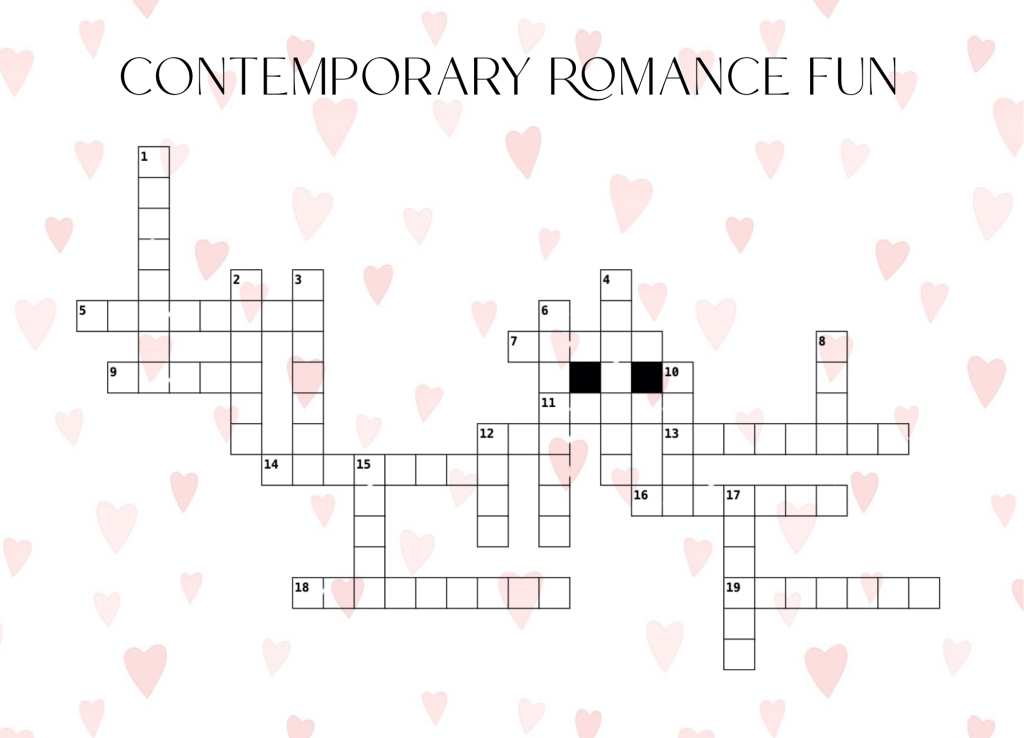
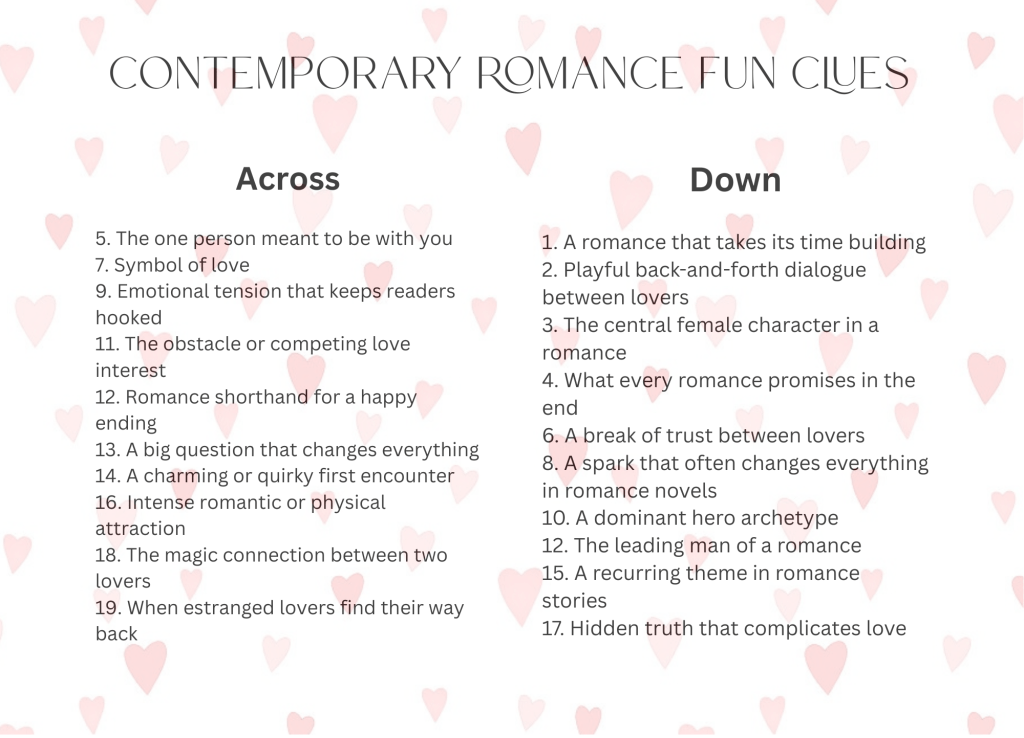
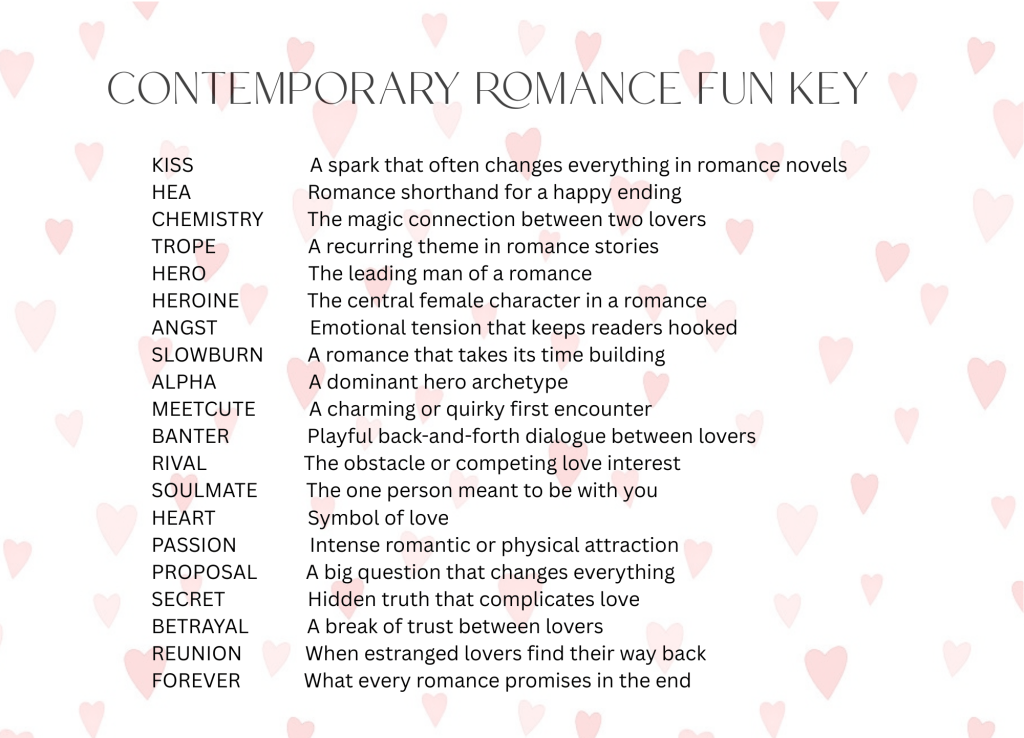
That’s about all I have for this week. As part of my “Favorite Things” section of my blog I have going until Christmas, I want to tell you about this free crossword puzzle maker that I used to make a romance crossword for my Facebook author page. You make up the questions and answers, and the website spits out the puzzle. It’s fun, and you can find it here: https://crosswordlabs.com/
Here’s the one I made with the answers. You can steal it if you want. I don’t mind.
You all know i have a terrible fear of missing out, and it was triggered this week by the announcement that Flodesk, the newsletter aggregator, is going to stop their unlimited pricing structure at the end of the month and you need to lock in that plan before it goes away. This shouldn’t concern me because for one, I don’t have a newsletter anymore, I blog on my author site, and two, I probably will never have the number of signups that would require the need for an unlimited pricing plan.
This ad popped up in my Instagram feed
But that didn’t stop the “what ifs” from running through my mind. What if I ever wanted to start up a newsletter again? What if I pushed my business to the next level and I needed that unlimited plan? WHAT IF I’M MISSING OUT ON THE BEST DEAL OF MY LIFE?
Cue the panic, right?
But this made me stop and think about where my business is and where it’s going. As of right now, I don’t have a book business. While I have money going out and money coming in, I have more money going out and I consider operating in the red more of a hobby than anything else. That reminded me I probably shouldn’t take on any more services that would dig my financial hole even deeper than it already is. Because if I paid for Flodesk, I would have to pay Bookfunnel for integration because I wouldn’t stop giving my reader magnet away. I already did that once with MailerLite, and while I did build up my newsletter to close to 1,000 subscribers back when I was trying, that is just more money than I want to spend for where I’m at and where I’m going.
So far, I’ve been able to eke time out in the week to keep this blog afloat, and surprisingly, it’s been easier than I thought. I do have a little free time on the days I work, but it’s not conducive to fiction writing, so I’ve been able to blog and make carousels for my secret TikTok account. That’s been a huge relief because when my work did all that changing up, I was really worried about having to cut back on this blog. I enjoy writing it and it gives me a place to put my thoughts about what’s going on in the industry and where I am in my indie life. So, unless work decides to mix things up again, or cut me loose all together, I think I can confidently say that I can keep writing my blog posts every Monday.
I have lost a lot of writing time though, and adding a “real” newsletter when my publishing schedule is taking a hit doesn’t make much sense–especially since I already pay for my WordPress website–so I might as well use it, even if it doesn’t have the same functionality as a newsletter aggregator. That doesn’t mean that from now until November 28th every time I see that ad I won’t think I’m making a huge mistake not signing up. That’s just the way I am. And I’m sure with Black Friday right around the corner there’s going to be more deals and steals I’ll have to say no to because I already have what I need to write and publish books. (I’m looking at you, AppSumo DepositPhoto sale when I already have 358 downloads available.)
I signed up for ProWritingAid’s Novel November, but I’m behind, or at least, I think I am. I’m not keeping track of the words I’ve written so far, but I’m 46k into Bitter Love, and if I can keep up the pace, I should be able to finish by the end of the year like I want. I’m at the point now where I go back and read from the beginning so I’ll be taking a couple days to do that, fix any plot points that got lost as the story developed and make sure the ending’s on track. I’ll have to add slow-burn to the list of tropes because this story needed so much setup, but a lot of secrets had to come out so hopefully even if the characters take their time hopping into bed it’s not boring or slow.
Besides that, I really don’t have much else. November is always kind of busy with my daughter’s birthday, Thanksgiving, and my birthday rounding out the month, but I’m not doing anything this year (I turned 50 on Thanksgiving Day last year and I think all that excitement will hold me over for a couple of years). I lucked out with my work schedule and I have Thanksgiving Day off, so that’s a nice break, and my daughter is still deciding where she wants to eat her birthday dinner.
Overall, things are okay, nothing bad happening, which I’m thankful for. Pim is doing great, but I’m trying to turn her into an internet star and that’s not working out. The last photo I posted of her on Threads only got 82 likes, but I’m probably lucky she got that since I think I post there maybe four times a month and the algorithms have no idea who I am.
But, I started a reader/book profile on TikTok, as opposed to my personal one and that seems to be doing better in terms of views. I didn’t tell anyone about it so I can’t “taint” the algorithms, but I didn’t use a VPN or anything. Just my personal iPhone using a gmail address I don’t use for much else. At least I broke out of the 200 views dungeon for a lot of my carousels, one getting over 3k views, but I haven’t gone viral . . . yet. I’m getting better finding hooks and writing ad copy, and I’m staying away from sex which always got me in trouble on my other profile. So far going for angsty instead of spicy has been serving me well, and now that I’ve slowed down with the writing, I’m making more time to post there. We’ll see how it goes.
I’m starting to think about promos for the holiday season, and I forgot that I have a nice four-book series set in the winter around Christmas I could promote if I wanted to. There’s a big author-driven book blast taking place next month but I don’t think I’ll officially put a book in it. It’s not that I don’t think free books are worth it, because I still think they can be if used strategically, but I’ve kind of given up hoping promos like will build into anything that lasts. So rather than take space from authors who are trying to use the blast to their advantage, I could just put a book or two free and piggy-back off the momentum of the day and see what that does. Or I could pay for something, but I doubt I would make my money back, so I would have go into it know that and being happy that people were just interested enough to download a copy. I’m not sure yet. Books are a dime a dozen, in every way that means, so what I do or don’t do won’t have any effect on me or my book business. It’s just something to do if I feel like it.
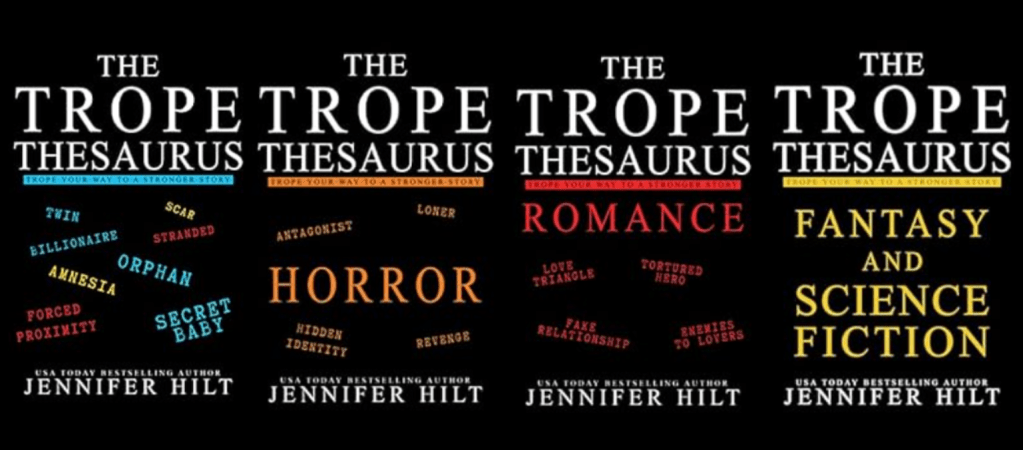
My Favorite Things I’m going to end every Monday blog post from here until Christmas with something that I’m liking in the author space, be it a writing resource, tool, or service that I find especially helpful. Today’s feature is the Trope Thesaurus series by Jennifer Hilt. I have the romance trope book, and I have to admit, when I’m feeling down, I get out my copy and flip through it. There are so many tropes out there I haven’t tried and it gets me really excited for all the books I haven’t written yet. There’s one for horror and fantasy/sci-fi and it looks like just a general one as well. Check them out here (this isn’t an affiliate link): https://www.amazon.com/dp/B0BFYR9L4Z
That’s all I have for today. Thanks for reading, and I will see you next week!
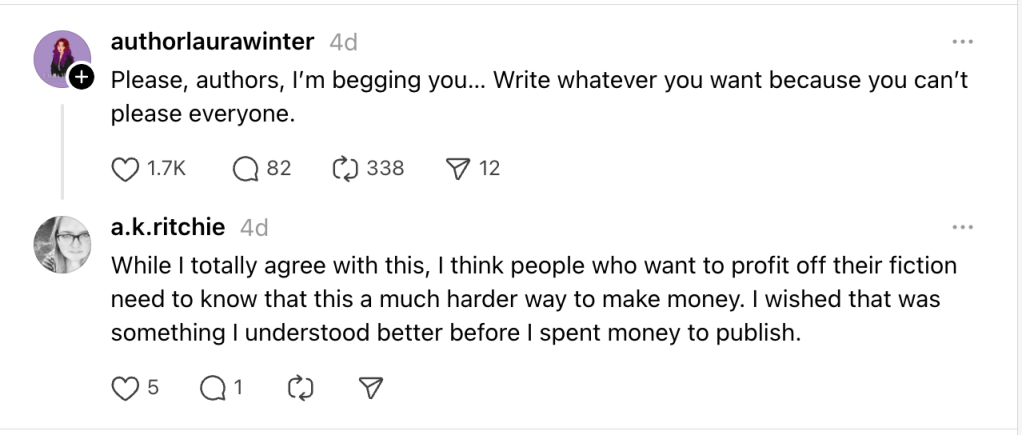
As with most of my online friends, I met A. K. on Twitter many years ago. After I left, I wasn’t sure how many people I’d lose touch with, and when I found her on Threads, I was thrilled! Recently, I saw her reply to this post:
Right away I asked her if she’d be willing to do a guest post to talk about her response a little more, and she agreed!
I’ll let her have the floor now. Thanks, A. K.!
It wasn’t long after I published my first novel, AFTER THE PARTY, that I realized a hard truth. I’d been so focused on getting my novel edited and learning how to manage the technical side of self-publishing that I forgot I would have to market my own book. Specifically, I would have to find my own readers.
I didn’t understand the impact platforms like TikTok and Instagram were going to have on fiction and sales. It never occurred to me that I would have to concisely explain to people my novels’ genre on a regular basis. I never realized how hard it would be to find my readers and promote my book.
I often joke that my novels are marketing nightmares. While some of my novels have romance, I don’t fit into the genre as the love story is often a subplot (or not included at all like my novel WILDE LIKE US). While my themes may be well suited for Upmarket fiction, my writing style does not fit the current trends. I landed on Women’s Fiction, but some argue that it’s more Coming-of-Age. It never occurred to me to lock down a genre and the ideal reader before I started creating.
It makes it hard to find readers when you don’t know who they might be.
I went into self-publishing over traditional publishing because I wanted to write what I wanted without the pressure of conforming to trends and labels. I grew up in a culture of hand-made, home-printed zines. I found bands recording in their garage, burning their songs to CDs with handwritten track listings. I wanted to DIY it. This is something that I lived in my everyday life, so I wanted it to apply to my fiction as well.
While I may have broken even on my first two novels, it occurred to me that writing only what you love, without considering the market, can make self-publishing an expensive endeavour. As much as I love the stories I’ve told and what I’ve created, it doesn’t mean that passion will translate to sales.
Without sales, it becomes difficult to continue producing more fiction. The cost of editors, artists, subscription for websites, etc, all costs money and unless you have funds coming in from other sources, continuing to produce fiction this way may not be sustainable for the vast majority of people.
If I were to start this journey from the beginning, I would take more time to understand what readers are looking for and how that can be implemented into the stories I want to tell. I’d try to find a space where my voice already fit into a thriving community.
In no way do I regret writing my stories the way I did. I was being true to my creative side, honouring the stories I wanted to tell. I was also learning so much. And I still am. My storytelling has become stronger with each novel I create. I wrote without external pressures of deadlines and expectations.
But I’ve also come to realize that if I would like to keep publishing, and would like to do so with more frequency, there needs to be a balance between what I write and what the market wants. Even those bands I listened to and zines I grew up consuming took that into consideration. They had a market and they were filling that need in their community.
There is nothing wrong with writing for yourself or writing based on the current trends or a mix of both. My advice would be to set realistic expectations based on your personal goals and move forward with intent. A good balance would be finding that sweet spot between stories you’re passionate about and ones that make a profit.
For now, I will keep writing my novels as a form of expression and as a hobby. However, I am already making plans for future romance novels that may still explore a mix of emotional topics with a focus on romance first and foremost. My plan is to bring my stories forward in a way that might meet the readers where they are.
Thanks again to A. K. for her post about writing what you love! If you’d like to follow A. K., you can find her on these platforms:
Writing a book takes a lot of time, and if you’re busy with work, kids, and maybe have an active social life, it can take even longer than someone who has more free time than you. It’s addicting to release a book the second you finish it, and what I mean by finishing it is you have most of your editing done and have a working cover. These days, not too many authors are willing to sit on a completed book, but I think the biggest reason is FOMO. You’re excited and want readers reading that book ASAP and having a finished book sitting around feels wrong. Also, you want to prove to your author friends that yes, you are writing and publishing, not just saying you are.
But after my time in the indie trenches, I think probably one of the most detrimental things you can do to your publishing schedule is publish as you go.
I see it a lot in indie circles. They’ve written a book, can’t wait to put it out, then they do. They do the ARCs and the launch, have an exciting week or month, and then there’s nothing else. And I mean, nothing. For years. Because they don’t have another book written, not even started, maybe they don’t even know what they’re going to write next. So they talk about the book or books they do have, and as the months and years go on, you can tell they get a little stressed out because the pressure to publish another book is intense.
Here are a few other reasons why I think it’s beneficial to publish a book behind . . .
Readers love consistency. Readers like to know when your next book is coming out. It gives them something to look forward to. When you create buffer it means you can have a manageable writing and release schedule that won’t leave a gap and readers won’t wonder if you disappeared. I’ve seen authors push back on this, saying readers are rude for asking, but then I have to ask, is it really though? Are they being rude or are you being sensitive because you know how much time has gone by? Especially if you’re writing a series. Especially if that book ends on a cliffhanger.
You have built-in time for marketing and a launch strategy. Rather than finishing up and book, diving into launch and marketing activities and then having all that fizzle the second you hit Publish, you are on a continual content loop of talking up an older book while building buzz for the new one that’s already written…while working on your next book. It took me a little bit to get into this kind of posting schedule. Once I publish a book I tend to forget about it and focus on the next, but keeping a published book in mind while being excited about one that is coming out in the next six months or so, and also writing the next one keeps motivation high because you removed the stress of not having a next book. I’m not one to really do cover or blurb reveals, but having a few months before a launch can give you lots of time for teasers, something I actually enjoyed doing for Loss and Damages, the book I released last month.
You give yourself room for quality control. I think every single one of us has rushed through editing because we wanted to publish. I’ve published with covers I didn’t 100% like because I wanted to get my books out ASAP and that only hurt me and my launch in the process. The fact is the editing and packaging of a book (meaning formatting, cover, and blurb-writing) takes a lot more time than we realize and we tend to rush through it all because it’s already been so long since we published last. Having a book waiting in the wings ensures you’re giving yourself time to edit, choose a cover or create a cover you like, write an enticing blurb, and make sure it all looks great before pushing it out into the world.
Flexibility for life interruptions. There’s nothing like life getting in the way of what you want to do. I discovered that when my work decided to fire everyone and mess with my schedule. Suddenly I went from having an obscene amount of time to write to almost nothing–just like every other writer who still works forty hours a week to pay their bills. It was a great relief to know I had a book already written and mostly edited. (I started Wicked Games on March 18th, 2025, finished it three months later, and now I’m not publishing it until May of 2026.) When life gets in the way, you can get through whatever pops up that much easier because you don’t have to worry about your readers and if they’re wondering when your next book will be out. It will already be written and planned.
All that sounds great, you say, but how do you do that?
Well, actually, that’s the hard part. It takes extreme willpower and patience (or nonchalance) not to publish a book just because you can, and takes triple that patience if you’re already caught in a writing, publishing, and waiting loop because that just means more time waiting while you write more to “catch up.”
Since I’ve published most of the books I wrote during lockdown, I’m now facing that same issue. I just released Loss and Damages in September of 2025 and I won’t be releasing Wicked Games until the middle of 2026 because I need time to write Bitter Love. I got waylaid by an editing project so I’m not as far as I’d like to be, but I’m still hoping I can write the bulk of it this year. Then I probably won’t publish it until the end of 2026 or the beginning 2027 because I need the time to write my hockey duet. Those books will just be interconnected standalones, so it might be okay to release them with space apart. I’m not sure yet.
Do I mind that I have Wicked Games almost ready and no immediate plan to publish? Not really. Maybe it’s just a mental thing, but I get most excited about the book I’m writing at the moment, and right now that’s Bitter Love. I mean, I love Seth and Avery in Wicked Games, but their story is done and I’m not in a rush to push them out into the world. I guess you can see that as a flaw, but I think it takes the pressure off to get my work out there as quickly as possible.
How can you make up a schedule like that? Here are a few tips that helped me:
Know Your Writing Pace. Track how long it usually takes you to finish a draft and get through edits. That way you’re working with realistic timelines instead of what you think you can do.
Decide on a Sustainable Release Schedule. Don’t compare yourself to authors who are doing this for a living. If one or two is all you can do, plan around that.
Commit to Holding Back. This is the hardest part! Even when a manuscript is polished and ready, remind yourself that waiting gives you breathing room later.
Enjoy the Writing. Remember that your readers aren’t counting the months like you are. They’d rather wait a little longer for a book you loved writing than get a rushed one.
It’s tough to start a schedule like that, but once you get into the groove, you might find a little wiggle room helps you write and you just enjoy the process more.
If you do this and love it or hate it, let me know. If you have any other tips, those are welcome too.
If, after reading that, you have Paula Cole’s Where Have All the Cowboys Gone? stuck in your head, you’re welcome. If not and want a flash of nineties nostalgia, you can listen to it here: https://youtu.be/bUmKUWzbDxg?si=u6OsnxNGOCIqQiil
Recently I came to the disappointing conclusion that I’m going to cancel my BookSprout membership. I’ve published quite a few books over the years and I can definitely tell that the quality of the reviews has gone down. It really sucks because for a long time it was a great place to find reviewers, and I was building a following of dedicated readers. But with my latest release of Loss and Damages, I’m finding that’s no longer the case. While I don’t want to insult the reviewers who have read my books because there are still a couple who read and leave honest feedback, there really is no incentive for me to stay there anymore, at least, not for the price I have to pay every month.
I put up Loss and Damages two months before launch because I know how important it is to give readers time to read, think about the book, and write a heartfelt, honest review. Twenty copies out of twenty five were taken, and now, nine days after my launch day, only eleven of those twenty have left a review and of those eleven only two wrote a review that was more than just a couple of sentences, wasn’t a blurb recap, or wasn’t written by AI. I understand that only a sentence can be a meaningful review and that any indie would/should be happy with any review at all. But when an author is paying for a service, and when those readers have voluntarily signed up to review books, I would think expectations can be a little higher.
There are a few reasons for this, I think, mostly due to so much content being out there these days. I see ARC readers online say they have several books on their lists, and it could be true they are over-extending themselves. There are so many books to choose from and if an ARC reader has several favorite authors, it would be easy to suddenly have ten books that need reviews at the same time. This is on top of day jobs, kids, and other responsibilities. This leads to shorter reviews or ARC readers resorting to using AI to spit out a review.
Another reason I think ARC reviews don’t have the quality they used to to is that authors are demanding they leave reviews all over the place–and there are many places. TikTok, Instagram, Facebook, Goodreads and Amazon, other platforms like Kobo and Apple Books if those authors are wide, their own social media, and places that may not be at the top of everyone’s heads but are there nonetheless like Pinterest and Lemon8. If authors aren’t making the graphics those ARC readers need, it can be time-consuming for those readers to come up with videos and graphics for those reviews and platforms. Whenever I added a book to BookSprout, all I asked was that the review be posted to Amazon. There were a couple that went above and beyond posting to TikTok and Instagram, but it wasn’t anything I asked for. Sometimes they’ll post to Goodreads too, but again, that wasn’t something I required.
I admit I’ve been doing things wrong. When I put out my Bookfunnel ARC link, I don’t ask for email addresses, I don’t ask potential reviewers to fill out a Google form. I don’t vet reviewers who ask for a copy of my book. I just give my link away and hope for the best. Obviously, I’m not getting the best, or even anything close to it, and I doubt my tactic ever will considering if you don’t hold people accountable, they’ll more than likely take what they can and run. I gave out over 100 copies of Loss and Damages this way and have nothing to show for it. Although, I never could be as unrelenting as some authors I see, which is why I go with my “hope for the best” process to begin with. I’ve seen some truly nasty authors treat reviewers with such disrespect and I can’t even imagine why they think that’s okay. I never want to come across as a harpy because you can do irreparable damage to your reputation with readers and reviewers. I just think that if you say you’re going to do something, then you should do it and apparently not everyone thinks that way.
I also gave away 100 copies of Loss and Damages in a Goodreads giveaway. Unfortunately, though that giveaway ended ten days ago, that didn’t result in many reviews yet either (I skimmed my reviews on GR and it looks like one person reviewed from that giveaway so far.) In a perfect world, I’d have over 200 reviews for that book: reviews from the people who took a copy on BookSprout, the people who downloaded it from my Bookfunnel link when I advertised it in an FB ad, and the people who won my Goodreads giveaway. I mean, it’s not for lack of trying that my books launch to few reviews, and I know I’m in the same position as a lot of other authors.
There are other review sites out there like BookSirens and Hidden Gems, and I follow an account called PenPinery on Threads that looks hopeful. I have a little bit of time to figure out what I want to do as I just announced to my newsletter and my (small) FB author page that my next book, Wicked Games, will come out in May of 2026. Trying a different review service might yield more favorable results, but being that I really do think ARC readers are already dealing with an onslaught of content and suffer from lack of time, it may not be the solution.
As for what other options you, me, or anyone else can try, I’m not sure. We obviously need reviews–social proof is really important. I firmly believe that reviews help your ads do better, they help a reader trust you’ll give them a good story, and book promos who vet your books before accepting you are more apt to feature your book. I don’t think there’s a magic number, like I don’t believe Amazon gives your book better treatment if you have say, 50 reviews. What authors see is that a book that has a good number reviews sells, and Amazon will boost that book because it’s already selling, and then it just gets more reviews. It’s a circular motion that feeds into itself, but it takes a lot of traction, sales, and a solid launch, to reach that point.
What I’ll try for my next launch?
Use a different review service. Cancelling BookSprout will give me that money to experiment with.
Build (better) buzz. I’ll try to post on social media more before ARCs are available. Readers can’t be excited about reading your book if they’ve never heard of it before. This is an especially difficult thing for me because I really don’t like posting on social media that much and I’m probably doing it wrong by not creating reels and videos for TikTok anyway.
Try a Google form. Maybe that will help weed out the people who only want a copy from the people who will actually do something with it once they have it. I have never created a form for all the books that I have ever given out ARCs for, so it will be interesting. Going in this train of thought, I may even just make only a set number of copies available. Scarcity creates excitement and a “Pick Me” vibe could also generate buzz.
Going about my ARCs in a different way next year may help me get more reviews. I have to do something. Well, I mean, I don’t, but I don’t mind trying new things. I gave BookSprout a lot of time and a lot of books and if there’s anything this business taught me it’s that doing things the same way and expecting different results never works. I don’t want to turn into one of “those” authors, but going the “set it and forget it” way isn’t helping. All I can do is try.
Have you tried a way to get reviews? Did it work? Let me know your thoughts in the comments.
In a blog post a couple of months ago, I shared my series’ sales and read-through numbers with you, and it really got me thinking about whether or not it’s worth it in this reading and publishing climate to write another series. Of course, if I really wanted to write another one (and I will some day because I have 2/6 done in a series I started years ago and I won’t let those two books go to waste) I would no matter where the evidence pointed. But because I’m curious by nature, like knowing the landscape of the publishing industry, and well, I just like plain old BSing, I wonder, how worth it these days is it to write a series in the first place?
Any author with a huge series and a strong audience for those books will say it’s worth it: JD Robb (In Death 60 books), Marie Force (McCarthys Of Gansett Island Books 28 books) Robyn Carr (Virgin River 20 books), and Susan Mallery (Fool’s Gold 22 books), to name a few. There are indie authors who write long series too, like Shannon Mayer (Rylee Adamson 10 books), A.J. Rivers (Emma Griffin® FBI Mystery 37 books) and more I don’t have the energy to look up. But if there’s one thing they all have in common is that they didn’t start writing those series recently. They’ve been building their audiences for years, when things were different. So where does this leave a new indie author who’s planning to write a ten-book series?
The blog post I referenced was written back in July, and my numbers haven’t gotten much better: (FYI the person who bought my series in print was my aunt.)
When doing series read-through, you can see how many readers are going from book one to book two and on. I don’t have big numbers to play with here, and for some reason my KDP dashboard decided not to show me all the free ebooks of book one I gave away during promos like Fussy Librarian and Freebooksy. That just makes my stats look even worse anyway, so let’s stick with paid books for now.
You can see my biggest drop is from book one to book two, but once readers get invested they keep going. Though, these numbers look deceiving because when you do the math, read-through from book one to book six is only 29%. (Dividing 44 (sales of Shattered Dreams)/151 (sales of Cruel Fate)x100=29%.) It’s rather disheartening to know that only 29% of readers who read book one went on to finish the series.
Of course my experience isn’t indicative of what’s going on in the entire indie industry when it comes to what people are doing and what their success or lack of it is. But it does make me wonder if there is an overall shift in what authors are doing or will be doing because of the changing landscape.
Publishers are noting a shift in industry mindset around short stories as readers embrace shorter works, with a number feeling like “something is slowly shifting” and that “there’s a real excitement around stories again.”
Getting readers excited about diving into a series that has five, six, seven or more books might be more work than an author wants to admit, or put in.
Authors may also not want to invest time to write a series. “Build it and they will come” isn’t true anymore, and there’s nothing more heartbreaking than putting years of your life into something no one wants. Writing a series is a serious time commitment and when there’s no guarantee a reader will make it all the way to the end of a series, the investment might not be worth it. When you think about it, an eight-book series could be a four-book series, a duet, and two standalones–books that are much more easier to digest and easier entry points for readers.
This also brings up the argument you can’t get away from when we talk about series. Readers may not want to start until all the books are released, but authors don’t want to write more books unless there’s proven interest in what’s already published. This creates a strange Catch-22, and the bottom line is an author would have to write, and finish, a series for their own personal fulfillment first rather than continuing based on positive reader response.
That’s not to say there isn’t advantages to writing a series, which is why the advice used to be so popular ten years ago. A series can build loyal readers. A well-written series can practically sell itself, but your first book has to be so strong that your series has actual read-through or you could end up with my 29%. Unfortunately, you don’t know how your book is going to hit the market, and what you think is a strong start could be boring to readers. But, if you have an engaging book one that leads readers to the rest, as long as your books keep reader attention, that’s money in your pocket and time well-spent writing them.
We’ve changed so much from where we were ten years ago that maybe readers and authors are moving in a different direction. Readers’ attention spans have shortened, there is a lot of content out there to compete with–from real authors and from people using AI to write their books, and authors are burning out trying to compete with all that content and getting frustrated when readers don’t want to wait for the next book.
What’s the solution? (If you think there needs to be one.)
Writer short “series.” Series that have four books in them instead of a massive list, or write trilogies or duets.
Write interconnected standalones. These types of series you can stop writing at any time if you get burned out, bored, or if readers stop reading.
Write a long series in novella length rather than full-length novels. You can still write a ten-book series, but if you cut the length of the book in half, you don’t have to put so much energy into writing them and readers don’t have to put so much time and energy into reading them. You can write them faster, save them up and do a rapid-release style launch and still get almost the same rewards. Your page reads may drop because longer books have higher KENP, but you may get more readers to settle in and binge.
I wrote this blog post as a way to feel out what’s been happening in the industry. From my own experience and the complaints I’ve been seeing online with regard to reader retention and author burnout, I think we’re going to see a shift in the coming years. Offering a selection for readers to choose from has always been solid advice anyway. Even if a series is fabulous, not ever reader wants to sign up for the time or financial commitment of reading one. Not to mention the mental and emotional requirement to get invested. Standalones, duets, and trilogies are great entry points for readers who haven’t read you yet or just want something they can read in a day or over the weekend. Offering a diverse backlist can only help you find and keep readers.
As for what I’ve got next, that series I started years ago will take more years to finish. I have Wicked Games done (standalone), working on Bitter Love (standalone), and have my hockey duet waiting in the penalty box. After those are finished, I have a Mafia duet simmering (but I could turn that into a trilogy as the premise is new for me and I’m excited to write it. I won’t be surprised if I want to stay in that world for longer than two books.), and only after that will I have the time and maybe the want to do work on something else. So it might be quite a while before I want to tackle the last four books in the series I started. But fortunately, I don’t publish until I have my series all written, so the books are trapped on my computer. Readers aren’t wondering where the rest are, and that takes a lot of pressure off me to keep going.
What do you think of the publishing landscape? Do you think it’s changing or do you see readers still getting excited for longer series? Let me know in the comments!
With the changes at my work, I think the time has come that I’ll have to cut my blog posts down to twice a month. Not only did they do a reduction in workforce, they shuffled my days off around which impacts my writing time during the week. I’ll still do my best to post weekly, but I’m not sure how easy that will be for me while still writing as many words as I want on my books during the week. When they let a lot of my coworkers go, I thought this might be coming, but then they changed my work schedule from something I had been working for years, so I need to get used to a new routine. Hopefully I can bounce back because I love writing on this blog, so we’ll see how it goes in the coming months.
I have no idea what I’m writing about next week, but I’ll try to show up and see you then.