Read to Me, Baby!

Many have you may have realized I’ve disappeared off social media for a bit. If you haven’t, uh. Anyway, so I’ve been editing the first book in my Tower City Romance Trilogy. I’ve been working on this for a while now, and I’m so close to publishing, I can taste it.

coffee-2436940_1920

But editing is a bitch, and it seems like no matter how much I do, it will never be enough. It doesn’t help that I’m taking an online editing class, and every time I complete lesson, I find a million more things wrong with my manuscript.

One class was extremely helpful though and we were told to either make Word read our work to us aloud or to read it ourselves. I can’t stand the sound of my own voice, and it’s a fact that you know what it says so your brain may fill in the blanks and you won’t catch what’s wrong, anyway. I didn’t know Word could read to you so I looked up the directions. You can find them here.

Quite simply, I fell in love with it. I can’t stop listening to my own work. I delight in hearing a perfect sentence or laugh when a piece dialogue sounds as good spoken as it did in my head. Of course, it’s not perfect. He doesn’t say some of my characters’ names right, and he skips over ellipses and em dashes. What does he get right? Well, he reads everything just as it’s written: the double words, the typos, the skipped words. I’m not sure a human could even do this level of proofreading. It’s not fail-proof, he doesn’t know I typed except when I meant accept, but that’s the beauty of him speaking it aloud, you can read along and correct as he goes.

The voice sounds more like this than that, but that’s okay.

This makes it tedious–it takes a long time to listen, correct, listen, correct, listen. Sometimes to the same paragraph over and over again. But I see more advantages of this than not. Audio is getting bigger and bigger, and there are a couple avenues indies can take to make audiobooks of their books.

ACX
ACX stands for Amazon Creative Exchange. Through ACX, for a fee, an indie can turn their book into audio and sell it alongside their books on Amazon.

Findaway Voices
Draft2Digital has partnered with Findaway Voices to give indies another choice than to go with Amazon to turn their books into audio. You can read about it here.

How cool is it that you already have an idea of how your book is going to sound if you decide to turn it into audio?  You won’t have to worry how that two-page paragraph, where, oops, you have six comma splices and five semicolons, will sound. You won’t have to worry if it sounds odd every time your characters speak to each other and they say each other’s names a million times.

Not to mention, that since you have already heard everything in your book spoken aloud, you really won’t have to do anything with your proof but make sure the inside and cover turned out.

So, this is what I’ve been doing for the past few days. I have a publishing date set for November, and I’ve been trying to get through this book. It’s slow going because as I said, he’s finding things I want to fix, so I do, then I listen and have to fix it if it doesn’t sound right, or if I made a mistake while I was fixing my mistake. Yeah, that happens. A lot. But I know that after all this is done, my book will sound the best I can make it.

Have you tried this? Tell me what you think!

Vania Blog Signature


Do You Have a Publishing Plan?

Sometimes it’s difficult to plan what you’re going to cook for dinner much less where you want your writing career to be in five years. But whether you are writing for fun and only plan to write one book a year, if that, or you are planning to write and publish maybe as many as ten books a year, (It can be done. But should it? That’s a different blog post.) a publishing plan can help.

time-273857_1920

Setting deadlines is a wonderful way, and sometimes a necessary way, to force yourself to write regularly. Talking about writing is easy. “If I write 1,000 words a day, I can write a book in three months.” That sounds like a piece of cake, but if it were, everyone would do it. When you are a writer, you are your own boss. No one is going to make you get to work. You need the willpower to do that yourself. So when you say you want to write 1,000 words a day, stick with it. But don’t set impossible goals for yourself—you’ll just feel rejected and depressed when you can’t meet them.

A publishing plan can help you with a marketing plan. Are you writing a series? How are you going to publish them? All at once? Three months in between? What websites will you use to promote your books? How will you find reviews? A deadline can help so you can plan to give ARCs to readers who will hopefully review it. Will you contact bloggers to organize a blog tour? All these choices will be made more easily if you have a publishing plan.

deadline-stopwatch-2636259_1920

Do you want to add more to your writing resume? Maybe start some freelance work? Or maybe you would like to start an editing service? Maybe that requires taking some editing courses and taking on some pro bono work to gather testimonials of what a great job you would do. If you want to branch out and not sacrifice time for your own work, fitting in extras like these would be easier if you had a plan.

For me, I know what books I want to write for the next little while. I have a lot of ideas for plots that should keep me going for the next couple of years. I beta/edit for people and I’m always researching something about the publishing industry. Right now I’m waiting for a book I want to read about how to effectively use Facebook ads, and I just finished a book about using Amazon ads.

I build time into my schedule to blog, and every day I work a little on my writer’s platform.

time-management-2427995_1920

I stumbled upon Kindle Scout, and I’m trying to work into my publishing schedule when I would want to enter the contest and what book I would write to try that with. I also haven’t completely ruled out querying.

I do know that now that I am a better writer (goodbye head hopping and garbage filler) I can write faster. I aim to publish about three books a year.

I like having a plan in place. It keeps me on track and accountable. It’s much too easy to waste time online and be waylaid by low productivity.

Maybe you feel you don’t need a publishing plan. That’s okay. Always write to have fun. I love writing, and a publishing plan isn’t to force me to write and make me feel guilty if I don’t, but it does allow me to look ahead to where my writing will bring me. Because I eventually want to quit my day job.

Where do you want your writing to bring you?

macro-1845286_1920

Where will you be in five years?

Let me know!

Vania Blog Signature

Anchoring Your Characters in Their Scene

I’ve shared some of my work lately, and I’ve received a lot of feedback in return (don’t worry, it was all good). But the best compliment I received was that I knew how to effectively set a scene.

girl-358771_1920

After I thought about it, I realized that is probably the number one thing I comment on when I edit or beta read for someone (besides making notes on grammar and punctuation). I like knowing where the scene is taking place. I think describing the scene, letting the reader know where your characters are, is important. If your characters are in a restaurant, but you don’t write that they are, your characters could be eating their dinner anywhere: on a bridge, at the park, on the moon. This might not seem like a big deal until all of a sudden where they are is part of the plot. Maybe your male main character moves in for a kiss, and your female main character balks. Why would she do that? Because they are in the middle of a grocery store and she doesn’t want a foot of tongue down her throat in the meat department. This makes him angry (why is she such a prude) so they fight. You’ve written that they are grocery shopping. Everyone can picture a grocery store, so problem solved.

supermarket-949913_1920

What happens though is, if you don’t write where the scene is taking place close to the beginning of the scene, your readers have already guessed where your characters are, and if they can’t, your reader is going to feel disorientated because she can’t picture the scene in her head. You haven’t given her anything to work with.

This is why when you read editing how-to books, they recommend describing a character right off the bat—this way your reader doesn’t have a chance to make up her own mind as to what a character looks like. If you allow your reader to do that but then go on to describe how your characters actually look and it differs from what your reader thinks, your reader feels cheated. You don’t want to give a reader an excuse to put your book down. Ever.

But you don’t have to anchor every single scene. If your scenes take place one after the next, say you’re just flipping POV to another character, or you’re starting a new chapter and your character hasn’t moved, repeating where your character is–standing by the fireplace or sitting at the kitchen table or peering out the window, is redundant. Your readers will remember where your characters are fighting, eating, making love, whatever they’re doing. But if in one scene they’re having sex, then in the next you fast forward and they’re having date night at the movies, ah, yeah, you want to tell your readers they’re at the movies now because your readers don’t want to read about your characters having sex during “The Hitman’s Bodyguard.” (Well, maybe they do, who am I to judge?)

I’m going to also assume that unless your characters are traveling across the country, or across the world, or into space, that you won’t have many settings in your novel/novella/story. And that’s fine. You don’t need to set your story in all of America to make it interesting. The story I’m writing now, for example, has three or four settings at best, and I’m half way through it.

fantasy-picture-2550222_1920

Here’s a quick list of when you should set a scene:

  1. When your characters are moving. If they are in the car, describe the car (the owner is a slob and has tons of fast food garbage in the back seat and the car stinks like grease). Describe what she sees out the window. How does the engine sound? Maybe the radio is on. The window is rolled down, and the character’s hair is flying in her face. If they’re taking a walk, describe the trees, are they changing colors because it’s fall? Describe the sidewalk. Cracks? Garbage along the path? You can work these details into the dialogue and narrative.
  2. When your characters are in a place they’ve never been before. This seems like a crazy thing to mention, but it’s true. If your characters are visiting a place they haven’t been to three-quarters of the way through your book, you may forget to mention where they are. Especially if the dialogue is more important than where the scene is taking place.
  3. When your characters are in a place they have been before, but things have changed. A teenage girl is mad because her mom cleaned her room. A room feels different because someone has been there when they shouldn’t have been and things are slightly out of place.
  4. When your characters are flashing back. It is really important that you describe where they are so your readers know that this is a flashback. I did this in book one of my trilogy. My characters were on a plane flying home, but I used a flashback while they thought about their vacation. I had to set the scene for each of them as they were daydreaming about different memories. I wanted to let my readers know they were thinking about their vacation while they were on the plane.
  5. When it’s important to the plot. It might not be so easy to forget to describe where your characters are if you depend on it for part of the plot. (The sun is shining in your character’s eyes while she’s driving so she hits a kid jaywalking.) But it’s best to pace your descriptions so they are already in place when you need them. (Having the sun conveniently show up to blind your character is a cop out. Have your character admire the sunny day before she climbs into her car.)

castle-2516837_1920

I can explain more on how to set a scene next time. For now, my 1,000-word limit is almost up. Did I miss a time when you should set a scene? Let me know!

Vania Blog Signature


#SmutChat Dialogue Giveaway

Seems like Thursdays come and go pretty fast, right? Thanks for taking the time to participate in chat tonight. I hope you had a good time. The giveaways are Dialogue for Writers: Create Powerful Dialogue in Fiction and Nonfiction by Sammie Justesen and The Cougarette by Eliza David.

a Rafflecopter giveaway


The next time on #smutchat we’re going to mix it up a little bit. We’ll have guest hosts Nadia Diament (@nadiadiament ) and Avi Ross answer your questions about writing believable law in your books.  The giveaways for that chat are super-amazing, so you’ll want to tune in on Sept 21st.  Happy fall!

hello sept

Have You Heard of Kindle Scout? I Haven’t Either

I was going to write a blog post on a very important question–when you are published by an Amazon imprint are you considered Traditionally Published? Because these imprints won’t take just anyone–you have to submit just like you would an agent or a publishing house. But is that the only difference between being published by an Amazon imprint or hitting publish on KDP?

That’s a great question but one we’re not going to explore here. I found something else during my research: Kindle Scout.

kindle scout

What is that, you ask? Good question because I didn’t know what it was either. Chris McMullen’s blog post about Amazon Imprints popped up when I was doing some research on imprints and I came upon another publishing option Amazon offers.

Kindle Scout is a book competition open to writers in qualifying countries. The book must be 50,000+ words and never been published anywhere before. It’s similar to self-publishing in that you have to submit your own cover, (I’m assuming you can hire someone) do your own editing (again maybe hire someone), blurb, and formatting. It is then vetted by Amazon staff and if it is chosen, it is entered into the competition.

What happens after that is up to you, as it’s called a competition for a reason. You’re supposed to drive all your friends, family, and fans to the Kindle Scout website where they are to vote for your book. After the nomination process, once again your book is vetted by Amazon staff. Which is a sneaky way of saying, even if your book received a million votes, Amazon Scout still may not choose it. I guess that’s a safety loophole for them.

If your book is chosen, Amazon will pay you a $1500.00 advance and 50% royalties after you earn out.

The whole process takes 45 days.

I summarized the whole process, so anyone who is considering this should look at their submission guidelines carefully.

Here are a couple other blog posts about it:

Jane Friedman had a guest blogger on her website who used it as a book launch. (If your book isn’t chosen Amazon gives your book back to you after the 45 day period is over and you do with it what you want.)  I think that is a great idea, and her blog post is here.  (Thanks to Gareth S. Young, you can find him here, for the heads up on that article.)

Another great blog article, courtesy of Gareth, is by Victoria Strauss, who is a Watch Dog contributor on Alli, (Alliance of Independent Authors) and she gave it a tentative stamp of approval, and you can read it here.

Overall, it doesn’t sound like a bad program. You can go on the website and browse the books that are entered and see for yourself what kind of competition you would have.

Good luck!


#SmutChat Traditional Publishing Giveaway

Today’s give away is Green-Light Your Book by Brooke Warner. Thank you for participating in chat tonight! I hope you had a great time!

a Rafflecopter giveaway


greenlight your book

What Do You Say When People Ask You . . .

. . . why did you write/are writing your book?

ask-2341784_1920


Some authors say their characters called to them and wouldn’t let them go. Some say a plot jumped into their head, and they had to get it down on paper before it disappeared. Some say it was part of a series/trilogy, etc. and they had no choice but to continue or abandon ship.

Why did I write Summer Secrets?

Because I’m insane.

That’s the short and easy explanation, but in reality, it’s much longer.

I had just come off from writing On the Corner of 1700 Hamilton. If you haven’t read it (and I know you haven’t because I can count the copies I’ve sold on my two hands and feet), you’ll know that it’s actually two novellas. One in the male’s point of view called 1700 Hamilton and the other novella is the same time frame but from the female’s point of view called On the Corner of Hamilton and Main. I know, completely crazy titles, and this was the new author in me—mistakes I won’t make again.

But I digress.

Anyway, so what I’m getting at is that writing novellas is fun, easy, and quick. I wrote on the weekends at work, transcribed once a week and actually had a life outside of writing, but I still felt like a writer. Writing novellas isn’t as daunting as writing full-length novels. By the time you reach 10,000 words, you’re halfway done. There’s something freeing about that—there isn’t so much pressure.

So, I kind of got sucked into writing novellas, and I wanted to write more.

woman-690216_1920

Conveniently, after 1700 was published, I was brainstorming with my friend Jewel, and we were talking about writing novella series. She had her own ideas, I had mine, and at work one day I outlined five novellas, characters and all.

This is where the insane part comes in.  I didn’t realize how long it would take me to actually write five. I’d just signed away five to six months of my life. But hell yeah, it sounded like fun. How bad could it be?

It wasn’t that bad. But in the middle of the 5th novella, a character “called to me” (yep, I just wrote that) and I realized he needed his story told. So five novellas I’d estimated at about 20,000 words a piece turned into 6 novellas, and after it was all said and done, turned out to be almost 160,000 words.

It takes a lot of time to edit 160,000 words. It takes a lot of time for someone else to edit 160,000 words. Let’s not mention formatting them and designing covers.

Never mind losing six months, I lost a whole year. On novellas.

But damn, are they good.

See, that’s why I can’t regret writing them. They are well-written, they are all part of the same story, told chronologically, and I learned so much writing them and editing them that I could never feel bad that I decided to do it.

Maybe I’ll be a little sad if they don’t sell—but I won’t be too worried about it, either. They are not the genre in which I want to keep writing, so building an audience won’t do be a lot of good unless they want to branch out as readers.

Never feel bad about what you’re writing. Somehow, some way, your project will serve a purpose.

What are you writing about and how did you decide to start?

Vania Blog Signature


Things I Learned So Far This Summer About Writing:

I’ve had an interesting summer so far. Here are some of the highlights:

Don’t fight with CreateSpace.
I didn’t have the knowledge to bend CreateSpace to my will.

witch-2501446_1920
This doesn’t mean that I never will, but I had to back down on things I wanted in favor of time and simplicity. Does that mean I won’t try again? Nope. I’m tenacious like that. But I may have more patience with a project that hasn’t been staring at me in the face for a year.

I can’t wait to try Amazon Ads!
I’m reading Mastering Amazon Ads by Brian D. Meeks. He’s hilarious and makes trying the ads sound profitable and so much fun. He discusses using them in a way that does not make them sound costly or scary at all. Unfortunately, you cannot use AMS (Amazon Marketing Services)  for erotica so I won’t be able to use them for Summer Secrets. But watch out when I release my Tower City Romance trilogy!

I get bored easily.
This may sound blasphemous to writers who are so in love with their characters they never want to let them go. Not me. I’m 7,500 words into the third (and last) Tower City Romance book and I just want it done already. It could be because the first in the trilogy was a NaNoWriMo project I’ve spent two years fixing. So these characters have been with me for a while. Regardless, I’m ready for new characters, new plots, and new adventures.

tower city logo


My #smutchat participants were tired of chatting about the writing craft.
Last Thursday I had the best chat ever. We talked about building your writer’s platform and it was a big hit. It was my most popular chat though I am still having trouble persuading people to enter the drawing for the writing resource. I may need to do a poll and see if an e-reader version would be a better bet. Maybe people don’t value a paperback as much as I do, or maybe people are hesitant to give me their mailing address. Nevertheless, it was a great chat, and I am so grateful everyone had fun.

whatsapp-interface-1660652_1280Summer is 66% over, and I am right where I want to be writing-wise.

I finished Summer Secrets, and I’m on track to publish my Tower City Romance trilogy in the fall. Maybe not all three–but releasing them even a month apart gives me more time than I need to finish the last and start the stand-alone I want to write and release very early next year.

The sun shining outside isn’t the only thing looking bright.

pretty-woman-1509956_1920

Tell me how your summer’s been going!

#Smutchat Writer’s Platform Giveaway

Thank you for joining #smutchat tonight! I hope you enjoyed talking about writer’s platform!

If you have any suggestions on what you would like to chat about during one of my chats, let me know! It doesn’t have to be about smut/romance–anything about writing/publishing/editing and everything in-between will do!

Tonight’s giveaway is the wonderful book by Chuck Sambuchino. I had the honor of meeting him at the MN Conference back in February. He’s a great guy and certainly knows his stuff!

create your writer's platform

I’ve read all the books I’ve given away, just FYI, so I would never give away a book I didn’t know would be 100% useful in some capacity.

Again, thanks for playing, and see you later!

a Rafflecopter giveaway

What Are You Writing For?

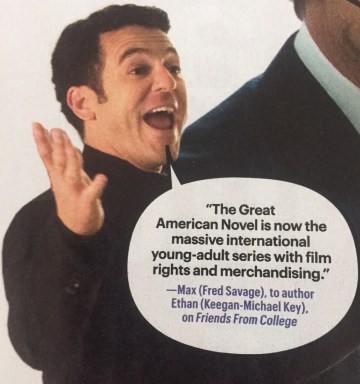
I was flipping through my Entertainment Weekly and you know how they have the funny quotes in the front from characters in shows you don’t watch? I like to read them and have a laugh, but this particular one this morning caught my eye.

FullSizeRender


It made me think: why do we write? What are our goals and aspirations when we start a novel, a novella, a story?  At a basic level, we want people to read our work. Maybe post a nice review. But is it more than that?  When we plan a series is our first thought, Jamie Dornan would be awesome playing my main male character if were to be turned into a movie. I doubt E. L. James was thinking anything past just making fun of Twilight for her own amusement when she was writing 50 Shades of Grey.

I think this quote says a lot about the industry, too. Hollywood is having a terrible time coming up with original ideas, and it seems services like Hulu and HBO are happy to pick up their next best thing from a book, The Handmaid’s Tale and Game of Thrones, respectively.  But there has been a shift in what’s trending, and gone are the days of blockbuster deals for a YA series like Twilight, Divergent, and The Hunger Games.  The whole thing does make me wonder how Hollywood chooses what to make into movies and what it won’t. Nicholas Sparks is always good for a movie, and I wonder if he sits down to write specifically thinking his next book will be turned into a movie. There are other authors who have tried, or at least, their books have tried, to break into the movie industry and have failed miserably. (I’m looking at you LeAnn Rimes and Nora Roberts’ Northern Lights.)

Joanna Penn loves to ask, “how do you measure success?” Is it when you finish a book, when you publish? When you are picked up by an agent? When your book is optioned for the movie rights?

It pays to have goals when you sit down to write–to know the direction you want your writing to take and who you’re writing for. It helps with the marketing of your book, it helps to know what your plan is going to be once your work is completed. But putting too much pressure on yourself, to picture your character sitting next to you on your desk, legs swinging off the edge, saying, “Hurry up and wrrriiiitttteeeee me, I want to be in a mooooovvvvviiiiieeee,” will do more harm than good.

Love what you’re writing is a standard rule when writing your books. Love your characters, love your plot. I’ve always advocated writing to market, but hopefully somewhere along the road, your passion and what sells meet. Sitting down to write expressly for commercial success is the wrong way to go. You may find success, but then you’re stuck writing what you don’t like. Eventually, that will come out in your writing, and once you stop caring about your stories, your readers will, too.

Success doesn’t come overnight–sometimes even us writers forget that as we are blinded by the success of indie authors such as Hugh Howey, Andy Weir, and Mark Dawson. Top indie author sellers like Melissa Foster, Bella Andre, and Linsday Buroker have been at this for years and have a strong backlist. They don’t stop writing, they’re always publishing new material, creating new content. It’s easy to forget how much freaking work this is.

So, go write, do the work; I wish you all the success in the world–movie rights and action figures of your characters included.