Why I Canceled my Twitter Chat

Last night I canceled my chat.
CANCELED

I think there was some surprise, and there was a little disappointment.  But I’ve been running it since April, and while it has been fun and I’ve made a lot of friends, I think I managed to get all that I could out of it.

Let me explain.

There are a lot of chats out there.

There are a gazillion chats on Twitter. You can find a chat on any day of the week, sometimes more than one, sometimes even more than two or three or four.  There are only so many hours in the day, and writers are busy. When they decide to give up some writing time to participate in your chat, they are giving you a gift. But since there are so many chats on Twitter right now, I was finding it hard to compete.  And because there are so many chats on Twitter, it was hard to stay original. Finding topics and themes that weren’t being used by other Twitter chat hosts was impossible. (If you want a complete list of chats and Twitter writing games, look here. Mica does a wonderful job of keeping everything in order.)

I chose the wrong hashtag.

My chat never achieved the elevation of other chats. This isn’t me being whiny, I’m just stating a fact. I had my regulars, my friends who wanted to support me (thank you!), but in all the months I hosted, it never blew up to the epic proportions I wanted. I think this had a large part to do with my hashtag. #SmutChat was a chat for everyone, and I tried to make that clear. But I think lots of people avoided it because they thought we were going to talk about romance or sex, or only the Romance genre, or Erotica. Had I chosen a more generic hashtag, I may have seen more movement. Perhaps if I had chosen to go full-blown smut and only focused chats around that topic, I could have drawn in the romance and erotica writers. I tried to go down the middle of the road, and it didn’t work. That was my mistake.

I was going broke.

At the end of #SmutChat, I gave away a writing resource that tied in with the topic. To me, this was genius; to everyone else . . . no one seemed to care all that much. In actuality, I had to plead with people to enter the giveaways, and there were never more than 6 or 7 people entering the giveaway at the end of every chat. There is so much free stuff on Twitter right now, the giveaway did nothing. I even had one person who won tell me they would get a hold of me when they found an address they were comfortable giving me. I offered the e-book version instead, but they said no. I can only take this to mean the person who won didn’t really want it to begin with, and that book is still sitting on my bookshelf. I didn’t mind spending money on the books and the shipping, but I was beginning to feel underappreciated. That’s no one’s fault but my own, being it was my idea to do the giveaways. I was hoping to set my chat apart from other peoples’ chats, but it didn’t work so well.

I have a publishing schedule I want to keep.

I have three books coming out in the next three months, and I have another book rumbling around in my head that I will write after my trilogy is released. Until they host one, no one can understand how time-consuming a chat is. They are a lot of work. Thinking up the topic, doing the graphics, tweeting about it. And that’s only the prep work. You have actually sit down and do the chat, and sometimes people will answer late, or the next day. As a courteous host, you want to try to touch base with everyone so I would be on the computer one or two hours after chat, and I would also answer tweets the day after. I know this is a counter-argument to the one where I wanted chat to grow even bigger because I would have spent even more time on it. Maybe I would have felt all the time spent on chat would have been worth it then. I’m not belittling the people who did take the time to participate, but sometimes you have to decide if you want to go big or go home. I decided to go home.

Think about what you want to get out of your chat.

What do you want to achieve with a chat? I had chat twice a month, and I would say I spent about 12 hours a month on prepping and the hostessing. What do you want to gain out of giving up that time? Twitter followers? What will you do with your followers once you earn them? Twitter doesn’t sell books, so those followers you gain will do nothing but plump up your numbers. Are you holding a chat to add it to your platform? That was my initial reason. I was doing something tangible that would add to my social media platform. But there again, you’re building your platform to sell books, connect with readers. Putting on a chat doesn’t do that. If you want to just make friends and connect with your followers, then hosting a chat is for you. If you want anything else out of it, think about what else you could do instead. Blog more, put that time into building your website. Write. Having a platform doesn’t do you much good if you’re not writing and/or publishing. Can you get what you want out of a chat by participating in others’ chats? I think with the little bit of free time I’ve recouped from canceling mine, I will participate in a bigger chat where I can still make friends, talk about a topic I love.

In parting, you may think this was just a big whiny blog post about how my Twitter chat didn’t go well for me, and now I’m crying about it. I’m actually blogging about it so anyone who is thinking about starting a chat knows the pitfalls of hostessing/hosting a chat, and what it entails. I appreciate every. single. participant. of my chat, and I have made some wonderful friends during the months I hostessed.  I started chat in April of 2017, and I ended it right before NaNo and the holidays could take people away. I feel I ended it on a positive note, and I’ll still be doing chat, in my own way. I’ll be blogging about the topics I want to talk about, rather than holding a chat. I’m hoping this will drive some traffic to my website, and I’ll encourage comments at the end of my posts. Maybe this won’t work either, but like anything in life, if you don’t take risks, you won’t get anywhere. I took a chance with chat, and I enjoyed it. But you have to know when to cut your losses if something isn’t working. Good luck to those of you who want to start a chat. And I’m not disappearing–I’ll still be on Twitter a lot. I’ll participate in other chats and enjoy the hard work I know goes into one. I’ll let the hostess handle the rest.

Tell me what you think!

Vania Blog Signature

#Smutchat Giveaway–NaNoWriMo

Thank you for participating in #smutchat tonight! I hope you had a great time talking about NaNoWriMo!

Tonight’s giveaways are Monsters by Gareth. S. Young and Book in a Month, the fool-proof system for writing a novel in 30 days by Victoria Lynn Schmidt, Ph.D. The other giveaway (yes! there are two winners tonight!) is The Wolves of Dynamo also by Gareth S. Young, and Write Your Novel in a Month, how to complete a first draft in 30 days and what to do next by Jeff Gerke.


A special thank you to Gareth S. Young for his donation of his books! Please follow him on Twitter, Goodreads, Facebook, and find him and his books on Amazon!

Thanks for playing, and have a wonderful weekend!

a Rafflecopter giveaway

To Query or Not to Query

When I talk to people about my publishing plans for my next couple of books, people ask me if I’ll ever query and try for a traditionally published deal. I always say, “No, I’m not writing anything queryable right now.”

People can take that a lot of different ways, and mostly that sounds like I don’t have faith in what I’m writing, or that my work is crap and only suited for self-publishing.

That couldn’t be further from that truth.

What I mean by that is, I know what I’m writing. I know what it’s suited for. That doesn’t mean what I’m writing isn’t being traditionally published; it just means I don’t have to find an agent to get it there. I write fluff. Maybe that’s demeaning to my genre when I say that, but I also am not pinning my work with any more importance than it deserves. Harlequin, the publisher that brings you the lines Temptation, Desire, Blaze, and the like (they’ve done some remodeling, so I don’t know what their lines are now) prints hundreds of books like that every year. In my Barnes and Noble, they take up a shelf in the corner of the building near the floor. All the shiny red spines with titles like One Night with the Billionaire or The Cowboy’s Baby. Women read these by the handfuls; a quick read you can get through in a couple hours before tossing it onto a pile and reaching for another one, like candies in a heart-shaped box. You know what you’re getting, you savor it as it melts in your mouth, but you have no problem reaching for another one when the chocolate is gone.

My books are like that. What I write in three to four months will be devoured in three to four hours, and I’m okay with that. I’m more than okay with that. Romance is a huge genre, and where there are millions of writers cranking out millions of books, there are also millions of readers. They don’t call the Romance genre the bestselling genre for nothing.

But along with pages of guidelines for how they like their books to be written and their preferred word count, Harlequin has its own dropbox on its website. I don’t need to query an agent and let my manuscript sit in a slush pile to wait for an agent’s assistant to skim my query letter. I can upload my manuscript onto Harlequin’s website myself, or to Carina Press, the digital-first arm of Harlequin, and let it rot in their slush pile without any help, thank you.

If I were to query, going back to the original question, I would query something more serious. Something I worked harder for. We all have visions of our books sitting on the display table at Barnes and Noble in the center of their main walkway. Trust me when I say Don’t Run Away would never make it there—agent or not. No, looking at the New York Times Book Review right now, I would want to write something more akin to Women’s Fiction, not Contemporary Romance. I would want my manuscript to mean something, to say something, to point out an injustice, to try to right a wrong, to help someone. I would want my manuscript to come from my brain as well as my heart.

bookstore_page

I’m not trying to degrade romance, not at all. But any romance writer or reader knows the difference between In the Arms of Her Boss and Sing Unburied Sing by Jesmyn Ward, a finalist for the National Book Award for Fiction. And let’s be clear, a reader who picks up either one of these knows what she’s getting. You have to be in the mood to read it, and a writer has to be in the mood (not to mention have the talent and skills) to write it.

I’m not in the mood to try to write something of Sing Unburied Sing’s caliber. I’m perfectly happy editing Chasing You. (You can weigh the two books by title alone, can’t you?)

If, or when, I plan to query, it will be with a book that will make it worth my time, and it will be with a book that will be worth the pain and heartache of rejection. Because I know the score. Querying is a whole lot of rejection, and I won’t put myself through that for a computer file full of fluff.

You might think that I’m too hard on myself, but I prefer to think of it as a realistic POV of my work. And, quite possibly, more indie writers should have it. Querying a story that won’t make it onto a table at the Barnes and Noble will sour you on the whole process. Traditional publishers only publish so many books per year. Why query a book that would never make it? That’s not to say your fluff isn’t good enough for Harlequin or a small press. (The back of bookstore on a shelf near the floor is better than nowhere at all, right?) It very well may be, and you should definitely go that route if you feel your book is worth it. Query to find an agent knowing/admitting where your book is going to end up, or use Harlequin’s dropbox and let your book sit in cyber purgatory for a few months while interns wade through the submissions.

But I won’t bother to try to find an agent for something that will sell just fine when I self-publish it.

After I’ve grown a bit more as a writer, or maybe when I have a nice backlist I can be proud of and want to challenge myself, or when the perfect plot plops into my head, I’ll write my book and I will query it to find an agent who loves it as much as I do, and maybe one day it will end up at the Barnes and Noble on a table in their main walkway.
I’ll pass it and brush my fingers over the cover as I walk to the café for a coffee. But for now, I’ll finish writing Running Scared while chocolate melts in my mouth.

#SmutChat Self-publishing Topic Recap!

I run a Twitter chat called #smutchat. It’s geared toward more than just smut, (though I am a romance author and I like to chat about that too, from time to time) and last night we talked about self-publishing.

I said I would recap the chat for a few people who couldn’t make it, so here you go. 🙂


#SmutChat-Selfpublishing (2)#SmutChat-Selfpublishing

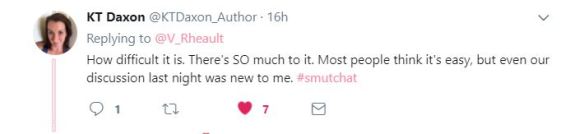
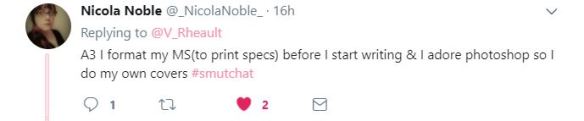
Question one, when I was making it up, was intended to be a question about the process of self-publishing. Was it formatting your paperback book? Dealing with uploading to KDP? Maybe figuring out your book cover? Some hit the nail on the head; others went far beyond.

smutchat recapsmutchat recap 4smutchat recap 2smutchat recap 1smut chat recap 3

smutchat recap 5


#SmutChat-Selfpublishing (3)

To be honest, I didn’t know what I was going to get out of this one, and the answers were all over the place.

smutchat recap 7smutchat recap 8smutchat recap 9smutchat recap 6

#SmutChat-Selfpublishing (4)

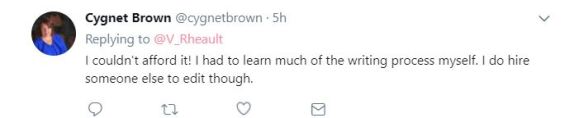
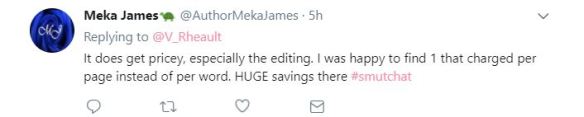
This question brought about the answers you would expect. It’s expensive to publish a book if you hire out, and no we can’t afford it, and no again, we probably won’t see a return on that investment any time soon. Yet the people who don’t know what they’re doing and publish bad-looking books muddy the pool for the rest of us who do it right.

smutchat recap 10smutchat recap 11smutchat recap 12smutchat recap 13smutchat recap 14

smutchat recap 15

nadia covers

gareth editing


#SmutChat-Selfpublishing (5)

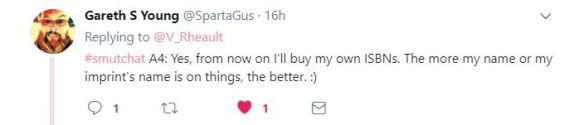
ISBNs are expensive–at least, they are in the US. CreateSpace gives you one for free and if you use theirs, they are listed as your book’s publisher, not you. Kindle Direct Publishing will give you an ASIN number, but I read somewhere that selling an ebook isn’t considered publishing per se, it’s just selling a file. I use my own ISBN numbers for both my Kindle file and my paperback for CS. Here’s what others said:

smutchat recap 16smutchat recap 17smutchat recap 18smutchat recap 19

emae isbn numbers

#SmutChat-Selfpublishing (6)

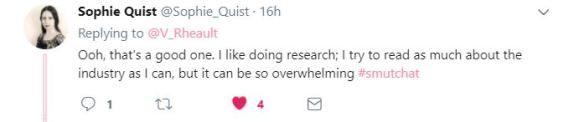
This is tough because if you don’t know you don’t know it, how will you figure it out? I researched the hell out of self-publishing, CreateSpace, and Kindle before I published On the Corner of 1700 Hamilton and I still got a lot of things wrong. When you self-publish on your own without help from someone who has done it before, you’re bound to make mistakes. I still make mistakes. I had to resubmit my cover for Don’t Run Away. CS said they “fixed” my cover, but I wanted to fix it myself. The more I know, the better off I’ll be. Here’s what other people thought:

smutchat recap 20smutchat recap 21smutchat recap 22

smutchat recap 23smutchat recap 24

That wrapped up the chat about self-publishing. Though I didn’t showcase them here, there were several tweets about book marketing. I haven’t delved into marketing yet, so I don’t have anything to offer in the way of that or what works. I do know that I have been reading up on Amazon Ads, and a good book by Brian D. Meeks seems to make a lot of sense. Whether it will work for you (or me) remains to be seen, but you can find it here. I have also been reading about Facebook Ads and this is the book I’m reading.

Rachel Thompson @BadRedheadMedia  runs a book marketing chat. You should check out her chat and maybe get some tips and ideas on how to market your own book. She has also written a book about it, and you can find it here.

In some sub-tweets, I told someone to look at Author Marketing Club, run by Jim Kukral. He’s co-host of the Sell More Books Show podcast I listen to every week. He also runs Happy Book Reviews if you’re interested in finding more book reviews. I haven’t used his services so do so at your own risk. Like everything online, be careful where you throw your money. I do listen to his podcast though, and he seems to be on the up and up or I wouldn’t point them out to you.

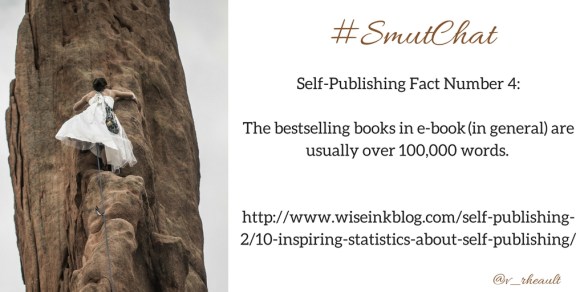
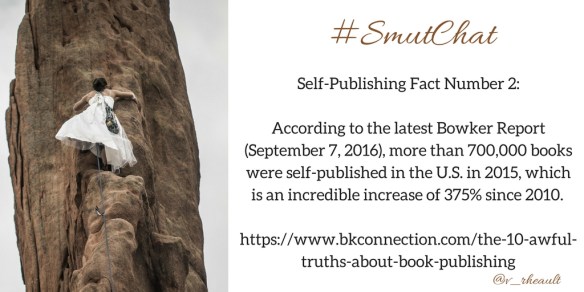
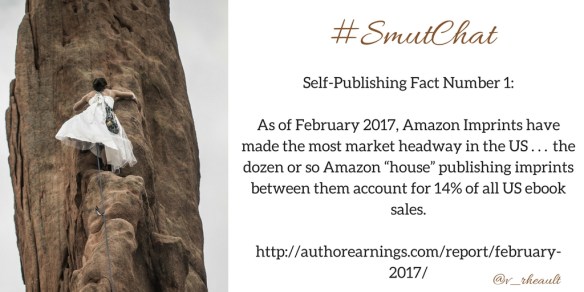
I also tweeted some interesting facts about self-publishing:

#SmutChat-Selfpublishing (14)#SmutChat-Selfpublishing (13)#SmutChat-Selfpublishing (12)#SmutChat-Selfpublishing (11)#SmutChat-Selfpublishing (10)

Anyway, thanks for reading over the recap. I apologize if I didn’t feature one of your tweets to a question. It was difficult wading through the answers, though I do appreciate everyone who participated last night! If you’re interested in all of the answers, or you want to look at the sub-tweets, please take a look at the hashtag! It was a great chat!

Vania Blog Signature

#Smutchat Self-publishing giveaway!

Thanks for participating in #smutchat tonight! I hope you had fun learning about the self-publishing industry!

The giveaway tonight is How to Self-Publish for Under $100 by Cinquanta Cox-Smith.

publish under 100 dollars

Self-publishing can be expensive–pick and choose wisely!

Thanks for playing! Have a lovely evening!

a Rafflecopter giveaway

Why Buy the Cow When You Get the Milk for Free? Or Something Like That.

Writers are notorious for giving their work away. “Sign up for my newsletter and receive a free book!” “My book is on Instafreebie!” “Every first book to all my series is permafree.” We hand out novellas and short stories like candy. We tweet poems. There is so much free content you could drown in words. Our Kindles are becoming black holes of free books downloaded in just a second, forever to rot in your device.

But this isn’t a post about too many books, or the quality of books, or another blog post on trad-pubbing vs. indie.

This post is about paying for services.

I was researching something a while back–I can’t remember what it was now. How to price a series, or how much to charge for something. I have no idea. But I came across an article that forever changed my way of thinking about giving my books away. I can’t refer to the author or the website because I can’t remember, but if I ever come across it again, I’ll link it up. See, the article was about . . . why writers are expected to give their work away, but no one else in a creative area is asked to do so.

arrow-964733_1920

Indie writers who research publishing are told from the get-go to hire out. Hire out your editing, hire out your cover design. Hire someone to format and convert your files. You can even hire someone to write your blurb for you. You want a professional looking and sounding book, don’t you? But what no one tells you that if you do, indeed, hire all that out, you’re spending thousands of dollars. Editors alone make a mint–and sometimes you need more than one. Developmental editing, line editing, proofreading. Sometimes you can find someone who does a mix of those, but that doesn’t make it cheaper. Anyway, so you hire out, do all the things you’re supposed to do. Then what do you do? You give your book away.

Why is it writers are expected to do this, but no one else? Cover designers don’t give their work away unless maybe they are part of a giveaway or something. Editors don’t edit for free unless they are donating their services for some odd reason. Even formatters want five bucks for setting up your margins and gutters in your Word document.

ecommerce-2140604_1920

I understand the backlash of indies doing things themselves. I even told a friend not long ago that if I were a reader now I would be pissed off. In one of my Facebook groups, a woman posted a lovely looking book. The cover was amazing, she had a great blurb, and the premise of the story hooked me. So I went into the “Look Inside” feature on Amazon, and the first page was riddled with head hopping. We were in the heads of at least three different people on the first page. The author obviously didn’t have her book edited. Maybe beta read by friends who didn’t want to tell her the truth, but that didn’t help. It made me wonder how many unsuspecting readers have been burned by indie books. Does buying a book now really have to feel like looking for a new car? Is the salesman going to talk you into a stinker then pop the champagne when you drive off the lot?

I don’t pay to have anything done to my books. I edit myself; I do my own covers. And I don’t give my books away, either. I’ve never used the promotions available to me on KDP Select. I enter my books a couple giveaways here and there for my paperbacks, but nothing in my library is “permafree.” Not even .99. (Except my short novelette I would feel guilty charging more for.)

So indies are expected to “invest in their futures” as the industry likes to call it, but then we’re supposed to turn around and give our books away for free. How are we supposed to have any return on that investment?

What I’m proposing is that maybe “investing in our futures” would be a lot easier to choke down if we demanded top dollar for our work the way other creatives do. Maybe it would be easier to pay out the $300 for a cover, the $500 dollars for the editing and for the other odds and ends you need to make your book look good. Maybe we would be more apt to do that if we knew it wouldn’t take 10 years to recoup those losses.

I know it’s a Catch-22. You can’t sell books if they don’t look and sound good, but you can’t afford to hire out unless you’re making money. I’m in the same boat. I can’t afford to pay $1,000+ per book to publish it. Almost no one I know can. But I’m not saying I won’t when I can afford it.

Pricing your book sucks. You want it to be cheap enough to draw people in, but you want to make money, too. You deserve to make money on something you spent so much time on. Writing is hard work, and you won’t find anyone who will tell you it’s not. You deserve to get paid.

money-1302835_1920

Stop giving your books way to people who join your newsletters. Stop posting your book on the Instafreebie site. Stop pricing your book at $0.00 on Smashwords and everywhere else. It’s not working anymore, anyway. There is too much free content. Would you rather have someone download your free book and never read it, or choose to spend the $4.99 on your e-book and actually read it and possibly review it? It’s a known fact that if someone spends money on something they put more value on it.

But it’s up to you to make your book valuable to your readers.

Trash is free; antiques are priceless.

Do you give your books away? Tell me what you think!

Vania Blog Signature


The “What Makes a Best Seller” #SmutChat

Thanks for participating in #smutchat tonight! Also, thank you for putting up with erratic scheduling this week. I have a friend coming in from out of town next week, and rather than try to work around it, I gambled and changed the dates.

I’ve been busy this week trying to do some editing things for a friend and for myself so I can enjoy next week without worrying about unfinished business.

Anyway, thanks again for dropping by #smutchat! I’ll see you in two weeks!

 a Rafflecopter giveaway


Read to Me, Baby!

Many have you may have realized I’ve disappeared off social media for a bit. If you haven’t, uh. Anyway, so I’ve been editing the first book in my Tower City Romance Trilogy. I’ve been working on this for a while now, and I’m so close to publishing, I can taste it.

coffee-2436940_1920

But editing is a bitch, and it seems like no matter how much I do, it will never be enough. It doesn’t help that I’m taking an online editing class, and every time I complete lesson, I find a million more things wrong with my manuscript.

One class was extremely helpful though and we were told to either make Word read our work to us aloud or to read it ourselves. I can’t stand the sound of my own voice, and it’s a fact that you know what it says so your brain may fill in the blanks and you won’t catch what’s wrong, anyway. I didn’t know Word could read to you so I looked up the directions. You can find them here.

Quite simply, I fell in love with it. I can’t stop listening to my own work. I delight in hearing a perfect sentence or laugh when a piece dialogue sounds as good spoken as it did in my head. Of course, it’s not perfect. He doesn’t say some of my characters’ names right, and he skips over ellipses and em dashes. What does he get right? Well, he reads everything just as it’s written: the double words, the typos, the skipped words. I’m not sure a human could even do this level of proofreading. It’s not fail-proof, he doesn’t know I typed except when I meant accept, but that’s the beauty of him speaking it aloud, you can read along and correct as he goes.

The voice sounds more like this than that, but that’s okay.

This makes it tedious–it takes a long time to listen, correct, listen, correct, listen. Sometimes to the same paragraph over and over again. But I see more advantages of this than not. Audio is getting bigger and bigger, and there are a couple avenues indies can take to make audiobooks of their books.

ACX
ACX stands for Amazon Creative Exchange. Through ACX, for a fee, an indie can turn their book into audio and sell it alongside their books on Amazon.

Findaway Voices
Draft2Digital has partnered with Findaway Voices to give indies another choice than to go with Amazon to turn their books into audio. You can read about it here.

How cool is it that you already have an idea of how your book is going to sound if you decide to turn it into audio?  You won’t have to worry how that two-page paragraph, where, oops, you have six comma splices and five semicolons, will sound. You won’t have to worry if it sounds odd every time your characters speak to each other and they say each other’s names a million times.

Not to mention, that since you have already heard everything in your book spoken aloud, you really won’t have to do anything with your proof but make sure the inside and cover turned out.

So, this is what I’ve been doing for the past few days. I have a publishing date set for November, and I’ve been trying to get through this book. It’s slow going because as I said, he’s finding things I want to fix, so I do, then I listen and have to fix it if it doesn’t sound right, or if I made a mistake while I was fixing my mistake. Yeah, that happens. A lot. But I know that after all this is done, my book will sound the best I can make it.

Have you tried this? Tell me what you think!

Vania Blog Signature


#smutchat All the Lawyerly Writing

{This is the giveaway for the Smutchat of the evening of Sept. 21st. I’m posting a bit early, but if you see this and want to get a head start on the giveaway, knock yourself out! Have a great day!}

A special thank you to Nadia (@nadiadiament) and Ari (@Ari_Ross) for guest co-hosting #smutchat today! It was a great chat, and I hope you learned a little something about how to write believable law into your books.

We deal with the law every day, and sometimes those pesky details can trip you up. To help with that, remember to enter the drawing.

a Rafflecopter giveaway

There are two different books for the winner this week due to a little miscommunication between Nadia and me. I thought Ari was going to answer legal questions about self-publishing, so I bought Helen Sedwick’s book for the giveaway. When Nadia and I discussed the chat further, I realized my mistake and bought  Books, Crooks and Counselors, too! So, it’s your lucky week! Enjoy!


And as always, the giveaway is open internationally, so don’t be afraid to give it a try!

Thanks for playing!

The next #smutchat will be next week due to scheduling conflicts I have the first week of October, and the official date is September 28th at
7 Central. See you there! 

Do You Have a Publishing Plan?

Sometimes it’s difficult to plan what you’re going to cook for dinner much less where you want your writing career to be in five years. But whether you are writing for fun and only plan to write one book a year, if that, or you are planning to write and publish maybe as many as ten books a year, (It can be done. But should it? That’s a different blog post.) a publishing plan can help.

time-273857_1920

Setting deadlines is a wonderful way, and sometimes a necessary way, to force yourself to write regularly. Talking about writing is easy. “If I write 1,000 words a day, I can write a book in three months.” That sounds like a piece of cake, but if it were, everyone would do it. When you are a writer, you are your own boss. No one is going to make you get to work. You need the willpower to do that yourself. So when you say you want to write 1,000 words a day, stick with it. But don’t set impossible goals for yourself—you’ll just feel rejected and depressed when you can’t meet them.

A publishing plan can help you with a marketing plan. Are you writing a series? How are you going to publish them? All at once? Three months in between? What websites will you use to promote your books? How will you find reviews? A deadline can help so you can plan to give ARCs to readers who will hopefully review it. Will you contact bloggers to organize a blog tour? All these choices will be made more easily if you have a publishing plan.

deadline-stopwatch-2636259_1920

Do you want to add more to your writing resume? Maybe start some freelance work? Or maybe you would like to start an editing service? Maybe that requires taking some editing courses and taking on some pro bono work to gather testimonials of what a great job you would do. If you want to branch out and not sacrifice time for your own work, fitting in extras like these would be easier if you had a plan.

For me, I know what books I want to write for the next little while. I have a lot of ideas for plots that should keep me going for the next couple of years. I beta/edit for people and I’m always researching something about the publishing industry. Right now I’m waiting for a book I want to read about how to effectively use Facebook ads, and I just finished a book about using Amazon ads.

I build time into my schedule to blog, and every day I work a little on my writer’s platform.

time-management-2427995_1920

I stumbled upon Kindle Scout, and I’m trying to work into my publishing schedule when I would want to enter the contest and what book I would write to try that with. I also haven’t completely ruled out querying.

I do know that now that I am a better writer (goodbye head hopping and garbage filler) I can write faster. I aim to publish about three books a year.

I like having a plan in place. It keeps me on track and accountable. It’s much too easy to waste time online and be waylaid by low productivity.

Maybe you feel you don’t need a publishing plan. That’s okay. Always write to have fun. I love writing, and a publishing plan isn’t to force me to write and make me feel guilty if I don’t, but it does allow me to look ahead to where my writing will bring me. Because I eventually want to quit my day job.

Where do you want your writing to bring you?

macro-1845286_1920

Where will you be in five years?

Let me know!

Vania Blog Signature