PitchWars: Should You Enter?

PitchWars is an annual writing contest where writers all over the world compete for the chance to be mentored by traditionally published authors. If you have a completed novel, you can enter. While mentors comb through entries, everyone involved in the contest spends about a month on Twitter making friends, talking about writing, and sharing their favorite GIFs.

Once picks are announced, mentors and mentees work together for two months on the mentee’s novel. After that, there’s an agent round where roughly fifty agents will read the entries and make requests for manuscripts that spark their interest.

Photo 1

Right? It’s an amazing opportunity to network and get your foot in the door with traditional publishing. The question is, should you enter?

Yes, I think every unpublished writer who wants to go traditional should try it once. I entered this past August and didn’t get a spot, but thought it was a very valuable experience. However, please save yourself some heartache and assume you will not win a spot. Getting into PitchWars is no easier than getting an agent from cold querying.

So why should you bother? As with everything in this bizarre universe of ours, it has its pluses and minuses.

Disadvantages

Seriously, the Odds Are Not in Your Favor

Ignoring duplicate entries, over 2800 people entered PitchWars in 2017. There were 180 spots. That’s a 0.6% acceptance rate. For context, Yale Fucking Law School has a 9.7% acceptance rate.

But let’s say you’re lucky enough to get in. As of July, PitchWars has almost 250 success stories. This means ~250 people have gotten agents out of the 385 mentees selected between 2013 and 2016. Don’t get me wrong, a 65% chance of getting an agent is HUGE, especially compared to the 1% cold query success rate rumor I keep hearing about. But it’s far from a guarantee.

Am I trying to shit on PitchWars? Absolutely not. But you need to go into this with wide-open eyes. You should have faith in yourself as a writer and your journey; your book will find a home (whether it’s with trad pub, self-pub, or small press). But it probably won’t be through PitchWars. PW is not a golden shortcut ticket to unlock the Gates of Traditional Publishing.

The Secret to Getting Picked Is a Goddamn Mystery

Photo 2

In addition to the numbers working against you, there is no real way to know why your manuscript does or doesn’t get picked. Some mentors give feedback, but most do not. Your book has to fit into a specific and subjective set of standards, which include…

  1. It has to be good. Good voice, solid plot, interesting characters, quality writing, etc. are essential.
  1. But it can’t be too good. *facepalm* I know. But if you’re going to work with a mentor for two months, they need to have a vision for what they can do to help you improve the book. Contest rules say to submit a “complete and polished” manuscript, but I would read this more as “complete and copyedited.” Your lump of clay needs to be good, but it still needs to be a lump of clay.
  1. It has to mesh with the mentor’s tastes. Before you submit your application, mentors will post wish lists about what kinds of stories they’re looking for, which is helpful, but look at their backlist too. Does anything about their work resonate with you? Their voice? Their subgenre? The tropes they use?
  1. But it can’t be too similar to the mentor’s body of work. If the mentor has a series about a talking squirrel who solves mysteries with a cynical school janitor, they probably won’t feel comfortable working with you on a book about a talking chipmunk who solves mysteries with a grumpy hotel maid.
  1. It has to be marketable. Mentors are more lenient about this than agents are, but it still has to be clear where your book will fit in the market.
  1. The mentor has to believe you can work together. Mentorship isn’t just about quality and marketability. It’s an interpersonal issue, too. Some mentors will stalk you on Twitter to see if you’ll be a good fit.
  1. Weird miscellaneous factors can decide your fate. Maybe your protagonist has the same name as their favorite niece. Maybe your book takes place in their hometown—which they HATE. As they always say, this business is subjective. Considering some mentors have hundreds of entries to wade through, it could be literally anything that puts your book in the “Yes” pile.

Not surprisingly, aside from #2, the reasons a mentor will accept or reject your work are similar to why an agent will or won’t request more pages. Once again, PW is not simpler or easier than cold querying an agent.

Social Media Is Hell

What makes PW such an event is the social media component of it on Twitter, but to be honest, I have conflicting feelings about that aspect. In the weeks leading up to the submission window opening, there are all kinds of Twitter games, encouraging you to get to know mentors and other PW hopefuls. Once the submission window closes, the Twitter party continues for another month…but it gets more intense.

The entire purpose of the PW Twitter community is for everyone to get worked into a literal frenzy. They want you to be excited and proud of your work, which is a nice thought, but it also sets up unrealistic expectations. Many mentors post teasers about entries they’re enjoying— there’s an entire hashtag for them. There are also endless posts telling you to stay positive because there’s always a chance you could win a spot. It was an exhausting rollercoaster.

At least with agents, you know to pray for the best but expect the worst. Cold querying is beautiful in its simplicity. I send out my package, note the expected response dates in a spreadsheet, and walk away. If I follow agents I’ve subbed to on social media, I don’t have to worry their posts will be hints about submissions they’re reading. Some agents do #tenqueries, but those posts include specific reasons for passing on or requesting more pages of a project. They don’t post cryptic messages about something they might pick.

So if you do enter PW, protect your space. Like all social media, PW Twitter can become too much. Don’t be afraid to block hashtags, mute certain accounts, or take a break.

Advantages – Why You Should Enter Anyway

 

Photo 3

I know, I raised a lot of issues with the contest, but I still think it’s worthwhile to enter at least once. Whether you’re new to the querying trenches or are a seasoned pro, PW has something to offer.

 If You Do Get Picked, It’s a Great Opportunity

It doesn’t hurt to buy a lottery ticket—just don’t gamble away all your money. Go in with low expectations, but if you do have the fortune of getting selected, the mentorship alone is an amazing opportunity. Not only are you getting free, in-depth help from a professional writer, but you’re also forming a connection with them. I often hear about mentors who still talk to and help their former mentees with their writing. Like with any other industry, you need connections to thrive. Mentorships are invaluable.

As I said earlier, the agent round may or may not yield fruit, but it does boost your chances.

You’ll Make New Friends and Expand Your Twitter Presence

While I wasn’t a fan of certain aspects of the PW hashtag, overall, I did enjoy the sense of camaraderie among entrants and mentors. If you participate in any of the games (e.g., GIF competitions) or interact with the hashtag, you’re bound to connect with other PW hopefuls. Some of these people will become followers, critique partners, and even friends. For some writers, PW has become as much a valued tradition as NaNoWriMo because of the unique community.

PitchWars is also a good excuse to post content and build your brand. Twitter is the most popular social media platform for us writer types, so if you’re looking to network, it’s the place to be. Many unpublished writers are using their growing platforms to build hype around their manuscripts by showing off novel aesthetics, character interviews, and memorable quotes. Taking advantage of the PW hashtag can help you with that.

You’ll Discover New Authors

Since mentors are wading through their slush piles for free, it’s nice to give back by reading their books. There are over a hundred PW mentors, so there is plenty of new content to discover. You might find your next favorite book or a new comp title to use in your query letter.

It’s Good Practice for Rejection

If you haven’t queried agents or publishers before…Welcome! PitchWars is a great way to rip off that first Band-Aid of rejection because there’s going to be tons of it, regardless of how you publish. Agents will reject you, publishers will rebuff you, and readers will scorn you. Get in the practice now with PitchWars. Rejections from faceless agents are way easier to digest after getting rejections from friendly mentors you bonded with.

It’s a Kick in the Pants

Most people don’t enter PitchWars because they simply happened to have a polished manuscript lying around. They prepare. Whether they just found out about PitchWars existed three weeks before the deadline or they’re a third-year PitchWars veteran, PW hopefuls haul ass. If you’re looking for motivation, the contest is a great stimulus for finishing your book and writing a query letter. Even if you don’t get a spot, you’re still way ahead of where you were before.

Photo 4

PitchWars will re-open in August 2018, but you can read this year’s winning entries here: www.pitchwars.org

nadia's logoNadia Diament writes sexy, funny things. You can ask her esoteric questions on Twitter here, check out her blog here, and read her stories here.


Let’s Talk about WAS

“Was” is a nasty, dirty, filthy word, am I right? “Was” means, oh my God, you are writing in the passive voice, and all passive voice must be eradicated from your Work in Progress, or you are going to fall into the fiery depths of writing hell when you die.

fire-298105_1920

Indies are told it’s bad, that you need to take it out of your writing. Even when I edit for others, I will find it, give the authors the bad news that yep, they used it 4,000 times in a 70,000 word WIP.

But just how bad is it?

I’m reading The Snowman by Jo Nesbø right now. I love it. I saw the trailer for the movie, and I wanted to read the book before I watched the movie. (Chances are after I finish the book I won’t want to watch the movie anymore, but that’s a different blog post.) But you know what I saw when I opened up the book? Well, yeah, I saw the front matter, the title page. But what was the first sentence of the first paragraph?

It was the day the snow came.

A book by an acclaimed author whose book was turned into a movie started his book with passive voice. He could have written, Snow came that day or It happened the day it snowed. Something. But he didn’t. Why didn’t he? Why didn’t his editor catch it? Ask him to fix it? I wonder how many “was” words he uses in his book.

When should you write out “was?” Here’s what I think.

wite out

When it’s an indicator of tell, not show.
This is another no-no in the indie world. Always, always show, not tell. And for the most part, I agree. Description is always a lot better than telling your reader something.
When I was editing Don’t Run Away one of my little triumphs was:
Dane was livid.
I turned it into:
Dane trembled with rage.
You can see right away that’s a better way to go. I didn’t do it so much as to get rid of the “was” word, but I wanted my readers to picture what Dane’s anger looked like.

When the sentence simply sounds better without it.
This is tricky because how do you know? You can try to rewrite your sentence, but if you can’t get it to make sense without “was,” leave it alone.  Writers use “was” because it’s easy. It’s a lot easier to say, The sky was blue, rather than, The blue sky shone; not one cloud masked its brilliance. But not every sentence needs to be written that way–it’s up to you as the author to pick and choose, to decide where you want to put your energy.

When you freaking use it too many times. 
It always sucks when you do a search to see how many times you’ve used a crutch word. Just, 500, that, 1,000. Nodded, smiled, rolled eyes, shrugged.  “Was” is no different. If you have a ton of them, it could mean you are doing more telling than showing, that you’ve gotten a bit lazy, and you need to examine your WIP to see what you can fix. A paragraph describing a room like this:

The bedroom was small. A bed was pushed against the wall to make room for a desk that was filled with papers. A dog was sleeping at the foot of the bed, and a picture was hung crookedly on the wall. The rug was dirty, and the closet door was open, revealing clothes hanging haphazardly on their hangers.

Can be turned into this:

A dog lay on an unmade bed that had been pushed against the wall to make room in the small space. A desk filled with paper sat under an open window.  A rug that had seen better days lay in front of a closet that hadn’t been closed properly, and Janet wrinkled her nose in distaste at the mess inside. She straightened the crooked picture on the wall before leaving. Jack wasn’t there. She’d have to look for him somewhere else. 

Not only are you getting rid of “was” words, you are getting rid of repetition. I’ve edited for a few people whose paragraphs sound the same. Subject + verb + the rest of the sentence. If you want to get words down and move on, that’s fine. Some writers like to worry about the editing later. But please do go back and mix up your sentence structure. Sometimes this includes getting rid of “was”, sometimes it means starting a sentence with a prepositional phrase.

When you can fix the verb.
Don’t say, He was standing say He stood. She was watching turns into She watched. This is an easy fix and will save you some words too, if your WIP is bloated and you need to cut it down.

Rewriting some sentences that have “was” in them can make a sentence or paragraph stronger, can show your reader something instead of telling them what is going on.

But I also think that “was” is a lot like “said” in that it is invisible to a reader. The room was dark, and Stacy stumbled. We know what that means. We can picture that just as clearly as Stacy couldn’t see two inches in front of her face. She didn’t know what lurked in the shadows of the bedroom, and she tripped over God knew what when she gingerly took a step inside. Did the second example sound better? Maybe it did, but it’s also exhausting to read that all the time. It’s also exhausting to write that way. If every author tried to eradicate “was” from their writing, every book would be as thick as a Stephen King novel.

There is room for “was,” and I’m not as hardcore to get rid of it as I used to be. As long as you’re conscious of how many you have, if some of them can be replaced with something stronger and you do, then you’ll be okay.

Sometimes we can get too caught up in following every single rule out there. And it’s disheartening to be trying your best when you read trad-pubbed books doing things you’re trying not to do. Give yourself a little break. Keep on eye on the numbers, take your beta-readers’ opinions to heart. Listen to your editor.

Avoiding “was” hell won’t matter too much if you’ve trapped yourself in editing hell. Find a happy medium. Your sanity, and your readers, will thank you.

To Query or Not to Query

When I talk to people about my publishing plans for my next couple of books, people ask me if I’ll ever query and try for a traditionally published deal. I always say, “No, I’m not writing anything queryable right now.”

People can take that a lot of different ways, and mostly that sounds like I don’t have faith in what I’m writing, or that my work is crap and only suited for self-publishing.

That couldn’t be further from that truth.

What I mean by that is, I know what I’m writing. I know what it’s suited for. That doesn’t mean what I’m writing isn’t being traditionally published; it just means I don’t have to find an agent to get it there. I write fluff. Maybe that’s demeaning to my genre when I say that, but I also am not pinning my work with any more importance than it deserves. Harlequin, the publisher that brings you the lines Temptation, Desire, Blaze, and the like (they’ve done some remodeling, so I don’t know what their lines are now) prints hundreds of books like that every year. In my Barnes and Noble, they take up a shelf in the corner of the building near the floor. All the shiny red spines with titles like One Night with the Billionaire or The Cowboy’s Baby. Women read these by the handfuls; a quick read you can get through in a couple hours before tossing it onto a pile and reaching for another one, like candies in a heart-shaped box. You know what you’re getting, you savor it as it melts in your mouth, but you have no problem reaching for another one when the chocolate is gone.

My books are like that. What I write in three to four months will be devoured in three to four hours, and I’m okay with that. I’m more than okay with that. Romance is a huge genre, and where there are millions of writers cranking out millions of books, there are also millions of readers. They don’t call the Romance genre the bestselling genre for nothing.

But along with pages of guidelines for how they like their books to be written and their preferred word count, Harlequin has its own dropbox on its website. I don’t need to query an agent and let my manuscript sit in a slush pile to wait for an agent’s assistant to skim my query letter. I can upload my manuscript onto Harlequin’s website myself, or to Carina Press, the digital-first arm of Harlequin, and let it rot in their slush pile without any help, thank you.

If I were to query, going back to the original question, I would query something more serious. Something I worked harder for. We all have visions of our books sitting on the display table at Barnes and Noble in the center of their main walkway. Trust me when I say Don’t Run Away would never make it there—agent or not. No, looking at the New York Times Book Review right now, I would want to write something more akin to Women’s Fiction, not Contemporary Romance. I would want my manuscript to mean something, to say something, to point out an injustice, to try to right a wrong, to help someone. I would want my manuscript to come from my brain as well as my heart.

bookstore_page

I’m not trying to degrade romance, not at all. But any romance writer or reader knows the difference between In the Arms of Her Boss and Sing Unburied Sing by Jesmyn Ward, a finalist for the National Book Award for Fiction. And let’s be clear, a reader who picks up either one of these knows what she’s getting. You have to be in the mood to read it, and a writer has to be in the mood (not to mention have the talent and skills) to write it.

I’m not in the mood to try to write something of Sing Unburied Sing’s caliber. I’m perfectly happy editing Chasing You. (You can weigh the two books by title alone, can’t you?)

If, or when, I plan to query, it will be with a book that will make it worth my time, and it will be with a book that will be worth the pain and heartache of rejection. Because I know the score. Querying is a whole lot of rejection, and I won’t put myself through that for a computer file full of fluff.

You might think that I’m too hard on myself, but I prefer to think of it as a realistic POV of my work. And, quite possibly, more indie writers should have it. Querying a story that won’t make it onto a table at the Barnes and Noble will sour you on the whole process. Traditional publishers only publish so many books per year. Why query a book that would never make it? That’s not to say your fluff isn’t good enough for Harlequin or a small press. (The back of bookstore on a shelf near the floor is better than nowhere at all, right?) It very well may be, and you should definitely go that route if you feel your book is worth it. Query to find an agent knowing/admitting where your book is going to end up, or use Harlequin’s dropbox and let your book sit in cyber purgatory for a few months while interns wade through the submissions.

But I won’t bother to try to find an agent for something that will sell just fine when I self-publish it.

After I’ve grown a bit more as a writer, or maybe when I have a nice backlist I can be proud of and want to challenge myself, or when the perfect plot plops into my head, I’ll write my book and I will query it to find an agent who loves it as much as I do, and maybe one day it will end up at the Barnes and Noble on a table in their main walkway.
I’ll pass it and brush my fingers over the cover as I walk to the café for a coffee. But for now, I’ll finish writing Running Scared while chocolate melts in my mouth.

#SmutChat Self-publishing Topic Recap!

I run a Twitter chat called #smutchat. It’s geared toward more than just smut, (though I am a romance author and I like to chat about that too, from time to time) and last night we talked about self-publishing.

I said I would recap the chat for a few people who couldn’t make it, so here you go. 🙂


#SmutChat-Selfpublishing (2)#SmutChat-Selfpublishing

Question one, when I was making it up, was intended to be a question about the process of self-publishing. Was it formatting your paperback book? Dealing with uploading to KDP? Maybe figuring out your book cover? Some hit the nail on the head; others went far beyond.

smutchat recapsmutchat recap 4smutchat recap 2smutchat recap 1smut chat recap 3

smutchat recap 5


#SmutChat-Selfpublishing (3)

To be honest, I didn’t know what I was going to get out of this one, and the answers were all over the place.

smutchat recap 7smutchat recap 8smutchat recap 9smutchat recap 6

#SmutChat-Selfpublishing (4)

This question brought about the answers you would expect. It’s expensive to publish a book if you hire out, and no we can’t afford it, and no again, we probably won’t see a return on that investment any time soon. Yet the people who don’t know what they’re doing and publish bad-looking books muddy the pool for the rest of us who do it right.

smutchat recap 10smutchat recap 11smutchat recap 12smutchat recap 13smutchat recap 14

smutchat recap 15

nadia covers

gareth editing


#SmutChat-Selfpublishing (5)

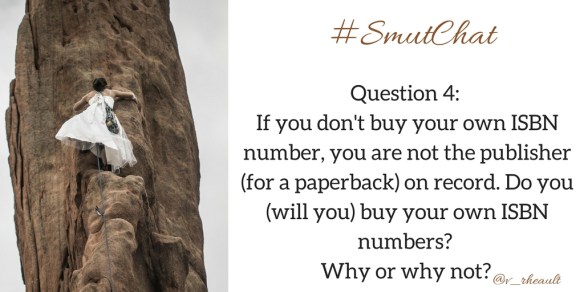
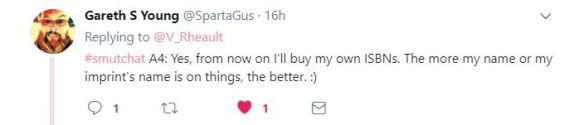
ISBNs are expensive–at least, they are in the US. CreateSpace gives you one for free and if you use theirs, they are listed as your book’s publisher, not you. Kindle Direct Publishing will give you an ASIN number, but I read somewhere that selling an ebook isn’t considered publishing per se, it’s just selling a file. I use my own ISBN numbers for both my Kindle file and my paperback for CS. Here’s what others said:

smutchat recap 16smutchat recap 17smutchat recap 18smutchat recap 19

emae isbn numbers

#SmutChat-Selfpublishing (6)

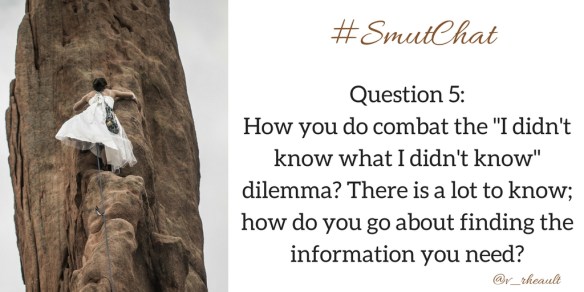
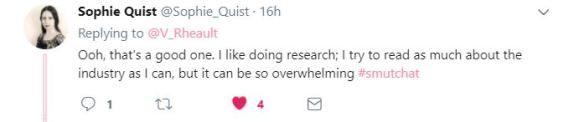
This is tough because if you don’t know you don’t know it, how will you figure it out? I researched the hell out of self-publishing, CreateSpace, and Kindle before I published On the Corner of 1700 Hamilton and I still got a lot of things wrong. When you self-publish on your own without help from someone who has done it before, you’re bound to make mistakes. I still make mistakes. I had to resubmit my cover for Don’t Run Away. CS said they “fixed” my cover, but I wanted to fix it myself. The more I know, the better off I’ll be. Here’s what other people thought:

smutchat recap 20smutchat recap 21smutchat recap 22

smutchat recap 23smutchat recap 24

That wrapped up the chat about self-publishing. Though I didn’t showcase them here, there were several tweets about book marketing. I haven’t delved into marketing yet, so I don’t have anything to offer in the way of that or what works. I do know that I have been reading up on Amazon Ads, and a good book by Brian D. Meeks seems to make a lot of sense. Whether it will work for you (or me) remains to be seen, but you can find it here. I have also been reading about Facebook Ads and this is the book I’m reading.

Rachel Thompson @BadRedheadMedia  runs a book marketing chat. You should check out her chat and maybe get some tips and ideas on how to market your own book. She has also written a book about it, and you can find it here.

In some sub-tweets, I told someone to look at Author Marketing Club, run by Jim Kukral. He’s co-host of the Sell More Books Show podcast I listen to every week. He also runs Happy Book Reviews if you’re interested in finding more book reviews. I haven’t used his services so do so at your own risk. Like everything online, be careful where you throw your money. I do listen to his podcast though, and he seems to be on the up and up or I wouldn’t point them out to you.

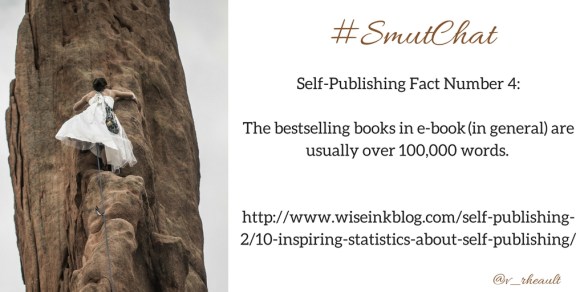
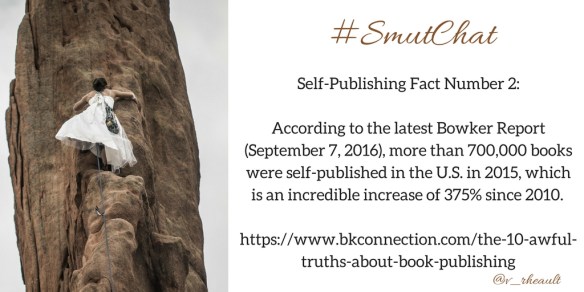
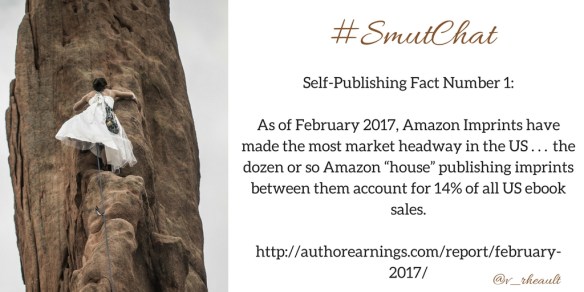
I also tweeted some interesting facts about self-publishing:

#SmutChat-Selfpublishing (14)#SmutChat-Selfpublishing (13)#SmutChat-Selfpublishing (12)#SmutChat-Selfpublishing (11)#SmutChat-Selfpublishing (10)

Anyway, thanks for reading over the recap. I apologize if I didn’t feature one of your tweets to a question. It was difficult wading through the answers, though I do appreciate everyone who participated last night! If you’re interested in all of the answers, or you want to look at the sub-tweets, please take a look at the hashtag! It was a great chat!

Vania Blog Signature

Why Buy the Cow When You Get the Milk for Free? Or Something Like That.

Writers are notorious for giving their work away. “Sign up for my newsletter and receive a free book!” “My book is on Instafreebie!” “Every first book to all my series is permafree.” We hand out novellas and short stories like candy. We tweet poems. There is so much free content you could drown in words. Our Kindles are becoming black holes of free books downloaded in just a second, forever to rot in your device.

But this isn’t a post about too many books, or the quality of books, or another blog post on trad-pubbing vs. indie.

This post is about paying for services.

I was researching something a while back–I can’t remember what it was now. How to price a series, or how much to charge for something. I have no idea. But I came across an article that forever changed my way of thinking about giving my books away. I can’t refer to the author or the website because I can’t remember, but if I ever come across it again, I’ll link it up. See, the article was about . . . why writers are expected to give their work away, but no one else in a creative area is asked to do so.

arrow-964733_1920

Indie writers who research publishing are told from the get-go to hire out. Hire out your editing, hire out your cover design. Hire someone to format and convert your files. You can even hire someone to write your blurb for you. You want a professional looking and sounding book, don’t you? But what no one tells you that if you do, indeed, hire all that out, you’re spending thousands of dollars. Editors alone make a mint–and sometimes you need more than one. Developmental editing, line editing, proofreading. Sometimes you can find someone who does a mix of those, but that doesn’t make it cheaper. Anyway, so you hire out, do all the things you’re supposed to do. Then what do you do? You give your book away.

Why is it writers are expected to do this, but no one else? Cover designers don’t give their work away unless maybe they are part of a giveaway or something. Editors don’t edit for free unless they are donating their services for some odd reason. Even formatters want five bucks for setting up your margins and gutters in your Word document.

ecommerce-2140604_1920

I understand the backlash of indies doing things themselves. I even told a friend not long ago that if I were a reader now I would be pissed off. In one of my Facebook groups, a woman posted a lovely looking book. The cover was amazing, she had a great blurb, and the premise of the story hooked me. So I went into the “Look Inside” feature on Amazon, and the first page was riddled with head hopping. We were in the heads of at least three different people on the first page. The author obviously didn’t have her book edited. Maybe beta read by friends who didn’t want to tell her the truth, but that didn’t help. It made me wonder how many unsuspecting readers have been burned by indie books. Does buying a book now really have to feel like looking for a new car? Is the salesman going to talk you into a stinker then pop the champagne when you drive off the lot?

I don’t pay to have anything done to my books. I edit myself; I do my own covers. And I don’t give my books away, either. I’ve never used the promotions available to me on KDP Select. I enter my books a couple giveaways here and there for my paperbacks, but nothing in my library is “permafree.” Not even .99. (Except my short novelette I would feel guilty charging more for.)

So indies are expected to “invest in their futures” as the industry likes to call it, but then we’re supposed to turn around and give our books away for free. How are we supposed to have any return on that investment?

What I’m proposing is that maybe “investing in our futures” would be a lot easier to choke down if we demanded top dollar for our work the way other creatives do. Maybe it would be easier to pay out the $300 for a cover, the $500 dollars for the editing and for the other odds and ends you need to make your book look good. Maybe we would be more apt to do that if we knew it wouldn’t take 10 years to recoup those losses.

I know it’s a Catch-22. You can’t sell books if they don’t look and sound good, but you can’t afford to hire out unless you’re making money. I’m in the same boat. I can’t afford to pay $1,000+ per book to publish it. Almost no one I know can. But I’m not saying I won’t when I can afford it.

Pricing your book sucks. You want it to be cheap enough to draw people in, but you want to make money, too. You deserve to make money on something you spent so much time on. Writing is hard work, and you won’t find anyone who will tell you it’s not. You deserve to get paid.

money-1302835_1920

Stop giving your books way to people who join your newsletters. Stop posting your book on the Instafreebie site. Stop pricing your book at $0.00 on Smashwords and everywhere else. It’s not working anymore, anyway. There is too much free content. Would you rather have someone download your free book and never read it, or choose to spend the $4.99 on your e-book and actually read it and possibly review it? It’s a known fact that if someone spends money on something they put more value on it.

But it’s up to you to make your book valuable to your readers.

Trash is free; antiques are priceless.

Do you give your books away? Tell me what you think!

Vania Blog Signature


Making Time to Beta Read and/or Edit

I beta read and I edit for my friends. When I beta read, sometimes that turns into light editing—I’ll point out typos, etc., if/when I find them, and I think the authors appreciate that. Sometimes I get asked to do a full edit, and sometimes the author isn’t clear, and I end up doing a full edit, anyway. Doing an edit is almost easier than only beta reading because my eyes immediately start searching for mistakes.

canstockphoto89558

This is true when I read anything. Reading for pleasure is almost non-existent because I automatically start editing and revising. “I would have written it this way. . .” While this can be good practice, trying to turn it off to enjoy a book is almost impossible. It doesn’t help when I feel justified when I do find something wrong.

But I like to beta read and edit because it sharpens my own skills as a writer. If I see repetition, telling instead of showing, words being used in the incorrect context, head hopping, it makes me more sensitive to it and I spot it more easily in my own work.

Stephen King says you don’t have time to be a writer if you don’t have time to be a reader, and this is true. You learn by reading other people, and you also expand your vocabulary. You improve your grammar and punctuation when you see it used correctly and if you think it isn’t being used correctly, you can look it up. Fact-checking helps you and the person you’re editing/beta reading for.

stephen king reading

It isn’t easy to make time to beta read—we have so little time as it is, writers like to use that time to write.

I’ve often likened writing to other occupations: you don’t have a business without product to sell, you wouldn’t want your child to go to school with a teacher who wasn’t always updating her skills, you wouldn’t go to a doctor who wasn’t constantly going to workshops, seminars, and publishing in medical journals.

glasses-272399_1920

You can’t write books without reading other people’s work or fine-tune your voice without reading editing books and how-to books about the craft of writing. No organization is making you do those things; a company isn’t going to give you tuition reimbursement. You are your own boss and it’s up to you to keep learning for yourself.

Beta reading is fun, and it’s helpful, and someday you’ll need a beta reader. What goes around comes around, so try to make time when you can.

Tips on how to beta read:

  1. Sometimes you’ll start beta reading a book that doesn’t suit you. Figure out why it doesn’t before you say anything. If it’s not your preferred genre, speak up before you agree.
  2. If it is your genre, make notes as you read. What feels off? Is the beginning slow, are the characters flat? This is why you’re beta reading—to give useful feedback. Don’t be vague—the beginning lacked pizzazz. How was it boring? Maybe the action picked up in chapter two.  Did the author start the book in the wrong place?
  3. As you read to the middle look at the characters. Are they still interesting? Are they battling an inner conflict? Are they struggling? A saggy middle is something many authors, including myself, have an issue with.
  4. Look for inconsistencies. Are the characters’ physical attributes the same throughout the book? If they have a pet, do they disappear half way through the book because the author forgot to include it?
  5. How is the dialogue? Does it flow? Do what the characters talk about further the story?
  6. Do any scenes seem to bog the story down?
  7. When you reach the end, think of the story as a whole. Are there any plot holes? Any minor characters that could have been developed or any of their storylines that don’t make sense? (Ask if there is a sequel in the works if this is the case, sometimes the foreshadowing won’t make sense. But foreshadowing should only make the reader curious to read the next book, not make the reader wonder if the author dropped the ball.) Does the ending give you a satisfied feeling? Does it feel rushed? Do the characters complete their internal journey, face their fears,  finally get what they want?

Ideally, the author you’re beta reading for will give you ample time to read the book before publishing and tell you a reasonable deadline. Sometimes, if they’ve finished editing it and the piece is ready to be published, the author won’t wait.

This can put you in a bad position if you’re finding typos—you won’t get a chance to give your feedback to your author. If you’re given a deadline try to stick to it. But the urges to hit “publish” are strong, and if your author goes ahead and publishes without waiting for you, try not to feel hurt or resentful. You can still finish beta reading and forward on the mistakes you found. Perhaps s/he fixed them without telling you.

Sometimes you might be expected to leave a review. Ask first to be sure—especially if you didn’t care for the book. You may want to skip leaving a review rather than leave a poor one because this book is will be new and no review will be better than a bad one.

Anyway, beta reading or editing for people is win-win. It helps you become a better writer, and it helps the person you’re reading for.

blond-1866951_1920

We need to help each other be better writers, one chapter at a time.

Vania Blog Signature

You’ve Written Your Book. Now What?

There’s a lot of talk in the publishing/writing community about what to write. Ask anyone, and the unanimous answer will be, “Write what you love and worry about the rest later.” And that’s okay; definitely write what you love because if you’re not, it will show in your writing. If you don’t love it, no one else will, either.

book-1760998_1920

But after you’ve written your book, what then? If you want to query, what you’ve written will decide almost 100% if you’ll get picked up. Agents sign books they know will sell, and they know what books will sell because they are in close contact with editors in publishing houses and know what books the editors will buy.  But what are those books?

There are books that will never go out of style because they encompass the bigger genres: romance, mystery/suspense (combine the two and you’re golden), a little science fiction, some fantasy, maybe. When you choose one of those, you’re choosing a subject or topic that will never stop selling.

But indie authors rarely go generic, and that’s a lot of the problem. Say I’ve written this wonderful story about a fairy princess set in modern times who is a pediatrician and she’s in love with the warlock neuro surgeon down the hall. Her father demands she go home to the fairy world to claim the throne and she’s torn away from her warlock lover. After she’s home and takes up her duties as royalty, she finds out she’s pregnant with her warlock lover’s baby. Now what?

gothic-1317139_1280

This story is near and dear to my heart, maybe. It’s all written out, all 99,000 words of magical goodness. I have plans to turn this into a trilogy.

Excitedly, I shop it around.

Agents pass, editors at publishing houses pass. A kind agent takes the time to email me and says, “This is great, the writing is solid. But fairies in adult fiction aren’t selling right now, and I don’t know when they will. I can sell it if you turn the fairy and warlock into humans.”

What she did was make my story generic. She turned it into a simple romance she’d probably sell to Avon.

But that’s not what I want, so she offers me, “I’ll sign you and keep it in my drawer. When fairies come around again, I’ll try to sell it.” This isn’t exactly what I want, either, and I wonder if I want to take her offer because how long do I want to wait, exactly? Selling my book could take years, or she could never do it. It doesn’t mean my book or writing is bad, it just means the publishing industry isn’t selling that kind of book right now.

We can all think of books that have had their day: vampires/werewolves (Twilight), dystopian societies (The Hunger Games), mommy porn (Fifty Shades of Grey).

But look on the NYT Bestseller list and we can see what’s hot right now: mysteries, The Woman in Cabin 10 (Ruth Ware), The Couple Next Door (Shari Lapena), Seeing Red (Sandra Brown), The Store (James Patterson). Simple romance, Two by Two (Nicholas Sparks). General Fiction, Before We Were Yours (Lisa Wingate), Exposed (Lisa Scottoline).


There isn’t a fairy, vampire, or elf on the whole list. Even Young Adult has is having a grown up moment: The Hate U Give (Angie Thomas), One of Us is Lying (Karen M. McManus). Third on the list is about faeries, but it’s part of a series by Cassandra Clare. She has her name and history behind that book, something you wouldn’t have. (Just sayin’.)

The reason I’m writing this blog post isn’t to tell you to write boring—write what you want to write. But I am saying that there may not be room for your book when you’re done with it depending on the climate of the industry.

#PitchWars just ended on Twitter. It’s a program (for lack of a better term) created by agent Brenda Drake. A writer submits their manuscript and hopes a “mentor” will take them on and help make their manuscript queryable.

The problem is, these mentors know what is selling and will choose manuscripts that have the best chance at being picked up. If that happens, everyone looks good; that’s the goal.

There have been a lot of hurt feelings because manuscripts haven’t been picked up by mentors, and I’m willing to bet it’s not the writing but the genre and plot that made a mentor decline a book. Vampires, out. A teen learning what her true gifts are just in time to save the world, out. Clumsy girls who fall in love with billionaires, out.

The stars have to align for a book to be published these days. Your book has to be on target with the plot, the characters, and the trends at the time. It has to resonate with an agent, who has to find the perfect editor who wants to take it on.

I would never feel bad if my book didn’t get picked up. There are so many things that have to go right for that to happen; I would never take it personally.

But lots of people do.

Let me know what you’re writing. Do you think your book would get picked up after seeing what’s being published right now?

Vania Blog Signature


(Book and Fairy taken from pixabay.com. Thanks to Amazon for the book cover pics.)

#SmutChat Traditional Publishing Giveaway

Today’s give away is Green-Light Your Book by Brooke Warner. Thank you for participating in chat tonight! I hope you had a great time!

a Rafflecopter giveaway


greenlight your book

When Should You Redo a Book?

I was listening to a podcast today–I know, shocker. I listen to them all the time, and it sure makes scooping the kitty litter a little more tolerable.

Anyway, so the two hosts went through their usual, what are you working on, what are you working on?  And the male host (I won’t say who it was or what podcast this was) said, I’m going to redo my first book. New cover, new title, redo some of the plot, the whole thing. And the other host was like, oh, that’s great, blah blah blah.

I don’t know what I was doing then. Cleaning my bathroom? Sweeping the kitchen? But I was like, wait, what?

Rereleasing a book isn’t a new concept to anyone. Traditionally published authors (or their houses) do it all the time, especially for old books. You know it when you’re reading and someone lights up in a restaurant. You think, I just bought this book at Walmart yesterday. Smoking in a public place hasn’t been legal in years. How the *bleep* old really is this book? Oh, the first copyright was 1982. That explains some things, right? Maybe you keep reading it because the story is good, maybe you don’t because you like your characters to have cell phones and access to the internet, but if you keep going, maybe, just maybe, by the time you read to the end, you realize you already read it–30 years ago.


This is Linda Howard’s Almost Forever.  Kinda different huh? There are more covers between these two. The original was released in 1986.


Again, pretty different.  It doesn’t make the inside change–but would you feel cheated if you bought this book today then found it it was published in 1989? There are other covers between these, too.


Unfortunately, this is the same book. I never would have known had I not gone on Goodreads and looked for the old cover of Breathless Innocence and found He’s Just a Cowboy. The descriptions are slightly different as well.


I realize there’s a difference between submitting a new file to CreateSpace to fix typos or if you’ve redone the cover and completely redoing a whole book. We’ve all done it. I did it for 1700. I fixed typos, redid the cover, fixed some formatting issues. It was my first book. Mistakes were made.

But where do you draw the line? Where do you draw the line between fixing the mistakes that you should have caught the first time, but were too damn excited to see or care about, to revamping an entire book?

See, I think of it this way. Your readers bought your crap version. Let’s just call it the way it is, okay?  People shelled out their hard-earned money to buy your mistake-riddled book. Should you have released better, yes. But you didn’t. I didn’t. So people bought it and maybe they didn’t care about the mistakes, maybe you ended up on their author shit-list. That’s on you, and that’s on me.

But say you have some time on your hands and you decide, you know, this book was great, but it’s got a crap-rep now (and maybe the reviews to prove it). I don’t want it to go to waste so I’m going to fix it up. A new title, new ISBN number, let’s fix those plot holes, give the MC a few extra demons, maybe real ones! Yank the old one and let’s watch the sales come in.

Is that fair? Is that fair to the people who bought the first version of your book?

What if you have a decent fan base? Maybe you don’t write as fast as you’d like so when you release a book, people buy it. That’s great. And how are they going to feel when they read a quarter of the way through it and realize that they’ve read this story before?  Yes, it sounds better, no there’s no typos this time around. The cover looks amazing because you learned some things. But . . .

People will think it’s very unfair if they pay twice for the same book. Only authors who have written for longer than you’ve been alive are allowed to do this. You know, authors who have 50+ books in their backlist. Then, only then, are the chances of the same person reading the same book slim. And when publishing houses do this, they are releasing the same book. Authors are too busy writing new material to rework a plot. Their houses are re-releasing books with a new up-to-date cover, and while I may not be too big a fan of that either, it’s a lot better than what we’re talking about here.

I’m not suggesting you don’t fix mistakes. But what I am suggesting is maybe you *don’t* revamp the entire book. Maybe you fix the mistakes, redo the cover, but leave the story and title alone. Leave the ISBN alone. Write a better book next time.

To me, writing is continually moving forward, not back.

What do you think?

Vania Blog Signature


You can read another opinion about this here.

(Book pictures were taken from http://harlequinblog.com/2017/05/8-wonderful-contemporary-romance-re-releases-we-love/ and http://www.goodreads.com)