Under Fire: Talking about Hot Takes

2,077 words
11 minutes read time

bonfire in the dark on some rocks. mountain silhouettes in background

I’ve seen a lot of hot takes online recently and I thought maybe it would be fun to talk about some of them. I know most hot takes are just engagement or rage bait (like arguing that a romance doesn’t need a happily ever after–if you don’t want to write a happily ever after ending, your novel is a love story–see the movie that is actually called Love Story with Ali McGraw and Ryan O’Neal where she freaking dies at the end) but there are are some hot takes that are worth discussing. When we talk about writing, publishing, and marketing, there is no one way to do things, and we can get caught up in the drama of opinions equalling fact or causation equalling correlation which usually is never true because there’s always going to be an exception that proves the rule.

Let’s go over some of the ones I’ve seen recently, and I’ll give you my opinion.

Releasing quickly doesn’t always mean writing fast or using AI
I’m kind of surprised more people don’t realize this–that an author can write a book or five, get them all prepped, and not do anything with them until they want to publish them. I think a lot of this stems from the idea that authors don’t sit on books, only because their own impatience dictates that they publish the second their book is ready.

If you’re a slow writer and have been working on a book for the past three years or whatever, I can understand the excitement of releasing the second your book is put together (edited, formatted, and cover done and blurb written), but for some people, waiting until they have a launch strategy is normal. Also, some authors like to rapid release books in a series to drive read-through. And while we, okay, I mean I, think it’s a pipe dream, there are authors out there who do this for a living and have the time to write for eight hours a day. They aren’t scrolling Threads or Twitter–they’re getting their books written because their paychecks depend on it. If you’re going to accuse someone of using AI because they released six books this year, take a step back, check your jealousy, and admit there are plausible reasons for how that’s possible.

Prologues and epilogues are fine . . . if done correctly
Talking about prologues and epilogues is always going to irritate some people because it’s not only a matter of preference, it’s a matter of craft.

Of course there are going to be prologues written by new authors who think they need to use one to “set up” the story rather than sprinkle in the details readers need to know throughout. They haven’t written enough to understand how to do it, so they info dump all the “important” parts first thinking a reader needs to know all that before they start reading the “real” story.

I’ve only written two prologues in my life, and that was in books one and five of my fantasy series I’ll never publish. Did it work? I’d like to think so. The series is about a women who gets pulled back in time because she’s a Healer and a sorceress needed her power. Then I added another prologue to the end of the last book where her ex-boyfriend also gets pulled back, and then later finds her living it up engaged to a prince. I thought it was quite clever, actually (don’t tell me it’s not), but then I switched to contemporary romance where prologues aren’t used as much.

Romance authors like to use epilogues, and there those make sense. Readers love a glimpse at the happy couple years later, and a lot of romance authors write more than one epilogue and use them as bonus material for newsletter signups. Sometimes I label my epilogues epilogues and sometimes I just label them the last chapter and put “three years later” or whatever at the top. I don’t think it really matters. With the way my “newsletter” is a blog on my author website now, it doesn’t make too much sense to write bonus material unless I wanted to pay for email collection on Bookfunnel. I don’t care about it that much and by the time I get done writing a book, I’m really not in the mood to write ten different endings. It’s one of my greatest faults as a writer is to say “See ya!” practically before I type the last period.

Whether you love or hate prologues and epilogues, either writing them or reading them, that’s personal taste. If you write a prologue make sure it serves purpose beyond an info dump, like letting us into the head of a murderer in a thriller, or letting your reader take a peek into the foundation of a world like GRRM’s prologue in Game of Thrones when the book opens beyond the Wall and the men of the Night’s Watch encounter the White Walkers.

When it comes to prologues and epilogues, it’s essential to know where your story starts and where you want it to end. Make each word count.

Tropes don’t take the place of stakes
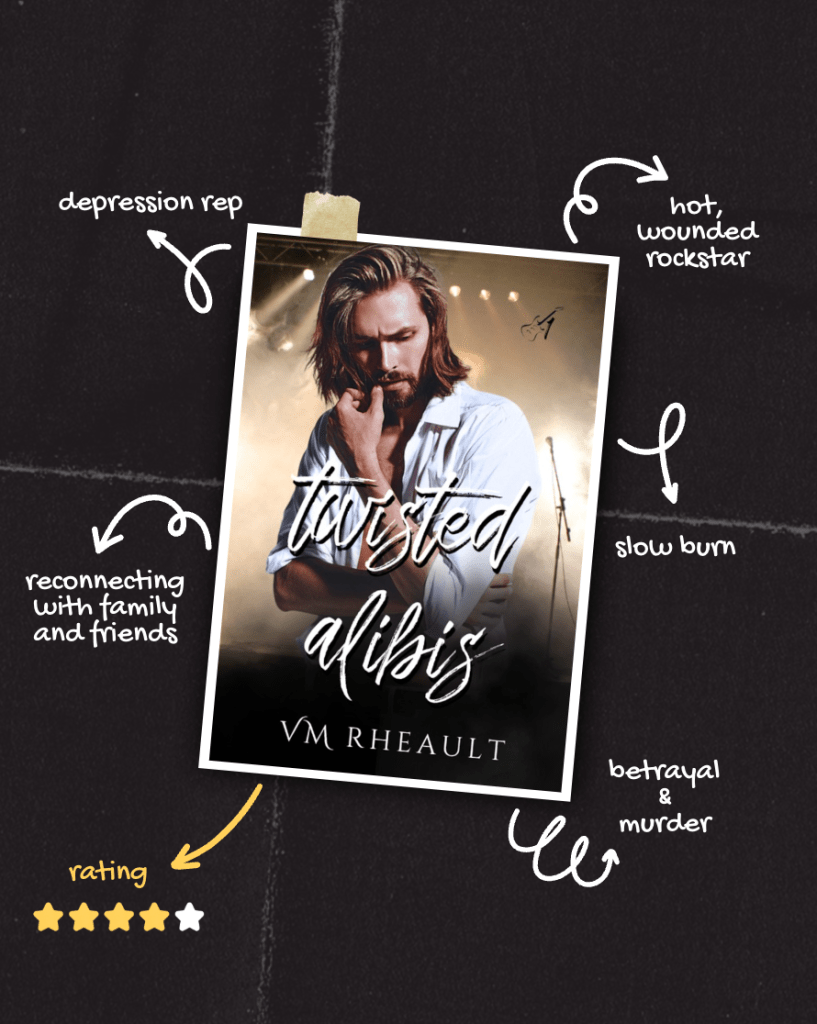
A while back there was a lot of heated discussion about those book graphics that have the cover of the book on it then the squiggly arrows that point out the micro-tropes. Like this:

black background. cover of Twisted Alibis by VM Rheault. man looking down, stage in background. arrow graphics pointing to hot, wounded rockstar, slow burn, betrayal and murder, rating (four stars) reconnecting with family and friends, depression rep
made with a template in Canva

People were saying that they love them because they give you a quick glance into what the book is about, others said they hated them because it’s just a long list of spoilers. I’ve been of the mind that spoilers don’t spoil a book. After all, a happily ever after in a romance is the biggest spoiler of all–it’s the couple’s journey to get to that point that matters. And that’s where stakes come in. There’s no hook, there’s no exciting plot, without stakes, motivation, and consequences. What will the couple lose choosing love? What will they gain? What will they lose if they go their separate ways? Is what they will gain be enough to make up for that loss?

It wasn’t that long ago that I read a romance blurb that was packed full of mini-tropes. Small town, second chance, fake dating. You name it, and it was in there. But what the blurb lacked was stakes. What did they lose if the fake dating scheme didn’t work out? What did that couple stand to lose if the MMC didn’t stay in the little town he left so long ago? What would she lose if he leaves? Her heart? The blurb sounded exciting until you dug just a little deeper and realized that blurb could have been the blurb of any small-town, second chance book out there. Nothing made it that author’s. Nothing in that blurb screamed, “I’m different! Read me!”

I think arrow graphics can definitely be used as a quick “at a glance” vibe for your book, especially if you add something that is unique to your characters. And I wouldn’t worry about spoilers. If a little spoiler can ruin your entire book, you better rethink that plot.

Not everything is Amazon’s fault
I’ve defended Amazon quite a few times in the past on this blog. I know they have their flaws, just like any other employer or company that you do business with, but a lot of what I see isn’t just Amazon, it’s authors refusing to take responsibility for their actions, like missing a preorder date and having their privileges taken away or not ordering stock in time and blaming Amazon for not getting their books to them during the busy holiday season. I actually saw someone on Threads complaining that it will take six weeks for their books to come, and that it happened to them last year. Like, if you know this is going to happen but don’t take the steps to avoid it, then all you’re doing is blaming someone else for your own mistake.

I know that Amazon isn’t perfect. They’ve shipped my books with a body lotion order and that could have had a poor outcome. I have also seen pictures of books coming damaged because they weren’t packed correctly. I’m not saying they’re entirely blameless, but instead of making Amazon the eternal bad guy, it would be nice to see some people just taking ownership of their actions like the adults they are.

Just because you can doesn’t mean you should
Indie authors have a lot of freedom, and that can be great. We can re-edit a book and upload new files or change our covers whenever we want. We can run ads or not, use social media to promote our books or not. We can take five years to put out a book or we can publish twelve novellas in a year. We have 100% say in how we run our businesses.

But we should use that freedom wisely because I see a lot of hot-take behavior from indie authors that makes me squirm. I see authors canceling preorders, airing their dirty laundry on social media, making fun of readers for their reviews, making fun of other authors for what they like to write. The list is endless.

We are in an era where nothing online seems real. There is so much AI and so many scammers out there that it’s difficult to parse through for real and true information. I read a Substack article by Claire Taylor and she was saying that one of the most important things readers will be looking for going forward is trustworthiness and integrity from the authors they choose to read. I think this is a valid point and really important. Do what you tell your readers you are going to do. Have follow-through. And be kind while you’re doing it.

Your peers and coworkers need to know they can trust you too. Don’t say you’ll send out author copies for an event if you don’t think you can. Don’t sign up for book conventions and then back out. Don’t say you’ll help a fellow indie and then change your mind. I know life happens, and so does everyone else, but at some point you have to look at yourself and ask if you’re dependable. If not, you need to figure out why and what’s going on in your life that you need to change.

I think Claire is on the right track when she says that trustworthiness, integrity, and dependability is going to be your number one marketing strategy next year. How are you going to show up to your readers? As 2025 draws to a close, it might be a great time to think about that.

Just because you can doesn’t mean you should. And what kind of person will you look like if you do?

Hot takes are hot for a reason: they spark debate and can hurt feelings. They can ruffle feathers, not only for their basis of truth (or not), but because they force us to question ourselves and our beliefs. And what do we think of the people who have a different opinion than we do? I like listening to hot takes. Some of them are valid, some are pure BS, and some challenge what I think.

In the end we all make our own choices–write a prologue or not, save up your books before publishing or not, follow through with that promise or not–but remember, hot takes were made to get attention, so keep your cool . . . at least where people can see.


As part of my “favorite things” segment I’ve been including until Christmas, I want to highlight the Authors Guild YouTube channel. They have great content like where to find your readers, querying tips, and how AI is changing the publishing industry. You don’t have to be a member of the Authors Guild to watch these videos.

If one of your New Year’s resolutions is to learn about the publishing industry, this is a great channel to subscribe to. There are some videos geared more toward traditional publishing, but as an indie, I think it’s important to keep up to date on what’s happening in publishing as a whole.

Look here for a list of their videos and you can subscribe to their channel: https://www.youtube.com/@AuthorsGuild

screenshot of the Authors Guild youtube channel header.  AG in green circle
Authors Guild
@AuthorsGuild
•
2.77K subscribers
•
199 videos
More about this channel 
...more

Subscribed
The oldest and largest community of writers resouces guidance support


That’s all I have for this week! Thanks for checking in and I’ll see you next Monday!

Guest Author A. K. Ritchie

cream and blue bokeh. cream square with author's photo.  text says. guest post: author a.k. ritchie

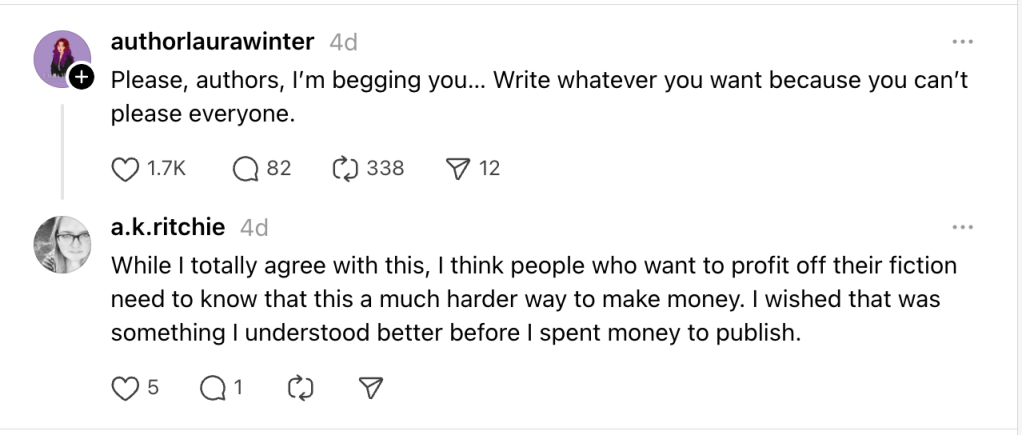
As with most of my online friends, I met A. K. on Twitter many years ago. After I left, I wasn’t sure how many people I’d lose touch with, and when I found her on Threads, I was thrilled! Recently, I saw her reply to this post:

Right away I asked her if she’d be willing to do a guest post to talk about her response a little more, and she agreed!

I’ll let her have the floor now. Thanks, A. K.!


It wasn’t long after I published my first novel, AFTER THE PARTY, that I realized a hard truth. I’d been so focused on getting my novel edited and learning how to manage the technical side of self-publishing that I forgot I would have to market my own book. Specifically, I would have to find my own readers.

I didn’t understand the impact platforms like TikTok and Instagram were going to have on fiction and sales. It never occurred to me that I would have to concisely explain to people my novels’ genre on a regular basis. I never realized how hard it would be to find my readers and promote my book. 

I often joke that my novels are marketing nightmares. While some of my novels have romance, I don’t fit into the genre as the love story is often a subplot (or not included at all like my novel WILDE LIKE US). While my themes may be well suited for Upmarket fiction, my writing style does not fit the current trends. I landed on Women’s Fiction, but some argue that it’s more Coming-of-Age. It never occurred to me to lock down a genre and the ideal reader before I started creating. 

It makes it hard to find readers when you don’t know who they might be. 

I went into self-publishing over traditional publishing because I wanted to write what I wanted without the pressure of conforming to trends and labels. I grew up in a culture of hand-made, home-printed zines. I found bands recording in their garage, burning their songs to CDs with handwritten track listings. I wanted to DIY it. This is something that I lived in my everyday life, so I wanted it to apply to my fiction as well. 

While I may have broken even on my first two novels, it occurred to me that writing only what you love, without considering the market, can make self-publishing an expensive endeavour. As much as I love the stories I’ve told and what I’ve created, it doesn’t mean that passion will translate to sales. 

Without sales, it becomes difficult to continue producing more fiction. The cost of editors, artists, subscription for websites, etc, all costs money and unless you have funds coming in from other sources, continuing to produce fiction this way may not be sustainable for the vast majority of people. 

If I were to start this journey from the beginning, I would take more time to understand what readers are looking for and how that can be implemented into the stories I want to tell. I’d try to find a space where my voice already fit into a thriving community. 

In no way do I regret writing my stories the way I did. I was being true to my creative side, honouring the stories I wanted to tell. I was also learning so much. And I still am. My storytelling has become stronger with each novel I create. I wrote without external pressures of deadlines and expectations.

But I’ve also come to realize that if I would like to keep publishing, and would like to do so with more frequency, there needs to be a balance between what I write and what the market wants. Even those bands I listened to and zines I grew up consuming took that into consideration. They had a market and they were filling that need in their community. 

There is nothing wrong with writing for yourself or writing based on the current trends or a mix of both. My advice would be to set realistic expectations based on your personal goals and move forward with intent. A good balance would be finding that sweet spot between stories you’re passionate about and ones that make a profit. 

For now, I will keep writing my novels as a form of expression and as a hobby. However, I am already making plans for future romance novels that may still explore a mix of emotional topics with a focus on romance first and foremost. My plan is to bring my stories forward in a way that might meet the readers where they are. 


Thanks again to A. K. for her post about writing what you love! If you’d like to follow
A. K., you can find her on these platforms:

Instagram: https://www.instagram.com/a.k.ritchie

Goodreads: https://www.goodreads.com/author/show/21836915.A_K_Ritchie

Amazon Canada: https://www.amazon.ca/stores/author/B09HJX6R6P/about

Amazon US: https://www.amazon.com/stores/A.K.-Ritchie/author/B09HJX6R6P

Website: akritchie.com

Monday’s Author Update

1,617 words
9 minutes read time

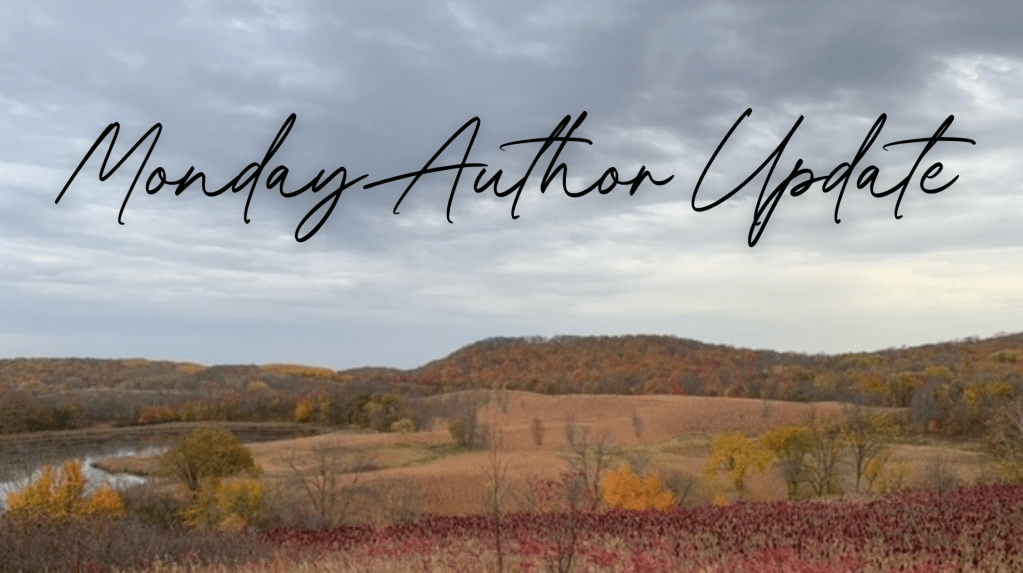
higher view of a state park in autumn. browns dull greens and oranges over a hilly field. lake to the left a murky green water.
Maplewood State Park, Maplewood, MN October 2024

It’s cooling down in the evenings and the leaves are just beginning to change colors, which is lovely. We’re tiptoeing into my most favorite part of the year, the yummy months when it isn’t summer but it isn’t winter. In Minnesota, no one can accurately guess how long that time will last, but I’ll enjoy it for however long it stays.

My editing and proofing is done!
I finally finished proofing my Christmas novel that I was re-editing in time for the holiday push. I ordered a second proof just to make sure the formatting is still okay, but I’m not reading it over again. I changed a lot of word choices and phrasing, just like I did for Faking Forever, and going forward I’ll be trying to sound more conversational while staying true to my voice.

One of the things I had in the back of my mind when I re-edited those three standalones (Rescue Me, Faking Forever, and A Heartache for Christmas) was those books not sounding like me if I made too many changes. But, I’m trying to lighten up because since I’ve been reading a little bit more I’ve noticed that popular romance books just don’t get too deep with the prose and vocabulary. Whether this is a conscious choice of the author or just their own light writing style, I’m going to try to meet in the middle. I can only write how I write . . . but I can be mindful of word choices and syntax and maybe my books will be a little easier to read. I wrote a blog post on the changes I was making in A Heartache for Christmas and you can read it here: https://vaniamargene.com/2025/08/18/when-dumbing-down-your-writing-isnt-dumb/

I’m going to set up an Amazon ad for it, I think, and maybe set up a Facebook ad for it at the end of October. I really let up on the Facebook ads this year, and the only ad I’ve purchased was for getting my ARCs of Loss and Damages seen. I did manage to give away quite a few ARCs of that book through the ad, but since I gave them away on good faith (meaning no Google form to fill out and no email collection), I doubt much will come of it.

Goodreads giveaway update.
My Goodreads giveaway is doing well, though I guess I don’t have a gauge to tell. I have 1,150 entries at the time of this writing, and I’m pretty happy with that. Like the ARC giveaways through my FB ad, I doubt much will come of it, but if you don’t get your name out there somehow, no one will know who you are. It’s especially true these days with so much content to choose from.

New book and new editing project.
I’m 6,563 words into Bitter Love, but I’m going to have to table that for now. One of my friends I edit for has the next book in her series ready for me, and I’ll be putting Jesse and Jordan aside to take care of that. Because of the changes at my work and just basic free time slipping away, it will take me a while to get that editing project done and I probably won’t get Bitter Love finished this year like I wanted. My day job has just been stressful overall, and I’m at the point where I’m not sure what would be harder: staying and toughing it out or finding something new after twenty-four years. All I’m grateful for is that I’m feeling better physically every day, so if/when I decide to jump into the job search I can at least handle the change. It still won’t be easy because change is hard, but at least I won’t have the physical stuff to deal with if it come to pass.

Posting on social media.
I’ve still been trying to post on socials, and though I’ve pulled way back on FB ads, I’ve been boosting posts on IG a little more. That hasn’t translated to sales as far as I can see, but I have gained a few followers pushing me close to 500 after having the account for thirteen years. I only post graphics, not reels, so I don’t know if growing my IG account will do anything for me, either in the long or short runs, but I think I prefer posting on IG rather than my FB author page. I have come to realize I hate that page. I have three friends who like all my posts and besides that, reach is non-existent. I wonder if it would be smart to start over, but I’ve had that page for almost as long as I’ve had Instagram so I have no idea where that link is out in the world. I hate broken links so I’ll keep it up and just repurpose my IG posts for it. I started a new TikTok account and just named it something generic that has to do with books. I’m testing to see whether a “book” account will do more for me than an “author” account, like my reader page on Facebook I run ads off of when I bother. It doesn’t seem so advertise-y, so we’ll see what comes of it. Content creation is still the main issue, but I’m good with Canva and just try to juggle creating on my laptop and posting on my phone (I have the Canva app). Even if I’m stuck in what’s considered the TikTok dungeon, the low views (my last carousel got 353 views) still beats what I get on FB and IG combined, even when I boost a post on IG. I don’t want to try to be everywhere, just where I can have the most eyes without a lot of work.

Blog cleanup.
Speaking of broken links, I’ve been cleaning up my blog posts and trashing some of my older ones I did with other authors who have since flaked out or have changed their own links (or even author pen names!) making the post useless or obsolete. I didn’t like doing that, but some of my relationships with those authors have gone so far south I didn’t like having them on my blog anymore anyway. So if you happen to run into a link that doesn’t work anymore, you weren’t missing much and there’s a reason why the post no longer exists. I’ve also gone back and updated a few older posts that kept getting hits even though they were six, seven, or eight years old. Back then I had no idea what I was doing and the posts are only getting hits because my SEO on this site is actually pretty good. So, I updated those older posts with actual relevant information and now I won’t feel bad when people are reading them to find out about something.


Library distribution of Kindle Select books.
There’s been a lot of talk in indie circles about KDP letting ebooks into libraries even if you’re enrolled in Kindle Select (the author side of Kindle Unlimited).

I didn’t jump on this bandwagon for one simple fact: you still have to be selected by a librarian to be in a library. Your books don’t just automatically show up there because they’re available. And with the deluge of indie books now being available, your chances of being selected are that much worse. So, no I didn’t go upload all my books to Draft2Digital to use their site as a distribution service to libraries, and I probably won’t. My paperbacks have always been available through IngramSpark and as far as I know a library has never purchased one of my books. Like being in a bookstore, being in a library has never been a dream of mine, and I just don’t care. If you care about being in the library system and want to take advantage of that for your Kindle Unlimited ebooks, you can make an account with Draft2Digital and when selecting storefronts, select library distribution only. This article gets a little more detailed: https://newshelves.com/kindle-unlimited-authors-can-now-distribute-to-libraries/

What’s on the blog next week.
I was going to get into if writing a long series anymore is a good idea and talk about some current information I’ve run into that has possibly proved that it’s not. But right now, this blog post is already eight minutes long, so it’s probably better if I wait to talk about it another day.

Peak leaf-looking season will be coming in a couple of weeks and I’ll be taking a day off to go to a state park near here with my sister and daughter. We went last year and I took some amazing pictures. It’s nice to spend the day outside in cooler temperatures and then we go out to dinner after we get back into town. Things will change a lot for me if I have to get a different job, but change doesn’t have to be bad. It’s the getting-through-it part that’s uncomfortable, but with my health issues, the past five years have been hellish and maybe finding a different job will be a piece of cake after that. Anyway, I will keep you posted on all that as I know more.

Next week, let’s say I’ll write that blog post on whether or not it’s worth an author’s time to invest in a long series. With attention spans dwindling and a reader’s need for instant gratification, I feel the old advice of writing a long series is slowly becoming as obsolete as some of my old blog posts.

Chat more about that later! Have a great week!

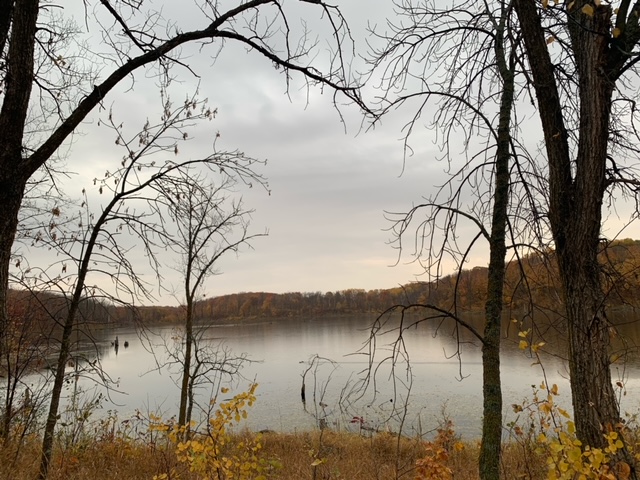
murky photo of a lake through dark brown and black tree branches. brown and orange trees off in the distance
Maplewood State Park, Maplewood, MN. October 2024.

Networking with the Right People at the Right Time

1,554 words
8 minutes read time

"life is one big tug of war between mediocrity and trying to find your best self"  david goggins

quote on cream background

In my last blog post, I talked about the writing community and meeting and networking with the right, or wrong, people. I see this on Threads, even today, though not at the scope it was on Twitter say, eight years ago. Back then, there were, like I said, themed days to post your work, like #1linewed​ #2bittues​ and #fridaykiss​ ​(that has since been moved to Instagram). The #writingcommunity​ was a melting pot of genres and publishing levels. It was easy to get swept away by how “professional” everyone seemed with their websites and debut books. Talk was cheap and sounding like you knew what you were doing had more weight than actually knowing what you were doing. I’m not sure how many books I bought that had fabulous covers that just sounded blah inside. And of course, the number of followers topped everything, and someone with 30k followers interacting with you or retweeting a tweet was like Christmas morning.

It was easy to lose sight of the real reason (if you knew the reason at all) you should have been networking, and a realization like that takes years to come, if it ever does.

If I were to do it over again, I’d stay off Twitter and focus on Facebook groups. I was there, too, in groups like Bryan Cohen, Mark Dawson, and 20booksto50k. But those groups were like being on Twitter–a mishmash of genres. I’d definitely focus more on romance groups and getting to know those authors. Once I started publishing, I did do that a bit, and joined the Romance Writers of America, but I didn’t get involved to nearly the extent I should have. That brings me to where I am today. Not having very many romance author friends and not having the energy (or time) to fix it.

I sound like I’m all gloom and doom, regretting and maybe resenting the path I didn’t realize I was taking, but that’s not entirely true. There’s a lot of good that came out of it, but it doesn’t benefit me in the way I’d like it to now.

When I dove into the Do-It-Yourself part of indie publishing, I didn’t hold back because I love the entire process. The formatting, even back before Vellum existed and we were formatting our CreateSpace manuscripts in Word, and book cover design, also in Word before Canva was around. I bought a book on how to use WordPress and set up my own website. Then tools like Vellum and Canva did come into existence, and with the encouragement of my friend Aila, I started using Canva and learned how to make graphics and later, book covers with it. I remember I wanted to do my book cover for Wherever He Goes in Canva, but I wasn’t sure if it was possible. Up until then, I was doing them in Word with instructions that I found online somewhere, but I thought, A PDF is a PDF, so why not try? So, I did the same thing I was doing in Word but in Canva, and I actually made a very nice (for what I was capable of back then) cover. If you want a sample of what I was doing back in 2017, you can look here: https://vaniamargene.com/2017/03/14/your-books-back-cover/ (Also, yikes!)

I was very into the soup to nuts of indie-publishing like a lot of people were, and while I do think it set me back in some ways, there are some skills that I don’t regret nurturing like learning how to use WordPress so I can maintain my own blog, or learning how to use Vellum so can I re-edited and update back matter whenever I want. The Canva tutorial on how to make a full paperback cover wrap has helped thousands of people, and I never would have been able to write it if I hadn’t learned how to do it myself.

But leaning into nonfiction really wasn’t what I had in mind when I was first starting out. Actually, I’m not really sure what I was doing. I never really thought I’d be able to turn my books into a career, and didn’t know how to go about it anyway. It took many years to figure out that other authors weren’t readers, that your cover, title, and blurb are more important that you realize, and when you’re just starting out, your books aren’t going to be very good. Meaning, I really do think it takes a million words or more to find your voice and style and actually write books that sound good. I think the only way I could describe what I was doing is fucking around, but seriously. Seriously fucking around. While I had good ideas, (I still love the short story I wrote about a woman inheriting a huge mansion on the coast in Oregon and falling in love with its caretaker) we all know that good ideas do not build a readership.

Which is probably why I’m stalled now, because I’m still seriously fucking around. My books have gotten better since I first wrote to publish back in 2016 when I wrote On the Corner of 1700 Hamilton, but I’m still stuck in the same DIY pattern I was back then, doing my own covers, doing my own formatting, and doing my own editing. What was popular and “wow” worthy back then really isn’t so much now, but with the way things have shifted in the industry, it’s not so easy to fix.

That brings us back around to having not met and networked with the right people and forming those connections that I could have used to find trustworthy editors and cover designers that don’t cost a fortune and who won’t use AI. It’s not impossible to find those people now, but it is a lot harder. Editors who will charge you only to feed your book chapter by chapter into AI or ProWritingAid, or book cover designers who use AI and try to hide it. So, not only am I stuck in the DIY trenches, it would take a lot of work to climb out of it.

I mean, where I am isn’t bad. It’s not, especially when you see other authors who are doing the same thing, either out of trust issues or lacking the financial budget to hire out. If your book is mediocre and it’s floating in a sea of mediocre books, it’s not mediocre now, is it?

I think I lost the thread.

What I’m trying to say is, had I networked differently, I could have went down the professional path rather than the DIY path, and maybe I would be in a different place. I say maybe because I have improved a lot over the years, even just re-editing Rescue Me, Faking Forever, and A Heartache for Christmas has shown me that and improvement like that has to come from doing the work. But had I hired an editor and bought premade covers for my books instead of insisting on doing them myself, maybe I could have gotten here faster. I’m not sure.

I don’t know why I threw myself into the nonfiction side of indie-publishing (and giving advice when I had no right to be giving it). Maybe back then I thought blogging was a way to sell books, just like I thought networking with whoever would also sell books, but besides giving me joy because I’m helping people and giving me a way to voice my thoughts to someone who might get something out of them, it’s not doing anything for me professionally. I don’t plan on writing a nonfiction book–I thought about it for five minutes then realized it wasn’t for me–and I’ll never monetize this blog. I don’t have the heart for it and I’m not arrogant enough to think that my opinion and advice is worth a cup of coffee.

So, the way I see it is, I have two choices now that I know what I’m doing: I can go professional and network with romance authors, hire an editor instead of doing it myself, and buy covers that look better than what I’ve been making, or I can keep doing things on my own and hope that it’s good enough to eventually lift me to the next level. Networking alone won’t help so I have to decide what I want to do.

The decision is harder than it seems because the work I’ve been doing for myself has been fine compared to what’s out there. But “fine” rarely makes headlines, so if you’re in my situation where you’re doing what you can but still not where you want to be, be it networking or sales, you can choose a different path. It might be scary since the road you’re on is familiar and you already know all the twists and turns, but we all know finding success won’t be where you’re comfortable. That means networking with the right people and making your product shine, so when those opportunities do come, you’re ready to take them and make the most out of them.

Next week I’ll catch you up on what I’ve been doing and chat about some things that have been happening in the indie community.

Talk to you next week!

Three Things I’ve Stopped Doing (and Three Things I Always Will)

2,645 words
14 minutes read time

brown scale on brown background. low part says, three things I stopped doing (ampersand) and high part says, three things I always will
black text

Things change in indie publishing. Some quickly, like Amazon guidelines, and some take years to shift, like marketing trends. I’ve been in this game for a bit now, longer than a lot of people I met when I first started out, but shorter than some of the tried and trues I knew who were doing this for years already when I first created my Twitter account.

I have found the longer you stay in the game, the more data you’re going to collect (if you’re smart and keep track). What works, what doesn’t. What did but doesn’t anymore. There are some basic things that will always have merit like publishing consistently, having a website, and, in most cases, not genre-hopping if you want to build an audience. But there are some things that just don’t work anymore, like just simply publishing and watching the royalties roll in as they did during the Kindle goldrush days.

So, I thought I’d share the three things I’ll always do and three things I stopped doing. As the years go by and I hang in there, this list might change, but these are the conclusions I’ve drawn so far since I published my first book in 2016.

Three things I’ll always do in my publishing business:

Finish a duet/trilogy/series before release. I’ve blogged about this a few times, as for most authors this is a Catch-22. Some readers now won’t read until a series is done and they can binge, but an author is reluctant to write more unless they see interest in the first book. What will always convince to me to finish is the fact that if your series is never done, it will never get the readers it could if it was finished. Books don’t expire. In the digital landscape they can sit on a virtual bookshelf for decades. Indies make money on older titles all the time, but you are ensuring that you won’t if you don’t finish. My reasons go beyond the money, even beyond author courtesy and reader habits. I finish out of a sense of integrity for myself and my work. I mean, I don’t publish as I go because I have anxiety over consistency issues that I couldn’t fix if my books were already out in the world. I’m not that good of a writer, so I need to be able to go back and double-check until I’m satisfied. But I also just couldn’t walk away from a world and characters I created. I loved them or wouldn’t have created them in the first place. I’ll always stay true to that creative spark and finish what I start.

Marketing in a way that’s sustainable to me without feeling guilty. That means letting go of the idea I need to be on social media. I don’t like thinking of a hook or a theme and making a graphic and posting. I don’t want to make videos for TikTok even if I have gotten better at it and it doesn’t take me that long. I still post every once in a while so if a reader stumbles upon my FB author page or my IG profile I look like I’m still alive, but otherwise, the constant advice that I need to be posting all the time I will happily ignore. The fact is, a lot of authors don’t have the money or don’t want to spend the money on marketing. I understand that, but paying for ads and for newsletters like Freebooksy and Fussy Librarian is my way of reaching readers without worrying about algorithms or coming up with content and the best way to present it. If I run an FB ad, that’s my limit, since you do need a hook and a graphic that will make people click.

I understand that in a perfect world, an author will use both paid and free tools to market effectively. But when mental health comes in, not to mention time and finances, each author has to make the best choices for them. Even if that’s not posting on socials, not paying for marketing tools, and only joining in a free, author-driven book blast once a year. You have to take a look at what results those methods are bringing in and if you’re okay with that. After a lot of soul-searching, I am okay with breaking even or losing money. I didn’t start publishing to become rich and famous, and that’s okay because I never will be. (I still play the PowerBall sometimes though.)

I will always buy my own ISBNs. This is kind of a cheat, because I already made this decision, and four years ago I bought a pack of 100–after I had already bought a pack of ten and went through them. It cost as much as my rent (at the time–my rent has gone up considerably since then) and I was sweating bullets, but I charged it and paid it off after a few months. I have been called privileged for being able to do that, and you might think I’m privileged to be able to afford ads and paid promos, too. I don’t feel privileged, living paycheck to paycheck, depending on the rent money my kids give me every month, and I still have to charge bigger purchases, like the new mattress I had to buy a few months ago for my back pain. I have a small budget for ads and don’t pay myself a wage out of my royalties. Every penny I make on book sales gets put back into my business hobby. I think that’s another reason authors are hesitant to pay for things like ISBNs and ads. They don’t always make their money back because they don’t write to market or their covers are bad, but I have never seen any industry besides indie publishing where people think they can start a business and not spend any money.

Not everyone will agree that buying ISBNs is a valid expense, and that’s okay. Amazon may not be around forever and neither may IngramSpark, though chances are good they’ll still be here in my lifetime at least. But, I wanted to protect my work under numbers that I paid for and now I’m the publisher on record for my titles. That means a lot to me. I protect both my ebooks and my paperbacks, even when the general consensus is you don’t need an ISBN for your ebooks. I still have quite a few numbers left, even using two a title, and well, I don’t think I’ll need to buy anymore. Obviously, buying ISBNs is a personal business decision but I have never regretted mine.

Bonus Entry:

I will always be a member of ALLi. This is something that I thought of last minute, but I’ll always be a member of the Alliance of Independent Authors. As someone running a business, I think it’s important to be part of an organization that will have your back. I mostly joined so I would have help if Amazon ever closed my account. There are a lot of other benefits too, like discount codes on formatting and publishing services, and I save a little every now and then if I have to update a file at IngramSpark. While it seems like a waste of money on the outside, paying for something that you don’t use (like an old gym membership that’s on autopay) it will be there whenever I need it and in these days of scammers and thieves, having some who’s in your corner is worth more than what they charge for a yearly membership.

Three things I have stopped doing since I started publishing:

Building and sending out a newsletter. Last year when MailerLite screwed me over when I was trying to make my newsletter compliant, I said “fuck it” and shut my newsletter down. I didn’t want to search for another newsletter aggregator and I exported my listed and imported it into my author website. I decide I would turn my newsletter into a public blog, and so far, things have been going okay.

There are a lot of disadvantages to this, to be sure. I can’t offer “bonus content” because what I post goes to everyone. Segregation of an email list isn’t possible on WordPress, nor is culling my subscribers. They have to opt out or my list is stuck with them. I can still force people to give me their emails if they want my reader magnet, but I would have to pay for that privilege on Bookfunnel and that’s not where I want to put my money right now.

So, as far as newsletters go, my blog is still sent out in email form but posted on my site and it will show up in the WordPress reader. People might think I’m crazy for giving away a book without strings, but what’s a book? I can always write another one. Kind of like when your hair stylist does a crappy job. Your hair will grow back. Eventually. Books are a dime a dozen and My Biggest Mistake has served me well. I’ve given away over a thousand copies, and because the back matter in all my books advertises this free book on my website, I’m afraid I’ve trapped myself into giving it away forever. My only ask is you subscribe to my blog, but that rarely happens. Still, I prefer the laid-back approach I’ve adopted since I’ve been working on not taking my books so seriously. I’ve given myself permission to relax, especially in the evenings after a full day. I’ve started watching Lucifer, because, you know. Tom Ellis.

This is one of those things that may change, but I’m not sure what would prompt me to move my list again. I like what I’m doing, and because I’m comfortable with WordPress, maintaining it isn’t a nightmare. In fact, I just refreshed the header, colors, and font on my author page. I hadn’t since I set it up and it looks nice. If you want to take a look around, you can find it here: vmrheault.com.

I’m getting rid of the hard back matter sell. A long time ago in a romance marketing room on Clubhouse, I heard the advice to do the “hard sell” right after the last paragraph of your book. There were all these little caveats, like you couldn’t even use a spacer or a hard enter because that would “force” the content on to the next “page” on an ereader. It was advised to put your call to action (CTA) practically right after the last period, and I did start doing that along with many many many authors. When I look back at my older books now, I hate it. I hate it, hate it, hate it, and I’ve been going through and getting rid of it. Why? Because after I have just read an amazing book, I want to sit with the happy ending, I want to sit with the characters who touched my heart. I don’t want to be yelled at to join a mailing list or to buy another book. So, while I was re-editing Rescue Me, I got rid the immediate CTA to go to my website. (I’ve always pointed people to my website and not a landing page, and that saved me a ton of headache when I stopped using MailerLite.) I didn’t get rid of it completely, but it’s on its own page now. Ebooks are flowable and don’t have pages, but I think a reader has to “flip” to see what else is in the back of the book after the content ends. I’m doing Faking Forever now, and along with updating my list of books, I’m also getting rid of the hard sell. I didn’t it do it on my new releases and that is a trend I’ll stick with. If readers loved your books they will find a way to stay in touch. Like moving my newsletter to my blog and cutting back on the number of books I’m publishing every year, I’m just going to ease up and stop trying so hard. Because you know what? It didn’t do that much anyway.

I’m not adding subtitles on my ebooks. That was another really popular thing to do, and I even wrote a blog post about it. I guess this goes along with the hard sell, and I’m not going to add subtitles to my ebooks anymore. I’m going to start letting my cover, title, and blurb speak for itself, and make sure my categories and keywords I choose when publishing do the heavy lifting. Adding a subtitle to your books was a very trendy thing to do to drive discoverability, and you may think that with market saturation that not doing it anymore might be going backward. But, Amazon doesn’t like it, either, and honestly, now I think shoving mini-tropes into a subtitle just looks desperate and ridiculous. So, as I update my books, along with taking out the hard CTA at the end, I’m going to be taking off the subtitles. It will make my buy-pages look cleaner. Am I telling you not to do it? No. Unless you really do want to be careful around Amazon, then maybe I would rethink that, but if you like to take chances and want to pack your subtitle full of mini-tropes, then you should still do what you want to do. This is the new and improved relaxed version, remember?

Bonus Entry:

I won’t ever use an illustrated cover. Obviously I was thinking about my hockey novels and the kind of covers I wanted to put on them. I don’t fault anyone for using an illustrated cover but I have just come to realize those are not for me. I understand the reasons why authors turn to them. There’s more of a selection when scrolling through vector art than there is real stock models and if you’re one to go with the trends, you don’t want to feel left out and think you could be leaving readers on the table. But at this point, illustrated covers would be at odds with the brand I’ve built for myself over the years, and if I can find what I need and there are still real people on the kinds of books I’m writing, then I don’t see any reason to change. I also have never, and probably will never, write a story light-hearted enough where an illustrated cover would fit, so instead of moaning about that, I’ll lean into my strengths and keep putting hot, sexy men on my covers.


When it comes to indie publishing, or just publishing in general, the ability to pivot and be flexible is probably one of the biggest assets you can have. Things change at a snail’s pace until all of a sudden everyone is talking about it and doing it a different way. What’s especially interesting is when things used to be the standard (like subtitles on ebooks) and that changes to something that no one does anymore.

I have extreme FOMO, I really do, but this year I have managed to brush a lot of that aside, for the most part because I think I know everything there is to know and there isn’t going to be a magic piece of advice that will push me to the next level. And that’s okay. Accepting that is actually freeing. I can do what I want, write what I want, and be happy with it. After the few years I’ve had, that is a really great place to be.

Next week I’ll give you a rundown on what I’ve been doing. July is almost gone, y’all. I hope you’re making the best of what’s left of summer.

See you next week!

The Evolution of the Romance Genre

1,663 words
9 minutes read time

beige background. a flower in its growing cycle dirt, sprout, stem, bloom. red flowers, green stem, white pot.  text says, The Evolution of the Romance Genre

I’ve wanted to be a writer since I was a kid.

That’s probably not a surprise to anyone who is also a writer, and many of us can say we’ve been writing stories since we learned how to hold a crayon. When I was in high school, I devoured Harlequin Temptations and Desires, finding them at garage sales, the library, and shoplifting them from Pamida. I got caught and my dad made me talk to the manager about how stealing was bad, but I was a kid who loved to read and was a kleptomaniac at heart and well, it didn’t stop me. That’s neither here nor there, but one night, I remember holding a book and thinking, I want to be in charge of it all. The cover, the blurb. All of it. What I didn’t realize back then is I was describing what would eventually become indie publishing. So, yeah. I am in charge of all of it. Down to where the numbers appear on the page.

That was thirty-five years ago or so, and I didn’t understand tropes. I chose books based off the blurb, if I thought I would enjoy the story. In fact, I don’t think I really understood tropes at all until I was assigned the difficult task of marketing my own books. It was through listening to romance marketing talks, webinars, and podcasts where I learned tropes are what sell your books. That was also a difficult realization for me because, like most writers, I just wrote what I wanted to write. My first trilogy was written without tropes in mind–I just made up a group of friends who lived in a fake town, gave them some trouble, and forced them to fall in love while navigating those troubles.

I don’t remember the precise “Ah-ha” moment I had regarding tropes, but I must have had it at some point because my next three standalones were all trope-specific–enemies to lovers, age-gap, and close proximity. Then I veered off again with my Rocky Point series and just wrote whatever I wanted, and if a trope was baked in, like second chance, yay for me.

So you can imagine my confusion when, after seven years of publishing, I realized, yet again, romance was becoming even further divided than just tropes and that I would never be a successful indie author writing “contemporary romance” because romance didn’t work like that anymore.

Indies were changing the game.

There’s an interesting interview that Nora Roberts did not long ago with the Associated Press, and she was talking about her career in romance. She’s written over 250 books and has seen firsthand how the romance genre has evolved, going so far to even say, “My roots are in romance and I have a lot of respect. But I don’t write romance anymore. I do write relationships.”

AP: Speaking of the sex, that’s a good transition to romance as a genre. It has evolved a lot in the last couple of years. Where do you see yourself in the pantheon of that genre?

Roberts: I don’t at all. My roots are in romance and I have a lot of respect. But I don’t write romance anymore. I do write relationships.

I’ve been writing for a really long time now, and the romance genre evolves and it changes. And it did when I was working in it, and it just got to a point where I didn’t want to go where it was evolving. I wanted to go in a different direction. So my roots and foundation are there, and gratitude. But that’s not what I’m doing now.

That’s a great way to look at it . . . if you’re Nora Roberts and not a nameless, faceless author trying to find readers in market so saturated it’s tempting to close your laptop and never look back. She has her audience and has built it over years of publishing. So where does that leave the rest of us?

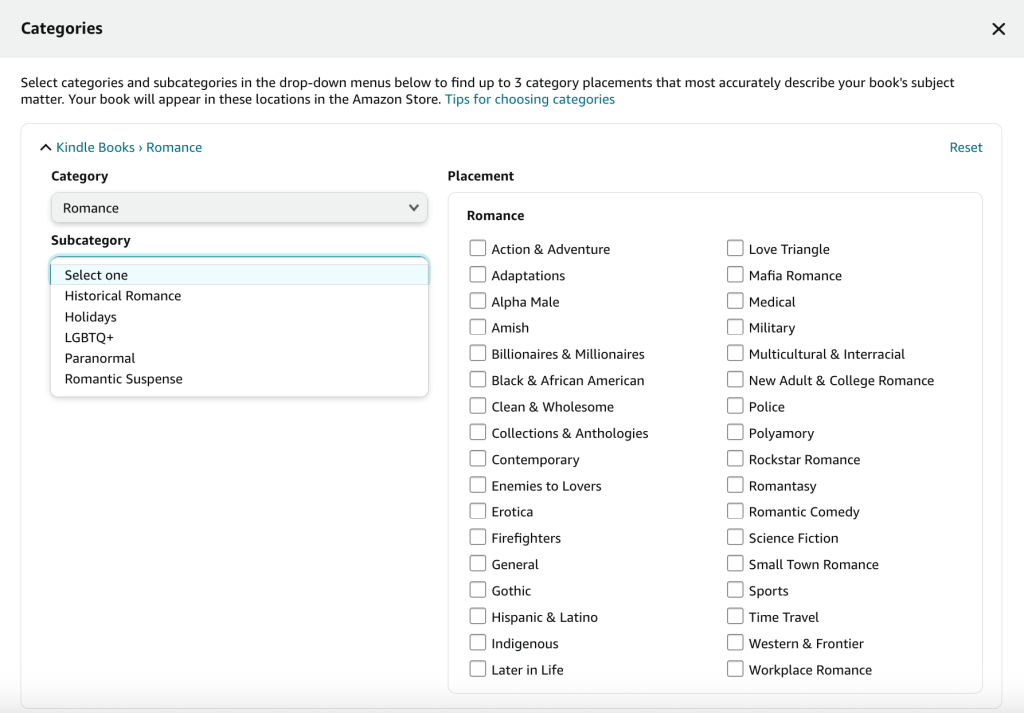
There are indie publishing “rules” and one of the biggest rules of them all is to never genre-hop. There’s some logic in that–it’s hard enough to market your books when you’re writing in just one genre, never mind trying to reach readers in two or three. But when you decide to write romance, that rule is split down even further. Choose a subgenre, and there are plenty:

screenshot of KDP's romance subcategories and subgenres

subcategories include historical romance, holidays, LGBTQ+, paranormal and romantic suspense

subgenres include:
Action & Adventure
Adaptations
Alpha Male
Amish
Billionaires & Millionaires
Black & African American
Clean & WholesomeLater in Life
Love Triangle
Mafia Romance
Medical
History
Multicultural and Interracial
New Adult and College Romance
Police
Polymory
Rockstar Romance
Romantasy
Romantic Comedy
Science Fiction
Small Town Romance
Sports
Time Trave
Western and Frontier
Workplace Romance
Collections & Anthologies
Contemporary
Enemies to Lovers
Erotica
Firefighters
General
Gothic
Hispanic & Latino
Indigenous

This is the screenshot of romance subgenres you can choose when you publish on KDP. They have narrowed them down so much you can pick something like Love Triangle or Workplace Romance. Ten years ago we didn’t have those choices, and it makes me wonder if they’re helping or hurting.

How niching down into a subgenre can help:

You have a built-in audience. You know before you write you’re going to have readers who want to read your books.
You can build your brand easier. Instead of saying you’re a “multi-genre author” and trying to turn your brand into something for everyone (which never works well and is expensive to market, too) you can say “Mafia romance author” and those readers will know they can plow through your entire backlist and be happy.
It’s easier to market. Just being able to choose your subgenre category and using the appropriate keywords will help immensely when it comes to creating ads. You can also partner with other authors who write that subgenre and share audiences.
Better discoverability. It’s a lot easier for a reader to recommend a hot new Small Town romance series than a general romance.

Cons to only writing one thing:

You might get bored. So far, I haven’t felt too burnt out writing Billionaire Romance, but what saved me was playing with tropes and adding in a dash of Romantic Suspense. Still, there’s not a lot of wiggle room when you choose something like Motorcycle Club. There’s a solid set of exceptions you have to meet to keep readers of that subgenre happy and not a lot of leeway to mix things up.
Your loyal readers won’t follow you. I’m fully aware that readers who liked my Billionaire stuff might not have read my Rockstar trilogy, and the readers who stumbled upon my Rockstars may not have wanted to read anything else in my backlist.
Your chosen niche might get saturated. Hockey is hot right now, and those who got in on the ground floor might be annoyed that suddenly the market is flooded. A while back Reverse Harem, or Why Choose as we have to call it now, went through the same popularity contest. You may have to pivot when that happens, and it might be too much work to start over.
Branding fatigue. All my covers look the same, though I actually don’t mind because with my limited skill set when it comes to graphic design and software, it’s easy for me to meet genre expectations but still keep my books and series separate and distinguishable from one another. But, I’m also trapped now because I put single men on the covers of my books and after sixteen books, a couple all of a sudden would look very out of place. Also, unless you can afford to be flexible, eventually you might use up all the hot men that are available on a stock site like DepositPhotos, trapping you even more.

So, what does all this even mean? Subgenres aren’t going to go away, in fact, chances are good KDP will add even more as time goes on, but I know from just my limited experience that niching down does help whether we want to admit it or not. It helps marketing and branding, for sure, and in turn it doesn’t take so much work to find readers. Anyone who looks at my Amazon author page knows exactly what they’re going to get, even if I do happen to throw in a rockstar or hockey player.

That doesn’t mean I’m always going to want to write billionaires, if even, you know, I’ve downgraded my billionaire status to simply, “Men with money.”

And what does that mean for romance? Readers aren’t picking romances off the Pamida shelves and deciding on which ones to stuff into their purses. They search online marketplaces like Amazon and Kobo by the tropes or subgenres they like, hope the cover catches their eye, then skim the blurb, looking to see if the description lives up to the cover. Subgenres have changed the way readers find books and I don’t know what we can do to combat that.

Writing what you want when you want in a time where indies niche down and produce six books a year is a tough act to follow and not everyone wants to. Some are steadfast in the idea that they’ll do their own thing, and it’s an idea that I keep circling around now that I’ve tried the other way and failed. I mean, to be clear, pivoting and writing Billionaire romance did boost my visibility and sales. Yes, it really did, but it wasn’t a magic bullet to a large readership, either, and in my case, I’m exploring other options to keep my joy.

I don’t know what the answer is. Maybe there is no answer because there’s not really a question. I just find it interesting how indies have shaped romance, even to the point where Nora Roberts has said, “Good luck.”

I can tell you what I’m going to do. I’m going to keep writing the books I want. I like writing “Men with money” or I wouldn’t keep doing it, but I can play with tropes and different subgenres like Romantic Suspense. I can explore themes of mental health, friendships, and found family. Because the market is going to keep evolving and there’s nothing we can do to stop it.

I’m going to write relationships, and if you want to grab one off a pirate site, go for it. But be careful. Pamida’s manager wasn’t very nice.

Splitting Your Author Life in Two: Readers vs. Writers

 white background. black piece of torn paper.  text says in black and white, splitting your author platform.

One of the biggest mistakes authors can make is trying to talk to everyone from the same place. Back when I first started publishing and writing my blog, I did this, and it actually took me years to figure out that not all readers are created equal. If you don’t know what I mean, let me explain.

It may not feel like it, but once you publish, your author life is suddenly split in two. You have your author pals who support you, maybe read your books (and that’s a big maybe), promote you on their socials that may or may not have readers in the audience, and after a while can even turn into accountability partners, alpha and beta readers, and friends. Then you have your readers, your actual readers who, if they are on social media at all, aren’t part of the . They use socials for other things like connecting with family and reading articles about gardening, cooking, movies, and politics. Maybe they like their favorite authors’ Facebook author pages because that’s where they hear about new releases, giveaways, book boxes, and in-person events.

I came this realization a while back, and when I started my pen name, decided I needed to have a hub just for readers. To be honest, I didn’t want readers reading my nonfiction stuff anyway. I use this blog as a way to help others in their publishing journeys, let other indies know what worked for me in terms of marketing (promos and ads), and just talk about what crazy BS is going on in the publishing industry. That information isn’t for readers, and it shouldn’t be. They don’t need to know how many books I’ve sold, what Amazon pays in terms of KENP, or that I make my covers in Canva and format my own books.

But, I understand this decision isn’t for everyone. I pay for two websites, and some authors don’t even like paying for one. I enjoy blogging for other indies and connecting to the industry makes me feel “professional” so I eat the cost of the WordPress plan and domain name. But, if that’s not for you, don’t feel bad. Not every indie author wants to share their journey, stay up-to-date on what’s going on in the publishing world (both trad and indie) to have something of substance to write about, or pass on what they’ve learned because writing tutorials can take a lot of time. There are weeks when I’m at a loss as to what to say too, and I either just default to an author update or scroll Threads looking for dirt a topic. I feel fortunate when I can share a podcast I enjoyed and/or learned from or I’m able to find a subject like this one that might resonate with someone and help them move in a better direction. You don’t have to lock yourself into writing every week like I have, but if the views and visits are what get you out of bed, consistency will always make that happen faster. I owe a lot of my SEO to my tutorials, particularly my Canva post on how to make a paperback cover. I’ve tried to keep this blog relevant and helpful, but if you already have limited time to write, nurturing a blog that won’t sell books won’t sound appealing.

That said, if you really want to make a go of this publishing stuff, you should have an author website, a place to point readers in the backs of your books. This is where you’ll have your backlist of books and where readers can find them, a newsletter signup, your reader magnet, trigger warnings, direct sales, and any in-person events. If you check out other author websites, you’ll find that they don’t blog about process or complain about Amazon payouts or how they package author copies for shipping. Author websites cater to readers and what they want, not other authors who like to hear about behind the scenes news.

The problem with only writing to only readers is that if you don’t have a lot going on, there’s not a lot to say and that can make you feel disconnected. I write my newsletter on my author blog once a month, and I usually have something to share. A sale, a new release. Maybe highlighting an older book in my backlist that hasn’t gotten a lot of love. Creating content can be challenging if you’re a one-book-a-year author, and it might be tempting to write about what you’re working on, but unfortunately, readers don’t care until you can give them something to buy and read. When that happens, when you aren’t constantly updating, it may feel like people are forgetting about you, but you know, as I’ve said in the past, they will. You can be afraid of something that will happen, but there’s no point to that. There is so much content out there it’s inevitable, but it’s better to jog their memory after a few months of silence than waste their time blogging about something that doesn’t concern them.

If that describes you, if you feel like if you’re not reaching out then you’re invisible, then yeah, you might want to blog for indies who are interested in your process, would like to know how well your promos did, and/or how you make your covers. It gives you a reason to communicate and not feel so alone, and you’re writing to the people who actually care what you’re working on. Sales won’t come of it, which is why in the end I moved my books off this website and put them on my author website, but the more you segment your efforts, the more effective each one becomes and you won’t feel like you’re shouting at people who aren’t listening. Reaching out doesn’t even require a blog. You can create an indie Facebook group or Discord channel. A place where other writers and authors can get together but where you also know the score: your peers won’t buy your books. You can let go of that expectation and just be happy you’re in a group of people who are going through what you are and know how it feels to have zero sales on your dashboard.

So you might ask how is my author platform split in two?

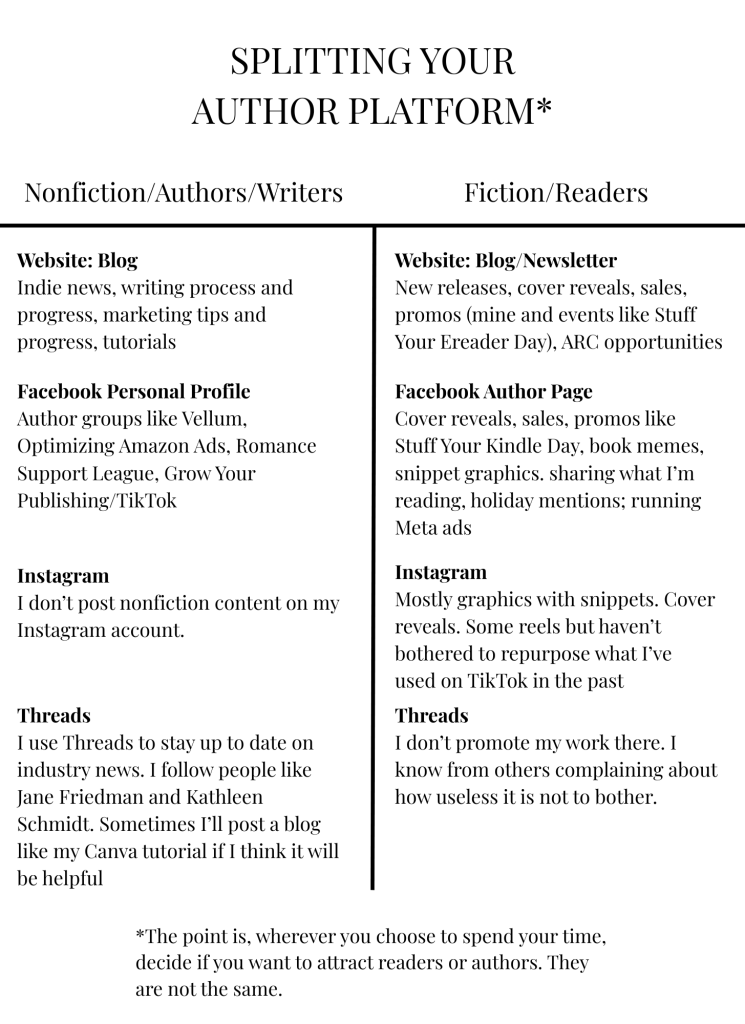
Here’s what I do, and I made a graphic in Canva so you can save it or print it out if you want a quick reference.

png image:
SPLITTING YOUR AUTHOR PLATFORM*
Nonfiction/Authors/Writers
Fiction/Readers
Website: Blog
Indie news, writing process and progress, marketing tips and progress, tutorials
Website: Blog/Newsletter
New releases, cover reveals, sales, promos (mine and events like Stuff Your Ereader Day), ARC opportunities
Facebook Personal Profile
Author groups like Vellum, Optimizing Amazon Ads, Romance Support League, Grow Your Publishing/TikTok
Instagram
I don't post nonfiction content on my
Instagram account.
Threads
I use Threads to stay up to date on industry news. I follow people like
Jane Friedman and Kathleen Schmidt. Sometimes I'll post a blog like my Canva tutorial if I think it will be helpful
Facebook Author Page
Cover reveals, sales, promos like Stuff Your Kindle Day, book memes, snippet graphics. sharing what I'm reading, holiday mentions; running
Meta ads
Instagram
Mostly graphics with snippets. Cover reveals. Some reels but haven't bothered to repurpose what I've used on TikTok in the past Threads
I don't promote my work there. I
know from others complaining about how useless it is not to bother.
*The point is, wherever you choose to spend your time, decide if you want to attract readers or authors. They are not the same.

There are a lot of places to hang out that I haven’t listed. I just can’t be everywhere and don’t want to be. Lemon8 is popular, so is Pinterest, and let’s not mention TikTok because I really don’t want to use my time making videos, but the fact is, if you’re a slow writer and you want to talk to only readers, you’re not going to have a lot to say. You can share book memes and pet photos, where you went to dinner on your anniversary, but you’re going to lose readers to other authors who publish faster. The industry in some ways is very slow, such as trends are very very slow to change, but when they do, it feels like it happened over night. Trad authors can seem like they get away with a book a year, but behind the scenes, they’re worried about getting a new book deal, if their publisher will pay for marketing, how their launch is going to go since they haven’t had a new book out in however long. Indies face the same trouble, trying to find traction while others are zooming ahead because they have more time/motivation/whatever than they do.

Figuring out where and what to post is a mental health issue, it really is. I’ve gone through my own struggles, beating myself up for not wanting to post on my Facebook author page, not making videos for TikTok when everyone says that’s where you belong if you’re an author. I boosted a post on my Instagram account and got a few new followers, but they aren’t going to do me any good if I don’t post. And you know, I’m pretty prolific, so it’s not that I don’t have content, it’s just that I don’t care. I let Amazon ads, promo newsletters like BargainBooksy, FreeBooksy, and Fussy Librarian, and author-driven book blasts like Zoe York’s ZoeBub pickup most of my sales weight, which I can do because my series and trilogies have solid read-through. Maybe I have to pay for it, but I’m reaching readers, not shouting at other authors then getting mad when my books aren’t selling.

Splitting up your author platform can take a lot of the stress off your shoulders. You know who you’re talking to and what they want to hear. Shouting to everyone will never work and you’ll only get frustrated. It’s difficult to break out of the bubble, but the longer you do it the more natural it will feel and the feedback will become more positive because you’re staying in your chosen lane and once you draw the lines, you’ll actually have more time to write because that urgency to post and reach anyone you can will be gone.

Again, I know this advice isn’t for everyone, but if even reading this makes you step back and look at how you’re posting on social media, you may make some small changes that could turn into big results. Let me know what you think!

I better get off here and finish proofing my proof of Loss and Damages. I’m almost done then I can put the changes in and order another proof. I’m really excited to jump into more hockey research. I’ve put that aside to get Loss and Damages ready for ARCs next month, but I’m eager to start again. Take care everyone, and have a great week ahead!

Past Decisions and Their Consequences

Words: 1535
Time to read: 8 minutes


Too tired to look for a stock image. Imagine something pretty here.


Everything we do results in some kind of consequence, some kind of reward, whether we know it or not. Whether we want to admit it or not.

Last week was another crazy day on social media when I saw someone encouraging people to use KDP’s POD, but mark up their paperback prices on Amazon to $200.00 so they could sell off their website instead. This is such a bad take for so many reasons, and when I replied saying that at least IngramSpark was a better option because you can print without distributing, she went off on me saying IS wasn’t viable for everyone and that I was toxic and privileged for even suggesting it. That really hurt and I dropped out of our conversation because I’m not going to let people assume how I live. It’s not toxic to suggest a better way of doing things, it’s not privilege to suggest a platform many authors have access to. She wanted to be right, and there were plenty of people who agreed with her. That’s fine. Look like an idiot selling your paperback for $200.00. Doesn’t bother me at all.

The main issue is that IngramSpark costs money. If you live in the US, you know how expensive ISBNs are. Part of her privilege insult was because she assumed I buy my ISBNs and that I was telling people they should do the same by suggesting they use IS. She doesn’t know that yeah, I did buy a pack of 100 (costs $575 which was almost as much as my rent) but I charged them on a credit card and it took me several years to pay them off. My ex-fiancé said he would buy them for me, but you know how that turned out and I ended up paying off a massive credit card bill that he said he would take care of. Anyway, the outcome of that story is that yeah, I did buy own ISBNs, and it’s none of her business it took me years to pay them off.

Very rarely on this blog do I suggest you spend money on your book business, but on the flip side, I’m very clear that I believe you can’t start a business properly without spending some cash. If you want to sell YOUR book off YOUR website because you’re running a business YOU own, why would you want to use an ISBN that didn’t belong to you? That’s MY main reason for buying ISBNs. They belong to me, I’m registered as the publisher, and if Amazon is ever a dick and closes my account, my books are safe. For all the hating on Amazon over on the sewing platform, they’re quick enough to take what Amazon gives them.

Anyway, so when you use free ISBNs you’re taking a risk Amazon will treat you well and if you take free ISBNs from anywhere else, you’re accepting any eventual consequences.

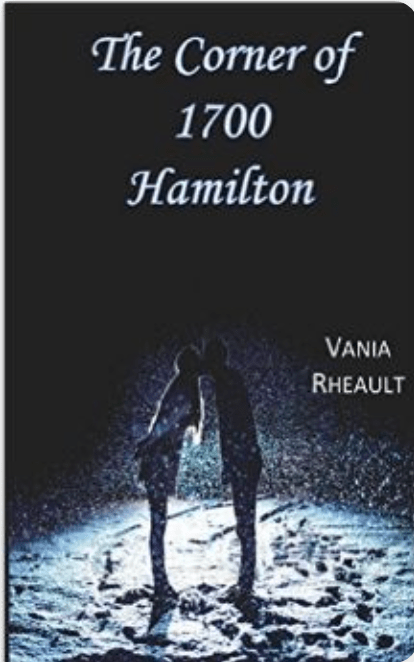
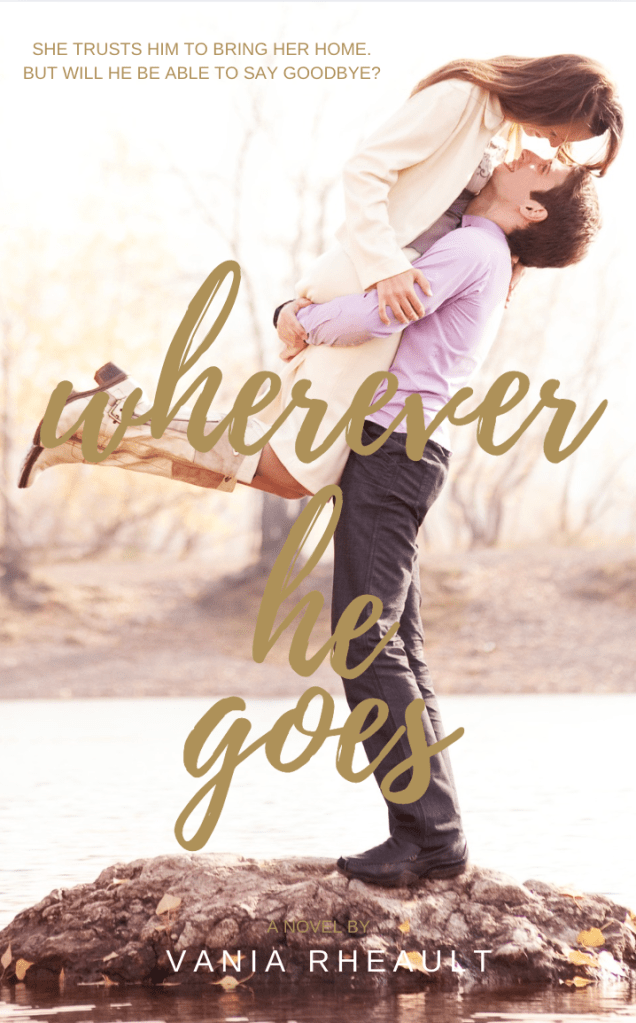
This isn’t a post just about ISBNs. You take risks making your own covers, especially if you don’t have the skill to create a cover that will tell readers what your genre is and won’t look homemade. Just the other day someone was bemoaning the fact he couldn’t get preorders for his book. I told him to look at his cover and maybe redo it, that it looked homemade. He actually was very nice about it, and maybe he will change it, I have no idea. That kind of consequence you may never see–you could not sell any books and blame it on lack of marketing or algorithms. Unless someone you believe and trust says your cover is garbage and you change it, you could go years without knowing what kind of damage your cover caused. I mean, you know I do my own covers, and back in the day they weren’t great. I still see the free stock photo I used on 1700 Hamilton other places, and I published that book eight years ago now. Canva templates taught me a lot, and I still like how this cover came out, the first for Wherever He Goes, even though I changed it to something sexier later that’s still the cover on the book now.

Not listening to your editor and having a book bomb after the fact can have dire consequences–a reader won’t give you another chance if they spent money on a book that had plot holes and grammatical errors every two sentences. And, you know, poor reviews last forever. I’ve been editing my own books for a while, and I know the risks, may have even suffered from some of them. God only knows who’s read my books and said they’d never read me again. I also know the risks of trusting people, and well, tired of that, so you have to choose the lesser of the two evils.

My biggest regret so far was not starting a newsletter sooner, and I wonder how far I’d be now if I had given as much attention to a newsletter as I have to this blog. Maybe because of the change in direction I decided on in 2020, it wouldn’t have mattered, or those people who signed up wouldn’t have cared either way.

After unpublishing some hardbacks and Large Print, I thought about unpublishing a couple of my first books, just because they aren’t the quality of the others, nor are they in the genre I decided to write in. Some say romance is romance, but my romantic speculative fiction could probably go, also my erotica that I decided I couldn’t write because there was just too much sex. (If you have to remind yourself to put in the sex scenes, erotica probably isn’t for you.) When you say you want to write and publish whatever, those consequences can catch up with you. Difficult to make a brand out of “whatever” and you may look back in five years at all the word salad you hoped people would buy.

The one thing all these have in common is that no one can tell you these things. I mean, yeah, the advice is out there, cover to market, hire an editor, start a newsletter, buy your ISBNs if you can. All that’s out there but it’s funny because we’ve turned being indie into defying the rules and maybe some rules are meant to be broken, but this is a business and whether we like it or not, there are best practices.

I almost didn’t write this blog post because I realize the subject is boring and repetitive, even if I’ve made similar mistakes. The bad advice out there can really take me aback, and that woman who had supporters telling people to price up their book left me speechless. What would readers think stumbling upon a book that cost $200.00? How is that author going to tell those readers she preferred to sell off her website? It all seemed so bizarre to me, yet people agreed, said they were going to try it. I don’t know, it just seems like one of those things that you could look back on later and say, “What was I thinking?” Of course, you can do that for just about anything, the cover that wasn’t right, blowing off your editor, not listening to someone who knew what they were talking about because you were determined to fail on your own. That’s how people learn, and I’ve had people tell me to hire an editor, but some things are easier said than done.

So this post is 1200 words of drivel (it’s almost Thanksgiving in the US so I’ll refer to it as turkey gravy), but honestly, my brain is fried. I’m halfway through editing my age-gap. I’m really loving the story and it’s fun to see how far my writing as come, but editing is tiring, probably more so than simply writing. I also have to proof my series proofs, and that will take a minute, but I’m hoping that I’ll get everything wrapped up by the end of the year. I want to start working on my first person stuff again, putting into practice the things I finally know that I didn’t before. I’ve come a long way working on my King’s Crossing series. Really, smoothing out over a half a million words taught me a lot, and I know it did because working on my Rocky Point series was really eye-opening. I agree that sometimes you have to fail on your own to learn, but you do have to keep working on your craft and level up on your own if you don’t want to take anyone’s advice.

That’s all I have for this week. I’ll probably post my Billionaire post next week. I think it’s still relevant, and tempers, while they haven’t cooled all the way down, aren’t so hot, at least, and even if it makes some readers crabby, I think it was wise to wait.

After that, well, it’s year-end stuff, and before you know it, it will be January. The world keeps spinning, no matter what kind of rut you’re in. Do your best to keep moving forward, and hopefully you’ll see more rewards than consequences.

Owning vs Renting: An Author’s Dilemma

Words: 1420
Time to read: 8 minutes

Is anything completely ours in this business? Maybe only our books.

Good morning! I hope you all had a good weekend! I worked more on my last book–getting ever so closer to finishing up. I’ll still have to take a break and read the proofs to look for typos I might have edited into my books, but the end is in sight, and I can’t wait! I might treat myself to a new Mac–my T is still driving me crazy, and it would be a nice little present for myself after working on this series for so long.

So, a week ago, on Monday, March 5th, Facebook, Instagram, Threads, and Messenger all went down. They were down for a couple of hours, but to say it spread panic across the author universe would be putting it mildly. I know a lot of authors happened to have releases that day, and I’m sure not being able to post was upsetting to a lot of people.

It was kind of eye-opening for me as well, because this was my first outage while on Threads instead of Twitter. Outages never bothered me because I was always able to flip from one platform to the other, but since Meta owns all of them, there was nowhere for me to go. A friend and I went to email for a quick exchange (just to assure each other we hadn’t been hacked), so all wasn’t completely lost, but not having any social media felt strange… scrolling is just habit. I finally was able to kick my Twitter addiction only because I found a substitute on Threads.

Anyway, so this gave way to some thought about how authors are always told never to build on someone else’s grass. I agree with that wholeheartedly–especially since TikTok gave me such a hard time, always accusing me of violating community guidelines. I’m glad I never got invested because it ticked me off and a ding on one of your videos like that affects your entire account and how they show your content.

But after my hassle with MailerLite, I realized that even a list you cultivate on your own doesn’t really belong to you. If your account, for whatever reason, goes down or glitches and you don’t regularly export your list as a backup, those emails you worked so hard for can disappear in a puff of smoke. Sometimes tech support can help, depending on your aggregator. MailerLite charges too much for their tech support and plenty of authors take their chances and stay on the free plan (that does not give you access to tech support) for as long as possible.

My WordPress site feels like it belongs to me. I pay for the domain and for the plan. I have access to tech support if something goes wrong (like when I accidentally deleted DNS records I needed), but the fact is, anything online can go down so even selling direct to avoid dealing with Amazon isn’t always a sure thing.

I guess this post is kind of a warning to pick and choose carefully. Last night I was thinking about all the author things I’m “stuck” with, and it’s kind of scary in a looking-into-the-future-and-adding-up-spend kind of way. Every single one of my books has a link to my author website and a call to action (CTA) to subscribe to my newsletter. Every single book. Over 20, which is over 60 files I would have to change if my author website ever went kaput (the ebooks and paperbacks on Amazon, and then all my paperbacks on IngramSpark). I mean, it wouldn’t be the end of the world to amend all that back matter, but if I didn’t have an IngramSpark code for free revisions, it would add up quickly. I was lucky I directed my readers to go to my website instead of a MailerLite landing signup page, probably one of the few things I did correctly from the start. My homebase, has been, and now with my newsletter gone, always will be, my author website.

Don’t get me wrong, I’m locked into other things too–things I want to keep at the very least because I like how they work. Like Bookfunnel. I may have gotten rid of my expensive plan that supported MailerLite integration after my migration to the new MailerLite platform screwed everything up (saving me 150 dollars a year), but I like how they deliver my free book and readers are used to that platform. The easter egg that I hid in Addicted to Her is delivered that way too. At least the team at Bookfunnel doesn’t seem to be going anywhere, and it helps that thousands, if not hundreds of thousands of authors, use them.

I’m also locked into my Canva account. I have so many designs there, and without it, I could never make changes to any of my book covers. I’ll always need my account, but luckily their business and reputation seem solid and hopefully won’t be disappearing anytime soon.

Maybe it will make you feel better to think that being locked into certain services isn’t only an author thing. I think Amazon is so integrated into our lives now that getting rid of it would cost–I have purchased several movies and TV shows on Prime. I would lose a lot of money if all of a sudden Prime Video disappeared. The same with my Kindle account. I’ve purchased many books that would disappear if something happened to my Kindle account. Several years ago I bought books on Nook, and when I dropped it into the tub, I lost all that content. I could have bought another Nook, but I preferred being on a Kindle anyway, so I swallowed the loss.

When you’re a baby author, as they like to say, you just don’t understand what you’re locking yourself into signing up for all these things. That would be the time to weigh what you’re willing to pay for, for pretty much all of your indie career. You get used to having access to those things and you tie up a lot of your IP into an account like Canva. But, when you’re new, you don’t know what you don’t know, and if you’re proud of your newsletter and start putting the landing page link everywhere, if something happens, you have no idea the damage control it takes to fix it.

I’m very fortunate that I linked to my website everywhere, and I’m very fortunate that I chose Bookfunnel as a way to distribute my reader magnet. I didn’t have to scramble to update any links–I don’t think I can portray in writing how relieved I was that I could just shut down my newsletter and not look back.

Building on someone else’s grass is definitely inconvenient at best (career damaging at worst), but sometimes you just can’t avoid it. We subscribe to products and services every day with the hope that those products and services have the longevity we need to keep our business afloat.

Only time will tell if the things we sign up for have staying power–in terms of the business itself and how we need to use them. I had thought MailerLite was a good fit and I recommended them several times, but they proved to be just as sketchy as any other business has the possibility to be, and some people just learn that the hard way. Lots of scammers in this business, and you’d like to think a steady business like that won’t turn, but like my daughter says, the risk is low but never zero.

I was lying in bed last night thinking about my blogs and how to make them seem more professional, if only on my author blog now, so it comes off as more newslettery and less bloggy, and I decided to create a “footer” of sorts for the ends of my posts. For eight years I’ve struggled with how to end my posts, and I’ve gone through various footers, like creating a graphic that has all my books on it and attaching my Amazon author page to it. This isn’t the right audience for that, but I would still like to end my blogs with some kind of signature so I came up with this. It’s especially important on my author blog now so no one misses the link to download their free book which I will add to every post.

Tell me what you think, and I hope you all have a great week!

Monday Misery and Giving Up (Kind Of)

woman wearing floral dress under water. text says: when nothing goes your way, you can feel like you're drowning

It seems whenever I manage to figure out one thing, something else pops up in its place–which is the definition of adulthood, I guess. I’ve been feeling better, so of course that means another areas of my life have to go to crap.

Ever since we had to authenticate our newsletters and align them with our websites, I have had nothing but problems. From actually taking down my website for twenty-four hours (thank God the WordPress chat was available!) to the newest disaster–broken links in my most recent newsletter I sent out on Friday, this has been one headache after the next. That SNAFU, broken links going to a scary error webpage–

webpage error message.  text reads, your connection is not private.  attackers might be trying to steal your information from vania.vaniamargene.com (for example, passwords, messages or credit cards) learn more.

–ended up resulting in me having to upgrade my MailerLite plan so I could contact their tech support. Because of the number of subscribers I have, that totaled a whopping 30 dollars a month, and honestly, I knew it wasn’t worth it. I had a 30% open rate, send once a month, and can’t pinpoint exact sales that have come from my newsletter.

So, I did what I tell you not to do–I made a choice based in frustration and anger and deleted my MailerLite account. I didn’t wait for the tech to get back to me, just exported my subscribers, deleted my account, and said screw it. It wasn’t completely spontaneous decision–I have a link in the back of all my books pointing them to my website where readers can sign up to my newsletter and download my free reader magnet. Luckily, the link was to my website and not a MailerLite landing page. I amended my website, said I would be blogging in place of a newsletter due to issues with my aggregator and that they can still download My Biggest Mistake. But instead of having to sign up for a newsletter to gain access, the Bookfunnel link is right there. Giving away a book like that with no strings is probably crazy, and after a while I may sell it, too. It won’t be in KU, but I can price it at .99 and have it pull double duty as a reader freebie and a book in my backlist if they want it that badly. I have choices, at least, but it will have to stay free on my website unless I want to update back matter for 20 books, and I actually do not want to do that.

I just was so tired of all this stuff–I’ve been dealing with the issues this authentication process has brought on since January, and honestly, I couldn’t take it anymore. The last straw was when I sent out that newsletter that had broken links in it. I can handle things going wrong on my end, but I do not want to look unprofessional or spammy to my subscribers. They trust me to keep their information safe, and that error message when they clicked on a link looked terrible. I never want to go through that again. I’ve been blogging on WordPress for eight years now, and nothing has ever happened like that before. All the links work, my site is secure, and I will never mess with the DNS records again.

If turning my “newsletter” into a blog loses me readers or subscribers, so be it. Dealing with MailerLite and the high monthly cost would have been very bad for my mental health long term. I don’t mind blogging, in fact, I love it, and content is content as far as I’m concerned. I was able to upload my MailerLite subscriber list to my author website and my subscribers will get an email when I blog. If they don’t want that, they can unsubscribe, though I’m not sure why they would. It really doesn’t matter where the content comes from.

A lot of them never opened my welcome email though, so that means they didn’t download My Biggest Mistake, and they can’t now unless they visit my website due to the links that probably won’t work even if they kept my newsletter emails. When I write my first blog post I’ll have to remind them to download it. I probably still will only blog for my readers once a month and that was another reason I was okay getting rid of MailerLite. I wasn’t using it very often and it makes sense to stay with a more cost effective alternative.

Of course, I’m like a lot of people and lying in bed at night will think about something humiliating and embarrassing that happened twenty years after the fact. This sting will stay with me for a long time, even though it was a MailerLite problem and not my fault. It helps I’m familiar with newsletter mixups. I’ve signed up for several, and usually once a month someone sends out a newsletter full of links and five seconds later there’s an amended newsletter sent out because the links were wrong, broken, or missing. My readers are probably used to that kind of thing too, but I was so grateful to anyone who gave me their email address that swallowing this humiliation is going to take some time. The only thing that I am happy with right now is how easy it was for me to turn my author website into a blog and that I had the wherewithal to export my list and add them to my website. I paid for a lot of those with FB ads and people signing up in the backs of my books. Those emails belong to me until they unsubscribe and they can do that if they wish. I’m not going to worry about where WordPress’s emails end up–if when I blog the updates end up in their promotions or spam. My site is safe, and I restored all the original DNS records. Maybe my updates won’t land in their inbox, but at this point, I just want to get back to writing and updating my readers when I have something fun to share and don’t care about the rest.

It was a costly lesson, energy and mental health wise, to learn some things just don’t matter as much as some people tell you it should. It was a relief to leave my newsletter groups–people are still talking and doing damage control regarding their own authentication nightmares, and I don’t need to see that anymore. I don’t need advice on what to share with my readers–I’m a writer and creating content is what I do.


I finished editing the 5th book in my series, and now I’m taking a break before I edit the last. I have a lot of admin stuff that doesn’t include newsletter clean up, such as getting my promo list I started a couple of years ago finished. I wanted a comprehensive list of promo sites that included how much it cost, if there was a minimum number of reviews required, that kind of thing. There are soooo many promo sites out there and one of my goals this year was to try the littler ones to expand my reach. I started up a Google Docs, and I’ll have to check over what I have and see if all the information is still accurate or if I need to update some entries. I also have a lot of screenshots on my phone of promo sites people have talked about in various groups and I want to add those as well. David Gaughran has a list that he updated last year, and you can see it here. https://davidgaughran.com/best-promo-sites-books/ I borrowed heavily from it, but there are a lot of promo sites that I picked up just scrolling around in my groups. Lee Hall also has one on his site, and you can look at it here: https://leehallwriter.com/2021/02/23/a-concise-list-of-book-promotion-sites/ I’ll finish it up this month and make it accessible for everyone.


I also would like to add a tab to this website for book covers that I make that don’t have anywhere to go. I like making them when I’m bored and don’t have anything to do, or if I see an author cover that sucks and I redo it just for fun. Sometimes I’ll do a cover for someone without them asking, and as you can imagine, that never turns out well, and they say thanks, but no thanks. I’d like to put them up, free of charge for authors who need something but don’t know what to do or just need a placeholder until they can afford something better. One of the prettiest covers I ever did was this one, but I’ll never use it because I don’t write women’s fiction.

promo graphic of a fake book called the forgotten bride.  a blurry woman, back to camera holding a bouquet of lilies.

Anyway, so I’ll do that when my series is all done and up for preorder. I have a lot of mockups in my Canva account, but I would have to download the stock photos and clean them up enough that I would only have to change the author names and titles. They wouldn’t be high-end by any means, but if an author is just starting out and sees a cover they could use, then it would worth it for me.


I think among that, getting my series finalized, and doing my promo list, I have enough going on. I need to shake off what happened to my newsletter. I’m not the first it’s happened to, and I won’t be the last. One of the last posts I saw before I left those groups is a poor woman who lost 800 subscribers because MailerLite got rid of the free classic accounts and her account and all her subscribers were purged. She was upset, to say the least, but MailerLite told everyone over and over again. It’s why I did the migration in December of last year, though that was just first of the headaches that started.

I think that is all I have for this week, but it’s enough. 2024 has started out with a bang, that’s for sure, and though this might be inviting trouble, I just don’t know what else could go wrong. And it’s really weird, I guess because I posted on a Thursday when my subscribers aren’t used to it, but I posted about author transparency last week and no one read it. So strange. If you want to read my goose egg post, you can look here.

Thanks, and have a good week, everyone!