Monday Author Update: Sweet Nothings.

Words: 1757
Time to read: 9 minutes

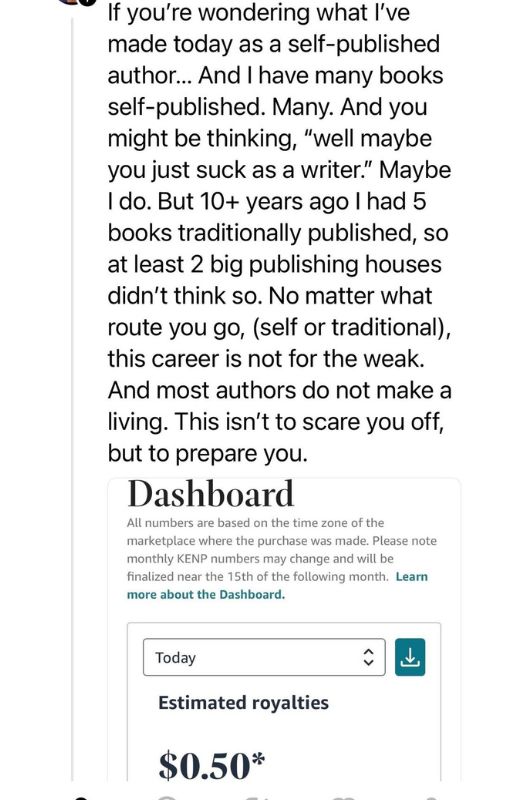
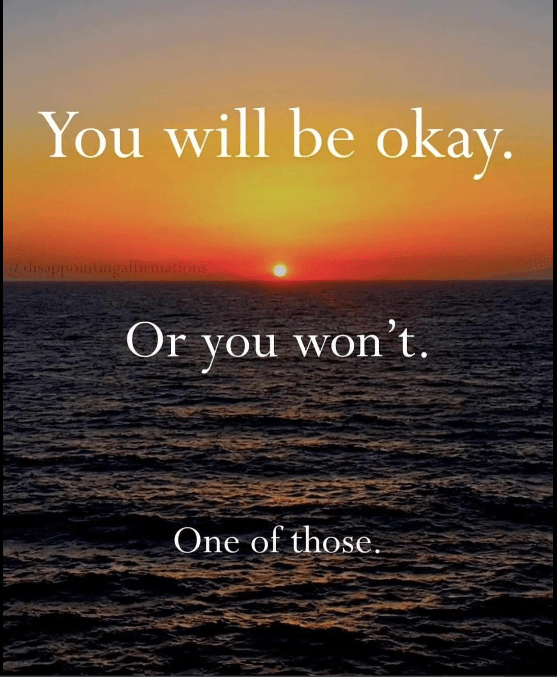
Happy Monday! Well, I hope it’s happy for you, but if you’re not a full-time author, by the time you read this, you’ve probably guzzled a gallon of coffee and you’re sitting behind your desk at work wondering why you haven’t won the lottery. I know, I’m such a downer, but that’s life. I was scrolling Facebook yesterday and bumped into this motivational piece of perfection….

I don’t know why stupid stuff like that makes me laugh, but it does.

Anyway, not much on my plate this week besides going to Rochester, MN on Tuesday for my Mayo Clinic visit that’s scheduled on Wednesday afternoon. I’m fortunate we’re having a mild winter and I don’t have to worry about blizzards. Over the past three years I’ve talked a lot about how icky I feel, and I’m trying not to get my hopes up. This is an old subject, so I won’t waste any more time on it. I’ll be sure to update you next week, though, and hopefully I’ll have some good news to share.

I’m proud of myself and I’ve been doing the prompts that I made up for the February social media content calendar I shared with you last week. I don’t mind talking about myself, but I was at a loss of how to do it. The prompts help, and I’ll schedule posts for when I’m gone. The Canva scheduler makes that easy and I post to my FB author page and to my IG page. The algos don’t know who I am so I don’t get many likes or comments, but if I can teach them to know who I am (again), maybe that will change and I can start building my following (again).

Here it is if you missed it last week. It’s never too late to start posting.

I’m more than halfway done editing book 4 in my series. It’s slow going, taking out all the whens, whiles, and withs and some becauses. I definitely took the easy way out when I wrote these, and I’m still layering in feelings, emotions, and descriptions into the scenes. This book isn’t too bad. I’ve only added 1,000 words so far and I have 4 chapters left. I won’t get it done before my trip, as rewriting takes a long time, but I’m hoping to get all of them done by the end of March. I still have to do covers, and I wish I could afford to source my stock from a site that wasn’t DepositPhotos. I don’t know if I’ll ever get there and right now, I’m at their mercy. I think I’ve got the template ready to go–the backgrounds and possibly the title font (though I’m always on the lookout for beautiful font duets). I’m keeping the series logo I made for the other covers. There’s nothing wrong with it. Will these be the books where I start chopping heads off? Stay tuned.

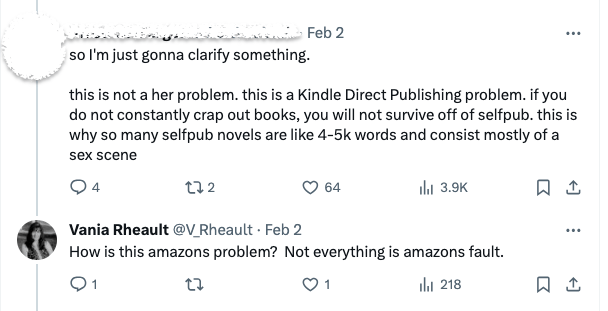
I’m thisclose to joining Threads. I vowed I wouldn’t add another platform to my social media, but I see teaser posts on IG and FB enticing me to join. I’ve exceeded my limits of clicking and reading without having a profile. It’s not because I want to promote my books–IG and my FB author pages are enough for that. No, the posts Zuck’s been teasing me with are what I’ve been missing since Twitter went to the way of X. I need a place for book news. Facebook and the author groups I’ve joined fill in a lot of that, but I had to leave 20booksto50k for ethical reasons, and I left the Self Publishing Formula group that’s hosted by Mark Dawson after all that plagiarizing stuff came out. Losing those two groups hasn’t been a big deal, but I’m seeing that BookThreads could be what I need to fill in the gap. Twitter hasn’t been the same, and I got treated to more BS the other day when someone was commenting on this article:

https://www.theverge.com/c/23194235/ai-fiction-writing-amazon-kindle-sudowrite-jasper

They talk about about authors using AI to get ahead, write faster, crank out more content. I’ve often referred to self-publishing as a hamster wheel, that little furry guy running faster and faster but not getting anywhere. The industry is full of books and when you release a book that sinks the second you hit Publish, it can feel like you do a lot of work for nothing.

I keep my mouth shut a lot of the time now. I’m not popular on Twitter, my views are not well-received, much like Joanna Penn who said in the article she had to step away because she’s an AI cheerleader and she got a lot of pushback for that. I am not an AI cheerleader, but I feel out of place all the same.

I really do just want to make one thing clear–I do not blame Amazon (KDP) for the grind self-publishing had turned it. I’m not denying at all that it’s common, COMMON, for authors to publish 4-6 books a year. And not novellas, either. Full-length books. It’s common. But it’s the KNOWLEDGE that it’s common that can eat at you. You know authors are doing something you can’t. I can’t publish four books a year. Not without writing them and saving them up. Writing, editing, cover design, proofing the proof, it all takes too long. Especially if you’re dealing with a series. Especially if you want to publish something that’s got some quality to it. It’s not easy writing a book full of twists. Half the reason I sat on my series for so long is that I have 540,000 words of an intricate plot that I needed desperately to make sure held together. Only time away could give me that clarity, and it has proven to be valuable so far.

The woman featured in the article turned to AI for help. She’s living off her book money and that in itself, I’m sure, is stressful. I’m at the point where I don’t think I’ll ever be able to quit my day job, and that’s okay, but trying to find time to write after working 40 hours a week is stressful in its own way. I’m not not blaming this woman for letting AI write part of her books, that’s her choice, but the WHY she did it I don’t agree with. She said her readers would drop her if they had to wait too long between books, and I think that is complete BS. Okay, maybe not complete because I do think you need to have consistency when publishing. Even if you train your readers to only expect one book a year. Publishing is the fastest moving sloth there is, and yeah, you’re going to have your work cut out for you if you’re writing a series and need five years between books. That’s why I write my series before I publish them. People binge now, and I just go with it. But rather than turn to Al for help, there are things you can do.

Keep your readers informed. Start a newsletter or post consistently on social media. If you let your readers know what you’re doing, what you’re working on, and when the next book will come out, they will wait for you. Build a connection with your readers. Care about them, and they will care about you.

Recommend other books. Listen, when I was reading that article, I felt her desperation, but in the end you are not going to be the only author a reader reads. It’s impossible. Romance whale readers can read a book a day. There’s no humanly possible way to keep up with that pace. Instead of being scared of being replaced, embrace the idea that books are a community and you are only a piece of it. Recommend other books–you should be reading them anyway–but that’s why it’s important to create a niche. On my V’s Vixens FB page, I post books that are free and in KU and pull quotes from books that are similar to mine. I’m building a readership of the kinds of books I write. If you’re all over the map, your readers won’t know what to read. They read YOU and want to read books that are similar to yours. Make it easy for them. Recommend books that you like so when your next book is ready to go they know exactly what they’ll be getting.

Relax, but not too much. I like rules, and if you’ve read my blog for a while, you know I do. Stick to one genre, know reader expectations. Cover your book to market. Learn an ad platform. But the one rule I have never ever agreed with is to write every day. For some people it’s not possible, and beating yourself up over it won’t make things better. If you can’t write, you can’t. Thinking is writing. Plotting is writing. Sorting through stock photos is, maybe not writing, but you get the idea. Don’t lose your joy, or like woman in the article, writing will be come work and not the good kind. She said after she started using AI for a prolonged time, she didn’t feel connected to her characters anymore, would lose the theme of her books. She didn’t wake up thinking about her characters, she didn’t go to bed and they were the lost thought in her mind before she drifted off. You know what? When characters claw at you from the inside out, that is the best part of writing. When your characters need their story told so badly they don’t let you go. I felt sorry for her when I read that. If you lose your joy, there’s not much to write for anymore.

I didn’t get into with that guy, though he spouted off a few more things about how evil KDP is and how there isn’t an alternative to publishing. Maybe KDP has the biggest slice of the pie, but they gave us the pie. I truly think Amazon gave us opportunities when we wouldn’t have had them otherwise.


That is all I have for this post. I hope you all have a wonderful week ahead, and if you have time, sign up for ProWritingAid’s Romance Week. I always sign up but never watch anything. I still have all the 20booksto50k videos from their November conference. Plus two of Alex Newton’s K-lytics reports. But if you’re interested here’s a non-affiliate link to sign up. https://prowritingaid.com/romance-week/sign-up

Until next time!

Monday Author Update: Newsletter/Email Guidelines

Words: 2148
Time to read: 11 minutes

Last week was not the greatest week I’ve ever had, but as they say, things could always be worse, and since things have smoothed out a little I’ll agree . . . for now. Let me get the “real” issues out of the way first and then I can tell you about a few personal things that haven’t exactly gone my way either.

Newsletter/Email Authentication and adding SPF and DKIM records
I’m subscribed to Holly Darling’s newsletter and she’s an expert in email marketing. I bought her MailerLite tutorial a couple of years go during a Black Friday sale. I haven’t gotten around to watching it *wincing* and with the migration I completed a few weeks ago maybe it won’t help me much now anyway, but it signed me up to her newsletter. In it, she outlined what you need to do to so Gmail and Yahoo will keep delivering your newsletter to your subscribers who use them as their email service provider. Luckily, she also has a blog, and you can read the article here:

https://pages.hollydarlinghq.com/posts/what-the-heck-is-a-dmarc-and-why-you-should-care-1

I knew changes were coming, but I didn’t realize they would be coming quite so soon. Most of these changes need to be completed by February 2024 (which is poor timing if you wanted to migrate to the new MailerLite because you also have to do that by the first of February), and I do not like waiting to do things until the last minute. That just begs for things to go wrong with no time to fix it–and I had plenty go wrong.

Way back when I started blogging, I let WordPress handle my hosting even though I was warned my site wouldn’t have all the bells and whistles that it could have if I found a different host. I didn’t want to mess with GoDaddy, Bluehost, GatorHost, SiteGround or anything else and didn’t need anything fancy. I didn’t start blogging to sell books–thank goodness too, because this blog does not sell books, and that’s fine. People who read this blog want to sell their own books, and I’m happy to help if I can. So, I was a little concerned when all this news started circulating that I was going to have to authenticate my newsletter account. I wasn’t sure if I even could with WordPress, but fortunately, the answer is yes.

I decided to start a newsletter last summer, no, was the summer of 2022 since 2023 is gone now. The first thing I did was pay for an email address linked to my website. Even back then people said not to use a regular email account, and I paid for a G-Suite account. You can email me at vania@vaniamargene.com if you want. I’ll get it eventually (my apologies to Debbie who wrote me some really nice things about A Heartache for Christmas that sat in my spam folder for two weeks). WordPress made that easy to do as well, and I pay $72 dollars a year for it. I looked up all my renewal notices and I pay $187.00 a year to WordPress for this site ($96 for the Explorer plan, $72 for the G-Suite account, and $19 for my domain name), and $66 dollars for my vmrheault.com author site ($48 for the personal plan and $18 for my domain name). It’s no wonder I’ve barely been breaking even doing this author thing. I pay WordPress a decent chunk of change, but websites are necessary and the email I set up to go with my newsletter is a must (and it will be for everyone after February 1). I thought I would have some trouble because I decided to write under a pen name, but I’m not hiding who I am and even give my first name in my welcome letter, so it’s not a big deal my newsletter shows they come from vaniamargene.com. I only set up a separate author website because my 1st person books are very different than my 3rd person books and I don’t promote the books I was writing under my full name . . . though I probably still should.

Anyway, long story not-so-short, I thought I was in for some trouble, but if you also host with WordPress because you were as confused as I was, don’t worry. I can show you were to go.

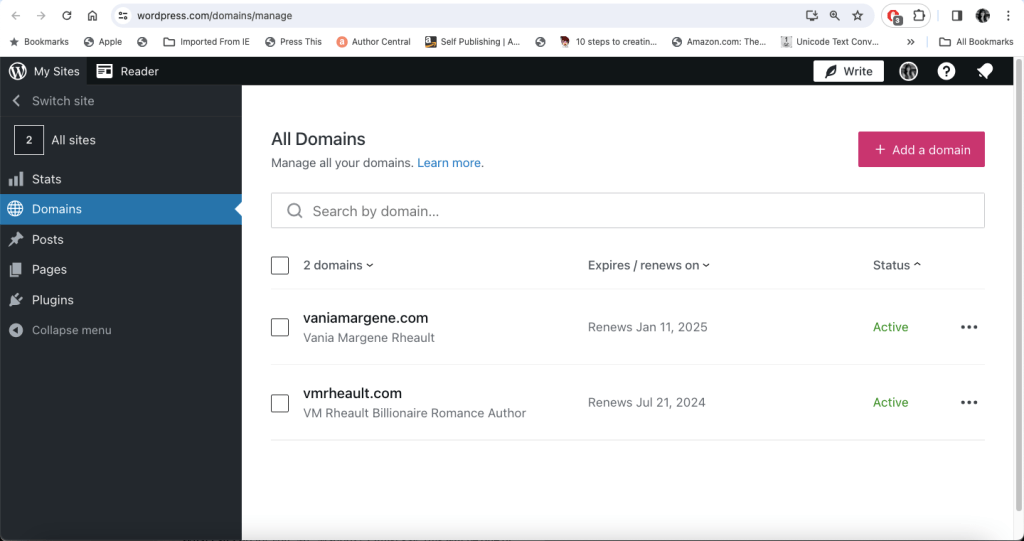
Click on your profile name:

You’ll get a new menu. Click on manage domains or it might say just one domain. I have two, as I just stated above.

Click on the one you want:

Scroll down to DNS records. Click it to make it expand then click Manage.

This is where you go to enter the information that your newsletter aggregator will give you. Click add a record and that opens up a new menu where you can chose the type and that will allow you to enter the name and value. I honestly don’t want to go any further than that to capture screenshots because when I was adding the information MailerLite was telling me to enter, I messed something up and took my whole site down for over 24 hours and didn’t even realize it. I was really lucky that WordPress’s chat was available and a Happiness Engineer knew exactly what I did wrong and helped me fix it in only 10 minutes, but I missed out on over 200 hits while it was down. I apologize to anyone who was trying to find the instructions on how to make a full book cover wrap in Canva (I know it’s all you guys love me for haha).

The good news is that DNS menu is going to look similar no matter where you host your website. The information your newsletter aggregator might be a bit different, but just copy it from them and paste it where it should go in your website’s DNS records.

Here is the MailerLite DNS tutorial.

Next you’ll want to add the DMARC, and what’s really cool is that DMARC is the same for everyone. I copied what Holly put into her domain and you can copy what I put in mine: TXT is the type, _dmarc is the name, and v-DMARC1: p=none; is the value. MailerLite also has a tutorial for this, but if you did the SPF and the DKIM, then this will be more of the same.

I didn’t do it the way they did, but what I did worked and I’m not going to go back and change it.

If you want to check your DMARC and see if you pass, you can use this free site: https://dmarcian.com/dmarc-inspector/

Holly goes through this in her video that she shares in her blog article, and she tells you how you can know if what you did worked by sending yourself a test newsletter email.

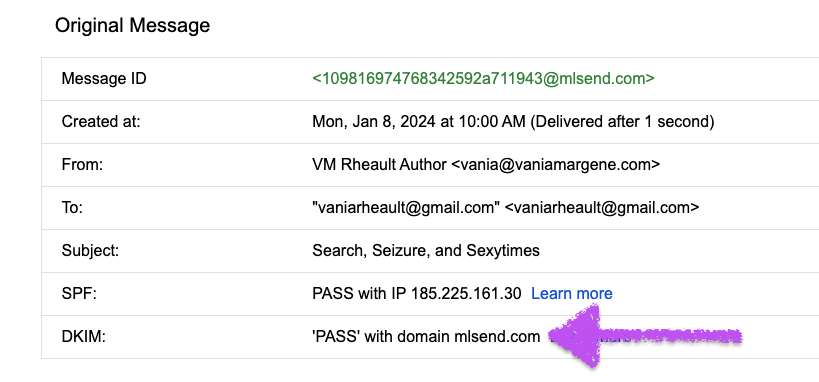
This is what my content looked like before I did the authentication and the DMARC:

What all this does is tell someone’s email platform where your email is coming from and you want it to say your website, not your newsletter aggregator.

My test email came to me all right and my website is back up and doing okay now. I won’t know 100% for sure if everything is fine until this blog post posts correctly, my next campaign is sent and opened, and February comes and goes and doesn’t cause any trouble.

It’s really difficult to stay in compliance with all of these things and I’ve seen authors who have just given up having a newsletter. I can understand that, especially after tallying up all the money I put into WordPress alone. I probably don’t need more than a personal package for this site but I upgraded when I thought I needed more. Saving $50.00 a year I guess isn’t that big of a deal, but I’ll consider it if I ever get to the point where I have to pay for MailerLite. So far I’m under 1,000 subscribers and likely will stay that way since my Bookfunnel integration went down the drain with the MailerLite migration to the new platform. Though, I’m saving money not running ads to my reader magnet anymore, and that money can go toward ads to the books I’m actually selling.

This wasn’t meant to be a detailed tutorial because there are so many different website hosts out there and so many newsletter aggregators too. I feel like everyone is scrambling to get this done and hosts and newsletter support are familiar with everyone’s troubles. Reach out to your support if you need to. I don’t send many emails but I want to stay in compliance so that the emails I do send are delivered properly.

If you run a newsletter and want to test the spammy-ness of it, this is a fun website. Send a test email to it and see what your score is. https://www.mail-tester.com/

Promos
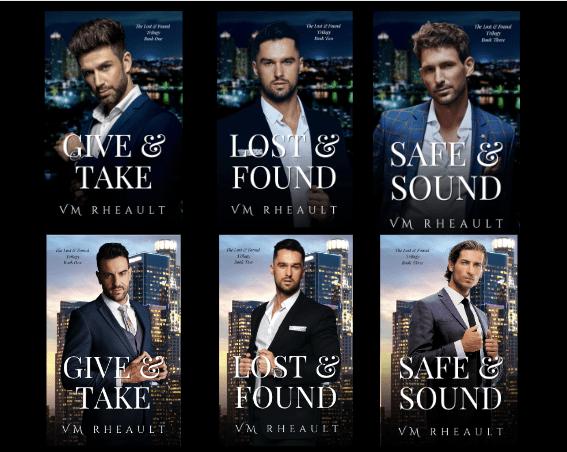
Because I downgraded my Bookfunnel account, I promptly spent the money on a BargainBooksy through Written Word Media. I’m advertising Give & Take, the first real promo I’ve done for that book and the trilogy since I redid the covers and edited the insides. I dropped the price of book one to .99 and I’ve been selling a few here and there. I’m running a Facebook ad to it, and I’ve sold 29 ebooks since the first of the year. I’ve also had 5907 page reads which equals out to about 15 books. Hopefully the BargainBooksy will kick that into gear and I can finally move my trilogy. It really is a shame I dropped the ball with the covers when I released them but I didn’t know the insides were so messy, so giving them an overhaul was the right choice. If you don’t remember what my covers were like before, here’s the comparison:

I’ll never get that first year back, but the insides weren’t my fault. I grew as a writer and spotted the flaws after the fact. That’s all you can really do, and as an indie, I have the freedom to fix the mistakes that were made. Now that I know what my tics are, I can write better books moving forward.

King’s Crossing Series Update
Not much new to report there. I’ve been distracted with newsletter changes and glitches, not feeling the best, and my son started a new job and I’ve taken on the role of unpaid taxi driver (he gets anxiety behind the wheel and doesn’t have his driver’s license). I’m working on Book 3, rewriting sentences, smoothing out scenes, adding words, deleting sentences. I think what I’ve learned in going back and redoing the trilogy and now this series is that taking time away from your WIP is very helpful. You can see more clearly what’s missing. I’m only on chapter eight of twenty-four, and I’ve already added 3k words. I’ll probably double that by the time I’m done. But it sounds richer, the scenes don’t sound as choppy. I’ve spent three years with these characters and I’m adding more emotional depth. This is slow going, but I’m pleased with how they’re sounding so far. I’m also playing with covers, but I’ll do a separate post about that later.

Personal Adventures
Last Monday I woke up to my back bumper ripped halfway off my car. I don’t know if someone hit it or tried to pull it off, but either way, they caused over 2k worth of damage. I just paid it off, literally, a month prior, so this was not the way I was hoping to celebrate. Luckily, I pay for full coverage and the car is drivable until I can get into the body shop and have it repaired. On top of the migration issues I was having then still not feeling all that great, I didn’t need this on my plate. Fortunately, I was able to get into the Mayo Clinic in Rochester, MN sooner than I thought, and I only have to wait three weeks to hopefully get some answers. My deductible would have paid for that trip, but it is what it is. Things happen. It could have been worse, and I’m thankful I can still at least drive it. My sister also experienced some car issues, and I had to pick her up and take her home after the tow truck towed her car to the dealership for engine trouble. 2024 hasn’t been kind, but I’m trying to keep my spirits up.

That’s all I have for this week, but at 2,100 words, I suppose that’s enough. I just hope that all I did for my newsletter compliance will suffice and that I don’t have to do anything else with my newsletter for a long time. My promo for Give & Take runs on Thursday, the 18th, and if you want to see what it looks like, you can subscribe to the BargainBooksy newsletter. They’ll drop you emails telling you what the bargain books are for the day.

I’m tired, and even a cup of coffee won’t fix it. 

Until next time!

Author Update…Happy December!

Words: 2164
Time to read: 11 minutes

There isn’t much going on in the land of indie these days…no controversial issue that I have to weigh in on. That’s a good thing, but it does leave me little to talk about every week. I used to listen to a weekly talk on Clubhouse about marketing romance books. It lasted for a bit, but the hosts took a summer off and never came back. Though I missed the Wednesday morning chats, I understood why. There are only so many things you can tell an author about marketing before you’re just repeating yourself because true marketing lies within the books you’re writing (tropes, reader expectation, and craft don’t get talked about nearly as much as they should) and how you package them. It’s something of a no-brainer to write to market, to cover to market, to make sure your blurb is clear and intriguing. You can’t give out many tips about that–and especially to those who don’t want to follow that advice. In relation to that little story that sounded as if it were going nowhere, there’s not much going on that I need to rehash but rather than not blog, I’ll give a quick recap of the past two months and what I’m going to be doing for the month of December.


I’m done with TikTok. I enjoyed it while I was on it, got into the groove of making videos on Canva without it taking all day, and thought maybe I could actually turn it into a marketing tool like so many other authors have. But like with most things, a few bad apples spoiled the barrel, and my innocent videos kept getting take down because they were supposedly violating community guidelines (and like KDP/Amazon Ads, they won’t tell you what you did so you can avoid doing it again). When I blame bad apples, I’m blaming the dark romance authors who used it to post explicit content. And I don’t even really blame them for that–marketing on TikTok is a goldmine if you can get it to work–it’s that TikTok doesn’t want that kind of thing on their platform and dark romance authors had to find new ways to outsmart the bots that would take those videos down. Now words like “hurt” and “death” and “die” and a long list of other words (a lot having to do with sex like “come”) will get your video pulled, and sometimes not even pulled. They won’t let you post it at all, which is what happened to my last video… I used the word “hurt” in a way that I didn’t think warranted that kind of consequence. There are so many dirty snippets that authors can still get away with posting, I just gave up. I don’t like dealing with the unfairness of it all, and you can call me a whiner because we all know life isn’t fair, that’s okay, but one of my biggest pet peeves is when people are not treated equally. I don’t like the way they arbitrarily enforce their guidelines and I’m not going to put up with it anymore. My books are angsty, not dark or dirty, and when I see other snippets getting away with it when mine don’t, it’s frustrating and I’m not going to play that game. Maybe the occasional blocked video wouldn’t bother me but when that happens, your whole account is suppressed and other videos aren’t shown as often as they normally would, and I don’t have time for it. I still have my profile up, and maybe I’ll still scroll now and then because I was finding books I wanted to read (yeah, because of the dirty snippets) but I’m done posting videos. My last appeal took over a week to go through and I’ll try finding other ways to market my books.

I started reading the first book in my series to get them ready to be published. I did a good job on the last editing sweep I did, and four chapters in, I’m not finding too much too fix. If I can easily edit out a “when” or a “while” or take out an “as” phrase (she did this as he did this) I do it, but I am keeping in mind I don’t want them to sound too edited, and if the words flow well, I leave them be. I want to say I want to be done reading this book by the end of December, but I need to be done a lot sooner than that if I want to start publishing by March. In the weird way that I am, I need to have them all done and ready and final files uploaded to KDP to put them on preorder. It’s just the way I am and I’ve stopped trying to fight it, but it will free up brain space to move on and work on something else.

I have an author interview set up for later this month, and I’m looking forward to posting that. I’ve been having a difficult time finding people who are a) actively writing and publishing and have something to share, and b) willing to give me their time, which is why I don’t think I’ve had a guest post or author interview since last spring when I had my hysterectomy and scheduled almost two months of guest posts to cover my time recovering. Guests posts and author interviews aren’t a staple of this blog, but I like offering other viewpoints and experiences. I believe we all have something to share and learn from each other.

You guys know I use ads and lately I’ve been using FB ads more than ever before. I’m starting to dislike sharing sales numbers (just this morning I saw a thread on Twitter asking people what their earnings were last month), but I also want to prove that my FB ads are working and that I’m earning more than I’m spending. That puts me in a tough spot because how else am I supposed to prove to you that I’m selling books if I can’t be transparent? I realize what a conundrum that is, but let me pull the numbers and see what I can do.

October had the best sales month I’ve had selling this pen name, but I can’t say for sure overall. I’m not going back to my 3rd person books because that would be time consuming and irrelevant anyway since I wasn’t playing with FB ads then. I didn’t quite make 4 figures, October coming in at $735.20. Those were primarily my rockstars, and that’s mostly because I was running the most ads to those books. But they’re selling because the covers and titles are good and the blurbs are strong. I don’t care how fancy your ad is or if you have the hookiest hook…you’re not gonna sell if your cover doesn’t look good and match your genre and if your blurb isn’t strong. I told you about my read-through for my trilogy last week, so I know all the books are getting read. I sold some of my other books too, but my trilogy makes up the lion’s share of that figure. For ad spend, I spent $77.52 on Amazon ads, which is a little more per month than I’m used to spending, but I have an auto ad for Rescue Me that goes gangbusters every month. My sales aren’t gangbusters for that book, but I let the ad go because it brings awareness to my name and the books I have, and the clicks aren’t that expensive. For Facebook ads, I spent $87.00 for one ad and $8.77 for a different ad, and that brings my royalties for the month to $561.91. I don’t think anyone would complain about that. (Unless you’re a 5- 6- or 7-figure author. Then you’d probably die. Haha!)

November was almost the same. Before ad spend I had royalties of $593.45, which was a bit lower, but I think I also slacked on keeping my FB ads running. I schedule them for 2-week blocks, but really if I’m getting low cost per click and people are liking and engaging with the ad, I should just let it go and check in periodically instead of having to remember to extend the end date. Anyway, so with how Facebook bills out, I paid the same amount–$87.00. I didn’t boost a post, so I didn’t have the $8.77 I spend last month as I did in October. I also didn’t spend as much on Amazon ads, that total coming in at $41.09. After those two ad spends, I brought in $465.36 in royalties, which I am not going to argue about. I think most of that is my rockstars too, but now that my other trilogy is edited and re-covered, after Christmas I’ll start running ads to them too. I think with the number of books I have out, if I ran my FB ads properly, I could hopefully make $1,000/month. The steady income would take some pressure off but I would have to make double that for any real impact to be made. (For example, if I did make a steady 2k a month, I could drop down to part-time at my job and write more.) Perhaps after my series is out I’ll have a chance of doing that. I’ll have 17 books published under my initials–that has to move the needle, you’d think.

Anyway, so I’m not screenshotting my dashboard–you’ll have to take my at my word that’s what my royalties are, but there’s no reason to lie. If I wanted to lie, I would tell you my numbers were a lot better than that. Haha.

I finally migrated from the old MailerLite to the new one, and it doesn’t look much different. It wasn’t too difficult though it took a few minutes for the signup link on my author website to click in and I tried to sign up a few times before it worked. Linking my Bookfunnel account and migration to MailerLite was a bit trickier, but all I had to do there was generate a new API code and replace it with the old one on my landing page settings for my reader magnet. After I figured that out, it was okay. Luckily, and surprisingly, I remembered how I set it up last time, and I didn’t need to ask for any help. My signups and landing pages are very barebones and I only send one welcome email so my welcome sequence is very short. I haven’t segmented any of my subscribers, and it seems all my subscribers migrated over, but I saved them all first before I did anything. I haven’t sent out a newsletter since I did that so we’ll see how that goes. As far as I know, no one has signed up to my newsletter either, but I’m hoping with all the tests I ran everything works out.

I may not be completely taking time off from my books, but I did make time to read a book I found on TikTok–200 pages of pretty much just sex. Not that I minded, as I said above, the sexy snippets are what helps me find the books in the first place, but what you see, at least with that particular book, is what you get. There was no character development, hardly any backstory for either character. They didn’t even tell each other I love you, which was a real let down after all that…physical connecting. They didn’t break up and get back together, which is my favorite part of a romance book. So, I plowed through it in just a couple of hours, but it’s nothing I could ever write. I need more substance to my books, need my characters to grow and change and realize without a shadow of a doubt, if they lost the other person, their lives would never be the same. I need tender moments in the dark and gut-wrenching, down-on-his-knees proposals. To me, that’s what makes a romance novel. But there are many different types of books and many different types of authors and of course, many different types of readers. We all will find our audience, and that’s okay. I gave her .95 in KU page reads and I read something that wasn’t mine. We both win.


Later in the month I’ll do my year-end summary. It’s too early to do that now–there are still four weeks left of the year I’m not going to brush aside. Looking ahead too far means you miss what’s right in front of you, and there are still good things to come with the remaining weeks of 2023.

How are you going to spend the rest of the year? Any big projects you’re going to wrap up? If you won NaNoWriMo last month, congratulations! I will talk to you all next week. 🙂

Until next time!

Brief Author Update and KDP Changes

Words: 2543
Time to read: 13 minutes

I haven’t been doing much except re-editing my Lost & Found trilogy and redoing the covers. I said in a previous blogpost that book one didn’t have the problems books two and three had, but I was mistaken. I went back and edited it more thoroughly which took time, and then I read all three of them again just to make sure I didn’t edit in any typos. My proofs come today, but I’m not reading them–okay I might spot-check them, but that’s all–I’ll page through them to look for formatting errors and make sure the back matter is how I want it, and then I need to move on. They are going to be as good as they’re going to be and I’ll have to be happy with that. I’m pleased with cover changes, and I hope that it will bump up sales. I haven’t been pushing them because I didn’t like the covers, but now I can promote them with confidence. I’ve said I don’t have imposter syndrome, but maybe I do. I’ve never been fully confident thinking my books are any good to read, but my trilogy is good, and I remembered that editing them. It’s a good story arch, and I want people to read them.

Just because I like the story, I’m reading my duet over again. Not with the express desire to edit them, though I am making changes and editing out the “when” sentence structure if I come across it. I also like “because” and with a quick sentence rewrite, I can usually edit it out. These aren’t bad–I hadn’t fallen into a writing tic while I was writing these, and I’m reading more for pleasure than to edit them. After those are done, I have a lot of admin stuff to do, and I’ll spend most, if not all of my free time in in the second half of November and all of December getting them done:

*Changing from the MailerLite Classic to the updated and newer version of MailerLite. We need to do that by February and I’ve heard stories ranging from it’s super simple to horror stories of lost email addresses. There’s a tutorial somewhere, so I need to watch it. Luckily, I don’t have anything complicated there, just one landing page and one welcome email that is sent to everyone regardless of how the sign up. It should be cut and dried, if not, dare I say, easy, but we’ll see. I’m going to set aside a whole day for it because I don’t want to stress myself out. This is a good time to redo my welcome email anyway, make it prettier, but I think I’ll have to redo the integration I have set up with Bookfunnel. I have 771 subscribers right now. I’m not running an FB ad to my freebie at the moment, so the past few subscribers I’ve managed to gain have been through the back matter of my books only. I’ll send an email letting my subscribers know that my Christmas novel is live, then I won’t send one out until I’ve moved my account over. That’s the top item on my to-do list for now.

*Publish my rockstar trilogy to IngramSpark. I always let a couple of months go by between publishing on KDP and publishing on IngramSpark. I’ve heard it’s good to let them settle, and it’s what I’ve always done. I’ve never had an issue publishing to IS after KDP, so I’ll keep doing it that way. The interiors are the same, but I’ll have to tweak the covers. IS uses different paper and the spines are thinner, which means I usually have to adjust the font to avoid it lapping over to the front or back covers. I can’t do that until my trilogy is done and published with new covers. I want to put the Lost & Found covers back there pushing readers who like trilogies to buy my other one. This is a back matter page of Safe & Sound telling readers I have my rockstars available:

I made the graphic in Canva. One of the best things you can do is use your back matter wisely! I do the same things with all three of my standalones–if you like this standalone, I have another available, and you can find it here.

*Make hardcovers for the rest of my books. I offer hardcovers of my Cedar Hill Duet and Rescue Me. That was all the further I got with my hardcovers, but now that my books will be 100% finished, I can make hardcovers of the rest. I’ve never sold a hardcover (only a handful of Large Print I can’t offer anymore because KDP blocks them as duplicate content) but I like how the buy-page shows more than one buying option and it shows readers that I’ve invested in my book to make other versions available.

*Try to enjoy the downtime and the holidays. That list will take me more than a few days, and while I’m not writing, I’m going to try to enjoy the holidays. I have a tooth that’s going to need to come out soon (I have PTSD from a root canal gone bad and I will never subject myself to another one) but I’m going out of town from November 15-18th and I would like to have it done after I come back. There’s no good time to have an extraction, and my November is busier than it’s ever been, but having an achy tooth in my mouth ups my anxiety, and I would like it out the sooner the better.

*Plan my next books. I’m thinking of another duet, but bigger ones, 150k per book or so. I want to incorporate the underground king concept I blogged about here, with the kidnapping/psychic element that’s been knocking around in my head. To write these as well as I want, I’m going to need to read some dark mafia books. I want these dark too, but not in the sex kind of way, well, not only the sex kind of way. Drugs, crime. Violence. The vibe I was looking for when I wrote All of Nothing. I don’t have a plot yet, and I still have to put my series up, but it’s never to late to plan.

*Try to enjoy walking more. I have a lot of negative feelings associated with going for walks, and I’m trying to sever those ties. When my ex-fiancé and I would talk, I would go outside for privacy. As our relationship deteriorated, I didn’t go outside just for privacy, I would go outside because we were fighting and I needed to walk off the nervous energy (and the fear but let’s not get into that). Walking now brings back a lot of those memories and feelings. We’ve been split up for a long time, and I’m used to him not being in my life anymore. Our five years together were more tumultuous than happy and splitting up was better for both of us. Still, those feelings are still there, and I need to push them aside to enjoy walking again. I also walked to get air at the beginning of the pandemic to try to quell my anxiety. I wasn’t anxious because of COVID though I know many were. I was anxious because unbeknownst to me at the time, I picked up a box of Snuggle dryer sheets, and they were wreaking havoc on my girlie parts (more specifically, they gave me bacterial vaginosis). Three years later, I’m still having issues my gynecologist doesn’t seem to understand, and now walking brings back those feelings too–of sucking air into my lungs, trying to calm down because while those dryer sheets were screwing up my body, they were also screwing up my mind. I’m still dealing with the side effects of that unfortunate purchase, but at least I know the cause of my health issues. There’s nothing keeping me from going for a walk and enjoying what that time outdoors used to mean to me–plotting my next book, listening to music, listening to publishing podcasts, and enjoying the health benefits that come with moving your body. I’m already doing better for myself recognizing those ties, I just need to do better with making time to do something about it.


I should probably make this a different blog post, especially since I don’t know if I’ll have time to post anything next week, but I wanted to chat about some of the new features KDP has been rolling out.

The first one is KDP will allow you to schedule when your paperback goes live. This isn’t the golden ticket people think it is though. While it’s nice you can schedule a release date, that doesn’t mean it’s on preorder. The only way you can schedule a preorder of a paperback is to publish it through IngramSpark, and I really discourage you from using IS to fulfill Amazon orders. You’ll end up with a bunch of problems, that, unfortunately, will be difficult to fix with the way I’ve heard IS’s customer service is since the pandemic and Robin Cutler’s exit. I’ve also heard that you need to have your files available before you choose a date (this was in an FB group and I have no idea if it’s true or if placeholder files can be used), but that actually makes sense, because the only nice thing I can see about pre-scheduling is that you can order author copies before your book goes live, and they won’t have the ugly stripe over the front. Paperbacks aren’t a big consideration when it comes to my books–most of my sales come from KU. I like to offer paperbacks, and Vellum makes it easy to format them and make them pretty. Lots of people were excited about this new development, but they still need the 72 hours to review your book and you can’t order author copies until your book has passed that review. As far as I can see, nothing much has changed there, except you can schedule and check it off your launch list.

For more information about using IS with KDP, look here: https://www.authorimprints.com/ingramspark-pre-order-amazon-kdp/#:~:text=Pre%2Dorders%20are%20accumulated%20in,or%20before%20the%20publication%20date.

The other thing KDP is playing with now is opening up audiobook creation using AI. So far, it’s by invitation only and in the beta stages. Beta in KDP language can take years (look a how long the new reports were in beta and how long the old reports hung around) and how long it will take to open to all of us (or at all) will be something to keep an eye on.

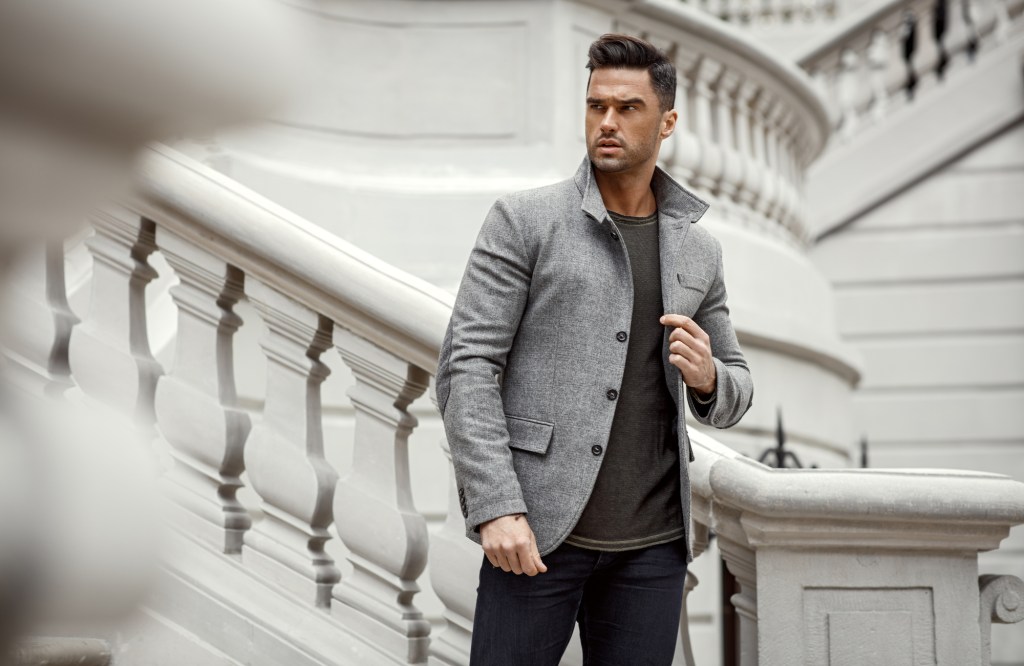
Of course this caused an uproar in the writing and author communities. Some are really against AI anything, and some totally embrace whatever AI has to offer. I like to be in the middle–there are good and bad aspects of it, and I think if you totally brush it aside because of the bad, you can miss out on the good. I don’t like using AI art for covers, and it’s becoming prevalent with romance authors because hot men who haven’t been used to death are becoming harder and harder to find–especially for authors on a budget who can’t afford to look beyond DepositPhotos. The only problem is, I can spot these a mile a way and all the covers that use AI to generate a man standing in a suit with a blurry background behind him are starting to look the same. No matter how long or how hard I have to dig, I will always buy stock. I believe in paying the photographer and I believe in paying the model. I don’t think creating an audiobook is entirely in the same category as using art. AI in this regard, I believe, is just technology moving forward. There is already text-to-voice options on devices, and using AI in this way is just opening up accessibility for readers who want to listen to the books they consume and for authors who can’t afford to pay a narrator. I don’t like gatekeeping and telling someone they shouldn’t create an audiobook because they can’t afford it is in its own way. There could be drawbacks to using text-to-voice, and we won’t know what those are until authors start reporting back. There needs to be way to correct the voice if it pronounces something incorrectly. The voice has to sound natural, but those voices are getting better day by day. On the author side, you have to take the time to listen and edit if that option is available. You can’t just upload your book, let AI spit out an audio version and put it up. There was one woman on Twitter who was using AI to translate her books into German, but she wasn’t using someone who knew German to double-check the translation. That’s irresponsible and scary. God only knows what it was coming up with. The last thing I want is to be a laughingstock in Germany. Good luck to her, I guess.

When it becomes available, I’ll give it a try. Apple already has given its authors a chance to create audiobooks with AI, (and people were excited about that, so I don’t know why KDP is getting flack) so it will be interesting to see how this goes. Just because I try it doesn’t mean I’ll publish with it. I might not like the voice choices, or because I write dual first person POV, I may not be able to publish using a female voice for the female POV and a male voice for the male POV. I’m definitely not going to shun something before I can even experiment with it. Ethics aside, you have to think of what you want for your business. I don’t listen to audiobooks–my mind drifts too much for me to concentrate–but I’m hearing now that listening to an audiobook is experience. It’s doubtful something that KDP offers will compete, but it’s nice to have to the option.


That’s about all I have for this week. I’ll be out of town November 15-18th. We’re driving down to the Twin Cities and we’ll be going to Mall of America, looking at a few museums, and going to the zoo if the weather permits us to be outside. I may take a pass at blogging or just put up a quick post I’ll write Sunday. Things won’t be calming down much after that either–we have The Ballad of Songbirds and Snakes to watch that following Tuesday, then Thanksgiving. We’ll be at the end of the month after that, and I have my birthday to celebrate. We’re going to Napoleon and out for a fancy dinner so I’m really looking forward to that. All in all a very busy month and I think I’m going to sleep all of December.

For my last piece of news, A Heartache for Christmas is available right now–it went live today! The reviews have been coming in through Booksprout, and readers are really touched by the story (and I am really really in love with the cover!). You can find it here: https://www.amazon.com/Heartache-Christmas-VM-Rheault-ebook/dp/B0CM2BLRPF/

Enjoy your week, everyone!

The Secret to Leveling Up?

Words: 1291
Time to read: 7 minutes

Like any author publishing today, be it indie or trad, I’m always looking for ways to level up. Take your career to the next level. We hear a lot of advice, some I’ve repeated here: learn an ad platform, network with authors in your genre for promo opportunities and newsletter swaps, write and publish a lot, that kind of thing. It can be frustrating when you think you’re doing everything right, and the success you’re hoping for is still out of reach.

I can personally attest to how frustrating that is, to the point where I think that maybe this whole writing career thing isn’t meant to be, and it will always be considered a hobby by the people in my life and the IRS.

I read some advice about leveling and it was enlightening as well as confusing. She said, and this is an author who makes six to seven figures a year, to focus on writing the next best book you can.

It made me a bit crabby (no offense to the advice-giver because I love her and she does a lot for the indie community), because when you’re writing a book you intend to publish, you’re always thinking it’s going to be your best book ever. Back when I wrote All of Nothing, I thought it was an 85k word masterpiece. (Little did I know it would take several edits after initial publication for me to be happy with it, and one that I actually did not long ago.)

This is akin to the question, how do you know what you don’t know? But, if your books aren’t selling, and you’ve tried ads and newsletter swaps and you’ve bought a Freebooksy promo that didn’t move books, there is unfortunately, room for improvement.

Craft is difficult to tackle mostly because it takes so long to make any kind of positive progress–depending on how you already write, it could take months or even years and hundreds of thousands of words. You have to write a lot to get better at it, and not only do you have to write a lot, you need constant feedback on that writing so you know what’s working and what’s not. How do you level up your craft?

*Join a critique group or work with an alpha reader who reads as you write.

*Get lets of beta reader feedback. And find people who are honest. If your characters are flat, you want, and need, to know about it.

*Read the kinds of books you want to write. One of the very first “complicated” series I read when I was thinking of writing my own books was a romantic suspense series by Lisa Marie Rice. She’s since expanded on those books, but the four I read have stuck with me for years. In fact, I want to read them again just to see if they are as good as I remember.

https://www.amazon.com/dp/B087CN1LNB?

*Just swallow it and admit series sell and read-through is what will make you money. I love writing standalones, I do. The Christmas novel I just finished is a standalone and I fixed it so I couldn’t write any sequels from it. But the fact is, series sell because readers love reading them. But, from a writer’s standpoint, they’re difficult and stressful. They take planning, something a lot of pantsers aren’t willing to do too much of, but you need to have some details fit together from every book. If you’re a new writer, that’s hard to do. There’s a lot of details to remember, breadcrumbs to drop. You can start “small” and write a duet, then as you get more experienced, add books.

Writing a book, and a good one, is a group effort until you can get the hang of it. But what if you already think you have? When I read that advice, it didn’t know what to think. I feel like my writing is pretty good, I get positive feedback from reviews, readers reach out to me to say how much they enjoy my books. I have the skills, ability, (talent?) to write a long series–my six books I have coming out next year–and the beta feedback I’ve already received–is proof of that. So, I mean, what can you do if you think your work is already there?

If I had an answer, I’d probably be a six-figure author myself. You can study the market and see if what you’re writing is not hitting the target. Romantic suspense, psychological and domestic thrillers, and several other genres and subgenres will always be popular, but if you’re writing something mainstream and still not selling, maybe you aren’t including enough to meet reader expectations. Maybe your mystery plot isn’t twisty enough, or your characters are flat–meaning their backstories are bland and you haven’t given them enough to fight through.

Be that as it may, you can write the most perfect book in the world, and no one will be able to read it if no one knows it exists. There is the idea of word of mouth, and that does work if your book blows people away. It’s not like you can ask every reader who reads your book to spread it around like an STD, they have to want to do it, be passionate enough about your book to do it. If a booktoker doesn’t get a hold of it though, you’ll have to run ads or buy a newsletter promo spot. Those don’t work unless your cover is good, so part of leveling up may be refreshing book covers or doing better than you have in the past.

It helps to have a hook too, something I didn’t have with my first billionaire trilogy. I have decided for their book birthdays in January that I’m going to redo their covers and come up with better hooks for ad copy. Obviously, doing what I should have done a year after the fact was part of that commenter’s point. You lose a lot of time and opportunity if you don’t do what you should have done at the start. Still though, you can get some marketing juice from a relaunch–especially if you actually make improvements and the changes you make aren’t lateral moves. Maybe that means hiring someone like GetCovers to redo them, or learning new techniques on your own. Maybe that means letting go of what you want and putting a cover on your book that will sell.

As for me, we’ll see what my series does next year. I’m rethinking the covers since I made them last year and my tastes have changed. I also need to read through them one more time and make sure the writing is there. My beta/proofer found a few things, too, so I’m glad I sat on these books and waited to publish. Before I do that, though, I need to get my Christmas novel ready to go, finalize the cover (I changed the man again) write the blurb, listen to my manuscript, and get the paperback proof to my beta/proofer. Then the new covers for the trilogy, and then my series. I’m already thinking of what I’m going to write next while those release, six books at two months apart will give me all of 2024 to write something else.

Anyway, leveling up can take different forms, but there is always room for improvement. If people have read you and are willing to give you feedback, take their advice to heart. It’s okay to listen and realize that what you thought was good isn’t. It’s what you do with that and were you go from there that will help you really level up.

Have a good week, everyone!

Ethics in Indie Publishing

photo taken from Canva

Independent publishing has opened up a whole new world for scammers who want to make a quick buck, and we all know those kinds of people don’t have morals or scruples. But we don’t hear a lot about ethical behavior of the “kind of” innocent kind, at least not until recently with the rise of AI. I have a lot of opinions on AI, many I keep to myself because for the most part, it’s none of my business what other people do. I’m not going to take part in the witch hunts I see happening online, authors guilty until proven innocent. People can make mistakes, can be misled, or, can actually make the choice to use AI for whatever reason, and I’m not interested in being judge and jury for those people. I’m too busy with my own stuff going on, and honestly, unethical behavior happens everywhere, every day. You can’t take it all on (and for the sake of your mental health, why would you want to?).

I have spoken out about some of it, though, beta readers who take your money to beta read but actually don’t put in the work, “cover designers” selling Canva templates and calling them their own designs, editors who are paid to edit, when they shouldn’t be anywhere near a red pen. I don’t like when I hear about people getting ripped off, mainly because I don’t believe in paying people to do something you can do yourself. You can create your own cover using a Canva template for free–there’s no need to pay someone 50 to 100 dollars. You can do the bulk of your editing for free too, if you take the time to listen to your manuscript before sending it off, and there are a free resources for formatting, Draft2Digital and Reedsy to name two off the top of my head.

Like almost everyone in the indie space, I’ve been a victim of some unethical behavior, and I have been for as long as I’ve published. Editors who sit on manuscripts for months and then when they finally get to your work, they don’t give you the experience (*cough* time and effort *cough*) you gave them money for. They say you get what you pay for, but that’s not necessarily true–some people don’t actually know they shouldn’t be charging for the services they are. They don’t know they’re poor editors, they don’t know it’s an ethical grey area to sell Canva templates. Once on Twitter I saw a freelance editor bragging about some kind of award ProWritingAid gave her, and I was dumbfounded. I knew she was putting her clients’ manuscripts through it. Perhaps that’s part of her “editing process” but her clients are paying for that–it’s definitely nothing she should have been admitting in public. After seeing that, I never would have hired her for anything. I can run my own manuscripts through PWA if I wanted to use it (the Hemingway Editor is a free version of this). I don’t need to pay for someone else to do it.

The question, I guess, is how do you know what you don’t know? You have to be honest with yourself for one thing. A “cover designer” I called out starting her business selling Canva templates said she liked “simple designs.” No. She just admitted she has no skills. If you’re an author and you can’t edit your own books, you shouldn’t think you can edit for other people and get paid for it. If you don’t have time or the inclination to beta read, don’t offer or don’t accept a job. Honesty and integrity begin with yourself and it will extend to your clients. If you need the money that badly, get a second job. Ripping people off, no matter how unintentionally, is still ripping people off.

On the author side, is it ethical to use AI? I’m not going to poke that bear. I think in some instances it is okay to use AI. I chat with Al, brainstorm with him, and it’s fun to bounce ideas off him when I’m stuck with a plot issue or need sparks for ad copy. I don’t feel it’s any different than searching for a plot generator and sorting through the prompts, or making a huge list of tropes and pulling one out of a fishbowl when it’s time to write a new novel. Of course, that’s very different than asking him to write a short story and then turning around and submitting it to an online journal. I would never do that, and all my books are written by me and only me. I don’t copy and paste. Never have and never will. I like to write; I wouldn’t outsource that. If there ever comes a time when I think I might, I’m tired of writing in general and should quit altogether. In connection, I would never use a ghostwriter to publish a book then claim I’m an author, but people do that. I saw on Twitter one “author” who queried a ghostwritten book and landed an agent. I think that’s kind of disgusting, especially since books go through extensive editing and likely that person won’t have the skills to do that.

Dealing with people who don’t have any ethics, or who don’t know they are being unethical, is what makes indie publishing difficult. It’s a minefield and it would be a lot easier for everyone involved if people stopped trying to make a quick buck out of everything. Life is hard, though, and I don’t see that happening. Authors can’t afford to hire a professional at every turn, so we do what we can, cut corners, or try to, and sometimes we get burned.

But, when we do that, as authors, sometimes it’s our readers who get burned, too. When you’re trading a product for cash, your product needs to be the best it can be, and not everyone can do that alone. I’m not fond of gatekeeping–it’s one of the pillars of this blog. To give you resources to do things for yourself, be it editing, cover design, or formatting. But I’m well aware that even with all the resources in the world, not everyone can do all the things on their own, and the unfortunate fact is, if you can’t put out a decent product by yourself, you can’t find someone to help you for free, and you can’t afford to pay for a service, then maybe it’s just not your time to publish. I don’t say that with a light heart, either, but your customers and you readers deserve more.

I have a short list of things I see authors do that I would never do when it comes to my own business. I would never put book one of a series in KU but publish the others wide in an attempt to force readers to buy them to keep reading. People try to have it both ways, and I blogged about that here: KU vs. Wide (Can you have your cake and eat it too?) I would never enroll my books in KU and still put them wide, hoping to take advantage of Amazon, but authors do, and even brag when they aren’t caught. I would never not finish a series. I think starting a series and abandoning it is terrible for your readers and you look untrustworthy and like you have no follow-through. I would never post on social media that I’m writing a book and then not actually write it. I have changed my mind once or twice when blogging here, but any books I’ve committed to where my readers are, I have finished and published. (Let’s just say that fantasy series I blogged about will never see the light of day. I’ve put it away for good, and I am really really okay with that now.)

This whole thing started with a Facebook post accusing GetCovers/MiblArt of unethical behavior, notably plagiarizing covers of bestselling books. I won’t point to the post or the person who wrote it because most of the Facebook groups I’m in are private and it’s against group guidelines to share. I took the post with a grain of salt because while you can accuse anyone of copying a book cover, the fact is, it’s done all the time. Maybe not purposefully, but it is done. One of the best practices of covers is to blend in with your genre while having one or two elements that stand out. Anyone will tell you to go through the top 100 in your genre and see what other authors are doing. That’s standard advice. If an author asks GetCovers to do their cover like the latest LJ Shen’s billionaire romance, that’s what they’re going to get. That’s hardly GetCovers or MiblArt’s fault. It’s not even the author’s fault because they’re following advice that’s pretty common. Designers have their own code of ethics that prevents them from stepping on each other’s toes, and that’s great. We should all support each other, but some of those guidelines are hazy and grey, and sometimes it just comes down to common sense and courtesy–like a lot of ethical subjects. I didn’t talk about the ethics part of copying a cover, but I do talk about the “sameness” of billionaire covers here. If you see ten covers with the same background stock photo, maybe it wouldn’t be that hard to avoid that photo. If you see the same font used for titles, use something else? I don’t know the right answer because I do the same things. Your books need to look like they belong, but using the same background, font for your tile, and color scheme may not do what you want it to do. You’re not Nicole Snow, and the only person who is, is her. Build your own brand instead of trying to piggyback off of someone else’s–that’s probably the best advice you can follow. Plus, it’s more ethical and will serve you well in the long run.

As always, this post went longer than I wanted. If you want to read more about ethics in publishing, look here:

Ethics Tips for Self-Published Authors BY ANDREA MORAN

The Ethics of Self-Publishing: Staying Honest and Fair

Author Ethics and Utilitarianism (Or, “Why Authors are Bad People”) by Derek Murphy

Thanks for reading, and drop me a comment if have any thoughts! I’d love to hear them!

So…Much…Indie Publishing…News!

Words: 1431
Time to read: 8 minutes

There has been a lot going on in the past couple of weeks, and now that I’m done with my trilogy (!) I can poke my head out of my writing cave and weigh in! Most of it’s been happening over at Amazon, but when aren’t they making huge waves over little changes that leave all of us authors rolling around on the floor in a temper tantrum?

The first big thing was they raised the price of Kindle Unlimited. It used to be $9.99 a month and they raised it to $11.99 USD. I’m not sure why that gave every author I know a heart attack. Two dollars is nothing, especially since in the email they sent all their subscribers, they said their catalogue has grown to over four million titles.

Since the launch of Kindle Unlimited in 2014, we have grown our eBook catalog from 600,000 titles to over 4 million titles today, introduced digital magazine subscriptions, and improved selection quality across genres. Kindle Unlimited members have unparalleled access to read as much as they want from a rich catalog of eBooks, audiobooks, magazines and comics. We continue to invest in making Kindle Unlimited even more valuable for members.

Taken from my Amazon Email

Guys, readers aren’t going to care. As a reader who uses KU, I don’t care. Have you priced ebooks lately? Anyone? These days your KU subscription fee will pay for two, mmmaaaayyybbbbeeee three ebooks, if they’re priced low enough. Everyone’s prices are rising, and KU for a reader is still a great deal. If you’ve been considering pulling your books out of Kindle Select because of this small price change, I would tell you to take a step back and breathe. You all are going to make a major business decision over two dollars a month? (And I’m especially staring at the people who are paying Musk $11.00/month to tweet.) I hope not. But if you are going to go wide, publish with Kobo directly and enroll your books in Kobo Plus. They don’t require the exclusivity Kindle Select does, and if you’re considering signing up as a reader to save money, understand that their catalogue isn’t nearly as large.

Graphic explaining Kobo Plus benefits for readers.  Text taken from their website:

After the free trial period, we'll charge you $7.99 a month for a Kobo Plus Read or Kobo Plus Listen subscription, or $9.99 a month for Kobo Plus Read & Listen, ...
Free delivery · ‎30-day returns
https://www.kobo.com/us/en/plus

Evaluate for yourself if keeping your books enrolled in Kindle Select is the right thing for you and your business. Don’t blindly follow what people are doing on Twitter and in your author groups. A lot of the reaction is due to the fact that AMAZON made this change. Authors love to hate Amazon, always accusing them of undercutting and cheating us. They added value and upped their prices–like any company does. Like Canva is going to do with all their new toys. I’m waiting for the email to come from them too. It’s what happens.

Another nasty surprise we woke up to is Kindle Direct Publishing raising their printing costs. This caused a lot of anger and resentment too, but someone I trust analyzed how much that means for indie authors, and the fact is, KDP upped printing costs by .15 a paperback. You need to take a look at your business and decide if freaking out over .15 is a wise business decision. I don’t sell many paperbacks. It’s not where my focus is. I market to KU subscribers. Any time I run an FB ad or mention my book on Twitter or anywhere else, I say it’s available in Kindle Unlimited. That is where my readers are. That might not be true for everyone. Authors who write poetry, kids books, and middle grade focus on paperbacks, and if you’re buying author copies in bulk, you can always print through IngramSpark. I think again, people are angry because this is Amazon, but you have to take a look at the industry as a whole. For some reason, I follow a lot of agents, and when they are telling querying writers to adhere to a certain word count because printing is expensive and it’s easier for them to sell shorter books, then it’s an industry problem, not an Amazon problem. Amazon is part of the publishing business, and the publishing industry is global. We are caught in the middle of the pandemic aftermath, and it seems a lot of people forget that. Are you upset about fifteen cents? I’ll give you the quarter I found between my couch cushions.

IngramSpark is dropping their publishing and revision fees this month. That was actually a very nice surprise, and I will be taking advantage of it as I haven’t put my trilogy on IS yet. (I abhor busywork and adjusting the KDP cover template to the IS template is a boring pain the butt.)

We believe that all authors should be able to successfully print, globally distribute and Share Their Story With the World!  In our tenth anniversary year, we’re announcing exciting changes that will make publishing your book with IngramSpark even easier. 


No more book setup fees  (Coming May 1st)

We will no longer charge book setup fees. It’s that simple. Upload your books for free*.


FREE revisions on new books (Coming May 1st)

Make a mistake? No problem. Revise your book within 60 days of the book's first production date and you will not be charged a revision fee.

I wondered how they were going to recoup that loss, and they too, are going to be charging more. I can’t remember where I got this screenshot, but I shared with my friend Sami-Jo when we were talking about IS dropping their fees:

To balance the general 60-day waiving of fees, IngramSpark is introducing a higher percentage fee on the publishing side, a "market access" fee. We are currently seeking more clarification on both changes and will further update you as soon as we know the full details.

So while the free title set up and the free revisions are a good thing, they are going to make up that loss, and it will fall to us. I’ve never paid a fee; I’ve belonged to a group like IBPA or ALLi who includes codes as member benefits, or just waited until they had a promotion and used their promo days (a good time was always in December for their NaNoWriMo promo.) Amazon isn’t doing anything everyone else isn’t doing, so please breathe and conduct your book business accordingly.

So much talk about AI I’m going to scream. I’m never going to use AI to write my books. I’ve played with Chat-GPT and while it’s fun to chat with Al and bounce ideas off him from time to time, the last thing I’m going to do is give him a prompt and copy and paste it into a book that has my name on it that i’m going to sell. If other authors want to do that, that’s their choice, name, and reputation. My books come from my heart, and I pour a lot of blood, sweat, tears, and wine into my fiction. (Not so much the wine anymore. I’ve stopped drinking hoping to drop a few pounds this summer.) I enjoy writing. I love creating characters and putting them through a lot of crap before giving them their HEAs. Why would I outsource that? I get not everyone feels the same, and that’s fine, but I have started to include a disclosure on the copyright page of my books, and I did it with my newest release Faking Forever, which was out last week.

screenshot of kindle view on the formatting software Vellum
No part of this product was generated by AI. The entirety of this book was created solely by the author’s hard work, skill, talent, and imagination.

My copyright page is absurdly long because I give credit to everyone living and dead who in any way shape or form helped me with my books. Just kidding, but I add all the contributors for my stock images and chapter headers with DepositPhotos plus I give credit to my son and ex-fiancé for helping me with the imprint logo. And maybe one day I’ll update that too so I don’t have his name in my books anymore. Anyway, maybe no one reads copyright pages, but I like knowing that I’ve added it. I’m not going to write my books using it, but I can look at both sides and understand that there can be a place for it. Authors are going to have to do what they’ve always had to do: write good books and find a readership. I don’t think AI is going to disrupt this any more than COVID did when everyone was staying home and writing and publishing books because they didn’t have anything better to do. Publish good books, publish consistently, buy promos and invest in an ad platform. Start a newsletter and reach out to your readers. Let them get to know you as a person, and they’ll respond and connect with that.


Probably more went on, but this is going to be it for me this week, as far as commentary goes, anyway. While I “take a break” I’m going to re-edit The Years Between Us and reformat it using one of the newer styles that came with a Vellum upgrade. Depending on how I feel after that I would like to tackle my small town series and give them a facelift (especially covers because not being able to run Amazon ads is especially annoying), but I also want to stay on track with my rockstar trilogy to have that ready to rapid release by the end of August. There is always something to do!

I hope you all have a fantastic week!

What I learned from an author’s literal, overnight success

This month was a good month for Chelsea Banning who tweeted about her book signing. When Henry Winkler quote tweeted it, other high-profile authors in the writing community picked her up and offered her support as well. If that wasn’t enough, news outlets like CBS tweeted about her too, and as a result her book sold hundreds (maybe even thousands) of copies.

I could fill my entire blog post with tweets mentioning her, but instead, you can search Twitter for her name or follow her here.

Not every one was happy for her, and like Brandon Sanderson’s success with Kickstarter there were some people who, let’s just say, weren’t thrilled with her sudden luck. That’s fine. Some people think success isn’t due unless it’s earned through back-breaking hard work, like somehow how hard you hustle should be equated with the level of success you can achieve (which is a terrible American way of thinking, to be honest, and if it were true, I’d be a millionaire by now).

Instead of feeling sorry for myself and how few books I’ve sold in my lifetime (which I didn’t, but I know there were some who did), I thought I would use her luck and success as a learning experience. What did I learn watching her career explode right in front of my face? Let’s take a look.

Have a great product. One of the biggest lessons you can learn is to put out a quality product because you never know when or where that bump will come from. It’s much easier to share someone’s work if it’s good quality. While Henry Winkler, Margaret Atwood, and Stephen King didn’t personally endorse her book or share a tweet with her book cover in it, her momentum may have halted in its tracks if her cover was bad or if her book wasn’t good enough to share. Not long ago I blogged about an author whose TIkTok went viral. He sold hundreds of copies of his book, but it wasn’t well-edited and his reviews reflected that. I felt so sorry for him and his read-through. While you don’t know what you don’t know, and we’re always putting out the best quality product we can at the time, having your book at least looked over by betas who can spot typos or hiring a proofreader and getting an inexpensive cover from GetCovers can go a long way if you’re a broke DIYer.

Have a way to capture readers. Chelsea went viral on Twitter and her followers reflect that. She went from a small following to over 10k almost over night, but we’re told the best way to keep a reader is to start a newsletter and grab their email address. (Chelsea has one through MailChimp and you can sign up here.) With the uncertainty of any social media platform (Musk taking over Twitter evidence of just how shaky a platform can be) it’s better to keep your readers on land you own. When you start a newsletter, you can export your list regularly so if you ever need to change aggregators, you can and not lose any subscribers. Please don’t try to set up a newsletter through a personal email account or something like vaniarheaultauthor@gmail.com (that is a legit email for me but I don’t check it so email me there at your own risk), as it can be illegal to do so. For more information about making sure your newsletter is compliant, check here, and you can find another great resource here. I go through MailerLite, though I don’t have a double-opt in feature. When I run ads to my reader magnet, people can give me their email address voluntarily and at the end of the book, they have another chance to sign up if they didn’t before. My unsubscribe link is clear at the bottom of every email, and I do get some occasionally. I like it because I can create pretty newsletters with specially placed text boxes and images–nothing like what you can do with gmail.

Have something to offer your new (new) readers. I don’t know what Chelsea’s situation is, and of course you can’t predict when something like this will happen, but I hope she has another book coming soon! If not, she can use her newsletter to keep readers engaged between books–and maybe she already has a reader magnet she gives away to her subscribers. Like Brandon Sanderson before he started his Kickstarter, he already had the four books written and was able to capitalize on his hard work. It’s also a great marketing tool to be able to say all the work is already done. If Chelsea doesn’t have a second book in the works, maybe she has an idea and can put up a pre-order for the next book. That’s another reason why writing in a series is a good move, and having them look like they all belong together encourages sales and read-through.

Put yourself out there. That is probably the biggest takeaway I learned from Chelsea’s experience. She stepped out of her comfort zone and approached a bookstore to host a signing. If you were a little jealous of her success, look at what you’ve done to step outside your comfort zone. She tried, set up an event on social media, and when it didn’t go her way, she shared that, too. That alone is worth more than a pat on the back, and more than likely, that bookstore was happy to host her because, looking at number one, her book is professionally put together. I have an independent bookstore not far from me, but I have never asked them to carry my books on consignment or otherwise. I know they do, as I flip through the local authors section every now and then and there are always books with the KDP Print stamp in the backs. I just have never bothered as being on a bookshelf has never been my dream, and I know my readers are mostly in KU. But if all you’ve ever wanted is to see your book on a shelf, then what are you waiting for? Your courage could lead to bigger and better things like it did for Chelsea.

I’ll never resent anyone who puts in the work and reaps from that work. With the start of the new year upon us, how do you plan to create your own luck?


I don’t have much personal news for myself. We had a lot of snow last week, and I ran over something and now my car is leaking oil. I can’t get it in until Tuesday, so fingers crossed I can get my errands done without trouble before I can get it fixed. I wanted to be at least 50k into my rockstar romance by now, but it’s been slow going, and I’m only at 46k at the time of this writing. Hopefully when you read this I can be at 50k because I can write all weekend without much interruption. I have 30 days before my first book in my trilogy releases and I’m going to try to do a few things from the 30 pre-launch plan that came with Stephanie Burdett’s social media kit that I wrote about last week. If anything, at least I can get my FB author pages going so they don’t look so empty. After Christmas I’ll put all three paperbacks on Amazon and list them on Booksprout for reviews. And for a kick, I’m still going to put book one of my duet on a couple of free days and buy a promo or two bump up my pen name. Just a lot of waiting, but I have my WIP to keep me occupied, so it’s all good.

There’s one more Monday where I’m going to post my end of the year recap, and unless I have something I want to say, I’m going to take Monday the 2nd of January off for a little break. I always say I’m going to take a break, but I never do, so we’ll see.

Have a great week!

The biggest lesson I’ve learned in 2022 and how I’m going to use in it 2023

Like a reader pointed out in her comment on my blog post last week, sometimes people have to learn things on their own and in their own time. That’s never been more true for publishing. There is so much information out there, and to consume it in some way (blog post, podcast, non-fiction book, reading a tweet) then applying it to your own circumstances can be a lot of work–and you need a healthy dose of self-awareness to even know you need the information in the first place. Not at easy feat when we’re told from the second we start writing our books that our novels are our babies and every baby is beautiful, not a product to sell.

https://quotefancy.com/quote/1139974/Jackie-Collins-I-have-written-20-books-and-each-one-is-like-having-a-baby-Writing-is-not

It’s important to know where you want your publishing to go (well it is for me–I’m done trying to tell people what to do), and you can think about these things if you’re unsatisfied with where your career is up to this point: Do you want to publish for fun and earn some pocket money, or do you want more? Do you want to make what you’d earn working part-time? Do you want to be a full-time writer and quit your day job? I think a lot of us, whether we really want to admit it nor not, would love to at least make a part-time income. Part-time, for me, would be about $10,000/year. Depending on where you live in the world and what you do as a profession, that’s either a lot or barely what you earn in a month at your day job. I work for a non-profit, I’m barely scraping by, and that’s half of what I make in a year. To say an extra $10,000 a year would turn my life around is an understatement. It would take care of a lot of worries for me. It’s not asking a lot, but that is the biggest thing I’ve learned this year–I have to write out a goal in black and white and figure out a plan on how to get there.

Changing what I’m writing was a good start (and something not a lot of people are willing to do). Most indie romances are written in first person now, and two years ago, I pivoted and that’s what I started writing in. It wasn’t that difficult–just a minor change in mindset and some feedback to put me on the right path since I’ve never written in it before and only read it without acknowledging it like the Hunger Games trilogy and the Twilight series.

But I need to do more than that. Through the years I’ve gotten the basics down: that marketing pertains to your whole brand and what you’re offering readers across the board as apposed to advertising which is only buying promos and running ads to your books. It’s funny that when you start a pen name you get a fresh start when it comes to your brand. I had to figure out how I was going to present myself to readers. It helped that I already had a few books written (not published) and I caught on to some characteristics/themes that I can play with: my characters are older, some divorced, they’ve gone through a trauma which means a shitty backstory they have yet to overcome so they can find love. My covers are cohesive, even if they aren’t in the same series, and over time I want people to be able to catch a glimpse of a cover and say, “That’s a VM Rheault romance.” That’s branding, that’s marketing, and that’s something I’ve learned on my own over the past five years. That’s not anything anyone can explain to someone else–it has to click. (When you have 20 books and they all look different, maybe it will click or maybe it won’t, or maybe you just don’t care. And definitely, under no circumstance, will I tell you that you should.)

Made in Canva

So for 2023, I thought I’d do the math and figure out what I needed to make $10,000 a year. Having more books, of course, is helpful all around, and right now I only have three under my pen name, though All of Nothing, a standalone under my full name, has been my biggest earner since I published it and my small-town holiday series comes in second because of read-through. I’ll always run ads to those books, but as I figured out during my Freebooksy promo, I think I just want to focus on my first person books for now and see what I can do with them. I have three out, I’ll release three more in January, and a standalone in March.

What I’m thinking, and though I haven’t accomplished it, I know it’s achievable, is the idea taken from the 20booksto50k concept, being if you have 20 books published, you should be able to make $50,000 a year. Twenty books is a lot of books (and let’s assume we’re talking full-length novels, only based on the idea that I’m in Kindle Select, and the longer the book the more you earn from page reads.) Maybe then, you can halve that and say I want to make $25,000 off ten books. That’s nothing I’ve done with my ten that’s written in 3rd person, but I know where I went wrong, even if they are in 3rd person. I didn’t stick to one sub-genre, my covers were abysmal because I did them myself starting out, my trilogy wasn’t solid because my writing just wasn’t there yet. I could have hired a better editor than I had, though, I just hadn’t written enough to find my voice and my writing was the best it could be at the time. I definitely could have had better covers, but I hadn’t heard the secret of researching the top 100 in that genre and blending in with those books. I was all about the “vibe” and capturing it on the cover, and I definitely didn’t know about stock photo sites and used pictures from Pixabay which is a huge no-no. I didn’t know how to write good blurbs or good ad copy for ads, and I didn’t know how to use those platforms anyway. It’s not a surprise that I haven’t earned $25,000 a year off those books. I was doing too many things wrong. Even though they’re “fixed” too much time has gone by to do anything with them.

Now I’m on the right path, or at least a frontage road going in the right direction, having a concrete number to shoot for is probably best. There are some things you need to know, such as your ratio of read-through from book one to the others if you have a series, and how much you earn from page reads if you’re in KU. I’m actually kind of surprised to see how many authors don’t know how to calculate pages read when they’re in KU. I’ll show you quick in case you don’t know. To find how many KENPs (Kindle Edition Normalized Page) are in your book if it’s enrolled in Kindle Select so it’s available in Kindle Unlimited, you have to go to your bookshelf, click on the promote and advertise tab of the ebook and it’s at the very bottom of that page.

My KENP for Captivated by Her is 404. Now that we know that, we can divide the number of page reads with that number to find out how many total books have been read. When I look for the number of pages reads for Captivated by Her for this year I get 14,800. 14,800/404 is 36.63. So roughly 36 full books in page reads since I published in June. You should know the KENP of all your books. (If you want to know how much you earn, multiply the total number of page reads by .0045 [the average payout of a page read by KDP–this fluctuates and you can use .0044 or even .0043 if you want to assume a decrease] and in my case 14800*.0045 is $66.60).

The KENP for the second book in that duet is 397. We can do the same for Addicted to Her: I’ve had 4593 pages read, equalling 11 full books read. (Royalties–4593*.0045=$20.66.). We don’t have to do the math to see that there is a significant drop off from book one to book two. And thanks to Mal Cooper, this is how you figure that percentage. But first, KU reads are only part of the equation. I did have a couple sales, so let’s factor those in.

Captivated: KU page reads equalling 36 books. Sales 13 (9 ebook, 4 print) Total: 36+13 = 49
Addicted: KU page reads equalling 11 books. Sales 5 (3 ebook, 2 print) Total 11+5 = 16

According to Mal’s math, you divide the number of book 2 by the number of book 1 and it looks like this:

16 / 49 = 32%.

32% of the readers who read book one went on to read book two. Mal says you want read through from book one to book two to be about 50% and each book after that will likely drop even more. If you want to read more about read-through, I grabbed her formula from the post she did for Dave Chesson, and you can read it here. https://kindlepreneur.com/calculate-series-read-through/

Where were we again? Oh, yeah, so I want to know how many books I would have to sell if I want to make $10,000 from my books next year. My books are around the same length so we can assume I make $1.78 from every full book read in KU and $3.49 for every ebook sale. (Remember to give KDP or your other platforms their %–Amazon takes 30% if you choose the 70% royalty, and 70% of 4.99 is $3.49.)

If we just go by full sales and not page reads, I would have to sell 2,865 books in 2023 to earn $10,000. Considering in my lifetime of publishing, I’ve only sold 887 books (not counting page reads) that seems like a significant feat–on the other hand, it’s not as many as I thought it would be. $10,000 sounds like such a large sum, LOL. But that’s also 5,617 full books read in KU, which may or may not be easier. ($10,000/$1.78 = 5,617 books.)

The math seems like the easiest part–it’s the advertising and marketing that trips us up. So what am I planning to do to sell that many books?

Use my Bookfunnel subscription in a more productive way. I haven’t taken advantage of any promos or newsletter builder opportunities. I’ve been waiting until my newsletter looks like it has something to offer and also been waiting until I have a few more books in my backlist. I plan to snoop around after my trilogy is out. I’ll have six books published and that seems like a good number to see how things go.

Keep going with ads. After the holidays I’m going bump up my bid per click on my Amazon ads and create some new ones with updated keywords and see if that helps. Right now I’m doing conservative bidding per Bryan Cohen but romance is competitive and bumping up my bids might help with impressions and getting more clicks. Amazon ads are easy with category and keyword ads, but Facebook is a bit trickier when it comes to building your target audience. I’m going to research a little more into how to build that audience so I’m not wasting clicks.

Buy more promos. There are a few I haven’t tried like Ereader News Today, Robin’s Reads, and Fussy Librarian that will put books in front of readers who have never heard of me before.

Start posting regularly on my FB pages. I was sneaky and turned my Vania Margene Rheault Author page into my VM Rheault Author page so I don’t haven’t start from scratch there. I don’t have a significant following, but I connected that to my Instagram that I also rebranded. I’m going to try harder to post content on there rather than waste time on Twitter. I’m so disillusioned with my experience on Twitter lately that the best thing I can do is to spend that time in a place that will have a better return on investment. I also have my V’s Vixens reader page that I started that I run ads from. If I post content there regularly, I can pick up followers from my ads. Building a social media platform takes time, patience, and content. If I trade the hour I spend scrolling Twitter every day, I should be able to post content no problem and that should be better for me long-term.

Publish consistently. The best thing I can do is publish consistently. I have the next 18 months set out and hopefully, by the time those books run out, I’ll have 6 more (or another year’s worth). I don’t want to think of my books as widgets on a factory conveyor belt, but I have to admit, there isn’t so much pressure to write quickly when I know I have time. With how my mind works it’s difficult for me to write a new WIP and go back and promote older books, but I’m going to explore turning two days a week into marketing only and then the rest of the week into writing days. Maybe that will help. Focus is a good thing until it’s not. Then you have to figure out ways to work around it and make it work for you rather than against you.

Keep putting my books on Booksprout for reviews. Publishing without reviews is tough and my duet may never recover (which would be a crummy start to my pen name). All I can do promote it and hope readers who like it review it. Unless I pull them out of KU and put them up in Booksprout, there’s not much more I can do, but I’m not willing to do that. It was a mistake I’ll learn from and move on.


Will I get to $10k in 2023? I don’t know. I’ve never been in this place in my life with all that I know now. If all goes to plan, I’ll have 8 books for sure, maybe 10 with two of my six book series released toward the later part of the year. All I can do is my best, apply what I’ve learned, and hopefully I’ll find some readers who enjoy my books!

I have three more Mondays after today to post before the New Year. One will be my end of the year recap that I usually do, and the other two, I’m not sure. The last Monday is the day after Christmas, so I might take that Monday off. We’ll see. I hope you all have a wonderful week!

Compassion Fatigue. What is it, and how does it affect your marketing?

Tired and sad woman sitting at desk with forehead resting on her hands.

Lots going on over on Twitter last week. Elon Musk reluctantly took over causing a tsunami of emotions. A lot of people talked about leaving (and still are), only to follow up that thought with, where else is there to go? Twitter is a unique experience, offering bite-sized content and opportunities to respond to other people in 280 characters or less. If you’ve read any of my prior blog posts, you’ll know I spend a lot of time over there, but I don’t use it as a promotional tool. Plenty of people do, and what started popping up in my feed after Musk took over surprised me. More than one person said, “If I have to leave Twitter, there goes my writing career.” As an example:

This is actually a common refrain, people depending on Twitter and nothing else because it’s free, and as long as you tweet regularly so the algorithms remember who you are, you can nurture a decent reach. But no matter how far you reach, after a while you will run out of people who will want to buy your books. Maybe that saturation point will take a while, especially if you’re new and you put a lot of effort into building your account, but anyone with a huge account can tell you that Twitter doesn’t sell books in the number they wish it did.

Where does compassion fatigue come in? Let’s first take a look at what it is. I hadn’t heard of it until I was chatting with my friend Sami-Jo about this very topic which led to this blog post. According to WebMD compassion fatigue is:

Compassion fatigue is a term that describes the physical, emotional, and psychological impact of helping others — often through experiences of stress or trauma. Compassion fatigue is often mistaken for burnout, which is a cumulative sense of fatigue or dissatisfaction.

https://www.webmd.com/mental-health/signs-compassion-fatigue

When you think of Twitter and marketing, you think of posting promotional material like this:

made with Canva

Or maybe something not so fancy like this:

Add a link, and there you go. Something quick and cute that can reach hundreds, if not thousands, of people in a few minutes. I can see why Twitter would be people’s first choice. Free and easy, it gives off the illusion you’re marketing. I say only the illusion of marketing because to truly market and advertise your books, you need to show those ads to readers who read your genre and want to buy. Writer Twitter is full of writers, and while, yes, we are readers, we don’t read nearly as much as a reader who doesn’t write. Also, there is a mish-mash of genres on Twitter, and even if your promo reaches 1,000 of your followers, only 10 of those could read the genre you’re writing in.

So, let’s take this a little farther. You’re promoting your books, chatting with other authors, sell a handful, but not as many as you think you should because you spend A LOT OF TIME on Twitter (and buying indie books, but let’s not go there because a buy for a buy is icky and we don’t do that, right?). Time that could be better spent writing, if you’re honest with yourself. And this is where compassion fatigue comes into play. You start complaining about sales. Tweeting screenshots of your empty sales dashboard, moaning that a new release didn’t take off. Then some of your friends buy one of your books to cheer you up, and for that customer, you’ve reached your saturation limit. Then you do it again and again for every new release, and you get more bitter and more bitter because your friends aren’t going to buy every book you write. They can’t. They can’t afford $4.99 a book every time you release. They have their own careers and family obligations to see to, and let’s face it, $4.99 is a gallon of milk, right? They have kids they need to feed, and times right now are tough. You get angry your books aren’t selling because you need money too, they get sad and not a little upset because they’ve helped you and can’t anymore.

Complaining about sales when you use Twitter to find readers will only tell the people who have bought your books that their purchases weren’t enough.

When you complain on Twitter and you garner some sales from tweeting your empty sales dashboard, those sales turn into pity buys, and that is not a good sustainable marketing strategy.

So when someone says, I don’t have a writing career without Twitter, I’m baffled because yes, while it’s free, there are several other ways to promote your books. Relying on only one way is a fool’s game and one you won’t win. I’ve blogged a lot over the past couple of years on ways you can market your book that’s not Twitter, and those are: buy a promo from places like Free/Bargainbooksy, E-reader News Today, Robin’s Reads, Fussy Librarian, and more. Buying a slot in one of those reader newsletters will grab you more readers than hours of tweeting into the void. Write a reader magnet, set up a newsletter, and build your reader list through platforms like Bookfunnel and StoryOrigin. Learn how to use Amazon ads and run a couple of low cost-per-click ads. I would rather run ads and sell a couple of books a day than spend hours on Twitter begging people to buy my book. Publish consistently, and that means the number of books a year as well as not genre-hopping for a bit to build an audience for that genre.

I get that authors are afraid to sink money into their books, but ads and promos are only expensive if your book isn’t advertising ready and it doesn’t sell (after all, you’re supposed to make more than you spend. That’s the point of an ad.). I’ve seen people say, I bought a promo and didn’t earn my fee back. That’s a you problem, not a promo problem (and definitely not a Twitter problem). Likely, your cover wasn’t good enough, or the ad copy they ask you to write to go along with a picture of your cover wasn’t hooky enough. Maybe you were trying to promote a standalone when a lot of earning a fee back consists of read-through or the purchases of other books in the series.

The good news is, if you’re losing money on promos, you can adjust. Write something new. Replace your cover with something from GetCovers (their prices are very inexpensive compared to some that are out there). Workshop your blurb and change it on your Amazon product page. But out of anything you can do, stop complaining on Twitter. Your friends and followers aren’t responsible for your writing career. They can’t carry you. They want to write and sell their own books. After a while, they’ll get sick of seeing your promos and hearing you beg. They’ll mute you out of bitterness and a feeling of worthlessness that their support wasn’t good enough for you.

If Elon Musk shuts down Twitter either by fault or design, how fucked would you be? Would you consider your writing career destroyed, or would you simply adjust your sails and chart a different course? I’d miss some friends I’ve met on Twitter and don’t know how to contact any other way, and maybe I wouldn’t see as much traffic on my blog as I do now, but Twitter closing up shop would have zero affect on my book sales. That’s a good thing. If you depend on Twitter and you’re telling yourself you have nowhere else to go, you’ve trapped yourself there out of fear. Don’t do that. You are in control of your writing career, not Elon Musk. Figure things out for yourself because not everything is forever.

As for the tweet above? She did end up with a few pity buys, and maybe that’s the way publishing works for her, but it’s not the way it works for me, and I hope it’s not the way it works for you.

At some point I’ll probably get beat up for this blog post, and I’m not trying to make anyone feel bad or embarrass anyone. Writing and publishing for me is pretty much my whole world, and if I depended on one unsteady platform for my longevity, I would quit writing and funnel my passion into something else. It truly is a lonely road, and isolating yourself only makes it worse. There’s talk now that everyone will need to be verified on Twitter if they want their tweets seen, and the cost will be $11.00 a month. Why sink further into the pit if you plan on paying that? If Twitter isn’t working for you now, it won’t work for you then.

With the holidays coming up and a shaky economy, I wish all of you good luck writing and publishing and hope 2023 is your best year ever.