Does it matter how long your (romance) book is?

Words: 2128
Time to read: 11 minutes

There was some romance discourse last week, well, maybe not discourse, as the topic was broached by people who weren’t fighting about it (sometimes respectful discussions can happen), but it is worth a look. They were talking about the length of a romance novel, and how long a romance novel really should be. It’s kind of a sticky subject because there are a lot of reasons why romance books are longer than they should be, or, for that matter, shorter than they could be.

In a time where attention spans are short and money is scarce, I can see how someone wouldn’t want to write long novels–and charge for them. People read in bite-sized chunks (Hello Kindle Vella and Amazon Short Reads) and move on to something else. Novellas appear popular these days (I’ll add a question mark because I don’t know that to be true from a reader standpoint) and if you’re a writer and can write two novellas a month, you can build a backlist and readership that much quicker.

My main concern is how people feel about longer novels. You can pat yourself on the back if you write 100k+ novel. It’s quite a feat to be able to pull that off. It’s more extraordinary if you can hold someone’s attention for that long, and that’s the rub. According to the discussion that I peeked in on, few authors can.

I remember when Lucy Score came out with Things We Never Got Over. There was much discussion about the fact that it’s 570 pages long, or over 140,000 words. Does a romance novel need to be that long? And since publishing that in January of 2022, she’s come out with two more in that series: Things We Hide from the Light (February of 2023) which is 592 pages long, and Things We Left Behind which will be out in September 2023. We can assume that book will be equal in length, and that means to read through the entire trilogy, you’re committing to 400,000 words. You can argue that if she’s a good a writer it doesn’t matter how long the books are. But, she also works with a professional editor who would (hopefully) tell her if her stories dragged.

More indies than we realize (or want to acknowledge) work without editors, especially developmental editors that can charge $1,000 dollars or more per manuscript. Indies aren’t getting the feedback they could to tighten up their books, and I get it. When you can’t find a beta reader who will help you for free or trade, many indies go without any kind of feedback before publishing. They don’t get opinions on that subplot, or how much crap they’ve thrown at their couple to extend the story. They don’t know how to pace themselves and bog their stories down with info dumps and add characters that don’t do anything to enrich their books. I’ve also read authors by Montlake (an Amazon imprint) whose reviews say similar things . . . the books were too long, the novel could have lost 100 pages and been a better read. So working with an editor doesn’t necessarily mean you’ll end up with a perfect product.

Is this opinion, or fact?

Does it matter?

The problem is, quality is subjective, and an author sure as hell can’t do anything about a reader’s attention span. Negative reviews can make it feel like it was the author’s fault they didn’t write a good book, when it actually could be the reader who had too much going on to settle in a read something that was more than 150 pages.

On the other hand, a book that’s only 150 pages that’s poorly written can feel like 1,000 pages and I’ve read first chapters that took me all day because I just couldn’t get through them. It doesn’t matter how long or short a book is if the writing is terrible or you don’t care about the characters.

I suppose the answer is you’ll find your readers if you deliver consistently. Over time, readers will come to know what you write, and if they’ve tried you and didn’t like you, for whatever reason, they’ll avoid new books.

I can’t write short. I have three full-length standalone novels that prove that when I was trying to write a novella-length reader magnet for my newsletter. I finally ended up offering the shortest one (77k words) and giving that away rather than keep trying to write something I can’t. This is worrisome in its own way–when you’re told a reader likes certain things and you can’t deliver. I can’t write a book that’s 40k words long, and that leaves me and other authors who like to write long or want to write long with a problem–how do we make sure we’re finding the right kind of readers for our books?

No one wants a review saying our book was “bloated” or bogged down, or even worse, be accused of writing filler for the KU page reads. Like Zoe York pointed out in a tweet thread about this very topic, you get paid the full amount only if a reader reads the entire book. They can “flip” for the good parts, and if they flip to the end you get paid for the book, but what are the chances of that going to be if you bore a reader? If the reader is bored enough, they’ll close out and return it.

A reader can look to see how many printed pages your book is in the product information. Readers who are looking for a certain length can avoid books that are too long or too short for their tastes. I don’t usually do that unless I know for sure it’s an indie book. Some indies overprice their books because they feel all the work they put into their product deserves the inflated price. I’m not going to pay 1.99 for a short story, or 3.99 for a novella. Not when I price my 75k-100k novels at 4.99. Price is a different subject all together and I’m not going to get into it here.

The trilogy I’m writing now is on the longer side and I didn’t intend for that to happen. I would need beta readers to tell me if there’s anything I could cut, if getting my 107k manuscript under 100k is important to me. It’s not–I’m more concerned with all the books being around the same length. I don’t want my first book to be 107k and my third to be 75k if you know what I mean. But since they are longer–not quite that different from other my books, but still longer by about 20k–I wonder if it would be worth adding page length to the blurb. I dislike all the qualifiers that some authors are now putting in their blurbs. There was one book by an author I won’t name who added a paragraph of trigger warnings. While this blog post isn’t about trigger warnings either, reading all those put me off reading it. Life is hard, and I wouldn’t expect fiction not to be. My characters can have very angsty backgrounds, and to add triggers to my books warning readers my characters have . . . lived hard lives? . . . doesn’t seem realistic to me. So adding page length when I don’t even like adding trigger warnings seems too precious. On the other hand, it would save readers from picking up a book they don’t want to invest time in, so it is an impasse, for sure.

If you like scrolling through Twitter, here are the tweets I saw over the weekend. I’m not picking on Zoe. I love her and she really makes me think about the publishing industry and more specifically, publishing romance.

I listened to a talk once, but I can’t find the video, so I don’t want to say who I think it was because I might be wrong. But even if I can’t remember who said it, it’s worth mentioning. In her talk, she talks about leveling up, and one of the simple things she did to make more money was to write longer books as all her books were in KU. Of course, she’s not encouraging you to book stuff or bloat your books with filler. We all want to make readers happy. We know you can’t create a fanbase without doing that. I just like exploring all sides of a conversation, and if you write 50k word novels and think you aren’t happy with how much you make from KU, I don’t see the harm in looking over your books and deciding to write 70k books instead. But, it is important to look at how you view success and how much time you have to work on your books. Maybe every month is NaNo for you, and 50k every 30 days is manageable and because of your day job and family life, 70k is not. Also, what kind of readership do you have now? Do they want a 70k book or would they be happier with two 35k books? If you don’t have a readership yet, it’s worth exploring what you want to write and what you have time for.

My brand will always be full-length novels. I’ve come to realize I like trilogies–both reading them and writing them. I have a soft spot for standalones but six books in a series will be my limit. If I had a team who could help me package the books, that might be something different, but editing them, formatting them, and doing their covers wears me out and I don’t have the patience to do that often. Eventually, as I publish, readers will know each new release is a full-length novel. For courtesy, since I’m still using Booksprout, I’ll tell potential reviewers this will be a long trilogy. I appreciate all the reviewers and the time they shared with me and my books, but there was one who said Give & Take was too long. At 77 words, it’s one of my shorter books and it just goes to show you’re not going to make everyone happy. So a length warning may be helpful if only to let them know that if they review the entire trilogy they’re signing up for some serious reading time.


That’s about all I have for this week. I started book three of my rockstar trilogy, and I’m so pleased I decided to turn this into a trilogy. It will be a fabulous addition to my library. I love the characters and the over-arching plot I’ve developed. The couples were made for each other, and I’m having a lot of fun pushing them together.

I’ll be working on that book for the next little while, trying to get these ready for an August release. I don’t know if I’ll publish them one week apart like I did before. I don’t have an audience yet, so a rapid release doesn’t do anything for me. I just prefer to have a series ready to go so at least readers know their next read isn’t that far off.

Doing something like this is a lot of work. Sometimes I get discouraged. Sometimes I want to give up just like anyone else. I said something to someone last week I probably shouldn’t have. It’s none of my business how she chooses to run hers. I get frustrated when people don’t put in their time but think they deserve results. I’m not talking about a particular person now, I’m talking about anyone, anytime. I used to be like that. Maybe not entitled, but when I pushed Publish on my first book, I went to bed hoping like we all do that it would be a runaway bestseller. Of course it wasn’t. None of my books have been. I have 16 books out and make pennies a day. Not for lack of trying, and certainly not lack of hard work and willing to try new things. I think the one thing you can do for your business is know what you want and don’t be scared of it. Don’t be scared what other people think of it. If you want to make money, own it. If you want to win awards, don’t let people tell you awards don’t matter. Why you write and publish is no one’s business. Why you quit isn’t anyone’s business (but you can just leave. Stop announcing it every five minutes and just go). Why you keep pushing when year after year you keep seeing the same results isn’t anyone’s business.

I’ll keep writing and publishing and maybe I’ll luck out and have a runaway bestseller. I’ll never know if I quit.

Have a great week, everyone!

Adding discussion questions to your novel, yes or no?

Words: 823
Time to read: 4 minutes

Adding discussion questions to the backs of books seems like a very traditionally-published thing to do. When I first started publishing in 2016 I never thought about it, mainly because up until that point, I don’t know if I read books that had discussion questions in the back. If I did, I skipped them entirely because after the last sentence, I set the book aside. It was only after I became an indie author and started devouring every book I read cover to cover (what people sneak into their copyright pages can be really hilarious) did I realize just how much I was missing not reading past The End.

Always Read the Acknowledgments Page by Grace Bialecki via Jane Friedman’s blog.

Why would an indie add discussion questions to the backs of their books? I asked that question on Twitter and I received varying responses. One said because she thought her book didn’t warrant them, another said if was an indie book, they would obviously be written by the author which seemed strange. (As opposed to them written by an editor, I guess.) One said he didn’t want to think too much about his own book to come up with the questions.

Those are valid reasons, I suppose, but I think any book has the content required to warrant discussion questions. Every character makes choices, and every one of those choices can be dissected and measured. That’s what I like about adding discussion questions to some of my books. I like puzzling out why a character did what he did and if there was a better way for the outcome he wanted. As an author who is “supposedly” in control, that’s not always the case. I’m not one of those authors who spends years editing her book because she thinks of something better. I write the damned book, and it’s done. What’s there is what will stay there and my stubbornness actually gives me room to explore why I wrote what I did. Characters’ choices aren’t always going to be ours–a nasty character doesn’t make us nasty because we created them.

I like the idea of discussion questions in the back of romance books. Considering what kind of a reputation romance books have, even if a reader glances briefly at the questions, it maybe give them the idea to explore the deeper meaning underneath the kisses. Of course, there may not be any deeper meaning, and that’s okay too. I think every character is flawed and will make poor choices at some point, and reaching to understand the answers to those questions help us grow as readers and our ability to understand other people.

I had a difficult time thinking of questions for the back of Rescue Me. I added them because Sam made a choice or two that may not have sat well with a reader. Lily understood the choices he made, and if there was anything to forgive, she did so with an open heart. Was she right to forgive him? We can’t control how other people behave, we can only control our reactions to what they do.

I admit that discussion questions probably work better with standalone novels, and I’ll add discussion questions to my next standalone coming out in May. That book also deals with some sensitive topics and behavior from both my male and female characters.

Characters are flawed, they’re human, and they’re not always going to do what we expect in the heat of the moment. It’s what they learn from their choices, if anything, that matter in the end.

Is it vain to add questions to the back of self-published novel? Not any more vain than thinking your own work is worthy of being published at all. When indies publish with no greenlight from a gatekeeper, you have to have faith in your work. Why not have faith that a reader will want to explore your book with questions you thought were a good complement?

You never know–maybe your book will fall into the hands of a book club and they’ll appreciate the built-in discussion help.

If you don’t like the idea of coming up with your own discussion questions, perhaps ask a fellow author to give you a few interview questions about your book. You can answer them and then offering extra content won’t feel like such a one-way street. There are always ways to reach your readers, and the more involved they are with you, your characters, and your books, the sooner they will turn into true fans.

Here are a few more resources on adding discussion questions to your own novel:

Creating Discussion Questions Using Your Book’s Themes by by Sara Letourneau via DIY MFA

How to Write Great Discussion Questions by Janet Kobobel Grant via Books & Such Literary Management

And a list of books that have discussion questions in the back: https://app.thestorygraph.com/reading_challenge_prompts/6e172dac-df93-425b-ae9e-702ebe940358

Thanks for reading and have a great week!

What I learned from an author’s literal, overnight success

This month was a good month for Chelsea Banning who tweeted about her book signing. When Henry Winkler quote tweeted it, other high-profile authors in the writing community picked her up and offered her support as well. If that wasn’t enough, news outlets like CBS tweeted about her too, and as a result her book sold hundreds (maybe even thousands) of copies.

I could fill my entire blog post with tweets mentioning her, but instead, you can search Twitter for her name or follow her here.

Not every one was happy for her, and like Brandon Sanderson’s success with Kickstarter there were some people who, let’s just say, weren’t thrilled with her sudden luck. That’s fine. Some people think success isn’t due unless it’s earned through back-breaking hard work, like somehow how hard you hustle should be equated with the level of success you can achieve (which is a terrible American way of thinking, to be honest, and if it were true, I’d be a millionaire by now).

Instead of feeling sorry for myself and how few books I’ve sold in my lifetime (which I didn’t, but I know there were some who did), I thought I would use her luck and success as a learning experience. What did I learn watching her career explode right in front of my face? Let’s take a look.

Have a great product. One of the biggest lessons you can learn is to put out a quality product because you never know when or where that bump will come from. It’s much easier to share someone’s work if it’s good quality. While Henry Winkler, Margaret Atwood, and Stephen King didn’t personally endorse her book or share a tweet with her book cover in it, her momentum may have halted in its tracks if her cover was bad or if her book wasn’t good enough to share. Not long ago I blogged about an author whose TIkTok went viral. He sold hundreds of copies of his book, but it wasn’t well-edited and his reviews reflected that. I felt so sorry for him and his read-through. While you don’t know what you don’t know, and we’re always putting out the best quality product we can at the time, having your book at least looked over by betas who can spot typos or hiring a proofreader and getting an inexpensive cover from GetCovers can go a long way if you’re a broke DIYer.

Have a way to capture readers. Chelsea went viral on Twitter and her followers reflect that. She went from a small following to over 10k almost over night, but we’re told the best way to keep a reader is to start a newsletter and grab their email address. (Chelsea has one through MailChimp and you can sign up here.) With the uncertainty of any social media platform (Musk taking over Twitter evidence of just how shaky a platform can be) it’s better to keep your readers on land you own. When you start a newsletter, you can export your list regularly so if you ever need to change aggregators, you can and not lose any subscribers. Please don’t try to set up a newsletter through a personal email account or something like vaniarheaultauthor@gmail.com (that is a legit email for me but I don’t check it so email me there at your own risk), as it can be illegal to do so. For more information about making sure your newsletter is compliant, check here, and you can find another great resource here. I go through MailerLite, though I don’t have a double-opt in feature. When I run ads to my reader magnet, people can give me their email address voluntarily and at the end of the book, they have another chance to sign up if they didn’t before. My unsubscribe link is clear at the bottom of every email, and I do get some occasionally. I like it because I can create pretty newsletters with specially placed text boxes and images–nothing like what you can do with gmail.

Have something to offer your new (new) readers. I don’t know what Chelsea’s situation is, and of course you can’t predict when something like this will happen, but I hope she has another book coming soon! If not, she can use her newsletter to keep readers engaged between books–and maybe she already has a reader magnet she gives away to her subscribers. Like Brandon Sanderson before he started his Kickstarter, he already had the four books written and was able to capitalize on his hard work. It’s also a great marketing tool to be able to say all the work is already done. If Chelsea doesn’t have a second book in the works, maybe she has an idea and can put up a pre-order for the next book. That’s another reason why writing in a series is a good move, and having them look like they all belong together encourages sales and read-through.

Put yourself out there. That is probably the biggest takeaway I learned from Chelsea’s experience. She stepped out of her comfort zone and approached a bookstore to host a signing. If you were a little jealous of her success, look at what you’ve done to step outside your comfort zone. She tried, set up an event on social media, and when it didn’t go her way, she shared that, too. That alone is worth more than a pat on the back, and more than likely, that bookstore was happy to host her because, looking at number one, her book is professionally put together. I have an independent bookstore not far from me, but I have never asked them to carry my books on consignment or otherwise. I know they do, as I flip through the local authors section every now and then and there are always books with the KDP Print stamp in the backs. I just have never bothered as being on a bookshelf has never been my dream, and I know my readers are mostly in KU. But if all you’ve ever wanted is to see your book on a shelf, then what are you waiting for? Your courage could lead to bigger and better things like it did for Chelsea.

I’ll never resent anyone who puts in the work and reaps from that work. With the start of the new year upon us, how do you plan to create your own luck?


I don’t have much personal news for myself. We had a lot of snow last week, and I ran over something and now my car is leaking oil. I can’t get it in until Tuesday, so fingers crossed I can get my errands done without trouble before I can get it fixed. I wanted to be at least 50k into my rockstar romance by now, but it’s been slow going, and I’m only at 46k at the time of this writing. Hopefully when you read this I can be at 50k because I can write all weekend without much interruption. I have 30 days before my first book in my trilogy releases and I’m going to try to do a few things from the 30 pre-launch plan that came with Stephanie Burdett’s social media kit that I wrote about last week. If anything, at least I can get my FB author pages going so they don’t look so empty. After Christmas I’ll put all three paperbacks on Amazon and list them on Booksprout for reviews. And for a kick, I’m still going to put book one of my duet on a couple of free days and buy a promo or two bump up my pen name. Just a lot of waiting, but I have my WIP to keep me occupied, so it’s all good.

There’s one more Monday where I’m going to post my end of the year recap, and unless I have something I want to say, I’m going to take Monday the 2nd of January off for a little break. I always say I’m going to take a break, but I never do, so we’ll see.

Have a great week!

Discussion with indie authors A.K. Ritchie and Jeanne Roland

I asked indie authors Jeanne Roland and A.K. Ritchie to chat with me about writing a second book, publishing, and marketing. I think it’s fun to pick the brains of my writer friends. You never know when someone will share something that will elevate your career to the next level. While I don’t think our conversation will turn your book into a best seller, sometimes it’s just helpful to know we’re all struggling. I thought we would chat for half an hour, I’d ask a few questions then we’d log off. We ended up talking for over two hours, and this is the bulk of our chat. I hope you find it entertaining if not useful. Thanks for pulling up a seat at our table. If you want to follow them or check out their books, their links are posted at the end. Enjoy!


Vania: A.K. Can we start with you? How long have you been writing and what made you decide you wanted to publish?

A.K.: Sure! I’ve been writing since I was five! My first book was dictated to my teacher and she turned it into printed books for us to create the pictures to go with the story. That’s when I was hooked! In terms of publishing, I’ve always wanted to! I don’t know where it began. I went to a publishing conference in 2019. It was for traditional publishing and while it sounded really interesting, there were a few things that turned me off traditional publishing. That’s when I decided to learn as much as I could about self-publishing. I was hooked.

Jeanne: Can I ask what turned you off trad publishing, if you remember?

A.K.: Oh, quite a few things. One, I listened to agents talking about how something as simple as a name would turn them off a manuscript. Two, they said it could take a year or even up to five years to get a book on the shelves. It was discouraging to hear.

Jeanne: Yes, don’t even get me started on names! That was the first thing that I was going to have to “change” to get mine published, and I get it. The name of my book doesn’t “work,” if one thinks of the book as a commodity. It won’t “sell.” But it’s the name of my book!

Vania: That seems to be a vibe even now from agents. They’re looking for books that require almost no work to get from your computer to the shelves.

A.K.: Yes! I understand they need to market, but to not even have someone read past the first page because of it is disheartening!

Jeanne: It’s probably a volume issue. An easy way to weed down the stack. I’m sorry I keep interrupting! I’m just very chatty. I’ll try to rein it in.

A.K.: That’s what they said, that there’s just too many to read them all.

Jeanne: I hate to say it, but I also think that agents are looking for authors to sell, not books to sell, too. Are you as an author someone or someone with a story or angle that lends itself to marketing? If not, forget it. There has to be a “story” behind the book, not just the book itself.

A.K.: Agreed!

Vania: Any angle, to get ahead, but I think indies do the same thing. Looking for the next biggest and best thing to somehow get ahead and find readers. A.K., that’s really cool that your teacher fed your passion. I hear so many people who have been shut down by their teachers. I’m glad she had a positive impact on your life! Jeanne, can you tell us a little about how you started writing and why you decided to publish?

Jeanne: Glad to hear that about teachers, too. Sure, here goes … I’ve always loved literature and language, I’ve studied a lot of it and done a lot of nonfiction writing. I write all the time for my job. But … even though I always wanted to write something creative, I thought I had to have something important to say, to write great literature, and that held me back from trying. My father was a professor of American history, and he died rather youngish. When he was terribly ill, he realized he’d always wanted to write something creative and hadn’t done it and then he tried a bit to do it while he was dying. That didn’t work, and I thought I don’t want that to happen to me. If I want to write, I should try. Around that time I read Hunger Games … and I thought, hmm. On the one hand, this is brilliant. I could never write something as brilliant and as well-plotted, but on a sentence level, sure, I could write that! And maybe I could just write something fun and escapist, the romantic escapes I myself enjoy reading. So about 12 years ago, I sat down and started writing Journeys, just as a daydream on paper, to entertain myself. I thought it was terrible and I put it aside then I came back to it a year or two later, sat down, and it just flowed out of me! That’s my story.

Vania: I guess I only have Twitter to gauge, but that seems to be a common quality among
writers–wanting to convey a deeper meaning with their writing. How did you marry wanting to write something deep and deciding to write something fun?

A.K.: That’s so great! I’m glad you came back to it! Sometimes you need to step back from a project to really see it for what it is. And I felt much the same. In my 20s I thought it had to be this massive novel that could “change the world” basically. That goal can be paralyzing.

Jeanne: I guess I matured enough to realize that I just love a good story, and that maybe the meaning comes through the writing, not the other way around.

Vania: I wonder if that’s why some authors look down on commercial fiction–they don’t think it’s deep enough or conveys enough feeling, yet, I think sometimes light and frothy is the perfect way to tackle darker themes.

Jeanne: I do a lot with ancient Greek literature, and it isn’t as moralizing or trying to send one message, and that’s why it is so compelling. It’s about exploring a situation and all its intricacies, and I’m certainly not saying I’m writing something like that, but I think particularly YA that is message-driven is just boring and dry. Don’t get me wrong. I think there are a lot of important things in my book, but they came in the back door.

A.K.: Yes. I think that applies to me too. I wrote a novel based on the music scene I loved and I turned into something more and focuses on healthy relationships, which hadn’t been my intention starting out. Haha.

Jeanne: Yes, I think themes develop in the writing!

Vania: If “lighter” books couldn’t talk about dark things, I think we’d all be in trouble. How could we write about anything worth reading?

Jeanne: For example, my heroine was kicked in the face by a mule and horribly scarred. It’s not “sexy,” and she appears to most to be ugly. That NEVER changes. No one ever finds her physically beautiful. But she is valued and even desired eventually for her character and actions. No “I think I’m not pretty but I am!” for me.

A.K.: I agree. I mean, there are definitely some books that don’t, but life has to be tough for everyone and fiction often reflects that.

Jeanne: And I think a great book doesn’t have to have messages. It can simply be a rip-roaring, well-written read. She also has dreams & goals and breaks herself trying to achieve them, and fails. I think it is so damaging, this lie that we can all get whatever we want if we just want it and work for it enough. That’s just not true! She adapts, and she has to get knocked down and get back up again.

Vania: I agree. I like exploring a person’s darker side. In one of The Years Between Us’ reviews, she says, how did anyone like this book? Everyone is nasty. Well, people can be! No one is perfect and there’s a million shades of gray when we talk about ethics and morality. A.K., you published your second book not long ago. How was that different from publishing your first?

A.K.: Yes! It’s hard to escape horrible people in real life too. Publishing my second book was way less stressful and much faster. Haha. Instead of being nervous to hit publish, I couldn’t wait to do it! Since I knew who I needed to hire and where to find these things, it was much smoother.

Vania: Did you run into any obstacles?

A.K.: I actually found it more difficult to find ARC readers for book two than my first one. As it wasn’t too long after my first book, I hadn’t established a pool of readers outside family and friends yet. I wanted ARC readers who were impartial. It didn’t result in the reviews I hoped for. Other than that, it was smooth.

Vania: That’s great!  Every time I publish, I seem to screw it up somehow. Jeanne, if I recall, you edit your own books? Do you use beta readers or ARC readers?

A.K.: I’m not an expert, but I’m pretty good at troubleshooting if you need help with something for any upcoming books 😊

Vania: A.K. for your next book, if you can afford the $9.00 fee, I suggest you put your book on Booksprout. It generated some good reviews for my standalone Rescue Me. I recommend it.

Jeanne: Yeah, I edit my own. I have one super good friend who reads my stuff and gives me advice/input as I write, and my sister and another friend or two have usually read my books before I publish them, but I do my own editing.

A.K.: Do you have a way of catching pesky typos that spell check and such doesn’t?

Jeanne: I should say that I actually had an agent for Journeys, who suggested some edits and did some proofreading. But I decided to self-publish rather than do what would have been necessary to get trad published, which was mostly to cut it waaay down, because it’s massively long.

Vania: Oh, that must be so helpful! Finding help is definitely one obstacle that we have to deal with. Especially since everything is pay to play now.

Jeanne: I wish I could help w/ the typos! But I’m sure there are many in my book b/c it is really long, but I have to rely on my handful of friends.

A.K.: Vania, do you self-edit as well?

Vania: I listen to my manuscripts before I upload them into KDP–you would be surprised at how much you find. Then I read the proof like I was a reader reading it for the first time, and I think that catches the rest. Yep! I do.

Jeanne: A word about editors, if I may …

A.K.: That’s great! I should start doing that as well.

Vania: I also edit on the side for other people, but they just pay what they can. Sliding-fee scale, I guess.

Jeanne: It isn’t because of either money or arrogance that I edit my own books … I’m sure I’d have caught more errors, etc. with a good one … but how in the world is a self-publisher supposed to know who is a good freelance editor? How are we supposed to trust someone else to edit our works? Any really really good editor is going to be massively expensive and/or not available to selfies. Some of the folks who offer their services … what are their credentials? Do they actually know grammar, even? There are so many people out there who scam indie authors. I trust my friends’ knowledge of grammar more than that of some people offering their services.

Vania: Oooooh, I know. Don’t get me started. Indie publishing has opened up a whole world to scammers who have no idea what they’re doing but are happy to charge you for it! Besides, some of it for me is arrogance. I write my books how I want them to be, and maybe suggestions could make them better, but maybe not?

Jeanne: Yes, this! You know, this idea that a book MUST have an editor … did Shakespeare have an editor? Aeschylus?

A.K.: I definitely agree with that. I picked an editor off Fiverr because it wasn’t expensive and I wanted someone who understood Canadian spellings. I really just wanted another set of eyes. I had no real way of knowing her credentials and while she did help with some things, it wasn’t the quality I hoped for.

Vania: Jeanne, was publishing your second book easier than the first?

Jeanne: It was sort of a unique situation, because it is a continuation of the story. You can read Journeys and end there, but you can’t really read the sequel without having read the first one which meant I knew I was going to have a small audience and there was little point doing any kind of launch … so I was SUPER stressed about putting it out. I was sure that I was going to be massively depressed. I thought no one would buy it and I’d be upset, but at the same time I thought, what if the people who read the first one and loved it are disappointed and hate it? I was really worried about that. Plus, I felt like I’d forgotten how to do it all. Vellum for formatting, uploading to KDP, getting the ISBNs. I’d only done it once, so I’d forgotten everything! It felt like I was supposed to know how to do my 2nd launch better, but I was worse at it, and I ended up super soft launching, no ARCS or advance copies at all, nothing.

A.K.: When you did launch it, did you find it brought any additional momentum to the first book?

Jeanne: All I did was announce it to my readers whose email addresses I had gathered, from asking them to ask for the 1st chapter of it at the end of the 1st book, a pretty short list. So this was the big surprise! YES! In fact, the moment that I put it up, the 1st one started getting interest again, particularly on KU.

A.K.: Amazing!

Jeanne: I had my biggest month of all time last month, b/c of that bump from the second one. 3x the number of KU reads. I think it “might” be because Amazon now lists them as 1 of 2 and 2 of 2, even though there are going to be 4 … so maybe KU readers think it’s a complete series. I feel bad about that, but besides that I say plainly in the blurb that there will be more, I’m not sure what to do about it. Yeah, I’ve started to think that all the effort I make means nothing. My book does ok when Amazon pushes it, for whatever reason then when they stop showing it, it dies. End of story.

A.K.: I don’t think you can change the number of books in the series unless you have pre-orders for them up at least. Mentioning in the blurb seems like a smart idea!

Jeanne: Yeah, I didn’t want people to think I was trying to fool them! But really, my books are Loooooong. If you get to the end of 2 of them, then probably you aren’t going to mind that there are more lol.

A.K.: Do either of you plot out and/or write your whole series before publishing the first?

Jeanne: So for me, I have the whole “main plot” plotted, I know how I’m going to tie up all the loose ends and all the main plot points, but it evolves, grows, and changes as I write. I like to think of it as knowing the destination and many of the big stops on the way, but leaving the exact route a little flexible. You? But mine are one continuous story, too, I should say that.

A.K.: I haven’t intentionally written in a series before, so I’m curious about other people’s processes!

Vania: Yeah, I couldn’t publish a series if I didn’t do that. Under this name I have a trilogy and a four-book series that I wrote, formatted, and did covers for all at once, and under my initials I did my duet at one time, and I’m releasing a trilogy in January with a week between books, and a co-worker is typo-hunting a six-book series that’s done. She’s reading the KDP proofs. I’m very afraid of consistency issues. My six-book series is all one story, too, and I’m afraid of how to market. Most of them end on cliffhangers and the only entry point to reading is book one.

Jeanne: I also have the issue that mine involves a big cast of characters, who keep doing things for x reason, which then seems to involve a y subplot! It’s hard! I’ve pretty much just been marketing book 1, b/c of that very reason.

Vania: I totally relate! My six books wasn’t supposed to be six books. It was supposed to be a trilogy, but then someone killed someone else, and bam! Three more books. LOL A.K, I would at least have a loose plot for most of the books, if only to be able to foreshadow to keep readers wanting the next book.

Jeanne: If I had to do it over again, I wouldn’t publish the first one until I’d written them all, like you. In fact, I wasn’t planning to, but it’s a long story about how I ended up publishing Journeys. It grew out of depression over what happened w/ the agent, and the realization that I wasn’t willing to do what I had to do for her to sell it; even getting her was a result of something else, not of my making. Yes, I’m afraid that my 2 more books might be 3 more books … I have a few characters who WILL NOT behave! I’d wait myself until I was 100% done, if I were doing it over again, frankly.

A.K.: This is really interesting! Thank you for sharing this! The idea for my intentional series is forming. It’s intimidating a little. Haha.

Jeanne: I will say this, too. My books are super long. SUPER long. And that’s probably cost me some interest from readers, scared some off, sure – those who notice. BUT it’s mostly publishers who don’t want a long book. I think readers don’t care, as long as it is interesting and keeps their interest. Length is relative. A slow book that drags is longer than a long book that flies by!

Vania: Some people don’t have the patience, and that’s fine too. It’s not even impatience for me as it is I just need to be able to go back and change things if I have to. Being like this actually will keep me from doing anything longer than 4-6 books because how would I ever be able to save up 10+ books before I publish? A.K., you will never see me so scared as when I opened the file for book 4 knowing I needed to come up with 240k words to complete my series. I wondered how in the HELL I was going to do that. But I did. You just have to take a deep breath and not think about it too hard. Stay in THAT book, that moment, with those people, and it will all come together.

Jeanne: For me, it’s the stress of finishing. As chance would have it, those few who read my book 2 loved it more than the first one thought it was terrific. That’s great! But now I am SUPER STRESSED about not being able to follow that w/ a decent next book.

A.K.: When people are engrossed in the world they don’t want books to end! And yes, Vania, that’s a smart way of doing it. It seems like the most cohesive way too.

Vania: I agree. I don’t think they care either as long as the words have quality and it’s not all filler for page reads.

Jeanne: So this is all an argument for finishing before you publish!

A.K.: I wonder if it will always be like that, worried about not following what you’ve already done.

Jeanne: Yeah, I know that the next book just won’t be as good as the first two. That’s ok. But I worry about it being utter crap. I’d feel better if I’d written it all before publishing no. 1! What if I can’t pull it out of me AT ALL?!

A.K.: “About not living up to what you’ve already done” is what I meant.

Jeanne: Yea, so funny story. When I was writing the book in the first place, I wasn’t thinking about page numbers. I was writing for myself, single spaced, etc. It didn’t seem like it was longer than average …

Vania: Realllly, Jeanne? I’m always afraid my first book will be too weak to carry the rest.

Jeanne: I had no idea about word counts, etc. Then I found out. And I was like, hmmm. So I guess it’s too long! Everyone was shocked, too, b/c it’s a fast read. but it’s long. Well, if the first one is weak, then ppl won’t read it, no problem. But if they read the first one and loved it, then … there’s expectation. That’s what I’m worried about. Readers who love book 1, then thought 2 was even better … they are expecting 3 to be even better! But it is going to be so much worse, lol.

Vania: Yeah that’s a problem when you’ve already written them all!

A.K.: As a reader, even if the second or third book is weaker, it doesn’t stop me from committing to a series. I know what the author is capable of. And I’ll come back for more.

Jeanne: I’m hoping that will be the case for my little pool of readers. but there’s also something depressing about working on massively long books knowing that the number orf readers is just going to decrease over time, not grow, b/c you have to have read the others and some will stop the series. So it’s like you read all the time about people growing their fan base, but I feel like I am just shrinking it, lol. Let’s just say, if and when I ever finish this series, no more series for me! Standalones all the way, baby.

Vania: Yeah, but they grow their fanbase over multiple books and multiple series and multiple years. that’s why everyone says not to genre-hop.

Jeanne: Haha, considering that I have no genre, that won’t be a problem!

A.K.: I only planned on standalone, but a few people wanted more of my characters. It seems hard to avoid! I still try to write them as standalones in their own way.

Jeanne: That sounds like the ideal – a book that can stand alone, but then more for the hungry readers! Perfect.

Vania: That’s how most romances are. The couple has an HEA but there’s some kind of overreaching arch that finishes at the end of the series. I have to admit, I had a lot of fun writing the long story, but I’m really concerned with how it’s going to sell. A.K. do you have a book 3 in the works or are you writing something different? Is what you have a duet?

A.K.: I’m taking a step back from that series to work on something else. I didn’t intend to write a second book in that world so I need some time to figure out what needs to go next. There’s a large pool of characters so there’s potentially more.

Jeanne: Are you working on a different project, then?

A.K.: Right now just working on something random for NaNoWriMo to clear my head a bit. Yup! Just a standalone that may or may not be published in the future. Haha.

Vania: Weren’t you writing a Christmas thing? Is that it?

Jeanne: I’ve always been curious about NaNo but can’t do it.

Vania: I’ve never been that excited about it, though I’ve never needed the motivation or the camaraderie. I find that just by scrolling Twitter, though that may change.

A.K.: The Christmas story was supposed to be book 3 in the series but it wasn’t working out the way I wanted and I felt pressured to write it quickly. Decided after NaNoWriMo, when I’m in the Christmas spirit, I’ll make another attempt and maybe have a Christmas story for next year! I’ve been doing NaNoWriMo for over 15 years. It was a good way to connect with writers back then! Not so necessary now, but I like the ceremony of it.

Jeanne: I’ll confess that I’ve been tempted to write some straight-up, short romance books under a different pen name, but my heart isn’t in it.

A.K.: For me, it seems to be the theme that makes it difficult to write. Haha no, I was writing a short story about a virus that took out the world and then… Covid happened. I love the end of the world fiction. Haha. It has to SAY something in that type of fiction. Not my forte.

Jeanne: Oh, man! I’m out, lol. I think I’ve already established that I have nothing to say.

Vania: Like, the characters have to learn something? Hahaha. I write romance. Out of the three of us, I’m pretty sure I’m the one who doesn’t say a damned thing 😛

A.K.: Hahaha. I love books that don’t say something.  Post-Apocalyptic fiction always seems to comment on the state of our current world. I don’t want to do a critique of our society. I think that’s why I don’t write it.

Jeanne: I don’t know. My series is about a 15-year-old (she’s probably 16 by now!), b/c I love this age – when you are still young enough for things to be firsts, when you are young enough to have big hopes & first loves, etc. I think I have some ideas of what it’s like to grow up. BUT …

A.K.: I prefer to write just about people coming together. That’s why I enjoy romance plots so much. The connection! ❤️

Jeanne: I don’t think my books are really very YA. So there’s a huge disconnect. I’m writing first person POV, present tense, about teens and there’s a TON of lusting after hot boys, but … it’s not really a young person’s book. All my readers pretty much are adult women. And I THOUGHT I was writing a romance, but lo and behold, it has to fit a very strict pattern to be that, and mine doesn’t fit it! So I don’t know what it is, lol.

A.K.: Romance does feel pretty rigid and my first doesn’t fit there either so I’m leaning into the women’s fiction label. As for your novel, there’s definitely a market for books about youth that can be enjoyed by adults. I always go back to YA books as comfort reading.

Jeanne: Yeah, I am calling it YA because I do think that it’s where adult women look for similar books (if there are any? Not sure there are!), and because there’s no sex in mine – just a lot of rather adult sensuality, but nothing that would satisfy most romance readers today, from what I can gather on Twitter!

A.K.: Makes sense! YA would give them the right expectation by the sounds of it. 😊

Jeanne: How about marketing? How do you guys do that? V, I know you do Amazon ads. Mine attempts at ‘zon ads all fail spectacularly, even though I think I’m doing them right. But my cover, title, and lack of clear genre mean that they don’t convert. Any other great ideas?

A.K.: This is likely Vania’s area. I haven’t gotten a grasp of it yet. However, I have found two awesome readers on TikTok. Haha.

Jeanne: Ah, are you conquering TikTok?

A.K.: I’m attempting TikTok. It’s not fruitful at this time. TikTok is very focused on spicy content. And the niche groups are harder to find (however not impossible, I hear).

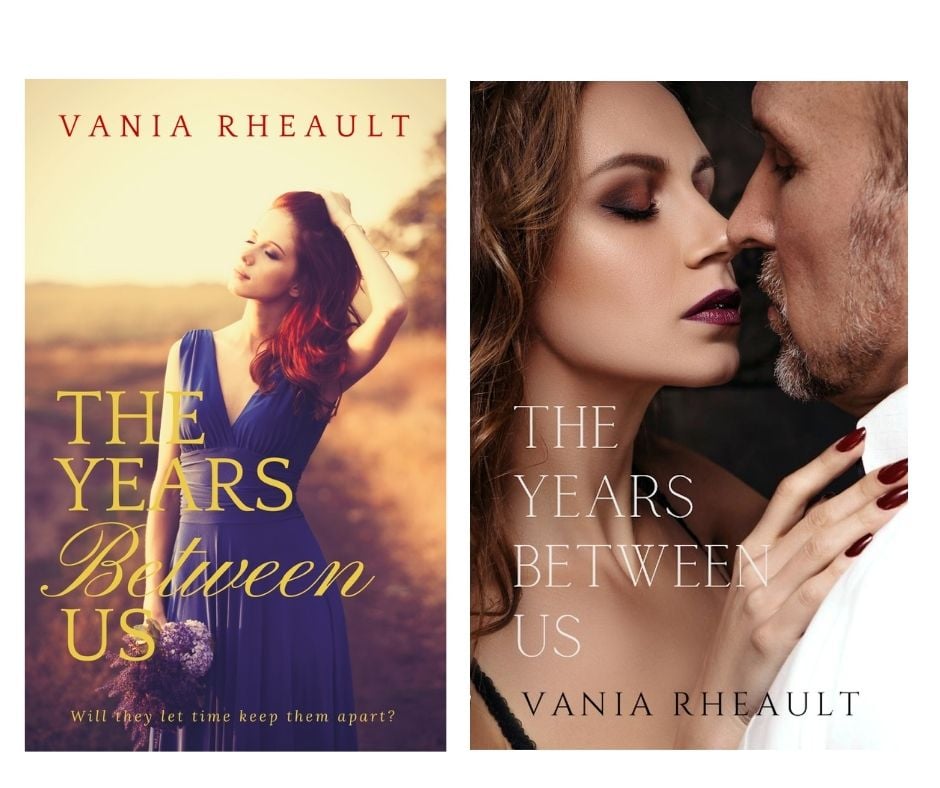
Vania: Through trial and error, I’ve realized that Amazon Ads are very cover-dependent. (Who knew, right? 😵‍💫) I always show this as an example:

I had one cover for my age-gap romance, but it screamed women’s fiction. I was getting a ton of clicks because the cover was pretty, but once they read the blurb, they wanted nothing to do with it. I changed the cover and now at least when I get a click, I’ll sometimes get a sale. At least I’ve stopped wasting money.

Jeanne: That’s the problem for me. Besides that I don’t like the platform, mine just is not spicy.

A.K.: Ohhhhh. Yeah, those are totally different genres. Smart move!

Vania: But I don’t have enough books to scale. Under my name was sub-genre hopping, and now under my initials I don’t have enough books out to say either way. I make money off my ads, just not a lot.

Jeanne: Yeah, I think I had that same problem. At first I could get some clicks, but the cover looks more “grown up” historical fiction, and the blurb reads more juvenile lust fest, so the 2 don’t match up, so now Amazon just won’t show the ads. Why should it bother? Lol

Vania: I don’t wanna do TikTok. I have carpal tunnel, and the thought of being on my phone like that makes my skin crawl. I know there are ways of posting on my laptop, but ugh.

Jeanne: Hey, if you make money rather than lose it, you are ahead of the game!

Vania: To play with TikTok’s algos, don’t you also have to follow and comment on other people? That sounds like sensory overload to me.

A.K.: Making money from ads is great! My plan for the winter is learning Amazon ads. Yes, TikTok is all about engagement. You need to do a lot to get a little in return. As for marketing, I’m looking to redo the cover of my first novel. I think it’s holding me back. Just need to figure it out!

Jeanne: And to do it well, you have to be so purposeful. To be honest, I’m just not interested in being that purposeful about anything. It’s exhausting, and I’ve pretty much given up on the idea that I will ever actually be “successful.” I’m trying to get back to just having fun and enjoying it. The only thing I do wish is that I had more readers. I think my books are great, for the right people, and I think there are more ppl out there who would like them, so I would like to get them into those people’s hands. Same here. I KNOW my covers don’t help me. I just cannot figure out what they should be instead, and …

Vania: If Amazon doesn’t know where to put you, they will definitely bury you. On the bright side, if you run them and they do that, they don’t cost you any money LOL

Jeanne: I’ve been feeling perverse about it lately, like, “these are the covers, dammit! And I’ve gotten some ppl to read the book, even with unlike covers. My covers.” That’s so unhelpful to myself, but I’ve been feeling feisty. I’ll get over it!

A.K.: Covers are hard. I need outside opinions because I’m not certain of how to do visual expression.

Vania: I don’t want to use TikTok to sell my book. I want to use it because I enjoy being on it, you know? Posting mini book trailers all the time or “teasers” for the sole purpose of selling my book seems even more scammy than tweeting a link all the time.

A.K.: Hahahaha. TikTok is overwhelming that way. It feels scammy for sure.

Jeanne: Yeah, Amazon is definitely happy to bury me! Unpopular opinion here, but I have no issue spamming my book.

Vania: When I was doing my trilogy covers, I took it very personally. I wanted what I wanted, and I liked the models that chose the first time, and honestly, you just have to disconnect that part of yourself and say, I’ll put what I need to sell my books on them and be done. So I used some guys that have been used before and did a background that would blend in with other books, and I just hope it’s enough. I don’t mind buying ads, but when you’re on a social media platform and that’s all you use it for, or that’s all you go into it thinking that’s what you’re going to use it for, that’s hard for me. I have no interest in TikTok and that’s all it would be for me.

Jeanne: I know. And I’ve been *this* close to changing. But I don’t know what to change them to, or even if the covers are really the issue. Maybe it’s the blurb. Maybe it’s just the books – they are for a specific audience, and maybe that’s not a big audience anymore.

Vania: I do all my own covers, A.K. I’m happy to brainstorm with you anytime.

A.K.: For my second book, I had my friend read it and suggest a cover for me and I was like “thank you!” Because I never would have gotten there. Is it a marketable cover? Not sure, but I love it and it fits my book.

Jeanne: Oh yeah, I have no interest in TikTok. If my books were spicy, then sure. I’d pretty much have to, but then I’d have ready-made content and I’d be pretty sure eventually it would help me sell the books. As it is? I already find myself overselling the “sexiness” of my books, b/c that’s what people want, and there is a lot of lust and sensuality, but that’s not the essence of my books, and I feel sleazy afterward.

A.K.: Thank you, Vania!

Vania: Sex sells, but you can’t be too misleading either, or you’ll disappoint readers who are looking for that and then it’s not there.

A.K.: I like making videos sometimes, so I do it. TikTok though requires a schedule and a commitment, etc. I work full time so it’s not really possible.

Jeanne: To be honest, I hired someone to do my cover at the beginning. I was going to get a professional cover! Yay! And then I felt like even though it was supposedly super reputable and a great place for indies and yada yada yada, I felt like I got scammed. So I was still willing to pay again, but to whom? Who could I trust to give me a great cover and not rip off a defenseless nobody? That’s when I made my own.

A.K.: People get very upset if they go into a book they think is smutty and there’s no sex. I always tag mine #nospice on TikTok to avoid backlash. Haha. Yes, it’s hard to know who to pick!

Jeanne: Ah, yeah – mine’s YA so I think that should be at least clear that it’s not going to be smut! It’s probably a little spicy for YA, not b/c of what happens, but because of the adult sensibilities and sensuality, but hey. I had a reviewer call it “panty-melting PG,” lol.

A.K.: Some YA can get pretty spicy without crossing the line. Haha that’s an awesome review.

Jeanne: Yeah, also calls the MMC “Darcy on steroids” – love that, too.

A.K.: Sometimes reviewers know how to sum up our characters and plot better than we do. Haha. That’s great though.

Jeanne: For sure! Sometimes they remember what happened better than I do, too.

A.K.: Haha! I went to BookCon and apparently one author uses fan art or fan wikis to remember characters eye colours. I wish I could remember which author said that. Made me laugh.

Jeanne: Right now I’m doing an event on my author FB page that I’m calling “13 day of Journeys,” posting a series of posts w/ content and interactive stuff Journeys’ publication. It’s a lot of work but it’s very fun — just a really small little group of participants, but it’s great. That’s hilarious! I usually don’t mention my characters’ eye colors, so that’s helpful, ha!

A.K.: What? That’s so cool! Such an awesome idea.

Jeanne: Yeah, I wish I’d thought it out a little better so it had better content, but it’s been fun. If you’re bored and want to check it out to see what I’ve done, I put a hashtag on it so that ppl could mute it if it was too much for them & their feeds, but that also means you can search it. It’s #13daysofjourneys.

A.K.: I will!

Vania: I wish I was as creative as you, Jeanne! Even just what you tweet on Twitter is amazing!

Jeanne: It’s all pretty juvenile, but that’s me. If I have to be entirely professional about it all, what’s the point? I’ve already got a profession! Oh, gosh! Thanks! I think I have a really big advantage, and that’s that I don’t really have to care if I ever “make it” as a writer. I’m old, I have a full-time job. I’ve already accepted that I won’t support myself with it. So I can just have fun with it all. That’s very freeing. It means I don’t have to follow all of the “rules”.

Vania: If we can’t have fun writing, we might as well all stop. The second this becomes a chore, I’m out. I need to love what I’m doing, or I might as well get a second job. I could use the money LOL

Jeanne: Oh, sure–I could use money! But in fact I’m losing money on my book, so …!

A.K.: Yes! I would just like to work my day job a little less and write a little more. That’s my goal!

Vania: Are you guys winding down? We actually hit most of the questions unless you want to answer my last, and that is, what do you have planned for 2023 when it comes to your writing, publishing, and marketing? Seems so simple yet so far away, doesn’t it, A.K.?

Jeanne: Sure, I’ll answer. I have GOT to get book 3 out! I’ve already got readers who want it, and I want to finish it for myself, too. As for marketing, that’s the rub, isn’t it? It’s going to be a long time before I have a new book, and then it’s a number 3 in a continuous series, so … yeah, marketing is pretty dead for me. That’ll be interesting!

Vania: How long does it take you to write 600 pages?

A.K.: For 2023, I’m hoping to have at least one more book out in the world! I would like to learn more about marketing and the best way to reach ideal readers. It seems like a good next step with two books out. Looking forward to what 2023 holds for this journey. 😊

Jeanne: Ha ha! It’s all relative. That first book … when I came back to it and got on a roll, I wrote most of it in about 8 months or so …

A.K.: 600 in 8 months is wild! Awesome!

Jeanne: The second book (1273 KENP, so figure! It’s longer) took me a lot longer, b/c I didn’t have the same ability to stay in the flow and just write. It took me some years. And it all depends for me on the writer’s block/ inspiration. If I’m writing the right thing, then I can write fast. But if I’m not … if I’m thinking about it wrong or have the wrong things happening and I get stuck, well … I might never finish! This book 3 has been kicking my ass.

Vania: It’s the fortunate writer who actually has time for it.

Jeanne: Yeah, I have none. and it isn’t just time. It’s mental clarity/mental “time.” Last year was the worst of my whole life. It took all the momentum out of everything. It didn’t leave a lot of room for creativity. But I also care about these books. They don’t have to be great. Or masterpieces. Or anything. BUT it does matter to me that I can feel that I like them, love them, even, and that’s not always easy to achieve. Just writing down the words to tell the story isn’t enough for me for this series. I really need to feel like I’ve done a decent job of it, at least, and I’m not sure I can do that.

A.K.: Sometimes it’s hard to get that clarity. I have a lot of family things always on the go and it takes up a lot of my mental capacity. I try to squeeze it in, but it can sometimes be hard!

Jeanne: Yes, family and kiddos take up so much energy! And I’ve learned the hard way.

A.K.: For sure. I am child-free but I help my aging grandma and chronically ill mom. I’m lucky they’re more independent than children. But it’s still draining.

Jeanne: Writing when I’m not “feeling it” is detrimental. I end up with garbage on the page but after it gels for a while, it is hard for me to change. It’s like I’m a potter making a pot. While the clay is fresh, I can change it. But once it dries, it’s the pot. I can’t do anything but try to disguise the flaws with glaze. Oh yes! I’ve got an aging mother and I know how stressful that can be – even though she’s in a retirement apartment so I’m not doing the care myself.

A.K.: That makes sense! It’s good you know your limit or what you need at least. I, on the other hand, need to keep writing even if I don’t want to because getting out of a routine is bad for me. I just don’t force myself to write anything specific.

Vania: I am so sorry, A.K. that does sound like it would take a lot of time and energy. I’m sorry you’re going through that. I understand, Jeanne. I have never been a “write every day” kind of person. I need to want to write or else why bother. A.K. that’s why I blog–if I don’t feel like writing, at least I’m still putting words somewhere. it’s a different outlet for me that keeps my hand in.

A.K.: Good call! Well, I do have to head out! Have some pre-bed time things to take care of around the house. I just want to thank you, Vania, for facilitating this! It was wonderful learning about your processes and your writing lives! Also, for allowing me to share about my own. ❤️

Vania: Thanks for taking the time, A.K.! I appreciate it very much.  Have a wonderful night!

A.K.: It was lovely chatty with you both. Have a good night!

Jeanne: Thanks for hosting this, V! Great chatting w/ you guys.

Vania: You’re welcome! It was fun sharing what we’ve been working on and what we find frustrating about the business.  Maybe we can do this again sometime. Goodnight!


If you want check out Jeanne’s and A.K.’s books or follow them on social media, here are the links:

Jeanne: Her books are available on Amazon, on Kindle, Kindle Unlimited, and Paperback. https://www.amazon.com/dp/B09L6KZ8D7
And you can also like her author Facebook page here: https://www.facebook.com/jeannerolandwrites

A.K.: You can find her books on Amazon here: https://www.amazon.com/A-K-Ritchie/e/B09HJX6R6P
And check out her author website: www.akritchie.com

Compassion Fatigue. What is it, and how does it affect your marketing?

Tired and sad woman sitting at desk with forehead resting on her hands.

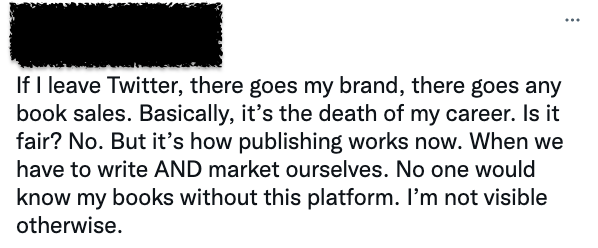
Lots going on over on Twitter last week. Elon Musk reluctantly took over causing a tsunami of emotions. A lot of people talked about leaving (and still are), only to follow up that thought with, where else is there to go? Twitter is a unique experience, offering bite-sized content and opportunities to respond to other people in 280 characters or less. If you’ve read any of my prior blog posts, you’ll know I spend a lot of time over there, but I don’t use it as a promotional tool. Plenty of people do, and what started popping up in my feed after Musk took over surprised me. More than one person said, “If I have to leave Twitter, there goes my writing career.” As an example:

This is actually a common refrain, people depending on Twitter and nothing else because it’s free, and as long as you tweet regularly so the algorithms remember who you are, you can nurture a decent reach. But no matter how far you reach, after a while you will run out of people who will want to buy your books. Maybe that saturation point will take a while, especially if you’re new and you put a lot of effort into building your account, but anyone with a huge account can tell you that Twitter doesn’t sell books in the number they wish it did.

Where does compassion fatigue come in? Let’s first take a look at what it is. I hadn’t heard of it until I was chatting with my friend Sami-Jo about this very topic which led to this blog post. According to WebMD compassion fatigue is:

Compassion fatigue is a term that describes the physical, emotional, and psychological impact of helping others — often through experiences of stress or trauma. Compassion fatigue is often mistaken for burnout, which is a cumulative sense of fatigue or dissatisfaction.

https://www.webmd.com/mental-health/signs-compassion-fatigue

When you think of Twitter and marketing, you think of posting promotional material like this:

made with Canva

Or maybe something not so fancy like this:

Add a link, and there you go. Something quick and cute that can reach hundreds, if not thousands, of people in a few minutes. I can see why Twitter would be people’s first choice. Free and easy, it gives off the illusion you’re marketing. I say only the illusion of marketing because to truly market and advertise your books, you need to show those ads to readers who read your genre and want to buy. Writer Twitter is full of writers, and while, yes, we are readers, we don’t read nearly as much as a reader who doesn’t write. Also, there is a mish-mash of genres on Twitter, and even if your promo reaches 1,000 of your followers, only 10 of those could read the genre you’re writing in.

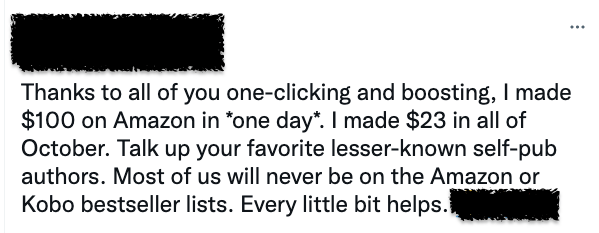
So, let’s take this a little farther. You’re promoting your books, chatting with other authors, sell a handful, but not as many as you think you should because you spend A LOT OF TIME on Twitter (and buying indie books, but let’s not go there because a buy for a buy is icky and we don’t do that, right?). Time that could be better spent writing, if you’re honest with yourself. And this is where compassion fatigue comes into play. You start complaining about sales. Tweeting screenshots of your empty sales dashboard, moaning that a new release didn’t take off. Then some of your friends buy one of your books to cheer you up, and for that customer, you’ve reached your saturation limit. Then you do it again and again for every new release, and you get more bitter and more bitter because your friends aren’t going to buy every book you write. They can’t. They can’t afford $4.99 a book every time you release. They have their own careers and family obligations to see to, and let’s face it, $4.99 is a gallon of milk, right? They have kids they need to feed, and times right now are tough. You get angry your books aren’t selling because you need money too, they get sad and not a little upset because they’ve helped you and can’t anymore.

Complaining about sales when you use Twitter to find readers will only tell the people who have bought your books that their purchases weren’t enough.

When you complain on Twitter and you garner some sales from tweeting your empty sales dashboard, those sales turn into pity buys, and that is not a good sustainable marketing strategy.

So when someone says, I don’t have a writing career without Twitter, I’m baffled because yes, while it’s free, there are several other ways to promote your books. Relying on only one way is a fool’s game and one you won’t win. I’ve blogged a lot over the past couple of years on ways you can market your book that’s not Twitter, and those are: buy a promo from places like Free/Bargainbooksy, E-reader News Today, Robin’s Reads, Fussy Librarian, and more. Buying a slot in one of those reader newsletters will grab you more readers than hours of tweeting into the void. Write a reader magnet, set up a newsletter, and build your reader list through platforms like Bookfunnel and StoryOrigin. Learn how to use Amazon ads and run a couple of low cost-per-click ads. I would rather run ads and sell a couple of books a day than spend hours on Twitter begging people to buy my book. Publish consistently, and that means the number of books a year as well as not genre-hopping for a bit to build an audience for that genre.

I get that authors are afraid to sink money into their books, but ads and promos are only expensive if your book isn’t advertising ready and it doesn’t sell (after all, you’re supposed to make more than you spend. That’s the point of an ad.). I’ve seen people say, I bought a promo and didn’t earn my fee back. That’s a you problem, not a promo problem (and definitely not a Twitter problem). Likely, your cover wasn’t good enough, or the ad copy they ask you to write to go along with a picture of your cover wasn’t hooky enough. Maybe you were trying to promote a standalone when a lot of earning a fee back consists of read-through or the purchases of other books in the series.

The good news is, if you’re losing money on promos, you can adjust. Write something new. Replace your cover with something from GetCovers (their prices are very inexpensive compared to some that are out there). Workshop your blurb and change it on your Amazon product page. But out of anything you can do, stop complaining on Twitter. Your friends and followers aren’t responsible for your writing career. They can’t carry you. They want to write and sell their own books. After a while, they’ll get sick of seeing your promos and hearing you beg. They’ll mute you out of bitterness and a feeling of worthlessness that their support wasn’t good enough for you.

If Elon Musk shuts down Twitter either by fault or design, how fucked would you be? Would you consider your writing career destroyed, or would you simply adjust your sails and chart a different course? I’d miss some friends I’ve met on Twitter and don’t know how to contact any other way, and maybe I wouldn’t see as much traffic on my blog as I do now, but Twitter closing up shop would have zero affect on my book sales. That’s a good thing. If you depend on Twitter and you’re telling yourself you have nowhere else to go, you’ve trapped yourself there out of fear. Don’t do that. You are in control of your writing career, not Elon Musk. Figure things out for yourself because not everything is forever.

As for the tweet above? She did end up with a few pity buys, and maybe that’s the way publishing works for her, but it’s not the way it works for me, and I hope it’s not the way it works for you.

At some point I’ll probably get beat up for this blog post, and I’m not trying to make anyone feel bad or embarrass anyone. Writing and publishing for me is pretty much my whole world, and if I depended on one unsteady platform for my longevity, I would quit writing and funnel my passion into something else. It truly is a lonely road, and isolating yourself only makes it worse. There’s talk now that everyone will need to be verified on Twitter if they want their tweets seen, and the cost will be $11.00 a month. Why sink further into the pit if you plan on paying that? If Twitter isn’t working for you now, it won’t work for you then.

With the holidays coming up and a shaky economy, I wish all of you good luck writing and publishing and hope 2023 is your best year ever.

Monday update and thoughts on marketing and being an indie author

I’m writing this very late, Sunday night, in fact, because I spent all weekend putting in the edits to book four of my series. It took me a little longer than I thought it would just because I was starting to make changes that I didn’t enter into my proof. I guess since this is such a large project, it won’t be a simple wham-bam-thank-you-ma’am-press-publish-and-hope-for-the-best type thing. You might say that no book should be like that, but if you’ve never written, edited, and packaged 540,000 words, it does feel just a little more serious than writing a 20k word novella and hitting publish the second you type “the end” at the end of the book. I’ve never had a problem editing and publishing with no regret, but I think, no matter how many times I go over these, they may never feel good enough, never feel ready. This will probably be the biggest project I’ll ever write, and while I know from the bottom of my heart I will never reach perfection, I’ll probably always have a little regret I didn’t do more. So for now, the plan is to edit the proofs for books five and six, put those edits in, tweak the covers because I think they could be better, and order more proofs. Then I’ll sit on them and read them all through again in February and pray to God I feel like they are good enough because I want book one ready to go by March 1st. By then the series will be two and a half years old. It’s time.


I got into another discussion the other day about the stigma of indie publishing. I really hate those conversations, but honestly, I think people use it as an excuse as to why their books don’t sell.

There are so many ways to publish now, and who can even accurately define what indie publishing is? There are huge independent publishers like Graywolf Press who are so successful that maybe authors don’t consider them independent anymore. Then we have publishers that are legit like Bookouture and Belt Publishing. Then we have the companies that aren’t vanity presses, but they aren’t exactly publishers, either, like BookBaby, Bublish, Lulu, and She Writes Press (Brooke Warner is great–you should check them out.) Then we have the smaller presses that pop up, and maybe they’re legit, maybe they aren’t. I mean, if you know how to edit, create a cover, or format a book, almost anyone can consider themselves a publisher. I’ve helped plenty of authors put together their books, but I would never consider myself a small press, nor would I want to. Then we have the vanity presses that walk the line of what’s legitimate and what’s not (like Austin McAuley, iUniverse, and Author Solutions). So when you think about the million different ways to publish, how can anyone say that readers don’t read indie? How in the heck are they even supposed to know?

I get cranky when I hear the theory there is still stigma against indie publishing, and my argument is that no reader is going to go out of their way to search who published your book. You know how a reader knows if your book is indie? If the cover is bad, if it’s not edited properly (by yourself or someone else), if the formatting is poor. That all screams unprofessionalism, and yes, self-publishing. All a reader wants is a good story in a nice package because they forked over their hard-earned cash to read your work. If you can’t give them quality, then you have no business publishing, and if you do publish, you have no right to be angry with poor reviews or returns. There are plenty of big-time indie authors who started out small, and yes, as they made more money their teams grew and some even go on to publish other people like Michele Anderle and his publishing company through LMBPN, and to me, that just blurs the line even more. Don’t push your failure on to other people. If my books don’t sell, it’s 100% my fault, not because I’m indie. WTF is wrong with people? (This is a rhetorical question, and I’m laughing.)


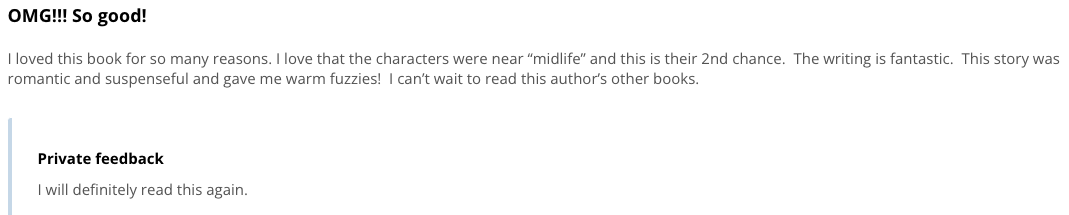
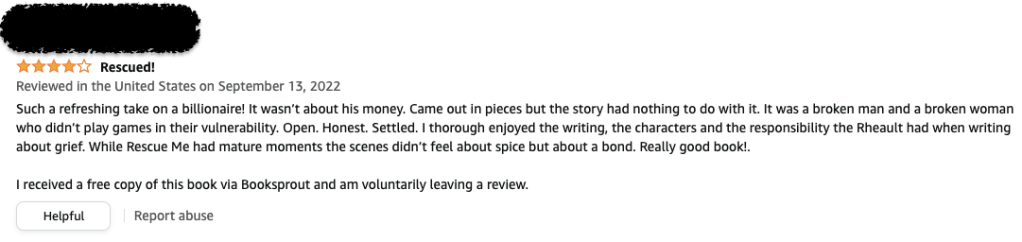
So, you know I went ahead and listed my book with Booksprout. I was hesitant because of the poor quality of reviews last time and since they did their overhaul, I was hoping for a better outcome. A couple reviews have come in, and it seems for the most part they’re at least reading the book. I got one sweet review and it’s always nice when a stranger can validate you’re putting out a good book:

I dislike for the cheapest plan reviewers have to include in the review that they received the book on Booksprout in exchange for a review. It seems dirty and just a little skeezy but there are plenty of review services so paying for a review I guess isn’t the end of the world. But when you give away 25 review copies, and all 25 have that at the bottom, and all the reviews are five stars, it doesn’t look honest or sincere and if a reader comes by and happens to see that, a review won’t make a bit of difference to them.

So you have to weigh the options here of publishing without reviews, which I did for my duet. I guess there’s not a right answer either way.


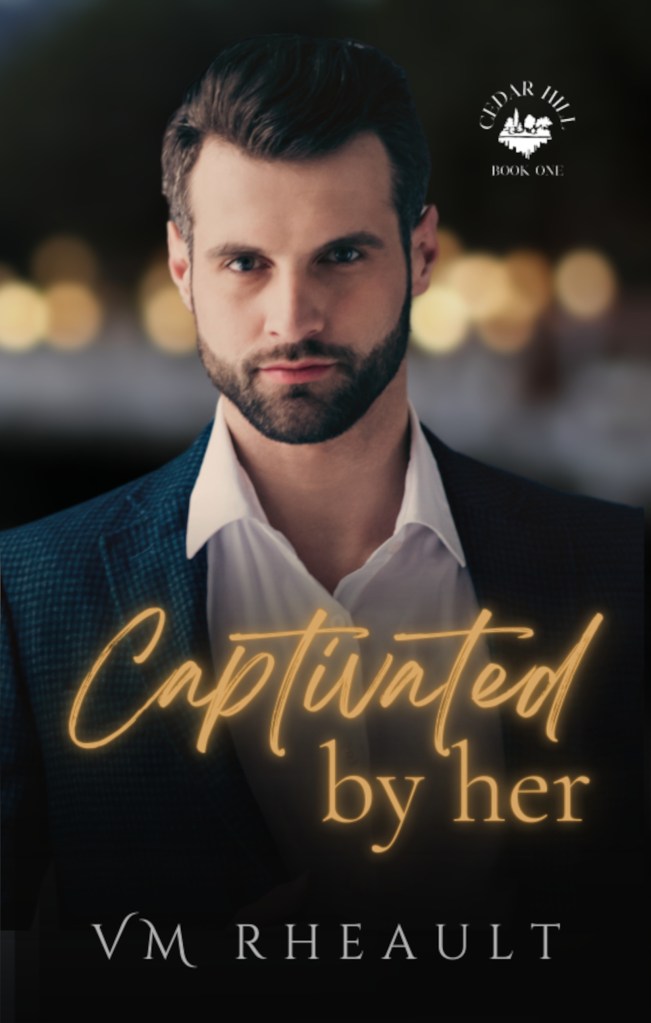
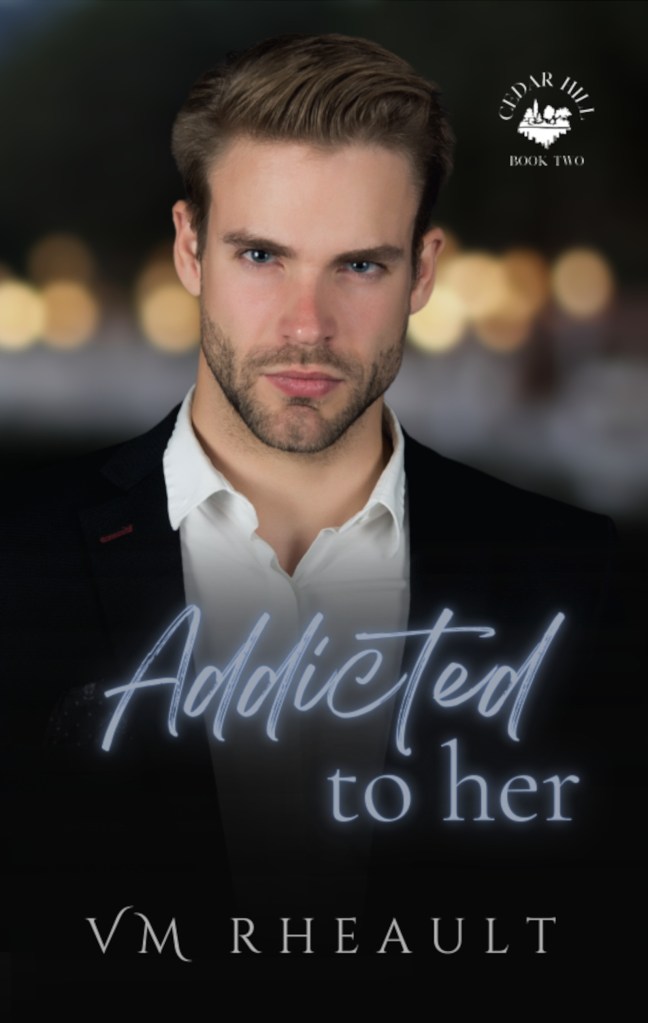
I really don’t have much else this week. I’ve been so busy proofing my proofs that between that and working, I don’t have much time for anything else. I thought briefly of doing NaNo in November, but I’m going to be way too busy getting my trilogy read to publish in January. I may not even be writing new stuff until next year which is sad, but I need to get my back list going. Sales for my duet have been so-so. I get a lot of impressions, but no clicks, which at first glance means my covers aren’t doing well. It could also mean my categories and targets are off, but I know they aren’t because I put a lot of time into my 7 keyword fields when I published and I emailed KDP and added more categories. Those are all on target. I knew but didn’t want to admit, through feedback on FB that the men chose weren’t sexy enough for covers. I just liked the look of them and went against my own advice which is to bend when you can because nothing is more important than doing what you need to do for your books to sell. Now that they’re on KDP in ebook, paperback, and soon hardcover, and I uploaded them to IngramSpark, changing them out won’t be easy. I’m going to wait for a while and see what happens, but learning from this, I do realize the covers for my trilogy I was playing around with won’t work. I need stronger, sexier men, even if they’ve been used on covers before. If you don’t know what my duet covers look like, here they are:

I still love them, but again, time will tell if they’ll do the job.

That’s all I have! Until next week!

Being an indie author means using what works for you, no matter the source.

I had an interesting conversation with a friend the other day. Not really a conversation I guess, because it’s long been established that we don’t see eye to eye on writing, publishing, and marketing, and that’s okay. Just looking at her back list and mine makes it clear we have different paths and different goals. She’s 100% indie, does her own thing when it comes to books, genres, writing craft, as well as covers and where she publishes her books. She’s happy, (I’m assuming she is as she has never told me otherwise) and wants to stay on that path.

I learned over the five years I’ve been writing and publishing romance is just because I want to do it the way I want to do it, it may not align with my business goals and what I want for my books. That’s an important distinction. Just because it’s the way I want to do it, it may not be the best way to make the dreams I have to come true. So, I’ve learned to niche down to a sub-genre and study what’s on the covers of the books doing well in that sub-genre. I create my covers not only with what I like (and what my skills will allow), but I also have to take into consideration what is selling, and what will meet Amazon’s guidelines when it comes to ads. Just because you’re indie doesn’t mean your books can’t look and read as professionally as they should, and this made me think: we can publish indie books while borrowing from the best of indie and trad worlds.

What do I mean?

Covers: Think like a trad author.
As an indie you can put whatever you want on your cover, but the fact is, after you publish, you aren’t competing with only indie authors. In fact, the line between indie and trad grows blurrier every day. Readers don’t care who publishes your book as long as they get a good read for a fair price. You’re in complete control of your cover, but once you start tweeting your book to generate interest, or you run any kind of ad, you’re going to compete against a lot of other authors. Authors who are traditionally published by the Big Four, authors who are published by a small press, authors who can afford to spend $500 dollars on a cover, authors who know a photo manipulation software backward and forward, and authors who put their cover together in the middle of the night high on caffeine using Microsoft Paint. This is an area where we can learn from traditional publishing. Create your cover to fit in with other books in your genre. People do judge books by their covers and who knows how many readers pass you by if your cover isn’t up to standards. Unfortunately, you may never know.

Blurbs: Think like an indie.
Up until recently, and I mean, like the past couple of years (which is recent when you’re talking about publishing) blurbs (plot teasers on the product page, not one-sentence praise from your peers) were written in third person present tense. It was just the way things were done, and there are still indie authors who write their blurbs this way, despite that their book is written in first person/present/past. It took me a long time to wrap my mind around a romance that was written in first person, and it took me actually writing a romance in first person dual POV for me to fall in love with it (no pun intended). While this was going on, the savvy authors started writing their blurbs in first person, using the voice of their characters. If you look back, the authors who started that and bucked the system were GENIUS. Blurbs have always been, and always will be, a marketing tool. Because it’s a trad thing to write your blurb in 3rd person present, there have been some people who are reluctant to move away from that (and I blogged about that too.) Personally, I think blurbs written in first person makes sense (and only applies to authors who write in first) and you can have a lot of fun writing your blurb that way. This is time for a good reminder that you should always research what other authors are doing in your genre and what reader expectations are. Writing your blurb in third could lose you readers, or make readers unhappy when they read a 3rd person blurb and expected a book written in 3rd person as well. There are some readers who detest first person books and go out of their way to avoid them. If you like to troll Twitter (and I mean scroll, not be a jerk) you can read some more thoughts on 3rd person vs. 1st person blurbs using these Twitter search results:
https://twitter.com/search?q=1st%20person%20blurbs&src=typed_query

Release schedules: Think like an indie.
Being an indie when it comes to how often you can publish and when can help you build an audience quickly. Trad authors are stuck to once a year, maybe twice if they’re with a small press with a flexible schedule. It seems Amazon imprints like Thomas and Mercer or Montlake allow their authors to publish a little faster, but all in all, authors who can release a book quarterly (3-4 a year) have a better chance at building an audience so why not use that to your advantage? It hurts to save up books, but if you’re a slow writer, why not? Write, edit, and package three, then write more as you release. this can start a publishing schedule that you can maintain and after a while, your growing audience will know when to look for a new release. In the time a trad author publishes three, an indie could publish nine to twelve, and that just means more money in your pocket.

Series: Think like an indie and trad author.
Indies are getting better at this, but I’ve seen some books in a series that don’t look like they’re a series because their covers don’t look the same and don’t have a similar vibe. Trad has always been great with series branding, using the same fonts, backgrounds, and characters. For instance, the first book in the Flowers in the Attic series was published way back in 1979.

photo taken from https://thebookmelon.weebly.com/blog/flowers-in-the-attic

Series branding is important, but these days in the era of fickle attention spans, a trad house may pull the plug before a series is complete because it’s not selling. Sometimes an author gets a chance to wrap up, but sometimes not. Readers get angry, but like my friend Dea pointed out on Twitter the other day, it’s not up to an author if they have a book deal whether or not to continue a series [unfortunately since I wrote this post, Dea left Twitter and the link no longer works]:

This is where being an indie can make all the difference. IF YOU’RE AN INDIE AND YOU’RE WRITING A SERIES, FINISH IT, OR AT LEAST WRAP IT UP! Readers don’t like being left hanging, and when you’re publishing your own books, there’s no reason not to finish. The release consistency subject above also comes into play here. If you’re going to make use of a cliffhanger, you better have the next book ready to go (hopefully on very short preorder), or you’ll get bad reviews like this one:

Use your freedom to your advantage and keep your readers informed. I was tweeting with this author, trying to figure out the best way to let her readers know so this didn’t happen again. Is posting a publishing schedule in the first book’s blurb the way to go? Perhaps this would be a good reason to use A+ content? I’m publishing a six-book series next year, and yes, I do use cliffhangers. But unlike the author above, they are all written and I will be releasing all six in one year. When I read the Crossfire series by Sylvia Day, she did give the characters a happily for now ending just for the fact she’s a trad author, knew her readers would have to wait a year between books, and wanted to give her readers a bit of closure until the next book came out. When you’re indie and you need time, maybe that is the better way to go. Personally, I’m not sure what the answer is, but I will never not have all my books written in a series before I publish. Just for the fact avoiding small plot-holes and consistency issues will always be reason enough for me to wait to publish while I write.

The overall look of your book: think like a trad author.

A lot of authors don’t know this, but there is a set of guidelines you can (should) follow when you publish. The Independent Book Publisher’s Association lists them on their website and covers everything from what you should have in your copyright page to reminding you that your interior should be full-justified. It’s amazing that you can be a life-long reader, but when it comes to assembling your own book, how a book should look flies right out of your head. I’ve seen books that are left-justified only, no page numbers, spaces between paragraphs (this is okay for non-fiction, but I’m referring to fiction books), double spaced, no front matter except a title page, nothing in the back, not even an About the Author page. There’s no reason you can’t put out a professional product. To find the list of guidelines, look here:
https://www.ibpa online.org/page/standardschecklist

While I understand the disgust thinking about traditional publishing can evoke in an indie, there are lessons trad can teach us. Your book should look professionally put together, even if you’ve done it all yourself. When you’re asking a reader to pay for your product, it’s up to you to make sure they are paying for quality. It doesn’t matter how you reach that standard, it’s only important that you do. If that means hiring out every step of the way, then that’s what it means. Some may only need an editor, some can edit their own work and do just fine. Some indies are a one-stop shop and do every single thing for themselves, or use $50 dollar premades to cover their books that go on to make thousands of dollars. As indies, we have so much flexibility, but don’t use that as an excuse to do what you want. Once you put your book out into the world, you want readers and you want readers who will recommend your book to others. You want people to take photos of your books in their gardens, next to their cats, at the beach, and they won’t do that if your book has a crappy cover on it.

You CAN have your cake and eat it too. Just maybe scrape a little frosting off it first.

Until next time!

Editor Interview: Kimberly Hunt

I met Kimberly on Twitter some time back, and I’m a member of her Facebook group, Revision Division. We’re also members of Romance Editor Q & A since I do a little editing myself and keep up the skill not only for my own books but for those I edit for on the side. I appreciate Kimberly’s time, and I hope you enjoy the answers to all the questions she so graciously filled out for me.


Introduce yourself! How did you get into editing and what are your qualifications? What genres do you enjoy editing most?
C.S. Lewis said “You are never too old to set another goal or to dream a new dream.” This is exactly what I did. After twenty years in the corporate world, I took a sabbatical and it shook my world to realize how amazing it is to fill my day with activities I’m passionate about. I have always enjoyed my work and the companies that employed me, so it was jarring to realize I could be happier. Before I set off on a vacation volunteering in Peru, a friend of the family asked if I’d read a novel he’d written. The story was amazing, but I couldn’t get past the number of errors. This was my inspiration to look into copyediting. My natural ability to spot punctuation, usage, grammar, and spelling errors lent itself well to copyediting, so I took courses to start there. My education introduced trusted resources like dictionaries and style guides and working with publishers taught me how to create and maintain a style sheet for consistency. The more advanced courses I took revealed my true passion is earlier in the process, with developmental editing. I love assessing the big picture elements like structure, plot, pace, point of view, and character development to help writers improve their stories. I love editing romance the most but I also enjoy editing women’s fiction, mystery, and psychological thrillers. I’ve edited all heat levels and time periods but prefer steamy contemporary.

There’s the saying that a writer needs to write a million words before they can write something publishable. Do you agree with this? Why or why not?
Whoa, that’s a loaded question without a simple answer! On one hand I don’t agree with the limitations of hitting an exact word count and refraining from sharing your work until it’s perfect. We grow and learn from making mistakes. I definitely don’t think writers should wait for an arbitrary milestone to publish. On the other hand, I agree with the sentiment of the saying where putting in the hours and the work makes for a better quality product in the end. Have you read Malcom Gladwell’s Outliers? He has a point about it taking 10,000 hours to become exceptional at something.

What is the biggest mistake you see indie writers making right now? (For example, info dumps at the beginning of their book, not enough conflict, too much tell vs. show, etc.)
I’ll admit I had to give this question some thought because I see such a wide variety of manuscripts with different issues. Considering both the unpublished manuscripts I edit and the completed books I read for pleasure, I’d say the biggest challenge seems to be related to pace because conflict is tricky. Many authors struggle to create believable conflict that escalates. Each chapter needs a purpose where the complications grow and the consequences are impactful. Many of my developmental editing projects require suggesting solutions for improving chapters without clear purpose. It’s hard to move the plot forward if the reader doesn’t know what the character wants, why they want it, or what stands in their way.

There’s a lot of talk about whether or not it’s necessary to have a manuscript edited before querying. What are your thoughts?
Most of my clients are independent authors, but I have helped several writers improve their story and polish with a copyedit prior to querying. I have more than one data point for authors gaining representation and eventually signing publishing contracts, but I can’t take credit for those achievements. Their storytelling talent far outshines my knowledge of where a comma goes. But as a businessperson who has reviewed cover letters and resumes before hiring someone, that first impression needs to be solid, so editing before querying could be beneficial even if it’s not required.

How do you keep the author’s voice intact while also guiding them with suggestions on how to make their book the best it can be?
Great question! My job is to point out both what works well and areas for improvement. I give suggested solutions in comments or in a revision letter for the more lengthy explanations. Changes made directly in the manuscript are usually corrections to indisputable errors. I reference Merriam-Webster dictionary and the Chicago Manual of Style to support the corrections I propose. When line editing, I tread carefully to make sure I’m respecting the author’s voice while keeping concision and clarity a priority.

Is there ever a time when a book would require too much work? What do you tell a writer whose book isn’t ready for a professional edit? What resources do you refer them to?
This has happened a few times. Sometimes an eager writer finishes that first draft and jumps to the editing stage too soon. Revision and self-editing are recommended in these cases and I often provide resources for finding critique partners or offer to take on the project as a writing coach instead if the manuscript isn’t ready for editing yet.

What advice can you offer an author who can’t afford a professional edit? Are there things they can do to sharpen their own self-editing skills?
Definitely! These tips don’t replace the value of working with a professional editor, but they do offer some cost-savings if you can self-edit as much as possible first. I have a bunch of videos and blog posts on this subject on https://revisiondivision.com/tips but here is my best advice: read aloud to yourself, others, or have Word read it aloud to you. You’d be amazed by how much this trick catches. It will highlight awkward flow and bring attention to missed words and sneaky errors.

As an editor, it’s important you’re honest and give critical and actionable feedback. How do you offer this feedback so a writer doesn’t take it personally?
Diplomacy. I aim to provide valuable feedback through constructive criticism AND praise. By pointing out a writer’s strengths and showing in their manuscript where something works well, they learn and grow. On a scale of one to ten, with one being a Positive Pollyanna and ten being brutally honest, I’m probably a moderate four. I’m a professional and my training emphasized how to provide actionable feedback tactfully.

Are there any other tips or thoughts you would like to add about editing or publishing?
Adding on to that last question, I’d like to encourage writers to expect good and bad feedback. But they shouldn’t react right away in order to avoid an emotionally defensive response. Edits can be overwhelming. After initially receiving feedback, it’s a good idea to set it aside and digest. See what resonates and come back to it later to make a plan for revisions. Most importantly, do not give up.

Thank you for this opportunity to talk about something I’m so passionate about. 😊


Thank you, Kimberly, for your time!

How to find Kimberly:

Website: https://revisiondivision.com/
Twitter: https://twitter.com/RevisionDiv
Instagram: https://www.instagram.com/revisiondivkimberly/
Facebook Group: https://www.facebook.com/groups/2376033425801031

May Recap and June Plans

Another month has come and gone, and I still feel like I’m trudging through quicksand, though, to be fair, I have gotten a lot done in the past couple of weeks. It’s more of a personal thing that I feel like I’m not making any progress when, in fact, I’ve made so much I’m freed up to write again. That I won’t have room in my publishing schedule until 2024 isn’t a concern, more of a blessing in disguise as I’m plotting out a new trilogy and having a difficult time. I feel like I may be broken since I haven’t written anything in months and the momentum I’ve had for the past two years is definitely gone. It is true, what they say, it’s better to have written as I have really enjoyed editing these books over the past few months, but I also like to write and I need to have at least a loose outline of all three books (for breadcrumb purposes) first before I can really dig into writing book one.

Despite a new diagnosis of a yeast infection (I swear, the fun never stops with me these days) I managed to format, write blurbs for, and create six covers for my King’s Crossing series. I’ve ordered proofs for them all, and here are the covers.

I have to admit, I’m pretty proud of these, but like I’ve mused in other blog posts, I may have been too far ahead of myself for these to stick. I’m hoping covers for billionaire books don’t do a complete 180, though illustrated covers are becoming more and more popular. I just don’t think that an illustrated cover would provide an accurate depiction of what I write about (high angst), so at least I don’t have to worry about that no matter how heavy the cover trends lean in that direction.

Last week, I spent more time than necessary (because they changed their platform since I’ve last used it) setting up a Facebook ad for Captivated by Her, which was released on the 1st. I don’t expect anything to come of it; I’m still getting my new pen name out there and unfortunately paying to do it. I have just a little under 200 on my newsletter subscriber list, and surprisingly, I’ve only lost four. I did go ahead and offer them an ARC of Captivated, but only 26 subscribers took me up on it. That’s fine, even if just one or two of them leave an honest review that they liked it, it will be a nice gauge into if my books will resonate with anyone. So for now, I’m running a very small budget FB ad to Captivated, turned my ad back on for my reader magnet to build my list, and I’m running a couple of Amazon ads that don’t have much traction yet. I didn’t think an ad to a preorder would, I just wanted the algorithms to pick me up.

I might buy a newsletter promo with ENT or Fussy Librarian for Captivated when Addicted to Her comes out in August. I don’t have a preorder for it because I’m reluctant to put something on preorder for that long. It would just sink on Amazon because nobody wants it, so I feel it’s better to wait and do what I did this time–put it on preorder for a week so I have a link and in that time I can run some ads to it so Amazon knows it exists. Am I doing this right? I have no idea. I won’t know for a long time if I’m going to make any money off these books, but underneath the need for financial validation, I sure had fun the past two years writing them all.

There is always TikTok. Apparently you need to be on there ASAP if you’re a romance writer, but honestly, I’d rather throw money at ads for now than learn how to work another platform. I still don’t have a complete grasp on MailerLite and all it can do (I have a course by Holly Darling I bought during a Black Friday sale that I haven’t taken yet, either), and if I wanted to put time into anything else, I need to learn how to participate in Bookfunnel promotions because I’m paying for the privilege.

For now, I’m just happy to be writing again, even if I’m having a bit of trouble plotting, but I’ll get back into it easy enough. I’m also trying to figure out what more I can offer on this blog. I’m going to look into an indie editor series because besides my author updates, there just isn’t a whole lot going on in indie publishing right now. TikTok is all the rage and I could experiment just for the sake of telling you about it, but with only one book out anyway, I feel it would be a waste of time. So, we’ll see what happens. I won’t stop writing, but I like being able to offer content that’s helpful. I guess I’ll be brainstorming more than just plot for the next little while.


What I’m loving right now:

When I sent a newsletter out hoping to prompt the readers who downloaded Captivated into leaving a review, I knew there was a way to create a link that would send the reader straight to the review page instead of just asking them to hunt for it on the book’s product page. Dave Chesson of Kindlepreneur usually has all the answers, and indeed, he has a YouTube video on how to create a review link, and also a blog post that explains it a bit better. This was a golden find for me and so helpful for your readers if you ever need to ask for reviews!

I hope you all have a fantastic week!

Author Update

Mondays always seem to come around so fast! Last week was a wash as I was still sick, and today was supposed to be the day I posted a video on how I made one of my romance covers in Canva. Last week went by in a haze of chores, sleep, and work, so I will do my best to get something figured out and post for next week.

As for today, I don’t have much going on. Everyone is slipping into the lazy days of summer. My Clubhouse marketing chat is on hiatus until the Fall, and I’m missing the only podcast I used to listen to as they wrapped up to pursue other things. I’m still trying to figure out why I feel like crap even after my surgery, and I have another appointment on Tuesday. It would go a long way if I could feel better, and I’ve been really struggling lately to remain upbeat and positive. Twitter isn’t the fun, supportive place it used to be, and it’s been difficult not to feel alone. Not just in the writing part of it, but in my personal life as well. My fiancé and I broke up after a five year long distance relationship and my son moved out to live with his dad to have a built-in ride to work for his summer job.

I’ve had a lot of transitioning to deal with lately, and when I clicked publish on my paperback the other day, I didn’t feel a sense of accomplishment (though if you wanna see how pretty the cover looks, click here). I also felt a bit let down as I don’t really have anyone to share that with. Most of my writing friends with whom I was close faded off, and the one person who would have been my biggest supporter is gone. It’s not that I’m complaining about any of that. I like being alone–I just have to get used to all these changes and find joy where I can. And of course, I don’t want to turn this blog into a Debbie Downer’s journal. I’ll bounce back one of these days; I just need time to adjust.

I have been working on my books, though that is another area of my life where sometimes I feel like I don’t know what I’m doing or why it even matters. I love writing and I love publishing, so I won’t stop any time soon (it’s what saved me the past two years), but a friend of mine on Twitter yesterday and I were talking about crap books and how it seems anyone can get anyone to buy anything if you make a video about it on TikTok. It’s pretty sad when you see people posting their sales figures in the author groups on Facebook, and the books are no better than first drafts. I’m not saying all books are like that, or that I would resent any author their success, but it is disheartening for anyone who puts their heart and soul into their books only for them to sink while “other” books do well. In the end, it will be their loss because with the number of books out there for readers to choose from, you only get one chance to make a good first impression, and in most instances, a first draft won’t cut it. So I can feel bad for myself now, but I’ll build my book business on good books and be proud of that.

I haven’t done anything with my paperback on Amazon yet besides claim my author page and add my photo and bio. Captivated by Her hasn’t clicked in with Goodreads or Bookbub yet, and I don’t want to manually add my book to Goodreads because I know from past experience it will eventually auto-populate, then I’ll have two of the same book on there. I’m also wondering if I want to go through with paying for Booksprout for reviews, and if I want to offer Captivated to my newsletter subscribers in exchange for a review. From what others have said in the past, I don’t think I would get many takers anyway, but reviews are important, and it makes the most sense to ask my newsletter subscribers and get into the habit of treating them like the VIPs I want them to be. I also hate that Booksprout went to a paid only service, and even at the cheapest rate ($9.00/month) the quality of the reviews in the past wasn’t worth it.

I went ahead and set up Captivated by Her in Bookfunnel so I have the link available if I decide to offer it in my newsletter. There is an option where you can put an expiration date on the link, so I might just tell my subscribers they have two days to download it and then in two weeks’ time email them a review link so they can post a review on Amazon if they want. This book is the first in a duet, anyway, so I’m not looking to push this book very hard. I’ll run some ads when the ebook is live, but I’ll use a couple of free days in Kindle Select and buy some promos when the second book comes out.

What I’m waiting for is for my book to show up on Goodreads so I can claim my author profile under my pen name. I may never be wide, so claiming my page on Bookbub may never be something I care about. Bookbub ads are great if you’re wide and your book is on sale, but I’m hearing it’s still difficult be approved for a BookBub feature if you’re in KU, so not sure if building my profile on there is something I want to waste energy on.

That’s about all I’m doing right now. I’m working on my covers for the series I’m going to release next year–titling these books is already giving me fits and doing the covers is probably pointless right now anyway because who knows what the cover trends will be in January. i just need to put them together so I can order proofs. Reading them in paperback form is the last step I need to finish editing them and then I can finalize everything this fall.

Despite being down about my current situation, I’m still working, trying to stay relevant and keep on top of things in the industry. There just isn’t a whole lot going on, which can be a really good thing, but it also doesn’t set me up to talk about much on here except what I’m doing with trying to get my pen name off the ground. I still think I made the right choice there, but I forgot how long it took to get everything situated.

So, I guess that’s it from me. This blog post is posting late today because Work was busy and then I went to my sister’s last night for dinner and a movie. By the time I got home, I was just ready for bed. We can’t be winning all the time.

Have a great week, everyone!