Is writing a hobby, or are you just telling people it is?

Happy March! I’m taking a break from my Written Word Media blog series on 2020 indie-publishing predictions to give you a blog post full of motivation that will hopefully bolster you through until Spring! I’m sure the New Year, New Me, New Goals enthusiasm has cooled off, but let’s find that spark to keep you going back to your laptop!

You teach people how to treat you-4

So, let’s discuss hobbies! Is your writing a hobby?  More than that? It’s probably not a career yet–not if you’re making twenty dollars a month in sales. But maybe you’re hoping your writing is somewhere in between a hobby and full-time profession. I fall into that crack . . . not making a whole lot, I still have a day job, but I put A LOT of time into my writing.

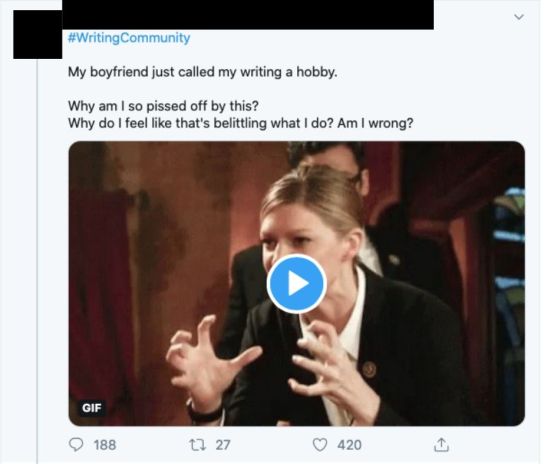
But when I take a little down time, I scroll Twitter, and the other day I came upon this tweet:

Untitled design

All the comments were along the lines of “what a jerk”, or “how insensitive”, or “why would he say something like that”?

My first instinct was to agree, because I know not everyone’s significant other is supportive. But then I thought, wait. And I responded, “That depends. Do you take your writing seriously? Are you writing? Publishing? Querying? He can only see what you let him see.”

He didn’t respond, but he’s not the first person who’s complained people in their lives don’t take their writing seriously. And sometimes I wonder why that is. Oprah says, “You teach people how to treat you.” I believe this 100%. If you don’t take writing seriously for yourself, you have no reason to be offended when others don’t, either.

You teach people how to treat you

Do you defend your writing time? Do you respect your writing time once you have it? Meaning, do you actually use the time to write and not play on social media or secretly watch Netflix? Do you turn down friends if you haven’t gotten your words down for the day?

How can you get angry at someone calling your writing a hobby if that’s how you treat it? When someone doesn’t take you seriously because you find reasons you can’t write, or you keep breaking self-imposed deadlines, or that book you say is coming and never does, can you justify being angry when someone calls you out on it?

What can you do to change people’s perceptions?

  1. Change your own perceptions. Treat yourself how you want others to treat you. If you want to be treated as a writer, you have to write.
  2. Be realistic. Sometimes we don’t have a lot of time. Maybe 1000 words is all you can do in a day. That’s fine. You don’t have to put out 12 books a year to be a writer, or six, or three, or even one. You can only do what you have time to do. But if you’re wasting the time you do have, that’s no one’s fault but your own.
  3. Stop breaking deadlines. Or don’t make them in the first place. You announce goal after goal on social media hoping for accountability. And then you break deadline after deadline, promise after promise. What does that do for you? What message does that send to people on social media? You have to be accountable to yourself before others will hold you accountable. Keep deadlines and promises for yourself. Stop letting yourself down and you’ll build up your self-esteem and confidence.
  4. Protect your writing time and respect the time you’ve been given. If you’re not going to write during the time you fight for, why fight for it? Train your friends and family to understand writing is important to you. Then act like it is. And show them results.
  5. Realize you don’t have to be a writer. It’s okay to want to do other things. If you’d rather go out with friends, or be a gamer, or read instead of write. It’s okay to write two hours a week or write 1000 words a month. That’s your choice, it’s your life. But you can’t be upset when someone calls your writing a hobby because that’s what it is.

You show people what and who you are by your actions. Writers write. They produce books to query and publish, and going back to the guy on Twitter, I have no idea if he’s querying, or publishes, or writes short stories for magazines, or nonfiction for Medium or anything in between. I have no idea if his partner is right or wrong. He never replied. In fact, I don’t think I even follow him.

The point is, everyone pointed a finger at his partner, and I wanted to bring attention to the idea that it’s not always the other person. Sometimes it’s you. And if it is, there’s nothing you can say to defend yourself because you taught them to see you that way, and only you can fix it.

You teach people how to treat you-2

This is one of the rare times I didn’t bring up money and writing (okay, maybe I did a little bit). Maybe that’s what his partner’s problem is–he’s not making money at writing, or like in my case and some of my friends’ situations, writing and publishing actually costs money. There’s not a lot you can say to someone who expects you to have overnight success (or any kind of success right out of the gate. Sometimes it takes years to find a foothold in this industry). All you can do is point out that without the work, there’s no success and hope that they accept it.

You teach people how to treat you-3

What are your plans for the rest of 2020? Land an agent? Publish a book? Do you have a big launch planned for this summer?

Get busy, and let me know how you do!

Thanks for reading!

If you want to read more articles on writing as a hobby, look here:

Writing: Is It a Hobby or a Job? by Brian A. Klems

Five Reasons Why Your Writing Matters (Even if No-One Will Take You Seriously) By Ali Hale


end of blog post graphic

Playing catchup and bending under pressure: a lesson in what not to do.

Hello, November!

Hello, everyone. Sorry I have been MIA. I think I did post last week, but I try to hit Mondays and this week was a fail. What have I been up to? Glad you asked!


Yesterday my proofer gave me back book one of series. He liked the story overall, and found some typos. I found some more running it through Grammarly, and I think it’s going to be as perfect as humans can make it. So, that’s book one down.

a rocky point wedding social media graphicWill I be able to start publishing near Thanksgiving like I hoped? Nope. I’ve decided I want him to read through all four and make sure they are consistent with details and plots. Waiting will make my life a lot easier if he finds anything. I could go ahead and start publishing because I’m hoping I would know if I left behind any giant plot holes, but I am not 100% confident in my abilities. I admire the authors who can publish books one by one in a series. I prefer to not chance it, but I should be able to start publishing before the end of the year, so I’m not that far off the mark. Editing always takes more time than I think.

Also, yesterday, I woke up in a lot of pain. My left shoulder blade and arm were hurting pretty badly. This could have been from all the typing I did on Monday since I transcribed the last of my SUPER SECRET PROJECT, and the final word count before editing came in at 80,500 words. Monday I transcribed to the tune of 6,000 words and that may have just been a little much.

But you know, I probably just slept funny. All those “after 40” memes are pretty accurate. Someone can look at me wrong, and my back will hurt the next day. Because aches and pains are going to be part of life from here on out, I try not to take too many pain meds and save them for the worst days. Yesterday was one of those days, and I took some before bed too, which gave me a decent night’s sleep. Except for the cats, of course.

I feel like my life is a box of clichés.


Anyway, this segues into something I’ve been thinking about.

We’re all under a lot of pressure. It’s something we don’t like to talk about. The pressure to create content, the pressure to publish. Especially in romance, the genre I write in. I haven’t published anything since May of this year, and that gap in a publishing schedule is practically unheard of (by authors who are making money). Never mind that in total this year, so far I have written four full-length novels and half of one that I started in December 2018.

We see authors cranking out content and we want to do that too. Sometimes we try. Sometimes we can, most times we can’t. This is a secret that I learned, and not that long ago.

You have no idea what is going on behind an author’s name. Or, more precisely, a pen name. You think, one name, one person. And a lot of time, I can’t say how many times because authors keep this secret pretty close, a prolific author name has two, three, or more writers behind it. It’s how they can crank out material so fast. We’re over here killing ourselves trying to keep up, and oh, look, a couple of top ten romance authors have two people writing the books.

I’m definitely not saying this is bad. If you can find someone who matches your style and you get along, hell yeah, collaborate. Why not? In fact, if you listen to any publishing prediction for any upcoming year, more collaboration is always one. Why? Because it’s smart. Why not share the work? Why not dominate in your genre if you can. Half of thousands in royalties is better than none, am I right?

But for those of us who write solo, it’s very deceptive. And it can be dangerous.

Another thing you have to watch out for if you’re comparing yourself to prolific writers is what the word count of their books is. Yes, they are writing full-length books, BUT, if you look closely, you’ll see that their catalog is peppered with novellas, novelettes, and even short stories. Lots of those are “add-ons” or “companions” to the full-length book, and it’s a fun way to give readers a little extra. But you do have to keep in mind that counting an author’s titles isn’t a fair way to compare how much time they spend writing versus how many books they have published.

I could publish two novellas a month if that how I wanted to build my backlist. For now I’d like to continue to offer my readers full-length novels of 70+ thousand words. You have to do what’s best for you and the readers you want to attract.

If you’re going to have comparisonitis, at least be smart about it.

Having passion and working hard at something doesn’t have to be a bad thing. When I used to run, I would run injured all the time. Anyone can tell you that’s bad, and it just sets you up for more injury. But whether it’s bad or not, it’s common. Runners even have memes about it:

runnign while injured

There are a lot more than this one, but it depicts how runners really feel about taking time off to relax and heal.

Writers can be the same way. I am very passionate about my SUPER SECRET PROJECT. It was fun to write, and I don’t feel like I was racing to get it done. It’s book one of a trilogy, and I probably won’t be able to release them until early next year when my series is out. Why was it so important I finish it so quickly?

zane and stella stats


Who knows, except, again, it was fun. But I could have afforded to go a bit slower, just to take better care of my health. Mental and physical.

There is pressure to publish, and to publish quickly. We scramble because it feels like other writers are gobbling up pieces of the reader pie and there won’t be any left by the time our book comes out.

The indie publishing space is drowning in books. But hurting yourself and making yourself burn out isn’t the way to make a grab for your piece.

Hello, November! (1)

I’m going to try to be more mindful of writing time. If I have twenty pages to transcribe, I have to remind myself it’s not a race to get them typed up.

Take care of yourself and don’t bow under the pressure. Especially with the holiday season coming. Sometimes you won’t have time to write, and that’s okay. Take a rest, tolerate enjoy your family, and eat a piece of pie while you watch TV. Just be mindful of what your goals are!

I’ll end with that for now. It’s early here yet, even though it’s pitch black outside. I have time to edit for a few more hours.

Just kidding!

No . . . I’m not. 😀

Have a great week everyone!


end of blog post graphic


You Can’t Have Something New if You Don’t Try Something New.

I’ve thought about this a lot in this lately. I see lots of posts from people who give themselves permission to not be uncomfortable. And I respect that. It’s tough being uncomfortable. You don’t feel good, it can make you have an anxiety or panic attack, it can make you physically ill. There are certainly bad kinds of uncomfortable. You don’t want to force yourself to be around someone you don’t like, or who gives you bad vibes. You want to listen to your gut, your intuition, and if it’s telling you to get the f*ck out of a situation, you do it.

But there’s something to be said for being uncomfortable. You can’t have something new if you don’t try something new. And let’s face it, trying something new is usually uncomfortable.

You can't HAVE something new, if you don't TRY something new.

You sit outside a building because you’ve never been in it before and don’t know where anything is. You sure as hell don’t want to go inside and make an ass of yourself wandering around. You wait outside a new meeting spot until you know a friend is already there so you’re not first to arrive and you have to sit by yourself.

A lot of people asked me if I was nervous going to that book signing a couple weeks ago. To be honest, no, I wasn’t.  There was the potential to be, sure. Who wants to drive fifteen minutes away, go into a conference center they’ve never been in before, set up all their books, and talk for six hours about their work to strangers, and hope they buy your books? Who the hell needs that when there’s Amazon, right?

I wasn’t nervous because I have a degree in Human Resources, and setting up for that book signing picture3book signing felt exactly like sitting at a table at a job/career fair. I did that a lot. A lot. On both sides of the table. I was used to standing, holding out my hand, making eye contact and, yeah, speaking. (Gross.) If I didn’t have two years of that behind me, I probably wouldn’t have gone.

But that’s the point of this blog post, too. Giving yourself permission to skip things because they make you uncomfortable won’t help you get anywhere. If I had let myself do that, I would have skipped the writing meeting where I met the woman who asked me to participate in the book signing in the first place. Let me tell you, the Monday evening we met, I was a nervous ball of energy, and I didn’t write all day.

As writers and authors, we’re going to be asked to do things that make us uncomfortable. If we strike it rich (and even if we don’t) we’re going to be asked to speak at panels, and give talks. Go to book signings, speak about our craft, our journey. We’ll be asked to encourage others, help others on the same journey.

While it’s okay to give yourself permission to avoid things you don’t want to do, keep in mind all that you’ll be missing if you can’t take that leap.

Many of us are afraid of change. We don’t want to find a new job, or we stay with a partner we may not even really like because breaking up is too hard. We don’t find a new apartment because moving sucks.

So think about what that means the next time you give yourself a pass, or encourage someone to skip something because it’s not what they want to do.

You can’t miss what you never had, but you may never have another opportunity.

1593399-Bobby-Unser-Quote-Success-is-where-preparation-and-opportunity

I really like this quote. Not only do you have to be prepared, but you have to be ready to take a leap, take a risk. An opportunity can present itself, but if opportunity is knocking, you have to be able to open the door.


public speaking joanna pennJoanna Penn has a new non-fiction book out about public speaking, called, well, Public Speaking. Public speaking sucks, and as authors, every once in a while we’re going to be asked to do it. Give a talk, participate in a panel. Even if we’re sitting in a writing group and we’re asked what we’re working on, you could have 2-10 pairs of eyes on you, listening to what you have to say.

You would think as writers all we would be asked to do is sit in a dark room and pour our hearts out into our laptops. This isn’t the case, unfortunately.

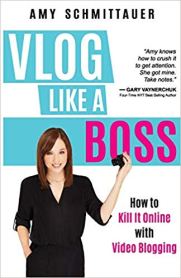
vlog like a bossAnother book that can help us put our faces out there besides Joanna’s public speaking book is Amy Schmittauer’s book, Vlog Like a Boss.  In it she gives out really great information on how to vlog, what to vlog about, and how to present yourself. It’s a good resource if you’re thinking about starting to put your author face out there!

Joanna’s public speaking book is also pretty cool, and since she’s been speaking forever, she knows what she’s talking about. I would recommend giving both these books a try.

Being uncomfortable sucks, but if you always give yourself a pass, you may never know what opportunities you’ll miss.

What have you done lately to step outside your comfort zone? Did it pay off?

Let me know!

nohting changes if nothing changes


end of blog post graphic

October is Prep for NaNoWriMo. Why I don’t participate.

Fall in Minnesota is my favorite time of year. The temperatures cool, the leaves start to fall, and the bugs die. The last is very important to my well-being. Haha. Seriously though, we get a couple sweet weeks of no bugs, and mild enough temperatures that you can still enjoy time outside.

I went for a walk with my sister last night, and the latter half the walk was in the dark since the sun sets so early now. But we saw a couple deer, lots of rabbits, and generally had a nice coffee walk in about 48F degree temperatures.

nanowrimo logoOctober is also NaNoWriMo prep month. It’s the month when writers who are going to participate in National Novel Writing Month plot their books, do their research, make character sheets, anything they have to do to write their book as quickly as possible in the month of November.

I participated once. And while I was a newbie writer at the time and that was probably more of the reason why I wrote a crappy book, doing so on a timeline didn’t do me any favors, and I’ll never participate again.

But that’s not the only reason. Everyone needs to make their own choices with their writing schedule, their publishing schedule, and what they want to accomplish, but let’s take a moment to go over a couple reasons why NaNoWriMo may not be an answer to a writer’s prayers.

  1. Craft gets lost.
    If you have the motivation and skill to write 50,000 words in a month, you don’t need the the contest to spur you on. If you’ve got the craft thing down already, maybe craft doesn’t get lost when you write, and that’s great! But there’s always a question of quality when a writer who is new at this decides to participate. You don’t have time to think about how sentences sound, where your paragraphs are going, if your scenes are relevant to the story, what the theme of your novel is. Writing is already hard enough as it is, and putting a deadline on it makes it worse.
  2. Lots of writers will abandon a current project to start something new.
    This is a tough one because not everyone writes to publish or query. I’m not the type of person who likes to have three different projects open. I adhere to writing and publishing schedule. It’s the only way I can make any headway at all. Dropping everything to start a new project to write for NaNo would derail everything I’m trying to accomplish. I get distracted by new things, too, but I try to keep that under control and finish my current projects. I don’t think I’d have as many books out as I do if I let myself write whatever I wanted whenever I wanted. I understand not everyone is hardcore about this writing thing as I am, and that’s okay. But 30 days of writing something new is still 30 days of time, and in 30 days I can do a lot that will actually move me toward my goal.
  3. It makes us question what a “book” is.
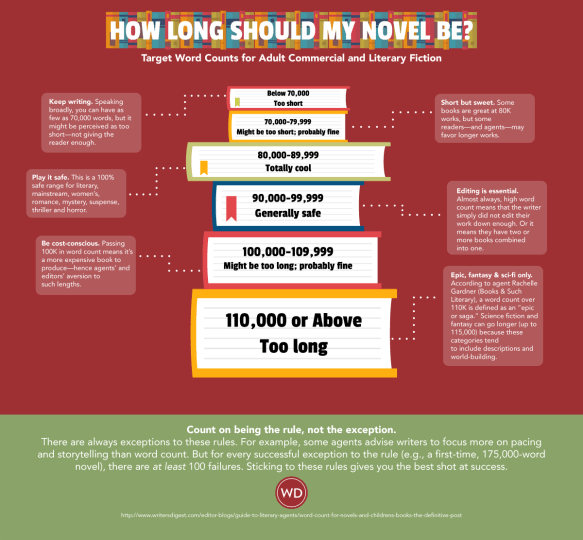
    Let’s be honest. I mean, really and truly honest. 50,000 words, in most genres, is not a novel. It’s a good start to a novel, say, in high fantasy, or women’s fiction, but for the most part you can “win” and still not have a finished book.

    how long is a novel graphic

    Click on the graphic to read the corresponding article by Chuck Sambuchino at Writer’s Digest.

    If you have trouble with subplots and character development while meeting the ideal word count, I don’t recommend trying to write under a deadline. Not always, but you can run the risk of having a full “novel” in word count, and it being incomplete in other ways. This is especially important if you ever want to query this book. Fully-developed plots, subplots without loose ends, full character arcs, and a spot-on beginning and ending are all things agents are going to require to sign you and your book.

  4. You’ll probably have a lot of editing to do afterward.
    This is a personal preference, of course, but I would rather spend a little more time writing and a less time editing after the fact. Editing is hard. Especially if you have to rip the book apart because you wrote yourself into a corner and there’s nothing that will fix it except scrapping the second half of your book, for example. Weaving character motivation and character growth into a book is hard enough as it is without having to go back and fix scenes.
  5. You shouldn’t have to depend on the NaNo energy to see you through a project.
    Most writers I know who participate, participate because they like the energy and the camaraderie. It’s why they do NaNoWriMo camp in July. They like to write with the buddy system, someone who will hold them accountable. The problem with this, though, is that NaNo is only once a year (besides the camp that’s held in the summer). What are you going to do during the other 11 months the contest is not going on? Writing is a solitary endeavor, and if you don’t get your butt in the chair and put the words down, if you can’t do that without a competition, well, I don’t have to tell you your productivity is going to tank. In my very humble opinion, striving for your own writing success, be that publishing yourself on Amazon or other platforms, querying, or whatever the case may be, that should be your fuel. Not a contest.
  6. What could your book be like if you hadn’t written it in November?
    We all have regrets when it comes to our writing. We write through sickness, or when we have a family emergency. Sometimes it’s what gets us through. I wrote through my divorce, I wrote (when I shouldn’t have probably) while I was healing from surgery. I wrote through one of the nastiest winters I have ever seen in Minnesota, and it happened to be the first winter I was a single mom. I have to admit, I write the best when I’m happy, when I’m not stressed out. When I can enjoy sitting at my laptop and not think about anything else but the story.
    We often say “let children be children” but sometimes we need to let our “books be books.” What I mean by that is, you may be doing your characters and story a disservice by rushing them. What could your book be if you write it organically? We meet word counts every day, but I’ve never preached you have to write every day. Sometimes that’s impossible. Sometimes you simply don’t feel like it. To reach 50,000 words in the month of November you need to write 1,666 words a day. That isn’t too bad, in all reality. But I know for me, November is a packed month: my daughter’s birthday, my birthday, Thanksgiving. We may have snow by then. Then there’s Black Friday shopping if you’re inclined to get a head start on Christmas shopping. It’s not hard in November to realize you haven’t written for a few days, and you’re behind. What kind of book could you write on your own time? 

I don’t see NaNo as some evil thing that writers shouldn’t participate in. I think it can be fun and motivational if used correctly. The month of November can be used to celebrate writing and books in general. There is a camaraderie just being a writer. We’re all in this together, and one month designated to writing doesn’t change the fact that we all enjoy writing every day. We don’t need one month set aside to enjoy it.

I create all year round. I’m involved in a lot of Facebook groups. I edit for my friends; I help them with formatting. I celebrate the writing and creation of books all the time. I don’t think a month goes by when I haven’t bought a book or ten. What I suggest you to do is harness how you feel in November and keep that momentum going all year round.

How do agents feel about NaNo? Here are a couple articles about their opinions. (Hint: it’s not a coincidence agents close their slush piles to submissions in December and January.)

An Agent’s Take on Nanowrimo by Fuse Literary

Better yet, DON’T write that novel
Why National Novel Writing Month is a waste of time and energy

Did You Win NaNoWriMo? Let Agent Eric Smith Guide You Through Your Next Steps!
Leah Schnelbach

How do you feel about NaNo? Are you going to participate? Let me know!


end of blog post graphic

The “As you know, Bob . . .” Syndrome. What it is and why you should stop it.

as you know bob

I didn’t feel like being on social media last night, and I didn’t feel like writing more. It was a bit of a busy day, and I had felt off all day, too. I got in 2,000 words, and that was fine being I had done 5,000 the day before. Not all my days off can be high-output days, and I realize this as long as I keep moving forward at a pace I’m comfortable with.

Anyway, I decided to hop on my Kindle and see what is out there by way of contemporary romance. Maybe find a another book to read, since I finished my last one, Next Girl to Die by Dea Poirier.

I downloaded a sample of a romantic suspense, and like everything else indie these days in romance, this was written in first person present. But that wasn’t what bothered me. (Okay it did, but I already roared about that in a previous blog post.) What bothered me was that the first scene started as an “As you know, Bob” scene and it gave the book a horrible start.

What is an “As you know, Bob” scene? It’s a scene were characters are sharing information with each other that they already know, but they are talking to fill the reader in.

The dialogue in the scene I read sounded like a biography because one character was telling her best friend all about her boyfriend. This is so unrealistic and implausible. If they are best friends, share everything, and talk on a regular basis like the scene implied, the BFF would already know about her friend’s boyfriend. It was obvious the scene was written to introduce the reader to facts about the boyfriend, and it slowed everything down to a screeching halt. I managed three page “flips” before closing out the book and deleting the sample from my Kindle.

How do you avoid an “As you know, Bob” scene? Here are a few ideas.

  • Ask yourself if the characters already know the information they are talking about. If the answer is yes, then you don’t need the scene, or give them something different to talk about. Dialogue is designed for characters to pass new information on to each other, not go over things they both already know. As a writer how do you know you’re doing this? When you get lazy and your characters start saying things like, “You’re so forgetful! I’ve told you this a thousand times . . .” Or “I don’t know why I have to keep telling you this over and over again . . .” Sure, sometimes we do forget things in real life; sometimes we do need a little reminder here and there. But a girl’s best friend won’t need a refresher course in a current boyfriend.
  • Find a different way to introduce the character.
    It was obvious this scene was to introduce the boyfriend. But instead of a whole dialogue scene about said boyfriend, how about waiting until the boyfriend needs to show up? He’s going to be part of the story, the blurb said so, so why feed us backstory right then? Why write a scene that has a character saying “Well, you know my boyfriend is a multi-millionaire. He started his company from scratch in his mother’s basement and only two years later sold it to Facebook for a hundred million dollars. Now he’s partying all over town and treats me like a queen!” When you could wait and actually have the MC meet him:

    So this was Jasper Hargrove, the famous boyfriend. Self-made millionaire and creme de la creme of Manhattan society. Pictures in the tabloids didn’t do his face justice. He looked like he stepped out of a Hugo Boss photo shoot and smelled just as good.

    Feeding readers information in real time will always sound better.

  • Ask yourself if the information is even needed.
    What you think your readers should know and what your readers actually need to know are two different things. Sometimes the best information is no information. Let your readers fill in the gaps on their own. Do we need to know the boyfriend is a self-made millionaire, or that he created a start up living in his mother’s basement gorging on Doritos and Mountain Dew? Is it enough to say he’s a millionaire?  Sometimes a little mystery can go a long way.
  • If the information is needed, can your reader find out about it in a different way?
    Maybe the MC reads an article about him in the paper, or an industry magazine. Maybe she’s watching TV and a news clip comes up. You don’t need much. The scene that lasted three pages? That could have been condensed into a couple of lines.
  • Read the scene aloud or have Word read it to you and be honest. Does the conversation sound like crap? Does it sound unrealistic? Think of the characters and who they are. The scene might have worked if the friends were getting reacquainted after being apart for years and years. But even then, the boyfriend and the friend were going to be key players in the book. An info dump disguised as dialogue is still an info dump. If there’s not any new information being passed along to either character, if the scene isn’t offering anything new, if it isn’t moving the plot along, then get rid of it. It does take a lot of practice at successfully dropping backstory into a novel, but I’m finding less in this respect is always going to be more.

Thanks for reading!


Have never heard of “Well, you know Bob . . .” Syndrome? Here are a few more articles about it:

The Sneaky Secret Life of “As You Know, Bob…” by K.M. Weiland 

As You Know, Bob: Info dumping in dialogue by Erica Ellis

Do You Have “As You Know, Bob…” Syndrome?–How Writers Can Butcher Dialogue & How to Fix It By Kristen Lamb


end of blog post graphic

Writing to write, or Writing to Publish? Is there a difference?

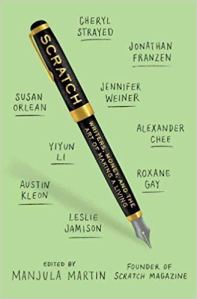
I had another post planned for today, but while I was working an extra shift at my job on Saturday night, I finished Scratch: Writers on Money and the Art of Making a Living. This book is a collection of essays by writers about, yeah, money and writing.

scratch book coverAs an author, I love looking through paperbacks. How is the copyright page constructed? Who did the author dedicate the book to? I skim over the table of contents. Do they use a quote? And by whom? I also look at the Acknowledgements. I like to read who people thank. In the indie world, sometimes I know a person who is mentioned. I like seeing who has helped the writer turn author.

I read Manjula Martin‘s acknowledgments, and something popped out at me. She said:

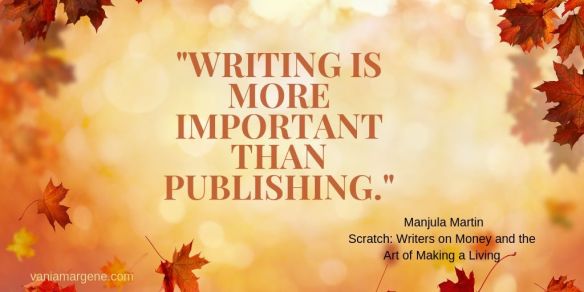
Thanks to the members of the Blood Moon writing group, who always reminded me that writing is more important than publishing.

She goes on to list names of people whom I don’t know, but I can appreciate their message.

writing is more important than publishing

In this modern time of CONTENT CONTENT CONTENT, that sentence is extremely powerful.

In this age of free books, blog posts, tweets, and author updates, how often we publish has turned more important than what we publish.

This has never been more true than the today with the market being saturated with bookstuffers to take advantage of KU page reads, or authors who team up to publish a book every two weeks, or authors who hire ghostwriters only to blame them when they are caught plagiarizing. There are even those who sell their previously published books to new authors who will strip the book of its title, repackage it, add a new author name, and put it up on Amazon for sale.

What happened to the quality of what we publish?

What has happened to the way we think about our content?

It’s a hard question for me, and I’ve been thinking about this while I’ve been writing my series. I have a different blog post about something similar already, in that I would like to try my hand at women’s fiction. I won’t get into that post now, but that quote does make me think about my publishing journey.

Sometimes publishing isn’t always what we should be doing with our work.

Sometimes we should be writing to practice. Sometimes we should be writing to learn. Sometimes we should write to give ourselves therapy, like writing in a journal or diary, or writing a poem.

Sometimes we should write for fun.

Sometimes we shouldn’t be writing at all. Too busy, burnout, nothing to say. There’s no harm in not writing–even if it feels like there is.

Though indie publishing is becoming more widely accepted (even some of the big-name authors use POD–especially for their non-fiction titles) it may always carry the stigma of people publishing crap.

There are legitimate reasons to write to publish: you’re on a deadline, or you freelance to pay the bills and if you don’t hustle, you can’t eat. But that doesn’t feel like the majority of my writing peers. We write to be published as any of our debut novels can attest.

This not only impacts our own writing careers–who wants to start a lifetime writing career on a cracked foundation?–but if affects all of us a whole.

Write to write, and then publish.

writing is more important than publishing (1)

Lots of people ask writers, “If you were never read, would you still write?” Of course most writers say yes. Writing is a passion, and they would write even if they never had another reader as long as they put words on the page. To be honest, if someone told me from here on out I wouldn’t have a single reader ever again, I would stop writing. There are other ways for me to communicate my passion. I would start running again, or I would volunteer. I would do what I set aside because writing takes up so much of my time. Because I love it. But an audience fuels my love of it, if that makes sense.

Now, if I were told I would still have readers, but I wouldn’t/couldn’t make any money, I would still write. If I was locked into only blogging, or publishing my work on Wattpad, I would still publish my stories. Being read means more to me than making money.

Seeing your book on Amazon is a crazy wonderful thing, and I don’t fault anyone who is damned proud of it.

But sometimes we need to take a step back and ask ourselves why we write. What fuels us? What do we get out of publishing our work? Would we be just as happy, just as proud, if we posted that novel for free, or even more mind-numbing, shoving that novel under your bed?

If we began every project without thinking of the cover art, or who is going to format for us, or when our publishing date is (Hello, Amazon and your one year pre-order deadline now) how would that change our perception of the project? Would we take our time? Put more of our hearts into the piece? Would we dive deeper into the truths of what we want to put down on paper?

Maybe if we wrote to write, writer’s block would be obliterated. After all, if we only wrote for ourselves, we wouldn’t fear criticism or disappointment and the blank page wouldn’t scare us so much.

When indie-publishing is so easy now, we have to stay aware of why we’re writing and what we’re trying to say to our reader.

Open a new document and put words on the page just to write. No agenda. No deadline.

You may find you’ll write something worth publishing.


I loved reading Scratch. There were great essays by some of the top authors. I particularly enjoyed Manjula’s interview with Cheryl Strayed (she talks about her book deal for Wild), and Jennifer Weiner’s essay on earning respect for your work vs. earning money and if you can have both.


Jeff Goins also has a blog post about this topic. You can find it here.


Until next time, lovelies! Have a wonderful writing week!

end of blog post graphic

Changing your Point of View: How you write, and thoughts on 1st, 3rd, past and present tense

change pov blog post

Change comes whether we want it to or not. Sometimes change happens so slowly you don’t know it’s happening. Sometimes you’re not paying attention and the old way you’ve taken for granted is suddenly gone.

This happened to me, though I think I was more in denial this was happening than embracing the change. Maybe I was hoping it would go away, or maybe I was hoping the old way would hang in there. The latter may still have a chance, but the former isn’t going to happen.

What am I talking about? The way fiction is being written. Not even by indies, as this change has been happening with the traditionally published books in the past couple of years as well.

To explain, let me go back.

Like all writers, I grew up reading. Nancy Drew, The Babysitters Club, Sweet Valley High. Slowly, I graduated to Sweet Dreams romances, VC Andrews and Harlequin Desires and Temptations.

And looking back, I realize there is one thing all those books have in common–they were written in third person past tense.

It stands to reason then, that when I began writing my own stories, I too, wrote in third person past since I grew up reading it. Never would I think this way would become outdated, but I’m afraid that it has.

Now books today are written in first person present, and that doesn’t seem like that’s going to change any time soon. Take a look at any new book, especially a romance in Kindle Unlimited, and you’ll see what I mean. I liken this to how Mike Campbell loses all is money in the The Sun Also Rises by Ernest Hemingway:

“How did you go bankrupt?” Bill asked.
“Two ways,” Mike said. “Gradually and then suddenly.”

It seems as if first person snuck up on us, and then suddenly it was everywhere.

And as a writer who writes in third person past, this is troubling because this isn’t about catching a trend or even writing to market, it’s about adapting to change as not to be left behind.

It used to be first person, be it past or present, served one purpose–the sole reason why the writer chose to use first person when writing their novel: to tell the story of “I.”

change pov blog post2

Who was the “I?” A girl with magical powers? A young boy out to seek his fortune? The author chose that way as a device to tell that ONE person’s story through their eyes. Middle grade and YA were (are) written in that fashion so the young readers could more easily envision themselves in that role.

I can’t remember the first person book I ever read–and I must have read some; they weren’t non-existent as I was growing up, but they obviously didn’t make an impact on me. And when I was a young adult, and now a “real” adult myself, I don’t read much YA.

And maybe this is the point.

I’m outdated. At forty-four years old, I’m writing in a way that is being used less and less, except by the authors who have been writing for as long as I’ve been reading. Nora Roberts, Brenda Novak, Robin Carr.

When you read and enjoy first person books, that is what you’ll probably write. Books like the Hunger Games, Twilight, 50 Shades of Gray took the lead of a style of writing that is prominent now. You may be shaking your head, but think to when those books were written and how popular they were. The first book in the Hunger Games Trilogy was published in 2008. Twilight, 2005. Divergent, 2011.

I’m an old lady.

When thrillers and romances are now being written in first person (and present, too) where do you fit in if you like to write in 3rd person past tense, or even 3rd person omniscient?

I write contemporary romance, and when others who write in my genre use first person, it confuses me. There is no “I” in contemporary romance, there are two characters. His and hers. Or his and his. Or hers and hers. Depending on what you write. There is no single “I” on a journey to a happily ever after. Writing a two-sided romance using first person, to me, defeats the purpose of using first person.

Is this an old way of thinking?

Some of the greats still use 3rd person past, Nora Roberts holds true. So does Susan Mallery. Brenda Novak still does, and Robyn Carr as I mentioned above. The Harlequin lines, though they are going through some rearranging at the moment, still seem to publish 3rd person past romances, at least their little pocket romances like their Intrigue and Desire lines.

And to really confuse me, authors are starting to use a mix of points-of-view, and what’s even more mind-numbing is that it’s becoming popular, like The Mister by EL James. Maxim tells his story in first person present, but Alessia shares her story in third person present. I would love to ask Erica why she wrote it this way.

It seems like these days authors use POV as an artistic tool. Does it work, does it not? I have no idea. They say anything that takes your reader out of the story is bad. But what is bad is subjective.

Dark Places by Gillian Flynn tells two stories. One story is present day and written in first person past, the other story took place while the female main character was a child and it’s told in third person past. She obviously choose this as a stylistic choice. Does being with the “I” character makes us feel more intimate with her? I don’t feel it would have changed the story much had she written the present day timeline in third person past. But with the popularity of her books, no one seems to mind what tense she chooses.

Have I had any complaints when it comes to my third person books? No, not that I’m aware, but nor would I know how many sales I’m either gaining or losing because of my choice.

So what is a writer to do? Keep writing in a style you like and are good at? Practice a different POV? I’ve tried writing first person present, and I liked writing it as much as I like reading it, and that’s to say, none.

And I will always believe writing a romance in first person POV when the author intends to show both sides of a relationship doesn’t make sense, and you can pry my opinion out of my cold, bloody fist.

change pov blog post3

But it’s obvious that what is coming out by younger romance writers that my viewpoint is not shared, and it’s not shared by their readers, either.

We need to adapt with change, though. When will my dislike turn into simple stubbornness? And when will that stubbornness keep me from reading books I may otherwise have enjoyed? I can’t be an old curmudgeon waving my cane hollering “3rd person past” at every writer I meet.

Point of view can bring on choices that you need to make besides just how you want to write your book. If there’s an “anything goes” with what’s between the covers, our blurbs and ads need to reflect that. Blurbs have always been written in third person present. Some unspoken, unwritten rule has ordained this since the beginning of time, and it didn’t matter if your books were written in first, third, or alien.

Now though, if your book is written in first person, blurbs are changing to reflect that. The first book I grabbed off Amazon that is self-published and in KU happens to be written in first person past and the blurb is also written in first person. Maybe a coincidence, maybe not. Is this how blurbs need to be written now? When did the rules change, and where do you read them in the updated Author Handbook?

What about ads? Ad copy isn’t the same as writing your book, though blurbs and ad copy are cousins, I guess. Ad copy is supposed to be snappy, hook your reader into buying the book. If you sell a book with snappy first person ad copy, but your book is written in third person, will that go over well with your reader?

I have no idea. You’ll hear it in reviews though, guaranteed. Or at the very least, wasted ad money for clicks that don’t turn into sales.

Looking at “how it always used to be done” may not help in these quickly changing publishing times. For another look at how to write blurbs and in what POV look at this blog post by Writer Unboxed. The author of the article mulled it over a lot more eloquently than I did. Marketing Copy: The First- Versus Third-Person Debate


I’ll keep writing in 3rd person past. It’s how I write best.

Write how you write at your best because after all, it doesn’t matter if you write in first, third, or alien, it comes down to giving your readers a good story.

But I caution you using POV as a stylistic choice to cover up lazy, or poor, writing. If you’re going to experiment, make sure you have plenty of betas on hand to tell you if it’s working or not.

You can do whatever you want to do with your book, but you still want people to read it too. Even aliens.

change pov blog post4

That was some really bad Sunday night humor. And with that I am going to bed. I hope you all have a lovely week of writing ahead!


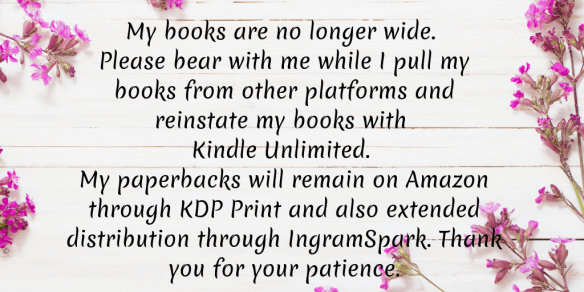
thank you for your patince

graphics made with font and photos from canva.com

A Snippet of Book One of my new Wedding Party Quartet

Series sell. Readers get invested, and that can mean the world to an author. Personally, I prefer to write standalones. Maybe because for now, I prefer reading them, too. But I recognize the value in writing a series, and after writing three stand alones,  I planned out a four-book series consisting of full-length novels.

I’m going to write them, edit them, format them, design the covers and drop them all at once. Risky, perhaps. But there are authors who swear by rapid release, and for consistency reasons, I would finish them all before publishing them, anyway.

Because I said I would update you as I write them, here is the first couple scenes of the first book. This was originally the second book in the series, but I felt it was a stronger start. The second book will need a bit of fluffing up, but nothing too terrible, and I’m looking forward to adding to the plot as I learn more and more about my characters.

Book One is about Callie Carter and Mitch Sinclair. Mitch has been in a horrific accident that has left him scarred, both physically and mentally. Callie has been under her father’s thumb for many years and accepted an offer to be a bridesmaid for a chance to breathe and figure out her life. Little did Mitch and Callie know that Marnie Zimmerman and James Fox’s nuptials would be the catalyst for such significant change.

Enjoy this small, kind of edited, excerpt from the first book of the Wedding Party Quartet. It doesn’t have a title yet, but that’s just one more thing I’m working on as I write. 🙂


“You’re here!”

Callie Carter tugged her suitcase into the Rocky Point Resort’s lobby as Marnie Zimmerman’s shriek zinged across the room.

“I told you I would be, but my dad didn’t make it easy,” Callie said, easing her case to a stop in front of the registration desk.

Marnie frowned. “You deserve the break.”

Callie set her purse on the counter next to a display of resort brochures. “No one knows that more than me. I had the time, and there wasn’t anything he could do about it.”

Her father didn’t believe in taking a break. Horace “Ace” Carter didn’t believe in down time. Rest. Taking care of her emotional health, her physical health. He believed in getting the job done. And for the past ten years, she had. But rubber bands, stretched too tightly, eventually snap, and Callie was almost there.

“I’ll make sure you have fun . . .” Marnie said, linking her arm through hers while the agent ran her card and handed her a small stack of papers.

“Here’s your key, Miss Carter,” the desk agent—her nametag read Sophia—said, handing her an honest-to-goodness key attached to a maroon keychain with the gold Rocky Point Resort logo stamped into the plastic. “You’re in room two-thirty-one, next door to Marnie and James.”

“. . . Starting tonight.”

Callie pulled her suitcase behind her. She’d left a few dresses hanging in her car, and she’d have go to back for those later. “What’s tonight?”

“I planned a get-to-know-you dinner. Jared is picking up Leah in Marengo, and she’ll be here this afternoon. I can’t wait for you to meet her. Hell, I can’t wait to meet her!”

“You are positively giddy,” Callie said, laughing. She stopped at the base of the short set of stairs that would take them to second floor. Purse hanging from the crook of her elbow, she hugged Marnie. “I’m happy for you.”

Marnie hugged her back so hard her spine cracked. “I am happy, and I’m happy you could be here.”

“I wouldn’t have missed it.”

She’d been honored when Marnie asked her to be a bridesmaid, and hadn’t thought for a second about saying no.

Standing outside Callie’s door, Marnie said, “I know you want time for yourself after that long drive. Take a bath, order a bottle of champagne, whatever you want. We’re meeting downstairs for dinner, and you’ll meet everyone then. I’m so excited!”

Marnie’s platinum blonde hair shimmered in the fluorescent lights, her pin curls, thick red lipstick, and clear skin giving her a Marilyn Monroe glow. She even had the curves to go with it, and Callie had always envied Marnie her softness.

Callie worked out seven days a week, three-hundred and sixty-five days a year. She had to. It was part of her job. Speaking of . . . she might be on vacation, but she still needed to workout. “You said the resort has a workout facility?”

“Yep,” Marnie said. “It’s downstairs by the pool. It’s not as big as the set up in your basement, but it will work.”

“Thanks. I’ll see you tonight, then.”

Callie didn’t feel the need for a bath, but a light nap sounded divine.

She let herself into her room and tucked her suitcase into the closet. The room smelled like any hotel room she’d ever stayed in: air freshener and the scent of recycled air.

A huge gift basket sat on a table tucked under the window that overlooked a thick swatch of trees. A brochure said there were woods to the west, the lake to the north, ski slopes on the east side of the building, and the town of Rocky Point on the south side. The resort offered quite a few amenities, Callie noticed, skimming the resort’s brochure. Maybe she would try her hand at skiing while she stayed there.

Callie washed her face in the sink and dried her skin with the bleached white hand towel. She hung it on the bar over the toilet and frowned at the water pooling at bottom of the bowl. “That’s great,” she muttered.

She needed a working sink. If all the pipes were connected, the bathtub might be affected, too, and she wanted to be able to shower in the morning. Or tonight after dinner.

“I need maintenance,” Callie said, using the landline phone on the nightstand to call the front desk. It wasn’t that late in the day, and she hoped someone would be able to come by her room soon. “My sink is plugged and won’t drain.”

She recognized Sophia’s voice. “We’ll have Mitch up there right away.”

“Thank you.”

Callie should have asked to be transferred to room service but she didn’t want to call back. She could save her appetite for dinner, and even though she was on vacation, she shouldn’t give in to wanting to drink too much. Her father told her she needed to be in control at all times. What if someone needed her? He always had an example at the ready of a time when he’d been able to help someone.

Service was a calling.

Ace Carter spoke of their occupation as if they were ministers or missionaries.

And he expected her to behave as such.

But why did being responsible mean she couldn’t have fun?

Someone knocked on her door, and she pushed the thoughts away. This was supposed to be vacation. A break. She’d fought hard for it and won.

Callie opened the door expecting an older man, balding, wearing a t-shirt and stained overalls carrying a red battered toolbox, and she blinked in surprise at the man a few years older than she standing in the hallway.

Her gaze traveled from his dark brown hair to his green yes. Slim, but strong, with the way he carried an enormous toolbox.

He shifted slightly, and asked, “Did you need maintenance?”

The right side of his face and neck made her hide a gasp behind her hand.

Through the crackling of heat in her ears, her mind whispered, fire.

***

Mitch was used to the wide-eyed stares, the stunned silences, the pity and the sneers. He’d become numb to it, and he ignored the shocked gasp the woman emitted when she saw the right side of his face and the scar that started at the top of his hairline and rippled down his temple and cheek, across his jaw, and into the neckline of his work t-shirt. It spread farther than that, but besides doctors and nurses, few had seen it, and Mitch intended to keep it that way.

“Maintenance?” he asked again.

She moved her hand away from her mouth. “Y-yes. The sink in the bathroom won’t drain.”

“I’ll take a look.”

When she didn’t move, he reached out a hand to nudge her from the door, but she flinched away.

So this was the way it was going to be. When he’d taken the job, the manager of the resort, Desiree Arnold, told him not to put himself into situations that could cause trouble for either party. If he felt the need to have someone with him while he did repairs, then that’s the way it would be. When she offered him the job, Desiree hadn’t brought up his scars at all, but Mitch didn’t need her to point out the obvious. He looked a hell of a lot scarier with his scars than he’d look without them.

“Would you like me to call Sophia and ask her to sit with you while I fix your sink? Or would you like to go to the bar and have a drink while you wait? It’d be on the house.” He carried vouchers in his toolbox to offer guests who didn’t want to be alone with him. A free drink to get them out their room so he could work in peace.

No one turned down free drinks, and her refusal took him aback.

“No, it’s fine. I’m sorry. You took me off-guard.”

“I usually do that to people,” he said mildly, stepping into her room. Before he shut the door, he asked, “Are you sure?”

And that question took him back to the last time he’d tried to make love to a woman. She’d been adamant she could handle the scars.

But it turned out she couldn’t, and he’d never tried again. With anyone.

She nodded. “I’m fine. I, ah, washed my face, and the water didn’t go down.”

“Sounds like an easy fix.” And it did. He’d spent the past seven years as the resort’s maintenance man, drawing on his own experiences fixing things around the house with his dad. Desiree, being in a jam when the current maintenance man quit unexpectedly due to a heart attack, had hired him on the spot, making it clear it was probationary. But there hadn’t been anything in the resort he couldn’t repair. His three month tryout ended with a pay raise and a small room with a twin-sized bed. Mitch didn’t need to stay there, but Desiree liked having on-site maintenance twenty-four/seven, and he didn’t have anything else to do.

The sink sat inside the spacious white-tiled room that held the bathtub, shower stall, and toilet.

Last month, Desiree had warned him that several of his old classmates would be trickling in for Marnie Zimmerman’s wedding and they would be filling the resort for two weeks. At the time he’d wondered why she’d bothered to say anything. It wasn’t like he’d never worked with a full resort before. The resort brought in tourist dollars for Rocky Point, and Desiree and her sales manager worked harder than anyone he knew to keep the rooms full all year round.

It was only after, while he thought about their conversation over a tuna sandwich, that he realized what she’d been getting at.

He didn’t recognize this one though. She hadn’t graduated from Rocky Point. He would have remembered.

Mitch hunkered down onto the floor with his toolbox and removed the extra toilet paper, box of Kleenex, and a hair dryer from under the vanity to reach the pipes.

He didn’t bring  a bucket, and he shoved the wastebasket under the pipe to catch the water as he removed it.

The brunette disappeared, and he worked in silence.

The culprit of the clog was a wad of hair and dirt, and a small diamond ring.

Satisfied he’d fixed the problem, he cleaned up. Dirty water filled the wastebasket, forcing Mitch to take it with him. He couldn’t empty it into her bathtub or sink. Desiree hired only the best housekeepers and Sophia said this woman hadn’t been in her room long. Maybe if she would have gone to the bar he could have dumped the water and cleaned up after himself, but he wouldn’t try it now.

“I’ll have housekeeping bring you another wastebasket for the bathroom. I’m sorry I had to use this one.”

She lay on the kind-sized bed staring at the ceiling. “Did you find what was clogging the sink?”

“Yeah.” Free of dirt, the ring sparkled, a platinum setting hugging the modest diamond. “Did you lose a ring?”

“No. Can I see it?”

Mitch shrugged. He didn’t know why not. He’d only take it to the registration desk so they could research the history of the room and ask if anyone had lost a ring recently. If they couldn’t find anyone who had, the ring would sit in the safe as part of their lost and found.

She rolled off the bed and took the ring when he offered it to her.

“I would be freaked out if I lost something like this.”

“I wouldn’t buy something like this,” he said. He caught the bitterness in his tone and pursed his lips.

Startled, her gaze met his. “You don’t want to get married?”

Mitch took the ring from her fingers, his skin brushing hers.

The way she looked at him, like she didn’t see the scars, not once she moved past her initial reaction, made him think that one day maybe he could find a woman who could see through his injury.

He snorted.

Yeah, when pigs flew.

“I learned a long time ago women want Mr. Perfect, and I have never been, and never will be, that kind of man. Have a good afternoon, miss, and enjoy your stay.”

Mitch dropped his toolbox with a large clatter outside her room, and hugged the wastebasket stinking of dirty water close to his chest.

Closing his eyes, he tried to forget about hers.
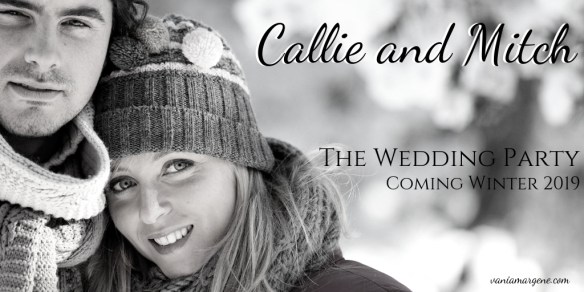
Callie and Mitch blog graphic

The age-old question, ‘what do you want from your writing?’ isn’t the real question at all. The REAL question? What can your writing GIVE YOU?

We’ve all been asked the $50,000 dollar question: Why do you write? Do you write for success? For the fame and fortune? Do you have a story that must come out no matter what? We all write for a reason, the reason that keeps us coming back to the laptop again and again.

But the fact is, after the writing is done, what can, what WILL, writing give us?

There are different kinds of writing, and each medium gives us different things:

  1. Blogging. Blogging gives us a place to vent, a place for our voice to be heard. Blogging lets us share information, be an authority. (That’s where the word AUTHOR comes from, don’tcha know?)  But blogging can only give you those things if you have an audience. Also known as, a reader who will read your blog post, maybe share it, maybe leave a comment. Your voice can only be heard if someone is listening. Will the blogger make a sound if no one is around to hear it? Yeah, and her voice sounds like this:
    wah wah wah
    You have to have good content, consistently, to find an audience who will enjoy your posts and keep coming back to you. And that’s difficult. I’ve blogged for the past few years, and finding consistent things I like to blog about and that I think others would enjoy hearing about, is downright hard. I’m not complaining, I love blogging. I wouldn’t do it if I didn’t. I put a lot of my heart, soul, and time into my website, and I blog to keep it current. That’s something I get out of blogging. Good SEO. Everyone once in a while someone will tell me they learned something on my blog. That’s great, too. But I understand when bloggers give up, because the time it takes, money (let’s get rid of that pesky .wordpress.com at the end of our domain addresses, okay?) and the pounding our heads into the walls to come up with ideas. Well. There’s not a lot of return on investment there, is there?
  2. Other social media. You’re writing when you post a picture on Instagram and tell your audience the story behind it. You’re writing when you update your Facebook Author page. You’re writing when you tweet. What kind of payback is there from spending time on social media? There is some. You find camaraderie, you find support. You can find people who will help you publish, both indie and traditionally. You network. You support the “big guys” by buying their books and promoting them. But besides being involved on social media for all those things, you hope one day you meet the right person who can introduce you to the next right person (hello agent!), you tweet something that goes viral, and that maybe, because you cultivated a social media following, you might sell some books. But realistically, the “might” is pretty big. Skyscraper big. Authors learn early on that joining social media and screaming
    BUY MY BOOK
    will annoy everyone very quickly, and eventually get you muted or blocked. Which, by the way, is the exact opposite of what you want to be doing. Just a little FYI in case you’re doing it wrong. Stop it!
  3. Writing books. If you ask any writer, they’ll tell you that they would still write even if no one were to ever read anything they’ve ever written ever again. And I believe that because there is something that keeps us writing. The innate human need to tell stories and to listen to stories. It’s how we learn, it’s how our cultures are passed down from generation to generation. Someone may not read our stories now, but maybe in 50 years? 60? You never know! Storytelling is in our blood. There is satisfaction in storytelling. There is happiness in typing THE END to a book or a short story or a novella. There is joy in it.
    cricket
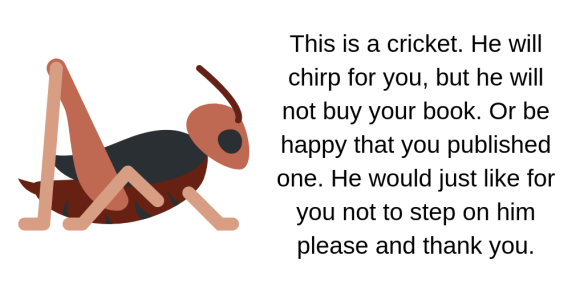
    But anyone who has ever published a book to crickets will tell you that sometimes you better be happy with self-satisfaction because that’s all you’re going to get. I was reading my friend Dave’s blog post right before I wrote this, and he gave me the idea for this post. He went through a lot with his release. A lot of anxiety and lot of pushing through panic publishing his book. And I wonder, if you asked him, if he knew what the outcome would be, if he knew that after all he went through publishing his book, if he would do it again.
    Was the payoff big enough?
    What was the payoff? That’s different for different people. Maybe it’s simply holding it in your hand. Maybe it’s seeing it “out in the wild” when your friends and family buy it to show their support. Maybe it’s that first review. Maybe it’s that first review by someone you don’t know.

But this is what this whole post is about–this is what it took 791 words to say. Those small things, they better the hell get you through, because in this day of self-publishing, in this day when 50,000 new books are published on Amazon every month, THAT’S ALL YOU’RE GOING TO GET.

You might not believe me when I tell you this isn’t a bitter post. You probably won’t after all the whining I’ve done about sales these past few months, and the huffing and puffing I’ve done about Amazon and KU. Those days are gone because I’ve made some decisions that feel right, and come hell or high water, I’m going to stick with the choices I’ve made. (My publishing career isn’t a ball in a pinball machine–I need to stay steady to gain ANY traction.)

This isn’t a bitter post, but it is realistic. You’re not going to set the world on fire when you hit publish. Anywhere. Not on FB when you publish an updated author post, not in a Tweet, though you may get a few hundred likes, and good on you if you can. You’re not going to change the world with a blog post. Someone did that already, back in 2011.

This is a new age of publishing, and you HAVE TO find little things you love about it to keep going, or you might as well quit. You’re not going to strike it rich with a book, or two, or even six, as I can tell you. 50 might be the new 30, but it used to be you could make okay money if you had 6-10 books out, and you can’t do that anymore. Indies making any kind of money have 10+ books out. Sure there are outliers, like Jami Albright, but for us little people who don’t have the means to go to an RWA conference and rub elbows with big authors who will put us in their newsletter, success is going to come much slower. We’re talking years. And the slower you write, well . . . you don’t need me to do that math.

So the question of this blog post wasn’t what do you get out of writing? It was, what does writing and publishing give you? 

Besides bills from hiring editors and formatters and graphic designers to do your book covers, what DOES writing give you, and is it enough to keep you going until it finally gives you what you want?

And what is it you want?

Fame and fortune, of course. Fame and fortune.


thank you for your patince

My Midlife Crisis. I Mean, my Mid-Year Check In.


It seems completely crazy to me that half the year has gone by. After a crappy winter, my first as a divorced lady, plus a surgery (old news) and dealing with a POS car on top of all that, my spring smoothed out, THANK GOD.

surgery photo

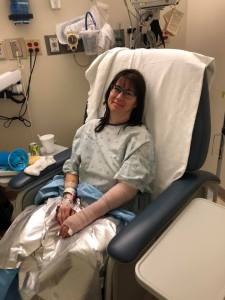
How I started 2019. This smile was before I started puking from anesthesia.

Blaze got better and is fitting into our new family dynamics. I post a lot of pictures of her and my other cats over on Instagram. If you want to follow me there, click here for my profile link.

My car, after $600.00 in repairs, is running all right, but the countdown is on to buy something better.

I published The Years Between Us in May, but that too, is old news. Though, really, it doesn’t feel like old news. It still feels like a brand new book. Not many people have read it, and it has 0 reviews on Amazon. I have it on BookSprout, and if you want to nab a copy for review through that service, click here.

I had a nice vacation last month to Georgia with my sister, and I met up with David Willis, a fellow writer I met on Twitter a couple years ago. I can’t even tell you how much I adore the ocean.

This slideshow requires JavaScript.

Spring is about new beginnings. Summer about shaking off the winter, sleeping in, and picking up more hours at work. Things are going as well as anyone can say their life is going.

Planning my next six months won’t be much of an undertaking. Like Adam Croft said in a New Year’s interview with Joanna Penn, he doesn’t treat the new year any differently. He does what he needs to do to get the things he needs done to write and publish books. And I feel that way about the rest of 2019.

When you are running your own business, being a self-starter and a self-motivator is a must. No one can force you to do the work. All you can do is look in the mirror and ask yourself if you want to sell your books or not. If the answer is yes, well, you can’t sell what you don’t have.

I’ll be finishing my Wedding Party series in the next few months. I’m 18,000 words into book three. As I write, I’ve been exploring covers. Formatting will be a snap with Vellum, but to put links in the back of the books, I’ll have to publish all of them at once so the links will be available, then I’ll need to add the links to the back matter and swap out those files. It’s nothing less than what other successful indies do, but it still sounds like a pain in the ass.

Anyway, anyone keeping track of my progress knows I’m getting a little fed up with this lack-of-sales thing I’ve got going on. It’s not my way to whine–in fact I tend to avoid those who do on a consistent basis. I can’t handle how energy-sucking it can be. I need all the energy I have for myself.

In the next 12 months, you’ll be seeing a lot more progress reports from me. I’ll do this because:

  1. not all of us are making money at this writing thing, and it’s okay to talk about it.
  2. if I find something that works for me, I want to share it because it might work for you, too.
  3. I’m at a point where my backlist should be making me a little money. Focusing on writing and not marketing has been at fault, but this is why I’m experimenting now. I thought All of Nothing would be a game-changer for me, and it has been in some ways. It’s the most-read book I have. But that was luck or better timing as when I used a free day and ran a Freebooksy, All of Nothing was in KU.

Why in this business does it feel like all roads lead to Amazon_ HMMMM.

My personal life probably has a lot to do with how I look at sales. But I’m not different than any other writer using their royalties to buy a better place to live, buy a newer vehicle, or pay down credit card debt.

Anyway, I’m doing what I can and what I can afford to do.

In September, I will be a part of an author panel and luncheon at the Fargo Public Library. I’ll be able to sell my books there too. A lovely woman who connected with me via LinkedIn emailed me the opportunity, and I said yes. While it may not yield any results, it made me remember that local networking can be just as important as networking online.

Something like this makes me excited I’m wide–if, after the luncheon, the library wants to carry my ebooks in their lending catalog, my books are available in the library program through Draft2Digital.

I’ll continue to blog in lieu of a newsletter. I prefer to blog, and every time I publish a new post, I gain new followers, so thank you for reading!

This post needn’t be too long. I’m struggling to write my books and stay afloat like many others out there. Some may have it better than me, some may have it worse. But as I have said many times in the past, we can only work with what we’ve got. Keep your chin up and a smile on your face.

Why in this business does it feel like all roads lead to Amazon_ HMMMM. (1)


Care to share how your 2019 is going? Drop me a comment.

Share a little triumph that will carry you for the rest of the year. ❤


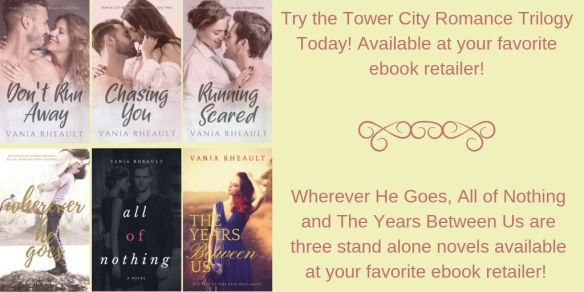
My books are wide! Find them at your favorite ebook retailer.

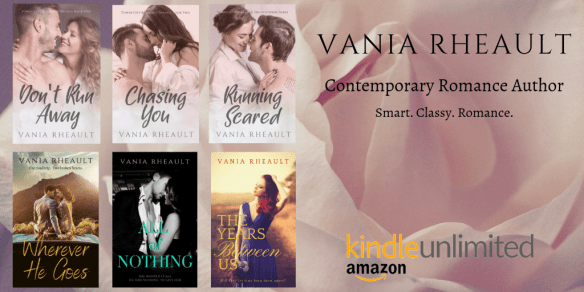
Don’t Run Away: books2read.com/dont-run-away
Chasing You: books2read.com/Chasing-You
Running Scared: books2read.com/running-scared

Wherever He Goes: books2read.com/whereverhegoes1
All of Nothing: books2read.com/allofnothing1
The Years Between Us: books2read.com/the-years-between-us

Try the Tower City Romance Trilogy Today!

all graphics made with Canva.com