Three Things I’ve Stopped Doing (and Three Things I Always Will)

2,645 words
14 minutes read time

brown scale on brown background. low part says, three things I stopped doing (ampersand) and high part says, three things I always will
black text

Things change in indie publishing. Some quickly, like Amazon guidelines, and some take years to shift, like marketing trends. I’ve been in this game for a bit now, longer than a lot of people I met when I first started out, but shorter than some of the tried and trues I knew who were doing this for years already when I first created my Twitter account.

I have found the longer you stay in the game, the more data you’re going to collect (if you’re smart and keep track). What works, what doesn’t. What did but doesn’t anymore. There are some basic things that will always have merit like publishing consistently, having a website, and, in most cases, not genre-hopping if you want to build an audience. But there are some things that just don’t work anymore, like just simply publishing and watching the royalties roll in as they did during the Kindle goldrush days.

So, I thought I’d share the three things I’ll always do and three things I stopped doing. As the years go by and I hang in there, this list might change, but these are the conclusions I’ve drawn so far since I published my first book in 2016.

Three things I’ll always do in my publishing business:

Finish a duet/trilogy/series before release. I’ve blogged about this a few times, as for most authors this is a Catch-22. Some readers now won’t read until a series is done and they can binge, but an author is reluctant to write more unless they see interest in the first book. What will always convince to me to finish is the fact that if your series is never done, it will never get the readers it could if it was finished. Books don’t expire. In the digital landscape they can sit on a virtual bookshelf for decades. Indies make money on older titles all the time, but you are ensuring that you won’t if you don’t finish. My reasons go beyond the money, even beyond author courtesy and reader habits. I finish out of a sense of integrity for myself and my work. I mean, I don’t publish as I go because I have anxiety over consistency issues that I couldn’t fix if my books were already out in the world. I’m not that good of a writer, so I need to be able to go back and double-check until I’m satisfied. But I also just couldn’t walk away from a world and characters I created. I loved them or wouldn’t have created them in the first place. I’ll always stay true to that creative spark and finish what I start.

Marketing in a way that’s sustainable to me without feeling guilty. That means letting go of the idea I need to be on social media. I don’t like thinking of a hook or a theme and making a graphic and posting. I don’t want to make videos for TikTok even if I have gotten better at it and it doesn’t take me that long. I still post every once in a while so if a reader stumbles upon my FB author page or my IG profile I look like I’m still alive, but otherwise, the constant advice that I need to be posting all the time I will happily ignore. The fact is, a lot of authors don’t have the money or don’t want to spend the money on marketing. I understand that, but paying for ads and for newsletters like Freebooksy and Fussy Librarian is my way of reaching readers without worrying about algorithms or coming up with content and the best way to present it. If I run an FB ad, that’s my limit, since you do need a hook and a graphic that will make people click.

I understand that in a perfect world, an author will use both paid and free tools to market effectively. But when mental health comes in, not to mention time and finances, each author has to make the best choices for them. Even if that’s not posting on socials, not paying for marketing tools, and only joining in a free, author-driven book blast once a year. You have to take a look at what results those methods are bringing in and if you’re okay with that. After a lot of soul-searching, I am okay with breaking even or losing money. I didn’t start publishing to become rich and famous, and that’s okay because I never will be. (I still play the PowerBall sometimes though.)

I will always buy my own ISBNs. This is kind of a cheat, because I already made this decision, and four years ago I bought a pack of 100–after I had already bought a pack of ten and went through them. It cost as much as my rent (at the time–my rent has gone up considerably since then) and I was sweating bullets, but I charged it and paid it off after a few months. I have been called privileged for being able to do that, and you might think I’m privileged to be able to afford ads and paid promos, too. I don’t feel privileged, living paycheck to paycheck, depending on the rent money my kids give me every month, and I still have to charge bigger purchases, like the new mattress I had to buy a few months ago for my back pain. I have a small budget for ads and don’t pay myself a wage out of my royalties. Every penny I make on book sales gets put back into my business hobby. I think that’s another reason authors are hesitant to pay for things like ISBNs and ads. They don’t always make their money back because they don’t write to market or their covers are bad, but I have never seen any industry besides indie publishing where people think they can start a business and not spend any money.

Not everyone will agree that buying ISBNs is a valid expense, and that’s okay. Amazon may not be around forever and neither may IngramSpark, though chances are good they’ll still be here in my lifetime at least. But, I wanted to protect my work under numbers that I paid for and now I’m the publisher on record for my titles. That means a lot to me. I protect both my ebooks and my paperbacks, even when the general consensus is you don’t need an ISBN for your ebooks. I still have quite a few numbers left, even using two a title, and well, I don’t think I’ll need to buy anymore. Obviously, buying ISBNs is a personal business decision but I have never regretted mine.

Bonus Entry:

I will always be a member of ALLi. This is something that I thought of last minute, but I’ll always be a member of the Alliance of Independent Authors. As someone running a business, I think it’s important to be part of an organization that will have your back. I mostly joined so I would have help if Amazon ever closed my account. There are a lot of other benefits too, like discount codes on formatting and publishing services, and I save a little every now and then if I have to update a file at IngramSpark. While it seems like a waste of money on the outside, paying for something that you don’t use (like an old gym membership that’s on autopay) it will be there whenever I need it and in these days of scammers and thieves, having some who’s in your corner is worth more than what they charge for a yearly membership.

Three things I have stopped doing since I started publishing:

Building and sending out a newsletter. Last year when MailerLite screwed me over when I was trying to make my newsletter compliant, I said “fuck it” and shut my newsletter down. I didn’t want to search for another newsletter aggregator and I exported my listed and imported it into my author website. I decide I would turn my newsletter into a public blog, and so far, things have been going okay.

There are a lot of disadvantages to this, to be sure. I can’t offer “bonus content” because what I post goes to everyone. Segregation of an email list isn’t possible on WordPress, nor is culling my subscribers. They have to opt out or my list is stuck with them. I can still force people to give me their emails if they want my reader magnet, but I would have to pay for that privilege on Bookfunnel and that’s not where I want to put my money right now.

So, as far as newsletters go, my blog is still sent out in email form but posted on my site and it will show up in the WordPress reader. People might think I’m crazy for giving away a book without strings, but what’s a book? I can always write another one. Kind of like when your hair stylist does a crappy job. Your hair will grow back. Eventually. Books are a dime a dozen and My Biggest Mistake has served me well. I’ve given away over a thousand copies, and because the back matter in all my books advertises this free book on my website, I’m afraid I’ve trapped myself into giving it away forever. My only ask is you subscribe to my blog, but that rarely happens. Still, I prefer the laid-back approach I’ve adopted since I’ve been working on not taking my books so seriously. I’ve given myself permission to relax, especially in the evenings after a full day. I’ve started watching Lucifer, because, you know. Tom Ellis.

This is one of those things that may change, but I’m not sure what would prompt me to move my list again. I like what I’m doing, and because I’m comfortable with WordPress, maintaining it isn’t a nightmare. In fact, I just refreshed the header, colors, and font on my author page. I hadn’t since I set it up and it looks nice. If you want to take a look around, you can find it here: vmrheault.com.

I’m getting rid of the hard back matter sell. A long time ago in a romance marketing room on Clubhouse, I heard the advice to do the “hard sell” right after the last paragraph of your book. There were all these little caveats, like you couldn’t even use a spacer or a hard enter because that would “force” the content on to the next “page” on an ereader. It was advised to put your call to action (CTA) practically right after the last period, and I did start doing that along with many many many authors. When I look back at my older books now, I hate it. I hate it, hate it, hate it, and I’ve been going through and getting rid of it. Why? Because after I have just read an amazing book, I want to sit with the happy ending, I want to sit with the characters who touched my heart. I don’t want to be yelled at to join a mailing list or to buy another book. So, while I was re-editing Rescue Me, I got rid the immediate CTA to go to my website. (I’ve always pointed people to my website and not a landing page, and that saved me a ton of headache when I stopped using MailerLite.) I didn’t get rid of it completely, but it’s on its own page now. Ebooks are flowable and don’t have pages, but I think a reader has to “flip” to see what else is in the back of the book after the content ends. I’m doing Faking Forever now, and along with updating my list of books, I’m also getting rid of the hard sell. I didn’t it do it on my new releases and that is a trend I’ll stick with. If readers loved your books they will find a way to stay in touch. Like moving my newsletter to my blog and cutting back on the number of books I’m publishing every year, I’m just going to ease up and stop trying so hard. Because you know what? It didn’t do that much anyway.

I’m not adding subtitles on my ebooks. That was another really popular thing to do, and I even wrote a blog post about it. I guess this goes along with the hard sell, and I’m not going to add subtitles to my ebooks anymore. I’m going to start letting my cover, title, and blurb speak for itself, and make sure my categories and keywords I choose when publishing do the heavy lifting. Adding a subtitle to your books was a very trendy thing to do to drive discoverability, and you may think that with market saturation that not doing it anymore might be going backward. But, Amazon doesn’t like it, either, and honestly, now I think shoving mini-tropes into a subtitle just looks desperate and ridiculous. So, as I update my books, along with taking out the hard CTA at the end, I’m going to be taking off the subtitles. It will make my buy-pages look cleaner. Am I telling you not to do it? No. Unless you really do want to be careful around Amazon, then maybe I would rethink that, but if you like to take chances and want to pack your subtitle full of mini-tropes, then you should still do what you want to do. This is the new and improved relaxed version, remember?

Bonus Entry:

I won’t ever use an illustrated cover. Obviously I was thinking about my hockey novels and the kind of covers I wanted to put on them. I don’t fault anyone for using an illustrated cover but I have just come to realize those are not for me. I understand the reasons why authors turn to them. There’s more of a selection when scrolling through vector art than there is real stock models and if you’re one to go with the trends, you don’t want to feel left out and think you could be leaving readers on the table. But at this point, illustrated covers would be at odds with the brand I’ve built for myself over the years, and if I can find what I need and there are still real people on the kinds of books I’m writing, then I don’t see any reason to change. I also have never, and probably will never, write a story light-hearted enough where an illustrated cover would fit, so instead of moaning about that, I’ll lean into my strengths and keep putting hot, sexy men on my covers.


When it comes to indie publishing, or just publishing in general, the ability to pivot and be flexible is probably one of the biggest assets you can have. Things change at a snail’s pace until all of a sudden everyone is talking about it and doing it a different way. What’s especially interesting is when things used to be the standard (like subtitles on ebooks) and that changes to something that no one does anymore.

I have extreme FOMO, I really do, but this year I have managed to brush a lot of that aside, for the most part because I think I know everything there is to know and there isn’t going to be a magic piece of advice that will push me to the next level. And that’s okay. Accepting that is actually freeing. I can do what I want, write what I want, and be happy with it. After the few years I’ve had, that is a really great place to be.

Next week I’ll give you a rundown on what I’ve been doing. July is almost gone, y’all. I hope you’re making the best of what’s left of summer.

See you next week!

The Evolution of the Romance Genre

1,663 words
9 minutes read time

beige background. a flower in its growing cycle dirt, sprout, stem, bloom. red flowers, green stem, white pot.  text says, The Evolution of the Romance Genre

I’ve wanted to be a writer since I was a kid.

That’s probably not a surprise to anyone who is also a writer, and many of us can say we’ve been writing stories since we learned how to hold a crayon. When I was in high school, I devoured Harlequin Temptations and Desires, finding them at garage sales, the library, and shoplifting them from Pamida. I got caught and my dad made me talk to the manager about how stealing was bad, but I was a kid who loved to read and was a kleptomaniac at heart and well, it didn’t stop me. That’s neither here nor there, but one night, I remember holding a book and thinking, I want to be in charge of it all. The cover, the blurb. All of it. What I didn’t realize back then is I was describing what would eventually become indie publishing. So, yeah. I am in charge of all of it. Down to where the numbers appear on the page.

That was thirty-five years ago or so, and I didn’t understand tropes. I chose books based off the blurb, if I thought I would enjoy the story. In fact, I don’t think I really understood tropes at all until I was assigned the difficult task of marketing my own books. It was through listening to romance marketing talks, webinars, and podcasts where I learned tropes are what sell your books. That was also a difficult realization for me because, like most writers, I just wrote what I wanted to write. My first trilogy was written without tropes in mind–I just made up a group of friends who lived in a fake town, gave them some trouble, and forced them to fall in love while navigating those troubles.

I don’t remember the precise “Ah-ha” moment I had regarding tropes, but I must have had it at some point because my next three standalones were all trope-specific–enemies to lovers, age-gap, and close proximity. Then I veered off again with my Rocky Point series and just wrote whatever I wanted, and if a trope was baked in, like second chance, yay for me.

So you can imagine my confusion when, after seven years of publishing, I realized, yet again, romance was becoming even further divided than just tropes and that I would never be a successful indie author writing “contemporary romance” because romance didn’t work like that anymore.

Indies were changing the game.

There’s an interesting interview that Nora Roberts did not long ago with the Associated Press, and she was talking about her career in romance. She’s written over 250 books and has seen firsthand how the romance genre has evolved, going so far to even say, “My roots are in romance and I have a lot of respect. But I don’t write romance anymore. I do write relationships.”

AP: Speaking of the sex, that’s a good transition to romance as a genre. It has evolved a lot in the last couple of years. Where do you see yourself in the pantheon of that genre?

Roberts: I don’t at all. My roots are in romance and I have a lot of respect. But I don’t write romance anymore. I do write relationships.

I’ve been writing for a really long time now, and the romance genre evolves and it changes. And it did when I was working in it, and it just got to a point where I didn’t want to go where it was evolving. I wanted to go in a different direction. So my roots and foundation are there, and gratitude. But that’s not what I’m doing now.

That’s a great way to look at it . . . if you’re Nora Roberts and not a nameless, faceless author trying to find readers in market so saturated it’s tempting to close your laptop and never look back. She has her audience and has built it over years of publishing. So where does that leave the rest of us?

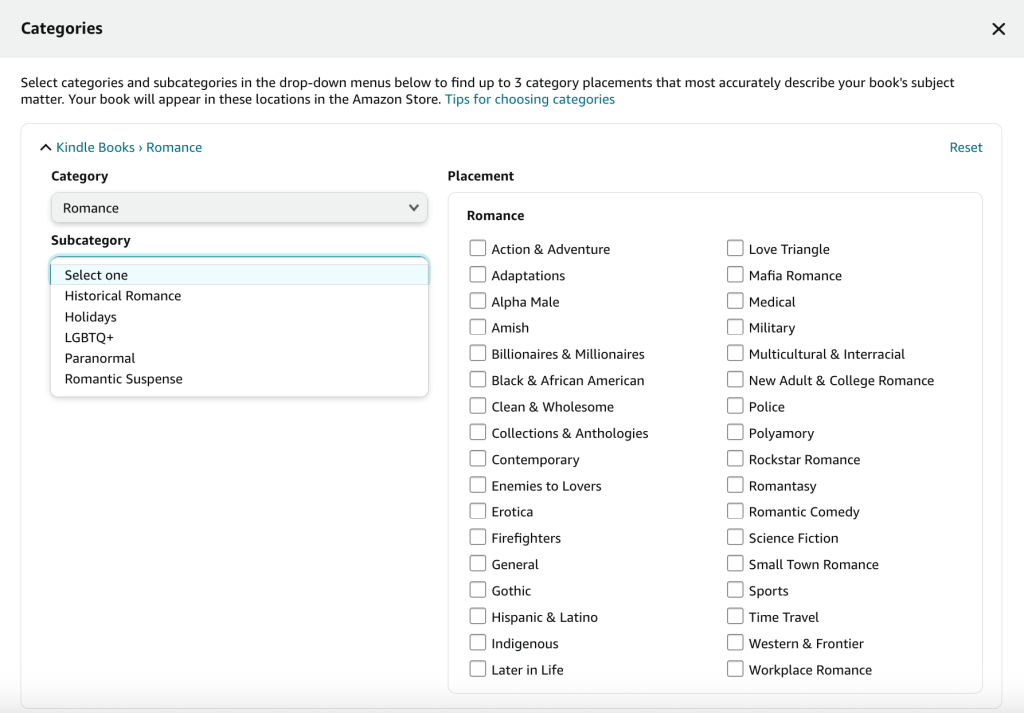
There are indie publishing “rules” and one of the biggest rules of them all is to never genre-hop. There’s some logic in that–it’s hard enough to market your books when you’re writing in just one genre, never mind trying to reach readers in two or three. But when you decide to write romance, that rule is split down even further. Choose a subgenre, and there are plenty:

screenshot of KDP's romance subcategories and subgenres

subcategories include historical romance, holidays, LGBTQ+, paranormal and romantic suspense

subgenres include:
Action & Adventure
Adaptations
Alpha Male
Amish
Billionaires & Millionaires
Black & African American
Clean & WholesomeLater in Life
Love Triangle
Mafia Romance
Medical
History
Multicultural and Interracial
New Adult and College Romance
Police
Polymory
Rockstar Romance
Romantasy
Romantic Comedy
Science Fiction
Small Town Romance
Sports
Time Trave
Western and Frontier
Workplace Romance
Collections & Anthologies
Contemporary
Enemies to Lovers
Erotica
Firefighters
General
Gothic
Hispanic & Latino
Indigenous

This is the screenshot of romance subgenres you can choose when you publish on KDP. They have narrowed them down so much you can pick something like Love Triangle or Workplace Romance. Ten years ago we didn’t have those choices, and it makes me wonder if they’re helping or hurting.

How niching down into a subgenre can help:

You have a built-in audience. You know before you write you’re going to have readers who want to read your books.
You can build your brand easier. Instead of saying you’re a “multi-genre author” and trying to turn your brand into something for everyone (which never works well and is expensive to market, too) you can say “Mafia romance author” and those readers will know they can plow through your entire backlist and be happy.
It’s easier to market. Just being able to choose your subgenre category and using the appropriate keywords will help immensely when it comes to creating ads. You can also partner with other authors who write that subgenre and share audiences.
Better discoverability. It’s a lot easier for a reader to recommend a hot new Small Town romance series than a general romance.

Cons to only writing one thing:

You might get bored. So far, I haven’t felt too burnt out writing Billionaire Romance, but what saved me was playing with tropes and adding in a dash of Romantic Suspense. Still, there’s not a lot of wiggle room when you choose something like Motorcycle Club. There’s a solid set of exceptions you have to meet to keep readers of that subgenre happy and not a lot of leeway to mix things up.
Your loyal readers won’t follow you. I’m fully aware that readers who liked my Billionaire stuff might not have read my Rockstar trilogy, and the readers who stumbled upon my Rockstars may not have wanted to read anything else in my backlist.
Your chosen niche might get saturated. Hockey is hot right now, and those who got in on the ground floor might be annoyed that suddenly the market is flooded. A while back Reverse Harem, or Why Choose as we have to call it now, went through the same popularity contest. You may have to pivot when that happens, and it might be too much work to start over.
Branding fatigue. All my covers look the same, though I actually don’t mind because with my limited skill set when it comes to graphic design and software, it’s easy for me to meet genre expectations but still keep my books and series separate and distinguishable from one another. But, I’m also trapped now because I put single men on the covers of my books and after sixteen books, a couple all of a sudden would look very out of place. Also, unless you can afford to be flexible, eventually you might use up all the hot men that are available on a stock site like DepositPhotos, trapping you even more.

So, what does all this even mean? Subgenres aren’t going to go away, in fact, chances are good KDP will add even more as time goes on, but I know from just my limited experience that niching down does help whether we want to admit it or not. It helps marketing and branding, for sure, and in turn it doesn’t take so much work to find readers. Anyone who looks at my Amazon author page knows exactly what they’re going to get, even if I do happen to throw in a rockstar or hockey player.

That doesn’t mean I’m always going to want to write billionaires, if even, you know, I’ve downgraded my billionaire status to simply, “Men with money.”

And what does that mean for romance? Readers aren’t picking romances off the Pamida shelves and deciding on which ones to stuff into their purses. They search online marketplaces like Amazon and Kobo by the tropes or subgenres they like, hope the cover catches their eye, then skim the blurb, looking to see if the description lives up to the cover. Subgenres have changed the way readers find books and I don’t know what we can do to combat that.

Writing what you want when you want in a time where indies niche down and produce six books a year is a tough act to follow and not everyone wants to. Some are steadfast in the idea that they’ll do their own thing, and it’s an idea that I keep circling around now that I’ve tried the other way and failed. I mean, to be clear, pivoting and writing Billionaire romance did boost my visibility and sales. Yes, it really did, but it wasn’t a magic bullet to a large readership, either, and in my case, I’m exploring other options to keep my joy.

I don’t know what the answer is. Maybe there is no answer because there’s not really a question. I just find it interesting how indies have shaped romance, even to the point where Nora Roberts has said, “Good luck.”

I can tell you what I’m going to do. I’m going to keep writing the books I want. I like writing “Men with money” or I wouldn’t keep doing it, but I can play with tropes and different subgenres like Romantic Suspense. I can explore themes of mental health, friendships, and found family. Because the market is going to keep evolving and there’s nothing we can do to stop it.

I’m going to write relationships, and if you want to grab one off a pirate site, go for it. But be careful. Pamida’s manager wasn’t very nice.

Pity Isn’t a Good Marketing Plan

1,483 words
8 minutes read time

box of tissues, with one coming out of the top. pink background. text says pity isn't a good marketing plan

It’s valid to talk about our struggles as authors. It’s something I do almost every Monday. We like to know that we’re not alone, that we can relate to people and what they’re going through with writing, marketing, and publishing.

But sometimes it gets out of hand. In the past week or so, there’s been a big TikTok account that has taken the concept of sharing our struggles just a little too far, and what started out as “I really need some support” has turned into a huge marketing strategy constructed pretty much on just . . . pity. I don’t want to go into all that, the article I linked to actually does a really good job, and honestly, I’m not interested enough in that person to do a deep dive to write my own post about it.

Actually, I see a rendition of it on social media all time. Little posts like, “I haven’t sold a book this week/month/year,” or “My husband just got laid off, any sales will help!” or, “I just had a death in the family. I’ll donate proceeds to their funeral if you buy my book,” or “I can’t afford my cat’s vet bills, please, any reads in KU will help a lot.” I sympathize with each and every one of those people. I really, really do. I’ve had financial trouble. I lost three cats in five years, and let me tell you, the vet costs were astronomical. I’m not a stranger to needing money, but what I didn’t do was ask my readers to help me by buying my books. Why? Because:

One: Book royalties don’t work like that. Amazon doesn’t pay us for today’s sales for three months, so even if I managed to guilt-trip a few people into buying my books, it wouldn’t help. Three months is a long time to wait when you need the money now.

Two: My financial situation isn’t my readers’ business nor is it their responsibility. Asking them to buy my book so I can have some cash to pay bills or whatever else grossly oversteps the author/reader relationship.

Three: It erodes reader trust. After a while, they won’t want to see your social media posts because they’ll be afraid you’re going to ask them to do something they can’t do. Not all readers have a ton of disposable income, and if you have a short backlist, maybe they already supported you and will feel bad now if they’ve already bought your book and don’t want to buy it again.

Four: It takes attention away from your books. As an author trying to create a professional reputation and a credible and enjoyable backlist, that diverted attention could cost you. Not only for just that day, or that week, or that month you’re begging for help, but . . . forever. Followers can mute you without unfollowing, so you may never know the true damage you cause. Out of sight is out of mind, and in this time of content saturation and short attention spans, it doesn’t take much for a reader to forget she ever read anything you wrote.

The only time you should be asking readers if they’d like to read your books is when you know that what you’re offering them is something you think they would enjoy, either because you know they’ve read similar books to yours or they asked for a recommendation and you have something they’re looking for. That’s it.

But, I can hear a lot of you saying, I share my bleak numbers and empty sales dashboards to have support and so others don’t feel alone. That’s understandable and you’re not alone thinking that, but unfortunately, the reader/author line blurs more every day. I know this and take the risk keeping this blog up. Maybe a reader would find my indie talk not to their liking and skip out, either from this blog or my books too, and that’s okay. It’s unrealistic to think that we can keep our roles completely separate, so let’s just say begging for sales in most ways is unappealing wherever you happen to be hanging out online.

Besides, and I wrote a whole blog post about this before: transparency means diddle squat if you’re not prepared to have a conversation about why your sales are in the toilet and how to fix it. Saying you had zero sales so far for the month of June means little. That’s pity marketing if I ever heard it. You can frame it any way you want: “Just letting people know how tough it is out there. No sales this month.” “Being transparent today. No sales for this month. Keep on keeping on.” “No KU page reads this month and we only have a couple days left. Fingers crossed next month is better.” Those all sound familiar because we hear them all the time, but what I really want to ask is, What are you doing marketing-wise to combat this? Are you only posting on Facebook? Only Threads? Pinterest? How’s your cover, how’s your blurb? Is your book first in a series that won’t be done until 2030?

If you’re not ready for the hard conversations, then you have no business sharing. Some people will ask, out of a want to help you, and mostly I hear, I don’t have money for ads, or ads didn’t work for me. There are a lot of reasons why ads don’t work, the top one being your book isn’t advertising-ready. The cover is off, the blurb is confusing. You didn’t choose the right keywords or categories and the ad platform is confused and doesn’t know who your readers are. Those things are fixable. The money thing, not so much, but indie publishing is the only business venture I know of where people think they can start a business with no start-up cash. It’s completely unrealistic to think you can publish a book and have it be successful completely for free. People get really mad at me when I say stuff like that and call me privileged, but it’s true. Even a simple artist who wants to sell paintings on Etsy needs money to buy canvas and paint. It’s really crazy and probably why Kickstarter has had another surge in popularity recently. Authors need money to produce books. It’s always been that way.

So, the biggest takeaway from this post today is, should you be sharing that online? Do you really want your readers to see it? Do you really want your peers to be feeling sorry for you? I have a lot of sympathy for my “co-workers” such as they are, but whenever I take a look at their books, I can usually find a hundred ways to fix what they’re complaining about. New cover, new blurb. Get that series done. Fix your formatting, your title is confusing. Your ads won’t waste money if you’re selling a book people want to read. You may need to experiment a bit with your audience–Facebook wants to shove your ad in front of everyone which we all know rarely works–but even though I’ve complained about my own ads, I’ve never lost money. Simply broken even which I don’t consider a failure, I was just having mental health issues and decided to step back from the grind.

Anyway, so 2025 is half over. We’ve got six more months to get stuff done. Can you go through your backlist and make a list of things to fix?
*Cover–just because you like it doesn’t mean it’s working
*Blurb–too confusing or too vague because you don’t want to give away spoilers may turn readers off
*Look Inside: the first 10% is important. If nothing is happening or you start off your book with an info dump, you won’t hook readers.
*Make sure your categories and keywords are solid
*Price competitively

Then you can:
*Do a couple of free days and join an author-driven promo
*Learn Amazon ads
*Buy a promo from Written Word Media or places like Fussy Librarian and Robin Reads

Let’s stop the pity marketing and take matters into our own hands. We have the power to fix things and acting like you don’t just makes you look bad.


One more thing before I head off to get my errands done for the day: Angela James is offering a deep POV workshop on July 8th for $30.00. Improving craft is another way to increase sales. No one wants to read a book that sounds like crap and is full of telling. Angela’s a fabulous editor who used to work for Harlequin’s Carina Press. Take a look at her workshop, and if you haven’t invested in your author business so far this year, this money will be well spent. This is not an affiliate link: https://angelajames.co/deep-pov-workshop/

Have a good week everyone, and if you live in an area that’s been hit by storms, stay safe!

Splitting Your Author Life in Two: Readers vs. Writers

 white background. black piece of torn paper.  text says in black and white, splitting your author platform.

One of the biggest mistakes authors can make is trying to talk to everyone from the same place. Back when I first started publishing and writing my blog, I did this, and it actually took me years to figure out that not all readers are created equal. If you don’t know what I mean, let me explain.

It may not feel like it, but once you publish, your author life is suddenly split in two. You have your author pals who support you, maybe read your books (and that’s a big maybe), promote you on their socials that may or may not have readers in the audience, and after a while can even turn into accountability partners, alpha and beta readers, and friends. Then you have your readers, your actual readers who, if they are on social media at all, aren’t part of the . They use socials for other things like connecting with family and reading articles about gardening, cooking, movies, and politics. Maybe they like their favorite authors’ Facebook author pages because that’s where they hear about new releases, giveaways, book boxes, and in-person events.

I came this realization a while back, and when I started my pen name, decided I needed to have a hub just for readers. To be honest, I didn’t want readers reading my nonfiction stuff anyway. I use this blog as a way to help others in their publishing journeys, let other indies know what worked for me in terms of marketing (promos and ads), and just talk about what crazy BS is going on in the publishing industry. That information isn’t for readers, and it shouldn’t be. They don’t need to know how many books I’ve sold, what Amazon pays in terms of KENP, or that I make my covers in Canva and format my own books.

But, I understand this decision isn’t for everyone. I pay for two websites, and some authors don’t even like paying for one. I enjoy blogging for other indies and connecting to the industry makes me feel “professional” so I eat the cost of the WordPress plan and domain name. But, if that’s not for you, don’t feel bad. Not every indie author wants to share their journey, stay up-to-date on what’s going on in the publishing world (both trad and indie) to have something of substance to write about, or pass on what they’ve learned because writing tutorials can take a lot of time. There are weeks when I’m at a loss as to what to say too, and I either just default to an author update or scroll Threads looking for dirt a topic. I feel fortunate when I can share a podcast I enjoyed and/or learned from or I’m able to find a subject like this one that might resonate with someone and help them move in a better direction. You don’t have to lock yourself into writing every week like I have, but if the views and visits are what get you out of bed, consistency will always make that happen faster. I owe a lot of my SEO to my tutorials, particularly my Canva post on how to make a paperback cover. I’ve tried to keep this blog relevant and helpful, but if you already have limited time to write, nurturing a blog that won’t sell books won’t sound appealing.

That said, if you really want to make a go of this publishing stuff, you should have an author website, a place to point readers in the backs of your books. This is where you’ll have your backlist of books and where readers can find them, a newsletter signup, your reader magnet, trigger warnings, direct sales, and any in-person events. If you check out other author websites, you’ll find that they don’t blog about process or complain about Amazon payouts or how they package author copies for shipping. Author websites cater to readers and what they want, not other authors who like to hear about behind the scenes news.

The problem with only writing to only readers is that if you don’t have a lot going on, there’s not a lot to say and that can make you feel disconnected. I write my newsletter on my author blog once a month, and I usually have something to share. A sale, a new release. Maybe highlighting an older book in my backlist that hasn’t gotten a lot of love. Creating content can be challenging if you’re a one-book-a-year author, and it might be tempting to write about what you’re working on, but unfortunately, readers don’t care until you can give them something to buy and read. When that happens, when you aren’t constantly updating, it may feel like people are forgetting about you, but you know, as I’ve said in the past, they will. You can be afraid of something that will happen, but there’s no point to that. There is so much content out there it’s inevitable, but it’s better to jog their memory after a few months of silence than waste their time blogging about something that doesn’t concern them.

If that describes you, if you feel like if you’re not reaching out then you’re invisible, then yeah, you might want to blog for indies who are interested in your process, would like to know how well your promos did, and/or how you make your covers. It gives you a reason to communicate and not feel so alone, and you’re writing to the people who actually care what you’re working on. Sales won’t come of it, which is why in the end I moved my books off this website and put them on my author website, but the more you segment your efforts, the more effective each one becomes and you won’t feel like you’re shouting at people who aren’t listening. Reaching out doesn’t even require a blog. You can create an indie Facebook group or Discord channel. A place where other writers and authors can get together but where you also know the score: your peers won’t buy your books. You can let go of that expectation and just be happy you’re in a group of people who are going through what you are and know how it feels to have zero sales on your dashboard.

So you might ask how is my author platform split in two?

Here’s what I do, and I made a graphic in Canva so you can save it or print it out if you want a quick reference.

png image:
SPLITTING YOUR AUTHOR PLATFORM*
Nonfiction/Authors/Writers
Fiction/Readers
Website: Blog
Indie news, writing process and progress, marketing tips and progress, tutorials
Website: Blog/Newsletter
New releases, cover reveals, sales, promos (mine and events like Stuff Your Ereader Day), ARC opportunities
Facebook Personal Profile
Author groups like Vellum, Optimizing Amazon Ads, Romance Support League, Grow Your Publishing/TikTok
Instagram
I don't post nonfiction content on my
Instagram account.
Threads
I use Threads to stay up to date on industry news. I follow people like
Jane Friedman and Kathleen Schmidt. Sometimes I'll post a blog like my Canva tutorial if I think it will be helpful
Facebook Author Page
Cover reveals, sales, promos like Stuff Your Kindle Day, book memes, snippet graphics. sharing what I'm reading, holiday mentions; running
Meta ads
Instagram
Mostly graphics with snippets. Cover reveals. Some reels but haven't bothered to repurpose what I've used on TikTok in the past Threads
I don't promote my work there. I
know from others complaining about how useless it is not to bother.
*The point is, wherever you choose to spend your time, decide if you want to attract readers or authors. They are not the same.

There are a lot of places to hang out that I haven’t listed. I just can’t be everywhere and don’t want to be. Lemon8 is popular, so is Pinterest, and let’s not mention TikTok because I really don’t want to use my time making videos, but the fact is, if you’re a slow writer and you want to talk to only readers, you’re not going to have a lot to say. You can share book memes and pet photos, where you went to dinner on your anniversary, but you’re going to lose readers to other authors who publish faster. The industry in some ways is very slow, such as trends are very very slow to change, but when they do, it feels like it happened over night. Trad authors can seem like they get away with a book a year, but behind the scenes, they’re worried about getting a new book deal, if their publisher will pay for marketing, how their launch is going to go since they haven’t had a new book out in however long. Indies face the same trouble, trying to find traction while others are zooming ahead because they have more time/motivation/whatever than they do.

Figuring out where and what to post is a mental health issue, it really is. I’ve gone through my own struggles, beating myself up for not wanting to post on my Facebook author page, not making videos for TikTok when everyone says that’s where you belong if you’re an author. I boosted a post on my Instagram account and got a few new followers, but they aren’t going to do me any good if I don’t post. And you know, I’m pretty prolific, so it’s not that I don’t have content, it’s just that I don’t care. I let Amazon ads, promo newsletters like BargainBooksy, FreeBooksy, and Fussy Librarian, and author-driven book blasts like Zoe York’s ZoeBub pickup most of my sales weight, which I can do because my series and trilogies have solid read-through. Maybe I have to pay for it, but I’m reaching readers, not shouting at other authors then getting mad when my books aren’t selling.

Splitting up your author platform can take a lot of the stress off your shoulders. You know who you’re talking to and what they want to hear. Shouting to everyone will never work and you’ll only get frustrated. It’s difficult to break out of the bubble, but the longer you do it the more natural it will feel and the feedback will become more positive because you’re staying in your chosen lane and once you draw the lines, you’ll actually have more time to write because that urgency to post and reach anyone you can will be gone.

Again, I know this advice isn’t for everyone, but if even reading this makes you step back and look at how you’re posting on social media, you may make some small changes that could turn into big results. Let me know what you think!

I better get off here and finish proofing my proof of Loss and Damages. I’m almost done then I can put the changes in and order another proof. I’m really excited to jump into more hockey research. I’ve put that aside to get Loss and Damages ready for ARCs next month, but I’m eager to start again. Take care everyone, and have a great week ahead!

Monday’s Author Update: Progress and Plateaus

1,438 words
8 minutes read time

I kind of copped out on you all last week, not really posting anything because I had nothing to say. Unfortunately, this week I’m in the same predicament. As Avery McKay says in my novel, Wicked Games, “I love writing. I can scribble all day. But that doesn’t mean it’s worth printing.” And that’s kind of where I’m at at the moment. I have plenty to say, but I don’t think it’s worth your time.

I scroll social media and there are so many voices out there. Screaming, and not even into the void, because I hear them, loud and clear. It has always mystified me how people can post on a social media platform, four, five, six even more times a day, assuming, hoping, maybe praying that what they are saying has some kind of worth to somebody . . . anybody. Most of the time, I don’t think it does, and a lot of what I see is just annoying, like a mosquito buzzing around my head that I can’t kill because I don’t kill things.

I was thinking about that this morning, too, that there are so many books out there, and so many opinions about them, and at some point, you have to think that none of it matters at all. That maybe, instead of posting every five seconds, it could be better for your mental health and everyone else’s if you only say something when you have something meaningful to say. There was something I read on Threads that said, “I’m not actually surprised when some authors don’t say anything about injustices in the world because they barely have anything to say in their books. Why start now” and it actually made me mad. Just because I don’t post incessantly on social media doesn’t mean I don’t care about what’s happening in the world or that my books don’t have substance. That maybe I’m doing things in my real life that make a difference that don’t need to be blasted all over the internet.

Is it a crime to be a private person now?

It perhaps isn’t a crime, but in the age of digital when you aren’t shoving yourself out there every five seconds, your chance of discoverability goes down. But I don’t want to be known for telling my followers I vacuumed the living room, or I finally got around to cleaning my bathroom, or that I have a dentist appointment that I finally kept after a year of canceling because I was fed up with doctor appointments and I just needed a break (actually, that’s what I’ll be doing Thursday afternoon. Pray for me.).

And the woman who got ran off the internet for musing about plotting a book where the hero and heroine meet at an ICE protest has probably never regretted anything more in her life. Some thoughts should just be kept inside your head. In fact, probably most thoughts you should just keep to yourself.

Then we have platforms where pictures and videos need to accompany what you want to say and honestly, it’s really no wonder people don’t have attention spans. Even I’ve had that problem lately, watching an episode of The Outsider, then stopping after ten minutes to scroll Threads only to find there’s nothing there, then going back to my show, but then stopping again and scrolling DepositPhotos for an alternate guy for my hockey book’s cover. Then I feel stupid for not being able to finish my show and go back and force myself to watch until the end. In my case, I want to be working on my books but I also know I’m burnt out and need the break–hence watching a show in the evenings to chill out. It’s not that I didn’t like it, I’ve watched it before and knew that I did, but that feeling of not getting anything done, especially when I do have things waiting for me, wouldn’t leave me alone. Which, I can just blame on social media anyway. People are always posting what they’re doing or what they wish they were doing or what they’ve done, and you feel left out if you can’t join in.

Anyway, I am getting some stuff done. I finished that read-through of Wicked Games, and now I’m definitely going to put it away for few months. Right now I’m 33% of the way through proofing my proof of Loss and Damages and it’s been worth it as I’m finding a few typos, a scene break that didn’t need to be there and a couple of slow spots where deleting a sentence or two keeps things on track. I’m second guessing myself a lot, putting in a change and then adding a question mark as an indication that I might not really want to change it after all. A lot of the time I don’t, thinking that it’s not going to be the end of the world either way and how I wrote it was probably how I wanted it.

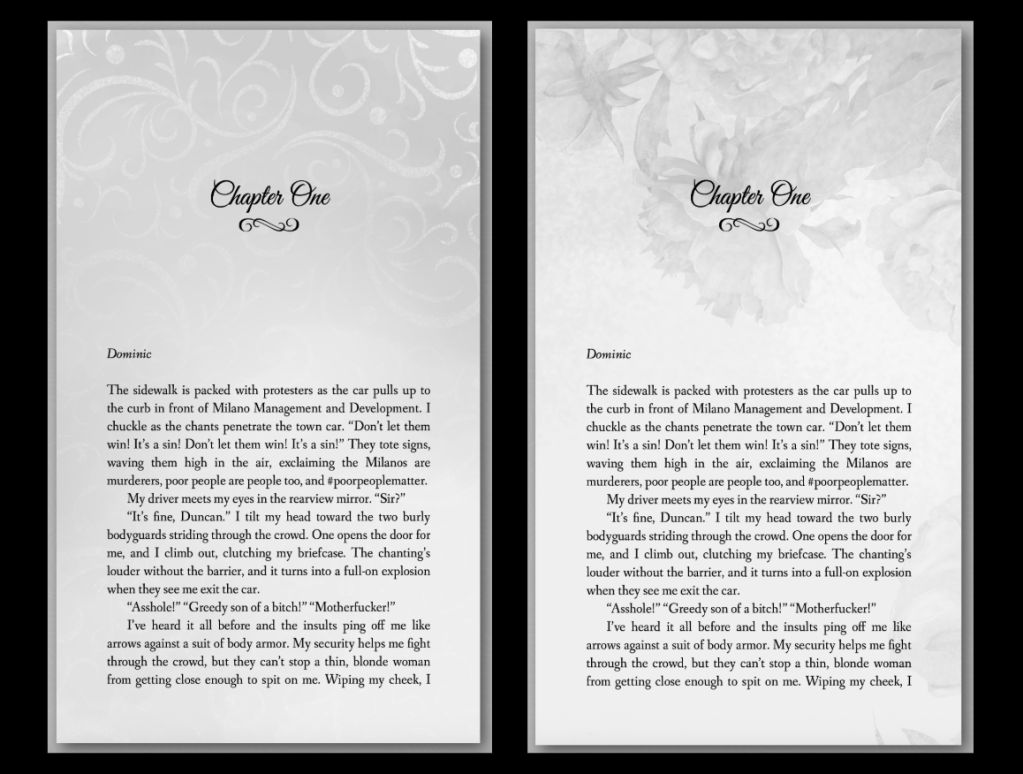
After I put the changes into Vellum I can order another proof, and I’m deciding between two chapter backgrounds. Let me know which one you like:

two screenshots of the first page of Loss and Damages one. One has light swirls from the top of the page that fades and the other has a light floral design that also fades down the page.

Text reads:
Dominic
The sidewalk is packed with protesters as the car pulls up to the curb in front of Milano Management and Development. I chuckle as the chants penetrate the town car. “Don’t let them win! It’s a sin! Don’t let them win! It’s a sin!” They tote signs, waving them high in the air, exclaiming the Milanos are murderers, poor people are people too, and #poorpeoplematter.
My driver meets my eyes in the rearview mirror. “Sir?”
“It’s fine, Duncan.” I tilt my head toward the two burly bodyguards striding through the crowd. One opens the door for me, and I climb out, clutching my briefcase. The chanting’s louder without the barrier, and it turns into a full-on explosion when they see me exit the car. 
“Asshole!” “Greedy son of a bitch!” “Motherfucker!”
I’ve heard it all before and the insults ping off me like arrows against a suit of body armor. My security helps me fight through the crowd, but they can’t stop a thin, blonde woman from getting close enough to spit on me. Wiping my cheek, I meet her tired blue eyes, frustration and stress digging lines into her skin.
I turn away.


The first one is what I have now because it complements the chapter style I chose, but then I got to thinking about the flowers because she’s an artist who paints china. The model I chose for Dominic on the cover is standing in front of a black brick wall which is a nod to him being a land developer, so I could have “him” on the outside and “her” on the inside. I’ll order another proof and see which one I like better in print. That will just be for the paperbacks. The Kindle version will just be the chapter style. I don’t care about finding a heading image like I have previously. I don’t know what I would put there anyway and don’t feel like scrolling through stock photos.

I decided I’d make ARCs available July 15th. Let the excitement of the holiday fade and that will give reviewers two months to read for a September 15th release.

I have realized that if I wanted to write my hockey romance this summer that I might actually need to start writing it as summer will be a third over soon. Though, I didn’t realize how far into the summer the hockey season goes, as the Florida Panthers and the Edmonton Oilers are still battling it out for the Stanley Cup and it’s mid June. So, maybe a hockey romance could be released all year without sales dipping too low during launch. Maybe I’ll publish Wicked Games first after all, but honestly, at this point, I’m just going to do what feels right. I don’t mind having books sit on my computer. I’ve never felt the need to publish something the second I got it done. Well, that’s not true, I used to feel that way when I first started publishing, but after a while, maybe the novelty doesn’t wear off, but you get more strategic and if a release doesn’t feel right, I have no problem waiting. My King’s Crossing serial can pick up a lot of slack and do some heavy lifting for the next year if it had to come to that.

I have another promo for the first book, Cruel Fate, lined up through BargainBooksy for the 20th. I changed up the copy from what I used in my Fussy Librarian so I’m hoping that I get a few more sales out of it. I think it’s important that you tell readers the series is complete (if it is) as that encourages them to buy because they know they can binge. The first three books are still on sale, and I have no interest in changing the prices, though most of my “sales” right now are from KU.

That’s about all I have this week. I read an interesting Substack article by Jan Harayda about Taylor Jenkins Reid’s publishing deal. It’s more talk on why “subpar” books sell, and what that means for the authors who get those kinds of deals, for other authors who get left behind, and the readers who are offered those books. I read Daisy Jones and The Six, and I thought it was good. I know the difference between commercial and literary fiction, and I can chose my books accordingly. There’s no harm in writing fluff, but that doesn’t mean people will always think you deserve to get paid for it. You can read that article here: https://substack.com/home/post/p-165915819

See you next week!

Thursday Thoughts: What is your book’s value?

When we think about our books, we think about value. What is the value to our readers? We want to give them a good book at a competitive price. That’s pretty much a no-brainer when we publish. Readers want and need that value because if they feel like authors have wasted their time and/or money, they won’t be a repeat customer. And that’s how most authors make their money–readers reading their back list and anything new they publish.

But we also think about value for ourselves. We’re told not to give away our books or price them low because we’re cheating ourselves and not doing our books and all the work we put into them justice. We can argue about it all day long, the benefit of having a loss leader, using free books to find new-to-you readers. We give away ARCs hoping for reviews, we hope that an inexpensive book will fuel word-of-mouth. And what that conversation comes down to is, how much do you value your book, and what does value mean to you?

At some point in your career, you may find you value readers and feedback more than you value the royalties that come with sales. The market is so saturated that maybe being seen and being read will feel like a victory even if you’re not making money. I’m not really talking about exposure, though that could be part of it. We work for free, like doing a guest blog post or donating a novella to an anthology, hoping to get our name out there. Exposure can be valuable, if the right people read it, as they could offer you opportunities you wouldn’t have had otherwise. But if you’re donating to a publisher or company who can afford to pay you and simply doesn’t or doesn’t want to, maybe you feel like your contribution isn’t that valuable after all. After all, there’s hardly a scarcity of writers out there. We’re easily replaceable, and I’m not just talking about AI, either.

They say that people value things they pay for and that’s true, but they also avoid things if they have doubts what they’re buying is worth the money. (A good cover, blurb, and look inside is imperative.)

I was just thinking about this when I saw a post from an author who said someone told her to never put her books on sale, but she ignored that advice and has built a successful author business around a book she priced at .99. She found more value in putting her book on sale than she would have keeping her book at full price.

So when you think about your books and author business, think more of just how much work you put into your book. You might price high, but are you finding value if no one wants to pay it? Or do you think that one sale at 9.99 is better than 10 sales at .99? I know you’re not guaranteed to sell books at any price, but I think you do stand a better chance of selling books at a “reasonable” price, and that means whatever price you would be comfortable buying someone else’s book.

You might feel a sense of validation over that one sale, but how far will that carry you? How far will that carry your author business?

We say that success means different things to different people, and I think that’s true for value as well. A common cliché is you get what you pay for, and maybe that saying is what fuels authors to price high or never put their book on sale. Except, in these days of no gatekeepers, paying more doesn’t mean, as a customer, you’re going to get more.

Anyway, that was on my mind. I hope you all have a great day and weekend ahead!

Chat with you Monday!

Six Things I Learned after Starting My Pen Name

2,277 words
12 minutes read time


I thought starting my pen name (not really a pen, VM Rheault vs. Vania Rheault but for now, that’s what I’ll call it) would be the ticket to not fame or fortune, but I wanted to start my career on the right path after a couple of years of not doing things the proper way.

When I first started publishing, I did what a lot of indies did, and still do. I published what I wanted, didn’t really have a plan. I genre-hopped, looking for that genre I wanted to settle into long-term. No one told me I didn’t have to actually publish those experiments, but I wouldn’t have listened even if they had. Publishing without gatekeeping was a free-for-all, and it still is, indies publishing whatever they want without regard to a publishing schedule, marketing, or anything else that would start them on the right foot. Probably the only habit I had and still hold on to now, is writing all my books in a series first before publishing them. I started that when I wrote my Tower City Trilogy and I’ll never stop, even if that means I have a year or two between launches. But, let’s break it down. Here are the six things I learned when I started my pen name back in 2020, well, 2022 when I first published my Cedar Hill Duet and I tried to do things the “right” way.

You can’t click Publish and walk away.
If you don’t have a launch plan, this is what a lot of authors do. They don’t know how to launch and it can hurt you. When I published my Cedar Hill Duet, I didn’t put them on Booksprout for reviews. Before 2022, it was a free service, and I used it for my Rocky Point series under my full name. Then it went to paid, and I listened to the annoyed authors who said they were going to stop using that service. I should never have listened and put my own books up. Reviews matter. No one wants to think it, and I know correlation doesn’t equal causation, but Captivated by Her and Addicted to Her are my worst selling books and I attribute that to their low number of reviews. So, if you don’t have a plan or don’t want to have a plan, like cover/title/blurb reveal or newsletter, at the very least, try to get as many reviews as you can the week of your launch. They will affect how your book does from that day forward.

Nail your cover the first time.
When I decided to do my pen name, I really wanted to make sure I published correctly the first time. And by that, I mean I wanted to make sure my covers met genre and reader expectations. I’ve written a lot about how my cover for The Years Between Us screamed Women’s Fiction, and after I changed it to a couple, my sales went up. It was a beautiful cover but didn’t match the blurb or what the book was about.


I changed the cover to Wherever He Goes, too, and that helped. Unfortunately, I’ve had to change covers for some of my first person books even though I tried my best to avoid it. Your skills get better or better models come along, your taste changes, whatever, but no matter why you have to change your cover, if you change it to something better, just know that you’re blowing your launch period. I totally fucked up my launch for my Lost & Found trilogy because I didn’t wait to find better models. I published with what I had, and didn’t change the covers for a year or so after my launch. I gave them another edit, too, so I “re-launched” them, but man, you really waste Amazon’s bump if you screw up the first month of your release. Title, blurb, and your cover’s tone need to be spot on. Just because you like something or it looks professional doesn’t mean it’s a good fit. You have to do market research, and nobody wants to do that because it sounds like you’re selling out. You’re not. You’re helping the right readers find your book, and that’s all that should matter. I wrote more about choosing the appropriate cover, and you can read it here: https://vaniamargene.com/2024/04/08/my-marketing-secret-shh/

Don’t listen to everything you hear.
One of the riskiest things you can do online is listen to other people. I’m on Threads a lot (you know this) and the number of opinions out there, well . . . you know the saying: Opinions are like assholes . . . everyone has one and they all stink. There is no place this is more true than when you get a bunch of romance authors together, be it on Threads or in a Facebook group, and they’re telling you what they like and what they think should be the standard. No 3rd act breakups, no cliffhangers. Don’t use the word “folds” when you’re talking about p*ssy. Don’t make him an asshole, don’t write about rape. Don’t romanticize stalking. Don’t write in 3rd person. Don’t write your blurb in 1st person. Don’t do this, don’t do that, but what’s funny is that when you take a look at popular books, THEY ALL DO THAT! Yes, there is some advice out there that’s good, like don’t genre-hop if you hope to build an audience. I’m a firm believer in writing your blurb in the POV your book is written in. But at the end of the day, when it’s just you and your book, you need to write what you enjoy. Even if that’s a super dark romance that would get you locked up (and not in a good way). If you’re bombarded with opinions about how nasty the enemies-to-lovers trope is, and that’s what you’re working on, it can be discouraging. But honestly, you’re not writing for other authors anyway, and if an author tells you she hates cliffhangers and you love them, tell her to fuck off. There are readers for everything, and it’s okay if people self-select out of your books. You don’t want people who don’t like what you’re writing to read your stuff because all you’re doing is courting bad reviews. It can be difficult staying true to yourself, but you’ll be happier for it.

Just because you do everything right doesn’t mean you’ll find success.
This is probably the hardest lesson of all. You can spend a ton of money on editing, you can publish with the perfect cover and a ton of reviews, but in the end, that doesn’t mean you’re going to find success. And by success, I mean, readers, sales, royalties, whatever success means to you. I’ve said in the past that success to me would be making a part-time income with my books. Part-time for me would be about 15k a year. It would help me out tremendously, that little extra money, but this year I gave up that dream and realized that maybe what I’m writing just isn’t going to hit the market the right way, or my reluctance to be on TikTok will always hold me back. My books are too quiet, or I chose the wrong sub-genre when I rebranded myself. I don’t know, but the fact is, there are thousands of authors out there who publish regularly, publish good books regularly, and they get absolutely nowhere. They spend more than they make, they get burnt out, and/or they publish to no one over and over again. After you come to that realization, you’re hit with the trite sayings like “A quitter never wins and a winner never quits” or “Believe in yourself and you’re halfway there” and you just wanna cry (or puke). When 2025 rolled around, I decided to change how I looked at my writing. I can’t call it a business because I don’t have one. That implies money in and money out, and right now, I pay more than I earn. So, in that vein, I decided to stop doing what I think I should be doing and just do what I want. That means writing what I feel like writing without regard to a publishing schedule. I stopped all my ads. Don’t care about social media and post only when I have something to say. I stopped chasing the dream and I feel better. Writing is fun again and that has turned into my new definition of success. Here’s an interesting article by Jane Friedman about having what it takes to make it: https://careerauthors.com/do-you-have-what-it-takes-to-make-it-in-publishing/

Numbers don’t mean anything.
Social media sucks. It really does. I believe that you should have a hub where readers can find you if they want. (That should ultimately be your website, but I understand the value of a Facebook author page or an Instagram account.) Authors should have some kind of social media presence, if only to prove you’re a real person instead of a made up author some guy sitting in his mother’s basement created using AI. You can’t appear fake in this day and age when there are so many bots out there that can act and interact like a real person. As AI usage gets worse and worse, readers knowing you are real will be part of your marketing toolbox. But in the past seven or eight years I’ve been online, I’ve learned no matter how many followers you have, that doesn’t mean you’re going to sell books. They might like you because you have pets or because you live in the same state. They like how you do your hair or think you’re pretty, whatever it is, but that doesn’t necessarily mean you’re going to be able to sell them your books [see Billie Eilish: https://medium.com/better-marketing/billie-eilishs-book-flopped-because-her-marketing-team-assumed-it-would-sell-itself-71c32dc19af3]. I just looked up someone who has over 5k followers on her Facebook author page, and she sells very few books every month–and she has a lot of books. So, if you don’t have many followers or you’re just on social media to kill time or to amuse yourself, don’t feel bad. Finding readers is hard work and it’s a long game. Besides, depending on how you run your social media, you could just have other authors following you, and when it comes down to it, that’s not helpful. I wrote about busting out of the bubble, and you can read it here: https://vaniamargene.com/2021/12/06/how-to-break-out-of-the-writing-community-bubble-and-sell-books-to-readers/

Mix friendship with business at your own risk.
I help a lot of people do their covers, format, even just give them publishing advice through my experiences and what has worked for me. I’ve paid my friends to edit and beta read, I’ve done a lot of free work that I was pleased to do because you’ll learn fast that the can be full of people only in it for themselves. I’ve also accepted some payment for the work I’ve done for others, but no matter if it was free or paid, in the past eight years I’ve been at this, nothing has pleased me more than helping someone publish their book. But not every relationship is infallible, and mixing business with pleasure isn’t always something that works out. I’ve lost friends because the business part of our relationship soured, and unfortunately, that’s a risk you take. Sometimes you can see that person for what they are and you realize that in time your friendship would have tanked anyway. But, it’s important to understand what you’re getting into, even simply saying you’ll format for someone or if you offer to whip up a quick cover. Writers and authors are some of the touchiest people on earth, and I’m included in that because I know I’ve gotten upset over things other people would have shrugged off. But when I help someone, I’m a professional at heart and always do my best to give them a product I would be proud of if it were for my own book and I don’t think I’m out of line to expect the same–especially when cash exchanges hands. I’d never beta read while watching TV or use photos on a cover that weren’t safe to use. Even though I have ethics and integrity, not everyone does, and I stopped talking to someone who admitted she was editing my book while she was at a hair salon, and I cut ties with someone who backed out of reading for me when she gave me her absolute promise she would finish. I know that sounds callous, but we had underlying issues and those instances just happened to be what did me in. So if you think you’d be heartbroken to lose that friendship, don’t let the line between personal and business smudge. It’s difficult to get past that.


I’m sure there are more things I’ve learned, but this blog post is long enough for now and I touched on the topics that I have found the most important in publishing and the most important to me when it comes to my experiences. It’s tough to cut out the noise, but like I said, at the end of the day, it’s only you, your book, and your readers and if you go to bed happy, that’s all that matters. People will come and go, opinions and advice change. Do your best with what you have, keep true friends close, and go outside and touch grass every once in a while.

That’s all I have for this week. Next week I’ll let you know about a shiny new thing I couldn’t step away from and what my publishing schedule will entail because of it.

Chat soon!

Monday Author Update: When you can’t decide what to write next

1,491 words
8 minutes read time

I was going to post something else today, something about writing “rules” and publishing “rules” mostly because I saw an author on Facebook who was complaining about sales who definitely wasn’t making choices I would be making, but alas, no one wants to read about rules. And, well, no one wants to hear what they’re doing wrong, either, which is fine. Some people need to learn from their mistakes, and some don’t realize they’re making mistakes, blaming their lack of sales on other things. *Cough* Like the Amazon boycott. *Cough Cough*

So, that doesn’t leave me with much except my own updates, of which there are not many. I’ve been listening to Loss and Damages, and Word has updated their read aloud feature since I used it last. The process is a lot smoother and it’s really easy to listen now. It can be tedious because it takes a lot of time, but I catch syntax errors, missed words, repeated words, and typos. I catch enough that I would never skip this part of the editing process. I’d much rather listen to my manuscript than feed it chapter by chapter to ProWritingAid, even if I have been pro-Al in the past. I will still Google a grammar question here and there, but even if I miss things, I like to be in control of my own editing. It’s slow going, I can only listen to about thirty pages at a time, but it’s worth it. That’s what I’ve been doing for the past few days since I took a break after I finished writing and doing a couple read-throughs of Wicked Games. I’ll be able to write Loss and Damages‘s blurb, format it, and order the proof sometime in the next couple of weeks, and that book will pretty much be a wrap.

Next I’ll maybe give Wicked Games another read-through, though I might let it sit for a while longer yet. I was going to jump into a series I have that’s 1/3 completed, but thinking about tackling another big project like that really wears me down. I never used to be one to shy away from work, but I’m still not feeling well, I’m always tired, and it doesn’t sound appealing. I’ve been reading Dea Poirier’s Last Girl to Die, and in that book, a detective goes back to her home town to solve a murder. It got me thinking about my own books and tropes, and besides a book in my Rocky Point series where Logan goes home to Rocky Point for a wedding and reconnects with his high school girlfriend, Ivy, I’ve never written a “back to my hometown” book.

I started putting the pieces together about a guy who left his small town after high school graduation to strike it rich, and he does. He gets called home because his grandpa is dying and there he bumps into his high school sweetheart. She knew it was better for him to leave after graduation and pretended to hook up with another guy to force him to go. I was thinking about all the shit he could step in going home, and the characters started grabbing me. It would be another standalone, but I realize now that I’m inching away from true Billionaire romances. Giving characters money isn’t the only thing that defines the genre, and shoving my characters into small towns doesn’t fit, no matter how rich they are. I turned to the billionaire genre and the alternating first person POV hoping it would springboard a career, but lately I’ve just been writing “Contemporary Romance” that would have better fit under my full name written in 3rd person. I don’t know what to do about that since I don’t want to write in 3rd person anymore. I could keep writing in first, but that would also possibly mean a shift in what my covers should look like. I’m seeing more covers with couples on them in general, but I’ve been watching my brand so carefully that suddenly throwing a couple on a cover would look very out of place. I’m between a rock and a hard place. I whole-heartedly believe in writing what you want, but I also believe you need to package those stories correctly or they won’t meet reader expectations resulting in readers not finding the books they want and/or poor reviews.

Along those lines, I have to stop looking at that series as a drudgery or I’m never going to want to write the rest. I could start looking at the books one by one instead of the series as a whole and maybe that would help my mindset. Maybe I’m still burnt out getting my King’s Crossing books done then jumping right into editing those Rocky Point books, but whatever the cause is, I’m not wasting the two books already written so I better just put some lipstick on and get my shit together, as Elizabeth Taylor is rumored to have said. Whether I’ll do that before or after this new standalone remains to be seen. It just depends on how loudly this new set of characters speaks to me. On the other hand, already having a standalone planned after my series is done would be like a little treat to myself for working so hard. It was very nice writing Wicked Games, no pressure at all to set up other books or having to think about more than one cover.

Speaking of series, my King’s Crossing serial isn’t lighting the world on fire, but I am happy to say that readers are making it to the sixth book. That’s always a gamble, writing such a long series, especially all at once instead of publishing as you go. I will always finish a series that I start just for the personal satisfaction and closure, but it’s nice when it pays off. I tried running an FB ad to it, and while it was getting clicks, sales and borrows didn’t keep up with ad spend and I paused it. I have a couple of Amazon ads running, some are auto placement and some are category placement, and that’s the only thing pushing my series right now. Well, any of my books. If I’m selling other books that aren’t my King’s Crossing serial, it’s because readers found my FB author page or my IG account or they’ve read me before and they’re reading other books. That’s about it. I was thinking of buying a BargainBooksy, since Cruel Fate is still .99, and seeing what that does. My Fussy Librarian didn’t do that much, more than if I had done nothing, but still. A BargainBooksy Romantic Suspense feature is $72.00, and it would be nice to think that I would earn that fee back but it doesn’t always happen.

I’m also going to run a giveaway of my paperbacks and the mug I made. If I run my giveaway in conjunction with that, maybe it would help a little. I have no idea. Here’s a picture I took for the giveaway.

I’m still teasing the giveaway on my FB page. I’m going out of town this week, Monday through Thursday (if you read this on Monday I’m probably on the road), and I didn’t want to run the giveaway while I’m gone in case something happened and I can’t fix it. I’ll do all of that when I get back and I’m available to post about it.

That’s about all I have. Life would be super if I felt better, but a lot of people can say that. If I had access to better doctors, I might even go back to see if there was anything else that can be done, but I don’t trust the idiots where I live and driving five hours to see someone who knows what they’re doing isn’t feasible. I was driving back and forth last year and it wore out my mental health and my wallet. It’s been nine months since my last appointment and in some ways I’m feeling a lot better and in some ways I’m not. I don’t know if, in the ways I’m not, that’s even treatable, but like I said, figuring that out seems like it would be a lot of work. I might just end up with a, “You’re old and this is your life now,” diagnosis that would just be depressing to hear or something that could possibly be, if not fixed, made better, through surgery, but I’m not letting myself get cut open again. I think that’s what caused a lot of this mess in the first place.

Next week I think I have an author interview scheduled, and if something happens with that, I’ll just let you know how my trip went and hopefully I can tell you I’m done listening to Loss and Damages.

I hope you all have a wonderful week ahead!

Author Update|Mid-April Check-In

2,061 words
11 minutes read time

You may not be used to this level of positivity from me, but I am excited to say that I’m doing pretty good. It probably helps that I’m feeling not too bad today, physically, and that always helps. Even on my “good” days I don’t feel great, but on my “bad” days I feel even worse, so you have to celebrate the little things.

Last week I finished Wicked Games. It came in at 97,606 words, and I’m really happy that I was able to finish it. I had given myself until the end of April, thinking that my funk would last longer than it did, but I got past a slow part, came up with the last little plot point I needed to push to the end, and that was it. It helped that for the past couple of weekends I had really great word counts, and it just snowballed. I hadn’t expected it since the days I felt down I felt really down, but I should realize by now that hormones play a huge part in how I’m feeling and that how I feel at that time won’t stay. I’ve already read through it once, but I’ll set it aside now and let it breathe while I work on Loss and Damages. I have a lot to do to get the ARCs ready for July, but looking at the cover gives me motivation to get the last edits done, format it, and write the blurb.

That’s not to say that the blog post I wrote a couple weeks ago was a waste, because I actually did have a pretty big epiphany that I think I realized but didn’t understand the full meaning of until I was emailing with a friend. Back when I pivoted to first person present POV in 2020, I was actively looking for ways to build a readership and to turn my writing from what was then a hobby into a career. I did a few things they say you should do, like write a reader magnet and start a newsletter. I’ve always had a website for this blog, but I created a new one that was for my author business only. I started taking my titles and my covers more seriously and instead of putting what I liked on my books, compromised and started doing research on what belonged on commercial genre covers. I started thinking about my brand and my books as a product to sell.

Maybe I never thought that I would become a millionaire author like some of my fellow romance authors such as Elana Johnson, Lucy Score, Melanie Harlow, Sadie Kincaid, or LJ Shen, but there are plenty of mid-list romance authors who write full time and are able to live off their royalties. I wanted to at least be a mid- mid-list author, making part time wages to supplement my day job. That came to a halt this year after I did my 2024 taxes. So it wasn’t that long ago actually when I decided that I was done trying to build a career. I have all that in place–the reader magnet, the blog/newsletter, the website. My brand is pretty well established if you scroll through my books on Amazon, at least for my pen name. I’m not going to be taking any of that down, and I’ve gone into why before and don’t want to repeat myself. But, I am going to change how I come at my writing. I’ve set myself up so that I’m ahead. I’m spacing my books out to give myself time to write, but I’m back to where I was in 2017 when I was writing because it was fun and publishing was exciting. (Though I don’t think after pressing Publish the night before I’m going to wake up rich and famous anymore.)

The longer you’re in the writing community, the longer you’re exposed to possibilities, and I think that’s what trips a lot of us up. We have no idea that money can be made until we start talking to authors who are making it. We have no idea we can build a newsletter subscriber list to the tens of thousands until we start hearing about authors who are doing it. And we think, Well, if they can do it, so can I, but the problem is, just because they’ve done it doesn’t actually mean you can. Some things are possible, just not for you, and it’s a blow to realize that, you know?

It puts you in a place that you’re not sure about. I’ve given 20-40 hours a week to my writing since at least 2020, possibly earlier than that. I bought into the belief that you can’t make it as an author if you don’t treat your writing like a job, something I really hounded you guys on over the years on this blog. I scheduled time to write and cranked out books like you wouldn’t believe. Of course I had fun, you can’t do something like that if you don’t like it, but looking back now, there was an underlying sense of, I don’t know, unhinged and deranged work ethic that demanded I spend every waking second I could writing because I wouldn’t get anywhere if I didn’t. Guess what? I didn’t get anywhere anyway. I’m proud of my backlist, of course I am. But no one is reading (and the zeros on my sales dashboard over the last few days are proof of that), so there wasn’t a point in working that hard and missing all the things I missed. A habit like that isn’t something I’ll be able to shake off so easily, and I wrote Wicked Games in two months. I started on February 5th and finished April 8th. I didn’t need to write that fast except that I had the plot in my head so it was easy to get it down on paper, and I enjoyed it. I love Seth and Avery, like the twisty plot. But it is kinda crazy to be writing with this resignation that I’m writing for myself and will only be writing for myself.

I’m still doing “fun” things that indie authors do, like I just made mugs that use my King’s Crossing chapter headers and I used the font in one of the title words on the covers:

I used a promo code on Snapfish and ordered two. They’re big (20 ounces) and sturdy, and came about to be about $15.00 a piece because of shipping. I can’t sell them because I didn’t buy the extended license for the vector, but I might do another giveaway at some point or I was playing around with doing a couple book boxes and seeing if I can build a little buzz, though with the last book out today, that might be too late.

I also made some cards (the size is 6 x 4 inches) that have the QR code to my website’s subscribe page where people can download my reader magnet.

I ordered them from VistaPrint, and I paid $25.00 dollars for 25. I don’t know what I’m going to do with them, keep them in my purse and pin them to community bulletin boards and whatever. Maybe buy some author copies of a standalone and tuck them into Little Free Libraries this summer while I’m out walking. I can do these things knowing that they won’t really do anything. I’m back to where I was, many years ago.


I started reading the first book in the next series I’m going to finish, and I must have gone through it a few times already because it’s pretty clean. That’s kind of depressing because it sets up five more books and I wasn’t really in the mood to write another long series. So my thought was it would have been easier to tear up a book that needed work. It’s a cool concept though, a woman’s father creates a list of men he thinks would be acceptable for her to marry, and each book is for a man on the list. Maybe I will just write them all. The second one is already written and the third is set up in it. I have the MMCs for the fourth, fifth, and sixth, but not any plots for any of them. No backstories or love interests, so I’ll be doing a lot of brainstorming if I’m going to go through with it. I don’t know. I’m glad I started reading the first one though, because I used the same last name in Wicked Games for one of my secondary characters as I did for the main female character in the first book, and it will be a lot easier to change it in one book instead of two. I’m starting to look at cover concepts though, because I’m running out of ideas on how to brand a series, so I’m hoping that will get me excited, too.

I know this blog post sounds a lot like what I’ve been writing about before, but it really was an “Ah-ha!” moment for me when I decided to stop chasing that career dream. It was like when I went to school for human resources and decided I didn’t want a job in HR after all. All that schooling, all that tuition. Just kidding! Right? Education is never a waste, just like the books I’ve written in the past few years aren’t a waste either, but it is a shock, a let down, a broken dream. (Though, to be fair, no one dreams about a career in HR, and if you thought writers drink, you’ve never seen a group of HR reps during happy hour.)

Where am I going from here? I’ll be doing the same I’ve always done. Work on my books, publish them. But I’ll take more time for myself during the day, during the week, only write when I feel like it. Which is still a lot because it’s something I like to do, but I have different expectations, different hopes, for the outcomes of that writing. It’s not a job anymore and any royalties I earn I won’t consider as wages. Maybe I’ll break even at the end of every year after paying what I have to pay to keep my hobby going, maybe I won’t. So far I can afford to keep investing, like I worked new running shoes into my budget every six months when I was running and racing a lot. I need to focus on my health too, so maybe I’ll get back into that. I know I’d feel better if I dropped a little weight as I’ve been a slug for the past five years, but it will be a painful process and I’m not looking forward to it at all.

Now that I’ve had my lightbulb moment, I can stop thinking about it and if I do need to muse about it any more, I’ll put it on my mental health blog. I don’t use that blog anymore since my anxiety faded. That too, has been a journey full of ups and downs and the final destination was a letdown, but it’s better to know how things stand than live under the guise things will get better.

I have a couple blog ideas for the coming weeks, and an author interview in the works. I’m going out of town for a few days with my sister and daughter at the beginning of May to hit up Mall of America and the Minnesota Zoo, and after that, I’ll hopefully be setting into the lazy days of summer. I’m getting a new mattress for my bed delivered tomorrow and Wednesday I’m finally getting my hair cut. I wish that once I marked something off my list that something else would’t take its place, but I suppose that’s what being an adult is. Still, my car’s been holding steady for a while now and I’m grateful for that, and my kids are working and seem to be doing fine if not spending too much time in front of their screens, but I’m not one to judge.

Things are okay here, and I hope they are for you too.

Have a great week!
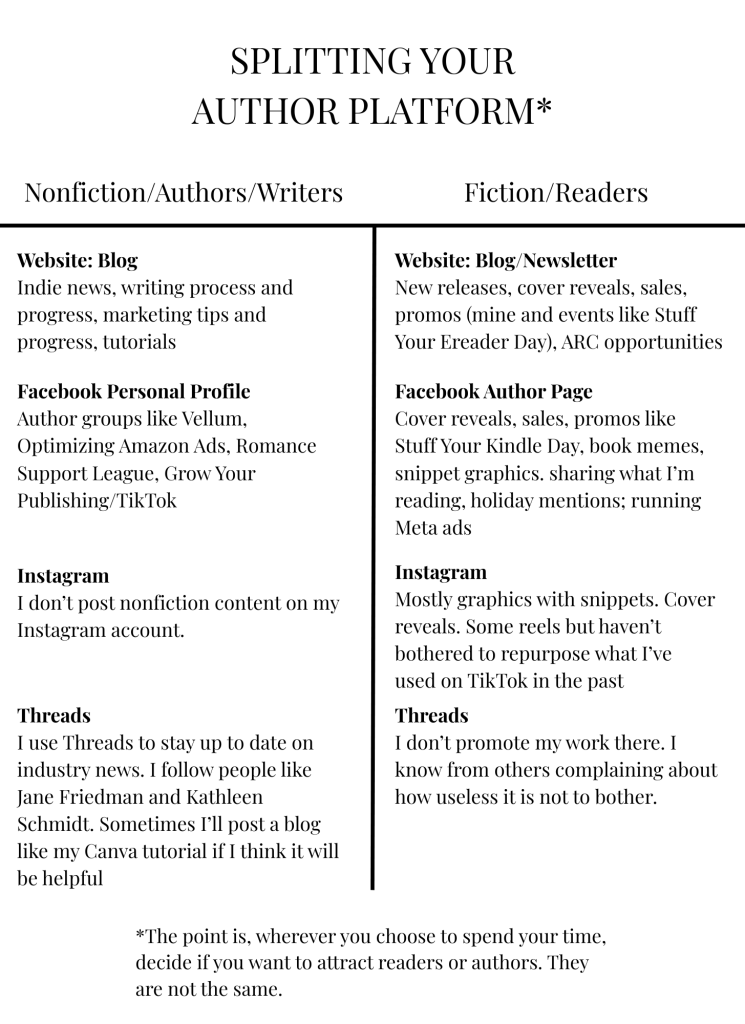
When Good Advice is Bad

1,681 words
9 minutes read time

picture of framed text that says when good advice is bad. generic white vases and a bronze bowl flanking the frame

There’s a lot of advice out there, some of it good, have decent covers, write an exciting blurb, and some of it’s not so good, like doing whatever you want just because you can (which is advice I actually see a lot online).

What’s disheartening is when you hear good advice that doesn’t fit you, for whatever reason, like rapid releasing/writing quickly when you don’t have the life that lets you, or writing a long series when maybe you don’t have the patience to invest in several related books. It can be good advice, and I’ve given my fair share on this blog too, like trying to afford some ads to reach new readers, but it just isn’t going to be for you. Ads can be expensive and time consuming to learn, for example. So I get it, especially when I’ve touted the advantages of Facebook ads then turned around and shut them off due to burnout.

There was a bit of advice I got from someone in one of my romance groups, and it’s advice you might have heard before too. When you want to find hooks in your books to make graphics, they say to borrow your book in KU or buy the Kindle version and look at the parts other readers have highlighted. This is the example in the book I’m reading now, Dea Poirier’s Next Girl to Die. To find the highlights in the book you’re reading, press the three dots on the upper right. I’m using a Kindle Fire, so I’m not sure if the way to find them is the same on all devices. There you’ll see the Popular Highlights. I apologize for the glare. No matter where I moved in the room I couldn’t get rid of my shadow.

screenshot of my kindle. screens indicate where you can find the highlights of a kindle book.
I’m reading Dea Poirier’s Next Girl to Die. You can find it here: https://www.amazon.com/dp/B07QDC7Y6B

I think this is great advice, as I’ve read books that have the highlights and it would be so easy to use those as hooks on graphics for Instagram and TikTok. So, I figured I would look at the book I’ve sold the most of and check out those highlights. Now, let me tell you, the book I chose was Twisted Alibis. I’ve sold 132 combined paperbacks and ebooks, had the equivalent of 821 books read in Kindle Unlimited, and gave away 3,130 copies during a promo last year. I thought those numbers would give me the best chance of giving me the most highlights, and you know how many sentences I had highlighted? None. Not one person who read Twisted Alibis thought a sentence or paragraph was worth highlighting.

At first I thought I wasn’t looking in the right place, and I Googled how to find the highlights in a Kindle book. Where the option should be wasn’t and it took me a few minutes to understand that the option wasn’t there because I didn’t have any highlights.

To say I was disappointed is an understatement and it’s easy, very easy, to take something like that personally. Even now I can feel the shame. That book is 107k words long and not one of them touched a person enough to highlight them. Then I thought maybe it was a fluke and looked up Rescue Me. That book has sold 429 ebook copies, I’ve given away 4,916, and I’ve had the equivalent of 572 books read in KU. Nope, not one highlight. I was so embarrassed after I looked that I didn’t look at any other books.

There’s a lot you can take away from that, not any of it good, if you want to be honest, and I was still stinging when I saw someone on Threads ask how they grab hooks on a newly released book and one of the responses was to wait a few days then look at the highlights. I felt compelled to tell that person that they might not get any at all and to have a thick skin just in case they don’t. I guess I don’t have to say that I bristled with the assumption that if you just wait a few days readers will love your book so much they’ll highlight the hell out of it. Some authors don’t even get readers, let alone highlights from those readers.

I don’t actively read my reviews because I’m just not up to reading why someone (or many someones) didn’t like my book, and that’s okay. After that highlighting debacle, I’m not going to look for my highlights anymore either, because obviously, I might not like what I find.

So, what can you do when stuff like this happens? When what works for someone else is just a dumpster fire for you?

What you have to do, first and foremost, is to remember that your books are good. Know that deep in your heart. My books sell, and Twisted Alibis has 87 reviews on Amazon and a 4.5 star rating. Rescue Me has 112 with a 4.4 rating on Amazon. That may not be much to some, but it means the world to me. Just because they don’t have any highlights doesn’t mean readers didn’t enjoy reading them.

Remember that you are not the only going through this. There are a lot of books out there that for some reason or other don’t have highlights (or reviews). They aren’t being read or like in my case, those authors just didn’t have the readers who were into highlights for whatever reason. It helps to know you’re not alone even if you feel like you are.

Find alternatives. If something isn’t working for you, find a different way to do things. The highlights are easy because you can just go through your book and find the ones YOU like and flash them all over. Maybe those quotes will get people excited enough to read your book. Brag. You wrote the damn thing and loved it enough to publish it! Who cares what others think? In the case of reviews, ask a friend to go through them for you, or choose an hour to scroll, pick a couple that you like, and then close out of Amazon–and look on Amazon! Stay off of Goodreads for all that’s holy. Reward yourself for not falling down the rabbit hole of bad reviews and have a piece of chocolate or a glass of wine, them remember you don’t have to do that again–at least, not for that book. I understand the value in having a review or two for social media purposes, and I noticed this review of Twisted Alibis when I was on Author Central skimming the reviews coming in for my King’s Crossing series:

Verified Purchase
If you like the rockstar romances, this is one, true, BUT it is more. Lots of social issues addressed, done in a delicate way, no raging reality tv tropes, more like addressing things we all face with a nice romance tucked inside.It's heavy in places, prepare for that, but you'll come out better for it at the end.Gitcher readin glasses out and enjoy.

Text on white background. Verified purchase in red

Like everyone else where bad things are concerned, I’ll probably carry that shame for a long time. Everyone makes it sound so easy to get and use highlights, and I feel like I’m missing out on something big. Maybe I do have highlights somewhere, but I think it’s best if I don’t look because if I don’t, that’s only going to make me feel worse. I don’t put up a lot of graphics anyway, so I guess in the scheme of things I’m not missing out on much. But in the future I’ll definitely be taking everyone’s advice with a grain of salt.


I suppose that’s all I have for this week. I’m 66k words into Wicked Games even though I said I would be taking it easy writing this book. I am, I don’t stress so much about it if I don’t feel like writing, but I guess it helps I’ve been thinking about this book for a long time and I know what I want to write every time I sit down. I was worried this book would be short, but after I ironed out a kink in the plot, I’m back on track and it will probably hit somewhere in the 90k range. After I reach 50k and swim through the murky middle, I really don’t care how long my books end up but I was a little worried about it when I didn’t know how to fit in what I needed without a setting change. They’re in a small town right now, but I just can’t finish it without them moving into the city where they both live, so that eased some of my worries. We’ll see how it turns out.

As far as anything else, my sales have all but slowed to a stop, even with the few Amazon ads I have going. I got my tax returns back and have a little “fun money” as my dad likes to call it, but I’m not too eager to start up my Facebook ads again. If I did that, I would only start one or two and push readers toward my King’s Crossing series as I have gotten good reviews on the books so far and the read-through would be amazing. Plus I might get a few sales here and there, especially since the first three are on sale right now. But we’ll see how that all shakes out after I pay all my bills and stash what I want to stash in savings. I could probably set aside a couple hundred and see what works, but I’d have to keep a close eye on clicks and be ready to pause if it looks like cost-per-click is greater than sales. I’m not into spending 5k to make 5k anymore. I really didn’t get anything out of it when I did that. Readers were reading but I didn’t see any evidence of an uptick in blog subscribers or read-through to other books in my backlist.

That’s all I have for now. The first day of spring is March 20th, so I’m looking forward to some warmer weather and more consistent sun. I hope wherever you are in the world the weather treating you okay, and my thoughts are with the people in the south who are dealing with tornadoes and their aftermath.

Thanks for reading and I’ll see you next week!