Advertising versus Marketing: an Indie’s interpretation

Words: 2725
Time to read: 14 minutes
(FML, I’m sorry!)

When I go through and read threads and posts about marketing, I’m surprised sometimes by the misunderstanding. I shouldn’t be because I had the same misunderstandings long ago. I don’t think authors really grasp the concept of what a long game writing and publishing is. We’re still hopeful that we’ll be an overnight success and that marketing will be taken care of for us by a viral TikTok or a random influencer who happens to love our book. The problem with that though, is that even if something like that were to happen, a lot of us don’t have our ducks in a row to keep that tail going.

During my first five or six years of publishing, I didn’t get what marketing was because I was thinking of each book singly as I published it. I also didn’t understand the magnitude of putting my work out there for strangers to enjoy (or not)…the responsibility I had as an author who is asking for readers to pay for a product. I was caught in an indie Twitter bubble, and honestly, it took me many many years to get out of it, or to realize I was in it, to be honest. Looking back at the first three books I published that I had no right to publish at all, and then the first trilogy I published that is still not good but better than what I had published before, I’m a little embarrassed I was so clueless. Sometimes you can’t learn unless you do it and fuck it up while you’re at it, but when you’re selling something, you’re also playing with people’s money.

When we talk about advertising vs. marketing, we’re going to assume your book is as good as it can be inside. If you’re getting any type of poor review that indicates the editing isn’t there, your character arcs aren’t fully formed, or there’s just an overall discontent with your book, you may need to revisit and revise. No amount of advertising or marketing is going to sell your subpar book and you can’t build an author brand on a shaky foundation. That’s what took me six years to learn, and maybe you need six years too, but six years is a long time to waste if you just believe what I say instead.

So this is what I’ve parsed out in my years publishing, especially the past three when I started writing for my pen name:

Advertising: Deciding what book you want to write next! Yay!
Marketing: Choosing a standalone or a series and which genre, knowing if you’re going to meet reader expectations, if you’re going to write to market, how long the book(s) are going to be, and if you’re going to write a series, if you’re going to write them all at once and rapid release them or if you’re going to publish as you go and how long that’s going to take.
Publishing, as we say, is a very long game, and you have to be honest with yourself. If you’re planning a five book series but you work full-time and have children, how long is that five books going to take you to write? Five years? If you do that and want to publish as you go, how are you going to keep your audience interested so they don’t forget about you while you’re writing the next one? I’ve spoken a lot about series on this blog, and I’m not going to rehash my pros and cons here, but advertising one book because it’s done and published is a lot different than creating a marketing and publishing plan for an entire series–especially if it’s long and won’t be completed for several years.

Advertising: You’re creating a cover for your book that you’ll use in ads like Amazon Ads and Bookbub CPC ads and social media graphics.
Marketing: You’re creating a cover for your book that will fit in with the image you want to project as an author, build your brand, and be recognizable to readers the instant they see a cover that belongs to one of your books. Not to mention convey the genre your book is written in (because you chose a genre, right?).
I think this is one of the hardest lessons I learned. I was pretty adamant that I was going to make my own covers when I first started writing and publishing, teaching myself with the help from a book that is now 100% obsolete how to make a PDF in Word. Because of that, you can thank me for the Canva how-to blog posts I have here on the website, which gets hits every day. I never would have been able to do that for others if I hadn’t learned it for myself first. That’s not to say it was the smartest thing I ever did, considering I made a lot of mistakes I still see indies make today–using a free photo from Pixabay, et al, not having any idea of a consistency stretching across other books in their catalogue, and having zero idea that the cover should actually match the spice-level my book was written in (people will tell you to browse the top 100 in your genre for a reason). I guess because my book had no specific genre, that made it kind of difficult to do any research had I even known to do it. (Romantic Speculative fiction, anyone? Blah.) One of my favorite examples of what I mean is Melanie Harlow. She has the cutest font for her name, her covers all have the same vibe, and with the sweeping font she uses for a lot of her titles, I know right away if it’s a Melanie Harlow book. I love everything she does and she knows her brand like nobody’s business. If you want to see what I mean, look at her website: https://www.melanieharlow.com/
If you work with the same designer (or do them for yourself) you’ll eventually end up with a cohesive vibe. We all have our own styles, and that will show. Choose a nice font for your name that you won’t get tired of. Decide if you’re going to do single men, couples, lighthouses, streets, what have you, depending on your genre. You want your Amazon author page to look TOGETHER. I’ve seen some author pages that look like I’m digging through a giveaway book box at a rummage sale, and that’s not a way to grab a reader . . . or their loyalty.

Advertising: You’re buying a promo spot like Freebooksy, Bargainbooksy, E-Reader News Today, Fussy Librarian, or something similar for one of your books to see if you can generate some buzz.
Marketing: You’re mapping out your promos for the next 12 months based on what you have coming down your publishing pipeline.
I heard a big-time author say you should be doing something every quarter–that’s four times a year. (It comes in handy if you’re in Kindle Select because they give you 5 free days per title, you guessed it, four times a year.) If you don’t have the backlist (or the front list) to continually run sales, you have to sit down and decide how fast you can write and what the next three to five years are going to hold for you. You don’t have much to market or advertise if you’re not writing and publishing, and what you’re writing and publishing will be important. You can do a sale or do a free promo, but unless you’re in KU where you might get some page reads during your promo, it doesn’t make a whole lot of sense to give away a standalone novel, especially if it’s your only book. If all you have are standalone novels, make sure your back matter is pointing your reader to the next standalone (if you like this book, check out this book) and/or to your newsletter.
You may be thinking you can’t afford to do something like that four times a year, and I understand that completely. In time you’ll start to earn out your fee or get ahead, and if you never do, then the conversation turns back to quality (book covers and blurbs) and craft (how well are the insides written).
So, grab a wall calendar and map out the next 12 months. I can mark up my new releases from now until the beginning of 2025. Can you?

Advertising: You decide to write XX genre for your next release, but you’ve written and published XX genre under the same name so your backlist is going to look a bit wonky. That’s okay though because you’re going to focus all your social media efforts and advertising promo dollars on your new release.
Marketing: You’ve decided on Small Town Romance, that is where you will stay, and that is what you want to be known for.
Everyone tells you not to genre-hop, and a lot of indies don’t listen, saying that it boxes them in or stifles their creativity. I get it. I went from Billionaires to Rockstars because I wanted to write my Rockstar trilogy and that’s what I did. I had an amazing idea for a trilogy and I wasn’t going to not write it–that would be dumb, right? I mean, rockstars are rich too, and as I’ve pointed out in the past, my books are still more contemporary romance than true Billionaire romances. Just because I make them rich doesn’t exactly mean they’re going to meet reader expectations, but so far I haven’t gotten any feedback to indicate readers are unhappy. Romance is neat in that you can choose a genre like small town romance, but the sky’s the limit when it comes to tropes. Most romances are written with a trope for a foundation, and it doesn’t matter which genre or subgenre you choose. So far, I haven’t found that writing Billionaire is stifling–there are many many tropes and you can twist them your own way to keep them fresh. Here’s a blog post I did on consistency: https://vaniamargene.com/2021/12/20/buzzword-consistency/

Advertising: I’m going to post on Social Media every chance I get. All my followers are other writers, but that’s okay–authors are readers too.
Marketing: Starting a reader group or author page on FB and joining reader groups for the genre you write in. Using author groups for publishing information and networking to find beta readers, editors, and making friends for newsletter swaps.
Bursting out of the writing community bubble was hard, but I think I’m finally doing it. It helps that Twitter imploded and I don’t waste time there anymore and besides all the authors whom I follow and who follow me back on IG where I rarely post, all my social media (besides this blog) now is for readers. I’m slowly building up a readership on my FB author page, VM Rheault, and my V’s Vixens Read Romance FB page, mostly because I run ads from it and I post so it doesn’t look empty. When I started my TikTok account, the smartest thing I did was not label myself as an author. I didn’t think it was necessary as I’m not posting non-fiction (like writing updates) there, and I’m keeping my author following to a minimum, too. I understand that social media is free and falling into the writing community is easy, especially on Twitter and Instagram, but there really is no cheap way to find readers that’s effective. Surprisingly, I’ve had better cost per click using Facebook ads, and when I paused my Amazon ads during Zoe York’s Stuff Your eReader day, I didn’t turn them back on. My sales haven’t suffered, so I’ll wait and see. I have two ads running on FB right now, one for Twisted Alibis and one for Rescue Me. I don’t want to say free social media is useless–established authors still have great success and engagement with reader groups, but filling your social media following with other writers or family and friends won’t get you the sales you’ll want long-term.

Advertising: You start a newsletter but don’t offer anything as an incentive to sign up and don’t push the link anywhere but on social media where the same people hang out.
Marketing: You start a newsletter and have a reader magnet that is a great sample of the kinds of things you’ll be writing or reflect what’s in your backlist. You add the sign up link to the back matter of all your books, you add the link wherever you can–Amazon Author Page bio, your BookBub Author Page bio, FB reader groups (if it’s allowed) and anywhere else you can get signups like BookFunnel or StoryOrigin promotions. You also push the link and your reader magnet with FB ads and promos like Fussy Librarian and Bookdoggy.
Probably the number one reason I hear for not starting a newsletter is that authors don’t like them so therefore don’t want to offer them, and the second is that they don’t know what to write. Like publishing, building a newsletter list a long game, but the longer you wait, the harder it is and the more urgent it will feel. I should have started one a long time ago, but I can genuinely say the first six years I’ve been doing this was all just one big learning curve. Maybe you aren’t ready for the information in this blogpost–and that’s okay. We do have to write the books of our hearts and in our own time, learn for ourselves that shilling books on Twitter will only go so far, and realize that if you try, you can actually make some money at this publishing thing.

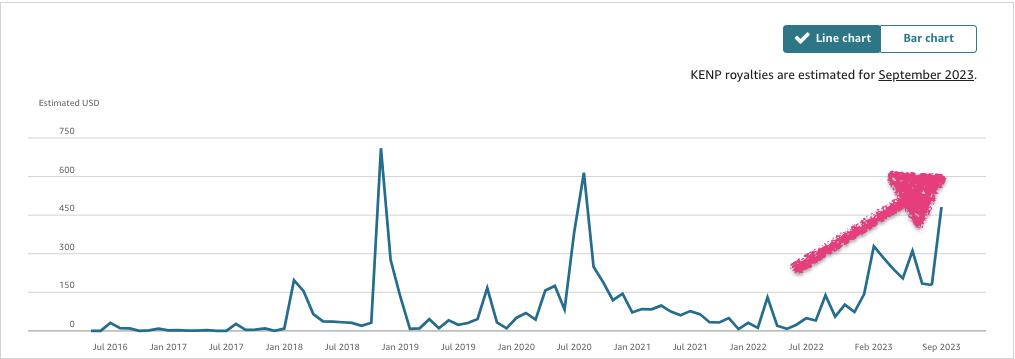
If you don’t think I know what I’m talking about, I pulled up the graph from my lifetime of publishing. As you can see, I had some spikes, anomalies, but the slight upward trajectory since June of 2022 when I first released Captivated by Her and Addicted to Her means more to me than the unexplained sale spikes. Consistency will win the race, and one day my sales will make me a small, if not steady, profit.
I could be sad that it took me so long to figure things out, but I met some great people along the way and learned a lot. I wasn’t prepared for success to come any earlier, but if I wrote something and a TikTok influence loved it now, I would know what to do with the attention and that’s really important. I’m still small potatoes, and I know that, especially since I’ve joined some TikTok for Author groups on FB, and holy hell, can those billionaire/mafia/dark romance authors rake it in. But after all the books I’ve written, I think I found where my heart truly lies–with rich guys written in angsty first person. Finding my niche may have been the biggest accomplishment from the past six years. Now I can write happily in a genre while building my audience.

You can look at advertising as something you do in the present, something that builds buzz short term, but marketing is something you do over months and years, pushing yourself as an author, what your brand is, as well as your books and what they’re about. But, you do need content, and that’s what trips people up, I think. You need be writing, need to have something for people to read, be it books or newsletter content. Time can be a huge factor and that’s why I suggested buying a wall calendar and mapping out what you think you can do for the next year or two.

It’s tiring, believe me, I know. If I didn’t love writing so much, I would have quit long ago, but I do love it, already thinking of what I’m going to write next, even if that won’t be published until the spring of 2025. God knows if I’ll even be alive then with the way I feel some days, but I never want people to think I’m floating on this cloud tapping away at my keyboard, when you probably would never believe the number of down days I have. My sexy men keep me going, and I hope your characters, when you’re down, keep you going too.

Have a good week!

Marketing ideas for your books

We tend to confuse marketing and advertising when it comes to our books. Advertising is what you do when you’ve already written it and published it and you’re only looking for readers. That’s running ads, buying a promo, tweeting about it, or posting in FB groups. That’s not really marketing. That’s shoving your book under someone’s nose and hoping they like it enough to buy it.

Marketing encompasses a lot more than that, and it starts with your product, a fact many indie authors don’t like because they prefer writing the book of their heart and hoping someone likes it enough to read it. That’s fine; whatever floats your boat. And honestly, it’s what you should do when you first start out. But writing the book of your heart, or the books of your heart, won’t get you very far unless you can meet in the middle between what you want to write and what readers are looking for. As I’ve said in the past, authors who can meet in the middle find their longevity in this business. Or rather than compromising on every book, write something you love, then something you know will sell, and go back and forth. I was reading Bryan Cohen’s new Amazon Ads book Self-Publishing with Amazon Ads: The Author’s Guide to Lower Costs, Higher Royalties, and Greater Peace of Mind and in it he quoted John Cusack, who said something like, “I do one project for them and one project for me.” I can’t find attribution for that quote, but for the sake of this blog post, let’s go with it. That’s not what this blog post is about, as it is your choice what you want to write, but as Seth Godin said, and I quoted him not long ago, “Find products for your customer instead of trying to find customers for your product.”

(And if you’re interested, a really great talk by Kyla Stone is available here. She talks about writing to market, but she couldn’t get to where she is today if she wasn’t writing what she loved to write.)

I’ve spent six years publishing and learning from my mistakes. Here are some tips I picked up from other authors and what you can implement with your next books.

Make sure your series looks like a series.
If you look at any big indie’s backlist all their series look like they belong together. It doesn’t matter if they’re all standalones and readers don’t have to read them in order. If they fit together, create their covers so they look like they do. Not only does a reader glancing at your Amazon page know they belong in a series, they just look nicer when they’re all branded in the same way. That means a matching background, maybe, cover models who have the same vibe. Create a series logo and add that to the cover as another way to identify one series from the next. If you do your own covers but publish as you write, create all your covers at once. That way you’re not stuck with one cover that’s already out in the world you can’t duplicate. That shoves you into a corner you don’t want to be in. Book covers are more important than we want to believe, but trust me. Look at any of your comparison authors’ backlists and see for yourself how they brand their series. Also make sure if you’re going to run ads that they meet Amazon’s policies. I had to tweak my small town contemporary series because Amazon kept blocking my ads. I had to zoom in on their faces and it ruined the entire look. I’m much more careful now.

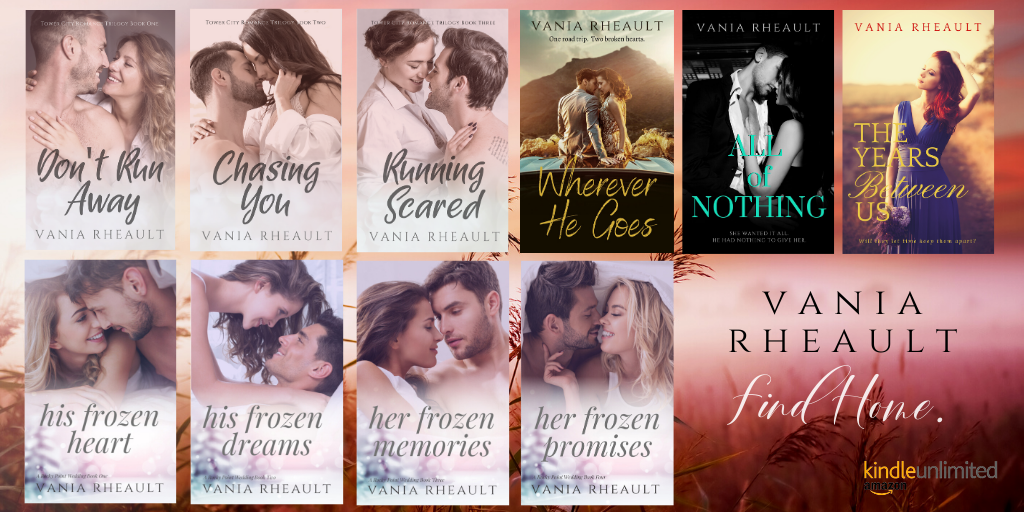
These are books under this name. It’s easy to see the trilogy belongs together, the three standalones and then the small town series. Amazon didn’t like they were in bed. Too bad. They did.

Write in a series, but also don’t tie things up –until the very last one.
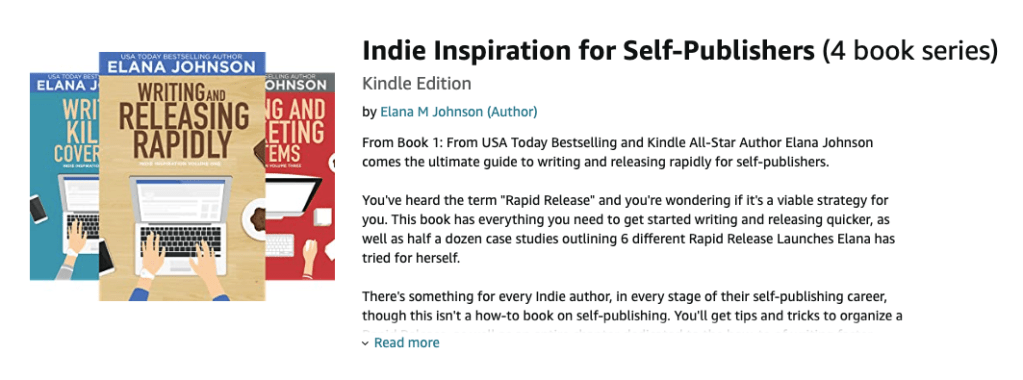
Elana Johnson calls these loops. You can end each book with an HEA, but with the overall plot, don’t wrap things up! This encourages the reader to read through your entire series to see how things finally end. With my small town series, everyone is in town for a wedding, and there are wedding activities throughout. The last book ends with the couple’s ceremony. What’s fun, the couple getting married isn’t even one of the couples featured in the books. They are background characters that help with the subplot of each book. That’s it. That might be a flimsy piece of tape holding the books together, but it was a fun way for me to end the series–with the reason why everyone was together in the first place. When Elana talks about loops, she doesn’t mean ending books on a cliffhanger, though it is well within your right and another marketing strategy you can incorporate into your writing. Elana has a wonderful series for indie authors, and you can look at the books here. I’ve read them all, and this isn’t an affiliate link.

Use your back matter.
When you write in a series, and the books are available, your Kindle can help you out by prompting you to read the next one. That can be a boost, but also, you want to take matters into your own hands and add the link to the next book in the back matter of the one before it. If you don’t write in a series, add a different book. If a reader loves your book, they’ll want to read more from you, and you might as well make it easy for them. Too many calls to action may confuse a reader, so you don’t want pages and pages of back matter asking a reader to buy a million books, sign up for your newsletter, and follow you on Twitter and Facebook. Choose the one most important to you, add it immediately after the last word of your book while they are still experiencing that reader’s high, and ask them to buy your next book or sign up for your newsletter. I have also heard that graphics work wonders and adding the cover along with the link is a great way to prompt readers to buy.

Introduce your next book with a scene at the end of the previous book.
This is one I learned from the writers in my romance group on Facebook. Say your novel is about Travis and Amy, but the next book is going to be about Rafe and Emily. End Travis and Amy’s book with a short chapter/scene in Rafe’s POV to get them excited for the next book. I haven’t started doing this, but the writers in my group give it 10/10 stars, would recommend as a great way to get readers buying the next book. Also, if you’re writing romance, readers gravitate toward those hunky men, so if you can, write from his POV. I’m definitely doing this with the trilogy I’m publishing in January, and with the six books that are with my proofer now, the third book ends with an HEA for that couple, but I added a chapter from the heroine’s POV for the next three books. I suppose I could have done it from his POV, but hers felt more natural, and I hope it will be enough to get the readers invested in her story and how the series plays out. You can do this with any genre you write in–if he’s a detective, maybe he stumbles onto a new case, or maybe something serious happens in his personal life. Whatever the case may be, add something that will entice readers to click on the link you’re putting in the back.

Bonus scenes for newsletter subscribers only.
I haven’t started this up yet because 1) you have to write the bonus content 2) I don’t know my newsletter aggregator well enough to make something like this happen, and 3) with my newsletter signup link already in the back, I’m giving away a full-length novel. If you don’t have a reader magnet, writing a bonus scene that is only available if readers sign up for your newsletter is a great way to add to your list and hopefully, the more engaged your list is, the more readers you have.

Looking at your entire backlist as a whole–or what you’ll be writing in the future.
If you think of marketing as an umbrella for your entire career, then think of advertising on a book by book basis. Marketing involves all your books, who you are as an author, and what your message is. That’s why so many authors want a logo–but attach feelings, emotions, and what you’re giving your reader in your books to that logo so they think of those things when they see it. It’s why soda commercials are always happy. They want you to equate having a good time with drinking their product. What do you want your readers to get out of your books? If you’re a romance author, an HEA, for sure, but what else? Is your brand a damaged hero? Found family? If you write women’s fiction, do you want your readers to expect a woman on a journey, or maybe sisters repairing their relationship? Best friends who have grown apart only to be reunited for some reason? Of course, that sounds like all your books will be about the same thing, but that’s not really the case. What is your theme, what is your message you want your reader to get from your books?

Publish consistently.
Training your readers to expect a book at certain time will help you build buzz as your readers will get used to your schedule. Figure out a comfortable schedule and try to maintain it. Once every 3 months seems like a good practice if you can keep up with that as you’ll never fall off Amazon’s 90 cliff. Also, if you’re writing a series, keep in mind readers don’t like to wait and you’ll have your work cut out for you if you can only release one book a year. You might just have to be resigned to the fact you won’t get the number of readers you want until all the books are released.

It’s a bit older now, but Jamie Albright spoke at the 20books convention a few years ago. She shared some good tips if you can only write and release one book a year.

Tweeting incessantly about your books isn’t marketing. Doing research on your next book before you write it, figuring out your comp authors and comp titles, doing cover research, and writing a good blurb is marketing. Running ads and buying promos to that book once you’ve written it is advertising.

It took me a really long time to figure this out–ten failed books because I genre hopped and was only writing what came to me. I didn’t publish on a schedule, didn’t have a plan. I’m still not publishing on a schedule, though I am going to try to aim for one book a quarter after my COVID stockpile is out into the world.

I’m getting a hang of this marketing thing, but it’s nothing you can achieve over night. I spent five years making mistakes. I’ll spend the next five fixing them.

Thanks for reading!


If you want resources on planning your career, Zoe York has a wonderful series of books that talk about that. You can get them here. https://www.amazon.com/dp/B082CZDK75

Sara Rosette also has a wonderful book on how to write series, and you can find it here. https://www.amazon.com/How-Write-Structure-Troubleshooting-Marketing/dp/1950054322/

Where Did Organic Reach Go? (And what you can do to find it.)

2020 indie publishing predictions

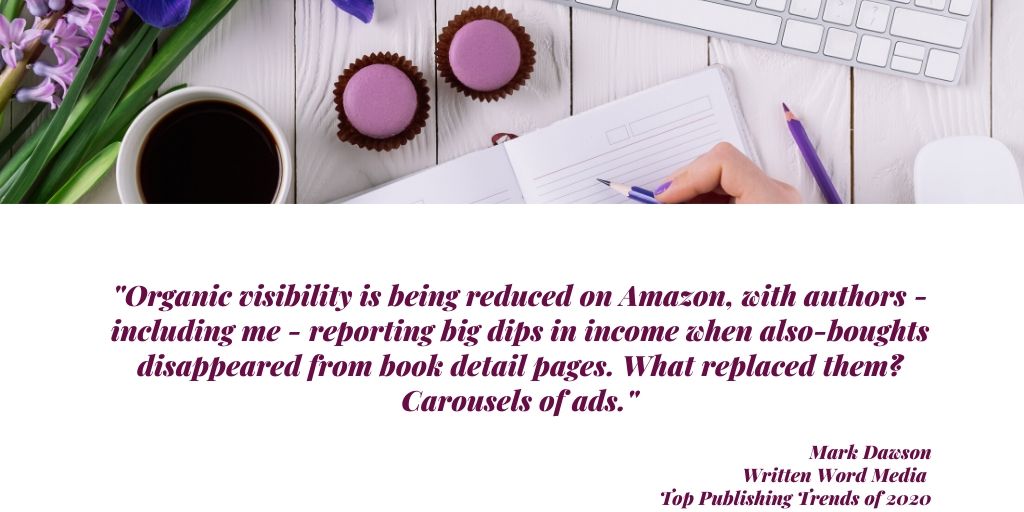
The reason we’re so crazy about marketing is that organic reach is disappearing.

What is organic reach? It’s when someone finds what they need without the company or publisher spending money on advertising. When people talk about ads and marketing  and say organic reach has disappeared, they mean free advertising.

2020 indie publishing predictions-2


Click on the graphic to read the entire article.

Free platforms on social media. Free exposure. There isn’t a day that goes by that I don’t see an author in one of my writing groups ask how they can find exposure for their book without spending any money.

Twitter has promoted tweets. Facebook makes you boost posts on your own page so everyone will see it. Instagram (in conjunction with Facebook) will promote your posts. Authors are clamoring for attention, and if you can’t, or don’t want, to pay, your post will get lost in the fray.

Is there anyway for an author to find free traction? There are some ways to get around disappearing organic reach, but they take a lot of time and work, and there are no guarantees you’ll see results.

  1. Look for other websites that pertain to you and your genre, and ask them to interview you or ask if you can write a blog post about your book. That’s free. Check the blog for the kind of content it offers and ask to contribute. Everyone is looking for quality content. You’re helping them, and they’re helping you. But make sure they have a good-sized audience or you’ll be wasting time.
  2. Simply ask. Ask for a retweet or ask for a share. If you’re blogging, use hashtags on Instagram, Twitter, and Facebook to tag your work when you and others share your post. I can get quite a few eyes on a blog post on a Monday using Rachel Thompson’s #MondayBlogs hashtag on Twitter. That’s for my blog, though. I don’t push my books on Twitter, and she has a strict no self-promo rule. Research hashtags and use them appropriately on social media platforms.
  3. Network. People don’t like to network because it takes time to build relationships. It can take years to build a foundation in your genre. Join groups that read the genre you read and write in. After you establish trust and made friendships, you can say, “This month’s selection was amazing. I have a book I just launched that is similar if anyone wants to give it a try.” And that’s it. Taking years to build a group only to be able to say one or two things about your book is a huge time suck. But if you can’t spend the cash, you have to spend the time.
  4. Ask your local newspaper or area magazine to interview you. I’ve even seen local authors on my local morning news program. Who knows who is watching at 5:30 AM but if you can’t spend money on ads and promos, every little bit helps.
  5. Send out a press release. There are press release templates online. Explain what your book is about and send it out into the world. You can find a list of paid and free places to submit a press releases here. You can Google a list of press release templates, and Word has a press release template you can search for in their templates menu.
  6. Write for Medium. Instead of blogging, write on Medium and build an audience there. This is especially ideal if your book is nonfiction. Then you can write short articles on your topic. If you don’t know how to go about it, but it sounds interesting you to you, check out Make Money on Medium: Build Your Audience and Grow Your Income with Medium.com.
  7. Start a newsletter. Start it now, even if you don’t have a book out yet. Some email aggregators don’t charge until you reach a certain amount of subscribers. It can take a while to build your list, but the sooner you begin, the better off you’ll be.
  8. Contact your independent bookstore in your area and develop a relationship with the

    68439602_2590399361023194_7744828669033447424_n

    Photo taken from Black Birch Books’ Facebook Page.

    manager and staff. A good example of this is Dave Koster. He has a relationship with Black Birch Books in his city. They carry his book and have hosted book signings for him. He gets to post about it on social media to build buzz, and he’s making local connections. If you don’t have money to spend on ads, or don’t want to take the time to learn how to use them properly, you will have to do the footwork to try other things. (To take a look at Dave’s book on Amazon, click here. If you want to follow him and his publishing journey, click here and follow his blog. He has another book coming out soon!)


A lot of the 2020 predictions are based on the fact that organic (free) reach is gone. Everything is pay to play, and this isn’t going to change. How much money do you think Amazon makes double-dipping their authors by charging to sell their books and charging them to advertise? The more important question – how much do you think Amazon makes off indies who waste money on their ad platform because they don’t know what they’re doing?

Mark Coker accuses Amazon of stealing the author platform, that we need Amazon to sell books, but I don’t think that’s only an Amazon problem. Facebook makes you boost a post in your own group or not everyone will see it. Some of Kobo’s prime promotions are paid or you aren’t eligible. They have free ones you can apply for too, but as you can imagine, they are very competitive and difficult to secure. Amazon isn’t the only one making you pay for exposure, yet they seem to take the most heat for it.

2020 indie publishing predictions-3

If you’re going to depend on free marketing when you publish, start building your platform long before your book comes out. Have all your social media intact in the niche or genre you’re writing in. Every little bit helps, I just can’t promise you how much.

Some other blog posts on organic reach:

https://www.tckpublishing.com/why-authors-should-not-use-social-media/

https://www.janefriedman.com/author-without-social-media-presence-now/


Do you have other ideas for free exposure? Let me know!


end of blog post graphic

Being a Career Author. Do you have what it takes? Wrap Up!

In this blog series we’ve been going through a survey by Written Word Media, and what it takes to be a career author. They surveyed authors who are emerging authors, authors who make 60k and authors who make 100k from their writing.

I went through their points as an emerging author who has six books in her library and I make less than $2,000 a year from my books. They went through how much authors spend in editing and covers. It’s no surprise that they found authors who put out quality books make more money.

They went through how they marketed, with easy and affordable promo sites heading the list.

They surveyed authors about being wide or exclusive and found it didn’t matter – authors still need to take time to build a readership no matter where they publish.

They also went into the time authors write, which not surprisingly, revealed at 60kers and 100kers spent the most time writing. In that blog post I tried to hammer in to the emerging authors that to make the leap from emerging author to 60ker, you still need to put in the writing work, no matter how many hours you put into your day job or how tired you are. Career money requires career time.


There are some variables as to why some authors make more than others, and the bonus material revealed some of these differences.

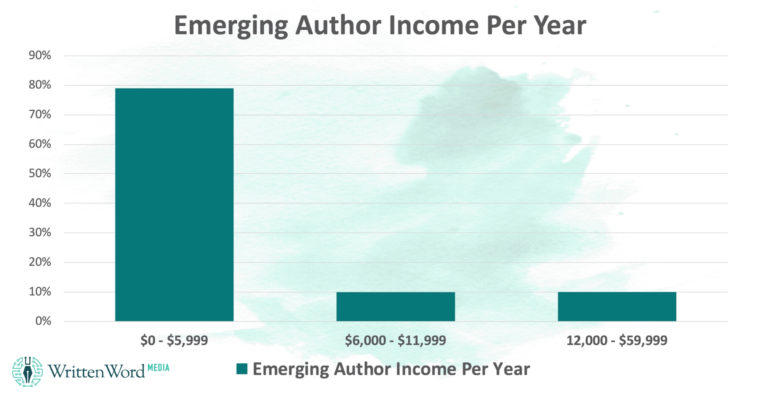
But first if you were curious about the amount of money an Emerging Author makes, take a look:

The difference between the emerging author and the 60ker. It’s quite a leap to be sure. If you’re single, you don’t need to make 60k to support yourself. At least in my area, you can get by okay on $30,000 a year. You’re not living in the lap of luxury, but a nice two-bedroom apartment with its own washer and dryer runs about $700/month. As an emerging author, even if I made an extra $300 a month, that’s a car payment on a newer car I desperately need. You can take a look at the graphic to check how much an emerging author makes.

EA-Income-768x400


Now for some of the reasons why one author would make more than another:

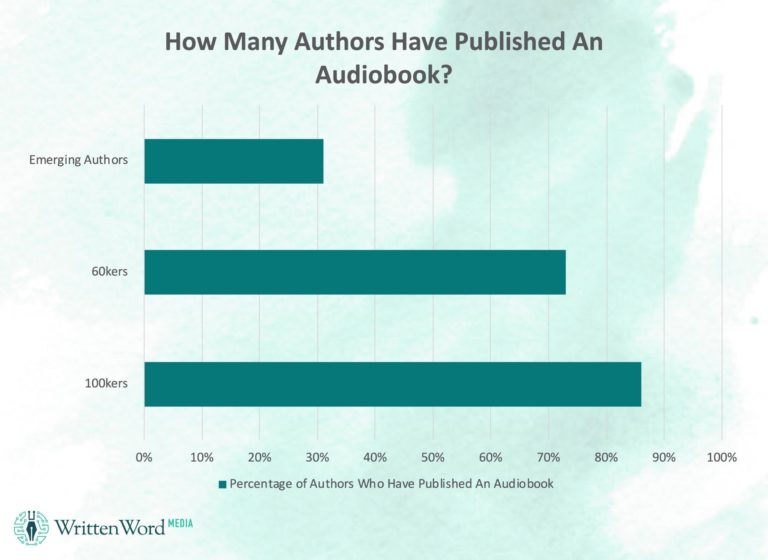
  1. Audiobooks. While audio is on the rise and it’s easier than ever to hire a narrator and get your audiobook out into the world, there’s no point in spending the money if the e-book isn’t selling. It makes sense to invest in audio if your book takes off, but if it doesn’t, there’s no point in spending the money to make an audio version. So while audio is a great supplement for 60kers and 100kers, they were already selling books and the audio is a complement to their library. Also, when audio finally fits into your publishing plan, indies now have their shit together and release the paperback, ebook, and audio all at the same time.

    Audiobook-s-768x560

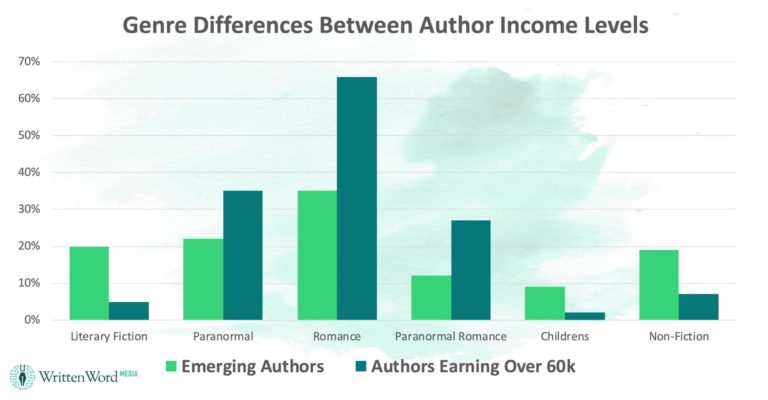
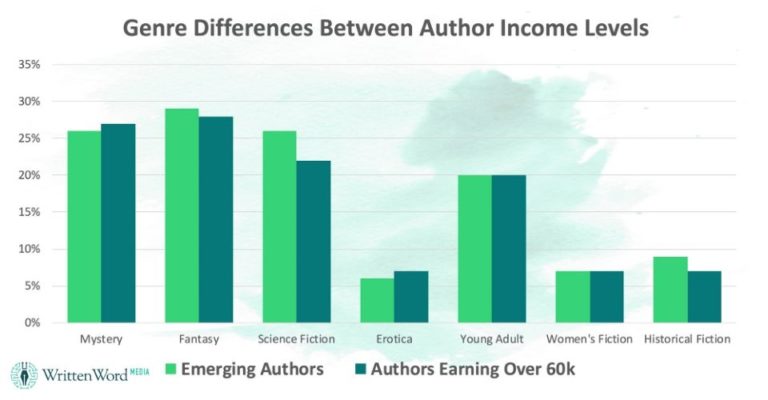
  2. Genre differences. I’m surprised they didn’t add this to the original survey because the genre you choose to write in is really important. As you can see by the graphics, authors made the most writing commercial fiction. Romance took the lead, and mystery, science fiction, and fantasy follow closely behind.

    Genre-Differences-768x400Genre-non-Differences-768x400
    Children’s books are a hard sell as they depend heavily on print, bookstore and library sales.

    Young adult is broken into lots of sub genres like fantasy and romance, and broken down further into sub sub genres like coming of age, new adult, or college. I don’t see many indies right now writing plain YA like Five Feet Apart or The Fault in Our Stars. They tend to lean more toward dystopian or fantasy like the Hunger Games or Harry Potter. At least, that’s what I get from seeing what others on Twitter are writing about. (Agents turned authors are the ones writing vanilla YA like Eric Smith’s Don’t Read the Comments. Maybe because they have their fingers on the pulse of the market and they’ll write what sells. Who knows.) If you look at indie romance YA, they tend to lean toward paranormal or urban fantasy. Paranormal Academy is hot right now and that usually includes a younger MC. It’s difficult to completely separate the genres, especially since indies like to mash as many genres together as possible.

    And with Amazon allowing you to choose 10 categories for your books, there’s a lot of space to move around.

    We can all agree that while you can make money writing nonfiction, it’s a lot different than writing fiction and it takes a different set of skills to market it. Authors like Bryan Cohen who wrote How to Write a Sizzling Synopsis, Mark Leslie Lefebvre who wrote Killing it on Kobo, and Brian Meeks who wrote Mastering Amazon Descriptions, all have solid foothold in the indie community and pretty much have a built-in audience. They’ve been a part of the indie community for many many years, and they have the platform required to succeed.

    In my experience many indies who venture into non-fiction write creative nonfiction also called memoir. Let’s face it. Everyone’s life is hard. I could write a book about how I survived my divorce, but that wasn’t anything special. I just joined the 50% of other American couples who also have divorced. Hardly book worthy. Unless you have something super special to say, it will be difficult to be the next Michelle Obama.

    Most emerging authors have no platform, and that’s what you need to get a nonfiction book off the ground.

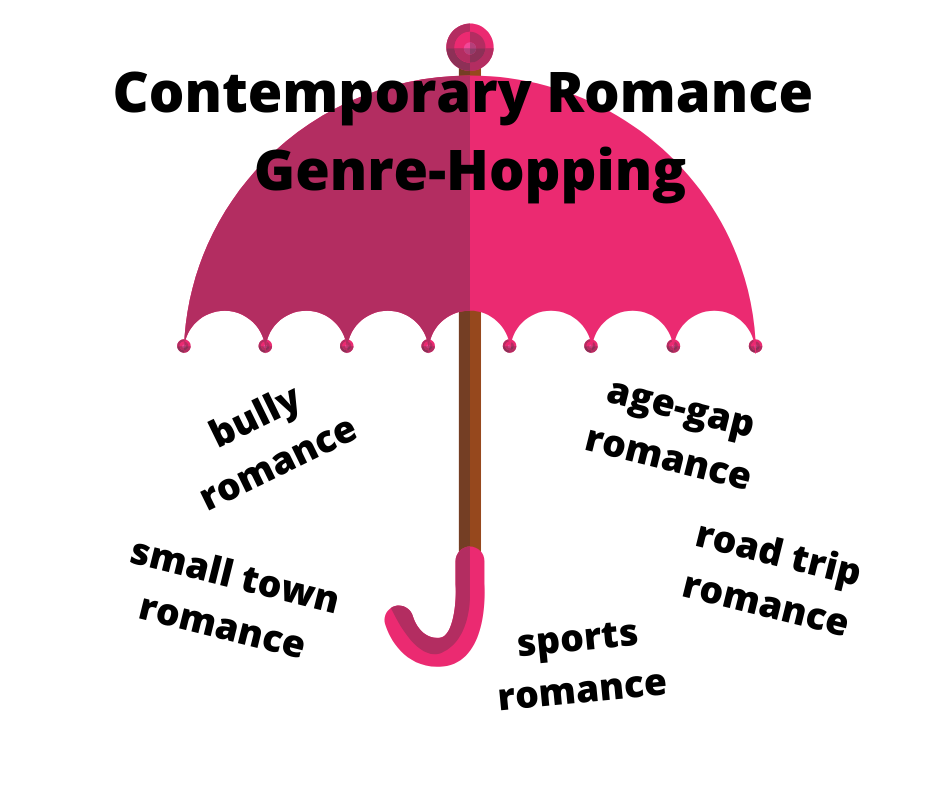
    When you’re an indie, it makes a difference what you choose to write, and, not only that, what you keep writing. Genre-hopping has never done an emerging author any favors, either, something I am finding out subgenre-hopping under my Coming soon!-2contemporary romance umbrella. From what I can see, the most successful indies stay within the same sub-genre like Aidy Award and her curvy girls or Alex Lidell’s academy books. Even Jami Albright writes romcoms and makes a killing with her Runaway Bride trope.
    Mystery, too, is seeing more segregation with subgenres, and authors who choose to write run-of-the-mill detectives might always want to stay with that, only moving the setting to other states, different police departments, and other tragic backstories.

    Indies do like to go their own way, though, and I like to write the stories I like to write as well. Hopefully we can all find a happy medium between writing what we want in writing what sells.

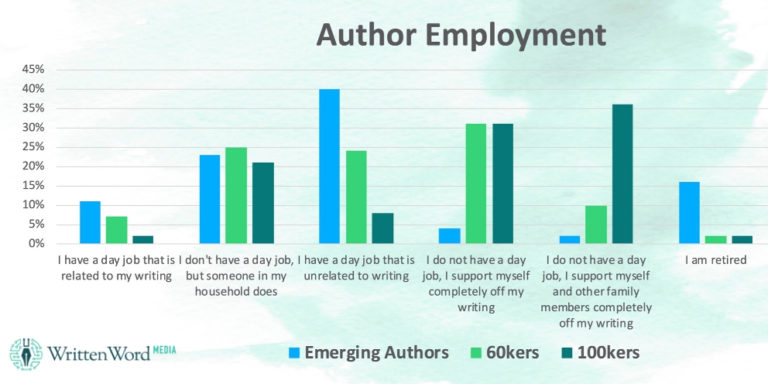
  3. The last point they went into was if the authors had a job outside of their writing. It’s not surprising emerging authors worked. Bills need to be paid somehow. The problem with needing to work is that sometimes your day job is so emotionally draining you don’t have any emotional energy left to write. I’m lucky that I can write and read at my job and that it isn’t emotionally draining. But I do trade that luxury with a lower wage and only because I have help paying bills can I continue to do so. I’m working hard to write as fast as I can to build my backlist so I can eventually hop from emerging author to 60ker. Eventually the sacrifices I’m making to put so much time into my writing will pay off. I’ll make sure it does.

employment-1-1-768x384


Even though they did add some additional data, they did leave out some other variables that I find are important in making an author successful.

  • Newsletter. The survey mentions newletter swaps saying that swaps aren’t an effective marketing tool. But that’s only swaps. Swapping implies an author has one to begin with, and I’m willing to bet there is a large gap between emerging authors who don’t have a newsletter and the 100kers that do.
  • The cost of ads. While the survey did go into how authors promoted their books, it’s not often authors reveal how much they’re spending on ads. If you make $50,000 a year but you’re spending $10,000 in ads you’re still doing well obviously, but the amount that author is claiming to have made is a bit deceiving. Bryan Cohen, when he does his mini ads courses, says any profit is good profit. At the core that is true. But if you have to babysit your ads so you make $2.00 for every $1.75 you spend, at some point you have to decide if you’d be better off writing. Ad creation takes time, especially when you need to take the time to write (or learn how to write) catchy ad copy. If you start a newsletter and add the link and call to action in the back of your books and pay for a promotion now and then, you may find that a bit easier, and a little less terrifying, than learning an ad platform and watching your ads like a hawk so overnight you suddenly aren’t $50 in the hole because people hated your blurb.
  • Writing in a series. I hate to keep harping on this, but this is also another component that the survey didn’t go into. Readers like series. They get invested in the outcome. They fall in love with the characters they follow through all the books. 60kers and 100kers know that and they capitalize on it. Emerging authors write what they want, and that isn’t always a series. But I would’ve liked the survey to ask its authors how many emerging authors versus how many 100kers write series. I doubt I would be surprised by the answer.
  • Frequent publishing. The survey didn’t go into how often authors publish. It stands to reason that the faster you put out books, the faster you can make money. But emerging authors have a hard time with timely output. They have their jobs. They are probably still learning craft and the critique partner/beta-reading stages they go through slow them down. Besides Jami Albright, I haven’t heard of an author who is not prolific making $60-$100,000 a year. And she admits she has to rely heavily on ads and other marketing techniques between releases. She knows her limits and embraces them. But you have to wonder if she could write more than one book a year, what that would do for her bottom line. I write as fast as I can, but I am not 100% confident in my ability. So the beta-reading stage slows me down as well, as does making sure of consistency and wanting no potholes in my stories. Maybe one day I won’t need so much reassurance. But I’d rather do it right the first time than pay for my haste with bad reviews.

In conclusion, the money is out there. There are different paths to the pot of gold at the end of the rainbow. But whether anyone wants to admit it or not, some paths are easier than others. Write commercial genres. Publish quality work. Publish often. Start a newsletter. Use promos like Freebooksy and Bargainbooksy to promote your work.

If you’re not doing these things, success may take longer to come. We all make mistakes and maybe telling your story the way you want to tell it is more important to you than money. That’s cool too, but be honest. Writing the story you want, with no editing, using a cover that’s not professional, and tweeting it out day after day won’t earn you any sales. So no whining when it doesn’t.


Thank you for joining me in this blog series where we broke down the Written Word Media Survey and the bonus material they later released. I hope the information given can steer you in the right direction to a productive and lucrative writing career.

Thanks for reading!


end of blog post graphic

Amazon Also-Boughts. Just a quick word about why they’re important.

Not many first-time authors know how important their also-boughts are on Amazon sales page.

I didn’t either.

When you’re a new author, and your friends are published authors, your also-boughts probably reflect that because you’ll buy each other’s books. Chances are your friends write in different genres so your also-boughts are full of steampunk, urban fantasy, and fantasy when you write romance. We laugh and take screenshots because Amazon has linked us to our Twitter friends.

That’s less than ideal because this is Amazon telling you they don’t know where your book goes on the virtual bookshelf. This is bad.

If Amazon doesn’t know what your book is, they can’t recommend it to readers in the correct genre.

This is why when someone on Twitter says they have birthday money and want to buy a couple of indie books, I get mad at all the people who try to entice them into buying their books. When it comes to Amazon, the biggest book retailer in the United States, a sale isn’t just a sale. I stopped advertising my books on writer Twitter a long time ago.


Why do you care what the also-boughts are on your books product page? Because when Amazon knows what genre your book is, Amazon will put your book in other authors also-boughts. This is really powerful. This is like free advertising. Amazon recommending your book on another books’ sales pages? Yes, please.

This is why you don’t want just anyone buying your books. You want readers in your genre buying your books.

This also goes for the first wave of sales that go to your family and your friends. Don’t ask them to buy if that’s not what they read and buy from Amazon on a regular basis. I know it’s hard, but training Amazon to know what you’re selling is beneficial in other ways. Mainly, ads.

Did you know Amazon won’t show your ad, no matter how much you bid, if the algorithms say no one is buying it? Amazon wants to make money. If they can’t make money selling your book, they’ll bury it.

But, you might say, they’re getting my money from ads with cost per click, right?

Yes, but that’s only 50% of what they can make if people are clicking and not buying. Amazon wants their 30% of your book royalties, too, and they go with the sure thing.

Training Amazon to know what genre you publish in is half the battle. That’s why you hear from established authors that say you shouldn’t genre-hop until you have an established audience.

Loading your book into Yasiv if to see if your book is connected to others in your genre is a good start. If it’s not, buy some promos. Your first order of business is getting readers of your genre to buy your book.

The second is to write more books.

The 3rd is to stop asking just anybody to buy it. If you’re hoping for reviews, give your book away.

You want Amazon to show your book to people who read in your genre. They’ll even email readers suggestions of books they might enjoy. We all get those emails. It takes a little work, but in the end it can be worth it.

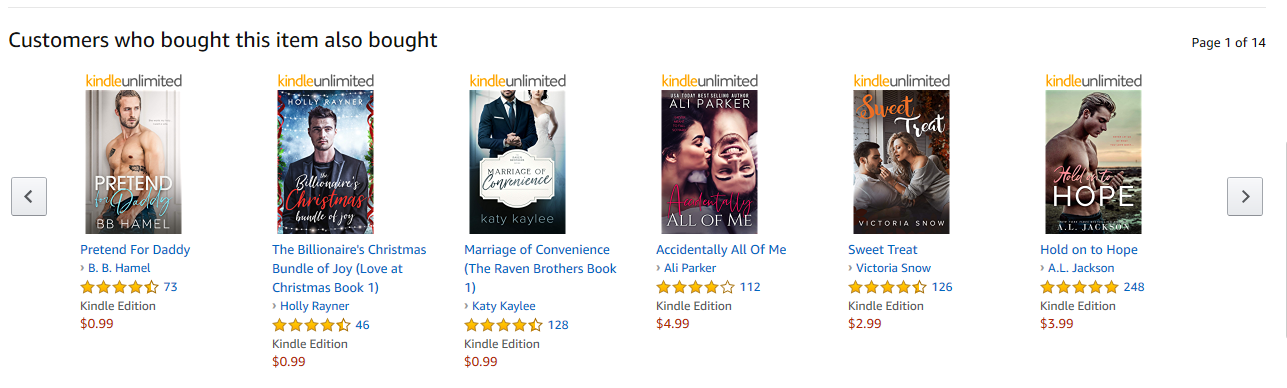
What are my also-boughts like?

all of nothing also boughts

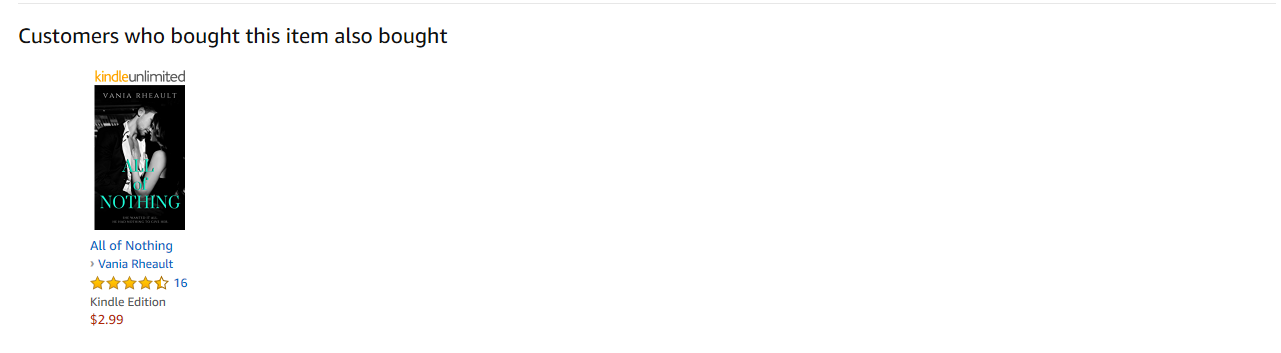
All of Nothing‘s also-boughts are solid. It’s my biggest seller (which isn’t saying much) but I’ve done the most ads for it.

The Years Between Us needs some work, apparently, and I’ll be doing a promo for it for my birthday coming up. I still need to change out the blurb though. This isn’t good, and I’ll be taking my own advice.

also boughts for the years between us


Want to learn more about also-boughts? Read Chris Fox’s Six Figure Author. He goes in depth with also-boughts and the Amazon algorithms.

What to hear more about how Amazon sells your book? Listen to an interview with author Russell Blake and Michael Beverly who runs AMS Ad Werks, an Amazon Ad management company. Listen to Joanna’s podcast here (or read the transcript).

Michael was also on the Self-Publishing Show with Mark Dawson and James Blatch. You can listen to the podcast, or watch them on YouTube.


That’s all I have for today! With the holidays coming, I can’t guarantee I’ll stay on a consistent schedule, but I’ll try.

I hope you all have a splendid week ahead!


end of blog post graphic