Author Interview: KT Daxon

This interview is archived. KT no longer writes under this pen name and her book is no longer available.

Today I spoke with author KT Daxon. We chat a lot offline, but we moved our discussion online so you could listen in on what her publishing experience was like, the roadblocks she ran into, and if there were any silver linings to the whole thing (of course there were!) Join me as I grill chat with KT about how it felt to release her first book! KT Interview

Vania Margene Rheault: I think I read somewhere you’ve worked on your book for about four years before your editor got a hold of it, is that right?

KT Daxon: Yes, that’s correct. Broken Tomorrows began as a Nanowrimo project in 2013. I’ve rewritten it like 80 times and shaped it into a piece of work I was comfortable sending to my editor.

Vania Margene Rheault: How did you start writing it? What compelled you to sit down and try to write a book?

KT Daxon: I had participated in NaNoWriMo two years before, though that book never saw a second draft. When we moved to Virginia, I had a rough start to the year and sought writing as a way to manage the dark cloud that loomed over me. Writing the first draft was a form of therapy that turned into a passion. 1

Vania Margene Rheault: I think writing is a form of therapy for a lot of people. How did you come up with the plot? I have to admit, your twist surprised me.

KT Daxon: Some people have told me the twist was confusing, others, reacted the way you did, surprised. The original plot is a 180 from what Broken Tomorrows ended up publishing as. I wanted to write about a single mom running from a past, but as the years went on the plot changed. My antagonist, Landon transformed into a guy I actually began to care about. In the end, it became his story as much as my female main character, Gabby’s.

Vania Margene Rheault: When you think of plots, or need help nudging loose an idea, do you brainstorm with anyone? Use writing prompts?

KT Daxon: Most of my plots are pulled from real life events, some happen to me, others to someone else. For Broken Tomorrows, I had a friend read the first draft and we talked often about different aspects, including figuring out plot holes. Luckily, the story has changed since the last draft she read, so she gets to read the twist and all the new goodies I’ve included. I only use writing prompts if I am 100% without an idea.

Vania Margene Rheault: You’re already writing another book, aren’t you?

KT Daxon: I am! I’m very excited about this new work in progress and I think that if I can get it to work like I envision in my head, it’ll be a great addition to any bookshelf.

Vania Margene Rheault: How will you mesh that sentiment, keeping your story your own, while improving your story from beta reader feedback and editing advice?

2KT Daxon: It won’t be easy, but I think if any writer were to listen to their editor/beta readers advice with an open mind, and then consider the possibility of making a change that has a meet in the middle aspect to it. I’m trying to think of an example with Broken Tomorrows but I’m blanking right now. Bottom line for me is I need to be open-minded to the suggestions the editor/betas are giving. To understand and know that it’s not because they want to take over your story, but they really are there to help and at the least cause you to pause a moment and consider the possibilities.

Vania Margene Rheault: Sounds like you’d have to think seriously if you ever decided to query. The editing process for books that have been picked up scares me, honestly.

All this background information has been fun, but let’s get to the real stuff, shall we? You launched, ah, early. I’m sure you’re not the first person who has done that. How many plans did that mess up?

KT Daxon: When I hit “approve proof” and published earlier than planned, I won’t lie, I panicked. I had planned to publish on my 35th birthday, make it a big party/celebration day. I had an ARC contest set up, an Indie Feature spot right around the launch date, my bookmarks and swag hadn’t been ordered yet…it got scary. But, it all worked out in the end. The four people who entered the ARC contest ended up getting autographed copies of my book, the indie feature is still on which will be helpful, and my swag is here so I can work on marketing. It also allowed me to begin my next WIP, so, all in all, it worked out.

Vania Margene Rheault: The process of putting the book together after the final manuscript is ready sounds daunting. How did you go about the cover and formatting? How did you decide what platforms to publish on, and what vendors to use?

KT Daxon: I had planned to do the cover myself, but I had to admit to myself it just wasn’t something in the cards for my debut novel. I’m still learning. I was lucky and had a couple of offers for assistance and stumbled upon my cover designer, Aila Stephens. She offered to the read the book to get a good idea as to what we could do and I was thankful for that consideration. I think she did an excellent job and between the two of us, she produced a solid cover. As for formatting, I got lucky there too and a friend helped me with that as well, Rebecca Yelland. CreateSpace has a template that even I seemed the screw up so Rebecca used it to shape up my paperback. A few adjustments from myself and we whipped it into shape. As for what platforms to publish on; that is something I’m still learning. I used CreateSpace and clicked all the channels I qualified for.

Vania Margene Rheault: With so many books being published every day, launches don’t go as well as we hope, or think they will. Care to share numbers? How did your launch really do as compared to as how you hoped it would?

KT Daxon: I wasn’t sure what I expected for launch day, but as of this interview 3/16 I am just under 30 books (paperback and e-book combined) sold. It could have been worse but had hoped it would be better.

Vania Margene Rheault: I don’t think I sold any of Don’t Run Away the first week. But that was my fault–I didn’t tell anyone it was available.  What are your marketing plans for the foreseeable future?3

KT Daxon: For Broken Tomorrows, I am going to try something risky next month. To celebrate my birthday and make it fun for everyone, it’ll involve gifts! But, those details are a secret, so readers will have to be on the lookout on my social media and website on April 1st. 🙂 I’m also going to renew my bookmark order and distribute those pretty much anywhere I can; dentist office, airport, housing office, and anytime I go out to eat. Just today, I left one with my receipt for lunch asking the waitress to share with a reader in their life. I also plan to craft a Facebook ad soon and use that to promote on FB in May.

Vania Margene Rheault: That’s a great idea! How are you going to promote that? I notice you’re quite visible on Instagram. Is that your primary social media choice, besides Twitter?

KT Daxon: Twitter is my primary social media choice because there’s more engagement here. Instagram is next because it’s easy and I also get a bit of engagement. However, I’m on FB as well but it kinda lacks in engagement. I plan to post a video, but Instagram only allows for 1 min videos, so that’ll be my challenge. I’m currently working on a “script” for the video now, LOL.

Vania Margene Rheault: Right. I’m rarely on Instagram, so I’m not sure of all the ins and outs. Do you have a tentative publication date for your next book?

KT Daxon: The only publication date I have for the next book is Spring 2019. Ideally, I’d love to publish in December of this year, but with my upcoming move, I need to be realistic.

Vania Margene Rheault: Right, as you know these things sound quick, but once you’re in the middle of things, you never know what can slow you down. Now that you’ve had your launch and you’ve gone through the publication process, can you share one thing that surprised you the most?

KT Daxon: One thing that surprised me the most was how hard it was to sell a book. I didn’t automatically think my book would be flying off the Amazon shelves but, selling a book is hard work!

Vania Margene Rheault: Yeah, it’s difficult to get your books out there. It’s something us authors struggle with on a daily basis. Is there anything else you want to add before we wrap this up for the evening?

KT Daxon: One thing I am learning is that you have to spend money as a self-published author. Biggest lesson learned is that writing is not a job; it’s a craft that when passion takes ahold of it can spin into a spectacular journey. I just want to add that I recommend our readers to feel free to download the preview offered on Amazon and keep an eye out for the giveaway information to be posted.

Also, final thought: If writing is your dream, if writing is your passion; never ever give up on it or yourself. There will be days where you’ll want to burn your laptop, but the reward of publishing is so worth the bad days.

Vania Margene Rheault: Sounds like advice we all need to hold on to at night! Thanks for chatting with me, tonight, KT, and for being so forthcoming. It’s always a nice reminder that while things look rosy on the outside, the reality is, writing and publishing is a struggle. Good luck and keep us posted! I know we’ll all be looking forward to your contest.

KT Daxon: Thank you for having me! It’s been fun, as always. I’ve enjoyed sharing some background information on my book and the whole process. Have a great night, Vania.

Vania Margene Rheault: Goodnight!

kt's cover

Thanks for reading!

Basic Rundown of Terms and What They Mean

It seems as if there is a lot of confusion in the way people post things online referring to who is what and what they do, and I see this mostly on Facebook. Let me clear up some confusion for any new writers who may be looking to self-publish in the near future. Here are a few basic terms and companies described.

  • CreateSpace
    CreateSpace is the paperback publishing arm of Amazon. This is where you go to create a paperback of your book, if you’re not choosing one from a myriad of other options. You can find free templates for your cover, and free formatted templates for the interior. They are free. You don’t need an account to download these. They also have a Cover Creator with templates and font/font placement. Choose a photo (available for commercial use) and the creator will create a cover in accordance with your book’s measurements. They also have a CreateSpace Community. If you have questions, they have most likely been answered 1,000 times already.
  • KDP
    KDP stands for Kindle Direct Publishing. This the Kindle arm of Amazon. Some people only publish on Kindle (or e-reader/tablet if they go wide {see definition below}.) The set up is much easier than putting together a paperback. Just format your file, upload your cover art, fill out all the fields for price, etc, and you’re done. Your ebook will be published on Amazon in 12 hours. They say to give them 3-5 days, but it has *never* taken that long.
  • KDP Select
    KDP Select is OPTIONAL. When you enroll your book into this program, you are promising Amazon you are not selling your e-book anywhere else, in three month blocks. That means you are not published on Nook, iBooks, Google Play, Kobo, or anywhere else e-books are sold, including your own website, during that time frame. This does not have anything to do with your paperback, and you don’t have to enroll in Select even if you don’t plan to publish your e-book elsewhere. It seems people use KDP and Select interchangeably, and this is not accurate. If you enroll in Select, your book will be enrolled in Kindle Unlimited, or KU. Readers with KU subscriptions can read your book as part of their subscription costs, and Amazon will still pay you for the page reads. If you want to know more about Kindle Unlimited, look here. You can unenroll any time, but KDP makes you finish out your three months, so plan ahead if you want to begin selling your books on other platforms.
  • KDP Print
    KDP Print is the paperback arm of Kindle Direct Publishing. With CreateSpace closing their online store and the creation of KDP Print, it is rumored that eventually Amazon will shut down CreateSpace. Why have two services doing the same thing? I’ve looked around KDP Print, and the submission process is similar. Even the downloadable templates are the same. The only difference is how your purchase your author copies. There was a lot of complaining at first, because KDP Print didn’t offer the same things as CreateSpace does. They are slowly changing that, though, and to me, that’s another indication that soon you won’t have a choice between the two. I only hope their customer service remains the same. I’ve had to call CreateSpace customer service on occasion, and I have always received polite and helpful service.
  • Going Wide
    Going wide means that you are not selling your e-books only on Amazon. That’s it. Lots of people don’t understand what this means, or they get confused because they don’t realize there is more than one place to sell books. There are a lot of opinions on this topic and you need to do what’s best for you and your writing and marketing plan. Currently, I’m in Select, but I feel as I add more to my backlist, I will expand. It’s never good to have all your eggs in one basket, but it may be a while before I have more than one egg.You have a couple options on how to go wide: You can upload your file to all the places yourself. Kobo recommends you upload directly to them so you can take advantage of marketing opportunities. But you can’t upload directly to iBooks unless you have a Mac and can download the necessary apps. Most people use a 3rd party aggregator such as Draft2Digital to distribute their e-books. But be aware if you do this, your royalties are lower. You pay D2D to distribute, but then you also pay the vendor for selling your book.
  • IngramSpark
    IngramSpark is the other company indies use to publish their paperbacks. They have better distribution (CreateSpace uses them to distribute) and The Alliance for Independent Authors suggests you use CreateSpace to sell your book on Amazon and use IngramSpark for other distribution. CreateSpace will give you a free ISBN number, which is why a lot of indies go that route, and CreateSpace is free (besides taking their cut of your royalties) and IngramSpark is not. Also, IngramSpark makes you purchase your ISBN through Bowker. If you decide to purchase one from Bowker, however, you can use that one for both IngramSpark and CreateSpace. That is another personal choice, and you will have to do your research and see what is best for you. If you plan to do any book signings, IngramSpark is the way to go. That way a Barnes and Noble can order your book from IngramSpark and return any that you do not sell at your signing. The cost is on you, for returned books, but bookstores do not like to deal with CreateSpace, as they view Amazon as a competitor.
  • BookBaby, Lulu
    If it all seems too much for you and you just want to upload your book and walk away, there are reputable self-publishing companies who will help you. Though I haven’t used BookBaby or Lulu, I have heard they treat you well, and don’t pressure you to buy services and products you can’t afford. Be aware that if a company offers “editing” that they do a light proofread or line edit only, and if you want developmental editing or a deeper sweep of your MS, you will need to hire that out before you submit your book to these companies. These companies are legitimate as far as I am aware. Joanna Penn even had the founder of BookBaby on as a guest on her podcast, and Joanna would never endorse a company that is not on the up-and-up. She is a member of the Alliance for Independent Authors and they are committed to helping the indie-publishing industry.These are not to be confused with other self-publishing companies run by Author Solutions. Companies such as Author House, Xlibris, and iUniverse are listed on the Writer Beware website, and you should use extreme caution when deciding with whom you will publish.

    Thanks for reading this quick guide. If you’re new to the writing and publishing scene, it may seem overwhelming, and there is never a lack of information on the internet. As always, check and double-check before you make any decisions, and always, always, be careful if you decide to pay someone for a service. It’s nice to think you can trust people you meet online, but in reality, the only person you can, and should, trust is yourself.

    Tell me what you think! And let me know how I can help.
Happy writing Vania Margene

Indie Book Reviews: My Unpopular Opinion

There’s been a lot of talk lately about writing indie book reviews. You know, it’s a kind thing to do, you’re giving the book a bump in the Amazon algorithms. You see it everywhere on Twitter: support an author, leave a review.

And I’ll be honest, when I jumped into the indie world, I read a lot of indie books. I was supporting my Twitter friends. But when you are just starting out, when you’re new to Writer Twitter, the thing that no one tells you is that there are bad books out there. Maybe I was naive, maybe I was just inexperienced. I was in awe of anyone who had published books. I hadn’t been exposed to the indie world, and I had no idea that a published book could be bad.

So I bought books, tweeted I was reading them, showed my support. The only problem was, some of them were good, some were okay, some were dumpster fires.

20-dumpster-fire.w1200.h630

Then I would have to write a review. I admit, I wrote a handful of 5-star reviews for books that were mediocre. (I realize that is a moral dilemma for some, and I have stopped doing it since it’s not fair to anyone). There was a lot of telling, or the characters were flat. Maybe a plot hole here and there.

After I bought two books in a row that I did not finish (DNF), I stopped buying indie completely. Because let’s face it, indie books are expensive. I buy paperback, and to get any kind of royalty, CreateSpace makes you price your book at a ridiculous price. So spending $17.99 on a book I won’t finish is a blow to my wallet.

But lately, the review talk is getting out of hand. While writing a positive review for a book that is well-written and well-edited is one thing, writing a negative review for a book that isn’t good is something else.

What makes a book bad?

Poor or complete lack of editing
The formatting is wonky, so wonky that it takes away from the reading experience
Flat characters
Plot holes
An all-around boring story

I’ve read my share, and if you read indie, you have too. I once read a book that had so many typos in it, I used it as a proofreading exercise (a quick run through Grammarly could have fixed 80% of those mistakes). I’ve read two books that I did not finish because the formatting was so terrible I couldn’t focus on the story. I read one book where nothing happened for three chapters. I was still waiting by chapter four and eventually toss the book aside.

Did I write bad reviews for any of those books? No, I didn’t. Did I reach out to those authors, my friends? No, I didn’t.

See, here’s the thing that you probably won’t agree with, but something that I live by:

When I pick up a book at Target, Walmart, Barnes and Noble, I’m picking up a traditionally published book. I’m reading a book that has been read several times by an agent, by several (and different kinds at that) editors. If the book is bad, say unlikeable characters, maybe a slight plot hole, or just a boring story, several people are to blame for the all the book lacks. I’m also reading that book as a readerI don’t know the author, probably. I’ll never interact with them. I can leave an honest review, and for a traditionally published book on GoodReads I have left, you know, two or three stars (which technically isn’t a bad review anyway).

When I read indie, I’m doing it because they are my friends, or I know them peripherally, or I thought it looked good and picked it up in a show of support. What do you get when you purchase an indie book?

Maybe something that hasn’t been edited all that great due to cost, resources, what have you. Most times editing is a favor, and it’s not always done by someone who knows how to edit.
A book that has a cover that was maybe done by the author to save a few bucks. I do my own covers, and I like to think they look decent. I know decent isn’t what we’re aiming for here, and I realize that if I wrote in any genre other than Romance, I would have to pay to have my covers done. Romance is the only genre you can get away with slapping a kissing couple on the front and adding the title and your name and be able to call it good.
A book that hasn’t been properly formatted. This has always bothered me because CreateSpace has free templates for you to download. And there are lovely templates you can purchase at a low cost you can use over and over again. Copy and paste your book into it, and you’re done. You’ve got your headers, footers, the pages where there should be numbers, and where they shouldn’t be. Gutters, margins. The templates aren’t perfect, and I’ve had to tweak mine, but even just using a template as a starting point will put you ahead of hundreds of authors who don’t know they exist or are too stubborn to use them. Pick up a trad-published book for God’s sake. Copy it. Page numbers, title, author name in the headers and footers. Full-justify the damn thing. Take out the auto spacing between paragraphs. A 200-page book shouldn’t be 600 pages. It costs money, for you and your customers, to print all that space. Stop it.

But you know what, a review is not the place to say all this. By the time the book is published, it’s too late. It’s not your job. You might say, well I have to warn other readers, or I’m giving my feedback.

When you read an indie, you are doing so as a writer, and that is not the same as reading a book as a reader. It’s not the same. When you read indie, you are peer-reviewing their books, and giving a poor review is a low blow. Reach out to them in a DM if you absolutely must, but be prepared for the backlash.

Look, there are a lot of readers out there, and eventually the book you want to “leave feedback on” will receive an honest review from someone the author doesn’t know. That’s an honest review, and maybe if your friend receives enough of them, they’ll pull the book and have it edited, or whatever.

reviews

This blog post is really long, and I haven’t even touched on the thing that makes me the maddest. I’ll write another blog post about it. But anyway, I don’t leave bad reviews for the simple fact that I am a nobody in the world of indie publishing. I don’t have thousands of sales, I don’t make six-figures. And when I do become an authority, I still won’t leave reviews. I’ll write blog posts like this.

Let’s try to save these books before they are published. Instead of reviewing, maybe offer to beta read, be a CP. Tweet informational articles about formatting. If you find services you like, tweet about it! Share when you find a paperback interior template that you LOVE. Share tips, tricks. A good editor that doesn’t cost an arm and a leg. Maybe you can get the information out there; even if you can help one person, it’s worth it.

It’s hell for an author to pull a book to fix it, and by then, their reputation may already be ruined. All it takes is one book for a reader to be turned off by an author, forever.

Let’s stop it before it starts. It can only help all of us.

no one heals themsevles by wouding another

Tell me if you leave bad reviews. Feel bad about it? Proud of yourself for being honest? Let me know!

Vania Blog Signature

It’s Beginning to Look a lot like . . . Something the Cat Dragged in

I’ve been blogging close to nothing these past few weeks. I’ve been sick, but not like, a flu/head cold/stomach bug thing that wouldn’t go away. I’ve had an infection in the cartilage of my nose, and while the pain has been annoying and uncomfortable, it’s been the antibiotics that have made me feel off for the past few weeks. I went through two courses in the past 24 days. I just finished my second course a couple days ago, and I think my body is finally getting back to normal. Though now I have some weird sinus/fuzzy ear/ face pressure thing that won’t go away. It can’t be anything bacterial-related since all the antibiotics I’ve been on would have killed it. I’m just biding my time, waiting to see if my body will right itself after all the drugs I’ve pumped into my body lately. (With the second round of antibiotics I was also put on Prednisone; that didn’t do me any favors.)

cat-2749889_1920

Tired of this BS. I want to get better!

Anyway, so I’ve been fuzzy, sleeping, and my nose hurt until the antibiotics kicked in, and the tip of my nose still tingles and aches in the cold (I live in MN). I admire anyone who can function on a day to day basis with any kind of chronic illness. Not only does the pain do things to your body, it preys on your mental health. I couldn’t concentrate while waiting to see if the drugs were going to kick in or not. And yes, I have to force myself to stop poking at my nose to see if it hurts. The short answer, yes. Anything you poke at long enough will start to hurt. LOL

Through it all, any mental wherewithal I had went into my books. I released book one of my Tower City Romance on November 18th to little to no fanfare. My fault. But that’s okay. My second book is loaded into CreateSpace and KDP and is ready to go on December 18th. I’m editing and scrambling to get book 3 ready for release on January 18th. I might be behind on that one, and I may need to settle for the end of January, or even the beginning of February. I don’t want to sacrifice any part of editing just to publish, and I know Christmas is going to take a little time whether I want it to or not.

retro-gifts-1847088_1920

On the bright side I already know the next book I’m going to write–it’s a stand-alone and once I get going on it, I should be able to write and publish it rather quickly. I’ve already got it plotted out, and I’ve been playing with the cover. I’m so used to dealing with a million words at a time (Summer Secrets was about 160,000 words all together and this trilogy is 210,000 combined) that working with only a 70,000-word book will feel like a dream come true.

Anyway, so that’s what I’ve been doing these past few weeks.

I’ve also been fiddling with what I can do to break into the reader/social media barrier that eludes a lot of writers.

binoculars-1209011_1920

I read a lot of books so, for now, I’m going to focus on reviewing them. But not just any books. I’m going to read romances (what I write, naturally) pick at them, and compare how they are written to what I’ve learned in the world of self-publishing. That way I’ll be reading my genre, get a blog post out of it, but also I can compare what’s being published to what indies are “learning” in the Twitter Writing community. A win-win for everyone.

I’ll start with The Mountain Between Us by Charles Martin. I watched the movie with my sister and bought the book to compare. But that is another blog post.

I realize 2017 is coming to a close, and I’ll be writing another blog post or two about what happened in 2017 both in the publishing community and in my own career. I have a lot to share–if my nose and my ears stop doing weird things.

Fingers crossed!


Vania Blog Signature

Aila Stephens’ Interview and Giveaway (Updated post. The giveaway is closed.)

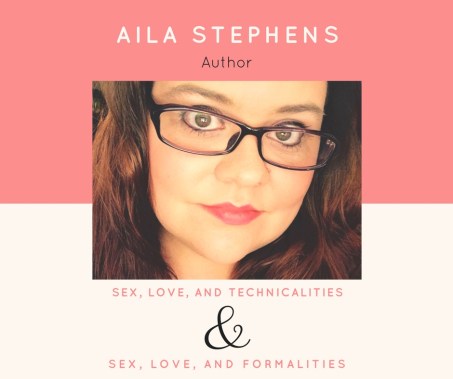
Aila StephensI got to know Aila wasting time networking on Twitter, and I read her first book, Sex, Love, and Technicalities, when it came out last year.

In celebration of her sequel’s release, Sex, Love, and Formalities, I’ve interviewed Aila, and I am also hosting a giveaway! (More on that later.) Settle down with a cup of coffee, and listen in to my interview with her! Enjoy!

You chose IngramSpark over CreateSpace. Can you explain why?
I was drawn to IngramSpark because of the reported quality of their paperbacks. I don’t know how many YouTube videos I watched where people had ordered copies from both Ingram and Createspace, and most authors liked the paper quality of Ingram better. I also liked the fact that my books would potentially be more attractive to brick and mortar stores—because you know, we Indie authors become household names so quickly. 😉
To be honest, I’m now convinced that using a combination of IngramSpark and Createspace is the way to go.

You published your first book in July of 2016, and now you are releasing the sequel in November of 2017. Can you give our readers some pros and cons of waiting over a year between books?
After SLT came out, life slapped me in the face. It wasn’t just one or two little things, it was more akin to a typhoon of problems pounding at my shore. I tried to keep writing during this rough period, but it was easy to see my creativity suffered and I knew I needed to step away if I wanted to even remotely be proud of my work. It stung…but in the long run, I think Sex, Love, and Formalities is better since I waited. The first storyline was weak—so I suppose that’s the pro. During the absence, I wasn’t writing, but I was thinking.
The cons are numerous. People forgot me. I wasn’t selling copies of SLT, therefore it’s hard to build hype around SLF. I will always worry I lost some of Briella’s voice.
All in all, I don’t recommend waiting over a year between books if it can be helped.

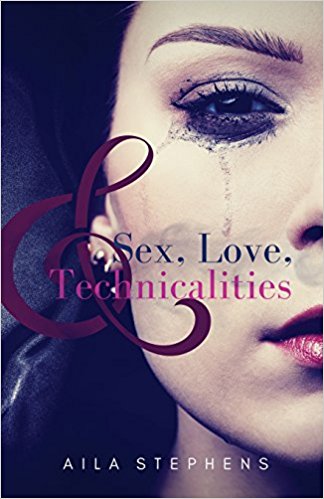
Sex, Love and Technicalities

The gorgeous cover for Sex, Love, and Technicalities. Love!

Now that you’ve released two books, can you tell us some of the things that surprised you about the self-publishing industry, or maybe the publishing industry in general?
It surprised me how much I enjoy the process. I love the fact that with self-publishing everything is up to me…which is also terrifying. There are a lot of rules. Marketing is the bane of my existence. That was one thing I hadn’t expected: How much I dislike marketing. I like creating marketing materials…it’s what to do after that baffles me.
I am glad I self-published these first two books. I think it was a great learning process, and I’m sure I will self-publish again. But the two books I am writing next, I plan to pitch. I’m still uncertain about how long I will pitch them before I decide to self-publish them, but I am excited to learn another side of the publishing industry.

Having gone through the publishing process twice now, can you tell us what you would have done differently the first time around with the knowledge you have now?
With the first book, I would have done more editing. I would NOT use IngramSpark for eBook publication. I also would have formatted the eBook myself from the beginning. I would force myself to market more.
With the second book, I wouldn’t have put my passion on hold for so long. I’d force my unsociable self to be more sociable.

In your opinion, what is the best part of the self-publishing process?
It may sound odd…but making my own book covers. I absolutely love making them. I hope people like them half as much as I loved making them.

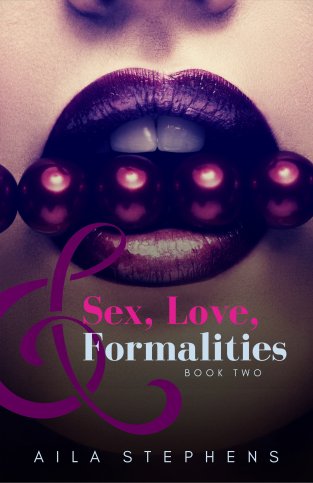
sex love and formalities

The dazzling new cover! Her cover design skill is proven here. Great job!

Will you ever query and try for a traditionally published deal?
Yes. That’s the plan with the next two books. Alabama Rain is a book I’ve been working on intermittently for the last year and a half, which will now get my full attention. Then I have a project I’m currently outlining and preparing for which has a placeholder title of Underthings.

Thanks for having me, Vania! I am sure I speak for all your readers when I say thanks for all you do for the Indie writing community. You’re an inspiration!

Thank you, Aila, for taking the time to answer my questions. If anyone has other self-publishing questions, ask in the comment sections or tweet us. 🙂 We’ll be more than happy to help!

Please follow Aila on Facebook Twitter (mandatory to enter the giveaway) Goodreads and of course, follow her on Amazon! Keep up to date on her blog posts, and please take a moment to check out her website.
The giveaway for Aila’s release includes:
An assortment of coffee and tea
A coffee mug
Signed paperback copies of Sex, Love, and Technicalities
and Sex, Love, and Formalities
A $25.00 gift card to Amazon sent to the winner’s email address

The giveaway is open internationally, so don’t be afraid to enter!

Click here to enter!!!


Updated to congradulate Rebecca Yelland on winning the giveaway! I hope you all enjoyed Aila’s launch–she had a blast! Thank you all for helping make her day a huge success!


The Evolution of Don’t Run Away’s Cover

This is an old, terrible post and unless you want your eyes to bleed, you shouldn’t read it. Or, go ahead if you want to be amused while I flailed helplessly and gave advice when I shouldn’t have been giving it. There are better posts to read about my book covers. Try this one about matching the vibe of your book to your cover and why a “perfect” cover might not always be the right one: https://vaniamargene.com/2024/04/08/my-marketing-secret-shh/


They say your cover is the most important part of your book. I don’t know who “they” are, or if that’s necessarily true, but your cover is important. It needs to convey your genre, it needs to be eye-catching. The font for your title and author name needs to look professional, yet suited to your genre.

This is a tall order if you want to do it yourself. Way back when I was new at this, I didn’t know as much as I do now, and I was adamant that indies could do their own covers. And you can. You should.

But let’s step back and figure out what a “good” cover is.

I wrote Don’t Run Away as a NaNoWriMo project in 2015. After I released Summer Secrets, I started editing it, I mean, really editing it, so that it was publishable. I took out all the head-hopping, the mixed up POVs, and I turned it into the book that’s going to be released on the 18th. So for the year I spent editing, I blogged about the publishing process and making your own cover. While I blogged about making your own cover, I came up with some doozies, that were, ah, well. See for yourself.

blog post 1

Yeah. I blogged about creating this cover. Did I say that I liked it? No. Am I embarrassed that I put something like that on the internet? Yes. But that was naivety and inexperience. Cover design takes practice and a good eye.

Did it get better? No.

back cover blurb

Then I came up with this piece of crap. Yeah, it’s better than that pink monstrosity above, but I would never buy a book that had this for a cover.

Luckily for me, lots of time went by, and I took a break.

When I was nearer to publication, I came up with this:

20813949_10155382724650751_814775920_n

And that’s not so bad. I even would have maybe used this. But the problem was, or is, is that Don’t Run Away is book one of a trilogy, so not only did I need to make one cover, I needed to keep in mind that I needed two other covers, and they needed to look like they belonged together.

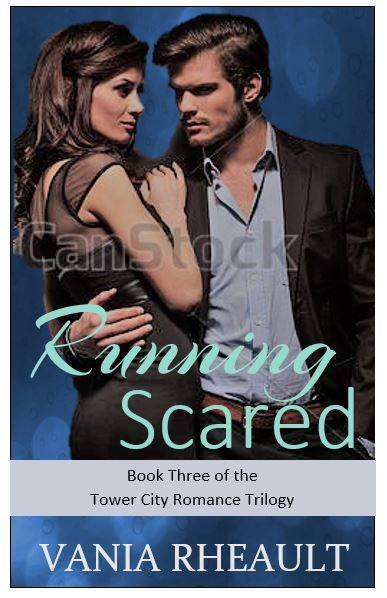
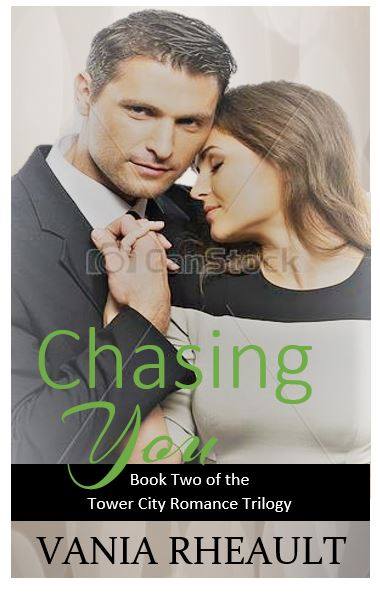
I came up with these two for books two and three:

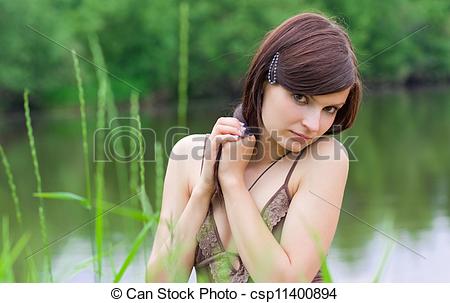
I mean, as far as covers go, they aren’t that bad. But ultimately, I turned all three of them down because, in the end, I felt the couples looked fake. When you look through sites like www.canstock.com or www.dreamstime.com there are three different categories of people. Real people:

canstockphoto11400894

You don’t want real people on your cover. I think this is where a lot of indies go wrong. Real people aren’t models, and the photographer didn’t touch up the photograph to make it look less real. I suppose if you found the perfect person, you could run the photo through some filters, modify it somehow so that she doesn’t look like a real person giving you a goofy look through some weeds. But you definitely have to do something to it. That’s where the pink “hell no” cover at the beginning of this post comes from. Real people don’t work.

The second category of people on stock sites are real, but they look better than real.

canstockphoto15361212

She looks good, ya know? She looks like model material, but approachable. The photographer added some sunlight. Depending on your genre, these make perfect covers.

The third category of people are fakes:

woman-grass-young-outdoors-fashion-portrait-style-boho-40902938

There’s a genre for actual models (erotica and porn), and I didn’t need anything like her for my covers. I needed my couples approachable. My characters aren’t billionaires, they aren’t sheiks, or princes, or even CEOs. My characters hold down-to-earth jobs and have real people problems. I needed my covers to convey that.

So I did manage to find this couple, and I was lucky to find two other couples that looked like they were taken by the same person. Two of them were, but the third was taken by someone else. I probably won’t write anymore trilogies, but if you do, or even a duet, or even more than three, make a plan for your covers because it’s a pain in the ass to change them. Not only do you have to go through the submission process again for CreateSpace, if you use IngramSpark, they charge you for every change you make. And you have to remember to change your cover on Goodreads, too. (Which isn’t the best because your old cover will always be attached to your book on the book’s page.)

Here are the three I chose for my covers:

canstockphoto11573436 (2)
canstockphoto38274429 (2)
canstockphoto46133644 (1)

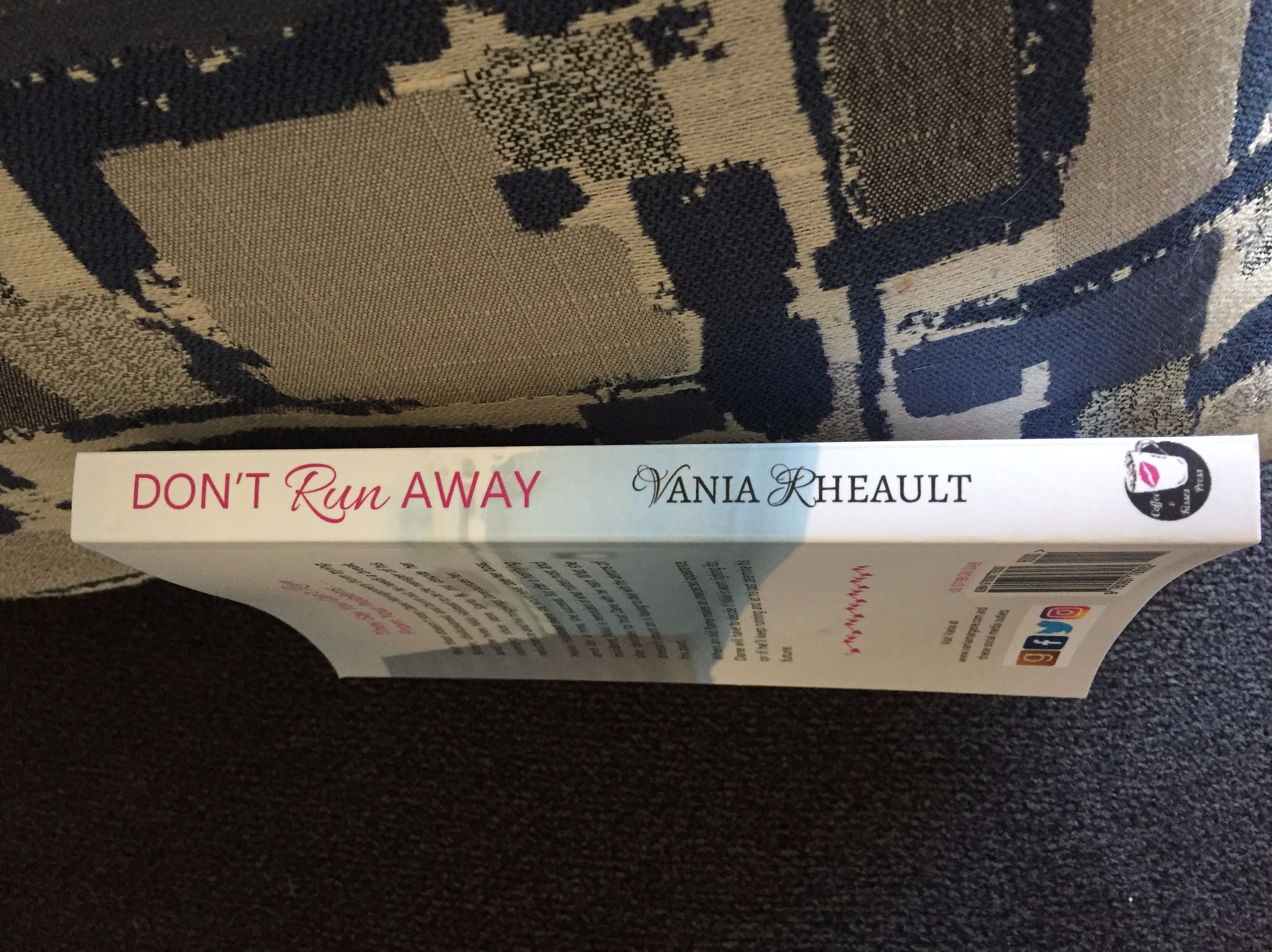
I also decided to make the whole picture wrap onto the spine and back cover, so the position of the couple was important too.

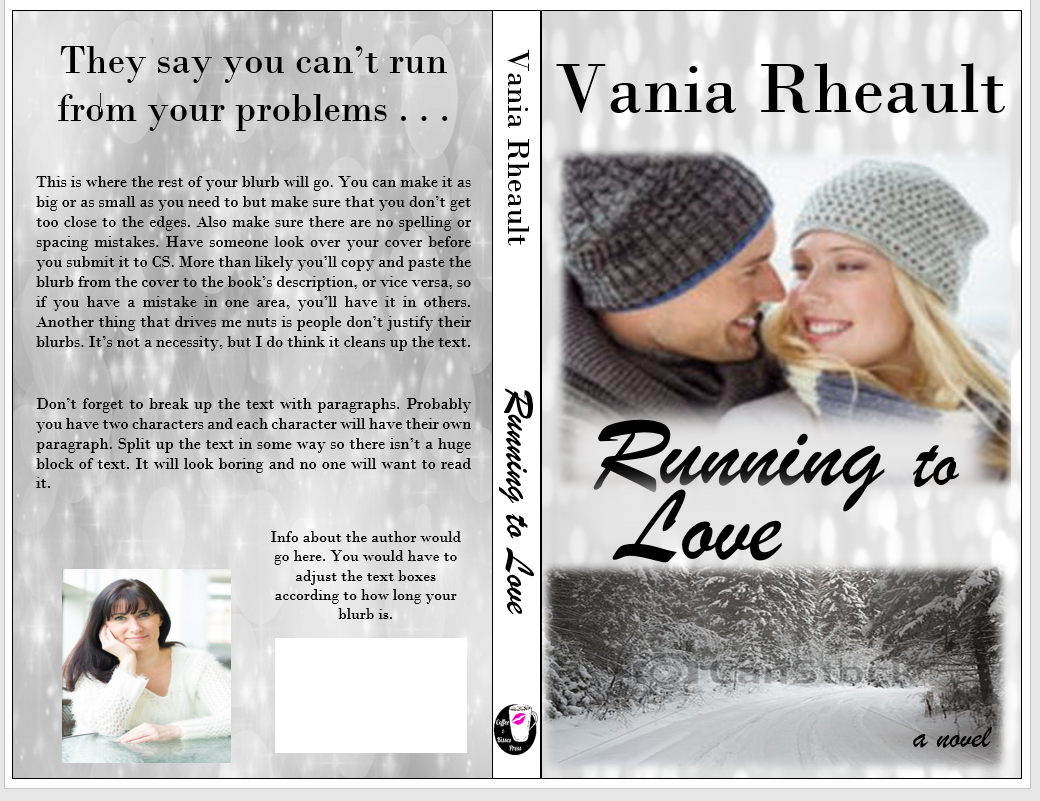
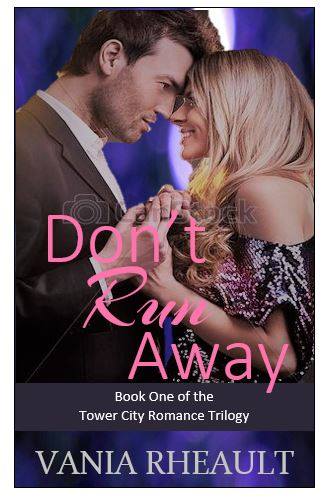
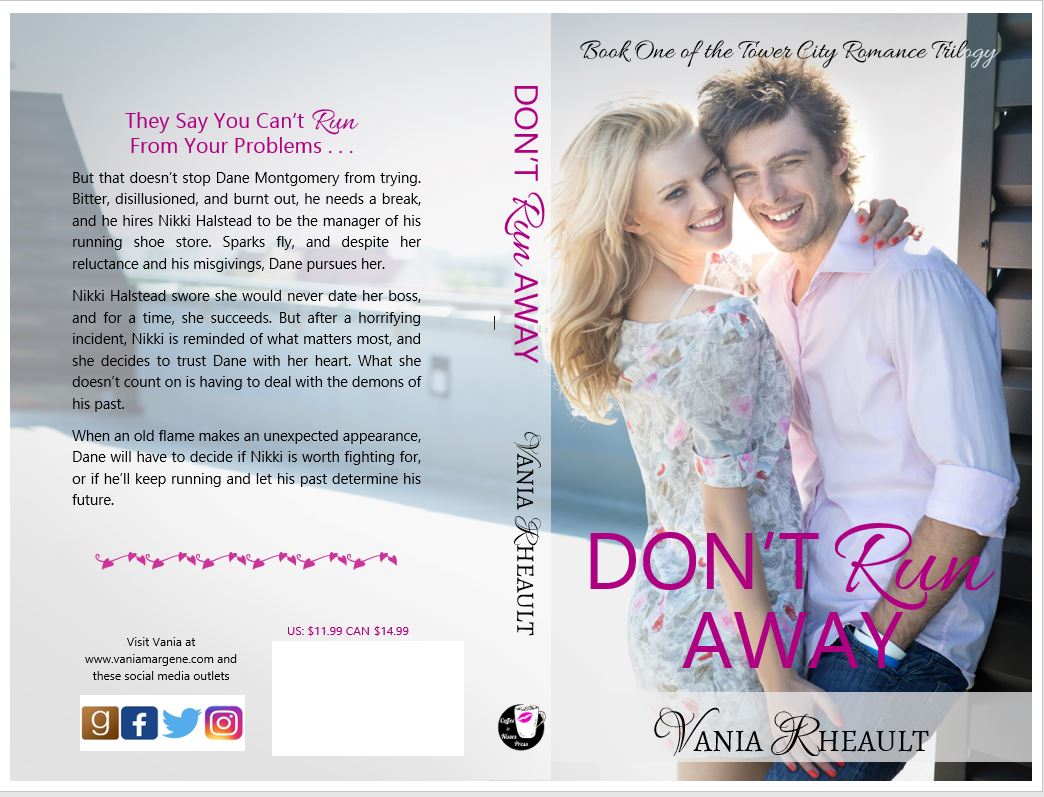
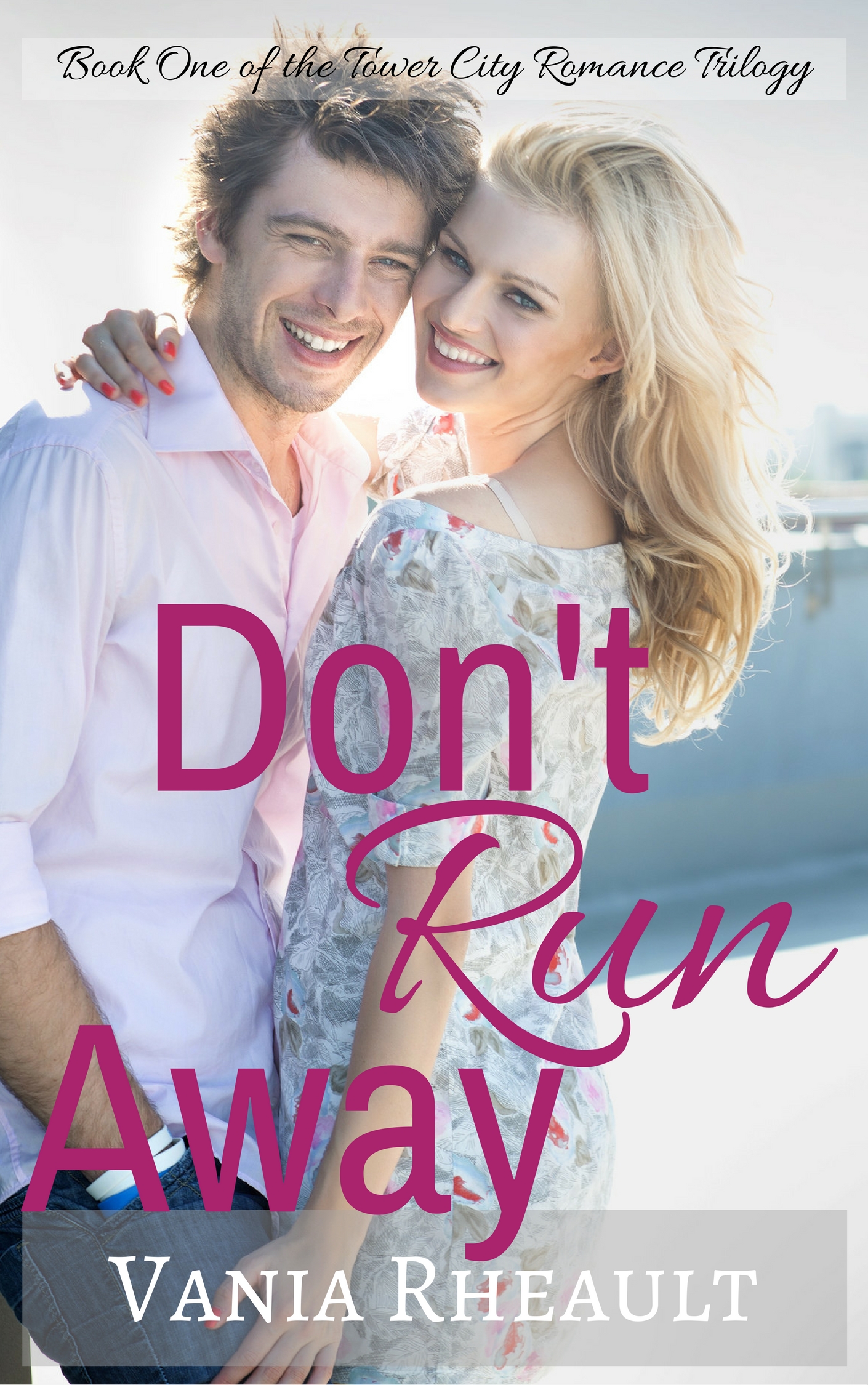
Here’s how Don’t Run Away turned out:

don't run away cover

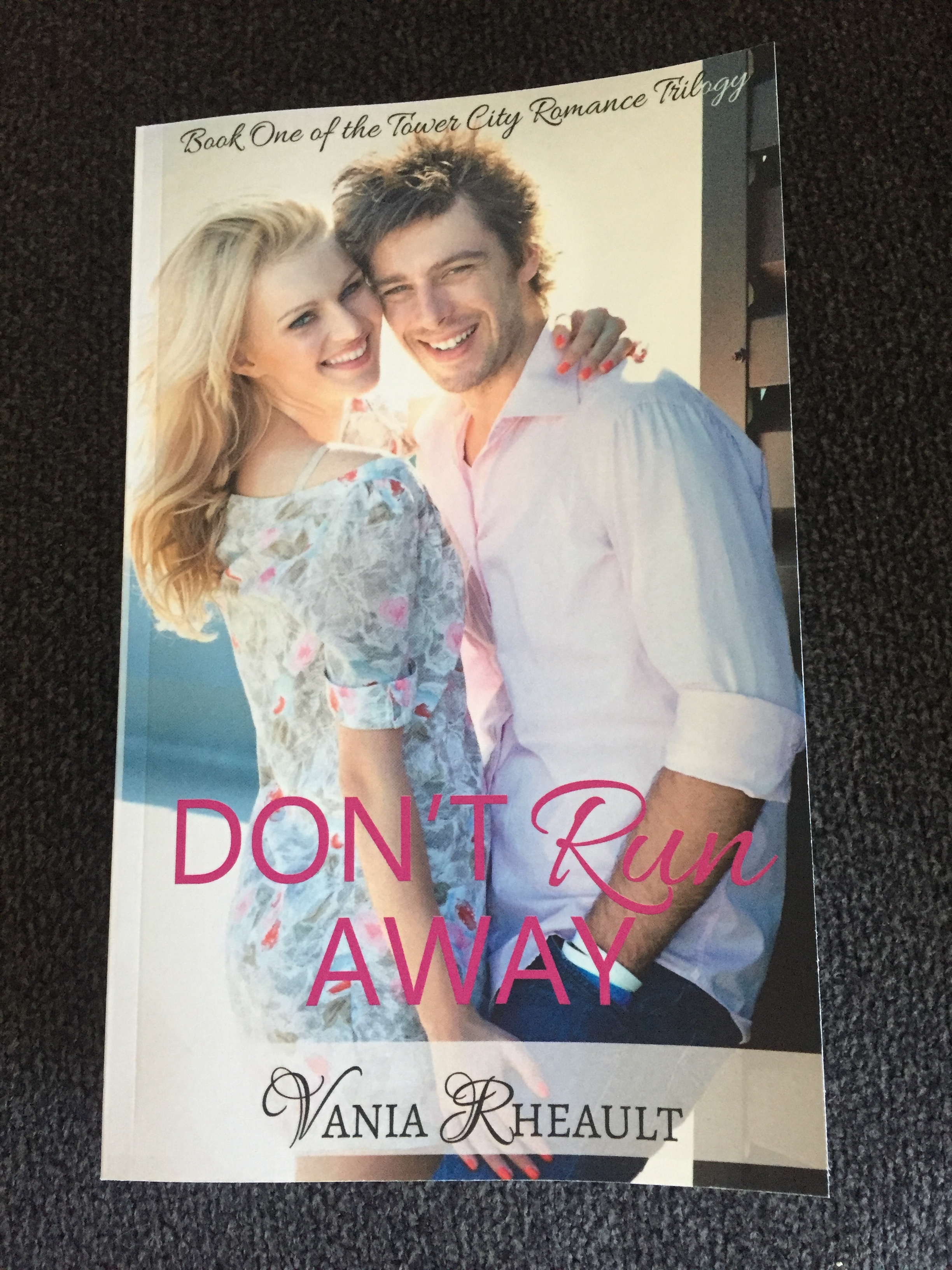
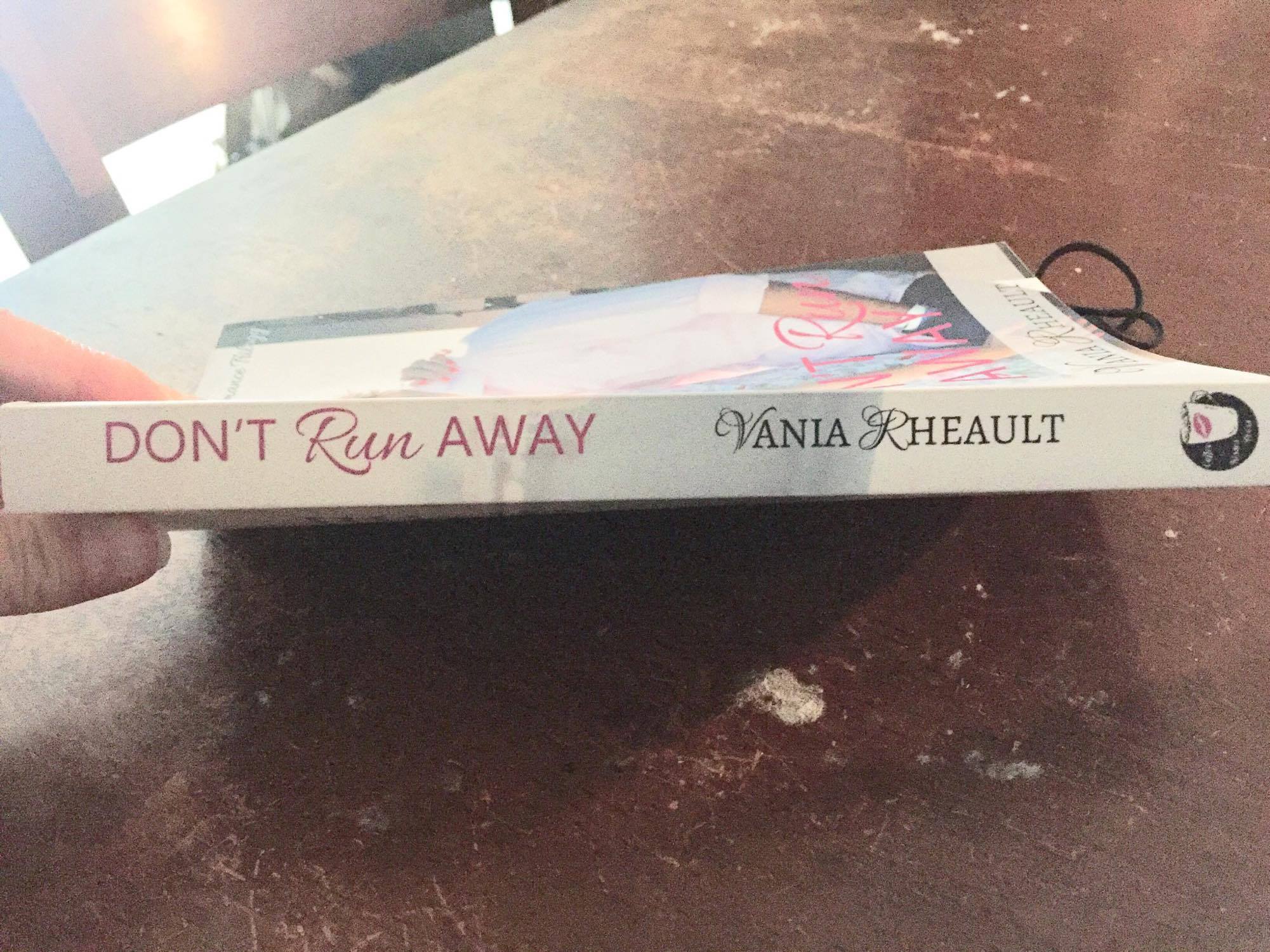
I’m pretty proud of it. And it turned out nice in person (ignore how goofy looking he is):

IMG_9499
IMG_9500
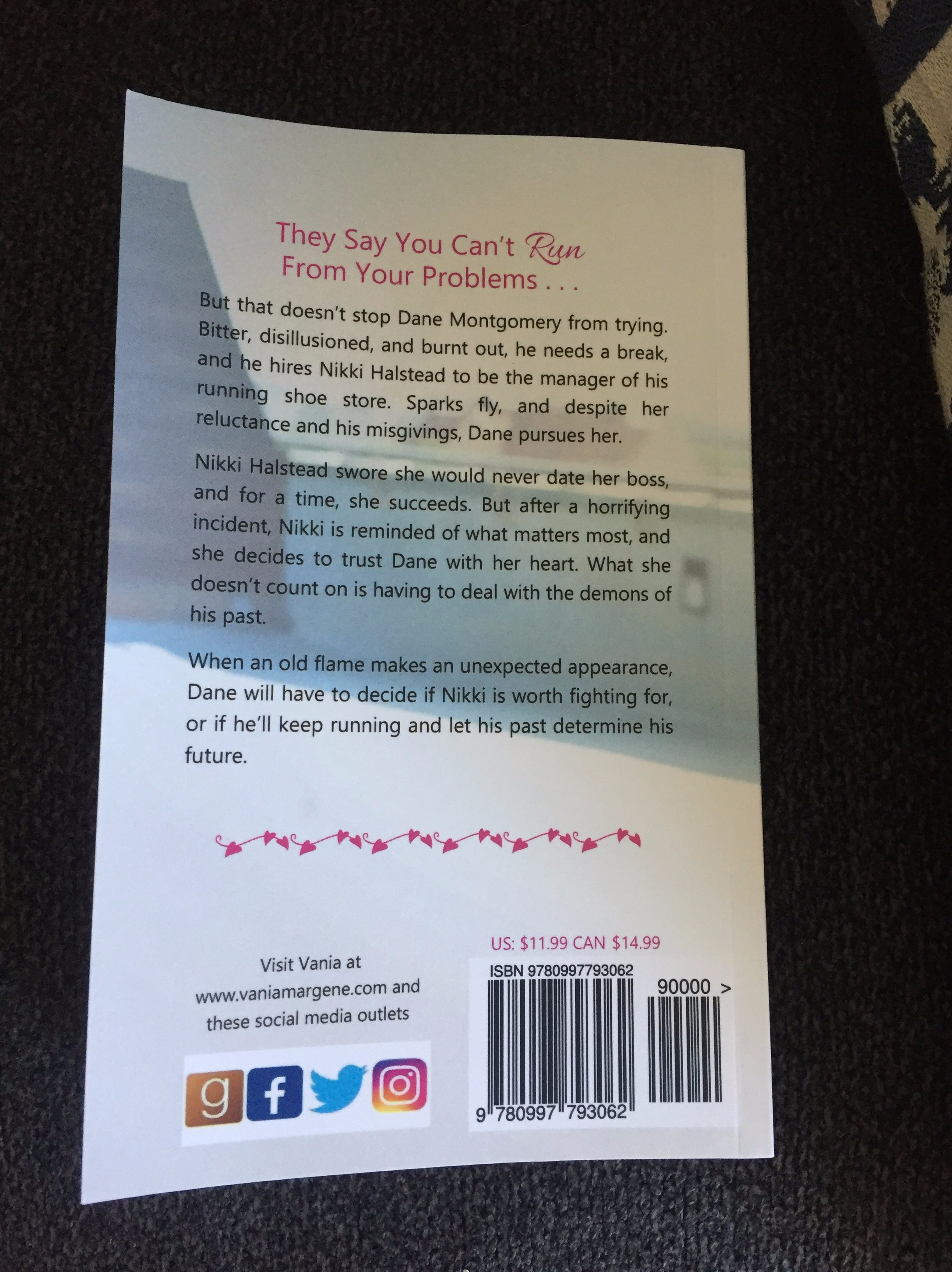
IMG_9501

Of course, even when you find the perfect picture, you need to play with font, where everything will go, that kind of thing. At first my cover looked like this:

Don't Run Away Experiment

And I didn’t have any qualms about it. But after the proof came in the mail, I realized the title was way too big. It didn’t need to be that large. My friend Gareth made the crack that, what, I didn’t need people be able to see it from outer space? No, I didn’t. So I fixed it, but then the spine was off:

23134703_10155603226795751_388290689_o

I was tempted to leave it, but I couldn’t. So again, I sent it in to be fixed, and it came back okay.

I guess my point is, covers go through an evolution of sorts, and it’s never too late to start playing around with fonts and photos.

Look around at other covers and see what’s popular in your genre. Maybe even see if other covers are using the same people you’re thinking about using.

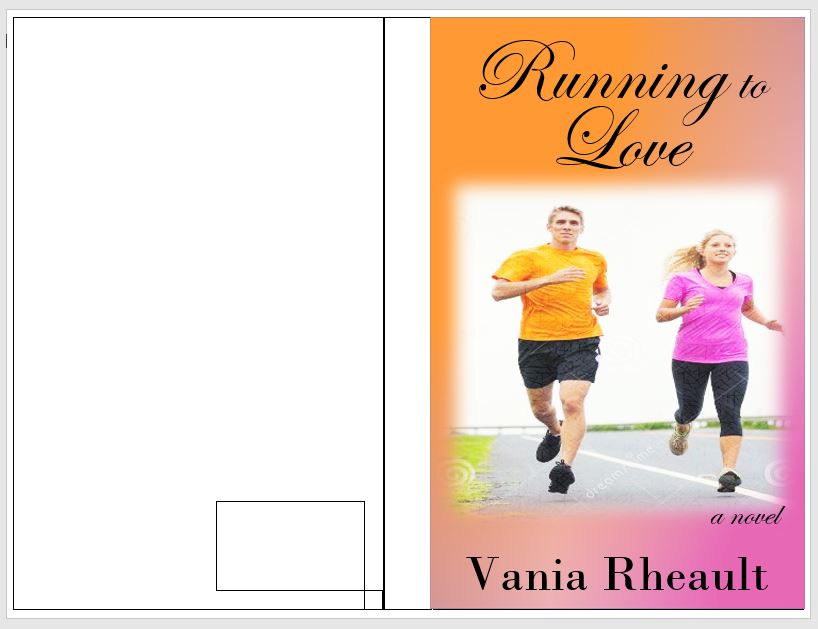
I found this nice one while looking around:

fake running to love

The site selling it wanted $50.00 for it. I’m sorry, but I like mine better, and it was free. Well, did pay http://www.canstock.com five credits for the picture, which turned out to be around 4 dollars. The fonts I used were all allowed for commercial use for free and I downloaded them from http://www.1001fonts.com/. Be careful if you use this site because some are for commercial use, and some are not.

That ends my cover adventure for Don’t Run Away. If you want to know how I used the photo for the spine and back cover, let me know. It’s fun, and it solves the problem of what to put on the back. Some people don’t care about the back since you’ll sell more e-reader versions, but still. If you ever do a book signing or a giveaway, perhaps on Goodreads, you’ll need a paperback version.

Let me know your thoughts!


To Query or Not to Query

When I talk to people about my publishing plans for my next couple of books, people ask me if I’ll ever query and try for a traditionally published deal. I always say, “No, I’m not writing anything queryable right now.”

People can take that a lot of different ways, and mostly that sounds like I don’t have faith in what I’m writing, or that my work is crap and only suited for self-publishing.

That couldn’t be further from that truth.

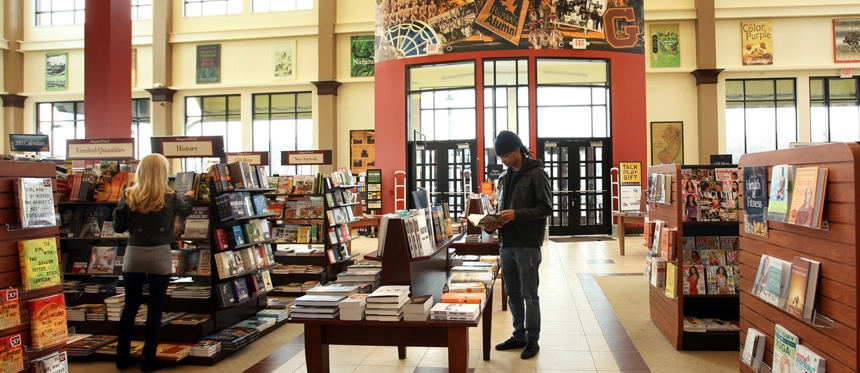
What I mean by that is, I know what I’m writing. I know what it’s suited for. That doesn’t mean what I’m writing isn’t being traditionally published; it just means I don’t have to find an agent to get it there. I write fluff. Maybe that’s demeaning to my genre when I say that, but I also am not pinning my work with any more importance than it deserves. Harlequin, the publisher that brings you the lines Temptation, Desire, Blaze, and the like (they’ve done some remodeling, so I don’t know what their lines are now) prints hundreds of books like that every year. In my Barnes and Noble, they take up a shelf in the corner of the building near the floor. All the shiny red spines with titles like One Night with the Billionaire or The Cowboy’s Baby. Women read these by the handfuls; a quick read you can get through in a couple hours before tossing it onto a pile and reaching for another one, like candies in a heart-shaped box. You know what you’re getting, you savor it as it melts in your mouth, but you have no problem reaching for another one when the chocolate is gone.

My books are like that. What I write in three to four months will be devoured in three to four hours, and I’m okay with that. I’m more than okay with that. Romance is a huge genre, and where there are millions of writers cranking out millions of books, there are also millions of readers. They don’t call the Romance genre the bestselling genre for nothing.

But along with pages of guidelines for how they like their books to be written and their preferred word count, Harlequin has its own dropbox on its website. I don’t need to query an agent and let my manuscript sit in a slush pile to wait for an agent’s assistant to skim my query letter. I can upload my manuscript onto Harlequin’s website myself, or to Carina Press, the digital-first arm of Harlequin, and let it rot in their slush pile without any help, thank you.

If I were to query, going back to the original question, I would query something more serious. Something I worked harder for. We all have visions of our books sitting on the display table at Barnes and Noble in the center of their main walkway. Trust me when I say Don’t Run Away would never make it there—agent or not. No, looking at the New York Times Book Review right now, I would want to write something more akin to Women’s Fiction, not Contemporary Romance. I would want my manuscript to mean something, to say something, to point out an injustice, to try to right a wrong, to help someone. I would want my manuscript to come from my brain as well as my heart.

bookstore_page

I’m not trying to degrade romance, not at all. But any romance writer or reader knows the difference between In the Arms of Her Boss and Sing Unburied Sing by Jesmyn Ward, a finalist for the National Book Award for Fiction. And let’s be clear, a reader who picks up either one of these knows what she’s getting. You have to be in the mood to read it, and a writer has to be in the mood (not to mention have the talent and skills) to write it.

I’m not in the mood to try to write something of Sing Unburied Sing’s caliber. I’m perfectly happy editing Chasing You. (You can weigh the two books by title alone, can’t you?)

If, or when, I plan to query, it will be with a book that will make it worth my time, and it will be with a book that will be worth the pain and heartache of rejection. Because I know the score. Querying is a whole lot of rejection, and I won’t put myself through that for a computer file full of fluff.

You might think that I’m too hard on myself, but I prefer to think of it as a realistic POV of my work. And, quite possibly, more indie writers should have it. Querying a story that won’t make it onto a table at the Barnes and Noble will sour you on the whole process. Traditional publishers only publish so many books per year. Why query a book that would never make it? That’s not to say your fluff isn’t good enough for Harlequin or a small press. (The back of bookstore on a shelf near the floor is better than nowhere at all, right?) It very well may be, and you should definitely go that route if you feel your book is worth it. Query to find an agent knowing/admitting where your book is going to end up, or use Harlequin’s dropbox and let your book sit in cyber purgatory for a few months while interns wade through the submissions.

But I won’t bother to try to find an agent for something that will sell just fine when I self-publish it.

After I’ve grown a bit more as a writer, or maybe when I have a nice backlist I can be proud of and want to challenge myself, or when the perfect plot plops into my head, I’ll write my book and I will query it to find an agent who loves it as much as I do, and maybe one day it will end up at the Barnes and Noble on a table in their main walkway.
I’ll pass it and brush my fingers over the cover as I walk to the café for a coffee. But for now, I’ll finish writing Running Scared while chocolate melts in my mouth.

#SmutChat Self-publishing Topic Recap!

I run a Twitter chat called #smutchat. It’s geared toward more than just smut, (though I am a romance author and I like to chat about that too, from time to time) and last night we talked about self-publishing.

I said I would recap the chat for a few people who couldn’t make it, so here you go. 🙂


#SmutChat-Selfpublishing (2)#SmutChat-Selfpublishing

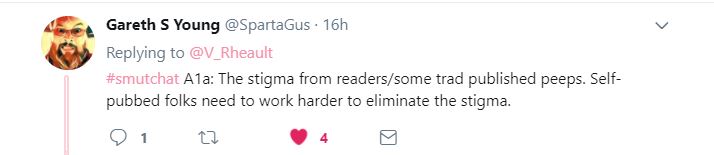
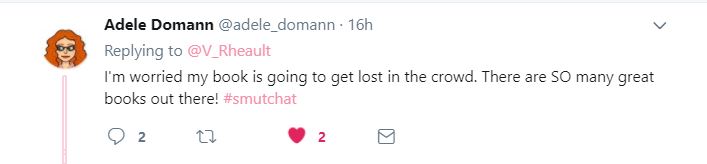
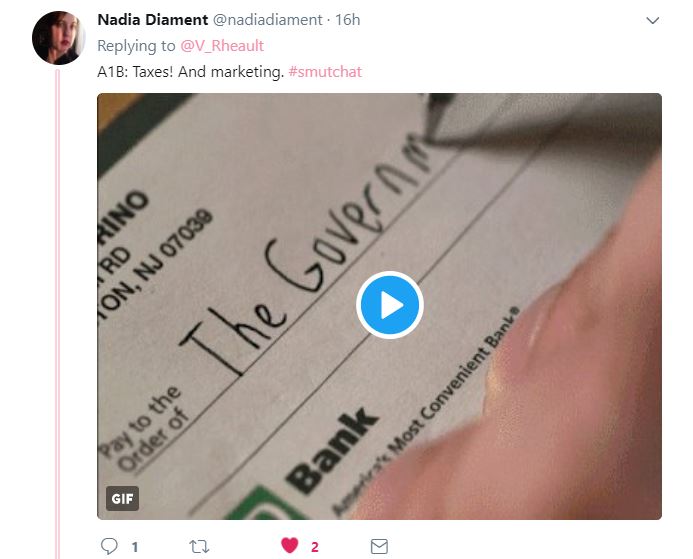
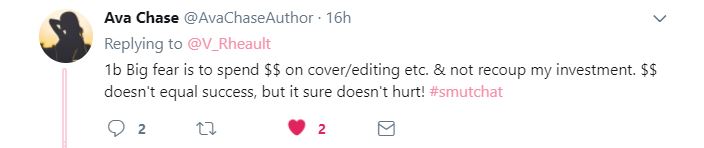
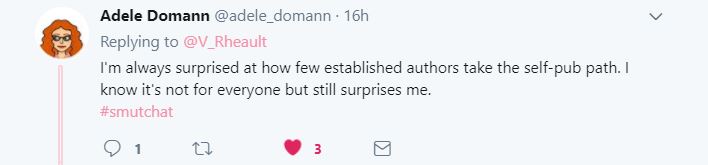
Question one, when I was making it up, was intended to be a question about the process of self-publishing. Was it formatting your paperback book? Dealing with uploading to KDP? Maybe figuring out your book cover? Some hit the nail on the head; others went far beyond.

smutchat recapsmutchat recap 4smutchat recap 2smutchat recap 1smut chat recap 3

smutchat recap 5


#SmutChat-Selfpublishing (3)

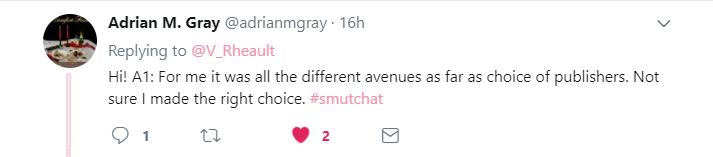
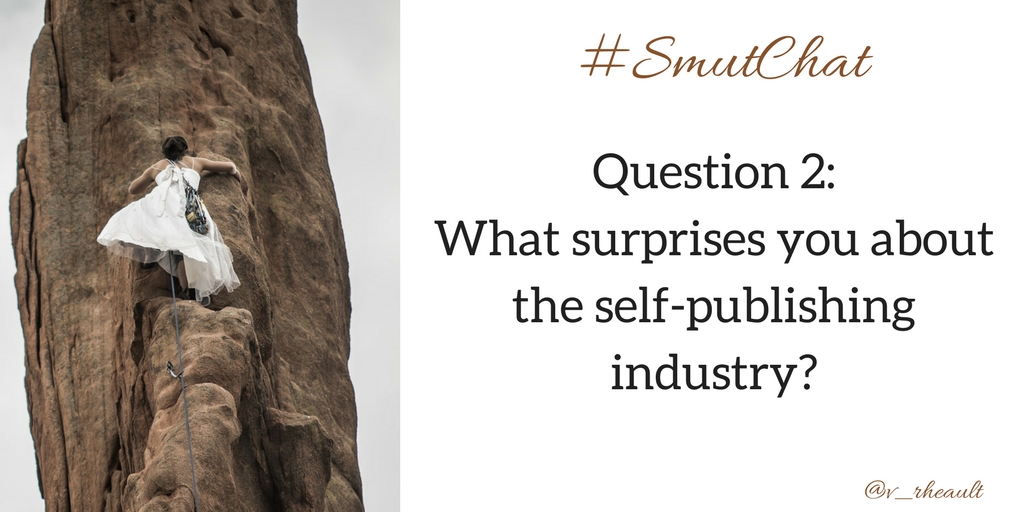
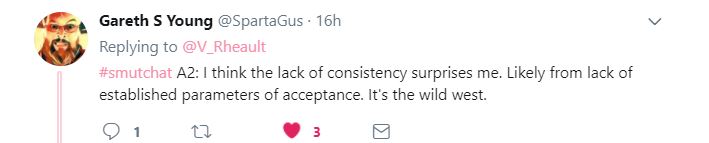
To be honest, I didn’t know what I was going to get out of this one, and the answers were all over the place.

smutchat recap 7smutchat recap 8smutchat recap 9smutchat recap 6

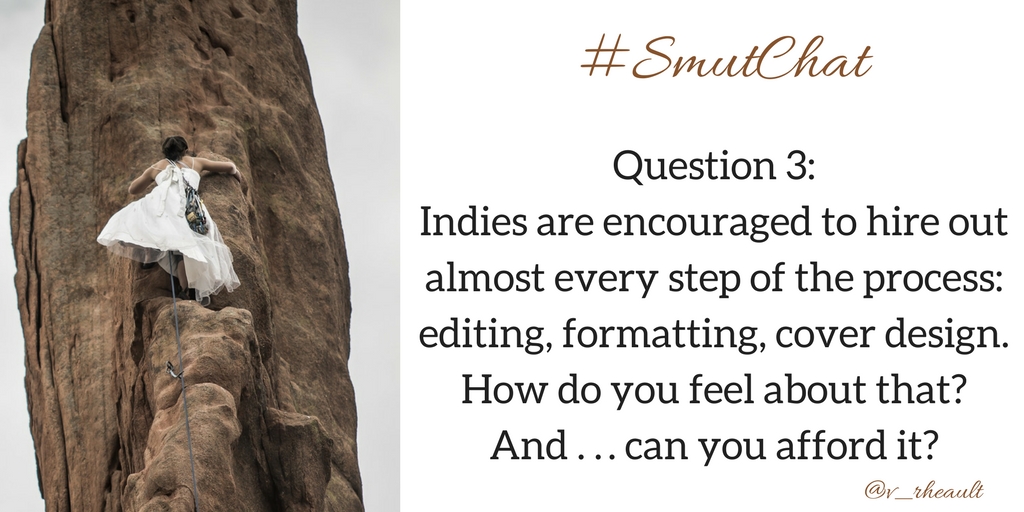
#SmutChat-Selfpublishing (4)

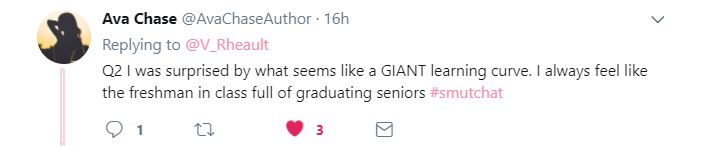
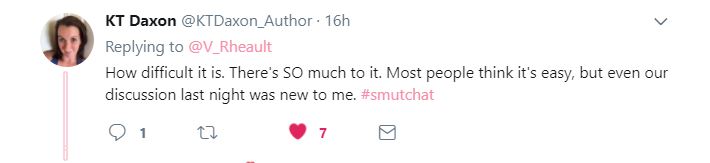
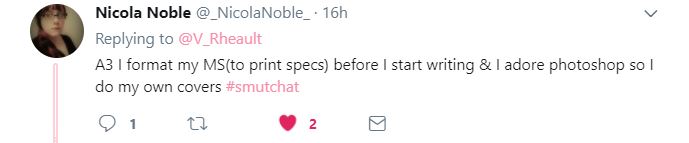
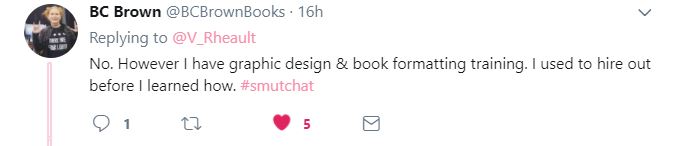
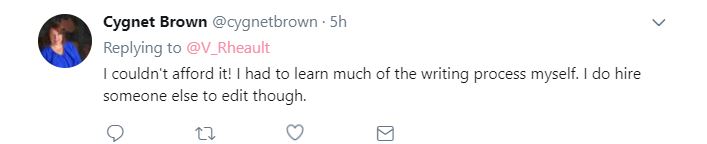
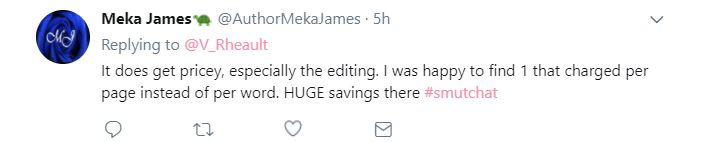
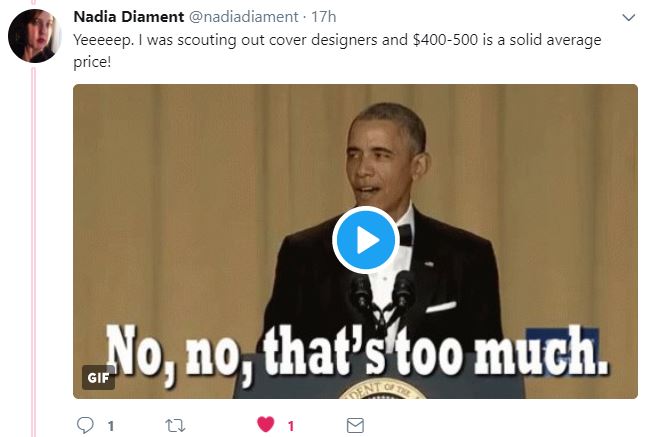
This question brought about the answers you would expect. It’s expensive to publish a book if you hire out, and no we can’t afford it, and no again, we probably won’t see a return on that investment any time soon. Yet the people who don’t know what they’re doing and publish bad-looking books muddy the pool for the rest of us who do it right.

smutchat recap 10smutchat recap 11smutchat recap 12smutchat recap 13smutchat recap 14

smutchat recap 15

nadia covers

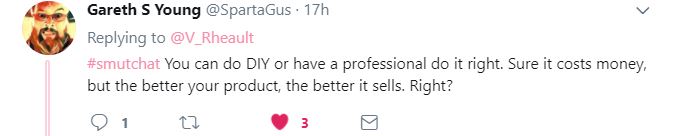
gareth editing


#SmutChat-Selfpublishing (5)

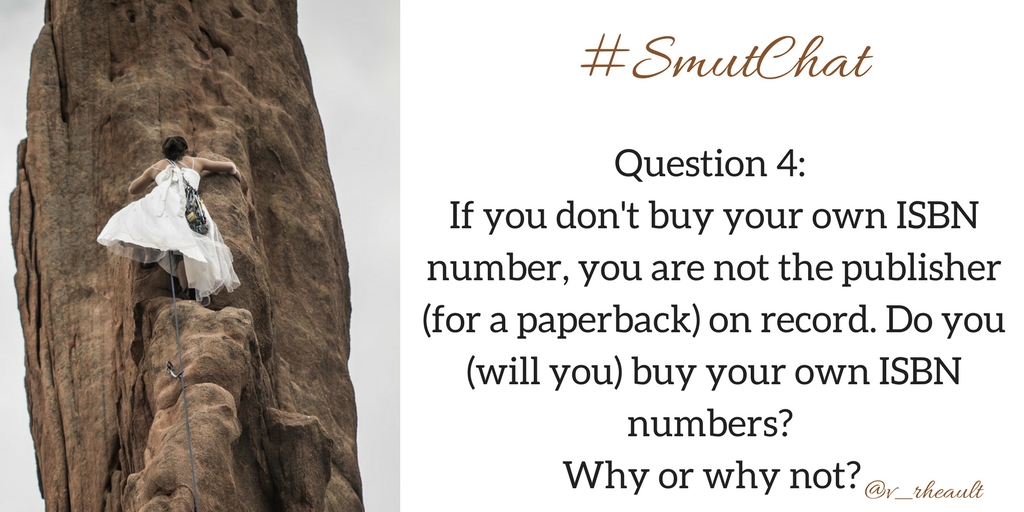
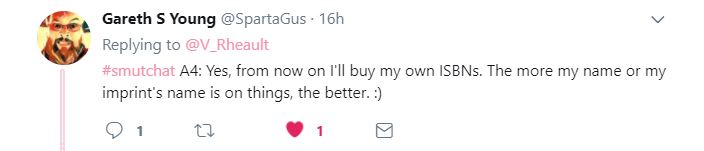
ISBNs are expensive–at least, they are in the US. CreateSpace gives you one for free and if you use theirs, they are listed as your book’s publisher, not you. Kindle Direct Publishing will give you an ASIN number, but I read somewhere that selling an ebook isn’t considered publishing per se, it’s just selling a file. I use my own ISBN numbers for both my Kindle file and my paperback for CS. Here’s what others said:

smutchat recap 16smutchat recap 17smutchat recap 18smutchat recap 19

emae isbn numbers

#SmutChat-Selfpublishing (6)

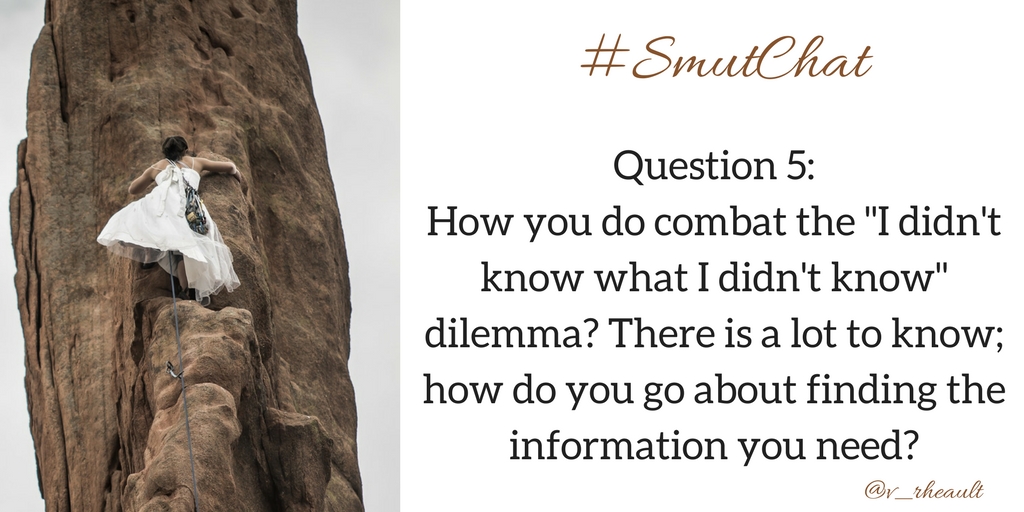
This is tough because if you don’t know you don’t know it, how will you figure it out? I researched the hell out of self-publishing, CreateSpace, and Kindle before I published On the Corner of 1700 Hamilton and I still got a lot of things wrong. When you self-publish on your own without help from someone who has done it before, you’re bound to make mistakes. I still make mistakes. I had to resubmit my cover for Don’t Run Away. CS said they “fixed” my cover, but I wanted to fix it myself. The more I know, the better off I’ll be. Here’s what other people thought:

smutchat recap 20smutchat recap 21smutchat recap 22

smutchat recap 23smutchat recap 24

That wrapped up the chat about self-publishing. Though I didn’t showcase them here, there were several tweets about book marketing. I haven’t delved into marketing yet, so I don’t have anything to offer in the way of that or what works. I do know that I have been reading up on Amazon Ads, and a good book by Brian D. Meeks seems to make a lot of sense. Whether it will work for you (or me) remains to be seen, but you can find it here. I have also been reading about Facebook Ads and this is the book I’m reading.

Rachel Thompson @BadRedheadMedia  runs a book marketing chat. You should check out her chat and maybe get some tips and ideas on how to market your own book. She has also written a book about it, and you can find it here.

In some sub-tweets, I told someone to look at Author Marketing Club, run by Jim Kukral. He’s co-host of the Sell More Books Show podcast I listen to every week. He also runs Happy Book Reviews if you’re interested in finding more book reviews. I haven’t used his services so do so at your own risk. Like everything online, be careful where you throw your money. I do listen to his podcast though, and he seems to be on the up and up or I wouldn’t point them out to you.

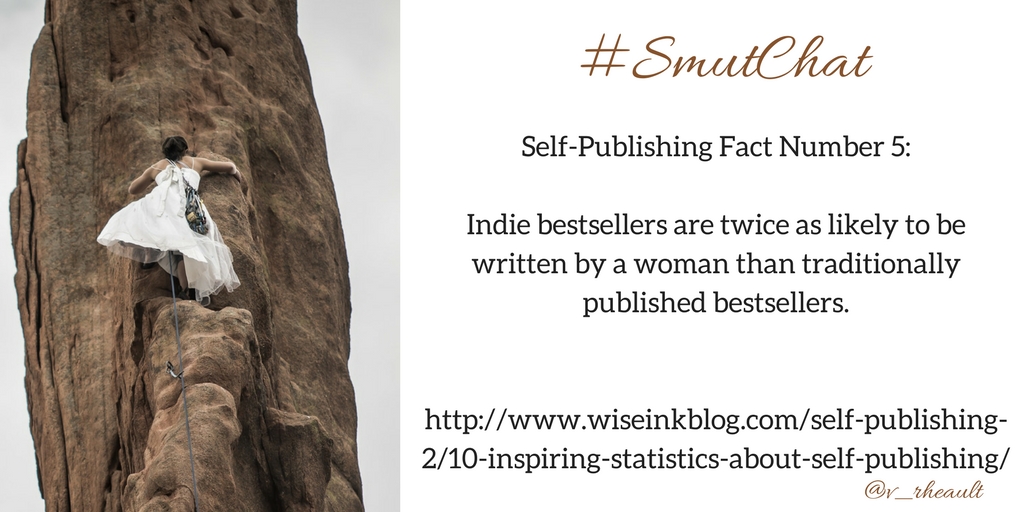
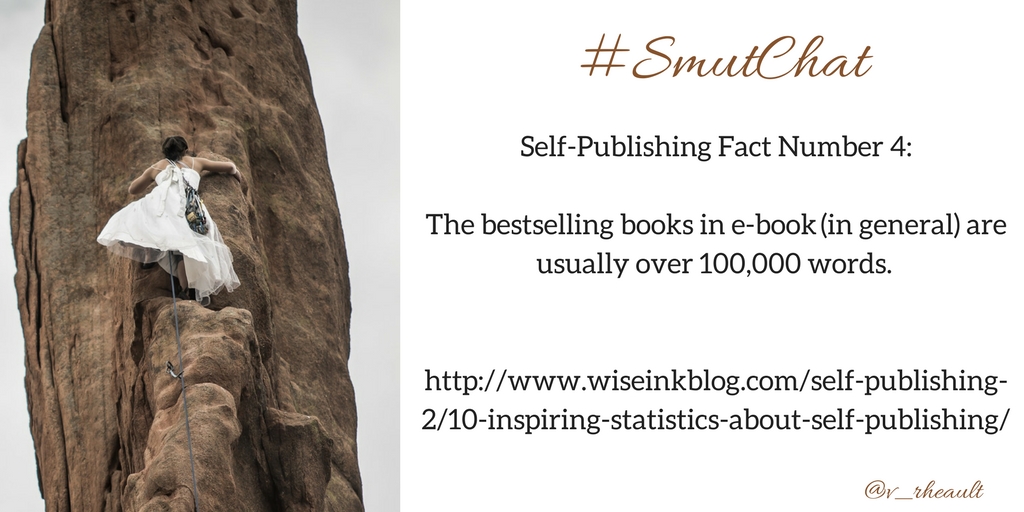
I also tweeted some interesting facts about self-publishing:

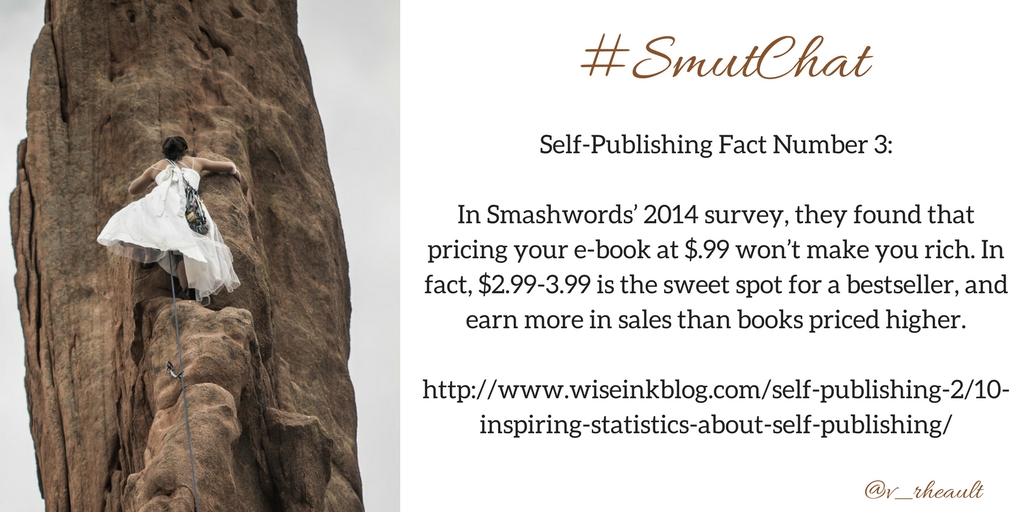
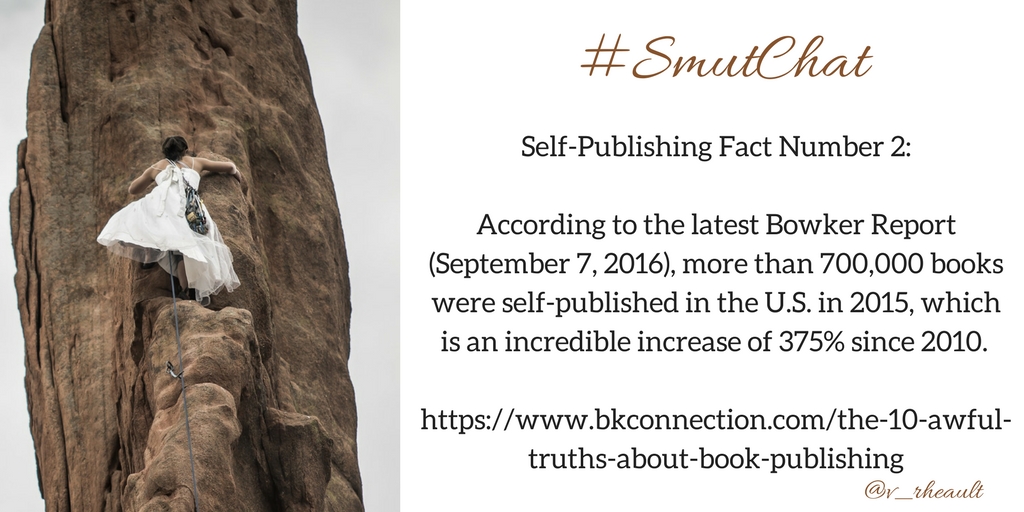
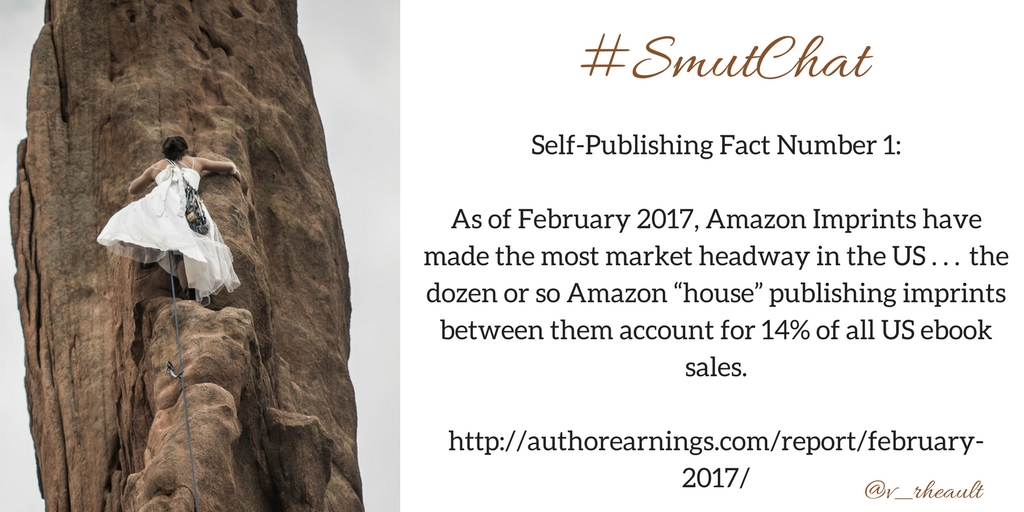
#SmutChat-Selfpublishing (14)#SmutChat-Selfpublishing (13)#SmutChat-Selfpublishing (12)#SmutChat-Selfpublishing (11)#SmutChat-Selfpublishing (10)

Anyway, thanks for reading over the recap. I apologize if I didn’t feature one of your tweets to a question. It was difficult wading through the answers, though I do appreciate everyone who participated last night! If you’re interested in all of the answers, or you want to look at the sub-tweets, please take a look at the hashtag! It was a great chat!

Vania Blog Signature

Why Buy the Cow When You Get the Milk for Free? Or Something Like That.

Writers are notorious for giving their work away. “Sign up for my newsletter and receive a free book!” “My book is on Instafreebie!” “Every first book to all my series is permafree.” We hand out novellas and short stories like candy. We tweet poems. There is so much free content you could drown in words. Our Kindles are becoming black holes of free books downloaded in just a second, forever to rot in your device.

But this isn’t a post about too many books, or the quality of books, or another blog post on trad-pubbing vs. indie.

This post is about paying for services.

I was researching something a while back–I can’t remember what it was now. How to price a series, or how much to charge for something. I have no idea. But I came across an article that forever changed my way of thinking about giving my books away. I can’t refer to the author or the website because I can’t remember, but if I ever come across it again, I’ll link it up. See, the article was about . . . why writers are expected to give their work away, but no one else in a creative area is asked to do so.

arrow-964733_1920

Indie writers who research publishing are told from the get-go to hire out. Hire out your editing, hire out your cover design. Hire someone to format and convert your files. You can even hire someone to write your blurb for you. You want a professional looking and sounding book, don’t you? But what no one tells you that if you do, indeed, hire all that out, you’re spending thousands of dollars. Editors alone make a mint–and sometimes you need more than one. Developmental editing, line editing, proofreading. Sometimes you can find someone who does a mix of those, but that doesn’t make it cheaper. Anyway, so you hire out, do all the things you’re supposed to do. Then what do you do? You give your book away.

Why is it writers are expected to do this, but no one else? Cover designers don’t give their work away unless maybe they are part of a giveaway or something. Editors don’t edit for free unless they are donating their services for some odd reason. Even formatters want five bucks for setting up your margins and gutters in your Word document.

ecommerce-2140604_1920

I understand the backlash of indies doing things themselves. I even told a friend not long ago that if I were a reader now I would be pissed off. In one of my Facebook groups, a woman posted a lovely looking book. The cover was amazing, she had a great blurb, and the premise of the story hooked me. So I went into the “Look Inside” feature on Amazon, and the first page was riddled with head hopping. We were in the heads of at least three different people on the first page. The author obviously didn’t have her book edited. Maybe beta read by friends who didn’t want to tell her the truth, but that didn’t help. It made me wonder how many unsuspecting readers have been burned by indie books. Does buying a book now really have to feel like looking for a new car? Is the salesman going to talk you into a stinker then pop the champagne when you drive off the lot?

I don’t pay to have anything done to my books. I edit myself; I do my own covers. And I don’t give my books away, either. I’ve never used the promotions available to me on KDP Select. I enter my books a couple giveaways here and there for my paperbacks, but nothing in my library is “permafree.” Not even .99. (Except my short novelette I would feel guilty charging more for.)

So indies are expected to “invest in their futures” as the industry likes to call it, but then we’re supposed to turn around and give our books away for free. How are we supposed to have any return on that investment?

What I’m proposing is that maybe “investing in our futures” would be a lot easier to choke down if we demanded top dollar for our work the way other creatives do. Maybe it would be easier to pay out the $300 for a cover, the $500 dollars for the editing and for the other odds and ends you need to make your book look good. Maybe we would be more apt to do that if we knew it wouldn’t take 10 years to recoup those losses.

I know it’s a Catch-22. You can’t sell books if they don’t look and sound good, but you can’t afford to hire out unless you’re making money. I’m in the same boat. I can’t afford to pay $1,000+ per book to publish it. Almost no one I know can. But I’m not saying I won’t when I can afford it.

Pricing your book sucks. You want it to be cheap enough to draw people in, but you want to make money, too. You deserve to make money on something you spent so much time on. Writing is hard work, and you won’t find anyone who will tell you it’s not. You deserve to get paid.

money-1302835_1920

Stop giving your books way to people who join your newsletters. Stop posting your book on the Instafreebie site. Stop pricing your book at $0.00 on Smashwords and everywhere else. It’s not working anymore, anyway. There is too much free content. Would you rather have someone download your free book and never read it, or choose to spend the $4.99 on your e-book and actually read it and possibly review it? It’s a known fact that if someone spends money on something they put more value on it.

But it’s up to you to make your book valuable to your readers.

Trash is free; antiques are priceless.

Do you give your books away? Tell me what you think!

Vania Blog Signature


#SmutChat Dialogue Giveaway

Seems like Thursdays come and go pretty fast, right? Thanks for taking the time to participate in chat tonight. I hope you had a good time. The giveaways are Dialogue for Writers: Create Powerful Dialogue in Fiction and Nonfiction by Sammie Justesen and The Cougarette by Eliza David.

a Rafflecopter giveaway


The next time on #smutchat we’re going to mix it up a little bit. We’ll have guest hosts Nadia Diament (@nadiadiament ) and Avi Ross answer your questions about writing believable law in your books.  The giveaways for that chat are super-amazing, so you’ll want to tune in on Sept 21st.  Happy fall!

hello sept