
1,663 words
9 minutes read time
I’ve wanted to be a writer since I was a kid.
That’s probably not a surprise to anyone who is also a writer, and many of us can say we’ve been writing stories since we learned how to hold a crayon. When I was in high school, I devoured Harlequin Temptations and Desires, finding them at garage sales, the library, and shoplifting them from Pamida. I got caught and my dad made me talk to the manager about how stealing was bad, but I was a kid who loved to read and was a kleptomaniac at heart and well, it didn’t stop me. That’s neither here nor there, but one night, I remember holding a book and thinking, I want to be in charge of it all. The cover, the blurb. All of it. What I didn’t realize back then is I was describing what would eventually become indie publishing. So, yeah. I am in charge of all of it. Down to where the numbers appear on the page.
That was thirty-five years ago or so, and I didn’t understand tropes. I chose books based off the blurb, if I thought I would enjoy the story. In fact, I don’t think I really understood tropes at all until I was assigned the difficult task of marketing my own books. It was through listening to romance marketing talks, webinars, and podcasts where I learned tropes are what sell your books. That was also a difficult realization for me because, like most writers, I just wrote what I wanted to write. My first trilogy was written without tropes in mind–I just made up a group of friends who lived in a fake town, gave them some trouble, and forced them to fall in love while navigating those troubles.
I don’t remember the precise “Ah-ha” moment I had regarding tropes, but I must have had it at some point because my next three standalones were all trope-specific–enemies to lovers, age-gap, and close proximity. Then I veered off again with my Rocky Point series and just wrote whatever I wanted, and if a trope was baked in, like second chance, yay for me.
So you can imagine my confusion when, after seven years of publishing, I realized, yet again, romance was becoming even further divided than just tropes and that I would never be a successful indie author writing “contemporary romance” because romance didn’t work like that anymore.
Indies were changing the game.
There’s an interesting interview that Nora Roberts did not long ago with the Associated Press, and she was talking about her career in romance. She’s written over 250 books and has seen firsthand how the romance genre has evolved, going so far to even say, “My roots are in romance and I have a lot of respect. But I don’t write romance anymore. I do write relationships.”
AP: Speaking of the sex, that’s a good transition to romance as a genre. It has evolved a lot in the last couple of years. Where do you see yourself in the pantheon of that genre?
Roberts: I don’t at all. My roots are in romance and I have a lot of respect. But I don’t write romance anymore. I do write relationships.
I’ve been writing for a really long time now, and the romance genre evolves and it changes. And it did when I was working in it, and it just got to a point where I didn’t want to go where it was evolving. I wanted to go in a different direction. So my roots and foundation are there, and gratitude. But that’s not what I’m doing now.
That’s a great way to look at it . . . if you’re Nora Roberts and not a nameless, faceless author trying to find readers in market so saturated it’s tempting to close your laptop and never look back. She has her audience and has built it over years of publishing. So where does that leave the rest of us?
There are indie publishing “rules” and one of the biggest rules of them all is to never genre-hop. There’s some logic in that–it’s hard enough to market your books when you’re writing in just one genre, never mind trying to reach readers in two or three. But when you decide to write romance, that rule is split down even further. Choose a subgenre, and there are plenty:
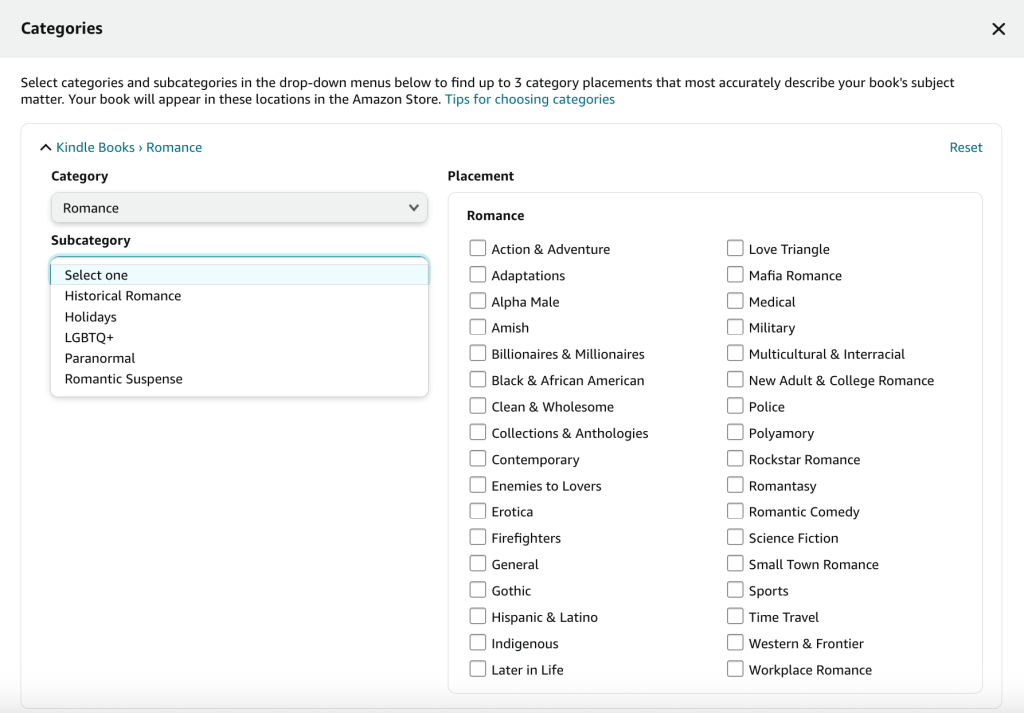
This is the screenshot of romance subgenres you can choose when you publish on KDP. They have narrowed them down so much you can pick something like Love Triangle or Workplace Romance. Ten years ago we didn’t have those choices, and it makes me wonder if they’re helping or hurting.
How niching down into a subgenre can help:
You have a built-in audience. You know before you write you’re going to have readers who want to read your books.
You can build your brand easier. Instead of saying you’re a “multi-genre author” and trying to turn your brand into something for everyone (which never works well and is expensive to market, too) you can say “Mafia romance author” and those readers will know they can plow through your entire backlist and be happy.
It’s easier to market. Just being able to choose your subgenre category and using the appropriate keywords will help immensely when it comes to creating ads. You can also partner with other authors who write that subgenre and share audiences.
Better discoverability. It’s a lot easier for a reader to recommend a hot new Small Town romance series than a general romance.
Cons to only writing one thing:
You might get bored. So far, I haven’t felt too burnt out writing Billionaire Romance, but what saved me was playing with tropes and adding in a dash of Romantic Suspense. Still, there’s not a lot of wiggle room when you choose something like Motorcycle Club. There’s a solid set of exceptions you have to meet to keep readers of that subgenre happy and not a lot of leeway to mix things up.
Your loyal readers won’t follow you. I’m fully aware that readers who liked my Billionaire stuff might not have read my Rockstar trilogy, and the readers who stumbled upon my Rockstars may not have wanted to read anything else in my backlist.
Your chosen niche might get saturated. Hockey is hot right now, and those who got in on the ground floor might be annoyed that suddenly the market is flooded. A while back Reverse Harem, or Why Choose as we have to call it now, went through the same popularity contest. You may have to pivot when that happens, and it might be too much work to start over.
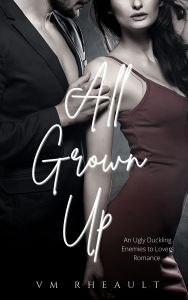
Branding fatigue. All my covers look the same, though I actually don’t mind because with my limited skill set when it comes to graphic design and software, it’s easy for me to meet genre expectations but still keep my books and series separate and distinguishable from one another. But, I’m also trapped now because I put single men on the covers of my books and after sixteen books, a couple all of a sudden would look very out of place. Also, unless you can afford to be flexible, eventually you might use up all the hot men that are available on a stock site like DepositPhotos, trapping you even more.
So, what does all this even mean? Subgenres aren’t going to go away, in fact, chances are good KDP will add even more as time goes on, but I know from just my limited experience that niching down does help whether we want to admit it or not. It helps marketing and branding, for sure, and in turn it doesn’t take so much work to find readers. Anyone who looks at my Amazon author page knows exactly what they’re going to get, even if I do happen to throw in a rockstar or hockey player.
That doesn’t mean I’m always going to want to write billionaires, if even, you know, I’ve downgraded my billionaire status to simply, “Men with money.”
And what does that mean for romance? Readers aren’t picking romances off the Pamida shelves and deciding on which ones to stuff into their purses. They search online marketplaces like Amazon and Kobo by the tropes or subgenres they like, hope the cover catches their eye, then skim the blurb, looking to see if the description lives up to the cover. Subgenres have changed the way readers find books and I don’t know what we can do to combat that.
Writing what you want when you want in a time where indies niche down and produce six books a year is a tough act to follow and not everyone wants to. Some are steadfast in the idea that they’ll do their own thing, and it’s an idea that I keep circling around now that I’ve tried the other way and failed. I mean, to be clear, pivoting and writing Billionaire romance did boost my visibility and sales. Yes, it really did, but it wasn’t a magic bullet to a large readership, either, and in my case, I’m exploring other options to keep my joy.
I don’t know what the answer is. Maybe there is no answer because there’s not really a question. I just find it interesting how indies have shaped romance, even to the point where Nora Roberts has said, “Good luck.”
I can tell you what I’m going to do. I’m going to keep writing the books I want. I like writing “Men with money” or I wouldn’t keep doing it, but I can play with tropes and different subgenres like Romantic Suspense. I can explore themes of mental health, friendships, and found family. Because the market is going to keep evolving and there’s nothing we can do to stop it.
I’m going to write relationships, and if you want to grab one off a pirate site, go for it. But be careful. Pamida’s manager wasn’t very nice.






















 Vania Margene Rheault