
The indie writing community is very tight-knit. Make one of us mad, we all get mad. I think Faleena Hopkins figured that out quick enough. We support each other; we help each other. We do free things for each other: cover help; editing; beta reading.
We even do some naughty stuff like review trading.
We tweet each other’s books.
Lately, there have been a couple of people asking for book recommendations from indie authors. They want to start a list on their website, or they want to start reviewing indie books.
There were lots of tweets, as you can imagine.
And there was something that surprised me, but I guess it shouldn’t have. Someone was recommending books they haven’t read. How do I know this? For one, I know she doesn’t read indie. Two, she’s a very picky writer, and I don’t think she would have recommended these books had she read them. (That is a polite way of saying they could have used more editing.)
This made me do one of my super researching techniques: I ran a poll on Twitter. While the participant number was low, the results still stunned me.
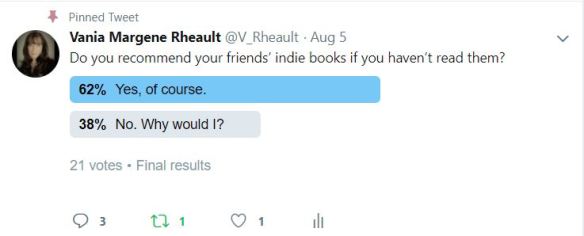
I’m trying to figure this out because this bothers me.
Why would you recommend a book to someone if you haven’t read it? Would you walk into a bookstore, grab any old book off the shelf, and tell your friend it was fabulous and a must-read? Of course not.
This seems to be an indie-only thing, like not full-justifying your margins in your books when you format or adding your cover designer to the book’s contributors when you publish. Indies start stuff traditionally published authors don’t do. And the more indie authors do it, the more it becomes acceptable and the more newbie authors do it.
Of course I want to support my friends. But we all know indie writers don’t read that much. We might beta read, or be a critique partner, and that’s fine. It’s a little different in that I would assume the published book is different from a draft a beta or CP read. But at least you know the gist of the story, know if the book has proper punctuation and grammar.
At least you know the story makes sense.
But what are you doing to your own credibility if you recommend a book to someone you haven’t read and that someone takes you seriously? What if that someone takes a peek at the look inside on Amazon. What if that book has no established POV, or doesn’t have a good hook (AKA boring as f*ck)? What if the formatting is messed up, or has typos in it? What if the first paragraph head-hops into five different heads?
There were a couple comments in that tweet thread that asked the question: Who doesn’t read their friends?
Well, quite a few if my own track record is anything to go by. I can count on one hand the number of my friends who have picked up Wherever He Goes and read it cover to cover.
And if you want to ask me what indies I’ve read in the past few months, I can say one. And it was someone I edited for back in February. Otherwise, I’m busy writing or reading craft books, or reading trad-pubbed romance books. I don’t read indie simply for the fact that most of my friends don’t write what I like to read–contemporary romance. And then another reason I don’t read indie much anymore is if they find out I’m reading their book, they expect a review. I won’t leave a bad indie review. I won’t do it. So I don’t want my friends to wonder where their review is because there won’t be one if I don’t like their book.
Given those reasons, I rarely recommend indie books on Twitter. I recommend how-to publishing books or marketing books. I recommend trad-pubbed books that do something well that could be used as an example to my fellow writers.
I think it’s great that we help our friends. But if we want to help our friends, we should do it in a different way. Pass along promo sites. Recommend books you’ve read on how to do proper Facebook ads or Amazon ads. Marketing your friends’ books is not your job.
Sure, I’m flattered when someone posts a picture of my book on Instagram, or tweets about it. (And yeah, less five people have done that for me anyway.) But I don’t expect it and I don’t ask. My readers aren’t on Twitter. They aren’t even following me on Instagram right now–I got sucked into the writing world there, too. {KT Daxon is a good one for this, and I have to give her credit where credit is due. She does a great job of promoting the books she reads, and she truly does read the books she says she does.}
I would only recommend books I’ve read. It’s honest.
And you want people to be able to trust you, not question your taste.
Not question how good your books are.
I know this blog post sounds like I don’t think indies can write and publish good books. That’s not the case. What I am saying is that some indie books could use more editing. And I understand why indies don’t. It’s expensive and time-consuming. Waiting for an editor to get back to you is like sitting on pins and needles, and then you have to put in all the edits once you get them back. A total edit could push your pub date back by several months. But let’s not pretend that indies aren’t impatient, and rushing to publish is a mistake a lot of indies make.
This reminds me of the trad-pubbed writing community. I’m exposed to a lot of YA on Twitter and Instagram. It seems like a lot of YA authors do read other YA authors and tweet about their books and support each other. Being trad-pubbed is like being in a club, and those authors have each other’s backs.
Romance writers are the same way:
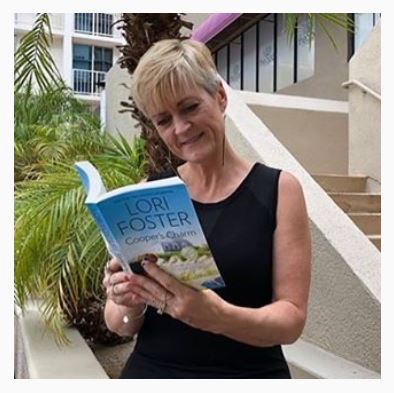
Here’s Brenda Novak reading Lori Foster for a book club Brenda is going to hold in her Facebook Author Group.
That’s real support. That’s real networking and collaboration.
There’s lot of bad things to say about the traditional publishing industry, but this isn’t one of them.
Let’s support our friends the right away.
Read the books you’re recommending. Because reading a book and having a discussion about the book with its author would mean a lot to the author, and a tweeted conversation about a plot twist or an evil character is true promotion.
Do you have any good reasons for recommending books you haven’t read? Let me know!


 Romance writers are all the same. We all want the same thing. To write quality books and make a reader swoon over a happily ever after. And the RWA supports that, no matter how those stories are published.





















 Vania Margene Rheault