Happy New Year! A quick update on my goals for 2020.

Happy New Year!

pexels-photo-3401900.jpeg

Photo by cottonbro on Pexels.com

Social media has been inundated with lists, lists, and more lists. I won’t bother with the best books I’ve read of the decade, or what all I’ve accomplished or not accomplished. I’m not going to bother ruminating about how 2019 was a dumpster fire in every way (actually, it wasn’t for me) or the million ways I’m going to make 2020 “my year.”

It’s silly to use January 1st to reinvent yourself. You are who you are, and a new date on the calendar won’t help. But that’s not to say I don’t have a few goals I’d like to tackle this year.

photo of a woman thinking

Photo by bruce mars on Pexels.com

In past blog posts I’ve written about the slow sale of my books. It’s difficult to keep up your spirits when you work so hard for so little in return. But this year I’m going to take responsibility for some of that. Instead of being a trout fighting my way upstream, I need to stop resisting and go with the flow.

Part of that is realizing I’m not doing 100% of what I need to do to sell my books, and I have to admit that part of the reason is I’m scared. I don’t have faith in my Tower City trilogy. It’s the first three books I count in my contemporary backlist and somehow I’ve gotten it into my head that they are not good. Book one was chopped and diced to the point I probably should have written it over from the start. But the reviews indicate they’re pretty good, and I should get over the idea that they’re not. Sure, I may have gotten strong as a writer since I published them, but I have to stop thinking they’re bad books.

I have a few reviews of Don’t Run Away on Amazon, and I remember this is the first review from someone I didn’t know. It was a proud moment–there’s even a ToC in it now thanks to formatting with Vellum:

Screen Shot 2020-01-02 at 6.57.06 PM

I need to have faith in my ability and not be scared when people read my work.


I also need to start a newsletter. I’m not very active online. My unanswered notifications on Twitter are months old. I don’t update my Facebook author page, and all I post on Instagram are pictures of my cats. (As cute as they may be, they don’t sell my books, dammit!) I need a hub for my readers. Either a newsletter or an active reader group on Facebook where I’ll actually post something, probably both. I know I’m doing myself a disservice not having a newsletter. This means focusing my attention on readers and not spending time on Twitter or using Canva to make pretty Instagram posts the same 10 people will like over and over again.


This year I also want to do more networking in the romance/indie-publishing space. I’ve been writing and publishing for three and a half years. I’ve made a lot friends in that time, lost some too, and some of the writers I know have been in the same place they were three years ago. I’m constantly learning about the industry, always listening for the new thing, I like listening to podcasts and keeping up with industry news. I need to start chatting with like-minded people who understand the value in that. Who treat their writing like a business and put in their 20-40 hours of writing time a week. Writing is really lonely. You’re by yourself with a laptop for hours and hours at a time and I need to find peers who know what that’s like and still do it anyway.

group of people standing beside body of water

Photo by bruce mars on Pexels.com

I like the phrase, “Never be the smartest person the room.” I also feel like lately I’m the only writer in the room, and it will be nice for that to change.


These aren’t life shattering revelations, but they’re what I need to focus on moving forward if I want to start selling the books I spend so much time writing.

It’s not a secret that these next few months are a little hard on me. Winter in Minnesota is long and dreary. It’s hard to want to go anywhere because the temperatures are horrible and the roads are constantly clogged with snow. It takes a lot of energy just to get through a day with no sunshine, and I need to focus on releasing my wedding series and appreciating the little things while I wait for warmer temps and the sun to come back.

I do have a selling/marketing summit in May that I’ll be attending with David in Nashville, and I’m looking forward to that. No matter how long winter seems, spring always comes back around.

Just keep moving forward the best you can, and better times will come.

Tell me your goals for 2020. How do you plan to move forward? Let me know!


end of blog post graphic

Being a Career Author. Do you have what it takes? Part four: Covers

I hope you all had a lovely holiday if you celebrated! I’m currently snowed in, and I’ve been working on some book-related stuff. I apologize for not posting last week, but let’s pick up where we left off . . .

The next installment in the Written Word Media survey looks at book covers. To recap, they surveyed indie authors to see how much time they spend writing, and how much they spend on products and services such as editing and marketing.

According to the survey, as you can see by the graphic, emerging authors do both almost equally–they design their own covers and use a professional designer. The 60kers and the 100kers use a professional cover designer way more than they design their own.

Marketing-Is-Hard-book covers 1

graphic taken by survey linked above

The article says the leap from emerging authors to 60kers is because emerging authors realize that without a professional cover, they aren’t going to sell books.

Of course, that’s true, and I’m not disputing it at all. But I have another explanation to offer. I’m not saying their conclusion is wrong. Emerging authors, after a bad book launch, probably do realize that their covers don’t cut it. But when you are an emerging author, it’s hard to know where to go for help. Quite possibly, emerging authors do their own covers because it’s quicker, easier, and they don’t have to worry about whom to trust. Indie publishing is a jungle. When an emerging author spends a couple years networking, they make friends, are put in touch with industry professionals, and can form relationships with people who know what they’re doing.

Especially with book covers, it’s imperative you find someone who knows where to find stock photos, and what fonts are okay to use and why they’re safe. There are so many people getting into the business who shouldn’t. They use free pictures from free sites like Pixabay or Unsplash and that is one of the biggest mistakes you can make. I still do my own covers rather than trust anyone else. Some people are idiots, and I’m not paying for their stupidity or mine for hiring them.

I think another reason emerging authors do their own covers is because they like to be 100% in control. It feels good to publish a book you did cover to cover. Espeically if you can design a decent cover that earns you compliments. Granted, the emerging authors who can make genre-appropriate covers are few, but no one is saying they still can’t be proud. It’s a learning process.

What the survey does say though, is publishing a book with a bad cover will set you back, and you’ll end up redoing it at some point anyway. (Which is a good reason, in my opinion, not to pay for a high-priced cover. You may want to refresh after a couple of years.)

Of course, the 60kers and 100kers don’t have time to do their own covers. These guys are writing, and they probably don’t have interest in cover design beyond that it looks good and will sell their books. I would also hazard a guess that by the time you have twenty books out, you’ve developed a relationship with someone, or at least found a premade site that sells decent work.

The survey then goes into the cost of book covers. As you can see by the graph, 100-249.00 is the most popular price range for all three types of authors. $100.00 for a cover is at the lower end of the scale for something that needs lots of manipulation, and at that price, it may not include a full wrap for a paperback.

Cost-of-Covers-2

graph taken from survey linked above

The authors paying 0-49.00 might only be having the e-book cover made. Most, if not all, designers charge extra for the spine and back cover if you’re also publishing a paperback.

The genre you write in will also determine the cost. A fancy cover for an epic fantasy or a tricked-out cover for an urban fantasy or paranormal will cost more than a romance cover. There are simply more elements needed to have a girl wearing a plaid skirt holding a fireball in front of a haunted high school for an urban fantasy academy novel than for a couple kissing in field for a plain contemporary romance novel. That’s just the way it is. If you write a genre that includes any kind of magic, you’ll be looking at having a cover made (providing you have zero photo manipulation skills). You need to blend in with the other books in your genre and finding a stock photo that contains all the elements you need is probably slim to none. Especially if you’re writing in a series.

It would be to your advantage to look for a cover designer while you are writing your book if you’re writing in one of those genres. Collect covers you like for a frame of reference. Create a logline (also called a six second elevator pitch) so your designer knows what your book is about and then go ahead and start looking. Join book cover groups on Facebook and ask for recommendations. Sometimes putting your budget out there will help so you don’t fall in love with a designer’s work you can’t afford. Find out where they buy their photos of models. If any of them mention a free site, pass them by. Your fee should include the cost of a photo. Cover designers charging you for a free photo is nothing but a scam and it’s dangerous too.

What can you do if you are absolutely stuck making your own cover?

  1. Look at what makes a good cover in your genre. It’s not only the photo, though that’s a good part of it. Its font placement. Where the author name is on the cover. If there’s a tagline and where that is.
  2. What are the elements in your genre? Sci-fi needs spaceships. Fantasy–dragons. Chris Fox calls these symbols. What symbols do your readers look for in your genre? Look at what is selling on the top 100 in that genre on Amazon. List the elements they all have. Yours will need them too. This isn’t the time to be different or to “stand out.” Sorry.
  3. Realize you may be able to offer only an ebook for the short-term. Learning how to do a full cover wrap isn’t as easy as an ebook cover. You need spine calculations based on how thick your formatted manuscript is, and what you want for the back cover. Blurb? Author photo? Imprint logo? It’s best to give yourself plenty of time to practice and itching to press publish when your book is done being edited isn’t the time to teach yourself.
  4. Search stock photo sites to see what’s out there. My tips are for the person who has little to no experience with Photoshop or GIMP. The easiest way to do a cover is to find a photo that you can use without a lot of manipulation. My go-to sites are depositphotos.com and canstockphoto.com.
  5. Watch tutorials. There are a ton of tutorials out there for both Photoshop and GIMP. I have GIMP (which is a free download) on my laptop and there are tutorials out there ranging from isolating a color in a black and white photo to gradients to font manipulation. People are generous with their time–take advantage.

I’ve been told, and have seen other people be told, that if they can’t afford a professional cover, they shouldn’t bother publishing. That’s not particularly helpful, but you do have to consider what your goals are. Do you want to make covers for all your books going forward? Then you’re going to have to learn how. If you’re writing in a genre that requires fancy covers, you’ll be creating a cover to squeak by until you can afford something better.

I do everything myself, and over three years I’d like to think I’ve developed a bit of an eye. It takes a long time, and practice. Instead of watching another show on Netflix, open Canva, put on some music, and practice. Canva isn’t just a software for design, they also offer “classes” that will teach you the elements of a good cover.

I do covers in my spare time. I practice font placement, choosing a cover-worthy photo, that kind of thing. I mess around with concepts for my friends. Even if they don’t turn out that great, practice is never a waste of time. You never know what new trick you’ll pick up. I scroll through stock photos and favorite photos that have potential for future covers. Mine or someone else’s.

Cover design is a career on its own, and you can spend as much time messing around with font as you do writing and editing.

But the point is, if you put enough time into it, you can make a passable cover yourself, if the genre you write in supports it. Women’s fiction, romance. Some mystery thrillers.

If you put out a homemade cover that doesn’t meet reader expectations, or doesn’t fit in with other books, realize that’s going to effect your sales.


Here are a few covers I’ve done, both for myself and others using Canva.com. I pay for a pro membership, and if you plan on doing a lot of covers or using it for graphics for marketing materials, it’s worth the fee. They add new features all the time.

I did these for the first two of my quartet. I haven’t done the third or fourth ones yet:

When you do a series, it’s important they look like they belong together. And before I ordered the proofs, I put the covers on top of another to make sure the placement of all the elements are the same. I might do a blog post explaining how I did them.

her-last-goodbye.png

Daisy Parker isn’t real. I was fooling around one night and came up with it. The photo is as-is and made in Canva.

stealing-home-paperback-cover.png

Stealing Home is one of my favorites. I learned how to do shadows watching a webinar hosted by James Blatch from Mark Dawson’s self-publishing podcast who was chatting with Stuart Bache, a professional cover designer. They were doing a kind of infomerical for a course, and you can check out the course here. I’d never done a thriller before, but I think it turned out rather nice, and when David did a book signing at a Barnes and Noble in Savannah, GA, everyone was surprised it wasn’t professionally done. (This book is real and you can buy it on Amazon or borrow it in KU.)

do-you-trust-me.png

Do You Trust Me took a little work as this photograph was in color and I isolated the red blindfold in GIMP. The font needs work, but I was playing one night and came up with this in about an hour.

So far I haven’t bothered to open a premade business, or sell covers on the side. I help out my friends when I can, and I like to play when I don’t feel like writing or there’s nothing going on online (I’m not a big TV-watcher). I know what my limitations are, and when anyone asks me for help, I make sure they know it, too.

broken-tomorrows-fake-cover-1.png

I was playing and did this concept for a friend. While she went in a different direction, I think this is a classy cover for a women’s fiction piece. (This is a real book; you can buy it on Amazon and it’s available in KU.)

The point is, like learning craft, if you want to make your own covers to save money, keep control, whatever, you need to practice.

I did a video I posted to YouTube showing you how to use Canva template elements to start you off with creating your own ebook cover. I hope it helps!


Next up, the survey goes into every author’s favorite topic–MARKETING! See you then!


end of blog post graphic

Author Panels, Advice, and Mixed Messages. What works for a different author might not work for you.

A while back I joined an author group on Facebook. I’ve blogged about them before, and they are great for motivation, tips, tricks, the list goes on. They also hold a huge author/marketing conference in November and even though I haven’t been able to attend in person, I watch the videos on YouTube. It’s really interesting to hear about how some of the indies making a living wage writing speak about their journeys.

This isn’t without its pitfalls. Listening to several different speakers tell you how they made it, as you can imagine, well, you’ll get several different results.

I have noticed though, how there are some mixed messages, even among the speakers on some of the same panels.

magic spell

It’s proof that there is no magic bullet, and what works for someone might not work for you. As I watch more of the videos from the conference, I’ll let you in on some more of the things I find, but for now we’ll start with a couple that popped into my head this morning while I was in the shower mulling over part of a romance panel I watched last night.

Disclosure:
These are my thoughts on public YouTube videos. The group very generously puts them out so authors who can’t attend can still benefit from the speakers and panels. I love this, and I am in no way saying derogatory things about this group, nor am I sharing information that isn’t available to everyone who is willing take the time to watch them. 

1.  Enroll your books into KU, but take advantage of Prolific Words (AKA Instafreebie) and Bookfunnel to build your email list and take advantage of genre promos.

l hope new authors understand that your book can’t be available anywhere else if its enrolled in KU. KDP’s terms of service is a bit hazy . . . you are allowed to give your book away for free for review purposes, and you are allowed to have up to 10% of your book available in other places. If you want to ride the edge of KDP’s TOS, good luck to you. I prefer not, and when I used BookSprout for reviews, I pulled my books out of there before I enrolled in KU.
How do you get around this? Make your book available on those sites before you publish and then take them down when you’re ready to publish, or use those sites before you enroll in Select. (You can publish with KDP and not be in Select.) If you have the time, and I prefer this method, write something that is only available to newsletter subscribers. If you’re taking advantage of a genre promo on Bookfunnel or Story Origin (I have done neither), it’s better to have a book that’s wide or not in KU so you don’t have to worry about it.
As far as the KU opinion goes, Alex Newton of K-lytics did a lovely talk about who is making the money (out of any author: traditionally published, small press, indie, and other), and it’s indies in KU. Alex is funny, and you’ll enjoy his presentation. You can watch his talk here:

2. You don’t need money to advertise/launch a book, but it’s really best if you have some money.

One romance author said her books depend on Facebook ads. Another said if she’s not advertising, her sales die. But I don’t think it’s fair when an author making money tells you that you don’t need to invest in ads and that investing time on free social media works just as well. They say starting small on ads works, too, and I will spend five dollars here, five dollars there. But do I have steady sales? No. What you need to keep in mind is a lot of these authors have been writing and publishing for years. Five dollars a day here and there probably did work for them five years ago, but that’s not true today. To have a good launch, you HAVE TO be able to throw some money at your book. To have steady sales, you have to be able to invest a little. Hopefully your book is solid (good cover, good blurb, good writing on the inside) and you always make more than what you spend.

3.  You shouldn’t be wasting your time on social media instead of writing, but you should really be on social media.

This one kind of drove me nuts because what some of those authors did on that romance panel made me want to puke. I saw hours and hours of writing time go up in smoke as one author said you should start your own reader group, and join other reader groups (in your genre) to get your name out there. Mostly it was all Facebook-centered, and that goes against almost everything I have ever heard about depending on another platform for your real estate. Drive everything to your website is what I’ve been told time and time again, but a couple romance authors swore up and down that they would not be where they are today had they not joined and started reader groups.


So what should you be doing? What did they agree on?

1.  Start a newsletter. While there was some disagreement on the best way to gather email addresses (some said to do the promos like Bookfunnel, StoryOrigin, and other means that require giving away a piece of writing in exchange for an address) others said that they do paid promotions on Facebook to gather email addresses, and another mentioned adding an opportunity for your readers to have access to secret content  to the back of a book that they’ll only receive if they sign up for your newsletter. An alternate ending would be an example. Or an epilogue. No matter which way you decide to start your list, that is top thing they all agreed on.

2.  Network. So far there have been quite a few authors who said their careers wouldn’t be where they are today if they hadn’t networked. They made friends “higher up” in the publishing totem pole, and it paid off for them. That’s not to say you’re networking to use people. People can spot false friends and you’ll be outed fairly quickly. But networking and getting to know other authors in your genre could pay off in the end with newsletters swaps, being asked to participate in a collection/anthology/promo, etc.

3.  Fulfill reader expectations. They couldn’t emphasize this enough in one of the romance panels I watched. You need to make your readers happy, or it’s all for nothing. Read in your genre and understand what your peers are offering their readers. If you decide to break a trope, do it in a way that won’t piss off your readers. The moderator of that panel used the example of a billionaire romance taking place in a small town. She said she was disappointed because the premise behind billionaire romance is that it takes place in a big city. He’s usually the head of a giant corporation. If you go against this trope and place a billionaire in small town (for example, maybe he’s on the run or in the witness protection program) perhaps it’s not a billionaire romance you’re writing but a romantic suspense. Give your readers what they expect out of the genres and sub-genres they enjoy. It’s why they picked up your book. Because your marketing/title/cover/blurb told them that’s what it is. Your insides have to match your outsides.

4.  Keep in mind your competition. This is a still from Alex’s talk, and if it doesn’t give you nightmares, nothing will. You HAVE TO FIND A WAY to push to the top. And if that means learning an ad platform, learn it. If that means starting a reader group, start it. If that means starting a newsletter, start it. I think some writers/authors live in a bubble, and they don’t realize just HOW MANY books are out there.

2019-11-24


At some point Craig Martelle said there is close to 50 videos on YouTube you can watch from the conference last month. It will take a while to get through the ones that interest me. Follow my blog and I will keep you updated as I parse through them!


I hope you had a wonderful holiday, and enjoy this last month of 2019!

end of blog post graphic

Amazon Also-Boughts. Just a quick word about why they’re important.

Not many first-time authors know how important their also-boughts are on Amazon sales page.

I didn’t either.

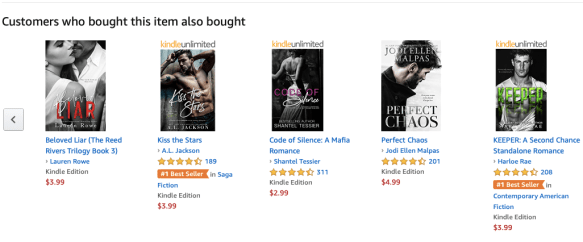
When you’re a new author, and your friends are published authors, your also-boughts probably reflect that because you’ll buy each other’s books. Chances are your friends write in different genres so your also-boughts are full of steampunk, urban fantasy, and fantasy when you write romance. We laugh and take screenshots because Amazon has linked us to our Twitter friends.

That’s less than ideal because this is Amazon telling you they don’t know where your book goes on the virtual bookshelf. This is bad.

If Amazon doesn’t know what your book is, they can’t recommend it to readers in the correct genre.

This is why when someone on Twitter says they have birthday money and want to buy a couple of indie books, I get mad at all the people who try to entice them into buying their books. When it comes to Amazon, the biggest book retailer in the United States, a sale isn’t just a sale. I stopped advertising my books on writer Twitter a long time ago.


Why do you care what the also-boughts are on your books product page? Because when Amazon knows what genre your book is, Amazon will put your book in other authors also-boughts. This is really powerful. This is like free advertising. Amazon recommending your book on another books’ sales pages? Yes, please.

This is why you don’t want just anyone buying your books. You want readers in your genre buying your books.

This also goes for the first wave of sales that go to your family and your friends. Don’t ask them to buy if that’s not what they read and buy from Amazon on a regular basis. I know it’s hard, but training Amazon to know what you’re selling is beneficial in other ways. Mainly, ads.

Did you know Amazon won’t show your ad, no matter how much you bid, if the algorithms say no one is buying it? Amazon wants to make money. If they can’t make money selling your book, they’ll bury it.

But, you might say, they’re getting my money from ads with cost per click, right?

Yes, but that’s only 50% of what they can make if people are clicking and not buying. Amazon wants their 30% of your book royalties, too, and they go with the sure thing.

Training Amazon to know what genre you publish in is half the battle. That’s why you hear from established authors that say you shouldn’t genre-hop until you have an established audience.

Loading your book into Yasiv if to see if your book is connected to others in your genre is a good start. If it’s not, buy some promos. Your first order of business is getting readers of your genre to buy your book.

The second is to write more books.

The 3rd is to stop asking just anybody to buy it. If you’re hoping for reviews, give your book away.

You want Amazon to show your book to people who read in your genre. They’ll even email readers suggestions of books they might enjoy. We all get those emails. It takes a little work, but in the end it can be worth it.

What are my also-boughts like?

all of nothing also boughts

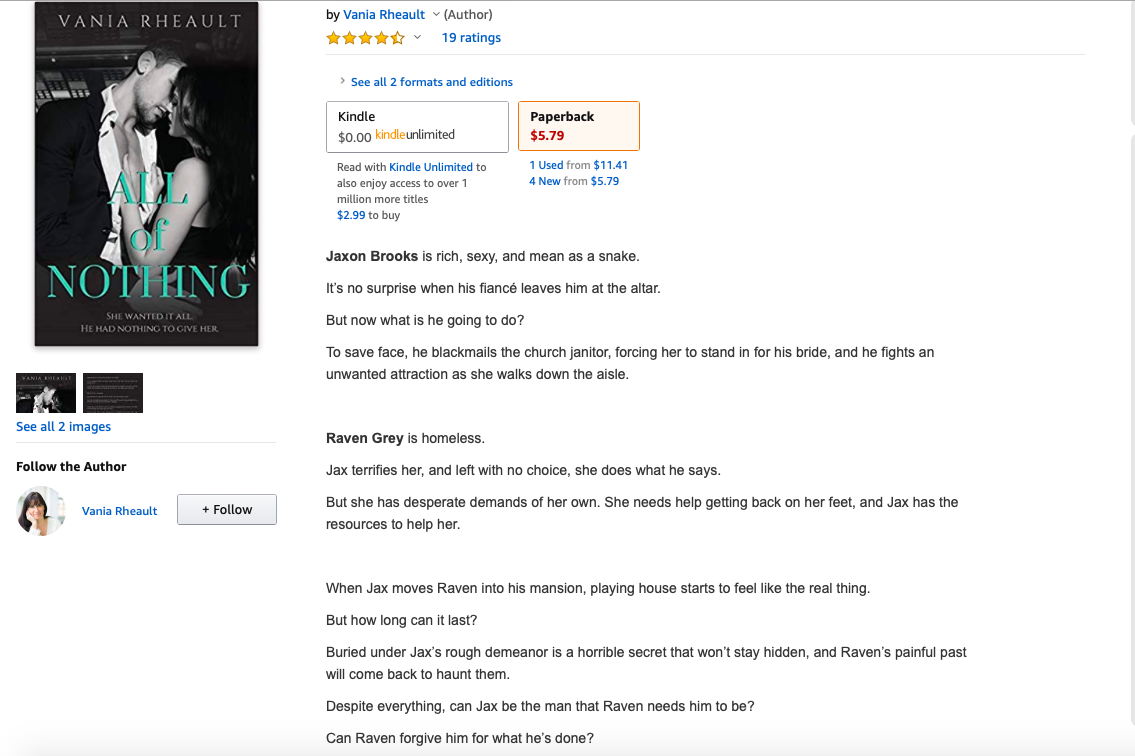
All of Nothing‘s also-boughts are solid. It’s my biggest seller (which isn’t saying much) but I’ve done the most ads for it.

The Years Between Us needs some work, apparently, and I’ll be doing a promo for it for my birthday coming up. I still need to change out the blurb though. This isn’t good, and I’ll be taking my own advice.

also boughts for the years between us


Want to learn more about also-boughts? Read Chris Fox’s Six Figure Author. He goes in depth with also-boughts and the Amazon algorithms.

What to hear more about how Amazon sells your book? Listen to an interview with author Russell Blake and Michael Beverly who runs AMS Ad Werks, an Amazon Ad management company. Listen to Joanna’s podcast here (or read the transcript).

Michael was also on the Self-Publishing Show with Mark Dawson and James Blatch. You can listen to the podcast, or watch them on YouTube.


That’s all I have for today! With the holidays coming, I can’t guarantee I’ll stay on a consistent schedule, but I’ll try.

I hope you all have a splendid week ahead!


end of blog post graphic

Launching your book. Is there anything you can do to have a great launch?

your book launch

I have to get this disclaimer out there: I suck at launches. I hit PUBLISH and kind of move on. In fact, this goes in line with what Andrea Pearson says on the new 6 Figure Authors Podcast with Lindsay Buroker and Joseph R. Lallo. She recommends not bothering to market until you have at least ten books out.

As I found out being $70 bucks in the hole doing Amazon ads for The Years Between Us (I still haven’t updated that blurb, dammit!) sometimes spending money on marketing and advertising is just a waste of money that you may not ever get back.

But sometimes you wanna throw a little money at a new book, and maybe if you can hit the right notes it can take off and Amazon might show your book some love. That chance is getting smaller and smaller because of the competition, but it never hurts to try. You might get lucky.

Launching can take some planning, so I’ve been mulling over ideas. Because only half the books are edited, I don’t have blurbs or titles yet, and I only have basic concepts for the covers, my launch is going to go into next year. I’m a little embarrassed since I’m 18k into book 2 of my SUPER SECRET PROJECT trilogy, and I’ve been spending more time writing that than I have working on my series. That’s what you get when you chase after the shiny objects. 

When we talk about launches, probably the top two things seasoned authors will tell you is to announce it to your email list and reach out for newsletters swaps.

I can’t do this because 1. I don’t have a email list, and 2. because I don’t have a newsletter (email list) I can’t ask around. I mean, I could ask, but I would have to be clear that I cannot reciprocate. So I’m reluctant to ask because swapping implies doing it in return at some point, and I can’t. To me it would feel like asking for favors, and I don’t like owing people.

If you don’t have a street team, email list, or friends to help you out, what can you do? The only options are then to fling some money at your book.

But first, before you shove money at it, try to get some reviews.

This is my tentative plan when I have my series ready to go:

  1. Put my book on BookSprout before I put the ebook in KU. You can publish your paperback ahead of your Kindle book. Reviewers can’t put up a review on a preorder so the way authors are getting around this is publishing the paperback before the Kindle book. That way, when you do publish your Kindle book, it will have reviews. (You may have to contact Amazon to have them linked up to make the reviews show up for both versions.)
    In a previous blogpost, I questioned the quality of the reviews from BookSprout, but you have to weigh what you need versus what you want. If you can grab four or five reviews from them at least you have something to get your book off the ground. Some readers won’t read anything that doesn’t have a review. And if you have only one book out and no one knows your name, your chances of a reader picking up your book without reviews is even lower. BookSprout will offer your book to 20 ARC readers for free. If 25% of them leave a review, you can publish your Kindle book with a few stars, at least.your book launch (2)
  2. Buy some promos. I want to have my whole series published when I do this. That way the promo for book one is actually going to be for all the books in the series, and I’m hoping for some serious read-through.
    The two places I’m going to try are: Red Feather Romance. This is a promo site run by Written Word Media who also offers Freebooksy and Bargainbooksy. I’ve tried both of those before, and I’ve had better luck with Freebooksy. But I tried Bargainbooksy on a standalone, and I’ve come to realize marketing a standalone is not cost-effective. Ereader News Today. I haven’t tried this service, but other authors swear by it. I like trying something new every time I release a book, if anything, just so I can blog about it.When you look at promo sites, make sure before you apply that they don’t have a minimum review policy. Some don’t, some do, so it’s best to be sure you don’t need 10+ reviews before you apply for a promo. It saves time.

    Also keep in mind your publication date. Popular promo sites book out a couple weeks in advance. If you’re launching  your Kindle version on January 10th, you may need to rethink it if you can’t get a promo date until February.

    This brings up the subject of release pricing. I think I’ll release the first book in the series at .99 and release the other books at 2.99.  I’ve tried 3.99 and that seems to be too high. When you’re releasing into KU, price doesn’t seem to matter as much because you’re going more for the page reads than you are sales. If you’re wide, price matters a little more, and then you have to research in your genre what other books are going for.

  3. Ads. I may still do some Amazon ads a few weeks after the release of book 4. That might keep my sales and page reads up after the 30 day drop off when I run out of books to release. I’ll have my SUPER SECRET PROJECT close to being done, probably, but that will be under a different name so I won’t have the power of this release behind it. What little power there might be.

your book launch (1)

I’m being realistic with this launch. My kind of books are not what’s selling right now. You might wonder how that’s possible, because romance is romance. But if you take a look at the top ten, only three of them are written in third person past, and one of them is from Nora Roberts. I don’t count her.

  1. Dirty Letters by Vi Keeland and Penelope Ward: 1st person past
  2. The Family Journal by Carolyn Brown: 3rd person past
  3. Crazy for Loving You: A Bluewater Billionaires Romantic Comedy by Pippa Grant: 1st person present
  4. Havoc at Prescott High (The Havoc Boys Book 1) by C.M. Stunich: 1st person present
  5. A Nora Roberts reprint from 2009: 3rd person past
  6. No Broken Beast by Nicole Snow: 1st person present
  7. Winter Cottage by Mary Ellen Taylor: 3rd person past
  8. My Big Fat Fake Wedding by Lauren Landish: 1st person present
  9. Insatiable: A Cloverleigh Farms Standalone by Melanie Harlow: 1st person past
  10. Stealing the Bride by Nadia Lee: 1st person present

You can dig deeper down the list and keep counting, but that small sample is enough for me. I’ve blogged about this before, too, how I think that 3rd person past is going out of style, and after my wedding quartet, I’ll have to decide if it’s even worth writing anymore. I mean, there’s no telling when 3rd person past might come back around. Everything circles around if you give it time. But you also have to resist banging your head into a brick wall trying to sell books readers don’t want.


Anyway, I’ve talked enough about my launch plans. It seems the best plans will incorporate a little teamwork by way of newsletter swaps, but it puts you in a hard place if you don’t have one of your own.

If you find this is the case, you can be stubborn like me and keep doing what you’re doing, or you can start a newsletter, and realize that it’s going to take you a couple years to build a list of readers where you can tell them about your releases and other books you enjoy. Also, there’s no time like the present to reach out and make some friends in your genre. If they’re your friends and want to help, maybe they won’t ask you for anything in return. Some people out there are still nice. Just be careful not to take advantage.

Got any other launch ideas? Let me know!


end of blog post graphic


Amazon Ads: Bad news.

Amazon ads and bad news probably go together in sentences from a lot of indies. I’m no exception, but not through any fault of my own. Kinda.

When I did my last update, I was breaking even, and pretty happy with that.

After some ads took off and ate up all my money with no return, I had to pause them. I was 70 dollars in the hole, and I had to try to figure out why.

The culprit was easy to spot.

ads.jpg

These are my ad results for The Years Between Us from September 20th when I started Bryan’s ad challenge to today October 19th when I’m writing this blogpost. The numbers look impressive. Look at those impressions! Look at all those clicks!  I mean, in all the times I’ve tried running ads, I’ve never had results like this. These tell me a couple things:

  1. Bryan’s advice works. (My keywords were good.)
  2. My cover is good.
  3. My ad copy is fabulous.
    They fell in love.
    The wrong person found out.
    Now he’ll do anything to protect her.
    Even if it breaks her heart.
  4. My daily spend was good enough for Amazon to show my ad around.
  5. My bid for clicks was high enough for Amazon to show my ad around.

But.

My ads, in roughly a month period, generated only $26.57 in sales and KU page reads with an ad spend of $95.52. That’s not good. (The sales column above doesn’t include KU reads so that’s why the numbers are different. The Amazon ad dashboard does not include them and BookReport does.)

book report results for the years between us

You have to be honest ask yourself why that is.

In my case, I’m sure it’s the blurb. I have a good number of clicks. I should have made more than $26.57. They liked the cover and the ad copy enough to click, but they got to the blurb and it turned them off.

That’s the only thing I can think of.

This is the blurb without having to click READ MORE (or above the fold, as they say):

Zia Bishop is in love with an older man.
On the night of her high school graduation, she persuades him to take her virginity, and the wrong person discovers their secret.

Matthew Harcourt knew he should never have made love to Zia, his best friend’s daughter.

And I guess that is enough to make people turn away. Now, this story is not naughty. It’s not dirty. If it was, then I would have used a grittier, sexier cover and marketed it as a “Daddy’s Best Friend Makes Me Wet” novel.  This is a pretty romance, with the bulk of the story taking place when she is 25 and he is 50. Still a wide gap, but maybe it doesn’t sound as weird when she’s 18 and he’s 43.

So, I paused all my ads. I’m going to rewrite my blurb, focus on a different aspect of their relationship.

The first page introduces them at her high school graduation party. So I could still lose readers if they borrow it in KU and decide after five pages they don’t want to read more.

If that happens, I may need to change the cover and target readers who will read OM/YW (older man/younger woman) romance and hope they like the softness of it, or pull it from KU and see if I can find a way to get more reviews, though I’m hesitant to try Booksprout again. If nothing works, I may just have to write off The Years Between Us completely and just forget about it.

There are things I can do, and everything needs to be tested to find out what works and what doesn’t. The blurb is the easiest experiment, so I’ll try that first.

Everything in stages, but that’s the plan so far.

The point is, there are steps I can take to try for sales, and if you find yourself in this position, you need to make sure you are constantly checking on your ads so clicks don’t eat through all your cash.

I should have paused my ads earlier, but seeing those results was pretty amazing. I have a little money to experiment, and I wanted to see what would happen. Sometimes page reads can come in later. In the Kindle Unlimited program, readers can borrow up to 10 books at a time. The Years Between Us could be sitting on quite a few Kindles waiting in a reader’s queue. But I’m not going to let clicks eat up my ad dollars if I don’t have proof of that.

All of Nothing is still making me some spare change every day, so I’ll keep my ads paused until I make up that ad spend money.

Then we’ll try again.

How are your ads doing? Let me know!

Want a list of older man/younger woman books? Goodreads has a shelf of recommendations. 🙂

Until next time!


end of blog post graphic


Market or Write? If you have only one book written . . . write another book!

When I did Bryan Cohen’s 5-day ad challenge, he did some Facebook live events where he would help us in real time with any questions we had. While this challenge was tied-in to him selling his course, I still can’t believe all the work he put into the free mini-lessons, and I’m very grateful.

Anyway, I would watch along with everyone else, picking up tips where I could that would apply to my own books.

After a few of these videos, I realized something . . . so many people were worried about the fate of their ONE BOOK.

Don’t get me wrong, having written and published a book is fantastic. It’s a feat many people say they want to do, but hardly anyone does. If you’ve done that and are trying to sell it, you’re already one step ahead of 98% of everyone who wants to write a book but never does.

The problem with this, though, is that if you’re only selling one book, if you’re taking courses, learning ad platforms, listening to podcasts about book marketing, doing anything that takes away from writing your next book, you’re BEHIND 98% of the writers who are concentrating on building their backlist.

I keep up with publishing news and what’s changing in the industry; which small presses are closing, what Amazon is up to, what Draft2Digital is offering next. Ads are a little bit different. What you know today might might be different than what you need to know tomorrow. In fact, as an example, Amazon changed the way their ad platform looks right as Bryan was done with his 5 day challenge! What he taught us was still invaluable and we could put that into practice, but his segment for visual learners was almost irrelevant the minute the course was over. Anyone watching the videos would be confused because the platform doesn’t look like that anymore.

One day after his course ended! Jeez.

What I want to explain going into that is, if you’re learning an ad platform for one book, you’re wasting time when you could be writing another book because by the time you need to know it for book two, it could be already changed.

But, you’re saying, maybe it’s not a waste because their book will sell with ads.

Sure, maybe it will. If you have a solid stand alone with a good cover and a good blurb, you might make some sales. 

BUT, raise your hand if you have only one book in your backlist that

  • is a novella
  • is the first in a series but you don’t have any of the others written yet (and have no idea when you will)
  • is a mishmash of genres and you don’t know who your audience is
  • is written in a genre you’re not sure you’re going to stick with
  • your book is wide

If you have an only book that is any of those above, you are better off leaving ads alone and writing another book.

the best marketing for a book is to write another.We’ve all heard that writing the next book is the best marketing there is for the first one. It’s not just the writing, it’s social media/networking, too. When you’re on social media sharing snippets, you’re blogging about your writing process, who your characters are, etc, you’re doing more than promoting one book. You’re laying a foundation of being an author. Readers will know that you’re planning to write for a while and they’ll feel more comfortable investing their time in your book(s).

It would be interesting to know how many books on Amazon are singles and their authors aren’t planning on anymore. They’ve walked away for various reasons. Maybe you don’t plan to walk away, but a reader isn’t going to wait three years for a book 2, either.

The number of books you need to make traction rises every year. When I started out it was three. Now, the latest statistic I’ve heard is 6-10, and that was last year. This year? I’ll safely assume that you need 10+ books in your backlist before you see any kind of movement toward actual sales. Learning ads is a big part of this, of course. But the time you spent learning and the money you spend experimenting could be going toward your backlist.

I’m a member of the 20booksto50k Facebook group. Michael Anderle came up with the idea that that if you have 20 books in your backlist you should be able to make 50k a year in sales. He does some math, and I won’t get into that now. It’s an easy concept to buy into. I rather like thinking that after my quartet comes out and I’ll have 10 books in my backlist, that I could potentially make 25k a year in sales. That would change my life.

It’s definitely something to work toward.

But you can’t make that a goal if you’re going to waste time marketing one book.

james scott bell marketing

Click on the photo for a link to the book. It’s a good read and worth your time. 

James Scott Bell has a great book out right now called Marketing For Writers Who Hate Marketing: The No-Stress Way to Sell Books Without Losing Your Mind. In it, he talks a lot about marketing books, (and I did say this in my review on Goodreads) and he does spend a great deal of time talking about writing. Write the next book, and the next and the next and the next. In my review, I pointed out, well, you gotta learn how to market at some point, or you’ll have a big backlist and no one reading it.

I think that’s true. Natural momentum only goes so far.

And while I’m happy to spend some money on ads, to try them out, get a feel for them, I have six books in my backlist, I have 4 more coming out in the next couple months, and I’m 30,000 words into a secret project.

My writing time is not taking a hit.

It’s a mindset. There’s no harm in getting your feet wet. There’s no harm in being curious. But when you publish a book you’re not a writer anymore, you’re a business person filling a need (readers of your genre). Remember that when you’re selling one thing in your store, and you’re spending money on ads.


That’s all I have for today! Likely, my blog posts will be hit and miss for the rest of the 2019. I’m editing my quartet and books one and two will be off to the proofer soon. I have three and four that I’ll be diving into soon, and my secret project is well under way.

I love to share whatever is on my mind, though, and I’ll try to keep up my posts!

I’ll be updating you with my Amazon Ads adventures over the weekend. Let’s just say . . . it’s been quite a ride, and not all together inexpensive, either, but that’s what you get, I suppose.

All of Nothing ebook coverI can share this little bit with you . . . All of Nothing, before I started Bryan’s 5-day ad challenge was at 81,xxx (dont remember the exact number) in the Amazon Kindle Store. Since promoting it with ads since September 20th, it’s at 16,399. I know rank doesn’t mean much, not really, but it is kinda cool to see people are reading it.

I think the new blurb and cover have made all the difference!


Until next time!


end of blog post graphic

Another try with Amazon Ads. Am I finally selling some books?

amazon advertising logo

If you don’t follow Bryan Cohen then you should. Follow him on Instagram, Facebook, and listen to the podcast he hosts with Jim Kukral.

This guy knows what he’s talking about with Amazon ads, and a lot of the stuff he puts out into social media is free. Don’t get me wrong, some of what he puts out there is a hook to get you to buy some of his courses, but he’s a businessman, and well, that’s what they do. But following him on social media for the free tidbits is totally worth it if you’re starting at zero.

I was starting at zero, and even though I had read Brian Meeks’ book on the subject, trying what he suggested didn’t move the needle. But to be fair, that was a while back and I didn’t have as many books published as I do now. They didn’t have the good covers they do now, and I didn’t know how to find keywords.

Bryan Cohen has a different approach, and I totally encourage you to try different things. We all publish different kinds of books, and lots of people get frustrated when something kills it for someone but then they try it and it does nothing, or even worse, it wastes money.

I took a free 5 day ad challenge Bryan hosted a couple weeks ago on Facebook. Of course, it was to sell an ad course that I didn’t buy because I couldn’t afford it (did you know scraping a cat’s bladder for stones cost 2,600 dollars? Yeah, Harley is fine now.), but during the five days I did his challenge, I learned a lot about ads, and more specifically, where to find keywords.

Keywords will make or break your ads. And I know you’re going to call me a cop-out writing this blog post and not telling you where to find them. But in a show of integrity and out of respect for Bryan, I’ll point you in his direction and let him tell you how (or you can use Publisher Rocket, or try Alex’s K-lytics and read his blog). After all, I wouldn’t know what I know without his help, and I’m all about attribution. I will feel comfortable saying this though: all my keywords are titles of bestselling books in my genre that are in KU. How you go about assembling this list will be up to you, but using a list comprised of titles that sell that are similar to yours works.

I started the challenge on September 20th, 2019. He told us to focus on one book, so I chose All of Nothing. That still proves to be my strongest book, and it’s made me the most money with the challenge. After the 5 day challenge was over, I did ads for my other two standalone books, and All of Nothing still blows it out of the water.

Since September 20th, on my three standalones I’ve had 110,709 impressions (impressions are free), 226 clicks, and $50.29 worth of ad spend. That might seem like a little bit of money to you, but remember that you’re hopefully earning most, if not all and beyond, that money back. Those stats are based on 42 ads. All of Nothing has the most, which may be why I’m selling more of that book, at 27 ads running right now. Some are from the challenge and some are ones I did on my own. Wherever He Goes has 7, and The Years Between Us has 8. I focused on keyword ads and I wrote a couple lines of my own ad copy for each ad. Bryan said to bid low, and while that’s up to you, I’m getting clicks and impressions with bids under 40 cents, which is really good considering my genre is contemporary romance, and that is a highly competitive genre. Keep in mind you don’t necessarily pay 40 cents just because you bid it. My cost per click average is .22 cents.

Now, I’ll tell you how much I’ve made since September 20, 2019, and learning ads is going to be a slow process. If you break even when you first start out, you should consider that a success.

To accurately know how much you’ve made, I suggest you use BookReport. It’s free until

bryan ad on instagram

These tips are a great reason to follow Bryan Cohen Blurbs on IG!

your monthly earnings exceed 1,000 dollars. That will tell you how much you’ve made with sales and KU READS. Your ads dashboard does not include KU reads, so if you’re in KU and you see you’ve spent 50 dollars on ads, but only made 13 dollars in sales, those are Kindle/paperback sales, and not KU reads. Bryan was very adamant about making sure we knew that. You could turn off a profitable ad not figuring in your KU page reads, so make sure you take those into consideration. After all, those are the main reason we’re in KU–so don’t forget to include them in your sales data.

I check my ad spend and sales every morning before I go into the writing, and today my ad spend is since I started the challenge, like I said, is $50.29.

What I’ve made so far since I started the challenge is 55.06. I’ve made 5 bucks. That might not seem like a lot, and it’s not. Not in the grand scheme of things. But I’m in it for more than the cash right now, so let’s look at what else we can glean from this data:

book report for ad challenge for blog

book report for ad challenge for blog 2

BookReport shows me that I’m getting sales as well as page reads. This is super since I wasn’t barely getting anything before the challenge, never mind when I was wide and trying to get traction spending money on promos.

All of Nothing has had 10 sales, and 7,894 page reads. All of Nothing is 420 KENPC, so if you divide 7894 by 420, you get the equivalent of 18.79 (almost 19) books read. For me, that’s pretty good for sales.

The Years Between Us is less at 420, so without doing the math, 603 is the equivalent of about 2 books read. Wherever He Goes, I can say just one book in KU page reads was read.

At this stage of the game, I’m happy with breaking even. Why?

  • Readers are seeing my ads. With a low bid, this is a big deal. Lots of people think they need to bid high to be seen, and clearly, that’s not the case. Bryan did not tell us to go after the big-named trad authors in our genre. He told us to target authors that are in KU in our genre that are doing well. Should I target Lauren Landish or Nora Roberts? Which obviously would be cheaper? Lauren is in KU and number one at the time of writing.
  • I’m getting clicks. This is also a big deal. Why? Because it tells me my covers are good and my ad copy is pulling readers in to click my ad and take a look at my product page.
  • I’m getting sales, though small ones. Part of ad maintenance is making sure your clicks convert to sales. If they aren’t, then something is wrong with your sales page. Maybe your blurb is bad, or your look inside doesn’t sound good. You’re losing readers between the click and the sale. Maybe your cover doesn’t hit the mark after all (or maybe you’re not in KU and readers were hoping you would be). Maybe based on your cover they thought it would be about one thing, but then they read your blurb and thought it was about something else. It could be anything, so make sure you keep up with clicks and if they are turning into sales.
  • Hopefully some of these sales and KU reads will turn into more reviews. I need reviews and if people enjoy my books, maybe down the road they’ll leave a review.

Ads aren’t always about making money. When you’re starting out you don’t want to lose money, but you’re also paying for exposure and hopefully reviews.

What am I going to do moving forward?

  • Keep an eye on my ads. Obviously a five dollar return can quickly go from plus to minus, so I will need to make sure I’m always earning or at least breaking even.
  • Work on my ad copy. Find a hook and reel in your readers.
  • Do more ads for All of Nothing. If that book is going to be my biggest earner, I need to exploit that.
  • Explore ads for my trilogy. Someone read Chasing You, so my trilogy has read-through potential. I always forget that they are decent books and people are reading all three of them. In my head I’ve kind of written them off as average, but maybe if I throw some ads at Don’t Run Away, the trilogy will make me some money. (I’ll need to rewrite the blurbs for those books and put in better keywords in my KDP dashboard before I try ads with those.)
  • Look for more keywords. New books pop up on the bestseller list all the time.  Keep adding titles to your keyword list.
  • Have patience. It’s easy to want to bid high, but Bryan has taught me that I can get impressions and clicks and not go broke. I’m going to follow his advice and keep my bids low.

I feel like that 5 day challenge was successful. His ad course digs a lot deeper into other things but I’ll take what I can for now. Learning ad copy and not being afraid to create more ads is what I’ll be focusing on for the next little while.

What do you need to do before you do ads?

  • Know your genre. If you don’t know your genre you don’t know what authors to target.
  • Make sure your cover is genre-appropriate. If you don’t run ads with ad copy, all your potential readers will see is your book cover. A picture is worth a thousand words, and it really is if that’s all your using to draw readers in.

    ads without ad copy

    The ad without ad copy sticks out, huh? But she’s got a hot cover, so it’s not so bad. 🙂

  • Make sure your blurb sounds good on your product page. Make it look good too with bold and spaces between paragraphs.
  • Make sure your price is genre-appropriate. Before the challenge, I lowered my prices from 4.99 to 2.99. Without testing I won’t know for sure if the lower price is helping people buy. That’s marketing strategy, and you’ll have to decide for yourself.
  • Fix the keywords in your KDP dashboard. I did a blog post about how to find real ones for your books. You can also search blurbs of books that are similar to yours and if the same words keep popping up (like action-packed) then include those too. You’re not limited to 7 just because there are seven spaces.

I’m not an expert at any of this. All I can tell you is what is working for me. Slow or otherwise. In the past 21 days I feel like I’ve finally found something that might work to get my books in front of readers. Hopefully it will help you too!

Thanks if you’ve made it this far. I’ll keep plugging away and I’ll start giving you guys monthly updates! Have a great weekend!

end of blog post graphic


A Rocky Point Wedding series update.

I haven’t posted an update for a while because well, there wasn’t much I could say besides, I’m writing.

But now I can at least announce I am done. I finished book four the other night, and while I did get a little teary-eyed, there is still much to do, and I’ll save the tears for when the last book is published. As authors, though, we know that we never really say goodbye to a book. There’s front and back matter updating, updating a cover if trends change or you decide you don’t like what you published, marketing, keyword updating, and all that other stuff you have to do to keep selling your babies. It’s not enough to hit publish, so while publishing them all will be a relief, I’ll hardly be slamming the door shut on them forever.

In total, I wrote 297,204 words. I started in December 2018, and tried to do as much as I could before the carpal tunnel surgery I had in January. I was out of commission for six weeks, but it should have been longer. My doctor gave me the okay to go back to work though, so did I make a mistake when I took that to mean “type my fingers off on this series”?  Probably. But the damage is done, and maybe I’ll always live with a little bit of pain in my left arm and hand. It is what it is.

I’m not going to add how many hours I spent on each file, it’s suffice enough to say that I plowed through four books in about 8 months.

I’ll be editing them now, starting with book one, taking notes making sure things stay consistent. I need to keep track of Autumn’s (my FMC in the last book) blog posts and write them . . . maybe as I edit since my mind will be in the story and I’ll have an easier time manufacturing those interviews.

I have a proofer/beta reader lined up as a fresh pair of eyes. He’s willing to read all four books, so that takes a load of worry off me. I don’t recommend publishing without some kind of feedback, and if you’re willing to beta any of my books, let me know!

I’ve been messing around with covers, and of course, they go through many many variations before I decide on the one I want to publish. I’m keeping my eyes on the top contemporary romances, but again, a lot of those romances are bad boy, tatted up dudes, and my small town romance series would not be a good fit for those types of covers. While All of Nothing has seen an uptick in KU reads since I changed the cover/blurb/keywords, an edgy cover only works if the book is . . . well, edgy.

This is what I have so far, and you can tell me if you like the concept:

a rocky point wedding book cover mock up for blog

The font is a placeholder font. Bad script font is bad, so I’ll be going through fonts. The titles for all four books are still up in the air, but it’s difficult to make up book covers without those elements.

Anyway, I just wanted to see if the overall effect works, and beside it not fitting in with the top 100 right now–which, I have to admit, is pretty important–I think it blends together. There are indie authors who do their covers like this. Melissa Foster and Zoe York are two that come to mind.

But I admit those are covers from books a few years ago, and both those authors have a backlist so extensive, I doubt they go back and redo covers to keep up with changing trends.

In that vein, I want to do mine right, so they have a bit of longevity as well, and I’ll get a few more opinions on the covers, too, before I decide anything. The point is, I’m working on them so I don’t get all cranky when my books are done and I have to pull four covers out of the air like magic.

Besides editing and working on the cover, there isn’t much else I can do with them. I’m hoping to start releasing them this winter, still in 2019, so we’ll see how that goes.

I’m also 10,000 words into an experiment, and I’m excited. I’m not going to say anything more about it since the outcome of the experiment depends on me not divulging information about it. At any rate, it will give me something interesting to do on the days I need an editing break.


That is my update, and I can’t wait to share these books with you!

a rocky point wedding social media graphic

While you wait, look for my other books that are available in KU!

end of blog post graphic

Why I wrote a series, and why you should write one, too!

Writing a series_ Why I did, and why you should too!

I’ll be the first to admit that I don’t like writing a series. Probably not the best thing to admit because it implies I’m not having fun writing my books, and when an author doesn’t have fun writing their stories, a reader won’t have fun reading them. We hear this a lot, and I think it’s true.

I don’t want to imply that I’m hating writing this series to the depths of my black soul because it’s not true. I have loved all my books in this wedding quartet and consider my characters friends, but I will not be sad to see them go.

Fly away little birds into the happily ever afters I have given to you.

If I don’t like writing series, or a better to way to say it is, if I prefer writing standalones, why did I write a four book series, and why am I recommending you do the same?

This is why I wrote A Rocky Point Wedding series, and why after a couple of standalones (to cleanse my palette and to lay some single plot ideas to rest) I’ll plan another.

  1. Writing to Market.
    I believe this. I say AMEN to the preacher who shouts this to his congregation. Writing to market simply means giving the readers of your genre what they want, and more importantly, what they expect. Tropes. The twists and turns they come to associate with plots of that genre. Writing to market means you are writing to an audience already established. You have a built-in comparison authors.
    What does this mean for a series? Readers like reading a series. How do I know? Ask Nora Roberts who writes trilogies and quartets, and the popular long-ass futuristic series she pens under J.D. Robb. She started writing those back in 1995 and the 49th book of that series is coming out in September. She couldn’t have gotten that far without readers GOBBLING those up the minute they come out.
    Series give readers what they want, and as an author, that’s my job.Writing a series_ Why I did, and why you should too! (1)
  2. There is a lot to play with when you write a series.
    You can do a map, mark where your characters live on the cutesy-named streets you make up.
    There are opportunities for novellas and prequels and even more sequels than what you originally planned. It’s nothing new for a side character to wiggle their way into a book of their own.
    Add extra content like I am. If your character is a reporter, write the articles mentioned in the book, or in my case, I’ll be adding Autumn’s blog posts.
    Extra content means:
  3. More ways to Market.
    I could add Autumn’s blog posts to a newsletter as a sign up cookie, or write a novella about Marnie and James’s honeymoon. (The last book stops after their ceremony.) What did they do? Where did they go? Can I fly there for research?
    Market the first book in a series with ads, social media, and if the first book is strong and captivating, the first book sells the rest of the series without any extra work. If you’re wide, put the first book free and drive traffic to that book. Use a drip campaign on BookBub and continually use ads to bring in new readers. Or use your free days in Select and buy a promo to drive traffic there for a certain number of days (or just one) and hopefully if your book is strong enough, over time your page reads from all your books will pay for your promo and then some!
  4. That’s something else you get with a series. Read-through.
    Any non-fiction book that talks about making money will talk about read-through. If you read a Chris Fox book, he’ll assume that’s all you write because it’s the smart thing to do, and Chris always assumes you’re smart and willing to put in the work. Read-through is your bread and butter. It’s especially true for romance, but you see this done in the thriller/suspense genre, as well as YA and women’s fiction. (See Patricia Sands and her Love in Provence series.)Indie books versus traditionally published books (1)
  5. The release schedule can give you time to write another book.
    I go back and forth between thinking I’ll drop my series all at once, or give time between each release. I suppose the smart thing to do is get them all ready to publish, publish the first one and then put the others on pre-order. That way readers can see the rest of the series will be available in a reasonable amount of time. Then, while my books drop, I push readers to the first book while I write another book. That’s not so much factory work as it is good planning.

Those are my reasons for writing A Rocky Point Wedding series.

Always first is giving readers what they want, and when you do that, natural sales will follow. That’s not to say releasing a series doesn’t come with its own challenges:

  • Editing and formatting them all.
  • Consistency from book to book. (Green eyes stay green, occupations stay the same, names stay the same, and no one knows something they shouldn’t.)
  • Making sure the covers belong together.
  • Where to put the extras, and what they’ll be.
  • Taking the time to create those extras.

Will it be worth it in the end? Sure. I’ll have four 70k+ word books that will be a lovely addition to my backlist. I’m smarter about covers and blurbs now, and keywords, too, so taking my time and being smart when I publish should help me avoid having to go back and redo them. Let’s not repeat going back and doing covers again like I had to with my trilogy.

But will it be nice to sink my teeth into a new standalone when this is done? Yes! I already have a story idea I try not to think about too much because I’m not done with book 4 of these quartet yet. I’m 37k into it though, and I’ve given myself until the end of September to get it done. Then while I edit them, I’ll do the busy work of blog posts and cover design. (The jury is still out if I’ll hire these out. If I do, I would at least like to have some couples pegged for the designer.)

Writing a series_ Why I did, and why you should too! (2)

I know planning a series can be daunting, and if you have a plot that spans through all the books that’s even worse. I don’t have a plot that takes place over all four books, unless you count wedding activities, but I don’t. Those activities are a natural progression as anyone who has been in a wedding party knows. There’s bridal showers, dress fittings, parties and the like, so while they may not add conflict, the characters do pass along information to each other, and they are easy ways for me to cram them together into the same room.

If you want to tackle series, the best thing you can do is plan. Plan your books out. Plan how you’ll end each one, and if a subplot weaves through each book and will only be completed at the end. I write romance, so I definitely need each couple to have their happily ever after, and a reader can jump into the series wherever they want.

Writing a series_ Why I did, and why you should too! (3)

A Rocky Point Wedding series isn’t the first series I’ve done, (my Summer Secrets erotica series contained six novellas and more than 150,000 words) and it won’t be the last. Look at your genre and if you see that series are a primary offering, look to your own publishing schedule and see what you can do to give your readers what they want!

Thanks for reading!

end of blog post graphic


Other blog posts on why you should be planning a series:

Why You Should Be Writing in a Series by Tom Ashford on Mark Dawson’s blog.

Why and How to Write a Book Series on the IngramSpark blog.

What Readers Want – Series vs. Standalone Books on the Indies Unlimited blog.