Where Did Organic Reach Go? (And what you can do to find it.)

2020 indie publishing predictions

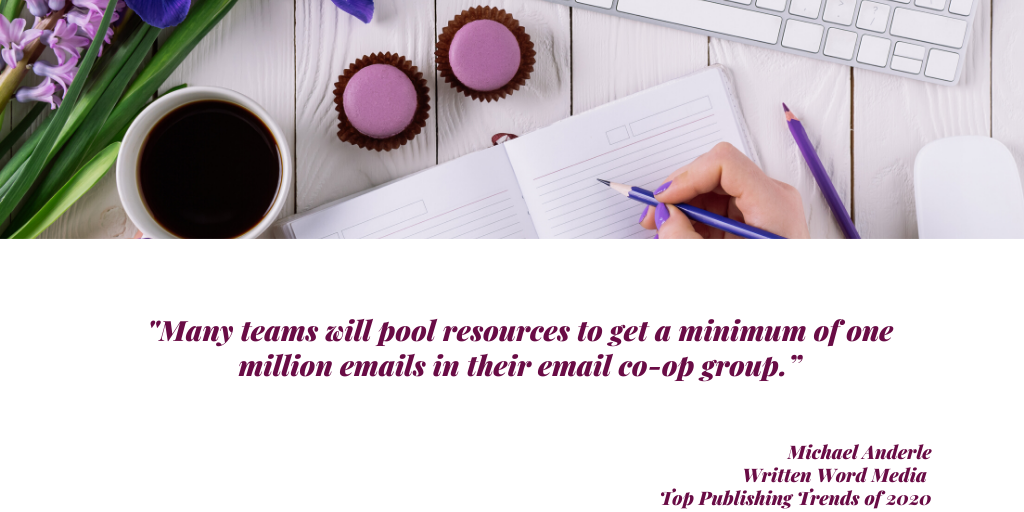
The reason we’re so crazy about marketing is that organic reach is disappearing.

What is organic reach? It’s when someone finds what they need without the company or publisher spending money on advertising. When people talk about ads and marketing  and say organic reach has disappeared, they mean free advertising.

2020 indie publishing predictions-2


Click on the graphic to read the entire article.

Free platforms on social media. Free exposure. There isn’t a day that goes by that I don’t see an author in one of my writing groups ask how they can find exposure for their book without spending any money.

Twitter has promoted tweets. Facebook makes you boost posts on your own page so everyone will see it. Instagram (in conjunction with Facebook) will promote your posts. Authors are clamoring for attention, and if you can’t, or don’t want, to pay, your post will get lost in the fray.

Is there anyway for an author to find free traction? There are some ways to get around disappearing organic reach, but they take a lot of time and work, and there are no guarantees you’ll see results.

  1. Look for other websites that pertain to you and your genre, and ask them to interview you or ask if you can write a blog post about your book. That’s free. Check the blog for the kind of content it offers and ask to contribute. Everyone is looking for quality content. You’re helping them, and they’re helping you. But make sure they have a good-sized audience or you’ll be wasting time.
  2. Simply ask. Ask for a retweet or ask for a share. If you’re blogging, use hashtags on Instagram, Twitter, and Facebook to tag your work when you and others share your post. I can get quite a few eyes on a blog post on a Monday using Rachel Thompson’s #MondayBlogs hashtag on Twitter. That’s for my blog, though. I don’t push my books on Twitter, and she has a strict no self-promo rule. Research hashtags and use them appropriately on social media platforms.
  3. Network. People don’t like to network because it takes time to build relationships. It can take years to build a foundation in your genre. Join groups that read the genre you read and write in. After you establish trust and made friendships, you can say, “This month’s selection was amazing. I have a book I just launched that is similar if anyone wants to give it a try.” And that’s it. Taking years to build a group only to be able to say one or two things about your book is a huge time suck. But if you can’t spend the cash, you have to spend the time.
  4. Ask your local newspaper or area magazine to interview you. I’ve even seen local authors on my local morning news program. Who knows who is watching at 5:30 AM but if you can’t spend money on ads and promos, every little bit helps.
  5. Send out a press release. There are press release templates online. Explain what your book is about and send it out into the world. You can find a list of paid and free places to submit a press releases here. You can Google a list of press release templates, and Word has a press release template you can search for in their templates menu.
  6. Write for Medium. Instead of blogging, write on Medium and build an audience there. This is especially ideal if your book is nonfiction. Then you can write short articles on your topic. If you don’t know how to go about it, but it sounds interesting you to you, check out Make Money on Medium: Build Your Audience and Grow Your Income with Medium.com.
  7. Start a newsletter. Start it now, even if you don’t have a book out yet. Some email aggregators don’t charge until you reach a certain amount of subscribers. It can take a while to build your list, but the sooner you begin, the better off you’ll be.
  8. Contact your independent bookstore in your area and develop a relationship with the
    68439602_2590399361023194_7744828669033447424_n

    Photo taken from Black Birch Books’ Facebook Page.

    manager and staff. A good example of this is Dave Koster. He has a relationship with Black Birch Books in his city. They carry his book and have hosted book signings for him. He gets to post about it on social media to build buzz, and he’s making local connections. If you don’t have money to spend on ads, or don’t want to take the time to learn how to use them properly, you will have to do the footwork to try other things. (To take a look at Dave’s book on Amazon, click here. If you want to follow him and his publishing journey, click here and follow his blog. He has another book coming out soon!)


A lot of the 2020 predictions are based on the fact that organic (free) reach is gone. Everything is pay to play, and this isn’t going to change. How much money do you think Amazon makes double-dipping their authors by charging to sell their books and charging them to advertise? The more important question – how much do you think Amazon makes off indies who waste money on their ad platform because they don’t know what they’re doing?

Mark Coker accuses Amazon of stealing the author platform, that we need Amazon to sell books, but I don’t think that’s only an Amazon problem. Facebook makes you boost a post in your own group or not everyone will see it. Some of Kobo’s prime promotions are paid or you aren’t eligible. They have free ones you can apply for too, but as you can imagine, they are very competitive and difficult to secure. Amazon isn’t the only one making you pay for exposure, yet they seem to take the most heat for it.

2020 indie publishing predictions-3

If you’re going to depend on free marketing when you publish, start building your platform long before your book comes out. Have all your social media intact in the niche or genre you’re writing in. Every little bit helps, I just can’t promise you how much.

Some other blog posts on organic reach:

https://www.tckpublishing.com/why-authors-should-not-use-social-media/

https://www.janefriedman.com/author-without-social-media-presence-now/


Do you have other ideas for free exposure? Let me know!


end of blog post graphic

Indie Publishing Predictions for 2020: Audiobooks

If you read Mark Coker’s predictions back to back with Written Word Media’s, you’ll see they have two very different ideas about what audio is going to do this year for us indies. According to Mark Coker, audio for indies has come and gone. According to Written Word Media, audio will continue to grow and more indie authors will invest.

Which is it?

I guess the more important question is, do you have the money to care?

Audiobook creation is expensive, and there are a couple of things you need to weigh before choosing to spend thousands on an audiobook.

  1. Where? Amazons ACX will trap you in a seven-year contract, and you do not have control of your own pricing. Seven years is a long time. You can create an audiobook through ACX and opt out of exclusivity to Amazon, but your royalties are lower through Audible. Findaway Voices is another place for audiobook creation, but once again, if your audiobook is wide, you’re looking at lower royalties from Audible, though there are more places to sell audio than ever before.
  2. How much will it cost? Lots to consider here. How long is your book? I’ve heard you want to give listeners their bang for their buck. Credits on Audible will buy any book, so listeners are more inclined to spend their credits on longer books. But for indies, these are more expensive to produce. It makes no sense to pay a narrator to narrate your novella because production will be cheaper for you. Audible subscribers won’t waste a credit on it.
  3. Distribution and marketing. You decide to go wide with your audiobook and opt out of exclusivity with ACX (Audible). That’s cool, but if you’re strapped for cash and you were searching couch cushions to pay for your voice actor, you won’t have money to market your audiobook. If you can’t market it, no one will know about it. Kind a like your ebooks, huh?

Written Word Media predicts the audio market will grow. Mark Coker says the audio market will become saturated and indies just starting out have already missed the boat. What does that mean? Audio will likely remain out of your reach until you start making money on your e-books. If an average indie can’t make a regular income until they have 20+ books published, audio in the near future isn’t likely.

Finding a narrator who will do a royalty split with you instead of being paid upfront is getting harder and harder. As Bryan Cohen, on a recent episode of the Sell More Books

woman inside studio

Voice actors have their own audience and have to take care of their own reputations.                     Photo by The Teens Network Daytime Show Studios on Pexels.com

Show says, voice actors are becoming savvy. They know they won’t earn their time/money back if they do a royalty share and will only do work paid upfront. Voice actors have their own wallets and reputations to look out for. If your e-books aren’t selling, you’ll have a difficult time finding a reputable narrator to work with you.

What does this mean for an indie starting out? For audio, at least for now, we feel rushed because we are. If the audiobook industry is saturated now, what will it look like in 2025? There’s no way to know, but you’d be better off writing than worrying about trying to find a foothold you can’t afford.

What if you really want to get in on the action? You don’t have to be completely left out, but even if it doesn’t cost money, it will cost you some time. As an emerging author, you have to decide if it’s worth it, or if you’d be better off writing.

  1. Do live recordings. Go on Facebook or YouTube. Save the recordings and post to your social media and blog. True, you’re not going to make money with free recordings, but at this point you’re building your back list and audience and/or hoping for a newsletter subscribers. My son is listening to free Witcher readings on YouTube. Sometimes it’s not all about sales but exposure, which at this point is what you want.
  2. Create your own. Joanna Penn used to narrate her non-fiction in a closet. Winter jackets can create a soundproof room. But you’ll still have to figure out some kind of editing software because a listener isn’t going to want to hear you flubbing every other line. (By the way, ACX and other platforms have quality control. Even if you happen to have the patience to read your whole book aloud, that doesn’t mean it’s good enough for sale.) Narrate your book in chapters and put it on Patreon, or hope for traffic on your blog. You don’t have to be left out of the audio loop, but you’ll be going about it in a different way.
  3. Explore AI. Audiobook distributors don’t accept text to audio files right now, but that’s not to say you still can’t create an AI file. Be careful using text to voice software because sometimes they aren’t available for commercial use unless you pay their fee. I tried to find something to link up to this blog, but the voices  sounded bad, or the fee was too much to bother with, usually both. Maybe you’ll find something if you decide to go this route.
  4. If you want to offer different mediums, publish your books in Large Print and hardcover. Find someone with Vellum; Large Print is a formatting option with that software. Adjust your cover to a larger spine, and you’re done. KDP has a Large Print box you can select when publishing, and your book will be labeled that way on your book’s product page. Pretty simple to offer your book in a different way. If you buy your ISBN numbers, you can publish your book with a hardcover on IngramSpark. Not necessarily a HARDCOVER that requires you also design a jacket, though that is an option, but you can publish your books with a harder cover like a children’s book. You don’t have to offer audio to sell your books in different ways.

I haven’t done anything with audio yet. Anyone who knows me knows my favorite part of all this is the actual writing and anything that takes my attention away from it I have no use for. The pragmatic side of me knows I need to explore more ways to sell books, but my stubborn side says screw it. I can’t afford audio, and even if I could, my books aren’t selling well enough to warrant it. Maybe in my case, Mark Coker is right – I missed the audiobook opportunity. Or maybe something else will come along. At some point AI text to audio will be acceptable. Us poor indies can wait for that day.

In the meantime, keep writing. You can only have an audiobook if you have a book in the first place. When it comes to this prediction, keep your eyes on your own paper and don’t worry what other indies are doing. As an emerging author, you can only do what your situation allows you to do.

As for me, I don’t care. I can’t afford audio. I listen to my book through Word’s text to voice during my editing process so I know how it will sound spoken aloud if I can ever afford it. At least lay the groundwork for a successful audiobook in case the opportunity ever presents itself.

For more resources on audiobooks, Joanna Penn is coming out with Audio for Authors, it’s on preorder right now, and you can take a look at it here.

She is also interviewed by Lindsay, Jo, and Andrea on the 6 Figure Author podcast, and you can listen to it here.

If you’re interested in tips on how to vlog, or do live videos, in the past I’ve recommend Amy Schmittauer’s book, Vlog Like a Boss. She gives you lots of practical tips for looking and sounding good on camera.

Next we will explore Written Word Media’s second prediction – indie authors and organic reach.

See you then!


end of blog post graphic

Formatting Your Book Descriptions on Amazon

This blog post is outdated. KDP has its own formatting tools and you don’t need outside resources to make your buy-page pretty. There are other tips in this post, but you don’t need Dave Chesson’s generator anymore.


When you add your book’s blurb to the description field on KDP while publishing your book, you may add spaces between the sentences/paragraphs only to find after your book is published they didn’t take on your Amazon’s product page.

Anytime you hear advice about your Amazon product page, you hear that a lump of text is not conducive to sales. Meaning, readers aren’t going to wade through a huge block of text to figure out what your book is about.

I didn’t use a generator for one of my paperback books, and this is how the description looks for the second book in my series:

Screen Shot 2020-02-05 at 10.06.10 AM

That doesn’t look good. Maybe the first sentence is enough of a hook for potential customers to keep reading, or their eyes will glaze over before they even read the first word.

It’s also confusing because when you do the description for your KINDLE book, usually the spaces will stick. And that makes things weird, too, because now your descriptions for your KINDLE book and your PAPERBACK don’t match.

How do you want your description to look?

Screen Shot 2020-02-05 at 10.06.46 AM

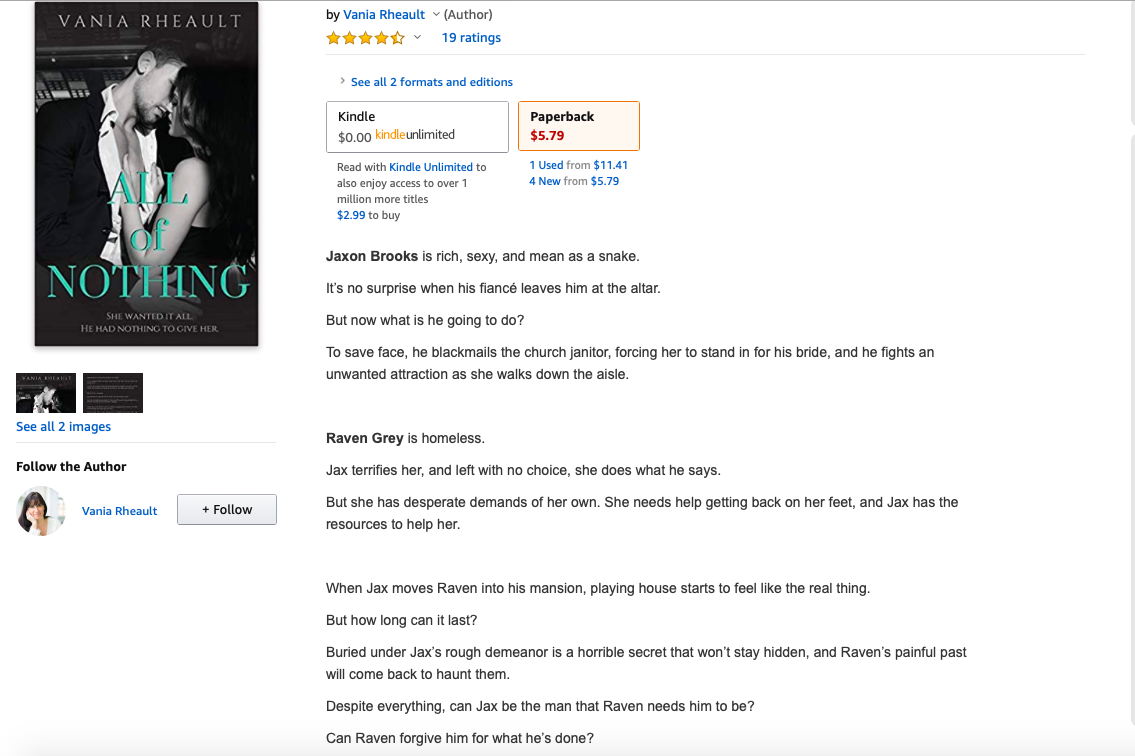
This is my description for All of Nothing. I used an HTML generator to make the spaces between the sentences and the paragraphs, and I also added bold which is eye-catching to a potential customer.

How can you do that?

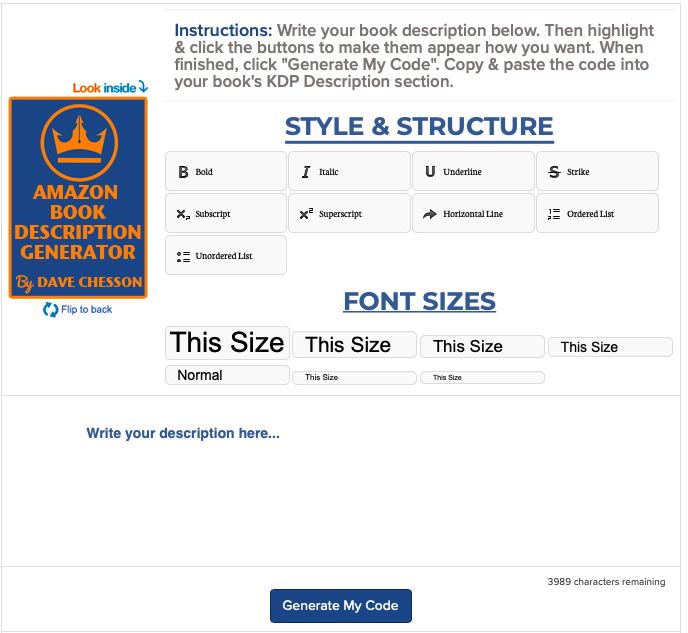
Dave Chesson from Kindlepreneur has a FREE Amazon Book Description Generator, and all you have to do is copy and paste your description into it, and generate the text with HTML code for spaces, bold, italics and more. Then you copy and paste the new generated code into your KDP dashboard under your book. KDP makes making changes a headache, and some authors get confused with the process because KDP calls making changes “publishing” but it only takes a day for the change to go into affect.

Here are the steps:

  1. Go to https://kindlepreneur.com/amazon-book-description-generator/
  2. Paste your unformatted description into the box.
    Screen Shot 2020-02-05 at 10.29.07 AM
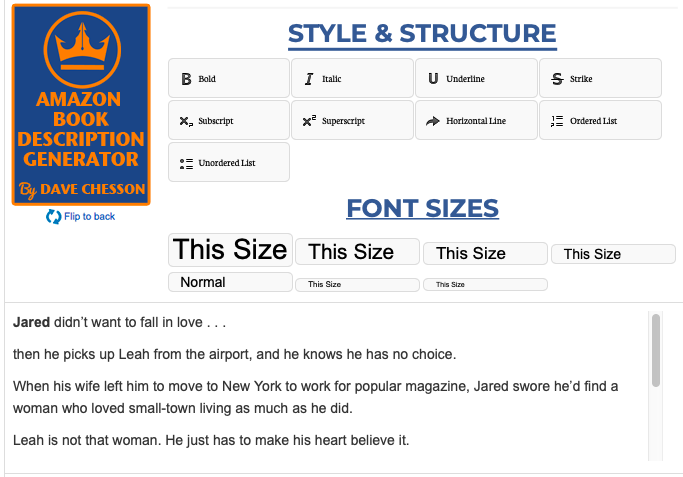
    Add the spaces you want and the bold, italics, or other formatting to your text. This is where you make it look like what you want it to look like on your Amazon product page.

    Like you would in Word, highlight the text you want to change, then click on the Style and Structure to apply the formatting.
    Screen Shot 2020-02-05 at 10.40.53 AM

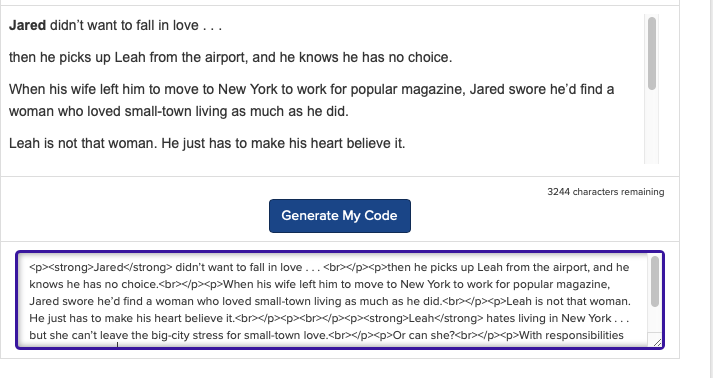
  3. Then click GENERATE MY CODE. Your description will have a ton of HTML attached to it, but you want that. KDP will read it and put up your description the way you want it on your product page.
    Screen Shot 2020-02-05 at 10.44.07 AM
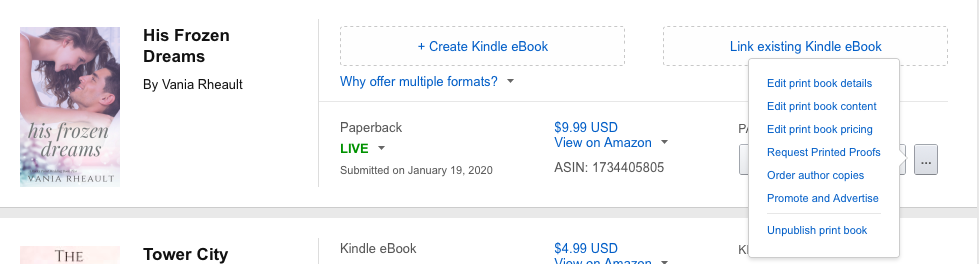
  4. Go to your KDP account, find your book in your BOOKSHELF, and click on edit book details. This generated code works Paperback only. If you try to use it for your Kindle book, you’ll receive an error message saying invisible characters cannot be accepted.
    Screen Shot 2020-02-05 at 10.36.04 AM
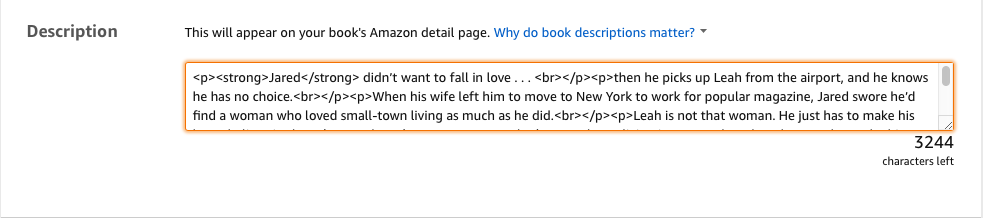
  5. Delete the description you already have there, and paste in the HTML code you generated from Dave’s description generator.
    Screen Shot 2020-02-05 at 10.36.47 AM
  6. Go through the steps to re-publish your book. The changes take affect in about 24-36 hours depending on how fast KDP gets around to it.

Then your description will have the spaces and bold that you want to catch a potential reader’s eye when they browse your product page.

Screen Shot 2020-02-05 at 10.50.11 AM

This is the description for the first book in the series. It looks like I missed some spaces between periods. But the bold and the spaces between lines and paragraphs look better than the block of text from book two.

Of course, the actual writing of the blurb is another headache that I won’t get into now, but with Dave Chesson’s Amazon Book Description Generator, at least it will look pretty!

Thanks for reading this tip, and I hope you can make it work for you!

Until next time!


end of blog post graphic

2020 Indie Publishing Predictions Blog Series

2020 indie publishing predictions

Sometimes when you’re just beginning, you don’t pay attention to the world around you. You think most news doesn’t pertain to you, or if something cool is happening, you can’t participate anyway.

Maybe you feel ill-equipped to do anything with new information, so why bother to know it? Or you automatically think you’re not going to be able to afford it, because let’s face it, us indies don’t have a lot of money to put toward our books.

With indie publishing, something changes every second, and it’s hard to keep up, weed out the useless information from what could help you get ahead, and apply those things to your career.

This is the the first week of the second month of the New Year. 2020 predictions have come and gone, but we still have a full eleven months of the year to go, and as any pregnant woman knows, eleven months can be a long time, and lots can change.

So let’s not ignore the predictions of the indie publishing industry because there is a lot of time for some to pan out, and time for you to apply some of these tips to your own career if you’re so inclined.

Written Word Media put out its own predictions with some of the indie heavy-hitters weighing in, including but not limited to Michael Anderle, (creator of the 20booksto50k Facebook group and conference, not to mention head of his own publishing empire) Mark Lefebvre, Bryan Cohen, David Gaughran, and Mark Dawson.

Their predictions touch on audiobooks, author collaborations, pay-to-play marketing, and much more.

I’ll also be combining Mark Coker’s 2020 predictions for the indie-publishing industry. Founder of Smashwords, an e-book distributor and publisher, he weighs in on what he thinks is going to happen to the indie-publishing space, and his dire predictions when it comes to Amazon and Kindle Unlimited.

I’ll be looking at these predictions through an emerging author’s eye. Remember from previous blog posts, Written Word Media classifies an emerging author as an author with six or less books in their backlast who makes less than 60k a year. Transparency–I made less than $2000 in 2019 with KDP, my short stint wide, and my paperbacks through IngramSpark.

As a beginning author, I’ll give you my opinion on what’s important and what you can put on the back burner in favor of writing more books. Which is usually a better choice.

When you don’t have much money to spend, you need to choose carefully where you throw your money. Not everything is of equal importance, and only when you’re near burnout do you realize how true this is.

Thanks for joining me on this next blog series. I’ll try to keep posting these on Mondays and continue giving you personal updates on Thursdays or Fridays. I haven’t had much to say on those days as you can just assume I’m plugging away at my wedding party series I’m finishing all that up so they are finally published, or working on book three of my first person trilogy.

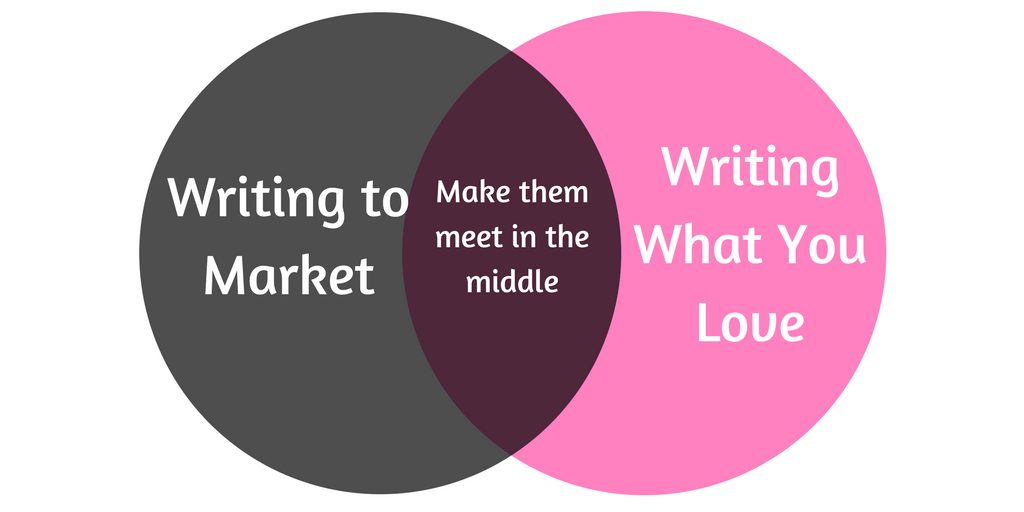
In the back of my mind with all this going on, I’m wondering what I want to write next. I hate thinking that I’ll either write third person past stuff if my series sells well, or first person present stuff if my trilogy sells well. You should never write for money, and that is not something I want to encourage to my readers. But I have always had the opinion that you need to write what readers want, and it’s always the best when you can combine what you love to write with what readers love to read. In that sweet spot you’ll find your career. I have enjoyed writing first person present. I didn’t think I would, but it was a pleasant surprise. I am also only reading first person present books right now, so I don’t confused myself with other tenses.
Writing to Market

In these days of pay-to-play, I know books only sell as much as you market, and that is one of the predictions Written Word Media goes into that we’ll talk about.

So, sit back, relax, and don’t worry. You won’t need your sunglasses. According to Mark Coker, our futures aren’t that bright.

We’ll be exploring audiobooks first! See you then!


end of blog post graphic

Is IngramSpark distribution pricing causing problems for authors on Amazon?

I don’t know when IngramSpark started distributing to Walmart.com.

A few weeks ago I saw someone post about having trouble with the pricing of their books  on Amazon because they were on sale on Walmart.com. At the time I thought the only way you could have your books on the retailer’s site was if you published your ebook with Kobo. With their partnership with Walmart, Walmart sells Kobo ebooks in their books section. I didn’t think anything of it, attributed it to the operator and not the machine and moved on.

But then I listened to an episode of The Sell More Books Show podcast, and they also featured an author who was having pricing problems on Amazon due to their paperbacks being on Walmart.com. (I tried to find the episode that news clip was featured on and I don’t remember when I listened to it.)

Of course, then I had to look for my own books. If you remember from a past blog post, I did have my ebooks on Walmart.com when I was wide through Kobo. That didn’t last long, and as I far as I know, I didn’t sell one through that channel either.

Screen Shot 2020-01-23 at 10.06.30 PMScreen Shot 2020-01-23 at 10.06.48 PM

The problem that’s been going around online now is that Walmart.com is willing to take a loss on books, and they have no problem discounting them. The person who does have a problem with it? Amazon. They’ll get on your butt right away for having a cheaper product than them somewhere else, and they’ll price match as soon as they find out. Some authors are even being told to contact Walmart and ask them to not discount their book(s), but of course, that’s impossible.

To combat this, authors are upping their prices on IngramSpark. That seems crappy though because 1) your book is suddenly more than you wanted it to be and 2) if you have your price anywhere on your cover you have to adjust your price on the cover so the prices match. I ran into that problem more than once, so I know first hand that Ingram won’t let you update your files unless they match.

Is publishing with IngramSpark worth it? I don’t know. It depends on what your goals are. How many books have I sold through Ingram? I only have my paperbacks there to take the place of expanded distribution on Amazon. I don’t go onto my dashboard very often because print isn’t part of my business model, but let me check:

Screen Shot 2020-01-23 at 9.45.15 PM

I’ve sold five copies. I’m not even sure where to look to find out where those copies were sold from. Maybe it was Walmart, maybe Waterstones, maybe Barnes and Noble. Not sure, and to be honest, five copies? I guess it doesn’t really matter, either, does it?

So what am I going to do? At this point I’m not going to do anything.

It used to be a big draw for me to have my books available to be sold in bookstores. A lot of times authors don’t understand that if you want your books in bookstores or libraries it has to be available through IngramSpark. You can always sell your books on consignment or donate your book to a library, but if you want them to order your book properly, it needs to be available through the Ingram catalogue, and that is the sole reason I published there. I still haven’t approached my Barnes and Noble or local indie bookstore to ask if they’ll carry my books–even in the local authors section. I haven’t bothered to ask my library to carry it. (If you want your ebook part of a borrowing app like Libby, you need to be wide and published through OVERDRIVE which is an available option through Draft2Digital.)

But since my ebooks can’t be in libraries because I’m in KU, and taking into account my dismal paperback sales on other platforms, it makes me wonder just how worth it is to publish on Ingram if I’m going to have to go through the hassle of keeping my eyes on my prices. I don’t want Amazon mad at me. They are going to be a huge part of my income once my books start moving and I would prefer to stay on their good side.

Screen Shot 2020-01-23 at 6.33.58 PM

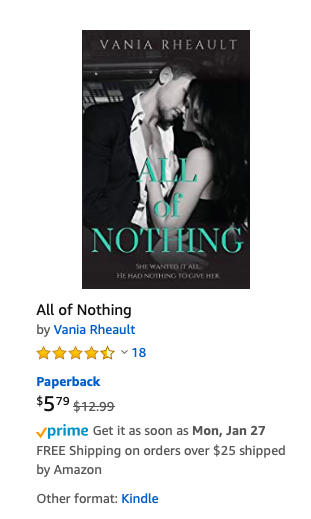
As for me, maybe the sale on All of Nothing doesn’t have anything to do with prices on other platforms. Maybe it doesn’t have anything to do with Walmart. I know Amazon will occasionally run sales on certain titles, and I never had a problem with that because I know that if AMAZON runs a sale on your book that you’ll receive full royalties. But do you if they price match behind your back? Hmmm.

Screen Shot 2020-01-23 at 10.00.09 PM

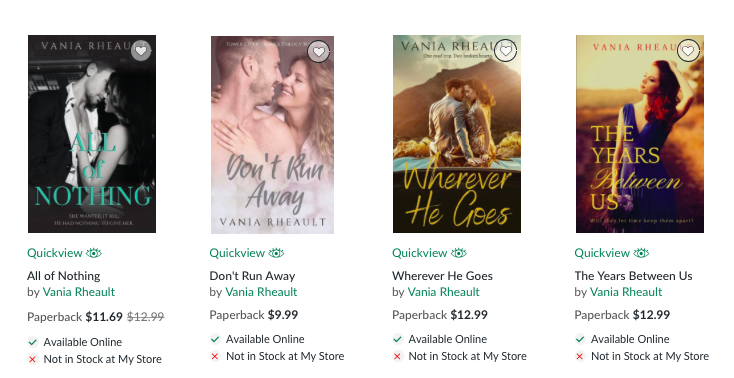
Here’s the first row of my books on Barnes and Noble. Everyone wants to discount All of Nothing it seems.

A list of retailers on Ingram’s website indicates they distribute to target.com and also Chapters/Indigo bookstores in Canada. I’m not going to go through the whole list, but I find it interesting, and I haven’t bothered to really look before. Some of my books are available on chapters.indigo.ca but some of the covers aren’t available, and a couple books in my trilogy have the old covers on them. You can look. here if you’re interested.

Well, I’m not going to freak out about it until Amazon asks me to stop offering my books at a lower price on other platforms. I don’t know if this sale is by them or not. Usually these flash sales don’t last long, and I’ll just keep an eye on my prices.

But it is something to be aware of all the same.

Thanks for reading the ramblings of this woman, and if you specifically want to see if my book is still on sale at the time of your reading this or perhaps by yourself a copy, the direct link is here.

Thanks for stopping by, and have an amazing and productive weekend!


end of blog post graphic


Being a Career Author. Do you have what it takes? Part 6 Exclusivity vs. Wide

Hey writers and authors, welcome back to my blog series that is breaking down Written Word Media’s survey from October of 2019. In it they surveyed three groups of authors: Emerging authors who earn less than 60k a year from their writing and who have six books in their backlist, 60kers who have 22 books in their backlist, and 100kers who have 28+ books in their backlist.

Enrolling your book(s) in KDP Select will always be a tough decision. Have access to all the readers with a KU subscription (in a different article, WWM estimates that to be around 2,488,000) or have access to readers who read on other devices like a Kobo reader, Nook, or an iPad (one would assume readers are reading on the iBooks app, but there is a Kindle app available for iOS devices).

When Written Word Media surveyed their authors, 91% of Emerging Authors said they make the most money from their books sold on Amazon while 93% of 60kers and 100kers say Amazon is their top retailer.

Wide-V-Exclu-1-768x400

taken from survey linked above

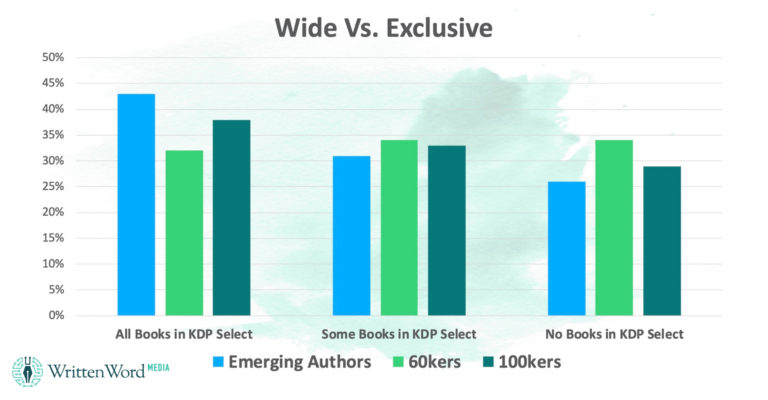
According to the chart, that income may or not be due to KU page reads–38% of 100kers are in Select, 33% of 100kers have a mix of books in KU and Wide, and 29% of 100kers have absolutely no books in Select.

What does this mean for you? If you’re an emerging author, it makes sense to focus on one platform. Even Joanna Penn who is a multiple-streams-of-income cheerleader admits that KU has its place, and the Penny Appleton books she co-writes with her mum are enrolled in the program. If anyone in the whole world can make wide work, it would be Joanna. So even the top indies can see the value of being exclusive.

I went wide for a little bit, but I became too sales-focused and I put a lot of pressure on myself to sell books. I didn’t like feeling like that, and after two months I went back to KU. It felt like a weight being lifted of my shoulders, and I started to enjoy writing again.

There is money to be made on other platforms, but it takes time to build an audience. You need to think about what your long-term plans are.

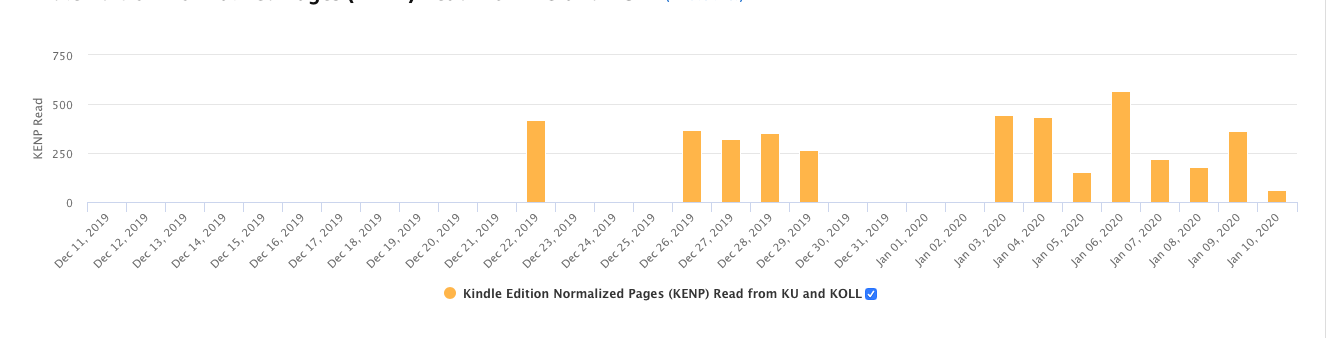
I like having page reads. Right now I’m trading being wide for earning a couple bucks every day in KU. This might not be a sound business decision–especially since my goal is being a 100ker author–but it makes me feel better to know a couple of people every day are reading my books versus the absolute nothing I was getting being wide.

Screen Shot 2020-01-10 at 4.44.22 PM

The KDP royalties estimator says I’ll make about $12.00 from January 1-11, 2020 and while that’s barely anything I should be making with the amount of books I have out, I don’t advertise, I don’t have a newsletter, and $5.00 week is more than I was making wide.

There are cons being exclusive though:

  1. It makes marketing tricker. It’s hard to give your book away after already enrolling in Select. You can’t participate in some promotions on Bookfunnel and Story Origin, and it’s tough to give your book away on review sites and still stay in line with KDP’s terms of service. That also means if you have a book in KU and you’re asked if you want to put it in an anthology, you have to pull your book out of Select to participate. That might not be a big deal . . .  but I have a short story in an anthology, and the author who put it together enrolled the collection into KU. She didn’t buy my rights from me, so the story is still “mine” but because my short story is in KU I can’t do anything else with it. Not unless she takes the anthology out of KU.
  2. You’re not in the library system. That was probably the most disappointing thing when I took my books out of wide. Draft2Digital also had to pull my book out of Overdrive. With the crap Macmillan is pulling with keeping new releases out of the library system for the first few months of a book’s release, having my ebooks in the library system was important to me. That’s not to say you can’t order author copies and donate them to your library.
  3. You might be missing out on other audiences. There are people who read on other devices other than a Kindle. Enrolling your book into Select will keep you from finding those readers.


But obviously, there are pros to being in KU as well:

  1. Easy to upload onto one platform. Only dealing with KDP is nice. But when I went wide, it didn’t take that long to set up accounts and upload my books. There’s just a lot of copying and pasting. Setting prices in other countries is time-consuming because on other platforms you set the price yourself–KDP does this for you.
  2. You can get page reads almost right away.
  3. KDP gives you Kindle Countdown deals and free days to use as marketing tools. These can help boost sales. I don’t use them nearly enough and I need to make them a part of my marketing strategies moving forward.

Enrolling doesn’t have to be forever. You can always pull your books out. Just remember going back and forth between wide and Select won’t help you find readers and will only make the other platforms mad at you. D2D and Kobo are run by real people, and you’ll look like a waffling idiot if you try to go back and forth too many times. I fully admit that the two moths I was wide wasn’t enough. But I tried going wide when I wasn’t ready. When my backlist is bigger I may do what a lot of indies do–have a mix. But for now my main goal is building a readership in KU.

Personally, I don’t think Amazon is going anywhere, and some of the bigger traditionally published authors think that, too. Dean Koontz and Sylvia Day are just two of a list that is getting longer of authors who like the direction Amazon is going and the money that can be made there.

I wish the Amazon imprints were available to query without an agent. For the disdain Amazon seems to have for the traditional publishing industry, I’m surprised they won’t deal with an author directly. I wouldn’t turn down a book deal with Montlake, that’s for sure.

Anyway, being exclusive or going wide is a choice you need to make for your business and as the survey suggests, there is no wrong way to publish. Building a readership takes work, no matter where you publish.

Consistency is key. Stick with with the path you choose, find an ad platform that works and write a lot of books. It’s easier said than done! Good luck!

The in the last point they touch on, we’ll talk about pricing to market. I hope you stop in. Thanks for reading!


end of blog post graphic

Being a Career Author. Do you have what it takes? Part 5 Marketing

Happy Monday! I hope the weekend treated you well!

If you just popped onto my blog, welcome! If you’ve visited before, welcome back!

We’ve been going through the Written Word Media Survey they conducted last year in October.

They broke down three types of authors–the ones who make less than 60k a year and have six books in their backlis, 60kers who have 22 books in their backlist, and 100kers who have 28+ books in their backlist. They broke those groups into sections on who pays how much for what.

My last blog post was a convoluted 2000 word monstrosity on how even though everyone advises authors to have a professional cover made, if you write in a genre that supports a simpler cover, there’s no reason why you can’t learn how to do them on your own. At any rate, you can read it here, and watch my rudimentary YouTube video on how to use Canva templates for an e-book cover so you don’t have to start from scratch. I hope to do a few more of those videos–if I can make a cover, anyone can.

The next installment of this blog series is marketing.

For fiction, marketing isn’t what it used to be. Even three years ago when the words “author platform” were the buzzwords in the author community, hardly anyone says those words now because nobody cares. (And this is for fiction. Memoir and nonfiction have their own rules and nothing I’m going to get into here.)

For fiction, author platform isn’t as important as a simple newsletter, and before, author platform meant your presence on everything from Twitter to Google Plus. That’s not true anymore.

If the author platform is falling by the wayside, how do you “market?” Marketing is simply finding out what kind of books people want and/or need to read and telling them about your book if your book fills that want or need. That’s it. Author platform used to do that. You would use your platform to draw readers to you and your content.

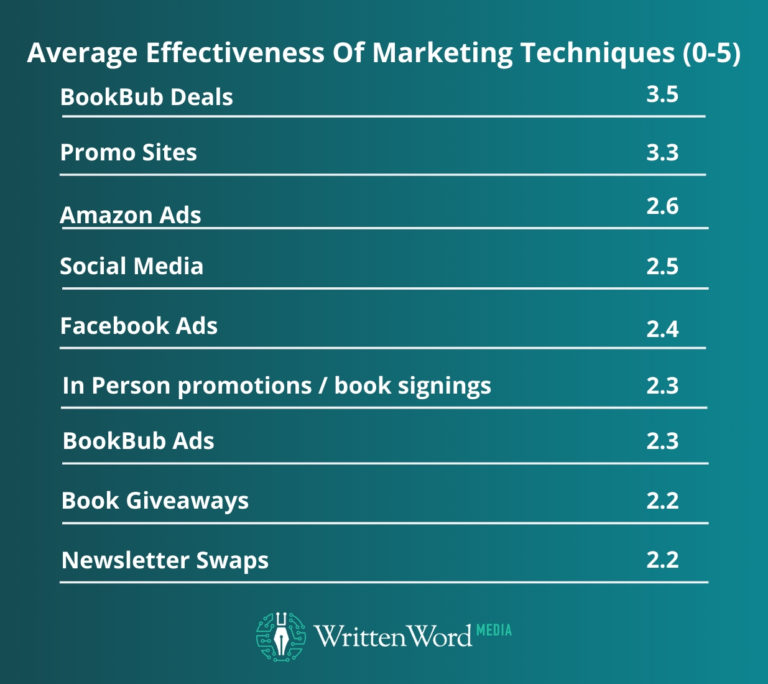
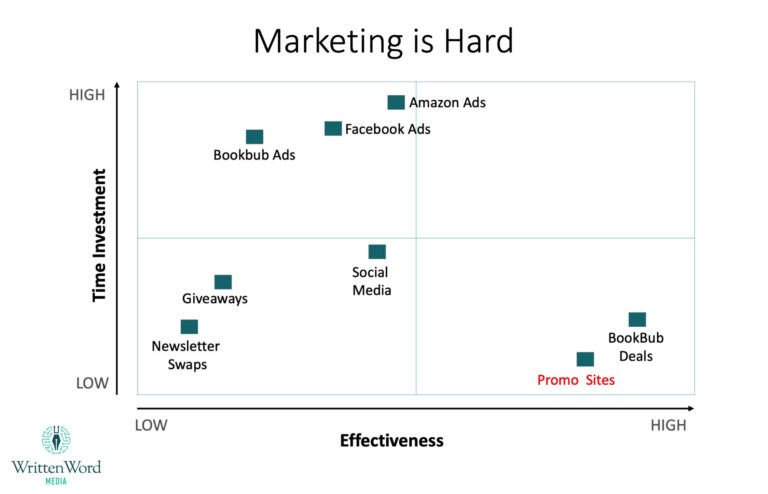
But as the survey points out, you can use promos and let them tell readers about your book. That’s a lot easier than tweeting into the void.

marketing promos

graphic taken from survey linked above

According to the chart, BookBub came in first for promos. Not everyone will be approved for a featured deal, and sometimes Amazon doesn’t like them. The too-swift uptick in sales flags their algorithms. I’ve heard from some authors that they’ve had their books frozen due to suspicious activity. They get it sorted out but it takes time and they lose sales. Also, featured deals are expensive. I know in some genres they can cost up to $600 so they aren’t an option for all authors. 

Promos like Freebooksy and Bargainbooksy work better than ads. I have found that for my own books, anyway. And as the article points out, there is no learning curve. Set your sale, set your promo, and walk away. Let the promo platform deliver your book to their readers.

Marketing-Is-Hard-graph

graphic taken from survey linked above

But what the article doesn’t say is it makes the most sense to use a promo on a book one in a series. If you run a Freebooksy promo on a standalone, yeah, you’re paying to give your book away. And contrary to that poor delusional soul on Twitter who thought being on the top 10 list of free books on Amazon made her a bestseller, unfortunately that isn’t the case. A bestseller implies you are selling books. Nice try though.

If you’re in KU, sometimes you can get some page reads from a Freebooksy on top of giving your book away because instead of downloading it for free, a reader who has a membership with Kindle Unlimited will read your book there instead.

Ads aren’t bad, but they’re complicated and keeping tabs on them so they don’t lose money is time consuming.

If you’re in KU it makes the most sense to learn Amazon ads–then you’re advertising for sales and page reads. If you’re wide and are everywhere like Kobo, Google Play, iBooks, Nook, using Facebook and BookBub ads (not the featured deal) makes sense. Though there is a way when creating your Facebook ad to choose Facebook users who like the Kindle, and that would target only those who buy books from Amazon.

I have dabbled in all the ad platforms and lost money on all of them, too. Your ads will only work if you have a killer product (cover, blurb, title, and look-inside) and it’s only after you lose money when you find out that your cover may have missed the mark or your blurb sucks.

Promos also feature your book’s cover and promos like Freebooksy and BargainBooksy gives you 130 characters or so for a short piece of ad copy so it’s worth it to take the time to write a short hook for each of your books.

Of course, the saying that the best marking marketing for your book is writing another book will never be wrong, and a steadily growing backlist will ensure your readers that you’re going to be around for a while.

Which may also take the place of author platform. Why be everywhere when you could be writing?

What can you do?

  1. Write more books. Promos only work if you have a library to offer your readers. Unless you’re looking for reviews. Freebooksy is around $100 a pop. Not in the BookBub featured deal pricing, but still spendy. Know what your goals are and make the fee count.

  2. Make sure your book is solid. It’s all a waste if you don’t have a good book to offer.

  3. Don’t be scared to stagger promos or overlap them for a longer sales tail. If you put your book on sale for .99 schedule a BargainBooksy and an E -reader News Today (also known as ENT). Authors who are trying to get in on a list like the USA today bestseller list schedule a ton of promos for the same time.

If you want to learn an ad platform there are lots of resources out there:

15039589_10103979409972338_6557733006768953375_o

For Amazon ads, the best thing you can do is follow Bryan Cohen on Facebook. Ask to join his Selling for Authors Facebook group, and do the 5 day mini challenge he’s starting on January 13th. It’s free, and he will teach you how to use the platform correctly and not go broke. Oh, but I thought you said you lost money, you ask. Yes, yes I did. It wasn’t due to following his instructions, but because an ad for The Years Between Us took off, and no one liked the blurb. So I got plenty of clicks on that super awesome ad, but no sales. I should have killed the ad sooner, but I didn’t and that’s my fault.

BookBub. BookBub has a newsletter they send out to all their subscribers. At the bottom of every newsletter are sponsored books. You bid like you would on Amazon, and if you win, your book has a place at the bottom of the newsletter.

Readers click and it takes them to wherever you linked the ad. The best resource I can direct you to is David Gaughran’s book. He knows how to run that platform, and I would’t try to do any BookBub ads without reading that book cover to cover. When I was wide for two months, I tried BookBub ads. I wasted the money to test ads, to test the graphic, whatever. Don’t Run Away was permafree, and I got a lot of downloads. That didn’t lead to sales of the other two books in the trilogy, and only after two months I went back to KU.

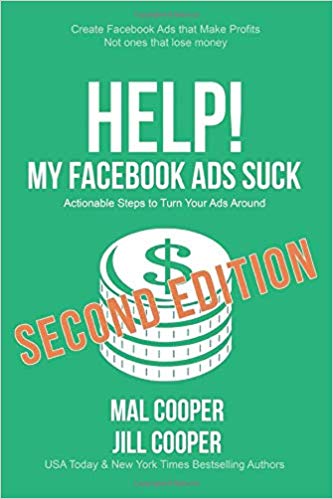
412mZB5USRL._SX331_BO1,204,203,200_Facebook ads. Mal and Jill Cooper came out with the second edition of their book, Help! My Facebook Ads Suck! They explain the platform, what works, how to target your audience. I wouldn’t do a Facebook ad without at least skimming this book so you know what kind of ad to choose, how to put it together, and what kind of graphic to use. I haven’t done much with FB ads. Sometimes I’ll boost a post off my FB Author page. I did that a few times to announce I was back in KU, and I got a small bump in page reads for a little while. I also am boosting posts from my pen name author page to start a little awareness of the books I’ll be releasing in the spring. But nothing too hardcore.

They do include a page about Instagram ads. Since IG is owned by FB, you can run Instagram ads from your FB ad account. I never tried it, so I can’t tell you anything about my experience.

It’s best to focus on one ad platform and learn it really well. I’ll stick with Amazon Ads. Bryan is really easy to understand, and what he teaches you works. But he can only hold your hand for so long. You need to have a viable product or it won’t matter if you choose ads or promos. Nothing will work.

As for a list of Promo sites–people are so generous with what they know. A round of applause to Dave Chesson for putting this list together. 


That’s all that I have on marketing. No two books are alike, so no two books are going to sell alike. Find your audience. Are they like you? Where you do you find your books? Market your books there. Sounds simple, but in the end, it’s enough to make you swear off writing forever.

Good luck!


My next post talks about exclusivity vs. going wide and what the Written Word Media survey has to say about that!  See you then!

end of blog post graphic


Market or Write? If you have only one book written . . . write another book!

When I did Bryan Cohen’s 5-day ad challenge, he did some Facebook live events where he would help us in real time with any questions we had. While this challenge was tied-in to him selling his course, I still can’t believe all the work he put into the free mini-lessons, and I’m very grateful.

Anyway, I would watch along with everyone else, picking up tips where I could that would apply to my own books.

After a few of these videos, I realized something . . . so many people were worried about the fate of their ONE BOOK.

Don’t get me wrong, having written and published a book is fantastic. It’s a feat many people say they want to do, but hardly anyone does. If you’ve done that and are trying to sell it, you’re already one step ahead of 98% of everyone who wants to write a book but never does.

The problem with this, though, is that if you’re only selling one book, if you’re taking courses, learning ad platforms, listening to podcasts about book marketing, doing anything that takes away from writing your next book, you’re BEHIND 98% of the writers who are concentrating on building their backlist.

I keep up with publishing news and what’s changing in the industry; which small presses are closing, what Amazon is up to, what Draft2Digital is offering next. Ads are a little bit different. What you know today might might be different than what you need to know tomorrow. In fact, as an example, Amazon changed the way their ad platform looks right as Bryan was done with his 5 day challenge! What he taught us was still invaluable and we could put that into practice, but his segment for visual learners was almost irrelevant the minute the course was over. Anyone watching the videos would be confused because the platform doesn’t look like that anymore.

One day after his course ended! Jeez.

What I want to explain going into that is, if you’re learning an ad platform for one book, you’re wasting time when you could be writing another book because by the time you need to know it for book two, it could be already changed.

But, you’re saying, maybe it’s not a waste because their book will sell with ads.

Sure, maybe it will. If you have a solid stand alone with a good cover and a good blurb, you might make some sales. 

BUT, raise your hand if you have only one book in your backlist that

  • is a novella
  • is the first in a series but you don’t have any of the others written yet (and have no idea when you will)
  • is a mishmash of genres and you don’t know who your audience is
  • is written in a genre you’re not sure you’re going to stick with
  • your book is wide

If you have an only book that is any of those above, you are better off leaving ads alone and writing another book.

the best marketing for a book is to write another.We’ve all heard that writing the next book is the best marketing there is for the first one. It’s not just the writing, it’s social media/networking, too. When you’re on social media sharing snippets, you’re blogging about your writing process, who your characters are, etc, you’re doing more than promoting one book. You’re laying a foundation of being an author. Readers will know that you’re planning to write for a while and they’ll feel more comfortable investing their time in your book(s).
It would be interesting to know how many books on Amazon are singles and their authors aren’t planning on anymore. They’ve walked away for various reasons. Maybe you don’t plan to walk away, but a reader isn’t going to wait three years for a book 2, either.

The number of books you need to make traction rises every year. When I started out it was three. Now, the latest statistic I’ve heard is 6-10, and that was last year. This year? I’ll safely assume that you need 10+ books in your backlist before you see any kind of movement toward actual sales. Learning ads is a big part of this, of course. But the time you spent learning and the money you spend experimenting could be going toward your backlist.

I’m a member of the 20booksto50k Facebook group. Michael Anderle came up with the idea that that if you have 20 books in your backlist you should be able to make 50k a year in sales. He does some math, and I won’t get into that now. It’s an easy concept to buy into. I rather like thinking that after my quartet comes out and I’ll have 10 books in my backlist, that I could potentially make 25k a year in sales. That would change my life.

It’s definitely something to work toward.

But you can’t make that a goal if you’re going to waste time marketing one book.

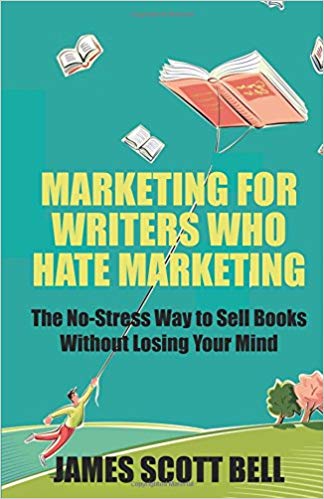
james scott bell marketing

Click on the photo for a link to the book. It’s a good read and worth your time. 

James Scott Bell has a great book out right now called Marketing For Writers Who Hate Marketing: The No-Stress Way to Sell Books Without Losing Your Mind. In it, he talks a lot about marketing books, (and I did say this in my review on Goodreads) and he does spend a great deal of time talking about writing. Write the next book, and the next and the next and the next. In my review, I pointed out, well, you gotta learn how to market at some point, or you’ll have a big backlist and no one reading it.

I think that’s true. Natural momentum only goes so far.

And while I’m happy to spend some money on ads, to try them out, get a feel for them, I have six books in my backlist, I have 4 more coming out in the next couple months, and I’m 30,000 words into a secret project.

My writing time is not taking a hit.

It’s a mindset. There’s no harm in getting your feet wet. There’s no harm in being curious. But when you publish a book you’re not a writer anymore, you’re a business person filling a need (readers of your genre). Remember that when you’re selling one thing in your store, and you’re spending money on ads.


That’s all I have for today! Likely, my blog posts will be hit and miss for the rest of the 2019. I’m editing my quartet and books one and two will be off to the proofer soon. I have three and four that I’ll be diving into soon, and my secret project is well under way.

I love to share whatever is on my mind, though, and I’ll try to keep up my posts!

I’ll be updating you with my Amazon Ads adventures over the weekend. Let’s just say . . . it’s been quite a ride, and not all together inexpensive, either, but that’s what you get, I suppose.

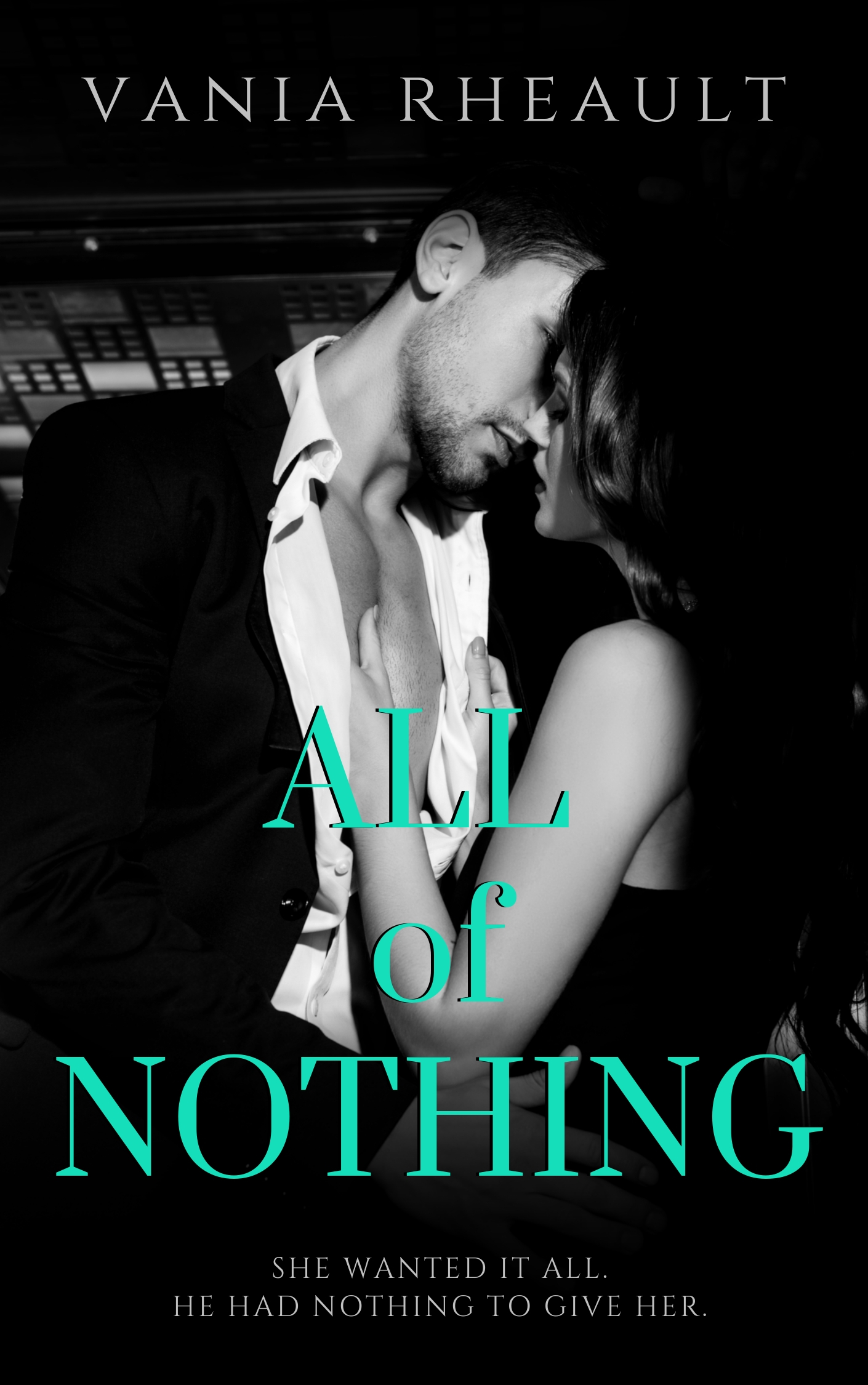
All of Nothing ebook coverI can share this little bit with you . . . All of Nothing, before I started Bryan’s 5-day ad challenge was at 81,xxx (dont remember the exact number) in the Amazon Kindle Store. Since promoting it with ads since September 20th, it’s at 16,399. I know rank doesn’t mean much, not really, but it is kinda cool to see people are reading it.

I think the new blurb and cover have made all the difference!


Until next time!


end of blog post graphic

Mid-August Check-in and What I’ve Been Doing

August 2019 blog photo

I usually have some writing-related blog post today, or commenting on something in the publishing or independent publishing space, but today I’ll just update you on what I’ve been doing, what I’m reading, and the things I’m going to try to do before the holidays hit. Christmas is in 128 days, if you can believe it!

It’s hard to believe summer is almost gone, and my daughter (maybe your kids already are) is going back to school in a couple weeks. I’ve done a bit of back to school shopping for her and ordered her pictures online.

I live in Minnesota, so I’m not looking forward to summer’s end. In fact, it’s always nice if the snow can hold off for as long as possible. Last year, we had a bad winter while I was recuperating from surgery and if we only get half the snow that we got last year, I’ll be happy. I’ll be figuring out my new writing rhythm when my daughter goes back to school, and that will take a little time to adjust to, but it shouldn’t be that bad. My work schedule won’t change, so that’s nice.


I changed All of Nothing‘s cover, blurb, and keywords. It’s still too soon to say if they made a difference.

But I am also doing the same for Wherever He Goes.

This is the old cover:

wherever he goes old cover jpg

Pretty and sweet. I have no qualms about it, but it also doesn’t give off the steamy contemporary vibe. So I changed it to this:

wherever he goes new cover jpg

They are both dressed, but I feel it ups the steam factor a bit. I also rewrote the blurb, but I won’t get into that, eventually I’ll get to the keywords. Looking for those will be interesting, as it’s a road trip romance, and that’s a sub-genre I know exists, but I haven’t seen the category for it on Amazon. I ordered a proof so I can see how it looks in print, but the ebook cover is already live. I’ve gotten great feedback on it, so for the skill I have and for the cost I paid ($7) I think it’s a nice change.

Of course, IngramSpark is giving me another pain in the ass about it. Since I published on Amazon, they are saying my ISBN is in use and not mine. I didn’t click on expanded distribution on KDP Print, so the ISBN should be (and is) available for other retailers. It’s just more going around in circles I’m going to have to do with them. Plus they keep insisting I didn’t build my cover within the correct guidelines, but I did. So, I think after I get this book straightened out with them, I won’t be using IS for expanded distribution anymore. Until they can become more indie-friendly, I’ll stick with Amazon.

I can honestly say that through all this wide business and going back and forth, I’ve learned what matters and what doesn’t.


Now that all my covers are how I want them to be for a while, I’ll be focusing on finished up my quartet. Officially called A Rocky Point Wedding (Books 1, 2, 3 and 4) I started book four a couple days ago, and I’m 10,000 words into it. At this point I’ll be trying to figure out covers and get a more concrete idea of what I want. I don’t know what I want yet, and when I don’t feel like writing I poke my eyes out look at stock photos. If I thought doing my trilogy was a pain, this quartet will be the death of me.

I am planning on a slow release . . . possibly one book a month, and while I’m releasing I’ll take a break write a new standalone that I’ve been planning for a while.

But first, book four. This book has its own plot to figure out, plus wrapping up wedding stuff. I do have a book 0 I could write if I ever feel like revisiting Rocky Point, or if I ever feel like starting a newsletter, I could write a prequel novella and offer that as a newsletter sign-up cookie. So there’s that potential, anyway.


I’m reading a really great book right now called Scratch: Writers, Money, and the Art of Making a Living Paperback by Manjula Martin. It has a lot of great essays in there by authors like Cheryl Strayed. They talk about giving work away for exposure and opportunity, living in poverty while trying to make it big, what they do with their advances if they do. I’m enjoying it a lot so far, and I recommend it if you’re interested in the money/business side of writing.

If you like books like that, I also recommend The Business of Being a Writer (Chicago Guides to Writing, Editing, and Publishing) by Jane Friedman. She breaks down the publishing industry and what you can do to make money off your writing. Being that it’s always being said writers can’t make a living wage anymore, I like to hear other people’s opinions.


August 2019 podcasts graphic blog post

I listen to a lot of podcasts, too, and here are some of my favorites:

Joanna Penn. The Creative Penn Podcast

We know she’s a powerhouse in the indie space, and she has a lot of great guest interviews. I don’t listen to every episode, and I have to pick and choose what tips I jot down for my own use since she’s a big believer in being wide, but overall I her podcasts are very useful.

***

The Sell More Books Show hosted by Jim Kukral and Bryan Cohen

These guys used to talk about the news, and they still do, but they have started to pad their podcast with “news” of indies making money. They don’t get into the hows or the whys (not in great detail, anyway), and if you’re not a member of the 20booksto50k group on FB (where they cull these stories) you’re not able to dig out the nitty-gritty details for yourself. I understand there are slow news days, and I listen for the big stories like Dean Koontz moving to Amazon from a Big Five. They pull stories from other places like the Hot Sheet by Jane Friedman and Porter Anderson, and if you don’t subscribe to that newsletter, this is one way to hear about the stories they report.

***

Stark Reflections by Mark Leslie Lefebvre

Mark’s a super nice guy, and I can’t wait to meet him at the Career Author Summit in Nashville in 2020. With so much history in the industry, his podcasts are very interesting to listen to, and he also has a bevy of author and publishing expert interviews. In the last podcast I just listened to, he interviewed Craig Martelle, who puts together the 20booksto50k conferences with Michael Anderle.  As with Joanna’s, I pick and choose what I want to listen to. Mark moved from Kobo to Draft2Digital, so it goes without saying he’s a big cheerleader of also being wide.

***

Self-Publishing Formula hosted by Mark Dawson and James Blatch

I listen to this one off and on. He has great interviews with authors and industry professionals, too, and again, I just pick and choose what I like to listen to by reading the details of the podcast episode. Sometimes they can get a little heavy with advertising their courses, but they all sell something, so listening to them tout their wares is going to be part of listening to a podcast.

***

Science Fiction & Fantasy Marketing Podcast hosted by Lindsay Buroker, Joseph Lallo and Jeffrey M. Poole and Laura Kirwan.

These guys took a break this summer, and so far Lindsay hasn’t said when they are coming back. She alluded to them changing their format, so I’m looking forward to them doing more episodes. Even if you don’t write Fantasy or Sci-fi, this is a great podcast to listen to. Keep an eye out for new episodes.

***

Print Run Podcast hosted by Erik Hane and Laura Zats

Erik and Laura are agents at a literary agency in Minneapolis, MN, and that was one of the primary reasons for listening. They talk about a lot of the literary stuff in the state, and if I had a more dependable car, I would go to some of them (the Twin Cities is a 4.5 hour drive away from where I live). But anyway, being that they are agents, they give an inside look at the traditional publishing industry. The last episode I listened to, though, they talked about Dean Koontz and his defection move from the traditional publishing marketing space to move to Amazon. They didn’t say very nice things about it, or about Amazon in general, and be aware, if you’re an indie making money off Amazon, that that is their stance. If you can look past their bias, their takes on books and publishing can be interesting at times, though they defend traditional publishing and an agent’s place in it (of course). Publishing is publishing though, and whether indie or trad, they all fit together, so keeping an ear to the ground isn’t a bad thing.


ku graphic

My books have been moved back to KU since the first of August. I boosted an announcement to that effect on from my FB author page and that grabbed a little attention. I used the audience I created for one of my ads for The Years Between Us that didn’t do anything because my ad copy was poor and the pictures I used weren’t the best. I ran two ads for three days a piece and I think I got one sale. But I blame the ad and the copy and the fact I was just messing around to get a feel for the platform. Anyway, so I already had an audience I’d created for that, so I used it and I think I got about 150 likes ad and a little engagement. It will take some time to let people know my books are in KU again, and I haven’t been very vigilant about it because I’ve been changing out covers.

Seeing page reads again is fun, I’ve made $21.00 since moving my books back to KU. You can look at my numbers in this blog post, but I can tell you that during my two months wide I made $66.00. So in a week with just a little boosted post on FB I’ve made 33% of what I made with wide while spending money on a Freebooksy ad. I feel better being in KU and I don’t check my numbers all the time like I was doing when I was wide. That is all KU reads though, not sales. I think I may need to research price more as maybe $4.99 is a bit too expensive for books by an unknown author. I said in a previous post that it was freeing being back on one platform and it is. I feel like I can focus more on the work instead of sales, and with a small backlist, writing is more important to me right now.


Well, that’s the personal update I’ve got for you. In my next blog post I’ll tell you about my experience with Booksprout, and if it’s useful or not.

Thanks for reading!

end of blog post graphic

Keywords for your books. What are they and how to find them.

I’m the first to admit that I don’t know anything about keywords. People may have differing opinions on where to find them, or how to use them, but one thing everyone can agree on is that they are pretty important. They help readers find your books, and in this age of publishing, our books need all the help they can get.

In this last mini-series post about how I revamped All of Nothing, I’m going to explore keywords and if I change anything in regards to my book’s keywords.  For a quick recap, if you want to read about how I changed the cover, you can click on the picture of the full wrap. (I still think it’s lovely!)

all of nothing second coverjpg

I also rewrote the blurb, and that garnered some interesting discussion. If you want to take a look at my process and how I did that, you can click here to read about editing the blurb.

So, keywords.

Like I said, I know next to nothing about keywords, so what are they, exactly?

According to an article on IngramSpark, keywords are “One or more words used to indicate the content of your book.” How do we choose the right ones?

The easiest, and cheapest (read, free) is searching on Amazon in the Kindle store. When you publish a book on Amazon, KDP gives you seven slots. That doesn’t mean that you are limited to seven words, and I only just learned this not long ago. (Evidence that you always need to keep learning because you don’t know what you don’t know, and something you learn in passing could change your whole life business.)

You can add more than one word to a space by separating words with semi colons or commas.

kdp keyword screen

It looks pretty intimidating, and if you look at this not even having one idea what to put there, the first thing you need to do is revisit the genre you’re writing in. There should be at least a few words that pop out at you, even if they’re generic and not that specific.

Anyway, so like I said in a previous post, I didn’t know bully romance was thing until recently, and it turned around the way I’m going to approach keywords and marketing for this book moving forward.

When you go to the Kindle Store (Dave Chesson of Publisher Rocket suggests using an incognito window for this) you can plug in some keywords and/or phrases to see what comes up.

2019-08-13 (1)

You can see in this incognito window that I started searching enemies to lovers. But you can also see what comes up that could work as keywords as well. Enemies to lovers romance kindle books would be a good phrase to use. Add free if your book is wide and permafree. There might be other phrases in there that could work depending on what your story is about. Enemies with benefits doesn’t quite fit my book, so I’ll leave that alone. What else did I search for?

2019-08-13 (2)

I searched for alpha next thinking I could go into alpha romance, or alpha dark romance. Alpha male romance works, maybe if, it isn’t associated with shifter romance. When you click on it, what kind books do you find? Will your book fit in? When I click on Alpha Male Romance, some books that pop up that All of Nothing would fit in with, and that’s the goal, so we can add that to the list.

What else can we search for?

2019-08-13 (3)

I can go with the tried and true contemporary romance, but that is a generic term and using up a space in your keywords may not yield results. We can always keep it in mind though, and plug up a space if we happen to have room at the end of the experiment. Not to write off the list entirely, if you happen to have a new release, it might be worth adding.

2019-08-13 (4)

I went a bit further and added “rom” for romance, and nothing extraordinary popped up, but contemporary romance with sex was an interesting return. That seems to be quite specific considering Sweet/Clean romance is having it’s 15 minutes and doing well; this would set my book apart. The word “contemporary” takes up a lot of space though, so I’m going to try to narrow it down before resorting to using it.

2019-08-13 (5)

But if you look for kindle books, adding that your book is in Kindle Unlimited may not be a bad idea.

2019-08-13 (6)

But let’s keep trying to narrow it down. Jax in All of Nothing is a millionaire. I toned it down, didn’t make him a billionaire. Sorry, Jax. But looks like that search may have had a good return, and I could add millionaire romance, even millionaire romance alpha male. Lots of characters though, so we need to watch our words.

What else can we look for?

2019-08-13 (7)

Dark romance gives us some return. Bully romance dark romance pops out at me. But there are some that would be good to keep in mind for other standalone books down the road like mafia, books where the heroine has been kidnapped.  Jeez, these sub-sub-genres are something, aren’t they? What could I choose from the list? The bully romance dark romance for sure.

At this point I think I’m running out of search terms.

2019-08-13

Bully pulls up a lot of terms that don’t particularly fit my book either, like high school, college, or reverse harem. All of Nothing isn’t paranormal, so I think besides the top search term, there’s nothing we can take away from this list.

But I have a few characters left. What else can we look for? I tried bully sex, but those kinds of books I don’t need my book associated with, so we’ll skip that. (Yeah, it’s important to click, and find out what kinds of books are coming up in the search, too. Especially in romance there’s quality, and then there’s quality. I’m not going to call anything trashy as we all have our things.)

We haven’t tried the basic steamy romance and this is what we get:

2019-08-13 (8)

Not much comes up here, accept bully romance again, and that can’t be discounted. There are a few more genres that we’ll need to avoid, but the list is interesting, and it gives us something to play with.

This is the cheap and easy way to figure out a limited amount of keywords.

What’s important to note too, is that based on keywords, Amazon may slot your book into categories that are not available to choose from when you publish. If you have a category that you would like your book listed under, you can always email them. But that’s why it’s important to know what genre you’re writing in, even the sub, or sub-sub genres to help narrow down your audience.

It’s obvious that I didn’t have any of the correct keywords for All of Nothing, since Amazon has left it in the most boring and generic category of romance books. That doesn’t do me or sales any favors.

all of nothing rank

Pretty freaking embarrassing, if you ask me, and now that the cover, blurb, and keywords are fixed, I’m hoping that I’ll see some traction in the coming months.

What did I come up with for keywords then?

keywords KDP filled

I think I filled up the slots pretty well, and if my book starts selling, they give Amazon a few sub-genre categories to put my book into, too. I do have to warn you that even if you change your keywords, and you hit Publish thinking that they’ve been accepted, they may not be. I hit Publish after filling those spaces out, but I won’t know they’ve been approved for a little while. I may be able to edit this blog post to let you know if they have been, so I’ll keep my eye on my email to see if they publish the book or they flag any of these words.

Edited to add: They did accept all my keywords without a problem! 


What’s the deal with programs that will pull keywords for you if finding free keywords is so easy?

When you start using programs like Publisher Rocket (this isn’t an affiliate link–I get nothing for telling you about this program. All I know is Dave Chesson is a really nice guy and works hard keeping this software working and up to date) you’re looking for a lot of keywords . . . for ads. When you start looking for keywords for Amazon Ads keep in mind they give you room for 1,000 words. You need a lot of help coming up with that many words, and using a software that can scrape your words together for you can save you a lot of time.

Keywords can make a huge difference if your ad converts to clicks, and using keywords is a way to help with that. I barely dipped my toes in the water when it came to Amazon Ads way back when I was trying, and I wasn’t using a program like Publisher Rocket to choose keywords, either. You’re leaving money on the table if you’re not utilizing all the space Amazon gives you.


So there you have it. How I revamped my book All of Nothing.

For some of you, this would include an edit as well, and if you want to learn more about relaunching your book, either read Relaunch Your Novel: Breathe Life Into Your Backlist (Write Faster, Write Smarter Book 6) by Chris Fox, or Ads for Authors Who Hate Math: Write Faster, Write Smarter.  In the latter book he goes a little into how much you should do to revamp your books (time vs. cost) so the ads work, because if anyone has heard Chris talk he is always very clear you need to start with a good product. (These aren’t affiliate links either, but I have read both of those books, and they are worth your time.)

Will all this work? Only time will tell. The cover is better, the blurb an improvement (I think, but that remains to be seen) and we’ll see if KDP approves my keywords and go from there. Could the book use an edit? In terms of getting better as a author, any past book an author writes won’t be as good as the newest release. That’s how it is, and I’m not going to stress about it. It’s a solid book in terms of plot and story. I’m sure it has its share of filler words, or a garbage word slipped by me here and there that I didn’t find and delete. But I did run it through a couple of betas who didn’t have anything bad to say, so I’ll take that as a small win and keep on going.

If you want more information about keywords, Dave Chesson has his own channel on YouTube, as well as Chris Fox. Taking time to listen to what these guys have to say is never a waste.

Thanks for reading!


If you want to know more about Dave and his thoughts on keywords and categories, you can listen to his interview with Joanna Penn here.

Here’s another article by the Book Designer on KDP keywords. Words Gone Wild: KDP Keywords Revisited


end of blog post graphic