Happy November!

Happy November


November is finally upon us, and that means we only have 61 days until the New Year!

I’ve been moving steadily along with my goals. In fact, I disappeared from social media for a bit while I released my new book, All of Nothing.

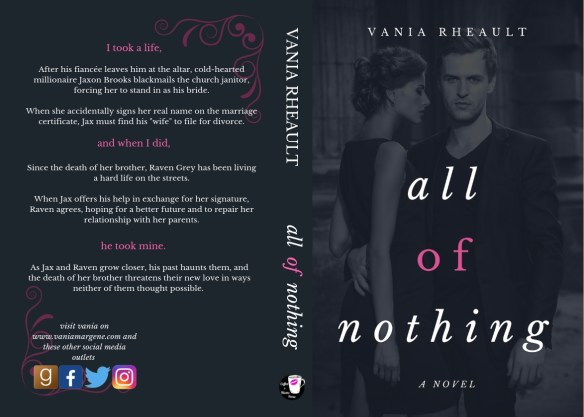
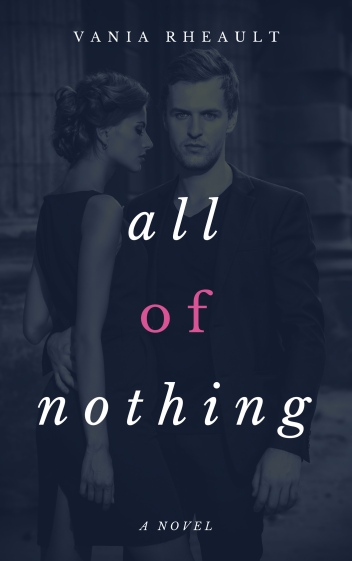
Here’s the lovely cover:

All of Nothing Paperback Cover

I did the entire cover in Canva, and I bought the photo on Canstockphoto for seven dollars. It’s not very fancy, but I do take pride in the fact that I did it myself. and it printed just as nicely as it looks online. It’s in KU, and I’m running a free promotion on it November 9th. It will be included in the Freebooksy newsletter that day. Because  I tried a Bargain Booksy on Wherever He Goes that didn’t do too well, I’m also putting that book for free that day to see if I can’t piggyback some downloads from All of Nothing‘s promotion.

As an early birthday present, a dear friend of mine gifted me a Mac and the formatting software Vellum. I was very excited in that since I had been doing all my own formatting, I could replace the interiors of all my books, and that’s what I’ve spent the last three days doing for Summer Secrets, my erotica novella series, and my Tower City Romance Trilogy. Because formatting is so easy with it, I put together a box set of my trilogy, so that is finally being offered on Amazon as well.

Nothing is ever easy though, and since I was doing the covers and insides, I went ahead and moved my trilogy over from CS to KDP Print. I hadn’t done that yet, so I wanted to get it all out of the way.

The second book in my series got lost in the conversion, and it took KDP four days to find it. It was over the weekend, and they did eventually restore it, so I was grateful for that. 🙂 If you haven’t moved your books over yet, I recommend you do so. My book was still for sale on Amazon, so it didn’t completely disappear, but it’s better to get all that taken care of sooner rather than later.

But I did redo the covers for Summer Secrets, being that I’m a bit better at covers now, and I redid the box set I created, inside and out. Though someone pointed out a typo on the first line of the first paragraph, {rolling eyes hard here} I’m still very happy with they turned out:


It wasn’t a big change, but I think it’s a step in the right direction, nonetheless. I didn’t get so different with my trilogy, so I won’t post them here. But I did redo them in Canva, which gives them a higher quality than when I used to do my covers in Word. A very warm shoutout to my friend Aila Stephens who told me about Canva so long ago. She’s just starting up a blog series about covers herself, so make sure you follow her blog for indie tips and publishing tips!

Anyway, so next up for me is my May/December romance that I’m already 8,000 words into. I’m so excited for this book! I’ve been thinking about a May/December romance for a long time now, and I was delighted when a plot popped into my head. All of Nothing is over 80,000 words long, and I don’t think Matthew and Zia (my book doesn’t have a title yet) will end up being quite so long. But I’m still excited to be mulling subplots and backstory as I get into writing.


This kind of sums up the whole story, and as a contemporary romance author, you know I’ll always dish up a nice happily ever after. I just make my characters go through hell to get there first.

In other news, I’m going to submit All of Nothing into the RITAs, a contest sponsored by the Romance Writers of America. The contest is open to both trad-pubbed and indie-pubbed authors, so in reality, I know I don’t stand a chance. But if my book could move on to a second round, or if the judges have some good feedback for me, I’d consider it a success. At any rate, it something I’m going to try, and I think All of Nothing is a solid book. It’s getting good feedback already, and my betas didn’t have anything bad to say about it. So, wish me luck!

Along with entering the contest, you also have to judge books in the first round, so I’ll be needing to dig out my Kindle and settle in for some serious reading coming up. Which suits, because I’m going to have carpal and cubital tunnel surgery on my left hand/elbow in the middle of January. I’m going to try to get Matthew and Zia at least written by then, so while I recover I can do some small edits. It will do me good to rest my hands while I help in the judging of the first round. I’m very much enjoying being part of the romance writing community!

What else is going on? NaNoWriMo starts tomorrow! I won’t play, I haven’t played for a couple years now, but I may meet up with my group. Sometimes it’s nice to see people in person, talk shop. Catch up. I used to work with a couple of the members, so it will be fun to see them, too. But after the colder weather hits (I’m in MN) it gets harder to get out of the house. Even for pie and coffee at the local coffee shop.

I guess that’s all I have to report! I hope you all are doing well, and tell me what your end of the year goals are! Remember, you have 61 days! Do your best!

2019 is right around the corner! What do you have left to do in 2018_


Drop me a comment, and have a great weekend!


My not so happy review of the Happy Book Reviews service

I listen to the Sell More Books Show podcast. I love listening to the self-publishing indie news they cover every week. Some weeks are lighter than others, but it’s a great way to keep up with all the changes in the industry.

The show is hosted by Bryan Cohen and Jim Kukral who are also hosting the 2nd annual Sell More Books Show summit I’m delighted to attend next year in Chicago.

Bryan does a lot for the indie community. He’s published several non-fiction books including How to Write a Sizzling Synopsis,  a book I recommend regularly, as I use it every time I need to write a blurb. He also runs a business based off that book, in case you ever feel like you just can’t write another synopsis.

Jim Kukral also does a lot for the author community: creator of Book Marketing Club, he also founded and curates the Happy Book Reviews website.

I went into the brief history of these gentlemen because I trust them and I admire all the hard work they do for us indies.

But sometimes things don’t work as well as they could, or should, and Jim’s Happy Book Reviews is one of those things.

feedback-2800867_1280

As indies, we all want those five-star reviews for our books. 

At $25.00, he promises to put your book in front of thousands of readers who want to download your book for free and leave a review. This sounds great! At this low fee, my book was available for twenty-five downloads on a first come, first serve basis, to people who would read it and review it with no obligations for me to do the same.

It really could be a boon for us authors who need reviews for that social proof we’ve written a good book.

But my enthusiasm waned the moment I received the email that contained the newsletter that featured my book.

In the whole month my book was available for download, my book was downloaded twice. Yep. Twice. Out of twenty-five copies available.

There were, in my opinion a few reasons for this:

When you sign up, you’re encouraged to sign up for the newsletter. This seems like a no-brainer because you want to see what your book looks like in the newsletter. But as my friend Aila points out–if all the recipients of the newsletter are other indie
authors . . . writers don’t read. If they do, they are helping out their friends by beta-reading or acting as a critique partner. Jim promises he’ll put your book in front of readers, but I suspect that what he’s doing is putting your (and my) book in front of a whole lot of indie authors. Who don’t read other indies, at least, not for pleasure.

The first email went into my Promotions tab and not my inbox. You can fix this, of course, but how many emails do people miss because their email marks the newsletters as ads? (Which, technically, they are.)

Happy Book Reviews will take anything. I’d never speak negatively about someone else’s work, but I have to admit, I was appalled at the company my book kept. I try to be professional in all ways. And while my books may look indie (there’s really no help for that no matter how good you are) some of the books featured in that newsletter looked downright cruddy. Jim will accept any book when what he should be doing is vetting them. While the information isn’t available to me, I wonder how many readers unsubscribe when they see the lack of quality in these books.

quality control

Someone needs to be in charge of quality control


**I can understand why he doesn’t do this. Jim and Bryan frequently talk about gatekeeping and I realize Jim doesn’t want to be in the position of determining what is “good.” But I don’t think this is any different than any other promo site where they only allow in quality books. They have a readership to keep happy, and offering them schlock is not the way to go about it. Someone, somewhere, will always play God, and with the products and services Jim, as a book coach, offers, he’s in a better position than some to determine what is “good.”

Only the blurb is available. I know it would take up more space or cost more to send it out the newsletter, but it would help if a potential reader could read the first couple pages of the book they’re considering downloading. It would have helped me avoid the boring contemporary romance I downloaded 1) because I wanted to try the service myself and 2) the cover and blurb looked okay.

The newsletter isn’t broken up into genres. My book sat next to children’s books, paranormal romance, thrillers, and history books. If he could separate the books into genres that could help readers find the books they like. I had a positive Freebooksy experience because of this.


The time for my book has run out, and there’s no time limit for those two people who have downloaded my book to leave a review. So I’m not even sure if those two people who downloaded my book will come through. But $25.00 for two reviews is too much.

I know why Jim will never do any of my suggestions–it’s too much work. He’s a savvy businessman, and I’m sure these suggestions have been brought up to him by other people in the past.

But it must work for some authors, or he’d close down the website. Everyone who uses his service can’t have the experience I did, or his inbox would be full of complaints.

Maybe I’m a black sheep, but somehow, I don’t think so. Wherever He Goes is a solid book. Anyone who reads the first page knows I don’t head hop, I don’t have any typos, and my inciting event happens on the first page of the book. Not Chapter 4.

Unfortunately, I do not feel like my book fit in with the others featured, and unless he makes changes, I won’t be using his service again.

You may have a different experience, and at $25.00, it’s a cheap risk. But I’m also aware that $25.00 could buy you two paperback books, five Starbucks coffees, or could reimburse a beta-reader for her time. If you’re poor, $25.00 can go a long way, so you’ll have to decide if it’s worth the risk.

My blog is about my experiences with the services offered to indies, and my adventures in publishing my books. I want to help. This was my experience, and unfortunately, it could have been better.

I’ll still listen to the podcast (and I encourage you, too) and I’m looking forward to the meeting Jim at the summit.

But the Happy Book Reviews feature isn’t for me, and I wish you luck if you decide to ever give it a go.

October through the end of the year goals.Whatever.

Everyone is doing October/end of year goals, so I thought I would, too.

I don’t have many.

  1. Finish All of Nothing. This includes finishing the editing, writing the blurb, doing the full cover for the paperback, formatting for both Kindle and paperback. Sending it out for betas and hopefully publish by Halloween. It was my target goal from the beginning, with Thanksgiving being the ultimate maximum amount of time I wanted to take. It looks like Halloween is more than doable–at least for the Kindle. Using KDP Print for the paperback takes longer, just for the simple fact ordering and waiting for a proof is a lot more time consuming than it used to be through CreateSpace. If you’re launching a paperback by a certain date, be prepared and give yourself plenty of time for the KDP Print hassle.

    Here’s the working cover I made in Canva. We’ll see if I stick with it.

    allofnothing
    Made with a Canva template and a photo I purchased from CanstockPhoto, it’s a simple cover which I hope conveys the darkness of the story.  No chick lit for this author. 😛

  2. I have 2,000 words into my next book (a beautiful May/December romance that will be a counter to the dark romance I’m editing now) already written, and a few pages longhand that I need to type up. I would at least like to get the handwritten stuff typed up this month. I would love to get the whole thing written and published by March of next year. I have a bookselling summit I’m attending in May, and the more in my backlist, the better.
  3. I did a Happy Book Reviews feature for Wherever He Goes that I am not terribly impressed with. I’ll do a full blog post on how it turned out. But for now, it’s safe to say, don’t waste your money. If it sounds too good to be true, it probably is.
  4. In my other blog post about marketing, I said I was writing a non-fiction book on self-editing. I’m going to be working hard on that in the coming months, and hopefully have that ready to go by no later than this summer. My fiction comes first, and I want my new book to be ready by the summit, but depending on my health (see number 5) I’d like to get the editing how-to book done by June.
  5. I have carpal tunnel and I’ll be going for a nerve test this Thursday. My carpal tunnel runs from my elbows into my neck, shoulder blades, and back. Meaning, I’m in a ton of pain a lot of the time. I let it go too long. I know. And I’m paying for it now. But the truth is, I’ll more than likely be having surgery and the recovery time for both arms will set me back. I know voice-to-text can be a life-saver to some, and I may still be able to blog that way for a bit, but chances are, I won’t be able to work on my fiction for a while. The break is much needed, but not that wanted. We’ll see how it goes.
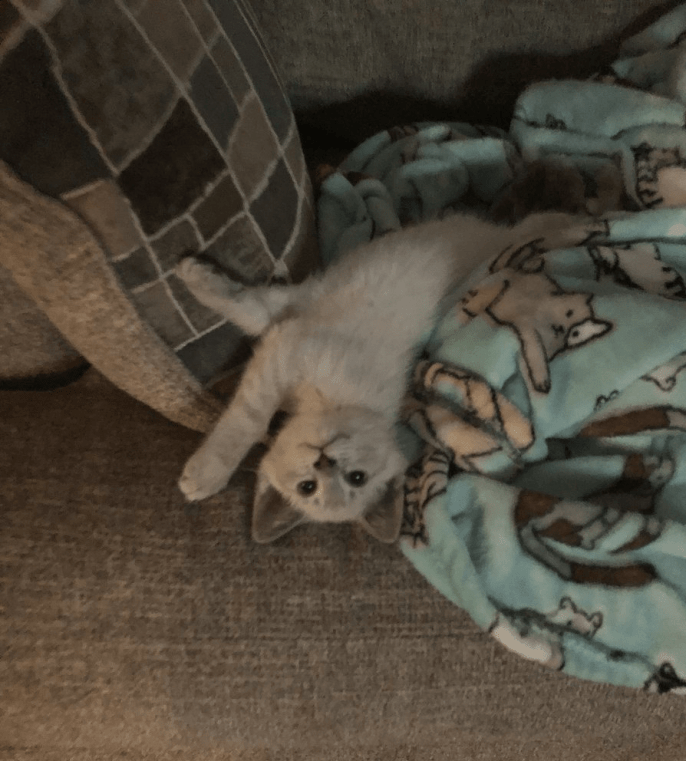
  6. These are lofty goals when I have a new kitty to play with! My husband moved out, and the kids and I replaced him with a new kitten named Blaze. It wasn’t really like that (LOL) but it’s hard to resist playing with her, or snuggling with her when she’s sleeping. She’ll be a good recovery pal. Here’s a pic:

    blaze
    It’s tough not to share pictures of her all the time, so if you follow me over on Instagram, you can see a lot more of her. 🙂

Those are pretty lofty goals for the next few months, but I’m hoping it’s nothing I can’t get accomplished. All of Nothing is the big item on my plate right now, along with keeping this blog going with indie news and writing tips.

Also, since I will be working on my editing book, if there is anything you struggle with when it comes to self-editing LET ME KNOW! I would love love love to include anything and everything indie writers struggle with.

Happy Fall, Everyone!

book and fall leaves

Marketing Our Books. It Sucks, so Let’s Talk About It!

Marketing is different from branding. Marketing is the act of pushing your book/brand/product out into the world.

social-media-1795578_1920


I think this is one reason indies get branding and marketing confused. We’re often told to start marketing ourselves before we have a solidified brand, or before we’ve published a book.

Build your brand (remember, that’s who you are as an author) by blogging, tweeting and posting about what interests you. You need to build your brand, then market that brand.

What can you do to prepare to market your brand?

Start a Blog 

But who are you blogging for: readers or writers? They usually are not the same audience. Joanna Penn is a good example of this. Joanna Penn writes non-fiction to help indie writers like herself. Her blog contains information for indies. But she also writes paranormal thrillers under JF Penn, and JF Penn writes a blog for her readers about her books. Right out of the gate I’m going to guess you don’t want to run two blogs. So choose who you are writing for. Then when you have a following you can use your blog to market your book by posting snippets of your WIP, short stories, etc. Hopefully, you’ll be cultivating your blog followers to want to buy your book when it comes out.


Tweet

Tweeting is easy, but again if you dive into Writer Twitter you won’t sell many books. Writer Twitter is helpful to your author brand if you can cultivate a helpful image. Offer to beta read. Retweet helpful articles about the publishing industry. Follow agents and retweet their query tips.  Network with others. Make writer friends.

This is also helpful if you ever decide you want to dive into non-fiction to help your fellow authors. I’m currently outlining a self-editing book. If there is something you know about the publishing process and you can help others by writing a book about it (you just might want to someday!) Writer Twitter is the perfect audience for a helpful resource book! 

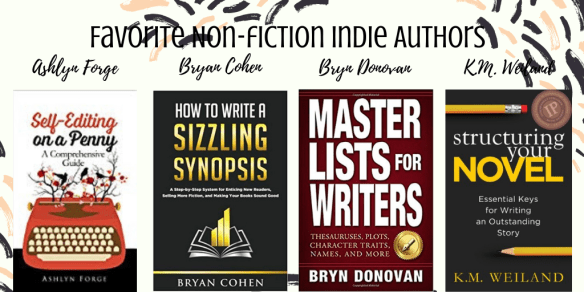
My favorite indie nonfiction books:

favorite non-fiction indie authors


Join Goodreads as a reader.

Read books in your genre and join discussion groups. This can take years, but the idea is that your friends on the platform will organically want to read your book after your release. If you read the study released by Goodreads about Celeste Ng’s book Little Fires Everywhere, it explains why and how her book was so successful. One of the points was that she was an active member of Goodreads for 10 years before she published. Her network helped make her book popular.


Join Instagram

This platform is the only one where I get personal. I’ve posted selfies. Pictures of my cats. Things that are interesting to me. And as my numbers grow I do post graphics with a line or two of my WIP, to build buzz for my books. I don’t do it often, maybe one photo ten will be something about my book.

Instagram is a good example of both branding and marketing. My photos allow my followers to get to know me. Chocolate. Cats. Books I’m reading. Pretty scenery. I’m a  chocolate-eating, coffee-drinking writer who loves to read. I hope my Instagram reflects that.

For a good list of writer hashtags you should use when posting a picture, look here.


Start a Facebook group for readers who love your genre.

Because not only do you write [insert genre here] you’re supposed to be reading it, too. Announce a book every couple months then talk about it. Authors these days, if you tell them their book is featured, may even participate in a question-and-answer discussion. If you read indie, that’s a win-win. A win for the indie author because it gives them exposure. A win for you because you’re networking and supporting a fellow author.

These types of marketing ideas are connected to your brand. You are a nice, friendly writer who writes yummy books your readers will want to devour, right?  Right. 

There are other marketing strategies that don’t take so much time and/or participation:

Pay for promos. Pay for Amazon ads. Pay for Facebook ads.

After you publish, use your promo free days if you are in Select to build buzz, or if you’re wide, price a prequel novella to a series permafree.

If you’re just starting out, you may not have a series, or a novella for that matter, which brings me to a good point: it’s easy to get caught up in all of this brand-building and not have time to write a word. Remember, you don’t need a brand if you don’t have something to sell. Get your book written. Blog about it – post snippets. But in the end, the following/readership you’re building will eventually want to see some progress. Namely a book they can buy to support you.

So where do I fall in all this? I don’t market much. I play on Twitter, but as I said, Twitter doesn’t sell books. I buy a promo here and there. But to be clear, even though I have my trilogy and a standalone, and another standalone I hope to release next month, I still consider myself a baby in this industry. I do very little with my author page on Facebook. I’ve heard popular indies post two or more times a day

I’m liking Instagram more. I bought the Canva app, and I’m playing with that so I can post cuter graphics on the platform. I haven’t quite gotten the hang of it yet, as it’s a little different from the desktop software.

The strategies I’m living by right now?

Blog. I like to help; it’s part of my brand.

Write. There’s no better marketing for your book then releasing another.

I’m going to keep studying. I read a ton of self-publishing books. Marketing books. Editing books. That may not do too much for me marketing-wise currently, but they’ll help me write better books and market them more effectively in the long run. And anything I learned I pass on to you. 🙂 

Throwing money at, and trying to market, one or two books won’t do you any good. Fiction is a long-term game, and your focus should be on building your backlist.

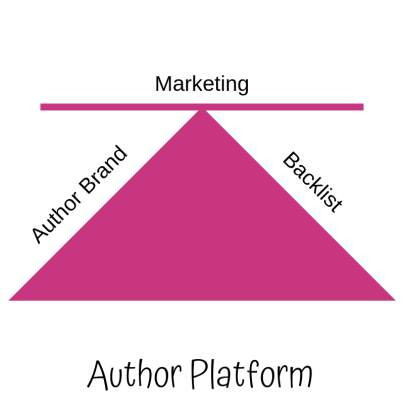
But by the same token, Rome wasn’t built in a day, and there’s no harm in building your brand. Eventually, you’ll want your brand and your backlist to meet where your marketing efforts will do something rather than waste money. I’ve been publishing for two years and still at the foot of the mountain. I won’t reach the top for a long time.  But that means I won’t stop trying.

author platform


It will take a while, but you can do it!

Tell me what you think.


Happy writing and book selling!

Author Interview with Daniel Mattia, Author of Debut Novella In Crows’ Claws

author interview daniel mattia


Dan and I chit-chat on Twitter a little bit, and I asked if I could interview him, and he was amazing and said yes! Dan published his debut novella, In Crows’ Claws on July 7th of 2018. Writing and publishing is hard work, and everyone has a different experience when it comes to publishing. Listen in to see how he fared in the big bad world of indie-publishing!


crowHow long have you been writing? How long did it take you to write
In Crows’ Claws?

I’ve written almost all of my life. I’m 28 now, and remember writing short stories and tales all throughout my childhood. I continued writing throughout my early teens, then stopped for a few years until about 2010.

During that time, I was at the tail-end of a severe bout of depression and found solace in my writing. It was during this time that I started crafting the fantasy setting of Fyrndell, the world in which In Crows’ Claws is based. I wrote quite a few short stories during this time, all of which have helped me to further flesh out and build upon this setting, but In Crows’ Claws is the first I’ve published.

I wrote the first version of In Crows’ Claws in 2010 or 2011 as a weekly web serial. It was a way to ensure I wrote on a consistent basis and the accountability of publishing a new chapter on a set schedule held me to that promise (for the most part).

The original serialized version took about three or four months to write and was fairly raw. That’s not to say it wasn’t written well-enough for publication, but it certainly didn’t meet my current standards.

crowWhat surprised you most about the writing process of this novella?

The emotions I had to invoke in order to represent the mindset of certain characters. I generally write without much personal emotion; I think there needs to be a sort of cold logic when you’re going through the actual craft of writing. I’m not writing how I feel, but how my characters feel, so it’s important for me, as the author, to be as emotionless as possible.

But as I wrote – particularly in the cases of Ahri and Nextiarc, two of the main characters in In Crows’ Claws – I discovered myself feeling how they felt in some of their specific chapters. Ahri, especially, starts off as an excited and optimistic young man who quickly finds out that the world of Fyrndell is a cold, dark place and the “truths” he felt he knew aren’t entirely accurate. The second-to-last chapter, especially, makes me tear up every time I read it – and, again, I’m not someone who has that happen often.

The chapters written from Nextiarc’s point-of-view surprised me even more. They were actually the most difficult to write because, in order to write from the POV of a literal monster who not only enjoys killing but venerates the very act, I had to adopt a rather dark and violent mindset. I had to write his POV chapters in short bursts because writing in his mindset for long actually frightened me.

crowWhy did you decide to publish?

To prove to myself that I could. I have so many stories I want to tell, particularly in the world of Fyrndell, but I’m someone who often has a self-defeatist attitude and can easily give up before I even try. Forcing myself to publish a finished work (along with the encouragement of some close friends) was what I needed to do first before I could even think of repeating the process.

crowWhat was the biggest obstacle when publishing your novella? What did you do to overcome that obstacle?

Formatting. My workflow, and the software used, is atypical from the workflow used by many other Kindle authors. I had to adapt and figure something out for myself despite there not being much information available for how to do it. Luckily, I discovered the Kindle Create software, which helped me to format and publish the Kindle version without much pain – after, of course, I had converted the book to the proper file format.

crowWhat do you mean by workflow?

In this context, workflow basically means process. Like you were witness to on Twitter during my editing/formatting phase, I didn’t write the novella in Word so exporting from the software I used (yWriter, something akin to Scrivener) meant much of the formatting advice I found online needed some tweaking to apply to my situation. On top of that, I completed the last editing phase in Kindle Create instead of the actual doc, which was a stupid idea, since it meant the final editing copy was locked to a proprietary format and couldn’t be easily converted to a friendlier format, ie. a .doc or .pdf.

crowWith publishing your debut novella, what is one piece of advice you would pass on to a writer who is thinking about publishing for the first time?

Don’t underestimate the value of editing. No matter how much or how little editing your work needs, it will always be better after you’ve put some solid editing time into it. I’d recommend hiring an editor to do it for you, but there’s no excuse for not editing yourself if you can’t afford an editor. Do at least three editing passes in which you read every word and every line.

crowWhat is next for you writing- and publishing-wise?

In Crows’ Claws is sort of the spiritual precursor to what readers can expect from the next Tales of Fyrndell book. My next work will be a novel in the same setting that takes place in a distant kingdom under siege from an invading neighbor, eventually introducing readers to a cold war that’s heating up quickly.

crowWhat will you do differently the next time around?

I’ve already identified where in my workflow I need to make changes to make the formatting process easier and more simple. The next release will come out in both Kindle and paperback format and will (fingers crossed!) not be such a pain to format and release into the world!

Thanks for the interview, Dan! It sounds like we have some spectacular stuff to look forward to!


yWriter is a free writing program similar to Scrivener. If you have been thinking about Scrivner, but don’t want to pay, try yWriter. You can find it here.

Editing and formatting your books for publication can be kind of tricky. Dan isn’t the first author to . . . put it informally . . . mess up. Even after the books I’ve published, I still find shortcuts and different ways of doing things every time.

Formatting your Word file for conversion to download to KDP (Kindle) doesn’t take that long at all. I blogged the instructions here.

If you’re interested in reading In Crows’ Claws you can find it here.


In Crows’ Claws Description

“This desert is the domain of death.”in crows claws cover for blog

The world of Fyrndell is a place of ancient powers, myriad races, and untold secrets. It is a world where gods may or may not exist, where heroes are few and far between, and where technology progresses at a haphazard pace.

IN CROWS’ CLAWS tells the story of two opposing armies as they race across the continent to a recently-unearthed desert tomb believed to be the final resting place of the goddess Konia. Read the letters sent home from Ahri Vestesson, crowkeeper for the Order of the Orthodox Knights of Fyrndell’s Crusade Army, as he wrestles with matters of faith and purpose while longing to return home to his betrothed. The letters of Marshal Taves Khest, veteran general of the Imperial Expedition Force of the Mhedorian Empire, will demonstrate his duty and ability while he leads his army to and through the desert to claim the glory of capturing the Tomb of Konia in the name of his empress.

But the desert holds many secrets and even more dangers still, for both armies will encounter a brutish and violent warband sworn to the service of Tavradyss, God-Prince of Conflict, and led by the even more vicious Nextiarc.

IN CROWS’ CLAWS is a tale full of action, ambiguous divinity, and heartbreak as three armies converge on the Tomb of Konia, desperate to lay claim to its hidden secrets…


Check Dan on these awesome platforms and thanks for reading!

crowAmazon   crow  Goodreads  crow  Twitter  crow  Facebook crow

Whine a Little . . . Over There

There’s been lots of whining on Twitter lately. More specifically, authors whining about not seeing books sales. Even more specifically, authors not seeing their books sell.

Maybe it’s because we’re in the dog days of summer, or people aren’t looking forward to school starting, or the crap we’re all going to have to deal with when THE HOLIDAYS start in full-swing October first.Dog Days of Summer

But whatever it is, it needs to stop. Because YOU, and nobody else but you, can make sales happen for your book.

Mostly, this is on Twitter. I can say it louder for the people in the back. TWITTER ISN’T FOR SELLING BOOKS. If you’re a member of Writer Twitter, you’re a member of WRITER Twitter. There’s a reason why it’s called that. Because we’re writers. Join READER Twitter. It’s gotta be there somewhere. Maybe #amreading is wedged between #IhateTrump and #turtlesareweird. If you’re convinced Twitter is the only way to sell books, or it’s the only way you want to try, break into the #amreading crowd. Or try. I’ll leave a light on for ya.

But if you want to take stab at moving books instead of whining about it, explore these ideas. First though, you need to take a look at your book.

  • Cover needs to be decent. Needs to depict the genre, needs to fit in, but stand out (in a good way.) Join an FB cover group and get some critiques. Taking a second look at your cover and if it’s not up to snuff, fix it. It’s killing your sales before they start.
    Books to consider:

    Cover Design and YOU!: Dos, Don’ts, and Choices
    Why Does My Book Not Sell? 20 Simple Fixes (Writer’s Craft)

  • Make your blurb awesome! This is easier said than done. Bryan Cohen is great at this. He teaches webinars and he runs a business doing this. And he makes very good money doing it. But he shares his knowledge, so don’t just moan you don’t know how to do it. Read about it. You’re a writer. Research. Here’s his book. He breaks it down so you can do it, too. With his guidance, I write my blurbs in half an hour. Here’s a Book Description Critique with Bryan Cohen hosted by Reedsy. Watch it.
  • Make sure you have a decent title. No one told me this before I published, and now my very first book has a stupid title I can’t change because I don’t want to waste the money I spent on my ISBN number. If you don’t have any reviews and didn’t purchase your ISBN number, you can change your title. Changing your title and ISBN number will lose you reviews so if you only have one from your best friend Angie, she’ll probably post it again if you republish with a better title.
    Grab some ideas from Dave Chesson; he’s got some good ones.
  • Make sure your “look insides” (first sample pages) are decent. This can make or break you if all the other parts about your book are spot on. If you don’t have a solid POV, if you have typos, if your formatting is messed up, the best cover in the world won’t save you. Try to get your hook within the first few pages of your book so it’s included in the look inside. Turn that browser into a buyer!

Now that we covered that and your book is up to par, you’ll need to ask yourself what you’re doing to help your book sell. Tweeting every day isn’t going to help. So what can you do to spike sales?

  • Are you spending any money?  You have to spend money to make money. I’m not kidding. Lots of people are like, “I don’t have any money to put toward selling my book.” Then you’re not going to sell your books. No business has ever opened that didn’t need seed money. Investors. Start-up money. You buy stock for your shelves, you fork over for rental space. You pay for wages for your employees before you’ve even sold one thing. Your book isn’t any different. Nobody ever went into business for themselves because they needed money yesterday. Starting a business is a lifelong endeavor. What can you put your money toward?

    *Pay for promos. I spent 80 dollars to give away 4,000 copies of Don’t Run Away in a free book promo for FreeBooksy. It got me some reviews, and lots of KU reads for the whole trilogy. I made my money back and then some.

    *Pay for giveaways. Goodreads did away with their free giveaways but because you have to pay, the market for giveaways isn’t so saturated. People have debated as to whether or not it’s a good thing, but I think it is. I haven’t tried them yet, but in the spirit of trying one new thing with each new release, I’ll be trying it when I publish All of Nothing this fall. Read about them here.

    *Pay for ads on Amazon. This isn’t as scary as it sounds. I’ve been blogging about my experience. It won’t break the bank to give it a try, but it’s important to do it correctly. Brian Meeks has a wonderful book about it. Amazon changed the platform a bit, so his instructions are already outdated even though his book is only a year old. But his advice is still as good as gold, and just as valuable.

    *Pay for ads on Facebook. These are trickier than Amazon ads. At least, I’ve read that they are. I haven’t tried Facebook ads, and if you don’t have the money to spare, I would suggest going with Amazon ads first. I’ve spent under five dollars experimenting with Amazon Ads. But if you want to try FB ads, again, do it correctly. Michael Cooper has a super great book about it. It’s important to try ads correctly, otherwise you’ll blow through money, claim they don’t work, and you may write off a great way to let people know about your books!

    *Pay for a blog tour. I used to hear a lot about these two years ago when I joined Twitter, but not so much anymore. You don’t have to pay someone to set up a blog tour, but if you pay a legit person they’ll know the best blogs to submit your book to. I’ve never tried one of these. They’re time-consuming. Either you have to fill out an interview sheet or compose a guest post for that blog. If you’re doing a full tour, that could consist of anywhere between 5 to 20 or even more blog sites. That’s a lot of guest blogging and interviews when maybe you should be writing your next book.

    *Reviews. If you do this in a legitimate fashion, this can be a coup for you. I have not tried it because the service I wanted to try distributes the books to readers through BookFunnel and that goes against KDP Select’s terms of service. I pulled Wherever He Goes out of Select to try this review service, and it comes out September 3rd. It wasn’t doing well in KU anyway, so I didn’t see the harm in trying. I’m going to try Happy Book Reviews. I’ve heard good things and so-so things about results. But if you have a good book with a good blurb and good cover, and the plot/genre isn’t too weird, you may get good results. Give it a shot.

  • Are you writing more books? The best marketing you can do is release new books. Lots of debate on quality versus quantity, but if you just can’t scrape up the cash to put toward your book’s promo, at least writing and releasing is free. *As free as you can get without spending money on cover, editing, etc. I’ve heard you drop off the Amazon algorithms after three months, so you want to release something every three months. Try releasing tie-in novellas. Or just dig in your heels and write the next book. I see lots of people trying to build careers on one book, and that only works if you write a non-fiction book and your career is already based on that book. Readers expect more from you. Keep them happy.
  • Offer to guest blog on other people’s websites in your genre. Ask “up.” Someone in your genre who has more followers than you. Someone whose website gets a bit more traction than yours. This is where your tweeting should come in handy–you’ve made connections, don’t be afraid to ask. Most people would love to host a guest blogger. It frees up their schedule for the week. But make sure your book is up to snuff or they’ll turn you down. And be prepared to giveaway a book. That seems counterproductive to sales, but lots of bloggers want to reward their readers for showing up.
  • Think local. Ask your town’s newspaper’s lifestyle section to do an article on you. If you have local small magazines, ask them to do a profile. Ask your indie bookstore if you can do a signing, or if they’ll sell your book. Heck, maybe get together with a couple of indies in your area and ask Barnes and Noble if they’re willing to do an Indie Night. Asking is hard. We’re introverts at heart, but even if the answer is no, at least you can say you tried.
  • Take a hard look at your book. Besides the cover, the editing, the blurb, the title, ask yourself, is this something someone would want to read? Especially if this is your first book. Indies like to experiment when they’re starting out. We’re finding our niche; we’re finding our passion. Experimenting with your hamster detective series is cool, but can you get sales? Maybe not. So take a hard look at your book before you throw money at it. It may not do any good. And that’s the sad truth. If you can be honest with yourself and say yes, my book has readers, all I have to do is fine them, then good luck!

Whining about lack of sales isn’t going to help you sell books. After a while it becomes annoying, and you end up tarnishing your reputation. If your first book isn’t working, then move on. Write something else. Write something better. We get better at our craft with every book we write.

book marketing challengeRachel Thompson says we don’t get traction with our careers until we have at least 6-10 books under our belts. As the self-publishing industry gets more competitive, that number may get higher. If you’d like to read her awesome book about marketing, you can look for it here.

Book sales are subjective. What works for you may not work for someone else.

The best advice I can give you is write well, and publish often. Stay consistent. Build your brand on a genre you love to write.

Sales take time.

Have patience, and good luck!


buy image for blog


More AMS (Amazon ads) Updates

I like doing these to help anyone who is afraid of dipping their toes into Amazon marketing. Ads are a scary concept, be it Amazon or Facebook. Anything that will take your money without a firm promise of ROI (return on investment) needs to be taken up with a bit of caution. Too cautious though, and you aren’t going to get the results you want.

You need to spend money to make money, and all that.

So here’s where I am so far with ads.

ams-blog-post.jpg

ams blog post 2

If you know anything about what you’re looking at, it’s pretty easy to see my bids are not high enough to be getting very many impressions or clicks. But that’s the name of the game, you know, to find the sweet spot where you’re getting impressions and clicks, but you’re also not paying a ton of money for clicks if no one is buying. You’re hoping if people are clicking on your ad, that you’ll make sales. But your clicks also have to be in line with how much you’re making from your books.

My books are priced at 2.99. If I spend 30 cents a click, and I get 2.09 from each sale, that’s a take-home royalty of 1.79 a book. (There’s a real way to determine ROI and I’m not doing that here, and I know I’m not, so you don’t have to tell me, for you die-hard ROI fans out there.)

Anyway, so anyone worried that you’re going to do some ads and Amazon is going to take all your money and you’re going to broke with no sales, well, you can go slow. You need to have patience. And some impressions are better than none, but these aren’t what I was hoping for, and these aren’t what Brian Meeks, in his book, says you can accomplish either.

I have 20 ads running simultaneously, and I’ve only spent $2.30.

I am still getting KU reads, and I’ll never know if those come from the impressions from my ads.

I’ll add a few more ads with a higher click and see if we can’t get something going. I’ll have another book coming out in November, hopefully, so I’ll have another book to promote.

The more, the better, right?

Anyway, so that’s where I’m at. If you’re interested in Brian’s book, click on the pic. He’s got a ton of great info there. amazon ads

Until next time, happy selling!


Blog book promo for the end of blog posts

My BargainBooksy Ad from last month. How did it do?

Well, apparently, not very well since I forgot to post the update. This time, this ad was a paid ad (meaning, my book wasn’t free), and I set the price of Wherever He Goes to .99. I thought, a dollar for a book, that’s pretty good, right? Heck, I spent three months working on it, I figured a dollar was a good price.

The problem is, with doing these ads, you just WON’T KNOW why your book doesn’t sell. It could be the cover, it could be your copy. It could just be that no one wants to pay. You never know.

So, in total, I sold 40 books on the day the newsletter came out and a couple days afterward. That is nothing compared to the 4,000 books I gave away during my Freebooksy ad I did back in February. You can read about that here.

june sales for bargainbooksy ad

As far as KU page reads are concerned, you can see that the newsletter created a bit of a spike, but nothing to write home about. And this is only for Wherever He Goes. My trilogy is still getting a few page reads, but I wanted to see what my ad would do for Wherever He Goes, and unfortunately, for 80 dollars, not much.

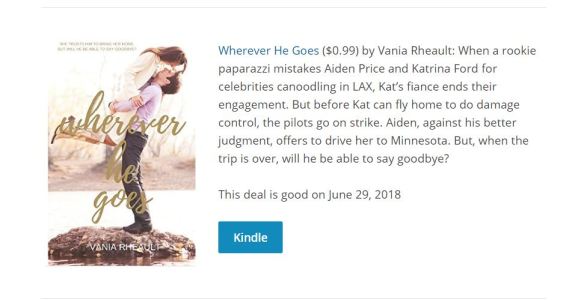
Here is what my ad looked like in the newsletter:

bargain booksy ad

Would I do this again? I haven’t made back what I spent on the ad, so it will be a while before I try something like that again.

What I need to focus on is getting reviews, but for using any legit reviewing services, I need to pull my book out of Select because the one review service I contacted distributes the books through Bookfunnel. Amazon considers Bookfunnel as a distribution platform and will yank you out of Select if they catch you using it.

For my next book, I’m going to place my book with a review service first, before putting into Select and see what happens. Hopefully, if I get some decent reviews that way, readers will give all my books a chance.

And I think if I ever do another promo with Written Word Media (Freebooksy/Bargainbooksy) I’ll do the free one, since I kind of feel like I got more bang for my buck. At least, it sounds better to say I gave away 4,000 copies than say I sold 40. It would be great if any of that had turned into reviews, but so far nothing significant on that end, either.

But, that is my experience with Bargainbooksy, and if you’ve tried them, and have gotten better results, let me know!

Thanks for reading!

Blog book promo for the end of blog posts


Formatting Your Book for Publication

If you don’t want to format yourself, yet you don’t want to have to pay too much, then there aren’t many things you can do.

Let’s start with Kindle, since more than likely 100% of you will publish on Amazon through KDP. What are your options if you don’t want to format your file for Kindle?

1. Actually, just format it, FFS. It’s easy. I pulled this out of an old blog post I did last year. Some of the info isn’t correct anymore, but you can still take a look at it here.

First, make a copy of your manuscript (just in case something goes wrong). This one shouldn’t have any headers or footers. If you have page numbers and/or a don’t steal my shit copyright header for your beta readers, remove them all.

The biggest thing with conversion is Tabs will screw everything up. If you use the Tab key to make your indents for your paragraphs, you’re going to have one messed up converted file. Here are the steps to take out your Tabs:

Removing Tabs

Press the Paragraph Show/Hide button in the Paragraph section of the Home tab so you can see the formatting marks.
Highlight (select) your whole document.
At the far right of the Home tab in the Editing section, click on the Replace button.
Click the More/Special button in the bottom left corner of the box.
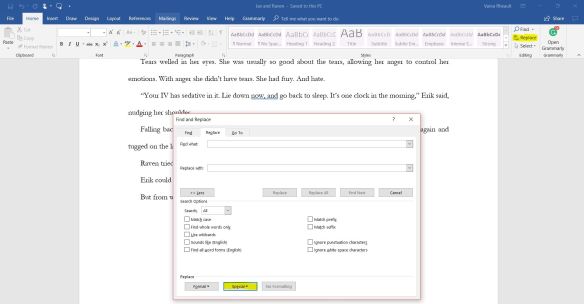
taking out tabs

Select the Tab Character.

2018-06-25_LI

Leave the Replace with field empty and click Replace All. This removes all the Tabs.

This should have taken them out. If, for some reason, you used the Spacebar to make a tab, go into Replace, and in the Find field hit the number of times you used the Spacebar to make the Tab (maybe five? Six?), leave the Replace line empty and hopefully Word will find all the Spacebar spaces you used for tabs and pull them out.

But now you have a whole book that doesn’t have any indentations. I’ve seen books like this. Don’t do it. You want your book to look as professional as possible so put them back in:

Putting your Tabs Back In

Again, select or highlight your whole document.
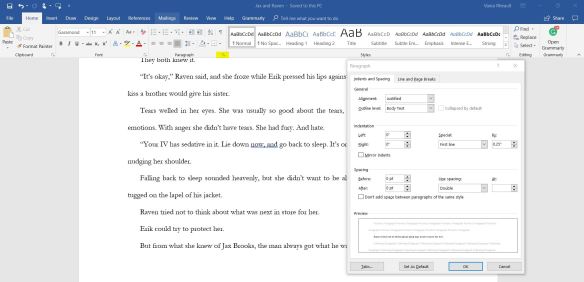
Click the little arrow at the bottom right of the Paragraph menu in the Home tab. Or right-click your mouse and select Paragraph from the menu.
tabs

In the Indentation section of the box change Special to First Line and enter 0.25. This is how long your Tab is going to be. If you want it shorter you can do 0.23 or something. I use 0.25.

Click OK.

This puts all the Tabs back into your document, but you don’t want the first paragraph of your Chapters and/or scenes to be indented (traditionally published books usually do not have the first paragraph of Chapters or scenes indented) so you will have to go through your whole novel(la), look for the Chapter starts and scene breaks and take the tab out of the first paragraph. When you find those, put your cursor in front of the first letter of the first word, right click your mouse, select Paragraph and in the Indentation section, change By to 0. This will manually take the one Tab out.

When you start a new document, it’s easier to go into Paragraph, change First Line to 0.25 from the beginning, then you don’t have to go through all this after you’re done. It will take a little getting used to, to not have to hit the Tab button at the beginning of every new paragraph, but it will be worth it in the long run.

KDP Formatting Instructions at a Glance:

Take out all the Tabs, put them back in with the instructions above. Don’t indent Chapter starts. First paragraphs after scene breaks have started to become optional.

If there is any in your document, remove headers, footers, and page numbers.

Use a common font. I use Georgia for my Kindle, Garamond for the paperback.

Drop caps are not e-reader friendly, at least not in my experience, and I don’t have enough patience to make them work. Remove those as they will probably mess up your paragraph during conversion.

Set your margins to .5 all around–top, bottom, left, right.

Set your line spacing to 1.5. Not single, not double.

Select your all your text and set to Full Justified.

Don’t use a bunch of Hard Enters to make new pages. Please insert page breaks to create new pages. Lots of hard enters will not convert well. Insert page breaks after you Title Page, Copyright page, dedication page, acknowledgments, Table of Contents, and after each Chapter End. Use them to separate your back matter from your author page.

insert page break

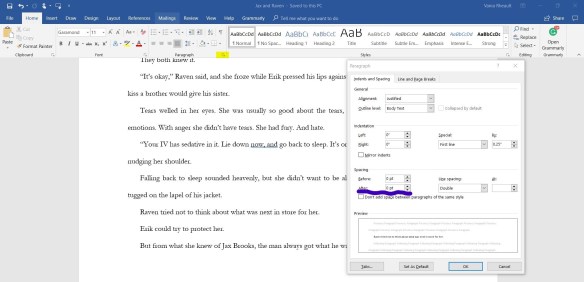
If you have spaces between your paragraphs, you’ll need to select your file again, go into Paragraph and change After in Spacing to 0 pt. This takes out all the unnecessary spacing between paragraphs. (You will want to do this so you are not accused of making your book longer for the extra KU page reads.)
tabs_LI

To add your website or author page in the back, say, on your author page, use https:// with the rest of the website in the link.

What you’ve done is made your file as simple as possible. If you have graphics or formulas or are publishing a nonfiction book with all the bells and whistles, then I would suggest buying a book or researching how to format a complicated document. These instructions are for a fiction book with the general front matter and back matter only.


If you follow those guidelines for your Word document, you should be good to go conversion-wise. But if you don’t even want to do that then you can:

2. Use Kindle Create to format your file. The file won’t belong to you–you format it and then publish right to KDP. So you wouldn’t be able to use the file for other platforms like Apple Books or Kobo. But if you all want to do is publish to Amazon, download the App, upload your book into it and just fiddle with it until you like what you see. Watch the videos to learn how. I played around with it, and I formatted a 50,000-word book in an hour. Look here for details.

3. Use a template. The templates are already set so all you do is copy and paste your document into it. Most of these cost money, so look at these at your own discretion. You can start here: Beautiful Templates for Book Design Success

4. Draft2Digital says they’ll let you format your book on their site for free, and let you use that file wherever you want. You can even use them just to make a file for Kindle. You don’t have to go wide to use their free services. I haven’t ever tried them simply because once you get down how to format a file for Kindle, you don’t need anyone’s help. But if you just want to upload your document into D2D after you create an account, give it a try.

5. Buy a Mac and buy Vellum. I  hear Vellum is the best at formatting e-books and paperbacks. I don’t have a Mac but I plan to treat myself this summer so I can buy Vellum (although, if it’s as good as I hear, I’ll be tempted to redo all my books). If you don’t have a Mac or Vellum, and can’t afford either one, maybe you can ask someone who does to format for you. Maybe offer to trade for the favor. You never know.

6. I also hear Scrivener has formatting capabilities. I don’t use it–I write in Word. But if you use Scrivener, you can try it and see how you like it.

You’ll note that I don’t have the instructions on how to put a Table of Contents in your file. I think they are stupid for fiction. But that’s just my opinion and not a very popular one at that. If you want to know how to make a clickable ToC for your e-reader file, read the instructions I had to hunt down when I made a box-set for Summer Secrets a couple months ago.


Formatting your paperback is a bit harder.

1. I will always recommend using an interior template from CreateSpace or KDP Print. These templates are the same, you just download them from different websites. Choose the formatted template which has all the headers, footers, and end sections in place so your page numbers and your author name and book’s title are on the pages they are supposed to be on. If you take a look at any trad-pubbed book, you’ll see there aren’t headers on Chapter start pages, or headers or footers on front matter or back matter. The interior templates takes care of most of this for you. The only issue I had with them at all is that I usually have more chapters than the template allows, so I have to monkey with the end section breaks myself to create more chapters. Most of the time I just copy and paste the section end break of a previous chapter into the end of the next chapter and that works for me. If you have any working knowledge of Word at all, you should be able to do this without any hassles. The front matter and back matter is all laid out for you as well, so just copy and paste page by page, or chapter by chapter. The template is “chunked” meaning you can’t copy and paste your whole document into the template at one time. The chapters and front and back matter are broken up by section end breaks.

Have patience. If you do 98% of the work, I’m willing to bet you have a friend who would look it over and do the other 2% if you just can’t get it right.

2. If you don’t want to go this route, I’m afraid there isn’t much you can do for free besides get a very good working knowledge of Word and start from scratch to do it all yourself. I took a college class in Word, and I still couldn’t do my formatting without at least getting a good start with the template. But you can always look for a paid template. Most websites that sell e-reader templates sell interiors for paperbacks too.

3. Pay for a formatter. Reedsy has freelance interior design recommendations. They maybe be a bit expensive–that’s my guess just by looking at their qualifications. Fiverr pulled up a lot of options for interior formatting as well, and what I saw were reasonably priced. Of course, always ask for referrals, or other books they’ve done to get an idea of how their books look.


As always, I recommend learning how to do this yourself. If you’re going to be a prolific writer, or even if you’re just going to write a book or two a year, you might as well learn how to do it. Hey, you might even get good at it and you can trade services with other people. That’s what the writing community is all about: I’ll scratch your back if you scratch mine. If you can format for someone, maybe they’ll beta read for you, etc.

I know there’s stuff I’m forgetting. I mentioned Draft2Digital but not Smashwords. If you want to publish through Smashwords, they have their own system, and I’ve read their how-to-format-your-file book so that it will convert through their “meatgrinder” process.  I’ve never published through them, so if you’re interested, here is their STYLEGUIDE that will help you format your file to upload to Smashwords. It’s long, but Mark Coker makes it funny, so there is that.

When I first started formatting, it was a lot of trial and error. Make use of the interior viewer on KDP, KDP Print, and CreateSpace. Trust me when I say what you see is what you’ll get. If you get caught in an upload, fix, upload, fix, upload, fix, upload, fix pattern and you feel like you’re going to go mad, take a step back, go outside and come back later with a clear head. There is nothing worse than trying to format when you are quivering with rage.

Try practicing on short stories or novella. It’s a lot easier to work with few words then build up to a complete MS when you kind of know what’s going on.

I hope this blog post helps you format!

Good luck!

Up next is cover design!

Thanks for reading.

Editing: What it is, why you need it, and where you can find help.

Editing your novel can vary in cost. You can pay nothing if you can find someone to swap with, or it can cost you in the thousands if you pay for all the things.

The types of editing vary, too, and it’s wise to figure out what you need before you look for an editor.

Types of editing:

  1. Proofreading. This is a sweep looking for typos. This is probably the cheapest and easiest editing job you can hire out. Even a beta reader could probably do this for you if you give out copies of your final draft.
  2. Line Edits. This goes a lot deeper. These editors look for punctuation, grammar, incorrect word usage, syntax, repetition, subject/verb agreement. If you don’t have a strong grasp of grammar, punctuation, or have a weak vocabulary and you often use an incorrect word, then a line edit is probably mandatory so you don’t look like an ass.
  3. Developmental Editing. Developmental editors read your whole book and make notes on plot holes and incomplete character arcs. They point out pacing, passages that don’t bring anything to the story or doesn’t make sense. If you wrote yourself into a corner and pulled a deus ex machina to get yourself out, they will call you on it. Developmental editors are good for writers who haven’t finished a book and need help getting there, or for a writer who is trying to stretch their writing wings and may need guidance with a more complicated plot. Book coaches or book doulas aren’t exactly the same thing, so research who/what/when/where before you hire anyone.

As an indie, you must decide what kind of editor you need. Because also, as an indie, you aren’t going to be able to afford all three–though some of the big indies who “have made it” pay for a combination of the three because they can.

What’s an indie to do if you can’t/doesn’t want to shell out the cash?

Let’s start with the developmental edit.
Look for places online that offer a critique partner match-up. On Twitter that’s #CPmatch. If you’re part of the #amwriting crowd you could probably just tweet you’re looking for a critique partner for your new novel in your genre. But the problem with this kind of service is the expectation of reciprocation. If you’re not willing to help someone else, don’t bother to look online for someone to help you for free. Expect to pay out. You could pay a beta reader for some feedback, but I doubt they would go as deep as a developmental editor. Betas maybe will give you a sense of what’s working and what’s not–but developmental editors can tell you how to fix your issues. There are also a gazillion writing groups on Facebook. Join a couple and ask if anyone would be willing to work with you. But this kind of situation is the same as Twitter–be prepared to reciprocate in some way in the future. And be prepared to wait. Not everyone will get back to you when you’d like them to.

Join a local writing group. People will be more than happy to tell you what’s wrong with your work. If you can develop a thick skin, and admit you need help, a writing group critique can be valuable. But people have the propensity to be cruel whether online or in person. So if you really need help of this nature, it may behoove you to pay out. At least the editor will be professional about it and actually tell you what you need to know to fix your book. I’ve spoken with people who have gotten such cruel feedback from writing groups they’ve stopped writing. I don’t want this for you.

Can you be your own developmental editor? You may need to write a few books before you can get your plot points, backstory building, saggy middles, and character arcs under control. Read up on plotting and building character arcs. If you want to avoid tons of rewriting and backing yourself into a corner only a deus ex machina could get you out of, then maybe learn to plot out your books. Pantsing is okay if you know where you want to go, but just letting your mind and your characters run wild may open you up to forgotten side characters, saggy middles where no one is doing anything, and plot holes that may take forever to fix.

One of the best ways you can learn developmental editing is to chart out a book you read that you enjoyed. Write out chapter by chapter what happened (mini-cliffhangers), paying special attention to the first part of the book (what drew you in), the middle (what kept the plot moving), the couple chapters toward the end (what made you keep reading to the last page). This is why it’s important to read in your genre. Eventually, you’ll learn the rhythm and feel of your genre and it will show in what you write.

Line editing.
If you really need this kind of help, there aren’t many places you can find this type of editing for free. I line edit, and it’s time-consuming. Pointing out grammar, punctuation, syntax, incorrect word usage, and repetition takes a lot of concentration. I do “look and finds” a lot. “You used ‘walked’ 300 times. ‘Looked’ 250. ‘Saw’ 600.” Whoever line edits for you needs to be able to point out comma splices, tell you when a word like saturated is better than lingered when it comes to a scent (or did you mean smell?). Did you mean waive instead of wave? Waist instead of waste? Or if it’s April second in your novel and you wrote there was a full moon, but at that time of year, the moon would actually have been a quarter? This attention to detail that a line editor gives you cannot be produced for free. It’s just too much work. Did you mean Kleenex or tissue? Because if you’re referring to the brand, you better capitalize it. Same with Jell-O or gelatin. Does your main male character watch sports center or SportsCenter? Because only one of them is correct, and I bet you can see which one it is.

The good news is you can teach yourself a lot. Read grammar books. Self-editing books. You need to train yourself to pay attention to detail. Look up words if you don’t know their exact meanings. The best way to learn is to read a lot of fiction and non-fiction books. In time, you’ll get better. But until then, are you talking about karat, or carat when you describe your FMC’s engagement ring? If you don’t understand, or you don’t know what you don’t know, you’re going to have to find, and probably pay, someone to tell you.

Proofreading.
Proofreading is the cheapest form of editing. Don’t give your book to someone to proofread unless you are done.

Done.

Because when you go through your book fixing things, sometimes you can fix in a mistake right along with it. Your proofreader will be your last set of eyes. So don’t decide to rewrite chapter one after your proofreader has done her job. That wastes everyone’s time.

There are some software programs that can help–but a software program can’t take the place of human eyes, so take their suggestions with a (huge) grain of salt.

Grammarly. Grammarly is okay. But they are comma crazy. They are also hyphen crazy. I stopped running my manuscripts through it. You’re better off knowing your stuff and reading your MS line by line with a ruler. In my experience, no help is better than their help. **I do have Grammarly installed on my laptop, and though I don’t use it for my books anymore, it’s great for blog posts, tweets, and FB posts. I appreciate their assistance when I’m blogging, as for non-fiction, it’s an accurate help.

Hemingway Editor. The Hemingway app gives you a free sample online. Just copy and past part of your manuscript into the program and see if it would be beneficial to you. It’s only $20.00. I have it, but I don’t use it.

ProWriting Aid. I’ve used the free sample online, and it’s similar to Hemingway. They have different levels of pay (per time usage), so see what’s best for you if you like the online sample. My friend Aila loves it and wrote a great blog post about it (but please note the giveaway is over), and she’s an affiliate with them. If you decide to buy the program, I would appreciate it if you bought it from her affiliate link.

If you have trouble with syntax, natural-sounding dialogue or if you have slow areas that affect your pacing, you may want to try having your computer read to you. I love doing this–especially if you ever think you’ll turn your books into audio. The voice isn’t perfect, but it’s better than nothing. Some people read their manuscripts aloud, but because you know what you want it to say, you may miss things.

Here is a list of my favorite editing books:

Writing Deep POV

Self-Editing On a Penny: A Comprehensive Guide

Self-Editing for Fiction Writers, Second Edition: How to Edit Yourself Into Print

VOICE: The Secret Power of Great Writing

Fix Your Damn Book!: A Self-Editing Guide for Authors: How to Painlessly Self-Edit Your Novels & Stories

Mastering Showing and Telling in Your Fiction (Busy Writer’s Guides) (Volume 4)

Structuring Your Novel: Essential Keys for Writing an Outstanding Story

Creating Character Arcs: The Masterful Author’s Guide to Uniting Story Structure (Helping Writers Become Authors) (Volume 7)

That should be enough to get you going. I’ve read all of these and they are my favorites.

If you hire an editor, always be sure to send a sample first. Some editors charge you for this, but if you hire them, they’ll put that fee toward your book. Give them as clean a draft as possible, because if your sample is a mess, they will quote you higher. They’ll think your book will take them a lot of time.

Writers are not always good editors, and editors don’t always make good writers. Writing and editing are different skill sets and they are not inclusive of each other.

Know what you’re getting into before forking out the cash.

Where to look for an editor:

Join Alli, the Alliance for Independent Authors. They have a great list of resources for indies. They take a stance on putting out supremely professional work though, so don’t be surprised if their resources are expensive. Unfortunately, you can’t gain access to their resources without becoming a member.

Joanna Penn makes her resources available for free. But be careful. Someone’s best fit won’t necessarily be yours.

Reedsy. Create an account and you will have their resources at your disposal. Vetted for skill and professionalism, you’ll get what you pay for. They have a lot of different freelancers for the different kinds of editing you’d be interested in.

reedsy editors

Start looking for an editor quite some time before you wish to publish. You’ll be put at the end of the queue. While you wait for them to edit your book, you can work on something else, get your author platform going, go on vacation, what have you. But you won’t be working on your timetable anymore.

I hope this blog post and resources have helped you a bit.

Next up is formatting! Fun times!

Thanks for reading!