Thursday Author Update

It’s been a while since I posted on a Thursday, mostly because I haven’t had that much to say and I’ve been using Mondays as my author update days. Since last Monday was about book reviews, I thought I would use today to update you on my trilogy and what I’m doing now.

My proofs for my trilogy came back, and they are lovely. There are always going to be some tweaks, and I think I’m going to sharpen the background pictures a little more so that they look like they are actually standing in front of a city. The blur above the models’ right shoulders is actually the two buildings on the lower left of the back covers. Otherwise, I think the background colors are rich and beautiful and I have no doubt (not like my duet) that these will hit the market okay. I’ve gotten a few compliments on the large ampersand on the backs, as well, and I’m going to make the changes upload the final files this week/weekend.

I was going back and forth on what to write next as I have three standalones I could write pretty quickly, but in the end, I decided to finish a series I started last year. I have two books done, and I need four more. The first book I started as a standalone but as I got into it, it made sense for me to turn it into a series. It’s about a woman who’s father decides she should settle down and marry. He devises a list of acceptable potential husbands and tells his business partner that if he wants 50% of the company he needs to see to it that his daughter marries one of the men on the list. His business partner is in love with his daughter, of course, and the twist is, he’s not on the list, forcing him to choose between love with and 50% of a company he worked all his life for. It was a fun book to write, but while I was writing it, I realized that the men on the list could use their own stories, and that’s how the whole project was born.

It’s a little unsettling to realize that committing to this series will tie up the next year of writing for me. I can write relatively quickly for all the stuff I have going on in my life… I can comfortably write 80k words in 6-8 weeks, but then there’s editing and formatting, and covers to consider. Not to mention these books aren’t plotted out yet, and figuring out the story and how it layers into the plot is the real work of writing something this big. I waited until the last minute to put together my trilogy covers, unease and uncertainty chasing me until I practically hit publish, and I’d like a more solid plan this time around. (I already played with covers and titles for the first book–before I realized it would launch a series, or be a part of a new billionaire brand under my pen name. It’s so funny how covers and concepts evolve.) (And headless models. FFS, no! LOL) These are covers attached to a blog post on titling your book, and you can read it here.

I’m also thinking of how to brand this series, and what it’s going to be called. I like the idea of calling the series The List, and titling every book after the male character featured in it. It’s a departure from what I normally do, and I won’t have to think of titles for six books (which, let’s be honest, is a real headache).

So yeah, the last time I had a whole year accounted for, we were in lockdown and things felt pretty isolated anyway. I’m going to have to settle in, fall in love with these characters, and keep in touch with online writing friends so I don’t get lonely. But these books will be a nice addition to my backlist and I’ll be proud of them once their done.

In the mean time, I’ll make the adjustments to my trilogy, but I don’t know if I want to put the first one on BookSprout only because book one with reviews and books two and three with none would look odd (and give the impression of no read-through). Maybe I’ll look into paying for the next package so I can put all three books up at the same time, and I’ve always offered free copies to Twitter and my newsletter hoping for more reviews (that never come). So I have side things to keep me busy.


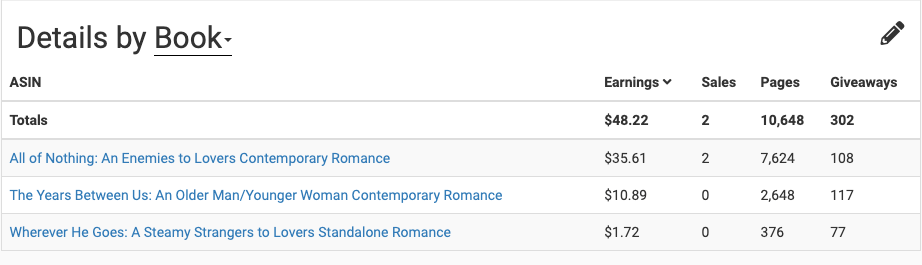
I haven’t given any love to my 3rd person books in a long time, so I scheduled a Freebooksy for my small town holiday wedding series for November 17-19th. I’m not even sure why I bothered since I’m not nurturing that pen name anymore (meaning, I’m not writing new books for it) but if the promo does as well as it did before (and the first book has six times the reviews it had before) then there’s no money lost. If you want to read how it went the first time, you can find it here. For the hell of it, since I’m not moving books anyway, I also scheduled the same free days for All of Nothing, The Years Between Us, and Wherever He Goes. The best thing about free days is if a reader has a Kindle Unlimited subscription, they’ll usually borrow it in KU before downloading it for free (and a borrow has the same weight as a paid sale). That’s why free promos, if you’re in KU, pay for themselves. It will be an exciting weekend, to say the least. I’m going to go ahead and still do another promo in January when my trilogy releases and focus on my 1st person books. But it makes sense to promote holiday books around the holidays, so no harm done. And for some reason, my paperbacks are extremely cheap right now, so maybe this promo will move some paperbacks, too. Who knows.

That’s about all I have going on. Going on a road trip with my sister on Monday to Bismarck, ND to eat at their Cracker Barrel and roam their mall. I’m hoping by that Tuesday I’ll be done with trilogy stuff and can really hop into this series. I was doing a little planning on it last night, old school, with pen and paper, but I didn’t get too far into it with my trilogy proofs mocking me from my desk. I never really could work on more than one thing at a time, but at least I don’t have “Look! Squirrel!” syndrome and finish the projects I start.

For Monday’s blog I’ll talk about my hardcovers, and I have a chat coming up with Jeanne Roland and A. K. Ritchie about publishing a second book, marketing, and all the fun stuff in between.

Thanks for reading today, and have a great weekend!

Monday Musings and an Author Update

I don’t even know where to start this week. As much as I absolutely love doing every little bit for each and every book, these projects feel like they take so much work to get from my head and onto Amazon’s website.

Last week I finished listening to the last book of my trilogy. I can pick up 99.9% of typos that way, and it makes for a pretty clean final draft. I need to keep a list of words I like to lean on while I’m writing, as I discovered the word “just” in my 3rd book and went back to the first and second and realized I abused it there too. All told among three books, I think I edited out about 300. Some make sense, some can be deleted without changing the sentence, and sometimes a better word can replace it. It wasn’t a huge task, but it added an extra hour to my editing on Wednesday. But, I know the books are better for it, so I can’t be too annoyed. Last Friday I was able to format them all, much to my delight, and over the weekend I was able to create my covers.

I’m not going with the covers I talked about in my last blog post. Honesty is always the best policy (with yourself and others, but especially with yourself), and they were just not a good fit for the billionaire subgenre. It sucks, because they’re pretty and I like them, but they aren’t going to do the job. What really tripped me up was looking for models who are older. I have one MC who is 45 and another who is almost 50, and while I’m not one to care if a model matches the description inside, I can’t portray young men on the covers when there are not young men inside. There are very few older men models on DepositPhotos (that are model quality, anyway, sorry guys), and I happened to use the most popular one on Rescue Me. Luckily, my next couple of books are finished cover-wise, so I won’t be scrolling through stock sites again anytime soon. DepositPhotos seems to be kind of picked over at this point, and that will be a dilemma I’ll need to face down the road. Covers are super agonizing, but I’m confident what I finally came up with will work. They are better suited, and they still have their heads. I suppose if that’s the only thing I can’t bend on, I’m not doing too bad.


The problem I have, and will always have, is doing what you want vs. what you need to do to sell books. Someone in one of my author groups on FB posted the other day and said the best thing about being an indie is not having to appeal to everybody. I read that, and I was so confused. Of course you don’t want to appeal to everybody, but you want to appeal to SOMEBODY, preferably readers in your genre, and you can’t do that if your cover looks like Photoshop and DepositPhoto had a baby. I write this blog and publish my books in the POV of a single mom with a full-time job that doesn’t pay very much. I get it. You’re broke, I’m broke, and paying out for everything is just not possible. I have never ever said you shouldn’t publish if you can’t afford things like covers and editing. But I was listening to a Clubhouse room not long ago and one of the speakers said this: You’re gonna pay. You’re gonna pay at the beginning when you hire out for an editor and cover designer and a formatter if you don’t know a kind soul who has Vellum, and if you don’t pay there, you’re going to pay with readers after you publish your book. You won’t have any. If you don’t have money to spend, you have to spend the time, and I can’t tell you how many premade sites I perused, how many current top 100 romance lists I looked at trying to gauge what I needed compared to the skills I have that yes, I have tried to cultivate over the course of the six years I’ve been publishing (but I am not an expert by any means).

It’s easy to believe what you hear. I got a lot of good feedback from those sunset/city covers I posted on Twitter, but Twitter writers are not my readers and while I appreciate the compliments, it doesn’t matter if they liked them or not. What matters is my readers like them enough to buy my book and read it. That’s all I want. That’s the cover’s only job. It isn’t about pride or what you like, and you can look for validation on Twitter until the cows come home, but when you buy a promo and you don’t get your money back, that’s the real validation. Giving away 4,000 copies of my first in series during a Freebooksy and paying for that fee the first day with KU page reads is a high that will never, ever get old.

Anyway, that seems to be a theme lately, the them vs us. Indie vs. readers, indie vs. traditional publishing. There is no versus if you do things the way things are meant to be done. There is no line, and I keep trying to figure out who is drawing it. If you’re standing on one side of that line, why? You have to identify with being an indie so hard that you’re willing to sacrifice readers for the control? Who is really in control when a reader sees your book, doesn’t like the cover, doesn’t like the title, doesn’t like your blurb and decides not to buy? Your control is an illusion. The control is with the reader who bought a different book.


Ooof, I’m done with this part of it. There are too many negative emotions online lately. Fear and doubt and desperation. No sales and launches that sink. 965 words of you can do better and your books and readers will thank you.

Besides the painful realization my covers needed a third revamp (no one saw my first try besides my friend Sami-Jo) the rest of what I have going on should be okay. Vellum is a dream and I formatted pretty quickly. I need some blurb feedback that I’ll seek out while I get some other stuff done, and all in all, I’m excited to publish these. I still have to adjust my author name on the hardcover of Rescue Me and approve it, but otherwise there’s nothing I need to backtrack for unless I want to load it into IngramSpark too, but I’m not in a hurry to publish my paperback there. If you’re looking for a freebie upload, you can sign up for their blog. They’ll let you know promo codes every so often, and this one popped in my email yesterday:

6 Figure Authors Podcast did a catch up episode that I was excited to see. I thought it was old until Lindsay (on Twitter) said it was new, and you can listen to it here.

That’s about all I have for this week. I’ve decided to work on completing my series that I started over COVID lockdown. I have two done, four more to go, and last night I was trying to think of why I stalled out when I realized it was because I decided I needed a reader magnet for a newsletter that was a long time in coming, and I stopped my series to write a novella. Three full-length books later I realized I can’t write a novella and ended up using the shortest of the three (76k words) as a freebie for my newsletter. Now it’s time to get back into finishing that series because I want to tackle a long series about one couple like Sylvia Day’s Crossfire series. I’m not sure on plot, though Lindsay Buroker was talking about psychics some time ago, and that idea has been rattling around in my brain for a long time now trying to tie a psychic in with the billionaire subgenre. And at some point I have three standalones I want to write, so I’m glad I won’t be running out of material for the next little while. But as always, I’m getting ahead of myself, and maybe I’ll take a couple days off after my trilogy is uploaded to Amazon and my proofs ordered. I’m on track to publish in January providing nothing strange happens. I won’t be participating in NaNo this year, though I rarely do. This November I’ll be rereading the first two books and making plans for the other four. I don’t have their plots laid out yet, and I can only blame the planster life for that. I know who the characters are for the most part, but not much more.

Next week I can write about my second try with Booksrpout and catch you up on how my Amazon ads are doing and how my Facebook Ad is doing with my reader magnet and my newsletter sign up.

Have a good week!

Your book’s back cover.

It might be surprising to hear that your book’s back cover doesn’t have to be ugly. In fact, you can put as much time into the back that you do the front, and while your back cover may not get the love your front cover does, when a reader flips your paperback over, it’s a nice surprise to reveal a pretty back cover that they could potentially love just as much as the front.

Some authors may not put forth much effort or thought into their back cover as they are focused on ebook sales, and that’s something I think about too, since my books are in KU. No one cares about the back cover of a paperback they aren’t going to buy, and more than likely, if you’re in KU and catering to whale readers (let’s say, romance), unless you really knock their socks off, may not even remember your name once they’re done skimming, reading your book. I mean, that’s fine–I get page reads whether a reader devours and savors every word or they skim for the sex. But you know when a reader shells out POD prices for a paperback that they love you and your books, so why not reward them with something extra special? I don’t mean tucking a 20 between the pages, though that could be something fun to do at some point.

Here are some tips on how to make your book cover shine:

Don’t choose a solid color (and if you do, expect to add some embellishment or it will look plain [see below]).
This is difficult if the image you choose for your front is vertical and not horizontal. This is what was tripping me up when I was doing my most recent trilogy. For the first round of model picks, they were all vertical and didn’t share a similar background that would make a pretty wrap. It’s especially disheartening when you’re doing more than one book and you need to keep their covers similar. Most, if not all, of my covers use a horizontal image so the back cover is taken care of. I would recommend finding a horizontal photo that can be used for the back, spine, and front. If that’s not possible, or you have your heart set on a stock photo that’s vertical, you can use up all that blank space with your blurb, your author photo and bio, maybe an author logo, and the book’s title. My book, All of Nothing, used a vertical photo for the front cover, but I was lucky and turned it black and white and was able to use a black color for the back.

The blurb sucks (don’t read it LOL) and I would move the placement of my author bio to the right of the picture, but my blurb fills the space because I spaced it out. Now I usually add the title of the book to the back as well, but this book is four years old and revamping the back cover isn’t on the my list of priorities at the moment (especially since the paperback is with IngramSpark and I would have to pay $29 dollars to replace the file), though looking at how plain it is, I suppose it could be.

If you add an author picture, add your bio.
There’s no point in having your author photo on the back of your book if you don’t want to add a couple lines of bio to it. It will just be a floating head if you don’t. It’s not hard to say, Vania Rheault loves winter and lives with her two cats in Minnesota. When she’s not writing, she’s sleeping, and you can find her at vaniamargene.com. So many people agonize over what to put, but just think of two or three things that everyone knows about you. It doesn’t have to be interesting or insightful. If you balk at that, skip the photo. I also have an author photo and a longer bio in the backs of all my books. I remember when I was creating the back cover of All of Nothing I knew I needed to take up space, and one of my other standalones I wrote around that same time (Wherever he Goes) was easier to put together, though it had a vertical photo for its front cover too.)

You can tell I was working on my photo manipulation skills here, fading out the bottom for the title on the front and using the bottom of the photo for the blurb on the back. This is the original photo:

courtesy of depositphotos.com

I still love everything about this book and consider it one of my biggest achievements though it sells like crap. Meaning, I haven’t sold a copy since July of this year. Which is more recent than I expected, to be honest.

Have fun with how your blurb looks!
This might not be too big of a deal in person if you’re focused on digital sales, but if you ever do a book signing or a convention, the first thing a potential reader is going to do is flip your book over to read the blurb. If your blurb is a big block of text, no one is going to want to read that. As Bryan Cohen likes to say, confused shoppers don’t buy. Don’t intimidate them. Space out your blurb like the ones above, and keep your blurb down to 200 words or less. If you want tips on how to write one, look here. https://www.masterclass.com/articles/how-to-write-a-back-cover-blurb-that-sells (This is actually good advice for your book’s product page on Amazon, too. Make the most of the blurb formatter KDP has so generously updated when you publish your book.)
I don’t have any examples from my own books for this–dual POV takes up a lot of room if you want both sides for the blurb–some authors give both, some stick with the male, some stick with the female. I am trying something else out for my new trilogy that I’ll be publishing in January–columns for the POVs instead of long paragraphs. This is how my blurb for dual POV looks for Rescue Me, the book I just released:

For their names, I used the same font as the title, and really, it’s a pretty plain back cover, all things considered.
And these are the columns I’m going to try for the trilogy:

I’m especially proud of the ombre coloring of the text, and I’m excited to get these proofs. These are the prettiest book covers I’ve done in a long time, and though they may not be 100% billionaire, I’m hoping they convey the genre well enough they garner good sales. I won’t know until I release them, but I searched for “hotter” guys than what I put on my duet, so I hope it makes a difference.

Tell readers how to find you.
I have always referred to the bottom left-hand corner of a book’s back cover as the crap corner. It looks weird blank, and over the years I have changed what I put there. I used to have my social media icons there, now I mostly stick to my website. It still looks bare, but it’s better that nothing. At one point I created a logo to put there for my new pen name, but the cover looks clearer without it (in my opinion) and I always use the same font as the front cover.

The back of your book doesn’t have to be dull–and maybe it shouldn’t be. If you ever hope to go to an author signing or convention, or simply want to give your book away, it’s fun to have the back cover look just as pretty as the front. It tells your reader that you care about the final product of your book. If you want more ideas on back covers, here are a couple of articles I found on the subject.

Write a Book Back Cover They Can’t Ignore: Tips & Examples

Back Book Cover Design: Everything you need to know

A collection of front and back covers on Pinterest.

A couple more tips before I wrap up:
You don’t need to make your font huge. It’s tempting since you have all that space back there, but you don’t need the astronauts in space to be able to read it. Your back cover really will look funny once you hold your book in your hands, so add what you can to the back and keep your font size to a minimum. The font size for the columns on Give & Take is 10.6 in Playfair Display and you don’t need anything bigger than that.
Then two, if you publish through IngramSpark, they force you to match the price on the back with your list price, so you can’t suddenly decide to raise or lower your price without having to change the cover as well. I found that to be a huge PITA, so I stopped adding my prices to the back. If I were just publishing through KDP, maybe I would still since it looks professional to have the price back there (but I never buy the barcodes so I don’t have the price embedded into it anyway) but it’s not a big loss for the hassle it saves me.


Book covers from my friends that I like. All images taken from Amazon.com and these are not affiliate links.

Marketing ideas for your books

We tend to confuse marketing and advertising when it comes to our books. Advertising is what you do when you’ve already written it and published it and you’re only looking for readers. That’s running ads, buying a promo, tweeting about it, or posting in FB groups. That’s not really marketing. That’s shoving your book under someone’s nose and hoping they like it enough to buy it.

Marketing encompasses a lot more than that, and it starts with your product, a fact many indie authors don’t like because they prefer writing the book of their heart and hoping someone likes it enough to read it. That’s fine; whatever floats your boat. And honestly, it’s what you should do when you first start out. But writing the book of your heart, or the books of your heart, won’t get you very far unless you can meet in the middle between what you want to write and what readers are looking for. As I’ve said in the past, authors who can meet in the middle find their longevity in this business. Or rather than compromising on every book, write something you love, then something you know will sell, and go back and forth. I was reading Bryan Cohen’s new Amazon Ads book Self-Publishing with Amazon Ads: The Author’s Guide to Lower Costs, Higher Royalties, and Greater Peace of Mind and in it he quoted John Cusack, who said something like, “I do one project for them and one project for me.” I can’t find attribution for that quote, but for the sake of this blog post, let’s go with it. That’s not what this blog post is about, as it is your choice what you want to write, but as Seth Godin said, and I quoted him not long ago, “Find products for your customer instead of trying to find customers for your product.”

(And if you’re interested, a really great talk by Kyla Stone is available here. She talks about writing to market, but she couldn’t get to where she is today if she wasn’t writing what she loved to write.)

I’ve spent six years publishing and learning from my mistakes. Here are some tips I picked up from other authors and what you can implement with your next books.

Make sure your series looks like a series.
If you look at any big indie’s backlist all their series look like they belong together. It doesn’t matter if they’re all standalones and readers don’t have to read them in order. If they fit together, create their covers so they look like they do. Not only does a reader glancing at your Amazon page know they belong in a series, they just look nicer when they’re all branded in the same way. That means a matching background, maybe, cover models who have the same vibe. Create a series logo and add that to the cover as another way to identify one series from the next. If you do your own covers but publish as you write, create all your covers at once. That way you’re not stuck with one cover that’s already out in the world you can’t duplicate. That shoves you into a corner you don’t want to be in. Book covers are more important than we want to believe, but trust me. Look at any of your comparison authors’ backlists and see for yourself how they brand their series. Also make sure if you’re going to run ads that they meet Amazon’s policies. I had to tweak my small town contemporary series because Amazon kept blocking my ads. I had to zoom in on their faces and it ruined the entire look. I’m much more careful now.

These are books under this name. It’s easy to see the trilogy belongs together, the three standalones and then the small town series. Amazon didn’t like they were in bed. Too bad. They did.

Write in a series, but also don’t tie things up –until the very last one.
Elana Johnson calls these loops. You can end each book with an HEA, but with the overall plot, don’t wrap things up! This encourages the reader to read through your entire series to see how things finally end. With my small town series, everyone is in town for a wedding, and there are wedding activities throughout. The last book ends with the couple’s ceremony. What’s fun, the couple getting married isn’t even one of the couples featured in the books. They are background characters that help with the subplot of each book. That’s it. That might be a flimsy piece of tape holding the books together, but it was a fun way for me to end the series–with the reason why everyone was together in the first place. When Elana talks about loops, she doesn’t mean ending books on a cliffhanger, though it is well within your right and another marketing strategy you can incorporate into your writing. Elana has a wonderful series for indie authors, and you can look at the books here. I’ve read them all, and this isn’t an affiliate link.

Use your back matter.
When you write in a series, and the books are available, your Kindle can help you out by prompting you to read the next one. That can be a boost, but also, you want to take matters into your own hands and add the link to the next book in the back matter of the one before it. If you don’t write in a series, add a different book. If a reader loves your book, they’ll want to read more from you, and you might as well make it easy for them. Too many calls to action may confuse a reader, so you don’t want pages and pages of back matter asking a reader to buy a million books, sign up for your newsletter, and follow you on Twitter and Facebook. Choose the one most important to you, add it immediately after the last word of your book while they are still experiencing that reader’s high, and ask them to buy your next book or sign up for your newsletter. I have also heard that graphics work wonders and adding the cover along with the link is a great way to prompt readers to buy.

Introduce your next book with a scene at the end of the previous book.
This is one I learned from the writers in my romance group on Facebook. Say your novel is about Travis and Amy, but the next book is going to be about Rafe and Emily. End Travis and Amy’s book with a short chapter/scene in Rafe’s POV to get them excited for the next book. I haven’t started doing this, but the writers in my group give it 10/10 stars, would recommend as a great way to get readers buying the next book. Also, if you’re writing romance, readers gravitate toward those hunky men, so if you can, write from his POV. I’m definitely doing this with the trilogy I’m publishing in January, and with the six books that are with my proofer now, the third book ends with an HEA for that couple, but I added a chapter from the heroine’s POV for the next three books. I suppose I could have done it from his POV, but hers felt more natural, and I hope it will be enough to get the readers invested in her story and how the series plays out. You can do this with any genre you write in–if he’s a detective, maybe he stumbles onto a new case, or maybe something serious happens in his personal life. Whatever the case may be, add something that will entice readers to click on the link you’re putting in the back.

Bonus scenes for newsletter subscribers only.
I haven’t started this up yet because 1) you have to write the bonus content 2) I don’t know my newsletter aggregator well enough to make something like this happen, and 3) with my newsletter signup link already in the back, I’m giving away a full-length novel. If you don’t have a reader magnet, writing a bonus scene that is only available if readers sign up for your newsletter is a great way to add to your list and hopefully, the more engaged your list is, the more readers you have.

Looking at your entire backlist as a whole–or what you’ll be writing in the future.
If you think of marketing as an umbrella for your entire career, then think of advertising on a book by book basis. Marketing involves all your books, who you are as an author, and what your message is. That’s why so many authors want a logo–but attach feelings, emotions, and what you’re giving your reader in your books to that logo so they think of those things when they see it. It’s why soda commercials are always happy. They want you to equate having a good time with drinking their product. What do you want your readers to get out of your books? If you’re a romance author, an HEA, for sure, but what else? Is your brand a damaged hero? Found family? If you write women’s fiction, do you want your readers to expect a woman on a journey, or maybe sisters repairing their relationship? Best friends who have grown apart only to be reunited for some reason? Of course, that sounds like all your books will be about the same thing, but that’s not really the case. What is your theme, what is your message you want your reader to get from your books?

Publish consistently.
Training your readers to expect a book at certain time will help you build buzz as your readers will get used to your schedule. Figure out a comfortable schedule and try to maintain it. Once every 3 months seems like a good practice if you can keep up with that as you’ll never fall off Amazon’s 90 cliff. Also, if you’re writing a series, keep in mind readers don’t like to wait and you’ll have your work cut out for you if you can only release one book a year. You might just have to be resigned to the fact you won’t get the number of readers you want until all the books are released.

It’s a bit older now, but Jamie Albright spoke at the 20books convention a few years ago. She shared some good tips if you can only write and release one book a year.

Tweeting incessantly about your books isn’t marketing. Doing research on your next book before you write it, figuring out your comp authors and comp titles, doing cover research, and writing a good blurb is marketing. Running ads and buying promos to that book once you’ve written it is advertising.

It took me a really long time to figure this out–ten failed books because I genre hopped and was only writing what came to me. I didn’t publish on a schedule, didn’t have a plan. I’m still not publishing on a schedule, though I am going to try to aim for one book a quarter after my COVID stockpile is out into the world.

I’m getting a hang of this marketing thing, but it’s nothing you can achieve over night. I spent five years making mistakes. I’ll spend the next five fixing them.

Thanks for reading!


If you want resources on planning your career, Zoe York has a wonderful series of books that talk about that. You can get them here. https://www.amazon.com/dp/B082CZDK75

Sara Rosette also has a wonderful book on how to write series, and you can find it here. https://www.amazon.com/How-Write-Structure-Troubleshooting-Marketing/dp/1950054322/

October and First Monday Update

Writing, publishing, and marketing is like running on a treadmill. You’re working your butt off and not getting anywhere.

Okay, that’s not exactly true. I finished my latest round of edits on my trilogy and now that that’s done, I’m going to dive into writing the blurbs and creating their covers. I need to do a little better on these than I did with my duet. I’ve complained that those covers just haven’t hit the way I wanted them to, but it could be a few things, not just the models I chose. With a new pen name it will take time to find traction and my Amazon ads haven’t run long enough for me to collect any data on if the covers are helping or hurting. Surprisingly, well, it’s not really as this issue has plagued me from the second I published the stupid thing, The Years Between Us has always performed well, meaning, I get a TON of clicks, but then no one goes on to buy. I know it’s because the cover is pretty but no one wants to read an age gap romance, and they’re turned off when they hit the product page. There’s not much I can do about that. But in September, I did sell a handful of my duet, and I’ve been playing with buying a promo soon. Now I think I’ll wait until January after the holidays are over and I’ll have six books under my name instead of just three. I might as well wait. I’ll keep running ads and hope for the best.

I started up my Facebook ad for my reader magnet again and we’ll see what happens there. Ads are so weird and there are so many variables as to why it wouldn’t work. The wrong graphic, the wrong headline, maybe your description wasn’t right on the money, or your target audience is off. Whatever it is, I did take my time putting it together so hopefully I can build up my newsletter some more. Despite paying for an ad for signups, my open rate was 36% last month (I’ve heard 40% is decent) and I only had four people unsubscribe. The person who won my giveaway never responded to the email I sent her, so as always, that giveaway was a wash and honestly I just don’t care about hosting them anymore. I also gave away more ARC copies of Rescue Me on Twitter than I did for my own newsletter which was surprising but whatever, I guess. I probably shouldn’t even have offered it there, but I made 20 available and gave away ten before I took the listing down when the book went into KU.

Reviews are still coming in from Booksprout and one sounds so ludicrous I think maybe an AI bot wrote it. I don’t want to offend anyone, especially since there has been some crossover between my blog and new readers under my pen name, but once again, it makes me wonder if paying for the service is worth it and if I should even bother to keep offering my books there.

I have three months to edit and package my trilogy but I’m not going to need that long so I’m at a crossroads for what I want to work on next. I have a standalone in mind that would probably work better in 3rd person under my name and it will need some research as it’s about a rockstar who suffers from depression and doesn’t want to perform anymore. His record label pays for a therapist to move in with him to convince him to do another album but she has her own backstory. I don’t know anything about being a rockstar and I’m looking forward to watching documentaries of that kind of life. I think will be just a little darker, like All of Nothing, and it will take me longer to write it. If I decide not to work on that, I have 2 books of a 6 book series completed and I should really write the last four and get those put out. The file information said I created the first one on November 2, 2020, so I think it’s about time to tackle those and get them off my plate. A standalone sounds welcome after working on a trilogy and my other six book series that will be going to a proofreader this week as the second set of proofs came yesterday, but getting that series done would be a load off my mind. I have my publishing schedule set until the middle of 2024, so I have plenty of time to do both and cleansing my palate with a standalone sounds like what I need to take a break but still write.

Because authors need someone in their corner, especially with how trigger-happy KDP has been lately with blocking author accounts and not accept copyright information, I decided to join the Alliance for Independent Authors. I’m familiar with Orna Ross and Joanna Penn and some of the others that are affiliated with the organization and at 119.00 USD annually, it’s a good investment. I do everything I can to ensure that my books meet copyright requirements–I buy my photos from DepositPhotos, make sure I have licensing for the fonts I use. I have my receipt from Vellum if there is ever a question on how I format my books. If they ever close my account for any reason, at least I have someone going to bat for me.

I suppose that’s all I have for this week. I have a few topics for blog posts planned and also something up my sleeve with a couple other authors I’ve met on Twitter. I need to reach out to them and hammer out a time we can collaborate.

I think the only thing left is mentioning that this month, Bryan Cohen is hosting his quarterly Amazon Ads Profit Challenge. Since I’m not actively writing right now, I think I’ll carve out the time to sit and listen to the videos and go through the steps. There are some things that have changed since the last time I sat down and went through all the material, so it will probably be beneficial this time around. I’ve been working with the info that I learned a couple years ago taking his challenge, and staying up to date is always a good thing. If you’re interested in joining, click here. It’s not an affiliate link; I don’t get anything if you sign up.

Thanks for hanging out with me, and Happy October!

The top 6 reasons listening to marketing advice is a pain in the A$$.

We all have marketing advice coming out our ears. I’m to the point where I don’t even care about marketing advice right now. I stopped listening to Clubhouse, I’m not an active participant in any Facebook group. All I’ve been doing is writing, writing, and more writing because let’s face it, marketing won’t do anything if you don’t have product. But more than that, marketing won’t do anything if you don’t have the right product. So here are my top six reasons why listening to marketing advice is a pain the you know what.

You don’t have the same backlist as the person dispensing the advice.
Frontlist drives backlist. Right? Maybe you’ve never heard it phrased like that. Maybe you’ve heard “writing the next book is the best marketing for the current book.” I like frontlist drives backlist better because sometimes we think that after a book is so many months old it will stop selling. Maybe in traditional publishing circles this is true–when bookstores yank your paperbacks off the shelves, but we’re digital now, and books on the digital shelf don’t get old. So when you have someone who’s been publishing for a while saying that their newest release earned them lots of money–you don’t know if it’s from the current release or if their new book bumped up all the books in their catalog. Listening to someone talk about how they are promoting their 20th book might not do much for you if you’re planning a second. They are 100 steps ahead of you. Take notes if you want, but chances are good what they are saying won’t apply to you. I’ve been in that position, too. Listening to big indies is discouraging. Rather than listening, I go write.

You’re not in the same genre/subgenre/novel length/platform.
If you write thrillers, what a romance author is doing may not help that much. Maybe you’ll get some ideas because a lot of marketing is universal, but for example, lots of romance authors are on TikTok right now. Whether that is beneficial for you, you would have to do your research and figure it out before you waste time learning how to make the videos. Marketing for wide isn’t going to be the same if you’re in KU, just like listening to a webinar on how to market a historical saga isn’t going to do much for you if you’re a children’s book author. Marketing advice isn’t created equal and it helps to figure out what you’re selling before listening to advice. Even marketing for historical romance would be different than marketing mafia romance. If you write short stories, chance are marketing those will be different than if you’re writing long novels.

They have money–you don’t.
It’s easy to say, “Oh, I bought a Freebooksy, put my first in series for free, and watched the royalties roll in through page reads.” That sounds like the answer to anyone’s prayers, except, then you rush to Written Word Media and see a Freebooksy spot is $40 to $175. If you’re trying to promote a standalone, there’s no way you’ll get that money back paying to give away a free book. Amazon ads aren’t nearly as expensive (I have six ads going and have only spent 4 dollars this month so far) but if you don’t know how to put together a Facebook ad, they are happy to take your money and run leaving you with no clicks and no sales. Unfortunately, there’s not a lot you can do for free anymore, all the begging going on right now on Twitter is proof of that. So it would be in your best interest to find a couple of nickels to rub together, make sure your book is advertising ready, and hope that you can find some traction with a low cost-per-click ad. If you’re afraid of losing money, do what you can with your product so that doesn’t happen. The person who DOES make their money back and then some on ads and promos has a product that people want and all they’re doing is helping readers find it.

They have a newsletter. You don’t.
Ever listen to a 6-figure indie author talk about their marketing campaigns? They give you all the sales numbers, all the rank, and someone asks them how they did it and they say…. “I emailed my newsletter and told them I had a new book out.” Where are the melting face emojis when you need them?

courtesy of Canva

Here they are. There is nothing so disheartening as thinking you are going to hear a nugget of information that will take your author career to the next level. Don’t get me wrong, you need a mailing list. That bomb she dropped is proof of that. Only, her list was six years in the making and you’re stuck on MailerLite tutorials on YouTube. That doesn’t mean you can’t listen and write down her advice for later. She built up her newsletter somehow and she probably has a lot of tips on how she did that. Gave away a reader magnet, joined in Bookfunnel promotions (or StoryOrigin), she networked with other authors and they featured her in theirs to get the ball rolling. But you have to understand that she’s six years ahead of you. I’ve heard Lucy Score has 140,000 subscribers on her email list. You may never, ever, get there, and her marketing strategies will not be yours.

They write and publish faster than you.
I remember when I settled in for a good marketing talk with a big indie author. I had a notebook, a pen, a cup of coffee, and I was going to absorb all the knowledge. She was talking about ads and promos and the usual, and then she got to how many books she released a year.

calico cat grimacing

That really sums how how I felt. There’s no way I could do that. I write fast–I can crank out four books a year with no help. No editor, no beta reader, no formatter, no one to do my covers, just me. But she multiplied that by four, and my heart sank. Obviously, their marketing techniques are going to be way different than yours. They can put a first in series for free, buy a promo, and get a ton of read-through from the get-go. They can run ads to several books and create boxed sets. What they can do in a year, you might be able to do in five, so you need to adjust accordingly. It doesn’t mean you won’t be successful, it just means you won’t be successful as quickly. When listening to marketing advice from prolific authors who are doing this as their day jobs, keep your expectations realistic. Save up advice that you might be able to use later, but realize that you can’t do anything without product first.

They could just be a better writer than you (for now).
No one likes to talk about craft. We don’t. It’s messy and subjective and it’s easy to start talking about rules and editing and first person vs. third person, and before you know it, you’re not talking to anybody anymore because everyone is ticked off about the Oxford Comma. But the fact is, good books sell. You can run ads and sell a bad book once, but you’ll never build an audience or a loyal readership off a crappy book. People work hard for their money and they don’t like to waste it. Time is precious and trying to read a book that isn’t well written is a drain when they could be reading something better, catching up with a show they’re behind on, or spending time with a significant other or their kids. You can’t be cavalier about asking people to spend time with you. People who have writing careers write good books. So if you’re discouraged because the authors you’re listening to are telling you that they don’t lose money on ads, and/or they have a huge newsletter, it’s because their books are good. Do you think this author has readers who are invested for the long haul?

I’m not making fun of anybody–he obviously has readers–I would do a lot for 458 reviews–but when 41% of them are one and two stars, you’re not offering content readers will come back for. Imagine how this book could have taken off if it had been well-written. It’s the first in a trilogy, and I don’t have to tell you the other two books aren’t doing well. The loss of potential is devastating to me. I can’t even imagine how he feels. Maybe he doesn’t even understand his own self-sabotage and is happy with the instant gratification.


It’s really difficult to listen to marketing advice. We all write such different books. Our genres will be different, our covers. Our willingness to put ourselves out there for the sake of networking. Our author voices and style will be different. Before you try to follow any advice, your books have to be marketable or any marketing you do will be for nothing.

This is why writing about marketing is hard. It’s why it’s difficult to listen to advice. And really, what no one talks about is how much marketing you have to do before you even write that book. We try to find customers for our product, when really, it’s a hell of a lot easier to find product for already existing customers. Finding your comparison authors makes it easy to find readers–their readers are your readers. We don’t like to study the market because we’d prefer to write what we want to write. The authors with the most longevity meet in the middle between what the market wants and what they love to write. It’s easy to do market research these days–Alex Newton of K-lytics takes the work right out of it, and you can watch a short trend report that he made this month for free here. https://k-lytics.com/kindle-e-book-market-trends-2022-september/

Read on for more resources and have a great week!

If you want to work on your craft, Tiffany Yates Martin has all her classes on sale for NaNoWriMo for $29.00/each. Check them out here! https://foxprinteditorial.teachable.com/


Monday update and thoughts on marketing and being an indie author

I’m writing this very late, Sunday night, in fact, because I spent all weekend putting in the edits to book four of my series. It took me a little longer than I thought it would just because I was starting to make changes that I didn’t enter into my proof. I guess since this is such a large project, it won’t be a simple wham-bam-thank-you-ma’am-press-publish-and-hope-for-the-best type thing. You might say that no book should be like that, but if you’ve never written, edited, and packaged 540,000 words, it does feel just a little more serious than writing a 20k word novella and hitting publish the second you type “the end” at the end of the book. I’ve never had a problem editing and publishing with no regret, but I think, no matter how many times I go over these, they may never feel good enough, never feel ready. This will probably be the biggest project I’ll ever write, and while I know from the bottom of my heart I will never reach perfection, I’ll probably always have a little regret I didn’t do more. So for now, the plan is to edit the proofs for books five and six, put those edits in, tweak the covers because I think they could be better, and order more proofs. Then I’ll sit on them and read them all through again in February and pray to God I feel like they are good enough because I want book one ready to go by March 1st. By then the series will be two and a half years old. It’s time.


I got into another discussion the other day about the stigma of indie publishing. I really hate those conversations, but honestly, I think people use it as an excuse as to why their books don’t sell.

There are so many ways to publish now, and who can even accurately define what indie publishing is? There are huge independent publishers like Graywolf Press who are so successful that maybe authors don’t consider them independent anymore. Then we have publishers that are legit like Bookouture and Belt Publishing. Then we have the companies that aren’t vanity presses, but they aren’t exactly publishers, either, like BookBaby, Bublish, Lulu, and She Writes Press (Brooke Warner is great–you should check them out.) Then we have the smaller presses that pop up, and maybe they’re legit, maybe they aren’t. I mean, if you know how to edit, create a cover, or format a book, almost anyone can consider themselves a publisher. I’ve helped plenty of authors put together their books, but I would never consider myself a small press, nor would I want to. Then we have the vanity presses that walk the line of what’s legitimate and what’s not (like Austin McAuley, iUniverse, and Author Solutions). So when you think about the million different ways to publish, how can anyone say that readers don’t read indie? How in the heck are they even supposed to know?

I get cranky when I hear the theory there is still stigma against indie publishing, and my argument is that no reader is going to go out of their way to search who published your book. You know how a reader knows if your book is indie? If the cover is bad, if it’s not edited properly (by yourself or someone else), if the formatting is poor. That all screams unprofessionalism, and yes, self-publishing. All a reader wants is a good story in a nice package because they forked over their hard-earned cash to read your work. If you can’t give them quality, then you have no business publishing, and if you do publish, you have no right to be angry with poor reviews or returns. There are plenty of big-time indie authors who started out small, and yes, as they made more money their teams grew and some even go on to publish other people like Michele Anderle and his publishing company through LMBPN, and to me, that just blurs the line even more. Don’t push your failure on to other people. If my books don’t sell, it’s 100% my fault, not because I’m indie. WTF is wrong with people? (This is a rhetorical question, and I’m laughing.)


So, you know I went ahead and listed my book with Booksprout. I was hesitant because of the poor quality of reviews last time and since they did their overhaul, I was hoping for a better outcome. A couple reviews have come in, and it seems for the most part they’re at least reading the book. I got one sweet review and it’s always nice when a stranger can validate you’re putting out a good book:

I dislike for the cheapest plan reviewers have to include in the review that they received the book on Booksprout in exchange for a review. It seems dirty and just a little skeezy but there are plenty of review services so paying for a review I guess isn’t the end of the world. But when you give away 25 review copies, and all 25 have that at the bottom, and all the reviews are five stars, it doesn’t look honest or sincere and if a reader comes by and happens to see that, a review won’t make a bit of difference to them.

So you have to weigh the options here of publishing without reviews, which I did for my duet. I guess there’s not a right answer either way.


I really don’t have much else this week. I’ve been so busy proofing my proofs that between that and working, I don’t have much time for anything else. I thought briefly of doing NaNo in November, but I’m going to be way too busy getting my trilogy read to publish in January. I may not even be writing new stuff until next year which is sad, but I need to get my back list going. Sales for my duet have been so-so. I get a lot of impressions, but no clicks, which at first glance means my covers aren’t doing well. It could also mean my categories and targets are off, but I know they aren’t because I put a lot of time into my 7 keyword fields when I published and I emailed KDP and added more categories. Those are all on target. I knew but didn’t want to admit, through feedback on FB that the men chose weren’t sexy enough for covers. I just liked the look of them and went against my own advice which is to bend when you can because nothing is more important than doing what you need to do for your books to sell. Now that they’re on KDP in ebook, paperback, and soon hardcover, and I uploaded them to IngramSpark, changing them out won’t be easy. I’m going to wait for a while and see what happens, but learning from this, I do realize the covers for my trilogy I was playing around with won’t work. I need stronger, sexier men, even if they’ve been used on covers before. If you don’t know what my duet covers look like, here they are:

I still love them, but again, time will tell if they’ll do the job.

That’s all I have! Until next week!

Author Update (Yep, Again)

I wish I had more to write about this week, but the problem is, I just haven’t been into listening to podcasts or reading the non-fiction books that have accumulated in my TBR pile. If it’s not happening on Twitter then I probably don’t know much about it which is sad, but the state of my life at the moment.

King’s Crossing
I’m knee deep editing my King’s Crossing series and it’s slow going because all the “takes” and “makes” I thought I managed to get rid of before I formatted them and ordered the proofs. Well, I didn’t do as good as job as I thought. I probably got tired, and I can’t blame myself because holy God, there are a lot. If I didn’t have that to worry about, I think these books would actually sound pretty good. No typos, at least, still getting rid of some repetitive words, but after editing the first two books of my trilogy, I can definitely tell these are the first books I wrote writing in first person. I fell into a bad rhythm and editing it out, even after several passes, has been a lot of work. Still, seeing them in book form has been very helpful, and I’m confident after this final pass, they will be good enough to publish. I’m only on book two, and there are a lot of sentences I marked that I have to rewrite, but the story is good. The consistency (so far) is solid, and I’m very happy with that. I’m also happy with the logo I created using a DepositPhotos vector I found:

Made with a vector from DepositPhotos in Canva

The “Book One” changes obviously, but after several failed attempts to create a logo with an X myself, I was so happy to have stumbled upon an X with a crown already made. I seriously love it!

Booksprout
I went ahead and put Rescue Me on Booksprout. I did it over Labor Day weekend, which probably wasn’t the best time, but so far I’ve given away 24 out of the 25 copies they make available. The paperback is already on Amazon, no sales, of course, but that’s okay. I’ll put the ebook up on October 1 like I planned and hope there will be a few reviews when I do. I’ll offer a few copies to my newsletter, though last month I had 7 people unsubscribe. I don’t know yet if they are good subscribers or not. From what I’ve heard, the open rate is decent (40%) but I ran a giveaway and only one person entered. After hosting giveaways on here with little participation, that’s actually not surprising, but it’s too bad because it’s a really great prize! What I need to do is think about running my ad on Facebook again for my reader magnet and see if I can’t get some more subscribers, and also look into Bookfunnel promos since I’m already paying for that. If you want a copy of Rescue Me, a one-night stand, steamy billionaire romance with an HEA, then grab a copy. It’s offered through Bookfunnel and I limited it to the first 20 people who download. You don’t have to give me your email. https://dl.bookfunnel.com/z92k8x1a92. Here’s the blurb. I got a little help from S. J. Cairns, and I think it sounds pretty good:

Sam
When my wife passed away, I buried my life with her.
For two years, I lived like I was already dead.
Until one night, when I meet Lily. Lying in her arms, I’m reminded of what hope feels like.
But sometimes what could have been is stronger than what could be, and I have a difficult time letting my wife’s memory go.
As I get to know Lily, I realize it isn’t only my past standing in our way, and what I’ll have to do to stop hers from destroying her future may very well destroy mine instead.

Lily
Billionaire Samuel Sharpe is beaten down and weary, and when we meet in a hotel bar, there’s no way I can say no when he asks me upstairs.
After a violent divorce, I’m struggling to find a fresh start, and a one night stand with the man who would turn out to be my boss isn’t part of the plan.
My ex-husband broke me, and until I met Sam, I didn’t think anyone could put me back together again.
I should have known my past wouldn’t leave me alone, and I can’t ask Sam to rescue me.
Compared to his wife’s memory, I’m not worth saving.

Hardbacks
With some persuading, I created hardcover versions for the two books in my duet. It didn’t take that long, and with some help from JP Garland, I was able to position the elements on the cover correctly, as the template is a bit different. I’ll write about it in full when I get my proof copies so I can post a picture. I placed the order today and it said they won’t come until the beginning of October, but I won’t forget.

IngramSpark
I approved my duet paperbacks on IngramSpark this morning. It took a little back and forth on the second book with the cover as they kept saying my spine was wrapping onto the front, but when I adjusted it, it still wasn’t correct. I overcorrected then they said my spine was too narrow, but that seemed to knock me out of a loop and when I moved my elements back to where they were before, the cover was accepted. I don’t use the Expanded Distribution option on KDP as I feel IngramSpark is more professional if I want to have my books in bookstores or if one day I ever drudge up the courage to ask the indie bookstore in downtown Fargo to carry my books. I’m always amused when authors bring in their author copies from Amazon, like they don’t understand that Amazon is every bookstore’s competitor and booksellers really don’t want the KDP POD stamp in the backs of the books they’re selling. It’s just proof to me that indies need to keep an eye on their own business and do things the professional way so they look like they know what they’re doing. Publishing is a business, after all, and booksellers don’t have to waste time with an indie who isn’t professional. There are plenty of authors who are.


That really is about all. Since my mind is a one-way track, I’ll be focusing on proofing the proofs of my series. I won’t be able to think about anything else until that’s done, but with as quickly as it’s going, I should be able to have them finished by the middle of October. Entering in the fixes takes longer than reading the proofs because for some reason, seeing a sentence that needs to be rewritten…i can’t wrap my mind around writing it in a different way. It’s just roadblock I need to overcome because of course there’s a different way to rewrite a sentence. There’s a million different ways to rewrite a sentence. After that’s completed, I will put all my attention on my trilogy because I want to get those out in January, and I have to still finalize covers and write my blurbs. With all that going on, I’m itching to get back to writing, but depending on how all the above goes, I may not be writing new material until next year. It’s just how my mind works. I’ve decided to go with it instead of fighting it. Besides, I like getting one project done and moving to the next. I feel more productive than having three or four things going on at once.

I hope you all have a good week! There’s not much of 2022 left. Do you have any goals you want to reach before then?

Until next time!

Author Update and Tropes in (Romance) Novels

Happy Monday! It’s Labor Day in the US, and most people have off work. I have Mondays and Tuesdays off, and today I’ll be catching up on chores. I finished editing my Bridgeport Trilogy (I don’t think that’s going to be the name of it, but I haven’t thought of anything better) and book three is off with a beta reader (S. J. Cairns, and I did an author interview with her earlier this year). I did more pantsing with that book than others in the past, so I just wanted to be sure the little mystery and plot twists made sense. After I get it back and put in any suggestions if she has any, I’ll listen to them and package them up. Book One is 76k, Book Two is 77k, and Book Three is 81k as it wraps up the trilogy. I’m happy with these and can’t wait to get them out in January!


Against my better judgement, I published the paperback of Rescue Me so I can list it with BookSprout for a couple of reviews. I paid the $9.00 to offer one book a month (which is fine–that’s all I’ll need anyway) and after KDP approves the paperback I’ll put it up for reviews. Per their help page, they don’t recommend having your ebook in KU while it’s listed for reviews, so I’m going to stick with the ebook publication date of October 1st. The readers who grab a copy shouldn’t need a whole month, but I know they’re reading more than just my book too, so I don’t want to rush anyone.

I probably should have done this with my duet, but I was hoping running ads and mentioning my book in my newsletter would help with reviews. I’ve been selling slowly primarily running Amazon ads. Since its publication in June, Captivated by Her has sold 5 ebooks, 3 paperbacks, and has had 10,736 page reads which is the equivalent of 26 Kindle books sold. Not extraordinary, but next month after the ebook version of Rescue Me releases, I’ll use a couple of free days in Select and buy a promo. I’ll have three books out by then and hopefully not only will I start to create a buzz, I’ll earn my fee back.

I understand it’s a very slow process, and I’m okay with that. I admit that I’d rather write than do anything else, and since June I’ve been busy writing my trilogy. I already know what I want to write next, it’s only a matter of how long I can hold off the urge to sit down and get to work. I am also very much wanting to write a duet that will go with these covers, but no plot means no writing, so we’ll see what happens.

But I also need to read my six-book series because I’ll start publishing them after my trilogy in January. I wrote them in 2020, so I need to stop stalling and just get them out there. I have the proofs for them, and reading them all in printed form for typos is the last thing I need to do before publishing.


There was lots and lots and lots of discourse when it came to Ali Hazelwood’s interview on the Goodreads site last week. Tropification of romance novels has been a sore subject for a long time, and I don’t think that’s ever going to change. Ali admitted that her agent suggested tropes and she wrote a book around those tropes. Personally, I don’t see what the fuss is about. Ali’s background came from writing fanfic, where characters and their backstories already exist. She didn’t know how to write a novel from the ground up, and her agent, who discovered her through her fan fiction (not unlike EL James) kind of talked her through it. I’m still struggling to figure out what the big deal is. Her agent obviously saw her writing potential and that’s why she signed Ali in the first place, but apparently Ali not knowing how to craft a novel rubbed a lot of people the wrong way, since, I guess, there are thousands of writers out there who do know how to write a book without handholding.

I see there are two different issues here–1) Ali was signed without the blood sweat and tears that usually accompanies querying, and 2) not that she was told what tropes to write, but that romance books are more than the tropes they’re made of and being that she admitted she didn’t know how to write a book from scratch, this caused a lot of outcry.

We can tackle the first one easily enough, and boil that outrage down to plain old jealousy. I’d never resent someone success of that nature: Ali, EL, Brandon Sanderson and his KickerStarter triumph as examples, because there’s usually a lot of groundwork being laid that we don’t know about (it’s the same as being an “overnight success” which never happens overnight). I’ve never read Ali’s fan fiction but she must have been popular, EL James already had the buzz and the traffic she earned simply writing a story readers like to read, and for years Brandon has been writing and cultivating an audience that would pay for his books. How anyone can be jealous of that is beyond me. Put in the work, reap the rewards. It’s the same as these bigger indies who worked hard, put their books out, hustled for newsletter subscribers all so Montlake (Amazon’s romance imprint) could approach them and pick them up. Am I going to be jealous of that? No. Am I going to work hard so it happens to me? Damned straight.

The other point about the tropes, I guess I can see the concern. Romance books are more than the tropes they’re built around, and when you focus on tropes to describe your book, you’re not telling a potential reader anything more about the plot. Sure, your book could be enemies to lovers, but why are they enemies? Why do they turn into lovers?

While I have built my pen name around tropes because they are easier to sell and because let’s face it, knowing your tropes and the whys of your characters’ motivations makes it a lot easier to write a book (a fact Ali’s agent knew), twisting that trope is part of the fun. In the first book of my trilogy, the trope is a baby for the billionaire. He hires his personal assistant to surrogate, but in all of the 76 thousands words, she doesn’t get pregnant. I didn’t make that the focus of the book. The real focus is why he needed to hire someone (hello, backstory) and her signing on the dotted line to spend time sleeping with him hoping to get him to fall in love with her. It honestly didn’t occur to me to let her get pregnant. His family issues were a lot more important to me, and they carried over to his sister who has her own book.

This trope stuff is made even worse by the subtitles we’re pressured to add to our ebooks on Amazon and like I said before in a previous blog post, all the qualifiers we’re encouraged to add to a blurb to ensure the “right” reader buys our books so they don’t leave a bad, or even worse, lukewarm, review is simply maddening in a amusing and bemusing way, of course.

“Author’s Note: This book contains a billionaire possessive alpha-hole and steamy scenes.”
“Full-length enemies-to-lovers office romance with slow-burn sizzle. Witness one commanding single dad become so enchanted with the hellion he can’t stand that he’ll do everything to keep her forever.”
“Twisted Love is a contemporary brother’s best friend/grumpy sunshine romance. It’s book one in the Twisted series but can be read as a standalone.”
“Grumpy vs. sunshine on steroids. This book is packed with banter, red-hot heat, and lots of dog-sized bow ties.”

It didn’t take long to find books with the summarization sentence at the bottom of the blurbs for these books. They are written by popular authors, so they know what they’re doing. I don’t do this. I don’t do this! I always forget. Should I be? Probably! Is there a lesson here? Probably! It took me long enough to add a hooky line and put that at the top in bold, a marketing strategy that has been adopted by every author on the planet at this point.

But then I have some books that just don’t have a trope. I mean, friends to lovers can encompass any kind of romance book, really, and says absolutely nothing about anything. And that’s how the second book in my trilogy is. The third book is the same. Second chance. That also could mean anything.

So the takeaway I got from all this is, you still need a damned good blurb to sell books. If your blurb is too vague because you’re scared to give too much away, or it’s confusing because you didn’t ask for some feedback, you’re not going to sell book no matter how many tropes you cram into the subtitle field of your ebook when you publish. Your cover also needs to convey what genre you’re writing in and wanting your readers to buy, and Amazon’s ads guidelines make this damned difficult, let me tell you. That I add steamy anywhere I can to make it clear I have sex in my books is imperative because I can’t add sexy manchest to my covers and think I can run ads. I can’t. Until I start selling by name and reputation alone, I will need ads. Need them. The meagre sales I’ve gotten so far on my duet are solely from Amazon ads because I haven’t advertised my book anywhere else. And God forbid someone who hates sex in their books reads my billionaire romances because he’s fully dressed thinking I have sex off the page. That is the fastest way for any author to get bad reviews. So.

I understand how difficult it is to try to steer readers toward your book if you think they’ll like it, but also AWAY from your book if you think they won’t. Readers need more than tropes though. They need plot, fully rounded out characters. Natural dialogue. Juicy backstory. Throwing a bunch of tropes at them is only half the job.

Apparently this all started with BookTok, a place I haven’t visited. They’re going crazy over tropes, but that’s easy to explain. It’s the fastest way to describe a book. So, use a trope to grab a reader’s attention, but use your cover and blurb to reel them in the rest of the way.

Want to read some more articles about this:? Look here. Thanks for reading, and if you’re in the US, enjoy the holiday!

Book Tropes that Every BookToker Secretly Loves – BookTok Favorites

MY FAVORITE BOOKTOK BOOK TROPES by MARIANA BASTIAS

BookTok is feeling romantic by Meera Navlakha

THE TROPIFICATION OF MARKETING ROMANCE NOVELS

Monday Musings and What I’m Liking Right Now

This is the last Monday of August, and I hope the month has treated you well. I got a lot done this month, including finishing the last book of my trilogy. It came in at a little over 80k and I’m pleased with how all the books turned out. They still need editing, but I’m on track to release them in January. I still don’t have a firm publishing schedule for them, maybe a week apart, but I do know that I’m not waiting between books like I did for my duet.

Sales of my duet have been slow, and no reviews on Amazon for either book as of yet. I’m running Amazon ads and actually just created a couple of fresh ones with a higher bid hoping to get more impressions and a few more clicks. I contacted the Librarian’s group on Goodreads and had my second book added to my pen name profile. The one thing I dislike about adding a subtitle to an ebook is that it looks like a different book from the paperback, and I have no idea why the paperback of Captivated was added but the ebook of Addicted was after that. It’s annoying, and though I don’t have any kind of OCD, I grind my teeth anyway.

Not that I should care, I guess, but it just looks funny to me. There have been discussions wondering if adding a keyword-stuffed subtitle is necessary or even helpful (though we all know that it’s against Amazon’s TOS) but there is still no arguing tropes in romance sell. It is getting to the point though where I have seen so many qualifiers attached to a blurb, I wonder if it does anything at all: A steamy small-town second chance standalone happily ever after with no cliffhangers full-length novel. Are readers that picky or are we just so marketing-focused we’re compelled to spell out every dirty detail before a reader buys? I don’t have the answer to that, but it’s interesting to think about nonetheless.

I finished proofing the proof of Rescue Me, and it’s all ready to go in KDP. I’m still on the fence if I should use Booksprout to find reviews–if I am, I should publish the paperback now so I have a link and ISBN as they ask that information when you set up your book for reviews. (At least they used to. I’m not sure if they still do–the platform went through an overhaul over the spring and I’m not familiar with it anymore.) There is no free plan for that service like there used to be, and the kinds of reviews I was getting almost doesn’t make it worth paying the $9.00 fee. I feel as though most readers use it as a vehicle of accessing free books and if they do leave a review it’s a synopsis of the book (if they’ve read it) or a copy and paste of the blurb (if they haven’t). Still not unsure, but a standalone would be a good book to try it out with, at least, so I’m still considering it. Here’s a little thing I made on Canva. I think my copywriting skills are getting better.

I have the large print version stuck in my KDP dashboard, but after going around and around with the large print version of Captivated, I’m not going to bother to try. It can just be stuck in there. I never did get an answer from anyone who answers Jeff Bezos’ email, so I’ve given up offering large print. I asked in the 20booksto50K group if anyone had a workaround, and the only thing that made sense to me was when someone said KDP doesn’t want you to have two paperback books available and if I was stubborn and wanted to offer large print, I would have to create a hardcover edition. Printing is already expensive enough as it is–a large print paperback costing about 16.99 to earn any royalties, and adding a hardcover on top of that isn’t worth it. I don’t give up on many things, but fighting with Amazon is one of them.


A tweet caught my eye this morning. Well, not this tweet as I answered her a couple of days ago when I saw it first, but I think the response I saw this morning was interesting.

I’m not 100% sure what he means–I asked for clarification but haven’t received a response as of writing this blog. To me, it can be taken two ways. 1) indies don’t know how to reach readers, which would be the natural assumption considering the original tweet, or 2) readers don’t like reading indie. When I first read the tweet, I thought that’s what he meant–that readers avoid indie for whatever reason. But then I read the tweet again after a couple cups of coffee, and he probably does mean indies don’t know how to reach readers. It’s interesting to me that he recognized it and lumped us all together and admitted it. I don’t know, I’m probably reading too much into it, it was just strange to see it in black and white. It’s also interesting to me because there is so much more to marketing your book and yourself as an author than just tweeting all the time. I’ve learned this creating my pen name and getting that going. Marketing begins with the products you want to sell so what is your product and what does it consist of?

*Genre/tropes
*Voice/writing style
*Cover
*Title
*Blurb
*How often you publish/how many books you have out and how many you plan to publish in the next year
*If you stick with one genre or if you genre-hop and/or sub-genre hop
*Metadata for your book such as categories and keywords

These are pretty important when you’re trying to market, and most authors don’t think about any of that until the book is published and they can’t find anyone interested in reading what they’ve written. If you don’t consider any of that, what you do after will be hit or miss. And what comes after that? Building a newsletter (though everyone says you should before you publish, and that’s a feat in and of itself) running ads, buying promotions in newsletters like Fussy Librarian and Ereader News Today. And after that, once you start to find some readers, you better be writing the next book or have one almost ready to go. That’s why indies don’t understand marketing. Marketing isn’t the same as advertising. https://www.outbrain.com/blog/marketing-vs-advertising-7-key-differences-you-need-to-know/

As far as the idea that readers don’t want to read indie–that’s a valid reason why there are some authors with no sales. They look indie. Their covers are only so-so and their books need editing. They only have one book out and it makes them look like a newbie (I am fully aware what my Amazon Author page looked like when I only had Captivated out and that’s why I’m going to publish my trilogy with little time between books). I don’t mean to insult indies. I am one, so why would I do that? But the less indie you look and your book sounds, the better your sales will be.

He answered me (real-time blogging is cool!) and I was actually kind of right on both counts:

I’m not going to argue with someone’s beliefs. I think in some way, shape, or form we all have to do a little marketing/advertising of our books. Tweeting isn’t going to get you very far.

Anyway, so that’s kind of what I’ve been thinking about today. I started my pen thinking years into the future. What my sub-genre would be, my voice/style of my books, the age of my characters and what that means for the ages of my readers. I research covers before I create mine, I try better to think of more relevant titles for my books–something I’m terrible at–but I know a title can make or break a book. Of course, I had to publish for five years before I figured out any of that, and I’ll have to publish for at least year before I know if that kind of preparation will pan out.

If you want to fall down the rabbit hole, I linked the picture of the original tweet to Twitter. I’m always interested to hear what others are saying about marketing and publishing.

September will be full of editing and playing with covers. I won’t start a new project until my trilogy is ready to go, but I do have loose plans what I want to write next. After tackling a trilogy, a standalone will be welcome. I had the idea when I was still writing in third person, but I think I can make it work in first just as well. There’s nothing stopping me from writing it in third and publishing it under my name and not my initials, but I rather like first person present and I might as well keep going with my pen name. We’ll see.


Oh, I forgot what I’m liking right now. Haha. Can’t be that great. Just kidding. When I have a bit of time, I’m going to listen to the roundtable talk moderated by Jane Friedman about the DOJ vs. PRH trial and what it means for authors and the book business. I didn’t follow the trial as it was happening, and if you didn’t either, but you’re curious, give it a listen.

Have a good week, everyone!

Until next time!