Where’d ya go, Chance Carter? (And other thoughts on author/reader loyalty.)

Actually, that question is pretty rhetorical. We all know what happened to Chance Carter. The self-proclaimed bad boy was very naughty, and not in a fun way, and Amazon punished him, and also again, not in a fun way.

But for those of you who don’t know what he did, I’ll just give you a quick recap:

Mainly Chance Carter got caught book stuffing. Meaning, he put more than one book into an e-book, made the reader “flip” to the end of the “book” to read the new content, and cashed in on page reads through Kindle Unlimited. Some books to the tune of over 2,000 pages. I hate math, so I won’t do it, but that’s a lot of page reads in KU when you think that a normal book might only be about 200+ pages depending on genre.

I wasn’t even aware of this term until whistleblowers David Gaughran and Nate Hoffelder blogged loud and long about people who violated Amazon’s terms of service. 

He did other things too, like offering raffles to readers who would review, and the biggest giveaway he did before his books were pulled was offer a chance to win Tiffany diamonds to anyone who would review.

This isn’t a blog post for trying to figure out if he was wrong or right, or dissecting his ethics when it comes to scamming.

What I want to talk about is our obligation to readers.

Chance had it going on. He had thousands of followers.  Thousands.

chance carter blog post 7_LI

Having that kind of following would be a dream for any author.

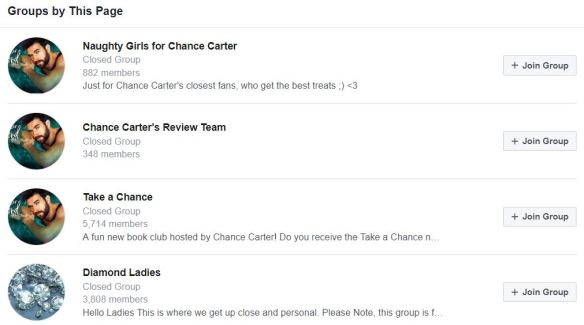
Even his fan groups were crazy with members.

chance carter blog post 8

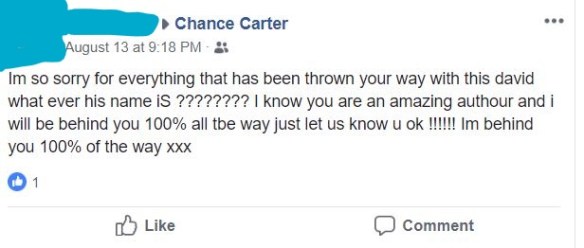
When you have that kind of following, you owe it to your readers to be real. To be honest. I mean, that’s neither here nor there now, but once he was ousted,

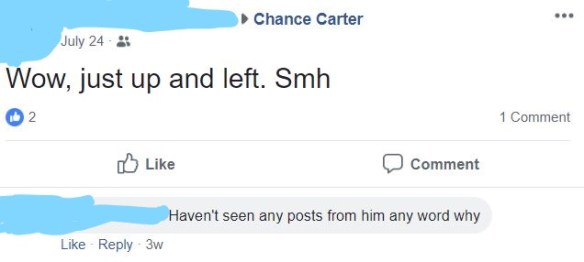
he didn’t even say goodbye.


No press release, no private message to one person who could spread the word. Nothing.

chance carter blog post 2_LI


chance carter blog post 3_LI

chance carter blog post 4_LI

chance carter blog post 6_LI

Not an apology. Not an, I’ll fix this and I’ll be back.

He completely disappeared.

I see a lot of indie authors maintain a cavalier attitude toward their readers. Mainly because they don’t think they have readers.

But do you have a responsibility? Even if you just have one or two readers? Do you care what they think? Do you care if a friend is waiting for your next book? Your neighbor? Your followers on Twitter? The forty-five people who like your Facebook Author Page?

Maybe you don’t think your readers matter until your followers and readers are up into the thousands like Chance’s.

When your readers write you open letters asking you where you are and if you’re coming back. 

First, I guess you have to ask yourself, why are you publishing? What is your goal? I can think of two off the top of my head: Readers and Money. Maybe you don’t care so much about money and you publish on Wattpad, or you write fanfic and publish it to fanfic.net. But if you’re publishing on Amazon, or Smashwords, and/or everything in between, you’re probably hoping to make a little money. With hoping for sales you would like to become well-known for your books.

But not only books. Authors like Chance know their brand. They build their reputations from the ground up, by showing up, being present. By engaging with the people who read their books.

Readers who read books by consistent authors like Chance know what they are getting. Even his covers look similar.

chance carter blog post 9

That’s a series, but his other books, look similar too:


Pecs and abs. It’s not too hard to figure out why these were popular with the ladies.


But what does that mean about loyalty for you?

  • Publishing consistently. Self-publishing is a fast-moving wheel that waits for no one. There are a million books out there to read. If you want a following, you need to give your readers something to follow.
  • Do you genre hop? Do you write contemporary romance, then throw in a bit of horror? Do you write historical fiction then jump into sci-fi when the fancy strikes? It’s okay to write what you like, but not all readers will follow you to every new path you want to take when that shiny new idea takes over.
  • Are you accessible? Do you have an email address that you check and respond to? Do you engage on social media? Do you post to an author page? When someone shoots you a tweet, or mentions you in a blog post, do you respond? Do you use a real photo? I’m not saying all those are musts, but if you take a look at Chance’s social media history, you’ll see consistent posting, videos. He shared bits and pieces of his life.  Chance Carter probably wasn’t his real name, but he was real–to 122,000 people.
  • Do you have follow-through? If you say you’re going to do it, do it. Changing up plans in mid-stream because you don’t feel like you have enough of a positive response will teach your fans you can’t be trusted to do what you say you’re going to do.

It’s tough starting out. You feel like you’re writing for no one. But it takes time and patience to build your audience. Chance didn’t wake up one day and decide to have 122,000 followers on his FB page.

It’s too bad that he didn’t treat his followers with more respect. His readers liked his books and kept buying them. They didn’t need to be scammed into reading his books or leaving reviews. They would have done that on their own. Simply because they liked him and his work.

Now they feel betrayed, cheated, abandoned. Leaving messages on his FB Page:

chance carter blog post 5


Uncle Ben said, With great power comes great responsibility. Actually, I looked it up, and he stole it, but the idea is still the same.

If you’re looking for a large number of readers, treat the ones you have with respect and loyalty.

Begin as you wish to continue.

And all you Chance Carter fans out there–I’m building my Contemporary Romance audience. I may not be a bad boy like Chance, but I can write a sexy and kind hero too–and I can guarantee, he will always get his girl.


end of blog post graphic


Whine a Little . . . Over There

There’s been lots of whining on Twitter lately. More specifically, authors whining about not seeing books sales. Even more specifically, authors not seeing their books sell.

Maybe it’s because we’re in the dog days of summer, or people aren’t looking forward to school starting, or the crap we’re all going to have to deal with when THE HOLIDAYS start in full-swing October first.Dog Days of Summer

But whatever it is, it needs to stop. Because YOU, and nobody else but you, can make sales happen for your book.

Mostly, this is on Twitter. I can say it louder for the people in the back. TWITTER ISN’T FOR SELLING BOOKS. If you’re a member of Writer Twitter, you’re a member of WRITER Twitter. There’s a reason why it’s called that. Because we’re writers. Join READER Twitter. It’s gotta be there somewhere. Maybe #amreading is wedged between #IhateTrump and #turtlesareweird. If you’re convinced Twitter is the only way to sell books, or it’s the only way you want to try, break into the #amreading crowd. Or try. I’ll leave a light on for ya.

But if you want to take stab at moving books instead of whining about it, explore these ideas. First though, you need to take a look at your book.

  • Cover needs to be decent. Needs to depict the genre, needs to fit in, but stand out (in a good way.) Join an FB cover group and get some critiques. Taking a second look at your cover and if it’s not up to snuff, fix it. It’s killing your sales before they start.
    Books to consider:

    Cover Design and YOU!: Dos, Don’ts, and Choices
    Why Does My Book Not Sell? 20 Simple Fixes (Writer’s Craft)

  • Make your blurb awesome! This is easier said than done. Bryan Cohen is great at this. He teaches webinars and he runs a business doing this. And he makes very good money doing it. But he shares his knowledge, so don’t just moan you don’t know how to do it. Read about it. You’re a writer. Research. Here’s his book. He breaks it down so you can do it, too. With his guidance, I write my blurbs in half an hour. Here’s a Book Description Critique with Bryan Cohen hosted by Reedsy. Watch it.
  • Make sure you have a decent title. No one told me this before I published, and now my very first book has a stupid title I can’t change because I don’t want to waste the money I spent on my ISBN number. If you don’t have any reviews and didn’t purchase your ISBN number, you can change your title. Changing your title and ISBN number will lose you reviews so if you only have one from your best friend Angie, she’ll probably post it again if you republish with a better title.
    Grab some ideas from Dave Chesson; he’s got some good ones.
  • Make sure your “look insides” (first sample pages) are decent. This can make or break you if all the other parts about your book are spot on. If you don’t have a solid POV, if you have typos, if your formatting is messed up, the best cover in the world won’t save you. Try to get your hook within the first few pages of your book so it’s included in the look inside. Turn that browser into a buyer!

Now that we covered that and your book is up to par, you’ll need to ask yourself what you’re doing to help your book sell. Tweeting every day isn’t going to help. So what can you do to spike sales?

  • Are you spending any money?  You have to spend money to make money. I’m not kidding. Lots of people are like, “I don’t have any money to put toward selling my book.” Then you’re not going to sell your books. No business has ever opened that didn’t need seed money. Investors. Start-up money. You buy stock for your shelves, you fork over for rental space. You pay for wages for your employees before you’ve even sold one thing. Your book isn’t any different. Nobody ever went into business for themselves because they needed money yesterday. Starting a business is a lifelong endeavor. What can you put your money toward?

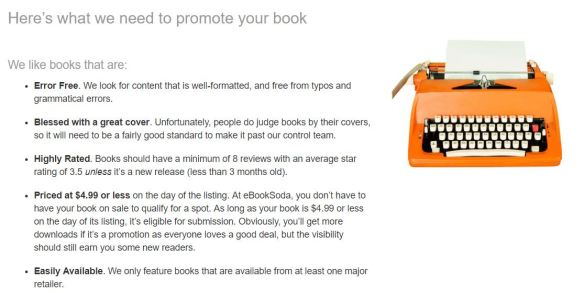
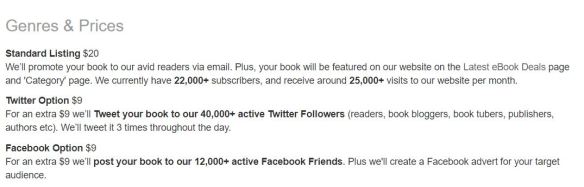
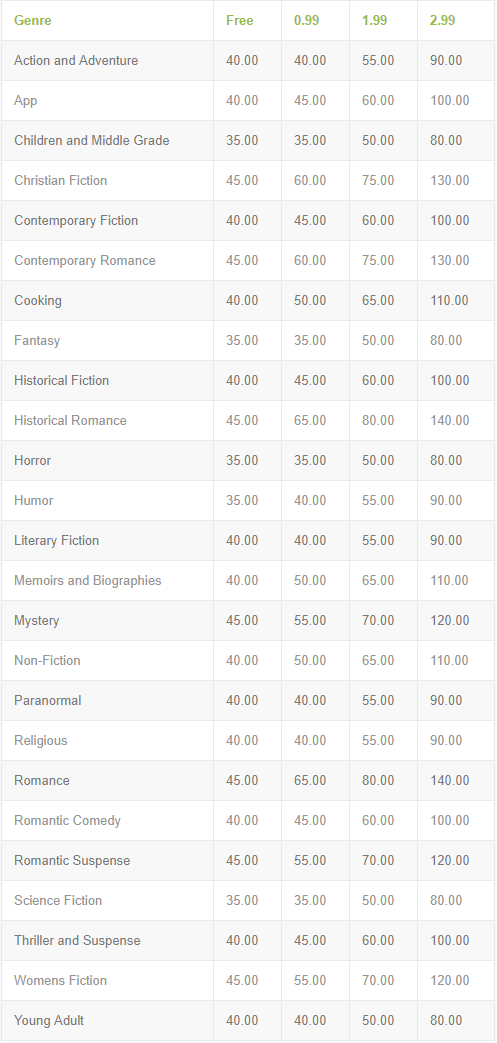
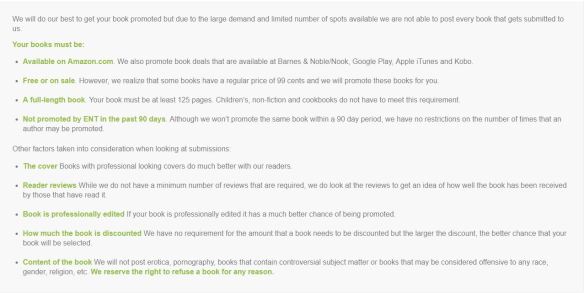
    *Pay for promos. I spent 80 dollars to give away 4,000 copies of Don’t Run Away in a free book promo for FreeBooksy. It got me some reviews, and lots of KU reads for the whole trilogy. I made my money back and then some.

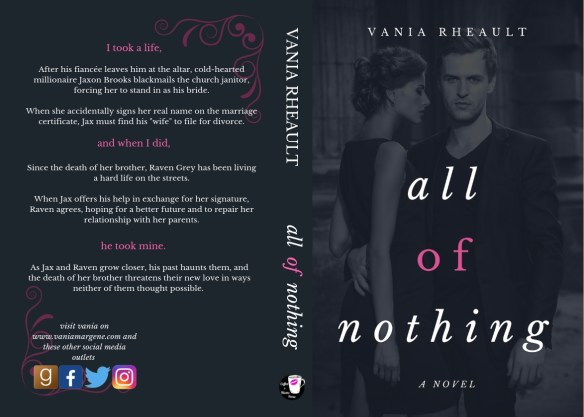
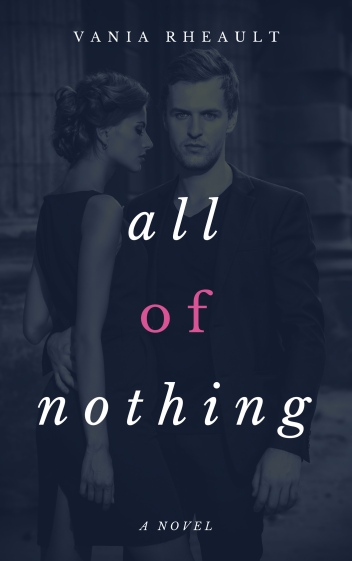
    *Pay for giveaways. Goodreads did away with their free giveaways but because you have to pay, the market for giveaways isn’t so saturated. People have debated as to whether or not it’s a good thing, but I think it is. I haven’t tried them yet, but in the spirit of trying one new thing with each new release, I’ll be trying it when I publish All of Nothing this fall. Read about them here.

    *Pay for ads on Amazon. This isn’t as scary as it sounds. I’ve been blogging about my experience. It won’t break the bank to give it a try, but it’s important to do it correctly. Brian Meeks has a wonderful book about it. Amazon changed the platform a bit, so his instructions are already outdated even though his book is only a year old. But his advice is still as good as gold, and just as valuable.

    *Pay for ads on Facebook. These are trickier than Amazon ads. At least, I’ve read that they are. I haven’t tried Facebook ads, and if you don’t have the money to spare, I would suggest going with Amazon ads first. I’ve spent under five dollars experimenting with Amazon Ads. But if you want to try FB ads, again, do it correctly. Michael Cooper has a super great book about it. It’s important to try ads correctly, otherwise you’ll blow through money, claim they don’t work, and you may write off a great way to let people know about your books!

    *Pay for a blog tour. I used to hear a lot about these two years ago when I joined Twitter, but not so much anymore. You don’t have to pay someone to set up a blog tour, but if you pay a legit person they’ll know the best blogs to submit your book to. I’ve never tried one of these. They’re time-consuming. Either you have to fill out an interview sheet or compose a guest post for that blog. If you’re doing a full tour, that could consist of anywhere between 5 to 20 or even more blog sites. That’s a lot of guest blogging and interviews when maybe you should be writing your next book.

    *Reviews. If you do this in a legitimate fashion, this can be a coup for you. I have not tried it because the service I wanted to try distributes the books to readers through BookFunnel and that goes against KDP Select’s terms of service. I pulled Wherever He Goes out of Select to try this review service, and it comes out September 3rd. It wasn’t doing well in KU anyway, so I didn’t see the harm in trying. I’m going to try Happy Book Reviews. I’ve heard good things and so-so things about results. But if you have a good book with a good blurb and good cover, and the plot/genre isn’t too weird, you may get good results. Give it a shot.

  • Are you writing more books? The best marketing you can do is release new books. Lots of debate on quality versus quantity, but if you just can’t scrape up the cash to put toward your book’s promo, at least writing and releasing is free. *As free as you can get without spending money on cover, editing, etc. I’ve heard you drop off the Amazon algorithms after three months, so you want to release something every three months. Try releasing tie-in novellas. Or just dig in your heels and write the next book. I see lots of people trying to build careers on one book, and that only works if you write a non-fiction book and your career is already based on that book. Readers expect more from you. Keep them happy.
  • Offer to guest blog on other people’s websites in your genre. Ask “up.” Someone in your genre who has more followers than you. Someone whose website gets a bit more traction than yours. This is where your tweeting should come in handy–you’ve made connections, don’t be afraid to ask. Most people would love to host a guest blogger. It frees up their schedule for the week. But make sure your book is up to snuff or they’ll turn you down. And be prepared to giveaway a book. That seems counterproductive to sales, but lots of bloggers want to reward their readers for showing up.
  • Think local. Ask your town’s newspaper’s lifestyle section to do an article on you. If you have local small magazines, ask them to do a profile. Ask your indie bookstore if you can do a signing, or if they’ll sell your book. Heck, maybe get together with a couple of indies in your area and ask Barnes and Noble if they’re willing to do an Indie Night. Asking is hard. We’re introverts at heart, but even if the answer is no, at least you can say you tried.
  • Take a hard look at your book. Besides the cover, the editing, the blurb, the title, ask yourself, is this something someone would want to read? Especially if this is your first book. Indies like to experiment when they’re starting out. We’re finding our niche; we’re finding our passion. Experimenting with your hamster detective series is cool, but can you get sales? Maybe not. So take a hard look at your book before you throw money at it. It may not do any good. And that’s the sad truth. If you can be honest with yourself and say yes, my book has readers, all I have to do is fine them, then good luck!

Whining about lack of sales isn’t going to help you sell books. After a while it becomes annoying, and you end up tarnishing your reputation. If your first book isn’t working, then move on. Write something else. Write something better. We get better at our craft with every book we write.

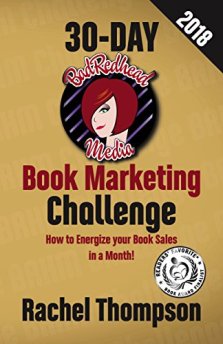
book marketing challengeRachel Thompson says we don’t get traction with our careers until we have at least 6-10 books under our belts. As the self-publishing industry gets more competitive, that number may get higher. If you’d like to read her awesome book about marketing, you can look for it here.

Book sales are subjective. What works for you may not work for someone else.

The best advice I can give you is write well, and publish often. Stay consistent. Build your brand on a genre you love to write.

Sales take time.

Have patience, and good luck!


buy image for blog


Changing Your Book Over From CreateSpace to KDP Print

This is the big bad everyone is talking about–moving your books over.

Do you want to move your books from CreateSpace to KDP print? I think, yes. Because if you’ve been following what CreateSpace has been doing (ie, cutting staff, removing services) then you know that Amazon is in the slow process of getting rid of it. Not that anyone from Amazon has admitted it.

If you’ve been avoiding it because you think it’s going to be hard, don’t worry! It will be fine. I did it just to see how it would go, and I ended up doing half my books.

Let me tell you how.

First, you go to your dashboard on KDP. The one you check when you want to see your lack of sales.

Then, what you need to do is find the corresponding book that you have on Kindle, and choose Create Paperback.

blog going from cs to kdpp5


After that, there is a place for you to enter the ISBN number you used for CreateSpace. Log into your CreateSpace account and copy and paste the ISBN number from your paperback into the space.  After you type in the number, you have to hit ENTER, and the yellow button will highlight so you can click it. I don’t have a screenshot of that, but just take my word for it. They tell you in pretty green that yes, you are the owner of the title. 🙂 Thanks, KDP Print!

blog going from cs to kdpp

The categories don’t come with your manuscript or your cover, so you need to choose the categories over again. I didn’t, and I got the error message.

blog going from cs to kdpp4

Choose the option “you have published this book on CreateSpace.” That’s the whole point to this exercise.

Also, another good thing to know is you can’t change your trim size and your interior since those things are attached to your ISBN number.

blog going from cs to kdpp2

But after that, you’ll see that everything has ported over:

blog going from cs to kdpp3

After the cover and manuscript are processed, you can take a look at it through the online viewer. I open it just to be sure, because KDP Print is a lot more clear on cover and manuscript requirements.

There is one thing I found out the hard way:

If CreateSpace tweaked your cover in any way to make it passable for publication, those changes do not carry over. 

Apparently, when I did my covers for Summer Secrets, I did them wrong, and the lovely customer service people at CreateSpace fixed them for me. They didn’t bother to tell me I was doing them incorrectly. When I did a cover for one of my books in my trilogy, I called them for something completely unrelated, but the rep I spoke with pointed out that error as well. I thought since they were publishable, I wouldn’t have a problem, but I did.

I wouldn’t bring this up except for the fact that I don’t know how may covers CreateSpace helped along with no notice to the author. Is it bad? No, not at all. But if they tweaked your cover and KDP Print tells you something is wrong now, I hope you have the skills to do what CreateSpace did to fix it in the first place. Or if you hired a designer, you’ll have to ask them to make the changes.

Don’t worry if KDP Print tells you something is wrong–they get very precise when pointing out the errors. They won’t leave you guessing, and they let you know right away–in the information bar on the left-hand side of the online viewer.

It was just a surprise to me that KDP Print didn’t approve my covers when CreateSpace had published them.

You won’t know right away if they pass, even if there aren’t any errors in the online viewer–they do go into review, and you’ll get an email saying if they pass or not. And if they don’t, the email will explain why. But it is faster than the 24 hour time period that CreateSpace used to take. I got my emails back in 12 hours. The online viewer is similar to the one on CreateSpace. Sometimes it seems like it will take forever for the viewer to populate your content, but I just hit REFRESH and that seems to do the trick to get it moving.

Don’t forget to hit SAVE AND PUBLISH.

And that’s all there is to it, really. I messed with the insides of 1700, so I ordered a new proof, just to be sure.

The link to order the proof is small, and it’s on the bottom of the page, so you’ll have to keep an eye out for it if you want to order a new proof.

I didn’t mess with the insides of Summer Secrets, so I didn’t order a proof of either of those. Proofs take a lot longer to come than they did using CreateSpace, and author copies, too. Definitely plan extra time into your publishing schedule.

All in all, I was happy with the experience. It will go smoothly for you if don’t have cover issues and if you don’t change anything with the interior. Although, now is a good time to do those changes, if that’s what you were going to do at some point. All you would have to do is upload the new file and replace the ported file from CreateSpace with the file you made changes to.

Always order a proof if you make interior changes, unless you are prepared to flip through every page with the online viewer.

KDP offers instructions and offers advice, and you can read about that here.

Otherwise, there’s not much else to tell you. I plan to do the trilogy soon. Oh, and if you’re selling paperbacks like hotcakes right now, you probably don’t want to do this until your sales die down because as you switch over, your paperbacks aren’t available for purchase.

If you’re worried, try not to be. I was a new author when I did my covers, but I’m better at it now. If you used a cover designer or in any way were more experienced than me when publishing your book, you’ll be just fine.

Jump, don’t be pushed.

Good luck!


buy image for blog


When Do You Recommend Your Friends’ Books?

The indie writing community is very tight-knit. Make one of us mad, we all get mad. I think Faleena Hopkins figured that out quick enough. We support each other; we help each other. We do free things for each other: cover help; editing; beta reading.

We even do some naughty stuff like review trading.

We tweet each other’s books.

Lately, there have been a couple of people asking for book recommendations from indie authors. They want to start a list on their website, or they want to start reviewing indie books.

There were lots of tweets, as you can imagine.

And there was something that surprised me, but I guess it shouldn’t have. Someone was recommending books they haven’t read. How do I know this? For one, I know she doesn’t read indie. Two, she’s a very picky writer, and I don’t think she would have recommended these books had she read them. (That is a polite way of saying they could have used more editing.)

This made me do one of my super researching techniques: I ran a poll on Twitter. While the participant number was low, the results still stunned me.

indie books

I’m trying to figure this out because this bothers me.

Why would you recommend a book to someone if you haven’t read it? Would you walk into a bookstore, grab any old book off the shelf, and tell your friend it was fabulous and a must-read? Of course not.

This seems to be an indie-only thing, like not full-justifying your margins in your books when you format or adding your cover designer to the book’s contributors when you publish. Indies start stuff traditionally published authors don’t do. And the more indie authors do it, the more it becomes acceptable and the more newbie authors do it.

Of course I want to support my friends. But we all know indie writers don’t read that much. We might beta read, or be a critique partner, and that’s fine. It’s a little different in that I would assume the published book is different from a draft a beta or CP read. But at least you know the gist of the story, know if the book has proper punctuation and grammar.

At least you know the story makes sense.

But what are you doing to your own credibility if you recommend a book to someone you haven’t read and that someone takes you seriously? What if that someone takes a peek at the look inside on Amazon. What if that book has no established POV, or doesn’t have a good hook (AKA boring as f*ck)? What if the formatting is messed up, or has typos in it? What if the first paragraph head-hops into five different heads?

There were a couple comments in that tweet thread that asked the question: Who doesn’t read their friends?

Well, quite a few if my own track record is anything to go by. I can count on one hand the number of my friends who have picked up Wherever He Goes and read it cover to cover.

And if you want to ask me what indies I’ve read in the past few months, I can say one. And it was someone I edited for back in February. Otherwise, I’m busy writing or reading craft books, or reading trad-pubbed romance books. I don’t read indie simply for the fact that most of my friends don’t write what I like to read–contemporary romance. And then another reason I don’t read indie much anymore is if they find out I’m reading their book, they expect a review. I won’t leave a bad indie review. I won’t do it. So I don’t want my friends to wonder where their review is because there won’t be one if I don’t like their book.

Given those reasons, I rarely recommend indie books on Twitter. I recommend how-to publishing books or marketing books. I recommend trad-pubbed books that do something well that could be used as an example to my fellow writers.

I think it’s great that we help our friends. But if we want to help our friends, we should do it in a different way. Pass along promo sites. Recommend books you’ve read on how to do proper Facebook ads or Amazon ads. Marketing your friends’ books is not your job.

Sure, I’m flattered when someone posts a picture of my book on Instagram, or tweets about it. (And yeah, less five people have done that for me anyway.) But I don’t expect it and I don’t ask. My readers aren’t on Twitter. They aren’t even following me on Instagram right now–I got sucked into the writing world there, too. {KT Daxon is a good one for this, and I have to give her credit where credit is due. She does a great job of promoting the books she reads, and she truly does read the books she says she does.}

I would only recommend books I’ve read. It’s honest.

And you want people to be able to trust you, not question your taste.

Not question how good your books are.

I know this blog post sounds like I don’t think indies can write and publish good books. That’s not the case. What I am saying is that some indie books could use more editing. And I understand why indies don’t. It’s expensive and time-consuming. Waiting for an editor to get back to you is like sitting on pins and needles, and then you have to put in all the edits once you get them back. A total edit could push your pub date back by several months. But let’s not pretend that indies aren’t impatient, and rushing to publish is a mistake a lot of indies make.

This reminds me of the trad-pubbed writing community. I’m exposed to a lot of YA on Twitter and Instagram. It seems like a lot of YA authors do read other YA authors and tweet about their books and support each other. Being trad-pubbed is like being in a club, and those authors have each other’s backs.

Romance writers are the same way:

lori foster brenda novak

Here’s Brenda Novak reading Lori Foster for a book club Brenda is going to hold in her Facebook Author Group.

That’s real support. That’s real networking and collaboration.

There’s lot of bad things to say about the traditional publishing industry, but this isn’t one of them.

Let’s support our friends the right away.

Read the books you’re recommending. Because reading a book and having a discussion about the book with its author would mean a lot to the author, and a tweeted conversation about a plot twist or an evil character is true promotion.

Do you have any good reasons for recommending books you haven’t read? Let me know!


Blog book promo for the end of blog posts


I Did an Amazon Giveaway–and It Did Pretty Much Nothing

THIS POST IS ARCHIVED AS AMAZON DID AWAY WITH GIVEAWAYS IN 2019 AND HAS SINCE NOT REPLACED IT WITH AN ALTERNATIVE. THANKS FOR READING!

I was always curious about the Amazon giveaways–you know the cute little button at the bottom left of your books’ (or any products’ really) page. You have to scroll down pretty far to find it–after reviews and two sets of sponsored product ad strips.

amazon giveaway blog

You can give away paperback or Kindle versions, and it’s obviously cheaper to give away Kindle versions. Amazon makes you pay for your book, so if you gave away paperbacks, you’d be paying the price you set in CreateSpace or KDP Print, plus shipping.  There’s no shipping with Kindle files, but there is tax. So make sure you’re looking at the correct page, and Amazon tells you which version you’re giving away–it’s in the blue to the right of your book’s cover.

Choose your number of prizes:

amazon giveaway blog 2

I’ll give away three Kindle file copies. I did five when I did my giveaway for Wherever He Goes, so I feel like I’ve already spent money on something that probably won’t do anything for me.

amazon giveaway blog 3

Add your photo. I chose a different pose of my author photo that I use everywhere else, but I still look like me.

The next part is where I royally screwed up because I had no idea giveaways ran that quickly, or that people would enter, or maybe I just didn’t understand the stats of a giveaway like this.

amazon giveaway blog 4

I did the recommend Lucky Number Instant Winner, and I chose 100 for the lucky number for the winning entry.

This is what it says if you click on LEARN MORE:

amazon giveaway blog 5

My giveaway lasted fifteen minutes. So When I chose 5 prizes along with the 100 entrants,  500 people entered my giveaway and every 100th entrant won a copy of my book. The fact that it only too 15 minutes for my giveaway to end blows my mind.  So will be going with a higher number next time.

And then, of course, I have them follow me on Amazon.

amazon giveaway blog 6

I made it public of course, because the more the merrier.

To recap, I’m doing 3 copies of Don’t Run Away. I have the number of entrants set at 200 per prize so 600 people have to enter to win three copies. They all have to follow me on Amazon.

You would think this would be a great thing. But the thing is, most people enter giveaways just to enter giveaways. That is what they do. Just for the rush of winning, I’m assuming.

I don’t think this giveaway is going to go any slower than my other one, but we’ll see.

Click on no for not offering discounts, then click next.

amazon giveaway blog 7

This is the last page, and it’s laughable. It’s probably where my high expectations came in. The giveaway will end in 7 days? Yeah right.

Then you get your shopping cart screen and you purchase your giveaway. I didn’t screenshot that because you don’t need to see my stuff. After you buy it, you get this:

amazon giveaway blog 8

And you’re all set.

You get an email when your giveaway is live, and for me, fifteen minutes later, I got an email saying my giveaway was over.

Amazon doesn’t tell you how many followers you have, but at some point, hopefully when they email your followers when you release a new book, that some of them will buy it.

Don’t turn blue holding your breath.

While I was typing this up, my giveaway went live–I got the email.

We’ll see how long it takes for the giveaway to end . . . . go get something to eat. I’ll wait.

At any rate, did the giveaway for Wherever He Goes do anything for me?

Not really that I could tell. At least with my AMS ads, even with little results, those are still measurable. These giveaways seem like a waste of time and a waste of money.

Maybe I’ll do a Goodreads giveaway when my new book comes out.

It will be something to blog about anyway.

Did you have a good experience with an Amazon Giveaway? Let me know!

Blog book promo for the end of blog posts


More AMS (Amazon ads) Updates

I like doing these to help anyone who is afraid of dipping their toes into Amazon marketing. Ads are a scary concept, be it Amazon or Facebook. Anything that will take your money without a firm promise of ROI (return on investment) needs to be taken up with a bit of caution. Too cautious though, and you aren’t going to get the results you want.

You need to spend money to make money, and all that.

So here’s where I am so far with ads.

ams-blog-post.jpg

ams blog post 2

If you know anything about what you’re looking at, it’s pretty easy to see my bids are not high enough to be getting very many impressions or clicks. But that’s the name of the game, you know, to find the sweet spot where you’re getting impressions and clicks, but you’re also not paying a ton of money for clicks if no one is buying. You’re hoping if people are clicking on your ad, that you’ll make sales. But your clicks also have to be in line with how much you’re making from your books.

My books are priced at 2.99. If I spend 30 cents a click, and I get 2.09 from each sale, that’s a take-home royalty of 1.79 a book. (There’s a real way to determine ROI and I’m not doing that here, and I know I’m not, so you don’t have to tell me, for you die-hard ROI fans out there.)

Anyway, so anyone worried that you’re going to do some ads and Amazon is going to take all your money and you’re going to broke with no sales, well, you can go slow. You need to have patience. And some impressions are better than none, but these aren’t what I was hoping for, and these aren’t what Brian Meeks, in his book, says you can accomplish either.

I have 20 ads running simultaneously, and I’ve only spent $2.30.

I am still getting KU reads, and I’ll never know if those come from the impressions from my ads.

I’ll add a few more ads with a higher click and see if we can’t get something going. I’ll have another book coming out in November, hopefully, so I’ll have another book to promote.

The more, the better, right?

Anyway, so that’s where I’m at. If you’re interested in Brian’s book, click on the pic. He’s got a ton of great info there. amazon ads

Until next time, happy selling!


Blog book promo for the end of blog posts

My BargainBooksy Ad from last month. How did it do?

Well, apparently, not very well since I forgot to post the update. This time, this ad was a paid ad (meaning, my book wasn’t free), and I set the price of Wherever He Goes to .99. I thought, a dollar for a book, that’s pretty good, right? Heck, I spent three months working on it, I figured a dollar was a good price.

The problem is, with doing these ads, you just WON’T KNOW why your book doesn’t sell. It could be the cover, it could be your copy. It could just be that no one wants to pay. You never know.

So, in total, I sold 40 books on the day the newsletter came out and a couple days afterward. That is nothing compared to the 4,000 books I gave away during my Freebooksy ad I did back in February. You can read about that here.

june sales for bargainbooksy ad

As far as KU page reads are concerned, you can see that the newsletter created a bit of a spike, but nothing to write home about. And this is only for Wherever He Goes. My trilogy is still getting a few page reads, but I wanted to see what my ad would do for Wherever He Goes, and unfortunately, for 80 dollars, not much.

Here is what my ad looked like in the newsletter:

bargain booksy ad

Would I do this again? I haven’t made back what I spent on the ad, so it will be a while before I try something like that again.

What I need to focus on is getting reviews, but for using any legit reviewing services, I need to pull my book out of Select because the one review service I contacted distributes the books through Bookfunnel. Amazon considers Bookfunnel as a distribution platform and will yank you out of Select if they catch you using it.

For my next book, I’m going to place my book with a review service first, before putting into Select and see what happens. Hopefully, if I get some decent reviews that way, readers will give all my books a chance.

And I think if I ever do another promo with Written Word Media (Freebooksy/Bargainbooksy) I’ll do the free one, since I kind of feel like I got more bang for my buck. At least, it sounds better to say I gave away 4,000 copies than say I sold 40. It would be great if any of that had turned into reviews, but so far nothing significant on that end, either.

But, that is my experience with Bargainbooksy, and if you’ve tried them, and have gotten better results, let me know!

Thanks for reading!

Blog book promo for the end of blog posts


How Free is Self-Publishing?

It costs absolutely nothing to publish a book. Nothing.

free

There are free word processing programs like Google Docs. You can use a library’s internet and computer. Platforms like Draft2Digital and Amazon’s KDP will provide you with some kind of book identification number so you don’t have to buy ISBNs for your books.

All you need to do is write, make a cover in Canva using their free website, use a free for commercial use picture from Pixabay, Pexels, or Unsplash, and you are a published author. All for free.

But when isn’t that a good idea?

Do you know Amazon has over 7 billion books in their Kindle store? And writers publish more every day.

So not only are you competing with everyone you know on Writer Twitter, you are competing with writers who are not on Twitter, big time indies who don’t have much time for social media. You’re competing with traditionally published authors, and those authors range from anywhere between The Big Five to tiny university presses.

You’re competing with writers from the US, Canada, (do you know how many writers I know who live in London, Ontario? A lot!) the UK, Australia, and many other countries.

Over 7 billion books.

Okay. What what is this blog post really about now that I’ve made you feel like crap?

Spending money.

Self-publishing is free.

Until it isn’t.

I do everything myself. For my trilogy, and Wherever He Goes, I wrote them, edited them. I formatted them and did the covers. The orangy hue on the third is my fault. I didn’t have the skill to fix it. It doesn’t look bad on screen, but the paperback could look better. That’s just the way it is, and I accept that.

What can you pay for when you self-publish?

  • Editing
  • Formatting
  • Cover

Those are the three big ones. But we can go further:

  • Beta Readers/Critique Partners/Book Coaches/Book Doulas
  • Blurb writing
  • Reviews/Arc review services like NetGalley
  • Advertising, ie, Facebook ads, Amazon ads, Promotions
  • ISBNs
  • Paperbacks for giveaways
  • Giveaway fees like on Goodreads

No one is saying you have to pay for all of that–or any of it.

It’s up to your discretion how much money you want to pump into your books.

See, this is the problem. No one wants to admit that they publish their books to sell them. Which leads an author not spending one dime on their books.

They are publishing for themselves. I repeat this over and over again like a broken record:

If you only publish for yourself you have no right to complain if your books do not sell.

But if you can admit you want people to pay to read your work then you have to take a hard look at your book.

Is the cover you made yourself doing the job?

Is your blurb up to snuff or is it confusing and off-putting?

Are there typos in the first few pages of the Look Inside?

If you can’t put out quality work yourself, then you’re going to need help.

It’s that simple.

And that difficult because saying you need help is a lot easier than being able to afford said help.

That being said, you can teach yourself how to do these things.

If you just shut down on me, it’s because you don’t want to take the time to learn. That’s okay. I wear clothes every day. That doesn’t mean I want to learn how to sew.

But what I’m trying to tell you is that you must find a happy medium between doing things for yourself and hiring out the help you need to make your book desirable to readers.

Because remember, readers have 7 billion choices.

Listen, my books aren’t pretty. Use the look Inside Feature for any of my books and you’ll see basic formatting. The embellishments are non-existent.

That’s fine. I taught myself enough to get by, and that’s good enough for me.

Readers aren’t going to care if you have fancy chapter headings if your story sucks.

So, being I’ve published a few things, I can suggest where you should put your money–if you have any, or where you should ask for favors from friends–if you have any. Just kidding!

  1. Editing. If you’re a newbie writer, this means a developmental edit as well as a line edit and proofing. Plot holes, flat characters. Developmental editing can be more of a job for a critique partner or someone from your writing group. Ask someone who reads your genre so they have a handle on the tropes and feel for the type of genre your book is in. Once you have a stellar story and a solid look inside sample, you need a good cover.
  2. Cover. Canva.com offers design classes. You need to train your eye and learn what makes a good cover. It can make or break your book. Plus, if you push your book in any way, ads, promos, giveaways, your cover will be the selling point. Look at your genre on Amazon. Look at templates. Try to duplicate them yourself in Canva. You may need to spring for a photo, but that’s not as expensive as you might think. I buy mine on canstockphoto.com for seven dollars apiece. Photos are even cheaper if you buy a credit package.

    A word of warning though. I write romance, and slapping some text onto a smiling couple is a lot different than making a cover for an Urban Fantasy novel. Fantasy, of any kind, requires a certain kind of cover. Negotiating a price with someone on Fiverr is a lot better than publishing a book that does not have an appropriate cover. Your sales will stop before they even start. I’m sorry, but that’s just the way it is.

    Sometimes you can find a pre-made template that’s cheap.

    Sometimes you can even find a photo on a photo site that is already doctored to how you need/want it to be. Set aside hours, days, if not weeks, to click through pictures. I’m barely 20,000 words into my next book and I’m already looking at photos.

  3. Formatting. Formatting for Kindle takes five minutes. All you need to do is set the options in Word so when you upload it into KDP it converts correctly. If you go wide and you use Draft2Digital, you don’t even have to do that. (Smashwords is a different story, and your Word file has to be formatted correctly or it won’t convert through their “meatgrinder” and they won’t publish your book.) Draft2Digital seems easier to work with, but I’m in KDP Select and haven’t used either of those services.


What is the cost of self-publishing? It can cost as much or as little as you want to put into it.

Someone opening a business always needs to invest. Paying for services is investing in your book business.

I used to think that I didn’t want to invest in my books because I may never get that money back. But that was incorrect thinking.

If my books are well-written, have a nice cover, and are formatted as to not turn anyone off from reading it, eventually, I will see that money returned to me by way of sales.

My books will be sold for years and years.  As I slowly make a name for myself, my sales will increase. It will take time, but I’m in it for the long haul, and I have patience.

I’ve put money toward my books by way of taking the time to learn how to do things for myself. I read lots of editing books. I read tons of blog posts about what makes a good cover. I’ve practiced making covers. I’ve learned to format my files. It took time. But time is money. I’ll eventually see dividends on the time I invested in my books.

time is money

It’s a personal choice.


This blog post begins a self-publishing series about how you can do most of these things by yourself if you want, and where to look if you don’t. I’ll give you the resources I used to learn and you can decide for yourself if it’s easier for you to hire out, or if you can’t afford it, where you can spend time learning things on your own.

Look for my next blog post about editing resources.

Thanks for reading!


Thoughts on the RWA

rwa header

I’m a member of the Romance Writers of America. I like being part of a group of people with similar interests. I was especially proud to belong when they stepped up to bat during #cockygate. (For those interested in following along with the hashtag on Twitter, look here.) I feel it’s an organization that has my best interests at heart as a writer and author and wants to help me succeed. In fact, I’ve been a member for a while now, and I haven’t even started to explore all the resources they offer their members.

I was listening to the Sell More Books Show and they featured a blog post by Allison Brennan who left the RWA because she felt like the organization operated more for indie writers than traditionally published romance authors.

While I don’t have a problem with the RWA operating this way because I am an indie author, I did notice this, too, as I paged through the Romance Writers Report. I’ve read articles about marketing, discoverability. How to work with editors and book cover designers. These articles are written with the self-publishing author in mind (trad-pubbed authors don’t have to worry about editing their own books, or hiring their own cover designer). Even in the June issue I have on hand, some of the articles include:

  • Romance Law School is Now in Session: How to include law in your fiction in a realistic manner.
  • Fifty Ways to Show the Spark without the Heat
  • Proofreading Hats

I’m not saying traditionally published authors don’t need how-to articles like these, but I am saying that indie or new writers could find more value in them. I suppose a veteran writer could use the Fifty Ways article for writing prompts, or read the Romance Law School is Now in Session article for ideas on how to write a new series featuring a lawyer. But the Report also features ads, and they are geared to the indie writer–lots of editing, proofreading, and formatting ads no traditional published author is going to need.

So the question is, is this the right move for the RWA?

They want to support all their members, and if indie membership outweighs traditionally published author membership, then perhaps it is a good direction for them to take.

However, it feels like there are more organizations aimed at supporting indie writers than ever before. The Alliance for Independent Authors is very supportive offering an array of services from podcasts to a services directory where an author can find professional editors, cover designers, and formatting professionals. There are other organizations as well, such as the Independent Book Publishers Association.

There is support for us indies. So does Allison have a point? Where do traditionally published authors go for support if they find RWA lacking? Do they even need support? After all, they are where a lot of us hope to be someday. Is the RWA pushing them from the nest because they are ready to fly? Do traditionally published authors get enough writing and publishing support from their publishing houses and their agents? Where do they go for networking opportunities if they are slowly being ousted from the organization?

Allison does make a good point, too: if all the traditionally published authors leave the RWA because they don’t feel RWA has anything more to offer, what becomes of us who look up the traditionally-published authors? Who would judge the RWA contests? Who would be our mentors? Who would be our professional critique partners and our chapter leaders?

But let’s be honest, here, too. If the RWA wants to support writers, and by support, I mean, help them make (more) money, then self-publishing is a viable way to go. At least for romance. (If you want to read about indie romance authors dominating the self-publishing industry, click here.)

To me, it makes a lot of sense for RWA to shift. After all, the distinction between traditional and indie publishing is blurring more and more every day. And a lot of traditionally published authors are still the ones who do a lot for their books: marketing, platform building. Some authors have to set up blog tours, book signings, that kind of thing.

Being a traditionally published author today doesn’t even guarantee you’ll end up on a bookshelf. Maybe a virtual bookshelf, but the chances of seeing your book at Barnes and Noble shrink every day. I took a quick peek at Harlequin’s mail service, and if you subscribed to every line and subscribed to the maximum they mailed you in that line every month, you would receive 86 books a month. It isn’t possible that every book would find shelf space, even for just four weeks.

So what does it mean to be traditionally published? To pass the gatekeepers? Is this Allison’s main guff with RWA supporting indies? Perhaps she wants the RWA to nurture us to being published traditionally. But not one way is going to be the right way for everyone.

The publishing landscape is changing. Maybe Allison Brennan doesn’t want to see it. Maybe she sees indies as her competition, not her colleagues. Maybe she sees herself as better because she’s traditionally published. The problem is, that way of thinking divides indies from the traditionally published authors, and that’s just not the way things are anymore.

One day traditional publishing won’t give Allison what she needs, and then she’ll need the RWA to help her gain her footing in a constantly changing publishing landscape that she’s refused to acknowledge.

rwa missionRomance writers are all the same. We all want the same thing. To write quality books and make a reader swoon over a happily ever after. And the RWA supports that, no matter how those stories are published.

Issues like #cockygate affect all of us, and we all need an organization like RWA to have our backs.

I’m proud to belong.

Let’s Talk Engagement

There has been a lot of talk of engagement on Twitter lately. What exactly is engagement? The Macmillian Dictionary defines engagement as

definition 4: the action of parts of a machine when they connect with each other or definition 6: the feeling of being involved in a particular activity.

You could even go as far as to say engagement means definition 3: a battle between armies, because, let’s face it, Writer Twitter isn’t always friendly.


woman-593134_1920

She’s cute, but forcing people to talk to you isn’t pretty.

No matter which definition you choose, engagement means a give and take between people or things. So when someone on Twitter says they don’t follow back without some engagement first, or they threaten to unfollow you if you don’t engage with them, what does that mean exactly?

This kind of attitude has always baffled me because first of all, they don’t understand what kind of social media tool Twitter is, and second of all, TWITTER IS F*CKING HUGE. “As of the fourth quarter of 2017, the micro-blogging service averaged at 330 million monthly active users.” Obviously, no one is going to have 330 million followers, but even in Writer Twitter, the number of people following you can grow to the double digits quickly.


So what does engagement really mean? What are you asking for when you expect (demand?) people to tweet with you?

i#followFriday (1)For sake of simplicity, we can pick on a relatively small account. Say you’re following 300 people. You have more people following you; let’s say this number is 1,000. We’ll keep an even number because my math is terrible. Let’s subtract the 300 you’ve followed back, leaving you with 700 people following you that you have not returned the favor to. Let’s subtract 200 of these because we’ll just assume they aren’t real people. Sexbots and whatnot. That’s 500 people, writers, potential friends, and connections, mind you, you’re not following. What if all of a sudden half those people started engaging with you.  You tweeted something funny, an article that hit home. They try to chat with you. Suddenly you have 250 people engaging with you.

What are you going to do, ignore them? This is your dream come true! You want engagement! Now you’ve got it! Oh, you say, 250 people aren’t just suddenly going to want to talk to me. Okay, fine. What about half that? What if 125 of those people started tweeting with you? Then what? You still don’t buy that? Okay, 75. It’s #FollowFriday. They haven’t been pissed off by your snotty attitude yet, so they try to get into your good graces by giving you a happy shoutout. Seventy-five #FollowFriday happy weekend shoutouts. Yee-haw!

i#followFridayYou better believe you respond to these people because this is what you wanted, right? All right, I know I’m being facetious, but let’s be real for a minute. Even if you had 25 people on a daily basis wanting to tweet with you, that’s a huge time suck. There are days, like #FollowFriday, or #WriterWednesday, where I do get quite a few notifications, and I do have to take the time to sit and thank everyone. I’m getting to the point where I may not be able to always answer all my notifications, but for now, I’m trying my best. I respect my followers, as should you. Someone thought you were interesting enough to follow, or you’re part of Writer Twitter, whatever, and you thank them by . . . ignoring them. Nice.

I admit, you can look at my numbers, and see my following and followers are not even. And that is fine. Some are bots, some are huge accounts I know will drop me after they get a follow back, huge marketers with 100K following/followers, writers who only tweet their books and nothing else. Yes, I do not follow those accounts. And I’m not suggesting that you do.

I follow back writers, readers, bloggers, agents, anyone human related to the reading/writing/self-publishing/traditional-publishing industry.

What I am suggesting is that with an engagement entitlement attitude, you do not.

I get that if you’re a big-time author you’re not going to follow back everyone. I was lucky and Karen M. McManus followed me, or vice versa, before she became famous. You can see that she’s no longer following everyone who follows her. I was lucky, and I’m able to tweet with her now and then.

one of us is lying

Buy Karen’s awesome book here!


So, why do I have a problem with this attitude, this need for engagement on Twitter? Because it’s the wrong platform for it. I’ve suggested to a few people on Twitter that if they want to keep their groups small, then they should invite 200 of their nearest and dearest and form a private group on Facebook. Chat away until your heart’s content, and you won’t have to worry about those pesky people wanting a follow back without saying hi first.

Twitter and Facebook are different.

Twitter is used for quickly exchanging information. Read an excellent blog post about editing, tweet it! Found a shortcut for formatting? Share it. Twitter is also for supporting your colleagues. Congratulate someone on their new release. If someone has a question, and you just read a book about it, let them know! Twitter has it set up now that tweets pop in your feed from people whom you do not follow. They did this to broaden your horizons and help you find more people to connect with. Don’t be annoyed by it! Use it to find your next Critique Partner or Beta Reader. If you need something, would you rather be able to ask 200 people, or 10K? Build up your account. Spread out your reach.

i#followFriday (2)Twitter is like being at a gigantic party! Grab a drink and say hello to everyone. You may not exchange business cards with every person you meet, but you never know when you’re going to make a connection. Or know someone who knows someone who can help you. It only takes a moment to follow back a living, breathing writer.

Do not insist on engagement. Twitter isn’t made to be a small group of people, your profile open to the public, and anyone can enter.

If you want privacy, switch over to Facebook and start a small writer’s group there. Share resources, tips and editing, vent. You’ll be happier.

I adore tweeting with people. Maybe I’ll only tweet with them once or twice and they’ll slip away, but that doesn’t mean they’re gone for good. They’ll pop back up one day, and then I’ll be the one to say hi.

And I’ll just make one last point before I go–you’re a part of Writer Twitter. Doesn’t that mean you’re supposed to be, oh I don’t know, writing? Insisting on engagement isn’t fair to the people on Twitter who spend the bulk of their time either working their day job, taking care of kids, and in the little time they have left, writing. Don’t punish your connections for doing what you should be doing, too.

Come say hi to me on Twitter and tell me what you think! I’ll see you there!


Happy writing Vania Margene