Being a Career Author. Do you have what it takes? Wrap Up!

In this blog series we’ve been going through a survey by Written Word Media, and what it takes to be a career author. They surveyed authors who are emerging authors, authors who make 60k and authors who make 100k from their writing.

I went through their points as an emerging author who has six books in her library and I make less than $2,000 a year from my books. They went through how much authors spend in editing and covers. It’s no surprise that they found authors who put out quality books make more money.

They went through how they marketed, with easy and affordable promo sites heading the list.

They surveyed authors about being wide or exclusive and found it didn’t matter – authors still need to take time to build a readership no matter where they publish.

They also went into the time authors write, which not surprisingly, revealed at 60kers and 100kers spent the most time writing. In that blog post I tried to hammer in to the emerging authors that to make the leap from emerging author to 60ker, you still need to put in the writing work, no matter how many hours you put into your day job or how tired you are. Career money requires career time.


There are some variables as to why some authors make more than others, and the bonus material revealed some of these differences.

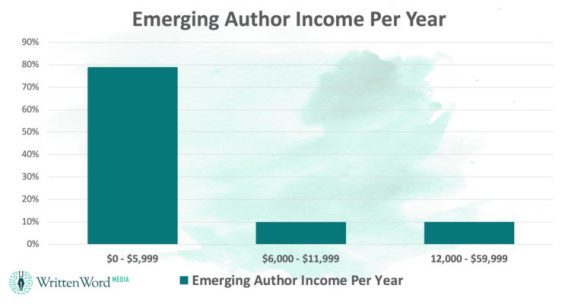
But first if you were curious about the amount of money an Emerging Author makes, take a look:

The difference between the emerging author and the 60ker. It’s quite a leap to be sure. If you’re single, you don’t need to make 60k to support yourself. At least in my area, you can get by okay on $30,000 a year. You’re not living in the lap of luxury, but a nice two-bedroom apartment with its own washer and dryer runs about $700/month. As an emerging author, even if I made an extra $300 a month, that’s a car payment on a newer car I desperately need. You can take a look at the graphic to check how much an emerging author makes.

EA-Income-768x400


Now for some of the reasons why one author would make more than another:

  1. Audiobooks. While audio is on the rise and it’s easier than ever to hire a narrator and get your audiobook out into the world, there’s no point in spending the money if the e-book isn’t selling. It makes sense to invest in audio if your book takes off, but if it doesn’t, there’s no point in spending the money to make an audio version. So while audio is a great supplement for 60kers and 100kers, they were already selling books and the audio is a complement to their library. Also, when audio finally fits into your publishing plan, indies now have their shit together and release the paperback, ebook, and audio all at the same time.

    Audiobook-s-768x560

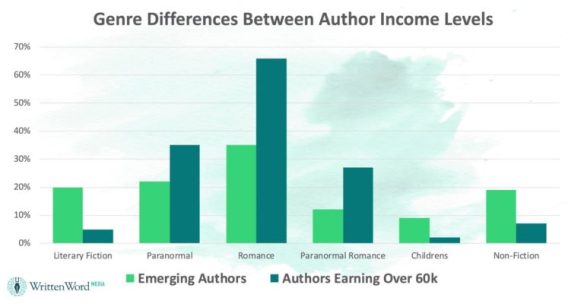
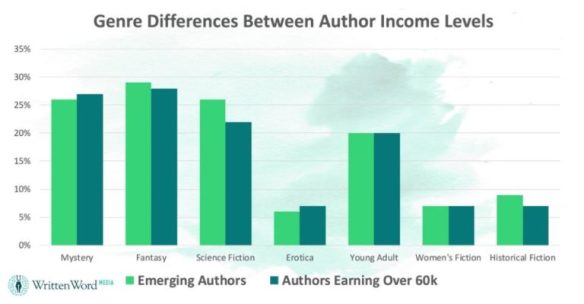
  2. Genre differences. I’m surprised they didn’t add this to the original survey because the genre you choose to write in is really important. As you can see by the graphics, authors made the most writing commercial fiction. Romance took the lead, and mystery, science fiction, and fantasy follow closely behind.

    Genre-Differences-768x400Genre-non-Differences-768x400
    Children’s books are a hard sell as they depend heavily on print, bookstore and library sales.

    Young adult is broken into lots of sub genres like fantasy and romance, and broken down further into sub sub genres like coming of age, new adult, or college. I don’t see many indies right now writing plain YA like Five Feet Apart or The Fault in Our Stars. They tend to lean more toward dystopian or fantasy like the Hunger Games or Harry Potter. At least, that’s what I get from seeing what others on Twitter are writing about. (Agents turned authors are the ones writing vanilla YA like Eric Smith’s Don’t Read the Comments. Maybe because they have their fingers on the pulse of the market and they’ll write what sells. Who knows.) If you look at indie romance YA, they tend to lean toward paranormal or urban fantasy. Paranormal Academy is hot right now and that usually includes a younger MC. It’s difficult to completely separate the genres, especially since indies like to mash as many genres together as possible.

    And with Amazon allowing you to choose 10 categories for your books, there’s a lot of space to move around.

    We can all agree that while you can make money writing nonfiction, it’s a lot different than writing fiction and it takes a different set of skills to market it. Authors like Bryan Cohen who wrote How to Write a Sizzling Synopsis, Mark Leslie Lefebvre who wrote Killing it on Kobo, and Brian Meeks who wrote Mastering Amazon Descriptions, all have solid foothold in the indie community and pretty much have a built-in audience. They’ve been a part of the indie community for many many years, and they have the platform required to succeed.

    In my experience many indies who venture into non-fiction write creative nonfiction also called memoir. Let’s face it. Everyone’s life is hard. I could write a book about how I survived my divorce, but that wasn’t anything special. I just joined the 50% of other American couples who also have divorced. Hardly book worthy. Unless you have something super special to say, it will be difficult to be the next Michelle Obama.

    Most emerging authors have no platform, and that’s what you need to get a nonfiction book off the ground.

    When you’re an indie, it makes a difference what you choose to write, and, not only that, what you keep writing. Genre-hopping has never done an emerging author any favors, either, something I am finding out subgenre-hopping under my Coming soon!-2contemporary romance umbrella. From what I can see, the most successful indies stay within the same sub-genre like Aidy Award and her curvy girls or Alex Lidell’s academy books. Even Jami Albright writes romcoms and makes a killing with her Runaway Bride trope.
    Mystery, too, is seeing more segregation with subgenres, and authors who choose to write run-of-the-mill detectives might always want to stay with that, only moving the setting to other states, different police departments, and other tragic backstories.

    Indies do like to go their own way, though, and I like to write the stories I like to write as well. Hopefully we can all find a happy medium between writing what we want in writing what sells.

  3. The last point they went into was if the authors had a job outside of their writing. It’s not surprising emerging authors worked. Bills need to be paid somehow. The problem with needing to work is that sometimes your day job is so emotionally draining you don’t have any emotional energy left to write. I’m lucky that I can write and read at my job and that it isn’t emotionally draining. But I do trade that luxury with a lower wage and only because I have help paying bills can I continue to do so. I’m working hard to write as fast as I can to build my backlist so I can eventually hop from emerging author to 60ker. Eventually the sacrifices I’m making to put so much time into my writing will pay off. I’ll make sure it does.

employment-1-1-768x384


Even though they did add some additional data, they did leave out some other variables that I find are important in making an author successful.

  • Newsletter. The survey mentions newletter swaps saying that swaps aren’t an effective marketing tool. But that’s only swaps. Swapping implies an author has one to begin with, and I’m willing to bet there is a large gap between emerging authors who don’t have a newsletter and the 100kers that do.
  • The cost of ads. While the survey did go into how authors promoted their books, it’s not often authors reveal how much they’re spending on ads. If you make $50,000 a year but you’re spending $10,000 in ads you’re still doing well obviously, but the amount that author is claiming to have made is a bit deceiving. Bryan Cohen, when he does his mini ads courses, says any profit is good profit. At the core that is true. But if you have to babysit your ads so you make $2.00 for every $1.75 you spend, at some point you have to decide if you’d be better off writing. Ad creation takes time, especially when you need to take the time to write (or learn how to write) catchy ad copy. If you start a newsletter and add the link and call to action in the back of your books and pay for a promotion now and then, you may find that a bit easier, and a little less terrifying, than learning an ad platform and watching your ads like a hawk so overnight you suddenly aren’t $50 in the hole because people hated your blurb.
  • Writing in a series. I hate to keep harping on this, but this is also another component that the survey didn’t go into. Readers like series. They get invested in the outcome. They fall in love with the characters they follow through all the books. 60kers and 100kers know that and they capitalize on it. Emerging authors write what they want, and that isn’t always a series. But I would’ve liked the survey to ask its authors how many emerging authors versus how many 100kers write series. I doubt I would be surprised by the answer.
  • Frequent publishing. The survey didn’t go into how often authors publish. It stands to reason that the faster you put out books, the faster you can make money. But emerging authors have a hard time with timely output. They have their jobs. They are probably still learning craft and the critique partner/beta-reading stages they go through slow them down. Besides Jami Albright, I haven’t heard of an author who is not prolific making $60-$100,000 a year. And she admits she has to rely heavily on ads and other marketing techniques between releases. She knows her limits and embraces them. But you have to wonder if she could write more than one book a year, what that would do for her bottom line. I write as fast as I can, but I am not 100% confident in my ability. So the beta-reading stage slows me down as well, as does making sure of consistency and wanting no potholes in my stories. Maybe one day I won’t need so much reassurance. But I’d rather do it right the first time than pay for my haste with bad reviews.

In conclusion, the money is out there. There are different paths to the pot of gold at the end of the rainbow. But whether anyone wants to admit it or not, some paths are easier than others. Write commercial genres. Publish quality work. Publish often. Start a newsletter. Use promos like Freebooksy and Bargainbooksy to promote your work.

If you’re not doing these things, success may take longer to come. We all make mistakes and maybe telling your story the way you want to tell it is more important to you than money. That’s cool too, but be honest. Writing the story you want, with no editing, using a cover that’s not professional, and tweeting it out day after day won’t earn you any sales. So no whining when it doesn’t.


Thank you for joining me in this blog series where we broke down the Written Word Media Survey and the bonus material they later released. I hope the information given can steer you in the right direction to a productive and lucrative writing career.

Thanks for reading!


end of blog post graphic

A Rocky Point Wedding Series Update

Hello from chilly Minnesota! I’m glad I’m a writer with stuff to work on, otherwise I don’t know what I would do while I wait for the weather to warm up. According to weather.com, we’re not looking at higher (and by higher I mean, actually comfortable) weather until the end of March, but if the temperatures they’re predicting for that time of Spring holds true, I’ll be one happy camper. (Not literally. I hate camping.)

This slideshow requires JavaScript.

Releasing this series is definitely giving me something to do.

I haven’t give you all an update for a while because I didn’t want to bore you, and I’m sure you all know I’ve been working diligently to get these done.

I just did the cover for book four. Books one and two are completely done. I’ve proofed the proofs, added the changes, tweaked the covers. Book three is almost done. I’m waiting for the second proof to come in the mail so I can look it over. None of the books are published yet, and I’m still wondering what kind of launch I want to have. Put them all on pre-order? Publish book one and put the others on pre-order? I’m not sure.

I do know I’m going to publish them three to four weeks a part and write like crazy on something else between releases. Whether I schedule those or drop them manually, I’m not sure yet. I don’t know if a pre-order will do me any good. I don’t have an audience, no one is really waiting for these. Book one isn’t going to create a huge splash, though I do plan to throw some money at it in some way, shape, or form. Since it is a series, and I have a little more faith in them than I do my trilogy (which is misguided, but it is what it is) I’m going to market these to an older audience and hope for page reads in KU.

Keywords for the Amazon ads will be important. I don’t want to target books written in first person. I don’t want to target books with young, coming of age/college-age heroines. My books have older characters (middle thirties) some of them dealing with divorces and second marriages. Some raising children as single parents. But I do have to find some middle-of-the-road comp authors because simply targeting Nora Roberts won’t work. Romance is competitive. I can’t spend a dollar a click to compete with other authors. So in the coming days I’ll be researching comp authors and putting together a list of authors and book titles to target in ads.

This is part of the reason why it’s important to be a voracious reader in your own genre. You need to know who you’re competing with. You need to know where your book fits in so you can target those readers.

82390680_955609938167440_479351314107596800_n

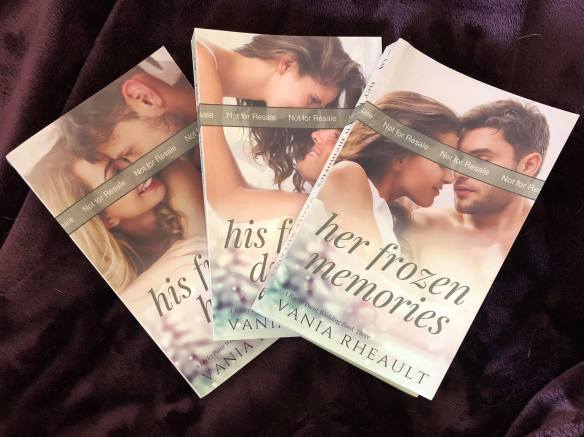
Ignore the cat hair on my bed. I know for book three I needed to zoom in more on the couple, and that was one of my tweaks besides correcting the typos I found while proofing the proof.

I did get some feed back from a FB Book Cover group and they did say that they like these. I’m always making sure (lesson learned) that my covers fit in with what’s currently out there. There are so many sub-genres now, and these are going to be categorized as small town romance along with the plain contemporary romance. Amazon will let you put your book into 10 categories, but you do you have to email or call them and ask.

I’ll be happy when these are done. I feel like I’ve been working on them forever, though it’s only been 13 months. A series is a pretty big undertaking–especially when you decide to hold them all until they’re done.

What am I going to work on next? I do have my first person stuff I need to finish for a spring release. I’ve been going over books one and two so I can write three and make sure I have all the loose ends tied up. This is more of a romantic suspense and as I edited I made a list of everything I needed to remember for the last book. These first person ones are a bit on the long side–the second one, after a first sweep of editing, is clocking in at a crazy 89k. It’s the longest book I’ve written.

It’s different writing in first person present, though I feel like I adapted my writing style to it without much trouble. The first book sounds a bit choppy, and while I was editing, part of that was smoothing out sentences and paragraphs to make them sound more conversational.

Otherwise, I don’t have much to report. My back/neck/arms are doing well. I’ve been having a string of really good days. But it does take a lot of maintenance on my part, checking in with my body to give it what it needs. I wear my elbow compression sleeves a lot, also my wrist splints. I don’t often wear them at the same time, though. I haven’t had to shovel much this winter, which has been a blessing as well, so I hope the weather continues to cooperate with me.

Anyway, that’s about it for now. I’ve been having a lot of fun with the Written Word Media survey and dissecting that as a new author. I’d like to do more youtube videos about book covers, too, but it’s hard for me to find quiet time. I have to threaten the kids to leave me alone for an hour. They ignore me any other time, but when I want to record, they’re all up in my face. Goofballs.

I hope you have fun weekend plans! Catch you here next time!


end of blog post graphic

Sometimes to get your issues worked out, you have to get on the phone. And trust me, I know how much that sucks.

woman wearing purple shirt holding smartphone white sitting on chair

She looks happy–she must have gotten her issues worked out. Photo by bruce mars on Pexels.com

As a business owner, you have to do some things you don’t wanna do. Switch graphic artists for your covers if yours isn’t working out. Fire your virtual assistant if you’re paying them to hang out on Facebook instead of doing what they’re supposed to do. Running your own business can be unpleasant. And one of those unpleasant things is having to make a phone call.

You all know I’m right. Calling sucks. But it’s so much more efficient than sending an email or doing, you know, nothing, and complaining about your issue instead.

We all have a love hate relationship with Amazon. Love them for letting us get our books into the world, hate them for making the process difficult (I’ve heard lots of complaints about KDP vs. CreateSpace and printed author copies that don’t look good, to name a couple of issues). But you have to take the good with the bad, and well, not having gatekeepers is pretty damned good, I say.

But you definitely have to deal with the bad, and I had to call this morning to figure out what in the heck was going on with my ISBN numbers and my imprint.

I bought a pack of ten ISBN numbers not long ago. I am the publisher, because I’m me, but I also have an imprint I created with mystery/thriller author D. R. Wills. Not only is he a fellow writer, he’s my fiancé and we’re getting married next year. That has nothing to do with the story, I’m just happy.

Anyway, we’ve had this imprint for three years, and I’ve published all my books under it just fine until yesterday.

I’m trying to upload my files for books one and two of my series and order proofs. It’s a common thing for us indies, right? But I had to call this morning because I kept getting a warning/error message saying that my ISBN does not match my imprint. Why this is happening now, I have no clue, so I called KDP, or rather requested they call.

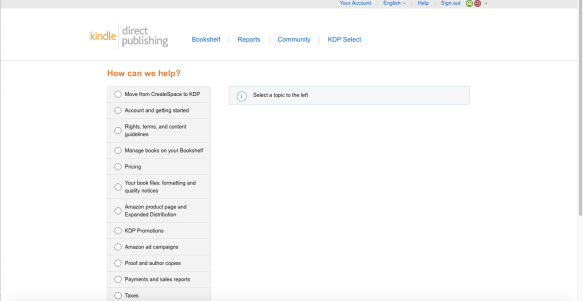
This is where you look to get a call back:

Screen Shot 2019-12-18 at 10.46.31 AM

Click on the unhappy face in the upper left hand corner. I go this route so you’re still in your bookshelf in case you need to reference something while you’re on the phone.

Screen Shot 2019-12-18 at 11.14.26 AM

Click the contact us.

Screen Shot 2019-12-18 at 10.46.53 AM

Choose the best way they can help you.

Screen Shot 2019-12-18 at 10.47.07 AM

I chose ordering proof copies because that was one of my concerns, but they’ll help you with anything once you get them on the phone.

kdp contact me screen

If you choose CALL ME RIGHT THE F NOW, be prepared for them to call you right away. I was still untangling my earbud cords when my phone rang.

All the reps there are very polite, and you should be polite too. It goes without saying that the rep who is talking to you is not responsible for the problems you’re having with your books. Remain friendly, and they’ll be friendly in return. And besides, who knows how they can mark up your profile. You don’t want them noting your account that you’re a big dick because then other reps won’t be so happy when you call in with something else that needs attention.

Anyway, so I did ask about why I wasn’t able to order my book proofs right now, and he said they were having system issues and no one is able to order proofs or author copies at the moment. He said they had techs working on the problem, but I didn’t ask if he thought he knew when the issue would be resolved. I figured it’s Christmastime, and I’m not going to bother to order proofs until after the new year. There’s no point in banging my head against the wall.

Then I asked him about my imprint issues. I bought a pack of ten, and listed the imprint as Coffee & Kisses Press. I’ve been publishing this way for three years, and never had a problem until now. When I talked to Kyle at KDP, he said my imprint name is actually my name. He suggested I call Bowker (My Identifiers). So I did and was amazed I didn’t have to wait on hold forever. The rep at Bowker said that the reps at KDP have limited information, and they see my name as the publisher name and that’s all. So if I really need to list my imprint name as the publisher, I need to screenshot my account information on Bowker and send it to KDP.  I asked him if I would have to do this for every book I publish and he said yes.

Now, I know you’re going to ask me two things:

  1. Why am I still buying my ISBN numbers instead of a new Coach bag, and
  2. Is having my imprint listed as the publisher really that important?

The answers are simple, my vices are chocolate and champagne, not purses, and no, it’s not that important.

I buy my ISBN numbers for the protection I feel it gives me and my work. I know some authors do the copyright thing, some don’t do anything accept take the numbers Amazon gives them, press publish, and walk away. But I want some control over my work, so I protect my books with ISBN numbers. I don’t know if this makes a lick of difference, or if I’m just wasting money, but I’ll probably always protect my books with ISBNs. I don’t apply for copyright . . . I email myself as a backup, and go with the “poor man’s copyright” that way. But at least there is a record that the work is mine, and I paid to have that work be considered as mine. In some other countries, it’s not even an issue. Like Canada, for example, ISBN numbers are free. It’s the United States that has to make everything for-profit, or this wouldn’t be a problem. It’s the fact that they are so dang expensive, too, that makes it hard for authors to afford them.

It doesn’t make that much of a difference who is listed as the publisher of my books. I’ll keep the imprint on all my stuff. That won’t change. And Coffee & Kisses Press is listed at Bowker as my imprint, so officially that hasn’t changed, either. Sometimes you just gotta lose a few battles to win the war.

Anyway, so I got the answers I needed, and for now my series is stalled out. I’m waiting for two betas to get through books three and four, I still have Autumn’s blog posts to write, which I will this weekend at work, (though I may not get through all of them), and proofing the proofs is really important to me this time around though I don’t know why. I’m just going to keep listening to my gut.

And what does this mean for paperbacks? I know Amazon’s preferred method is Kindle books. And not just Kindle–they love it when you’re in KU, and they love readers who read books from KU. Author copies and paperback sales may not mean that much to them. Especially since that’s the old-school way of doing things, and Amazon is all about moving forward.

Some indies don’t bother with a paperback version of their book, and that may be a decision more indies are going to have to make as time goes on.

So what can we learn through all this?

  1. Have patience. Sometimes that’s hard if you’ve promised a release date to your readers, but the fact is, things happen. Keep your schedule flexible, or having your publishing date a ways into the future so if you hit any snags your release date won’t be affected.
  2. Call if you need help. Calling took me five minutes, and he told me what I needed to know. It was easier than emailing, and it was a lot easier than just stewing about it. And you can pass along the information once you have it. The first thing I did was tweet it out, because you are probably not the only one wondering what is going on.
  3. Dealing with unpleasant things is part of being a business owner. Can’t get around it. Creating is fun, but we must take our creative caps off at times and put on our business hat.

Hopefully what I found out has helped some of you. If you’re having an issue uploading your files and you’re getting an error message about your ISBN and imprint name, more than likely they have your name listed as the imprint name because you are the publisher. I changed my imprint name from Coffee & Kisses Press to Vania Rheault in the imprint field in my KDP dashboard, and it all worked.

Lesson learned for future books.

I’ll have one more blog post on Monday, and then I’m going to take a small break for the holidays!

Have a good week, everyone!


end of blog post graphic

Being a Career Author. Do you have what it takes? Part 3

Hello writers and authors! This is the third blog post in this series that is exploring the findings in an author survey conducted by Written Word Media, the company that brings you Freebooksy and Bargainbooksy and other promotional tools.

You can read the intro to this blog series here and read the second part about how much time career authors spend writing here.

The third thing this survey found about these authors is that they invest in professional editing.

hand holding red pen over proofreading text

Editing can be costly and scary, but it’s much needed by every author.

Remember, emerging authors have six books in their catalog, have never made more than 60k in a year, and spend on average 18 hours a week writing.

60kers have 22 books in their catalog, and, on average, spend 28 hours a week writing.

100kers have 28 books in their catalog and spend, on average 32 hours a week writing.

As we can see by the graphic below that accompanied the original survey, all three kinds of authors use a professional editor the most. But when it comes to editing, new authors have it tough. We’re not making money yet, but we never will if we’re not selling a good product.

Marketing-Is-Hard-3-768x494

And while technology makes it easier than ever to find typos (thanks, Grammarly) technology makes it easier for readers to complain. When you read a book on a Kindle, for example, a reader can highlight a typo or mistake and report it.

Crazy, huh?

It stands to reason a well-edited book will earn you more money in the long run. But when you have no money, it’s hard to come up with the fees.

Not to mention, there are different types of editors, and you may not understand what kind you need, and the cost can add up if you need more than one kind.

If you’re a new writer, you may want to invest in a developmental editor. They’ll weigh in on character arcs, character development, plotting, and pacing. Readers aren’t going to like a book with flat characters and plot holes. Learning craft is hard, but you may only need to hire a developmental editor once to steer you on the right path for the rest of your writing career.

A line editor is different. They check facts (does your sun set in the west and rise in the east?), word usage, and syntax. They’ll correct you if you used the word sporadic when you meant erratic. If you’re not good with details, this kind of edit can help you a lot. I still use advice and tips I learned from the people who beta read and edited my earlier books. I used a lot of garbage words and learned how not to echo words in the same sentences and paragraphs.

Proofreading is a quick read through of the book as a last step for typos, missing words, etc. before publication. This is also the cheapest kind of editing.

If you can afford editing, make sure you ask for a sample first. The indie community is full of people charging for services they have no business providing because they don’t know what they’re doing. Be smart. Reedsy offers a list of professional editors, as well as Joanna Penn.

As for me, as I said above, early on I asked for lots of feedback and I took a lot of their advice. My first beta reader, Joshua Edward Smith, gave me invaluable advice that I still use (and I still laugh over some of my mistakes and his comments).

These days, against popular opinion, I do a lot of my own editing. I have nothing in my defense except that so far I’m not making a lot, and it’s hard to justify the expense. I do use beta readers, and they’ll look for typos for me after I run my manuscript through Grammarly.

2019-11-24You could argue I’m not making any money because my books aren’t edited properly. Maybe. But I’ll use this reasoning instead. Remember Alex Newton’s K-lytics report from one of my previous blog posts? I prefer to blame the saturation of the industry. Shh! I don’t spend much on marketing, so I would prefer to think people don’t know my books are out there.

Can you get by without an editor?

That depends on where your skills are with the craft, how much writing you do, how much feedback you listen to and apply. It depends if you can catch all your own typos, or if you know enough to use Grammarly effectively. (Not everything Grammarly flags needs to be fixed, so you can’t trust it blindly.) Usually the answer to those questions is no.

Would I advise a new author to publish without an editor? Nope. There’s no denying a book will sell better with a strong plot, three-dimensional characters, great grammar and punctuation than one without those things. And if you’re a new author, you’re unlikely to catch all those things on your own, or even know what to look for while editing.

You can building a writing career on a bad book, but it will take you longer than if you start strong.

What can you do?

  1. Join a writing group on FB and swap with someone in your genre. Just be careful and have a thick skin. Ideally, you’d want to form relationships with people in those groups before you ask. At least if you’re more than acquaintances they’ll hopefully be kind and actually be helpful. People can be cruel, and some just like to tear others down out of their own self-esteem issues, or they think they’re better than everyone else. You may need to pick through a few people before you find a good match. Twitter is also good if you search #betareader with maybe a hashtag of your genre. There’s been lot of activity on the hashtag in the past six months or so. Just look for someone who will be willing to give you some real and useful feedback.
  2. Do what you can on your own when it comes to craft and grammar. The cleaner your manuscript when you hand it off, the less time an editor will have to spend on it, and that can cut down on costs. There are a lot of books out there that can help. Two of my most favorite books are James Scott Bell’s VOICE: The Secret Power of Great Writing and Grammar Girl’s Quick and Dirty Tips for Better Writing. Sit down and read it just like you would any other book. Mignon is funny and very easy to understand. She didn’t write it like a reference book, and you’ll be amazed at what you didn’t know. Another good editing book that everyone at the Santa Barbara Writers Conference I attended a couple years ago said was a must have is Self-Editing for Fiction Writers. How to Edit Yourself into Print. 
  3. Publish on WattPad for feedback. I don’t really condone this, as I feel that if you’re going to use the platform as a publishing site, putting up work only to take it down to publish it elsewhere might not sit well with your readers. On the other hand, I’ve heard from other writers that do this, and it seems to be an acceptable thing. If WattPad has turned into kind of a testing site for books and stories, then I’m not one to say anything. It’s something to consider at least, if you think a plot isn’t working, or you want general feedback overall.
  4. Keep an open mind. When you ask for feedback you need to keep an open mind. I hear some writers say they would never change their plot/characters/POV whatever based on feedback alone, yet they say they’re querying. A book being published without needing edits is almost unheard of, so if you’re querying without an open mind, you’ll never get published and you’re wasting everyone’s time. If you are honest and know that you’re not going to take people’s valid opinions into consideration, you’ll never grow as a writer. There is always room for improvement.

This wraps up the editing portion of the survey. Smart authors get their books edited/apply feedback, and the authors who don’t will deal with the consequences (ie, bad reviews and poor sales).

Next up, the survey asks about book covers and what the three levels of career authors do in that instance.

See you then!


end of blog post graphic

Launching your book. Is there anything you can do to have a great launch?

your book launch

I have to get this disclaimer out there: I suck at launches. I hit PUBLISH and kind of move on. In fact, this goes in line with what Andrea Pearson says on the new 6 Figure Authors Podcast with Lindsay Buroker and Joseph R. Lallo. She recommends not bothering to market until you have at least ten books out.

As I found out being $70 bucks in the hole doing Amazon ads for The Years Between Us (I still haven’t updated that blurb, dammit!) sometimes spending money on marketing and advertising is just a waste of money that you may not ever get back.

But sometimes you wanna throw a little money at a new book, and maybe if you can hit the right notes it can take off and Amazon might show your book some love. That chance is getting smaller and smaller because of the competition, but it never hurts to try. You might get lucky.

Launching can take some planning, so I’ve been mulling over ideas. Because only half the books are edited, I don’t have blurbs or titles yet, and I only have basic concepts for the covers, my launch is going to go into next year. I’m a little embarrassed since I’m 18k into book 2 of my SUPER SECRET PROJECT trilogy, and I’ve been spending more time writing that than I have working on my series. That’s what you get when you chase after the shiny objects. 

When we talk about launches, probably the top two things seasoned authors will tell you is to announce it to your email list and reach out for newsletters swaps.

I can’t do this because 1. I don’t have a email list, and 2. because I don’t have a newsletter (email list) I can’t ask around. I mean, I could ask, but I would have to be clear that I cannot reciprocate. So I’m reluctant to ask because swapping implies doing it in return at some point, and I can’t. To me it would feel like asking for favors, and I don’t like owing people.

If you don’t have a street team, email list, or friends to help you out, what can you do? The only options are then to fling some money at your book.

But first, before you shove money at it, try to get some reviews.

This is my tentative plan when I have my series ready to go:

  1. Put my book on BookSprout before I put the ebook in KU. You can publish your paperback ahead of your Kindle book. Reviewers can’t put up a review on a preorder so the way authors are getting around this is publishing the paperback before the Kindle book. That way, when you do publish your Kindle book, it will have reviews. (You may have to contact Amazon to have them linked up to make the reviews show up for both versions.)
    In a previous blogpost, I questioned the quality of the reviews from BookSprout, but you have to weigh what you need versus what you want. If you can grab four or five reviews from them at least you have something to get your book off the ground. Some readers won’t read anything that doesn’t have a review. And if you have only one book out and no one knows your name, your chances of a reader picking up your book without reviews is even lower. BookSprout will offer your book to 20 ARC readers for free. If 25% of them leave a review, you can publish your Kindle book with a few stars, at least.your book launch (2)
  2. Buy some promos. I want to have my whole series published when I do this. That way the promo for book one is actually going to be for all the books in the series, and I’m hoping for some serious read-through.
    The two places I’m going to try are: Red Feather Romance. This is a promo site run by Written Word Media who also offers Freebooksy and Bargainbooksy. I’ve tried both of those before, and I’ve had better luck with Freebooksy. But I tried Bargainbooksy on a standalone, and I’ve come to realize marketing a standalone is not cost-effective. Ereader News Today. I haven’t tried this service, but other authors swear by it. I like trying something new every time I release a book, if anything, just so I can blog about it.When you look at promo sites, make sure before you apply that they don’t have a minimum review policy. Some don’t, some do, so it’s best to be sure you don’t need 10+ reviews before you apply for a promo. It saves time.

    Also keep in mind your publication date. Popular promo sites book out a couple weeks in advance. If you’re launching  your Kindle version on January 10th, you may need to rethink it if you can’t get a promo date until February.

    This brings up the subject of release pricing. I think I’ll release the first book in the series at .99 and release the other books at 2.99.  I’ve tried 3.99 and that seems to be too high. When you’re releasing into KU, price doesn’t seem to matter as much because you’re going more for the page reads than you are sales. If you’re wide, price matters a little more, and then you have to research in your genre what other books are going for.

  3. Ads. I may still do some Amazon ads a few weeks after the release of book 4. That might keep my sales and page reads up after the 30 day drop off when I run out of books to release. I’ll have my SUPER SECRET PROJECT close to being done, probably, but that will be under a different name so I won’t have the power of this release behind it. What little power there might be.

your book launch (1)

I’m being realistic with this launch. My kind of books are not what’s selling right now. You might wonder how that’s possible, because romance is romance. But if you take a look at the top ten, only three of them are written in third person past, and one of them is from Nora Roberts. I don’t count her.

  1. Dirty Letters by Vi Keeland and Penelope Ward: 1st person past
  2. The Family Journal by Carolyn Brown: 3rd person past
  3. Crazy for Loving You: A Bluewater Billionaires Romantic Comedy by Pippa Grant: 1st person present
  4. Havoc at Prescott High (The Havoc Boys Book 1) by C.M. Stunich: 1st person present
  5. A Nora Roberts reprint from 2009: 3rd person past
  6. No Broken Beast by Nicole Snow: 1st person present
  7. Winter Cottage by Mary Ellen Taylor: 3rd person past
  8. My Big Fat Fake Wedding by Lauren Landish: 1st person present
  9. Insatiable: A Cloverleigh Farms Standalone by Melanie Harlow: 1st person past
  10. Stealing the Bride by Nadia Lee: 1st person present

You can dig deeper down the list and keep counting, but that small sample is enough for me. I’ve blogged about this before, too, how I think that 3rd person past is going out of style, and after my wedding quartet, I’ll have to decide if it’s even worth writing anymore. I mean, there’s no telling when 3rd person past might come back around. Everything circles around if you give it time. But you also have to resist banging your head into a brick wall trying to sell books readers don’t want.


Anyway, I’ve talked enough about my launch plans. It seems the best plans will incorporate a little teamwork by way of newsletter swaps, but it puts you in a hard place if you don’t have one of your own.

If you find this is the case, you can be stubborn like me and keep doing what you’re doing, or you can start a newsletter, and realize that it’s going to take you a couple years to build a list of readers where you can tell them about your releases and other books you enjoy. Also, there’s no time like the present to reach out and make some friends in your genre. If they’re your friends and want to help, maybe they won’t ask you for anything in return. Some people out there are still nice. Just be careful not to take advantage.

Got any other launch ideas? Let me know!


end of blog post graphic


Is your book fitting in where it should be? Find out by using Yasiv!

A really cool way to figure out if your book is fitting in with others in your genre is using a site called Yasiv.  You put in the ASIN of your book, and it will pop up books that are related to yours–if readers of that genre have been buying your book.

If your book is not connected to others in your genre, then the right people (your audience!) are not reading your book.

I’ll show you what I mean:

This is Stuart Bache’s book about making book covers, The Author’s Guide to Cover Design. He’s a popular cover designer and wrote a book about cover design. He did an interview on Joanna Penn’s podcast a bit ago if you want to listen to it.

Anyway, it’s a good selling non-fiction book, and if you look at the books his is connected to, he’s found a good foothold in the non-fiction for indie authors arena.

2019-10-29

This is also a great way to find other books you’re interested in. There are a few in this graphic that I wouldn’t mind reading. But I also see a ton of books that I have read as well.

Let’s try with a fiction book.

2019-10-29 (1)_LI

Don’t Run Away is on the outskirts of all these romance books.

Though my book is low in the rankings right now because I don’t promote it, at least steamy contemporary romance readers are reading it.

What else can you get from using Yasiv?

You can see if your cover is cutting it with others in your genre. This is a great tool to use as research to make sure your cover is going to meet reader expectations of your genre.


What can you do to get readers reading your book?

Buy a promotion. You need to get your book in front of readers (and not your friends!) and buying a promo is the best way to do that. Use a free day if you’re in KU and set up a Freebooksy promo in your genre. It may cost a little bit to give your book away, but it’s better money spent than wasting money on ads if you don’t know what you’re doing. (Plus I always see a little bump in KU page reads so you may not completely lose out on your promo fee.) I lost 70 dollars on ads for The Years Between Us. That money may have been better spent on a promo instead.

Freebooksy has lots of genre categories, and you can look here for the complete list.

Another popular one is E-reader News Today. I haven’t tried this service, but I have a release coming up and this is a service I’ll try.


Anyway, this is a fun little tool to help you find where your book is fitting in, and also finding books to read that are connected to your favorites.

Other articles about Yasiv that you can take a look at:

Using YASIV to understand your market and improve your marketing

Finding Readers with Yasiv

Tell me what you think!


end of blog post graphic

Author integrity, where I’m at with my series, and what’s going on for the rest of the year.

Author integrity and what building a brand means.

I got some bad news this weekend. An author friend of mine, who has been saying (for quite a while now) she’s rewriting her first book posted on social media that she has decided not to. She’s rebranding, and the old book will be republished under her new pen name, cover, and reformatted interior. I was bummed, and I’m sure I’m not the only person she let down.

When we start building our businesses and start thinking about author brand, we think right away about our website, our logos, pen names, and everything in-between. But building a brand is more than the color palette we’re going to use on our website. Building a brand is letting readers (i.e. the public on social media) know who we are as people. Are we honest? Do we do what we say we’re going to do? Do we treat our peers with respect? Do we run our businesses with integrity? Do we have follow-through? I see plenty of authors who like to be jerks online. They say people are too sensitive, or people are too easily offended, and that gives them an excuse to say what they want without regards to other people’s feelings. I see authors publish without follow-through. We write the first book in a series or trilogy, publish it, then nothing. For years. Or authors who release less than stellar books and then get upset (sometimes online by way of responding!) when their reviews reflect that. That does not inspire loyalty from readers, and doing something like that won’t build a readership.

honest

Building a brand is showing people who we are. We want to inspire trust. We want readers to know that if they buy one of our books, they know what they are going to get. Quality. A good story. Authors like Stephen King and Nora Roberts are household names for a reason. Even big named indies like Melissa Foster and Mark Dawson have created brands that a lot of us can identify just by hearing their names. Their names bring to mind who they are as public figures and as authors.

You’ll lose readers if you aren’t kind and honest, don’t produce quality work, and don’t have follow-through. Keep your promises. Be a professional.

I love this quote by Rachel Hollis, author of Girl, Wash Your Face and Girl, Stop Apologizing:

integrity quote by rachel hollis

Your brand is your business, and your business will sell your books.

I wish my author friend well. I wish her lots of success.

If you’re interested in reading Rachel’s books, Girl, Wash Your Face is right here, and Girl, Stop Apologizing is right here.


Where I’m at with my A Rocky Point Wedding series.

I sent books one and two to the proofer/beta reader. He’s going to tell me how they sound and if there’re any typos. With these books I’m cutting out a couple of editing steps, but adding one I haven’t done for the past three books. This time I will proof the paperback proofs as they come in. Hopefully that will make up for the two I’m skipping.

I’m done editing book three. It’s sounds great, and the only thing I did so far is deleting sections that don’t fit/slow down the flow and finding typos. I must have been feeling good when I wrote this book, or I liked the characters a bit more, because this couple is punchier than the other two. Ivy’s got an attitude, and I like her very much. Here’s a small snippet of something I came across that made me laugh:

“You’re going on the sleigh ride with us, aren’t you? I don’t want you to be hungry, and there’s not enough time to go home first. Come on, we’re meeting in the dining room.”

He looked good in jeans and a dark blue sweater. His blonde hair glinted in the sunset sparkling in from the huge windows that overlooked the slopes. Logan had always hated his glasses, but Ivy liked them. They made him look smart and handsome.

That hadn’t changed.

“I can grab something in the kitchen. It’s where I take my breaks, anyway,” she said, crossing her arms in front of her chest.

Logan scowled.

Ivy enjoyed it.

He’d paid for her time; she didn’t have to make it easy on him.

He sighed. “Please?”

“Honey, don’t turn down the pleasure of this hunk’s company,” Lola said, nudging Ivy’s shoulder.

“You don’t even like men,” Ivy said.

“Doesn’t mean I can’t appreciate the finer of the species,” she said, winking a heavily made up eye with silver sparkly eye shadow and a million coats of mascara.

Ivy glared at Logan. “Fine, but that doesn’t mean I’m happy about it.”

When she went to the stockroom for her jacket, she heard Lola say, “She’ll come around, honey. She doesn’t date much.”

“Much?” Logan asked, and he sounded way more interested than he should have been.

“Okay, none. She needs a little fun, and a little fun.”

Ivy could picture Lola leering.

“Oh, I’ve got that covered,” Logan said.

Dammit. He could charm an Eskimo into buying ice.

“That’s enough,” Ivy snapped, stomping out of the stockroom.

Lola whistled. “Honey, you ain’t got that covered enough.”

“I’ll keep working on it,” Logan said, laughing. He took her arm in a strong grip, and Ivy let him lead her out of the lounge.

Book four will take a little more work since I haven’t looked at it since finishing it a few weeks ago. The time away will help me find what needs fixing, but I doubt I’ll get it to the proofer before the holiday stuff kicks in.

I’m not in any hurry to get these out. I did plan for book one to be released around Thanksgiving, and I don’t see that as an issue as long as everything stays on track. I don’t want to have too much time between releases, but my timing might just be a little off. It depends on how fast my proofer goes, as well.

A little side project.

I am doing a little side project to keep me sane while I edit. I write that in longhand at work then when I get tired of editing my wedding series, I transcribe what I have so I can start fresh the next day I work. It’s been working really well and will be the first book I’ve written completely in longhand.

It makes the editing tolerable, and I’m already 51,400 words in.  This is something I’m thinking of publishing under a pen name, and it won’t be out until my series is fully released. So maybe in the spring. I’m not sure. It’s already plotted out, and it will be a full-length novel trilogy.

It’s fun trying a new direction!


Thanks for stopping in. I’ll be talking about change and being in uncomfortable situations.

Have a productive weekend, everyone!

end of blog post graphic

Market or Write? If you have only one book written . . . write another book!

When I did Bryan Cohen’s 5-day ad challenge, he did some Facebook live events where he would help us in real time with any questions we had. While this challenge was tied-in to him selling his course, I still can’t believe all the work he put into the free mini-lessons, and I’m very grateful.

Anyway, I would watch along with everyone else, picking up tips where I could that would apply to my own books.

After a few of these videos, I realized something . . . so many people were worried about the fate of their ONE BOOK.

Don’t get me wrong, having written and published a book is fantastic. It’s a feat many people say they want to do, but hardly anyone does. If you’ve done that and are trying to sell it, you’re already one step ahead of 98% of everyone who wants to write a book but never does.

The problem with this, though, is that if you’re only selling one book, if you’re taking courses, learning ad platforms, listening to podcasts about book marketing, doing anything that takes away from writing your next book, you’re BEHIND 98% of the writers who are concentrating on building their backlist.

I keep up with publishing news and what’s changing in the industry; which small presses are closing, what Amazon is up to, what Draft2Digital is offering next. Ads are a little bit different. What you know today might might be different than what you need to know tomorrow. In fact, as an example, Amazon changed the way their ad platform looks right as Bryan was done with his 5 day challenge! What he taught us was still invaluable and we could put that into practice, but his segment for visual learners was almost irrelevant the minute the course was over. Anyone watching the videos would be confused because the platform doesn’t look like that anymore.

One day after his course ended! Jeez.

What I want to explain going into that is, if you’re learning an ad platform for one book, you’re wasting time when you could be writing another book because by the time you need to know it for book two, it could be already changed.

But, you’re saying, maybe it’s not a waste because their book will sell with ads.

Sure, maybe it will. If you have a solid stand alone with a good cover and a good blurb, you might make some sales. 

BUT, raise your hand if you have only one book in your backlist that

  • is a novella
  • is the first in a series but you don’t have any of the others written yet (and have no idea when you will)
  • is a mishmash of genres and you don’t know who your audience is
  • is written in a genre you’re not sure you’re going to stick with
  • your book is wide

If you have an only book that is any of those above, you are better off leaving ads alone and writing another book.

the best marketing for a book is to write another.We’ve all heard that writing the next book is the best marketing there is for the first one. It’s not just the writing, it’s social media/networking, too. When you’re on social media sharing snippets, you’re blogging about your writing process, who your characters are, etc, you’re doing more than promoting one book. You’re laying a foundation of being an author. Readers will know that you’re planning to write for a while and they’ll feel more comfortable investing their time in your book(s).

It would be interesting to know how many books on Amazon are singles and their authors aren’t planning on anymore. They’ve walked away for various reasons. Maybe you don’t plan to walk away, but a reader isn’t going to wait three years for a book 2, either.

The number of books you need to make traction rises every year. When I started out it was three. Now, the latest statistic I’ve heard is 6-10, and that was last year. This year? I’ll safely assume that you need 10+ books in your backlist before you see any kind of movement toward actual sales. Learning ads is a big part of this, of course. But the time you spent learning and the money you spend experimenting could be going toward your backlist.

I’m a member of the 20booksto50k Facebook group. Michael Anderle came up with the idea that that if you have 20 books in your backlist you should be able to make 50k a year in sales. He does some math, and I won’t get into that now. It’s an easy concept to buy into. I rather like thinking that after my quartet comes out and I’ll have 10 books in my backlist, that I could potentially make 25k a year in sales. That would change my life.

It’s definitely something to work toward.

But you can’t make that a goal if you’re going to waste time marketing one book.

james scott bell marketing

Click on the photo for a link to the book. It’s a good read and worth your time. 

James Scott Bell has a great book out right now called Marketing For Writers Who Hate Marketing: The No-Stress Way to Sell Books Without Losing Your Mind. In it, he talks a lot about marketing books, (and I did say this in my review on Goodreads) and he does spend a great deal of time talking about writing. Write the next book, and the next and the next and the next. In my review, I pointed out, well, you gotta learn how to market at some point, or you’ll have a big backlist and no one reading it.

I think that’s true. Natural momentum only goes so far.

And while I’m happy to spend some money on ads, to try them out, get a feel for them, I have six books in my backlist, I have 4 more coming out in the next couple months, and I’m 30,000 words into a secret project.

My writing time is not taking a hit.

It’s a mindset. There’s no harm in getting your feet wet. There’s no harm in being curious. But when you publish a book you’re not a writer anymore, you’re a business person filling a need (readers of your genre). Remember that when you’re selling one thing in your store, and you’re spending money on ads.


That’s all I have for today! Likely, my blog posts will be hit and miss for the rest of the 2019. I’m editing my quartet and books one and two will be off to the proofer soon. I have three and four that I’ll be diving into soon, and my secret project is well under way.

I love to share whatever is on my mind, though, and I’ll try to keep up my posts!

I’ll be updating you with my Amazon Ads adventures over the weekend. Let’s just say . . . it’s been quite a ride, and not all together inexpensive, either, but that’s what you get, I suppose.

All of Nothing ebook coverI can share this little bit with you . . . All of Nothing, before I started Bryan’s 5-day ad challenge was at 81,xxx (dont remember the exact number) in the Amazon Kindle Store. Since promoting it with ads since September 20th, it’s at 16,399. I know rank doesn’t mean much, not really, but it is kinda cool to see people are reading it.

I think the new blurb and cover have made all the difference!


Until next time!


end of blog post graphic

October is Prep for NaNoWriMo. Why I don’t participate.

Fall in Minnesota is my favorite time of year. The temperatures cool, the leaves start to fall, and the bugs die. The last is very important to my well-being. Haha. Seriously though, we get a couple sweet weeks of no bugs, and mild enough temperatures that you can still enjoy time outside.

I went for a walk with my sister last night, and the latter half the walk was in the dark since the sun sets so early now. But we saw a couple deer, lots of rabbits, and generally had a nice coffee walk in about 48F degree temperatures.

nanowrimo logoOctober is also NaNoWriMo prep month. It’s the month when writers who are going to participate in National Novel Writing Month plot their books, do their research, make character sheets, anything they have to do to write their book as quickly as possible in the month of November.

I participated once. And while I was a newbie writer at the time and that was probably more of the reason why I wrote a crappy book, doing so on a timeline didn’t do me any favors, and I’ll never participate again.

But that’s not the only reason. Everyone needs to make their own choices with their writing schedule, their publishing schedule, and what they want to accomplish, but let’s take a moment to go over a couple reasons why NaNoWriMo may not be an answer to a writer’s prayers.

  1. Craft gets lost.
    If you have the motivation and skill to write 50,000 words in a month, you don’t need the the contest to spur you on. If you’ve got the craft thing down already, maybe craft doesn’t get lost when you write, and that’s great! But there’s always a question of quality when a writer who is new at this decides to participate. You don’t have time to think about how sentences sound, where your paragraphs are going, if your scenes are relevant to the story, what the theme of your novel is. Writing is already hard enough as it is, and putting a deadline on it makes it worse.
  2. Lots of writers will abandon a current project to start something new.
    This is a tough one because not everyone writes to publish or query. I’m not the type of person who likes to have three different projects open. I adhere to writing and publishing schedule. It’s the only way I can make any headway at all. Dropping everything to start a new project to write for NaNo would derail everything I’m trying to accomplish. I get distracted by new things, too, but I try to keep that under control and finish my current projects. I don’t think I’d have as many books out as I do if I let myself write whatever I wanted whenever I wanted. I understand not everyone is hardcore about this writing thing as I am, and that’s okay. But 30 days of writing something new is still 30 days of time, and in 30 days I can do a lot that will actually move me toward my goal.
  3. It makes us question what a “book” is.
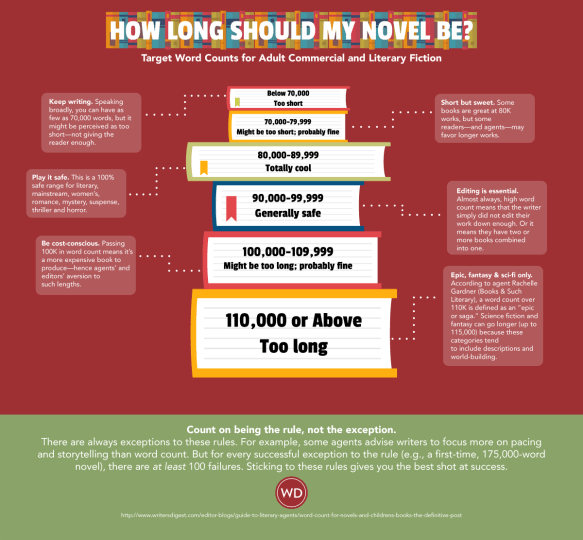
    Let’s be honest. I mean, really and truly honest. 50,000 words, in most genres, is not a novel. It’s a good start to a novel, say, in high fantasy, or women’s fiction, but for the most part you can “win” and still not have a finished book.

    how long is a novel graphic

    Click on the graphic to read the corresponding article by Chuck Sambuchino at Writer’s Digest.

    If you have trouble with subplots and character development while meeting the ideal word count, I don’t recommend trying to write under a deadline. Not always, but you can run the risk of having a full “novel” in word count, and it being incomplete in other ways. This is especially important if you ever want to query this book. Fully-developed plots, subplots without loose ends, full character arcs, and a spot-on beginning and ending are all things agents are going to require to sign you and your book.

  4. You’ll probably have a lot of editing to do afterward.
    This is a personal preference, of course, but I would rather spend a little more time writing and a less time editing after the fact. Editing is hard. Especially if you have to rip the book apart because you wrote yourself into a corner and there’s nothing that will fix it except scrapping the second half of your book, for example. Weaving character motivation and character growth into a book is hard enough as it is without having to go back and fix scenes.
  5. You shouldn’t have to depend on the NaNo energy to see you through a project.
    Most writers I know who participate, participate because they like the energy and the camaraderie. It’s why they do NaNoWriMo camp in July. They like to write with the buddy system, someone who will hold them accountable. The problem with this, though, is that NaNo is only once a year (besides the camp that’s held in the summer). What are you going to do during the other 11 months the contest is not going on? Writing is a solitary endeavor, and if you don’t get your butt in the chair and put the words down, if you can’t do that without a competition, well, I don’t have to tell you your productivity is going to tank. In my very humble opinion, striving for your own writing success, be that publishing yourself on Amazon or other platforms, querying, or whatever the case may be, that should be your fuel. Not a contest.
  6. What could your book be like if you hadn’t written it in November?
    We all have regrets when it comes to our writing. We write through sickness, or when we have a family emergency. Sometimes it’s what gets us through. I wrote through my divorce, I wrote (when I shouldn’t have probably) while I was healing from surgery. I wrote through one of the nastiest winters I have ever seen in Minnesota, and it happened to be the first winter I was a single mom. I have to admit, I write the best when I’m happy, when I’m not stressed out. When I can enjoy sitting at my laptop and not think about anything else but the story.
    We often say “let children be children” but sometimes we need to let our “books be books.” What I mean by that is, you may be doing your characters and story a disservice by rushing them. What could your book be if you write it organically? We meet word counts every day, but I’ve never preached you have to write every day. Sometimes that’s impossible. Sometimes you simply don’t feel like it. To reach 50,000 words in the month of November you need to write 1,666 words a day. That isn’t too bad, in all reality. But I know for me, November is a packed month: my daughter’s birthday, my birthday, Thanksgiving. We may have snow by then. Then there’s Black Friday shopping if you’re inclined to get a head start on Christmas shopping. It’s not hard in November to realize you haven’t written for a few days, and you’re behind. What kind of book could you write on your own time? 

I don’t see NaNo as some evil thing that writers shouldn’t participate in. I think it can be fun and motivational if used correctly. The month of November can be used to celebrate writing and books in general. There is a camaraderie just being a writer. We’re all in this together, and one month designated to writing doesn’t change the fact that we all enjoy writing every day. We don’t need one month set aside to enjoy it.

I create all year round. I’m involved in a lot of Facebook groups. I edit for my friends; I help them with formatting. I celebrate the writing and creation of books all the time. I don’t think a month goes by when I haven’t bought a book or ten. What I suggest you to do is harness how you feel in November and keep that momentum going all year round.

How do agents feel about NaNo? Here are a couple articles about their opinions. (Hint: it’s not a coincidence agents close their slush piles to submissions in December and January.)

An Agent’s Take on Nanowrimo by Fuse Literary

Better yet, DON’T write that novel
Why National Novel Writing Month is a waste of time and energy

Did You Win NaNoWriMo? Let Agent Eric Smith Guide You Through Your Next Steps!
Leah Schnelbach

How do you feel about NaNo? Are you going to participate? Let me know!


end of blog post graphic

Writing to write, or Writing to Publish? Is there a difference?

I had another post planned for today, but while I was working an extra shift at my job on Saturday night, I finished Scratch: Writers on Money and the Art of Making a Living. This book is a collection of essays by writers about, yeah, money and writing.

scratch book coverAs an author, I love looking through paperbacks. How is the copyright page constructed? Who did the author dedicate the book to? I skim over the table of contents. Do they use a quote? And by whom? I also look at the Acknowledgements. I like to read who people thank. In the indie world, sometimes I know a person who is mentioned. I like seeing who has helped the writer turn author.

I read Manjula Martin‘s acknowledgments, and something popped out at me. She said:

Thanks to the members of the Blood Moon writing group, who always reminded me that writing is more important than publishing.

She goes on to list names of people whom I don’t know, but I can appreciate their message.

writing is more important than publishing

In this modern time of CONTENT CONTENT CONTENT, that sentence is extremely powerful.

In this age of free books, blog posts, tweets, and author updates, how often we publish has turned more important than what we publish.

This has never been more true than the today with the market being saturated with bookstuffers to take advantage of KU page reads, or authors who team up to publish a book every two weeks, or authors who hire ghostwriters only to blame them when they are caught plagiarizing. There are even those who sell their previously published books to new authors who will strip the book of its title, repackage it, add a new author name, and put it up on Amazon for sale.

What happened to the quality of what we publish?

What has happened to the way we think about our content?

It’s a hard question for me, and I’ve been thinking about this while I’ve been writing my series. I have a different blog post about something similar already, in that I would like to try my hand at women’s fiction. I won’t get into that post now, but that quote does make me think about my publishing journey.

Sometimes publishing isn’t always what we should be doing with our work.

Sometimes we should be writing to practice. Sometimes we should be writing to learn. Sometimes we should write to give ourselves therapy, like writing in a journal or diary, or writing a poem.

Sometimes we should write for fun.

Sometimes we shouldn’t be writing at all. Too busy, burnout, nothing to say. There’s no harm in not writing–even if it feels like there is.

Though indie publishing is becoming more widely accepted (even some of the big-name authors use POD–especially for their non-fiction titles) it may always carry the stigma of people publishing crap.

There are legitimate reasons to write to publish: you’re on a deadline, or you freelance to pay the bills and if you don’t hustle, you can’t eat. But that doesn’t feel like the majority of my writing peers. We write to be published as any of our debut novels can attest.

This not only impacts our own writing careers–who wants to start a lifetime writing career on a cracked foundation?–but if affects all of us a whole.

Write to write, and then publish.

writing is more important than publishing (1)

Lots of people ask writers, “If you were never read, would you still write?” Of course most writers say yes. Writing is a passion, and they would write even if they never had another reader as long as they put words on the page. To be honest, if someone told me from here on out I wouldn’t have a single reader ever again, I would stop writing. There are other ways for me to communicate my passion. I would start running again, or I would volunteer. I would do what I set aside because writing takes up so much of my time. Because I love it. But an audience fuels my love of it, if that makes sense.

Now, if I were told I would still have readers, but I wouldn’t/couldn’t make any money, I would still write. If I was locked into only blogging, or publishing my work on Wattpad, I would still publish my stories. Being read means more to me than making money.

Seeing your book on Amazon is a crazy wonderful thing, and I don’t fault anyone who is damned proud of it.

But sometimes we need to take a step back and ask ourselves why we write. What fuels us? What do we get out of publishing our work? Would we be just as happy, just as proud, if we posted that novel for free, or even more mind-numbing, shoving that novel under your bed?

If we began every project without thinking of the cover art, or who is going to format for us, or when our publishing date is (Hello, Amazon and your one year pre-order deadline now) how would that change our perception of the project? Would we take our time? Put more of our hearts into the piece? Would we dive deeper into the truths of what we want to put down on paper?

Maybe if we wrote to write, writer’s block would be obliterated. After all, if we only wrote for ourselves, we wouldn’t fear criticism or disappointment and the blank page wouldn’t scare us so much.

When indie-publishing is so easy now, we have to stay aware of why we’re writing and what we’re trying to say to our reader.

Open a new document and put words on the page just to write. No agenda. No deadline.

You may find you’ll write something worth publishing.


I loved reading Scratch. There were great essays by some of the top authors. I particularly enjoyed Manjula’s interview with Cheryl Strayed (she talks about her book deal for Wild), and Jennifer Weiner’s essay on earning respect for your work vs. earning money and if you can have both.


Jeff Goins also has a blog post about this topic. You can find it here.


Until next time, lovelies! Have a wonderful writing week!

end of blog post graphic