A Rocky Point Wedding series update.

I haven’t posted an update for a while because well, there wasn’t much I could say besides, I’m writing.

But now I can at least announce I am done. I finished book four the other night, and while I did get a little teary-eyed, there is still much to do, and I’ll save the tears for when the last book is published. As authors, though, we know that we never really say goodbye to a book. There’s front and back matter updating, updating a cover if trends change or you decide you don’t like what you published, marketing, keyword updating, and all that other stuff you have to do to keep selling your babies. It’s not enough to hit publish, so while publishing them all will be a relief, I’ll hardly be slamming the door shut on them forever.

In total, I wrote 297,204 words. I started in December 2018, and tried to do as much as I could before the carpal tunnel surgery I had in January. I was out of commission for six weeks, but it should have been longer. My doctor gave me the okay to go back to work though, so did I make a mistake when I took that to mean “type my fingers off on this series”?  Probably. But the damage is done, and maybe I’ll always live with a little bit of pain in my left arm and hand. It is what it is.

I’m not going to add how many hours I spent on each file, it’s suffice enough to say that I plowed through four books in about 8 months.

I’ll be editing them now, starting with book one, taking notes making sure things stay consistent. I need to keep track of Autumn’s (my FMC in the last book) blog posts and write them . . . maybe as I edit since my mind will be in the story and I’ll have an easier time manufacturing those interviews.

I have a proofer/beta reader lined up as a fresh pair of eyes. He’s willing to read all four books, so that takes a load of worry off me. I don’t recommend publishing without some kind of feedback, and if you’re willing to beta any of my books, let me know!

I’ve been messing around with covers, and of course, they go through many many variations before I decide on the one I want to publish. I’m keeping my eyes on the top contemporary romances, but again, a lot of those romances are bad boy, tatted up dudes, and my small town romance series would not be a good fit for those types of covers. While All of Nothing has seen an uptick in KU reads since I changed the cover/blurb/keywords, an edgy cover only works if the book is . . . well, edgy.

This is what I have so far, and you can tell me if you like the concept:

a rocky point wedding book cover mock up for blog

The font is a placeholder font. Bad script font is bad, so I’ll be going through fonts. The titles for all four books are still up in the air, but it’s difficult to make up book covers without those elements.

Anyway, I just wanted to see if the overall effect works, and beside it not fitting in with the top 100 right now–which, I have to admit, is pretty important–I think it blends together. There are indie authors who do their covers like this. Melissa Foster and Zoe York are two that come to mind.

But I admit those are covers from books a few years ago, and both those authors have a backlist so extensive, I doubt they go back and redo covers to keep up with changing trends.

In that vein, I want to do mine right, so they have a bit of longevity as well, and I’ll get a few more opinions on the covers, too, before I decide anything. The point is, I’m working on them so I don’t get all cranky when my books are done and I have to pull four covers out of the air like magic.

Besides editing and working on the cover, there isn’t much else I can do with them. I’m hoping to start releasing them this winter, still in 2019, so we’ll see how that goes.

I’m also 10,000 words into an experiment, and I’m excited. I’m not going to say anything more about it since the outcome of the experiment depends on me not divulging information about it. At any rate, it will give me something interesting to do on the days I need an editing break.


That is my update, and I can’t wait to share these books with you!

a rocky point wedding social media graphic

While you wait, look for my other books that are available in KU!

end of blog post graphic

Kindle Create: for Kindle and Paperbacks for KDP

kindle create for blog 1Formatting for an ereader and paperback grows easier and easier all the time with the tools that are continually created for indie authors. These days it’s easier than ever to pay someone for their time if they have Vellum, a formatting software available on Mac computers.

If you don’t have the connections or the cash to pay someone to do it for you, or you want to remain in control (it’s hard and maybe costly to approach your formatter every time you want to make a change your to your book; for instance if you want to update your back matter, or you swapped out your cover and need to change the attribution to the photographer and add a new photo id) Draft2Digital offers a free formatting on their website that also formats your book for paperback and ereader. Draft2Digital creates a .mobi file and an epub you can download so you can go wide with your files if you like.

But if you are only going to publish on Amazon, there is another software you can try. Kindle Create offers both Kindle and paperback formatting, and both files are sent directly to your KDP dashboard enabling you to publish quickly and easily.

There are drawbacks to the software however: the files can only be used on Amazon. Since the finished files are sent directly to your KDP dashboard, they are not “yours.” When you format with D2D, you download the files they generate for you, and you can use them wherever you please. With Kindle Create, that is not the case. Also if you make ANY changes to your document, those changes are stuck inside the software, but that might not matter to you if you’re only uploading changes to publish on Kindle. It is something to keep in mind, though.

How do you get started?

Download the Kindle Create software. Download how you would normally download new software. Sometimes that means finding the file in your Downloads and clicking on it to start the install process if it doesn’t install automatically. Accept terms and conditions. The install process only takes a few moments.

Then it will ask if you want to resume an existing project or start a new one,  but first you need to enable Early Access so you can create paperbacks with the software.

Click on Help in the upper left hand corner, then Settings. Check Enable Beta Features.

kindle create for blog 2

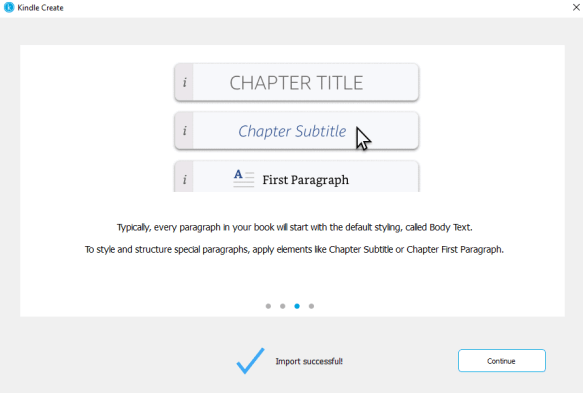
Then you can import your Word File. It only takes a moment.

kindle create for blog 3

kindle create for blog 4

Click Continue when you’re done.

kindle create for blog 5

Your Word file for your book should have your Title Page, your Copyright Page, Dedication, Acknowledgements, and any back matter you want. The only thing Kindle Create will generate for you is the Table of Contents.  Click on Insert in the upper left hand corner and it will look like this:

2019-09-11

kindle create for blog 6

When you upload your file, what you see is very generic, and it’s up to you to design your manuscript how you want it to look. This is the first page of The Years Between Us.

Choose a Theme by clicking on the THEME in the upper right hand corner. Unfortunately, there are not many to choose from, but actually, there are not many to choose from when you format in Vellum, either, so don’t feel like you’re missing out if you use Kindle Create.

kindle create for blog 7

The rest is a bit time consuming as you have to go page by page and add the things you want. For example, changing one scene break does not change them all:

2019-09-11 (1)

2019-09-11 (2)

So you may just want to stick with asterisks when you format, unless you are formatting something a little on the shorter side.

The same is true for the chapter start drop caps. You need to put your cursor at the beginning of every paragraph and then choose drop cap on the right under Formatting.

2019-09-11 (3)

Kindle Create will nudge you to save every so often, and it’s in your best interest, in any case. It also has a handy UNDO feature in case you mess up somehow.

Like any software, there’s a small learning curve, but it didn’t take me long to play around with it and begin formatting my manuscript how I want it to look.

Once you’re all done, there’s a Preview feature where you can take a look at your book page by page. This is a good idea while you’re still in the software and not in the online previewer on your KDP Dashboard.

2019-09-11 (4)

Go through your book page by page. Make sure you didn’t miss any scene breaks, or anything else you’re going to want to change. Flipping through it will take some time, but remember that poor formatting can pull a reader from your story, so you want it to look its best.


Unfortunately, I cannot take you further than this. Pressing Publish will move the files to my KDP Dashboard, and The Years Between Us is already published. But KDP has several tutorials you can watch to see how the process is done. They have a fabulous help section, and you can find anything else out that you’ll need to know.

Look at a typed tutorial here.

Here is a tutorial by KDP on YouTube about Kindle Create. 

Here is another blog post by Just Publishing Advice on their blog. How To Use The Amazon Kindle Create App For Better Ebooks

There are a couple other tutorials that look okay to watch on YouTube, if you search Kindle Create tutorials. The best thing you can do though, is experiment, use the undo button if you do something you don’t like, and save often.

After you publish your files to your dashboard, they will give you options for your paperback such as trim size, and if you want cream or white paper. Your choices will determine the template size for your cover. And you can use the Kindle Cover Creator if you want, to generate a cover for both your Kindle book and paperback, too.

KDP is your one stop shop to formatting, cover creation, and publishing your book!

Have fun!


I wasn’t aware that Kindle Create generated a paperback file until I saw that Daniel Mattia was able to offer a paperback of his book, In Crows’ Claws. We went through some issues he had using Kindle Create in my interview with him a while back. So a big thank you to Daniel and his tips!

Check out his amazing work linked above, and he’s also the creator of an Indie book database called Indie book DB. Check out that site for your next awesome read!


There is a lot that goes into publishing a book, and I hope this can be a starting point if you are new and have no idea where to begin. If you have any questions drop them below, or my DMs on Twitter are open, though it can take me a day or two to get back to you–especially if I have to work that day. Thanks for reading, and good luck to you!


end of blog post graphic

The “As you know, Bob . . .” Syndrome. What it is and why you should stop it.

as you know bob

I didn’t feel like being on social media last night, and I didn’t feel like writing more. It was a bit of a busy day, and I had felt off all day, too. I got in 2,000 words, and that was fine being I had done 5,000 the day before. Not all my days off can be high-output days, and I realize this as long as I keep moving forward at a pace I’m comfortable with.

Anyway, I decided to hop on my Kindle and see what is out there by way of contemporary romance. Maybe find a another book to read, since I finished my last one, Next Girl to Die by Dea Poirier.

I downloaded a sample of a romantic suspense, and like everything else indie these days in romance, this was written in first person present. But that wasn’t what bothered me. (Okay it did, but I already roared about that in a previous blog post.) What bothered me was that the first scene started as an “As you know, Bob” scene and it gave the book a horrible start.

What is an “As you know, Bob” scene? It’s a scene were characters are sharing information with each other that they already know, but they are talking to fill the reader in.

The dialogue in the scene I read sounded like a biography because one character was telling her best friend all about her boyfriend. This is so unrealistic and implausible. If they are best friends, share everything, and talk on a regular basis like the scene implied, the BFF would already know about her friend’s boyfriend. It was obvious the scene was written to introduce the reader to facts about the boyfriend, and it slowed everything down to a screeching halt. I managed three page “flips” before closing out the book and deleting the sample from my Kindle.

How do you avoid an “As you know, Bob” scene? Here are a few ideas.

  • Ask yourself if the characters already know the information they are talking about. If the answer is yes, then you don’t need the scene, or give them something different to talk about. Dialogue is designed for characters to pass new information on to each other, not go over things they both already know. As a writer how do you know you’re doing this? When you get lazy and your characters start saying things like, “You’re so forgetful! I’ve told you this a thousand times . . .” Or “I don’t know why I have to keep telling you this over and over again . . .” Sure, sometimes we do forget things in real life; sometimes we do need a little reminder here and there. But a girl’s best friend won’t need a refresher course in a current boyfriend.
  • Find a different way to introduce the character.
    It was obvious this scene was to introduce the boyfriend. But instead of a whole dialogue scene about said boyfriend, how about waiting until the boyfriend needs to show up? He’s going to be part of the story, the blurb said so, so why feed us backstory right then? Why write a scene that has a character saying “Well, you know my boyfriend is a multi-millionaire. He started his company from scratch in his mother’s basement and only two years later sold it to Facebook for a hundred million dollars. Now he’s partying all over town and treats me like a queen!” When you could wait and actually have the MC meet him:

    So this was Jasper Hargrove, the famous boyfriend. Self-made millionaire and creme de la creme of Manhattan society. Pictures in the tabloids didn’t do his face justice. He looked like he stepped out of a Hugo Boss photo shoot and smelled just as good.

    Feeding readers information in real time will always sound better.

  • Ask yourself if the information is even needed.
    What you think your readers should know and what your readers actually need to know are two different things. Sometimes the best information is no information. Let your readers fill in the gaps on their own. Do we need to know the boyfriend is a self-made millionaire, or that he created a start up living in his mother’s basement gorging on Doritos and Mountain Dew? Is it enough to say he’s a millionaire?  Sometimes a little mystery can go a long way.
  • If the information is needed, can your reader find out about it in a different way?
    Maybe the MC reads an article about him in the paper, or an industry magazine. Maybe she’s watching TV and a news clip comes up. You don’t need much. The scene that lasted three pages? That could have been condensed into a couple of lines.
  • Read the scene aloud or have Word read it to you and be honest. Does the conversation sound like crap? Does it sound unrealistic? Think of the characters and who they are. The scene might have worked if the friends were getting reacquainted after being apart for years and years. But even then, the boyfriend and the friend were going to be key players in the book. An info dump disguised as dialogue is still an info dump. If there’s not any new information being passed along to either character, if the scene isn’t offering anything new, if it isn’t moving the plot along, then get rid of it. It does take a lot of practice at successfully dropping backstory into a novel, but I’m finding less in this respect is always going to be more.

Thanks for reading!


Have never heard of “Well, you know Bob . . .” Syndrome? Here are a few more articles about it:

The Sneaky Secret Life of “As You Know, Bob…” by K.M. Weiland 

As You Know, Bob: Info dumping in dialogue by Erica Ellis

Do You Have “As You Know, Bob…” Syndrome?–How Writers Can Butcher Dialogue & How to Fix It By Kristen Lamb


end of blog post graphic

Entering the RITAs. My full circle experience.

I’m not sure if I said anything about entering the RITAs, or the outcome of that contest.

The RITA award is a prestigious award given by the RWA (Romance Writers of America). I didn’t win, nor did I advance, and I did not attend the RWA conference this year that was held in New York City. I didn’t expect to win (though when you enter a contest, there’s a little bit of you that will hope you’ll at least advance.)  Anyway, I didn’t advance, didn’t win, and I didn’t expect to hear anything more about it.

All of Nothing ebook coverBut I received an unexpected email in my inbox today. The email contained my overall score of All of Nothing, something I didn’t know the RWA sent out.

To say that I was stunned would be an understatement, but when I thought about the score, and I mean, really thought about it (meaning, I put away my ego and my pride and honestly evaluated the kind of book All of Nothing is) the score made sense.

I knew a long time ago that All of Nothing didn’t advance to a finalist position. I figured since the contest is open to everyone who wanted to enter, traditional and indie, I had a slim to none chance. After all, when Kristin Higgins and Brenda Novak enter their books, you’re up against talent, several years in the industry, and name recognition. Heck, Nora Roberts has won 21 of them. I won’t disclose whose books I judged, but I will say I judged a big name, too.

I had thought, at least, even if my book didn’t advance, it had receive average scores.

It didn’t.

My book received a 4.33 out of a possible 10.

I don’t know how private the scoring is, so I won’t show you the email contents, but suffice to say, I didn’t make it into the top half, and I didn’t expect that. I also didn’t expect that one judge did not think my novel had a central love story, and a different judge didn’t think it concluded with an HEA. And that makes me wonder if she somehow missed the Epilogue, which clearly shows that they did have a happily ever after.

Anyway, so here’s what I learned entering the RITAs, how I felt, and what I will do differently if I should ever enter again.


What I learned:

  • Your book won’t resonate with everyone.
    You can use this as a way to shake off a bad book, (NO ONE is going to like a book full of plot holes and flat characters, so that reasoning only goes so far) but even a well-written book with amazing characters and the best plot twists known to man won’t appeal to everyone. This is okay, and as authors, something we all deal with. I know All of Nothing is dark. I know Jax is an asshole to the extreme. Maybe even too much. He doesn’t redeem himself until almost the end of the book, and that could have been too long for some readers. Even my reviews on Goodreads are split down the middle. Either readers are blown away or they hate it. There’s not a lot of middle ground in reviews, and I didn’t see any in my scores.
  • You’re forced to read, and that can put you off from the very beginning.
    The RWA has changed this policy for the next contest, but when I entered my book, you had to judge the preliminary round to submit. Being forced to read is akin to being in school and assigned War and Peace. Not everyone wants to read books they are told they must. Also, you were only able to opt out of one genre. My book was in the Contemporary Romance Long category, and it could have been readers didn’t like the genre. Maybe they preferred Romantic Comedy, or Romantic Suspense, or Paranormal. That’s not really an excuse, but it’s natural to not be excited about a genre you don’t care to read in the first place.
  • Have a professional cover.
    This might seem like a no-brainer, or something that you wouldn’t think of for a craft contest, but either way, I have a feeling that somehow the entire package is judged. When I judged and found the author’s name on the title page, you bet I looked on Amazon for the author and what else they had published, and who they were published by. I’m sure the judges did the same for me, and the overall look of my catalog and All of Nothing‘s cover maybe have influenced their feelings toward the book. This is a professional contest put on by a professional organization. Submit a book that is professional from cover to cover.

What I would do differently:

  • Enter something lighter.
    All of Nothing was dark, and it didn’t hit the right notes, obviously. Something lighter might fare better. When you’re reading at the end of the day, and you’re on a deadline to submit your scores, giving your reader something a little more light-hearted may be easier for them to enjoy. Is this playing the system? Nah. I can only think back to the books I particularly enjoyed while judging. I would also offer something with more . . . I don’t know. I don’t want to say chemistry because I think Jax and Raven had chemistry. But maybe a more steamier, sweeter, attraction? Not all of my heroes are jerks. But I would definitely try something not so dark.
  • In that vein, I would enter something shorter.
    All of Nothing was entered into the Contemporary Romance Long category. There’s nothing worse than being forced to read something you don’t like, and having so much of it. I would do the short category. Though I don’t tend to write novellas, so that category may always be out of my reach.
  • Take the contest more seriously.
    I’m a newbie writer. Without written feedback, I can only guess why my book didn’t resonate with readers. Had it been a debut, I would worry that my voice wasn’t strong enough. But I think my voice is strong–I’ve written enough words to find it, and I’ve received compliments on the book. In fact, a woman at my work read it. She’s a prolific reader, and she told me she enjoyed All of Nothing very much and that I was extremely talented. I didn’t know she read it, so I don’t think she said anything because she thought I was expecting it. She didn’t have to say anything at all. I went into that because I’m thinking it was the plot and characters the judges didn’t care for, and not the writing itself. (Which I feel is a very important distinction.) But, I have never worked with a developmental editor or a professional editor of any kind. And if I ever hope to advance in a contest like this, I may have to hire someone who knows the romance market, knows all the tropes involved, and can tell me if I’m on the right track with my writing. I have never queried, have never sent out any of my books on subs, so I don’t even have a line or two from an agent/editor saying I’m on the right track, either. All I have to go on is reviews from my books, and that’s not saying a whole lot because I haven’t put much into marketing preferring to use my time to write instead.

How I felt about the contest:

I don’t feel terrible about my score. You have to face rejection with a thick skin. Since All of Nothing I’ve written five more books. So maybe if my tone or voice missed the mark, at least I’m still working on my craft as it’s natural for every book to be a bit better than the last.

It was interesting being a part of the RITAs. I liked seeing how the process worked and the quality of books entered by my peers.

I may never enter again. Or I may enter a book I haven’t written yet. Something that takes my breath away. Who knows. I do know that if you’re going to compete with the best of the best, you have to take your craft seriously, and if you can do that year after year and get better year after year, then maybe, just maybe, one day, you’ll win.

Have a wonderful week!


Want to try your hand at a contest? Poets and Writers Magazine offers a long list of contests to enter. Everything from poetry to essays. Look here to find out more.

You don’t have to enter the RITAs to enter a contest hosted by the RWA. All the chapters offer some kind of contest, too, though they can be seasonal and not offered at the same time. For a list of contests and chapter events, look here.


end of blog post graphic

Writing to write, or Writing to Publish? Is there a difference?

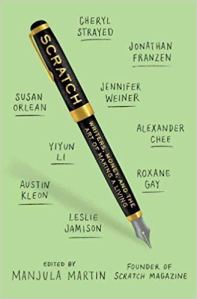
I had another post planned for today, but while I was working an extra shift at my job on Saturday night, I finished Scratch: Writers on Money and the Art of Making a Living. This book is a collection of essays by writers about, yeah, money and writing.

scratch book coverAs an author, I love looking through paperbacks. How is the copyright page constructed? Who did the author dedicate the book to? I skim over the table of contents. Do they use a quote? And by whom? I also look at the Acknowledgements. I like to read who people thank. In the indie world, sometimes I know a person who is mentioned. I like seeing who has helped the writer turn author.

I read Manjula Martin‘s acknowledgments, and something popped out at me. She said:

Thanks to the members of the Blood Moon writing group, who always reminded me that writing is more important than publishing.

She goes on to list names of people whom I don’t know, but I can appreciate their message.

writing is more important than publishing

In this modern time of CONTENT CONTENT CONTENT, that sentence is extremely powerful.

In this age of free books, blog posts, tweets, and author updates, how often we publish has turned more important than what we publish.

This has never been more true than the today with the market being saturated with bookstuffers to take advantage of KU page reads, or authors who team up to publish a book every two weeks, or authors who hire ghostwriters only to blame them when they are caught plagiarizing. There are even those who sell their previously published books to new authors who will strip the book of its title, repackage it, add a new author name, and put it up on Amazon for sale.

What happened to the quality of what we publish?

What has happened to the way we think about our content?

It’s a hard question for me, and I’ve been thinking about this while I’ve been writing my series. I have a different blog post about something similar already, in that I would like to try my hand at women’s fiction. I won’t get into that post now, but that quote does make me think about my publishing journey.

Sometimes publishing isn’t always what we should be doing with our work.

Sometimes we should be writing to practice. Sometimes we should be writing to learn. Sometimes we should write to give ourselves therapy, like writing in a journal or diary, or writing a poem.

Sometimes we should write for fun.

Sometimes we shouldn’t be writing at all. Too busy, burnout, nothing to say. There’s no harm in not writing–even if it feels like there is.

Though indie publishing is becoming more widely accepted (even some of the big-name authors use POD–especially for their non-fiction titles) it may always carry the stigma of people publishing crap.

There are legitimate reasons to write to publish: you’re on a deadline, or you freelance to pay the bills and if you don’t hustle, you can’t eat. But that doesn’t feel like the majority of my writing peers. We write to be published as any of our debut novels can attest.

This not only impacts our own writing careers–who wants to start a lifetime writing career on a cracked foundation?–but if affects all of us a whole.

Write to write, and then publish.

writing is more important than publishing (1)

Lots of people ask writers, “If you were never read, would you still write?” Of course most writers say yes. Writing is a passion, and they would write even if they never had another reader as long as they put words on the page. To be honest, if someone told me from here on out I wouldn’t have a single reader ever again, I would stop writing. There are other ways for me to communicate my passion. I would start running again, or I would volunteer. I would do what I set aside because writing takes up so much of my time. Because I love it. But an audience fuels my love of it, if that makes sense.

Now, if I were told I would still have readers, but I wouldn’t/couldn’t make any money, I would still write. If I was locked into only blogging, or publishing my work on Wattpad, I would still publish my stories. Being read means more to me than making money.

Seeing your book on Amazon is a crazy wonderful thing, and I don’t fault anyone who is damned proud of it.

But sometimes we need to take a step back and ask ourselves why we write. What fuels us? What do we get out of publishing our work? Would we be just as happy, just as proud, if we posted that novel for free, or even more mind-numbing, shoving that novel under your bed?

If we began every project without thinking of the cover art, or who is going to format for us, or when our publishing date is (Hello, Amazon and your one year pre-order deadline now) how would that change our perception of the project? Would we take our time? Put more of our hearts into the piece? Would we dive deeper into the truths of what we want to put down on paper?

Maybe if we wrote to write, writer’s block would be obliterated. After all, if we only wrote for ourselves, we wouldn’t fear criticism or disappointment and the blank page wouldn’t scare us so much.

When indie-publishing is so easy now, we have to stay aware of why we’re writing and what we’re trying to say to our reader.

Open a new document and put words on the page just to write. No agenda. No deadline.

You may find you’ll write something worth publishing.


I loved reading Scratch. There were great essays by some of the top authors. I particularly enjoyed Manjula’s interview with Cheryl Strayed (she talks about her book deal for Wild), and Jennifer Weiner’s essay on earning respect for your work vs. earning money and if you can have both.


Jeff Goins also has a blog post about this topic. You can find it here.


Until next time, lovelies! Have a wonderful writing week!

end of blog post graphic

Why I wrote a series, and why you should write one, too!

Writing a series_ Why I did, and why you should too!

I’ll be the first to admit that I don’t like writing a series. Probably not the best thing to admit because it implies I’m not having fun writing my books, and when an author doesn’t have fun writing their stories, a reader won’t have fun reading them. We hear this a lot, and I think it’s true.

I don’t want to imply that I’m hating writing this series to the depths of my black soul because it’s not true. I have loved all my books in this wedding quartet and consider my characters friends, but I will not be sad to see them go.

Fly away little birds into the happily ever afters I have given to you.

If I don’t like writing series, or a better to way to say it is, if I prefer writing standalones, why did I write a four book series, and why am I recommending you do the same?

This is why I wrote A Rocky Point Wedding series, and why after a couple of standalones (to cleanse my palette and to lay some single plot ideas to rest) I’ll plan another.

  1. Writing to Market.
    I believe this. I say AMEN to the preacher who shouts this to his congregation. Writing to market simply means giving the readers of your genre what they want, and more importantly, what they expect. Tropes. The twists and turns they come to associate with plots of that genre. Writing to market means you are writing to an audience already established. You have a built-in comparison authors.
    What does this mean for a series? Readers like reading a series. How do I know? Ask Nora Roberts who writes trilogies and quartets, and the popular long-ass futuristic series she pens under J.D. Robb. She started writing those back in 1995 and the 49th book of that series is coming out in September. She couldn’t have gotten that far without readers GOBBLING those up the minute they come out.
    Series give readers what they want, and as an author, that’s my job.Writing a series_ Why I did, and why you should too! (1)
  2. There is a lot to play with when you write a series.
    You can do a map, mark where your characters live on the cutesy-named streets you make up.
    There are opportunities for novellas and prequels and even more sequels than what you originally planned. It’s nothing new for a side character to wiggle their way into a book of their own.
    Add extra content like I am. If your character is a reporter, write the articles mentioned in the book, or in my case, I’ll be adding Autumn’s blog posts.
    Extra content means:
  3. More ways to Market.
    I could add Autumn’s blog posts to a newsletter as a sign up cookie, or write a novella about Marnie and James’s honeymoon. (The last book stops after their ceremony.) What did they do? Where did they go? Can I fly there for research?
    Market the first book in a series with ads, social media, and if the first book is strong and captivating, the first book sells the rest of the series without any extra work. If you’re wide, put the first book free and drive traffic to that book. Use a drip campaign on BookBub and continually use ads to bring in new readers. Or use your free days in Select and buy a promo to drive traffic there for a certain number of days (or just one) and hopefully if your book is strong enough, over time your page reads from all your books will pay for your promo and then some!
  4. That’s something else you get with a series. Read-through.
    Any non-fiction book that talks about making money will talk about read-through. If you read a Chris Fox book, he’ll assume that’s all you write because it’s the smart thing to do, and Chris always assumes you’re smart and willing to put in the work. Read-through is your bread and butter. It’s especially true for romance, but you see this done in the thriller/suspense genre, as well as YA and women’s fiction. (See Patricia Sands and her Love in Provence series.)Indie books versus traditionally published books (1)
  5. The release schedule can give you time to write another book.
    I go back and forth between thinking I’ll drop my series all at once, or give time between each release. I suppose the smart thing to do is get them all ready to publish, publish the first one and then put the others on pre-order. That way readers can see the rest of the series will be available in a reasonable amount of time. Then, while my books drop, I push readers to the first book while I write another book. That’s not so much factory work as it is good planning.

Those are my reasons for writing A Rocky Point Wedding series.

Always first is giving readers what they want, and when you do that, natural sales will follow. That’s not to say releasing a series doesn’t come with its own challenges:

  • Editing and formatting them all.
  • Consistency from book to book. (Green eyes stay green, occupations stay the same, names stay the same, and no one knows something they shouldn’t.)
  • Making sure the covers belong together.
  • Where to put the extras, and what they’ll be.
  • Taking the time to create those extras.

Will it be worth it in the end? Sure. I’ll have four 70k+ word books that will be a lovely addition to my backlist. I’m smarter about covers and blurbs now, and keywords, too, so taking my time and being smart when I publish should help me avoid having to go back and redo them. Let’s not repeat going back and doing covers again like I had to with my trilogy.

But will it be nice to sink my teeth into a new standalone when this is done? Yes! I already have a story idea I try not to think about too much because I’m not done with book 4 of these quartet yet. I’m 37k into it though, and I’ve given myself until the end of September to get it done. Then while I edit them, I’ll do the busy work of blog posts and cover design. (The jury is still out if I’ll hire these out. If I do, I would at least like to have some couples pegged for the designer.)

Writing a series_ Why I did, and why you should too! (2)

I know planning a series can be daunting, and if you have a plot that spans through all the books that’s even worse. I don’t have a plot that takes place over all four books, unless you count wedding activities, but I don’t. Those activities are a natural progression as anyone who has been in a wedding party knows. There’s bridal showers, dress fittings, parties and the like, so while they may not add conflict, the characters do pass along information to each other, and they are easy ways for me to cram them together into the same room.

If you want to tackle series, the best thing you can do is plan. Plan your books out. Plan how you’ll end each one, and if a subplot weaves through each book and will only be completed at the end. I write romance, so I definitely need each couple to have their happily ever after, and a reader can jump into the series wherever they want.

Writing a series_ Why I did, and why you should too! (3)

A Rocky Point Wedding series isn’t the first series I’ve done, (my Summer Secrets erotica series contained six novellas and more than 150,000 words) and it won’t be the last. Look at your genre and if you see that series are a primary offering, look to your own publishing schedule and see what you can do to give your readers what they want!

Thanks for reading!

end of blog post graphic


Other blog posts on why you should be planning a series:

Why You Should Be Writing in a Series by Tom Ashford on Mark Dawson’s blog.

Why and How to Write a Book Series on the IngramSpark blog.

What Readers Want – Series vs. Standalone Books on the Indies Unlimited blog.


Mid-August Check-in and What I’ve Been Doing

August 2019 blog photo

I usually have some writing-related blog post today, or commenting on something in the publishing or independent publishing space, but today I’ll just update you on what I’ve been doing, what I’m reading, and the things I’m going to try to do before the holidays hit. Christmas is in 128 days, if you can believe it!

It’s hard to believe summer is almost gone, and my daughter (maybe your kids already are) is going back to school in a couple weeks. I’ve done a bit of back to school shopping for her and ordered her pictures online.

I live in Minnesota, so I’m not looking forward to summer’s end. In fact, it’s always nice if the snow can hold off for as long as possible. Last year, we had a bad winter while I was recuperating from surgery and if we only get half the snow that we got last year, I’ll be happy. I’ll be figuring out my new writing rhythm when my daughter goes back to school, and that will take a little time to adjust to, but it shouldn’t be that bad. My work schedule won’t change, so that’s nice.


I changed All of Nothing‘s cover, blurb, and keywords. It’s still too soon to say if they made a difference.

But I am also doing the same for Wherever He Goes.

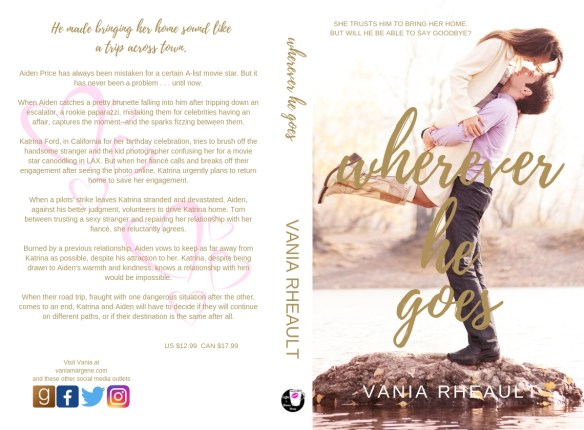
This is the old cover:

wherever he goes old cover jpg

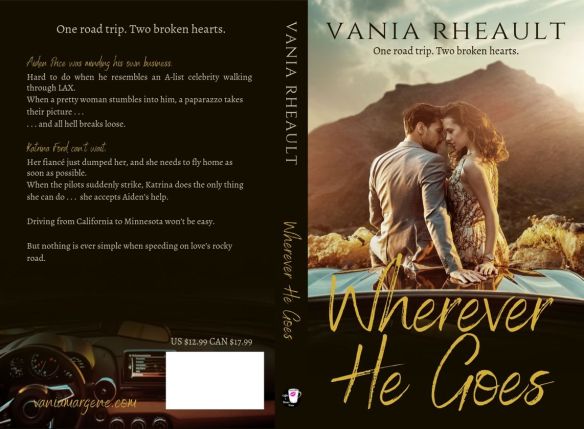
Pretty and sweet. I have no qualms about it, but it also doesn’t give off the steamy contemporary vibe. So I changed it to this:

wherever he goes new cover jpg

They are both dressed, but I feel it ups the steam factor a bit. I also rewrote the blurb, but I won’t get into that, eventually I’ll get to the keywords. Looking for those will be interesting, as it’s a road trip romance, and that’s a sub-genre I know exists, but I haven’t seen the category for it on Amazon. I ordered a proof so I can see how it looks in print, but the ebook cover is already live. I’ve gotten great feedback on it, so for the skill I have and for the cost I paid ($7) I think it’s a nice change.

Of course, IngramSpark is giving me another pain in the ass about it. Since I published on Amazon, they are saying my ISBN is in use and not mine. I didn’t click on expanded distribution on KDP Print, so the ISBN should be (and is) available for other retailers. It’s just more going around in circles I’m going to have to do with them. Plus they keep insisting I didn’t build my cover within the correct guidelines, but I did. So, I think after I get this book straightened out with them, I won’t be using IS for expanded distribution anymore. Until they can become more indie-friendly, I’ll stick with Amazon.

I can honestly say that through all this wide business and going back and forth, I’ve learned what matters and what doesn’t.


Now that all my covers are how I want them to be for a while, I’ll be focusing on finished up my quartet. Officially called A Rocky Point Wedding (Books 1, 2, 3 and 4) I started book four a couple days ago, and I’m 10,000 words into it. At this point I’ll be trying to figure out covers and get a more concrete idea of what I want. I don’t know what I want yet, and when I don’t feel like writing I poke my eyes out look at stock photos. If I thought doing my trilogy was a pain, this quartet will be the death of me.

I am planning on a slow release . . . possibly one book a month, and while I’m releasing I’ll take a break write a new standalone that I’ve been planning for a while.

But first, book four. This book has its own plot to figure out, plus wrapping up wedding stuff. I do have a book 0 I could write if I ever feel like revisiting Rocky Point, or if I ever feel like starting a newsletter, I could write a prequel novella and offer that as a newsletter sign-up cookie. So there’s that potential, anyway.


I’m reading a really great book right now called Scratch: Writers, Money, and the Art of Making a Living Paperback by Manjula Martin. It has a lot of great essays in there by authors like Cheryl Strayed. They talk about giving work away for exposure and opportunity, living in poverty while trying to make it big, what they do with their advances if they do. I’m enjoying it a lot so far, and I recommend it if you’re interested in the money/business side of writing.

If you like books like that, I also recommend The Business of Being a Writer (Chicago Guides to Writing, Editing, and Publishing) by Jane Friedman. She breaks down the publishing industry and what you can do to make money off your writing. Being that it’s always being said writers can’t make a living wage anymore, I like to hear other people’s opinions.


August 2019 podcasts graphic blog post

I listen to a lot of podcasts, too, and here are some of my favorites:

Joanna Penn. The Creative Penn Podcast

We know she’s a powerhouse in the indie space, and she has a lot of great guest interviews. I don’t listen to every episode, and I have to pick and choose what tips I jot down for my own use since she’s a big believer in being wide, but overall I her podcasts are very useful.

***

The Sell More Books Show hosted by Jim Kukral and Bryan Cohen

These guys used to talk about the news, and they still do, but they have started to pad their podcast with “news” of indies making money. They don’t get into the hows or the whys (not in great detail, anyway), and if you’re not a member of the 20booksto50k group on FB (where they cull these stories) you’re not able to dig out the nitty-gritty details for yourself. I understand there are slow news days, and I listen for the big stories like Dean Koontz moving to Amazon from a Big Five. They pull stories from other places like the Hot Sheet by Jane Friedman and Porter Anderson, and if you don’t subscribe to that newsletter, this is one way to hear about the stories they report.

***

Stark Reflections by Mark Leslie Lefebvre

Mark’s a super nice guy, and I can’t wait to meet him at the Career Author Summit in Nashville in 2020. With so much history in the industry, his podcasts are very interesting to listen to, and he also has a bevy of author and publishing expert interviews. In the last podcast I just listened to, he interviewed Craig Martelle, who puts together the 20booksto50k conferences with Michael Anderle.  As with Joanna’s, I pick and choose what I want to listen to. Mark moved from Kobo to Draft2Digital, so it goes without saying he’s a big cheerleader of also being wide.

***

Self-Publishing Formula hosted by Mark Dawson and James Blatch

I listen to this one off and on. He has great interviews with authors and industry professionals, too, and again, I just pick and choose what I like to listen to by reading the details of the podcast episode. Sometimes they can get a little heavy with advertising their courses, but they all sell something, so listening to them tout their wares is going to be part of listening to a podcast.

***

Science Fiction & Fantasy Marketing Podcast hosted by Lindsay Buroker, Joseph Lallo and Jeffrey M. Poole and Laura Kirwan.

These guys took a break this summer, and so far Lindsay hasn’t said when they are coming back. She alluded to them changing their format, so I’m looking forward to them doing more episodes. Even if you don’t write Fantasy or Sci-fi, this is a great podcast to listen to. Keep an eye out for new episodes.

***

Print Run Podcast hosted by Erik Hane and Laura Zats

Erik and Laura are agents at a literary agency in Minneapolis, MN, and that was one of the primary reasons for listening. They talk about a lot of the literary stuff in the state, and if I had a more dependable car, I would go to some of them (the Twin Cities is a 4.5 hour drive away from where I live). But anyway, being that they are agents, they give an inside look at the traditional publishing industry. The last episode I listened to, though, they talked about Dean Koontz and his defection move from the traditional publishing marketing space to move to Amazon. They didn’t say very nice things about it, or about Amazon in general, and be aware, if you’re an indie making money off Amazon, that that is their stance. If you can look past their bias, their takes on books and publishing can be interesting at times, though they defend traditional publishing and an agent’s place in it (of course). Publishing is publishing though, and whether indie or trad, they all fit together, so keeping an ear to the ground isn’t a bad thing.


ku graphic

My books have been moved back to KU since the first of August. I boosted an announcement to that effect on from my FB author page and that grabbed a little attention. I used the audience I created for one of my ads for The Years Between Us that didn’t do anything because my ad copy was poor and the pictures I used weren’t the best. I ran two ads for three days a piece and I think I got one sale. But I blame the ad and the copy and the fact I was just messing around to get a feel for the platform. Anyway, so I already had an audience I’d created for that, so I used it and I think I got about 150 likes ad and a little engagement. It will take some time to let people know my books are in KU again, and I haven’t been very vigilant about it because I’ve been changing out covers.

Seeing page reads again is fun, I’ve made $21.00 since moving my books back to KU. You can look at my numbers in this blog post, but I can tell you that during my two months wide I made $66.00. So in a week with just a little boosted post on FB I’ve made 33% of what I made with wide while spending money on a Freebooksy ad. I feel better being in KU and I don’t check my numbers all the time like I was doing when I was wide. That is all KU reads though, not sales. I think I may need to research price more as maybe $4.99 is a bit too expensive for books by an unknown author. I said in a previous post that it was freeing being back on one platform and it is. I feel like I can focus more on the work instead of sales, and with a small backlist, writing is more important to me right now.


Well, that’s the personal update I’ve got for you. In my next blog post I’ll tell you about my experience with Booksprout, and if it’s useful or not.

Thanks for reading!

end of blog post graphic

Keywords for your books. What are they and how to find them.

I’m the first to admit that I don’t know anything about keywords. People may have differing opinions on where to find them, or how to use them, but one thing everyone can agree on is that they are pretty important. They help readers find your books, and in this age of publishing, our books need all the help they can get.

In this last mini-series post about how I revamped All of Nothing, I’m going to explore keywords and if I change anything in regards to my book’s keywords.  For a quick recap, if you want to read about how I changed the cover, you can click on the picture of the full wrap. (I still think it’s lovely!)
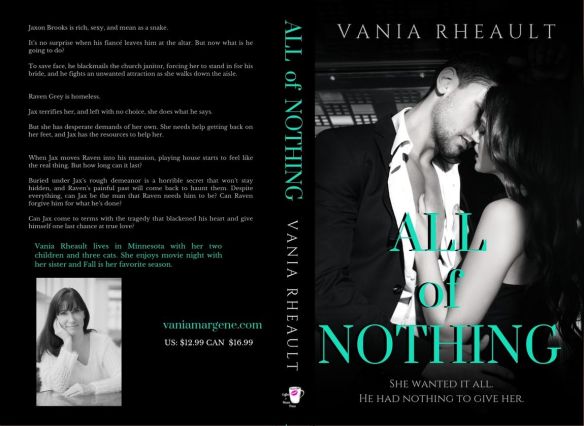
all of nothing second coverjpg

I also rewrote the blurb, and that garnered some interesting discussion. If you want to take a look at my process and how I did that, you can click here to read about editing the blurb.

So, keywords.

Like I said, I know next to nothing about keywords, so what are they, exactly?

According to an article on IngramSpark, keywords are “One or more words used to indicate the content of your book.” How do we choose the right ones?

The easiest, and cheapest (read, free) is searching on Amazon in the Kindle store. When you publish a book on Amazon, KDP gives you seven slots. That doesn’t mean that you are limited to seven words, and I only just learned this not long ago. (Evidence that you always need to keep learning because you don’t know what you don’t know, and something you learn in passing could change your whole life business.)

You can add more than one word to a space by separating words with semi colons or commas.
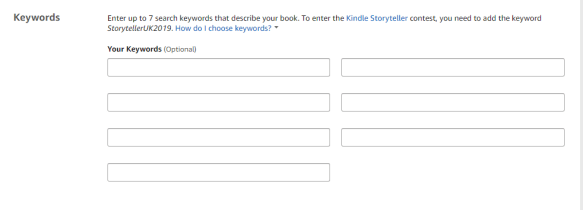
kdp keyword screen

It looks pretty intimidating, and if you look at this not even having one idea what to put there, the first thing you need to do is revisit the genre you’re writing in. There should be at least a few words that pop out at you, even if they’re generic and not that specific.

Anyway, so like I said in a previous post, I didn’t know bully romance was thing until recently, and it turned around the way I’m going to approach keywords and marketing for this book moving forward.

When you go to the Kindle Store (Dave Chesson of Publisher Rocket suggests using an incognito window for this) you can plug in some keywords and/or phrases to see what comes up.
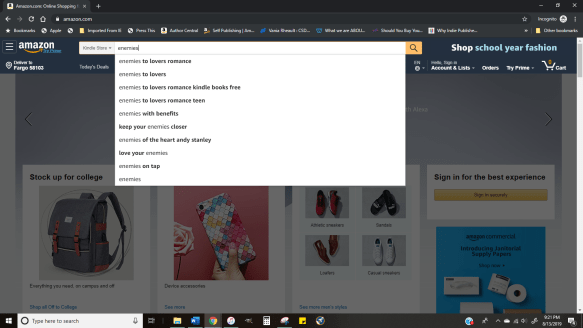
2019-08-13 (1)

You can see in this incognito window that I started searching enemies to lovers. But you can also see what comes up that could work as keywords as well. Enemies to lovers romance kindle books would be a good phrase to use. Add free if your book is wide and permafree. There might be other phrases in there that could work depending on what your story is about. Enemies with benefits doesn’t quite fit my book, so I’ll leave that alone. What else did I search for?
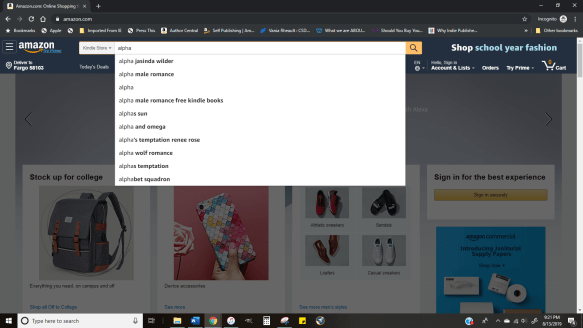
2019-08-13 (2)

I searched for alpha next thinking I could go into alpha romance, or alpha dark romance. Alpha male romance works, maybe if, it isn’t associated with shifter romance. When you click on it, what kind books do you find? Will your book fit in? When I click on Alpha Male Romance, some books that pop up that All of Nothing would fit in with, and that’s the goal, so we can add that to the list.

What else can we search for?
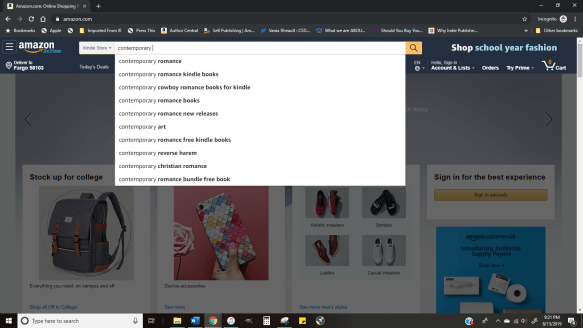
2019-08-13 (3)

I can go with the tried and true contemporary romance, but that is a generic term and using up a space in your keywords may not yield results. We can always keep it in mind though, and plug up a space if we happen to have room at the end of the experiment. Not to write off the list entirely, if you happen to have a new release, it might be worth adding.
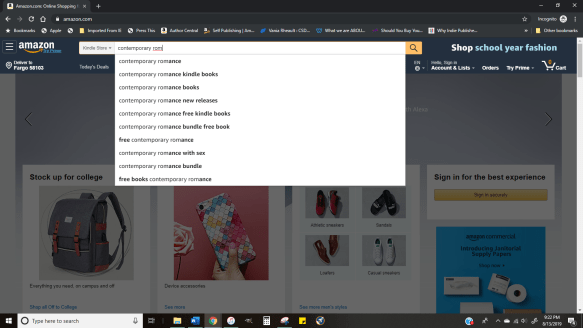
2019-08-13 (4)

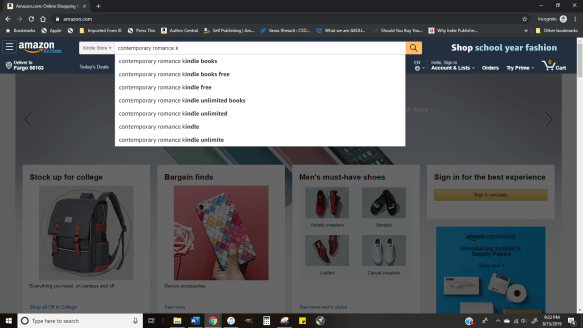
I went a bit further and added “rom” for romance, and nothing extraordinary popped up, but contemporary romance with sex was an interesting return. That seems to be quite specific considering Sweet/Clean romance is having it’s 15 minutes and doing well; this would set my book apart. The word “contemporary” takes up a lot of space though, so I’m going to try to narrow it down before resorting to using it.
2019-08-13 (5)

But if you look for kindle books, adding that your book is in Kindle Unlimited may not be a bad idea.
2019-08-13 (6)

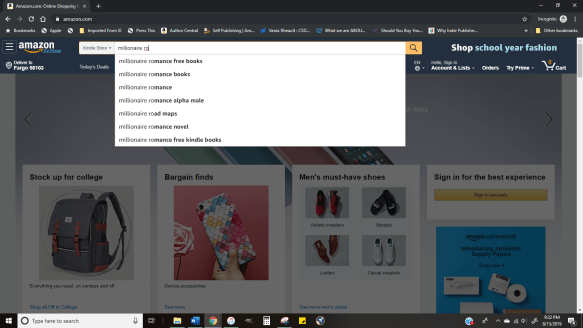
But let’s keep trying to narrow it down. Jax in All of Nothing is a millionaire. I toned it down, didn’t make him a billionaire. Sorry, Jax. But looks like that search may have had a good return, and I could add millionaire romance, even millionaire romance alpha male. Lots of characters though, so we need to watch our words.

What else can we look for?
2019-08-13 (7)

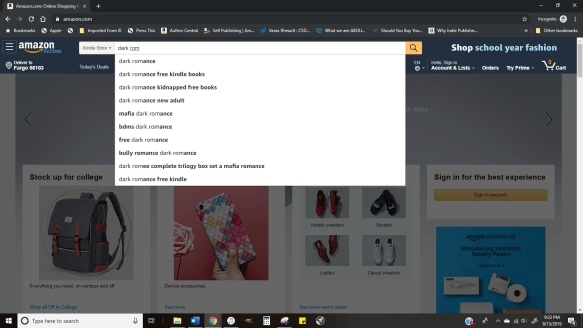
Dark romance gives us some return. Bully romance dark romance pops out at me. But there are some that would be good to keep in mind for other standalone books down the road like mafia, books where the heroine has been kidnapped.  Jeez, these sub-sub-genres are something, aren’t they? What could I choose from the list? The bully romance dark romance for sure.

At this point I think I’m running out of search terms.
2019-08-13

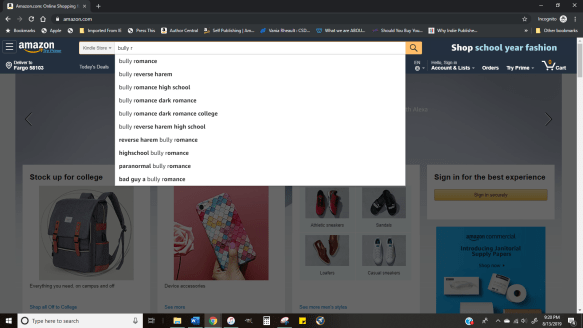
Bully pulls up a lot of terms that don’t particularly fit my book either, like high school, college, or reverse harem. All of Nothing isn’t paranormal, so I think besides the top search term, there’s nothing we can take away from this list.

But I have a few characters left. What else can we look for? I tried bully sex, but those kinds of books I don’t need my book associated with, so we’ll skip that. (Yeah, it’s important to click, and find out what kinds of books are coming up in the search, too. Especially in romance there’s quality, and then there’s quality. I’m not going to call anything trashy as we all have our things.)

We haven’t tried the basic steamy romance and this is what we get:
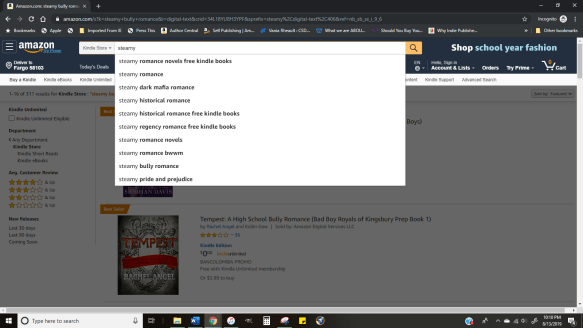
2019-08-13 (8)

Not much comes up here, accept bully romance again, and that can’t be discounted. There are a few more genres that we’ll need to avoid, but the list is interesting, and it gives us something to play with.

This is the cheap and easy way to figure out a limited amount of keywords.

What’s important to note too, is that based on keywords, Amazon may slot your book into categories that are not available to choose from when you publish. If you have a category that you would like your book listed under, you can always email them. But that’s why it’s important to know what genre you’re writing in, even the sub, or sub-sub genres to help narrow down your audience.

It’s obvious that I didn’t have any of the correct keywords for All of Nothing, since Amazon has left it in the most boring and generic category of romance books. That doesn’t do me or sales any favors.

all of nothing rank

Pretty freaking embarrassing, if you ask me, and now that the cover, blurb, and keywords are fixed, I’m hoping that I’ll see some traction in the coming months.

What did I come up with for keywords then?
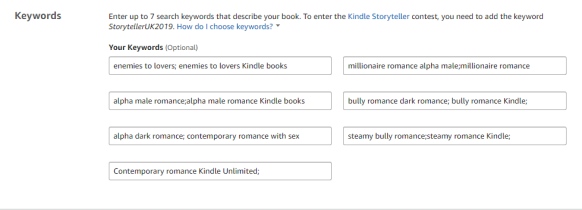
keywords KDP filled

I think I filled up the slots pretty well, and if my book starts selling, they give Amazon a few sub-genre categories to put my book into, too. I do have to warn you that even if you change your keywords, and you hit Publish thinking that they’ve been accepted, they may not be. I hit Publish after filling those spaces out, but I won’t know they’ve been approved for a little while. I may be able to edit this blog post to let you know if they have been, so I’ll keep my eye on my email to see if they publish the book or they flag any of these words.

Edited to add: They did accept all my keywords without a problem! 


What’s the deal with programs that will pull keywords for you if finding free keywords is so easy?

When you start using programs like Publisher Rocket (this isn’t an affiliate link–I get nothing for telling you about this program. All I know is Dave Chesson is a really nice guy and works hard keeping this software working and up to date) you’re looking for a lot of keywords . . . for ads. When you start looking for keywords for Amazon Ads keep in mind they give you room for 1,000 words. You need a lot of help coming up with that many words, and using a software that can scrape your words together for you can save you a lot of time.

Keywords can make a huge difference if your ad converts to clicks, and using keywords is a way to help with that. I barely dipped my toes in the water when it came to Amazon Ads way back when I was trying, and I wasn’t using a program like Publisher Rocket to choose keywords, either. You’re leaving money on the table if you’re not utilizing all the space Amazon gives you.


So there you have it. How I revamped my book All of Nothing.

For some of you, this would include an edit as well, and if you want to learn more about relaunching your book, either read Relaunch Your Novel: Breathe Life Into Your Backlist (Write Faster, Write Smarter Book 6) by Chris Fox, or Ads for Authors Who Hate Math: Write Faster, Write Smarter.  In the latter book he goes a little into how much you should do to revamp your books (time vs. cost) so the ads work, because if anyone has heard Chris talk he is always very clear you need to start with a good product. (These aren’t affiliate links either, but I have read both of those books, and they are worth your time.)

Will all this work? Only time will tell. The cover is better, the blurb an improvement (I think, but that remains to be seen) and we’ll see if KDP approves my keywords and go from there. Could the book use an edit? In terms of getting better as a author, any past book an author writes won’t be as good as the newest release. That’s how it is, and I’m not going to stress about it. It’s a solid book in terms of plot and story. I’m sure it has its share of filler words, or a garbage word slipped by me here and there that I didn’t find and delete. But I did run it through a couple of betas who didn’t have anything bad to say, so I’ll take that as a small win and keep on going.

If you want more information about keywords, Dave Chesson has his own channel on YouTube, as well as Chris Fox. Taking time to listen to what these guys have to say is never a waste.

Thanks for reading!


If you want to know more about Dave and his thoughts on keywords and categories, you can listen to his interview with Joanna Penn here.

Here’s another article by the Book Designer on KDP keywords. Words Gone Wild: KDP Keywords Revisited


end of blog post graphic

When is marketing too much marketing?

As authors, we are driven to connect with our readers. We use Pinterest, we post on Instagram, we tweet on Twitter, and we create our author pages on Facebook. We post excerpts of our books on our blogs. Some of us form book clubs. We want to connect with readers, let them know what we’re working on, and hope one day with all the book buzz we’ve been building that on launch day, everyone is excited to read our books!
This all can be a marketing trap. There is only so much time in a day–especially if you have a day job or have kids, pets, or all of the above. A blog post about your inspiration is great . . . but could that time have been better spent working on your book?

We all love to use Canva to create aesthetics. They help us picture our characters, put us in the mood to write. But how long do you flip through photos to use? Search for that special font that will tie it all in together? Is creating an aesthetic that useful that you need to participate in every #aestheticthursday on Twitter, or do post a weekly aesthetic to your Instagram feed?

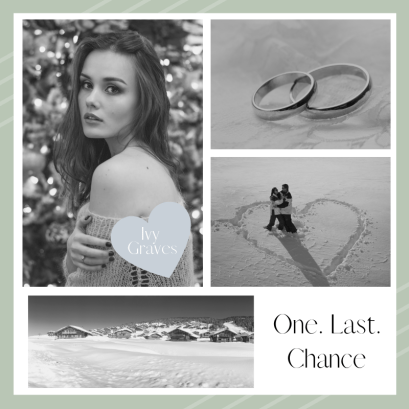
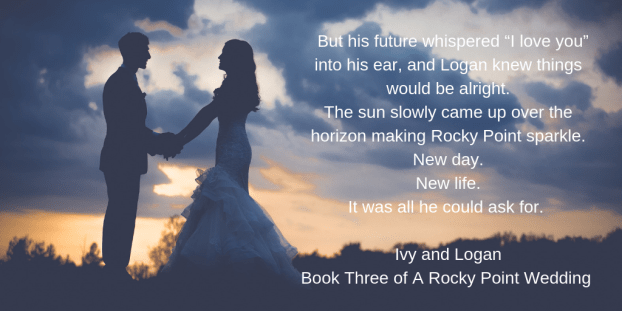
Here’s an aesthetic I made up for this blog post for my new couple Ivy and Logan:

One. Last. Chance

It took me close to an hour to make this. Choosing pictures, looking at font, and waiting for Canva to stop dragging (it really slows down my Chrome browser for some reason) and apply the filters I wanted to the photos. Do you know how many words I can write in an hour? A thousand. When you are fledgling writer, or a person fighting for time to write, an hour is a valuable amount of time. And what will I do with this aesthetic? Post it on Instagram? Maybe Tweet it? (Most likely, leave it here for your eyes only. 🙂 ) You can be a million places online, but you can’t continually post the same things. So the hour I took to make this will equal into only a few minutes of media exposure for the graphic.

Not a very big return on investment, if you ask me.

But his future whispered “I love you” into his ear, and Logan knew things would be alright. The sun slowly came up over the horizon making Rocky Point sparkle. New day. New life. It was all he could ask for. Ivy an

You can make graphics to feature pretty lines from your WIP, you can play Instagram games and try to draw readers and writer friends to share the excitement of your book, but here’s the thing: Sooner or later you’re going to have to produce the book.

Otherwise, what are you building buzz for?

After a while, if you can’t come up with a publication date, if you can’t announce some kind of plan, all your marketing is going to do the opposite of what you’re trying to do. No one will listen to you anymore. Because everyone will think you’re full of crap. Anyone can pull a pretty sentence out of thin air and say it’s from the book their working on. But is it?

And you have to keep in mind that while you’re blogging about your character’s interests and hobbies, other writers in your genre are getting it done. They’re publishing regularly and the only social media they’re engaged in is creating ads for their books.

So, here’s the thing. You want readers. You’re marketing. Write the book. If you’re not writing, and only messing around, then be honest with yourself that no, you’re not going to produce a book, the lines and characters will never see the light of day, and be prepared for that eventual drop in traffic on your social media platforms.
Readers read. And they can only read books that are published.

It’s easy to get caught up in marketing and building your social media presence. It’s fun to play with website templates and creating covers for books not written yet. And I’m not saying it’s bad to do those things.

But if you have a limited amount of time to write, you should be writing. All those writing memes aren’t wrong.

You Should Be Writing

Mister, I’ll do whatever you say!


I’m not trying to be snarky, or make you feel bad if you happen to do more Canva creating than writing. But I am trying to tell you that the writing is on the wall. Independent writers are publishing three to four books a year. I know for myself I’ll be rapid releasing four books around the holidays, providing that nothing goes terribly wrong with my family or my job.

There’s a lot of debate about trying to keep up with your fellow authors or doing your own thing. But what if I told you that you don’t need to tell everyone all the time what your characters are eating, or what their favorite color is? Why not let them discover those things as they are reading your book?

Sometimes you need a reality check. Or sometimes you just have to tell yourself the truth: that you’d rather play than write. And that’s okay. We all have our things. I write a lot and surround myself with people who do the same. They write and they want to make money from their books. I hang out with like-minded people because I have a business ethic and feed off the energy of others.

Publish or get left behind. And that’s not me saying that to be mean, that’s the harsh reality of the fast-pace independent publishing industry. You can only stay relevant in the industry for so long if you aren’t going to produce content.

Sorry, folks. But you gotta pay to play.


What do you think? Is there a place for someone who will market for two years before producing a book? Let me know what you think!

Some other articles on marketing before your book is ready:

When should you start promoting your book?

BOOK MARKETING PLAN THE DEFINITIVE CHECKLIST
by Tim Grahl


end of blog post graphic

All of Nothing’s blurb. How I rewrote it.

All of Nothing ebook cover

Click here to read All of Nothing! Available in paperback and Kindle Unlimited!

If you’re brave and take a look at your reviews from time to time, there may be some common themes that readers have picked out with your book. If you have a thick skin, sometimes this can be a benefit–readers can (and probably will) see things about your book that you didn’t realize yourself.

With All of Nothing, I knew Jax was a jerk, and I made him that way. An accident he was involved in damaged him beyond all comprehension. In the book he was cold and heartless because underneath the armor, that’s exactly what he wasn’t.

I had a lot of fun with his character arc, but some of the readers were put off by just how mean he really was.

So, when I rewrote the blurb, I knew I needed to make this clearer so his attitude and actions toward Raven weren’t such a shock.

Writing a blurb is difficult, and at the end of this blog post I’ll list a few resources you can look into that may help you on your own path to writing your blurbs.

***

This was the old blurb:

“I took a life, and when I did, he took mine.”

After his fiancée leaves him at the altar, cold-hearted millionaire Jaxon Brooks blackmails the church janitor, forcing her to stand in as his bride.

When she accidentally signs her real name on the marriage certificate, Jax must find his wife to file for divorce.

Since the death of her brother, Raven Grey has been living a hard life on the streets.

When Jax offers his help in exchange for her signature, Raven agrees, hoping for a better future and to repair her relationship with her parents.

As Jax and Raven grow closer, his past haunts them, and the death of her brother threatens their new love in ways neither of them thought possible.

***

I’ve linked to the podcast before, but the Best Page Forward podcast took it apart. Abigail Dunard made some good points, and so did Jim Heskett, and when I rewrote it, I tried to keep their thoughts in mind. I wrote the original blurb with tips from Bryan Cohen’s book, How To Write a Sizzling Synopsis, but I must not have done that great of a job. Anyone who teaches blurb-writing will tell you to measure how good a blurb is by the number of conversions to your ads, but if you don’t run ads, it’s difficult to measure if the blurb is working or not. (Plus, if you use that reasoning, it may be your cover that isn’t doing it when your blurb could be perfectly fine.)

Anyway, I also read Brian D. Meeks’ book about writing Amazon descriptions. He goes about it in a completely different way. It’s a very pared down approach, and does not resemble Bryan’s more book summary style at all. I decided to give that a try.  And only time will tell if I hit the mark.

When writing the new blurb, I used Brian’s tips on copywriting, things I gleaned from the reviews, and tried to take out the confusing parts of the blurb the podcast hosts pointed out.

I ran it by a couple people who liked it, but until I start getting more reviews and more feedback, I still may not have made the right changes. The beauty of being an indie, though, is that you can make any kind of changes you want, nothing is locked in. Because I did do a cover update at the same time as rewriting the blurb, I went ahead and replaced the blurb on the back cover. But that isn’t always necessary, and if I tweak the blurb again, I’ll leave the paperback cover alone.

***

Jaxon Brooks is rich, sexy, and mean as a snake.

It’s no surprise when his fiancé leaves him at the altar. But now what is he going to do?

To save face, he blackmails the church janitor, forcing her to stand in for his bride, and he fights an unwanted attraction as she walks down the aisle.

Raven Grey is homeless.

Jax terrifies her, and left with no choice, she does what he says.

But she has desperate demands of her own. She needs help getting back on her feet, and Jax has the resources to help her.

When Jax moves Raven into his mansion, playing house starts to feel like the real thing. But how long can it last?

Buried under Jax’s rough demeanor is a horrible secret that won’t stay hidden, and Raven’s painful past will come back to haunt them. Despite everything, can Jax be the man that Raven needs him to be? Can Raven forgive him for what he’s done?

Can Jax come to terms with the tragedy that blackened his heart and give himself one last chance at true love?

If you like enemies to lovers or a bully hero, All of Nothing is perfect for you! Read it today!

***

The one huge departure from the other blurb is the call to action (CTA) at the end. I hate telling people what to do. I leave my kids alone, I didn’t run my ex-husband’s life, I don’t even like to give advice unless it’s asked for, and then I’m fully prepared for anyone not to take it. My back matter doesn’t ask readers to sign up for a newsletter, give a review, or read the next book. So putting that last sentence at the bottom really threw me, but Brian swears by it, and well,  it’s way down at the bottom, so what did it hurt? (And I do realize I’m letting opportunity go by with no CTA in my back matter, at all, and I’ll try to think of something when my wedding series drops.)

Is it better? Is it worse? I have no idea.

That is part two in what I did to revamp All of Nothing. I’ve been getting good feedback so far on the cover, and I’ve been kind of messing around with Wherever He Goes. But I don’t want to get so caught up in busy work that I’m not working on my current books.  I’m still on track to put this quartet out by the holidays, and I’m going to keep my eyes on that prize.

In the next blog post, I’ll go over metadata and keywords!

Thanks for reading!


Need help with blurbs?

Check out Bryan Cohen’s book.

Check out Brian Meeks’ book.

Listen to Libby Hawker’s tips on YouTube. Her videos are cut into parts, just to let you know, and this link starts with part one. This was quite some time ago, and trends change, but sometimes if you can piecemeal advice from different sources, you can turn that advice into something relevant today.

Bryan Cohen and Chris Fox did a presentation about Blurb, Cover, and Title at the 20books Vegas conferences last November. This is such a great resource, and one of the conferences that I plan to go to! Take a listen to this video on how blurbs, titles, and covers work together to sell your book.


Thanks for reading, and let me know if you have any blurb writing tips!

end of blog post graphic