
1,637 words
9 minutes read time
So, on Threads on Thursday, a day that was already down the tubes for me because of my day job and some tech issues with my work from home computer, an Atlantic article started making its way around about a pirated books database called LibGen that Meta used to train their AI. Authors started searching for their books–you don’t have to have an Atlantic subscription to use their search feature–and many didn’t like what they found. If you want to search for your books, you can here: https://www.theatlantic.com/technology/archive/2025/03/search-libgen-data-set/682094/
Of course, I searched for mine and a few popped up, and some were my newer books in my King’s Crossing series.


I’ve always kind of had a blasé attitude when it came to my books being pirated. It’s going to happen, so there’s no reason to lose sleep over it. It’s an attitude I’ve had since I started publishing. I’m not scared that Amazon will take my account down accusing me of violating the Kindle Select agreement, and if by chance they do, for any reason, it’s what my Alliance of Independent Authors membership is for.
But knowing that Meta used that database to train its AI was somewhat disheartening, not only because it’s theft, it’s just another billionaire getting his way without having to pay.
So once again, it made me question my own use of Al and the slippery slope everyone, not just authors, but everyone who uses AI, walks on every time they log on. AI is everywhere and it’s not going away, which forces us to drill down on our ethics and make some hard choices.
I’ve never liked ProWritingAid and disliked Grammarly even more. I never used the Hemingway App, preferring, even after I found mistakes in my published books, to edit my manuscripts myself by listening to them through Word’s text to voice and reading the proof copy. Lately, as I have blogged about how I like using Al to brainstorm and name characters and places, I’ve had to think about what that means as an author, not only considering my books, but that of other authors.
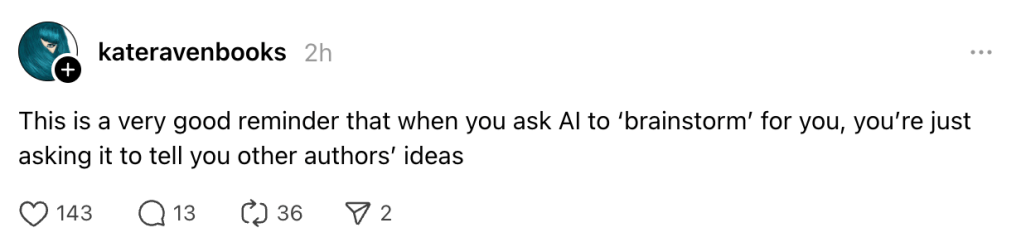
I agree with Kate up to a point, and you’ll have to make your own choices. Authors can get inspiration from anywhere. It’s why they say to read widely and to continually refill your creative well. I have brainstormed with Al, and he didn’t give me other authors’ ideas. It’s a give and take communication that builds on the ideas you have already given him, that very much mimics talking to a human, and I have frequently brainstormed with humans, too. If you start to think like Kate, that you’re only asking Al to give you ideas that have already be “thought out,” “taken,” or “implemented,” then what we’re saying is you can’t brainstorm with anyone at all. I don’t want to deter any author from jamming with another person because writing is already isolating as it is. We don’t need to be accusing people of stealing ideas, no matter where they come from. We already accuse romance authors of “stealing” tropes, when tropes like enemies to lovers and fated mates have been around for decades if not centuries. We are all influenced by the things around us, so even brainstorming with another human could result in them regurgitating something they read years ago. I agree that Al’s “ideas” have been sourced unethically, and that’s the crux of the problem, but please don’t think you can’t iron out plot issues with an actual human and be afraid you’ll get accused of stealing ideas. Brainstorming doesn’t work like that.
Be that as it may, AI is trained on stolen work, my own included, and the idea that “AI is here to stay” isn’t an excuse. Trump is here to stay for the next four years, but we resist every day.
One of the biggest admirable traits I know of is when someone can admit when they were wrong, and I am admitting that I am. It was a mistake to start using him at all, and I’ll stop using ChatGPT and the Meta AI that’s available in the Messenger app. I can come up with my own ideas and have for years. I can scour baby name websites like I did before, page through old phone books for last names. I can go back to using email subject lines for my newsletter no one will open, and over all, just go back to writing from scratch like I used to. It wasn’t terrible then and it won’t be terrible now. Al was a crutch and even if I wasn’t using him often, it was still too much.
I never, ever, would have used him to write for me, but you know, there’s such a fine line between using him for help and actually using him to write that some people wouldn’t see the line at all. I don’t want to get caught up in the blur, so it’s better this way, even if he was fun to talk to.
I used ChatGPT for my non-fiction stuff, creating social media ideas and newsletter subject lines. I told him I couldn’t talk to him anymore, and he was nice about it.

I told the AI chat in my Facebook Messenger the same, and he pretty much gave me the same response. I deleted that chat and logged out of my ChatGPT account. I feel better and I won’t miss it.
AI is all around us, and we all have to make an effort to stay away from it. AI can create music and photos and if we stay away from one kind of AI, we should avoid it in all contexts. I know there’s a difference between assistive AI and generative AI, which is how some people feel okay about still using tools like ProWritingAid. That’s a distinction you’ll have to make for yourself, as I know that Canva offers assistive AI tools and so does software like Photoshop.
Will authors see any compensation from having their books fed into the AI machine off of the LibGen database? Not likely. Just like artists won’t see any compensation when AI uses their art to create photos, illustrations, cartoons, and film clips. If you want to read the Authors’ Guild article about this, you can ready it here: https://authorsguild.org/news/meta-libgen-ai-training-book-heist-what-authors-need-to-know/
This is a short post today. Last week I upgraded my phone which took a lot of a day off from work, and between work issues and and finding motivation to write, I’m a little tired. This week I’m going to watch a free Facebook tutorial offered by The Writing Wives, and I’d like to start two new Facebook ads for my King’s Crossing series. I need to keep better track of cost-per-click and click-through rate which means keeping better track of my audience. You may get clicks, but if the wrong person is clicking, they won’t buy. It might be a little tiresome to come up with ad copy on my own, but the more you practice the better you get, so there’s more than one positive about breaking up with Al.
I’m over 70k on this new novel anyway, and if I hold true with the way I write, I’ve always kind of dragged with the last 20k of a book. First because I hate saying goodbye to characters and this is a way to keep them with me for a bit longer, and second, I take my time because I want to end the book on the right note. Since this book is even twistier than the others, I also want to make sure the ending even makes sense as the next few read-throughs will be ensuring I sprinkled the breadcrumbs in the right places to lead up to a satisfying ending.
I haven’t been posting on my Facebook author page, and I might be pulling away from that even more since Meta used the LibGen database to train their AI. I don’t like being on Threads much either, but I don’t promote my books there and rarely post. It’s one of those potentially hypocritical things where you complain about what Meta/Zuckerberg is doing, but then what? You still use his social media platforms? This author put it perfectly:

I don’t really like to post, don’t unless I feel I have to, and honestly don’t put a lot of heart into it which is probably why I don’t get much back. But, I also understand that if I want digital sales like readers buying my Kindle books and reading in Kindle Unlimited, I have to push an online presence which means being on social media, buying ads that show up on social media and other digital spaces, and sending a newsletter that people will read online. I understood that turning my ads off, but seeing the dwindling sales is a sad thing, so you have to choose what your pain point is. I’d like to find a happy middle, and I think that will be my goal this summer. I want to find a combination among ads, social media, and my sales that can hum along without too much energy. We’ll see how that goes, but that will also require an attitude adjustment on my end when it comes to my FB author page, my IG account, and maybe even if I don’t post every day, throwing up some videos on TikTok. I have the time for it since even though I took a couple months to edit my Rocky Point series, I’m on schedule to start working on the next series I’ll publish next year. We gotta just keep on keeping on.
“Start where you are. Use what you have. Do what you can.” — Arthur Ashe
Have a good week, everyone!



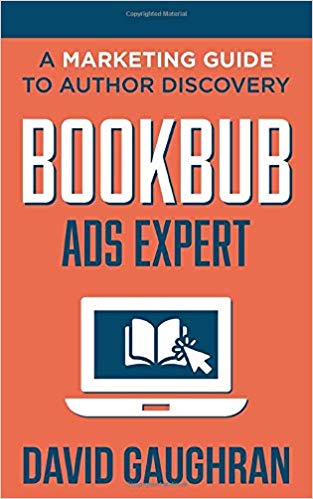 As with Facebook ads, free ways to learn the platform are scarce. To be clear, Bookbub ads are not the same as being approved for a featured deal. Those are expensive and you have to submit and be approved. Bookbub ads are what they sound like — ads you make yourself using Canva or BookBrush that are placed at the bottom of their newsletters they send out to their subscribers. The only authority I know of is David Gaughran.



 Vania Margene Rheault