Monday Author Update: When you can’t decide what to write next

1,491 words
8 minutes read time
I was going to post something else today, something about writing “rules” and publishing “rules” mostly because I saw an author on Facebook who was complaining about sales who definitely wasn’t making choices I would be making, but alas, no one wants to read about rules. And, well, no one wants to hear what they’re doing wrong, either, which is fine. Some people need to learn from their mistakes, and some don’t realize they’re making mistakes, blaming their lack of sales on other things. *Cough* Like the Amazon boycott. *Cough Cough*

So, that doesn’t leave me with much except my own updates, of which there are not many. I’ve been listening to Loss and Damages, and Word has updated their read aloud feature since I used it last. The process is a lot smoother and it’s really easy to listen now. It can be tedious because it takes a lot of time, but I catch syntax errors, missed words, repeated words, and typos. I catch enough that I would never skip this part of the editing process. I’d much rather listen to my manuscript than feed it chapter by chapter to ProWritingAid, even if I have been pro-Al in the past. I will still Google a grammar question here and there, but even if I miss things, I like to be in control of my own editing. It’s slow going, I can only listen to about thirty pages at a time, but it’s worth it. That’s what I’ve been doing for the past few days since I took a break after I finished writing and doing a couple read-throughs of Wicked Games. I’ll be able to write Loss and Damages‘s blurb, format it, and order the proof sometime in the next couple of weeks, and that book will pretty much be a wrap.

Next I’ll maybe give Wicked Games another read-through, though I might let it sit for a while longer yet. I was going to jump into a series I have that’s 1/3 completed, but thinking about tackling another big project like that really wears me down. I never used to be one to shy away from work, but I’m still not feeling well, I’m always tired, and it doesn’t sound appealing. I’ve been reading Dea Poirier’s Last Girl to Die, and in that book, a detective goes back to her home town to solve a murder. It got me thinking about my own books and tropes, and besides a book in my Rocky Point series where Logan goes home to Rocky Point for a wedding and reconnects with his high school girlfriend, Ivy, I’ve never written a “back to my hometown” book.

I started putting the pieces together about a guy who left his small town after high school graduation to strike it rich, and he does. He gets called home because his grandpa is dying and there he bumps into his high school sweetheart. She knew it was better for him to leave after graduation and pretended to hook up with another guy to force him to go. I was thinking about all the shit he could step in going home, and the characters started grabbing me. It would be another standalone, but I realize now that I’m inching away from true Billionaire romances. Giving characters money isn’t the only thing that defines the genre, and shoving my characters into small towns doesn’t fit, no matter how rich they are. I turned to the billionaire genre and the alternating first person POV hoping it would springboard a career, but lately I’ve just been writing “Contemporary Romance” that would have better fit under my full name written in 3rd person. I don’t know what to do about that since I don’t want to write in 3rd person anymore. I could keep writing in first, but that would also possibly mean a shift in what my covers should look like. I’m seeing more covers with couples on them in general, but I’ve been watching my brand so carefully that suddenly throwing a couple on a cover would look very out of place. I’m between a rock and a hard place. I whole-heartedly believe in writing what you want, but I also believe you need to package those stories correctly or they won’t meet reader expectations resulting in readers not finding the books they want and/or poor reviews.

Along those lines, I have to stop looking at that series as a drudgery or I’m never going to want to write the rest. I could start looking at the books one by one instead of the series as a whole and maybe that would help my mindset. Maybe I’m still burnt out getting my King’s Crossing books done then jumping right into editing those Rocky Point books, but whatever the cause is, I’m not wasting the two books already written so I better just put some lipstick on and get my shit together, as Elizabeth Taylor is rumored to have said. Whether I’ll do that before or after this new standalone remains to be seen. It just depends on how loudly this new set of characters speaks to me. On the other hand, already having a standalone planned after my series is done would be like a little treat to myself for working so hard. It was very nice writing Wicked Games, no pressure at all to set up other books or having to think about more than one cover.

Speaking of series, my King’s Crossing serial isn’t lighting the world on fire, but I am happy to say that readers are making it to the sixth book. That’s always a gamble, writing such a long series, especially all at once instead of publishing as you go. I will always finish a series that I start just for the personal satisfaction and closure, but it’s nice when it pays off. I tried running an FB ad to it, and while it was getting clicks, sales and borrows didn’t keep up with ad spend and I paused it. I have a couple of Amazon ads running, some are auto placement and some are category placement, and that’s the only thing pushing my series right now. Well, any of my books. If I’m selling other books that aren’t my King’s Crossing serial, it’s because readers found my FB author page or my IG account or they’ve read me before and they’re reading other books. That’s about it. I was thinking of buying a BargainBooksy, since Cruel Fate is still .99, and seeing what that does. My Fussy Librarian didn’t do that much, more than if I had done nothing, but still. A BargainBooksy Romantic Suspense feature is $72.00, and it would be nice to think that I would earn that fee back but it doesn’t always happen.

I’m also going to run a giveaway of my paperbacks and the mug I made. If I run my giveaway in conjunction with that, maybe it would help a little. I have no idea. Here’s a picture I took for the giveaway.
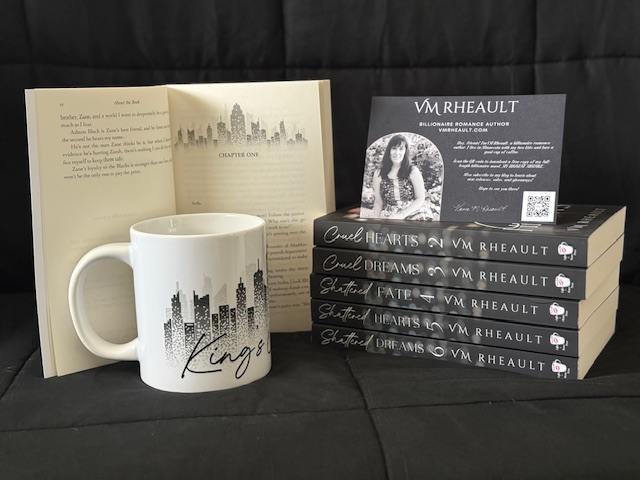
I’m still teasing the giveaway on my FB page. I’m going out of town this week, Monday through Thursday (if you read this on Monday I’m probably on the road), and I didn’t want to run the giveaway while I’m gone in case something happened and I can’t fix it. I’ll do all of that when I get back and I’m available to post about it.

That’s about all I have. Life would be super if I felt better, but a lot of people can say that. If I had access to better doctors, I might even go back to see if there was anything else that can be done, but I don’t trust the idiots where I live and driving five hours to see someone who knows what they’re doing isn’t feasible. I was driving back and forth last year and it wore out my mental health and my wallet. It’s been nine months since my last appointment and in some ways I’m feeling a lot better and in some ways I’m not. I don’t know if, in the ways I’m not, that’s even treatable, but like I said, figuring that out seems like it would be a lot of work. I might just end up with a, “You’re old and this is your life now,” diagnosis that would just be depressing to hear or something that could possibly be, if not fixed, made better, through surgery, but I’m not letting myself get cut open again. I think that’s what caused a lot of this mess in the first place.

Next week I think I have an author interview scheduled, and if something happens with that, I’ll just let you know how my trip went and hopefully I can tell you I’m done listening to Loss and Damages.

I hope you all have a wonderful week ahead!

Author Update and SMH

Words: 1299
Time to read: 7 minutes

So, there have been a couple things going on that just make me shake my head because I have too much going on to care, and while I do take interest in most things, if my energy allows it, I’ll be patient and see what happens.

I guess there’s been some issues with the founder of WordPress and WP Engine who uses the… I want to call it software, but I guess it’s technology? I’m not really sure, but I did a little snooping and my website isn’t run by WP Engine, it’s through WordPress directly. I don’t know how any of that is going to affect anyone’s websites now, and it seems a lot of people are panicking and pulling their websites that use WordPress technology down and going with something else. From what I understand, a lot of websites are built using WordPress, but are hosted by someone else like GoDaddy. I never went with a different host, even knowing I wouldn’t have all the flexibility, but I never minded. My website and blog does what I want it to do. Not to mention, I’m not very tech savvy, and fighting to create a website didn’t interest me. (Not back then. I was too busy trying to figure out how to format my freaking books!) Anyway, since the issue is really with the founder of WordPress and the people who run WP Engine, I think I’m safe. Listening to my gut has paid off before, so I’ll wait it out and see what happens. Moving my websites somewhere else, or breaking off from WordPress hosting and going with a different host sounds like a headache and nothing I want to tackle. I did export my blog posts from January of 2018 (the first two years I blogged are a disaster and that information is probably useless anyway) up until now. That would be a lot of words to suddenly lose, and maybe it’s a good idea to do that once in a while anyway. TechCrunch summarized what’s been going on and you can read it here: https://techcrunch.com/2024/09/27/wordpress-vs-wp-engine-drama-explained/

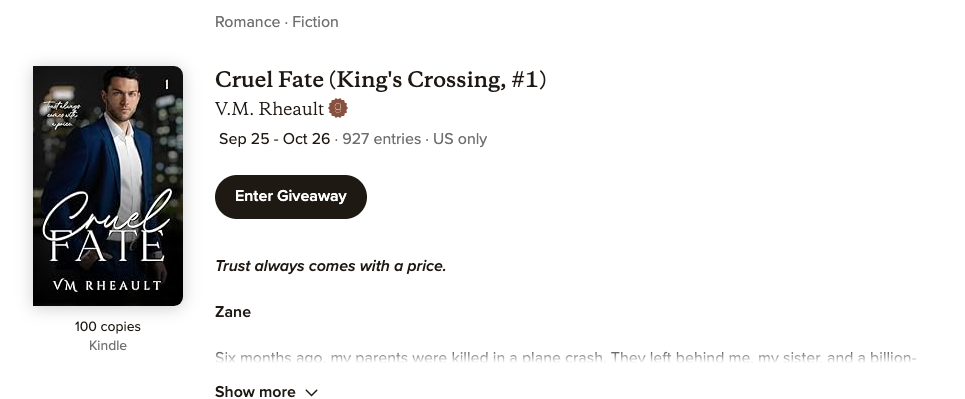
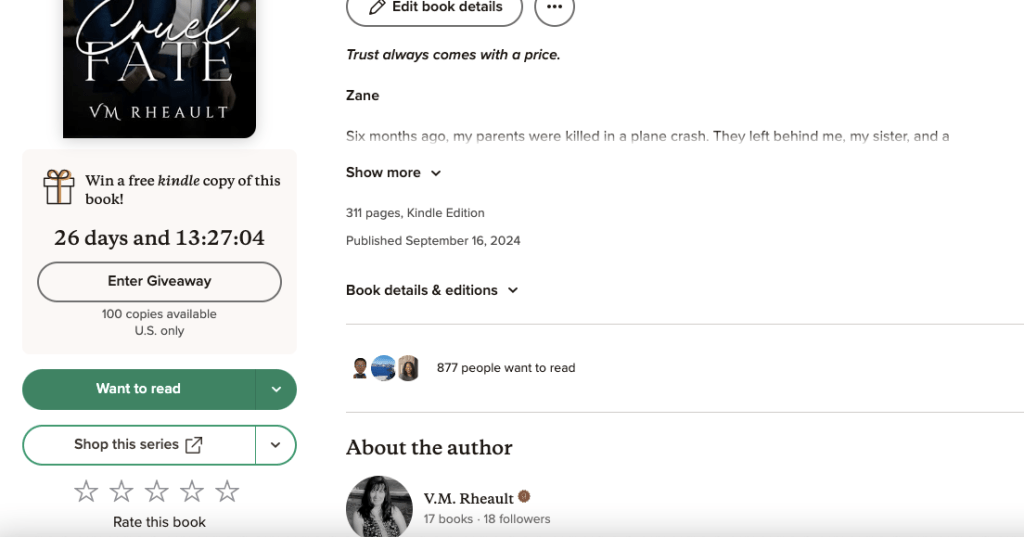
In other news, my Goodreads giveaway is doing fine, and just under a week I already have over 900 entries. If you want to enter, click here: https://www.goodreads.com/giveaway/enter_kindle_giveaway/397874-cruel-fate

I’m not actually sure what I expected, but I’m grateful there seems to be interest.

screenshot of goodreads 877 people want to read

I knew this giveaway would plump up my “want to read” numbers, and that’s cool, too. I don’t do much with Goodreads, haven’t even bothered to change the old covers on some of my books. I don’t know really, if Goodreads is safe for an author who reads, and at this point, with all my health issues and other things going on, I don’t think I want to add another platform anyway. Alessandra Torre is a huge Goodreads cheerleader, and you can read (and watch) how she uses it here: https://www.alessandratorreink.com/home/2017/5/12/grpromo

She has quite a bit of information out there on how to use Goodreads, just search “Alessandra Torre how to use Goodreads,” and a lot of information comes up. I don’t read as much as I should, so maybe Goodreads isn’t that great of a place to hang out if you don’t, but I don’t think once a reader becomes an author that it’s an author’s place to review another author’s work. I see authors all the time who defend their right to say what they want, but then when they get an “honest” review of their work, they can’t handle it. Don’t be in the kitchen if you can’t stand the heat is all I have to say to that. You all know my stance. Stay out of reader spaces (even if you are one!). Leave people alone. Go write your next book. There are actually some things you don’t have to tell anyone about. Imagine.

Now that I got my sarcasm out of the way for today, no, I don’t think I plan to be on Goodreads all that much, even during/after my giveaway. This was mostly an experiment in paying for exposure, and I have no idea really if it’s even worth it. I have Amazon ads going to my series, and I’m getting quite a few clicks and lots of impressions, but all my books will be released into KU and that’s what my readers will wait for. I’m not running ads hoping for preorders, even though I dropped the preorder price on books two and three. Book one is still .99 and probably will be until the last book comes out in April. I’m trying to be pragmatic about this release, realistic, and even though they call it “rapid release” I know I won’t see any real movement until they’re all out.

I have a lot of thoughts on paying for exposure, and maybe I’ll do a blog post about it sometime. For now, let’s move on.

Actually, there’s not a lot to move on to. I’m still editing my series, and I did get done with book two on Friday after our trip to the zoo and the junk market and started book three while I was at work on Saturday. Book two needed some work, some plumping up, and I know why. That was the first book I wrote and I remember thinking it was too “quiet” to carry a series and I decided to make book two book one. Now that I’m reading them with fresh eyes, I think book two would have been an okay book one, but I hadn’t gotten into the flow of the characters and I added 1500 words to book two. That took a little time, and I added a lot to the ending because it didn’t quite make sense. I think I learned a lot writing my King’s Crossing series, handling all that plot and all those details. I have a better memory than I did when I wrote my Rocky Point series, or maybe I was just in a rush to publish and didn’t work on them as hard as I should/could have. Hard to say since I published them in 2018, and that feels like a lifetime ago now. Still, never too late to fix a mistake, and these will sound good when I’m done. I’d like to celebrate their rerelease since some authors do that, maybe do a couple of lives if I can get up the courage and I’ll order some author copies to give away. I know I need to start being more active online, engage with people more. I’m not sure why I have problems with it. Hiding behind a screen is the easiest way to communicate with people.

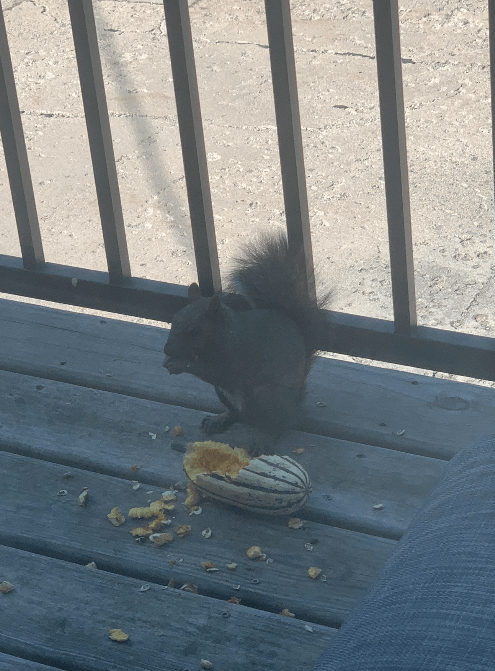
That’s really all I have left. My ex-husband has a key to my apartment (it was ours before we divorced and he kept his in case of an emergency) and he does weird things like come over while I’m working and drops off bags of garden veg he gets from somewhere. He did that a couple weeks ago and I put the squash on my balcony, jokingly referring to it as my fall aesthetic because I’m terrible at decorating. So, you all know I feed the squirrels and one of them decided to turn my fall aesthetic into a snack. She completely ripped the guts out of one and scattered them all over the balcony. But, she’s enjoying it, and I’ll let her have at it until there’s nothing left.

Squirrel eating squash
I took the picture through my screen so I wouldn’t disturb her.

That’s all I have for this week. I’m praying for everyone who was affected by Hurricane Helene. I’ve seen some pictures and read on Threads what’s been going on and I feel for everyone who has suffered. My thoughts are with you.

Until next time.

Finishing a Series and Author Update

Words: 1749
Time to read: 9 minutes

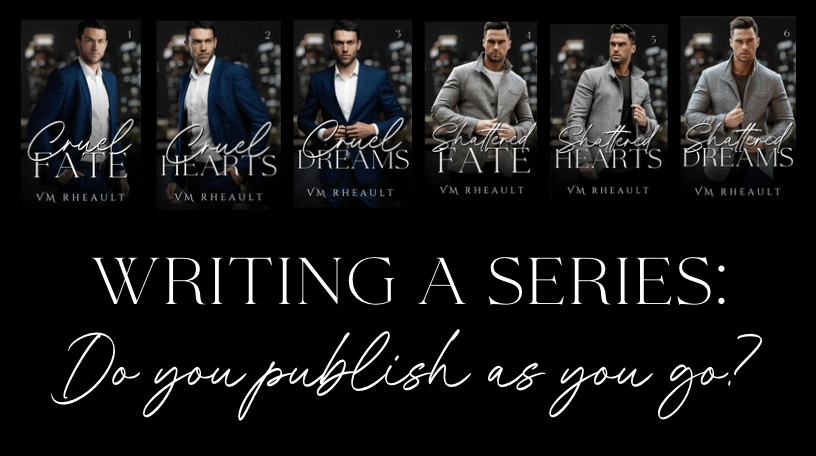
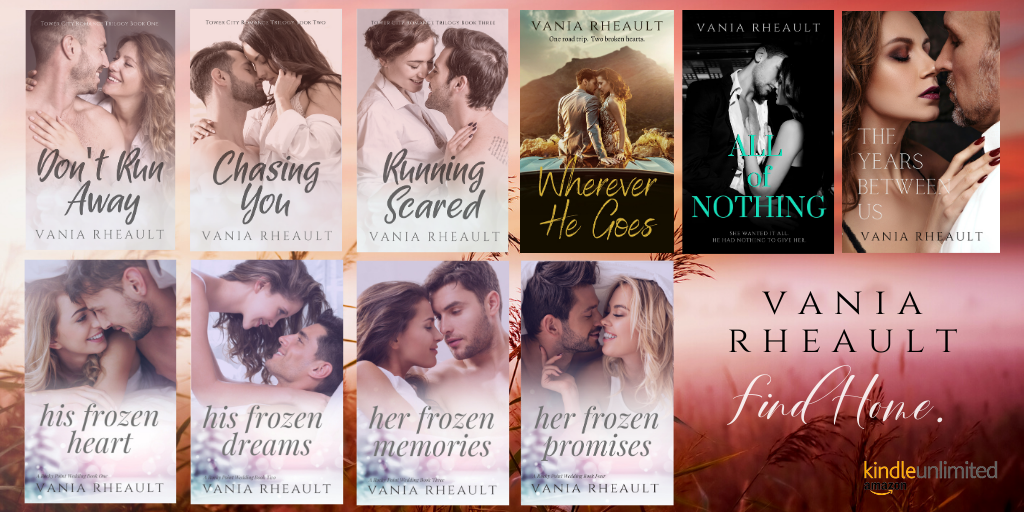
graphic of six book covers and the title of the blog: Writing a Series. Do you publish as you go?
These are the covers I’ve chosen for my series. They just need a few more tweaks before they’ll be ready to submit when I order my proofs.

I’ve written about series a few times on this blog, mostly in favor of them because if your first book is strong there can be potential for great read-through and they have numerous marketing advantages like putting the first book free (a loss leader) or making compilation. But there are cons to writing a series too, such as how much work they are, they cost more to produce, and not everyone likes to dive into a long series, especially by an unknown author.

One thing I didn’t consider when I wrote my first trilogy, or any others after that for that matter, is never finishing once I started. To me, my duets, trilogies, and series are one long story, and like writing a standalone from the first page to the last, they aren’t done until the last book is written. I don’t consider the time or the energy it takes to write it. Once I get it into my head (and the books plotted out) I write until I’m done. I don’t even think about if readers will enjoy them or what kind of return on investment I’ll get after they’re published.

When I first joined the writing community, many years before Musk ruined Twitter, there were authors here and there who wouldn’t finish their series. Being the arrogant new writer that I was, I thought it was simply laziness on their part, but over the years, and days such as yesterday when I’m reminded of it, I’ve learned some authors don’t finish a series because the books they already have published aren’t selling.

This is a huge Catch-22. Some readers don’t read a series until all the books are out, bingeing the books like they would a Netflix show (that actually drops all at once. I’m looking at you, Bridgerton.). That does mean fewer readers of your series if you publish as you write. But since readers do this, maybe you’re not selling as many books as you want and you think finishing isn’t worth it.

I wasn’t aware authors gauged the success of their series this way, mostly because I don’t write and publish that way. In fact, it boggles my mind how you could. The thought of being unable to change details in earlier books to fit with later books gives me hives. I know not all writers need that flexibility (they’re better writers and keep meticulous track of details and/or their stories aren’t too complicated and/or their series are interconnected but true standalones that aren’t as dependent on the books before), but I think needing it also gives me the freedom to finish without worrying about consequences. Consequences such as lost time and lost resources. I’m going to take the time to write and finish because I want to take the time.

The problem with my way of thinking is that if no one reads my series from start to finish, I’ve already lost time. I don’t have the option to bail because that time is already gone. But, even if the books don’t sell, like my duet, I can’t consider it a waste–I’ve written the story I want to tell.

I understand why people don’t want to wait and write them all first. If you have limited time, you may be writing for five or six years before you can publish them all. The series I’m about to publish took me four and a half years to get to where I’m comfortable publishing, but I’ve also written, packaged, and published other books while they were breathing between edits. I’ve said I have a lot of time to write, and not everyone is afforded that luxury. So I get being impatient, wanting to put your books out there, but if you are, that does come with, in my opinion, expectations you’ll have to control. Readers who enjoy your books will want to know when the next one comes out, and that increases the pressure to write and publish quickly. On the flip side, if no one reads, you’ll feel like writing the subsequent books will be a waste of time. On the flip side of that, you’d have to decide if abandoning a series would be worth it because you have no idea how an unrelated book would do and you could find you would have been better off writing the next book in the series you put aside.

Books sell forever and you never know when something will suddenly catch. That may be a book one in a series you didn’t finish and you’re sabotaging your own success. Read through will always earn you more, and an incomplete series can elicit distrust.

It doesn’t happen with only indies… we all know about George RR Martin. I watched the Game of Thrones on HBO because I knew after all this time Martin wouldn’t finish, and I wanted some type of closure, even if it wasn’t his. Whether or not Martin had any input in how the series ended, it ended how I thought it would and I was satisfied, if not happy, though I would have been happier had I been able to read the books. Life happens and he has his fingers in a lot of pies. As an author, I’m not sure how he feels about leaving a project like that unfinished. Maybe it bothers him or maybe he feels HBO finished it for him and he doesn’t think about it. Plenty of fans want the books, and him writing and releasing them would revive the whole series.

What it comes down to is how you want to run your business and how you want to spend your time. It may not be so simple to some, but books end up being products and an incomplete series will never sell as well as one that’s finished. If anything, complete your series to say that you did? I know I wouldn’t be able to write anything else if I didn’t have intentions of finishing. I would feel like I’m letting myself down, and the time it would take to finish would be worth it to me. It’s not for me to judge if it’s not worth it to you.


As for my author update, I finally finished editing my series. The next steps are adding elements to the formatting–even though I said I wouldn’t, I’m going to add chapter headers to the paperbacks, but they’re going to be the same for all six books. I have to make sure all the front and back matter is the same and in the same order, update my copyright pages as I changed the models and backgrounds and I add that information, make sure my Also By pages are updated and rewrite my acknowledgments. I thanked my ex-fiancé and he doesn’t deserve the mention. I still have plenty to do before I can order the proofs, but it won’t take as long as the editing. Toward the end, I just kept rereading the same paragraphs over and over, mostly due to fixating on how I felt instead of the story. I haven’t had any anxiety since my Mayo Clinic appointment on the 28th, and I’m thankful for that. Anxiety attacks were also getting in the way of my editing sessions, causing me to reread more than I should have because I was scared I had missed a mistake.

If you’re reading this the day it posts, I’ll be on a clear liquid diet for a colonoscopy on the 4th. To keep my mind off how hungry I am, formatting these books will be the perfect project. I can make a cup of broth, turn on some music, and pretend I don’t have such a crummy task ahead of me. My doctor at Mayo recommended I have it, and I was very fortunate my local clinic could get me in so quickly so I didn’t have to worry or think about it over the summer. Of course, I’m hoping they don’t find anything–I’m not sure if my mental health could take anymore. I didn’t hear any bad news at Mayo. She reassured me things were okay inside my body and that my hysterectomy hadn’t messed anything up inside me. I was really relieved. I have a follow up on August 23rd, but if my colonoscopy comes back clear, I think that appointment will be the end of things for a while. I know what my issues are and I’m on a treatment plan. I may never feel “normal” again but I’ve come a long way in the four months since my first appointment, and I’m grateful.

I don’t want to bog up this post with health updates–I just mentioned it because my editing was slowed down quite a bit by panic attacks and not feeling well. I still plan on reading most if not all of the proofs, but hopefully that last and final read through will be enjoyable and I can look at it as a kind of closure in two ways: maybe not the end of my health issues, but I worked on these the whole time I was unwell and now I’m feeling better, and the end of four years of work on a six-book series that will be my pride and joy. I doubt I’ll ever be able (or want) to write anything that will compare to these. Writing kept me sane while I was dealing with all this crap, and while they may remind me of these hard years, it will be tough to say goodbye, too.

Besides telling you if my colonoscopy went okay, I don’t think I’ll need to mention my health anymore. It’s under control, and it will be interesting to see how I feel writing new books without that in the back of my mind. But I won’t stop writing on my other blog, and if you want to follow along, you can do it here: chaoscoffeeandconfessions.blogspot.com

Next week I hope to tell you my positive test results and that I was able to order my proofs. Because of the time I’ll need to read the proofs and submit the changes, I won’t be able to put my ARCs up until the beginning of July, but that’s okay. I know these are done to the best of my ability. It’s time to move on, in a lot of ways, and I’m looking forward to it. Keep your fingers crossed for me! Have a great week!

When do you know when your book is done?

books and flowers with quote:


“A writer only begins a book. A reader finishes it.”

--Samuel Johnson, 
Works of Samuel Johnson

Since I’ve been listening to my trilogy, that’s a question that has been on my mind the last few days. Listening to my books to find typos, missing words, extra words, and syntax issues is the last editing step I will never skip. In an FB group someone said they paid a proofer (an exorbitant amount, in my opinion) who missed too many errors for the price she was charging. Listening to your manuscript can help you find and fix all those issues, and from the feedback the reviewers give me on Booksprout, I catch 99.9% of mistakes. (One reviewer found only one typo in Faking Forever, and I was so proud of that!)

That doesn’t mean you shouldn’t have a second set of eyes on your books if you can find a set that doesn’t cost and arm and a leg, but like I wrote in my last blog post, finding people you can trust is impossible at worst and difficult at best.

So, when do I know when my book is done?

I honestly don’t spend a lot of time on my books and you can take that however you want to. Product quality will always be subjective, and I see that all the time online. People who can write quickly are judged and accused of putting out crap, as if spending more time on your manuscript means you’ve got the next great American Novel on your hands, ah, laptop. Not everyone wants to spend the next five years writing their next book. In fact, if someone told me I had to spend five years writing my next book, I wouldn’t even start. Some writers don’t bother to even finish a WIP before it’s on to the next shiny thing, but I can’t have projects overlapping in my brain. I need to finish one and then go on to the next. It’s just how I am.

books and flowers with quote:


It’s being ready to accept rejection. You can work on a book for two years and get it published, and it’s like you may as well have thrown it down a well. It’s not all champagne and doing interviews with The New York Times.

George R. R. Martin

When I write a first draft, it’s pretty clean. I don’t like to edit, though I’m getting better, and I never rewrite unless I find an inconsistency and I have no choice. There’s nothing I love more than reading my own books, but knowing I have things to fix makes me crabby and I try to avoid it. I edit as I go along, especially inconsistencies I know are there. Everyone will have their own process, but if you hate editing, plotting your books to avoid plot holes and knowing your grammar and punctuation to avoid errors can give you a cleaner first draft.

Standalones are easier than duets or trilogies just because you’re not dealing with so many words. The trilogy I’m working on now wasn’t supposed to be one, and I’m thankful I don’t publish as I go. I would have been in a world of hurt when it came to details that link all the books together. I had no choice, anyway, once I decided there was going to be a book two and three because there was so much foreshadowing to book one I needed to add.

books and flowers with quote:

If you're going to publish a book, 
you probably are going to make 
a fool of yourself.

--Annie Dillard

Once I get them all written, I immediately reread them all and make notes of character details like eye and hair color, and who knows what. That was a big one for this trilogy as this has a twisty murder in it, and I needed to keep track of what information each character had. Even at the end of the trilogy, not everyone knows everything, and I had a few pages of notes to keep everything straight.

I read book one more times than the others, but books two and three got their share. The story is set in stone by the time I listen to them. In a perfect world, I would have a beta read them before I listen, but the more productive you are, the harder it is to find someone to help you. Especially if you can’t afford the help and are looking for free or are trading services. I had a free beta lined up for book one, before I knew it was going to be a trilogy, but after I decided to add books two and three I didn’t ask her. I know I write fast, I know I produce a lot of books, and that is just too much for someone to take on. Not many people agree with the idea you should edit your own work, but sometimes that’s just how it has to be.

I have a pretty decent memory and usually know when I’ve messed up with consistency. It’s difficult when a character says one thing at the beginning and near the end says something else. That usually happens because they’ve grown in the middle, but you have to make sure that growth is on the page and not in your head or the character’s head. If you’re having trouble picking that stuff out for yourself, you probably need a manuscript critique or a developmental edit if you can afford it.

In book two of my trilogy, Eddie wants to keep his relationship with Clarissa a secret. Well, he says he does, but every little thing he does negates what he says. He moves in with her, tells his best friend he’s living with her, is in love with her, and was having an affair with her while she was married to his bandmate. Parks in the driveway instead of hiding his car in the garage. Doesn’t mind when other people find out he’s seeing her. Little things add up to the fact that while he said he wanted to keep their relationship a secret, he really didn’t want to. He was doing his best to out himself even if he didn’t realize it. It even took me a while to realize that’s what he was doing, but after that clicked, it made total sense. He was tired of hiding her, and I hope my readers understand that. It’s funny when things like that make it into your writing, almost like a subliminal message. I only mention this because I thought I had a big problem with consistency. He was continually saying one thing but doing another. It wasn’t intentional, but it was, and I’m actually really proud of that. (And super glad I didn’t have a ton or rewriting ahead of me!)

flowers and books with quote:

The process of writing a book is so removed in my mind from the process of publishing it that I often forget for great stretches that I eventually hope to do the latter.

--Karen Joy Fowler

I have to be pretty sure my books are how I want them before I start listening to them. How do I get to that point? I don’t get tired of my books, per se, but there is an eagerness to get them done and move on to the next thing. I don’t have a problem with perfection, and anyone reading in their genre and who can be honest knows some of the best selling books aren’t perfect either. I’m proud of my books, but doesn’t mean I’m going to reread them 120 times and haggle with myself over comma placement. If you don’t know about a comma, listen to the sentence both ways. You’ll right away if it belongs or not. For me, there’s only so much you can do for a book after it’s written. I’ve done my best by it and it’s time to nudge it out of the nest to see if it can fly.

Of course, you don’t want to publish too soon. I’ve seen this happen and the results can be… not good. You really don’t want readers to pay for a subpar product, and if my proofer finds stuff in the paperback proofs, of course I’m going to fix them. I wouldn’t ignore her findings because I’m in a hurry. That’s what she’s there for.

I’m not sure if I answered the question, “How do I know my books are ready to publish?” It’s more of a feeling, a proud sense of accomplishment that they’re done and ready to go out into the world. They sound good, the plot is solid. I had reservations about Faking Forever. I didn’t like Fox, and I was worried other readers wouldn’t like him either. But I wasn’t going to rewrite it or scrap the book. There actually was nothing I could rewrite. The story was what it was. The only thing I could have done was not publish it at all, but it was already there, already done, and I took a chance. That was a book that didn’t have a proofer or a beta reader. I put it out 100% on my own. Maybe had I had feedback first I wouldn’t have felt like I did. Or I might have felt worse. Who knows. I’m not looking at the reviews. You can do that if you want to see how readers like it.

Books with flowers and quotes

Self publishing is not as easy as it is portrayed! When you think you have finished your book, proof read, proof read again, and again, and again. Don't believe it is ready until you have a hard copy proofed! --Phil Simpkin

You have to listen to your instincts and be honest about what your plans are. There are some writers who don’t ever plan to publish. They are in love with their characters and completing and publishing would mean they aren’t able to spend time with them anymore. That’s okay. I like publishing and I like knowing readers are reading my books. But I also like moving on to the next project. I’m trying to savor the process more–writing the blurbs, doing the covers, even uploading them on KDP. But trying not to be so quick is hard. Not really because I’m tired of working on that particular project, but because I’m excited to publish. It’s a lot of fun to put my books on Booksprout and send my newsletter ARC copies.

Probably the best advice I can give you is to not chase perfection. You’re not going to find it. I’ll reread books I’ve written and of course I find things I could change. That only means I’ve grown as a writer between writing it and that reread, but that doesn’t mean a reader won’t enjoy the book that exists. Kristine Kathryn Rusch has a talk about chasing perfection, and I post it every now and then. I think it’s a great. We’re our own worst critics and you can’t let that keep you from moving forward.

Thanks for reading and I’ll see you next week!

Reedsy’s Savannah Cordova: How to Ensure Your Romance Sequel Exceeds Expectations

I’d like to welcome Savannah Cordova from Reedsy to my blog today! I was so excited when she reached out to me and asked if I would be interested in hosting a guest blog post. Of course I said yes! I love Reedsy and all they have to offer indie authors. If you like this post and are interested in others like it, Reedsy hosts its own blog, and you can find it here. Thanks for stopping by today!


How to Ensure Your Romance Sequel Exceeds Expectations
by Savannah Cordova

Having enough acclaim to write a sequel to your book is every writer’s dream — but that doesn’t mean the process comes as easily as the butterflies when you get a crush. There are plenty of critically panned sequels out there, and the pressure can be nerve-wracking: you’re stressed about both living up to the first novel and coming up with something fresh and original.

The best romance novel sequels build on the success of their debuts, while also introducing new concepts, characters, and plot lines — which means that some beloved elements of the first novel might end up on the cutting room floor. A lot to juggle, right? Read on if you’re a romance author in need of some help; here are five tips to help your sequel shine.

1. Identify what your fans loved and focus on it
A great love story is a surefire way for a book to attract a following and take on a life beyond itself. With investment into a fictive world, and the growth of a fandom, come expectations. Expectations that need to be met or, dare I say, exceeded.

To do this successfully, it’s important to analyze what really made your first love story sing. Were people inspired by your fresh twist on that popular romance trope? Was the main love interest setting readers’ hearts aflutter? Did people enjoy the relatability of a certain character’s struggle to accept love? A stellar first romance novel normally has something special to distinguish it from other releases (if you’re feeling brave, reviews of your book might help you on this front). Zero in on this aspect and do your best to tease it out in the sequel.

That said, you shouldn’t be completely cowed by what you think your fans want — it’s your story, after all! Don’t be afraid to challenge their expectations and take the plot in unanticipated directions. It’s even advisable to drop some characters and subplots if they no longer serve a purpose. “Out with the old, in with the new,” as the old adage goes.

2. Introduce new plot threads
Writing a sequel doesn’t always mean picking up where you left off — this can fall into the trap of predictability and boring linearity. You may need to resolve cliffhangers left in your first book, but you should also take the opportunity to explore uncharted waters!

Many romance authors change the who of the story in their sequels (focusing on a new set of protagonists, often secondary characters of the previous book), but keep in mind that you might be better off simply changing the where and when. Great material can be found in illustrating your amorous protagonists adapting to unfamiliar settings and different life challenges, and can allow you to “test” the strength of their romantic relationship.

Another idea is to throw up some roadblocks that will put your characters through their paces, revitalize your narrative, and make space for character development. For example, in Bridget Jones: The Edge of Reason, Bridget diverges from the original setting of London and, after a mishap on a vacation in Thailand, ends up in jail — definitely not what she (or readers!) were expecting. However, we learn about Bridget’s resilience, and this scene change also sets the stage for her two suitors to fight over her, in that iconic fountain fight scene.

3. Don’t hesitate to change the stakes
Beware of giving your readers another helping of the exact same dish. It’s fairly easy to change the more episodic events of a story, but what will really give your story fresh dynamism is changing your protagonist’s priorities or stakes. Better yet, doing this without betraying any key qualities of your characters, their principles, or the overall tone will mean the key change won’t seem gratuitous or excessive to the point of unbelievability.

Let’s take Jojo Moyes’ Me Before You trilogy as an example. In the second book, following the death of her lover Will, Louisa is dealing with her heartbreak and trying to move on as best she can. After an accident, she ends up in a church basement with the members of the Moving On support group.

So what’s changed? For one, in grief, she’s a more world-wise, introspective character. She’s also adapting to a new social setting, where she is introduced to handsome and charming fireman, Sam — you can probably see where this is going. The stakes have been altered because of the events that have occurred. She’s recovering from an accident and therefore vulnerable, which no doubt factors into the risks she will take if she is to fall in love again.

4. Develop your characters in interesting ways
You may think you know a character, and then they respond to a situation in a way you never would have anticipated. Surprise is the essence of any great drama, right? Though introductory beats are usually where a good chunk of character information is found, any good novel will treat character development as a continuous process. To do so will give you room to interrogate and deconstruct your characters — and subvert expectations.

Though character development has been touched upon in point #2, consider also how you might want to accentuate a feature (or flaw) of a character that was not touched upon in your first story. This might come naturally if the character has aged, as well as with the general forward-thrust of your plot. Perhaps a softer, more sensitive side to a character is revealed when they become a parent — or a more daring, combative facet of another character comes to the fore when their relationship is threatened by a third party. The list is endless!

5. Expand on the backstory
Even as you’re in the process of driving your plot forward, why not throw in a bit of time traveling via flashbacks? There is more incentive to do this if you’re penning a sequel to the first part of a book that did well — your fans will be invested in your characters and hankering for juicy details on their backstories.

Moreover, elaborating on a character’s origins will give color to their actions, reactions, and decision-making in the present day. For example, in the Bridgerton books and Netflix series, we learn that the Duke of Hastings lost his mother at a young age and had a terrible relationship with his father. From this, we are better equipped to understand his reluctance to marry Daphne Bridgerton — the Duke has trust issues and feels unworthy of her love.

Throwing in some snapshots of life before the present day is often an effective way to understand characters’ psyches and how this factors into a romantic dynamic. In this instance, Daphne and the Duke’s love story is made even more powerful after we learn of the psychological hurdles the Duke has had to overcome to commit himself to their relationship.

And there you have it. Hopefully these ideas will aid your writing process and enhance the next act of your story, as it were. You might even have an entire series under your belt one day!


Thank you, Savannah! Reedsy offers a ton of writing/publishing/marketing resources for indie authors. Check out Ricardo Fayet’s free marketing book here. Reedsy also hosts their own YouTube channel, and you can find it here.

And my favorite part of Reedsy is their straight-to-inbox free courses! Check out all they have to offer here.

Thanks again, Savannah, and have a great week, everyone! Until next time!

Catching up with what I’m doing and Bits and Pieces of Publishing News.

Lately my blog posts have been a hodgepodge of little things to make up a whole post. It’s tough when you don’t have a lot going on, and sometimes I feel like my blog posts are the blind leading the blind. I don’t have much to offer in way of advice, particularly because I haven’t found anything that is working for me sales-wise.

Anyway, like everyone else, I’m glad the election is over, though I”m sure we’re far from finding peace. Hopefully that won’t deter readers from reading like it has over the past few weeks. I can’t tell you the number of authors who have complained about sinking sales. It is what it is. I’m in the hole with my ads this month and I paused all of them and created a few new ones to target holiday romance for my series. What’s really nice is that Amazon now lets you run ads to your series page which allows a reader to pick up all the books with one click.

We’ll see how that goes. I haven’t done the math to look at read-through for all my books, but I can do that now, out of curiosity. The last book was published in May of this year, so I only have five month’s of data too interpret. Using the read-through instructions and formula by Malorie Cooper on Dave Chesson’s Kindlepreneur website, read-through is dividing the copies of the second book sold by the copies of the first book sold. You have to do a little math if you’re in KU.

Remember, the number of KU pages read divided by the number of KENPC pages in your book will tell you how many books those page reads equal to.

Doing the math, I have sold 214 of the first book in my series between June 1st 2020 and October 31st. That total includes both sales and KU pages read.

I have sold 97 books (together with sales and KU pages read) of book two.

That’s a read-through of 40%. 40% of my readers who read book one went on to read book two.

A profitable series will have a strong read-through for all the books, and we can calculate read-through of book two to three doing the same math:

Book two’s sales and KU page reads was 97 books. Book three has a total of 76 books sold. (Together with sales and KU reads.) That makes read-through (76/97=) 78%

And read-through from book 3 to book 4 using all the same formulas: 88% read-through. Meaning 88% of people who read book three will finish the series and read book four.

According to Mal Cooper, my 40% read-through from book one to book two could indicate a problem. I already know from reviews that the reception of my male main character is lacklustre at best. As I’ve said in the past, a physically damaged character is neither sexy nor romantic. Besides trying to market the book as a beauty and the beast retelling, there’s not much I can really do. His injuries make the whole book. It’s nothing I can go and change to encourage read-through. My sales from book one to two will just have to be a lesson in the future. It’s also a reminder if you’re going to invest time in a series, you need to hit it out of the park or the other books won’t matter. Your book one won’t be good enough to entice readers to read them.

I will keep an eye on my ads, make sure they stay profitable. With the holiday season approaching, if I can grab a couple sales and come out ahead, it will be worth advertising.


photo taken from their website

In other news, IngramSpark has decided to give ISBNs away if you publish through them, like Kindle Direct Publishing has done all along. The only problem with that is if you publish on Amazon and use their free ISBNs, you can’t turn around and use those on Ingram. Then you take the free ISBNs from Ingram and all of a sudden your book is listed under many numbers, and that doesn’t sound good to me.

I realize buying ISBNs in the States is a big pain, not to mention very costly, but when people say you need to invest in your business, this is what they’re talking about. You need to protect your work. I buy my ISBNs from Bowker and use the same paperback ISBN on both Amazon and Ingram. That way my paperback is listed under one number. The one I paid for that belongs to me. That’s important to me. I also use an ISBN number for each of my ebooks. Some will say that’s a waste of money because Amazon will assign your book to an ASIN number, but then if you’re wide, you can’t use that ASIN number as that belongs in only Amazon’s system. So there again, you have different identifying numbers for every ebook platform you publish on.

There is has been argument in the past that you can’t use the same ISBN number for a .MOBI file and an ePub because they are different formats. Then you have people who say that a digital file is a digital file. When I went wide, I used the same ISBN number for my ebooks across all platforms and nothing bad happened. I can’t imagine this would even be an issue now that Amazon asks you to upload an ePub to their platform instead of a .MOBI file.

You can have Ingram distribute to Amazon, but I’ve heard of people having trouble with their books being available (listed “out of stock” instead) and you don’t have access to your KDP dashboard and you can’t run ads if Ingram supplies your books to KDP. It’s always better to go direct where you can. It might take a little hassle, but then, we went indie to stay in control, didn’t we?


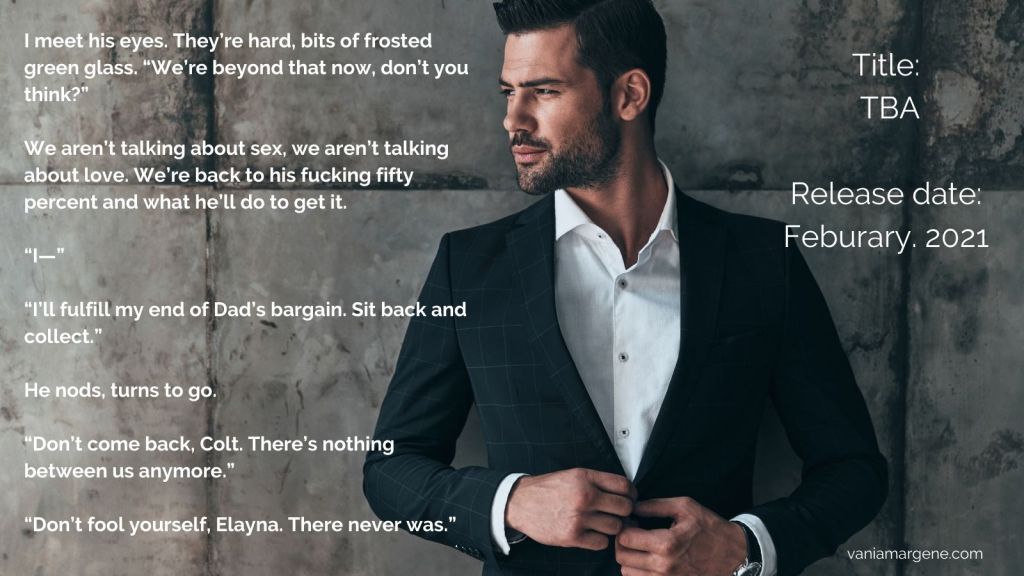
I’m 20k into my new project, about a man tasked to finding a husband for his boss’s daughter in exchange for a portion of the company he helped build. It’s going well, though I feel like no matter how much planning I’ve done with this book, I’m pantsing it. Maybe I’m just tired or maybe I’m still not used to writing in first person present, but it’s coming along, and if I keep up the slightly faster pace than a NaNo participant, I should be done with it by the end of the month. We’ll have to see if that happens. I have a lot coming up in the next couple of weeks, namely a longer work schedule, Thanksgiving, a couple of birthdays and possible jury duty. I write when I can, though, so if not by the end of the month, by the middle of December, for sure. Here’s a sneak peak of a sliver of a scene I wrote the other day. There is potential for spin-off books, but I still have my 6 book series I need to polish to release next year. I’m grateful there is so much to write about.

Man in suit leaning against a grey stone wall. Text:
I meet his eyes. They’re hard, bits of frosted green glass. “We’re beyond that now, don’t you think?”

We aren’t talking about sex, we aren’t talking about love. We’re back to his fucking fifty percent and what he’ll do to get it.

“I—”

“I’ll fulfill my end of Dad’s bargain. Sit back and collect.”

He nods, turns to go.

“Don’t come back, Colt. There’s nothing between us anymore.”

“Don’t fool yourself, Elayna. There never was.”
created with Canva Pro. Photo purchased on depositphotos.com

That’s going to be all for today! I hope you have a productive week! Good luck to those participating in NaNo!

The Positives and Pitfalls of Writing a Series

Writing a series is hard. And daunting. Not one person can tell you it’s easy. But there are a lot of positives that can come with taking the time to write an intriguing, action-packed series.

Personally, I don’t like writing them. I’m getting used to them, but I like writing one book, being able to edit it, format it, slap a cover on it, and push it out to the world. Writing a series is more involved, but the pay off can be much more than the instant gratification of writing a standalone.

When I started writing my first person book back in December, I had a plan for it to be a trilogy. And it could have stayed that way, but a secondary character needed her story told, and I worried for a while over what that story would be. I laid a shaky foundation for her in the first three books, but now that I’m starting book six, I know highlighting her story was the right choice. At least, I hope it turns out to be.

What are the positives and negatives of writing a series? From my limited experience, I’ll give you my list:

The positives:

  1. Read-through. This isn’t to say that if someone reads one of your standalones, they can’t or won’t go on to read other books in your backlist, but if you can hook them with a solid book one, it’s almost a no-brainer that you’ll have that reader for as long as your series lasts. That means guaranteed sales for you.
  2. The books are easier to write. More than likely, the books after book one will have some of the plot built into the overall story. When I wrote my wedding series, I had to include wedding activities that included the other characters. Not only does that take up space, but readers like when other characters play a role, even if the book isn’t centered on them.
  3. They look great on your Amazon Author Page, and Amazon will create a series page for you to help promote them. This is a silly thing to point out, mostly I added it because I can’t think of any other positives. I’m sure if you enjoy writing a series, you can com up with something more, but I’m all out. A series with nice covers does look terrific on your author page, though, and if you have more than one series, it clues a reader in that you’re in this for the long haul and they can count on you to deliver books well into the future.

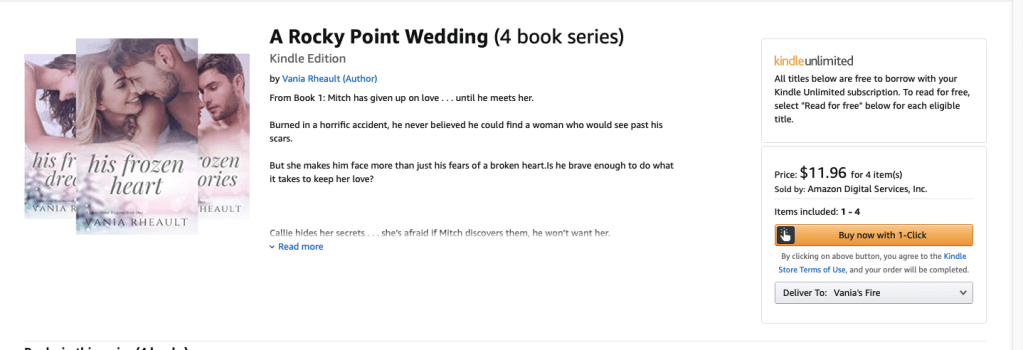
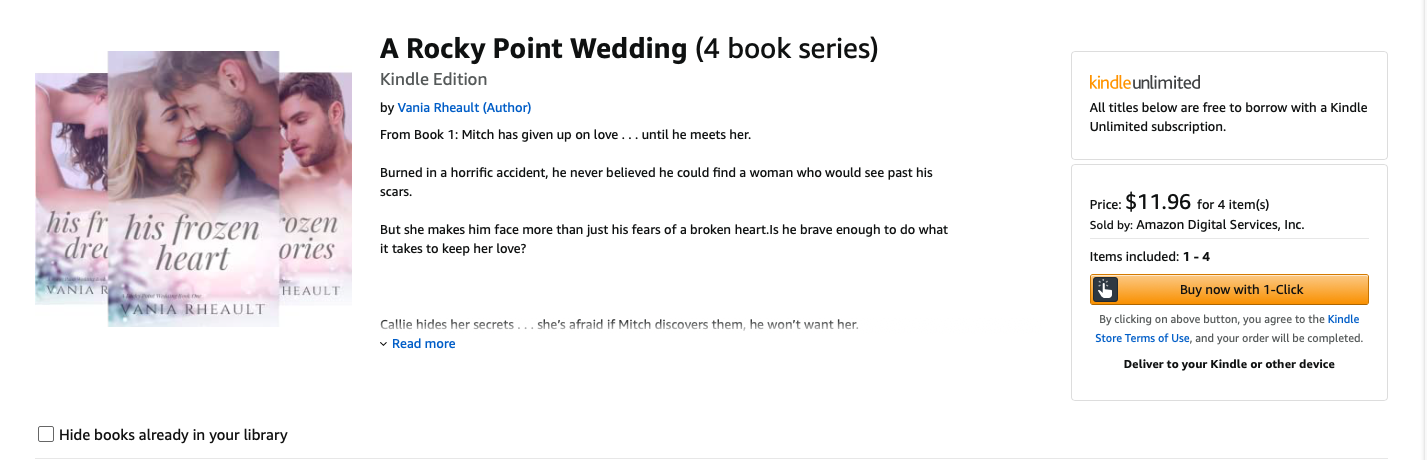
    This is the top of my series page on Amazon. If you want to look at the whole page Amazon provides, click on the graphic.
  4. That does remind me that a series has more marketing potential than a standalone novel. You can price a book one free for a time using your Kindle promotion free days you’re allowed every quarter (or permafree if you’re wide), and later when all the books are published you can put them into a box set. A series is good for a reader magnet prequel, too. For my wedding series, I could write a novella about how the couple meets as the series starts two weeks before their wedding. It’s a way to get readers invested and sign up for your newsletter. It would only take me a few days to write a 30,000 word novella to offer as a reader magnet but I’m writing something else right now and I would need to schedule that into my writing calendar. If I’m interested enough to bother with it.

Which brings me to the pitfalls of a series:

  1. The biggest for me is that I get bored. And you know if the writer is bored, so will the reader be. I like fresh characters; I like starting from scratch. In romance, you can write a series with a plot that spans all the books, like the wedding in mine. All the characters are in town for the ceremony, and the wedding takes place at the end of book four, but each book focuses on a different couple. That made it enough for me to write four books, but I was relieved when they were done. In fact, I started writing book one of the series I’m working on now before book 4 was properly finished. It took a few extra weeks because, unfortunately, I had checked out. I was craving something new, even though I saved my favorite couple for last.
  2. The covers are harder. This probably won’t mean much to you if you hire out. But a series is more work, more costly, and you have to keep branding in mind. They need to look like a series. If you do your own covers, that could mean hours looking through stock photos searching for pictures that have the same vibe. Once I knew the basic design of the covers, I could choose a couple and slip the composite into the template I made in Canva. It took a long time for me to decide on the layout, though, because there’s lots to consider, especially if you write romance:
    a) what’s trending? single woman? single man? man chest? a couple?
    b) steam level
    c) overall look for the genre or subgenre you’ve written in
    d) what font to use
  3. You have to make the first book strong or your read-through will fizzle and the subsequent books you write will be for nothing. This happened to me with my trilogy. My first book is weak–I didn’t know a lot about character arcs, conflict, or stakes. With the wedding series, the first couple I chose were also “quiet” and I didn’t think they had enough oomph to encourage read-through. When writing the second book, I realized that couple was stronger than the first and swapped them. This series is still new, so only time will tell if I made the right choice, but that brings me to another pitfall:
  4. Consistency. I hang on to all my books while I write them. I don’t publish them one by one. There are pros and cons to this, but the main reason I do it is to have control over editing. I like being able to make changes if I’m writing later books and a good idea comes to me, or a beta reader catches inconsistencies. But that also means I won’t know how book one will do, or if I’ve wasted my time writing a whole series first. That’s a risk I need to take because I don’t know if I’ll ever be comfortable enough to write one book at a time and release as I go along.

    This puts me in a position to rapid release, but I’m still so new as an author I don’t have an audience and putting books on pre-order don’t do anything.

    Some authors will release one by one and tie things up if their read-through drops off, or they keep it going if they make a lot of money and readers are enjoying their books. I don’t have either of those options when I hold onto them from start to finish.

I’m getting used to writing in a series and the first person books are going pretty fast. I will have quite the chore editing them, but like I said in a previous post, I’m going to lighten up with these, have fun, and let my characters (and my voice) shine.

Will I write another seres? Sure. The book I’m planning in the back of my mind could very well be a series. Sometimes they come to you without you wanting them to. Secondary characters can steal the show. I think those are the best kinds of series, when characters demand their stories by told. After all, if they demand it, hopefully readers will, too.


If you have a series, or are in the middle of writing one, and want to promote it, Written Word Media has a new promotional tool for authors. When I purchased my Freeobooksy through Written Word Media in July for the first book in my series, I had forgotten they had come out with this. I will definitely check into it the next time I want to run a promo. While it can seem a bit costly, the read-through of a readable series can more than pay for the fee. Good luck!


Happy Wednesday! Author musings and Indie Publishing news.

Happy Wednesday! I usually post on Thursdays when I have a little something I want to share, but today I’m writing about some time sensitive material, so posting today instead.

We have five more days of this month, and I couldn’t be happier. I’ve always been a Fall girl, and this year, especially, I can’t wait for cooler temperatures and rainy afternoons while the wind whips the leaves from the trees. I don’t even have to dread all the snow we’re predicted to get this year as I got a new vehicle, and hopefully it will take to the snowdrifts better than my crappy little Neon ever did.

Due to COVID-related issues, my trip I was going to take this week has been canceled, and that gave me time to write I didn’t think I’d have. I got 5,000 words written yesterday and I’ll be at 70k soon. I’m aiming for 90k, but since this really is just one long story, if I reach a good ending point, I’ll stop and pick up in the last book of the series. It’s coming along, though some of the planning has dragged a little bit as I’m more pantsing this book than plotting, and I can’t sit down and write until I know what I need. That means a lot of daydreaming or free writing to figure out where my story is going and how to get it there. On the bright side, I know what I need to finish this book, so I should have it done in the next week or so.

I did a terrific interview with romance author Meka James and we’re hosting a lovely giveaway of a ebook or audiobook of Being Hospitable, and a $25.00 e-gift card to Amazon. To be perfectly honest, none of the giveaways I have ever hosted have done that well, and if you want to enter, you have a REALLY good chance of winning. There’s only been a handful of entries, and that includes me and Meka testing the link so you should definitely enter! http://www.rafflecopter.com/rafl/display/f2ad9b1e25/

As far as what’s going on in the news, I may be the last to report this, but a couple weeks ago, Amazon Ads have starting reporting page reads in your ads dashboard. That means if your book is in KU you can see if that ad is bringing in page reads. Now, that’s not a sure-fire way of knowing if your ad is profitable, since page reads can come from more places than just an ad. Amazon reporting isn’t the greatest, and we’re encouraged to use the KDP Reports instead of depending on your ads dashboard. But I think a lot of us were just happy that Amazon seems to be trying to make things better for us in terms of working with them. I get that we have a love hate relationship with the big giant, but I tell myself that self-publishing wouldn’t be possible with the creation of the Kindle. I mean, who’s to say if a different company wouldn’t have picked up the reigns, but had that happened, who knows what the indie publishing space would look like now. Better? Worse? Less opportunities? More? It’s nice they listen to our feedback, and I appreciate the opportunities Amazon has given us.

Anyway, if you run Amazon ads, KENP reads are another way of showing you if your ads are profitable.

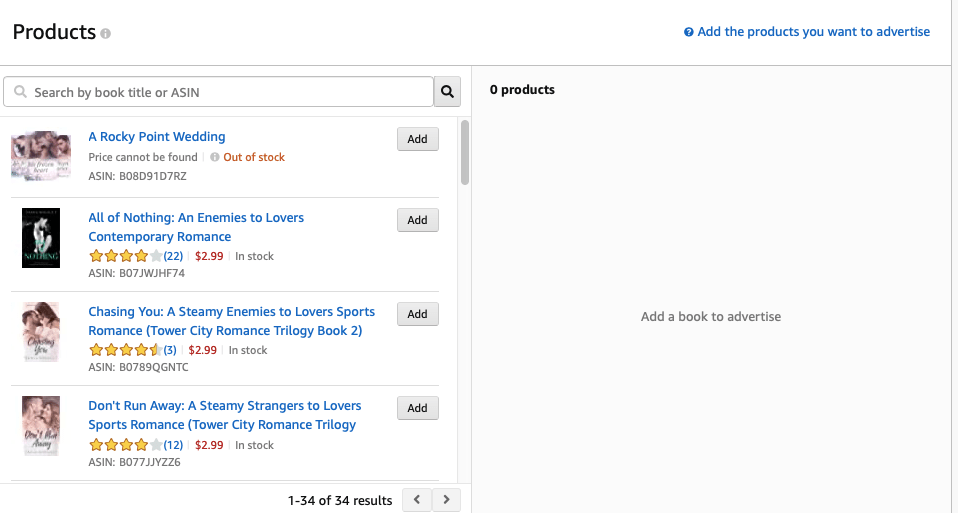
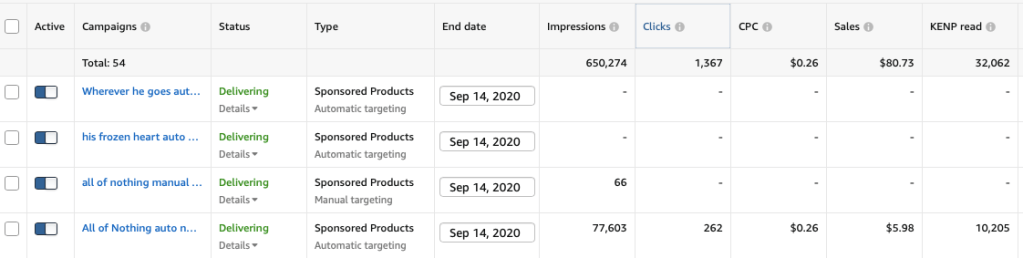
Here’s a screenshot of one of my well-performing ads:

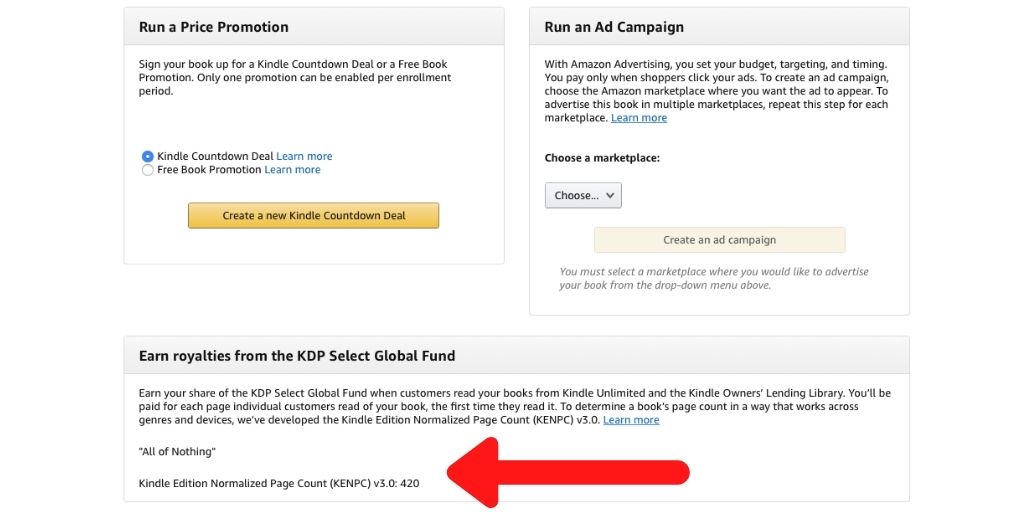
The ad for All of Nothing at the bottom of this picture does pretty good. The total KENP for the ad is 10,205 and that equals into about 23 books. (Divide KENP page reads by the number of KENP pages your book has, and that information can be found under promote and advertise on your bookshelf for your book).

If you’re interested in trying Amazon ads, watch this video with Janet Margo, Craig Martelle, and Mark Dawson. She used to work at Amazon and has some great tips for authors. Also, it’s quite amusing to watch Mark Dawson in the background smoking a cigar and drinking. LOL

In other news with Amazon Ads, they are expanding, and they added Canada and Australia this week! I did put up some Canadian ones to test the waters since I’m in Minnesota near the Canadian border (and some of my books are set along that area as well). We’ll see how it goes. I need to watch them carefully as I don’t know if the bids are the same as in the US. I’m sure the Amazon Ad Profit Challenge Bryan Cohen is going to host in October will have some tips regarding the new countries we can advertise in. It sucks that each country has their own ad dashboard, and you have to remember to calculate all the different spend totals when figuring out if you’re still ahead, which is the most important thing when all is said and done.

I’m a member of an Amazon Ads FB group and when I asked for ideas on blog posts lots of people wanted to know about marketing.

In an email that Bryan Cohen sent out to us (if you’re on his newsletter list) he teamed up with Alex Newton of K-lytics to host a webinar about genre research and he said:

Whether you want to believe it or not, meeting reader expectations is the best way to sell a lot of books. That means knowing your genre. Worrying about how to market your book after you’ve already spent six months to a year writing it isn’t the best time to wonder where your readers are. Just my two cents, especially considering I’m on book 5 of a 6 book series that isn’t *quite* like any of the longer billionaire series I’ve read. But I do agree we have write what we like, too, or we’re trapped writing books we don’t want solely for the paycheck. I hope I hit the mark with the tropes and the characters, and where I didn’t, readers can still enjoy what I did with the plot or overlook the parts they dislike.

If you want to sign up for the webinar, you can do it here: https://k-lytics.lpages.co/webinar-bpf/ It plays Thursday, August 27th, but there is always a replay if you can’t watch it live. I’m working tomorrow, so I’ll be watching the replay when they release it.

I think that’s all friends! I hope you all have a terrific weekend, and don’t forget to sign up for that giveaway! Read Meka’s interview, too! I asked her a lot of questions about her self-publishing journey!

Until next time!


Thursday Musings, what I’m up to, and what’s ahead for the month.

Well, it’s July and saying the world is crumbling around us is an understatement to say the least. COVID-19 is going crazy, we have a president who doesn’t seem to care, and the whole thing is really scary. My fiancé was supposed to move up from Georgia this summer, but he can’t if he can’t get a job up here. He has something steady where he’s at, and we’re thinking he won’t move until this coronavirus stuff is under control. And who knows how long that will take? I try not to be political on this blog–there are authors who will say anything they want and if you don’t like it, deal with it. I’ve never been that kind of author to treat my social media that way. It’s always more fun to share pictures of baby skunks anyway. But this COVID stuff is . . . people are dying, people don’t have jobs, people don’t know where their next rent payment is coming from. It’s terrifying, and it feels almost petty to go on and talk about books. But I keep trying to find the light at the end of the tunnel. When all this is over (and “over” means different things for different people) I don’t want to look back and realize that I didn’t get anything done. I’m trying to press through the best way I know how, and that’s keeping my mindset in the publishing game.

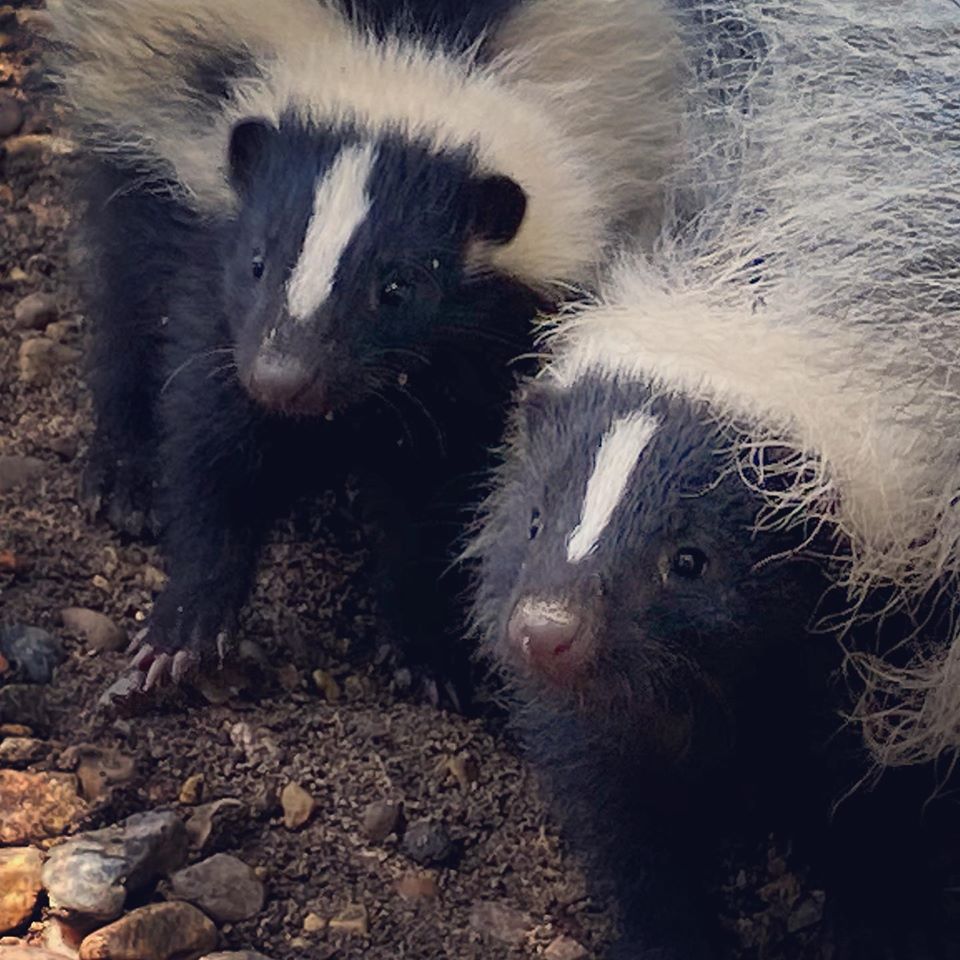
This image is from For Fox Sake Wildlife Rescue in Tennessee. I pulled it off their FB page. They rehab animals and put them safely back into the wild. I love looking at their photos and give when I can. You can support them here.

Why isn’t my book selling?

This question bothers me so much because it’s usually obvious. There’s someone on Twitter and he constantly laments that no one is buying his book. But his book doesn’t meet industry standards. The trim size is wrong, his book doesn’t have a professional cover–to the point the book’s title and his author name aren’t even on it! The insides are a mess. I don’t understand this because I have told him what he needs to do to fix it, and he says it’s his first book and didn’t expect anything from it. THEN STOP TRYING TO SELL IT. He seems to have plenty of people on Twitter who would be willing to help him, for free, even, if he would just ask for a little help. His tweets are a bore. Put in the work, or don’t bother.

But I like it this way.

I ran into someone else in a FB group who said she doesn’t full-justify her paperbacks because she doesn’t like how it looks. I’m having a hard time wrapping my head around that since first of all, it shouldn’t matter what you like or don’t like–full-justification is industry standard for a paperback. When an indie won’t follow industry standards (like the person on Twitter up above as well) it makes them look petty and immature. Are you really running your business while being so trite? And then we still wonder why there are people who won’t buy indie. It’s rather ridiculous to me that a person chooses to go indie for the creative freedom, and that’s what they’re going to do with it. I’ve read lots of indie books and their paperback books look AMAZING. Why not strive for that instead of cutting corners then complaining about it? Just a thought.


In other news, because this isn’t going to be a bitch session, I’m 35k into the 4th book of my series. I was scared to start this book, and I took me a week to hunker in, do some outlining, and actually start. But now that I have, it’s going well, and as always, I didn’t need to worry about word count. I usually do, but first person takes up a lot of room, if you know what I mean, and it’s a lot easier to meet word count. I understand the appeal of indies writing first person. It’s quick, it’s easy, it’s not complicated. I’ve even gotten some feedback that says my first person sounds better than my third person books. What? I’m flattered, and I like writing in it, but I started this first person stuff on a whim and I’m not sure if it’s what I want to keep writing. It’s interesting, though.

June Amazon Ads

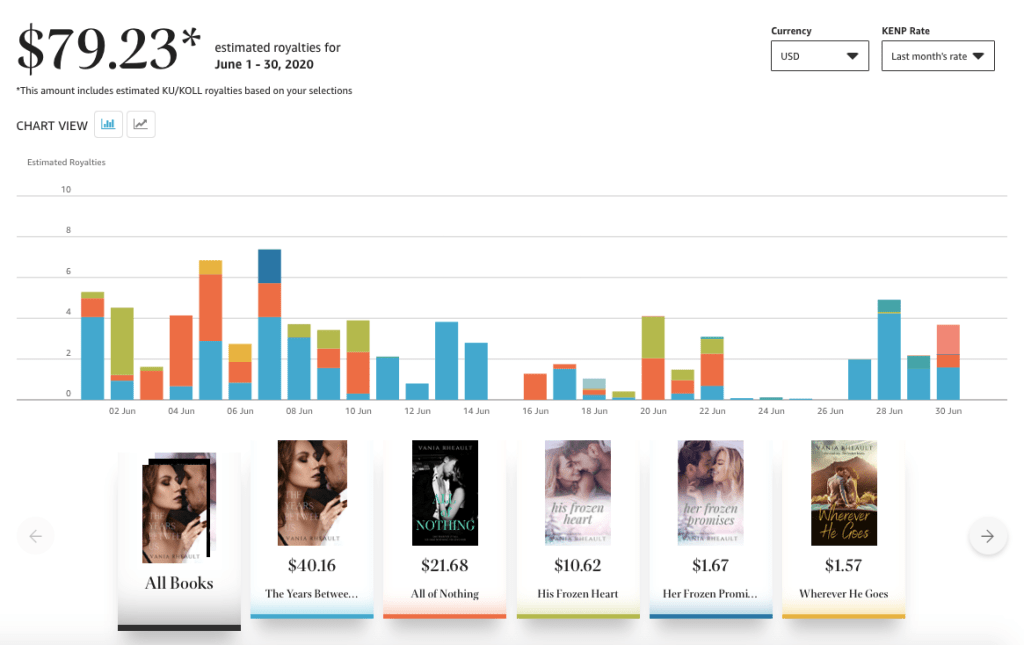
I turned my ads off on June 26th because I was in the red four dollars. I wanted to see if I could catch up with page reads and I did:

My ad spend was $79.85. I am selling some books, which is fun, but you can see that most of my royalties are from KU, which is fine; that’s why I’m in the program.

And I have to say, changing out the cover to The Years Between Us was probably the smartest thing I ever did. I never would be selling so many books with the old cover. Just a lesson to never be so set in your ways or what you think should be working when it’s easy to try something else.

I’m interested in seeing that people are reading the last book in my series, so I decided to look at my KU read-through for A Rocky Point Wedding for the month of June.

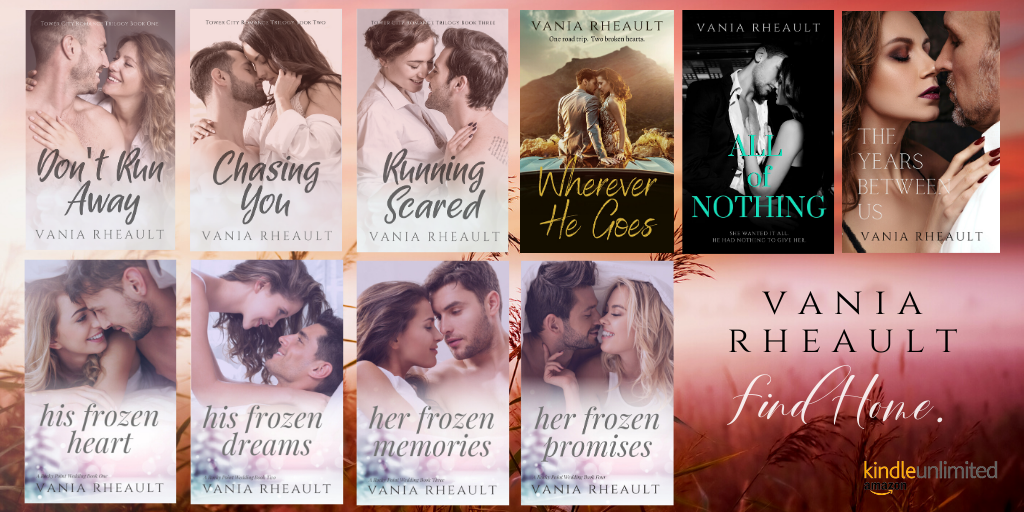
For His Frozen Heart, the first in the series had 1,557 pages read.

His Frozen Dreams had 361.

Her Frozen Memories had 355, and Her Frozen Promises had 5.

Lots of people have told me that it’s too soon to decide if the series is a wash. Especially since the last book has only been out a month, and I haven’t done much promo for the series as a whole. But while I was finishing it up, I knew books one and two weren’t as strong as books three and four, and that’s such a bummer. I’ve heard it’s common, though. As you get to know your characters the writing is deeper and richer and the plots get a little more involved since the readers know the characters better and you are more comfortable as a writer to draw them into the conflict. It’s definitely something I’ll keep in mind if I write another series. The first person one feels different and I can’t explain how. Maybe because the first three books follow the same couple and I don’t have to worry about introducing new characters.

Anyway, if you’re going to fumble along, you can expect to scrape your knees.

I think I’ll end here and get some writing in. I hope you all have a wonderful weekend ahead!


Writing with tropes in mind. What I learned from reading Zoe York’s Romance Your Brand

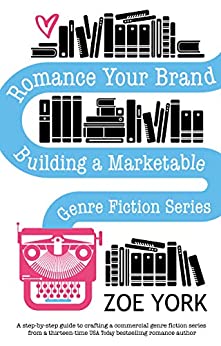
Last weekend I read Romance Your Brand: Building a Marketable Genre Fiction Series by Zoe York.

I love reading nonfiction by indie authors. It’s like being able to pick their brains without actually bothering them. An author shared a screenshot of the books on her Kindle in one of the Facebook groups I’m in, and Zoe’s book caught my eye. Zoe is a well-known in the indie publishing space as a contemporary romance writer. I first heard of her when she was a contributor of the now defunct podcast Self-Publishing Round Table, one of the first podcasts I listened to about self-publishing.

I was excited to see that she started writing nonfiction and I purchased her book right away.

I’ve written two series: one trilogy and another with four books. They don’t sell that great, but though to be fair, I don’t promote them much, either, and I thought Zoe could share some things that worked for her.

She goes through the reasons why a series is good–namely read-through and creating a world fans can fall in love with. I already know that, which is why I tortured myself all of 2019 writing one. It’s not to say I didn’t enjoy it, but there are things you have to consider like consistency and bringing other characters into the story of the main couple because they’re all friends and people simply don’t disappear when you don’t need them at the moment.

Zoe goes into some of the planning, encouraging you to draw a map of where your series is going to take place. She writes small-town romance, and my Rocky Point Wedding Series is placed in a small town, too. I knew my series wasn’t going to be very long — I don’t have an attention span for several books, so I trusted myself to keep Rocky Point’s details in my head without writing them down. But if you plan to write 5+ books, it may be advantageous to treat your setting like a character and write a detailed sheet to keep facts straight.

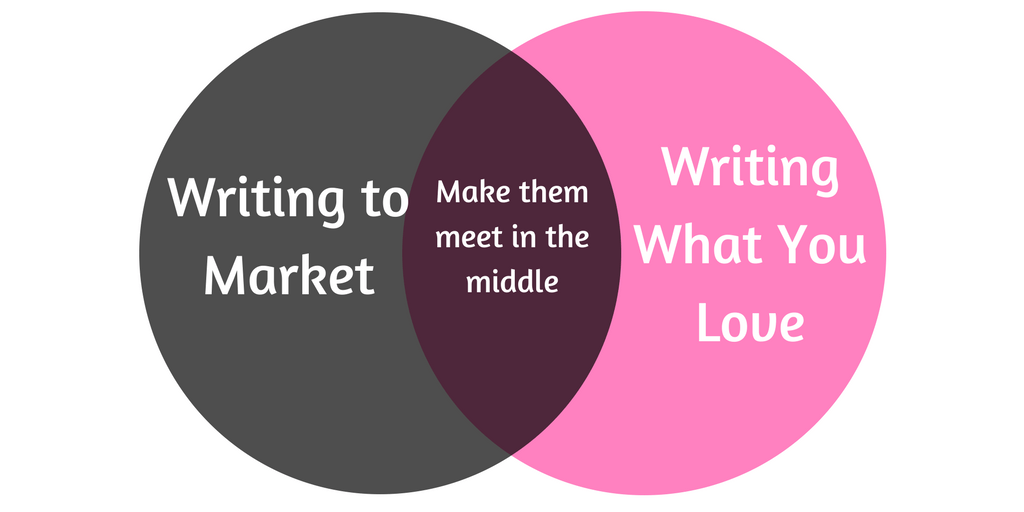
Other tips she offers are keywords, naming your series, and plotting out the books. This is where my ears perked up so to speak because Zoe is a genre fiction author. She subscribes to the Venn Diagram where you need to write to market while writing what you love and finding that sweet spot to sustain a lucrative, but happy and satisfying, career for yourself.

When I plotted my series, I started with setting first. For me that’s the easy part. I set the books in a fictional small town in Minnesota based on my hometown. I even gave my town the same attributes — along the Canadian border, a shut-down paper mill, and a similar Main Street. I’ll probably always set my stories in Minnesota. I love the seasons and the variety they can bring to the plots.

Then I move onto characters. I think this is where I dropped the ball and Zoe opened my eyes that actually when I plan out my books I don’t keep tropes in mind.

Every romance novel is based on a trope or two, and while you might scoff or want to deny it because your books are better than that drivel, I need to remind you readers love tropes. The kind of trope the book contains is why the reader chooses to read your book.

While plotting my series I forgot that, and it’s why my books aren’t as strong as they could and should be. Of course my books contain tropes, but I assign the tropes after the fact when I should be planning my stories around them. Knowing the tropes I want to include beforehand will give my books a stronger spine.

What are some romance tropes? These are from Zoe’s book:

  1. friends with with benefits
  2. married to the enemy
  3. marriage of convenience
  4. enemies to lovers
  5. fish out of water (new town, fresh start)
  6. forced proximity
  7. bad boy
  8. ugly duckling
  9. unrequited love
  10. friends to lovers
  11. strangers to lovers

There are more, these is only a sample. A Google search can come up with a couple more:

  1. forbidden love
  2. age gap
  3. secret baby
  4. fake date
  5. fake marriage

You can have a lot of fun with tropes. Take forced proximity. Maybe two strangers have to share a shelter during a tornado, or the elevator stalls (that’s pretty popular) or there’s only one bed (another that’s popular). Anything where the characters need to spend a lot of time together in a close space with no chance of escape. Like a cabin during a blizzard.

Zoe encourages you to list the tropes as you plan the books in your series and I’m going to start doing that with all my books. For now I can list the tropes that my books do contain (I can list them for marketing and ad copy purposes) and going forward use new tropes as I plot.

Knowing what tropes your books includes can help with blurb-writing and writing ad copy. As Jami Albright says, tropes sell. If you can make the tropes easy for readers to see, you’ll be more apt to make a sale.

Writing a series takes a bit of planning. At least the first few books so you can fit the pieces of each book together like a puzzle. Some series can go on for a while see (Robyn Carr) and there is no way to plan twenty books at one time. But if you can list the elements you want to include in the first few hopefully consistency won’t be too big of an issue and you (and your characters) can find a groove.

Zoe’s book gave me a new perspective and I feel there are things any genre writer could benefit from. I encourage you to pick it up. You’ll be glad you did.


A note about sub-genre and tropes.

Some writers blur the line between sub-genre and tropes. The easiest way to explain the two is to give an example.

Take Aidy Award’s books. She writes curvy-girl romance. That’s her sub-genre. You know when you grab one of her books the heroine will be voluptuous. But that can’t be the plot. The plot will contain tropes that pertain to genres that aren’t only curvy-girl. Like close proximity or enemies to lovers.

Billionaire romance is another example. Maybe every single male character an author writes will be a billionaire, but those characters will have their own plots that contain their own tropes.

I have noticed that some of the bigger in the writers like Aidy focus on one sub-genre. Then they have fun with the tropes. They have an easier time branding their books and that helps marketing and sales. It’s something to think about moving forward.


If you want to grab Zoe’s book, look here. She has another book related to this one, and I’m going to grab it as soon as it’s available.

To check out her Amazon author page, and take a peek at her contemporary romance books, look here.


Thanks for stopping by!