Life is full of minor inconveniences. There’s even a hashtag for that–#firstworldproblems. What bothers us would make people in other countries shake their heads. I’m not talking about coronavirus now, though mask-wearing may be up there for some people who would prefer not for, um, reasons. But despite how petty and immature we can be about things that inconvenience us, when they keep coming, it can seem like life is trying its best to get you down.
I’ve had a few of those inconveniences, and I’m waiting for life to possibly get back to normal. I could be waiting for a long time, but trying to make lemonade out of lemons, or trying to find the silver lining, is getting to be a little tiring. My little inconveniences range from having maintenance in our bathroom fixing the caulking in the tub and repainting, to having to shower at my ex-husband’s while said paint and caulking dry, to being told, just a few minutes ago, that we can’t let water go down the drains in our apartment because it will make the guy’s bathroom downstairs flood. Of course he called maintenance, but the last time this happened they had to dig up pipes the front yard. So no telling when we’ll get to run our water. On the plus side, I’m clean, so there is that.
Other inconveniences range from my mouth is still hurting, and likely will for months to come as there isn’t an end to my dental work in the foreseeable future, (either they’ll finish or I’ll run out of money. Who knows?) to me being able to work from home but my cat making a meal of the ethernet cable laying on the floor. I did get permission to buy a new cord in the event this one is destroyed by tiny cat teeth, but then I’ll buy a longer one and attach it to the ceiling instead of letting lay on the floor.
Small inconveniences that add up to me being generally crabby about life right now, but make me feel like a petty snot because hello? fires everywhere. And they aren’t little, either.
In other news, I’m 26k into the last book of my series. I’m really excited to get these books all wrapped up, and it’s no secret that I am very excited to start something else. That will have to wait a bit but I can distract myself by looking more into newsletters. I created an email for my website and I signed up for MailerLite. I haven’t watched any of the tutorials to figure out how to set up a welcome email, but I should at least get that sorted so I can include a sign up link to the back of the books I’ll be editing soon. I need to figure out a reader magnet too, and look into how Story Origin works for building newsletter signups and joining promotions. I suppose I could be doing that instead of watching the old Jurassic Park films, but I feel such a kinship to Sam Neill and his crooked bottom teeth.
I’ve had to stop my ads for now. I spent 400 dollars in the month of August but made 500 (for all you math nerds that means I came in ahead by 100 dollars instead of breaking even like I normally do). Because of the way Amazon bills you for ad spent vs. the way they pay you for royalties, my ad spend money is in the hole, and I can’t afford more until that money is replaced. They pay out every sixty days, so I won’t be able to start more ads until the end of October or early November. Right now I’m still making a little very day, mostly in read-through of my series, so I’m not crying too much. I’ll start ads up again after Halloween and play up the Christmas aspect of my books, or at the very least, that they take place in the winter.
I guess that’s all I have for this Thursday. Tomorrow after I log off from work I’ll clean the bathroom and get that put together again. I hope I hear from the property management when it comes to being able to use water again. I mean, we can use the water, just not let anything go down the drain, and I’m assuming that means we can’t flush the toilet, either. We weren’t told by property management we can’t, but this has happened before, so I know all too well what is going on with the poor guy downstairs. I hope they can fix it quickly!
I hope everyone has a wonderful weekend, and if you’ve had a crappy week, things pick up for you!
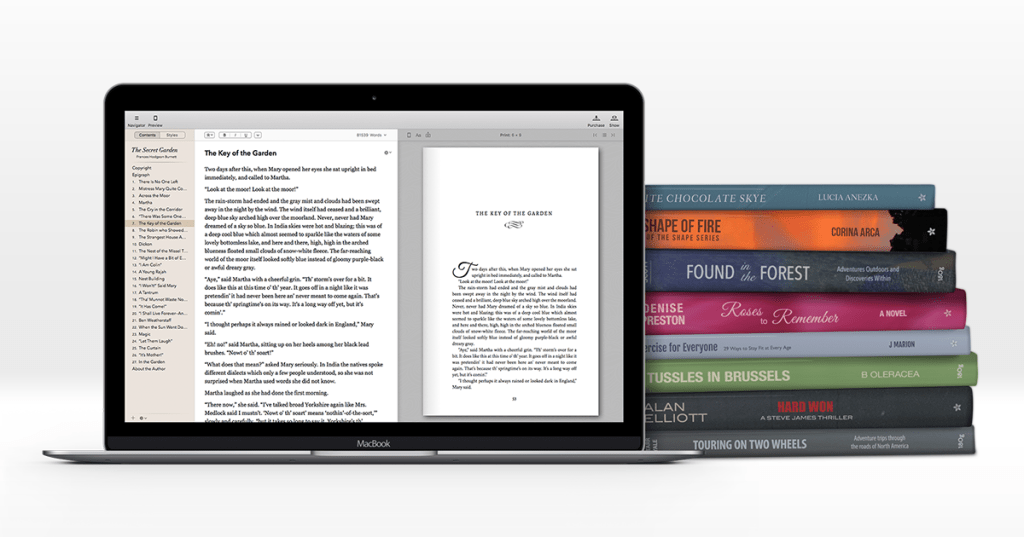
Vellum is expensive–$250.00 for unlimited ebook and paperback capability–and I never recommend it because I’m sensitive to people not being able to afford it. Also, it only runs on a Mac and if you don’t want to pay to use MacinCloud on a PC, Vellum won’t be an option for you anyway.
But for those authors who can afford it, or hire a formatter who uses it, it can be a wonderful software that can generate book files in just a couple of hours. (Some authors say minutes, but I’ve found it can take a little longer than that–especially if you have to create the front and back matter from scratch.) I’ve formatted all my books with Vellum–even backlist titles got a facelift when my fiancé purchased a Mac and Vellum for me.
It’s amazing, and I absolutely have no argument with it.
But some authors do. They say they are disappointed in the limited capabilities and I’ve heard the familiar refrain a few times. Enough to make me mad. I take offense when someone feels the need to nitpick this software. Brad West and Brad Andalman did the indie community a huge service designing this software and continually updating it and adding new features. Still, this isn’t enough for some authors.
When I’m feeling particularly spunky, I’ll challenge them with this: a reader might appreciate the little extras you can deliver, but the real reason readers buy your book is for the story. Have you written a good book? That should be your main priority, not moaning because you can’t add color chapter headings, or fancy maps, or any other crazy stuff you want to add in a lame attempt to hide a mediocre story.
That might seem a little harsh, but it seems to me the writers who complain the loudest are the first time authors who haven’t understood that they are going to have to fight tooth and nail to sell their book and formatting is the least of their worries. (During COVID a whopping 88,000 books are being published very MONTH! — source, Alex Newton from K-lytics.)
Of course you want the inside of your book to look professional and in my mind you only need four things:
Full Justification
Drop Cap for Chapter Starts
Professional Chapter Heading
Appropriate page numbers and author name/title in headers and footers
That’s it.
Readers aren’t going to care if the chapter headers are colored images, or if they take the whole page. What they’re going to care about is if the story grabs them from the first sentence, or if there are typos or other mistakes that will pull them out of the story. They care if your story will engage them to the very last line.
Beautiful and simple formatting with an elegant cover will sell lots of books.
Can you guarentee your readers that?
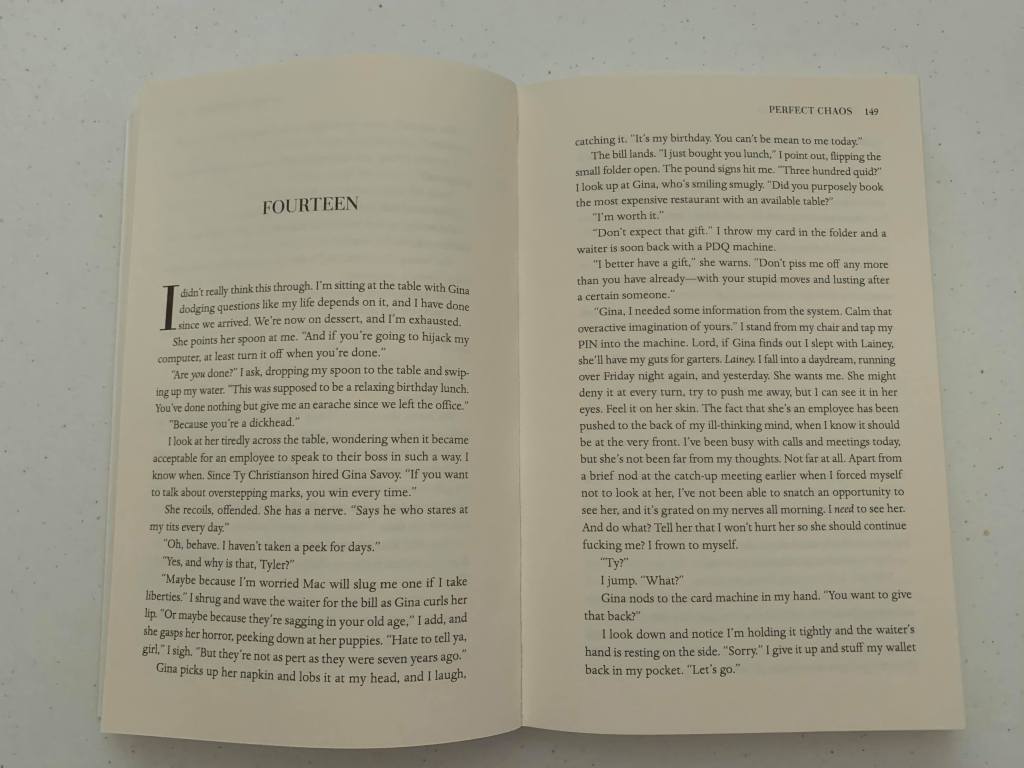
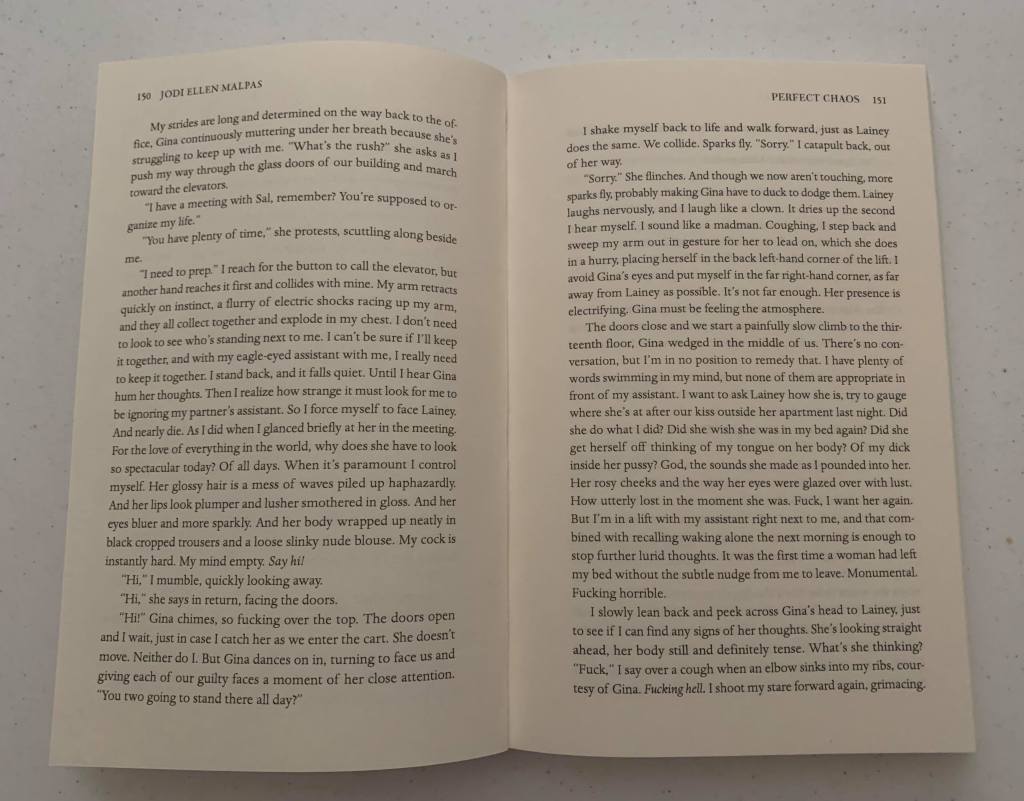
I bought a Jodi Ellen Malpas book on Amazon and I was surprised to see it came from Ingram Spark’s print on demand. She self-published this book. She’s a New York Times best-selling author. She can afford a team that can put together a beautiful book. And the formatting inside is plain. As plain as you can make the inside of a book. Because she knows her fans are not buying the book for how it looks, but for the story inside.
Here are my list of reasons why I do the minimum formatting in my books:
Kindles can only handle so much. Not everyone reads on a tablet. Some people really do read on a Kindle Paperwhite, or a Voyage (that has been discontinued), Kindle Oasis, or other e-readers with limited functions. Readers can set the font so who cares if you’re bitching Vellum has a short list to choose from? Some e-readers are black and white so what does it matter if you insist on inserting colored chapter headers? E-readers strip a book of almost everything but the actual text that makes the story. If your story isn’t engaging they’ll return your book and read some thing else.
Fancy formatting is a paperback perk. How many of those do you sell? Unless you write non-fiction or children’s books, then that’s something different. If you want to write in commercial, mainstream fiction, your e-books will far outsell your paperbacks. If you’re going to a convention, fine. But your cover is going to be on display more prominently than your formatting.
Fancy formatting takes time. Pay for it if you insist on having it. There’s no reason to gripe in Facebook groups about how Vellum won’t suits your needs. There are other programs that will, like InDesign. If you don’t know how to use it, either learn or hire someone who does. You don’t need to complain in forums about a software you’re unhappy with. Deal with it because for every person it disappoints, it makes twenty others happier than hell.
Story will always come first. Yes it’s exciting to publish and you want your book to be perfect. But your story should be the most perfect thing about your book followed by the cover. Readers will appreciate a cleanly formatted book. I know I have tossed books aside that are not formatted properly. I appreciate a plain format and a compelling story much more than a boring story with pretty chapter headers. I’ll know what the author cared more about and I won’t be impressed.
I’ll defend Brad and Brad. They did the indie community a huge courtesy developing a software that makes book formatting easy. The software produces a .mobi, epub, and generic epub for Nook, Google Play and Apple Books. It produces a PDF for the paperback. Vellum creates a beautiful book and when you’ve written a beautiful story, what it offers should be enough.
If you’ve followed my blog for any amount of time, you guys know I love talking about book covers. I especially love talking about scammers trying to rip you off by slapping a pretty font over a free photo from PIxabay and charging you $50.00 for something you can do yourself in Canva for free. I recently called out a “designer” for doing exactly that, and the icing on the cake was another member of the FB group posted her cover with the same exact photo and said she, too, had been taken for a ride. The universe was on my side that day! I would post a screenshot, but the original poster took it down a couple minutes after. Hopefully in embarrassment with her tail tucked between her legs!
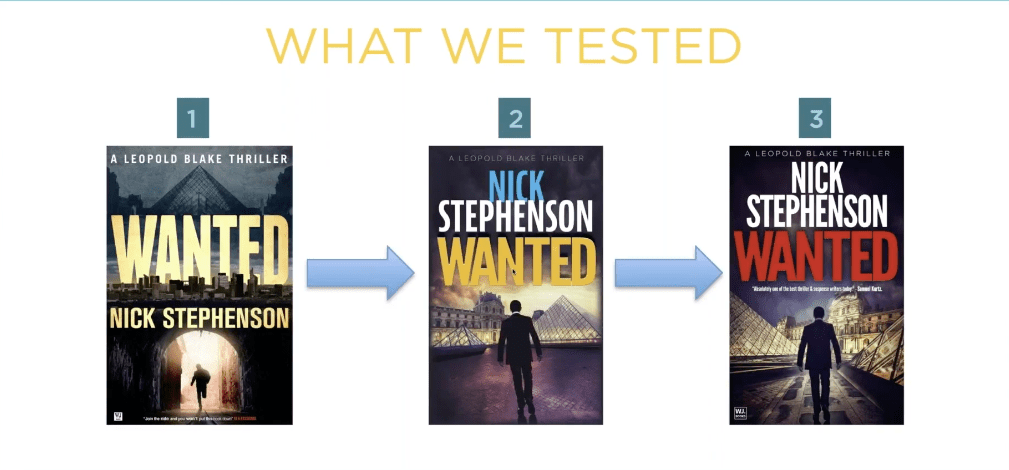
I know I can’t save the world, and if I tried, I wouldn’t have enough time to write. I do like talking about covers though and what draws readers to buy our books. I’m watching a replay of a webinar with Nick Stephenson, and like any webinar talking about sales, he goes briefly goes over a book cover case study with one of his own books.
Taken from Nick’s free webinar
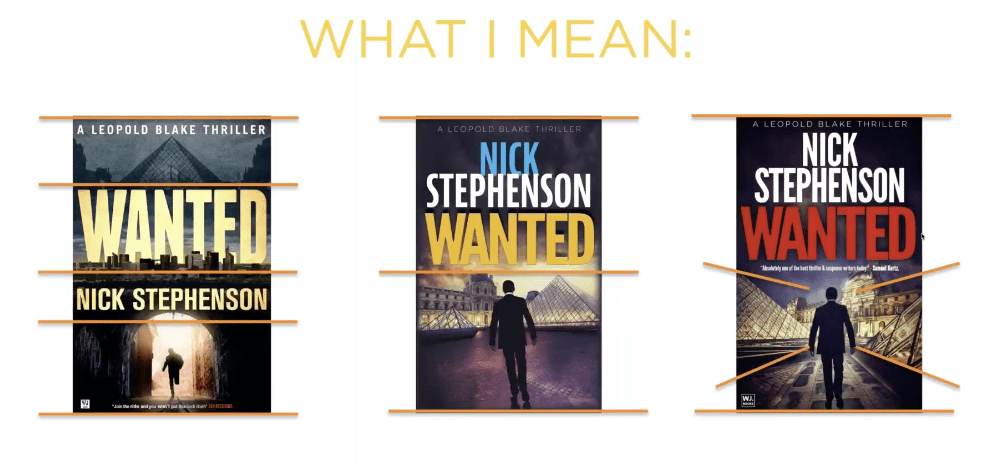
What he said is that the first cover wasn’t doing a good job. So they tried book cover number two, and eventually number three. Number three had the highest click-through and he explained in the next slide why:
Taken from Nick’s free webinar
Apparently, the red title that is associated with thrillers helped, along with the placing the elements that draw the eyes toward the center of the book. I like the first cover though, and I wonder how it would have done had he just changed the butter yellow font color to the dark red that works with thrillers. I think the guy running through the tunnel draws the eye to the center of the book just as well as the silhouette on the third cover. What do you think?
But it just goes to show that even a perfectly good cover may not be doing its job.
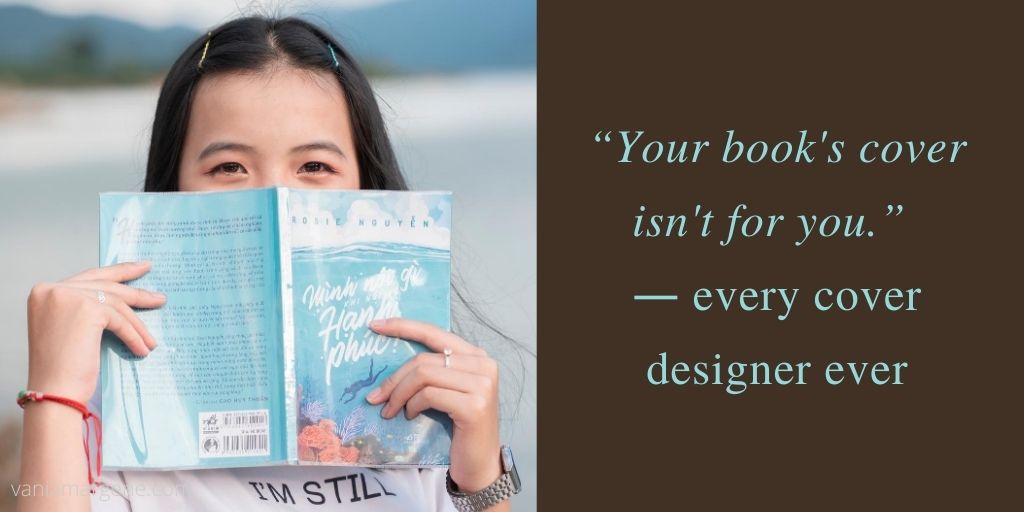
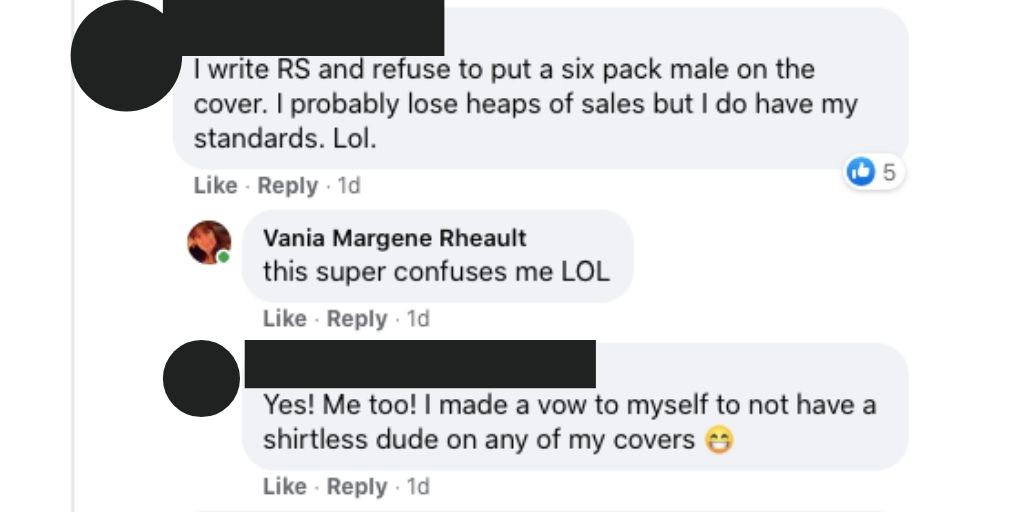
Anyway, in the FB group I’m in, there was a thread about cover pet peeves, and I thought it was a silly thread because this is something that authors seem to forget. Your book’s cover isn’t for you.
Just like most people agree that reviews aren’t for the author, they’re for readers finding their next book, covers, also, are only for readers. If you get too precious about your cover, or you’re too attached, or you let pride stand in the way of sales, what are you trying to prove? And to who?
names protected to hide the . . .
Listen, if I have to find a picture of a pig and a chicken falling in love to sell my book, then that’s what I’ll put on my cover. I didn’t write my book so it would sink to the bottom of the charts because I cared more about my likes than what will sell my book.
Stock photo provided by Canva. Template provided by Canva.
Genres have cover expectations, and unless you have a solid audience already in place, you need a cover that will sell books. I’m not sure why authors have such a hard time understanding this. I know some of it is cash. Especially if you pay out and you can’t afford to swap. I mean, I’ve heard of that happening, and it’s too bad. But you’re not going to make anything off a book that has a cover on it that isn’t appealing to readers.
Authors can make fun of man-chest covers, or the boring couple with the script font on the front, or all the thriller covers that look the same (girl in red jacket running away from the camera in the fog), or all the Urban Fantasy with the tough girl holding a fireball, but in doing so it just closes their minds to the possibility that being the same as other books might not be a bad thing. And why make things harder than they need to be? Discoverability is difficult!
That thread just really boggled my mind like so many indie decisions do, I guess.
I want my books to sell. That means genre specific tropes, cover to market, good blurb, correct categories and keywords, a nice look inside without typos.
Readers have a lot of choices these days, over 8 million to be exact. Why purposely give them a reason to keep scrolling?
Okay, I think I’m done musing and I’m going to bed. One day I’ll probably get kicked out of all my Facebook groups, but I just can’t help it. I just shake my head at the authors who want to do it their way then end up crying because they don’t sell books.
Can you ever really have your cake and eat it too?
Let me know, because I don’t care enough to try.
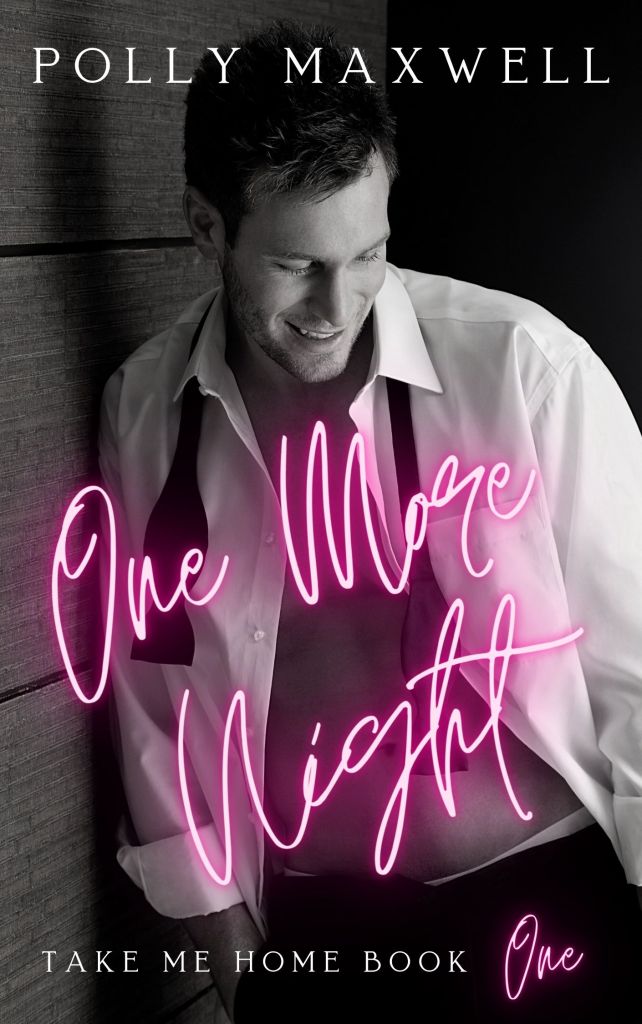
Man chest? Yes please. 🙂 Stock photo provided by Canva. Font provided by Canva. Cover design by yours truly.
As I look up wrapping up my six book series (I’m at 67k for book five) editing 540,000 words is weighing on my mind. It’s a daunting task. I edit my own books, which people tell me is quite a no-no, and I agree for first-time authors and writers still working on their craft. I use beta readers who hunt for typos and point out murky scenes and I take their opinions to heart and decide if what they say has any validation in my work. (It usually does.)
On the other hand, my betas are writers, too, not only readers, and writers don’t read like readers do. We are pickier, which may or not be a good thing. The problem is, the pickier you are, the more you’re going to nickel and dime your manuscript to death.
So how can you edit without sucking the life out of your story?
Don’t write by committee. I have to thank Kristine Kathryn Rusch for this tip. While critique partners and writing groups can offer valuable tips and suggestions, the end product should always be yours. There is no “best” way to write. Readers read your work because they like your voice. Writing by committee is the fastest way to lose your voice. You simply can’t implement everyone’s suggestions, nor can you make your book “perfect.” There is no such thing. Your book could have a million endings, a million different twists. If what you have chosen gels (meaning no potholes, you have realized character acs, etc) there’s no reason to be swayed by someone else’s opinion if you like what you’ve already got.
Too many cooks ruin the broth. Every beta reader is going to have an opinion and your mind can spin if you try to listen to everyone. Some people think the more beta readers the better, but all that does is give you more opinions to listen to. Maybe you like that. I have one or two trusted betas and that’s it. I wouldn’t even bother with that except it’s not a good idea to publish without another set of eyes just to be sure you’re not missing anything plot-wise.
Too many editing sweeps and you’ll edit the flavor right out of the story. I did this with Wherever He Goes. I wanted my first standalone to sound good, but all I did was make the opening chapters sound bland. It’s difficult to trust your gut, especially if you haven’t been writing for a while and you know your voice and writing style still need a little work. Going over and over your work won’t make it better–it’s already written. Make that particular piece the best it can be with as few editing sweeps as possible and move on to something new.
Trust your instincts. I have already made some changes with my first couple of books in the series that I don’t agree with based on beta suggestions, and I regret them now. In my next editing sweep I’ll put them back. The things she pointed out and I changed were based on her personal dislikes and I should never have listened to her. I liked what I had before I made changes.
Choose beta readers in your genre. I think that was part of my problem with number four above. The person who disliked aspects of my book doesn’t read or write in my genre. Sometimes this can be valuable, but usually having a beta familiar with your genre can help with tropes etc. and tell you if you hit the nail on the head or missed the mark. (Usually if you are an extensive reader in your genre, you’ll know without being told.)
If you’ve been writing for a while, you may not need an editor. Hear me out. You may only need a proofreader so you can publish a clean copy of your work. As you’re writing evolves, you’ll become more confident and you won’t second-guess yourself like I did with Wherever He Goes, or even when I listened to my beta reader with the first couple of books when deep down I didn’t want to.
In closing, I’m not going to go all crazy with the editing of these books. I don’t want to edit my voice out of them. I want my characters to sound like themselves and that is a real risk when you over-edit. You can edit the spirit right out of your characters so they sound like every other character you’ll ever write.
You don’t want to publish a first draft, but you don’t want your editing to take longer than the actual writing either. There’re a lot of stories out there. Go write them.
If you want to hear Kristine Kathryn Rusch’s talk, she spoke at the 20booksto50k conference in Vegas last year. I think I might have referenced this video once before on the blog, but I’ll post it again if you’re curious.
Also, if you’re curious about a couple of good editing books, I just recommended these two to a friend on Twitter:
And a new editing book that just came on the scene not long ago by Tiffany Yates Martin called Intuitive Editing: A Creative and Practical Guide to Revising Your Writing is fabulous! I heard about it in one of the FB groups I’m in, and it is awesome! I recommend you check it out! https://www.amazon.com/Intuitive-Editing-Creative-Practical-Revising/dp/1950830020/
Happy Wednesday! I usually post on Thursdays when I have a little something I want to share, but today I’m writing about some time sensitive material, so posting today instead.
We have five more days of this month, and I couldn’t be happier. I’ve always been a Fall girl, and this year, especially, I can’t wait for cooler temperatures and rainy afternoons while the wind whips the leaves from the trees. I don’t even have to dread all the snow we’re predicted to get this year as I got a new vehicle, and hopefully it will take to the snowdrifts better than my crappy little Neon ever did.
Due to COVID-related issues, my trip I was going to take this week has been canceled, and that gave me time to write I didn’t think I’d have. I got 5,000 words written yesterday and I’ll be at 70k soon. I’m aiming for 90k, but since this really is just one long story, if I reach a good ending point, I’ll stop and pick up in the last book of the series. It’s coming along, though some of the planning has dragged a little bit as I’m more pantsing this book than plotting, and I can’t sit down and write until I know what I need. That means a lot of daydreaming or free writing to figure out where my story is going and how to get it there. On the bright side, I know what I need to finish this book, so I should have it done in the next week or so.
As far as what’s going on in the news, I may be the last to report this, but a couple weeks ago, Amazon Ads have starting reporting page reads in your ads dashboard. That means if your book is in KU you can see if that ad is bringing in page reads. Now, that’s not a sure-fire way of knowing if your ad is profitable, since page reads can come from more places than just an ad. Amazon reporting isn’t the greatest, and we’re encouraged to use the KDP Reports instead of depending on your ads dashboard. But I think a lot of us were just happy that Amazon seems to be trying to make things better for us in terms of working with them. I get that we have a love hate relationship with the big giant, but I tell myself that self-publishing wouldn’t be possible with the creation of the Kindle. I mean, who’s to say if a different company wouldn’t have picked up the reigns, but had that happened, who knows what the indie publishing space would look like now. Better? Worse? Less opportunities? More? It’s nice they listen to our feedback, and I appreciate the opportunities Amazon has given us.
Anyway, if you run Amazon ads, KENP reads are another way of showing you if your ads are profitable.
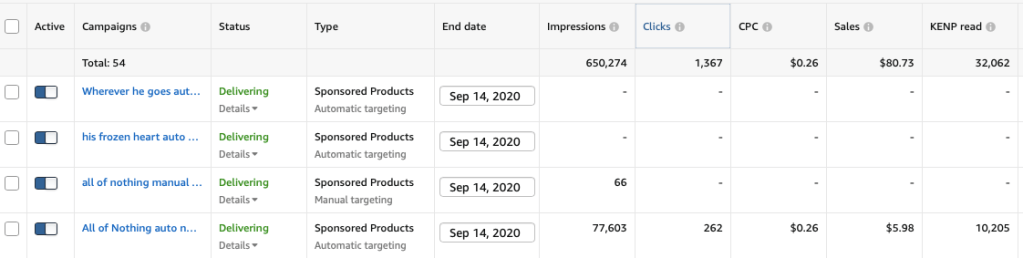
Here’s a screenshot of one of my well-performing ads:
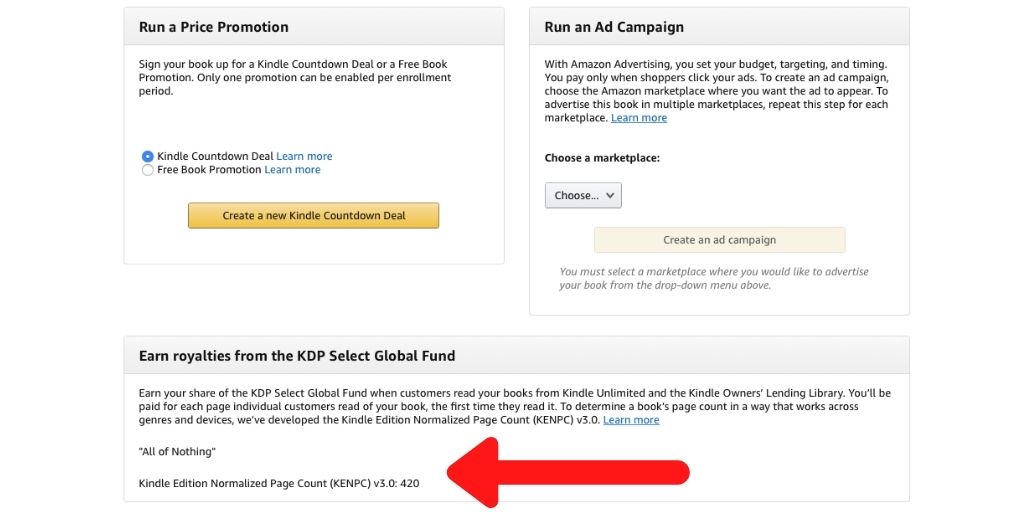
The ad for All of Nothing at the bottom of this picture does pretty good. The total KENP for the ad is 10,205 and that equals into about 23 books. (Divide KENP page reads by the number of KENP pages your book has, and that information can be found under promote and advertise on your bookshelf for your book).
If you’re interested in trying Amazon ads, watch this video with Janet Margo, Craig Martelle, and Mark Dawson. She used to work at Amazon and has some great tips for authors. Also, it’s quite amusing to watch Mark Dawson in the background smoking a cigar and drinking. LOL
In other news with Amazon Ads, they are expanding, and they added Canada and Australia this week! I did put up some Canadian ones to test the waters since I’m in Minnesota near the Canadian border (and some of my books are set along that area as well). We’ll see how it goes. I need to watch them carefully as I don’t know if the bids are the same as in the US. I’m sure the Amazon Ad Profit Challenge Bryan Cohen is going to host in October will have some tips regarding the new countries we can advertise in. It sucks that each country has their own ad dashboard, and you have to remember to calculate all the different spend totals when figuring out if you’re still ahead, which is the most important thing when all is said and done.
I’m a member of an Amazon Ads FB group and when I asked for ideas on blog posts lots of people wanted to know about marketing.
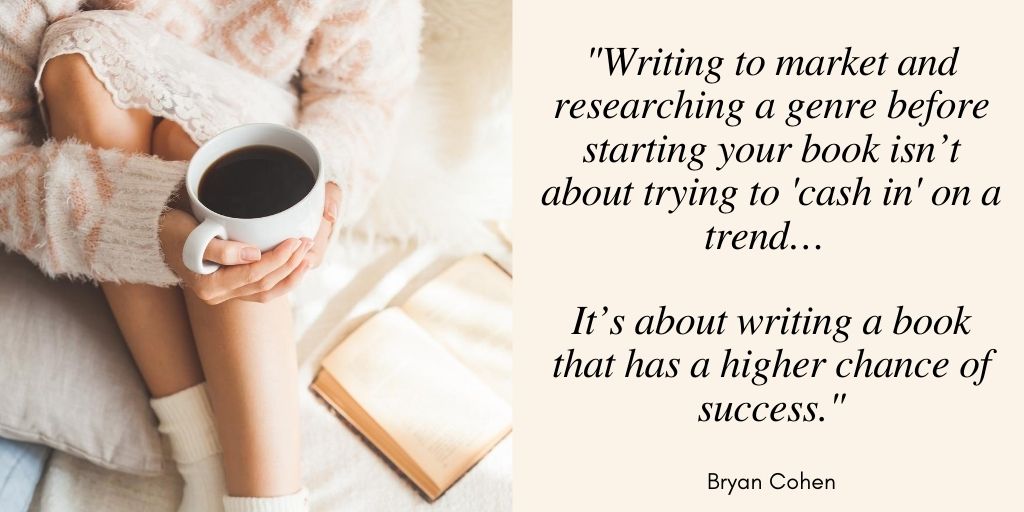
In an email that Bryan Cohen sent out to us (if you’re on his newsletter list) he teamed up with Alex Newton of K-lytics to host a webinar about genre research and he said:
Whether you want to believe it or not, meeting reader expectations is the best way to sell a lot of books. That means knowing your genre. Worrying about how to market your book after you’ve already spent six months to a year writing it isn’t the best time to wonder where your readers are. Just my two cents, especially considering I’m on book 5 of a 6 book series that isn’t *quite* like any of the longer billionaire series I’ve read. But I do agree we have write what we like, too, or we’re trapped writing books we don’t want solely for the paycheck. I hope I hit the mark with the tropes and the characters, and where I didn’t, readers can still enjoy what I did with the plot or overlook the parts they dislike.
If you want to sign up for the webinar, you can do it here: https://k-lytics.lpages.co/webinar-bpf/ It plays Thursday, August 27th, but there is always a replay if you can’t watch it live. I’m working tomorrow, so I’ll be watching the replay when they release it.
I think that’s all friends! I hope you all have a terrific weekend, and don’t forget to sign up for that giveaway! Read Meka’s interview, too! I asked her a lot of questions about her self-publishing journey!
I was supposed to be flying to Georgia today to help my fiancé drive up from the Savannah area. I had a tooth start hurting, and because of my unwillingness to wait for a root canal, I’m getting it pulled. I was supposed to go Wednesday, but they had a cancellation and I’m going in at 3:00 today. Needless to say, I’m a bit nervous and because alcohol is a blood thinner, I can’t take a few nips before I head in. I don’t have much dental anxiety, but I don’t know anyone who wouldn’t be a little scared to get a tooth pulled out of their head. I’m only happy he said he could do it and didn’t need to refer me to an oral surgeon. The sooner the better. The bright spot is, I can run errands afterward because my mask will hide the big wad of gauze I’ll have shoved into the back of my mouth. There is, my dear readers, always a silver lining!
As for my trip, I rescheduled for next Monday, August 24th. Pray all goes well because between the two of us (me and my fiancé) we have horrible luck. Case in point: who would have predicted he’d need to move in the middle of a pandemic. That’s something we didn’t need.
I am still writing, and last night after I transcribed the bit I was able to write at work I’m up to 45k for book 5 in my series. It’s going well–I still love the characters and the plot is coming along. This mystery/thriller stuff isn’t my cup of tea though. All the breadcrumbing and making sure if a character says something, (dun dun dun) someone, somewhere, follows up. I have a few subplots weaving through this book and keeping them straight is tougher than making sure my earbud cords don’t tangle. But it’s interesting to note that my skills are improving writing-wise, and I may not have been able to write a plot like this two years ago. It makes me think about a book I had to abandon about 3 years ago because like this series, there’s a bit of a mystery I just couldn’t figure out, no matter how much brainstorming I did. Now if I look at the notes, I wonder if I could fit together the pieces. I wasn’t ready to write that book. It could be after writing this series I will be.
I read My Dark Vanessa over the weekend, and if you haven’t read it, you should! I read that book faster than almost any book I’ve every dug into, even faster than when I started Daisy Jones and the Six and couldn’t put that down until I was done.
I just ordered Midnight Sun by Stephenie Meyer, and I have Butterfly in Frost to read next by Sylvia Day. I am trying to make more of an effort to read first person present books while I write it in, and I wish I didn’t have such a hard time reading on my Kindle. I could get good use out of my KU subscription reading all the top 100 romance books on Amazon to keep up with what my fellow authors are doing.
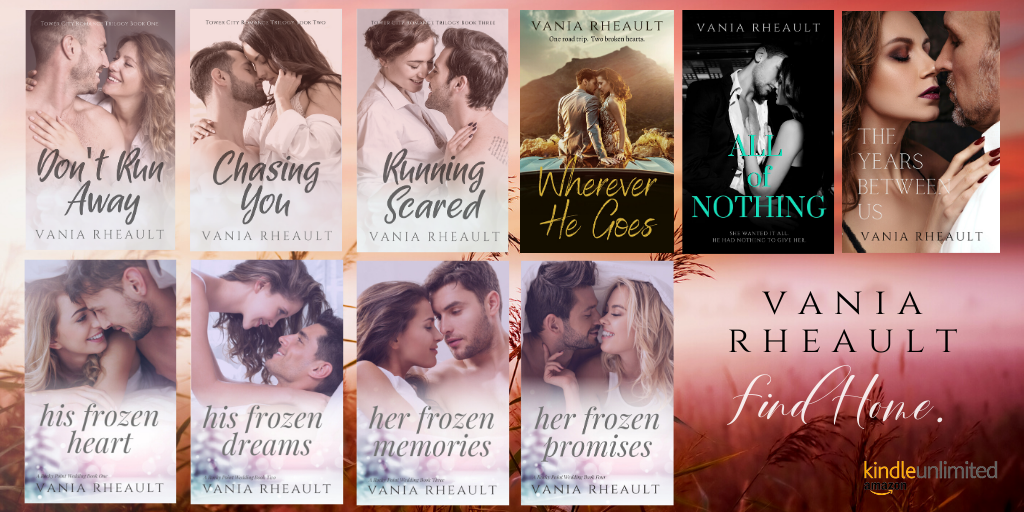
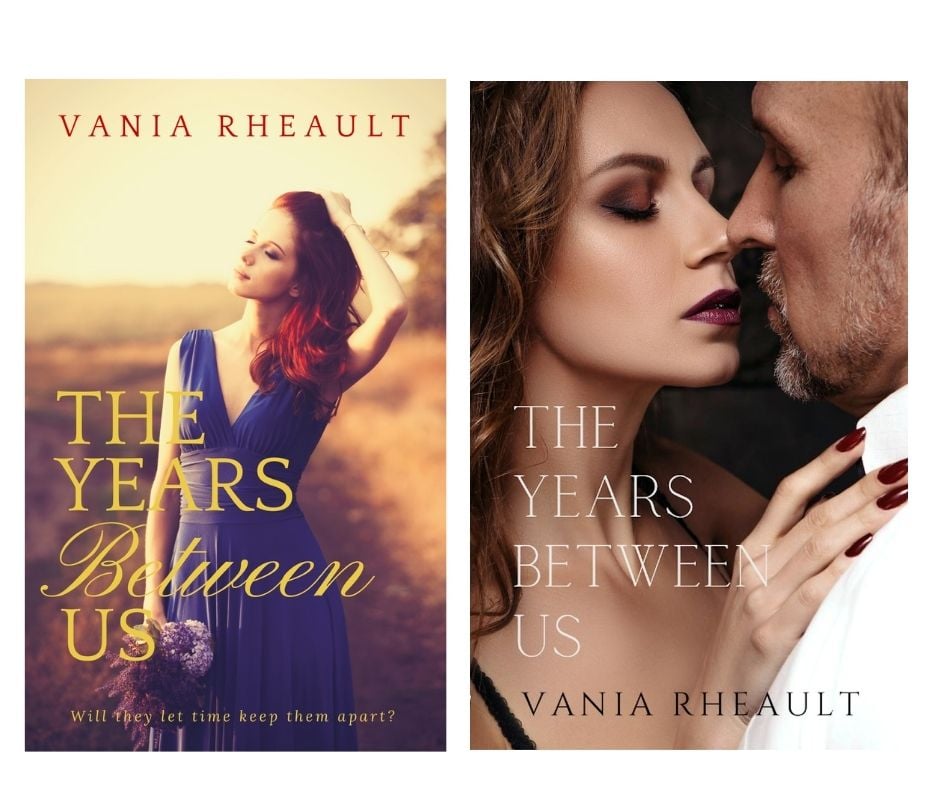
Anyway, my ads are still doing well. I’m up 100 dollars this month so far! It’s a little scary thinking of all the money I’m spending, and I wish that Amazon would bill me at the same time they pay out royalties. It wouldn’t look like it hurts so much then. But surprisingly, or not, my biggest seller is The Years Between Us, after I redid the cover. I can’t express how important a cover is. Even if you think your cover is good, if it’s not selling your book, don’t be afraid to change it!
I will always be grateful that I have the flexibility as an indie to change things that aren’t working, and the humbleness to admit that the choices I’ve made may not always be the right ones. People can get so stuck with their choices thinking that once a choice is made there is no other way, but that kind of thinking keeps you from broadening your horizons and maybe finding a different path that really works.
As far as anything else goes, my daughter is starting 9th grade next month, and things are still up in the air. She chose to do the hybrid plan instead of all online, and I supported that. She didn’t do so well at the end of last year. She may be an introvert, but we all crave human contact. So this week I’ll be taking her to get her hair done and doing a bit of school shopping for some new clothes and school supplies. So I suppose it worked out that I had to postpone my trip, but I do miss him and I’m excited for the changes that will happen once we’re finally in the same town!
I’m watching the replay of the marketing webinar Jane Friedman put on last week. I linked it to you in last week’s blog post. She has a lot to say on marketing for both traditionally published authors and indies, and the very first thing she said was you have to make sure your cover, blurb, and the product as a whole are good. After you put your book for sale, your book is no longer just a book, but a product. I joined an Amazon Ads Facebook group after Bryan Cohen’s Ads Challenge finished, and lots of people forget that you need a good product. All the time I see, I’m tweaking my ads all over the place but I’m not getting any sales. So I take a look at their books and I can see right away. Poor cover, or the blurb is a big block of text. Maybe they have a genre mashup and they don’t have the correct categories chosen, and who knows what they’re using for keywords. I’m not saying I have it all together. My cover for TYBU is a good example. But, if you’re going to ask for advice, at least listen to what someone has to tell you. They could be right on point, even if it means more work for you.
I suppose that’s all I have for now. I try to give my readers some kind of value or tip, but while I still listen to a lot of podcasts and I’m in the middle of that webinar, I haven’t discovered anything to pass on. Bryan does have his next ads profit challenge starting in October, but God, for some reason that just seems so far away right now. And with David (please, God) finally here, I may not sign up for it. It’s going to take a bit to get him settled in and I’ll still be working and doing as much writing as I can to finish up these last two books before all the plot flies out of my head and I don’t know what I’m writing anymore. Sounds silly, but I don’t keep notes. I’m writing these back to back to back and all the details of every little thing are in my head. Maybe not the best way, but it’s my process nonetheless.
I hope you all have a wonderful week ahead, and if you want to know how my dental appointment goes today, let me know and I’ll post a comment. Tell me something yucky you have to do this week!
I don’t have a lot to say at the moment. I’ve been writing my first person present books, and I’m 34k into the 5th book out of 6. I’m happy things are moving along and my alpha reader says that so far they are engaging and stuff keeps happening even if I feel some parts are a bit laggy in places. So, that’s good news! It’s going to be quite the task to edit them but because of consistency issues, I’ll do them all once book 6 is done and I take a bit of a breather. When I don’t feel like writing I’m looking through stock photos of couples I like. The covers will be a process, and you can’t start something like that too soon.
I’m happy that Canva has introduced some text effects and that will add some additional choices when making covers. It will be fun to play around with new combinations.
My Amazon ads are still doing well. I think the promo I did with Freebooksy is still working. I’m up almost a hundred dollars after ad expenses for the month, and it’s only the ninth. It would be really cool if I could make that and not spend, but paying for marketing is always going to be a necessary evil.
Not too many readers are leaving reviews on Amazon though, and I’m scared to look at Goodreads. People can be a little nastier there, and I just don’t need that kind of negativity. Being a writer and putting yourself out there is already hard enough. No need to torture yourself when you don’t have to.
I suppose that’s all I have for now. I’ve been writing a lot, working, and it feels like I’m always doing laundry. It’s been hotter than hell in MN this summer, and dealing with the heat, despite our air conditioning being fixed has been a real drain. And this week we’re supposed to find out what my daughter will be doing with her school year. She starts 9th grade next month! I can’t believe how time flies.
I hope you all are doing well, and looking forward to fall. The cooler weather will be welcome! Have a great week everyone!
Hello, and welcome to August! I hope you are staying safe, healthy, and sane. A lot of things are up in the air right now, but I did want to talk about one thing that’s been on my mind. I joined a Facebook Group for Amazon ads. Most of the members are holdovers from the Ad Profit Challenge that Bryan Cohen hosted last month. But I did notice a common theme.
Lots of us are starting at zero.
We all start at zero. Even Steven King started at zero, submitting stories through snail mail, hoping a magazine would publish his work. It’s a little hard to believe that huge writers like King and Nora Roberts, Neil Gaiman, and others started at a typewriter or computer, stared at a blank page, and started writing their books for no one but themselves.
These days starting at zero doesn’t seem so daunting. There are writing groups, publishing groups, publishing conferences, virtual conferences, Zoom rooms, Facebook rooms, and more. Writers have a million places to share links and drive traffic to their book, blog, or social media sites. But even if you have a hundred people starting from zero around you, you’re still in it yourself, and when you feel like you can’t make any traction, that journey seems very lonely.
What’s even worse is starting from zero means you’re probably making mistakes that you don’t know you’re making. Mistakes that could effect you and your business for years to come. Some things can be fixed like a bad cover, some might take longer, like re-editing a poorly written book. One of my biggest is no newsletter.
But there is a ton of information at your disposal, and David Gaughran has helped with that. In his new course, Staring From Zero, he talks you through what you need to do to get your book published, and published well so it sells. The course is free, and I’m half-way through it. It’s a great resource, even for those who have been around for a little while. Things change, and David provides information that’s relevant as of July 2020. I would sign up and watch the videos. He gives you two free ebooks also, and all you need is a little time to make your books better. He doesn’t even try to sell you anything!
I’m enjoying the course so far, and because of Bryan’s Amazon Ads Profit Challenge, I’ve done some of David’s suggestions already for some of my books. What I need to do is take a couple hours and do all the things so I can give my books the best chance of selling as I can.
If only selling your book were as easy as writing it!
Click on the photo for the website to get started! Tell me what you think
In Monday’s blog post I talked about relevancy and mentioned that the categories you put your book into when you publish should closely fit what’s inside your book as possible.
There are a lot of questions about categories, such as, is there a list to choose from and where do we find it?
Amazon hasn’t provided us a list of categories they offer their authors, but they do let you add categories to your book–up to ten. All you have to do is ask.
But how do we do that?
The first thing we need to do is find a book that is most like ours on Amazon. This can be a traditionally published book, or choose an indie who has been publishing for a while who knows what’s going on. Meaning, they have probably already done this process, and we’re just going to borrow their categories.
To show you, I’m going to do The Years Between Us. The categories that the book is in right now is what I chose when I published:
You can choose two, and I think I did choose Coming of Age Fiction and, well, let me look. It’s easy enough to remind yourself if you go into your Bookshelf on KDP and look at the ebook details.
Unfortunately, it made me save changes and republish, so if you plan on going in and doing any promotions or anything, don’t check on your categories until you’ve done what you need to do because while KDP publishes your “changes” they lock you out. Anyway, so you can see that Amazon stayed true to what I set when I first published, but those categories are not a complete representation of what that book is. The Years Between Us is an older man/younger woman novel, and I’m not sure if that’s actually a category, so we need to snoop around. I don’t think it is, but I do know that I can do better than the categories that book is in.
I’ll go to Amazon and search in the Kindle Store, Older Man/Younger Woman and see what comes up. It can be a naughty sub-genre, and mine isn’t dirty like that. So finding a comp book might take a little bit of time. We might need to click through a few books to find a close match.
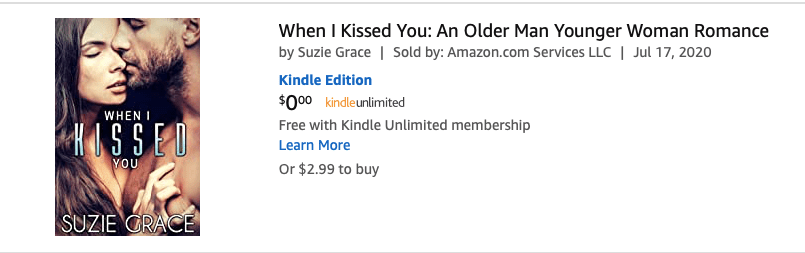
I’m going to go with this book for the sake of this blog post, but once you know how to check a book’s categories, you can check as many books as you like and search for as many categories as you think will fit your book.
The cover doesn’t look that naughty, and it’s obviously an older man/younger woman romance. I haven’t read it, and never heard of Suzie before, but let’s see what categories she used for her book:
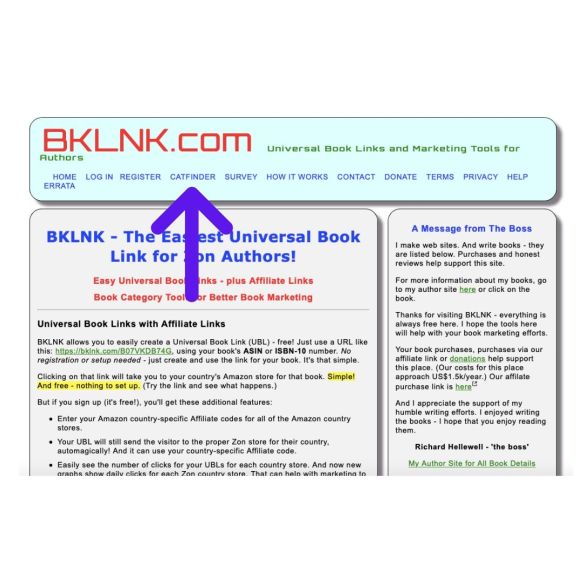
I can’t choose Billionaire Romance because The Years Between Us doesn’t follow that sub-genre, but this isn’t the only way we can see what categories this book is listed under. If you go to www.bklnk.com, you can use this website to insert the ASIN number for any book and we’ll hopefully see if there are more categories this book is in.
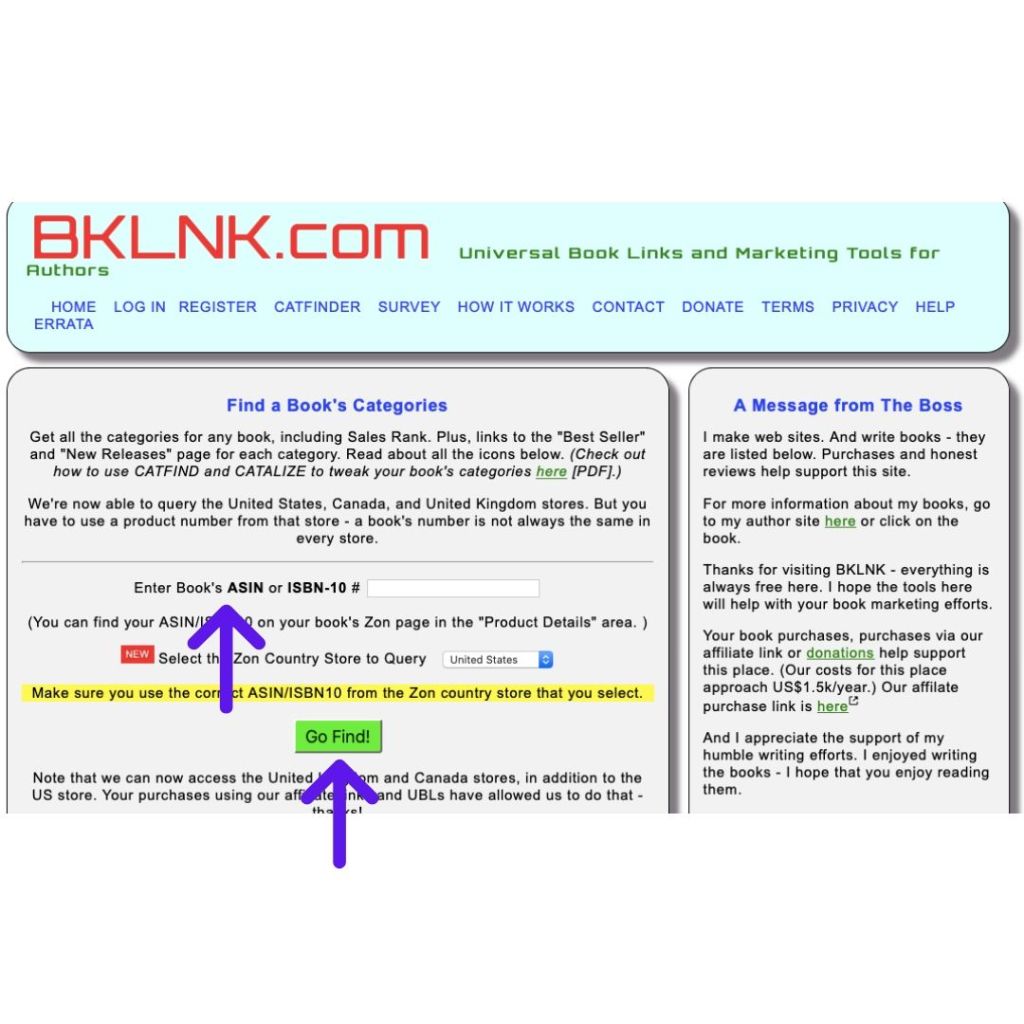
Click on Catfinder and enter the ASIN in the field provided.
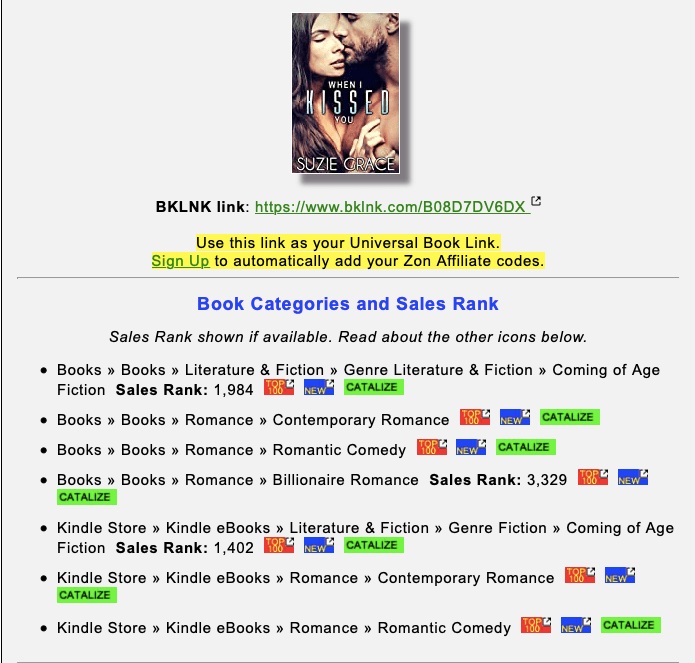
After you click, Go Find! you’ll be presented with a list of categories that book is in on Amazon.
It doesn’t look like there are going to be any discoveries here, except I do see that it’s listed in Romantic Comedy. She may have asked for that category to be added. That’s not something I can use for my book because my book is all about drama and secrets.
Let’s try another book. After some hunting, I found Reckless Suit: A Hero Club Novel, by Alexia Chase.
You’ll remember The Years Between Us wasn’t even listed in contemporary romance, so that’s a category we can add right away. But looking at the categories for this book gives me a couple of ideas. City Life could be one, because the book does take place in a huge (albeit made up city), and I could add Women’s Romance Fiction. So there are three I could add. Contemporary Romance, City Life, and Women’s Romance.
If your book has a lot to do with families, you could probably add Family Life Fiction, but that might be more aimed at a women’s fiction book dealing with family issues. I would prefer to aim my book at readers who want more romance in their plots.
So now that we have the categories we want, how do we as Amazon to add those categories?
Go to your KDP Dashboard and click on HELP in the top right menu next to Sign Out.
Scroll to the bottom and click on Contact Us. That will be a yellow button on the bottom left of the page.
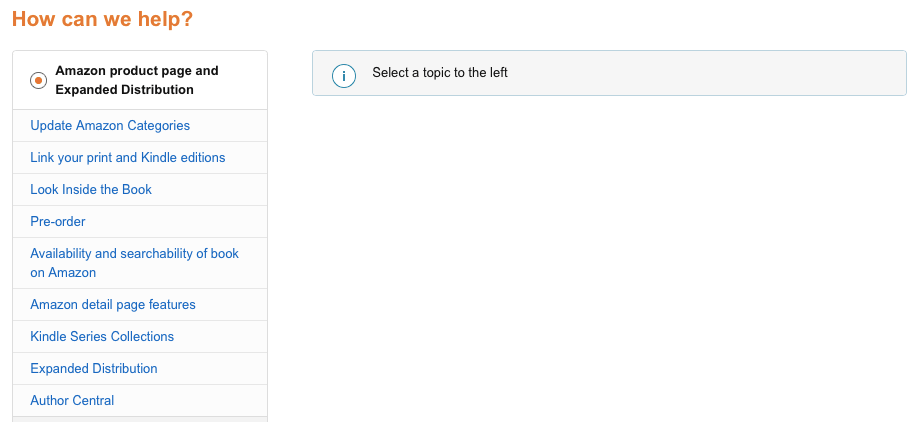
Click on Amazon Product page and Expanded Distribution.
Then click on Update Amazon Categories.
There it will even give you a template you can fill out, and from here all you have to do is give them your book’s ISBN and ASIN numbers and the exact categories you borrowed from the books like yours.
Here is my list for The Years Between Us that I found from searching Amazon for books similar to mine, and using www.bklnk.com for the string of categories that Amazon requires you to include:
Kindle Store » Kindle eBooks » Literature & Fiction » Contemporary Fiction » Contemporary Romance Fiction
Kindle Store » Kindle eBooks » Literature & Fiction » Genre Fiction » City Life Fiction
Kindle Store » Kindle eBooks » Literature & Fiction » Women’s Fiction » Women’s Romance Fiction
Books » Books » Literature & Fiction » Genre Literature & Fiction » City Life Fiction
Books » Books » Romance » Contemporary Romance
This is the exact text in the message I sent to Amazon through my KDP account:
Please add these categories to The Years Between Us in the .com store.
The ASIN number is: B07Q4143R1 and the ISBN number is: 978-0999677568
Categories to be added (list each category as a separate line item for all applicable titles)
Kindle Store » Kindle eBooks » Literature & Fiction » Contemporary Fiction » Contemporary Romance Fiction
Kindle Store » Kindle eBooks » Literature & Fiction » Genre Fiction » City Life Fiction
Kindle Store » Kindle eBooks » Literature & Fiction » Women’s Fiction » Women’s Romance Fiction
Books » Books » Literature & Fiction » Genre Literature & Fiction » City Life Fiction
Books » Books » Romance » Contemporary Romance
Thank you for adding these to my book! Your time is very much appreciated! Stay safe and healthy. 🙂
I’m always polite, and I’ve never had a problem asking them to do something. It takes about a day to get a response, and if you give them the entire string in the categories you need added, they shouldn’t have a problem fulfilling your request. Unfortunately if you want to add your book’s categories to the other stores like Canada (.ca) or the UK (.co.uk) then you have to send separate messages. (This is per Bryan Cohen and what he teaches in his ads course. I have never added categories in the other stores.)
As with the relevancy post on Monday, you want to make sure you choose the most relevant categories for your book. The correct categories will only help Amazon sell your book by putting it in front of readers who most likely to want to read it.
I always give credit where credit is due, and I learned this tip doing the Amazon Ads Profit Challenge with Bryan Cohen. He’s going to leave the video up for a little bit, so if you want to watch him in action choosing categories for his book, you can check it out here. https://www.bestpageforward.net/july-2020-challenge-prep-work/ The talk about Categories starts about 25 minutes in, but the whole video is very useful! 🙂
Amazon got back to me before I published this post, and they added my categories without an issue:
Let me know if you’re going to add some categories, and what your thoughts are with adding the correct ones. I hope you found this useful! Until next time!
So if any of you follow Mark Dawson or you’re concerned about marketing strategies, or you were thinking about taking an ads course, or if you’re in any writing groups at all on Facebook, you know that Mark Dawson’s Ads for Authors course closed last week. Whenever Mark opens up his course, I have a huge case of the nerves. Why? Because everyone raves about this course. How helpful it is. How it’s a lifetime pass to ads and all your questions and all of the answers until you die. You can’t be an author and learn how to sell your books without it. After hearing it’s God’s gift to sales, you’ll run out and sign up, right? Well, the next time it opens is in the winter, and you’ll need that time to save up the fee, because you know why I haven’t signed up? It’s $849.00. You read that correctly. It’s almost a $1,000. And if you take the cheapest payment plan, it does cost over $1,000 dollars payable over two years’ time.
You know how indies say, “I can’t afford a cover, or a professional edit, etc, etc, etc, because I’ll never earn my money back?” Yeah. That. How many books would I have to sell to earn back $849? That’s the whole point of the ads course, right? To learn how to make that kind of money? Sure.
So how about this one? In Mark’s SPF University, there’s a course on how to write a bestseller by Suzy K. Quinn. People have raved over this, and I’m always wanting to work on the craft part of being an author. Some would say working on craft is the most important part of being a writer because it always starts with a good book. But her class is a whopping $297.00. People say they learn so much from that class. But hey, that’s two car payments for me. Or half a month’s rent.
And I’m not picking on Mark Dawson. John Truby also has a writing class. He gave a intro talk about it at the 20booksto50k conference in November last year. And you can watch it here.
And that’s just classes. We haven’t talked tools yet.
Bookbrush. A platinum yearly fee with them is $250.00. Canva. A yearly membership with them is $120.00 a year. But if you compare the two, you get quite a lot more with Bookbrush, as you should since it’s double the cost. There there’s Vellum, and if you don’t have a Mac you have to run it through Macincloud, and if you do want a Mac, well, everyone knows how much they cost.
Never mind paying for clicks on Amazon Advertising, and the same goes for running Facebook ads and Bookbub ads. (Don’t bother with running ads on a platform you don’t understand. You might as well give me your money. I’ll use it to buy promos.)
Can we add newsletter providers too?
Oh, I forgot about website hosting and a domain name. Maybe a business upgrade on WordPress.
A yearly subscription to Microsoft Office 365.
Forgot coffee. And booze. Are you even a writer if you’re not drinking something like a fish?
Let’s just say that indies have a lot of resources and not all of them cheap, ah, budget-friendly.
How much does it cost to be a writer? Well, nothing. I mean, literally 0 dollars. It takes no money to be a writer. Maybe two dollars. Grab a pen and notebook from the dollar store. Or scrounge your kids’ school supplies for things they didn’t use after everything moved to online learning because of COVID-19.
There’s a joke in the running world that running is the most expensive free sport there is. Shoes, race fees, GPS watches, the rest of the gear. The list is almost as long as what a writer needs to be an author. Being an author is the most expensive free thing you can do right? Tell that to my $150.00/pair Brooks running shoes so I don’t get tendonitis in my ankles.
But how much money does it really take to invest in your business?
The problem is, not anyone is going to know but you.
I had a friend step back from writing. She’s focusing on her family. That’s great; she has to do what’s best for her. And while she’s never said she won’t come back into the writing/indie space, what she did invest in will just sit while she decides what she wants to do. She bought a Mac, she purchased Vellum. She bought a yearly subscription to Canva Pro. Granted, that can run out, but I don’t know how much of her paid year will go to waste while she’s not using it. She purchased her domain name for a blog she took down. I gave her a free developmental edit of her book, so there’s something, but she paid for a cover for a book that will sink in the Amazon store because she won’t be promoting it (and by promoting it, I really mean writing the next book) while she takes a break.
So how much money should you spend? Start small. I pay for Word. I don’t use a writing software like Scrivner. But you don’t have to purchase Word, either, though the .docx is compatible with Vellum and other conversion websites as well as KDP. There are free options like Open Office or Google Docs.
There are some things indie professionals say you can’t skimp on like a professional edit, or a decent book cover. And that’s true. You don’t have anything if you don’t have a good book. That’s why there’re craft classes out there. But you don’t have to pay $300.00 for a class. There are a ton of craft books, and all you need is to invest some time into reading them. In fact, there are a lot of free resources on YouTube if you learn better listening to a speaker. Brian Sanderson has a set of lectures on Youtube people say are really good, and you can get started here. And over the years John Truby has spoken about craft and you can watch those YouTube videos for free. I’ve shared several talks I’ve enjoyed from the 20booksto50k conference in Vegas last year. The group puts those on YouTube for free too. Chris Fox’s channel is valuable, as is David Gaughran’s new channel.
I suggest narrowing down what you need at the moment you need it. If you only have one book out, probably you don’t need an $800.00 ads course. If you only have one book chances are working on craft would suit where you are in your career a lot better than learning an ad platform or any kind of marketing strategy.
I have fear of missing out, and a lot of writers I know do too. It’s tough not to want the newest brightest thing. Especially when all your groups on Facebook are raving about it. I can’t afford Mark Dawson’s class, and if you can’t either, there’s no point in feeling bad about it. It is what it is. I’ve learned a lot taking Bryan Cohen’s free ad challenges, and he doesn’t push you to pay for his class. I break even with my ads, and that’s okay. I’m not losing money and I’m picking up new readers. At this stage in my career, that’s a win for me.
Having all the tools and technology won’t make you a writer and I have a feeling that was what my friend was aiming for. She was collecting the tools of the trade, but in two years wrote only 60,000 words. For some indies, that’s a word total per month.
Think about what your goals are, what you want out of your career and when you want them. My fiancé bought me a Mac and purchased Vellum for me. I format a lot of books, and pay my fiancé’s kindness forward and will format free for others. Like I said, I pay for Word. It’s my main (umm, only) writing software and I use it every day. I pay for Canva. I bought Publisher Rocket because I do experiment with ads (and right now those small ads are my main source of sales). I’m ashamed to say I threw $40.00 at something I don’t even know what it is or how it will help me. All I know is she said it was her final offer because she wasn’t going to sell it anymore, and I swallowed it hook, line, and, sinker. Some kind of author toolbox website that I probably will never be able to find because I was too busy throwing money at her to pay attention to what I was buying.
It happens, and probably more frequently than we want to admit. The panic sucks. The fear of missing out on something that will make us a bestseller. And we especially panic when we think everyone else but us has the magic bullet.
A good rule of thumb is to exhaust all the free possibilities before going to paid. Newsetter providers have tutorials. So do lots of people on YouTube wanting to help you. Podcasts have been a great way to learn things, and I like to multi-task. Listen while you’re doing chores, or running errands, or taking a walk. I use my phone to take notes if they mention something of interest I don’t want to forget.
No matter how you learn what you learn, probably the one thing you’re going to need to invest is time, and in a lot of cases, that time is better spent writing.