Another update, because, why not? And other musings of a #stayhome life

I had a blog post planned for today, and it’s even written out in my notebook. I need to type it up and get it out there, because it’s part of the 2020 predictions from Written Word Media. I would like to get that series finished up so I can blog about other things. Though, with this virus stuff going on, (and I don’t mean to make light of it at all; I know it’s affected many people) it feels almost strange to be carrying on in any normal sort of way.
silhouette-4233622_1920Even with my rah-rah-sis-boom-bah, write, write, write mentality I like to shove down people’s throats on this blog, I haven’t been doing much of that.

That’s not to say I haven’t been doing something. I was dismayed to find one day that some of my Vellum files for my books went missing. It’s not technically a big deal. I mean, I still had the .mobi files for Kindle the PDFs, but I didn’t like not having the actual files that upload into Vellum. So I took it upon myself to take the PDFs, convert them back into a Word docx and put them back into Vellum.

It’s just as convoluted as it sounds, and when you convert a PDF into a Word docx, the formatting isn’t 100% the same. And when you put that Word docx into Vellum, it gets messed up even more. So what I did (for my own peace of mind and my weird anxiety I get when I think about my books) I decided that while I was fixing the formatting in Vellum, I would give them a light edit and push them back into the world.

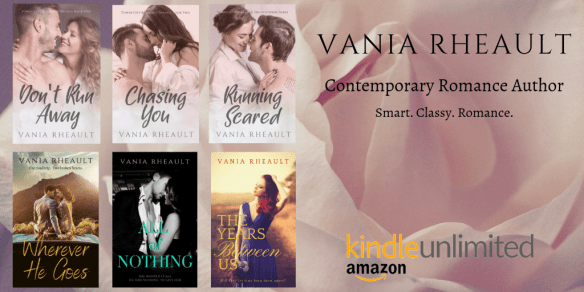
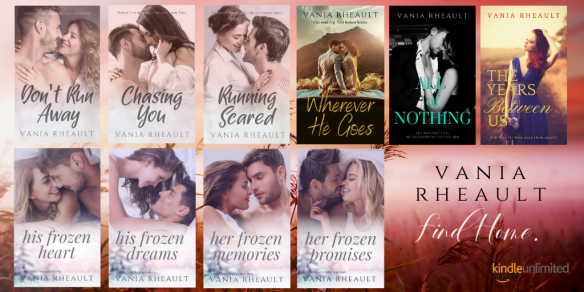
I’ve taken the last two weeks and I did All of Nothing, The Years Between Us, and Wherever He Goes. I guess because the formatting changed, or maybe I chose a different font for the text, who knows, I had to redo cover dimensions for All of Nothing and Wherever He Goes. That wasn’t too big a deal, since everything was saved in Canva and I had all my stock photos still saved there. Recreating them with a different canvas size didn’t take too much time, and I’m getting good enough that I didn’t bother ordering proofs before publishing them (something I used to do every time I made a change to the paperback).

It was actually kind of interesting to go back and read my books again, and I learned a couple things along the way:

1. I need to keep my baby name book with me. ALWAYS. I used the same names over and over again. There’s a Jared in Wherever He Goes, and there’s a Jared in my Wedding series. I reused the name Max, as well. Dismayed, I found I used Erik in All of Nothing, and there’s an Eric in Don’t Run Away. There’s an Elmer in Wherever He Goes, and an Elmer in the new trilogy I’m editing (I’ll change his name, for sure). You know, there are so many names available, I shouldn’t have reused the names at all. It’s not like I’m 60+ into my backlist and I’ve run out of choices. For consistency and scared I would do more harm than good, I didn’t change any of the names. Maybe in the future an Excel sheet will come in handy.

2. I use the same imagery. I’m consistent in imagery, and I guess that’s what people mean when they say they know a book’s author by the way it’s written. Though some of the metaphors and cliches change from book to book, it’s evident I like the sound of a certain way of comparing things.

In the mirror, I give myself one last look. The dress shows off just enough leg, my hair is a blonde mess of curls down my back, my eyes have just the right amount of shadow and eyeliner.

I’ll pass, if no one looks too closely.

After all, even imitation gold shines in the light.

This is an example of some of the language I like to use from book to book, and while it’s pretty, I need to make sure that I’m mixing up my imagery or my books will start to sound the same.

3. My themes are the same. This isn’t necessarily a bad thing. In fact, I’ve been told that a consistent theme weaving your books together will help with marketing. My theme, so far, is when you fall in love with the right person, you can find your place, you can find your home. Of course, in romance you have to be careful that the woman isn’t losing herself in her man, that her world doesn’t revolve around him. So it’s important that you give your female main characters their own backstories and make sure they have their own arcs so they fall in love and find their place with their man on their own terms. All my female characters battle their own demons before allowing themselves to find happiness in a relationship. This is the way romance has evolved, but I don’t have any complaints. No one wants to read about a doormat who doesn’t have her own life outside of her love interest.


I could tell that when I was writing Wherever He Goes that I was a bit stiff at the beginning and I did take the chance to smooth out some sentences and make the scenes and paragraphs flow a little better. I didn’t hit my stride with that book until the middle, and I find it interesting because already by Wherever He Goes I had already written quite a few words. But that book was my first standalone after the my Tower City Trilogy and I guess I was getting used to new characters and plot.

I don’t know if I’m going to do every single book I’ve published. The box set file for my trilogy is still intact, so pulling those out and making the books single again to recover my Vellum files won’t take that long, and they won’t require proofing unless I want to go back and read them. I suppose I could since in the back of my mind I feel like those are mediocre offerings at best and I’m reluctant to advertise them. If I read through them and fix typos, etc, then maybe the time I invest doing that will come back to me since I’ll be more comfortable promoting them. That’s committing to a lot of work, and for now I’m going to do 1700. I don’t have the file for that cover anymore–that was way back when I was doing covers in Word, and Canva wasn’t available yet. So I want to revamp that and reformat the insides with Vellum. I’m excited to do that–and it won’t take me long. The whole book is barely 50k. I already edited an old paperback so I just need to add them in and make the interior pretty. It’s a romantic fantasy, and once I update the cover and keywords, it might actually make a few sales. It’s a cute little story, and even though it’s the first one I published, I’m still proud of it.

I think I even found a stock photo that might work:

depositphotos_321067012-stock-photo-young-elegant-couple-hugging-while

I know the font will play a big part of the cover, and to be honest, I totally fucked myself with the title. On the Corner of 1700 Hamilton is atrocious, and if I cared at all, I would unpublish and start over. But while it’s a sweet little thing, it doesn’t mean enough to me to completely revamp it. As they say, mistakes were made, so what’s the point of pretending they weren’t?

Anyway, so that’s what I’ve been doing with my time. It’s amusing, at any rate, and it’s actually kind of heartening to know that I like what I write and I feel like though there were typos I had to take care of, my books are solid and I’ll have confidence in running ads to them in the coming years.

Tell me what you’ve been up to! Are you doing little things to keep your mind busy or have you been able to write?

Let me know!

end of blog post graphic

Author integrity, where I’m at with my series, and what’s going on for the rest of the year.

Author integrity and what building a brand means.

I got some bad news this weekend. An author friend of mine, who has been saying (for quite a while now) she’s rewriting her first book posted on social media that she has decided not to. She’s rebranding, and the old book will be republished under her new pen name, cover, and reformatted interior. I was bummed, and I’m sure I’m not the only person she let down.

When we start building our businesses and start thinking about author brand, we think right away about our website, our logos, pen names, and everything in-between. But building a brand is more than the color palette we’re going to use on our website. Building a brand is letting readers (i.e. the public on social media) know who we are as people. Are we honest? Do we do what we say we’re going to do? Do we treat our peers with respect? Do we run our businesses with integrity? Do we have follow-through? I see plenty of authors who like to be jerks online. They say people are too sensitive, or people are too easily offended, and that gives them an excuse to say what they want without regards to other people’s feelings. I see authors publish without follow-through. We write the first book in a series or trilogy, publish it, then nothing. For years. Or authors who release less than stellar books and then get upset (sometimes online by way of responding!) when their reviews reflect that. That does not inspire loyalty from readers, and doing something like that won’t build a readership.

honest

Building a brand is showing people who we are. We want to inspire trust. We want readers to know that if they buy one of our books, they know what they are going to get. Quality. A good story. Authors like Stephen King and Nora Roberts are household names for a reason. Even big named indies like Melissa Foster and Mark Dawson have created brands that a lot of us can identify just by hearing their names. Their names bring to mind who they are as public figures and as authors.

You’ll lose readers if you aren’t kind and honest, don’t produce quality work, and don’t have follow-through. Keep your promises. Be a professional.

I love this quote by Rachel Hollis, author of Girl, Wash Your Face and Girl, Stop Apologizing:

integrity quote by rachel hollis

Your brand is your business, and your business will sell your books.

I wish my author friend well. I wish her lots of success.

If you’re interested in reading Rachel’s books, Girl, Wash Your Face is right here, and Girl, Stop Apologizing is right here.


Where I’m at with my A Rocky Point Wedding series.

I sent books one and two to the proofer/beta reader. He’s going to tell me how they sound and if there’re any typos. With these books I’m cutting out a couple of editing steps, but adding one I haven’t done for the past three books. This time I will proof the paperback proofs as they come in. Hopefully that will make up for the two I’m skipping.

I’m done editing book three. It’s sounds great, and the only thing I did so far is deleting sections that don’t fit/slow down the flow and finding typos. I must have been feeling good when I wrote this book, or I liked the characters a bit more, because this couple is punchier than the other two. Ivy’s got an attitude, and I like her very much. Here’s a small snippet of something I came across that made me laugh:

“You’re going on the sleigh ride with us, aren’t you? I don’t want you to be hungry, and there’s not enough time to go home first. Come on, we’re meeting in the dining room.”

He looked good in jeans and a dark blue sweater. His blonde hair glinted in the sunset sparkling in from the huge windows that overlooked the slopes. Logan had always hated his glasses, but Ivy liked them. They made him look smart and handsome.

That hadn’t changed.

“I can grab something in the kitchen. It’s where I take my breaks, anyway,” she said, crossing her arms in front of her chest.

Logan scowled.

Ivy enjoyed it.

He’d paid for her time; she didn’t have to make it easy on him.

He sighed. “Please?”

“Honey, don’t turn down the pleasure of this hunk’s company,” Lola said, nudging Ivy’s shoulder.

“You don’t even like men,” Ivy said.

“Doesn’t mean I can’t appreciate the finer of the species,” she said, winking a heavily made up eye with silver sparkly eye shadow and a million coats of mascara.

Ivy glared at Logan. “Fine, but that doesn’t mean I’m happy about it.”

When she went to the stockroom for her jacket, she heard Lola say, “She’ll come around, honey. She doesn’t date much.”

“Much?” Logan asked, and he sounded way more interested than he should have been.

“Okay, none. She needs a little fun, and a little fun.”

Ivy could picture Lola leering.

“Oh, I’ve got that covered,” Logan said.

Dammit. He could charm an Eskimo into buying ice.

“That’s enough,” Ivy snapped, stomping out of the stockroom.

Lola whistled. “Honey, you ain’t got that covered enough.”

“I’ll keep working on it,” Logan said, laughing. He took her arm in a strong grip, and Ivy let him lead her out of the lounge.

Book four will take a little more work since I haven’t looked at it since finishing it a few weeks ago. The time away will help me find what needs fixing, but I doubt I’ll get it to the proofer before the holiday stuff kicks in.

I’m not in any hurry to get these out. I did plan for book one to be released around Thanksgiving, and I don’t see that as an issue as long as everything stays on track. I don’t want to have too much time between releases, but my timing might just be a little off. It depends on how fast my proofer goes, as well.

A little side project.

I am doing a little side project to keep me sane while I edit. I write that in longhand at work then when I get tired of editing my wedding series, I transcribe what I have so I can start fresh the next day I work. It’s been working really well and will be the first book I’ve written completely in longhand.

It makes the editing tolerable, and I’m already 51,400 words in.  This is something I’m thinking of publishing under a pen name, and it won’t be out until my series is fully released. So maybe in the spring. I’m not sure. It’s already plotted out, and it will be a full-length novel trilogy.

It’s fun trying a new direction!


Thanks for stopping in. I’ll be talking about change and being in uncomfortable situations.

Have a productive weekend, everyone!

end of blog post graphic

Another try with Amazon Ads. Am I finally selling some books?

amazon advertising logo

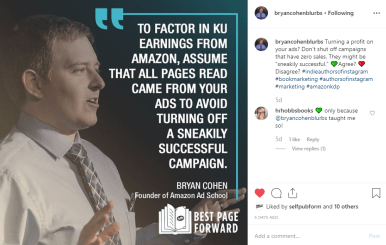
If you don’t follow Bryan Cohen then you should. Follow him on Instagram, Facebook, and listen to the podcast he hosts with Jim Kukral.

This guy knows what he’s talking about with Amazon ads, and a lot of the stuff he puts out into social media is free. Don’t get me wrong, some of what he puts out there is a hook to get you to buy some of his courses, but he’s a businessman, and well, that’s what they do. But following him on social media for the free tidbits is totally worth it if you’re starting at zero.

I was starting at zero, and even though I had read Brian Meeks’ book on the subject, trying what he suggested didn’t move the needle. But to be fair, that was a while back and I didn’t have as many books published as I do now. They didn’t have the good covers they do now, and I didn’t know how to find keywords.

Bryan Cohen has a different approach, and I totally encourage you to try different things. We all publish different kinds of books, and lots of people get frustrated when something kills it for someone but then they try it and it does nothing, or even worse, it wastes money.

I took a free 5 day ad challenge Bryan hosted a couple weeks ago on Facebook. Of course, it was to sell an ad course that I didn’t buy because I couldn’t afford it (did you know scraping a cat’s bladder for stones cost 2,600 dollars? Yeah, Harley is fine now.), but during the five days I did his challenge, I learned a lot about ads, and more specifically, where to find keywords.

Keywords will make or break your ads. And I know you’re going to call me a cop-out writing this blog post and not telling you where to find them. But in a show of integrity and out of respect for Bryan, I’ll point you in his direction and let him tell you how (or you can use Publisher Rocket, or try Alex’s K-lytics and read his blog). After all, I wouldn’t know what I know without his help, and I’m all about attribution. I will feel comfortable saying this though: all my keywords are titles of bestselling books in my genre that are in KU. How you go about assembling this list will be up to you, but using a list comprised of titles that sell that are similar to yours works.

I started the challenge on September 20th, 2019. He told us to focus on one book, so I chose All of Nothing. That still proves to be my strongest book, and it’s made me the most money with the challenge. After the 5 day challenge was over, I did ads for my other two standalone books, and All of Nothing still blows it out of the water.

Since September 20th, on my three standalones I’ve had 110,709 impressions (impressions are free), 226 clicks, and $50.29 worth of ad spend. That might seem like a little bit of money to you, but remember that you’re hopefully earning most, if not all and beyond, that money back. Those stats are based on 42 ads. All of Nothing has the most, which may be why I’m selling more of that book, at 27 ads running right now. Some are from the challenge and some are ones I did on my own. Wherever He Goes has 7, and The Years Between Us has 8. I focused on keyword ads and I wrote a couple lines of my own ad copy for each ad. Bryan said to bid low, and while that’s up to you, I’m getting clicks and impressions with bids under 40 cents, which is really good considering my genre is contemporary romance, and that is a highly competitive genre. Keep in mind you don’t necessarily pay 40 cents just because you bid it. My cost per click average is .22 cents.

Now, I’ll tell you how much I’ve made since September 20, 2019, and learning ads is going to be a slow process. If you break even when you first start out, you should consider that a success.

To accurately know how much you’ve made, I suggest you use BookReport. It’s free until

bryan ad on instagram

These tips are a great reason to follow Bryan Cohen Blurbs on IG!

your monthly earnings exceed 1,000 dollars. That will tell you how much you’ve made with sales and KU READS. Your ads dashboard does not include KU reads, so if you’re in KU and you see you’ve spent 50 dollars on ads, but only made 13 dollars in sales, those are Kindle/paperback sales, and not KU reads. Bryan was very adamant about making sure we knew that. You could turn off a profitable ad not figuring in your KU page reads, so make sure you take those into consideration. After all, those are the main reason we’re in KU–so don’t forget to include them in your sales data.

I check my ad spend and sales every morning before I go into the writing, and today my ad spend is since I started the challenge, like I said, is $50.29.

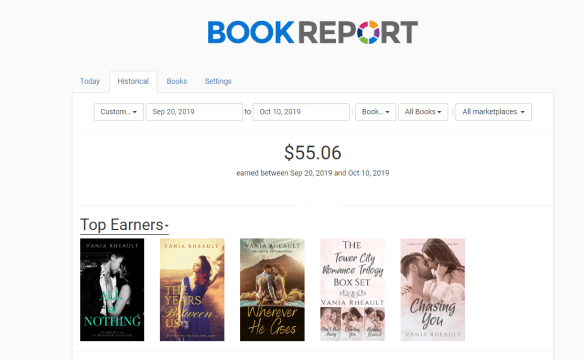
What I’ve made so far since I started the challenge is 55.06. I’ve made 5 bucks. That might not seem like a lot, and it’s not. Not in the grand scheme of things. But I’m in it for more than the cash right now, so let’s look at what else we can glean from this data:

book report for ad challenge for blog

book report for ad challenge for blog 2

BookReport shows me that I’m getting sales as well as page reads. This is super since I wasn’t barely getting anything before the challenge, never mind when I was wide and trying to get traction spending money on promos.

All of Nothing has had 10 sales, and 7,894 page reads. All of Nothing is 420 KENPC, so if you divide 7894 by 420, you get the equivalent of 18.79 (almost 19) books read. For me, that’s pretty good for sales.

The Years Between Us is less at 420, so without doing the math, 603 is the equivalent of about 2 books read. Wherever He Goes, I can say just one book in KU page reads was read.

At this stage of the game, I’m happy with breaking even. Why?

  • Readers are seeing my ads. With a low bid, this is a big deal. Lots of people think they need to bid high to be seen, and clearly, that’s not the case. Bryan did not tell us to go after the big-named trad authors in our genre. He told us to target authors that are in KU in our genre that are doing well. Should I target Lauren Landish or Nora Roberts? Which obviously would be cheaper? Lauren is in KU and number one at the time of writing.
  • I’m getting clicks. This is also a big deal. Why? Because it tells me my covers are good and my ad copy is pulling readers in to click my ad and take a look at my product page.
  • I’m getting sales, though small ones. Part of ad maintenance is making sure your clicks convert to sales. If they aren’t, then something is wrong with your sales page. Maybe your blurb is bad, or your look inside doesn’t sound good. You’re losing readers between the click and the sale. Maybe your cover doesn’t hit the mark after all (or maybe you’re not in KU and readers were hoping you would be). Maybe based on your cover they thought it would be about one thing, but then they read your blurb and thought it was about something else. It could be anything, so make sure you keep up with clicks and if they are turning into sales.
  • Hopefully some of these sales and KU reads will turn into more reviews. I need reviews and if people enjoy my books, maybe down the road they’ll leave a review.

Ads aren’t always about making money. When you’re starting out you don’t want to lose money, but you’re also paying for exposure and hopefully reviews.

What am I going to do moving forward?

  • Keep an eye on my ads. Obviously a five dollar return can quickly go from plus to minus, so I will need to make sure I’m always earning or at least breaking even.
  • Work on my ad copy. Find a hook and reel in your readers.
  • Do more ads for All of Nothing. If that book is going to be my biggest earner, I need to exploit that.
  • Explore ads for my trilogy. Someone read Chasing You, so my trilogy has read-through potential. I always forget that they are decent books and people are reading all three of them. In my head I’ve kind of written them off as average, but maybe if I throw some ads at Don’t Run Away, the trilogy will make me some money. (I’ll need to rewrite the blurbs for those books and put in better keywords in my KDP dashboard before I try ads with those.)
  • Look for more keywords. New books pop up on the bestseller list all the time.  Keep adding titles to your keyword list.
  • Have patience. It’s easy to want to bid high, but Bryan has taught me that I can get impressions and clicks and not go broke. I’m going to follow his advice and keep my bids low.

I feel like that 5 day challenge was successful. His ad course digs a lot deeper into other things but I’ll take what I can for now. Learning ad copy and not being afraid to create more ads is what I’ll be focusing on for the next little while.

What do you need to do before you do ads?

  • Know your genre. If you don’t know your genre you don’t know what authors to target.
  • Make sure your cover is genre-appropriate. If you don’t run ads with ad copy, all your potential readers will see is your book cover. A picture is worth a thousand words, and it really is if that’s all your using to draw readers in.

    ads without ad copy

    The ad without ad copy sticks out, huh? But she’s got a hot cover, so it’s not so bad. 🙂

  • Make sure your blurb sounds good on your product page. Make it look good too with bold and spaces between paragraphs.
  • Make sure your price is genre-appropriate. Before the challenge, I lowered my prices from 4.99 to 2.99. Without testing I won’t know for sure if the lower price is helping people buy. That’s marketing strategy, and you’ll have to decide for yourself.
  • Fix the keywords in your KDP dashboard. I did a blog post about how to find real ones for your books. You can also search blurbs of books that are similar to yours and if the same words keep popping up (like action-packed) then include those too. You’re not limited to 7 just because there are seven spaces.

I’m not an expert at any of this. All I can tell you is what is working for me. Slow or otherwise. In the past 21 days I feel like I’ve finally found something that might work to get my books in front of readers. Hopefully it will help you too!

Thanks if you’ve made it this far. I’ll keep plugging away and I’ll start giving you guys monthly updates! Have a great weekend!

end of blog post graphic


A Rocky Point Wedding series update.

I haven’t posted an update for a while because well, there wasn’t much I could say besides, I’m writing.

But now I can at least announce I am done. I finished book four the other night, and while I did get a little teary-eyed, there is still much to do, and I’ll save the tears for when the last book is published. As authors, though, we know that we never really say goodbye to a book. There’s front and back matter updating, updating a cover if trends change or you decide you don’t like what you published, marketing, keyword updating, and all that other stuff you have to do to keep selling your babies. It’s not enough to hit publish, so while publishing them all will be a relief, I’ll hardly be slamming the door shut on them forever.

In total, I wrote 297,204 words. I started in December 2018, and tried to do as much as I could before the carpal tunnel surgery I had in January. I was out of commission for six weeks, but it should have been longer. My doctor gave me the okay to go back to work though, so did I make a mistake when I took that to mean “type my fingers off on this series”?  Probably. But the damage is done, and maybe I’ll always live with a little bit of pain in my left arm and hand. It is what it is.

I’m not going to add how many hours I spent on each file, it’s suffice enough to say that I plowed through four books in about 8 months.

I’ll be editing them now, starting with book one, taking notes making sure things stay consistent. I need to keep track of Autumn’s (my FMC in the last book) blog posts and write them . . . maybe as I edit since my mind will be in the story and I’ll have an easier time manufacturing those interviews.

I have a proofer/beta reader lined up as a fresh pair of eyes. He’s willing to read all four books, so that takes a load of worry off me. I don’t recommend publishing without some kind of feedback, and if you’re willing to beta any of my books, let me know!

I’ve been messing around with covers, and of course, they go through many many variations before I decide on the one I want to publish. I’m keeping my eyes on the top contemporary romances, but again, a lot of those romances are bad boy, tatted up dudes, and my small town romance series would not be a good fit for those types of covers. While All of Nothing has seen an uptick in KU reads since I changed the cover/blurb/keywords, an edgy cover only works if the book is . . . well, edgy.

This is what I have so far, and you can tell me if you like the concept:

a rocky point wedding book cover mock up for blog

The font is a placeholder font. Bad script font is bad, so I’ll be going through fonts. The titles for all four books are still up in the air, but it’s difficult to make up book covers without those elements.

Anyway, I just wanted to see if the overall effect works, and beside it not fitting in with the top 100 right now–which, I have to admit, is pretty important–I think it blends together. There are indie authors who do their covers like this. Melissa Foster and Zoe York are two that come to mind.

But I admit those are covers from books a few years ago, and both those authors have a backlist so extensive, I doubt they go back and redo covers to keep up with changing trends.

In that vein, I want to do mine right, so they have a bit of longevity as well, and I’ll get a few more opinions on the covers, too, before I decide anything. The point is, I’m working on them so I don’t get all cranky when my books are done and I have to pull four covers out of the air like magic.

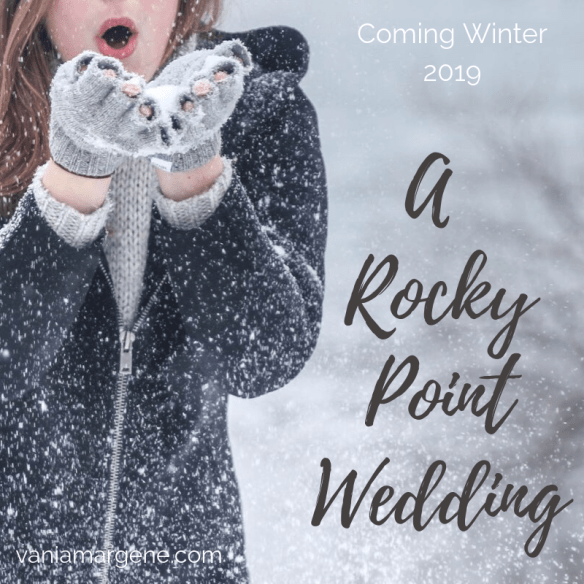
Besides editing and working on the cover, there isn’t much else I can do with them. I’m hoping to start releasing them this winter, still in 2019, so we’ll see how that goes.

I’m also 10,000 words into an experiment, and I’m excited. I’m not going to say anything more about it since the outcome of the experiment depends on me not divulging information about it. At any rate, it will give me something interesting to do on the days I need an editing break.


That is my update, and I can’t wait to share these books with you!

a rocky point wedding social media graphic

While you wait, look for my other books that are available in KU!

end of blog post graphic

Why I wrote a series, and why you should write one, too!

Writing a series_ Why I did, and why you should too!

I’ll be the first to admit that I don’t like writing a series. Probably not the best thing to admit because it implies I’m not having fun writing my books, and when an author doesn’t have fun writing their stories, a reader won’t have fun reading them. We hear this a lot, and I think it’s true.

I don’t want to imply that I’m hating writing this series to the depths of my black soul because it’s not true. I have loved all my books in this wedding quartet and consider my characters friends, but I will not be sad to see them go.

Fly away little birds into the happily ever afters I have given to you.

If I don’t like writing series, or a better to way to say it is, if I prefer writing standalones, why did I write a four book series, and why am I recommending you do the same?

This is why I wrote A Rocky Point Wedding series, and why after a couple of standalones (to cleanse my palette and to lay some single plot ideas to rest) I’ll plan another.

  1. Writing to Market.
    I believe this. I say AMEN to the preacher who shouts this to his congregation. Writing to market simply means giving the readers of your genre what they want, and more importantly, what they expect. Tropes. The twists and turns they come to associate with plots of that genre. Writing to market means you are writing to an audience already established. You have a built-in comparison authors.
    What does this mean for a series? Readers like reading a series. How do I know? Ask Nora Roberts who writes trilogies and quartets, and the popular long-ass futuristic series she pens under J.D. Robb. She started writing those back in 1995 and the 49th book of that series is coming out in September. She couldn’t have gotten that far without readers GOBBLING those up the minute they come out.
    Series give readers what they want, and as an author, that’s my job.Writing a series_ Why I did, and why you should too! (1)
  2. There is a lot to play with when you write a series.
    You can do a map, mark where your characters live on the cutesy-named streets you make up.
    There are opportunities for novellas and prequels and even more sequels than what you originally planned. It’s nothing new for a side character to wiggle their way into a book of their own.
    Add extra content like I am. If your character is a reporter, write the articles mentioned in the book, or in my case, I’ll be adding Autumn’s blog posts.
    Extra content means:
  3. More ways to Market.
    I could add Autumn’s blog posts to a newsletter as a sign up cookie, or write a novella about Marnie and James’s honeymoon. (The last book stops after their ceremony.) What did they do? Where did they go? Can I fly there for research?
    Market the first book in a series with ads, social media, and if the first book is strong and captivating, the first book sells the rest of the series without any extra work. If you’re wide, put the first book free and drive traffic to that book. Use a drip campaign on BookBub and continually use ads to bring in new readers. Or use your free days in Select and buy a promo to drive traffic there for a certain number of days (or just one) and hopefully if your book is strong enough, over time your page reads from all your books will pay for your promo and then some!
  4. That’s something else you get with a series. Read-through.
    Any non-fiction book that talks about making money will talk about read-through. If you read a Chris Fox book, he’ll assume that’s all you write because it’s the smart thing to do, and Chris always assumes you’re smart and willing to put in the work. Read-through is your bread and butter. It’s especially true for romance, but you see this done in the thriller/suspense genre, as well as YA and women’s fiction. (See Patricia Sands and her Love in Provence series.)Indie books versus traditionally published books (1)
  5. The release schedule can give you time to write another book.
    I go back and forth between thinking I’ll drop my series all at once, or give time between each release. I suppose the smart thing to do is get them all ready to publish, publish the first one and then put the others on pre-order. That way readers can see the rest of the series will be available in a reasonable amount of time. Then, while my books drop, I push readers to the first book while I write another book. That’s not so much factory work as it is good planning.

Those are my reasons for writing A Rocky Point Wedding series.

Always first is giving readers what they want, and when you do that, natural sales will follow. That’s not to say releasing a series doesn’t come with its own challenges:

  • Editing and formatting them all.
  • Consistency from book to book. (Green eyes stay green, occupations stay the same, names stay the same, and no one knows something they shouldn’t.)
  • Making sure the covers belong together.
  • Where to put the extras, and what they’ll be.
  • Taking the time to create those extras.

Will it be worth it in the end? Sure. I’ll have four 70k+ word books that will be a lovely addition to my backlist. I’m smarter about covers and blurbs now, and keywords, too, so taking my time and being smart when I publish should help me avoid having to go back and redo them. Let’s not repeat going back and doing covers again like I had to with my trilogy.

But will it be nice to sink my teeth into a new standalone when this is done? Yes! I already have a story idea I try not to think about too much because I’m not done with book 4 of these quartet yet. I’m 37k into it though, and I’ve given myself until the end of September to get it done. Then while I edit them, I’ll do the busy work of blog posts and cover design. (The jury is still out if I’ll hire these out. If I do, I would at least like to have some couples pegged for the designer.)

Writing a series_ Why I did, and why you should too! (2)

I know planning a series can be daunting, and if you have a plot that spans through all the books that’s even worse. I don’t have a plot that takes place over all four books, unless you count wedding activities, but I don’t. Those activities are a natural progression as anyone who has been in a wedding party knows. There’s bridal showers, dress fittings, parties and the like, so while they may not add conflict, the characters do pass along information to each other, and they are easy ways for me to cram them together into the same room.

If you want to tackle series, the best thing you can do is plan. Plan your books out. Plan how you’ll end each one, and if a subplot weaves through each book and will only be completed at the end. I write romance, so I definitely need each couple to have their happily ever after, and a reader can jump into the series wherever they want.

Writing a series_ Why I did, and why you should too! (3)

A Rocky Point Wedding series isn’t the first series I’ve done, (my Summer Secrets erotica series contained six novellas and more than 150,000 words) and it won’t be the last. Look at your genre and if you see that series are a primary offering, look to your own publishing schedule and see what you can do to give your readers what they want!

Thanks for reading!

end of blog post graphic


Other blog posts on why you should be planning a series:

Why You Should Be Writing in a Series by Tom Ashford on Mark Dawson’s blog.

Why and How to Write a Book Series on the IngramSpark blog.

What Readers Want – Series vs. Standalone Books on the Indies Unlimited blog.


My Wedding Quartet Update

I haven’t been doing much with my series, so there’s not a lot to say about it (she says but after she’s finished typing she has a 1400 word blog post about it).  I have finished book two, which will now be book one. To stop having to give that convoluted explanation, I’ll just refer them by the order they will be published. I changed them because I realized the second book I wrote was stronger, and it would make for a better first book in the series. This will take a little rewriting, as I started the book thinking readers were already going in knowing who characters are, but that’s okay.

I finished the first read-through of book two, and after I finish the read-through of book one, I’ll print them both out and add to book two since I know more about what’s going on with the story.

What’s been dragging me down has been looking at stock photos for the covers. I briefly looked into hiring them out, and depending on how much hair I lose between now and when they are ready to publish, I still might. The problem is, and the problem most indies have, is figuring return on investment versus cost. I found a site that will do custom covers for 350 dollars a piece. Now, if I were only doing a standalone, that would be more than manageable. That also includes a full paperback wrap, so I wouldn’t have to worry about that, either. But being that I’ll have four, well, you can do that math. (In case you don’t want to, that’s $1400.) You can see how I would maybe balk at that. Now, I’m not saying I can do as well as that artist can, probably (most certainly) I can’t. But I’m poor, and I have no problem with saying so. I would have to work a lot of hours to cover that. And with the way my books are selling, I would never recoup that cost.

So, for the past few nights, instead of writing, I’ve been researching wedding covers, looking at stock photos, and slowly losing my mind.

To make matters worse is that yes, there is going to be a wedding in this story, but the bride and groom are not a featured couple in the any of the books, so does it make sense to put a bride and groom on any of the covers?

My books all end with some kind of a wedding proposal or a promise to love forever, so implying my couples will get married at some point isn’t a lie.

Another reason I have so much pause is something someone said in one of those FB book cover groups I keep talking about. Someone said that indies are held to a different standard than trad-pubbed authors are. And I guess they are right. Our covers better be pretty damned special to catch a reader’s eye because we can’t depend on our well-known names to make the sales for us.

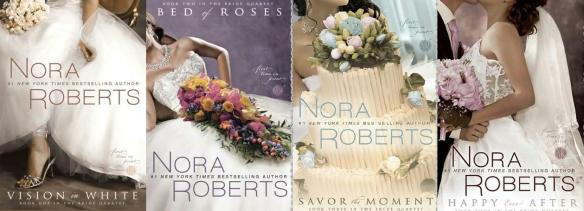
nora roberts quartet

I think of Nora’s quartet when I’m looking at my own covers. If I thought I could get away with it, I would definitely do something similar. Look here for the article accompanying the image I borrowed.

If I go with this way of thinking, I most definitely need couples on my covers. Maybe not locked in a steamy embrace, because these books are the same as other books I’ve written. Not a lot of sex, but there is some.

What does that mean for me? Can I put bridesmaids and groomsmen on my covers? Singly? Because I’ve looked through a lot of photos and I can barely find one good couple that looks part of a wedding party, much less four.

Can I put a bride and groom on all my covers?

Items don’t seem to go over as well with indie authors, so choosing bridal bouquets or other wedding paraphernalia may not be enough to make a sale. (See the dreamy covers on Nora’s books above.)

If I take the wedding element away, that gives me more choices, but that still leaves me

Elegant couple posing together.

The plastic, vacant looks on their faces do not match how I feel my characters are portrayed in my books. (Photo purchased from depositphotos)

digging through photos of pretty girls with dorky-looking guys. I don’t know how that happens, but it’s weird. (Out of respect for the men, I won’t post an example here.)

Or I get too “plastic” and they look kind of fake. Definitely not the kind of book I’m writing.

I mean, you know the book covers this couple would end up on. Mega rich, lots of hot sex. And maybe one day I’ll write something like that, but I need down-to-earth couples, and sometimes that means the people look just a little too “real” for a book cover.

It’s a balancing act that makes me want to poke my eyes out.

And while it’s a necessary part of the creative process, to keeping trying, that is, it does make me feel like I’m wasting writing time. Anyone can tell you  that you don’t need book covers if there’s no books. But I’ve blogged about book covers before, and figuring out what looks good, and finding the right photos, takes a lot of time. Not only time, but practice. I have Canva open all the time, shoving photos into their templates, experimenting with font for the titles. I did find this beautiful photo and I thought right away she reminded me so much of Leah, the female main character of my second book. She looks so much like what I envisioned, she literally took my breath away. You might say that would be a sure sign to use her for the cover, because if she evoked that much feeling when I took a look at her, hopefully she would for other readers.

Wedding bouquet in girl's hands.

Leah! Isn’t she gorgeous? 

But, don’t forget she would only be one cover of four. And she is cover worthy, so it’s not that she wouldn’t be perfect. But is she perfect for a series, and more importantly, is she perfect for a contemporary romance cover? Unfortunately, she doesn’t pose with a man in the series of photos that were published on depositphotos with this one. But I have purchased her, (that’s why she doesn’t have a watermark) so I may decide to use her somehow.

Anyway, I have 6 pages of book 3 I have written out longhand that I’ll be transcribing after I finish out this blog post. I still hope to have all four books done by Halloween. Probably not fully edited, but close enough that I should still be able to start publishing them around Thanksgiving. I read Craig Martelle’s book on Rapid Releasing, and to be perfectly honest, what he wrote didn’t give me much hope for a good launch. I have no readers. No one waiting for these, so to tell you the God’s honest truth, it doesn’t matter when I publish. I do know that after they are done I’m going to take a short break because these are going to drive me nuts between now and the end of the year.

I’ll keep you updated on progress though, and next week I’ll share a snippet or two of my favorite scenes so far. I’m glad that Autumn and Cole are the last couple because I’m very much looking forward to getting their story out, and as of right now, it’s what’s keeping me going. I love all my characters, but the sheer scope of writing four books and producing them all at once is daunting and I’m overwhelmed at times. But because of consistency issues, I’m glad I’m taking things slow and writing them all first before I publish.

As for Autumn’s blog posts, I need to get on with typing those out and writing more. As the stories go on, and she interviews more people, her list grows longer, and I’m falling behind. Still not sure what I’ll do with that extra content. It’s looking like more and more they’ll end up on the website to maybe drive some more traffic here. Not sure.

If you’ve stuck with me, thanks for reading! I’ll be visiting Tybee Island as you’re reading this, on a vacation with my sister. After I take a week to breathe and see the ocean, I’ll come back with a clear head and hit the ground running on the second half of my series.

I hope you all are having a great summer!


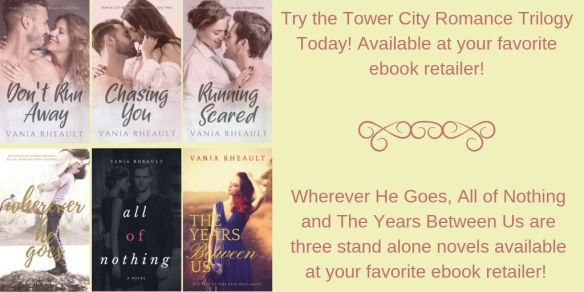
My books are wide! Check them out at your favorite retailer!

Don’t Run Away: books2read.com/dont-run-away
Chasing You: books2read.com/Chasing-You
Running Scared: books2read.com/running-scared

Wherever He Goes: books2read.com/whereverhegoes1
All of Nothing: books2read.com/allofnothing1
The Years Between Us: books2read.com/the-years-between-us

Try the Tower City Romance Trilogy Today!

My Wide Adventures AKA Sales so far

Almost two months ago I went wide. Has it paid off?

Not so much.

I put All of Nothing, and Wherever He Goes wide through Draft2Digital as soon as they dropped out of KU. I put The Years Between Us on all platforms as soon as it was finished–it never went into KU at all.

Because of an oversight, I missed one of my books in the trilogy, and I thought I would have to wait for them to drop out, but everyone encouraged me to just email Amazon and ask for them to be pulled out, and I did. They were polite about it, and the minute I had the email saying they were out of Select, I put them wide.

For simplicity’s sake, I can say all six of my contemporary romances have been wide since April first.

And well, nothing happened.

Actually, something did happen.

My KU reads dried up, but sales on other platforms didn’t make up that loss. I kind of knew that would happen, but it’s different seeing it. They even talked a little about it at the summit during the wide panel–that dip where page reads go from a waterfall to a trickle, and where no one knows your books are on other platforms.

It takes time, and seeing that money, no matter now small, disappear, makes you sick inside.

Also, listening to Jami Albright talk about her success at the summit in KU with only three books didn’t help me feel any less bitter when I had just pulled my own books out of KU and made them wide.

But like a life-style change to beat a sugar addiction that will make you feel better for the rest of your life, I feel going wide will be the same for my career. Is Amazon cake? I guess if you’re you in the 20booksto50k group on FB and see everyone’s earnings in KU, you can feel like Amazon is a giant piece of gooey cake with a huge scoop of ice cream, too.

amazon vs cake

Hello, type-2 diabetes!

I might have taken that too far.

But, as always, this isn’t about whether going wide is smart or not–always go back to your business plan and decide for yourself what you want out of your writing career.

As for sales: I put Don’t Run Away permafree the minute I could, and asked Amazon to price match when the free price on other platforms kicked in. This is supposed to help introduce a reader to my books. Being that Don’t Run Away isn’t as strong as the books I’m writing now, that’s a plan that may not pan out. But I’ll be publishing  a new series this year after I get them all written and edited, and eventually book one will be permafree, too.

For sales from April 1st to the day I’m writing this blog post, May 30th (rather, the 29th since that’s the way reporting goes).

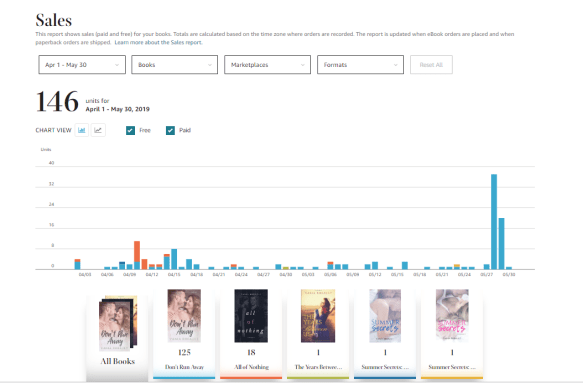
Amazon:

Free:
Don’t Run Away: 125
Paid:
All of Nothing: 18
Wherever He Goes: 0
The Years Between Us: 1
Summer Secrets Novellas 1-3: 1
Summer Secrets Novellas 4-6: 1

Out of the 125 copies of Don’t Run Away, no one bothered to go on to books two or three of the trilogy. It takes time for people to read, so maybe they haven’t gotten around to reading the book yet. I don’t like to think they didn’t like the first book and don’t want to read the other two. (But when you’re writing a series, that’s always a possibility.)

amazon sales for blog post

So, sales aren’t all that great. Those two little spikes you see? Those are me fiddling around with BookBub ads. I’ll write another post about that later.

How about on Kobo?

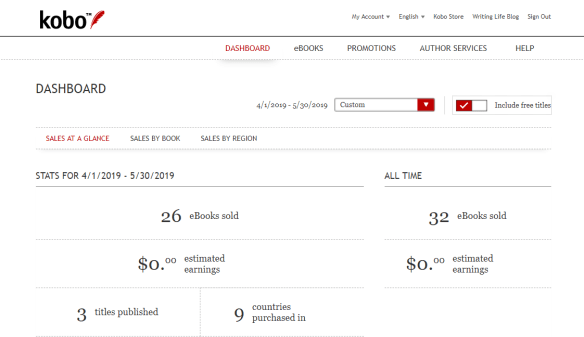
On Kobo, I gave away 32 copies of Don’t Run Away. I had 0 organic sales of any of my other books on there. Meaning, I didn’t get any read through to my other books in the trilogy. Bummer.

kobo graphic for blog post

Draft2Digital

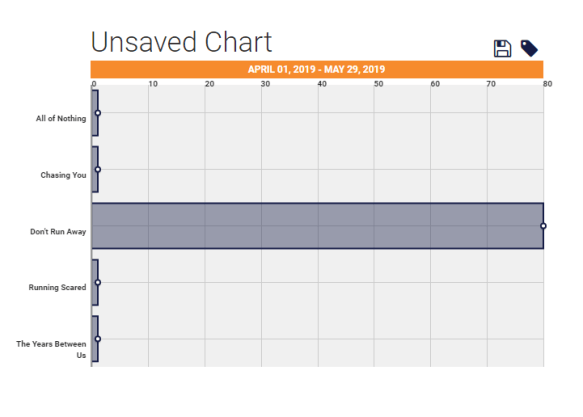
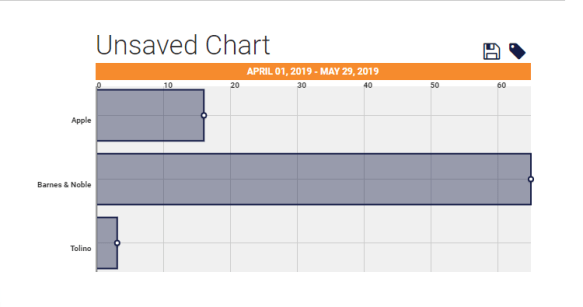
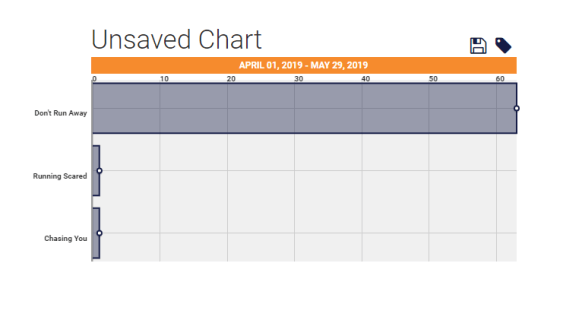
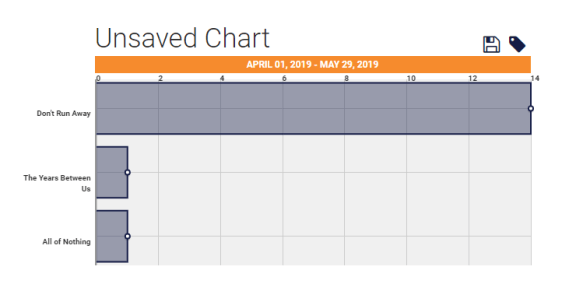
Draft2Digital publishes my books in a lot of places, but the top two are Apple and Nook. It’s easier to give you the charts. But I’m sure you can imagine that giving away Don’t Run Away dominated my “Sales.”

draft to digital chart for blog

I sold one copy of All of Nothing, Chasing You, Running Scared, and The Years Between Us. I liked the Chasing You and Running Scared. It means out of the 80 people who downloaded Don’t Run Away, ONE person read the other two. I mean, that’s progress, right?

draft to digital chart for blog 2

As you can see, I gave away the most copies of Don’t Run Away on Nook. I’m not sure why, but maybe one day those will turn into sales of my other books.

Here are the chart breakdowns:
Nook:

draft to digital chart for blog nook sales

And Apple Books:

draft to digital chart for blog apple sales

I feel like I got a little bit of something going everywhere, but not a lot of anything.

As I experiment with ads, and put more books out, maybe that will help. I mean, after all, I haven’t really done much marketing letting readers know my books are everywhere. I use my FB author and personal page to let people know as much as I can without sounding like a harpy.

I use the end of this blog post to let people know my books are wide, but let’s be honest. I’m writing for writers who probably won’t buy my books, and that’s okay. That was the path I chose when I decided to blog on these topics.

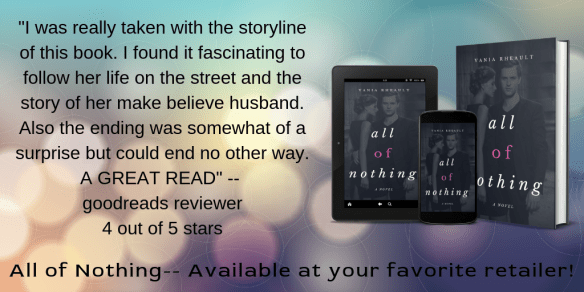
And it’s the same with Twitter. I have this as my pinned tweet, and it does absolutely nothing:

All of Nothing promo with goodreads review

I boosted this post on Facebook and it got me 3 new likes to my author page. One of them was my sister. Go me. But the ad is pretty, no? (If you want to make your graphics, use this website; Derek Murphy is so great for the writing community. Be sure to save it as a PNG though, so you have the transparent background. Otherwise, you’ll save it with the white background underneath. I did the rest in Canva. Search for [your color] bokeh if you like the background.)

I do have a Freebooksy scheduled for the middle of next month for Don’t Run Away since it’s permafree. That will be my first real ad aimed at all the platforms I’m on. We’ll see if it makes a difference.

To be honest, this was pretty much what I expected. I’m willing to experiment with ads for now while I’m working on my series. Maybe working with ads over the summer will help me grow a small audience and they’ll be willing to buy my quartet when it’s done.

Slow and steady wins the race, and all that, right?

Have you tried going wide? What has been your experience? Let me know!

Thanks for reading!

Don’t Run Away: books2read.com/dont-run-away
Chasing You: books2read.com/Chasing-You
Running Scared: books2read.com/running-scared

Wherever He Goes: books2read.com/whereverhegoes1
All of Nothing: books2read.com/allofnothing1
The Years Between Us: books2read.com/the-years-between-us

Try the Tower City Romance Trilogy Today!

Writing Resources Non-fiction Spotlight: The Author Blog: Easy Blogging for Busy Authors by Anne R. Allen

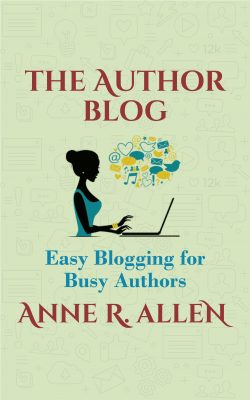
the author blog book coverI read Anne’s blog sometimes. Not as much as I should because she writes about some very important topics, and she’s a great resource for writers. Every so often I’ll tweet out a link to one of her posts.

So when I saw she wrote a book about blogging, I bought it ASAP, and one for a friend, too.

This book is great for the author/writer who isn’t sure if they should start an author website or a blog. It’s for the blogger who has been blogging for a while and who not seeing results (results like comments, subscriptions). It’s for the blogger that has lost his or her way. It’s also a wonderful source for maybe a more seasoned blogger who may need to get back to basics.

I belong to one or more categories. I’ve been blogging for over two years, and only now just starting to find some traction–and it’s very little. But Anne reminded me of a few things I’ve forgotten along the way. Simple things like tagging your blog posts with the titles of your books, or remembering to tag a photo with a description for your visually impaired readers.

Anne explains SEO and offers us blog ideas. Something we all need from time to time.

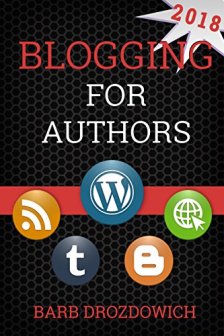
blogging for authors book coverI was delighted to see she knows Barb Drozdowich and recommends Barb’s book about blogging.
I know Barb from Rachel Thompson’s #bookmarketingchat on Twitter, and I have also read her book about blogging. It’s just proof that we’re all friends here. 🙂

If you’re interested in purchasing Anne’s book, click here and this will bring you to her website. She offers links to all her retailers there.

If you’re only interested in buying it from Amazon, you can click here for the buy-link.

Blogging may not be for everyone, but knowing how to start, and how to do it right, can save you time, money, and lots of frustration down the road.

Thanks, Ladies, for writing these awesome books!


Callie and Mitch blog graphic


When Friends Turn into Business Partners . . . Sometimes it doesn’t work out

friends to business parnters blog post

I’ve never met a community so full of people willing to help. I’ve met authors who will share anything and everything. How they use ads, how they write blurbs and the resources that taught them how. They share their favorite blogs, podcasts, promo sites, non-fiction books. There are even authors who will share how much they make in sales.

So many authors are helpful and generous. (And if you run into one who won’t share anything, well, keep an eye out. I’ve found those people are users, and you won’t get anything in return for the information you share with them.)

I’ve made a few friends on Twitter. Some are better friends than anyone I’ve met in real life. Some have come and gone. Some needed so much hand-holding it was physically draining to be friends with them. Some acted like their work was the only thing worth discussing, and I’ve faded away because I believe friendship should work both ways.

I’ve had some small successes as an author, and I like to share, too. It’s a horrible feeling to be snubbed when sharing something you’re proud of.

friends or enemies

But there are those who stick around–you feel a kinship, support goes both ways, and you settle into an online routine of touching base, reading each other’s blogs, retweeting news and book cover reveals, and helping with book launches.

Inevitably this will lead to your friendship moving more into a business relationship.

You’ll be asked to edit for someone or do a cover. Maybe she needs a critique partner or he needs a beta reader. It could even be as simple as doing an author interview for a blog.

Friendships can easily blur into business and while the transition feels easy and breezy, if you don’t treat that relationship with the respect it deserves, not only are you risking your business relationship with that person, your friendship will be broken as well.

The culprit of all this is the nonchalance and the cavalier attitude of writers. They aren’t treating their business with the respect it deserves, so they see no harm in treating you the same way.

I treat my books as a business. I always have and I always will. When I do something for you, I do it in a decent amount of time, and to the best of my ability. And that’s always what I’ve done.

business peers

But I haven’t always been treated with the same courtesy.

I paid someone to edit for me, and one day she told me she was editing my book while she was having her hair done at the salon. I guess it was too much to ask that she edit my book in a quiet place where she could focus. I paid another, and she waited months before even starting to edit my book. I have patience–I have two children, three cats, and an ex-husband. I have patience. But when you pay someone for a service, even if she’s a friend, you expect them to treat you with professionalism.

Those people were my friends. Circumstances being what they were at the time . . . they aren’t anymore.

What’s funny is recently one of them asked me for a favor. I guess it wasn’t so funny when I didn’t respond.

Most of the time I can separate friendship from business. (I treat my Twitter account as part of my business, and I rarely unfollow anyone for crappy behavior. Most times the only thing that will earn you an unfollow is if you do it to me first.) And I can stay in touch with someone friendship-wise even if we don’t/didn’t work together so well in the business aspect of things.

I edited for someone, and that didn’t work out like I had expected. We’re still friends because I expressed how I felt, and she apologized. I don’t hold grudges, but just like anyone else, I remember how people treat me.

When you treat someone like crap, you’re burning bridges, plain and simple. The author so quick to help you? They may not be so quick to pull through for you next time.

So what can you do to keep your friendships intact if it moves into business territory?

  1. Set boundaries and expectations.
    Before work exchanges hands, hammer out what expectations are. Does she expect to get paid? Is she doing it for free? Are you sure? Is there an expectation you’re going to help her down the road? Is there a deadline? Can your friend meet it? If she can’t, can you change it? If you’re too rigid with what you need, it’s better for your friend to pass. Which brings me to:
  2. Don’t be angry if your friend can’t meet your needs.
    A lot of indie business is trade and favors. Money doesn’t always exchange hands. That’s common when indies operate in the red–especially when just starting out. You may feel desperate because if this particular friend can’t help you, who will? People who know what they are doing, and willing to do it for free or on the cheap are few. If you need her, it’s YOUR job to bend, not hers. If you can’t, understand where she’s coming from, take a deep breath, and move on. While writing is a business, it will always come in secondary to children, jobs that pay the bills, and maybe even an evening of self-care if she’s had a bad day. If your needs are more important than that, hire out and pay for the priority. Your friend helping you isn’t a right–it’s a privilege.
  3. Keep communication open.
    Maybe you think she’s not working fast enough. Or you haven’t heard from her in a couple of days. Or worse yet, you haven’t heard from her, yet she’s posting on social media. It’s easy to go from simmering to boiling if you expect her to be working on your project but she’s posting a new blog post every day. It’s easy to get annoyed–trust me, I know. Maybe she already had them scheduled, and she IS working on your stuff. You won’t know unless you ask. If you need constant reassurance like daily updates, request it before you give her the project. That way you can remind her you asked.
  4. Keep social media in mind.
    When I edited for my friend, she never stopped posting her publication date. She was building buzz–I get that. But her manuscript needed work, and the more she posted and the more I edited, the angrier I became until eventually I felt like I was doing it for nothing. So remember–you are friends and she can see what you tweet, post on your Facebook author page, blog, and anything snarky by way of a bitchy meme on Instagram. But the same goes for her. If she’s tweeting she’s editing a pile of garbage, or the person she’s editing for is dumber than a box of rocks . . . you may need to rethink if you want her working on your project. A good friend doesn’t necessarily translate into a good business partner. (I would rethink my friendship with anyone who would put something like that out into the world, anyway.)
  5. Know when to quit.
    Ideally, you want to work things out before this step. If you can’t, the next best thing is to back out before your business relationship destroys your friendship. Be clear why you don’t want to work with him anymore. Try not to let hurt feelings muddy the water. He may have hurt your feelings, but that is only as a bi-product of unprofessional behavior that may not have been intentional. And don’t flip out if he has to back out on you. Maybe it has nothing to do with professionalism. His private issues are none of your business unless he wants to divulge them. That depends on how good of friends you are. But if it is due to not being able to work together, learn from the experience and move on. Having a truthful “We make better friends than business partners” talk can salvage a friendship. Don’t be defensive.

Not all friendships cum business relationships are going to fail. I’ve heard of several people who have worked together for years. There relationships are based on respect and a mutual admiration of each other’s work.

It’s up to you how much you can take–and it’s up to your friend what her limits are if you’re the one behaving badly. Publishing is scary and stressful, but alienating people who want to help you makes it more so. And it won’t do your career any good if someone labels you as difficult to work with. You may be passed up for opportunities and you won’t even realize it.

stressed out

If you’re the one slighted, do your best to move on. If that means you’re no longer talking to that person, so be it. Publishing IS stressful, writing, emotionally draining. You need to protect your mental health, too.

Friendships can come and go, but it’s difficult to repair a business connection.

Don’t burn your bridges. You never know when you’ll have to circle back.


To be clear, I didn’t mention any of my experiences to throw my friends and acquaintances under the bus. I mentioned them to demonstrate I know how it feels to be treated in a manner that is hurtful and unprofessional. I have other examples of people using my generous nature against me–to the point of a friend of mine saying I should stop helping people.

I couldn’t do that, though. For every one person who ignores what I offer, five people appreciate any information I can give them. Be it my favorite stock photo sites, or a reminder that KDP Print offers templates to format the interiors of paperback books.

For every one person who ignores my edits, another person’s writing is brought to the next level.

I’ll probably never stop helping people. I enjoy it too much. But neither am I a doormat, and if you treat me poorly, that’s on you, not me.

If you treat anyone without respect and kindness, you need to look inside yourself and figure out why. But the secret is no one has to be friends with you, no one has to do business with you, and one day you may very well find yourself alone.

being helpful

If you enjoy helping and being part of the writing community, don’t let one bad apple ruin the whole barrel. There are lots of people out there who need help–and one day you’ll find yourself in a group of friends you can trust to help you in return.

That’s what the writing community is all about.

photos taken from pixabay or canva. graphics made in canva.com

jared and leah for end of blog posts

What do you do when you publish a bad book? 5 Ideas.

Writing tools_ What can you do when you publish a bad book_

As indies, this is bound to happen. Hell, if you’re traditionally published, this can happen too. See my blog post on The Wedding Date.  (Spoiler Alert, I wasn’t impressed.)

As indies, we rush to put out content. Maybe it wasn’t edited the way it should have been, or maybe you didn’t catch a plot hole before you hit Publish. Maybe there’s more telling in there than you thought, or maybe you had some head hopping and you didn’t know you were doing it.

No matter what the issue is, you’re getting bad reviews. People don’t like your book. If you have more than one book out, maybe you feel like it’s not a big deal. But the problem is, if a reader happens along that book–they may not give you another chance to redeem yourself.

bad star reviews

So, what can you do?

  • First, admit your book still needs work. I see lots of people in denial over this. They don’t want to see the truth that their book was published before it was ready. It’s a scary and sad thing to admit. It’s especially heartbreaking when you thought it WAS ready, like The Corner of 1700 Hamilton. I had beta readers. I had an editor. It was as good as I could do at the time. But, now, after writing so many more words and getting better, it wasn’t that great. This can happen to anyone.
  • You can fix it. 
    This presents its own issues with ISBN numbers, and other little things like feeling like you’re ripping off the people who have already purchased it. Time is also a factor because depending on how big of a mess your book is, it could take a few months to rewrite, get it edited again, reformat it, and maybe redo the paperback cover if the number of pages changed. Fixing your book is almost as time-consuming as the launch.
    There is also the ethical question of is it right? Like I said, will you feel like you’re cheating the readers who have paid for your book? What if those reads resulted in bad reviews? Fixing it won’t make those bad reviews go away, and the only thing you can do is add to your blurb on your selling page that your book has been re-edited. This isn’t such a problem if not many people have bought your book, or you caught your mistakes before you started to promote it. This is the ideal scenario, but then you have to ask yourself if you’re going to pull it while you fix it, or hope that no one buys it while it’s in edits.
  • You can unpublish it.
    If your book really sucks, like, it should be hidden in a box under your bed with the dust bunnies and not the plot bunnies, then you can take it down. If you published a paperback, your book will always be there. Goodreads won’t take your books down. Bad books can linger, and there’s nothing you can do about it. I don’t recommend unpublishing. At some point you believed in your book enough to publish it. So deal with the consequences and learn from your mistakes.
  • You can write more books and hope you bury it. 
    If you don’t promote it at all, and never talk about it, there’s a good chance you can bury it. I’ve heard the stat bandied about that 50,000 books are published every month. That’s a lot of books, and it’s not so hard to think that if you never, ever, talk about your book, people will forget you wrote it. In fact, (and I know this to be true) you can soft launch quite a few books and no one will ever know you’re a writer if you don’t say anything.
  • You can leave it alone and start a pen name. 
    Starting over is hard. It means new social media. It means new business cards, new email. It means starting from ground zero. And maybe that’s your thing. Maybe that’s what it takes to feel better, have a fresh start. Lots of people write under different pen names. They abandon series that aren’t working. They want to write in different genres. They have no problem leaving the past behind. They have the time to make a new pen name work–and actually write under that pen name. I listen to  lot of podcasts, and this seems to be quite common. Letting the chips fall where they may and never looking back.
    This certainly is a viable option. If I ever get around to editing my fantasy books, I’ll release those under a pen name. That doesn’t mean I’ll be letting go of my contemporary romance name (which is my real name) but sometimes taking on a different name is smart. Can you do it every time you make a mistake with a book? Probably not. You won’t get anywhere. It’s hard enough as it is to make it under one name consistently putting out quality content. If you keep changing up your names because you keep making mistakes, that’s just wasting time. Time you may not have. As Mark Lefebvre says in The 7 Ps of Publishing, the golden age of Kindle is over. You can’t make a living publishing a couple of books. Making any kind of profit from your writing takes dedication and commitment. It takes consistency and quality work. You have to ask yourself, is the time it takes to let go of that book and start over worth it? Or is it better to take a month and edit the old book, and make it the book it should have been in the first place?


choice

The great thing about being an indie is choice. You have the freedom to do whatever you think is right for your business. And, if presented these choices you feel your book isn’t that bad after all? That is up to you. Promote it. See where it goes. In the scheme of 50,000 books a month, your book really may not be that bad. That’s your choice an author. Take the risk.

This same advice holds true for the authors who are not just publishing but querying. If you’re getting rejection after rejection, or the feedback indicates that your book just isn’t up to par, you have to decide if you want to keep hammering away, fix it, or if you want to put it aside and write something new.

It never ceases to amaze me how many first time authors think their book is wonderful. I was one of them. I learned better, and you will too. It’s what you do with that knowledge that will shape the rest of your career.


A long time ago I  listened to a podcast where the author talked about revamping his series because it wasn’t selling. I was new the indie scene, and I thought that just sounded so wrong. Unfortunately, redoing and rebranding books is an old practice and not just for indies. Traditionally published books have done that for their authors for years. I wrote a pretty in-depth blog post about it, and you can read it here. 

What are your thoughts on redoing books? Worth the time? Or is it better just to forget? Do you still promote your book even though you know it can be better?

For more opinions on what you can do with a bad book check out these links:

https://chrismcmullen.com/2013/09/25/unpublishing-republishing-and-updating-your-book/

https://www.thecreativepenn.com/2015/04/28/changing-book-titles/

https://selfpublishingadvice.org/why-i-unpublished-my-back-catalog/