A Massive Monday Author Update

Words: 1878
Time to read: 10 minutes

I was going to blog about something different today, and I even had the post written and scheduled. It had to do with writing billionaire romance in the current political climate, but I don’t have the heart to post it. We had a chance to do something great, to make positive change, and we blew it. We chose hate and violence, and we will pay for that for the next four years, and possibly beyond. All I can hope is that the Democrats who did win state by state will slow him down and block him as much as possible. Maybe he’ll be too busy golfing to cause all the damage he says he’s going to cause.

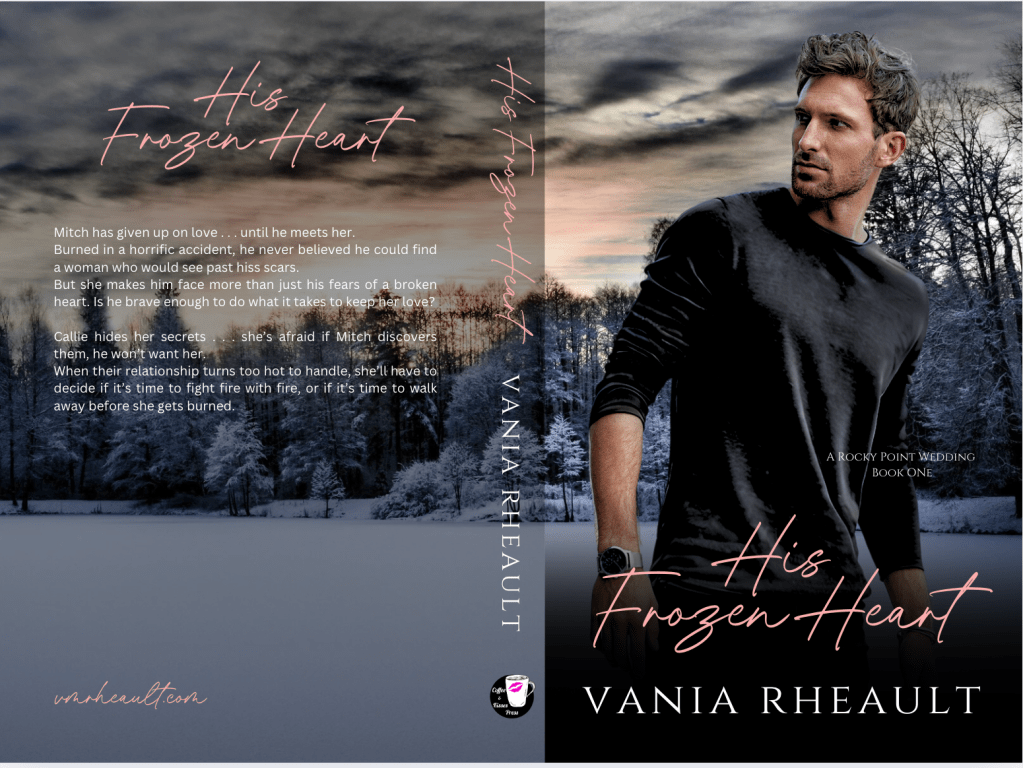
I know lots of people didn’t get much done last week, and it’s understandable. I’ve always used my writing to hide from reality (or, more accurately, my health issues), and this week was no exception. I was able to finish editing my Rocky Point Wedding series, finish the covers, and order the proofs. I’m going to read them over to look for mistakes and make sure the changes I made make sense. I had a lot of timeline discrepancies because the first three books overlap and I didn’t keep track of my characters and what they were doing. Then I fluffed up some scenes, took out some things to streamline the prose, and I’ll just read them over quick before I approve them. I’m also interested in how the covers are going to print. When I chose the background stock photo, I knew I’d have trouble with the spine and back cover, so we’ll see if my “fix” looks good or if I need to try something else. On screen I think it looks okay and I tried really hard to match up the grey blocks and black gradients with the spine lines but printing isn’t always accurate, so we’ll see what happens.

I ended up using the same ISBNs for the books, which I probably shouldn’t have done since these will have new covers and substantial changes to the insides. On the other hand, unpublishing the old ones so I can publish new ones seemed to be a waste of ISBNs, especially since before I revamped them I wasn’t selling (m)any anyway. I put in the copyright pages that these were re-edited and re-released but I don’t know if it was necessary or will do any good. I have quite a few of the first book floating around out there due to free promos I’ve done in the past, but I don’t think it will make a difference to ask KDP to push out the new version to the readers who have the old version on their Kindles. I’ve heard of authors doing that, but I have never tried. If they don’t give me a hard time and just let me update, I think I’ll be happy with that and leave the rest alone. I don’t like messing with KDP, and I’m relieved that so far the preorders for my King’s Crossing series are still okay, that Amazon hasn’t arbitrarily canceled them. So, whether using the same ISBNs was the right call or not, I don’t know, but no one is really policing these changes, so I guess there’s no harm in it.

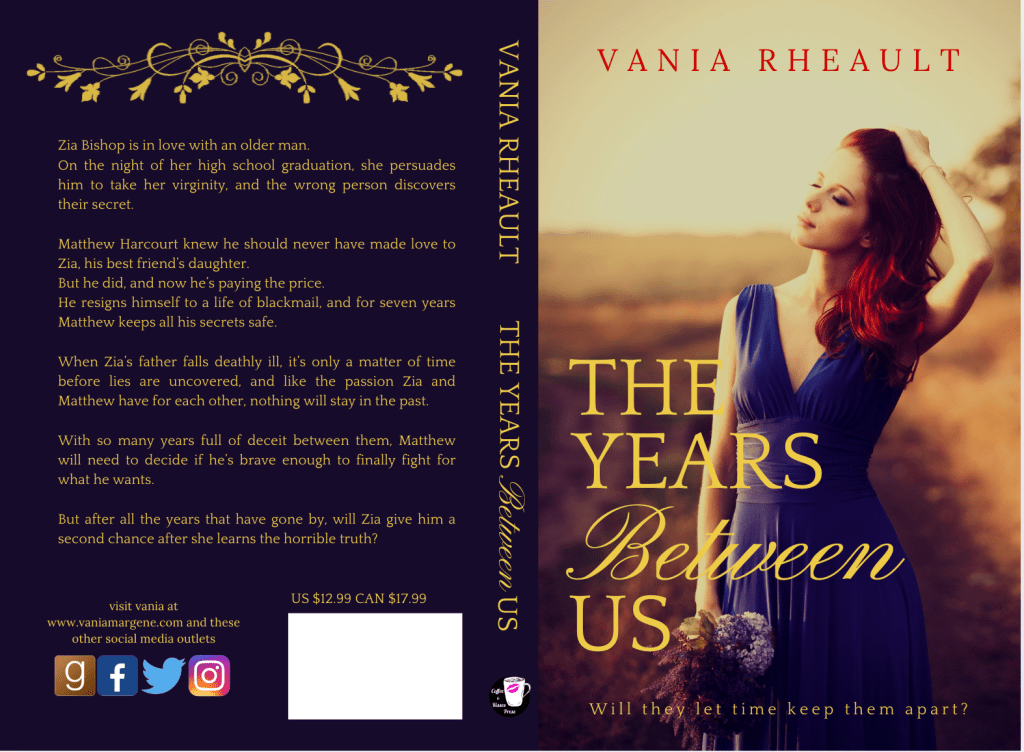
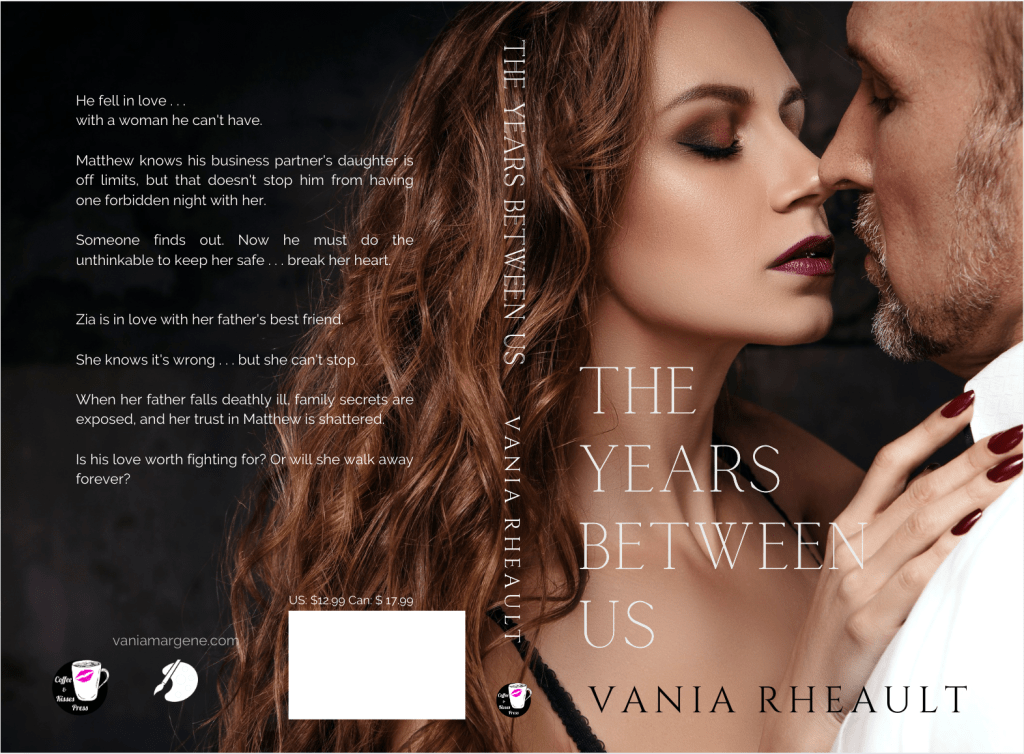
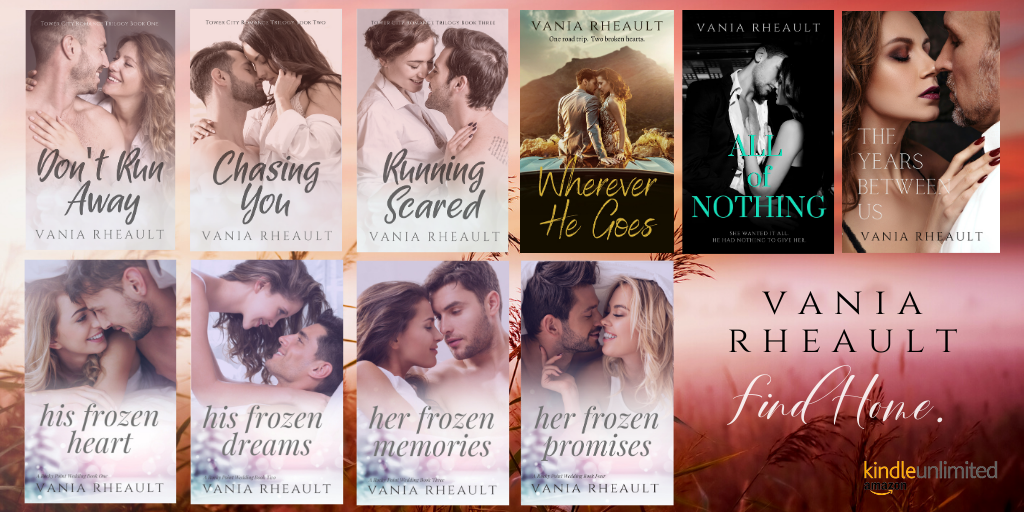
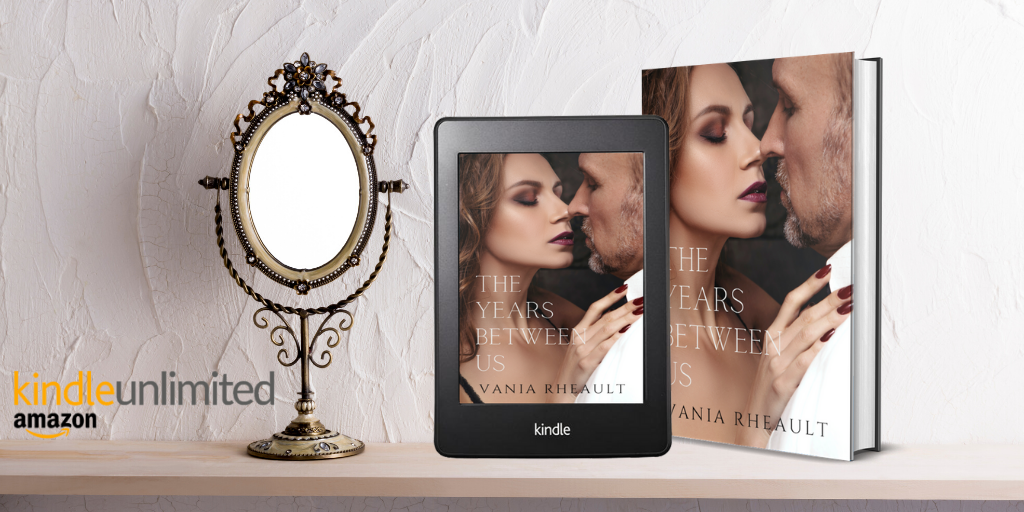
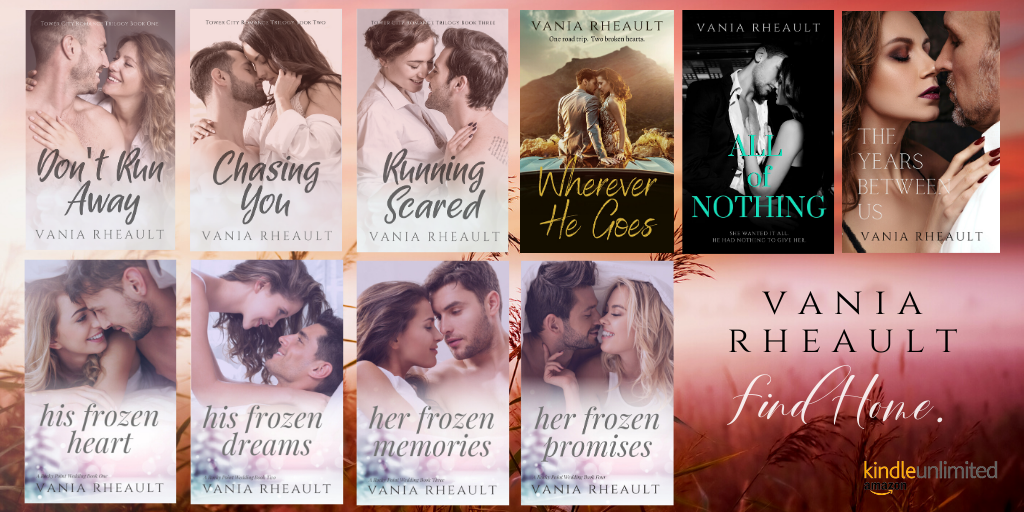
I’m going to do some more cleaning up of my third person books. While I’m waiting for my proofs to come back, I started re-editing The Years Between Us, an age-gap standalone. I’m halfway through the first chapter and haven’t found anything too bad, I just like to echo words and hadn’t caught on to it yet. No matter what Stephen King says, the thesaurus is your friend. I updated the back matter too, deleting people out of my Acknowledgements page that no longer had a place there, updated my Also By page, and a few other odds and ends. I’ve started directing all my readers to my vmrheault.com website and eventually I’ll take books off this one. It makes sense to turn my author website into my real author site and just use this site to blog. I’m having fun reading this book though, since I haven’t for many years. It has the same kind of tone Rescue Me does, and it’s funny that all my books have the same style, even between 3rd person past and 1st person present. I guess that’s why they say a reader falls in love with your voice. I won’t be changing the cover for this book–I think it looks fine how it is, and being that it’s age-gap, I doubt I’d be able to find a couple that fits as well as the one I found a few years ago. I know a couple years back I wrote a blog post on the differences, but I can’t find it now. For curiosity, this was the old one when I first published, then changed to the second when I couldn’t sell books. Very different vibe from the blurb.

I unpublished the two Large Print books I was able to publish before Amazon started blocking them due to duplicate content. I want to offer the same versions of all my books, so I unpublished the Hardcover versions of Captivated by Her, Addicted to Her, and Rescue Me. Hardcovers don’t sell and I wasn’t going to bother publishing more. Because they’re a mess and didn’t sell anyway, I also unpublished my two ebook boxset compilations–my Tower City series and my Rocky Point Wedding series. That sounds like a lot of unpublishing, but I mainly wanted to clean up my editions. The ISBNs will always be attached to those versions and they might even stay on my Amazon product pages, but from here on, I’m only going to offer the Kindle version and a plain paperback.

I was also going to unpublish the first three books I published (1700 Hamilton and my Summer Secrets series) but that would require updating back matter of books I’m not going to re-edit and I don’t want to do that. I was even going to unpublish my first trilogy, but then I remembered I wrote a bonus novella that sounds better than the original trilogy and closed out the story nicely, so even if they’re not well-written, I’d be taking down at least a quarter of a million words. I guess there’s no harm in keeping them up, but they aren’t my best work and I’ll never promote them in any way.

I probably should have done this stuff a long time ago, but I wasn’t feeling well and during the pandemic when everything was just kind of shitty, I wasn’t really thinking about it. I was more focused on building my pen name and writing books for that. Now that my King’s Crossing series is slowly releasing, I have a bit of free time, though not much if I don’t want my conveyor belt of content to slow down. I like knowing I have books scheduled–it takes the pressure off to write quickly.

That’s what I’m doing until the end of the year, and I have to remember what I do on KDP I have to do on IngramSpark. I updated the interior of All of Nothing after I re-edited it a few weeks ago, and I’ll have no choice but to replace both the interior and cover files for my Rocky Point series. Even though it’s going to cost a good $200.00, there’s just too much discrepancy for them to share the same ISBNs but look so different on other retailers. I used to get free revisions with my Alliance of Independent Authors membership, but now I noticed that instead of five or six free revisions you only get one. When I re-edited and re-covered my Lost and Found trilogy, I had enough revision codes I only had to pay $25.00. Unfortunately, that seems not to be the case anymore, but I’m tenacious and I’ll see what I can find when it’s time to do it.

I’d like to start 2025 with a clean slate, putting my 3rd person stuff behind me and looking forward to the future and building my 1st person pen name. I just felt like my 3rd person stuff was unfinished somehow. This won’t make that feeling entirely go away, but I can push them aside knowing that they’re better than they were before. I know for sure that my Rocky Point series sounds 100% better and I don’t consider the time I spent on them a waste, even if it will be an expensive hassle to swap out their files on Ingram. (It was actually fun to see how far my writing has come.) I might even stop putting books on there. There’s no real benefit, but it’s easy because I do my own formatting and covers. All it costs is a bit of time.

That’s about all I have this week. I’m busy doing what I want to do. I’m not going to worry about sales or page reads anymore. Those numbers have been dismal since summer and I honestly don’t know what to do. I feel like I’m doing all I can, and I need to find the fun in writing again. I’m proud of my books and what I’m doing for the indie community with this blog, beta reading, formatting, and editing for others. Sometimes I forget about what matters most, but it gets easier as I feel better. I have more gratitude for the small things and maybe getting my 3rd person stuff situated feels like a bigger project than I really wanted to tackle right now, but it will be a relief when it’s all done.

I said this was a massive update only because it felt massive. I never thought I would unpublish anything, and pushing unpublish made my stomach quiver. It’s nice because KDP keeps your title there and if I ever wanted to publish those things again, I can, but I think I’ll stick with my decision to keep my books in KU, offer the Kindle version, and price my paperbacks as cheaply as I can. There are discrepancies with some of my prices too, like my series versus standalones. I just price whatever I feel like pricing which doesn’t look very professional, but that’s something I”ll have to look into another time.

For the rest of this week I’ll be re-editing The Years Between Us and diving into proofing my wedding series proofs. I’m on track to get those done by December so I can promote them for Christmas. I think that may be my last hurrah I’m going to give my 3rd person stuff.

2025 is meant for new things. I’m going to leave behind the people who have hurt me, focus on marketing my King’s Crossing series, and plan my next releases. Now that I have a diagnosis, I’m feeling better than I have in a long time and I can leave those four years behind me.

I hope 2025 can be the start of something new for you too, despite the election outcome. We’ve dealt with him before, and we’ll do it again.

Take care of yourselves, and I’ll catch up with you you next week!

Why My Books Will Stay in KU…For Now

Words: 2649
Time to read: 14 minutes

There’s been a fair amount of talk whether an author should go into KU (Kindle Unlimited on the reader side or Kindle Select on the author side) or publish their books wide, meaning on all platforms like Kobo, Apple Books, Nook, etc. You can do that easily by uploading to a place like Draft2Digital or PublishDrive. You should always go direct where you can, Kobo being the easiest, so you can earn more, but that’s a different topic for a different day.

It’s personal choice to go wide or stay in KU, and a lot of authors try to have it both ways, releasing into KU then going wide after their 90 days is up, or doing the opposite, going wide and then yanking everything down after a set amount of time, a month or so, and putting their book into KU. I’ve heard some authors even put a first in series into KU hoping to force KU readers to buy the rest to finish the series or forcing wide readers to buy on Amazon rather than their preferred platform.

I used to get disgusted, you know, authors trying to find the short cut to success, but after eight years in the business, I don’t care what other authors do anymore. For one, they have to do what they think is best for their books and for another, well, if they want to look bad to potential readers and to platforms like Kobo and Apple Books who actually do pay attention to what indies are doing, that’s their business. I’m not saying every way is a bad way. I know big indie authors like Lindsay Buroker and Mark Dawson offer their books using all kinds of various methods, but I’ve also seen indies try to sell their books in whatever way possible, regardless if they hurt readers . . . or their reputations.

I tried going wide once, and I lasted six months or so. That was back when I was writing in 3rd person, my books weren’t that great, and I had no idea about marketing. See, the thing is, it doesn’t matter where you publish if you can’t push readers there (and your books aren’t good). The only thing going wide will do is give you more zeroes to look at on more platforms. And that’s another thing authors really don’t understand–KU readers are different from wide readers. When you ask a KU reader if they buy books that are wide, most will say no because KU offers enough of a selection that they don’t have to. They have their favorite authors and Amazon is adding more books to KU all the time. Authors are delusional when they think they can force readers to buy their books by being scammy. KU readers don’t have to fall for it. Al says there are over 4 million books in KU right now (versus the 1.5 million books in Kobo Plus) so it’s just better to understand who your reader is going to be and where they are going to read your books. Anyway, I switched back to KU because it was better for my mental health. I didn’t like looking at the low sales everywhere, and being available in libraries didn’t make up for it. For me, being in KU was a better choice and still is. Here are the reasons why my books will stay in KU (for the foreseeable future):

I don’t hate Amazon, and I don’t hate that KU requires exclusivity.
The other day on Threads someone said they deserve to be in KU without the exclusivity, and I wondered which planet she came from. Life isn’t fair. Amazon doesn’t owe you anything. If you think you deserve to be in a subscription program without being exclusive, join Kobo Plus. There’s less competition over there anyway. Amazon is never going to change a platform they created for a device they invented. Through KDP and CreateSpace, back in the day when their paperback branch was called that, they gave us the tools to self-publish. Without them, it’s hard to tell how long it would have taken for indie publishing to develop into what it is now. I’m not going to look a gift horse in the mouth. I’m grateful to Amazon for the opportunities they’ve given us, and I’ll die on this hill.

I like that it’s income-friendly.
Times are tough. I read books enrolled KU and I offer my books there. I know Kobo Plus is cheaper (KU is $11.99 and Kobo Plus is $7.99 US), but Kindle Unlimited offers more books and a lot of the romance authors I like include their books there. So not only is it a personal choice because of my limited funds, but it’s a business choice because I know thousands of people are in similar situations. Sometimes I get asked if I mind I earn less on a book read in KU than if someone buys it, but I don’t. I make the same amount if two people read in KU versus one person outright buying it, but I just think I’m getting two for the price of one. I’d rather have one reader for a lower royalty than none.

I don’t believe my books are susceptible to piracy any more than other books.
People love to blame KU and Amazon for their books ending up on pirate sites, but I think this energy could be directed elsewhere. The minute you upload anything to anywhere online, your information can get stolen. A well-known author used one of my graphics I made in Canva during her 20booksto50k presentation. (I used it in a blog post on this website and I imagine it popped up in a Google search when she was looking for a graphic to use.) I was surprised to see my design on her PowerPoint (especially since it would have been very easy to create her own), but I never said anything. I was kind of tickled she liked it enough to use it, but that’s just one example of how anyone can help themselves to your work. There’s no one stopping anyone from copying and pasting my words here to create their own blog posts. My books are on pirate sites, and while we like to accuse Amazon of suspending accounts for this, they are reasonable and understand you can’t stop piracy. The issue is authors who like to try to game the system, and I don’t blame Amazon for cracking down. If anything, we can blame other indies for their “shoot now and ask questions later” approach to dealing with us. For every ten honest indies, there’s one who has to ruin it for everyone.

I think being in KU is easier.
Without KU, I wouldn’t be making any money. Going wide is hard. It takes consistency and perseverance. It takes marketing know-how and cash to push readers to all the platforms. I’m not saying that overall KU is any easier or I’d be making bank and wouldn’t still have to log into my day job, but I think it’s easier to push specific readers at one platform. “My books are in KU.” That’s all I have to say and that weeds out anyone who doesn’t have a subscription. Those people aren’t my readers. (Unless they want to be, because I do sell ebooks here and there). I don’t sell many paperbacks and don’t push paperbacks at anyone. All my ads on Facebook say my books are in KU. Sometimes, if I remember, I’ll put the KU logo on the graphic. Being part of a huge ecosystem of books on a platform that is known for selling books makes sense to me, and it frees up a lot of headspace to think about other things.

I’m not scared of Amazon.
This is probably a big thing for a lot of people. They’re scared they’re going to do something and their account is going to get suspended. I mean, I know it can happen. At the base, Amazon is run by bots, and then if you need something, a lot of times their first level of support is someone overseas. I applaud anyone who can speak more than one language because I sure as hell can’t, but sometimes language barriers prevent you from being understood. I’ve had run-ins with Amazon–they blocked a large print book accusing me of trying to publish duplicate content (ah, yeah, it was!) even though I checked the Large Print box when I tried to publish. Despite having been able to publish large print in the past, they wouldn’t let me, and after a couple of go-arounds with KDP support, I gave up.

The other time was last year when they asked me for licensing proof for the stock photos for Twisted Lies. I had what they needed, and eventually they accepted the licensing screenshots I gave them of my DepositPhotos account. I say “eventually” because I sent it in the first time and it was accepted and he told me to publish again. When I tried again, the book was flagged a second time. I submitted everything again, and that time they put it through. Pretty basic stuff from what I hear, but it doesn’t make me not worry. Running your own business is stressful and even if you’re not exclusive, you can still have your account terminated. Being wide doesn’t necessarily get you around that, especially if you really do want Amazon to sell your books because they have the lion’s share of the market in the United States. What you can do is join an organization like ALLi (Alliance of Independent Authors) who have connections at Amazon and can speak up on your behalf. I’ve been a member for a couple of years now, and they have other benefits. It’s $119.00 a year, USD, but because you’re running a business and deal with other businesses every day, I consider it an investment and write it off when my accountant does my taxes.

I’m not scared of having all my eggs in one basket.
I know this is a concern for a lot of people, and the big indies who are making six or seven figures have multiple streams of income. They have ebooks, audio, print, and translations. They offer special editions of their books. They get offers to join in book boxes. They write nonfiction and speak at conferences. They travel to book signings and reader events. They have Patreons and/or sell merchandise. I completely understand that is the way to go, but I’m small, really still consider myself a baby author despite how many books I have out. Audio isn’t possible for me right now, and I do all my own covers, formatting, and editing. The work I do on the side I do for free or accept whatever they can pay because I know life is tough and I do it to be helpful, not to make money. Maybe one day I can afford to produce audio books or pay a translator since the German market is pretty solid from what I hear, but keeping my books only in KU right now is a good fit for me. Yeah, I do publish my paperbacks everywhere because I don’t think IngramSpark is as hard to work with as people say it is. At least, I’ve never had a problem with the platform and either being part of the 20booksto50k group or being a member of ALLi has given me the resources to forgo the fees. And because I do my own covers, I can do them with what IngramSpark needs without the extra cost.

After eight years of publishing, my readers know my books will be in Kindle Unlimited.
Being in KU is part of my marketing strategy and part of my brand. I’ve been writing and publishing for eight years, or only two, I guess, if you just want to count the last couple of years when I created a pen name, started publishing first person Billionaire, and really tried to get serious about my career and where it’s headed, but I think by now, any reader who has found me and read any of my books, especially my series, knows my books are in KU. Probably one of the things authors have a tough time wrapping their heads around is consistency because when we talk about consistency, we’re talking about years of work. It’s really tough to think about what you’re doing tomorrow, and when we talk publishing schedules or a five- or ten-year business plan, you’re expected to look ahead, and by a lot. Part of marketing is training readers to know where to find you. You can’t do that skipping around from wide to KU and then back again. Part of marketing is training readers to know what you write, and you can’t do that skipping around from genre to genre. No one likes that when I say it, but it’s true. When your department store moves things around and you can’t find anything, you get mad, right? You have a favorite restaurant and it closes, or someone is parked in “your spot” at work. Consistency is comfortable, not a box like some authors think it is, and if you can realize readers love consistency and trust you to provide it in what you write, how often you publish, and where you publish your books, the easier marketing will feel. “Build it, and they will come” might not be so easy, but I think “Build it, remain consistent, and they will stay” can be pretty truthful. Anyway, I have a whole blog post on consistency, and you can read it here: https://vaniamargene.com/2021/12/20/buzzword-consistency/


Every business needs flexibility, and I’ve proven to myself that when I’m flexible, like pivoting from third person to first, that it can make a real difference. So while I’m happy being in KU, and I’m okay with the limitations that go along with it, I may be open to doing something different if circumstances change or an opportunity presents itself. Amazon may be a cornerstone in our communities, but there’s no guarantee it will last forever. (Which is why I don’t depend on free ISBNs from anyone.) Sometimes I do get bummed because I can’t do whatever I want with my books, but for now, being in KU still feels like the right decision. I don’t have a PA to deal with uploading to multiple platforms or to create graphics and social posts. I don’t have time to submit to promos on Kobo or Apple Books. I just don’t feel like I have time to push my books in a hundred different places so readers can find me. I can run an Amazon ad or I can run a Facebook ad to just Amazon and call it a day. Since I haven’t felt good for a while, that’s all the energy I really have and if you have more time and energy to devote to the marketing part of your business rather than the writing part, you do what you can do and be grateful for it.

I look at choosing between KU and being wide like this: You know how you’re in a grocery store and the lines are long. You have somewhere you need to be so you try with all your might to figure out the fastest lane. You spot one with only two people in it, and what’s this? They both have baskets, not carts. Score! But, but! You have no idea the cashier is in training and it will take him longer to check out those two people than the experienced cashier checking out the longer lines.

Hopping around from wide to KU and back again is like that. You’re looking for the fastest way to success when really, only consistency and hard work will get you there.

Choose a lane, grab a cookie out of your cart, and wait.

One day you’ll reach the parking lot.

Until next time!

KU vs. Wide (Can you have your cake and eat it too?)

The answer is no.

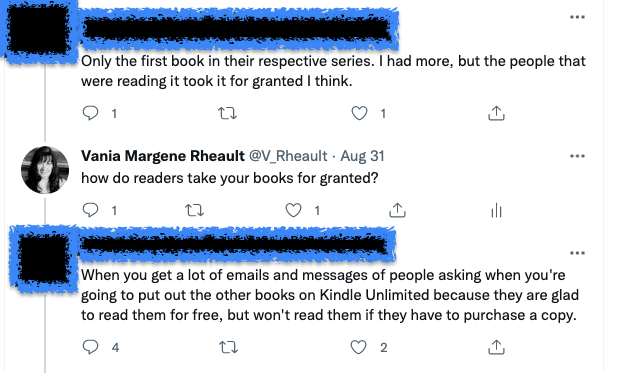
I’ve ran into a couple of people on Twitter and in some Facebook author groups who are trying to use both KU and wide tactics, at the same time, to bring in readers. I love reading threads like this, not only because I’m curious what people are thinking and how they’re running their businesses, but sometimes I’ll chime in and try to help someone who seems to be genuinely floundering. I had a back and forth with this guy, and it made me think–can we play the Amazon KU vs. Wide game successfully, and if we can’t, who loses? The question the original tweeter asked is, Do you have your books enrolled in Kindle Unlimited.

Splitting up your books is never going to work well because you’re going to alienate one set of readers somehow. Enrolling book one of a series in KU and publishing the rest of the books in that same series wide is a terrible idea, but they think:

a) the KU readers will buy the rest of the books in the series and
b) the wide readers will buy all the books anyway

Not only is this just plain old being a jerk and trying to game the system, but:

1) KU readers don’t buy. They already pay for a KU subscription–which is the whole point of paying the subscription fee, and
2) Not everyone reads on a Kindle or uses the Kindle app, which is the whole point of going wide, right? To reach the readers who read on a Nook or uses the Apple Books app. Or likes Kobo.

I wondered why these authors didn’t want to mark their first book at .99 or even free and ask Amazon to price match, but then I realized it’s because they would make more money on page reads (a 250 paged book brings in about $1.10 if a reader reads the whole thing) and more than what Amazon pays out for a .99 cent book. (KDP pays only a 35% royalty on a book priced that low.)

So they really are trying to game the system. The only thing is, it’s the readers they are trying to bring into their fanbase that are hurt. If you want to appeal to readers, you have to think like them. I have a KU subscription, and just the other day, I saw a Facebook ad from a wide author I was curious about who was giving away a first-in-series. I downloaded it and read it, and had I wanted to continue the series, I could have bought the others, but I didn’t. The book didn’t grab me enough that I wanted to continue. That’s another thing these authors don’t think about trying to game the system–your writing has to be TOP NOTCH to make a reader shell out money to keep reading. I mean, that’s a no-brainer anyway, but had her series been in KU, I would have read the next one even though the first book didn’t engage me all that much. But to buy them, there are three more in the series, each priced at $4.99, that would have been a costly stretch for me. Fifteen dollars to finish a series where the first book didn’t grab me… ah call me cheap like the guy in the tweet, but that’s just way too much. (And if I were to pay that for a book–I would go to Barnes and Noble and buy a beautiful hardcover by an author I know I’ll enjoy.)

You might be wondering where I’m going with this, and it’s this: I’m obviously not her reader. With her books having 1,500 reviews a piece, she knows who her readers are, and they are willing to pay for each book. True, giving away a free book can definitely bring in new readers, but you are taking the chance and if you don’t hit the mark, you’ll lose those new readers just as quickly as you brought them in.

When it comes to building a fanbase, you are much better off focusing your energy on doing things the right way than spending all your time scheming the best way to “pull one over on Amazon.” This could stem from a hatred of Amazon–no one likes having to be exclusive to gain the rewards of participating in KU. But while you think you’re being smart, what you’re doing is hurting readers who want to read your books. KU readers aren’t cheap–they just aren’t your readers.

What can you do if you’re wide? How can you reach the maximum number of readers? Well, if you’re going on the assumption that readers are, indeed, cheap, and don’t want to pay for books, yet you want those vile creatures as your readers (I’m kidding, kind of), Kobo does have a subscription service similar to KU, but your books do not have to be exclusive. The only problem with enrolling your books into that program is that to have access to it, you have to publish directly with Kobo, not let a distributor like Draft2Digital or Smashwords publish on your behalf. Kobo Plus is similar to KU in that readers pay $9.99 for access to a library of books and Kobo pays the author based time and pages read. (You can look at the full article about royalties here.) So while you may not like the idea of losing out on KU readers, nurture Kobo readers, enroll your book into Kobo Plus and use your marketing tactics to tell people that your book is enrolled there. Readers don’t need a Kobo device to read Kobo books, either. The Kobo app is free to download and will turn any tablet or phone into a reading device. (Although, if you like to read in the tub like I do, some Kobo Readers are waterproof, and you can find the list here.)

Instead of complaining because you think the grass is greener on the other side, pick a side and water that patch. It’s easy to let your Kobo readers know your books are available in the Kobo Plus library. For all the time I spend on Twitter, never ever have I seen a tweeted ad like this:

It took me longer to decide on the Kobo logo to use than it did to put that together. (I already had the fake cover mockup made–I’m assuming if you promote your books you’ll already have a few graphics made, too.)

I mean, I guess there’s no help for the people who think it’s funny to try to pull the wool over Amazon’s eyes enrolling their books in Kindle Select while their books are published on other platforms:

Truly lovely human being, there. (And I would love it if Amazon reached out to that author and asked to be reimbursed for all the KU royalties he earned while breaking their exclusivity policy.)

This Twitter thread showed the true colors of some indie authors, and I didn’t like what I saw. Most blamed Amazon for having to stoop to their underhanded ways or crappy attitudes, but, no one, not one person, ever said you have to sell on Amazon, exclusive or not. And then we wonder why indies have such a bad reputation as authors, business owners, and publishers. You know, I feel sorry for people who have to deal with us. I really do.

There are a ton of wide resources out there, and I’ve blogged about them before. Don’t like KU, don’t be in it. Want the page reads, enroll in it, and suck it up you can’t be anywhere else. Plenty of authors make a good living off of KU, and plenty of authors make a good living wide. I can list a number of things that enable them to do it, and if you can’t, it would help your business to figure it out. (I’m not making money yet because I’ve spent the past four years learning what’s on that list. I can only hope making changes to the way I run my own business will help.)

Stop trying to have your cake and eat it too. All it will do is give you a stomachache.

Good luck!

Resources:

Wide

Killing It on Kobo by Mark Leslie Lefebvre

Wide for the Win by Mark Leslie Lefebvre

Wide for the Win Facebook Group

Amazon

Amazon Ads Unleashed: Advanced Publishing and Marketing Strategies for Indie Authors by Robert J Ryan

Amazon Ads for Authors: Tips and Strategies to Sell Your Books by Deb Potter

Amazon Ads FREE course by Dave Chesson

And if you just want to get back to basics and start over, David Gaughran put together a free course on starting from day one:

David Gaughran, Starting from Zero

Catching up with what I’m doing and Bits and Pieces of Publishing News.

Lately my blog posts have been a hodgepodge of little things to make up a whole post. It’s tough when you don’t have a lot going on, and sometimes I feel like my blog posts are the blind leading the blind. I don’t have much to offer in way of advice, particularly because I haven’t found anything that is working for me sales-wise.

Anyway, like everyone else, I’m glad the election is over, though I”m sure we’re far from finding peace. Hopefully that won’t deter readers from reading like it has over the past few weeks. I can’t tell you the number of authors who have complained about sinking sales. It is what it is. I’m in the hole with my ads this month and I paused all of them and created a few new ones to target holiday romance for my series. What’s really nice is that Amazon now lets you run ads to your series page which allows a reader to pick up all the books with one click.

We’ll see how that goes. I haven’t done the math to look at read-through for all my books, but I can do that now, out of curiosity. The last book was published in May of this year, so I only have five month’s of data too interpret. Using the read-through instructions and formula by Malorie Cooper on Dave Chesson’s Kindlepreneur website, read-through is dividing the copies of the second book sold by the copies of the first book sold. You have to do a little math if you’re in KU.

Remember, the number of KU pages read divided by the number of KENPC pages in your book will tell you how many books those page reads equal to.

Doing the math, I have sold 214 of the first book in my series between June 1st 2020 and October 31st. That total includes both sales and KU pages read.

I have sold 97 books (together with sales and KU pages read) of book two.

That’s a read-through of 40%. 40% of my readers who read book one went on to read book two.

A profitable series will have a strong read-through for all the books, and we can calculate read-through of book two to three doing the same math:

Book two’s sales and KU page reads was 97 books. Book three has a total of 76 books sold. (Together with sales and KU reads.) That makes read-through (76/97=) 78%

And read-through from book 3 to book 4 using all the same formulas: 88% read-through. Meaning 88% of people who read book three will finish the series and read book four.

According to Mal Cooper, my 40% read-through from book one to book two could indicate a problem. I already know from reviews that the reception of my male main character is lacklustre at best. As I’ve said in the past, a physically damaged character is neither sexy nor romantic. Besides trying to market the book as a beauty and the beast retelling, there’s not much I can really do. His injuries make the whole book. It’s nothing I can go and change to encourage read-through. My sales from book one to two will just have to be a lesson in the future. It’s also a reminder if you’re going to invest time in a series, you need to hit it out of the park or the other books won’t matter. Your book one won’t be good enough to entice readers to read them.

I will keep an eye on my ads, make sure they stay profitable. With the holiday season approaching, if I can grab a couple sales and come out ahead, it will be worth advertising.


photo taken from their website

In other news, IngramSpark has decided to give ISBNs away if you publish through them, like Kindle Direct Publishing has done all along. The only problem with that is if you publish on Amazon and use their free ISBNs, you can’t turn around and use those on Ingram. Then you take the free ISBNs from Ingram and all of a sudden your book is listed under many numbers, and that doesn’t sound good to me.

I realize buying ISBNs in the States is a big pain, not to mention very costly, but when people say you need to invest in your business, this is what they’re talking about. You need to protect your work. I buy my ISBNs from Bowker and use the same paperback ISBN on both Amazon and Ingram. That way my paperback is listed under one number. The one I paid for that belongs to me. That’s important to me. I also use an ISBN number for each of my ebooks. Some will say that’s a waste of money because Amazon will assign your book to an ASIN number, but then if you’re wide, you can’t use that ASIN number as that belongs in only Amazon’s system. So there again, you have different identifying numbers for every ebook platform you publish on.

There is has been argument in the past that you can’t use the same ISBN number for a .MOBI file and an ePub because they are different formats. Then you have people who say that a digital file is a digital file. When I went wide, I used the same ISBN number for my ebooks across all platforms and nothing bad happened. I can’t imagine this would even be an issue now that Amazon asks you to upload an ePub to their platform instead of a .MOBI file.

You can have Ingram distribute to Amazon, but I’ve heard of people having trouble with their books being available (listed “out of stock” instead) and you don’t have access to your KDP dashboard and you can’t run ads if Ingram supplies your books to KDP. It’s always better to go direct where you can. It might take a little hassle, but then, we went indie to stay in control, didn’t we?


I’m 20k into my new project, about a man tasked to finding a husband for his boss’s daughter in exchange for a portion of the company he helped build. It’s going well, though I feel like no matter how much planning I’ve done with this book, I’m pantsing it. Maybe I’m just tired or maybe I’m still not used to writing in first person present, but it’s coming along, and if I keep up the slightly faster pace than a NaNo participant, I should be done with it by the end of the month. We’ll have to see if that happens. I have a lot coming up in the next couple of weeks, namely a longer work schedule, Thanksgiving, a couple of birthdays and possible jury duty. I write when I can, though, so if not by the end of the month, by the middle of December, for sure. Here’s a sneak peak of a sliver of a scene I wrote the other day. There is potential for spin-off books, but I still have my 6 book series I need to polish to release next year. I’m grateful there is so much to write about.

Man in suit leaning against a grey stone wall. Text:
I meet his eyes. They’re hard, bits of frosted green glass. “We’re beyond that now, don’t you think?”

We aren’t talking about sex, we aren’t talking about love. We’re back to his fucking fifty percent and what he’ll do to get it.

“I—”

“I’ll fulfill my end of Dad’s bargain. Sit back and collect.”

He nods, turns to go.

“Don’t come back, Colt. There’s nothing between us anymore.”

“Don’t fool yourself, Elayna. There never was.”
created with Canva Pro. Photo purchased on depositphotos.com

That’s going to be all for today! I hope you have a productive week! Good luck to those participating in NaNo!
Formatting your book with Vellum: Why I love it and why haters gotta stop hating.

taken from vellum.pub

Vellum is expensive–$250.00 for unlimited ebook and paperback capability–and I never recommend it because I’m sensitive to people not being able to afford it. Also, it only runs on a Mac and if you don’t want to pay to use MacinCloud on a PC, Vellum won’t be an option for you anyway.

But for those authors who can afford it, or hire a formatter who uses it, it can be a wonderful software that can generate book files in just a couple of hours. (Some authors say minutes, but I’ve found it can take a little longer than that–especially if you have to create the front and back matter from scratch.) I’ve formatted all my books with Vellum–even backlist titles got a facelift when my fiancé purchased a Mac and Vellum for me.

It’s amazing, and I absolutely have no argument with it.

But some authors do. They say they are disappointed in the limited capabilities and I’ve heard the familiar refrain a few times. Enough to make me mad. I take offense when someone feels the need to nitpick this software. Brad West and Brad Andalman did the indie community a huge service designing this software and continually updating it and adding new features. Still, this isn’t enough for some authors.

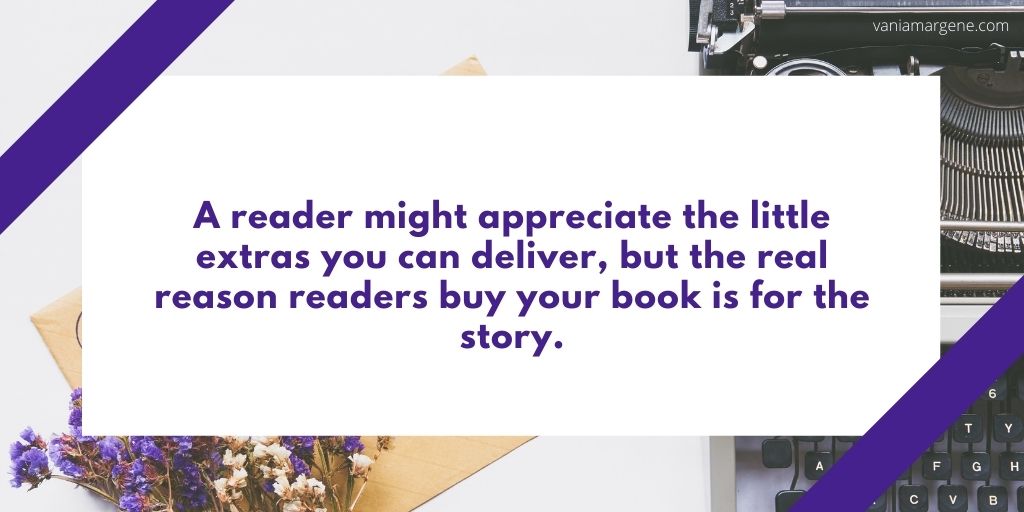
When I’m feeling particularly spunky, I’ll challenge them with this: a reader might appreciate the little extras you can deliver, but the real reason readers buy your book is for the story. Have you written a good book? That should be your main priority, not moaning because you can’t add color chapter headings, or fancy maps, or any other crazy stuff you want to add in a lame attempt to hide a mediocre story.

That might seem a little harsh, but it seems to me the writers who complain the loudest are the first time authors who haven’t understood that they are going to have to fight tooth and nail to sell their book and formatting is the least of their worries. (During COVID a whopping 88,000 books are being published very MONTH! — source, Alex Newton from K-lytics.)

Of course you want the inside of your book to look professional and in my mind you only need four things:

  1. Full Justification
  2. Drop Cap for Chapter Starts
  3. Professional Chapter Heading
  4. Appropriate page numbers and author name/title in headers and footers

That’s it.

Readers aren’t going to care if the chapter headers are colored images, or if they take the whole page. What they’re going to care about is if the story grabs them from the first sentence, or if there are typos or other mistakes that will pull them out of the story. They care if your story will engage them to the very last line.

Can you guarentee your readers that?

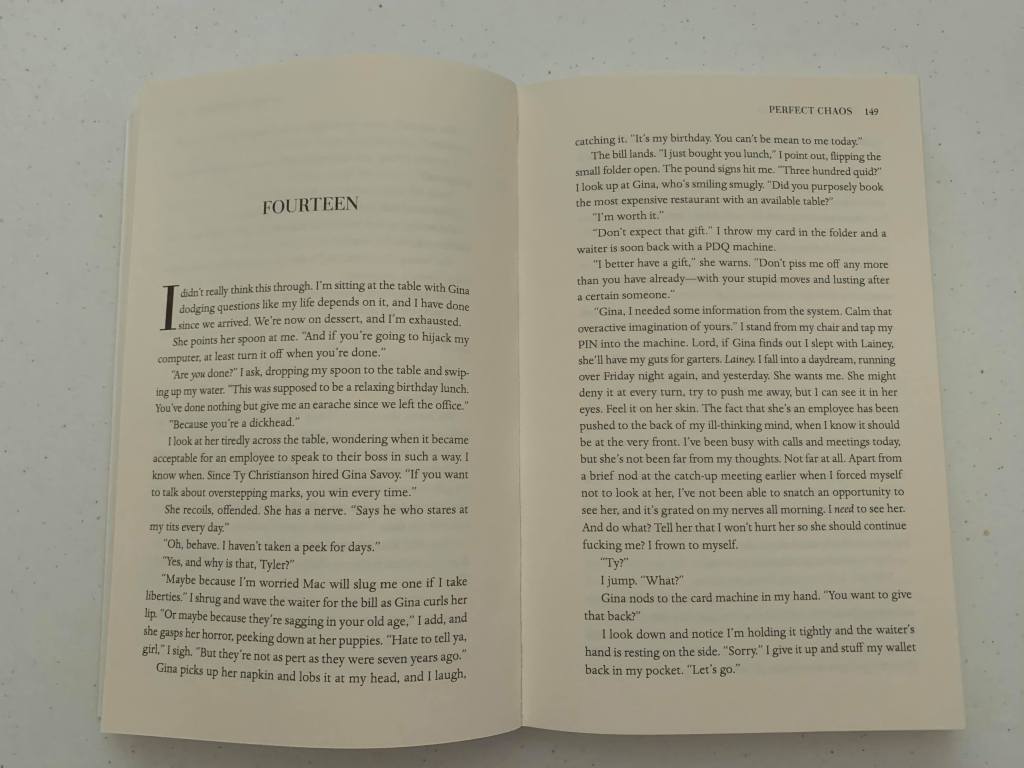
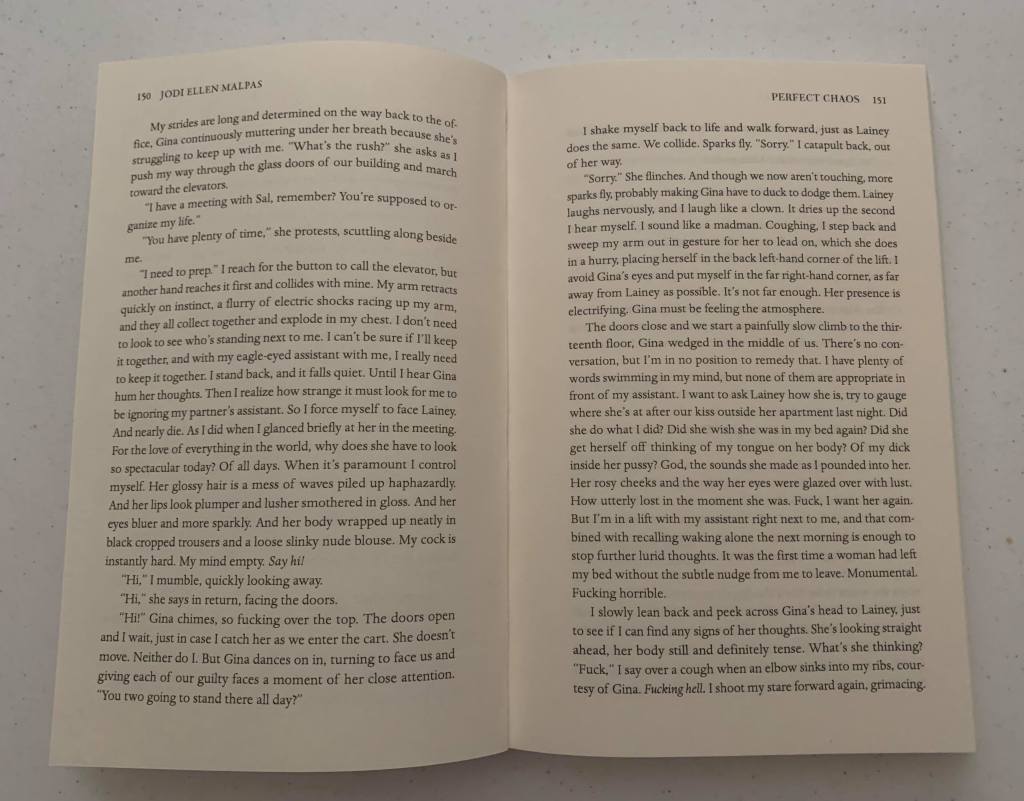
I bought a Jodi Ellen Malpas book on Amazon and I was surprised to see it came from Ingram Spark’s print on demand. She self-published this book. She’s a New York Times best-selling author. She can afford a team that can put together a beautiful book. And the formatting inside is plain. As plain as you can make the inside of a book. Because she knows her fans are not buying the book for how it looks, but for the story inside.

Here are my list of reasons why I do the minimum formatting in my books:

  1. Kindles can only handle so much. Not everyone reads on a tablet. Some people really do read on a Kindle Paperwhite, or a Voyage (that has been discontinued), Kindle Oasis, or other e-readers with limited functions. Readers can set the font so who cares if you’re bitching Vellum has a short list to choose from? Some e-readers are black and white so what does it matter if you insist on inserting colored chapter headers? E-readers strip a book of almost everything but the actual text that makes the story. If your story isn’t engaging they’ll return your book and read some thing else.
  2. Fancy formatting is a paperback perk. How many of those do you sell? Unless you write non-fiction or children’s books, then that’s something different. If you want to write in commercial, mainstream fiction, your e-books will far outsell your paperbacks. If you’re going to a convention, fine. But your cover is going to be on display more prominently than your formatting.
  3. Fancy formatting takes time. Pay for it if you insist on having it. There’s no reason to gripe in Facebook groups about how Vellum won’t suits your needs. There are other programs that will, like InDesign. If you don’t know how to use it, either learn or hire someone who does. You don’t need to complain in forums about a software you’re unhappy with. Deal with it because for every person it disappoints, it makes twenty others happier than hell.
  4. Story will always come first. Yes it’s exciting to publish and you want your book to be perfect. But your story should be the most perfect thing about your book followed by the cover. Readers will appreciate a cleanly formatted book. I know I have tossed books aside that are not formatted properly. I appreciate a plain format and a compelling story much more than a boring story with pretty chapter headers. I’ll know what the author cared more about and I won’t be impressed.

I’ll defend Brad and Brad. They did the indie community a huge courtesy developing a software that makes book formatting easy. The software produces a .mobi, epub, and generic epub for Nook, Google Play and Apple Books. It produces a PDF for the paperback. Vellum creates a beautiful book and when you’ve written a beautiful story, what it offers should be enough.


Agree? Disagree? Let me know!

Thanks for stopping by. Until next time!


Amazon Ads Adventures: how did my May go?

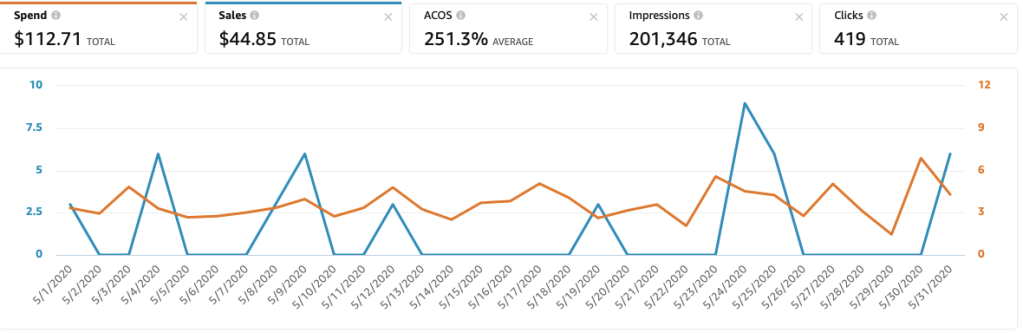
Because I have nothing else to talk about, let’s see how my ads did for the month of May. Right now I’m running ads for four books: All of Nothing, Wherever He Goes, The Years Between Us, and His Frozen Heart. I actually came in ahead last month, making about $60.00 after ad spend. That’s not terrible–breaking even for me so more than acceptable at this point–and I’m aware that it’s more than what some people are making on their books right now.

Before I get into the numbers, I’ll tell you that my daily ad budget is always $5.00, and that my bid per click is always between .25-.35. I never EVER go with Amazon’s suggested bid. I know click bid can depend heavily on genre, and everyone always says how competitive romance is. But I’m not willing to up my bid on the off chance that it will make me more money. Right now all I’m concerned with is tweaking my covers, blurbs, and look inside so that my books are profitable, and my lower bid per click is working. I get impressions and I get clicks and that’s more than enough for now. There is plenty to worry about without hoping Amazon’s suggested bid won’t blow your grocery budget for the month.

My ad spend for the month of May:

Don’t let the spend versus sales fool you. If your books are in KU, the sales don’t include KU page reads. Sales are readers who buy the ebook/paperback. And in this case, I didn’t sell any paperbacks.

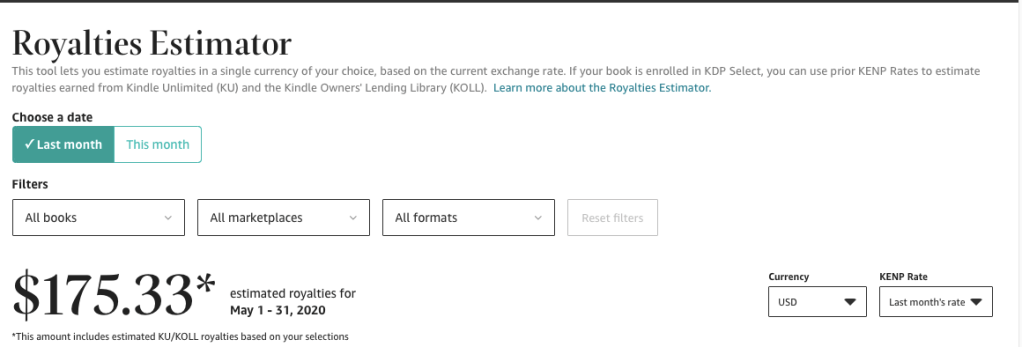
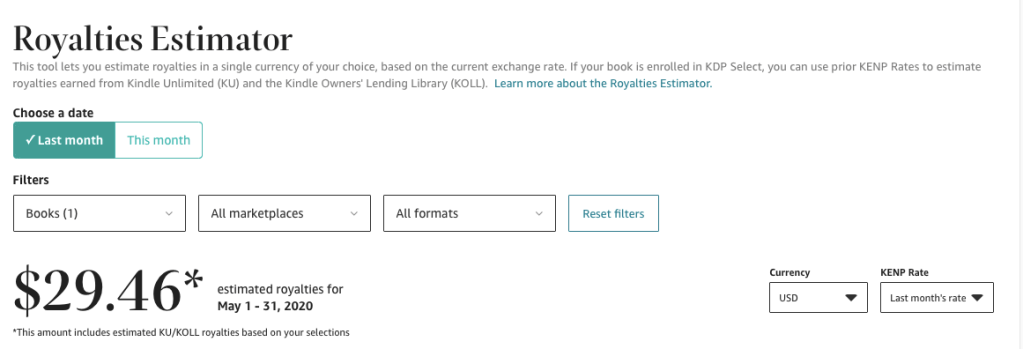
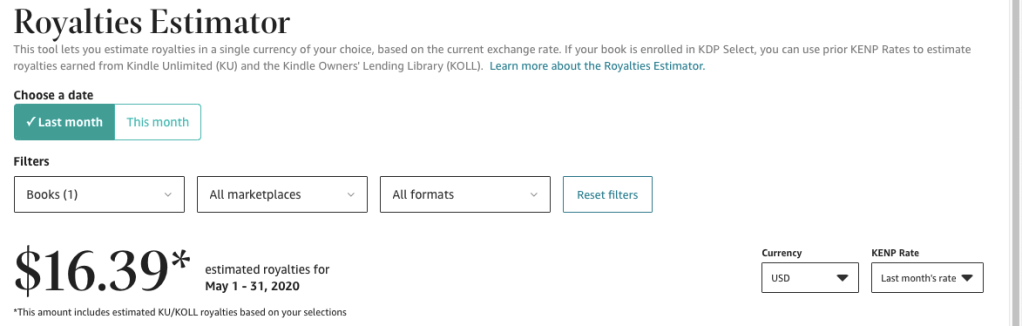
Here are the royalties:

Using the royalties estimator from the KDP reports dashboard is the easiest way to look at your royalties. Some people use BookReport, a Google Chrome extension, but I haven’t put Chrome on my Mac.

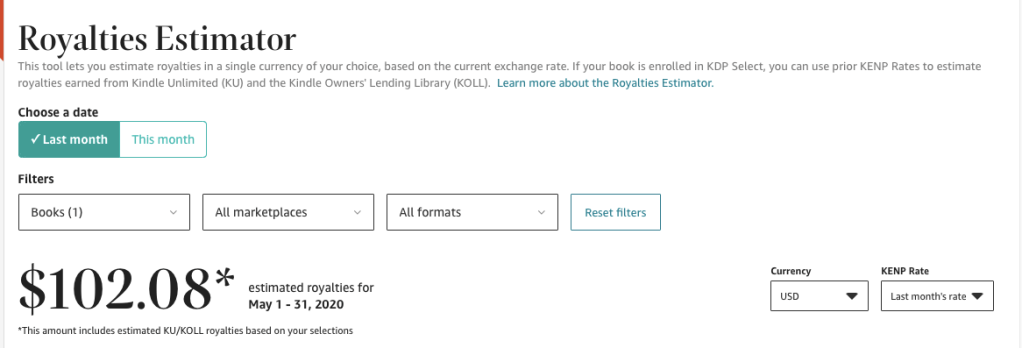
I took screenshots of the royalties vs. ads for each book individually. I don’t normally look at that–so long as I’m not wasting money, I don’t mind which book is making more than the others. You can see All of Nothing made the most–and also spent the most. Wherever He Goes is the unpopular one of the group, and maybe a new blurb could help. But I’ve already rewritten it, and at this point I’m done going back.


My numbers might not add up 100% just because I do make a couple cents here and there on other books, but these are the main four I run ads for. You can see that All of Nothing is the leader in sales. Sales for that book allows me to lose money on ads for the others. Is that smart? Probably not–all your ads should run in the black, but I’m just playing around and experimenting.

I’m happy to see that The Years Between Us is doing better with the new cover and blurb. People are actually reading it and in the past few days I have been selling the ebook; people aren’t only reading it in KU. I wish they’d buy the paperback because the new cover looks gorgeous in print.

Anyway, so that’s how I’ve done for the month of May. So far for June I’m in the black, but just by a few dollars. I may not be making a ton of money, but I’m picking up new readers, and that feels good. The last book in my series launched at the end of May, so I don’t have any reports yet on how my read-through is for the four books. I think next month I may plan a Christmas-in-July promotion and buy a BargainBooksy promo and see if I put His Frozen Heart on sale for .99 if I can get some read-through for that series. I’ll be playing around with ads for the next little while because I won’t have anything coming out for a few months.


What I know I learned from Bryan Cohen’s free ad challenge that he does every once in a while. He gives out such useful information, and he’s even usually around to answer questions. I can’t say enough good things about the guy, and I really encourage you to sign up for his challenge in July. It makes a big difference if you know how to use an ad platform before plunking down the money on experimentation. Trust me, there’s a lot to experiment with (like ad copy) without worrying about wasting money on ad spend because you don’t know what you’re doing. If you want to sign up for the challenge next month, you can find Bryan’s sign up link here. I don’t get anything if you sign up. I learned a lot from his classes and homework, and I know you will too!

Thanks for reading, and I hope you’re all having a wonderful June so far!

Thursday musings: What I’ve completed, what’s next, and a small pet peeve.

Brown Photo Independence Day Twitter Post

Happy Thursday! It’s a rainy day here and I thought the picture was apt. I’m not having as much fun as they are, but that’s okay. Rainy days are good for writing, or in this case, catching you up on all that I’ve been doing.

I’m going to start with a something that has been bothering me a lot in the past couple days. All the writing groups on Facebook can provide an endless stream of fodder for any blogger, and the other day I took particular offense to one post. I won’t mention the group because I don’t to get kicked out, and I don’t want to mention the poster because maybe she didn’t know what she was doing (though I’m sure she did). At any rate, she posted something to the effect of, “Whew! I wrote two books this month! Now it’s time to relax and celebrate!”

Of course she got the obligatory congratulations, and there were some people who were a little down, because, hey, that announcement really sounds like something good. Who doesn’t want to be able to write two books a month?

The problem is, and I’m sure you know where I’m going with this is, what really is a “book?” How many words is that? You know me and my big mouth and my nosiness couldn’t leave it be and I asked her how many words she’d managed to write in a month’s time.

You know what? She didn’t answer me. It could be that she missed it. It could be she never checked that post again, because the whole point was to a brag in the guise of, “If I can do it, you can do it, too!” Or it could be she didn’t want to admit that she wrote two novellas that were about 25,000 words a piece.

Even if she did do that, it’s an accomplishment and I don’t want to take that away from her. But I think it shows complete lack of courtesy for the writers and authors in that group who struggle just to write a couple thousand words a week. Be proud of yourself, share your victories, but come on, be honest about it too. You’ll get more appreciation that way.

Brown Photo Independence Day Twitter Post-2

This is why comparisonitis is a bad thing. You don’t know the real story. You don’t know what is really being accomplished. It could be she “wrote” 100,000 words–in dictation, and hired someone to transcribe it all. That sounds pretty cool, too, but not how the majority of us write. Be careful who you compare yourselves to. Get the real story, then mine their experiences for the real-life tips that can help you achieve your own level of success.


I took the feedback from comments on a different blog post, and I found a different photo for The Years Between Us. I think there were a few photographers who uploaded new stock photos on depositphotos.com because I had never seen this couple before, but they hit the nail on the head when it came to my characters.

After I changed out the cover and ordered a proof to make sure it looked good in print, too, I started running some ads using keywords from Publisher Rocket. The ads haven’t turned on yet, so I’m getting some impressions but not many. As I said in a previous blog post, a new cover, a fresh editing sweep, and a new blurb is the best I can do for this book. It could just be that I didn’t hit the mark, and it will never sell. That’s something I’m going to have to come to terms with, but at least I can say I gave this book my all.

Brown Photo Independence Day Twitter Post-3

I’m not going to write it off just yet. I can bid very low and continuously run ads to it, as impressions are free and running ads as long as they don’t cost you money without return never hurts. I’ll keep you posted.


I am using COVID-19 and the #stayathome order to still go back and get some messy housekeeping done.

Yesterday I went on IngramsSpark and uploaded new insides and uploaded new covers for some of my books. I have this thing where my books need to be the same everywhere, and even though dealing with IngramSpark can be a pain, and I did three out of six books. I’ll wait to make sure they go through then do the other three. They do not have the online previewer that KDP does, so you can upload your files, but you won’t know if they pass until someone from Ingram looks them over. At least with the KDP previewer you have an idea if the file is going to be approved, or if you see a mistake you can fix it before submitting. Ingram did make some changes to their website and it’s more user friendly, but it still doesn’t work the way I wish it did.

I did my standalones, next I’ll do my Tower City trilogy. When those are all uploaded and approved, I’ll publish my Rocky Point Wedding Series there. I haven’t done that yet, though I did not select expanded distribution on Amazon. I do like seeing my paperbacks other places even if they’re not selling.

Screen Shot 2020-05-13 at 12.36.22 PM

And please keep in mind for anyone who does not know, you have to be listed in the IngramSpark catalogue for someone to walk into Barnes and Noble and ask them to order your paperback. They will not purchase a book from Amazon. You may approach the manager of your local Barnes and Noble and see if they will carry your book on consignment and then bring in your author copies from Amazon, but you’ll look more professional if you say your book is available through the IngramSpark catalogue. It is a pain dealing with them, but they will list your paperback book on all the marketplaces. You do have to buy your own ISBN though. IngramSpark won’t take the free one Amazon gives you if you go that route.

Robin Cutler is the director of the indie side of Ingram, and she did a wonderful interview with Craig Martelle in the 20booksto50k group! Take a few minutes to give it a listen. There’s some really great advice there if you’re interested.


I wanted to add a little bonus content to my Tower City trilogy. After I edited the books again (took out some telling, smoothed out the writing) I wanted to add a little something to the boxed set. I intended to write a novelette, but it turned into a 29k novella. I’ve been writing that for the past few days (ten to be exact, ahem) and I’ll spend the weekend cleaning it up and putting together a new boxed set with extra novella. Then I’ll run some ads to it and see if I can’t get some page reads. I said in a previous blog post I didn’t think my books were worth selling, and I feel better now that I’ve given them a read through and corrected a few typos and small inconsistencies. I haven’t looked at those books since I published them, and going at them with a fresh eye was beneficial.


That is all the news I have to share–unless you want a quick update on my ads.

I lost 14 dollars for the month of April with a spend of $180.97 and royalties across all my books of $166.92.  I turned off my big spenders to see if my KU page reads would eat up the difference. Not so much, but I’ve operated in the red before. Obviously the main goal is making money, but at this point I’ll be happy to break even. It’s cool. Still learning, still playing. Going forward I won’t bid so much and hopefully lower cost per click.

I’m up for the month of May, with an ad spend so far of $41.16 and estimated royalties of $78.73. I only have two ads going right now for All of Nothing, still my biggest earner. I put up some fresh ones for The Years Between Us, but nothing to write home about yet, and Wherever He Goes is DOA. Not sure what I can do to revive that either. His Frozen Heart is going okay, and I’ll run a promo later after the last book in the series releases at the end of this month. As I said, it was an ill-timed release, so maybe a Christmas in July type thing. We’ll see.

I really will shut up now since I talked your ears off. I hope all of you are having productive days and weeks, as it seems this may not get back to normal until the fall, and maybe not even then. It’s hard to keep your head in the game, but every little bit helps!

Until next time!

end of blog post graphic


Ebook explosion 2020

2020 indie publishing predictions

We’ve reached the end of Written Word Media’s 2020 predictions. So far we’ve talked about audiobooks, author collaboration on marketing and writing projects, the organic reach that is diminishing and ways to find it again, and the necessity of running ads. We’ve explored what would happen if the big five started using KU.

I’ll be ending the series now as the COVID-19 virus has a lot of us on edge (and frankly, tired of being at home), and some writers aren’t writing much now, instead focusing on the day to day just to stay sane. It’s difficult to write when you’re worried, so I’ll hit on one more point to round out the prediction series and wrap it up until the next wave in 2021.

The next prediction that WWM goes into is that the e-book market will grow even more

photo of person s hand holding ipad

Photo by Lisa Fotios on Pexels.com

in 2020.

When you think that over 2,000 books are published every month, it’s crazy to think that it could grow even more than that. As publishing a book gets easier and easier, and faster and faster, the number may rise, but the quality probably won’t. This presents two problems: one, you have to fight to be seen and two, you have to fight to be seen through crap.

The article goes on to say that e-book readers are younger, which is a good thing for authors who write YA and coming of age/college fiction. It used to be a struggle for authors of those genres to be seen in an online presence only able to only reach those readers through a traditional publishing channel (paperbacks and brick and mortar stores), but when teens are reading on their phones it gives authors of those genres a reachable audience.

But like all the rest of the predictions indicate, writing good books and publishing frequently will help you find readers.

There’s not much to this prediction – it’s almost a given — but it does make discoverability harder, no matter what genre you write in. The article suggests not getting distracted by shiny objects, but hopefully a writer with his or her eye on the prize has been avoiding temptation already.

In that vein, you have to think of publishing as a lifelong endeavor. I’ve listened to podcasts and read articles about 2020 predictions and discussions looking back at the past 10 years.

A good one is Joanna Penn talking with Orna Ross from the Alliance of Independent Authors, and you can watch/listen to it here:

One thing that has kept popping up was how many authors have disappeared. The indie “gold rush” such as it was started with the invention of the Kindle in 2010 and writers like Lindsay Buroker and Joanna Penn were there at the start. Both have commented that quite a few writers they knew 10 years ago have dropped out and have never been seen again. I’ve only been publishing for four years, and even in that short amount of time people have come and people have gone.

You can take a couple things from this. Of the 2,000 to 3,000 books published every month, some, maybe most, of those authors are one and done. Of course you don’t want to feel good because of another’s misfortune or bad luck, but let’s say those authors only had one book in them, or they thought publishing would be a different experience from what they had. Maybe they thought they would get rich quick and slunk away when their booked debuted at 300,000 in the Kindle Store and was buried, never to be seen again. Those authors aren’t competition for long, but unfortunately, there will always be more to take their place.

If you can publish a few times a year, build a backlist a potential reader can see looking your author page, you’ll be ahead of the curve just by sticking around.

selective focus photography of spark

Photo by Malte luk on Pexels.com

2020 started a new decade and we don’t know what the next 10 years in publishing will bring. What does your next 10 years look like? Five years? Are you still in the game or did you come in like a sparkler only to fizzle and die out?

My goal is to make it. I want to work on discoverability; writing and publishing isn’t a problem. If you read my blog on a semi-regular basis you know I’d rather write with my free time over anything else. I don’t see that changing anytime soon. Twenty-five years ago I majored in English and creative writing. Books are in my blood.

The e-book market will grow and continue to do so beyond this year. It’s the easiest way to publish a book. But it will be the ones who stick around that will cut through the noise.

What will this new decade bring to you?

Thanks for sticking with me through these predictions. I’ve always been interested in the evolution of the publishing industry. If you want to read a good book about the industry, and how Amazon has impacted it, more specifically, read  The Book Business: What Everyone Needs to Know by Mike Shatzkin and Robert Paris Riger.

And you can listen to Mike’s podcast interview with Joanna Penn, here:

Thanks for reading and stay safe and healthy!


end of blog post graphic

Free, interactive way to learn Amazon Ads hosted by Bryan Cohen

I use this blog to pass along the information about writing and especially publishing I’ve heard about, information I’ve learned from, especially the free stuff since I know how difficult it is to scrape up cash for every little thing that seems to come up when you want to write and publish a book.

In Written Word Media’s predictions for 2020, one stood out among all the others–this is a pay to play industry, and there is no getting around it. (I did a blog post about that prediction, and you can read it here.) You need to learn an ad platform to make your books visible in a vast sea of other books.

Use Amazon Ads to make your book stand out!
If you think you don’t need to learn, if you think that publishing a book and telling your Twitter followers will be enough, it won’t be. Not for the kind of sales you’re hoping for. It’s tough breaking out of the friend and family bubble, but if you want strangers, ie, READERS to find your book, you’re going to need to pay to shove it in front of them. It’s that simple.

And that scary.

70316258_10106981372290788_8409044794424164352_n

Photo taken from the FB group. To ask to join the group, click here.

Bryan Cohen is a leading figure in the indie industry (he weighed in on some predictions in the Written Word Media 2020 predictions article). He runs a blurb-writing business, has written HOW TO WRITE A SIZZLING SYNOPSIS, is co-host of The Sell More Books Show podcast, is founder of Selling for Authors, and runs an Amazon Ad School. He knows how to sell books, not just ours, but his own. If you want to see his backlist, look at his Amazon author page. I met him at the Sell More Books Show summit last year in Chicago (no, I didn’t, I was too shy to introduce myself, but he seemed to be a very nice guy, and it was my fault we didn’t chat, not his) and I participated in a different ads challenge last year. It was participating in that challenge that taught me:

  • the importance of using correct keywords
  • where to find them
  • how to navigate the Amazon ads platform
  • how to bid for clicks, and how to keep them low
  • how to set a manageable daily budget
  • how to correctly identify if your ad is a money suck or if you have any ROI (in other words, are you getting sales or KU page reads?)

    and most importantly,

  • you don’t have to spend a lot of money to see results

That was one of the main concerns that people brought up the ad challenge I participated in, and a subsequent challenge I had to drop out of because I was too busy putting my series together to give it any real attention. I was part of the Facebook group, and I did pop in and encourage other authors, and unfortunately, it was a worry for many using the ad platform.

Ads are scary, and yes, you do need a little bit of cash to experiment with. But you remain in control of the ads the whole time. You can pause an ad without penalty. If you’re getting tons of clicks and your ad spend is a little too high for your liking, you can kill an ad, and that’s that.

Bryan has a new ad challenge that will be starting April 13th. While Covid-19 is heavy on people’s minds, a lot of us are staying at home, and this might be a great time for some of you to take an hour from your day for a week and learn something that could help you for months, maybe even years, to come.

The ad challenge is free (besides ad cost). He’ll walk you through how to find keywords, what to do with them, how to bid, how to set your daily budget. He shows you how to do all this for FREE, though he is transparent in that he wants you to sign up for his Amazon Ad School. Some of you may decide to do that after taking his challenge, some of you may join the challenge just for the free information. He gets it. But he also gives you enough information that you can run some low-cost ads and get comfortable with the platform without breaking the bank and without needing to pay for his ad school for additional information.

There is one caveat to the challenge, and it’s this: HE ASSUMES YOU’RE ADVERTISING A GOOD BOOK. He assumes that your cover is on point, that your blurb on your Amazon product page is hooky and well-written. He assumes your look-inside will grab a reader to want more and buy your book.

IF YOUR BOOK IS NOT UP TO PAR, DON’T WASTE YOUR TIME ON THE CHALLENGE.

People waste money on ads because their cover is on point, but their blurb sucks. Or they don’t get any clicks because their cover is too plain, doesn’t convey genre, etc. Impressions are free (which is great!), but if you end up with 200,000 impressions and no clicks, you’ll get discouraged.

The ad challenge won’t work if you don’t have a good product to sell.

That said, I’m writing this blog post specifically to ask you to join it, learn the platform, and get your books into the hands of readers. Break that Twitter and Facebook bubble, and reach out to people who read your genre. There are hundreds of thousands of readers out there and you need a way to reach them!

man in white dress shirt and black pants sitting on bench

Do you want him reading your book? Of course you do!                                                   Photo by Andrea Piacquadio on Pexels.com

Here is the link to sign up for his ad school: https://bryancohen.lpages.co/amazon-ad-profit-challenge-landing-april-2020/?affiliate=bestpageforward

One of the best things about the challenge is the community that it brings together on the Facebook page. We share our impressions, clicks, disappointment. We ask questions, and they’re answered either by Bryan himself, so someone else. It’s a wonderful community and I’ve met some amazing and helpful authors on there. Here is the link to the FB group: https://www.facebook.com/groups/2230194167089012/ He’ll tell you about the group in the welcome video that’s available to you when you sign up.

You’re probably wondering why I’m pressing this so hard–Bryan is so generous, and I’m always impressed by what he’s willing to share for free. Trust me, what you learn in this ad challenge will get you started on the right path–he doesn’t leaving you hanging at all. Not like some webinars that are really just infomercials to try to get you to buy something. This isn’t like that.

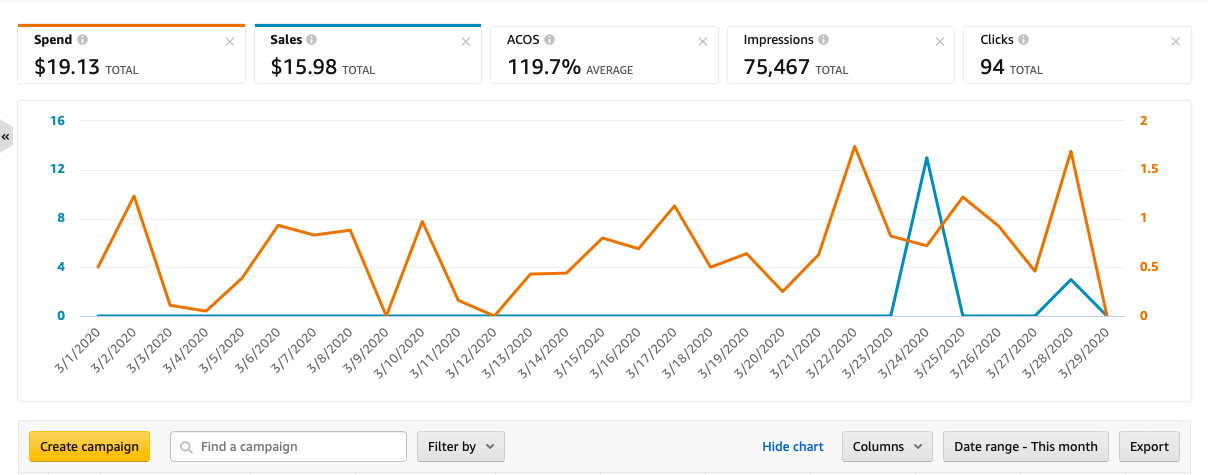
I’ve had some small sales since learning how to do the ads. Admittedly, I don’t pay nearly enough attention to them, but this ad challenge will be different. My series is slowly dropping. Book one is out, and book two will be by the time the challenge starts. Book three will be available at the end of the April, and book four at the end of May. Shoving some money at the first in the series won’t hurt, not at all. I’ll share my numbers with you for the month of March:

Screen Shot 2020-03-29 at 11.05.00 PM

This makes it look like I’m losing money, but Sales doesn’t include KU page reads, and Bryan will go into that with us, so I’m not freaking out that my spend is more than my sales. But see, I have only spent not even $20.00 for the month of March, and I wanted to show you that to prove to you that ads don’t have to be expensive!

For the $19.13 I’ve spent so far this month, I’m running:

10 ads for All of Nothing

4 ads for His Frozen Heart

10 ads for The Years Between Us

0 for Wherever He Goes and the other books in my backlist

That’s not a crazy ad spend for 24 ads, and a lot of authors run more ads than that at any give time.

What I’ve made so far in sales and KU Page reads:

Screen Shot 2020-03-29 at 11.31.46 PM

So I’ve spent 20 dollars to make 20 dollars. That’s a little more than breaking even, but when you’re just starting out that’s better than losing. Since I’ve adjusted my blurb on The Years Between Us, I’ve started getting sales so don’t despair right away if you get impressions or clicks without sales. Things can be changed. They aren’t set in stone–take comfort in that. Plus you only have to run the number of ads you’re comfortable with. I dip my toes in, obviously. I don’t have time to do more than that.

Anyway, it’s late here, so I need to wrap up. I just really can’t say enough about Bryan and his challenge. He taught me so much, and I can’t wait to do the challenge again! I hope you join me!

Until next time!


end of blog post graphic

2020 Indie Publishing Predictions: Pay-to-Play and ad platform resources for indie authors

2020 indie publishing predictions

Thank you for staying with me through this blog series about Written Word Media’s predictions for 2020. I’m discussing these predictions as an Emerging Author who has less than 10 books published and making less than $60,000 a year (let’s be honest according to my 1099s I made less than $2000 in 2019).

In the last post we talked a little bit about author collaboration because there is power in numbers, though the group opportunities don’t mean much to me because I’m still building my own career in my own right. Just as I’m sure most readers of my blog are.

The next point WWM predicts is that running ads will become a requirement. This isn’t a prediction so much as it’s already a fact. You need to learn an ad platform and not be afraid to use it. Meaning, you can’t be afraid to spend a little money to make a little money.

Various people say that Amazon ads are the smartest way to go. You’re putting your ad in front of shoppers who’re already in the mood to buy books. I like Amazon ads, too, because you’re selling books to readers who do not have a KU subscription and your enticing readers to borrow your book if they do.

It shouldn’t need to be said that running successful ads means you’re advertising a quality product. Unfortunately you may waste a little money on clicks figuring this out. You may recall in a prior blog post of mine where I described losing some money in ads for The Years Between Us. My ad copy was good, my cover was good, but I was losing people at the blurb. The Years Between Us is an older man/younger woman novel, but it’s not naughty. I was marketing it as a older man/younger woman, when maybe my blurb should have emphasized the forbidden love aspect instead. At any rate, you may need to experiment. If your ad doesn’t get any clicks, but you are getting some impressions, maybe your ad copy isn’t hooky, or your cover looks too homemade or doesn’t reflect the genre clearly. In any case, the blurb cost me clicks. I should have turned my ads off a lot sooner than I did. I was optimistic and I paid the price.


Mark Coker has is own opinion on this prediction–it’s evident he hates that Amazon took this direction. He claims that being pay-to-play makes us compete against other authors. He also states that since Amazon took away the also-boughts at the bottom of the product pages and replaced those with sponsored ads, Amazon is pitting us against each other. (Amazon is always playing with their platform looking for ways to improve the customer experience. Just because they are gone today doesn’t mean they won’t be back tomorrow, or a variation of them.) My book, All of Nothing, does still have some also-boughts, and I’m happy to say that they seem to fit into the kind of book All of Nothing is.

Screen Shot 2020-03-14 at 6.33.41 PM

It’s true that when you search an author, their product pages can be peppered with ads. That’s business. It’s no different than driving down the main strip of the city and having your choice of Dairy Queen, Hardee’s, Burger King, McDonald’s, Sonic, Popeye’s, KFC, and a million other places. It’s up to their marketing team to make them stand out, just like it’s up to you to have a good cover, blurb, title, and look inside, so your potential reader isn’t lured away by a prettier cover and better ad copy.

The motto of the 20booksto50k group is a “A rising tide lifts all boats.” There’s no competition. Be the best you can be, put out the best quality product you can. If you write against the grain (the book of your heart), and/or can’t afford an editor and/or can’t find someone to trade with you, if you have to make your own cover, these are choices in situations you’re going to have to work with. Your book isn’t anyone else’s responsibility.

I don’t agree much with Mark Coker. We aren’t competing against each other. It helps to look at other authors as allies instead of competition. Make friends, not enemies, and stay in control of what you can–the quality of your own books.

I like Amazon ads. They don’t cost much money, and they are surprisingly easy to learn how to use. I haven’t ventured into the UK, or Germany territory. I advertise in the US store, and small sales I do have are because I run ads. But you may find better luck with Facebook or Bookbub ads. In my experience, they eat up money faster. We can blame, or try to blame, Amazon for a lot of things, but taking your money isn’t one of them. Except for when they do–but then that usually is due to operator error not the machine.

No matter where you advertise, you’ll need comp authors and their book titles. You need these because in Amazon’s case they’ll be your keywords, in Facebook’s case they will help you find an audience to target. That’s why it’s important to know what genre you’re writing in, and what books fit with yours. Always stay up-to-date with what’s happening in your genre. Keep an eye on authors who are doing well who write the same kinds of books you do.

Take time to learn how ads work. There are a lot of free resources out there. All they take is a little bit of time to listen to a podcast or to read a book a generous person (usually an indie author himself or herself) has taken time to write for the rest of us. Going in blind is silly and will cost you money. As a writer, you should be used to researching. This isn’t any different – you’re only researching wearing your businessperson’s hat and not your writer’s hat. I’ll list them at the bottom of the blog post.

When it comes to this prediction, the future is now. You won’t get far without some kind of paid advertising. You won’t have a launch, strong or otherwise, without ads, and they are especially important in keeping your book in front of readers if you’re going to take a while to release another. Jami Albright has said she wouldn’t make the money she does releasing one book a year without depending on ads.

They are a huge piece of the indie–publishing puzzle.


Resources

Amazon

Bryan Cohen hosts an Amazon ads challenge every once in a while. The next one is scheduled for April 2020. In this ad challenge, he teaches you the fundamentals of Amazon ads: where to find keywords, how much to bid, what to set your daily limit at. Ultimately, he wants you to buy his Amazon Ads course, but in the challenge, he’ll teach you beginning information for free and it’s enough to get you started. It runs for a week, then a week after that he closes down the information. If you miss participating, you have to wait until he does it again. Eventually he may stop doing the ad challenge and think of something else to advertise is Amazon Ad course.

Follow Bryan on Facebook. This is his Facebook group for his business, Selling for Authors. Join his group for lots of Amazon ad tips, blurb help, copywriting tips and more. This is where he’ll announce a new ads challenge. You can request to join the ads challenge group here. He may not approve your request until the ads challenge opens up again. He’s very generous with his time, and if you have a question, he’ll do his best to answer it. He posts a lot of info on Instagram, too. I would follow him there, as well.

Dave Chesson has made how-to-learn Amazon ad videos. You can access them for free and watch at your own pace. He teaches you the same as Bryan: how to find keywords, how much to bid, how much to set your daily limit. His way is a little different from Bryan’s methods. Though like Bryan, he wants to sell you something and Dave wants to sell you a Publisher Rocket, a software to analyze what the competition is doing, how much they’re making, how many books are selling. It’s also a keyword grabber, though both gentlemen kindly teach you how to find keywords for free. I have Publisher Rocket and it’s worth the money.

Reedsy also has a course that is delivered in chunks to your email. Taught by Ricardo Fayet, this course is free, and you can sign up for it here. 

Facebook

There is only one free way to learn Facebook ads, that I know of, that’s signing up for the email class by Reedsy. Otherwise, you need buy a book explaining how to do them, or take a paid class. I recommend you do something before diving in because Facebook loves to take your money, and if you don’t have the proper audience targeted, or your ad isn’t put together correctly (bad graphics, bad ad copy) you’ll be broke and your ads won’t attract any engagement, never mind convert to sales. Mal Cooper is the powerhouse here, and she has an updated Facebook ads book available (you can even download the ebook version for free though I would encourage you to throw her some coin for being so great!), and she was just interviewed about Facebook ads on the 6 Figure Authors podcast. You can watch it here.


Bookbub

41hhK-35Z0L._SX311_BO1,204,203,200_As with Facebook ads, free ways to learn the platform are scarce. To be clear, Bookbub ads are not the same as being approved for a featured deal. Those are expensive and you have to submit and be approved. Bookbub ads are what they sound like — ads you make yourself using Canva or BookBrush that are placed at the bottom of their newsletters they send out to their subscribers. The only authority I know of is David Gaughran. He wrote a book about them, and you can find it here. In partnership with Reedsy, he also did a course that is delivered in segments for free to your email address. You can sign up here.

He’s very generous with his time, and he includes links in the book to a forum where you can ask questions. He’ll answer or someone else will help out. The book is a year old, so if you have a question and you search the forum you might find your answer without having to ask. But Bookbub is good for discounted books only. That’s the basis of their whole platform and they’ve trained their readers to look to them for deals. Don’t advertise a full-priced book there. You’ll get plenty of clicks and no sales.

The pros say to choose one platform and get really good at it.

Good luck!

PS: Since I love throwing podcasts at you, this is one by Joanna Penn with Russell Blake and Michael Beverly. Michael founded Adwerks, a business that runs Amazon ads for indie authors who don’t have the time to manage them on their own. They are a wealth of information on how the Amazon ads work, and they give you a peek into the mysterious Amazon Algorithms. I highly recommend it!


The next prediction that Written Word Media talks about is the Big Five putting books into KU. See you there!


end of blog post graphic